




Abstract
Expository texts are vital to acquiring knowledge; however, they are challenging for L2 learners for their dense information and abstract concepts. Although augmented reality (AR) has shown promise in supporting L2 reading, little is known about its effectiveness for expository text reading among young L2 learners. This quasi-experimental study explored the effects of AR on elementary Chinese-as-a-second-language (CSL) learners’ expository reading comprehension, motivation and experience. Ninety fourth-grade CSL students from two intact classes were assigned to an AR group (n = 46) or an image group (n = 44) for a 5-day intervention. Both groups read identical printed expository texts. The AR group could trigger 3-D models and interactive animations, whereas the control group viewed only static images. ANCOVA controlling for reading comprehension pretest scores revealed that the AR group outperformed the control group on both the posttest (F = 4.606, p = .036, η2 = .05) and the delayed test (F = 4.359, p = .040, η2 = .055). Mann-Whitney U tests indicated that greater gains for initially low-proficiency readers (U = 140.50, Z = 2.649, p = .008). Additionally, the AR group reported greater reading motivation (U = 1,275.50, Z = 2.128, p = .033) and more positive reading experience (U = 1,615.50, Z = 4.886, p < .001). The interview data further supported these findings. Theoretically, these findings extend multimedia learning theory by demonstrating that AR’s visual cues and interactivity can scaffold CSL learners’ comprehension in expository reading by compensating for limited background knowledge, thereby promoting deeper text processing, stronger reading motivation, and more engaging experiences. Practical implications for CSL curriculum design and future research on AR-mediated literacy support are discussed.
Plain Language Summary
This study explored how augmented reality (AR) can help elementary school students who are learning Mandarin as a second language (MSL) read and understand nonfiction texts. Ninety fourth-grade students took part in a 5-day reading activity. Half of the students read digital texts with 3D animations and interactive labels that explained important ideas, while the other half read the same texts but with only pictures. Results showed that students with AR support understood the texts better, especially those who started with lower language skills. These students were also more motivated to read and felt more positive about the experience. Many said that AR made reading more interesting and less intimidating, and some expressed they would be more willing to read nonfiction in the future. The findings suggest that AR’s interactive visuals can make complex information easier to understand and create a more engaging learning experience. This has important implications for teachers and curriculum designers who want to make reading nonfiction in a new language more enjoyable and effective.
Keywords
Introduction
Reading is the main way to acquire knowledge (Aparicio et al., 2022), and expository texts constitute a key vehicle for conveying factual information and disciplinary concepts (Hebert et al., 2016; Saadatnia et al., 2017).As children reach 8 to 9 years of age, their reading materials often shift from narrative to expository texts, which from fourth grade onward play a central role in acquiring scientific knowledge and supporting students’ later academic development (Kim, 2025a; Kraal et al., 2019). However, reading expository texts presents various challenges. Compared with narrative texts, expository texts contain more information, more abstract or unfamiliar concepts, and more complex relational structures, often requiring substantial background knowledge to integrate new information effectively (Aparicio et al., 2022; Best et al., 2008; Y. Wu et al., 2020). These challenges are further intensified for second language (L2) learners (Dirix et al., 2019; Hessel & Schroeder, 2022). Limited vocabulary knowledge, insufficient background knowledge and high cognitive load can hinder L2 learners’ ability to interpret key ideas and develop a coherent understanding of the text (Khataee, 2019; Rangnes, 2019; Vettori et al., 2023). As a result, L2 readers may experience lower levels of comprehension, weak motivation, and negative reading experiences when they engage with expository texts.
Technology-enhanced language learning has shown promise in mitigating reading challenges through interactive, multimodal, and contextualized learning environments (Booton et al., 2023; Gutiérrez-Colón et al., 2023). Among these technologies, augmented reality (AR) has attracted increasing attention due to its unique ability to blend virtual elements into real environments, offering learners immersive, embodied, and context-rich learning experiences (Azuma, 1997; Cai et al.,2022; Pellas et al., 2019) Empirical studies have shown that AR can contextualize reading materials, supplement background knowledge, enhance learner engagement and reduce cognitive load, contributing to better comprehension, higher motivation, and more positive reading experiences in L2 learning (Danaei et al., 2020; Ebadi & Ashrafabadi, 2022; Liu et al., 2024). Given that expository texts often involve abstract concepts and dense information, AR’s ability to visualize content, provide contextual cues, and enable interactive 3D representations holds promise for addressing these challenges. However, most existing research has focused on storybook reading or general L2 learning, and little is known about the role of AR in L2 expository text reading. Therefore, this study aimed to explore whether AR can enhance Chinese as a second language (CSL) learners’ reading comprehension, reading motivation and reading experience in the context of expository text reading.
Literature Review
Challenges of Reading Expository Text in L2
Expository text, also known as informational text, is written to convey factual information by explaining phenomena and presenting relevant knowledge (Hall et al., 2005; Saadatnia et al., 2017). Common examples include textbooks, encyclopedia entries, news articles, how-to guides, and scientific reports (Best et al., 2008; Woltag, 2023). Expository text is an important learning tool for transferring knowledge from a specific subject area. Reading expository texts is the main way for students to acquire knowledge and information from fourth grade onward, and it plays an increasingly important role in students’ later learning and development (Hebert et al., 2016; Kim, 2025b).
Expository text is difficult for learners to comprehend because it contains abstract unfamiliar concepts, involves high information density and complex relational structures, and relies on readers’ background knowledge (Aparicio et al., 2022; Best et al., 2008; Kraal et al., 2019; Y. Wu et al., 2020). These challenges were further amplified in L2 contexts. Dirix et al. (2019) reported that compared with L1 reading, L2 expository reading involves lower processing efficiency and greater difficulty with complex sentences. From the perspective of vocabulary and linguistic complexity, L2 readers often struggle with unfamiliar vocabulary, technical terms, and complex sentence structures typical of expository texts (Rangnes, 2019). Learners’ L2 vocabulary knowledge was found to be significantly associated with their comprehension of expository texts (Vettori et al., 2023), and mastery of specialized terminology further supported L2 learners’ ability to read such texts independently (Song & Reynolds, 2022a). Background knowledge was similarly essential, as expository comprehension depended on the integration of new information with specific prior knowledge or existing schemas (Khataee, 2019; Kim, 2025a), and topic familiarity exerted a significant independent influence on L2 readers’ understanding (Song & Reynolds, 2022b). In addition, effective expository reading requires cognitive resources such as working memory, comprehension monitoring, and the ability to infer and integrate causal or rhetorical relations across the text—processes with which lower-proficiency learners often struggle (Hessel & Schroeder, 2022; Sladoljev-Agejev & Kolić-Vehovec, 2021; Vettori et al., 2023). Overall, reading expository texts in a second language posed challenges due to vocabulary demands, limited background knowledge, and high cognitive load.
Embodied Cognition Theory
Embodied cognition theory provides a basis for using AR in language learning, as it proposes that cognition is grounded in bodily interactions with the physical world (Wilson, 2002). It emphasizes the role of action in learning, as students activate cognitive resources through manipulation, scanning, and movement (Price & Rogers, 2004). Studies have shown that embodied learning approaches can enhance second language acquisition and improve both learning efficiency and retention (Birdsell, 2020; Macedonia, 2019). Applied to reading, Glenberg and Robertson (2000) proposed the indexical hypothesis of language comprehension, suggesting that comprehension involves three steps: indexing lexical symbols with environmental objects or perceived information, deriving affordances from embodied experience, and integrating these for understanding. Successful indexing facilitates text comprehension (Xu & Chen, 2018), and text-related activities can enhance this process, yielding positive cognitive outcomes (Glenberg & Robertson, 2000).
From the perspective of embodied cognition theory, AR can provide situated learning experiences that connect texts with the environment and support embodied interaction. Studies have shown that AR is more effective than virtual reality and mixed reality in language learning because it allows learners to remain aware of their physical surroundings while providing enriched information and a sense of presence (Geng & Yamada, 2025). Interacting with three-dimensional AR models, such as rotating, moving, or observing them, significantly improved learners’ understanding of complex concepts (Mansour et al., 2024), and the interactivity of AR was considered a key factor in enhancing memory, comprehension, motivation, and engagement in language learning (Huang et al., 2021). Overall, AR’s main advantage lies in creating immersive, context-rich environments with embodied interaction, thereby facilitating both first- and second-language acquisition and enhancing learners’ language abilities (Chen et al., 2022; Gönen & Zeybek, 2022; Qiu et al., 2023). In terms of reading, the interactivity and contextualization of AR may scaffold students’ reading, helping learners construct indexes to facilitate information integration, deepen comprehension, and achieve a richer learning experience.
Current Study
AR Effect on Reading Comprehension
Reading comprehension is a crucial skill for language learners, but it presents persistent challenges for L2 learners (Asadi & Ebadi, 2025). Recent studies have explored the effects of AR-based reading on comprehension, suggesting that AR can increase learners’ background knowledge (Ebadi & Ashrafabadi, 2022), provide engaging and contextualized reading situations (Danaei et al., 2020), and support understanding and retention of text content (Bursali & Yilmaz, 2019; Şimşek & Direkçi, 2023). By presenting concrete 3D models and representing abstract concepts, AR helps learners integrate background information and construct immersive reading contexts (Ibáñez et al., 2015; Yang et al., 2025). For example, Ebadi and Ashrafabad (2022) used AR to provide background knowledge, voice key characters, and explain difficult vocabulary and example sentences to enhance L2 students’ understanding of the text. Sulaiman et al. (2023) integrated AR into instructional tools and demonstrated that using technologies such as AR can affect ESL pupils’ learning processes and enhance their reading comprehension skills. Despite these promising findings, few studies have specifically examined the impact of AR on L2 expository text reading comprehension. Therefore, the present study posed the first research question:
AR Effect on Reading Motivation and Experience
Reading motivation is the individual’s willingness and desire to engage with reading materials and activities (Wigfield, 2016). J. Wu et al. (2024) confirmed that AR has the potential to enhance language learning outcomes and is conducive to improving noncognitive abilities such as language learning motivation. For example, AR increased motivation during picture book reading and demonstrated advantages over print books (Liu et al., 2024). Dindas and Ince (2025) integrated AR into fourth-grade Turkish reading lessons and reported that AR can enhance elementary students’ reading motivation. By making learning experiences more authentic and engaging, AR fostered positive attitudes and motivation among learners (Lai & Chang, 2021). Although research has increasingly explored how AR supports learners’ motivation, engagement, and self-efficacy (X. Wu & Chen, 2025), the impact of AR on learners’ motivation for second language expository text reading remains to be investigated.
Reading experience refers to readers’ positive or negative psychological responses during reading and is shaped by both emotional states and contextual factors (Currie et al., 2025; Wirth et al., 2022). Prior studies have shown that the rich visual presentation and interactive operation of AR provide users with more positive experiences while they are reading (Danaei et al., 2020). In AR-enhanced contextualized L2 learning, learners similarly reported positive emotional responses (Chen et al., 2022). M. H. Wu (2021) also demonstrated that AR, used as a medium for L2 English learning, enhanced students’ interest, emotional engagement, and overall learning satisfaction. Despite the positive effects of AR on reading experience reported in previous studies, few investigations have specifically examined how AR influences the reading experience of expository texts, particularly for L2 learners. Therefore, the second research question of the present study is as follows:
Method
Participants
A total of 97 fourth-grade students (mean age = 10.8 years; 49 males and 48 females) from two primary school classes in China’s Xinjiang ethnic minority areas were recruited for this study. The two classes were assessed by their teachers to have comparable Chinese proficiency levels, and the pretest data indicated no significant differences between them in expository reading comprehension (t = −0.024, p = .981 > .05). Randomization was conducted through a simple draw, in which an administrative staff member who was uninvolved in teaching or assessment randomly selected one of two slips indicating the intervention conditions to determine each class’s assignment. One class was randomly assigned as the experimental group that used the AR-based materials, and the other class was the control group that used the image-based materials. All of the participants were ethnic minority children who spoke Chinese as a second language and used this language in school. Unlike they acquire their native languages, they learn Chinese as a second language, which differs significantly from both minority languages and alphabetic languages such as English (Y. Zhang et al., 2020). The participants had an initial HSK level of 2 ∼ 3 (National Language Commission, 2021) and a CEFR level of A2–B1 (Council of Europe, 2020). The homeroom teachers fully explained the study procedures to the students, and all the participants signed written informed consent forms prior to the study. They participated voluntarily and were able to terminate the activities at any time without cost, consequence, or obligation. The study involved minimal risk and posed no foreseeable harm to participants. No ethical or fairness concerns were raised by the pupils, their parents, or the teachers. Owing to repeated absences, there were 90 valid samples. The AR group included 46 students, and the image group included 44 students. Ethical approval for this study was granted by the Research Fault Ethics Committee of the Affiliated University.
Procedures
A quasi-experimental design was adopted for this study. In this design, static images were used as the comparison condition for AR. Images commonly serve as supportive resources in expository reading (Herrlinger et al., 2016) and can provide clear visual information without altering learners’ self-paced reading processes, thereby allowing tighter control of experimental variables. Video was not selected because its dynamic nature may introduce additional cognitive and temporal variables that could confound the interpretation of the results.
The complete process of the experiment is shown in Figure 1. All activities throughout the experiment were conducted in regular classrooms, and the same teacher supervised both groups. On the first day, a pretest of the reading comprehension levels of all students in the two classes was conducted. These data represented the level of the students’ prereading and were used as the basis for stratification analysis. All the students participated in expository text reading activities on days 2 to 4 of the experiment, with one 60-min activity conducted each day. Each student received printed reading materials and was provided with an individual tablet that displayed either AR content or picture content. During the reading activities, the AR group (N = 46) used AR to assist in the reading of the expository text, whereas the image group (N = 44) used pictures to assist in reading. During these activities, students primarily engaged in independent reading. The teacher’s role was limited to organizing the activities, maintaining order, and assisting with technical issues related to the devices, and no instructional guidance was provided. After all the reading activities were completed on day 5, a posttest was conducted to measure the students’ reading comprehension levels, reading motivation and experience. In addition, the investigators interviewed five students from the AR group to gather personal reflections and feedback that deepened the understanding of the intervention’s effects. Two weeks later, the students conducted a delayed test to evaluate the retention of their reading comprehension. After the test results were collected, the data were analyzed via SPSS 26.0 to draw conclusions.

Schematic diagram of the quasi-experimental study design.
Instruments
Development of Reading Materials and AR Reading Software
The present study selected expository texts on the topics of the Sun and Whales from students’ textbooks, with minor adjustments to control the length. These texts are prototypical expository materials and are part of the content that students are required to study in future learning. Readability was assessed using the Chinese Readability Index Explorer (CRIE) developed by Sung et al. (2016). Based on measures including words (average: 333), sentences (average: 38.5), average sentence length (average: 8.64), content words (average: 276.5), and sentences with complex semantic categories (average: 18), the texts were readable for fourth-grade native Chinese speakers. However, for CSL learners at the CEFR A2–B1 level, the materials were relatively difficult and more suitable for CEFR B2 level learners, according to CRIE. After careful consideration by the three reading teachers of the participants, it was determined that the material was suitable for assisting their reading through augmented reality technology enhancement.
With respect to the current knowledge level of the students and the conceptual complexity of expository texts, the researchers analyzed the textual content, added identification maps at points that students were likely to find difficult, and designed corresponding AR scenes. 3-D models and animations were employed to interactively present expository texts to assist students in understanding some unintelligible phenomena, abstract concepts, or complex logical connections conveyed in the texts. In this study, the tools Unity3D, Android Studio, 3ds Max, and Vuforia were used to create scenes. The following functions were implemented in the AR software. The specific case is shown in Figure 2, and the participants use AR for expository text reading in classroom are shown in Figure 3.

Screenshot of the AR tool used in this study.
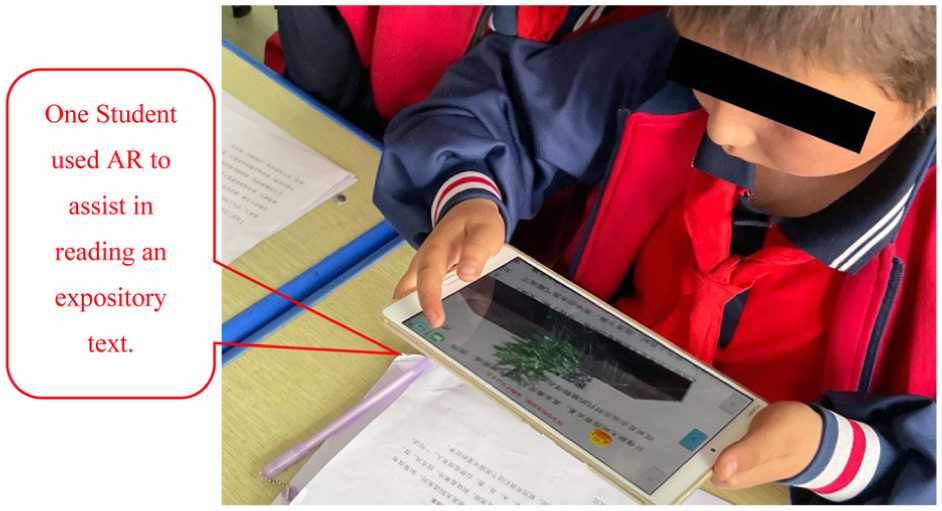
Photo of a student using AR for expository text reading.
Reading Comprehension Test
The reading comprehension test was jointly developed by experienced teachers and researchers. The test consisted of five items designed according to the three representational levels proposed in Kintsch’s construction–integration (CI) model (Kintsch, 1998): the surface model, the text-based model, and the situation model. One item assessed surface-level processing, which consisted of a vocabulary-based sentence completion task that included five subitems. This question required students to map literal word meanings onto sentence contexts and construct basic surface-form representations. Three items assessed text-based processing, requiring students to extract explicit propositions, integrate ideas across sentences or paragraphs, or perform local causal inference. The remaining item tapped the situation model, asking students to connect textual information with their own life experiences and to construct an enriched mental representation that integrates prior knowledge with the content of the passages. Specific content can be found in the Table S1. Three domain experts in literacy education reviewed the test and confirmed that the items adequately captured the targeted comprehension processes. Internal consistency was estimated using McDonald’s ω because the five items differ in weight and cognitive demand (McDonald, 1999; Revelle & Zinbarg, 2008). The coefficient ω for the test was .727, indicating acceptable internal consistency.
The cognitive dimensions assessed by the questions in the pretest, posttest, and delayed test were the same, but the expression and order of the questions differed. The test lasted 30 min. The scoring of the reading comprehension test was independently conducted by two researchers following the established scoring criteria (see Table S1). The raters were blinded to whether each response belonged to the pretest or the posttest, and they had no access to any student information or group assignment. Interrater reliability was examined using the intraclass correlation coefficient (ICC) based on a two-way random-effects model to assess absolute agreement. The ICC (2,1) was 0.920 (95% CI [0.885, 0.945], p < .001), indicating strong consistency among the raters (Koo & Li, 2016).
Reading Motivation and Experience Scales
All measurements were used on a 5-point Likert scale with answer options ranging from 1 (low) to 5 (high). The students were given 20 min to complete the scales.
Reading motivation scale. The Motivational Learning Strategies Questionnaire by Wang and Chen (2010) was adopted. This scale consists of six items and is divided into two dimensions: intrinsic motivation and extrinsic motivation. The reliability coefficient was .79, as measured by Cronbach’s alpha.
Reading experience scale. This scale was adapted from the Positive and Negative Affection Scale (Watson et al., 1988) and contains two dimensions, positive affect and negative affect, with each dimension consisting of five affective words. The Cronbach’s α coefficient of this scale was .728, indicating good reliability.
Data Analysis
In this study, data on students’ pretest, posttest and delayed test scores for reading comprehension, reading motivation, and reading experience were collected. To explore whether the reading comprehension levels of the students before and after the experiment differed significantly, a paired-samples t test was performed on the pretest and posttest data of the two groups. To examine whether there was a significant difference in reading comprehension levels between the two groups after the intervention, analysis of covariance (ANCOVA) was used to analyze the posttest data. ANCOVA was also used to analyze the delayed test data on reading comprehension to investigate the lasting effect of the intervention. Students in the AR group were divided into high-level and low-level groups on the basis of their pretest scores. The Mann–Whitney U test was applied to detect differences in score improvements with the aim of exploring which students benefit more from AR. The Mann–Whitney U test was also used to analyze whether there were differences in reading motivation and experience between the AR group and the image group. The interview data were analyzed using an interpretive approach, which allowed the researchers to situate and make sense of students’ learning experiences and their responses to the intervention (Patton, 2015). The qualitative insights offered richer descriptions and deeper understanding, thereby complementing the quantitative findings.
Results
Reading Comprehension
Table 1 presents the descriptive statistics for the pretest and posttest results of the reading comprehension scores in both the AR group and the image group. To investigate whether there was a significant improvement in students’ reading comprehension, a paired-samples t test was conducted on the pretest and posttest reading comprehension data of the two groups. The results in Table 1 show that there was a significant difference between the pretest and posttest scores of the AR group (t = 8.764, p < .001) and the image group (t = 6.157, p < .001), and the posttest scores were higher. These findings revealed that reading comprehension improved significantly in both groups after the expository text reading activity.
Descriptive Statistics of the Reading Comprehension Scores for the Pretest and Posttest and the Results of the Paired Samples t-Test.

p < .001.
In this study, the pretest of reading comprehension was used as the covariate, and the posttest of reading comprehension was used as the dependent variable to analyze the intervention effect. To ensure the robustness of the ANCOVA results, critical assumptions were checked prior to data analysis. The results of the Shapiro–Wilk test revealed that the residuals of the posttest reading comprehension scores in the AR group (p = .330 > .05) and the image group (p = .215 > .05) did not deviate significantly from the normal distribution. The assumption of independence for the pretest of reading comprehension was also satisfied, and no significant difference was observed between the two groups in the pretest of reading comprehension (t = −0.024, p = .981 > .05). Levene’s test for homogeneity of variance indicated that the assumption of homogeneity of variance for the posttest reading comprehension scores between the two groups was valid (F(1, 88) = 1.207, p = .275 > .05). In addition, the interaction term between the two groups and the covariate for the homogeneity of regression slopes was not significant (F(1, 88) = 0.147, p = .702 > .05), which supported the assumption of homogeneity of regression slopes. Therefore, ANCOVA was appropriate for evaluating the differences between the two groups. The ANCOVA results presented in Table 2 indicate that the reading comprehension of the AR group was significantly better than that of the image group (F = 4.606, p = .035 < .05, η2 = .05). Furthermore, AR-based expository text reading promoted the reading comprehension of CSL learners.
ANCOVA Results of Reading Comprehension Posttest Between the AR Group and the Image Group.

p < .05.
The quantitative results indicated that AR significantly enhanced students’ comprehension of informational texts, and these findings were supported by evidence from the interviews. Students repeatedly emphasized that AR made abstract information tangible and observable. For instance, R1 explained that he previously did not understand “why whales were not fish,” but after seeing the clearly rendered blowhole in the AR model, he “remembered it immediately,” illustrating how visualization facilitated rapid conceptual formation. R4 described “dragging the models and viewing the sun and the whale from different angles,” which enabled him to acquire more detailed structural understanding. This active manipulation allowed the students to flexibly explore key features according to their own cognitive needs. Similarly, R3 noted that “AR turned the key points of the text into 3D forms,” making reading “more focused and easier to understand,” reflecting how the combination of visualization and interactivity reduced cognitive load. Overall, these student insights aligned with the observed improvements in reading comprehension, suggesting that AR’s visual and interactive affordances effectively support learners’ understanding and construction of knowledge in informational texts.
We divided the learners in the AR group into a low-level group and a high-level group based on the median of their pretest scores. Learners whose scores were below the median were assigned to the low-level group, and the remaining learners were assigned to the high-level group. Next, we tested the difference in reading comprehension promotion between the two groups. The purpose was to further investigate the promotion effect of AR-based expository text reading on students with different reading bases. Since the samples in the low/high group were small, we used the Mann–Whitney U test. Table 3 shows that the promotion effect was significantly greater in the low-level group than in the high-level group (U = 140.50, Z = 2.649, p = .008 < .01). These findings suggested that AR-based expository text reading had a greater promoting effect on the reading comprehension of CSL learners with lower reading proficiency.
Results of the Mann–Whitney U Test on the Promotion of Reading Comprehension Among Students With Different Levels of Reading Proficiency.

p < .01.
A delayed test was administered to examine whether the effects of the AR intervention on reading comprehension were retained over time. Because several students were absent due to personal matters or illness, the valid sample size for the delayed test was slightly reduced, resulting in 78 participants. Normality checks indicated that both groups met the normality assumption (AR group: p = .187; image group: p = .083). An independent samples t-test revealed no significant group difference in the pretest scores (t = 0.321, p = .749), fulfilling the requirement of covariate homogeneity. Levene’s test confirmed equal error variances (F(1,76) = 0.259, p = .613), and the interaction between group and pretest scores was nonsignificant (F(1,76) = 0.549, p = .461). With all assumptions satisfied, the ANCOVA revealed a significant group effect (F = 4.359, p = .040 < .05, η2 = .055) in Table 4, indicating that the AR group continued to outperform the Image group on the delayed test, suggesting sustained benefits of the AR intervention.
ANCOVA Results for the Delayed Reading Comprehension Test.

p < .05.
In summary, AR-based expository text reading significantly improved students’ reading comprehension and had a greater positive effect on students with low reading proficiency. Moreover, the advantage of AR-based reading was sustained over time.
Reading Motivation and Reading Experience
According to the results of the Shapiro–Wilk test, although the reading motivation of the image group (p = .189 > .05) conformed to the normal distribution, the reading motivation of the AR group (p = .006 < .05) did not. The Mann–Whitney U test was conducted to test whether AR-based expository text reading had any effect on the students’ reading motivation. As shown in Table 5, the AR group (M = 24.80) had greater reading motivation than the image group did (M = 23.18). The difference between the two groups was statistically significant (U = 1,275.50, Z = 2.128, p = .033 < .05). AR-based expository text reading significantly improved CSL learners’ reading motivation.
Results of the Mann–Whitney U Test on Reading Motivation and Affective Experience for Both Groups.

p < .05. ***p < .001.
The Shapiro–Wilk test results revealed that the reading experience data of the AR group (p < .001) and the image group (p = .023 < .05) did not conform to a normal distribution. The Mann–Whitney U test was used to test whether there was a difference in the affective experiences of the two groups. The data in Table 5 show that the AR group (M = 44.87) had better affective experience than the image group did (M = 39.80), with a significant difference between the two groups (U = 1,615.50, Z = 4.886, p < .001). Higher values represented more positive emotions. The results of the test indicated that AR-based expository text reading significantly improved CSL learners’ affective experience.
In terms of reading motivation and experience, the substantial improvements observed in the quantitative results were further corroborated by the interview data. Participants frequently described the AR-enhanced reading activities as “fun,”“surprising,” and “magical,” indicating strong positive emotional engagement. As R2 noted, the experience “felt like playing a game,” suggesting that AR heightened both enjoyment and participation. R3 explained that although informational texts usually felt “a bit boring,” the AR-supported activity made them want “to read it again,” reflecting a noticeable increase in intrinsic motivation. The interactive affordances of AR also fostered greater exploratory behavior; for example, R4 expressed enthusiasm for “dragging the models and viewing them from different angles,” an action that made them “feel like a scientist.” Moreover, several students expressed a strong willingness to participate in similar activities in the future (e.g., R1: “I would definitely sign up!”). These qualitative insights align closely with the quantitative findings, indicating that AR not only enriched students’ reading experiences but also reshaped their attitudes toward informational text reading in a positive direction.
Discussion
AR-Based Expository Text Reading Improves the Reading Comprehension of CSL Learners
This study revealed that AR-based expository text reading effectively promoted CSL learners’ reading comprehension. This conclusion was consistent with previous findings on the application of AR technology in language learning, which suggest that AR-based learning can improve students’ learning achievements (Wen et al., 2023; J. Wu et al., 2024). In L2 expository reading, AR’s visual representations help learners concretize abstract concepts and index complex lexical items (Glenberg & Robertson, 2000), making dense informational content more comprehensible and reducing processing demands. Similarly, prior studies have shown that visually enriched AR materials provide relevant background knowledge and alleviate cognitive load, thereby supporting learners’ retention and understanding of abstract content (Ebadi & Ashrafabadi, 2022; Liu et al., 2024). Beyond visual enhancement, AR’s interactive affordances—in contrast to mages—encouraged active embodied engagement, directing learners’ attention toward core meaning-making processes and activating relevant prior knowledge, which in turn supported their understanding and application of new information (Danaei et al., 2020; Yang et al., 2025). In addition, the synchronous presentation of textual information and AR in this study appeared to support learners in perceiving the text more coherently and forming the mental connections necessary for integrating and retrieving information, thereby facilitating their comprehension of expository texts (Gönen & Zeybek, 2022).
Notably, AR had a stronger facilitative effect on the reading comprehension of expository text for CSL learners with low reading proficiency. This finding aligned with that of J. Zhang et al. (2015), who reported that compared with high-level learning, AR enhanced the academic performance of low-level learners more. Readers with weaker foundations often struggle with vocabulary, background knowledge, and inferential reasoning (Vettori et al., 2023; Wolfe & Woodwyk, 2010). AR provided targeted scaffolds to support these areas, whereas learners with higher reading proficiency may rely less on such scaffolds. Additionally, AR captured learners’ attention and promoted engagement, helping to narrow the gap between low- and high-proficiency students (J. Zhang et al., 2015). For learners who often experience frustration, AR reading also mitigated negative emotions while encouraging active involvement with the text, thereby enhancing comprehension (J. Zhang et al., 2025). In summary, AR technology has considerable potential for enhancing students’ cognitive ability (M. H. Wu, 2021), and it can serve as a particularly powerful supportive tool for learners with weaker proficiency.
Positive Effects of AR-Supported Expository Text Reading on Reading Motivation and Experience
This study revealed that the AR group exhibited greater motivation and a more positive reading experience than the image group did, which aligns with the findings of numerous previous studies (Alhamad et al., 2026; Dindas & Ince, 2025; Lee & Park, 2020; Liu et al., 2024; Yang et al., 2025). Specifically, CSL students demonstrated strong interest and positive attitudes toward AR-based expository reading, perceiving that the activity not only broadened their knowledge but also stimulated their curiosity in natural sciences and enhanced their initiative in reading. These findings suggest that AR can play a significant role in fostering intrinsic motivation among learners. Previous research supports this interpretation. Şimşek and Direkçi (2023) reported that AR content, by presenting reading material in more interactive and detailed ways than static images, can better support readers’ imagination and increase their motivation to engage with texts. Similarly, Liu et al. (2024) highlighted that AR books have an advantage over print books in motivating reading. In this study, students’ positive responses to AR-based reading indicated that the immersive and interactive features of AR made the reading process more engaging and enjoyable, thereby improving reading motivation and experience.
Conclusions and Limitations
This study combined AR with expository text reading to explore the effect of AR on expository text reading for CSL learners and revealed the potential advantages of AR in this context. The results showed that AR can effectively enhance CSL learners’ reading comprehension of expository texts. Compared with traditional word-and-picture formats, AR can provide CSL learners with richer visual information, which helps them better understand expository texts in context. Moreover, AR provides multiple opportunities for students to interact with the AR models during the reading process, allowing them to deepen their understanding of the expository text through embodied participation with the AR models. Additionally, the results revealed that AR can significantly improve CSL learners’ reading motivation and reading experience. This study provides empirical evidence on the effectiveness of AR in expository reading for CSL learners, offering reference data for related research. The findings demonstrate the instructional potential of AR in enhancing reading comprehension, reading motivation, and reading experience while also providing practical implications for educators. Based on these findings, the integration of AR into expository reading activities is recommended to support learners’ autonomous exploration, deepen conceptual understanding, and foster a more positive and meaningful reading experience in second-language contexts.
Owing to the limitations of the experimental conditions, the duration of the AR intervention in this study was relatively short, which may not have been sufficient to produce sustained and stable effects on learners’ reading habits. Future research should therefore conduct long-term reading experiments to explore the deeper effects of AR-based expository reading on L2 learners. In addition, the sample size of this study was limited, and randomization was conducted at the class level; future research could select larger and more diverse samples. Furthermore, the development of AR materials can be challenging for teachers. Thus, collaboration between researchers and educators is essential for the successful implementation of AR in instructional settings. As the present study focused on independent expository text reading with AR or static images, future research could further examine the effects of integrating AR with teacher guidance or other complementary media (e.g., video or audio narration) to support reading comprehension. Furthermore, considering the significant effect of AR on students with different reading proficiency, future AR technologies could be designed with greater flexibility and integrated with artificial intelligence to provide personalized support tailored to learners’ varying reading levels.
Supplemental Material
sj-docx-1-sgo-10.1177_21582440261429632 – Supplemental material for Effects of Augmented-Reality-Supported Expository Reading on Chinese L2 Fourth-Graders: A Quasi-Experimental Study of Comprehension, Motivation, and Experience
Supplemental material, sj-docx-1-sgo-10.1177_21582440261429632 for Effects of Augmented-Reality-Supported Expository Reading on Chinese L2 Fourth-Graders: A Quasi-Experimental Study of Comprehension, Motivation, and Experience by Juan Wu, Shiya Chen, Qingxuan Li, Rui Chen and Xinran Zhou in SAGE Open
Footnotes

Ethical Considerations
Ethical approval was obtained from the ethics committee of the Faculty of Education at Beijing Normal University.
Author Contributions
WJ contributed to the conceptualization, methodology, funding acquisition, formal analysis, and writing of the original draft and revisions. CSY&LQX contributed to the Software development, methodology, data curation, and writing of the original draft and revisions. CR&ZXR contributed to the methodology, validation, funding acquisition and data collection and writing of the original draft. All authors read and approved the final manuscript.
Funding
The authors disclosed receipt of the following financial support for the research, authorship, and/or publication of this article: This study was supported by the General Office of the National Language Commission Research Planning Committee of China, under grant number ZDA145-20.
Declaration of Conflicting Interests
The authors declared no potential conflicts of interest with respect to the research, authorship, and/or publication of this article.
Data Availability Statement
The datasets used and analyzed during the current study are available from the corresponding author upon reasonable request.*
Generative Artificial Intelligence (AI) Declarations
Grammarly was used to enhance the language. This study did not employ any other generative artificial intelligence tools.
Supplemental Material
Supplemental material for this article is available online.
References
Supplementary Material
Please find the following supplemental material available below.
For Open Access articles published under a Creative Commons License, all supplemental material carries the same license as the article it is associated with.
For non-Open Access articles published, all supplemental material carries a non-exclusive license, and permission requests for re-use of supplemental material or any part of supplemental material shall be sent directly to the copyright owner as specified in the copyright notice associated with the article.
