



Abstract
This study aimed to determine the levels of resistance to change and accreditation perceptions among academics working in higher education institutions, reveal the relationship between these variables, and examine the predictive effect of resistance to change on accreditation perceptions. A correlational survey-design was used.Data were collected, from 346 academics, selected through a simple random sampling method, who voluntarily participated in the study, using the resistance to change scale (RTCS) and the accreditation perception scale (APS). The data were analyzed using the t-test, one-way analysis of variance, Pearson correlation, and multiple regression analysis. The findings revealed significant differences between academics’ accreditation perceptions of the affective resistance subdimension of the RTCS in terms of marital status, gender, age, academic title, and professional seniority. A significant difference was observed in the quality assurance and quality assessment subdimensions of the APS in terms of gender. Multiple regression analysis revealed that affective resistance negatively and significantly predicted both subdimensions of—the APS: quality assurance and quality assessment. This research, found that the affective dimension plays a critical role in the change process and that academics’ affective responses should not be overlooked.
Introduction
Higher education institutions are undergoing a transformation because of the expectations of quality assurance in today’s rapidly changing world. Accreditation practices, which are at the heart of this transformation, stand out for their functions of certifying institutional quality and efficiency in the areas of education and training, social contribution, research and development, and internationalization, as well as providing strong accountability. However, these practices are not limited to structural or administrative compliance alone, but are also closely related to the perceptions and attitudes of academic and administrative staff, and especially their cognitive, emotional, and behavioral responses to change.
Accreditation, traditionally based on volunteerism, is becoming increasingly mandatory worldwide. In voluntary systems, institutions take responsibility for improvement; however, a mandatory system can trigger change, while carrying the risk of superficial implementation. The advantages and disadvantages of both the approaches must be carefully evaluated. For accreditation to be effective, standards must be compatible with and comprehensible to the system, the process must be embraced, gaps must be identified through self-assessment and transformed into improvement plans, and the system must have both the willingness and capacity to progress accordingly (Nicklin et al., 2020). An examination of the accreditation process in higher education in various countries has reported that while the accreditation process is efficient in most countries, and higher education institutions are accredited within a reasonable period, accreditation can also be complex and time-consuming for the first time (Duarte & Vardasca, 2023). In Turkey, accreditation practices started being implemented with the establishment of the Higher Education Quality Council (THEQC) in 2015. This is important for establishing and maintaining quality assurance systems. It can be argued that, as it is a relatively new process, it has not yet fully become a part of the institutional culture. Taştan (2021) has found that universities in Turkey have widely adopted quality management; however, this adoption is largely driven by external pressures and carried out in a more formalistic manner, rather than being genuinely internalized.
The literature includes studies addressing the challenges experienced during the accreditation process (Alpaydın & Topal, 2022; Cooper & Terrell, 2013; Erkuş & Özdemir, 2010; Fidan et al., 2022; Hail et al., 2019; Hartle, 2012; Larkan-Skinner, 2015; Şendur Atabek, 2023; Woolston, 2012). These studies have revealed that individuals’ undesirable negative experiences and perceptions of uncertainty during the accreditation process cause them to view change as a threat, and exhibit cognitive, emotional, and behavioral resistance. Increased concerns can trigger individual resistance when the accreditation process is not managed effectively, institutional goals, plans, and strategies are not clearly defined; employees are not adequately informed about these issues, and their feedback is not received.
Quality assurance activities in higher education are becoming increasingly important in Turkey. In this context, evaluting accreditation processes and practices is critical. These evaluations will contribute to a better understanding of the accreditation process and the improvement and dissemination of effective practices. Based on the 2025 data, 30 public and private universities have achieved full accreditation under the Institutional Accreditation Program in Turkey (Higher Education Quality Council of Turkey [THEQC], 2025). Various national agencies have assessed and accredited the quality of higher education programs in Turkey. These agencies aim to ensure quality by assessing the compliance of educational programs in each field with quality standards. For example, accreditation agencies such as MÜDEK (Association for Evaluation and Accreditation of Engineering Programs) for engineering, TEPDAD (Association for Evaluation and Accreditation of Medical Education Programs), for medical education, TPD (Turkish Psychiatric Association), for psychology, and MİAK (Association for the Accreditation of Architectural Education) for architecture operate in different areas of expertise (THEQC, n.d.).
Addressing accreditation processes not only in terms of their structural and administrative aspects, but also how academics perceive them as critical to their success. In this context, the main objective of this study is to examine the effect of academics’ resistance to change on their perceptions of accreditation in higher education institutions. Accordingly, the study analyzed the predictive effects of resistance to change on the accreditation perceptions using multivariate statistical methods. This study makes significant contributions to existing literature. First, it determines the effects of academics’ perceptions of accreditation processes in higher education in Turkey in terms of various demographic variables. Second, it reveales how academics’ perceptions of accreditation are shaped by their attitudes toward change, thereby improving institutional quality practices. The findings are expected to shed light on policies and practices that consider the attitudes of academic staff toward change to ensure the effective implementation of quality assurance systems in higher education. To achieve this goal, the following questions were addressed:
Do academics’ resistance to change levels vary by marital status, gender, age, professional seniority, and academic title?
Do academics’ accreditation perception levels vary by marital status, gender, age, professional seniority, and academic title?
Is there a significant relationship between academics’ resistance to change and their accreditation perceptions?
Do academics’ resistance to organizational change levels significantly predict their accreditation perceptions?
Literature Review
Organizational Change
Change, an inevitable and natural part of life that parallels global development, is the cornerstone of progress. Enhancing performance and achieving competitive advantage (Boeker, 1997) depend on continuous progress, which necessitates greater change (Wanberg & Banas, 2000). The concept of change is “qualitative or quantitative change that occurs in the current state of anything, concrete or abstract” (Çalışkan, 2019, p. 7). According to Kesmen (2014), although change represents growth, innovation, and opportunities, it also brings about uncertainty, complexity, and threats. Kreitner (1992) likened the changes to ripples created by a stone thrown into a still lake, stating that these ripples can spread in all directions with unpredictable results (as cited in Dent & Goldberg, 1999).
The process of change is inevitable for organizations to sustain their existence (Basım et al., 2009). The renewal of an organization depends on adapting changes to its corporate strategy and transforming this alignment over time, rather than recognizing changing conditions (Barr et al.,1992, p. 15). According to Töremen (2002, p. 187), organizational change not only prepares an organization for the future but also fosters trust-based collaboration among employees, keeps communication channels open, and facilitates the development of solutions to problems. It also contributes to the organization’s growth and development while preserving its integrity and sustainability. Hassan (2018, p. 3) emphasized that, like the world in which we live, the organizations we build are not static but evolutionary, and this evolution is related to the progress that leads to organizational success.
Although various definitions of the concept of change exist, certain models have been developed to manage and implement these processes successfully. Lewin’s change model is one of the theoretical frameworks to understand and manage how change occurs. “Nothing is as practical as a good theory” (McCain, 2015; Schein, 1996) is one of Lewin’s most famous quotes, known as the “father of change management” (Sonenshein, 2010). According to Lewin (1947 as cited in Burnes, 2004a), who prioritized behavioral change to resolve social conflict, change theory should explain the mechanism of change. Lewin’s three-step model, which explains change mechanisms, was used in this. This model suggests that organizational culture is essential for understanding and implementing change and is also the driving force of organizational change. The model argued that a successful change project consists of three steps—unfreeze, change, and refreeze (Burnes, 2004b; Burnes & Bargal, 2017; Cummings et al., 2016; Dent & Goldberg, 1999; Hassan, 2018; Kaminski, 2011; Nurhasanah et al., 2024; Sarayreh et al., 2013)—and defined the continuous improvement process and planned changes through these steps to maintain long-term sustainability in organizations.
Step 1: Unfreeze. This stage provides a clear explanation of why the action strategy is important (Hussain et al., 2018) and refers to lowering the forces that keep the organization in its current state. Schein (1996) has described the key to unfreezing as “… to recognize that change, whether at the individual or group level, was a profound psychological dynamic process,” highlighting the necessity of changing the current situation, feeling compelled to make the necessary changes to adapt to changing conditions to survive, and creating sufficient psychological confidence to complete the unfreezing stage successfully.
Lewin (1947) argued that this stage requires abandoning old behaviors and adopting new ones successfully, thus unfreezing the balance (Burnes, 2004a; Sarayreh et al., 2013). Mellita and Elpanso (2020, p. 147) described this as a critical stage in which the importance of change is felt, and individuals prepare themselves and others to step out of their comfort zone. Hassan (2018, p. 24) proposed three approaches to achieve Lewin’s unfreezing stage: boosting the driving forces moving behavior away from the current state, establishing a balance through restraining factors, and finding a balance among the driving forces to progress toward the planned change (Figure 1).

Lewin’s three-step model.
At this stage, managers should activate all elements of the organization for change, identify the needs that support the change, and recognize the existing problems. The manager’s role during the unfreezing stage in the implementation of Lewin’s change model was to prepare employees for change. To achieve this, managers should establish strong relationships with people, demonstrate the ineffectiveness of current behaviors, and minimize potential resistance to change. Creating an environment of open communication and trust is crucial in this process (Helvacı, 2015).
Step 2: Change. The environment is ready for the development of new attitudes, behaviors, and values in the unfreeze step. The change stage involves a transformation, marking the transition from the old to the new state. At this stage, it is crucial to reduce feelings of anxiety, fear, and uncertainty experienced by organization members when making changes. Members should be given sufficient time to understand and confront future changes. Therefore, it is particularly important to guide the targeted system toward a new balance (Nurhasanah et al., 2024, p. 4). Predicting the outcomes of planned changes is challenging. Lewin emphasized the need to identify and evaluate all possible options through trial and error (Burnes, 2004b). According to Helvacı (2015), the manager’s role at this stage is to implement and guide the change. New and more effective behavioral approaches should be recognized, and the most appropriate changes should be selected in terms of tasks, interpersonal relationships, organizational culture, technology, and structural elements. Guidance and support mechanisms should be established to enable employees to adapt to changes that occur during this process.
Step 3: Refreeze. The final step in the change model, that is, refreezing, is the stage where the new situation is made permanent. In other words, this stage requires integrating the changes into the organizational structures and procedures in such a way that they become part of the organization rather than remaining separate units. During this stage, the organization should conduct an identification and evaluation process to define the problem, gather information about its strengths, develop alternative solutions, and decide which actions are appropriate to resolve the problems in the change process (Nurhasanah et al., 2024). According to Lewin (1947, as cited in Helvacı, 2015), a manager’s primary role is to make new behaviors sustainable and acceptable. To achieve this, the necessary resources should be provided, and reward and positive reinforcement mechanisms should be implemented to increase performance and motivation. This prevents the change from becoming a temporary process and ensures its integration into the organizational culture.
According to Lewin’s’ model, the change process is explained by a dynamic balance between opposing forces. On one side are the driving forces that aim to change the current situation, whereas on the other side are the resisting forces that oppose change or attempt to preserve the old situation. Change begins when the balance of these forces is disrupted in favor of one side. This imbalance freezes the existing behavioral pattern and initiates the process of change. This change continues until a new balance is established between the forces (Kaminski, 2011).
Lewin’s three-stage change model also shows that organizational change is not limited to structural adjustments. In particular, the unfreezing and refreezing stages demonstrate that employees’ perceptions of and emotional responses to change are decisive in the success of the change process. This situation inevitably brings to the fore questions of resistance to change and how such resistance can be managed, necessitating that change management approaches consider individual reactions.
Resistance to Change
Resistance is perceived as destructive in classical management approaches (Furst & Cable, 2008; Waddell & Sohal, 1998). It typically refers to negative attitudes, inaction, responses containing anger or ill will, and defensive or conflictual tendencies (Starr, 2011). It is defined as an active or passive reaction that affects, hinders, or slows down the change process (Pardo del Val & Fuentes, 2003). According to Ford and Ford (2010, p. 24), the concept of resistance encompasses a wide range of behaviors, including backlash, not accepting, not responding to requests in a timely manner, making critical or negative comments, and agreeing to do something but not doing it. Many researchers have emphasized that resistance is a key reason for the failure of change initiatives (Fullan & Hargreaves, 1996; Ford & Ford, 2010; Kotter, 1995; Oreg, 2006; Waddell & Sohal, 1998). However, contemporary perspectives suggest that resistance and the conflicts it may generate can play constructive roles in the organizational change process (Henry, 1997; Hultman, 2003; Koçel, 2005; Theron et al., 1996; Waddell & Sohal, 1998).
Since organizational change is accepted as a desirable and necessary process, individuals who resist it are often perceived as irrational; such resistance is considered an obstacle that must be managed (Pieterse et al., 2012). Within organizations, some employees may view organizational change as an opportunity to learn and grow, whereas others may react negatively even to the smallest changes (Wanberg & Banas, 2000). According to Pardo del Val and Fuentes (2003, p. 149), inaccurate initial perceptions, such as interpretation barriers, distorted perceptions, and unclear strategic priorities are the primary obstacles to change. Employees’ attitudes toward organizational change are influenced by their past experiences, current knowledge, and individual cognitive processes. During the change process, the most critical factor is the perception of trust in management. In particular, the competence, helpfulness, and honesty of management play a decisive role in the acceptance of change (Blanca & Ramona, 2016, p. 48).
Numerous studies have examined the effect of trust on resistance to change (Albrecht, 2010; Lee & Jang, 2012; Örücü & Kambur, 2019; Saruhan, 2013; Thundiyil et al., 2015). These studies suggest that in organizations where trust in management is high, resistance to change decreases and change processes are managed more successfully.
Resistance to organizational change stems from several factors. According to Töremen (2002, p. 192), the main reasons for employees’ resistance to change include security concerns, fear that working conditions will become more difficult, concerns about supervision, feelings of pressure, and a lack of knowledge about the subject. Basım et al. (2009, pp. 34–35) examined these reasons under the headings of organizational, psychological, economic, sociological, and rational. Kesmen (2014, p. 50) suggests that individuals’ inability to easily abandon their habits can lead to a crisis of trust in change, which in turn creates resistance. Employees may tend to resist changes due to the stress caused by having to adapt to new rules. In general, the three primary reasons for conducting RCT are uncertainty, fear of losing the current benefits, and recognition of the weaknesses of the proposed change. Additionally, uncertainty, changes in work processes, cultural conflicts, and economic losses are among other important factors contributing to resistance. Organizational managers to accurately identify these resistance factors and develop appropriate strategies to address them (Elagöz et al., 2023, p. 84).
The literature reveals that resistance is a component of organizational change and should not be considered solely as a negative obstacle. When addressed through its cognitive, emotional, and behavioral dimensions, resistance points to employees’ experiences such as uncertainty, perceived threat, and loss of control in relation to change. In this context, resistance should be regarded as an important indicator of how employees interpret change rather than as a sign of change failure.
Change Management
Whit constant global change, the change process must be managed professionally. If change processes are not managed strategically, organizations can drift uncontrollably in undesirable directions. Kotter (1995) identified eight key reasons for the failure of change processes: failing to create a sufficient sense of the need for change, failing to establish a strong leadership team, moving forward without a clear vision and strategy, failing to establish communication engaging employees in the vision, failing to eliminate obstacles preventing the new vision from being implemented, failing to generate short-term gains, declaring victory too early, and neglecting to firmly embed changes into the organizational culture. The primary goal of all stages is to change people’s behavior. When a change process is managed in an unplanned, inadequate, or hasty manner, momentum is negatively affected. This model highlights that change is not only a technical process but also requires a people-centered approach, emphasizing the importance of strategic planning, leadership, and participation in successful change.
Change is inevitable in organizational life, and the ability to manage it effectively is regarded as one of the core competencies of successful organizations (Burnes, 2004a). Ensuring employee participation in the change process is among the most effective and long-standing strategies for overcoming organizational resistance (Hussain et al., 2018). Managers encountering resistance should seek different methods to ensure adoption of change. They must maintain regular communication with employees, involve them in the process, and pay careful attention to obtaining feedback. This is a critical factor for the successful implementation of a change. Employees should be provided with opportunities for participation, and teamwork support at every stage of the change process. Managers should create an appropriate environment, provide the necessary resources to encourage participation and play an active role in overcoming organizational challenges by facilitating teamwork (Waddel & Sohal, 1998, p. 547). According to Theron et al. (1996), managers can implement various strategies to minimize the resistance that may arise during the change process. Ensuring employee participation in decision-making is an effective method for reducing resistance to change. Effective communication facilitates employees’ understanding of the necessity for change, whereas support mechanisms and reward systems accelerate individual adaptation and increase motivation. A planned and systematic approach contributes to more controlled and sustainable processes. However, when all these methods fail, coercive measures can be considered a last resort and sanctions can be applied to employees who resist change.
Hultman (2003, p. 705) argued that the effectiveness of any strategy for change becomes evident only after the implementation process begins. Therefore, whether a strategy works can only be understood through evaluations conducted during the process, and may need to be revised if necessary. In general, strategies do not yield effective results without adjustments during the process. Implementers should be prepared for potential obstacles and act flexibly. Inaccurate assessments of resistance, focusing solely on symptoms in the strategy, ignoring the context, failing to make adjustments based on current information, and errors in timing can negatively affect the process. Additionally, strategies may trigger unexpected reactions, or the form of resistance may change over time. Therefore, dynamic, responsive, and continuously reviewed strategic approaches should be adopted to deal with resistance effectively. The change management model, developed based on Porter’s value chain concept, consists of three main components: triggering events, core processes, and supporting processes. In the model, the core processes include six stages, and the supporting processes continue uninterruptedly in parallel with these stages. The first stage aims to create motivation for change among organization members and increase their willingness to participate. In this context, it is crucial to establish a supportive environment with the necessary physical and psychological conditions. The second stage involves creating a vision that determines the direction and objectives of change. The third stage encompasses the development of political support within the organization to gain the support of individuals and groups for the implementation of change. The fourth stage involves managing the transformation process toward the desired future based on current conditions. The fifth stage aims to maintain the momentum necessary for change. This process includes providing resources, supporting representatives, and enhancing individual motivation. The final stage aims to make the changes permanent. Otherwise, the sustainability of the gains achieved in the previous stages cannot be ensured (Basım et al., 2009).
According to Malik (2025), organizations should carry out the change management process in five consecutive stages, beginning by examining the factors that necessitate change. At this stage, the internal and external factors of the organization are analyzed to determine the need for change. Next, a change diagnosis is conducted to evaluate the changes in the organization’s environment and develop appropriate strategies. The change program is then developed, outlining how the change will be implemented, who will be involved, and what resources will be utilized. During the implementation stage of the change program, the determined strategy was implemented and the process was managed effectively. Finally, the results of the implemented changes are analyzed, and necessary improvements are made. Helvacı (2015) has proposed three basic strategies in change management: experimental and rational, force and coercion, and normative and re-educative. Experimental and rational strategies are based on the assumption that individuals are rational beings and aim to adapt to change by persuading employees with objective, evidence-based information. On the other hand, the force and coercion strategy, imposes change using authority, sanctions, and reward-punishment mechanisms, but its effects are generally short-term. Normative and re-educative strategy aims to achieve change by transforming individuals’ norms, values, and relationships and is based on participation. According to this strategy, a balanced distribution of power within the system is crucial for a succesful change. Although these three strategies involve different approaches, selecting the most appropriate method is essential for effective change management.
A review of the literature indicates that for the effective implementation of organizational change, technical arrangements alone are not sufficient and that human elements are also necessary. Factors such as communication, trust, active participation, and leadership appear to be the fundamental elements shaping employees’ perceptions of and responses to change. Therefore, change management should be addressed as a holistic approach aimed not at eliminating resistance to change, but at making the change process more manageable and acceptable by understanding the underlying reasons for resistance. Within this framework, when organizational change, resistance to change, change management, and accreditation in higher education are considered together, individual reactions play an important role in quality-oriented change processes. Academics’ cognitive, emotional, and behavioral responses to change directly influence how accreditation and quality practices are perceived and internalized.
Accreditation and Quality in Higher Education
Accreditation is “a French word of Latin origin, referring to the state of being trustworthy and credible” (Doğan, 1999, p. 560). In higher education, accreditation is defined as “an evaluation process that aims to demonstrate that a higher education institution, or any program implemented by the institution, meets certain performance standards (quality, efficiency, and effectiveness) at the national and/or international level” (Aktan & Gencel, 2010, p. 138). This process, which began in the 1960s in the United States and Western countries, has become widespread throughout the world (Demirel, 2016).
The quality assurance system in higher education first emerged as a process involving external auditors in 1832, when Durham University appointed auditors from Oxford University. Currently, accreditation is implemented as a process that includes evaluations by both internal and external auditors to ensure compliance with established standards (Kumar et al., 2020). This process aims to ensure quality, continuous improvement, and the establishment of ethical values by examining the performance of institutions through internal and external audits (Aktan & Gencel, 2010). This process, designed to improve programs, encompasses both peer review and self-assessment methods (Welsh & Metcalf, 2003).
With increasing global competition and evolving educational approaches, ensuring quality assurance in higher education has become a fundamental requirement. Maintaining the reliability and effectiveness of higher education institutions, which play key roles in the development of individuals and society, requires continuous improvements based on rigorous standards. In this context, accreditation provides a multidimensional evaluation process that guarantees that institutions meet established quality and accountability criteria, positioning them as reliable providers of education (Kayyali, 2024). The accreditation process requires the academic and administrative staff of the institution to work in coordination toward a common goal (Larkan-Skinner, 2015); it strengthens the motivation of academic and administrative staff, improves the quality of education, and supports the professional development of faculty members, enhancing the reputation of higher education institutions. This process aims to ensure that universities meet international quality assurance standards and gain recognition (Demirel, 2016). Accreditation is an essential tool for improving institutional performance, beginning with self-assessment reports, desk reviews, site visits, and peer reviews, and is completed with the approval of the Ministry of Higher Education (Mussawy & Rossman, 2018, p. 10). Based on the principle of continuous improvement (Larkan-Skinner, 2015), this system contributes to the production of qualified graduates by improving the quality of education and significantly supports national development by integrating graduates into the workforce (Özçiçek & Karaca, 2019).
The accreditation process in higher education, which aims to ensure the quality of both institutions and their relevant programs, is a critical element in meeting the expectations of society (Duarte & Vardasca, 2023). According to Fadeeva et al. (2014), universities consider quality a central component of their transformation processes. They emphasize that institutions that structure their internal quality systems to adapt to transformation bear the responsibility of educating today’s graduates as well as developing sustainability-conscious, creative, and ethical leaders. They further highlighted that a radical transformation in higher education institutions is essential to achieving this goal. According to Sanyal and Martin (2007), who outlined the factors that make the adoption of accreditation for quality assurance attractive today, both students and their families and the labor market can easily compare higher education institutions based on quality labels. Higher education institutions competing globally attract the best students on national and international platforms with the potential to become learning organizations that continuously improve quality. One of today’s major challenges fake diplomas, documents, certificates, and so on leads graduates to institutions that guarantee employment in professional practice. Accreditation serves as the mechanism to provide this guarantee. Nicklin et al. (2020) pointed out that accreditation must adapt to be sustainable, and that traditional 2020 accreditation evaluates well-performing institutions using fixed listing criteria, monitors compliance through specific requirements for structural processes, and advises institutions on what to do using traditional surveys.
However, the 2030 vision sets an accrediation agenda focused on achieving predefined goals, providing guidance for structures and processes, and supporting the management of complex systems. It addresses processes not only in terms of compliance but also through exploratory research to understand the reasons behind the observed outcomes, generates judgments based on the obtained results, and adopts a data-driven approach that helps institutions achieve their goals by reporting on the mechanisms.
While institutional accreditation ensures quality standards by evaluating an institution’s overall capacity, program-oriented accreditation examines the adequacy of specific academic programs and certifies professional competencies (Aktan & Gencel, 2010, p. 139). In international literature, accreditation practices in higher education are mainly discussed as program-based and institutional. In Europe, under the Bologna Process and European Standards and Guidelines (ESG) framework, national agencies conduct quality assurance based on shared standards. In Turkey, the Council of Higher Education Quality Council evaluates the overall quality of institutions directly through the Institutional Accreditation Program, whereas program accreditation is conducted through national and international agencies. This system enhances international recognition by ensuring alignment with ESG. This situation necessitates that accreditation be considered not merely as a structural evaluation tool, but also as an organizational change process that develops in interaction with academic staff’s perceptions and reactions.
Current Study
As indicated in the problem statement and theoretical background, several studies have addressed resistance to change and accreditation. However, few studies have examined the effects of resistance to changes in higher education on accreditation. Therefore, in line with the problem statement, the hypotheses examined with in the scope of this study are as follows:
Method
Research Model
This study used a correlational survey model and a quantitative research method to examine the relationship between resistance to change and perceptions accreditation in the context of higher education. This model sought to determine whether there was a relationship between resistance to change and accreditation perception, and if so, to identify the direction (positive or negative) and strength (weak or strong) of this relationship. Within the scope of the study, the relationship between the resistance to change exhibited by academics working in higher education institutions and their accreditation perceptions. This study included one independent and one dependent variable resistance to change and accreditation perceptions, respectively. This study employed a descriptive survey method to examine whether academics’ resistance to change and accreditation perceptions differed significantly based on variables such as marital status, gender, age, professional seniority, and academic title.
Study Population and Sample
The study population consisted of academic staff at all faculties working at public universities in Turkey. After obtaining ethical committee approval, the authorized academic unit within the university, where the study was conducted, sent documents containing research permission, the purpose of the study, the voluntary participation consent form, and a link to the data collection tools to all public universities in Turkey. These documents were sent via official correspondence to be delivered to the institutional electronic information systems of academics. However, owing to the voluntary nature of participation, a sufficient number of participants could not be contacted. The researcher selected samples in two stages. In the first stage, each public university was selected as a group. In the second stage, a personalized invitation was sent via email to 10,000 academics selected through a simple random sampling method at the designated universities. Participants were informed about the purpose of the study, the steps to be followed, the measures taken to ensure the confidentiality of personal data, that participation was entirely voluntary, and that they could withdraw from the study at any time without giving any reason. As the study did not include any sensitive questions that could pose a risk of physical intervention or personal data breach, the risk of physical, psychological, or social harm to the participants was minimized. Participants’ anonymity was maintained throughout the study, and demographic questions were maintained at the most general level, with an option provided to refuse participation. Informed consent was obtained as follows: The first page of the questionnaire included a detailed information sheet specifying the purpose of the study, the voluntary nature of participation, the guarantee of anonymity, that the data would be used solely for research purposes, that participation could be terminated at any stage, that potential risks were minimal, and the contact information. Participants were deemed to have provided consent by clicking the “I agree to participate” button and completing the questionnaire. The survey took approximately 20 min to complete. The data collection process took place between October 2024 and May 2025, contacting 346 academics who responded to the online survey. A posthoc power analysis was conducted to assess the statistical adequacy of the sample size. The analysis was performed at a significance level of α = .05, with an effect size of f2 = 0.15 (Cohen, 1988), based on the model containing one independent variable. The analysis was based on linear multiple regression: constant model (R2≠ 0) within the scope of the F test. Based on the calculations performed using G*Power 3.1 software (Faul et al., 2009), the statistical power achieved with 346 participants was found to be (1 −β) = .99. This result indicates that the obtained sample size was statistically sufficient, as the power level was above the recommended minimum threshold of 80%.
Data Collection Tools
Data of the present study were collected using the resistance to change scale (RTCS) and the accreditation perception scale (APS).
The RTCS was developed by Oreg (2006) and adapted to Turkish by Çalışkan (2019). It is a 5-point Likert-type scale (1 = strongly disagree, 5 = strongly agree) that includes 15 items under three subdimensions: cognitive resistance (five items), affective resistance (five items), and behavioral resistance (five items). The mean ranges were calculated by dividing the mean scores obtained from the subdimensions by the number of items. The lowest and highest possible scores for each subdimension were 5 and 25, respectively.
The APS, developed by Semerci (2017), consists of 17 items under two subdimensions: quality assurance (seven items) and quality assessment (10 items). The lowest and highest possible scores for the quality assurance subdimension ranged between 7 and 35 for the quality assessment sub-dimension between 10 and 50. The arithmetic mean values were interpreted as follows: 0 to 0.80 “very low,” 0.81 to 1.60 “low,” 1.61 to 2.40 “moderate,” 2.41 to 3.20 “high,” and 3.21 to 4.00 “very high.”
The Kaiser–Meyer–Olkin (KMO) measure of sampling adequacy and Bartlett’s test of sphericity were used to assess the suitability of the data for exploratory factor analysis (EFA; Shrestha, 2021). Based on the EFA, the KMO values of the RTCS and APS were 0.861 and 0.965, respectively. Bartlett’s test results were significant for both scales (p < .05). These values indicate that the data were suitable for analysis, and sufficient sampling was achieved.
The factor loadings of the items in the RCTSRTCS ranged from 0.430 to 0.918. The explained variance between 40% and 60% indicates that the scale is suitable for EFA (Çokluk et al., 2014). In this study, the RTCS items explained 59.53% of total variance. Cronbach’s alpha reliability coefficient of the RTCS was .617, indicating that the scale was highly reliable. In the Turkish adaptation study, Çalışkan (2019) reported the Cronbach’s alpha reliability as .83 and .94 in two different sample groups, respectively, and the explained variance as 61.8% in the first sample and 70.91% in the second sample. Item loadings ranged from 0.680 to 0.870 in the first sample and from 0.599 to 0.830 in the second sample.
The factor loadings for the APS items range from 0.611 to 0.840. The APS items accounted for 73.76% of total variance. In this study, the Cronbach’s alpha reliability coefficient of the scale was .970, indicating that the scale was highly reliable. Semerci (2017) reported a Cronbach’s alpha reliability coefficient of .901, explained a variance of 43.357%, and item loadings between 0.538 and 0.692.
In this study, the convergent validity of the resistance to change scale (RTCS) was calculated considering the indicator’s factor loading, composite reliability (CR), and average variance extracted (AVE). These values range from 0 to 1, with a CR value of .933 and an AVE value of 0.493. To ensure sufficient convergent validity, the AVE value should be >0.50. However, according to Shrestha (2021), even if the AVE value is <0.50, convergent validity is considered to be achieved if the CR value is above .60. Additionally, previous studies have emphasized that the CR coefficient should be >.70 (Hair et al., 2011). For the APS, the CR and AVE values were calculated as .550 and .953, respectively, indicating that convergent validity was achieved.
Data Analysis
The study data were collected from 346 academics and entered into the SPSS 25.00 software for analysis. Based on the data obtained validity and reliability analyses were conducted on the scales. The Cronbach’s alpha coefficient was used to determine the reliability of the data obtained from the scales. Various statistical methods were employed in the study. Correlation and regression analyses were use to determine the relationships between variables. After performing the normality test, the skewness and kurtosis values were examined to determine whether the distribution was normal. Independent Sample t-tests and one-way analysis of variance were performed on normally distributed. Pearson correlation and multiple regression analyses were also conducted in the study, and the significance level was set at .05 in the evaluation of the results.
Results
This section presents the findings of the analysis related to the study’s sub-questions. This study examines whether academics’ resistance to change and accreditation perceptions differ significantly based on demographic variables (marital status, gender, age, professional seniority, and academic title). In addition, it analyzes the possible relationship between academics’ resistance to change and accreditation perceptions, as well as the predictive effect of resistance to change on accreditation perception.
As Table 1 demonstrates, academics’ perceptions of the affective resistance subdimension showed significant differences in terms of marital status, gender, age, and professional seniority (p < .05). Single academics reported “high” (
Analysis Results of the Variables Related to the Resistance to Change Scale.
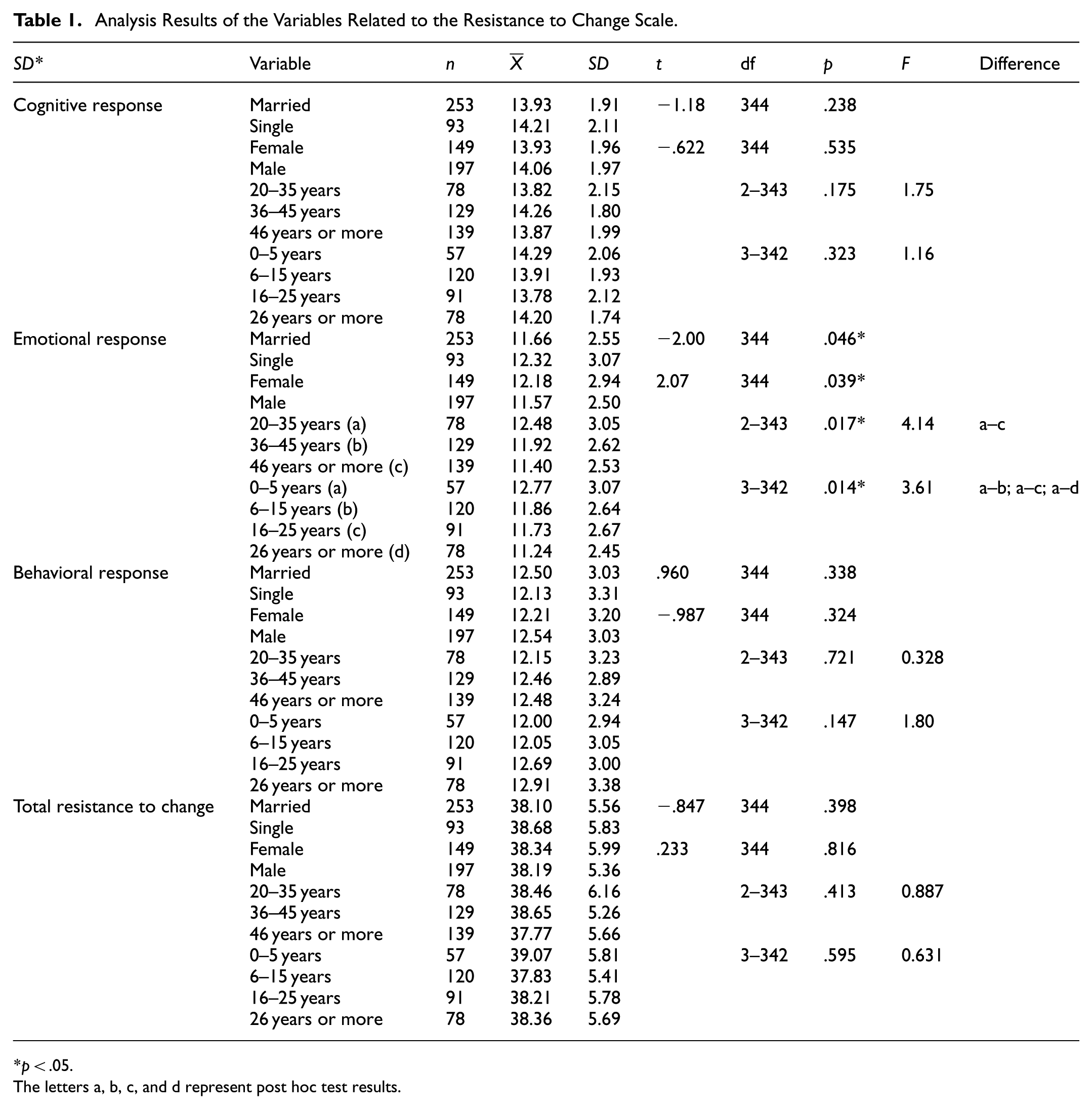
p < .05.
The letters a, b, c, and d represent post hoc test results.
Table 2 shows that academics’ perceptions of the quality assurance subdimension differed significantly according to gender (p < .05). Female academics’ perception levels of quality assurance (
Analysis Results of the Variables Related to the Accreditation Perception Scale.

p < .05.
The letters a, b, c, and d represent post hoc test results.
This study also examined whether academics’ perceptions of resistance to change and accreditation differed according to their academic titles. The findings indicated a significant difference in the affective resistance subdimension [(6, 339) = 5.477; p < .05]. This difference was observed among lecturers (
As shown in Table 3, no significant relationship was observed between the quality assurance subdimension and the cognitive resistance (r = −.028, p > .05) and behavioral resistance (r = −.100, p > .05) subdimensions (Table 3). In contrast, a positive and strong relationship was found between the quality assurance quality assessment subdimensions (r = .878, p < .05). Additionally, a week negative relationship was found between quality and affective resistance (r = −.207, p < .05). Furthermore, no significant relationship was observed between the quality assessment and cognitive resistance subdimensions (r = −.034, p > .05). A negative, weak, and significant relationship was found between the quality assessment subdimension and the affective (r = −.226, p < .05) and behavioral resistance (r = −.106, p < .05) subdimensions.
Analysis Results of Correlation Between Resistance to Change and Accreditation Perception.
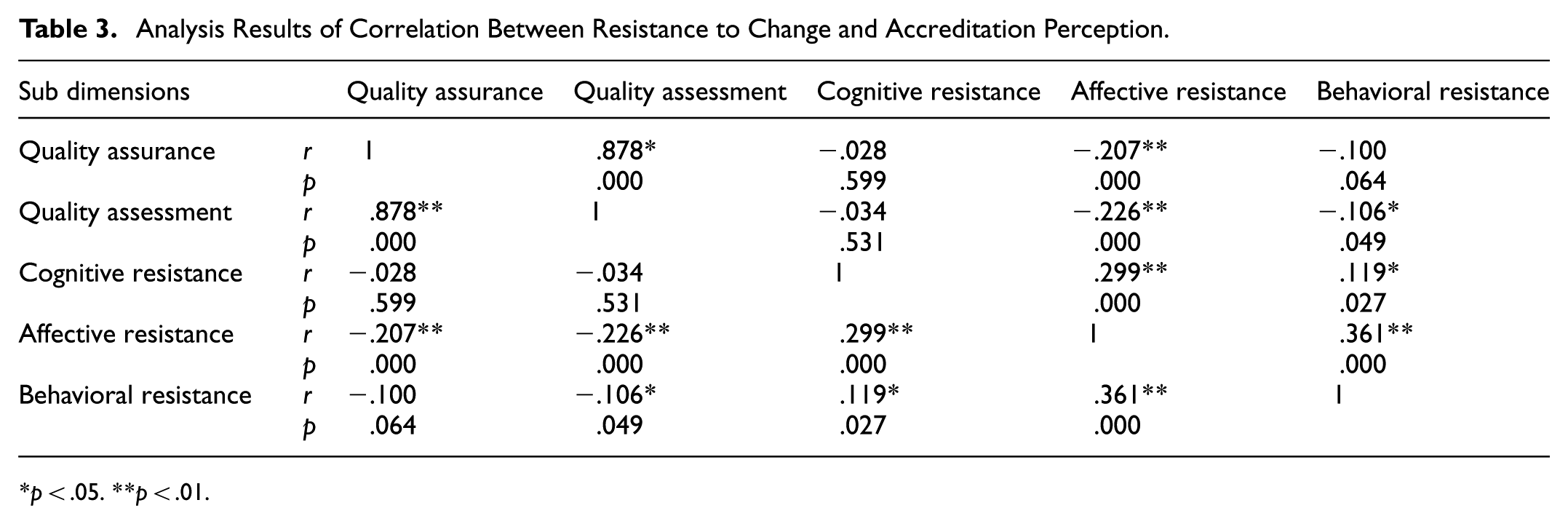
p < .05. **p < .01.
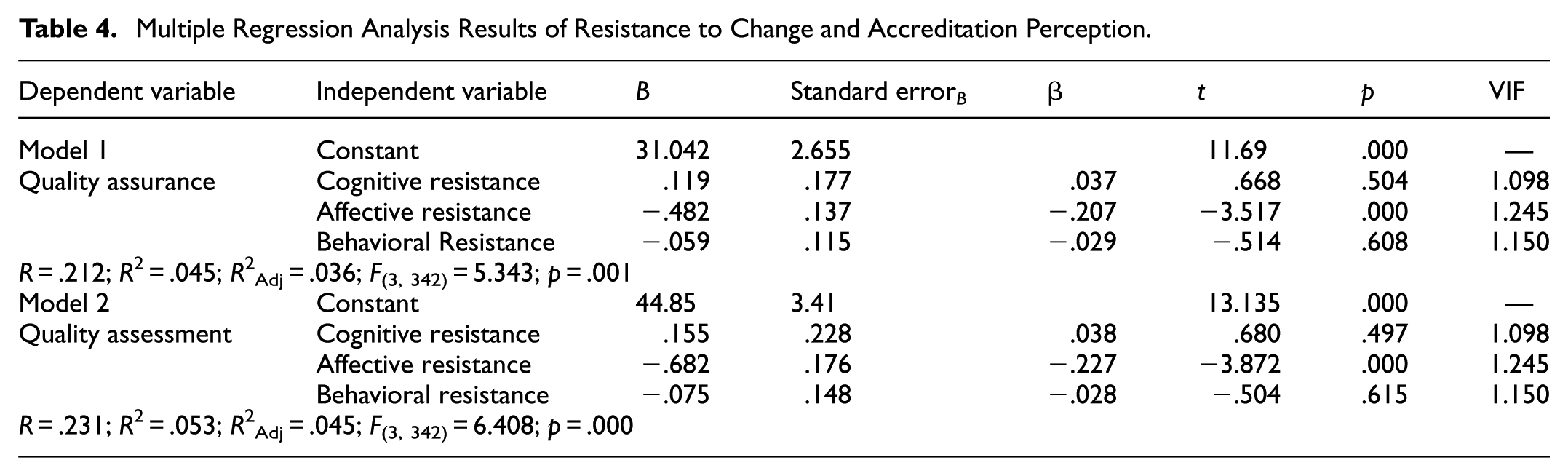
As shown in Table 4, before performing the regression analysis, the basic assumptions were tested to determine whether there was multicollinearity among the variables. There was a linear relationship between the variables, and the correlation coefficient value of the independent variables was <.80, the maximum value of Cook’s Distance was <1, indicating no outliers, and there was no autocorrelation in the model (1.5 < Durbin-Watson test [1.876; 1.988] < 2.5). Multiple linear regression analyses were conducted to test whether the cognitive, affective, and behavioral resistance subdimensions of the RTCS significantly predicted the quality assurance and quality assessment subdimensions of the APS. In the first model, the analysis of accreditation quality assurance perception was significant, explaining 4.5% of the variance in this sub-dimension. In this model, only emotional response variable was a significant predictor. In contrast, cognitive resistance and behavioral resistance variables were not found to be significant. In the second model, the regression model created for the dependent variable of quality assessment was significant and, explaine 5.3% of the variance. In this model, only emotional response was a significant negative predictor. Cognitive and behavioral resistance were not significant in this model. No evidence of multicollinearity was found in the regression analysis (VIF < 10).
Multiple Regression Analysis Results of Resistance to Change and Accreditation Perception.
Discussion
The results showed that academics’ perceptions of the affective resistance sub-dimension differed significantly according to marital status and gender. In the affective resistance subdimension, which includes expressions such as fear, excitement, sadness, stress, and other negative feelings related to change, married academics appear to be more resilient to uncertain change processes than their single counterparts. The habits of single people, which are based on a stable and individual routine, may cause more emotional responses when this routine is threatened by change compared to married individuals who have an established work-life balance. Bilgi et al., (2024) reported that individuals with healthy and happy marriages have better emotional health. Social, psychological, and structural factors were found to explain why women and single people showed higher resilience in the affective resistance subdimension. The study also found significant differences in the affective resistance subdimension in terms of age, academic title, and professional seniority. Young academics aged 20 to 25 years with 0 to 5 years of professional seniority who are new to their jobs, may not have developed strategies for coping with uncertainty during periods of change. Lecturers had a lower level of affective resistance than research assistants, research assistants with PhDs, and assistant professors. Assistant professors exhibited the highest affective resistance. Similarly, in terms of the total RTCS, research assistants with PhDs had the highest level of affective resistance. This can be explained by the fact that their job descriptions are more clearly defined, not directly affected by change processes, and hold more stable positions. Younger academics may perceive change as a threat because they are more vulnerable in terms of their professional status. In particular, research assistants and research assistants who have completed their doctorates may develop a higher level of affective resistance to change because of academic uncertainty, job insecurity, and the increased workload associated with accreditation processes. Özbozkurt (2019) found no significant differences in the affective resistance subdimension according to gender, marital status, or age. Semerci et al. (2021) reported that accreditation perceptions in higher education did not differ according to gender or professional seniority; however, academics aged 46 to 50 had higher accreditation perceptions than those aged 26 to 30. This study also indicated that professors’ perceptions of accreditation were higher than those of research assistants.
Hultman (2003) stated that emotions are the result of thinking and therefore cannot be changed through direct intervention. According to Kiefer (2005), the organizational change process is closely related not only to its structural or functional dimensions, but also to the affective resistance individuals display toward this process. Changes often trigger negative emotion, and employees may experience stress, anxiety, and dissatisfaction during this process. In particular, as the number of changes to which an employee is exposed increases, the negative emotions they experience daily also increase. In this context, it is emphasized that individuals’ affective responses to change play a critical role in determining the success or failure of change initiatives and that these responses should not be ignored. Indeed, in his study, Newton (2002, p. 59) highlighted the importance of how key staff members—who play a central role in the implementation of quality policy—perceive and interpret change and the policy itself during the steering process. The study indicates that academics did not passively accept changes or quality assurance systems and policies. Furthermore, academics were not merely passive recipients of managerial objectives but responded by either adapting to policies or expressing resistance. Coghlan et al. (2016) define employee resistance to organizational change as a four-stage psychological process. The first stage, denial, is characterized by the refusal to acknowledge the necessity of change, during which defense mechanisms are activated against the process. In the subsequent avoidance stage, individuals develop counter-arguments to avoid or delay change and may remain emotionally distant from the process even if they participate physically. In the implementation stage, the need for change is acknowledged, and negotiations regarding how and in what way change will be implemented are initiated. Finally, in the maintenance stage, the goal is to ensure that new behaviors become permanent, and reinforcement strategies are required to transform the change into habit. This model also reveals that resistance to change is a gradual and manageable process (as cited in Çerezci, 2019). Aras-Beger and Türker (2018) conducted a study on academics to examine whether resistance to change turned into a source of stress, emphasizing that both the change itself and the resistance exhibited toward it must be carefully considered in terms of individual-level outcomes. These findings indicate that individuals who resisted change tended to experience higher levels of stress. Theron et al. (1996) state that resistance to change may strengthen communication between managers and staff, allowing problematic areas to be idemore easily identified. More importantly, this would raise awareness of the nature and purpose of the change, which positively influences planning, improvement, and implementation processes. They also pointed out that resistance could make positive contributions and that it often stemmed from the way change was handled or the management style of the process; therefore, when analyzed correctly, this resistance could serve as valuable feedback. During the accreditation process, it is important to obtain the opinions of all stakeholders and conduct informative activities. Erkuş and Özdemir (2020) found that 40% of faculty members were unaware of any accreditation-related activities, and 60% stated that they had not been consulted during the process. In this regard, it can be argued that faculty members who lack sufficient information on the subject are not interested in ongoing activities.
The findings of the present study indicate that, in terms of gender, female academics’ total, quality assurance, and quality assessment scores were significantly higher than those of men. This may have resulted from women’s more sensitive and responsibility-based approaches to quality processes. To effectively implement quality assessment processes, it is crucial to understand how academics who are directly involved in these processes perceive quality, respond to these processes, and cope with them for the effective implementation of quality assessment processes (Harvey & Newton, 2007).
The present study found a positive relationship between the quality assurance and quality assessment subdimensions according to the perceptions of academics. YeşilbaşÖzenç (2024) emphasized the importance of assuring quality in higher education and integrating it into management processes to enhance global competitiveness. Semerci et al. (2021) argued that accreditation allows for the establishment of the necessary mechanisms to ensure quality in education and meet certain standards through assessment and assurance systems. This process has made academics aware of these requirements. Both the quality assurance and quality assessment dimensions contribute to the development of positive attitudes toward accreditation. Bıyıklı and Fidan (2023) found a strong negative relationship between resistance to change and accreditation. Their findings indicated that the lack of key personnel embracing the process slowed it downand was a cause of concern. Additionally, resistance can be reduced through effective communication, and the perception of accreditation can be positively changed. Fidan et al. (2022) highlight resistance as a prominent issue. Academics in their study expressed that the time-consuming nature of accreditation activities, which hindered their overall academic work, was a significant challenge faced during the process. However, the consensus was that they viewed this as a routine part of their work. The study also noted that academics would be least affected by this situation with an equal distribution of tasks. Busco et al. (2018) found that academics were aware of the gains and institutional learning associated with quality assurance–related self-assessment practices; however, they also indicated that factors such as increased workload generated internal tension. The authors emphasized the necessity for institutions to achieve balance to establish regular self-assessment processes.
Based on the findings of this study, affective resistance significantly predicted the quality assurance and quality assessment(negatively). Kiefer’ (2005) discussed negative emotions as a natural consequence of daily events and problems, rather than resistance to change. The study reported that constant change increased employees’ doubts about their professional competence, perceptions of threats to their future, and feelings of lack of organizational support, justice, and appreciation, which in turn led to the emergence of negative emotions. Additionally, over time, these feelings weaken trust in management and strengthen withdrawal tendencies. Hoare and Goad (2022) state that preventing accreditation from being perceived as a bureaucratic burden depends on leaders involving participants in the decision-making process and encouraging trust and collaboration through open communication.
These findings indicate that the emotional dimension of change processes is crucial and cannot be overlooked. According to Hultman (2003), although completely preventing or eliminating resistance is not a realistic goal, the ability to manage resistance to change effectively is a fundamental skill. Resistance is a mental state that reflects the reluctance or refusal to accept change. However, predictions, assumptions, and conclusions derived from facts can trigger emotions because the human mind cannot distinguish between imagined and real threats. For example, an organism that perceives a situation as threatening may release adrenaline as a physiological response and experience fear, regardless of the actual environmental conditions. These emotional responses can positively or negatively influence individuals’ decision-making processes and behaviors.
Solution
The present study showed that affective resistance to change particularly affected academics’ accreditation perceptions, and that some demographic variables also played a significant role in their emotional response. Academic’ opinions highlight the importance of viewing resistance as a form of feedback. As t academics’ levels of affective resistance to change increase, their perception of the accreditation process as an effective development-supporting institutional procedure decreases. These results supported the hypotheses of this study.
Conclusions and Recommendations
Accreditation, a crucial mechanism for standardizing quality and enhancing institutional efficiency, should not be viewed merely as a certification process; rather, quality should be embraced as a culture. Accreditation is used worldwide to monitor and evaluate the quality and standards of higher education institutions. However, it is important to review strategic errors, prejudices, and institutional communication deficiencies at the managerial level to increase the effectiveness of this process.
Waddel and Sohal (1998) noted that management should not merely strive to overcome resistance to change but rather seek to harness it constructively and manage it by applying appropriate strategies. While the classical approach views resistance to change as a negative phenomenon, modern management techniques consider it as a positive feedback process. Resistance varies depending on the leader’s style, such as keeping communication channels open, involving employees in decision-making, providing training, and fostering trust-based collaboration, as well as how change is communicated within the organization. Elagöz et al. (2023) evaluated resistance to change as distrust in leadership, disbelief in the attainability of goals, and the necessity of change. Thus, the importance of a management system developed in line with strategic objectives is evident. Blanca and Ramona (2016) state that 70% of all change initiatives fail because managers do not fully understand the process and nature of organizational change; therefore, distrust felt by employees is the dominant factor in resistance to change.
Employees’ perceptions tend to change in organizations that lack inefficient and negative managerial attitudes and behaviors. For example, according to the results of a survey conducted by the New England Association of Schools and Colleges in 2006 with 30 higher education institution administrators, the vast majority of participants agreed that accreditation promoted quality at their institutions, provided assurance to the public regarding educational quality, and was beneficial to faculty and staff (Gonzáles-Bravo et al., 2020). Indeed, in his study, Newton (2002, p. 59) highlighted the importance of how key staff members—who play a central role in the implementation of quality policy—perceive and interpret change and the policy itself during the steering process. The study indicates that academics did not passively accept changes or quality assurance systems and policies. Furthermore, academics were not merely passive recipients of managerial objectives but responded by either adapting to policies or expressing resistance. As can be seen, the successful implementation of an accreditation process depends on the existence of a structure that is open to change at both the individual and institutional levels. In this context, the reasons for resistance within the organization should be identified, and measures should be taken accordingly. These factors may vary depending on the individual or the group. Compelling academics to participate in the procees through imposition, without persuading them, creating an appropriate basis for raising awareness, or involving them in decision-making processes has led them to participate merely superficially in the process and respond to emotional reactions. Given academics’ workloads, time constraints have emerged as a critical challenge, as highlighted in the literature. Therefore, during the accreditation process, academics should be financially supported for their overtime/additional workload, or they should be awarded additional points for career advancement and reappointment. Organizational incentives can also increase academic motivation and enhance a sense of commitment to the process. Managers should adopt a theoretical and applicable management model for effective management of the accreditation process and approach individuals or groups using different methods. Furthermore, the results suggest that employees’ emotional responses should not be ignored.
Future research could enhance, the generalizability of the findings by employing broader and more diversified samples, including administrative staff, students, graduates, university management, and policymakers responsible for setting accreditation standards. Thus, how attitudes toward change shape perceptions of accreditation can be understood in a multidimensional manner. Long-term longitudinal studies would help reveal changes over time and the sustainability of the effects of accreditation processes. In addition, it is recommended that resistance during the accreditation process be examined not only as a reaction but also in conjunction with psychosocial variables such as organizational culture, stakeholder motivation, and institutional commitment. This enables a more in-depth analysis of the dynamics of resistance and motivation that emerge during the process.
Limitations
This study was conducted on academics working at public universities in different geographical regions of Turkey. Therefore, the generalizability of these findings is limited. The research data were confined to the items included in the measurement instruments used in the study and the views of the academics who participated voluntarily. The study is structured around Kurt Lewin’s three-step model and Kotter’s model, which explain change mechanisms. Future; studies may offer alternative explanations by employing different theoretical approaches. As this study was limited to quantitative methods, the underlying reasons behind academics’ resistance to change and their perceptions of accreditation could not be sufficiently elucidated. Future research employing mixed-method designs may enable a more comprehensive examination of these aspects.
Footnotes

Ethical Considerations
The research methods and procedures of this study were conducted in accordance with ethical principles and the Declaration of Helsinki regarding research involving human subjects. The protection of participants’ rights was adopted as a primary principle throughout the study design, data collection, and analysis processes. Ethical approval was obtained for this research from the Mersin University Social and Human Sciences Ethics Committee on September 23, 2024 (Approval No. 298).
Consent to Participate
Informed consent was obtained before participation.
Funding
The author received no financial support for the research, authorship, and/or publication of this article.
Declaration of Conflicting Interests
The author declared no potential conflicts of interest with respect to the research, authorship, and/or publication of this article.
Data Availability Statement
The dataset generated and analyzed during the current study is not publicly available because participants were informed during consent that their data would not be shared with third parties.