




Abstract
This study investigates how Deleuze and Guattari’s philosophical concepts, particularly deterritorialization, rhizome, body without organs, and desiring machines, inform the behavioral complexity and intuitive decision-making of school administrators. Rooted in postmodern educational theory, the research explores how administrators navigate increasingly complex and unpredictable school environments by adopting non-linear, flexible, and intuitive approaches to leadership. Behavioral complexity is defined here as the ability to manage multiple and sometimes contradictory roles, while intuitive decision-making reflects administrators’ reliance on internal judgments in response to dynamic challenges. Using a qualitative case study approach, data were collected through semi-structured interviews with 46 school administrators enrolled in a graduate program. Content analysis revealed that exposure to Deleuze and Guattari’s philosophy led to increased cognitive flexibility, stronger collaboration and creation competencies, and more conscious, reflective practices in decision-making. Administrators reported enhanced abilities to break away from rigid structures, think holistically, and draw on personal intuition and experience when managing organizational challenges. The study concludes that Deleuze and Guattari’s philosophical framework can support the development of leadership skills essential for navigating postmodern educational contexts. It is recommended that training programs for current and future school administrators incorporate philosophical and reflective components such as postmodern theories to enhance complexity navigation, decision-making autonomy, and adaptive leadership. Such integration may foster educational environments grounded in creativity, trust, and innovation.
Keywords
Introduction
In Anti-Oedipus (1972), Gilles Deleuze and Félix Guattari introduced the concept of deterritorialization, referring to the breaking down of fixed structures and hierarchical norms in favor of fluid, evolving connections. Their critique of capitalist and psychoanalytic systems underscored the need for decentralized, adaptive, and networked ways of understanding society. Central to their philosophy is the idea of desiring-machines, which represent individuals as complex, multi-functional beings constantly in motion, shaped by and shaping the systems around them (Deleuze & Guattari, 1977). These ideas challenge rigid frameworks and instead promote non-linear, intuitive, and relational thinking.
This theoretical lens provides a powerful foundation for rethinking educational leadership, especially in increasingly complex school environments shaped by globalization, reform pressures, and institutional uncertainty. As Uhl-Bien (2021) notes, modern organizations including schools operate in dynamic systems that require adaptive leadership rooted in complexity thinking. In this context, school administrators must balance diverse roles: managing institutional expectations, fostering collaboration, navigating change, and making intuitive decisions under pressure (Jawadi et al., 2013; Thompson, 2020).
Behavioral complexity, in this study, refers to the administrator’s capacity to perform and integrate multiple leadership behaviors, collaborating, controlling, creating, and competing, depending on context (Lawrence et al., 2009). Intuitive decision-making is the ability to make judgments based on experience, insight, and context-sensitive awareness rather than formal logic alone (Kinchington, 2020; Luo, 2008). These two constructs have gained significance in educational leadership research as the demands on school leaders have grown more fluid and unpredictable (Cockerill, 2021).
Drawing on Deleuze and Guattari’s notions of rhizome, deterritorialization, body without organs, and desiring-machines, this study explores how philosophical engagement with these concepts can influence administrators’ understanding and enactment of behavioral complexity and intuitive decision-making. The rhizome, for instance, offers a metaphor for non-hierarchical, horizontal leadership where connections between individuals and ideas are constantly formed and reformed (Munro, 2015; Olivier, 2024). This aligns closely with the leadership demands of fostering collaborative cultures, innovation, and flexibility within school environments (McKay et al., 2014).
Previous research has emphasized the importance of collaboration and creativity in school leadership (León et al., 2017), as well as the need for adaptive and reflective decision-making in complex systems (Spicer & Sadler-Smith, 2005). However, few studies have examined how philosophical inquiry, particularly through postmodern thought, can shape the cognitive and behavioral practices of educational leaders. This study addresses this gap by investigating how engagement with Deleuze and Guattari’s ideas influences school administrators’ perceptions and practices related to complexity and decision-making.
Theoretical Framework
Deterritorialization, Globalization, and Education
Deleuze and Guattari’s concept of deterritorialization refers to the process of breaking free from fixed structures, identities, and meanings in favor of fluid, adaptive, and interconnected modes of existence (Abdul-Jabbar, 2024; Bradley & Argenton, 2025; Deleuze & Guattari, 1987). Rather than suggesting the erasure of complexity, deterritorialization embraces multiplicity and mobility. In educational contexts, this concept challenges rigid institutional boundaries and invites more dynamic, relational approaches to leadership and learning (Cole, 2022; Purcell, 2013; Woodward & Jones, 2005).
This idea is especially relevant in an era shaped by globalization. Globalization has altered the boundaries between cultures and institutions through shifting population dynamics, digital transformation, and economic interdependence, leading to what Axford (2001) calls “new social morphological characteristics.” Within education, deterritorialization manifests in cross-border collaboration, policy mobility, remote learning environments, and transnational networks (Martens et al., 2015). As such, educational institutions are increasingly operating beyond traditional geographic and political constraints, fostering new expectations for administrative flexibility and responsiveness (Saberi Fathi, 2025).
These shifts necessitate educational leaders who can adapt to complexity and uncertainty. School administrators today must navigate fluid stakeholder relationships, shifting governance structures, and evolving pedagogical expectations. Deterritorialization offers a theoretical lens to understand how administrators release rigid behavioral roles and respond to emerging global and local demands through more flexible, pluralistic, and intuitive approaches.
Rhizome Thinking and Educational Leadership
Closely linked to deterritorialization is Deleuze and Guattari’s concept of the rhizome, which represents a non-linear, non-hierarchical model of thought and organization (Brailas, 2023; Cook, 2024; Drumm, 2024; Okorokova, 2024). Unlike traditional tree-like models based on roots, origins, and centralized authority, rhizomes spread in multiple directions without a single center, connecting disparate elements through dynamic and unpredictable pathways (Deleuze & Guattari, 1987; Fox, 2023). This model is particularly useful in conceptualizing leadership in complex systems.
In education, rhizomatic structures support innovation, distributed leadership, and collaborative problem-solving (Oliver, 2024; Thwe & Kalman, 2024). As Buchanan (2007) outlines, rhizomes resist binary thinking and instead foster diverse, open-ended connections. This orientation aligns with educational contexts that require school administrators to operate flexibly, work across roles, and lead relationally rather than hierarchically (McKay et al., 2014; Munro, 2015).
Rhizomatic thinking provides a cognitive and structural basis for school leaders to perform multiple functions simultaneously and to draw connections across experience, intuition, and institutional need (Magno & Becker, 2024). It supports the kind of responsive, integrative mindset required to navigate the behavioral demands and intuitive challenges of school leadership in the 21st century.
Behavioral Complexity and Intuitive Decision-Making Competence
Educational systems today are characterized by rapid change, information overload, and increased accountability, demands that require administrators to develop broad skill sets. Behavioral complexity refers to the capacity of individuals to perform multiple, sometimes contradictory roles, and to adapt behavior based on context (Denison et al., 1995; Lawrence et al., 2009). In school leadership, this includes roles such as collaborator, innovator, disciplinarian, and strategist, often enacted simultaneously.
This complexity aligns with the Deleuzian view of identity as fluid, deterritorialized, and context-dependent. Administrators operating with a deterritorialized mindset are better positioned to shift between roles without becoming trapped in fixed patterns, enabling more responsive and creative leadership.
Another critical competency is intuitive decision-making, defined as the ability to make judgments based on experience, emotion, and instinct rather than solely on analytical reasoning (Parsons & Jennings, 1998; Spicer & Sadler-Smith, 2005). Research suggests that intuition plays a vital role in high-stakes educational decisions, especially in novel or ambiguous situations (Kinchington, 2020; Luo, 2008; Sipman et al., 2021). Deleuze and Guattari’s philosophy affirms the value of intuitive flows and unconscious processes in action, framing them as productive rather than irrational.
In sum, the concepts of deterritorialization and rhizome thinking offer a philosophical foundation for understanding how school administrators develop and enact behavioral complexity and intuitive decision-making. These theories illuminate the dynamic, relational, and creative aspects of leadership in complex educational environments and support the cultivation of flexible, ethical, and reflective school leadership.
Building on the theoretical lens provided by Deleuze and Guattari’s concepts of deterritorialization, rhizome, body without organs, and desiring machines, this study seeks to explore how these poststructuralist ideas can be meaningfully applied within educational leadership. The framework suggests that contemporary school administrators, operating in increasingly complex and unpredictable environments, may benefit from philosophical tools that promote adaptive, non-linear, and intuitive modes of thinking and acting.
By positioning Deleuze and Guattari’s thought in direct relation to the leadership competencies of behavioral complexity and intuitive decision-making, the study offers a novel interpretation of how abstract philosophical ideas can influence real-world administrative practices. Specifically, it examines how exposure to these concepts may reshape how administrators perceive and perform key leadership behaviors such as collaboration, control, creation, and competition.
Purpose of the Study and Research Questions
This research aims to investigate how Deleuze and Guattari’s concepts, particularly deterritorialization, rhizome, body without organs, and desiring machines, impact the behavioral complexity and intuitive decision-making competencies of school administrators who work in public schools and are concurrently pursuing graduate studies in educational sciences.
The study is guided by the following research questions:
What are the perceptions of school administrators regarding behavioral complexity and intuitive decision-making competencies after acquainting themselves with Deleuze and Guattari’s rhizome concept?
What are the perceptions of school administrators regarding behavioral complexity and intuitive decision-making competencies after acquainting themselves with Deleuze and Guattari’s deterritorialization concept?
What are the perceptions of school administrators regarding behavioral complexity and intuitive decision-making competencies after acquainting themselves with Deleuze and Guattari’s ideas of body without organs and desire machines?
What are the perceptions of school administrators regarding behavioral complexity (collaborating, controlling, creating, competing) competencies/behaviors after acquainting themselves with Deleuze and Guattari’s philosophical concepts?
Methodology
Research Design
This study endeavors to explore the influence of Deleuze and Guattari’s philosophies on the behavioral complexity behavior and intuitive decision-making behaviors of school administrators. The research employs a qualitative case study design as a part of its methodology. Qualitative research involves direct engagement with individuals in natural settings and employs an approach that combines both inductive and deductive data analysis to uncover patterns and themes (Creswell, 2013). Case studies are particularly adept at providing comprehensive explanations and evaluations of specific situations, facilitating an in-depth examination of the situation under scrutiny (Merriam & Tisdell, 2013). By utilizing data directly derived from the sources, case studies offer researchers to closely examine real-life events within a specific context, revealing their holistic and meaningful attributes (Yin, 2003). The primary characteristic of a case study is its in-depth investigation of one or more cases (Yıldırım & Şimşek, 2016, p. 73). When multiple cases are included, it is termed a multiple case study (Gerring, 2007). Given the multifaceted nature of this study, which delves into the behavioral complexity behaviors (collaboration, control, creation, and competition) and intuitive decision-making behaviors of school administrators based on Deleuze and Guattari’s philosophies, a nested multiple case study model was employed.
Study Group
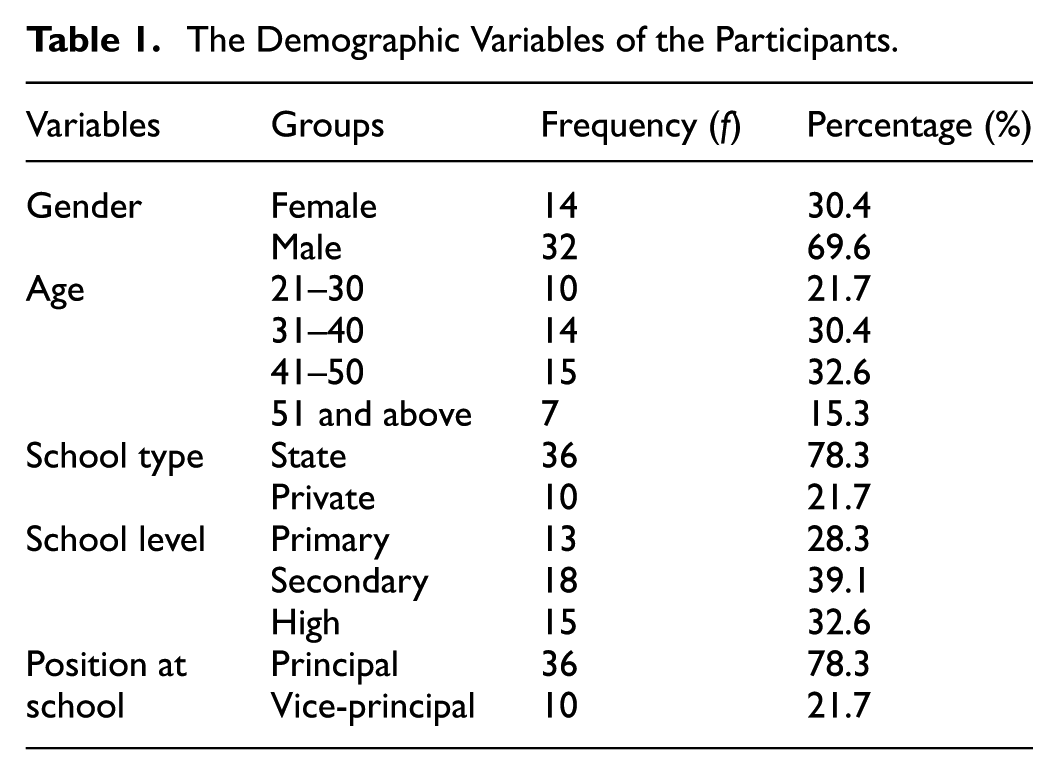
The study’s participants consist of 57 school administrators pursuing their master’s degrees at Mustafa Kemal University Faculty of Education in Hatay, Turkey. While all school administrators enrolled in the master’s program were invited to participate in the research, a total of 46 administrators volunteered to take part in the study (Table 1).
The Demographic Variables of the Participants.
Data Collection Tools
The research employed the semi-structured interview technique as a qualitative data collection method. This technique grants the researcher the freedom to pose prepared questions to participants while staying within the scope of the subject and domain. Moreover, it allows for additional inquiries to gather more comprehensive information. For this study, the process unfolded in several stages. Initially, Deleuze and Guattari’s philosophies were introduced over a span of 12 weeks within the “adult education and lifelong learning” course of the master’s degree program. The school administrators were assigned tasks related to these philosophies. Subsequently, interviews were conducted with the administrators to address sub-problems of the research. The interviews employed open-ended semi-structured questions developed by the researcher. Through these initial interviews, a draft of the semi-structured interview form was developed by the researcher to gather the insights of the administrators. To ensure the reliability and clarity of the interview tool, a multi-step development process was followed. Initially, a comprehensive literature review was conducted, followed by preliminary interviews with school administrators to draft the initial version of the interview form. Subsequently, expert feedback was obtained from five faculty members with doctoral degrees. To ensure the efficacy of the interview form, expert opinions were sought. Two associate professors specialized in the field of philosophy and three associate professors specialized in the field of educational sciences were consulted, their feedback resulting in refinements to the questions in the interview form. Based on their suggestions, the interview questions were revised for content and conceptual accuracy. The input of a doctoral faculty member, with expertise in grammar, was also sought to enhance the clarity and comprehensibility of the form. Following these editions and corrections, the interview form was finalized. A pilot study was then conducted to identify any potential issues with clarity and meaning in the questions. Following the pilot implementation, final revisions were made, and the interview forms were finalized. To facilitate smooth data collection, appointments were scheduled in advance with participating school administrators, who were working in public schools, and all interviews were conducted according to the scheduled times. The interview process delved into detailed discussions, further probing concepts through supplementary questions such as “Could you provide an example?,”“What exactly do you mean?,” and “Can you explain further?.” These follow-up questions aimed to explore surface-level discussions more profoundly and gain a deeper understanding. The interviews were conducted individually, providing a face-to-face interaction with each participant. The duration of each interview ranged from 20 to 50 min. The data collection phase spanned ∼21 days, during which the research gathered valuable insights from the participants.
The study spanned 12 weeks, during which participants engaged with Deleuze and Guattari’s philosophy through a progressive curriculum. In the first 3 weeks, the foundational ideas of Deleuze and Guattari were introduced and explored. The following 4 weeks were dedicated to in-depth discussions on key philosophical concepts such as deterritorialization, rhizome, body without organs, and desire machines. These sessions involved both instructor-led explanations and open classroom debates. Over the next 3 weeks, the focus shifted to examining participants’ perceptions of behavioral complexity and intuitive decision-making competencies in light of the philosophical framework. This stage encouraged participants to draw connections between theory and their own professional practices. During the final 2 weeks, the course content was synthesized through integrative discussions, in which participants critically evaluated both the strengths and limitations of applying these philosophical perspectives to educational leadership. Throughout the course, participants completed reflective assignments, engaged in guided readings, and participated in group discussions, which allowed them to internalize and articulate how the philosophy might shape their thinking and practice. While the study employed a qualitative approach rather than a case study design, all participant responses were analyzed in depth with attention to emerging patterns and conceptual insights.
Ethical Considerations
Before commencing the study, the necessary ethical approval was obtained from the Scientific Research and Publication Ethics Committee of University (date: June 6, 2024, meeting no. 06, decision no. 09).
To protect participants and prevent any potential issues with institutions or individuals, the identities of all participants were kept strictly confidential, and codes were used instead of names during data analysis. Prior to recording participants’ statements using mobile phones or voice recorders, verbal consent was obtained, and an informed consent form, prepared in advance, was read and signed by the participants. Furthermore, participants were assured that the voice recordings would be securely stored and would not be shared with others, either in part or in full, under any circumstances. After the data analysis was completed, the findings were shared with the participants one final time to confirm whether they had any additional opinions or wished to retract or revise any statements. In this way, potential harm to participants was minimized.
During the data collection process, participants’ responses to the research questions were obtained solely through verbal communication. This approach was adopted to prevent any social, psychological, or physical harm to the participants. In fact, providing an opportunity for participants to share past negative experiences can be considered a therapeutic process in itself. Before the interviews began, participants were informed that their involvement in the study was entirely voluntary, that they could stop answering questions at any time without providing any justification, and that they could withdraw from the study whenever they wished. Nonetheless, some participants may have experienced temporary emotional reactions or sadness while answering certain questions. However, considering the potential contributions of this study to teachers, students, parents, administrators, educators, those interested in the field, and even broader communities, the research was deemed highly valuable for the field of education. Indeed, some participants expressed happiness during the study, stating that they were pleased to have their opinions, views, and ideas heard and to know that their perspectives will be shared through an academic publication.
Data Analysis
The data obtained in these research underwent analysis using the content analysis method, which incorporated both inductive and deductive approaches. First of all, the data, obtained through mobile phones and recording devices, were transcribed into computer environment. Pertinent elements, the places, words, sentences, and dimensions, considered important for the research, were marked for coding. Coding entailed employing words and concepts articulated by the participants as codes. In certain instances, synonyms or phrases closest to the concept were used as codes. The process followed the line-by-line analysis approach outlined Patton (2014). In an effort to reflect the participants’ perspectives accurately, direct quotations were predominantly used. The coding phase was carried out collaboratively by three different doctoral faculty members, and subsequent comparison of codes exhibited a compatibility rate of 92%. The coding was finalized upon achieving data saturation, the point where repetition and redundancy became evident (Charmaz, 2006).
The coding process began by breaking down all codes into subcategories, subsequently forming themes under these categories. This categorization enabled harmonious alignment among the various data segments. The deductive method was applied to the primary headings/dimensions, where findings were presented. These main headings, pivotal to the thematic analysis of behavioral complexity and intuitive decision-making abilities of school administrators, were determined at the outset of data analysis to set the context. In contrast, the inductive method guided the identification of themes. Four distinct themes (collaboration, control, creation, and competition) emerged under the main heading. The themes and sub-themes identified in this study were derived directly from the responses of participants to the research questions. Accordingly, a qualitative content analysis approach was followed: initial codes were generated from participants’ expressions, and these codes were then conceptually grouped to form broader categories and themes. Once the data were rigorously examined, the dimensions and themes were organized into comprehensive tables and subsequently interpreted. Although the tables in the results section present individual codes, the narrative interpretation under each sub-research question reflects how these codes were synthesized into meaningful thematic structures. This inductive process ensured that the emerging themes were firmly grounded in the data.
Findings
This section of the study delves into the sub-problems that were outlined to explore the impact of Deleuze and Guattari’s philosophies of rhizome, deterritorialization, body without organs and desire machines on the behavioral complexity, and intuitive decision-making competencies/behaviors of school administrators.
When Table 2 is examined, it becomes evident that school administrators’ viewpoints regarding changes in behavioral complexity and intuitive decision-making behaviors, following their exposure to Deleuze and Guattari’s rhizome philosophy, are defined with eight distinct codes. The interviews with school administrators and the data obtained indicate that a significant majority of school administrators observed a positive impact of Deleuze and Guattari’s rhizome philosophy on both their behavioral complexity behaviors and intuitive decision-making behaviors.
School Administrators’ Perceptions on Behavioral Complexity and Intuitive Decision-Making Competencies/Behaviors Based on Deleuze and Guattari’s Concept of Rhizome.
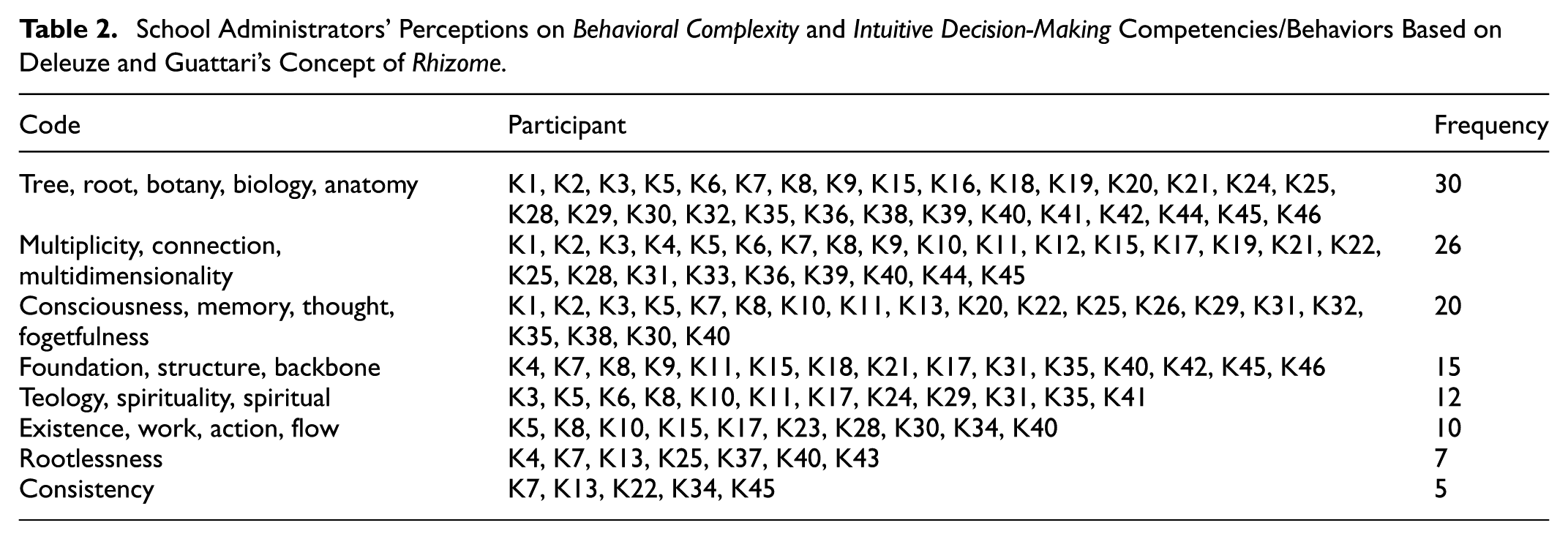
Selected opinions from school administrators regarding the changes in their behavioral complexity and intuitive decision-making behaviors following their engagement with Deleuze and Guattari’s rhizome philosophy include:
Participant 3: “I now employ rhizome philosophy to cope with the problems I encounter. In other words, I try to explain the whole issue, problem or event as a whole, by adopting a holistic approach from a given point or problem’s origin. Should there be notions or sentiments that do not align with my understanding of the problem, I choose to ignore them.”
Participant 5: “In instances where I experience behavioral complexity or engage in intuitive thinking, I no longer look for a linear causality akin to the rhizome philosophy. Therefore, I find it easier to establish connections among diverse events and I do not make an effort to simplify tese events into singular or plural occurances. This often allows me to make more confident decisions or assessments.”
Participant 15: “When making decisions about the events I encounter, I intuitively benefit most from the rhizome philosophy by thinking both good and bad together and at the same time. This approach allows me to concurrently consider both positive and negative aspects of situations. This, in turn, enables me to make connections between events that lack fixed roots, thanks to non-representational multiplicities encompassing subjects, objects, principles, and behaviors that are not based on a specific system. This multifaceted perspective allows me to make more accurate decisions about events.”
Participant 38: “According to the rhizome philosophy, interpretations can only expand through capturing diverse points and interconnecting them coherently. By adopting this philosophy, when I encounter a situation that I need to think or solve, I examine the situation from various perspectives. Subsequently, by connecting these points, I find I can solve complex events more effectively through more accurate intuitive behaviors and make more accurate decisions.”
When Table 3 is examined, it becomes apparent that school administrators’ perspectives on the change in behavioral complexity and intuitive decision-making behaviors following their exposure to Deleuze and Guattari’s philosophy of deterritorialization are defined through nine distinct codes. School administrators stated that the philosophy of deterritorialization had a beneficial impact on their cognitive processes and ideation. They reported shedding negative thoughts and embracing positive thoughts thanks to this philosophy, thereby strengthening both their intuitive behaviors and their grasp of complex behaviors.
School Administrators’ Perceptions on Behavioral Complexity and Intuitive Decision-Making Behaviors Based on Deleuze and Guattari’s Concept of Deterritorialization.
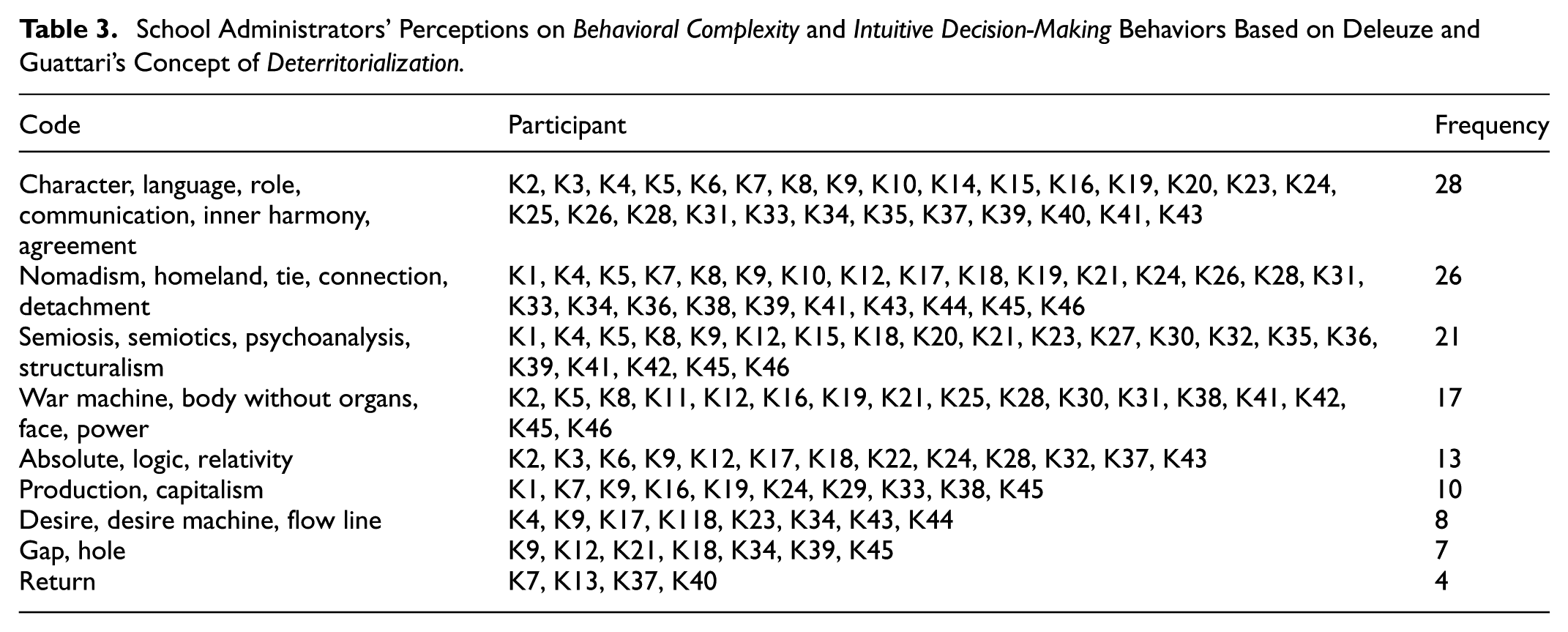
Selected viewpoints from school administrators regarding the changes in their behavioral complexity and intuitive decision-making behaviors following their engagement with Deleuze and Guattari’s philosophy of deterritorialization:
Participant 4: “Since encountering Deleuze and Guattari’s philosophies, I have actively incorporated these philosophies in my school management practices. For instance, if I find myself entangled in stereotypical thoughts concerning a problem, issue, or event that have been ingrained in my mind, I combat these thoughts using the philosophy of deterritorialization. In cases where I am plagued by obsessive thoughts about certain event or events, I first break free from these mental chains through the rhizome philosophy and then proceed to deterritorialize them. Similarly, when confronted with complex events demanding intuitive decision-making, I first get rid of these negative thoughts through the philosophy of deterritorialization. Subsequently, I try to solve the event by establishing connections between my positive thoughts about the tenets of rhizome philosophy.”
Participant 12: “When I encounter challenging situation, the first thing that comes to my mind is the philosophies of Deleuze and Guattari. Their philosophy of deterritorialization, which dismantles ideas before reconstituting them, compels me to utilize my intellect, reasoning, and logic adeptly. Consequently, this also increases the productivity of my reasoning in the face of events. I am very happy to have learned the philosophies of Deleuze and Guattari.”
Participant 24: “I, like Deleuze and Guattari, liken the philosophy of deterritorialization without a home to nomadic lives. In philosophy, there are signs that guide people. In other words, each signifier leads to the subsequent one. I believe the philosophy of homelessness entails that in every event I encounter, prior experiences and ideas serve as guides to the next event. Hence, thanks to the philosophy of deterritorialization, I extract lessons from every situation I encounter, gain ideas, and then utilize these ideas as guiding principles in other scenarios. This process fortifies my intuitive behaviors and enhance my comprehension of complex behaviors.”
When Table 4 is examined, it becomes evident that school administrators’ perspectives on the changes in their behavioral complexity and intuitive decision-making behaviors following their exposure to Deleuze and Guattari’s philosophies of “body without organs” and “desire machines” are defined with seven distinct codes. These administrators conveyed that their behavior became more conscious and sensitive while performing their duties due to the influence of “body without organs” and “desire machines” the philosophies.
School Administrators’ Perceptions on Behavioral Complexity and Intuitive Decision-Making Behaviors Based on Deleuze and Guattari’s Concepts of Body Without Organs and Desire Machines.
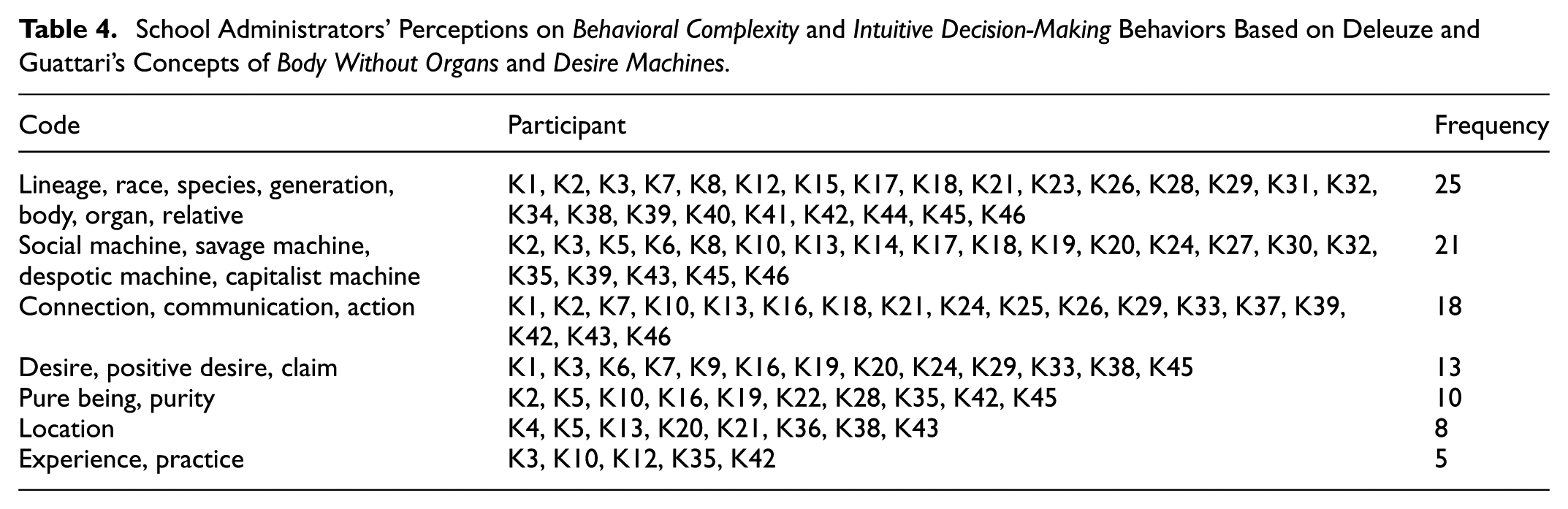
Selected viewpoints from school administrators concerning the changes in behavioral complexity and intuitive decision-making behaviors after learning about Deleuze and Guattari’s philosophy of “body without organs” and “desire machines” include:
Participant 7: “After examining Deleuze and Guattari’s philosophies of ‘body without organs’ and ‘desire machines’, I adopted the idea that the human mind and body are engaged in a perpetual endeavor by connecting with desire and knowledge. I perceive individuals, akin to machines, as constantly making connections, and even when these connections are sometimes interrupted, in essence they fundamentally serve a goal or purpose. Based on this idea, when I encounter an issue in school management, I try to understand the event both physically and mentally, akin to a machine. Although I sometimes get away from the essence of the event as a result of thoughts, I realize these philosophical concepts enable me to recognize these interruptions and refocus on the essence of the event. By focusing on the event, I direct my intuitive and complex behaviors by thinking about the connections associated with the event. Deleuze and Guattari’s philosophy has significantly contributed a lot to me intellectually.”
Participant 19: “Similar to every system within the human body constituting a machine, interconnectedness abounds (e.g. mouth, stomach, small intestine, large intestine, and anus), and if one component malfunctions, the others cannot fulfill their functions. Analogously, the school embodies various ‘machines’ (students, parents, teachers, administrators), which are also interconnected. As with machines, in human life, each individual should optimally perform their designated role in the best way possible. Otherwise, since the next ‘machine’ depends on you, a failure on your part will disrupt the subsequent system or machines. For this reason, both teachers and school administrators should use their intuition and behavior in the most accurate way in order not to disrupt the functioning of these mechanical systems, and they should strive to perform their tasks in the best, most accurate, most efficient and most effective way. After examining Deleuze and Guattari’s philosophy of ‘body without organs’ and ‘desire machines,’ I found myself acting with higher sensitivity and consciousness while fulfilling my professional and personal responsibilities.”
Participant 41: “Based on Deleuze and Guattari’s philosophies of ‘body without organs’ and ‘desire machines’, I have set aside complex thoughts, problems, and obsessions that previously occupied my mind, instead focusing on avenues to enhance my job performance. These intriguing philosophies of Deleuze and Guattari have redirected me away from negative and complex thoughts, guiding me towards the appropriate execution of my duties. They have enlightened my path, bringing clarity and consciousness to my professional role and fostering a more successful approach as a school administrator.”
When Table 5 is examined, it is evident that school administrators’ perspectives on the changes in behavioral complexity (collaboration, control, creation, competition) behaviors following their exposure to Deleuze and Guattari’s fundamental philosophies are defined with 12 distinct codes. Schools represent complex structures, and school administrators shoulder the responsibility of navigating these complex structures. The adoption of appropriate behaviors and decisions by school administrators, rooted in creative, collaborative, positive, and intuitive principles of Deleuze and Guattari’s philosophies, has the potential to enhance the motivation of both school administrator and employees, consequently leading to an increase in the academic and social achievements of the institution.
School Administrators’ Perceptions on Behavioral Complexity (Collaboration, Control, Creation, Competition).
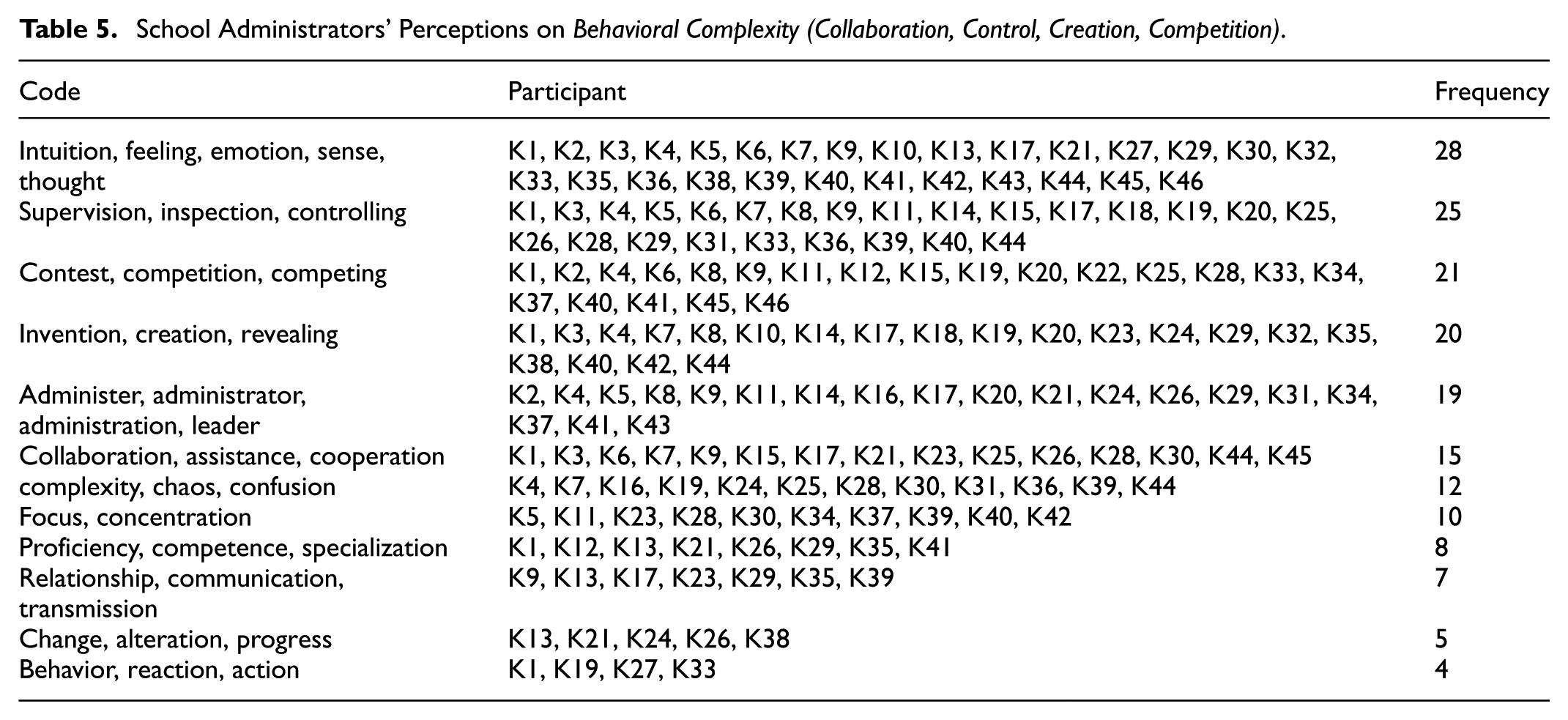
Highlighted below are some viewpoints expressed by school administrators concerning behavioral complexity following their exposure to Deleuze and Guattari’s philosophy:
Participant 6: “Deleuze and Guattari’s philosophies have liberated me from the grasp of negative thoughts, confusion, and chaos when making decisions. Moreover, when relying on my intuition to make decisions on specific matters, I endeavor to incorporate the philosophies of rhizome and deterritorialization.”
Participant 17: “The acquisition of philosophy, especially philosophies applicable to management, has relieved me psychologically. Presently, I perform my tasks or jobs meticulously and diligently by relying on my intuitive behavior, aiming to remain uninfluenced and to avoid disrupting the tasks of others, similar to the principles of the ‘body without organs’ and ‘desire machines’.”
Participant 26: “After learning Deleuze and Guattari’s philosophies, my role as a school administrator has shifted away from competing with other schools. I now place trust in my teachers, encourage them to succeed, and provide support to deliver the most effective education to our students. I think this shift will increase the success of the school and create a positive, joyful school environment.”
In addition, the interviews with school administrators regarding the concept of behavioral complexity and its sub-dimensions (collaboration, control, creation, competition) unveiled a recurring and interlinked relationship among all sub-dimensions of behavioral complexity. The research data revealed a strong correlation between the sub-dimensions of collaboration and creation, while a lesser correlation was observed between collaboration and competition.
Participant 41: “As a school administrator, I believe that collaboration, creation, controlling and competing should all coexit within an organization. However, I also think that it is essential to maintain a certain balance, as an excessive emphasis on these aspects can potentially harm the organization.”
Participant 36: “I believe these skills should be inherent for all school administrators and teachers. However, there should be moderation, ensuring that these skills do not transform into unchecked ambition, leading individuals to exceed expected levels, which could result in health-related issues. Exaggerations should be avoided.”
Participant 19: “In fact, the concepts of collaboration, creation, control, and compettipn are related to each other, supporting one another and contributing to overall success. Therefore, a balanced and coordinated application of these skills has the potential to elevate achievement.”
Participant 23: “There are many skills known today that can affect success. However, I consider that collaboration and creation skills to be paramount in fostering self-fulfillment and success. While collaboration bolsters achievement, competition can become detrimental if it transforms into unwarranted ambition. Hence, the nurutirng of these skills in schools is imperative, guided by our teachers and administrators through the the teachings of Deleuze and Guattari’s philosophies, raising awareness among all educators.”
Discussion
This research has been grounded in Deleuze and Guattari’s perspective presented in Anti-Oedipus, exploring essential skills that modern school administrators should possess. The study investigated the intricate relationship between the behavioral complexity repertoire of school administrators and their intuitive decision-making competencies. Guided by the postmodernist concepts of Deleuze and Guattari, especially their notion of deterritorialization, this study responds to the need for new frameworks in leadership, as traditional paradigms often fall short in addressing contemporary educational challenges. As Uhl-Bien (2021) argues, increasing interconnectivity brings rising complexity, a condition inherent to modern organizations that demands school administrators take on evolving and multifaceted roles (Thompson, 2020).
Behavioral complexity administration requires both cognitive and behavioral capabilities to effectively manage a wide range of situations, including contradictory ones (Jawadi et al., 2013). These skills include responding to stakeholder expectations, navigating competitive dynamics, and performing a variety of leadership roles. Deleuze and Guattari’s deterritorialization concept offers a useful lens for understanding this dynamic. The administrators’ thoughts, emotions, and decision-making processes, as revealed in this study, often reflected the fluidity and adaptability associated with deterritorialization. This philosophical orientation supported administrators in breaking from deterministic thinking and embracing context-sensitive leadership, ultimately fostering deterritorialized forms of administration.
In addition to deterritorialization, the concept of the rhizome proved central. Administrators reported that after engaging with Deleuze and Guattari’s ideas, particularly through graduate-level coursework in educational sciences, they began to view their leadership not as hierarchical or linear, but as relational and interconnected. The rhizome, as described by Deleuze and Guattari (1977), represents endless, non-hierarchical lines of growth and connection. Participants who intsernalized this thinking described greater openness to uncertainty, relational complexity, and networked forms of decision-making (Gajauskaitė, 2024). The combination of rhizomatic and deterritorialized perspectives allowed administrators to disengage from rigid practices and manage diversity and organizational change more effectively (Munro, 2015).
The findings suggest that administrators who previously relied on conventional or habitual methods shifted toward new philosophical understandings. Concepts such as desire machines and body without organs enabled them to think about their professional identities as fluid and multi-dimensional. As a result, they reported the development of multifaceted perspectives, the ability to discard biases and negative thought patterns, and a habit of drawing insight from lived experience. These shifts reflect the conscious integration of postmodern thought into professional practice, a transformation facilitated through reflective academic engagement.
This transformation also underscores the importance of philosophical content in educational leadership training. It is recommended that administrators receive training on philosophical concepts—particularly those from Deleuze and Guattari—that guide reflective practice and support complex decision-making. These teachings could be incorporated into both graduate programs and state-supported in-service training. They would not only help school leaders become more adaptive and insightful, but also foster broader institutional capacity for process management, ethical leadership, and systemic improvement.
With regard to behavioral complexity, this study examined sub-dimensions such as collaboration, control, creation, and competition. The strongest positive correlation was found between collaboration and creation, suggesting that school leaders often foster innovation through cooperative environments. The lowest positive relationship appeared between collaboration and competition, echoing findings by León et al. (2017). However, qualitative analysis revealed that competition—often overlooked or misunderstood—was viewed by administrators not as aggressive or external rivalry, but as an internal process. Many described competition as a motivating force driving personal excellence, high performance, and organizational improvement. This aligns with Deleuze and Guattari’s emphasis on transformation through internal desire flows. Administrators saw competition not as zero-sum, but as part of an ethos of excellence grounded in ethical ambition and staff development.
These results highlight the relevance of postmodern perspectives in understanding internal school processes. For example, the control dimension was frequently associated with self-regulatory practices and internal systems for policy implementation and project execution. School leaders emphasized mechanisms that promote accountability while allowing flexibility, a reflection of the intuitive balancing act between order and innovation. In turn, intuitive decision-making was seen as key to managing these tensions. As noted in previous studies (Kinchington, 2020; Luo, 2008), intuition plays a vital role in navigating uncertain, time-sensitive, and politically charged educational environments.
This research found that intuitive decision-making significantly influenced both control and competition behaviors. Administrators described intuition as drawing on tacit knowledge, trust, and accumulated professional experience. Their judgments were often described as affective and embodied rather than strictly logical. This resonates with Deleuze and Guattari’s treatment of non-rational, desire-driven flows of decision-making. In this framework, leadership becomes not only a rational act but an emotional and existential one where instinct, context, and relational intelligence guide complex choices.
Conclusion and Implications
Overall, the conclusion drawn from this study extends well beyond the idea of embracing “freedom.” Rather, it reflects the emergence of a more adaptive, ethically grounded, and philosophically reflective leadership identity. School administrators who encountered Deleuze and Guattari’s work reported developing new cognitive and affective tools to approach uncertainty, rethink leadership roles, and navigate ambiguity with creativity and composure. Their exposure to Anti-Oedipus and related texts opened space for what Deleuze and Guattari would call “lines of flight”—routes out of static roles and into continuous learning.
This research contributes to the growing interest in integrating philosophical thinking into educational leadership. Poststructuralist theory, often seen as abstract, proved in this context to be directly applicable to real-world challenges. Its value lies not in prescribing solutions, but in encouraging reflection, disruption of fixed categories, and openness to multiplicity.
In practical terms, leadership training programs should consider incorporating philosophical perspectives that emphasize complexity, interconnection, and emotional intelligence. Deterritorialized thinking can help administrators reimagine leadership as a non-linear process of navigating systems, people, and power. Rhizomatic structures allow for leadership, that is, collaborative, responsive, and grounded in authentic relationships. Future studies might examine how different institutional settings mediate these philosophical applications, or how long-term engagement with theory influences leadership behavior in practice.
Limitations
Despite its contributions, this study has several limitations. First, the sample consisted exclusively of school administrators enrolled in a master’s program in educational sciences, which may limit the generalizability of the findings to administrators with different academic or professional backgrounds. Their exposure to Deleuze and Guattari’s philosophy occurred in a specific academic context, which likely influenced their interpretations and reflective depth. Second, the study relied on self-reported perceptions obtained through qualitative interviews; while rich in detail, these responses may be influenced by participants’ desire to align with perceived academic expectations. Additionally, the research focused on philosophical engagement over a single semester, meaning the long-term effects of this exposure on administrative behavior remain unknown. Finally, contextual variables such as the administrators’ school environments, regional policies, or cultural influences were not deeply examined, which may affect how these philosophical frameworks are internalized and applied in diverse settings.
From an ethical standpoint, another limitation relates to the reliance on self-disclosure during interviews. Although confidentiality was ensured, participants may have exercised caution in fully expressing critical views. Furthermore, while informed consent procedures and safeguards against harm were in place, the short duration of the study limited opportunities to assess potential delayed impacts of engaging with challenging philosophical concepts. Future research should consider longitudinal designs to better capture both professional growth and any unforeseen risks over time.
Footnotes
Acknowledgements
The author would like to acknowledge Assoc. Prof. Dr. Yunus Doğan from Dicle University Faculty of Foreign Languages and Tourism, whose support in addressing the requested revisions and careful proofreading greatly strengthened this article.

Ethical Considerations
The Scientific Research and Publication Ethics Committee of Social and Human Sciences at Hatay Mustafa Kemal University approved our interviews (approval: 902-01-FR 006) on June 6, 2024.
Consent to Participate
Respondents gave written consent for review and signature before starting interviews.
Funding
The author received no financial support for the research, authorship, and/or publication of this article.
Declaration of Conflicting Interests
The author declared no potential conflicts of interest with respect to the research, authorship, and/or publication of this article.
Data Availability Statement
Data sharing not applicable to this article as no datasets were generated or analyzed during the current study.