



Abstract
This study investigates the effects of natural resources, non-renewable and renewable energy consumption, financial development, and globalization on environmental quality, while also incorporating industrialization, economic development, and trade openness into the model across developed, developing, and emerging economies over the 1985 to 2019 periods. Using dynamic fixed effects (DFE), dynamic seemingly unrelated regressions (DSUR), and the dynamic system generalized method of moments (DSGMM), the findings indicate that natural resource rents and non-renewable energy consumption significantly intensify environmental degradation by raising CO2 emissions across all country groups. In contrast, renewable energy use, industrialization, and financial development reduce CO2 emissions in all but emerging countries. Additionally, globalization has a positive and significant impact on CO2 emissions in emerging and developing economies, while its effect is insignificant in developed nations. Notably, in emerging economies, financial expansion is found to worsen environmental quality, indicating a need for targeted policy interventions. To address these environmental challenges, the study recommends promoting green technology transfer through foreign direct investment in renewable energy, enhancing financial development to support eco-friendly arrangement, and expanding renewable energy emissions, particularly in emerging markets. These findings underscore the complex role of various economic and energy-related factors in shaping environmental outcomes and highlight the importance of tailored environmental and energy policies based on a country’s development status.
Keywords
Introduction
Carbon dioxide (CO2) emissions remain a critical issue for developed, developing, and emerging economies. The main driving factors include natural resources, energy use, globalization, industrialization, and financial development. Although extensive research has examined the link between economic development, energy use, and carbon emissions, most studies concentrate on single countries or particular regions and rely primarily on time-series data. Far less attention has been given to the causal effects of natural resources, financial development, globalization, and industrialization on CO2 emissions (Balsalobre-Lorente et al., 2018; Dong et al., 2019; Kafeel et al., 2025; Khan et al., 2020a; S. Khan et al., 2025; Zaidi et al., 2019; Y. J. Zhang, 2011). Many studies have also failed to include critical variables or rely on traditional panel data techniques.
This study addresses this gap by analyzing the influence of natural resource depletion, financial development, globalization and non-renewable energy consumption, on CO2 emissions or emissions across developed, developing, and emerging economies from 1985 to 2019.
Greenhouse gas emissions affect not only emerging countries but also developing and developed nations. According to World Economic Forum (2019), the highest polluters include both developed and emerging economies. Natural resources are fundamental to economic and social development. Aneja et al. (2023) and Khan et al. (2020b) noted that in early development stages, economies depend heavily on natural resources, but at more advanced stages, societies demand a cleaner environment. Zafar et al. (2019) argue that natural resources are essential to maintaining environmental quality. However, over-exploitation can cause degradation, particularly in mining, agriculture, and deforestation (Hassan et al., 2019b). Excessive extraction in the pursuit of growth deteriorates environmental quality, as shown by Aneja et al. (2024) in G20 countries.
Globalization significantly influences social, political, and economic life. It facilitates the movement of goods, services, capital, people, and technology across borders (O’Rourke & Williamson, 2001; Zaidi et al., 2019). It promotes development through foreign direct investment (FDI) and trade (Shahbaz et al., 2015b). According to Shahbaz et al. (2017), globalization enhances environmental quality and financial development. However, it can also lead to increased pollution due to intensified urbanization and industrialization. Navarro (1998) noted that globalization integrates domestic with global economies, creating disparities in wealth and contributing to environmental challenges in emerging countries. Another study about citizens’ behavioral intentions toward cryptocurrency adoption using the diffusion of innovation theory, analyzing factors such as relative advantage, compatibility, complexity, trialability, and observability. Data collected from potential users in Karachi reveal that relative advantage, compatibility, and complexity significantly influence adoption, while trialability and observability do not. These findings provide valuable insights for promoting cryptocurrency in emerging markets (Fakhrullah et al., 2024). Financial development is another vital factor influencing environmental quality. A growing body of literature explores its link to economic development (Levine, 1997; Sadorsky, 2010; Shahbaz & Lean, 2012), but fewer studies examine its effect on CO2 emissions using panel data (e.g., Dogan & Seker, 2016; Salahuddin et al., 2015; Tamazian et al., 2009). Two contrasting views exist: one posits that financial development boosts growth and energy consumption, thereby increasing CO2 emissions (Sadorsky, 2010; Shahbaz & Lean, 2012), while the other suggests it can reduce emissions by encouraging cleaner technologies (Jalil & Feridun, 2011; Zaidi et al., 2019). Some studies report no significant impact (Dogan & Turkekul, 2016; Salahuddin et al., 2018). The environmental impact of financial development may depend on the good quality and structure of financial firms. Greater trade liberalization can improve risk sharing and reduce investment costs, driving growth and emissions (Bekaert & Harvey, 2000; Sadorsky, 2010).
Industrialization also profoundly affects CO2 emissions, with impacts varying across development stages (K. Li et al., 2015). While it raises living standards and fosters innovation, it also causes environmental harm, especially in emerging economies where industrial waste contributes to air and water pollution (He et al., 2012). More studies offer a comprehensive assessment of the relationship between CO2 emissions and the achievement of Sustainable Development Goals (SDGs) across European countries. By analyzing environmental and economic indicators, the research highlights the importance of environmental stewardship in promoting long-term economic prosperity. The findings emphasize the need for integrated policies that balance ecological sustainability with economic development (Fakhrullah et al., 2024). Industrialization accelerates growth, but also leads to deforestation, health issues, and climate change (Saboori & Sulaiman, 2013).
Despite the significance of these factors, few studies have comprehensively examined their combined effect on CO2 emissions using robust econometric methods across multiple countries. Existing literature mostly focuses on the energy-emissions nexus without adequately including variables like natural resource depletion or composite indices for financial development and globalization. This study addresses these gaps by incorporating new elements such as resource depletion and applying weighted indices for financial development and globalization using Principal Component Analysis (PCA) as in Zafar et al. (2019), M. Haseeb et al. (2019), and Shahbaz et al. (2016a). These indices reduce multicollinearity and capture more accurate dynamics.
Moreover, this research employs dynamic models such as DSUR, system GMM, and DFE to address endogeneity, measurement errors, and omitted variable bias (Blundell & Bond, 1998). The goal is to understand the roles of financial development, resource use, and globalization in driving or mitigating CO2 emissions, and to provide practical insights for environmental policy.
The findings are timely and relevant considering current debates on green finance, clean technology, and global sustainability. In summary is being studied because rising CO2 emissions pose a significant threat to global environmental sustainability, public health, and economic stability. Understanding the complex drivers—such as natural resource depletion, financial development, and globalization—is essential for designing effective policies to mitigate climate change across diverse economies. Furthermore, this study contributes to the literature by empirically assessing whether reductions in resource extraction, increased renewable energy usage, improved financial systems, and globalization policies contribute to emissions reductions. The results will inform policymakers aiming to develop strategies for environmental sustainability and carbon reduction.
The remainder of the paper is organized as follows: Section 2 presents the literature review. Section 3 describes the data and methodology. Section 4 discusses results and findings. Section 5 concludes with policy recommendations.
Literature Review
The literature review analyzes how financial development, renewable energy, natural resources, and globalization influence CO2 emissions.
Financial development plays a key role in economic development and environmental quality, but empirical findings remain mixed. Some studies found that financial development helps reduce emissions. For instance, Saidi and Mbarek (2017) using GMM showed that financial development reduces CO2 emissions in emerging economies. Similar findings were reported by Shahbaz et al. (2016b), S. Wang et al. (2016), Z. Wang et al. (2018), Uddin et al. (2016), Esso and Keho (2016), and Chen et al. (2016). F. Islam et al. (2013) found both long-run and short-run relationships in Malaysia, while Omri et al. (2015) found a positive link in MENA countries. In the case of China, S. Zhang et al. (2025) put forward that green technology innovation and financial development mediate the emissions reduction effects of economic agglomeration.
On the contrary, Boutabba (2014) showed that financial development increases CO2 emissions in India. Abbasi and Riaz (2016) emphasized its importance in reducing emissions in developing countries. However, Shahbaz et al. (2015a) argued that financial sector development degrades environmental quality in Pakistan. Bekhet et al. (2017) found that, except for the UAE, financial development leads to CO2 emissions in GCC countries. Kahouli (2017) and Khan et al. (2017) found unidirectional and bidirectional causality respectively, while (Khan et al., 2021; Riti et al., 2017) found that financial development reduces emissions. Some found no significant relationship, for example, Salahuddin et al. (2018) in Kuwait and Baloch et al. (2018) in Saudi Arabia. Others like Pata (2018), Amri (2018), and Zafar et al. (2019) confirmed positive associations. Recently, Rahman et al. (2024) found financial development worsens environmental quality in Pakistan. For some group of countries and panel studies some recent study such as (S. Khan et al., 2025; S. Zhang et al., 2025) reported the financial development deteriorate environmental quality. Renewable energy consumption also shows mixed outcomes. Shahbaz et al. (2017), using Bayer and Hank co-integration and VECM, found a positive relationship between financial development and resource rent in the U.S. Farhani et al. (2014) reported long-run bidirectional causality among renewable/nonrenewable energy, growth, and CO2 in MENA countries. Ackah and Kizys (2015) identified key drivers of renewable energy in African oil-rich countries as per capita income, energy prices, depletion, and carbon emissions. Ben Jebli et al. (2016) used panel data from 17 OECD countries and found economic development and renewable energy consumption impact emissions. Shahbaz et al. (2017) noted different effects between high- and low-income countries, implying tailored policies are necessary. Sari et al. (2008) found industrial output positively impacts renewable energy use. Bowden and Payne (2010) showed unidirectional causality from residential renewable energy to GDP. Recently, Muhammad et al. (2021) came with the findings that clean energy mitigates CO2 emissions in developed and developing countries. Similarly, most recently, Waris et al. (2023) put forward that renewable energy plays a pivotal role in reducing CO2 emissions in G20 countries.
Natural resource rents and fossil fuel use remain major emissions drivers (Khoshnevis Yazdi & Shakouri, 2017; Nguyen & Kakinaka, 2019). The EU-28 attributes economic development and emissions control partly to natural resource rents. Globalization also plays a role. Zafar et al. (2019) supported the EKC hypothesis in OECD countries, finding that globalization and financial development can improve environmental quality. According to this study introduces a broad-based index of financial development—spanning financial depth, access, and efficiency—to assess its impact on technological innovation and GDP across IMF-listed countries from A to L during 2019–2022. The results demonstrate strong positive correlations between financial development, innovation, and economic development, emphasizing the role of financial infrastructure in driving sustainable development. These findings offer valuable insights for policymakers aiming to enhance financial systems to support innovation-led growth (Fakhrullah et al., 2024). Balsalobre-Lorente et al. (2018), in a panel study of five European Union countries (1985–2016), find that economic development, renewable energy use, and natural resources are crucial factors of carbon dioxide emissions. Other studies investigate the relationships among energy consumption, economic and environmental factors, and natural resource depletion, indicating that environmental degradation can be reduced through abundant natural resources, clean energy, and energy improvement. The impact of natural resource mining on environmental declination has been studied at national and regional levels. Kwakwa et al. (2020) used the STIRPAT model to analyze Ghana’s environment (1971–2013), finding that rising energy consumption and carbon emissions stem from urbanization, economic expansion, and resource depletion. Pao and Tsai (2011) applied the Gray prediction model to Brazil (1980–2007) and found energy use and environmental harm initially increase with economic development, then level off and decline. Granger causality tests indicate bi-directional connection among carbon dioxide emissions, income, and energy utilization. Excessive resource exploitation leads to environmental problems (Khan et al., 2020a). Economic development spurs urbanization and industrialization, increasing resource exploitation and agricultural emissions (Hassan et al., 2019a). Natural resources also play a key role in emissions, and adequate supply helps control inflation and reduce oil consumption (Balsalobre-Lorente et al., 2018). Prior studies focused mainly on economic development and natural resources, with limited attention to globalization, financial development, and CO2 emissions. Danish et al. (2019) and Balsalobre-Lorente et al. (2018) recently explored these areas. Danish et al. (2019) highlight that South Africa’s environmental degradation is driven by excessive resource use, low renewable energy share, and high fossil fuel consumption. Aneja et al. (2023) found that natural resource depletion deteriorates environmental quality in G20 countries (1992–2018) using a CS-ARDL model. Similarly came with same findings for full sampled countries using system GMM and dynamic fixed effects model. Jia et al. (2024), controlling for corruption, fintech, and information technology, used CS-ARDL on G20 data (2000–2021), showing that rents from oil, gas, and forests significantly reduce environmental risks linked to rising CO2 emissions.
The relationship between renewable energy consumption and economic development may aggravate environmental degradation. Shahbaz et al. (2017) examined financial development, resource rents, and education in the US (1960–2016) using VECM and cointegration tests, and found a positive and significant association between financial development and resource rents. Ben Jebli et al. (2016) analyzed the effects of economic development and renewable energy consumption on emissions in 17 OECD countries using panel and time-series data. Shahbaz et al. (2017) further reported that the effect of renewable energy on CO2 emissions differs by development level, showing a positive link in low-income countries and a negative association in high-income countries. Qi and Li (2017) argued that renewable energy adoption positively affects the environment, appealing to econ-conscious businesses and consumers. Banday and Aneja (2020) used bootstrap panel causality tests to find convergence and divergence in renewable and non-renewable energy consumption among BRICS nations, showing impacts on CO2 emissions. Aneja et al. (2024) highlighted cleaner energy and technological innovation’s role in sustainability, confirming resource depletion’s negative impact on G20 environmental quality. Alfaisal et al. (2024) used quantile regression to show energy efficiency, tourism, and renewable energy reduce CO2 emissions, while economic development raises them in BRICS. Das et al. (2025) and Kafeel et al. (2024) similarly confirmed renewable energy, and environmental taxes reduce carbon emissions in OECD countries. Aneja et al. (2023) further demonstrated that green finance reduces non-renewable energy use globally using the entropy approach, closing a gap in prior research regarding carbonization and energy sources. Kafeel et al. (2025) put forward that green finance and clean technology positively effects CO2 emissions while economic development and NREC adversely effects CO2 emissions. In the same vein, Alfaisal et al. (2024), came with findings that energy efficiency, and REC substantially improves environmental sustainability. Similarly, in a recent study by S. Khan et al. (2025) found that renewable energy improves environmental quality and stresses on the uses and emissions of clean energy.
Studies over the past decade examined globalization’s effect on carbon emissions for individual countries (Chang, 2012; Kanjilal & Ghosh, 2013; K. H. Lee & Min, 2014; Tiwari et al., 2013). Shahbaz et al. (2013a, 2013b), Solarin (2014), Tiwari et al. (2013), and Ling et al. (2015) focused on trade globalization and carbon emissions. Shahbaz et al. (2017) noted that using trade openness alone as a proxy for globalization may be insufficient. Dreher (2006) addressed this by creating a globalization index with political, social, and economic sub-indices. Panel and time series studies have found mixed effects: Shahbaz et al. (2015b) reported globalization increased emissions in India but decreased them in Australia. K. H. Lee and Min (2014) found globalization reduces emissions in a study of 255 countries. Shahbaz et al. (2016b) concluded globalization lowers emissions in most African countries, while Kwabena Twerefou et al. (2017) observed globalization affects environmental quality in Sub-Saharan Africa. Shahbaz et al. (2017) found globalization degrades environmental quality in advanced economies.
This research investigates the impacts of natural resources, nonrenewable energy use, globalization, and financial advancement on carbon emissions. It contributes by examining, for the first time, the combined effect of natural resources, financial development, renewable energy, and global CO2 emissions. Adding natural resources and globalization as an explanatory variable fills a gap in the literature, particularly regarding renewable energy and emissions. The study employs GMM, SGMM, and SUR methods on data from 1985 to 2019 and provides policy insights relevant to developed, developing, and emerging countries to address environmental challenges and achieve carbon neutrality goals. In simple story this literature review is organized around four key themes that influence CO2 emissions: financial development, renewable energy, natural resources, and globalization. It examines existing studies within each theme to identify consistent findings, conflicting evidence, and unresolved research gaps across different countries and regions. While many previous works have explored these factors individually, this study contributes by analyzing their combined effects on CO2 emissions within a single empirical framework. By integrating financial development, renewable energy use, globalization, and natural resource rents, and applying advanced econometric techniques such as GMM, SGMM, and SUR, this research offers a more comprehensive understanding of environmental degradation. This multidimensional approach addresses a notable gap in the literature and provides valuable insights for policymakers aiming to achieve carbon neutrality.
Methodology
This study examines how natural source reduction, renewable and non-renewable energy consumption, globalization, and financial development shape environmental outcomes across developing, developed, and emerging economies. In doing so, it controls for key structural factors such as industrialization, economic development, and trade openness. By taking this broader perspective, the analysis captures the evolving and dynamic nature of CO2 emissions, which more closely reflects real-world conditions, as highlighted by Pierre et al. (2020).
To improve the robustness of the empirical results, a lagged dependent variable is incorporated into the model. Including this term allows the analysis to account for persistence in emissions over time and helps absorb the influence of unobserved or uncontrollable factors that may otherwise bias the estimates. Accordingly, the study employs a dynamic panel framework, specified as follows:

In this model, CDEit represents CO2 emissions. NRECit refers to non-renewable energy consumption, RECit to renewable energy consumption, and TNRit to natural resource depletion. KOFGLOBit captures globalization, while FDFIit measures financial development in the banking sector. The control variables include industrialization, economic development, and trade openness. The coefficients β0 to β6 and λ correspond to the explanatory and control variables. μi reflects unobserved country-specific effects, εit is the error term, and i and t denote country and year. The term CDEit is the lagged value of CO2 emissions.
Since the model includes a lagged dependent variable, traditional methods such as OLS or fixed and random effects may produce biased results due to endogeneity. Therefore, the study applies dynamic panel estimators, specifically; the study employs dynamic seemingly unrelated regressions (DSUR), dynamic fixed effects (DFE), and the dynamic system generalized method of moments (DSGMM). System GMM is preferred because it provides more efficient estimates in the presence of persistence and Endogeneity, while DSUR is used to account for cross-sectional dependence and to check the robustness of the results.
Data and Sources
This reading uses annual panel data from 1985 to 2019 for 37 developed, 23 emerging, and 114 developing countries, excluding those with insufficient data. Two indices are constructed: a globalization index covering social, political, and economic dimensions, and a financial development index based on PCA of domestic credit variables (Shahbaz et al., 2016a; Zafar et al., 2019; Zaidi et al., 2019). CO2 emissions are measured metric tons per capita; natural resource depletion is a percentage of GDP. Other variables include non-renewable and renewable energy consumption, industrialization, GDP per capita, and trade openness (Dreher, 2006; World Bank, 2019). Details are in Supplemental Appendix A–Table 1. The descriptive statistics for this study are presented in Table 1.
Descriptive Statistics.

Source.Author’s analysis based on STATA 14.
Note.Std. Dev stand for standard deviation.
The total rent from natural resources as a percentage of GDP is displayed in Figure 1 for developed, developing, and emerging nations.

Natural resources rents.
The percentage of total renewable energy used in developed, developing, and emerging countries has significantly grown between 1985 and 2017, as shown in Figure 2. According to the graph, in 1985, the percentage of developed, developing, and emerging nations that used renewable energy was 10%, 6%, and 13%, respectively. But in 2017, it rose to 21%, 34%, and 264% (World Bank, 2019).

Renewable energy.
Empirical Results and Discussion
In this study, DFE, DSGMM, and DSUR estimators are applied to achieve the research objectives. For the system GMM estimation, the XTABOND2 procedure developed by Blundell and Bond (1998) is used. Before conducting the main estimations, the data are tested for first- and second-order serial correlation using the Arellano and Bond tests. The results of the AR(1), AR(2), and Sargan tests for GMM system are reported in Tables 3, 6 and 9 for emerging, developed, and developing countries, respectively. The AR(1) and AR(2) statistics confirm the absence of problematic auto-correlation, while the Sargan test shows a p-value above 1%, supporting the validity of the instruments. The empirical findings from DFE, system GMM, and DSUR are also presented in Tables 3, 6 and 9. Model (1) is assessed using DFE, whereas Models (2) and (3) are explained using system GMM and DSUR. Across all specifications, the lagged coefficient of CO2 emissions is statistically significant, indicating persistence in emissions and supporting the existence of a long-run relationship.
Cross-Sectional Dependency Test
The overall cross-sectional dependency test is as follow;
Prior to implementing advanced dynamic panel estimation techniques, it is essential to assess the underlying properties of the variables based on the structured dataset’s. In this context, the initial step involves testing for cross-sectional dependence. Various studies have proposed a significant need to examine whether cross-sectional dependence exists in the study data (Pesaran, 2004). Examining whether the cross-sectional dependence exists, t-statistics with significance provide enough evidence. The cross-section dependence test of Pesaran (2004) is reported in the Table 2 for CDE, TNR, NREC, and KOFGLOB (except FDFI for developed and developing), the values of t-statistics are highly significant at 1%, confirming the presence of CD, which further validate the (bottom-line regressions) results of seemingly unrelated regressions (SUR) and GMM. These findings therefore give an excellent empirical rationale as to why the main estimator employed in the study was the Dynamic SGMM and DSUR) estimator, the principal estimator i.e., specifically developed to provide reliable estimates under such cross-sectional dependence. The panel unit root of Fisher ADF Test, Levin–Lin–Chu (LLC) Test and Im–Pesaran–Shin (IPS) Test for three 3-grouped of countries are given in Supplemental Appendix B–Tables 1 to 9 for developing, developed and emerging countries, respectively, which under examined variables are stationary. The total unit root summary index are also given in Supplemental Appendix B–Table 10. Furthermore, at three panel level, the other CD test are given in Supplemental Appendix B–Table 11.
Cross Sectional Dependence Test.

Note. CD are the cross-sectional dependence (CD) tests by Pesaran (2004). Abbreviations: CDE = carbon emissions(kt); TNR = total natural resources rents; NREC = non-renewable energy consumption; REC = renewable energy consumption; KOGLOB = globalization; FDFI = financial development financial index.
p < .1. **p < .05. ***p < .01.
Emerging Countries
The influence of natural resources depletion, renewable energy consumption, globalization, financial development, and industrialization on CO2 emissions in emerging economies is reported in Table 3. The interrelation between renewable energy consumption (REC) and CO2 emissions is not counter-intuitive but indicates the magnitude effect of total energy demand in the face of the blistering development of the industrial sectors. The total increase in the amount of energy use of all sources is so huge that the increase in renewable capacity, though positive, is too small to offset the overwhelming and growing proportion of fossil fuels in the energy portfolio. This points to a very important policy point: at what point does the environmental advantage of renewables become fully actualized? At what point do they become active as opposed to supplementary to the generation of fossil fuels? Therefore, policy should not only aim at subsidizing renewables but also actively work on the decline of fossil fuels by the use of carbon pricing and phasing out of carbon intensive assets.
Panel Analysis Results for a Panel of Emerging Countries by Using DFE, DSGMM, and DSUR Models.

Source. Author’s analysis based on STATA 14
Note. *, **, *** indicate statistical significance at the 10%, 5%, and 1% levels, respectively. AR(1) and AR(2) denote the Arellano–Bond tests for first- and second-order autocorrelation in the differenced residuals. The Sargan test assesses the validity of the overidentifying restrictions for the instrumental variables within the GMM framework. This clarification also applies to Supplemental Tables 4–11 and is not repeated to prevent duplication.
Table 3 reports the results for models (1) and (2), showing that the given coefficients are significant statistically. The linkage between NREC and CDE is positive and significant. In particular, a 1% rise in NREC increases CDE by 0.003% in emerging economies. The SUR model validates these findings, showing that high energy demand in emerging nations makes NREC the primary CO2 emissions source. These countries rely heavily on energy from non-renewable sources like coal and oil, raising CO2 levels and harming environmental quality. Model (3) confirms the reliability of these results, aligning with prior studies (Aneja et al., 2023; Banday & Aneja, 2020; Farhani & Ozturk, 2015; S. Khan et al., 2019; A. Khan et al., 2021a; T. Li et al., 2016; Muhammad, 2019; Salahuddin et al., 2018; Zafar et al., 2019). Consequently, emerging countries should promote alternative energy sources such as bio-fuels, biogas, ethanol, natural gas, wind, hydroelectric, and solar power. The NREC coefficient signs for developing countries are similar to those for emerging countries in Table 2, warranting further discussion.
Similarly, natural resource depletion (TNR) exhibits a statistically significant positive relationship with CO2 emissions. Models (1), (2), and (3) show a 1% increase in TNR corresponds to a 0.012%, 0.017% and 0.019 rise, in CDE, respectively, indicating environmental degradation caused by increasing carbon emissions. The economic development of industrialized countries accelerates natural resource extraction and unsustainable use, increasing dependence on primary energy imports, which intensifies environmental stress (Balsalobre-Lorente et al., 2018). This study concludes that natural resource abundance contributes to global environmental pollution. Thus, resource-rich countries should reduce reliance on primary energy imports and aim to lower carbon emissions, as fossil fuels dominate the energy mix worldwide. Aneja et al. (2024), Shahbaz et al. (2017), Balsalobre-Lorente et al. (2018), and Shang et al. (2024) support these findings for G20 nations, South Africa, the EU’s five largest countries, and top 10 emitting nations, respectively, though Nuta et al. (2025) found opposing results for European countries.
Regarding financial development (FDFI), models (1), (2), and (3) indicate a positive and significant effect on CO2 emissions in emerging countries. Holding other factors constant, a 1% increase in FDFI raises carbon emissions by 0.058%, 0.028%, and 0.017%, respectively. The development of banking sectors intensifies environmental degradation, as many emerging economies still rely on dirty fossil fuels in emissions, leading to higher resource waste and emissions. These findings align with S. Khan et al. (2019) for 192 countries, Xiong et al. (2017) for underdeveloped regions in China, Shahbaz et al. (2015b) for India, Farhani and Ozturk (2015) for Tunisia and Shang et al. (2024) for top 10 emitting nations.
Financial development supports enterprises by reducing financial costs, expanding financial channels, and minimizing risks, which foster investment and economic development but also increases energy consumption and carbon emissions. Additionally, bank-based institutions provide loans for large purchases that increase greenhouse gas emissions (A. Haseeb et al., 2018). This study concludes that bank sector financial development significantly contributes to CO2 emissions in emerging countries. Similar results were found by Dogan and Seker (2016), Saidi and Mbarek (2017), and Shahbaz et al. (2019). The study suggests that banks should support policies that reduce emissions and enhance environmental quality.
Globalization (KOFGLOB) coefficients related CO2 emissions are significant in all models at the 1% and 10% levels. A 1% rise in globalization increases CO2 emissions by 0.066%, 0.084%, and 0.043%, respectively. These results imply that increased trade and investment due to globalization raise energy consumption and emissions in emerging countries. The increased emissions machinery demands more power, increasing non-renewable energy use. This shows that the scale effect dominates in emerging countries, with external factors exacerbating environmental degradation more than internal factors. These findings contradict You and Lv (2018), Zafar et al. (2019), and Shahbaz et al. (2016a, 2016b), who found globalization reduced emissions.
Renewable energy consumption (REC) surprisingly shows a positive and significant impact on CO2 emissions. Models (1) and (3) confirm this relationship. A 1% increase in REC leads to a 0.002% rise in CO2 emissions. This counterintuitive result arises because renewable energy’s share in total energy consumption remains low relative to non-renewable sources in emerging countries, causing emissions to rise. Secondly, compare this results with developed and developing countries, These contrasting effects likely reflect cross-country disparities in the energy transition process, where developed and developing countries benefit from more efficient renewable technologies and supportive regulatory frameworks, whereas emerging economies may face structural constraints such as fossil fuel lock-in, technology gaps, grid integration challenges, and limited institutional capacity that reduce the environmental effectiveness of renewable energy deployment. This study suggest that emerging countries should reduce fossil fuel consumption and increase renewable energy usage from biofuels, solar, wind, biomass, and hydroelectric sources. Prior studies (Aneja et al., 2024; Balsalobre-Lorente et al., 2018; Banday & Aneja, 2020; Cheng et al., 2019; Das et al., 2025) report similar results for BRICS and G20 countries. These results are contradicted to the previous study of (A. Khan et al., 2021a; S. Khan et al., 2025; Waris et al., 2023).
Industrialization’s impact on CO2 emissions in emerging countries is less clear. The coefficient for industrial value-added (INDUS) is insignificant in model (1) but partially significant at the 10% level in model (2), with model (3) confirming result validity. These findings suggest that rising industrialization may reduce CO2 emissions in emerging countries, contrasting with Dong et al. (2019), who found industrialization increased emissions in developed countries. Raheem and Ogebe (2017) similarly found an inverse effect in 20 African countries. This implies that industrial growth in emerging countries may exert less environmental pressure while promoting economic development.
Economic development (GDPpc) has a negative and significant coefficient in all three models. A 1% increase in GDP per capita corresponds to a −0.0001% decrease in CO2 emissions, indicating economic development reduces emissions in emerging countries. The trade openness (TRO) coefficient is negative and significant only in model (1), but insignificant in others.
Robust Analysis Using Different Specifications for Emerging Countries
To ensure that the results were robust and reliable, we re-ran them using the main system GMM model. Table 4 shows an analysis of the Predictor indictors while controlling for economic development and trade openness from a global perspective, focusing on CO2 emissions with a single key explanatory variable in emerging economies.
Parameter Estimates for a Panel of Emerging Countries by Using Single Explanatory Variables.

Source. Author’s computation using STATA 14. Note. *p < .1. **p < .05. ***p < .01.
Table 4 reports the regression results of the primary system GMM models for emerging economies, assessing the impact of non-renewable energy consumption, natural resource rents, renewable energy use, globalization, industrialization, and financial development on CO2 emissions. The findings indicate that economic development, as a control variable, shows substantial differences, whereas trade openness reflects smaller yet statistically significant effects. The coefficient signs and significance of the independent variables in Table 4 align closely with those reported in Table 3, confirming the robustness and validity of the findings. These variables are identified as the main determinants of CO2 emissions in emerging nations.
To ensure robustness and reliability, the outcomes were re-estimated using the system GMM approach, controlling for economic development and trade openness. Table 5 thus provides a comprehensive global perspective on how different explanatory variables influence CO2 emissions in emerging economies with a single control variable framework.
Parameter Estimates For a Panel of Emerging Countries as a Robust Check.

Source. Author’s calculation based on STATA 14. Note. *p < .1. **p < .05. ***p < .01.
Table 5 reports the core system GMM estimations for emerging economies. Each model incorporates one control variable at a time, specifically economic development, trade openness, and urbanization, while maintaining CO2 emissions as the explained variable. The results reveal only marginal changes when trade openness is added. Overall, the coefficients of non-renewable energy consumption, natural resource rents, financial development, renewable energy use, and industrialization remain stable in both direction and statistical significance relative to the baseline findings. This stability confirms the robustness and reliability of the estimates. In practical terms, the evidence suggests that non-renewable energy consumption, reliance on natural resource rents, renewable energy use, financial development, and industrialization are key drivers of CO2 emissions in emerging economies.
Developed Countries
The impact of the predictor variables on CO2 emissions in developed economies are presented in Table 6.
Panel Analysis for a Panel of Developed Countries Using DFE, DSGMM, and DSUR Model.

Source. Author’s analysis based on STATA 14. Note. *p < .1. **p < .05. ***p < .01.
Table 6 shows that the estimated slopes are statistically significant. In Models (1) and (2), non-renewable energy consumption (NREC) has a favorable and statistically significant relationship with CDE. Specifically, a 1% increase in NREC is linked to a 0.002% rise in CDE in developed countries. The results of models (1) and (3) confirm this reliability. NREC use stimulates environmental degradation and deteriorates environmental quality, as many developed countries rely on dirty fuels like gas, oil, and coal, which dominate the energy portfolio and increase CDE. These findings are consistent with Shahbaz et al. (2013a), Salahuddin et al. (2018), S. Khan et al. (2019), Muhammad (2019), Zafar et al. (2019), Banday and Aneja (2020), Aneja et al. (2023) and S. Khan et al. (2025). Therefore, policymakers in developed countries should prioritize energy-conservation policies, reducing fossil fuel use while promoting renewable energy sources.
Regarding natural resources (TNR), the positive and significant relationship with CDE shows that an increase in 1% in TNR leads to a 0.036% to 0.001% increase in CDE. This supports the greenhouse gas hypothesis for developed countries, as natural resource extraction and use accelerates environmental degradation. The role of TNR in elevating CDE relates to high primary energy consumption and economic development, which increase dependency on primary energy importations. Natural resources and non-renewable energy sources in developed countries are finite and unsustainable, as shown in Figures 1 and 2 (methodology section), causing increased environmental stress. The study concludes that natural resources contribute to pollution in developed countries, and pressure to increase productivity via TNR may threaten environmental quality long term. Thus, developed countries should reduce reliance on primary energy imports and lower carbon emissions. These findings align with Khan et al. (2020a), Balsalobre-Lorente et al. (2018), Aneja et al. (2024), and S. Khan et al. (2025) who found positive TNR-CDE relationships in BRICS, South Africa, G20, European Union countries and full sampled countries.
REC coefficients are negative and statistically significant at 5%, 10%, and 5% levels across models, indicating that higher renewable energy use reduces CDE in developed countries due to widespread clean technology adoption, energy system structures, the efficiency of renewable energy deployment, and the strength of institutional and regulatory frameworks. Renewable energy consumption is an environmentally friendly source that policymakers should emphasize to improve environmental quality. Consistent with Balsalobre-Lorente et al. (2018) and Balsalobre-Lorente and Shahbaz (2016), greater renewable energy use fosters output per capita growth while reducing CO2 emissions. Conversely, increased fossil fuel use inhibits sustainable output growth despite cleaner technology. Prior studies (Aneja et al., 2024; Balsalobre-Lorente et al., 2018; Banday & Aneja, 2020; Bekhet & Othman, 2018; Das et al., 2025; Kafeel et al., 2024; Khan et al., 2020b; S. Khan et al., 2025; Muhammad & Khan, 2021; Shang et al., 2024) confirm these findings across various panels. However, Dilanchiev et al. (2024) found an inverted U-shaped relationship between renewable energy and carbon emissions for top remittance-receiving countries. From comparison point of view, the estimated elasticity reveal notable differences in both the sign and magnitude of the effects of renewable and non-renewable energy consumption across country groups, with non-renewable energy consistently exhibiting larger positive elasticity with respect to CO2 emissions, while the emission-reducing elasticity of renewable energy are observed mainly in developed and developing economies and become positive in emerging countries. These patterns may likely reflect heterogeneity in energy system structures, the efficiency of renewable energy deployment, and the strength of institutional and regulatory frameworks, whereby emerging economies continue to experience transitional frictions such as fossil-fuel dependence, infrastructure constraints, and limitations in technology absorption that may weaken the environmental benefits of renewable energy. From a policy perspective, these findings imply that uniform energy transition strategies may be ineffective, and that emerging economies in particular require targeted interventions such as grid modernization, institutional strengthening, and capacity building to enhance the environmental effectiveness of renewable energy investments.”
The environmental impact of financial development (FDFI) in developed countries shows that coefficients in models (2) and (3) are negative and significant, while model (1) is insignificant. Models (1) and (2) indicate that a 1% increase in FDFI results in a −0.316% decrease in carbon emissions. This means bank sector development reduces environmental degradation and improves environmental quality, likely due to advanced technologies supported by financial institutions in developed countries that consume less energy and emit less carbon. This conclusion aligns with (Dogan & Seker, 2016; S. Khan et al., 2021b; Saidi & Mbarek, 2017; Shahbaz et al., 2019) who reported similar results in other regions. However, S. Zhang et al. (2025) came with the finding that green technology innovation and financial development mediate the emissions reduction effects of economic agglomeration.
The globalization index (KOFGLOB) coefficient with respect to CO2 emissions (CDE) is negative but statistically insignificant. This indicates that globalization has no impact on carbon emissions in developed countries. Thus, environmental pollution in developed countries is driven more by internal than external factors. Environmental and social sustainability conditions in developed countries may explain this, as A. Haseeb et al. (2018) and Shahbaz et al. (2017) argued these conditions are fundamental to globalization processes. Industrialization may also have a stronger effect on power demand and greenhouse gas emissions than globalization. Political and social factors may further limit globalization’s environmental impact (A. Haseeb et al., 2018). These findings align with A. Haseeb et al. (2018), who reported non-significant globalization-environment relationships for BRICS countries.
Regarding industrialization (INDUS), its coefficient in the CDE model is insignificant in model 1 and marginally significant (10%) in model 2, with model 3 confirming validity. This suggests industrialization in developed countries exerts limited pressure on CDE and may not threaten environmental quality long-term. This may be because CDE tend to rise in early industrialization stages but decline after industrialization peaks, which is the case for most developed countries. Dong et al. (2019) found that industrialization’s promotional effect on CDE decreases in high-income countries but increases at intermediate and low-income levels. These results contradict Dong et al. (2019) and Farhani et al. (2014), who found a positive impact of industrialization on CDE in developed economies and Bangladesh, respectively. Dong further argued that as income increases, development of emission-reduction technologies and knowledge-intensive industries leads to carbon emissions decline.
For the control variable economic development (GDPpc), coefficients are negative and insignificant in models (2) and (3) and positive but insignificant in model (1). Overall, economic development appears to have no impact on CDE in developed countries. Trade openness (TRO) shows a negative and statistically significant effect only in model (3), with insignificant results in the other two models.
Robust Analysis Using Different Specification for Developed Countries
To verify the robustness and consistency of the findings, the estimations were repeated using the primary GMM approach, which addresses potential endogeneity concerns. The results reported in Table 7 examine the impact of the explanatory variables on CO2 emissions while controlling for economic development and trade openness. The analysis is conducted from a global perspective, focusing on the effect of each independent variable individually within the sample of developed countries
Parameter Estimates for a Panel of Developed Countries by Employing System GMM Model as a Robust Check.

Source. Author’s computation using STATA 14. Note. *p < .1. **p < .05. ***p < .01.
Table 7 reports the system GMM results for developed countries. Each specification focuses on one key explanatory variable, including non-renewable energy consumption, natural resource rents, globalization, renewable energy consumption, and financial development, with CDE as the dependent variable. The coefficients for non-renewable energy consumption, natural resource rents, and renewable energy consumption remain stable in both sign and statistical significance, consistent with the earlier results. This consistency strengthens confidence in those findings. In contrast, globalization, financial development, and some control variables show changes in sign and significance, suggesting that their effects are less stable and not as robust. Overall, the evidence points to non-renewable energy use, natural resource rents, and renewable energy consumption as the main drivers of CO2 emissions in developed economies.
Table 8 extends the analysis by examining these relationships while separately controlling for economic development and trade openness, offering a clearer view of how these macroeconomic factors shape environmental outcomes in developed countries.
Parameter Estimates for a Panel of Developed Countries by Using Single Explanatory Variables as a Robust Check.

Source. Author’s analysis based on STATA 14. Note. *p < .1. **p < .05. ***p < .01.
Table 8 reports the system GMM results for developed countries, introducing economic development, trade openness, and urbanization separately as control variables, with CO2 emissions as the dependent variable. Only small changes appear when trade openness is included.
The coefficients for non-renewable energy consumption, natural resource rents, and financial development change in sign and lose significance compared with earlier results, which weakens their robustness. In contrast, industrialization and renewable energy consumption remain stable and significant, indicating that these two factors are the main drivers of CO2 emissions in developed countries.
Developing Countries
The influence of natural resources depletion, renewable and non-renewable energy consumption, globalization, financial development, and industrialization on CDE in developing countries is reported in Table 9.
Panel Analysis Results for a Panel of Developing Countries by Using DFE, DSGMM, and DSUR Models.

Source. Author’s analysis based on STATA 14. Note. *p < .1. **p < .05. ***p < .01.
Table 9 shows that the estimated coefficients for all models are statistically significant. The relationship between non-renewable energy consumption (NREC) and CDE is positive and significant, with a 1% increase in NREC leading to a 0.003% and 0.002% increase in CDE in developing countries. These results align with findings for developed and emerging countries in Tables 3 and 6, confirming similar coefficient signs and interpretations.
Regarding natural resources (TNR), the coefficient in model (1) is insignificant, while model (2) is partially significant at 10%, and model (3) confirms the result’s robustness and validity. This supports the hypothesis that natural resource depletion leads to increased CO2 emissions in developing countries, indicating that pressure on natural resources may threaten long-term environmental quality.
For financial development (FDFI), model (1) shows a negative but insignificant impact on CDE, while model (2) is significant at the 5% level. However, model (3) does not confirm robustness. The significant result in model (2) is consistent with findings for developed countries. Renewable energy consumption (REC) has a negative and statistically significant effect on CDE; a 1% increase in REC reduces CDE by 0.009%. This suggests that increasing renewable energy use in developing countries, relative to fossil fuels, helps mitigate emissions. Policies should encourage the use of renewable energy sources such as biofuels, solar, wind, biomass, and hydroelectric.)
The globalization index (KOFGLOB) is negative but insignificant in models (1) and (3), while model (2) shows a positive and significant effect, similar to emerging countries.
Industrialization (INDUS) shows negative and insignificant coefficients in models (1) and (3), but model (2) shows a negative and significant effect, implying a 1% increase in industrialization reduces emissions by 0.005%. The insignificance in other models may relate to many countries being agriculture-based rather than industrialized.
Economic development (GDPpc) is positive and significant in models (1) and (2), with a 1% rise increasing CDE by 0.0001%. Trade openness (TRO) is negative and significant only in model (2).
Robust Analysis Using Different Specification for Developing Countries
To further check the reliability of the results, the main system GMM model is re-estimated. From the perspective of developing countries, CO2 emissions are examined while separately controlling for industrialization, economic development, and trade openness.
Table 10 reports the results for each explanatory variable considered individually, allowing a clearer assessment of their effects on CO2 emissions in developing economies.
Parameter Estimates for a Panel of Developing Countries by Using Single Explanatory Variables as a Robust Check.
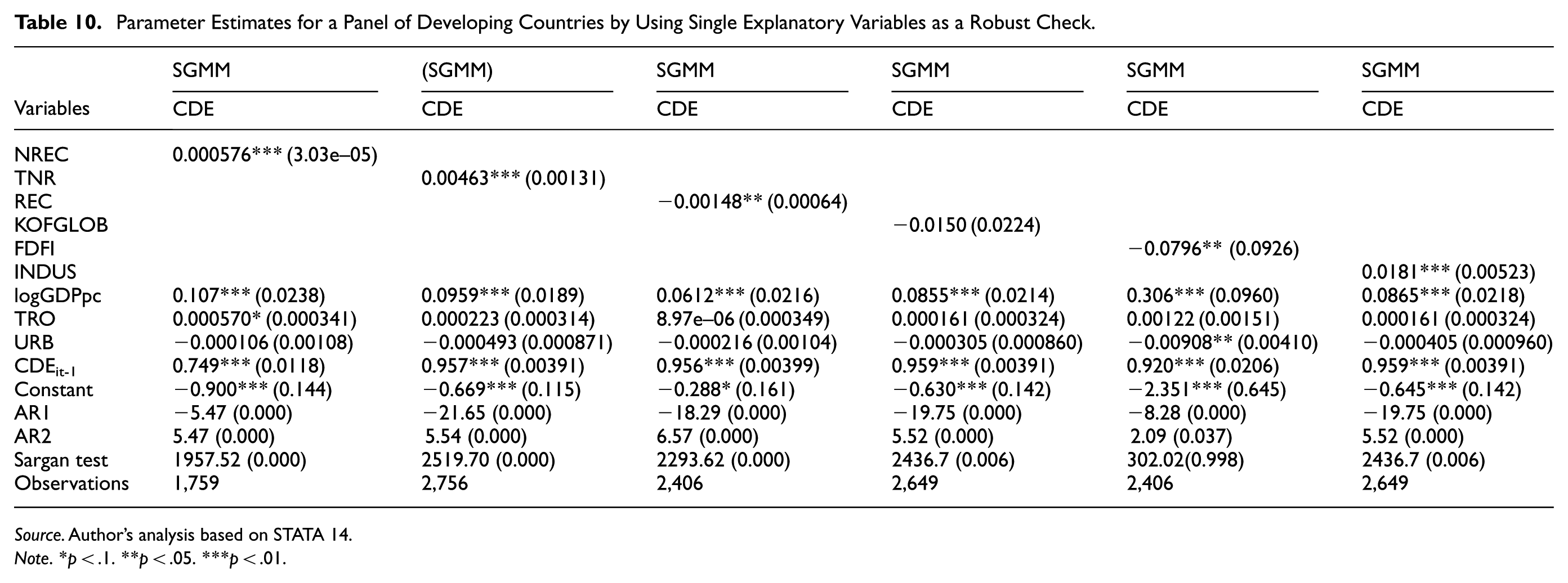
Source. Author’s analysis based on STATA 14. Note. *p < .1. **p < .05. ***p < .01.
Table 10 reports the main system GMM results for developing countries, with CO2 emissions as the dependent variable and each explanatory variable entered separately. The findings show notable differences only for globalization and the control variable trade openness, both of which are statistically significant.
For the remaining variables, the coefficient signs and significance levels are consistent with those reported earlier, except for globalization. This overall consistency supports the time period and strength of the results. The evidence indicates that non-renewable energy consumption, natural resource rents, renewable energy use, financial development, and industrialization are the principal drivers for CO2 emissions in developing economies. To further assess robustness, the system GMM model is re-estimated. Table 11 presents the impact of the predictor variables on CO2 emissions while separately regulatory for economic development and trade openness in developing countries.
Parameter estimates for a panel of developing countries as a robust check.
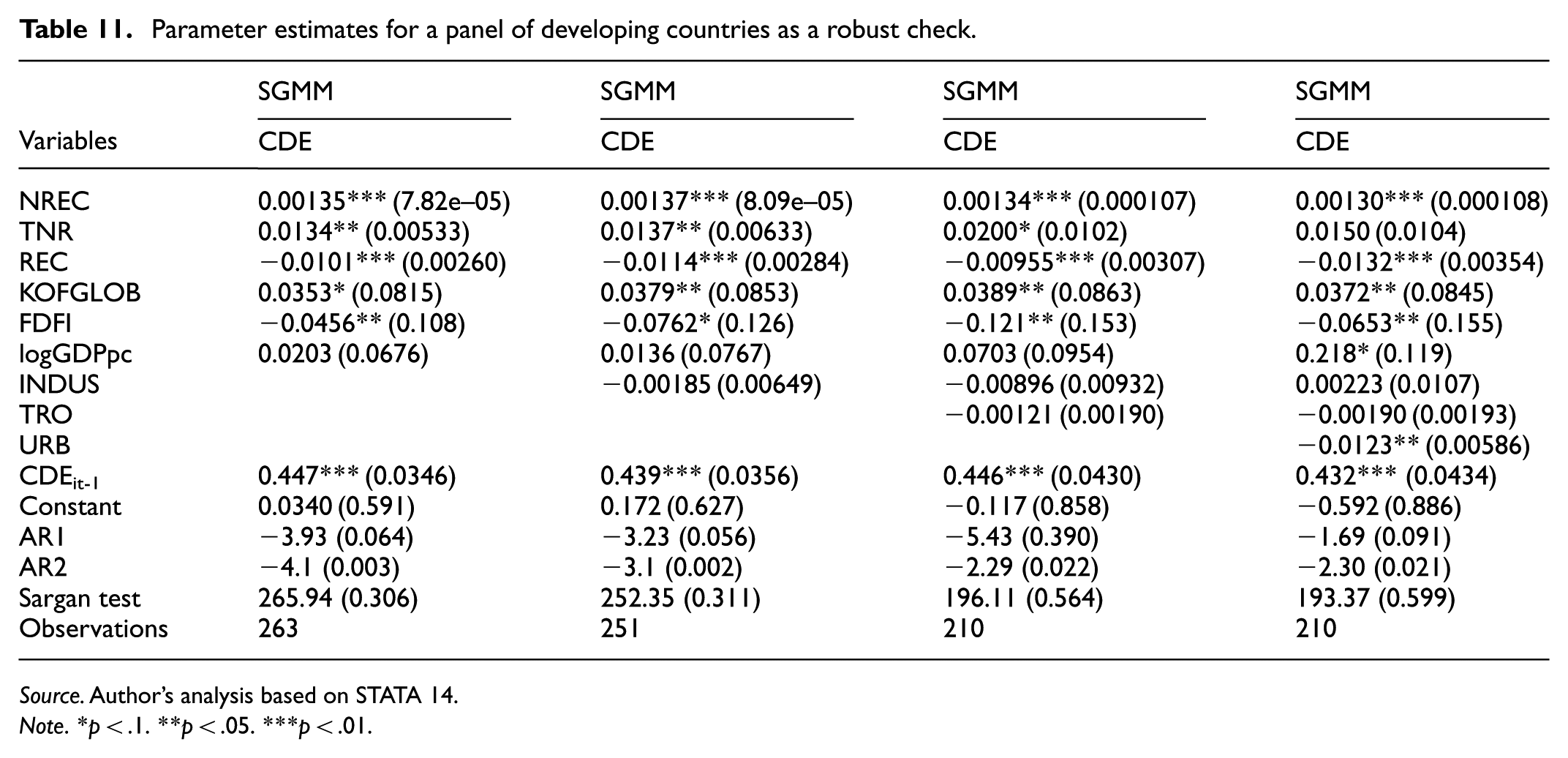
Source. Author’s analysis based on STATA 14. Note. *p < .1. **p < .05. ***p < .01.
Table 11 presents the main system GMM estimates, where CO2 emissions remain the dependent variable and economic development, trade openness, and urbanization are introduced separately as control variables. The results show only slight variation when economic development and trade openness are included.
Importantly, the explanatory variables maintain the same coefficient signs and remain statistically significant, consistent with the earlier findings. This stability reinforces the robustness and overall validity of the results.
Discussion and Summary
Table 12 brings together the overall findings by examining the impact of the explanatory variables on CO2 emissions while monitoring for economic development and trade openness across developed, developing, and emerging economies. For developing and emerging countries, the results show that globalization, natural resource depletion and non-renewable energy consumption increase CO2 emissions. In contrast, industrialization is associated with a reduction in emissions. Renewable energy presents mixed evidence, particularly across country groups. In developed economies, non-renewable energy use and natural resource depletion exert a positive effect on emissions, whereas industrialization, financial development, and renewable energy contribute to emissions reductions. Globalization appears to have a relatively limited influence in these countries. The estimated elasticity highlight clear differences in both direction and magnitude across income groups. Non-renewable energy consistently shows a stronger positive association with CO2 emissions. Renewable energy generally reduces emissions in developed and developing economies, but its effect turns positive in emerging countries. This likely reflects structural differences in energy systems, variations in regulatory quality, and transitional challenges in emerging markets, such as continued reliance on fossil fuels, infrastructure gaps, and limited capacity to fully absorb clean technologies. Supplemental Figures 3 and 4, and 5 in the Supplemental Appendix A, provide a visual summary of these results for emerging, developed, and developing countries, respectively.
Results Summary.

Note. Sigf and Insigf’ stand for significance and insignificant, and (+)/ (−) denotes positive and negative connection.
Conclusion and Policy Implication
This study investigates how natural resource, renewable and nonrenewable energy use, globalization, financial development, and industrialization affect CDE in developed, developing, and emerging countries from 2001 to 2019, considering economic development and trade openness. Using dynamic fixed effects, SUR, and system GMM models, key findings emerge.
In developed countries, non-renewable energy and natural resources increase CDE, while renewable energy, industrialization, and financial development reduce them; globalization has no significant effect. In emerging nations, industrialization lowers emissions, but non-renewable and renewable energy, natural resources, globalization, and financial development raise CO2 levels. For developing countries, non-renewable energy, natural resources, and globalization increase emissions; renewable energy, industrialization, and financial development decrease them.
Results shows the study have important policy ramifications for the three categories of nations.
Policy implications suggest promoting renewable energy to reduce fossil fuel dependence, enhancing banking sector efficiency to support green investments, and regulating natural resource use to lower emissions. Governments should enforce technology adoption and improve energy efficiency through structural reforms.
The banking industry in rising nations may contribute to environmental damage through financial development, thus these nations should encourage energy-efficient and ecologically benign enterprises. Instead of financing projects that increase carbon dioxide emissions, a strong and efficient banking industry would help to streamline the investment process by lending money to businesses who committed to lowering carbon dioxide emissions.
According to the findings of this study, renewable energy significantly reduces CO2 emissions in both developed and developing nations, but not in emerging countries. Conversely, the use of non-renewable energy consumption significantly increases CO2 emissions in all grouped of countries. Discouraging the utilization of energy use and encouraging of the use of renewable sources is one policy conclusion that aims to reduce the share of fossil fuels and other highly polluting sources in the energy mix. The use of renewable energy also has the policy implication of improving environmental well-being. Developed nations should therefore implement a plan to optimize their benefits from the transfer of renewable energy technologies when introducing capital properties like equipment’s and equipment to promote the use of renewable energy. Furthermore, these findings imply that uniform energy transition strategies may be ineffective, and that emerging economies in particular require targeted interventions such as grid modernization, institutional strengthening, and capacity building to enhance the environmental effectiveness of renewable energy investments.”
The results on natural resources are clear. Since natural resource rents are consistently linked with higher CO2 emissions across all three country groups, policymakers should focus on die-carbonizing extractive industries. This can be done by tightening environmental regulations, encouraging cleaner extraction technologies, and internalizing environmental costs through carbon pricing and environmental taxation. With respect to globalization, governments need to ensure that deeper global integration does not come at the expense of environmental quality. Globalization and financial development can support sustainable growth, but only when supported by strong institutions. Improvements in legal systems, protection of property rights, transparency in financial reporting, anti-corruption measures, and effective banking supervision are essential. Strong institutional foundations allow countries to benefit from globalization and financial expansion without worsening emissions. Governments should also adopt regulations that encourage firms to use more efficient and cleaner technologies. Structural and technological reforms can enhance energy efficiency, particularly through modern emissions processes and advanced materials. Promoting energy-saving programs, upgrading energy infrastructure, and supporting conservation measures are practical steps to curb carbon emissions.
At the same time, even within the categories of developed, developing, and emerging economies, substantial differences remain in institutional quality, energy systems, and economic structures. Policy recommendations should therefore be tailored to country-specific conditions rather than applied uniformly. Future research can build on this work by examining specific dimensions of globalization, such as economic, social, and political integration, as well as more detailed measures of financial development. Environmental challenges are global in nature, so international cooperation remains vital. Participation in multilateral climate frameworks, including the Paris Agreement, along with technology transfer and capacity building, can strengthen collective efforts to mitigate climate change.
This study also faces certain limitations, particularly data constraints and the use of aggregate indicators for financial development and globalization. Future studies could incorporate additional variables, such as technological innovation, carbon taxation, information and communication technology, and institutional quality, to gain a more comprehensive understanding of the drivers of environmental sustainability.
Supplemental Material
sj-docx-1-sgo-10.1177_21582440261454133 – Supplemental material for The Interplay Between Natural Resources, Non-Renewable Energy Consumption, and Financial Development: The Role of Renewable Energy Consumption and Globalization
Supplemental material, sj-docx-1-sgo-10.1177_21582440261454133 for The Interplay Between Natural Resources, Non-Renewable Energy Consumption, and Financial Development: The Role of Renewable Energy Consumption and Globalization by Sher Khan, Marian Suplata and Fakhrullah Fakhrullah in SAGE Open
Footnotes

Ethical Considerations
There are no human participants in this article.
Consent to Participate
Informed consent is not required.
Author Contributions
Funding
The authors disclosed receipt of the following financial support for the research, authorship and publication of this article: This research was supported by the Recovery and Resilience Plan of SR, co-financed by the European Union through NextGeneration EU under contract nr.09I02-03-V01-00011 – project Smart Transformation and Innovation Consortium Slovakia (STICS).
Declaration of Conflicting Interests
The authors declared no potential conflicts of interest with respect to the research, authorship, and/or publication of this article.
Data Availability Statement
This manuscript has no associated data or data that support the findings of this study are available from the author upon reasonable request.
Supplemental Material
Supplemental material for this article is available online.
References
Supplementary Material
Please find the following supplemental material available below.
For Open Access articles published under a Creative Commons License, all supplemental material carries the same license as the article it is associated with.
For non-Open Access articles published, all supplemental material carries a non-exclusive license, and permission requests for re-use of supplemental material or any part of supplemental material shall be sent directly to the copyright owner as specified in the copyright notice associated with the article.
