




Abstract
This study examines the mediating role of intrapreneurship in the relationship between organizational openness to change and innovative behavior in small and medium-sized enterprises (SMEs). Although it is known that employees’ openness to change plays an important role in the development of innovative behaviors in organizations, the mechanisms through which this relationship emerges have not yet been sufficiently clarified. The research is based on quantitative data obtained from SME employees operating in Kırşehir. The data obtained from a total of 403 participants were analyzed using structural equation modeling (SEM). The results of the analysis show that organizational openness to change has a positive and significant effect on innovative behavior. In addition, it was determined that openness to organizational change has a significant effect on intrapreneurship and intrapreneurship significantly affects innovative behavior. The findings reveal that intrapreneurship plays a partial mediating role in the relationship between organizational openness to change and innovative behavior. These results show that organizational environments that are open to change contribute to the emergence of innovative behaviors by encouraging employees’ intrapreneurship tendencies and reveal that intrapreneurship is a critical mechanism in the development of innovative behaviors in organizations.
Plain Language Summary
In today’s business world, rapidly increasing competition is driving organizations toward continuous change and development. Various efforts are being made to ensure that this is embraced at all levels of the organization. Based on this, this study aims to examine the role of intrapreneurship as a mediator in the effect of openness to organizational change on innovative behavior. The research is based on quantitative data collected from employees working in small and medium-sized enterprises in Kırşehir. The analysis, conducted using structural equation modeling (SEM) on data obtained from 403 participants, revealed that openness to organizational change has a significant and statistically strong effect on shaping organizational outcomes through both direct and indirect channels. The findings highlight the decisive role of intrapreneurship in the effect of openness to organizational change on innovative behavior. Furthermore, it was found that openness to organizational change has a significant impact on intrapreneurship, and that intrapreneurship, in turn, has a significant effect on innovative behavior. When evaluated within the framework of Proactive Motivation Theory, these findings indicate that individuals not only adapt to the current situation but also tend to plan their behavior in a future-oriented manner and make efforts in that direction. According to this theory, individuals can activate their internal motivation to recognize environmental opportunities, initiate actions toward these opportunities, and sustain them over time. In the context of this study, it was concluded that employees exhibit intrapreneurship behavior through their openness to organizational change and proactive motivation, thereby developing innovative behavior.
Introduction
For organizations, change means an inevitable process of transformation from traditional to contemporary structures. However, under today’s rapidly changing conditions, this transformation is no longer a one-off process and has become a means of continuous adaptation (Hubbart, 2023). In this context, digital transformation spending is expected to reach USD 2.5 trillion by the end of 2024 and increase to USD 3.9 trillion annually by 2027 (Statista, 2024). Considering that technological developments are increasingly affecting business life with large financial investments, the change processes of organizations are not only radical transformations. It has also gained importance as a driving force applied in different dimensions to adapt to the internal and external environment (Omol, 2024). This situation causes employees to develop assumptions and expectations that they can contribute positively to change at individual and organizational levels (Choi et al., 2011).
In today’s dynamic and uncertain business environment, openness to change has become an important factor in the emergence of organizational success and innovative behaviors (Miller et al., 1994). Employees who are open to change can show more willingness to improve organizational processes and implement new ideas by exhibiting an entrepreneurial attitude (Özdemir et al., 2024). The majority of studies examining the reflections of organizational openness to change on innovative behavior focus on the effects of the change process at the organizational level (Aulia & Soetjipto, 2021; Huang et al., 2021; Sung & Kim, 2021). On the other hand, there are no studies that address the relationship between employees’ openness to change and innovative behaviors at the individual level. Therefore, the current study addresses openness to change and innovative behaviors at the individual level and examines the impact of employees’ openness to change on their innovative behaviors in the context of SMEs.
Moreover, this study was born out of the need to reveal the determinant role of individual characteristics in organizational innovation processes, taking into account the structural challenges and resource constraints faced by small and medium-sized enterprises (SMEs). In today’s rapidly changing and competitive business environment, SMEs in particular have limited financial resources, less human capital, and often no formal R&D units compared to large-scale firms. This suggests that organizational innovation processes are more influenced by individual characteristics such as motivation, entrepreneurship, and openness to change than by institutional structures (Ilonen & Hytönen, 2023). Although SMEs have the potential to adapt to change faster due to their agile structure, this agility is only possible if employees take initiative with intrinsic motivation, generate innovative ideas, and realize these ideas. In this context, understanding how individual dispositions such as openness to change affect innovative behavior through intrapreneurship is critical for the sustainability and competitiveness of SMEs (Uygungil-Erdogan et al., 2025). Therefore, the study was designed to understand the potential contribution of individual-level psychological and behavioral characteristics to organizational innovation.
At this point, organizational openness to change creates an important basis for innovation by preparing the ground for employees to accept new ideas and be open to different approaches. However, this attitude alone does not guarantee innovative behavior of employees. Although being open to change shows that employees are willing to evaluate new ideas, entrepreneurial behaviors are required to develop and implement these ideas. In this context, intrapreneurship stands out as a critical mechanism that enables employees to assume an entrepreneurial role within the organization, develop new ideas, put these ideas into practice, and create innovation in organizational processes. Therefore, intrapreneurship is considered an important mediating process that explains the relationship between openness to change and innovative behavior and fills the gap between attitude and behavior (Cristo-Andrade et al., 2019; Heinze & Weber, 2016; Huang et al., 2021).
Intrapreneurship refers to employees taking on an entrepreneurial role within the organization and enables them to develop and implement innovative ideas. Supporting intrapreneurship in organizations with flexible structures, such as SMEs, is particularly important to prevent employees from becoming competitors by starting their own businesses to implement their ideas (Neessen et al., 2019). Therefore, it is of strategic importance for organizations to involve employees in change processes and cooperate with them to support intrapreneurship. In other words, allowing employees who are open to change to evaluate their innovative ideas within the organization can increase the innovation capacity of businesses while reducing the risk of the emergence of potential competitors (Sagbas et al., 2023). In this direction, combining employees’ openness to change with intrapreneurship can contribute to their displaying innovative behaviors more strongly (Gawke et al., 2018; Parker & Wang, 2015).
In this framework, intrapreneurship functions as a bridge that transforms employees’ positive attitudes toward change into innovative behavior. In other words, while openness to change facilitates employees’ adoption of new ideas, intrapreneurship represents the behavioral mechanism that transforms these ideas into concrete innovations within the organization. Therefore, considering intrapreneurship as a mediating variable in the relationship between openness to change and innovative behavior offers an important theoretical contribution to explain how employees’ attitudinal dispositions are transformed into innovative outputs (Do & Luu, 2020; Gawke et al., 2018).
However, the emergence of openness to change in an organization largely depends on leaders. The initiatives initiated by leaders within the organization play an important role in revealing the intrapreneurship behaviors of employees and increasing their innovative behaviors. Today, leaders are considered to have a critical role in creating an innovative organizational culture (Erhan et al., 2022). On the other hand, research on the perceptual and psychological processes that explain how employees are motivated to innovative behaviors in the context of organizational openness to change is still insufficient. This situation shows that employees tend to interpret the openness to change elements offered by the organization in line with their individual perceptions (Kim et al., 2024). In this respect, determining the effects of organizational openness to change on innovative behavior will contribute to the existing knowledge in the literature and reveal how this phenomenon works, especially in the context of SMEs. In addition, determining the mediating effect of intrapreneurship in this process is critical in terms of evaluating the indirect effect of openness to change on innovative behavior.
This study aims to examine the relationship between organizational openness to change and innovative behavior within the mediating role of intrapreneurship. Based on the Proactive Motivation Theory (Parker et al., 2010), the study assumes that openness to change has a stimulating effect on employees’ innovative behavior. Proactive Motivation Theory suggests that employees tend to exhibit innovative behavior when they are intrinsically motivated (Liu et al., 2024). Furthermore, the study predicts that employees who are open to change will increase their innovative behavior by using intrapreneurship as a mediating mechanism (González-Cánovas et al., 2024). While intrapreneurship enables employees to participate in innovative practices within the organization, it is thought that their openness to change also supports this process. In this respect, the study aims to fill the gap in the literature by positioning intrapreneurship as a fundamental mechanism in organizational innovation processes (Çağa et al., 2024).
The results of the research are expected to contribute to the formulation of strategies for promoting innovative culture in organizations and to provide managers with practical information on how to develop innovative behaviors of individuals who are open to change through intrapreneurship. In the following sections of the study, the conceptual framework, methodology, and analysis processes will be presented in detail. Then, the findings will be explained, and the implications and contributions of the research will be discussed.
Conceptual Framework and Hypotheses
The present study is conceptually based on Proactive Motivation Theory, which focuses on explaining the proactive behaviors of employees (Parker et al., 2010). The study is also based on the assumption that this theory offers an effective framework for explaining the innovative behavior of employees.
In today’s business world, where global competition and technological transformation are gaining momentum, SMEs can maintain their sustainability and competitiveness not only by responding to current conditions but also by anticipating environmental changes and developing proactive strategies. In this context, it is stated that the Proactive Motivation Theory, developed by Parker et al. (2010), provides an essential theoretical framework for guiding the organizational behavior and human resource management practices of SMEs. The Proactive Motivation Theory posits that individuals possess the capacity to initiate change toward the future, and these behaviors emerge as a result of the interaction between personal resources and the organizational environment (Parker et al., 2010). This approach is particularly valuable for SMEs with limited resources and flexible organizational structures, as individuals’ ability to generate innovative solutions through their initiative can directly affect the organization’s adaptability (Bacon & Hoque, 2005; Macpherson & Holt, 2007). According to Proactive Motivation Theory, individuals only take action when they believe that change is necessary, are convinced that the change will be beneficial, and feel that they have sufficient support and competence (Parker et al., 2010).
SMEs’ structural flexibility, horizontal decision-making processes, and the broad scope of individuals’ roles provide a suitable environment for the development of proactive behavior (Vossen, 1998). However, realizing this potential requires managers to view employees not only as task-oriented actors but also as actors who are willing to shape the future. From this perspective, SMEs with high entrepreneurial tendencies must develop leadership styles that support proactive motivation among employees and an organizational culture that is open to learning (Hmieleski & Ensley, 2007). In this sense, Proactive Motivation Theory, based on openness to organizational change, innovative behavior, and intrapreneurship, can serve as a valuable guide for SMEs in the process of uncovering their human resource potential and developing sustainable innovation capacity. This theory can contribute to the development of a strategic human resource management approach, particularly for small and medium-sized enterprises (SMEs) operating in environments characterized by change and dynamism. Proactive behavior is defined as self-management and future-focused actions aimed at changing the situation faced by employees or themselves (Grant & Ashford, 2008). Proactivity does not always have to include innovation (Bindl & Parker, 2011). Proactive behaviors have been regarded as employees’ efforts to create changes in organizational functioning with regard to how work is accomplished (Parker & Collins, 2010). In this respect, proactive behaviors are associated with taking initiative and are distinguished from the necessity of being innovative all the time. In this regard, based on the question, “What are the situations that show the innovative aspect of proactive behavior?,” the model of the study is explained through Proactive Motivation Theory, which expresses the innovative behavior of employees within the framework of three basic psychological and motivational processes, such as proactive goal, ability perception, and desire.
The Relationship Between Openness to Organizational Change and Innovative Behavior
Change has become an inevitable requirement for the sustainability of organizations in the current business life (Burnes, 2004). The success criteria for change in organizations involve not merely structural changes but the attitudes of employees toward change, as well (Armenakis & Bedeian, 1999). Employees’ openness to change contributes to organizational change processes by positively influencing cognitive, emotional, and behavioral reactions (Klarner et al., 2011).
Openness to change is described as the combination of willingness to support change with beliefs about the positive consequences of change (Miller et al., 1994). In this regard, employees who are open to change are inclined to regard new situations as an opportunity (Wanberg & Banas, 2000) and contribute actively to the successful accomplishment of this process (Yue et al., 2019). Furthermore, openness to change stands out as a psychological feature that shapes attitudes of employees toward innovation and triggers their innovative behavior (Hien et al., 2024). Innovative behaviors refer to the fact that employees come up with original ideas to improve business processes, introduce these ideas, and engage in behaviors that support change processes throughout the organization (Janssen, 2000). Employees who are open to change show a tendency to generate creative solutions and make innovative changes in uncertain conditions. In this respect, openness to change reflects an individual inclination associated with characteristics such as creativity, flexibility, a high degree of independence, and extroversion (Cristo-Andrade et al., 2019; Fugate & Kinicki, 2008).
The previous studies reveal that openness to change is often considered as an organizational climate element (Curşeu et al., 2022; Judge & Zapata, 2015). In the present study, however, openness to change was considered as an individual characteristic, and the impact of this characteristic on the innovative behavior of employees was investigated. The study was conducted within the framework of Proactive Motivation Theory (Parker et al., 2010), which considers the concept of proactive goals as an important psychological element in determining internal goals that support the innovative behavior of employees. A proactive goal refers to a motivation toward the reason why employees regard a behavior or outcome as valuable (Gorgievski et al., 2023). The process is shaped by employees’ acceptance of the need for improving current situations or creating change in the organization. Bearing this information in mind, openness to change is considered to be a critical element in terms of directing employees’ internal goals toward innovative behaviors. In this regard, the H1 hypothesis was formed:
The Relationship Between Openness to Organizational Change and Intrapreneurship
Change processes frequently encountered in business life pave the way for significant management challenges for organizations. In this process, uncertainties about which change initiatives organizations should put into practice and at what level arise (Boehm & Turner, 2005). Continuous review of management processes and adoption of innovative approaches indicate that leading the change has become significant beyond adapting to change (Antoncic & Hisrich, 2001). Employees advocating change have an important role in evaluating opportunities and generating innovative ideas. Sharing these ideas with managers can form the basis for entrepreneurial activities within the organization.
Entrepreneurship refers to the process of discovering, developing, and evaluating opportunities that can create value through innovation (Prince et al., 2021). In this process, regardless of the environment in which the entrepreneur is located (i.e., a new or existing organization), the capacity to gain a competitive advantage in the market and evaluate opportunities is significant (Ratten & Usmanij, 2020). An entrepreneur is creative, takes risks that are anticipated, recognizes opportunities that are anticipated, and is open to new experiences (Singh & Mehdi, 2022). The concept of intrapreneurship explains that entrepreneurial activities can be maintained not only in newly established organizations but also within existing organizations. Intrapreneurship is defined as the process of discovering new opportunities and practicing innovative activities within an existing organizational structure (Antoncic & Hisrich, 2001). Intrapreneurs stand out as individuals who can take risks, produce innovative solutions, and add value to the organization (Huang et al., 2021).
Proactive Motivation Theory helps explain the capacity of employees to take initiative, generate creative solutions, and find innovative answers to existing problems (Gorgievski et al., 2023). The theory provides insight, especially into openness to change, employees’ ability to learn new skills, generate innovative solutions, and participate in entrepreneurial processes more (Cristo-Andrade et al., 2019). Bearing this in mind, it is possible to claim that employees with a high level of openness to change are inclined to regard themselves as competent, and this tendency may increase their likelihood of participating in intrapreneurship. For this reason, openness to organizational change shows an important incentive that enables employees to recognize opportunities within the organization and transform these opportunities into intrapreneurship activities (Ettis & Kefi, 2016). In this respect, the H2 hypothesis was formed:
The Relationship Between Intrapreneurship and Innovative Behavior
Intrapreneurship refers to the fact that individuals produce innovative ideas with an entrepreneurial approach within the organization, incorporate these ideas into organizational processes, and develop innovative applications by using the resources of the organization (Bičo & Knezović, 2025). Intrapreneurs are known as pioneers of new business opportunities within the organization with the help of their innovation, value creation, and risk-taking qualities (Huang et al., 2021). The most valuable feature of intrapreneurship is accepted to be its innovation dimension (Stopford & Baden-Fuller, 1994). Nevertheless, intrapreneurs strive to change the behavior of others within the organization and create new institutional resources (Antoncic & Hisrich, 2001). In this respect, the relationship between intrapreneurship and innovative behavior results directly from the efforts shown to increase the innovative capacity of existing organizations.
The Proactive Motivation Theory suggests that the relationship between intrapreneurship and innovative behaviors can be explained by the employees’ desire to exhibit innovative behavior, namely, the internal motivation dimension (Gorgievski et al., 2023). Thus, intrapreneur employees tend to exhibit their innovative behaviors voluntarily, and they perform these behaviors in accordance with their internal motivation, not as a forced response (Vargas-Halabí et al., 2017). When considered within the scope of Proactive Motivation Theory, the innovative behavior of intrapreneurs shows the desire of employees to generate and practice innovative solutions.
In this respect, intrapreneurship plays a role not merely in the development of new products and services, but in the improvement of existing products and restructuring of processes, as well. Intrapreneurs work actively in order to create innovative opportunities, take risks, and raise competitiveness in the organization (Huang et al., 2021). Innovative behavior of employees contributes greatly to organizational development and change processes via intrapreneurship. In this regard, the positive impact of employees’ individual-level intrapreneurship behaviors on their innovative behavior has been widely covered in the literature and is considered to be a critical element in terms of organizational performance (Do & Luu, 2020). Bearing this in mind, the following hypothesis was formed within the scope of the study:
Mediating Role of Intrapreneurship
Organizational openness to change is considered an important individual characteristic that increases individuals’ capacity to generate new ideas, enables them to actively participate in change processes, and contributes to the implementation of innovative projects (Heinze & Weber, 2016). However, it is stated in the literature that openness to change alone may not be sufficient to explain the emergence of innovative behaviors. Because in order for innovative behaviors to occur, other personal characteristics and behavioral competencies of individuals should also support this process (Cristo-Andrade et al., 2019). At this point, intrapreneurship stands out as an important behavioral mechanism that expresses the capacity of employees to recognize opportunities, develop innovative solutions, and implement these solutions within the organization. Intrapreneurship behaviors are supported by individual antecedents such as self-efficacy perception and social networks (Wang et al., 2013). While self-efficacy refers to an individual’s capacity to act proactively in the face of change processes, social networks strengthen information sharing and collaboration within the organization. Therefore, individuals with technical competencies and strong social relationships are more likely to exhibit intrapreneurial behaviors (Cristo-Andrade et al., 2019). Similarly, Neessen et al. (2019) define intrapreneurs in terms of key characteristics such as skills and abilities, self-efficacy perception, personal knowledge, and past experiences. Considering these characteristics, it is thought that individuals who are open to organizational change may have a higher tendency to exhibit intrapreneurial behaviors.
Intrapreneurship is also considered a mechanism that enables employees to take an active role in developing and implementing innovative ideas within the organization. Heinze and Weber (2016) state that intrapreneurs play an important role in creating opportunities within the organization, supporting the diffusion of innovations, and facilitating change processes. Since individuals who are open to change generally have creative and curious personality traits, they show more interest in innovative processes and can take leading roles in the implementation of new ideas (Choi et al., 2011). These characteristics also strengthen the entrepreneurial aspects of individuals. Indeed, Huang et al. (2021) state that employees who are open to change increase their capacity to develop and implement innovative projects through intrapreneurship. In particular, creative problem-solving, evaluating opportunities, and coping with uncertainty skills contribute to the innovative behaviors of individuals who are open to change more effectively.
Proactive Motivation Theory provides an important theoretical framework to explain these relationships. According to this theory developed by Parker et al. (2010), the ability of employees to exhibit proactive behaviors depends on motivational processes such as setting goals for the future, recognizing opportunities, and taking initiative to realize these opportunities. The theory emphasizes that the intrinsic motivation of individuals is decisive in the emergence of proactive behaviors. In this context, openness to organizational change can be considered as a source of motivation that enables employees to adopt new ideas and approach change processes positively. Intrapreneurship functions as a mechanism that transforms this motivation into behavior.
Within the scope of this research, it is thought that organizational openness to change and intrapreneurship are among the motivational factors that are effective in the emergence of innovative behaviors of employees. Individuals who are open to organizational change become more prone to innovative practices due to their more positive approach to new ideas and their tendency to adapt to change processes. Therefore, it can be said that employees who are open to change are more willing to develop new ideas and implement innovative behaviors in line with their creative and curious personality traits. The research aims to examine the relationship between openness to organizational change and innovative behavior within the framework of the mediating role of intrapreneurship. In this research, which is based on the Proactive Motivation Theory (Parker et al., 2010), it is assumed that openness to change creates an encouraging effect on employees’ innovative behaviors. Proactive Motivation Theory suggests that employees tend to exhibit innovative and developmental behaviors when they are intrinsically motivated (Liu et al., 2024). The concept of proactive goal refers to the motivation for why employees find a particular behavior or outcome valuable and helps to explain why individuals take the initiative to generate creative solutions and develop innovative responses to existing problems (Gorgievski et al., 2023). In this context, intrapreneurship plays an important role for employees to recognize opportunities, take risks, and implement new ideas within the organization.
When evaluated within the framework of Proactive Motivation Theory, intrapreneurship is an important form of behavior that reveals employees’ willingness to produce innovative solutions and turn these solutions into practice. Intrapreneurship is effective not only in the process of developing new products and services but also in improving existing products and restructuring organizational processes. Intrapreneurs act actively to create innovative opportunities, take risks, and increase competitiveness within the organization (Huang et al., 2021). Within the scope of this study, it is predicted that employees who are open to organizational change may be more prone to exhibiting entrepreneurial behaviors within the organization, and this may support the emergence of innovative behaviors. In other words, while openness to organizational change encourages employees to adopt new ideas and actively participate in change processes, intrapreneurship is considered an important tool that transforms this tendency into concrete innovative behaviors. In this framework, intrapreneurship may play a mediating role in the relationship between openness to organizational change and innovative behavior.
In line with this approach, the study aims to contribute to the literature by revealing that intrapreneurship assumes an important function among the processes that explain the effect of openness to organizational change on innovative behavior. Accordingly, hypothesis H2 explains the effect of openness to organizational change on intrapreneurship, and hypothesis H3 explains the effect of intrapreneurship on innovative behavior. When these two relationships are considered together, it is predicted that intrapreneurship may play a mediating role in the relationship between openness to organizational change and innovative behavior. This perspective contributes to the literature on the factors explaining the effect of openness to organizational change on innovative behavior. In particular, it provides a theoretical framework that explains how individual attitudes toward change are transformed into innovative behaviors by revealing that intrapreneurship can play a mediating role in this relationship. In addition, conducting the study in the context of SMEs provides an additional contribution to the literature on the impact of individual characteristics of employees on innovation processes in organizations with limited resources. Accordingly, the following hypothesis was developed.
A research model was formed within the scope of the hypotheses and is displayed in Figure 1.

Research model.
Materials and Methods
The sample of the research consists of employees in small and medium-sized enterprises in Kırşehir. The number of employees working in enterprises affiliated with the Chamber of Commerce and Industry in Kırşehir province is stated to be 22.775 according to the Turkish Employment Agency Labor Market Research 2022 Result Report (Turkstat, 2023a). The literature points out that a sample of 384 people will be sufficient to represent a universe of 100.000 people (Hair et al., 2014). In this respect, it was concluded that it was sufficient to reach at least 384 people out of 22.775.
According to the 2023 data of the Turkish Employment Agency, approximately 23.000 people are employed in SMEs in Kırşehir province (Turkish Employment Agency, 2023). The formula proposed by Cochran (1977), as shown in Figure 1, was used to determine the sample in question. According to the literature, a 95% confidence level and a 5% margin of error were used to ensure the statistical reliability and generalizability of the findings (Obeng & Atan, 2024). Additionally, the formula is an effective method for calculating sample sizes for both smaller groups and larger populations (Fattah et al., 2022). In the formula, the term “n” represents the population size, “p” means the percentage of occurrence of a condition or situation, “e” represents the margin of error, and “z” represents the confidence level (1.96 for a 95% confidence interval; Alzoubi et al., 2024).

According to the formula above, at least 379 people must be reached. In addition, considering that there are 39 questions in the survey, it is thought that the number of questions should be increased tenfold according to the literature (Nunnally, 1978).SMEs are organizations that hold great significance for the development of trade in the world. When the literature is paid attention to, there is no consensus on the definition of SMEs, which constitute the basic dynamics of the economy. Nevertheless, it is also observed that definitions vary depending on the economic conditions of the countries in which SMEs operate (Storey, 2016). SMEs are described by the Turkish Statistical Institute as enterprises with fewer than 250 employees and a balance sheet not exceeding 250 million Turkish Liras (Turkstat, 2023b). When the annual data published by the Turkish Statistical Institute is taken into consideration, it is suggested that 3 million 773 thousand enterprises are classified as SMEs in Turkiye. In the report published in December 2023, SMEs are claimed to constitute 99.7% of the total enterprises in 2022 and contribute 36.4% to added value.
In accordance with these remarkable data showing their place and importance in the country’s economy, the present study was designed to be carried out on SMEs. The study was conducted in Kırşehir for several reasons. Even though cities such as Istanbul, Ankara, Izmir, Bursa, and Adana make great contributions to the economy in Turkiye, it is an obvious fact that the employment impacts of small cities cannot be ignored. Kırşehir is one of the small cities in Turkiye with a population of nearly 250.000 people and holds an important place in the Turkish economy, where SMEs constitute more than 95% of the enterprises. Another reason why Kırşehir was selected for the present study is that it is geographically close to metropolitan cities such as Ankara and Kayseri and functions as a connection point. This situation, in turn, increases the access of businesses in Kırşehir to the regional economy and contributes to the development of commercial activities.
Furthermore, organized industrial zones in Kırşehir are in the process of development, and it is thought that carrying out a study on SMEs in this region will provide an opportunity to better understand the industrial and economic development of the province. For this reason, it is possible to say that a portrait of 51 provinces, similar to Kırşehir, where approximately 20 million people live, was also taken. The survey form was delivered online to businesses in Kırşehir with a convenience sample.
Ethical approval for this study was obtained from Yozgat Bozok University Social and Human Sciences Ethics Committee (Decision No: 14/04, Date: May 22, 2024). The research design was planned to minimize the possible risks that may arise for the participants. Participation in the study was entirely voluntary, and participants had the right to withdraw from the study at any stage. Before the data collection process, participants were informed about the purpose of the study, that their responses would be kept confidential, and that participation in the study was voluntary. Informed consent was obtained from all participants before completing the questionnaire. The data were collected anonymously, and no personal information that could reveal the identity of the participants was requested. The potential benefits of the research, which would contribute to organizational behavior and innovative behavior, were considered to outweigh the minimal risks to the participants. The study was conducted in accordance with the ethical principles set for research involving human participants.
In the present study, socio-demographic information form, Intrapreneurship Scale, Innovative Behavior Scale, and Openness to Organizational Change Scale were utilized as data collection tools. In this respect, the Intrapreneur Behavior Scale, developed by Sezgin (2020) and consisting of 6 dimensions and 23 statements, was used to measure intrapreneurship. A five-point Likert scale type was used in the scale. The Cronbach’s Alpha value of the original scale was found to be .888. The scale consists of statements such as “I constantly try my new ideas by applying them to my work.,”“I encourage my colleagues to have innovative business ideas.”
The Innovative Behavior Scale, which is a five-point Likert-type scale, was developed by Çimen and Yücel (2017) and consists of 10 statements and 4 sub-dimensions. The Cronbach’s Alpha value of the original scale was determined to be .930. The scale includes statements such as “Employees in this institution generate original solutions for problems.,”“Employees in this institution also attach importance to issues that are not included in the routine workload.”
The Openness to Organizational Change Scale, developed by Çalışkan (2022) and consisting of six items, was utilized to measure the employees’ openness levels to organizational change. The Cronbach’s Alpha value of the original scale was determined to be .857. The scale includes statements such as “I think I am open to changes in my workplace.”, “The change will serve the benefit of the organization.”
Results
In the present study, 403 individuals were reached, and detailed socio-demographic information about the participants is presented in Table 1. Almost half of the participants (50.1%) were women, and the other half (49.9%) were men. In general, compared to the conditions in Türkiye, where male employment is higher (even in a small city like Kırşehir, located in the Central Anatolia Region), the excess female employment stands out (Turkstat, 2023a). Therefore, it can be suggested that increasing the number of women entrepreneurs with the grants and support of the Small and Medium Enterprises Development and Support Administration (KOSGEB), as well as highlighting positive discrimination toward employment of women, has been effective in this regard (Kosgeb, 2024). It is noted that the number of married participants (53.6%) is higher than that of single participants. Most of the participants (39.2%) were observed to have associate degree graduates, and 39.5% had 5 years or less of experience. Moreover, it is observed that the majority of the participants (80.4%) do not have a managerial status.
Socio-Demographic Information.

The validity of the scales used in the study was analyzed through the Smart-PLS program, and the relevant acceptable values are presented in Table 2. Factor loadings are greater than 0.50 while Cronbach’s Alpha, Composite Reliability, and rho_A coefficients are greater than .70. It is suggested that the AVE value should be higher than 0.50 (Hair et al., 2017). Internal consistency analyses are carried out to evaluate the consistency of the underlying structure of the indicator elements in a research model (Guenther et al., 2023). In the literature, Cronbach’s Alpha coefficient and the CR coefficient, referred to as Composite Reliability, are used frequently as reliability coefficients. Even so, it is recommended to calculate the rho_A coefficient in studies analyzed with PLS-SEM (Sarstedt et al., 2022), as well. When factor load values are considered, it becomes apparent that the generally accepted value in the literature is above 0.50, which stems from the fact that it should comprise strong items with factor loadings higher than 0.50 (Hair et al., 2014).
Factor Load Values, Reliability, Validity, and Descriptive Statistics for the Scales.
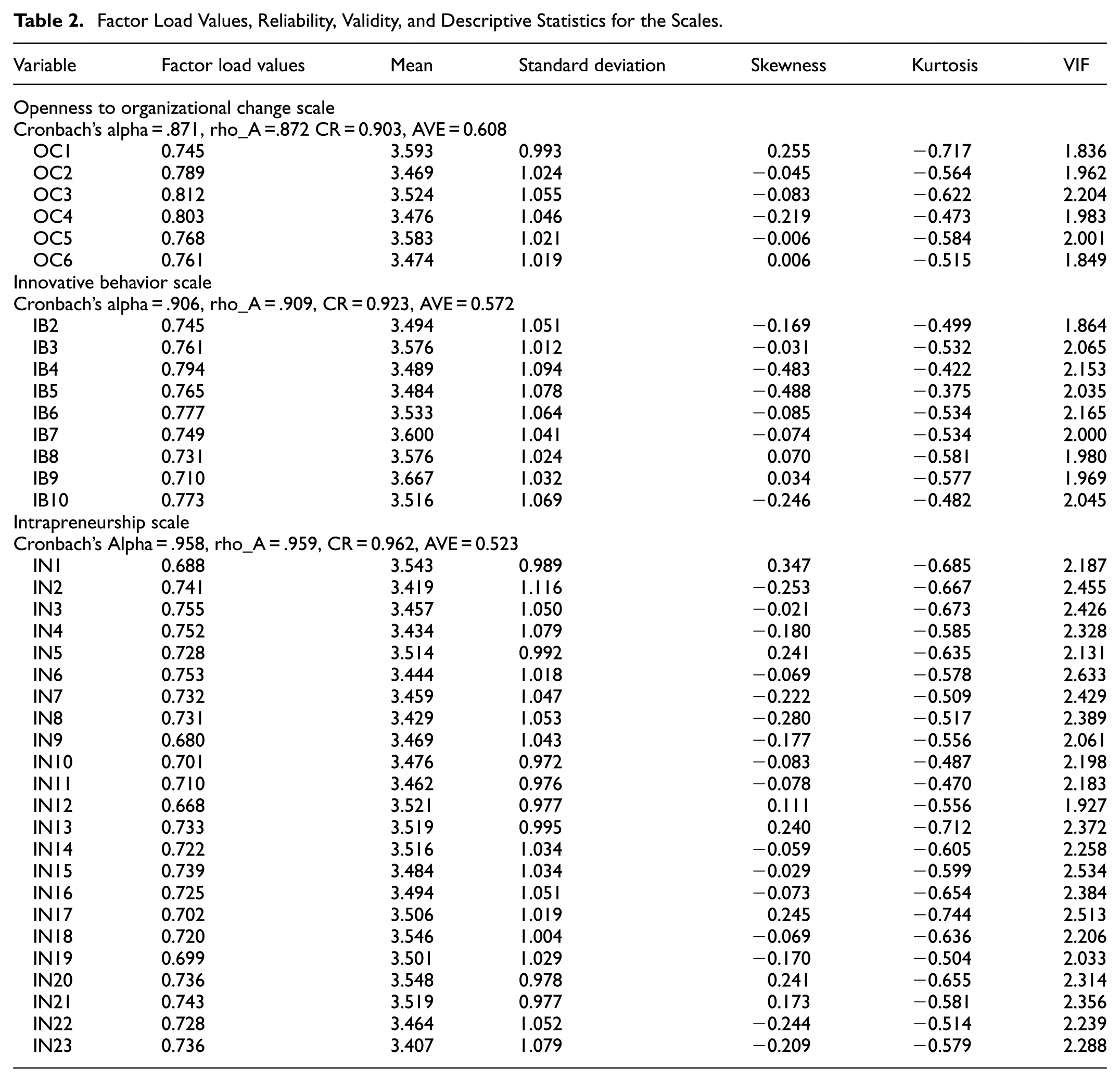
When the values given in Table 2 are considered, it becomes clear that the validity and reliability of the scales are ensured, which means there is no need to perform a confirmatory factor analysis, such as CB-SEM, in the Smart-PLS program. When the relevant model is created and the necessary steps are followed, these values are automatically provided to the researcher by the program. This, as a user-friendly interface, demonstrates its intuitive nature, making for a seamless experience for users. As a result of the analysis, statement 1 from the Innovative Behavior Scale was excluded because it did not yield a factor load value of 0.5. When the values obtained from the analysis made in the Smart-PLS program were examined, the VIF values were observed to be less than 3. The VIF value is used to test whether there is a common method variance problem in the research data. VIF values greater than 3 are an indicator of multicollinearity and point out that the research model may be influenced by common method variance (Kock, 2015).
Discriminant validity is a criterion used to determine the extent to which latent variables are distinguished from other latent variables. When the literature is examined, the criterion proposed by Fornell and Larcker (1981) and the Heterotrait-Monotrait (HTMT) criterion proposed by Henseler et al. (2015) are recognized as frequently used discriminant validity methods. Discriminant validity values, as per Fornell and Larcker, and Heterotrait-Monotrait (HTMT) criteria, are presented in Table 3.
Fornell-Larcker Criterion and Heterotrait-Monotrait Ratio (HTMT) Values.

IB = innovative behavior; OC = openness to organizational change; IN = intrapreneurship.
In the Fornell-Larcker criterion, the coefficients at the intersection of the variables refer to the square root of the average variance extracted (AVE) coefficients of the pertinent variables, ensuring discriminant validity. On the other hand, HTMT, which has been recently suggested in PLS-SEM research, states that the average correlations between research structures are revealed by calculating the geometric mean of the average correlations within the expressions of the structures (Voorhees et al., 2016). The Heterotrait-Monotrait Ratio (HTMT) criterion states that the threshold value should be below 0.90 (Henseler et al., 2015). According to Table 3, it is realized that discriminant validity is achieved as the values are below 0.90. Although the Fornell-Larcker criterion does not appear to have been met in terms of the discriminant validity of the diagonal values, it is possible to say that discriminant validity has been achieved because the HTMT values are below 0.90. According to the HTMT approach, the HTMT value represents the ratio of the average correlations of all statements related to the variables included in the study to the geometric mean of the correlations of the statements associated with the same variable (Hair et al., 2017; Henseler et al., 2015).
Following the evaluation of the measurement part of the research model, the Bootstrapping calculation method and 5.000 Bootstrap (resampling) number in the Smart-PLS program were preferred in the structural model evaluation. The Bootstrap test, developed by Preacher and Hayes (2004), was used to conduct the mediation test (Hair et al., 2014). As a result of the test, Beta, p, and t values were examined to test whether the path coefficients were statistically significant (Hair et al., 2017). Figure 2 indicates the Smart-PLS Path diagram obtained from the research model.

Path diagram.
Fit. Goodness-of-fit values obtained from the structural model are presented in Table 4.
Goodness of Fit Values.

When Table 4 is examined, it becomes apparent that the goodness-of-fit is assessed, and the goodness-of-fit values obtained from the model are found to be within acceptable limits. According to the appropriate values, the Standardized Root Mean Square Residual (SRMR) value should be below 0.08, and the Normed Fit Index (NFI) value should be above 0.80 (Byrne, 2016). Structural equation model coefficients are displayed in Table 5.
Hypothesis Test Results.

R2 (IB = 0.541; IN = 0.670); Q2 (IB = 0.303; IN = 0.346).
Table 5 presents the coefficients illustrating the mediating role of intrapreneurship in the relationship between openness to organizational change and innovative behavior. Before the mediator variable was introduced into the model, openness to organizational change had a positive and significant impact on innovative behavior (β = .658; p < .01), indicating the total effect. With the addition of intrapreneurship to the first model, it is observed that openness to organizational change has a positive and significant impact on innovative behavior (β = .185; p < .01). The H1 hypothesis was accepted. The positive and significant effect of openness to organizational change on intrapreneurship is observed (β = .818; p < .01), while it is also realized that intrapreneurship has a positive and significant effect on innovative behavior (β = .576; p < .01). Therefore, H2 and H3 hypotheses were accepted.
The significance of adding the mediator variable into the model and the decrease in beta values is determined via the VAF test (Hair et al., 2017). The VAF value ranges between 20% and 80% (0%–20% indicates no mediation, 20%–80% partial mediation, and 80%–100% complete mediation; Hair et al., 2019). VAF is calculated by dividing the indirect effect by the total impact, and the VAF value is determined to be 42% when calculated according to the formula. For this reason, it can be concluded that intrapreneurship has a mediating role in the effect of openness to organizational change on innovative behavior. Study. The H4 formed within the scope of the study was accepted. R2 and Q2 values obtained within the scope of the model are presented in Table 5. The relevant values indicate the predictive powers of the scales utilized in the model. The R2 value is suggested to be evaluated through interdisciplinary approaches (Hair et al., 2017), and the Q2 value should be above zero (Sarstedt et al., 2014). It can be realized that the predictive power values presented in Table 5 are compatible with the literature.
Discussion
This study examines the mediating role of intrapreneurship in the relationship between openness to organizational change and innovative behavior within the framework of Proactive Motivation Theory (Parker et al., 2010). The research findings show that all relationships in the model are statistically significant and the hypotheses are supported. These results reveal that individual entrepreneurial behaviors are an important mechanism in transforming employees’ attitudes toward change into innovative behaviors.
In the first hypothesis of the study, it was predicted that openness to organizational change has a positive and significant effect on innovative behavior. The results of the analysis support this hypothesis and show that employees who are open to change have a higher tendency to exhibit innovative behavior. This finding is in line with previous studies indicating that openness to change encourages employees’ innovative thinking processes (Cristo-Andrade et al., 2019; Hien et al., 2024). Individuals who are open to change are more likely to view uncertainties as opportunities rather than threats and are more willing to generate new ideas to improve existing business processes. When this situation is evaluated within the scope of Proactive Motivation Theory, it can be explained by the fact that employees see change as a valuable goal and desire to contribute to organizational development (Parker et al., 2010). Therefore, openness to change can be considered an important psychological antecedent that triggers employees’ innovative behaviors.
In the second hypothesis of the study, it was predicted that openness to organizational change has a positive effect on intrapreneurship. The findings confirm this hypothesis and show that employees who are open to change have a higher tendency to exhibit entrepreneurial behaviors within the organization. This result is in line with previous studies that show that individuals who are open to change are more active in recognizing opportunities and developing new solutions (Cristo-Andrade et al., 2019; Gawke et al., 2018). Employees who are open to change do not hesitate to try new ideas and take more initiative in taking innovative initiatives within the organization. This situation becomes more evident, especially in organizations with flexible structures such as SMEs. Because in such organizations, individual initiatives of employees can be an important determinant of organizational innovation processes. In this context, research findings suggest that openness to organizational change is an important individual characteristic that encourages employees’ intrapreneurship behaviors.
The third hypothesis of the study predicted that intrapreneurship has a positive effect on innovative behavior. The findings support this hypothesis and reveal that employees with high intrapreneurship tendency exhibit more innovative behavior. This result is in line with previous studies that emphasize that intrapreneurship plays a critical role in the development and implementation of innovative ideas within the organization (Amo, 2010; Do & Luu, 2020; Huang et al., 2021). Intrapreneurial employees not only generate new ideas but also try to integrate these ideas into organizational processes. This shows that innovative behavior is not only limited to creative thinking, but also includes implementation and value creation processes. Therefore, intrapreneurship can be considered an important behavioral mechanism that transforms employees’ innovative ideas into concrete outputs.
In the last hypothesis of the study, it was predicted that intrapreneurship plays a mediating role in the relationship between openness to organizational change and innovative behavior. The results of the analysis support this hypothesis and show that intrapreneurship plays a partial mediating role in this relationship. This finding indicates that innovative behaviors of employees who are open to change emerge to a significant extent through intrapreneurship. In other words, employees’ positive attitudes toward change are transformed into innovative outputs through their entrepreneurial behaviors. This result is in line with studies in the literature that emphasize intrapreneurship as a critical mechanism in innovation processes (Heinze & Weber, 2016; Huang et al., 2021).
Theoretical/Practical Implications
This study aims to explain the effects of openness to organizational change on innovative behavior and intrapreneurship through the Proactive Motivation Theory. At the core of Proactive Motivation Theory are proactive goals, perceived ability, and desire. Proactive goals are referred to as the “why should I do it” motivation and form a compelling reason for being proactive (Gorgievski et al., 2023). This motivation explains why employees find a behavior or outcome valuable. Proactive behaviors are generally thought to aim at gaining control within the organization and creating change (Parker & Collins, 2010). In this context, considering that the idea of “change” forms the basis of proactive behavior, this study takes “openness to change” as the trigger for proactive behavior. Employees who are open to change tend to set proactive goals such as improving organizational processes and creating innovation. According to the data obtained from the research, it was determined that 0.658 of the effect of organizational openness to change on innovative behavior stems from this. Therefore, employees who are open to change may have proactive goals that lead to positive outcomes for both themselves and their organizations.
On the other hand, the second element of Proactive Motivation Theory, “perceived ability,” refers to employees’ perception of their competence in exhibiting innovative behavior. This element is based on “I can do it” motivation and reflects the individual’s self-confidence (Gorgievski et al., 2023). In other words, it focuses on employees’ expectations regarding the outcomes of their behavior and their perceived competence. Proactive behavior is defined as actions that include taking initiative, speaking up, individual innovation, and problem prevention. Within this framework, it is well established that perceived competence is a crucial precursor to taking initiative and similar behaviors (Parker & Collins, 2010). Intrapreneurship can support employees in discovering their abilities and exhibiting more innovative behaviors within the organization. Intrapreneurial employees can use their abilities to develop creative solutions to existing problems. Thus, intrapreneurship can become a mechanism that facilitates innovative work behaviors.
Finally, “desire,” defined as the desire to behave proactively, increases employees’ motivation to exhibit innovative behavior. In other words, the desire element is defined as “willingness” motivation and reflects a positive emotional state and arousal (Gorgievski et al., 2023). This type of motivation shows how a person’s behavior is affected by their emotional state. Bateman and Crant (1993) state that proactive individuals seek opportunities, take initiative, act, and persist until they achieve results. They have pointed out that individuals who are highly proactive within an organization are more likely to exhibit higher levels of innovation and intrapreneurship. Individuals who are open to organizational change have a desire to innovate and improve processes because they view change in a positive light. In the context of Proactive Motivation Theory, while openness to change increases employees’ motivation for innovative behaviors, intrapreneurship functions as a tool that transforms this motivation into behavior. The research results also offer important implications in the context of SMEs. Although SMEs have limited resources, their flexible organizational structures can provide an environment that can support the individual initiatives of employees. In this context, supporting employees who are open to change and encouraging intrapreneurship activities can make significant contributions to the development of innovative behaviors in organizations. In particular, creating an organizational culture that encourages employees to develop new ideas can be considered an important strategic tool in increasing innovative performance.
Examining practical examples, Ford Motor Company (FoMoCo) is one of the rare large-scale companies that continues to behave like an entrepreneurial business, despite its long history, and occasionally demonstrates SME-like flexibility. Ford developed the moving assembly line system in 1913, which accelerated production processes and reduced costs. This innovation made automobiles accessible to the masses. The company revolutionized the automotive industry with the Model T and produced 15 million units by 1927 (Encyclopedia Britannica, 2025). Ford Motor Company (FoMoCo) stands out as a company that revolutionized the automotive industry in terms of entrepreneurship. Ford created intrapreneurship and turned it into an independent company known as Visteon. The company, which is particularly active in the production of spare parts, has made a significant contribution to Ford’s competitiveness in the market, particularly in comparison to Japanese companies (Mercer, 2009). As can be seen from the example given, intrapreneurship is a crucial phenomenon for driving innovation, establishing a competitive edge, enhancing profitability, and ensuring the satisfaction of customers, employees, and stakeholders.
Limitations and Directions for Future Research
From an administrative perspective, the study’s results offer valuable strategic implications for managers seeking to stimulate innovation within their organizations. Supporting the proactive initiatives of employees who are open to change has a positive impact on innovative behavior by fostering intrapreneurship. Consistent with the studies of Huang et al. (2021), which emphasize the impact of openness to change on innovative behavior, it is crucial to adopt practices that foster an intrapreneurial culture within organizations. In this respect, it is estimated that practices such as training that support intrapreneurship and reward systems that encourage participation in innovative projects can increase employees’ contributions to innovative behavior. These strategic approaches are believed to incur additional costs for organizations in the short term; however, in the long term, the competitive advantage gained through increased innovative behavior among employees will enhance organizational performance. The findings obtained in this direction also support these ideas empirically.
This study also has some limitations. Since the research was limited to a specific sample in Kırşehir, the generalizability of the results to other regions and sectors is limited. Additionally, since data were collected using a convenience sampling method, a sample representative of all employee groups could not be obtained. Future studies examining the mediating role of intrapreneurship on innovative behavior in different sectors and with larger samples could provide significant contributions to the literature. Furthermore, examining the interaction between intrapreneurship and innovative behavior in relation to factors such as organizational climate, leadership styles, or job security could provide a more comprehensive perspective within the framework of Proactive Behavior Theory. Finally, since the current study employs quantitative methods, it is recommended that qualitative research methods (e.g., in-depth interviews and case studies) be used to gain a deeper understanding of how openness to organizational change influences innovative behavior and cognitive processes. This would enable a more comprehensive assessment of how employees’ experiences and behaviors are reflected in their work practices.
To conclude, this study examines the relationship between openness to change, intrapreneurship, and innovative behaviors within the framework of Proactive Behavior Theory, highlighting the critical role of intrapreneurship in transforming employee behaviors into innovative ones. The findings offer a new perspective in the literature on how intrapreneurship and innovative behavior at the individual level can develop under the influence of proactive motivation, making valuable contributions to managers in developing strategies that support innovative business environments.
These findings also have important practical implications for managers and organizations. In order for organizations to encourage innovative behaviors, it is important to create an organizational culture that supports employees’ openness to change. In this context, managers should provide a working environment that encourages employees to generate new ideas and transform these ideas into practice. In particular, organizational practices that support intrapreneurship activities can facilitate employees to take initiative and develop innovative solutions. In addition, training programs, participatory decision-making processes, and leadership approaches that support employees’ risk-taking behaviors can also contribute to the development of an entrepreneurship and innovation culture within the organization. Therefore, it is recommended that organizations should pay more attention to human resources practices and leadership strategies that will improve employees’ capacity to adapt to change and encourage intrapreneurship behaviors.
Conclusions
This study aims to examine the relationships between openness to change, intrapreneurship, and innovative behavior and to reveal the mediating role of intrapreneurship in the effect of openness to change on innovative behavior. Research findings show that openness to change has a positive and significant effect on innovative behavior. This result reveals that individuals who are more open to change are more willing to develop new ideas and turn these ideas into practice. In addition, research results show that openness to change has a positive and significant effect on intrapreneurship. This shows that individuals who are open to change take more initiative in the organization, are more entrepreneurial in seizing opportunities, and take an active role in organizational processes.
Another important finding of the study is that intrapreneurship has a significant and positive effect on innovative behavior. This result shows that encouraging entrepreneurial behaviors within the organization helps employees develop innovative ideas and put these ideas into practice. In addition, research findings reveal that intrapreneurship plays a mediating role in the relationship between openness to change and innovative behavior. This finding suggests that the innovative behavior of individuals who are open to change emerges to a significant extent through intrapreneurship activities and that the entrepreneurial aspects of employees constitute a critical mechanism in innovation processes.
In general, this study reveals the importance of considering individual characteristics and entrepreneurial orientations together in the emergence of innovative behaviors in organizations. Individuals who are open to change, take a more active role in organizational processes, and exhibit entrepreneurial behaviors can be considered as an important factor that increases the innovation capacity of organizations. For this reason, it is recommended that organizations should give importance to management practices that will improve employees’ capacity to adapt to change and encourage their intrapreneurial behaviors.
In terms of future research, conducting similar studies in different sectors and in different cultural contexts can make significant contributions to the literature. In addition, examining the role of different variables such as leadership styles, organizational support, psychological empowerment, or organizational learning on these relationships in future research may contribute to a more comprehensive understanding of the mechanisms between openness to change, intrapreneurship, and innovative behavior. In addition, conducting different studies may enable stronger inferences to be made by revealing the development of the relationships between variables over time.
Footnotes

Ethical Considerations
Ethical approval for this study was obtained from the Yozgat Bozok University Social and Humanities Ethics Committee (Decision No: 14/04, dated May 22, 2024). Participation in the study was voluntary, and informed consent was obtained from all participants prior to data collection. Participants were informed about the purpose of the research and were assured that their responses would remain anonymous and confidential. The study was conducted in accordance with ethical principles for research involving human participants.
Author Contributions
Conceptualization, M.A. and N.P.; methodology, M.A.; software, all authors.; validation, all authors; formal analysis, all authors; investigation, all authors; resources, V.T.; data curation, all authors; writing-original draft preparation, all authors; writing-review and editing, all authors; visualization, all authors; supervision, all authors; project administration, all authors; funding acquisition, all authors. All authors have read and agreed to the published version of the manuscript.”
Funding
The authors received no financial support for the research, authorship, and/or publication of this article.
Declaration of Conflicting Interests
The authors declared no potential conflicts of interest with respect to the research, authorship, and/or publication of this article.
Data Availability Statements
The data presented in this study are available on request from the corresponding authors*.