




Abstract
Breast milk is an ideal and unique nutritional source for the healthy growth and development of babies. Breastfeeding education for pregnant women and mothers is one of the most effective methods for increasing breastfeeding rates. With the rise of internet use globally, online platforms like YouTube have become an important source of access to health information. However, questions remain regarding the accuracy and reliability of this content. This study aims to assess the quality and reliability of Turkish-language YouTube videos offering breastfeeding education. This descriptive study examined videos retrieved through searches using the keywords “Breastfeeding,”“Breast milk,” and “Lactation,” using YouTube’s default “relevance” and “most viewed” filters. Our analysis revealed that the content primarily focused on practical topics such as increasing breast milk supply (23.0%) and breastfeeding techniques (19.0%), while critical issues such as medication use during breastfeeding were largely overlooked. Although more than half of the videos featured health professionals as speakers (55.0%), the mean information quality score was 3.17 out of 5, while the mean total DISCERN quality score was 3.11 out of 5. Furthermore, content from medical authorities was quite limited. These findings highlight the significant gap between the high demand for accessible breastfeeding support and the availability of reliable, evidence-based guidance on popular online platforms. Health authorities in Türkiye and globally need to develop a stronger presence on YouTube to prevent misinformation, fill content gaps, and provide reliable support to breastfeeding mothers.
Plain Language Summary
Why was the study done? The World Health Organization highlights that supporting mothers to breastfeed is an important target for improving child health. Many mothers look for information online, especially on YouTube. Yet, the type of information they find and how reliable it is are poorly understood in Türkiye. This lack of understanding can make it difficult to create effective ways to support new mothers, as our efforts may not be based on the real problems they face online. What did the researchers do? The research team studied the 100 most-watched YouTube videos about breastfeeding in Türkiye to better understand what kind of information is available and how high-quality it is, so we can find ways to improve the support mothers receive online. What did the researchers find? The most common videos were about practical tips, such as how to increase milk supply and proper breastfeeding positions. However, important safety topics, like which medicines are safe to use while breastfeeding, were often missing. Even though more than half of the videos were made by doctors or nurses, the overall quality of the information was just average. There were very few videos from official health organizations. What do the findings mean? This study has identified that while mothers use YouTube heavily, the information is not always complete or of high quality. Future efforts to improve breastfeeding support should focus on creating reliable videos about the topics mothers are most concerned about, as well as important safety issues. Official health organizations need to be more active on YouTube to ensure mothers have access to trustworthy information.
Introduction
The most ideal and unique source of nutrition for the healthy development of infants is breast milk, and thus the act of breastfeeding, with infants recommended to be exclusively breastfed for the first 6 months and breastfeeding continued until 2 years of age. Breast milk, thanks to its safe structure and the antibodies it contains, has protective properties against many childhood diseases (World Health Organization [WHO], 2025). Breastfeeding plays a protective role against many health problems such as asthma, respiratory diseases, obesity, type 1 diabetes, ear infections, sudden infant death syndrome, and gastrointestinal infections in babies, while it is beneficial in reducing the risk of high blood pressure, type 2 diabetes, ovarian and breast cancer in mothers (Centers for Disease Control and Prevention, 2025). However, approximately two in three babies are not exclusively breastfed for the recommended 6 months, a rate that has not improved over the past 20 years (UNICEF, 2025; WHO, 2025). Despite this, according to World Health Organization (WHO) data, global exclusive breastfeeding rates have increased by 10% in the last decade to 48%, and are approaching the 50% target by 2025. Expanding breastfeeding support has the potential to prevent more than 820,000 child deaths each year, according to WHO (2024) estimates. The Global Breastfeeding Collective has set a goal of 70% by 2030 (WHO, 2023). In Türkiye, according to the 2018 Turkey Demographic and Health Survey (2018), only 40.7% of babies under 6 months of age are exclusively breastfed, and this rate decreases rapidly with age. Recommended rates of exclusive breastfeeding are still well below ideal levels. Strengthening breastfeeding support and conducting more comprehensive studies in this area are critical to achieving the set goals and optimizing maternal and infant health.
One of the effective ways to increase breastfeeding rates is comprehensive breastfeeding education for expectant mothers and mothers. Research shows that prenatal breastfeeding education increases breastfeeding rates by increasing mothers’ breastfeeding knowledge, positive attitudes, and self-efficacy. This education increases breastfeeding success in the postpartum period by strengthening mothers’ tendency to initiate and continue breastfeeding (Kehinde et al., 2023). Breastfeeding is not only the mother’s responsibility; success at the community level is achieved by raising awareness of health workers, families, and society within the framework of the socioecological model. These interventions increase breastfeeding sustainability and reduce early formula use (Pérez-Escamilla et al., 2023). With the ease of access to information today, the internet and social media platforms have become an important source of information by meeting mothers’ needs for instant access and social connection (Lupton, 2016). YouTube is an increasingly used platform to disseminate health information, providing mothers with access to shared experiences and expert content, but the high prevalence of misleading and non-scientific information calls into question the reliability of this content (Madathil et al., 2015). For instance, Azak et al. (2023) found that while 72.1% of breastfeeding and COVID-19–related YouTube videos were informative, only about one-third achieved the highest scores on DISCERN and GQS quality measures. Similarly, Almoayad et al. (2024) reported that most breastfeeding-related videos were of only medium reliability and informational quality, even when produced by health professionals, underscoring the need for accurate and culturally relevant content to better support new mothers.
The low rates of exclusive breastfeeding in Türkiye highlight the need for innovative approaches that provide accessible and accurate information to mothers (Turkey Demographic and Health Survey, 2018). Although YouTube stands out as a powerful tool for disseminating health information, the prevalence of misleading information poses a serious risk content (Madathil et al., 2015). In the context of the rapid growth of online health information, understanding how individuals access and evaluate such content has become a critical public health issue. Digital health communication provides a conceptual framework for examining how online platforms shape the dissemination, credibility, and uptake of health-related information. Within this framework, users’ ability to assess the credibility of digital content (referred to as digital health literacy) plays a central role in determining their health-related decisions and behaviours. Therefore, this study aims to assess the quality and reliability of breastfeeding-related YouTube videos within the broader field of digital health communication and to identify potential areas for improving the reliability of online breastfeeding education. Thus, this study will provide mothers with reliable sources of information and develop evidence-based recommendations to increase breastfeeding rates by analysing the educational value and accuracy of breastfeeding, breast milk, and lactation videos on YouTube in the context of Türkiye. Based on these objectives, the study was guided by the following research questions:
(1) What is the quality and reliability of Turkish-language breastfeeding-related videos on YouTube according to the DISCERN criteria?
(2) How do the source and speaker characteristics (e.g., health professionals vs. non-professionals) relate to the quality of the content?
(3) What gaps exist between the available online information and the potential needs of users seeking breastfeeding education?
Materials and Methods
Design and YouTube Search
This descriptive study was conducted between September 2024 and May 2025 to assess the content and quality of YouTube videos on breastfeeding. During the data collection process, a single search was conducted in Turkish on November 18, 2024, using the keywords “Breastfeeding (Emzirme),”“Breast Milk (Anne Sütü),” and “Lactation (Laktasyon).” This method was chosen to prevent search engine algorithms from producing results that change over time and to ensure data consistency. Each expert cleared their computer cache and cookies before the search. The videos were selected based on YouTube’s default “relevance” setting and “most viewed” criteria, and their quality was assessed based on the DISCERN online video quality assessment tool. The study did not require ethics committee approval due to its observational design, use of only publicly available data, and the absence of any personal data or human/animal intervention. This study was conducted in accordance with the ethical standards of the Declaration of Helsinki and the COPE guidelines for research using publicly available data.
Inclusion and Exclusion Criteria
The search settings were adjusted to sort the videos based on the highest to the lowest view count and 4 to 20 min length. The top 100 YouTube videos posted, which were based on the number of viewings, were included in the study. Any YouTube video which was not relevant (e.g., advertisement or not covering breastfeeding information), was in a language other than Turkish or did not appear among the top 100 most searched results, audio-only videos, longer than 20 min or duplicates were excluded. The first 100 videos were selected because previous studies have shown that the first 60 to 200 videos found in any search are the most viewed content (Malik et al., 2019; Ozsoy-Unubol & Alanbay-Yagci, 2021; Sampson et al., 2013). Video length was limited to 4 to 20 min because the literature indicates that 15- to 16-min videos have the highest viewing rates and that very long videos decrease interest (Cheng et al., 2007).
Data Extraction
A comprehensive set of variables was extracted and tabulated for each video. This included viewership metrics (views, comments, likes, dislikes), video features (title, URL, length), and categorical data. Categorical data were organized based on the type of speaker featured in each video, and source of the video. Speakers in each video were grouped as health professionals (e.g., doctor, nurse, midwife), performers (e.g., actor, influencer), multiple speakers, and others (e.g., mothers). The video source was classified as medical authorities (including the Ministry of Health), private channel (including the private sector), news channel, and personal channel. Video content was categorized based on the main theme or subject discussed. Data extraction was done in Excel by two researchers (HB and GN), one of whom was an expert in the area with a breast-feeding support certificate. In Türkiye, the official certification for breastfeeding support is the “Breastfeeding Counseling and Support Training Program” (Emzirme Danışmanlığı ve Destek Eğitimi Programı), coordinated by the Republic of Türkiye Ministry of Health. This program is a public qualification provided to healthcare professionals such as nurses, midwives, and physicians who complete a standardized training course. In case of disagreement between reviewers, a consensus was reached through discussion and joint review of the video in question.
Video Quality Analysis
In this study, DISCERN (Quality Criteria for Consumer Health Information), a validated tool developed at Oxford University and used to measure the quality of consumer health information, was used to evaluate the quality of the included videos (Charnock et al., 1999). This tool consists of 16 questions; it consists of three parts that measure the reliability of the source, the quality of the information provided, and an overall quality rating. The validity and applicability of the DISCERN scale in analysing health content on social media platforms has been proven by many previous studies (Almoayad et al., 2024; Azak et al., 2023; Kahlam et al., 2024; Madathil et al., 2015; Ozsoy-Unubol & Alanbay-Yagci, 2021; Singh et al., 2024; Stelmach et al., 2025; Suárez-llevat et al., 2025). Moreover, DISCERN was chosen over other tools because it was designed to assess consumer health information on a variety of medical topics, including maternal and child health, and because it has been successfully applied in previous breastfeeding research (Almoayad et al., 2024). The DISCERN instrument has demonstrated acceptable psychometric performance. In the original development study, the overall inter-rater agreement for the global quality rating was κ = 0.53 (95% CI 0.48–0.59) among experts, κ = 0.40 among information providers, and κ = 0.23 among self-help members, and the instrument showed good face and content validity (Charnock et al., 1999). A subsequent evaluation conducted with prostate cancer information leaflets reported substantial agreement for the overall rating (κ = 0.65, 95% CI 0.49–0.82), supporting its reliability for assessing written patient information quality (Rees et al., 2002).
The instrument items were divided into three scales: (1) Reliability (items 1–8); (2) Information Quality (items 9–15); and (3) Video Quality (item 16). Each item was independently scored, and the average of their scores was used for analysis. The first 15 items, covering the Reliability and Information Quality scales, were rated on a 5-point scale, where 5 indicated that all quality criteria were completely fulfilled (high quality), and 1 represented that quality criteria have not been fulfilled at all (low quality). Video Quality (item 16), which assessed the overall quality of each video, was also rated on a scale from 1 to 5. The overall DISCERN Quality Assessment score was calculated as the average of all subscale scores. A mean score between 1 and 2 indicated low quality, a score greater than 2 and less than 4 (>2–<4) indicated moderate quality, and a score between 4 and 5 indicated high quality (Charnock, 1998).
Statistical Analysis
Data were analysed using Stata Now 18 SE version of Stata software (StataCorp, College Station, TX, USA) (StataCorp, 2019). Descriptive quantitative data were summarized using mean and standard deviation (SD) for normally distributed continuous variables, median interquartile range (IQR), and minimum-maximum levels for skewed continuous variables, and number and percentage for categorical variables. The normality of the data distribution was tested using the Shapiro–Wilk test, which is recommended for small to moderate sample sizes. The results indicated that the data were not normally distributed; therefore, non-parametric tests were applied in subsequent analyses (Razali & Wah, 2011). Chi-square test was used for comparisons between two groups. Spearman’s correlation analysis was used to examine between not normally distributed quantitative variables possible correlations between DISCERN quality assessment results and video metrics. The mean DISCERN scores were compared across speaker profiles and video source categories using either one-way ANOVA or the Kruskal–Wallis test, depending on data distribution, followed by appropriate post-hoc analyses to identify pairwise differences between groups. The level of statistical significance was set at p ≤ .05.
A total of 225 videos were reached as a result of the initial screening with the keywords “breastfeeding” (n = 100), “breast milk” (n = 100), and “lactation” (n = 25) (generated only 25 videos for lactation). After applying the predetermined exclusion criteria, 125 of these videos were excluded from the study. The remaining videos were ranked from highest to lowest in terms of view count and the first 100 were included in this study. At the end of this process, a total of 100 videos (40 “breastfeeding,” 58 “breast milk,” and 2 “lactation” videos) that met the analysis criteria were included in the study. A flow diagram of the video selection process is shown in Figure 1.

A flow diagram of the video selection process.
Results
Video Characteristics
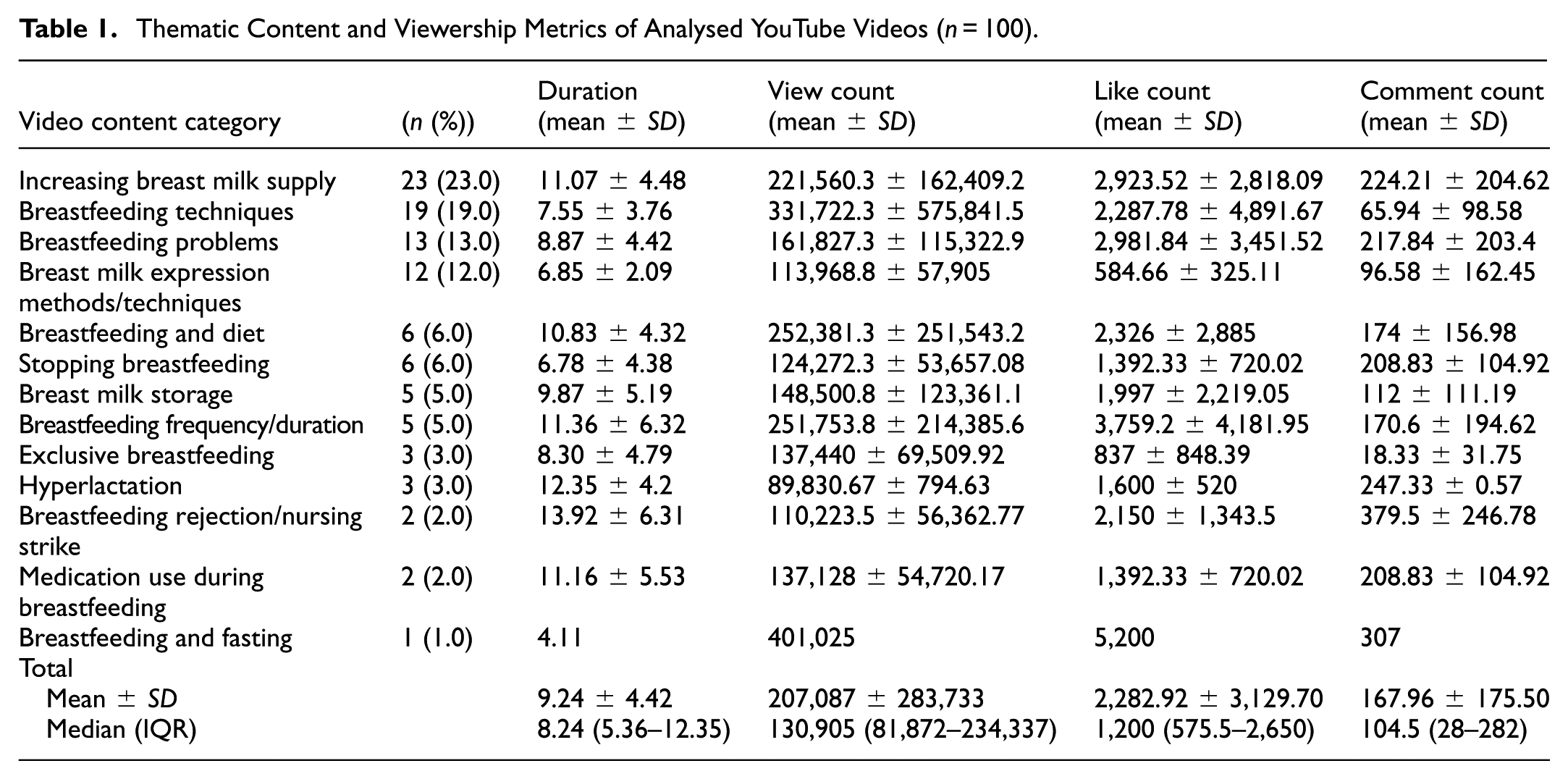
Included videos were uploaded between 2011 and 2023, with the majority released in 2019 (19%). Most videos addressed multiple topics, but they were categorized based on the most prominent theme. As shown in Table 1, out of these 100 videos, the increasing breast milk supply was the most common (23%), followed by breastfeeding techniques (e.g., holding positions) (19%) and breastfeeding problems (e.g., mastitis) (13%). The mean duration of the videos was 9.24 ± 4.42 min (median = 8.24). The videos attracted a mean of 207,087 ± 283,733 views (median = 130,905), 2,282.92 ± 3,129.70 likes (median = 1,200), and 167.96 ± 175.50 comments (median = 104.5). The longest videos were on breastfeeding rejection/nursing strike (13.92 ± 6.31 min) and hyperlactation (12.35 ± 4.42 min), while the shortest focused on breastfeeding and fasting (4.11 min). Videos on breastfeeding techniques and breast milk and diet had the highest view counts, while those covering breastfeeding frequency and breastfeeding problems generated the most audience engagement (Table 1).
Thematic Content and Viewership Metrics of Analysed YouTube Videos (n = 100).
Regarding the source of the videos, the vast majority (81%) originated from personal channels. Other sources were much less common, with news channels and private (commercial company) channels each accounting for just 7%. Official medical authorities, such as the Ministry of Health, represented the least frequent source category, contributing only 5% of the analysed videos. When speaker profiles were analysed, the content was most frequently presented by doctors (32%). A significant proportion of the videos were also created by nurses or midwives (23%) and mothers (25%), highlighting a diverse combination of professional and experiential knowledge (Table 2).
Speaker Profiles and Video Sources in Breastfeeding Videos on YouTube (n = 100).

Table 3 presents the comparison of DISCERN scores according to speaker category and video source. Significant differences were identified among speaker groups in terms of reliability (χ2 = 37.4, p < .001), information quality (χ2 = 38.59, p < .001), and total DISCERN score (F = 15.88, p < .001). Among the speaker categories, doctors obtained the highest mean scores across all DISCERN dimensions (Reliability = 3.53 ± 0.43; Information Quality = 3.93 ± 0.71; total DISCERN score = 3.73 ± 0.53), indicating superior content reliability and accuracy. In contrast, videos presented by others (e.g., mothers) had the lowest mean scores (Reliability = 2.49 ± 0.58; Information Quality = 2.51 ± 0.73; total DISCERN score = 2.46 ± 0.60). Videos featuring nurses, midwives, influencers, or multiple speakers demonstrated moderate results but did not differ significantly from one another. These findings suggest that the professional background of the speaker plays a crucial role in determining not only reliability and information quality but also the overall quality rating of breastfeeding-related videos.
Comparison of DISCERN Scores by Speaker Category and Video Source.

Note. Reliability, Information Quality, and Video Quality scores were analysed using Kruskal-Wallis. Total DISCERN scores were analysed using Kruskal–Wallis and one-way ANOVA tests (mean ± SD). Post hoc pairwise comparisons were corrected using the Bonferroni method. Significant differences were observed only among speaker groups (p < .05).
When evaluated by video source, there were no statistically significant differences in DISCERN subscale scores (p > .05 for all). Nonetheless, videos uploaded by news channels and medical authorities tended to have higher mean total DISCERN scores (3.36 ± 0.64 and 3.19 ± 0.81, respectively) compared to personal and private (commercial) sources (3.11 ± 0.78 and 2.93 ± 0.47, respectively). Although the differences were not significant, this pattern indicates that institutional and professional sources generally provide more reliable content than individual or commercial contributors.
Reliability, Information Quality, Video Quality
The DISCERN Reliability sub-scale evaluates the quality of a publication by examining several key attributes, including the clarity of its aims, the transparency of its sources, and the overall balance and bias of the information presented. The mean score for the DISCERN Reliability sub-scale was 3.04 ± 0.67. An item-by-item analysis revealed that mean scores for the eight questions within this domain ranged from a low of 1.63 to a high of 4.31. The highest-scoring item was “Are the aims clear?” (M = 4.31, SD = 0.82), whereas the lowest-scoring item was “Is it clear what sources of information were used to compile the publication?” (M = 1.63, SD = 0.63).
Average scores for the seven questions on information quality varied between 2.46 and 3.58, resulting in a mean sub-scale score of 3.17 ± 0.88. The top-scoring item in this domain (3.58 ± 1.0) was “Does it describe how the treatment choices affect overall quality of life?,” while the lowest-scoring was “Does it describe what would happen if no treatment is used?” (2.46 ± 0.97). This finding suggests that the information presented in the videos was of moderate quality. Furthermore, the single-item Video Quality assessment revealed that 52% of the videos were classified as moderate (>2–4), yielding an average score of 3.32 ± 0.86.
The composite score from the three DISCERN sub-scales resulted in a mean DISCERN Total Quality Assessment score of 3.11 ± 0.75. In line with this score, an overwhelming majority of the videos (81%) were classified within the “Moderate” quality range, a finding that again indicates a moderate overall quality. A detailed breakdown of the scores for each sub-scale (Reliability, Information Quality, and Video Quality) and DISCERN Total Quality Assessment are presented in Table 4. In addition, the quality classification of videos based on DISCERN sub-scale scores was reported in Table 5.
DISCERN Quality Assessment Scores for Analysed Videos (n = 100).
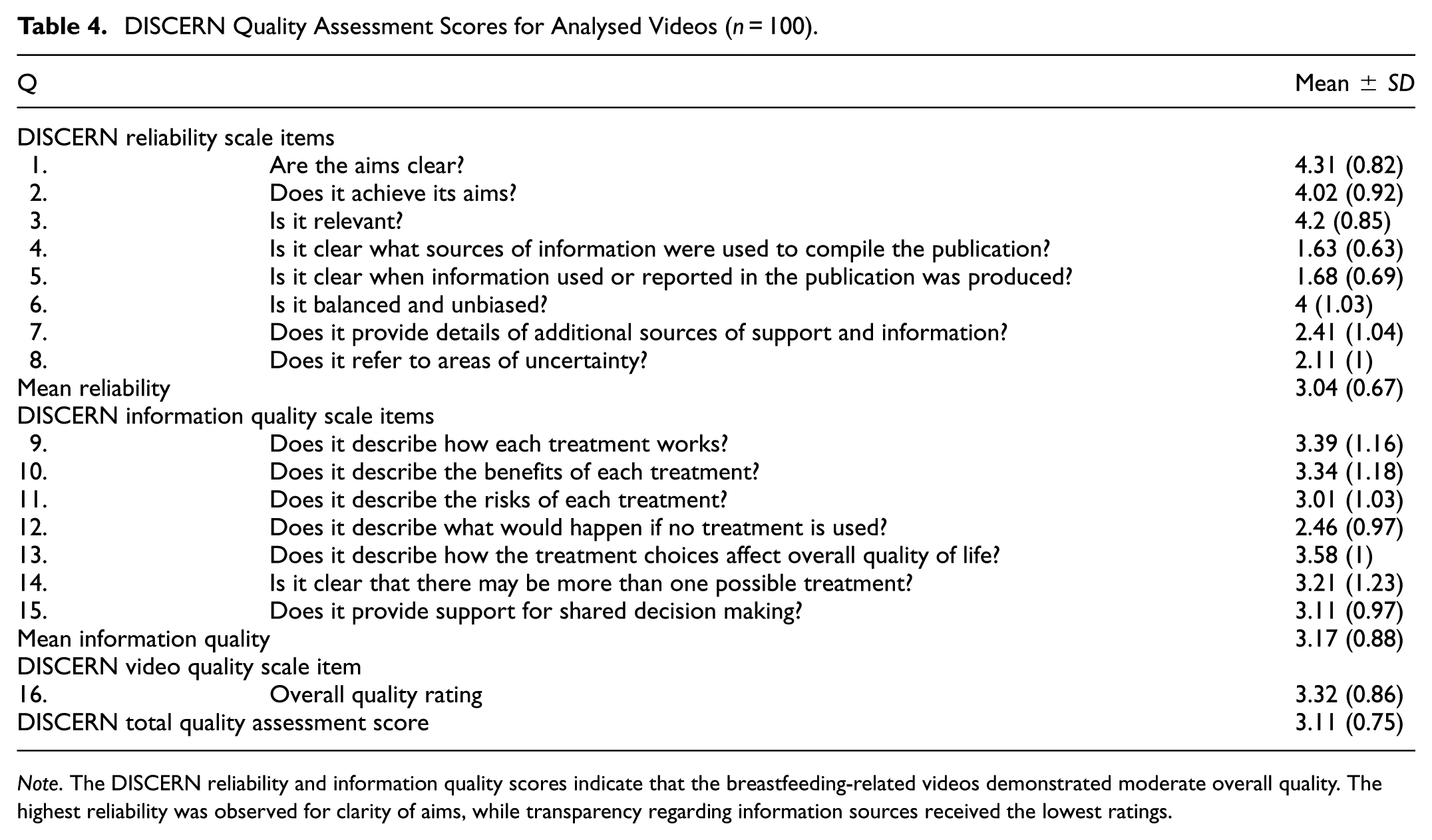
Note. The DISCERN reliability and information quality scores indicate that the breastfeeding-related videos demonstrated moderate overall quality. The highest reliability was observed for clarity of aims, while transparency regarding information sources received the lowest ratings.
Quality Classification of Videos Based on DISCERN Subscale Scores (n = 100).
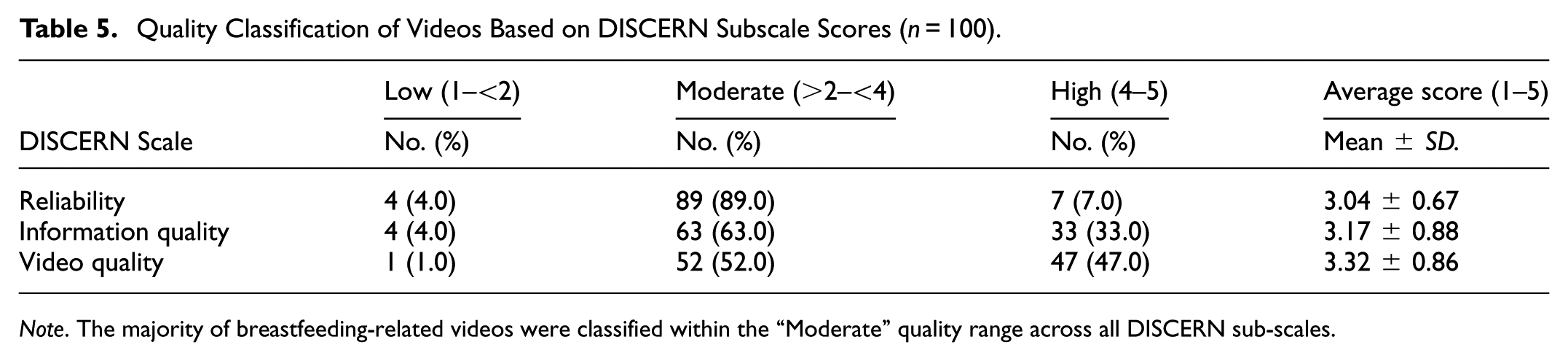
Note. The majority of breastfeeding-related videos were classified within the “Moderate” quality range across all DISCERN sub-scales.
Table 6 illustrates the distribution of DISCERN subscale and total scores of breastfeeding-related YouTube videos according to their year of upload between 2011 and 2023. The mean DISCERN scores of breastfeeding-related YouTube videos varied by year of upload, with some apparent increases in later years but also year-to-year fluctuations. Reliability and information quality scores fluctuated but reached their highest levels in 2023 (3.75 ± 0.93 and 4.43 ± 1.09, respectively). Video quality also improved steadily from 2011 (2.50 ± 2.12) to 2023 (4.50 ± 0.71). Despite these gains, total DISCERN scores remained within the moderate range across all years, though 2023 showed the highest score reaching high quality (4.09 ± 0.04), indicating that newer videos demonstrate enhanced presentation and somewhat higher information quality.
Mean DISCERN Subscale and Total Scores of Breastfeeding Videos on YouTube by Year of Upload (2011–2023).
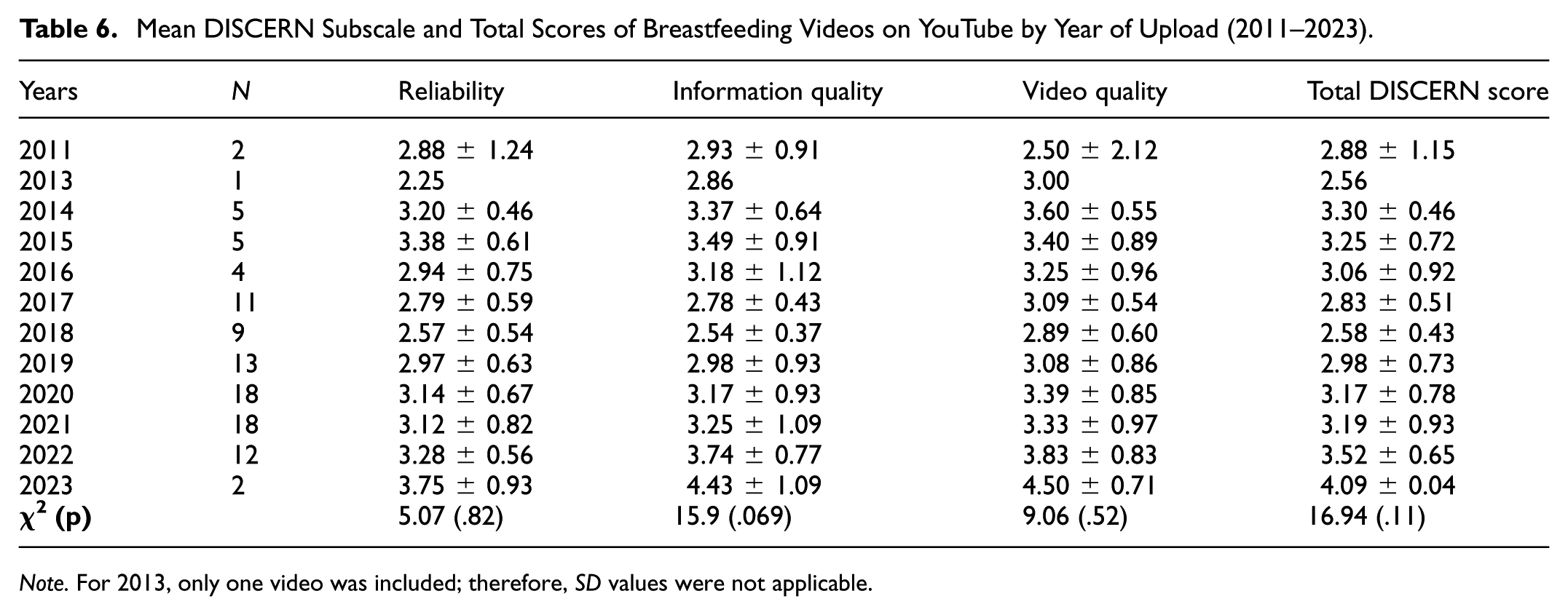
Note. For 2013, only one video was included; therefore, SD values were not applicable.
Spearman’s correlation coefficients (rs) analysis revealed a significant positive association between the Total DISCERN Score and its sub-scales: Reliability (rs = 0.889, p < .001), Information Quality (rs = 0.920, p < .001), and Video Quality (rs = 0.893, p < .001). The Reliability sub-scale score was also significantly correlated with Information Quality (rs = 0.878, p < .001), Video Quality (rs = 0.884, p < .001), and several video metrics, including view count (rs = 0.213, p = 0.033), like count (rs = 0.228, p = .022), and comment count (rs = 0.202, p = .043). Likewise, Information Quality demonstrated a significant positive correlation with Video Quality (rs = 0.892, p < .001), like count (rs = 0.247, p = .013), and comment count (rs = 0.203, p = .042). Among the video engagement metrics themselves, view count was positively correlated with both like count (rs = 0.579, p < .001) and comment count (rs = 0.281, P = .004). Additionally, a strong positive correlation was observed between like count and comment count (rs = 0.682, p < .001) (Table 7).
Spearman Correlations Among DISCERN Quality Scores and Video Metrics.
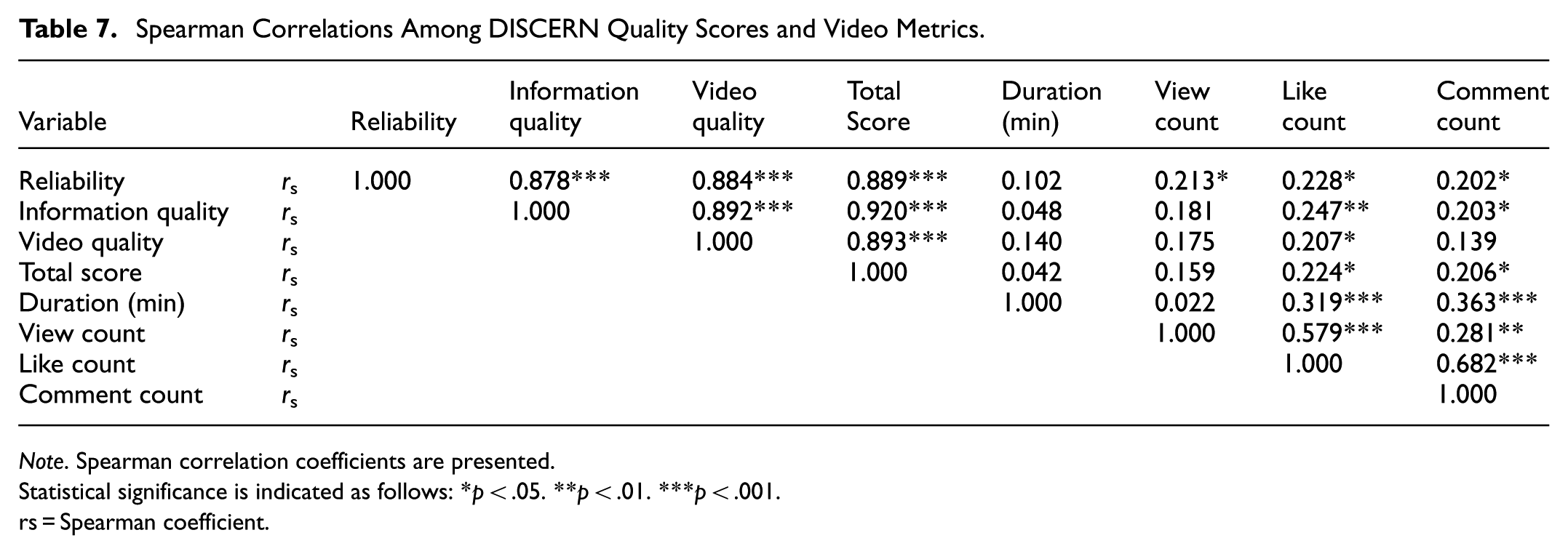
Note. Spearman correlation coefficients are presented.
Statistical significance is indicated as follows: *p < .05. **p < .01. ***p < .001.
rs = Spearman coefficient.
An analysis based on speaker type revealed statistically significant associations with the Information Quality, Reliability, and Total DISCERN Scores (p < .001 for these quality assessment scores) while no such relationship was observed for the Video Quality subscale (p = .29). A detailed breakdown highlights differing quality profiles among the speaker groups. For instance, while a majority of videos by doctors (84.3%) received a “Moderate” rating for Reliability, they tended to score highly on other metrics, with 75% rated as “High” for Information Quality and 81.2% as “High” for Video Quality. In contrast, videos featuring nurses or midwives were predominantly classified as “Moderate” across all three domains: Reliability (95.6%), Information Quality (73.9%), and Video Quality (56.5%).
Discussion
In this study, a search was made on the YouTube platform with the keyword “breastfeeding (emzirme),”“breast milk (anne sütü),” and “lactation (laktasyon),” which is predicted to be preferred by individuals seeking information about breastfeeding. One hundred videos were analysed. The majority of the videos were centred on topics such as increasing breast milk supply and breastfeeding techniques, while less attention was given to areas like medication use and breastfeeding during fasting. The videos had an average duration of approximately 9 minutes, with a mean view count of 207,087, an average of 2,282 likes, and around 168 comments. The majority of the videos were presented by healthcare professionals, with doctors, and nurses or midwives representing 55% of the speakers in total. Most content was sourced from personal channels, with limited representation from medical authorities. The mean scores indicated moderate quality for all scales of the DISCERN criteria, with a DISCERN Total Quality Assessment Score rating of 3.11.
One of the important findings of this study is that the most popular videos on YouTube feature content with the theme of “increasing breast milk” at a rate of 23%. This result may be related to a common anxiety defined in the literature as “Perceived Insufficient Milk” (PIM) and stated to play an important role in the behaviour of stopping breastfeeding early (Galipeau et al., 2018; Gatti, 2008). In addition, according to the findings of Gatti (2008), approximately 35% of mothers who stop breastfeeding early associate this decision with PIM. It is also stated that this anxiety is prominent in different contexts, and that one of the most difficult issues for mothers on digital platforms is “managing milk supply” (Heng & Azhari, 2025). This result suggests that it is not only a search for information, but also a need for support to increase mothers’ confidence and self-efficacy in breastfeeding. In fact, it has been found that digital-based interventions can significantly increase breastfeeding self-efficacy, that this effect is more pronounced in the early postpartum period, and that digital supports result in a high effect size (Hadizadeh-talasaz & Abdollahpour, 2025). Similarly, targeted interventions conducted through social media platforms can positively affect mothers’ breastfeeding self-efficacy, attitudes, and perceptions of social support (Sanchez et al., 2023). The prominence of similar themes on different platforms (such as YouTube and Facebook) and cultural environments (Turkey and Singapore) suggests that anxiety about insufficient milk supply may be a common motivation that triggers online information and support seeking (Heng & Azhari, 2025). For example, a similar situation was observed in a study conducted on TikTok videos; videos with the theme of “ways to increase breast milk” had the highest interaction rates, but received the lowest scores in terms of content accuracy (Jack, 2024). These results may mean that highly interactive content does not always carry scientific accuracy, and therefore it points to the need to carefully evaluate the quality of content, especially on sensitive health topics.
The high viewing rates of themes such as “breastfeeding techniques” (19%) and “breastfeeding problems” (13%) in the videos included in the study indicate that YouTube is not only a source of theoretical knowledge but also a “problem-solving” tool actively used by mothers to find practical solutions to the problems they encounter. It is seen that different studies conducted on similar topics in the literature classify video content with various methodological approaches. For example, in one study, videos were categorized as “information” (67.8%) and “patient experience” (32.1%) in the search result made with the keyword “breastfeeding education” (Orbatu et al., 2021). In another study, videos were examined under more general YouTube categories such as “Education” (29.7%) (Almoayad et al., 2024). In this study, the prominence of more specific themes such as “increasing breast milk” shows that mothers seek to benefit not only from general information but also from guidance on specific problems. In fact, previous studies have emphasized that mothers seek a solution and goal-oriented information from online platforms, especially in the face of specific health problems (Almoayad et al., 2024; Ayers & Kronenfeld, 2007). This approach allows for a clearer understanding of mothers’ real concerns and information-seeking behaviours on online platforms.
When we look at who produces breastfeeding content on YouTube, we find that the field is a hybrid knowledge ecosystem shaped by both professional and peer experience. In this hybrid structure, health professionals (HPs) play a central role in content production. While 55% of the speakers in our study were HPs, a higher proportion was reported in a study conducted in Saudi Arabia, where 63.6% of the speakers were HPs (Almoayad et al., 2024). Similarly, it has been reported in another study that 46% of the uploaded content (doctors 21.8%, other HPs 24.2%) was created by HPs (Orbatu et al., 2021). However, despite professional dominance, it is understood that content based on peer experience also has a significant place. For example, in some studies, the proportion of experienced individuals such as mothers as content producers is as high as 34.5% (Orbatu et al., 2021), while it was found to be 25% in our study, it drops to 10.9% in another study (Almoayad et al., 2024). These findings indicate that breastfeeding content on YouTube is not only based on the transfer of knowledge by professionals, but also on the sharing of collective experience. Despite the dominance of professional content creators, government participation in breastfeeding-related content on YouTube remains limited. This may reflect a broader lack of institutional strategies for digital health communication within Türkiye’s public health system. Many government institutions and hospitals continue to prioritize traditional information and in-person education, with limited adoption of online and social media-based communication models. Furthermore, the algorithmic mechanisms of platforms like YouTube tend to favour user-generated or commercially attractive content, while educational or institutional videos receive less visibility and audience engagement. This imbalance potentially limits the reach and impact of credible and evidence-based institutional resources and highlights the need for systematic digital communication strategies to promote maternal and child health.
YouTube is not only a video archive but also functions as a dynamic social network platform where users can interact through comments, likes, and shares. This interaction dimension has become an element that can directly affect users’ access to information and decision-making processes, especially in health-related content (Madathil et al., 2015). The present study reported an average of 168 comments, which is notably higher than the average documented in a previous study, which found an average of 46.2 comments, yet considerably lower than that reported in another study, which found an average of 322.4 comments (Almoayad et al., 2024; Orbatu et al., 2021). Variability in such interaction levels can be associated not only with the type of content and presentation format, but also with contextual factors such as linguistic, cultural, and platform usage habits. In a previous study examining social media usage behaviours, it was reported that mothers were not only viewers but also active content producers and commentators, with 70.5% of participants sharing in social media groups and 70.8% commenting on content (Dündar & Özsoy, 2018). It is observed that content based on personal experiences in particular increases the perception of trustworthiness and that social media is not only a tool for obtaining information but also an effective support mechanism in decision-making processes. In fact, interventions that include digital peer support have been shown to be more effective in increasing exclusive breastfeeding rates (Corkery-Hayward & Talaei, 2024). Furthermore, perceived breastfeeding support from family and close social networks during pregnancy has been significantly associated with stronger breastfeeding intention (Anderson et al., 2024). Moreover, peer support has been emphasized as a contributing factor to successful breastfeeding (Gama et al., 2025). These findings suggest that digital platforms can support mothers’ breastfeeding intention and confidence by offering both information and social interaction.
The average number of views of the videos analysed in this study was found to be 207,087. This value largely coincides with the number of views reported in other studies examining similar content; for example, one study reported the average number of views of videos as 210,816 (Azak et al., 2023), while another reported it as 210,477 (Orbatu et al., 2021). In studies reporting higher levels of views, this number goes up to 341,953 (Lazalde & Nakphong, 2019) and 381,612 (Almoayad et al., 2024). The number of views of breastfeeding-themed videos was found to be significantly higher than videos on many other health topics (Basim & Argun, 2021; Canbolat et al., 2024; Subaşi et al., 2024). These findings reveal that women have a strong digital tendency to access information about the breastfeeding process. This situation reveals that the need for information about the breastfeeding process is concentrated in the digital environment and that the quality of the content in this area is a critical issue for women’s health. However, these high levels of access require the evaluation of the content in terms of scientific accuracy and reliability.
According to DISCERN quality assessment, the quality of the videos were rated as “moderate” for all scales of the DISCERN criteria as well as the overall DISCERN quality rating. The literature presents mixed findings on the quality of the videos. While one study found that the majority of videos were of moderate quality (Almoayad et al., 2024), another reported that 81.2% were of low or inadequate quality (Orbatu et al., 2021), and yet another indicated that over 60% were rated as good or very good (Azak et al., 2023). This diversity may be related to factors such as the qualification of the speaker, video type and presentation format. In this study, the Total DISCERN score showed weak but statistically significant positive correlations with like count (r = 0.224, p < .05) and comment count (r = 0.206, p < .05), while its correlation with view count was not statistically significant (r = 0.159). In the evaluations made according to the speaker profile, it was seen that videos featuring doctors received higher scores in terms of information and video quality, while content featuring nurses or midwives was mostly classified as moderate. These findings reveal that the professional qualification of the content provider is an important factor affecting both video quality and viewer perception. In fact, similarly, it has been reported in the literature that quality scores of videos featuring health professionals are higher (Almoayad et al., 2024; Azak et al., 2023).
Beyond its practical implications, this study also contributes to the theoretical understanding of digital health communication and online information-seeking behaviour. The findings illustrate how users’ engagement with breastfeeding-related content on YouTube reflects broader processes of digital trust formation and health information evaluation. By revealing that videos produced by health professionals receive higher quality scores and engagement levels, this study supports and extends digital health communication theories emphasizing source credibility and message framing as central determinants of user trust. Moreover, the results highlight the need to adapt traditional health communication models to interactive, algorithm-driven platforms where users simultaneously act as both consumers and producers of health information.
Strengths and Limitations
This study has strengths as well as limitations. The involvement of one author who is a certified breastfeeding supporter enhanced the accuracy and reliability of the video quality assessments. Additionally, unlike many previous studies that utilized only one or two search terms, this study employed three search terms, broadening the scope of the content reviewed. However, the study also has limitations. The search was conducted exclusively in Turkish, restricting the findings to the Turkish context and potentially limiting generalizability to other linguistic or cultural settings. Furthermore, as YouTube is a dynamic platform with continuously changing content and algorithms, the search results reflect a specific point in time. Consequently, the findings provide time-sensitive insights, consistent with the limitations inherent in other studies analysing YouTube content. Another limitation of this study is that it focused on only one social media platform, YouTube. Future research could examine breastfeeding-related content on other platforms such as X, TikTok, or Instagram.
Implications for Future Practice and Research
It is important for health professionals and health authorities to produce evidence-based, up-to-date, and understandable content on platforms with high accessibility, such as YouTube, and to regularly update this content in line with current needs and new developments. In this process, using both visual and experiential information will increase the impact of content. Health professionals should be encouraged to take a more active role in social media content production; midwives and nurses, in particular, should be included in these processes. Furthermore, standards should be established for individuals and institutions uploading content to online platforms for breastfeeding education, and quality control mechanisms should be developed. Expanding digital health literacy training for women, pregnant women, and mothers, and raising awareness on this topic, will support the accurate and reliable use of information.
Future research could benefit from comparing the quality and reach of breastfeeding-related content on different social media platforms, such as TikTok, Instagram, and X. In addition, revealing how content quality varies in different cultural and linguistic contexts and evaluating the relationships between factors such as video duration, title format, and presentation style, as well as viewing rate and information accuracy, will make significant contributions to the development of digital health communication strategies. Also, future research should therefore focus on understanding the motivations behind viewers’ engagement with breastfeeding-related videos and developing strategies to increase interaction with high-quality, evidence-based content.
Conclusions
The results of this study reveal that majority of online content related to breastfeeding was uploaded via personal channels and was of moderate quality. Mothers seeking information or support on breastfeeding may particularly need problem-solving content while experiencing the challenges of caring for a newborn or very young infant. In this regard, there is a clear need for health authorities to have a stronger presence on such platforms to provide accurate and evidence-based information and effectively support breastfeeding women in Türkiye. Nurses and midwives, with their unique position combining clinical expertise with hands-on patient support, are ideally suited to produce such engaging and reliable content. Balancing evidence-based content and relatable peer experiences is key to providing accurate information and enhancing accessibility and engagement.
To translate these findings into practice, a multi-level strategy is essential for improving the quality and visibility of breastfeeding-related content on digital platforms. Governments and policymakers should develop national digital health communication frameworks, allocate funding for the creation of authoritative online materials, and support collaborations between public health institutions and digital media experts. Social media platforms such as YouTube should establish mechanisms that promote verified and evidence-based videos, enhance the visibility of content produced by official sources, and introduce credibility indicators for health-related information. Health professionals and institutions are encouraged to take a more active role in creating accurate, audience-centred, and culturally sensitive breastfeeding education content while strengthening their competencies in digital communication. Likewise, users and caregivers should be supported to improve their digital health literacy, critically evaluate the accuracy of online information, and prioritize content produced by credible healthcare sources. Implementing such a multi-layered approach will enhance digital health ecosystems, increase public trust, and ensure equitable access to reliable breastfeeding information across diverse audiences.
Beyond the national context, these findings carry significant global and public policy implications. Developing international frameworks for digital health communication and promoting global collaboration among health institutions are crucial to ensuring equitable access to evidence-based breastfeeding education. Policymakers and digital platforms should jointly establish mechanisms that regulate misinformation and enhance the visibility of verified health content. Strengthening these global efforts will help bridge informational gaps, foster public trust, and contribute to healthier maternal and child outcomes worldwide.
Footnotes
Acknowledgements
The authors extend their appreciation to Umm Al-Qura University, Saudi Arabia for funding this research work through grant number: 26UQU4330959GSSR02.

Ethical Considerations
The study did not require ethics committee approval due to its observational design, use of only publicly available data, and the absence of any personal data or human/animal intervention.
Author Contributions
Conceptualization, H.B. and G.N.; Data curation, H.B. and G.N.; Formal analysis, H.B., G.N., and T.A.; Investigation, H.B. and G.N.; Methodology, H.B., G.N., and T.A.; Resources, H.B., G.N., and T.A.; Writing – original draft, H.B., G.N., and T.A.; Writing – review & editing, H.B., G.N., and T.A. All authors have read and approved the final version of the manuscript for publication.
Funding
The authors disclosed receipt of the following financial support for the research, authorship, and/or publication of this article: This research work was funded by Umm Al-Qura University, Saudi Arabia under grant number: 26UQU4330959GSSR02.
Declaration of Conflicting Interests
The authors declared no potential conflicts of interest with respect to the research, authorship, and/or publication of this article.
Data Availability Statement
A data set will be available upon request.