




Abstract
Understanding how school organizational structures influence teachers’ professional autonomy has become increasingly important in discussions of educational improvement and teacher professionalism. The purpose of this research is to examine the relationship between teachers’ perception levels of autonomy and the facilitating and obstructive bureaucratic structures. The research population, utilizing the relational screening model, comprises primary and secondary school teachers in the Eyüp Sultan district of Istanbul for the 2023 to 2024 academic year. The sample for the research consists of 348 teachers, selected through convenience sampling. In this research, the Teacher Autonomy and Enabling School Scales were used to collect research data. The findings indicated that, in this sample, perceived bureaucratic structures were not significantly associated with teacher autonomy. While certain demographic differences were observed, no empirical support was found for the predictive role of school bureaucratic structure. Future research may examine psychological and individual factors directly to better understand the sources of teacher autonomy.
Plain Language Summary
Teacher autonomy refers to teachers’ ability to make professional decisions about their teaching, such as how to plan lessons, choose instructional methods, and manage their classrooms. It is often assumed that school rules and administrative structures strongly influence how much autonomy teachers experience in their daily work. This study examined whether teachers who perceive their schools as having more supportive or facilitating bureaucratic structures also report higher levels of professional autonomy. Data were collected from teachers working in different types of schools in the Eyüp Sultan district of Istanbul. The findings showed that teachers’ perceptions of school bureaucracy were not meaningfully related to their sense of autonomy. In other words, teachers who viewed bureaucratic structures as more supportive did not feel more autonomous than those who perceived them as more restrictive. This suggests that formal school structures alone may not determine how autonomous teachers feel in their professional roles. Although some differences were observed across demographic groups, overall the study did not find evidence that bureaucratic arrangements directly shape teacher autonomy. These results highlight that teacher autonomy may depend on factors beyond formal rules and organizational structures, such as professional relationships, school culture, and everyday teaching experiences. Future research may help clarify how these factors support teachers’ autonomy in practice.
Keywords
Introduction
Teacher autonomy has become a central concept in educational research because of its well-documented associations with instructional quality, teacher motivation, and professional agency. Autonomy generally refers to teachers’ perceived ability to make decisions regarding curriculum, instruction, and classroom management in ways that reflect their professional judgment (Friedman, 1999; Pearson & Moomaw, 2005). Contemporary research emphasizes that autonomy is shaped not only by internal motivation but also by contextual and organizational factors that either support or restrict teachers’ professional discretion (Ryan & Deci, 2017; Slemp et al., 2018). Among these organizational factors, school bureaucratic structure has been identified as a key contextual condition shaping teachers’ professional experiences.
Over time, scholars have approached teacher autonomy from different angles. Early studies defined autonomy as teachers’ responsibility for their own professional development and their ability to make pedagogical decisions independently (J. V. Little, 1990; Smith, 2001). Later frameworks emphasized behavioral, competence-based, and participatory dimensions, highlighting teachers’ control over instructional decisions, influence in school-level decision-making, and their perceived authority in shaping the teaching–learning environment (Ingersoll, 1997; Kreis & Young Brockopp, 2001; Yan, 2010). More recent perspectives also recognize emerging forms of autonomy, including digital and instructional decision-making in technologically rich environments (Hermosilla et al., 2020; Liu et al., 2022). Although definitions vary, most converge on the idea that teacher autonomy reflects teachers’ capacity to exercise professional judgment in classroom practice and participate meaningfully in decisions shaping their work conditions (Soini et al., 2021; Torres, 2019; Üzüm, & Karslı, 2013).
Several studies show that teacher autonomy is linked not only to classroom decisions but also to broader organizational participation. Pedagogical autonomy includes decisions about methods, materials, and instructional strategies, while organizational autonomy involves involvement in school governance, planning, and improvement (Friedman, 1999; Pearson & Hall, 1993). Research consistently indicates that opportunities for teachers to influence both classroom-level and school-wide decisions enhance their professional commitment and instructional effectiveness (Downer et al., 2021; Mustafa & Cullingford, 2008). However, autonomy is not static; it must be continually supported through professional development, collaborative practices, and enabling organizational environments (Bauer, 2005; Bustingorry, 2008).
Recent scholarship highlights significant challenges to teacher autonomy globally, particularly due to policy pressures, accountability demands, and increasing bureaucratic constraints (Torres, 2019). At the same time, teachers’ demands for greater professional discretion continue to rise. These dynamics underscore the importance of examining the organizational conditions that shape autonomy, especially in contexts where bureaucratic structures play a prominent role in shaping daily professional practice.
Teacher autonomy is widely discussed as supporting teachers’ contributions to instructional improvement, the adoption of new teaching methods, professional competence, and the development of educational resources. Autonomy supports teachers’ ability to respond flexibly to classroom needs and exercise professional judgment in their daily work (Anderson, 1987; Pearson & Moomaw, 2005). Research also shows that working in environments that promote autonomy is associated with stronger decision-making capacity and more effective school functioning (Firestone, 1991; Rosenholtz, 1987). Furthermore, autonomy contributes to teachers’ professional growth by increasing motivation, job satisfaction, and participation in collaborative learning communities, which collectively enhance instructional quality (Deci & Ryan, 2000; DuFour, 2004; Hargreaves, 2000; Ryan & Deci, 2000). Recent evidence shows that teacher autonomy has been linked to lower levels of burnout and higher levels of innovative instructional practices (Hallgarten, 2022; Kabat-Zinn & Ergas, 2020). Taken together, these findings indicate that understanding the conditions under which teacher autonomy is fostered or constrained is crucial for improving teachers’ well-being, their motivation, and ultimately student learning outcomes.
Bureaucracy is commonly understood as an organizational system governed by formal rules, hierarchical authority, and specialization of duties (Merton, 1940). Weber conceptualized bureaucracy as a rational and efficient form of administration in which decisions are guided by clearly defined procedures, documentation, and merit-based appointment (Weber, 1968). Although his work introduced important characteristics—such as hierarchy, division of labor, and formal rules—later scholars emphasized how these features manifest differently across organizational contexts, including schools (Buluç, 2009).
In this study, school bureaucratic structure is examined using the Enabling School Structure Scale, which conceptualizes organizational arrangements through two dimensions: facilitating bureaucratic structure and obstructive bureaucratic structure. The term facilitating bureaucratic structure is used to refer to organizational arrangements that support teachers’ professional functioning while maintaining formal bureaucratic procedures (Hoy & Sweetland, 2001). In the literature, similar constructs have been described using related terms such as “enabling school structure,”“facilitative structure,” or “supportive bureaucratic structure.” For clarity and consistency, the present study uses the term facilitating bureaucratic structure throughout, unless directly referencing terminology used in prior studies.
In educational settings, bureaucratic structures are discussed in the literature as shaping the extent to which teachers participate in decision-making and exercise professional discretion. Hoy and Sweetland (2000, 2001) examined two key components of bureaucracy—formalization and centralization—highlighting how written rules and centralized authority shape teachers’ work. Formalization refers to the degree to which procedures are specified through written regulations, while centralization concerns the locus of decision-making authority (Adler & Borys, 1996). Building on these dimensions, Hoy and Sweetland distinguished between enabling and coercive bureaucracies. Enabling structures provide support, guidance, and problem-solving mechanisms that facilitate teacher performance, whereas coercive structures rely on control, compliance, and restrictive rules that limit teacher autonomy and empowerment (Hoy & Miskel, 2008). Research increasingly shows that overly centralized or coercive administrative systems constrain teachers’ professional judgment and hinder innovation (Finnigan & Daly, 2021). These theoretical and empirical insights together suggest a potential relationship between enabling bureaucratic structures and teachers’ perceived autonomy, yet existing studies remain inconclusive, highlighting the need for further investigation. In Turkey, the national education system is organized through a highly centralized and hierarchical bureaucracy, with strong state control over curriculum, assessment, and personnel decisions. These structural features make bureaucratic arrangements especially salient in shaping teachers’ day-to-day professional practices. Therefore, examining how bureaucratic structures are perceived by teachers in the Turkish context is both necessary and timely.
Research has discussed how enabling or facilitating bureaucratic arrangements may be associated with school environments in which teacher autonomy, collaboration, and innovation are supported (Adler & Borys, 1996; McGuigan & Hoy, 2006; Watts, 2011). Some empirical studies have reported positive associations between facilitating bureaucratic structures and teacher autonomy, suggesting that supportive organizational arrangements may relate to teachers’ professional discretion (Gümüş et al., 2022; Ozdemir, 2020). However, other studies have found weak or negligible relationships between structural features and teacher autonomy, indicating that autonomy may not be directly linked to bureaucratic conditions and may instead be influenced by factors beyond organizational structure (Bakır et al., 2024; Ryan & Deci, 2017). Taken together, these contrasting findings suggest that the nature and strength of the relationship between school bureaucratic structure and teacher autonomy remain empirically unclear. Accordingly, the present study examines whether teachers’ perceptions of facilitating and obstructive bureaucratic structures are associated with their perceptions of teacher autonomy.
Recent research highlights teacher autonomy as a critical factor influencing professional motivation, instructional decision-making, and innovation in educational settings. However, in the Turkish context, empirical studies examining the extent to which teacher autonomy is shaped by the bureaucratic structure of schools remain limited. In particular, it is unclear whether enabling bureaucratic structures enhance teachers’ perceived autonomy or whether structural conditions have only a minimal influence on teachers’ professional agency. The Eyüp Sultan district, characterized by diverse school types and administrative approaches, provides an important context for exploring this issue. Accordingly, the central problem addressed in this study concerns the uncertainty surrounding the relationship between teachers’ perceptions of autonomy and their perceptions of facilitating and obstructive bureaucratic structures in schools.
Significance of the Study
This study is significant for several reasons. First, the question of teacher autonomy has gained renewed importance in contemporary educational research due to its strong associations with instructional quality, professional motivation, and school improvement. Despite this relevance, little is known about how autonomy is shaped within highly centralized education systems such as Turkey’s, where bureaucratic structures play a defining role in teachers’ professional environments. Second, recent policy debates in Türkiye emphasize the need to strengthen teacher agency and flexibility, making it timely to examine the relationship between facilitating and obstructive bureaucratic structures and teachers’ professional autonomy. Third, this study contributes to international academic discussions by examining autonomy not solely as an individual characteristic but as a construct shaped by organizational conditions. By focusing on enabling and constraining bureaucratic structures, the study extends existing research and offers empirical evidence from a context that has been underrepresented in the autonomy literature.
Theoretical Framework
This study is grounded in Self-Determination Theory (SDT), which conceptualizes autonomy as a basic psychological need that supports intrinsic motivation and professional functioning (Deci & Ryan, 2000; Ryan & Deci, 2000, 2017). From this perspective, teachers’ perceived autonomy reflects the extent to which their work environment enables them to exercise professional judgment and self-direction. Organizational theories of bureaucracy further explain how structural conditions shape this experience. Weber’s model highlights formalization, hierarchy, and rule-based coordination as defining features of bureaucratic systems, while Hoy and Sweetland’s distinction between enabling and coercive bureaucracy clarifies how these structures may either support or constrain employees. Enabling bureaucratic structures function as supportive mechanisms that facilitate problem solving and professional discretion, whereas coercive structures rely on control and compliance. Integrating these perspectives, the theoretical framework conceptualizes facilitating and obstructive bureaucratic structures as organizational conditions that may be related to teachers’ perceptions of autonomy. Accordingly, the statistical model examines whether teachers’ perceptions of bureaucratic structure predict their perceptions of autonomy.
Research Aims and Research Questions
Based on the problem outlined above, this study pursues the following specific and measurable aims:
To examine the relationship between teachers’ perceptions of facilitating and obstructive bureaucratic structures and their perceptions of autonomy.
To examine whether facilitating and obstructive bureaucratic structures predict teachers’ perceived autonomy.
To evaluate the extent to which variations in bureaucratic structure scores account for variations in autonomy scores.
Based on the stated aims, the study addresses the following research questions:
These research questions specify the expected associations between bureaucratic structures and teacher autonomy within the theoretical framework and function in place of formal hypotheses in this descriptive–correlational design.
Method
Design
This study was conducted within a quantitative research approach using a descriptive–correlational survey design (Karasar, 2014). The purpose of the study was to examine the relationships between teachers’ perceptions of facilitating and obstructive bureaucratic structures and their perceptions of teacher autonomy. A correlational design was selected because the study aimed to investigate naturally occurring associations among variables without manipulating the research context. Within this framework, the relational screening (correlational) model was employed to examine associations between teachers’ perceptions of school bureaucratic structure, as measured through enabling school structure dimensions, and autonomy. This design is appropriate for identifying relational and predictive patterns among variables in non-experimental educational settings and is commonly used to examine associations between organizational perceptions and individual outcomes.
Participants
The participants of the study consisted of primary and secondary school teachers working in the Eyüp Sultan district of Istanbul during the 2023 to 2024 academic year. The sample was selected using convenience sampling from an easily accessible population. Because convenience sampling was used, the representativeness of the sample is limited, and therefore the generalizability of the findings should be interpreted with caution.
A total of 348 teachers participated in the study, of whom 66.4% (n = 231) were female and 33.6% (n = 117) were male. Regarding age, 18.2% (n = 63) were between 20 and 29 years, 35.4% (n = 123) between 30 and 39 years, 37.1% (n = 129) between 40 and 49 years, and 12.3% (n = 42) were 50 years or older. In terms of educational level, 73.6% (n = 256) held undergraduate degrees and 26.4% (n = 92) held postgraduate degrees. With respect to professional background, 72.7% (n = 253) reported no administrative experience, while 27.3% (n = 95) had held managerial roles. Teaching experience varied, with 54.3% (n = 189) having less than 10 years, 19.0% (n = 66) having 11 to 20 years, and 26.7% (n = 93) having 21 years or more of experience. Regarding school type, 54.0% (n = 188) worked in preschool or primary schools, whereas 46.0% (n = 160) were employed in secondary or high schools. In terms of subject area, teachers were distributed across different instructional fields, including classroom teaching (n = 65), numerical subjects such as mathematics and science (n = 77), Turkish (n = 30), foreign languages (n = 48), technical or vocational/applied courses (n = 100), and other verbal subjects (n = 28).
Data Collection Instruments
Data were collected using the Enabling School Scale (Özer & Dönmez, 2013) and the Teacher Autonomy Scale (Akçay, 2025). Both instruments were originally developed and validated in the Turkish educational context, and therefore no additional cultural adaptation was required for their use in the Eyüp Sultan sample.
Enabling School Scale (ESS)
School bureaucratic structure was measured using the Enabling School Structure Scale (ESS) developed by Özer and Dönmez (2013). The scale consists of two dimensions: facilitating bureaucratic structure, which reflects supportive, flexible, and problem-solving organizational arrangements, and obstructive bureaucratic structure, which reflects rigid, controlling, and restrictive bureaucratic practices. In the present study, these two dimensions were analyzed separately rather than combined into a single composite score. The 12-item, two-factor ESS was originally validated with a factor structure explaining 51% of the total variance (Özer & Dönmez, 2013). The internal consistency reliability coefficients reported for the original scale were acceptable for both dimensions (facilitating bureaucratic structure, α = .81; obstructive bureaucratic structure, α = .77). Confirmatory factor analysis in the original validation study demonstrated good model fit, χ2(51) = 215.48, χ2/df = 4.22, RMSEA = 0.056, RMR = 0.036, SRMR = 0.040, GFI = 0.97, AGFI = 0.95, NFI = 0.94, CFI = 0.96, and IFI = 0.96 (Hu & Bentler, 1999). In the current sample, internal consistency reliability was examined separately for each dimension of the scale. Cronbach’s alpha coefficients were α = .900 for the facilitating bureaucratic structure dimension and α = .877 for the obstructive bureaucratic structure dimension, indicating good internal consistency. Responses to the items were recorded on a 5-point Likert scale ranging from 1 (Never) to 5 (Always). Higher scores on the facilitating bureaucratic structure dimension indicate that school bureaucracy supports teachers’ professional work, whereas higher scores on the obstructive bureaucratic structure dimension indicate that bureaucratic practices hinder teachers’ work. Because the scale was originally developed and validated within the Turkish educational context, no additional cultural adaptation was required for the present study.
Teacher Autonomy Scale (TAS)
The Teacher Autonomy Scale was developed by (Akçay, 2025) as a 15-item unidimensional measure. The factor structure and construct validity of the scale were established in the original validation study; therefore, no confirmatory factor analysis was conducted in the present research, and the original CFA results (e.g., χ2 = 7,109.02, RMSEA = 0.096, SRMR = 0.075, CFI = 0.96, TLI = 0.95) are reported only for reference. The unidimensional factor explained 57.89% of the total variance in the original validation sample, and the internal consistency reliability was α = .89. In the current sample, internal consistency reliability was again examined, and the scale demonstrated high reliability (Cronbach’s α = .898). No items were removed or modified for the purposes of this study, and the instrument was administered in its original form. The TAS uses a 5-point Likert response format ranging from 1 (Strongly disagree) to 5 (Strongly agree). Because the scale was originally developed and validated in Türkiye and reflects the characteristics of the Turkish education system, it was considered appropriate for use in the Eyüp Sultan context without requiring additional cultural adaptation.
Data Analysis
Prior to analysis, the dataset was screened for missing values. Cases with missing data on key study variables were excluded using listwise deletion. The proportion of missing data was minimal and did not meaningfully reduce the effective sample size. Normality assumptions were evaluated using skewness and kurtosis values. The skewness and kurtosis values of the Enabling School Structure (ESS) scores were −1.037 and 0.155, respectively, falling within the acceptable range of ±1.50, which is considered indicative of normality (Tabachnick & Fidell, 2013). In contrast, the Teacher Autonomy Scale (TAS) scores showed skewness and kurtosis values of 0.918 and 2.678, respectively, indicating deviation from normality. Based on these distributional characteristics, parametric tests (independent-samples t-test and one-way ANOVA) were applied only to ESS scores that met normality assumptions. Non-parametric alternatives (Mann–Whitney U and Kruskal–Wallis H tests) were used for all analyses involving TAS scores. This analytic strategy ensured that statistical procedures were aligned with the underlying assumptions of each test and enhanced the robustness of the findings. Demographic data were analyzed using descriptive statistics. Demographic variables were included because prior research suggests that teachers’ perceptions of autonomy and school structure may differ by gender, age, professional experience, and subject area. To examine group differences, independent-samples t-tests and Mann–Whitney U tests were used for binary variables, while one-way ANOVA and Kruskal–Wallis H tests were applied for variables with more than two categories. Given that Teacher Autonomy Scale (TAS) scores deviated from normality, Spearman’s rank-order correlation coefficients were calculated to examine the relationships between perceived facilitating and obstructive bureaucratic structures and teacher autonomy. Correlation coefficients were interpreted as high (.70–1.00), moderate (.30–.69), or low (.10–.29) in absolute value. Finally, perceived facilitating and obstructive bureaucratic structures were entered into the model to examine their statistical association with teacher autonomyin multiple linear regression analyses to address RQ2 and RQ3, while correlation analyses were used to address RQ1.
Ethical Considerations
Due to ethical considerations, the participants were required to provide informed consent. In this version, the investigators provided clear and understandable information about the study’s objective and procedure. All participants were informed about the study, including the right to withdraw at any point.
Results
In this section, the results of the analyses examining teachers’ perceptions of facilitating and obstructive bureaucratic structures and teacher autonomy are presented. Group comparisons were conducted to examine whether perceptions of bureaucratic structure and autonomy differed across demographic variables. In addition, correlation analyses were performed to assess the relationships between bureaucratic structure dimensions and teacher autonomy, and multiple regression analyses were conducted to examine the predictive role of facilitating and obstructive bureaucratic structures on teacher autonomy. The results are reported descriptively and inferentially, without interpretive commentary. Overall, demographic factors showed limited influence on both enabling school structure and autonomy. Correlation analyses indicated no meaningful relationship between bureaucratic structure and teacher autonomy, and regression analyses revealed that bureaucratic variables did not predict autonomy. These findings suggest that teachers’ perceived autonomy operates largely independently from perceived organizational structures.
Teachers’ Perceptions of Facilitating Bureaucratic Structure and Teacher Autonomy
The independent-samples t-test results examining whether teachers’ perceptions of facilitating bureaucratic structure differed across demographic variables are presented in Table 1.
Independent-Samples t-Test Results for Teachers’ Perceptions of Facilitating Bureaucratic Structure Across Demographic Variables.
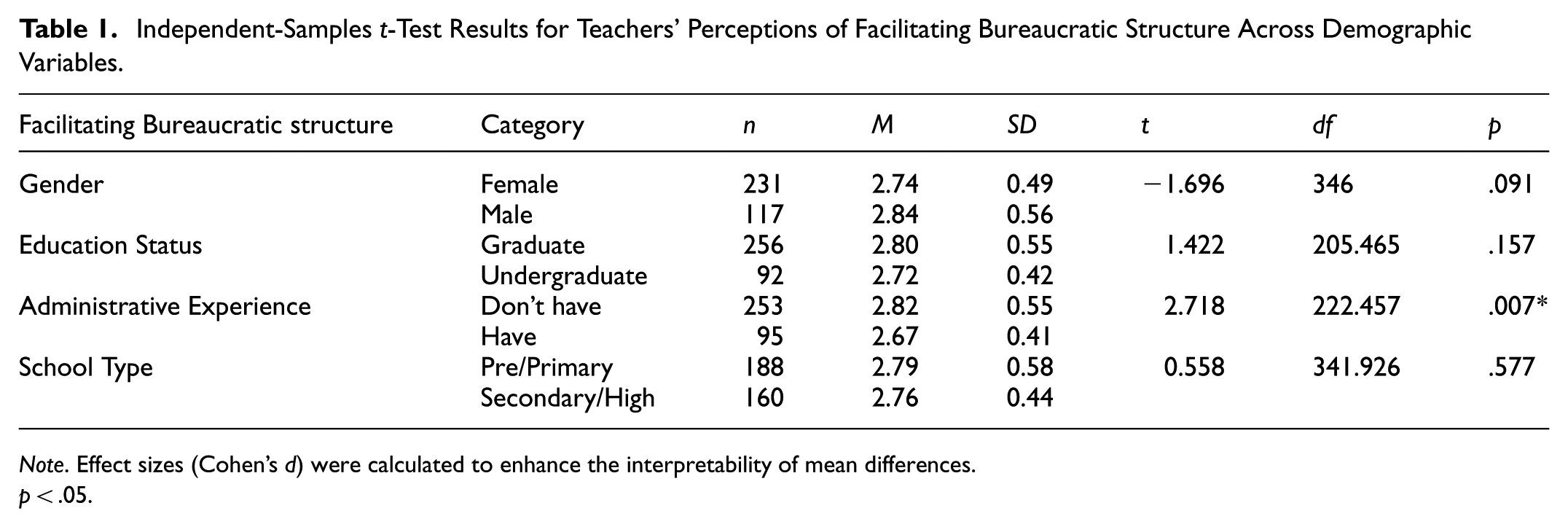
Note. Effect sizes (Cohen’s d) were calculated to enhance the interpretability of mean differences.
p < .05.
Administrative experience was the only demographic variable associated with a statistically significant difference in teachers’ perceptions of facilitating bureaucratic structure. The independent-samples t-test indicated that teachers without administrative experience reported higher facilitating bureaucratic structure scores (M = 2.82, SD = 0.55) than those with administrative experience (M = 2.67, SD = 0.41), t(346) = 2.72, p < 05. No other demographic variables were associated with significant differences in facilitating bureaucratic structure scores. No statistically significant differences were found in teachers’ perceptions of obstructive bureaucratic structure across any of the examined demographic variables (p > .05).
Teachers’ Perceptions of Autonomy Across Demographic Variables
The Mann–Whitney U test was conducted to examine whether teachers’ perceptions of autonomy differed across selected demographic variables, and the results are presented in Table 2.
Mann–Whitney U Test Results for Teachers’ Perceptions of Autonomy Across Gender, Education Status, Administrative Experience, and School Type.

Note. Effect size (r) values were also computed to provide additional information about practical significance.
p < .05.
Teachers’ perceptions of autonomy differed significantly only by gender and administrative experience. Specifically, a statistically significant difference was observed between female and male teachers, as well as between teachers with and without administrative experience (p < .05).
The one-way ANOVA results examining whether teachers’ perceptions of facilitating bureaucratic structure differed according to seniority are presented in Table 3.
One-Way ANOVA Results for Teachers’ Perceptions of Facilitating Bureaucratic Structure Across Seniority Levels.

p < .05.
One-way ANOVA results indicated that teachers’ perceptions of facilitating bureaucratic structure did not differ significantly according to seniority, age, or subject area (p > .05). Specifically, seniority did not significantly influence teachers’ perceptions of facilitating bureaucratic structure (F = 0.215, p > .05). Similarly, no statistically significant differences were observed across age groups (F = 0.476, p > .05) or teaching branches (F = 1.238, p > .05). These results indicate that teachers’ perceptions of facilitating bureaucratic structure were comparable across different levels of professional experience, age, and subject specialization.
Table 4 presents the results of the Kruskal–Wallis H test conducted to examine whether teachers’ perceptions of autonomy differed according to seniority. The results indicated that there were no statistically significant differences in teachers’ autonomy perceptions across seniority groups (p > .05).
Kruskal–Wallis H Test Results for Teachers’ Perceptions of Autonomy Across Seniority, Age, and Subject Area.

Note. Effect size (r) values were also computed to provide additional information about practical significance.
p < .05.
Kruskal–Wallis H test results indicated that teachers’ perceptions of autonomy did not differ significantly according to seniority, age, or subject area (p > .05). Specifically, no statistically significant differences were observed across seniority groups, χ2(2) = 0.95, p = .622; age groups, χ2(3) = 5.03, p = .170; or teaching branches, χ2(5) = 6.82, p = .235. Consistent with these results, autonomy levels did not differ significantly by seniority, age, or subject area (χ2 = 0.95, df = 2, p > .05).
Relationship Between Teacher Autonomy and School Bureaucratic Structure
Spearman correlation analyses were conducted to examine the relationships between teacher autonomy and the two dimensions of school bureaucratic structure, namely facilitating and obstructive bureaucratic structures (see Table 5).
Spearman Correlations Between School Bureaucratic Structure Dimensions and Teacher Autonomy.

Note. Values are Spearman’s rho (ρ) correlation coefficients.
p < .01 (two-tailed).
Correlation analyses revealed no meaningful relationship between teacher autonomy and any dimension of school bureaucratic structure (p > .01). The associations between teacher autonomy and overall school bureaucratic structure (ρ = .006, p = .913), facilitating bureaucratic structure (ρ = .009, p = .868), and obstructive bureaucratic structure (ρ = –.026, p = .628) were extremely weak and not statistically significant. In contrast, strong and statistically significant positive relationships were observed among the dimensions of school bureaucratic structure. Overall school bureaucratic structure was strongly correlated with facilitating bureaucratic structure (ρ = .874, p ≤ .01) and obstructive bureaucratic structure (ρ = .874, p ≤ .01). In addition, a moderate and statistically significant positive correlation was found between facilitating and obstructive bureaucratic structures (ρ = .528, p ≤ .01). These findings indicate that teachers’ perceptions of bureaucratic structures are not meaningfully associated with their perceptions of autonomy in the present sample. This absence of association suggests that teacher autonomy and perceived bureaucratic structures did not covary in the present sample. Because psychological, cultural, or classroom-level factors were not directly measured in this study, no explanatory conclusions are drawn regarding their role; instead, these factors are identified as important directions for future research.
Predictive Power of School Bureaucratic Structure on Teacher Autonomy
To examine whether the facilitating and obstructive dimensions of school bureaucratic structure, as measured by the Enabling School Structure Scale, predict teacher autonomy, a multiple linear regression analysis was conducted. Facilitating bureaucratic structure and obstructive bureaucratic structure were entered into the regression model as independent variables, while teacher autonomy served as the dependent variable. The results of the regression analysis are presented in Table 6.
Regression Results for Predicting Teacher Autonomy Based on School Bureaucratic Structure.

Bureaucratic structure variables did not show a statistically significant relationship with teacher autonomy, as indicated by an R2 value of .000 (see Table 6). This finding suggests that facilitating and obstructive bureaucratic structures explain virtually none of the variance in teachers’ perceived autonomy. Accordingly, the regression model provides no empirical support for the predictive role of bureaucratic structure variables, directly addressing RQ2 and RQ3. Neither facilitating bureaucratic structure (β = .001, p = .986) nor obstructive bureaucratic structure (β = .006, p = .921) emerged as a significant predictor of teacher autonomy. Collinearity diagnostics further indicated that the regression estimates were stable, with Variance Inflation Factor (VIF = 1.07) and tolerance values (0.93) well within acceptable limits, confirming that the null findings cannot be attributed to multicollinearity.
Discussion
This study examined teacher autonomy and its relationship with perceived enabling school structures, as well as differences in autonomy perceptions across demographic variables. Results showed that teacher autonomy differed across certain demographic variables, while no significant relationship was found between perceived bureaucratic structure and autonomy.
Before interpreting the findings, it is important to emphasize that the central results of this study are non-significant with respect to the relationship between perceived school bureaucratic structure and teacher autonomy. Correlation coefficients were close to zero, and regression analyses explained virtually none of the variance in autonomy (R2 = .000). Accordingly, these findings should be interpreted as null findings, indicating that, in this sample, perceived bureaucratic structures did not function as meaningful correlates or predictors of teacher autonomy. Viewed in this way, the null findings are informative in themselves, as they challenge the common assumption that enabling or supportive bureaucratic structures are necessarily associated with higher levels of teacher autonomy.
These findings provide a basis for interpreting how demographic factors intersect with teachers’ perceptions of autonomy and facilitating bureaucratic structures in light of prior research. Teachers without prior administrative experience reported higher perceptions of facilitating bureaucratic structure, and teachers who were female and without administrative experience reported higher levels of autonomy. In this respect, the finding that administrative background may shape how school organizational structures are perceived is complemented by the work of Schön and Sykes (2023). In addition, the finding that female teachers reported higher autonomy perceptions is consistent with the results of Paustian-Underdahl et al. (2014), who showed that female educators tend to adopt more democratic and collaborative approaches than their male counterparts. Taken together, these studies help contextualize the present findings by suggesting that demographic characteristics may influence how teachers perceive both structural conditions and autonomy, even though bureaucratic structure variables themselves did not directly predict autonomy in this study.
Moreover, this interpretation aligns with prior research indicating that leadership or administrative experience—often associated with centralized authority—may be linked to more constraining orientations. As administrative experience increases, there may be a greater emphasis on standardization and control rather than flexibility and inclusiveness, which could influence how organizational structures are perceived (e.g., Schön & Sykes, 2023). This perspective offers a possible interpretive context for the observed demographic differences without implying a direct causal relationship.
For example, research suggests that more experienced leaders may tend to rely on practices that were successful in their earlier professional experiences, which can be associated with lower levels of innovation and reduced employee autonomy (Eagly & Karau, 2002). Similarly, Steinmann et al. (2018) argues that such reliance on prior experience may lead leaders to base decisions more heavily on their own judgments, potentially limiting the participation of other stakeholders, particularly under conditions of uncertainty.
A central contribution of the present study lies in its interpretation of the null relationship between perceived bureaucratic structure and teacher autonomy. Rather than treating this finding as merely unexpected, the results suggest that autonomy and bureaucratic structure may operate at fundamentally different analytical levels. Bureaucratic structure represents an organizational-level condition, whereas teacher autonomy reflects an individual-level psychological experience. When constructs function on distinct conceptual planes, a lack of empirical association is theoretically plausible.
Importantly, the present study did not include direct measures of psychological constructs such as motivation, basic psychological needs, or professional identity. Therefore, psychological factors are not offered here as empirical explanations of the findings. Instead, they are referenced to situate the results within established theoretical frameworks—most notably Self-Determination Theory—which conceptualizes autonomy as a psychological need whose fulfillment does not necessarily depend on formal structural arrangements. In this sense, the findings do not contradict autonomy theory but rather reinforce its distinction between structural conditions and psychological need satisfaction.
Viewed from this perspective, the null findings make a conceptual contribution by refining existing organizational models of schooling. While enabling bureaucratic structures may shape teachers’ perceptions of organizational climate, the present results suggest that such structures do not automatically translate into higher levels of perceived professional autonomy. This distinction advances understanding of how autonomy functions in school contexts and highlights the importance of empirically testing, rather than assuming, structural effects on teachers’ psychological experiences.
Strong associations between the facilitating structure and bureaucratic structure dimensions suggest that the capacity-building agents present themselves to organizational members as comprising a group within the organization. The concept of “enabling bureaucracy” proposed by Hoy and Sweetland (2001) also highlights a relationship between these two aspects. Our findings refine Hoy and Sweetland’s model by suggesting that while enabling structures contribute to perceptions of organizational climate, they do not extend to predicting teachers’ professional autonomy, indicating boundaries in the model’s explanatory scope. Previous research suggests that enabling organizational structures may contribute to supportive networks that reduce teacher burnout; however, such effects were not directly examined in the present study.
The conclusion that structural variables very weakly predict teacher autonomy in the regression analysis suggests that teacher autonomy is more closely related to psychological and cultural (or work environment) factors, which are not bound by organizational structure. The R2 = .000 value further confirms that perceived structural variables explain virtually none of the variance in autonomy, indicating that organizational structure does not function as a meaningful predictor in this dataset. This null finding is theoretically significant because many organizational models assume that structural conditions shape teacher behavior; however, our results challenge this assumption and suggest that autonomy may remain largely insulated from such structural influences. Together, these findings integrate into a coherent argument that teacher autonomy teacher autonomy may be influenced by psychological and interpersonal factors that were not directly assessed in the present study. Conversely, Turn et al. (2025) indicate that structural support does not directly impact teacher autonomy.
This research has demonstrated that the phenomenon of teacher autonomy cannot be reduced to organizational structural aspects, and it may also be more closely related to individual characteristics, disregarding gender and executive experience, and is rooted in psychological dimensions. There is evidence indicating that teachers’ conceptions of structural dimensions are not the only influence on their perception of professional autonomy. Taken together, these findings align partially with prior studies emphasizing the psychological determinants of autonomy while diverging from research that attributes stronger effects to organizational structures, thereby situating our results within the broader empirical landscape.
Conclusions
The practical recommendations outlined here are grounded in the study’s empirical findings, particularly the demographic differences observed and the absence of significant predictive effects of structural variables on autonomy. Future research may adopt models that incorporate leadership style, school culture, professional capacity, teacher–student relationships, organizational support, and educational policy. These recommendations follow directly from the empirical results of this study, particularly the limited predictive effect of structural variables and the demographic patterns observed, which indicate a need to investigate additional psychological and relational mechanisms influencing teacher autonomy. Moreover, studies that follow a qualitative research methodology are needed to gain a thorough understanding of teachers’ perceptions of autonomy. Such variables are proposed not as unrelated additions but as theoretically justified extensions to address the unexplained variance observed in this study and to illuminate mechanisms that quantitative structural measures could not capture. This recommendation complements the current quantitative design by allowing future research to explore the psychological and relational mechanisms suggested by the null structural effects observed in this study. Although structural features did not show a measurable relationship with autonomy in this study, school leaders may still support teachers’ sense of autonomy through relational, motivational, and psychologically supportive practices rather than through formal organizational mechanisms. Finally, a supportive school climate may be associated with higher levels of perceived autonomy and positive professional experiences, including motivation, relationships with students, and perceptions of teaching quality. These implications do not assume a direct structural effect on autonomy; rather, they highlight non-structural pathways—such as interpersonal support, professional dialogue, and collaborative climate—through which school leaders may foster teachers’ sense of autonomy, consistent with the study’s findings. In this respect, school administrators and leaders need to adopt support for instructional changes that are both structural and psychologically sensitive.
This study has several limitations. First, it relied on convenience sampling, which may introduce sampling bias and limit the representativeness of the findings. Second, the sample was drawn from a single district, restricting the generalizability of the results to other contexts. Third, all variables were measured through self-report scales, and no psychological or behavioral constructs were directly assessed, which may limit construct validity and introduce response or social desirability bias. Fourth, the regression models explained minimal variance (R2 = .000), suggesting that the variables included in the model accounted for little of the observed variation in teacher autonomy and that additional factors may be relevant. Finally, the presence of several non-significant results limits the strength of the conclusions and highlights the need for future research using additional variables, alternative methodologies, or qualitative approaches to better understand the mechanisms underlying teacher autonomy.
Footnotes

Ethical Considerations
The study meets ethical requirements for humanities and social sciences research and was approved by the Social Sciences and Humanities Ethics Committee of Halic University (27.10.2023/7).
Funding
The author received no financial support for the research, authorship, and/or publication of this article.
Declaration of Conflicting Interests
The author declared no potential conflicts of interest with respect to the research, authorship, and/or publication of this article.
Data Availability Statement
The data that support the findings of this study are available from the corresponding author upon reasonable request.