




Abstract
Non-profit private universities, which share costs with students, parents, and donors, and public universities, where a large portion of the costs is covered by the government, provide scholarships to students to reduce inequalities, improve access to education, and ensure equal opportunities in education. The coexistence of cost-sharing and financial aid creates a paradoxical situation, and this study investigates the impact of receiving financial aid on students’ social capital and academic engagement among those attending non-profit private or public universities with different funding structures. An ex post facto (causal-comparative) research design was utilized in the study. The study was carried out with 187 preservice teachers from public university and 102 preservice teachers from non-profit private university where the capital city of Ankara, Turkiye, selected through quota sampling. Data analysis was performed using a two-way MANOVA for unequal sample sizes (2 × 2 sequential approach). As a result of the study, neither university funding structure nor financial aid status produced a significant difference in social capital or academic engagement. However, the interaction between the university and the financial aid variable created a significant effect. Students studying at public universities who did not receive financial aid had lower social capital and academic engagement scores compared to those who did receive them; however, this pattern is not supported by statistically significant differences at non-profit private universities. The findings were discussed in the context of equality of educational opportunity, economic capital, and reducing inequalities.
Plain Language Summary
This study examines whether receiving financial aid (such as scholarships) affects students’ social relationships and their engagement in academic activities in public and non-profit private universities. The study included 289 preservice teachers studying at universities in Ankara, Türkiye. The results show that neither the type of university (public or non-profit private) nor receiving financial aid alone makes a significant difference in students’ social capital or academic engagement. However, when these two factors are considered together, some differences emerge. Students at public universities who did not receive financial aid had lower levels of social relationships and academic engagement compared to those who received financial aid. In contrast, this pattern was not observed in non-profit private universities.
Keywords
Introduction
In both developing and developed countries, cost-sharing in public, private, and non-profit private universities varies among public resources (government), students, parents, and individual and institutional donors (Johnstone, 2004). This study focuses on non-profit private and public universities, which are both non-profit but differ in terms of cost-sharing mechanisms. Non-profit private universities rely on financial resources from individual donors, institutional donors, and tuition fees paid by students. In contrast, public universities are funded through government budgets. Therefore, it can be said that students attending non-profit private universities predominantly come from wealthier families who can afford to pay full tuition fees, while students at public universities represent a broader socioeconomic spectrum.
Constitutionally, profit-oriented higher education institutions cannot be established in Turkey. However, non-profit institutions can be established by foundations. “Non-profit Private University” is a university or high-tech institute established by foundations, provided it is not for profit, and includes faculties, institutes, colleges, vocational schools, conservatories, research and application centers within these institutions, as well as vocational schools not affiliated with a university or high-tech institute (Çelik, 2015).
Türkiye follows a state-led model connecting higher education to regional development and inclusion goals (Çalıkoğlu, 2025; Organisation for Economic Co-operation and Development, 2023). These variations reflect the coexistence of public, private, and positional good rationales, each with differing emphases, that characterize contemporary higher education systems (Marginson, 2011, as cited in Çalıkoğlu, 2025; Merrill, 2010, as cited in Çalıkoğlu, 2025).
In Turkey, there are fundamental differences between public universities and non-profit private universities in terms of their funding structure, acceptance of donations, student fees, and state support. Public universities can accept monetary and in-kind donations within the framework of the Public Financial Management and Control Law No. 5018, the Higher Education Law No. 2547, and relevant tax legislation. Turkish citizens are exempt from tuition fees at public universities. Public universities are financed by central budget allocations. Project revenues, revolving funds, student contributions, and donations are also among the university’s revenues. The state provides funding for physical infrastructure, personnel expenses, and basic education activities (Aksu, 2023; Keskiner, 2021).
H. Ateş (2024) notes that non-profit Private universities in Turkey, despite their differences, are subject to the same legal regulations as public universities. Similarities in institutional processes from a cultural and social perspective exist for both public and private universities in Turkish higher education (Üsdiken et al., 2017). A study by F. Ateş and Dönmezer (2020), based on academic opinions, also found that similarities in institutional values between public and private universities were relatively greater than differences. This situation is stated to be a result of the centralized university structure in Turkey.
As of 2023, there are 75 non-profit private universities and 4 non-profit private vocational schools in Turkey (Aksu, 2023). As stated in the European University Autonomy Report (Pruvot et al., 2023), universities in Turkey receive funding for budget items regulated according to the supplementary budget model. In Turkey, the financing of higher education is covered by the state through student contributions/tuition fees (Tosun, 2017). In Turkey, the concept of a scholarship refers to money given unconditionally to successful and needy students, while a loan refers to borrowed money provided by higher education institutions for the duration of normal studies, without any mandatory service obligation (Tatoğlu, 2019).
The costs of tuition and living expenses for higher education students can be met by some educational aid provided by governments or the private sector for low-income and/or successful students. In higher education, students’ living expenses are covered by student loans and scholarships provided by credit and dormitory institutions (Ozekicioglu, 2017). In Turkey, tuition fees were abolished in public universities in 2012 with a regulation, granting daytime students free education. However, students in evening and distance education programs pay tuition fees, while open education students pay material fees.
Research indicates that studying at universities with differing financing structures leads to various outcomes. Rasul et al. (2021) found that students at private universities tend to be more participatory compared to those at public universities. Babar et al. (2013) noted that students at public universities have significantly higher levels of empathy than those at private universities. Eyel et al. (2020) revealed that individual values influencing entrepreneurial tendencies differ between students at public and non-profit private universities.
To address economic inequalities and improve access to education, various financial aid programs are provided to students in many other countries. Herbaut and Geven (2020) analyzed the effects of financial aid on socioeconomically disadvantaged groups using a systematic review method. The results indicate that need-based grants do not increase enrolment rates but consistently improve the completion rates of disadvantaged students. In contrast, merit-based grants rarely enhance the outcomes for disadvantaged students. Moreira et al. (2019) demonstrated that students receiving scholarships perform better academically than those who do not receive financial aid, while Nguyen et al. (2019) highlighted the significant increase in student persistence and degree attainment due to grant assistance, emphasizing the importance of financial support. Salazar-Fernandez (2024) showed that students who lose their scholarship are more likely to drop out of school, while students who continue receiving scholarships have a higher likelihood of graduating on time.
In contrast to the existing literature, this study investigates the impact of cost-sharing and financial aid in higher education on social capital and academic engagement. Social capital studies on undergraduate students have revealed the influence of socioeconomic background (Brooks et al., 2011) on social capital. Undergraduate students who perceive higher levels of social support are more likely to show greater academic engagement (Chen, 2023; Liu, 2024), and their academic engagement is positively related to their academic performance (Abubakar et al., 2022). Meng and Zhang (2023) state that improving academic engagement is crucial for university students to maintain and enhance their academic performance. Kahu (2013) emphasizes the critical role of engagement in influencing academic achievement and learning outcomes.
Upon reviewing previous research, it is evident that cost-sharing and financial aid in higher education have been examined as separate variables. Researchers have not encountered any study that has explored the combined effect of these two variables. While non-profit private universities share costs with students, parents, and donors, they also provide scholarships to reduce inequalities. In contrast, public universities cover a significant portion of the costs from the public budget and provide scholarships to ensure equal access to education based on need. To address this paradox and fill the gap in the current literature, this study investigates the impact of financial aid receipt on social capital and academic engagement among students attending non-profit private or public universities with different funding mechanisms. In this regard, the study will contribute to the literature by demonstrating whether the effects of financial aid vary according to the institutional context. Furthermore, it will provide a deeper understanding of how equality-related mechanisms operate within different structures in higher education, thereby offering implications for context-sensitive policies and practices.
Theoretical Framework
Higher education institutions undertake the functions of education and training, science and research, and service to society, as well as social and academic cooperation. Although access to higher education has increased today, research highlights the conditions of academic and social integration (Pascarella & Terenzini, 1977; Tinto, 1975) that support student success in terms of equal opportunity in higher education (Paulsen & St. John, 2002). In this context, how higher education institutions encourage students’ involvement (A. W. Astin, 1984; Tinto, 1997) and social capital levels (Coleman, 1988) is of particular importance.
Tinto’s “Student Integration Model” suggests that the social integration of students increases institutional commitment, ultimately reducing student attrition. However, it is stated that scholarships/financial aid are a mediating factor in increasing their continuity (H. S. Astin & Cross, 1979; Swail, 2003; Tinto, 1993); decision to enroll in higher education (Tinto 1993); facilitates students' academic and social participation (Cabrera et al., 2012); have a positive impact on education (Goldrick-Rab et al., 2009, 2012), positively contribute to students’ academic and social integration behaviours (Boatman & Long, 2016), and are an intervention with cultural, social, and psychological effects in creating equal opportunities (Voorhees, 1985); while Rauscher and Elliot (2014) claimed that college savings accounts offer a policy change that can begin to level the playing field.
It has been noted that students are negatively affected by the lack of scholarships (Bettinger 2004; Desjardins et al., 2002), and that recent trends in financial aid–the reduction of needs-based aid and the increase of merit-based aid, and the allocation of more funds to loans rather than grants have reduced the chances of children from low-income families completing a degree (Perna, 1998; St. John & Noell, 1989). Bourdieu (1986) emphasizes the interaction between education and society, also states that equality should be designed to address deficiencies in cultural and social capital.
According to Stanton-Salazar (2011), the support of institutional actors plays a significant role in addressing inequalities. Leach (2013) also supports this view, stating that consistent support for equality-related goals in Australian higher education policy analyses between 1960 and 2011 positively impacted participation.
Therefore, one of the underlying mechanisms for achieving the targeted equality goal in higher education through social capital and student involvement levels is financial aid programs. Based on the literature, financial aid can provide disadvantaged students with the opportunity to compensate for their initial social capital disadvantage (Bourdieu, 1986; Coleman, 1988) and build new social capital (networks, trust, norms) within the university institution (Coleman, 1988). Furthermore, by strengthening students’ academic participation (A. W. Astin, 1984), they can increase their deep integration into university life, enhance their commitment to the institution, and contribute to equality by reducing student dropout rates (Tinto, 1997).
Studies on the impact of financial aid policies on equity in higher education highlight that aid positively influences student participation and persistence to graduation decisions (Bettinger, 2004; Desjardins et al., 2002; St. John & Noell, 1989; Zacharias & Ryan, 2021). However, for financial support to provide the maximum benefit in terms of academic and social integration, it needs to be intertwined with other forms of support such as financial advice, life coaching, networking, and professional development events (Zacharias & Ryan, 2021). According to Reed and Brain (2016), financial support programs should be seen not only as tools for enrolment incentives but also as fundamental institutional mechanisms to support the participation of disadvantaged students in higher education. Scholarships are a powerful tool in higher education’s social inclusion mission, supporting social mobility and equality.
In his theory of student engagement, Tinto (1993) emphasized the importance of social and academic integration for students to complete their education. Academic integration is related to grade performance and intellectual development, while social integration concerns the student’s interactions with peer groups and faculty. In higher education, the role of financial aid is to address inequalities in access to social and academic networks. To sum, the most important role of financial aid is to create the conditions that enable the student’s academic and social integration process. Revealing the role of financial support provided by scholarships in networking, accessing university information resources, and mediating trust and norms can contribute to equality in terms of student success and institutional policies. As Perna stated (Perna 1998) financial aid policies and programs should consider what innovations they offer in ensuring student retention.
Social Capital and Higher Education
Coleman (1988) presented his theoretical model of the concept; he identified three forms of social capital. The first reflects the degree of social trust existing among community members that obligations and expectations will be met. The second is characterized by the degree to which social networks facilitate access to information that helps individuals achieve their priorities. Finally, community norms, which reward/reinforce certain kinds of behavior and sanction others, represent the third form of social capital. As for Bourdieu (1986, p. 243), “made up of social obligations (connections), which is convertible, in certain conditions, into economic capital and may be institutionalized in the form of a title of nobility.” Another definition is friends, colleagues, and more general contacts through whom you receive opportunities to use your financial and human capital. Social capital, particularly in the form of supportive relationships and mentorship, plays a crucial role in enhancing college students’ academic success and retention. However, disparities in access to these resources contribute to inequities in educational and career outcomes (Hersch et al., 2025). Social capital is defined as consisting of resources and key forms of social support embedded in one’s network or associations, and accessible through direct or indirect ties with institutional agents (Stanton-Salazar, 2011). Differing forms of social capital (social trust, social networks, and social norms with effective sanctions) in enabling meaningful support of youth are important. Some investigations from the literature on how social capital operates in universities are as follows: Hersch et al. (2025) examined the long-term effects of a one-credit course, Connected Scholars, which was designed to teach college students a variety of evidence-based skills for building social capital and recruiting mentors. In this longitudinal study from a state university, the Connected Scholars program helped alleviate economic inequalities frequently experienced by students from disadvantaged backgrounds by highlighting the long-term effects of social capital intervention. In addition, assigning students to formal mentors is an effective strategy used to enable them to build connections on campus (Crisp & Cruz, 2009). Wells (2008) examined the role of social and cultural capital in persistence from the 1st to 2nd year by focusing on community colleges compared to 4-year institutions. The IHAD (I Have Dream) program developed by Kahne and Bailey (1999) is another example of a specific strategy aimed at supporting young people through the development of social capital. The program leverages social trust, an aspect of social capital, to provide access to social networks that offer information about financial resources, high academic expectations, and an environment with norms that include social behavior. Social trust facilitates the presentation of opportunities and, as a result, thrives.
Academic Engagement and Higher Education
Involvement in the higher education setting has been studied extensively (e.g., A. W. Astin, 1984; Kuh et al., 1991). Persistence to graduation may well be determined, in part, by involvement (Tinto, 1997; cited by Kuh et al., 1991). Tinto (1997) argues that social integration should take place in the classroom because the classroom serves as a gateway for students to participate in a university’s academic and social communities (Tinto, 1993). Classrooms serve as smaller academic and social meeting places or crossroads that intersect the diverse faculty and student communities that mark the college generally. Student involvement consists of three areas of integration: academic integration, social integration, and institutional commitment. Students who feel academically, socially, or both committed to their institutions are more likely to remain enrolled than those who do not, and students leave university when their commitment to the institution and their education is low (Kuh et al., 1991; Tinto, 1975). A. W. Astin’s (1984) Participation Theory states that the amount of learning students receive is directly proportional to the quality or quantity of their participation in university, whether inside or outside the classroom. The three sub-dimensions of the academic participation scale: (1) Class participation, library, resource, access, (2) Communication with faculty members, and (3) Participation in scientific and cultural activities. According to the study “Student Involvement: The Key to Promoting Student Learning and Growth” (Kuh et al., 1991), institutional mission is extremely important in involvement.
Scholarships and Equality in Higher Education
Barrios-Fernández et al. (2024) suggest that parents’ elite university attendance may shape children’s human and social capital, but do not establish its causal role. Bourdieu argues that reducing inequality requires supporting students with cultural support and social intervention tools that appeal to their habitus (system of internalized predispositions) by targeting deficiencies in cultural and social capital. The literature provides examples of how scholarship programs can be designed to promote greater equitably among different types of universities: In Colombia (ICETEX), Costa Rica (CONAPE), and the Dominican Republic (FUNDAPEC), they are structured as independent lending institutions that stand out with their effective debt management systems (Salmi, 2003); categorical funding (Wright-Kim, 2024); the creation of fiscal equity through standards-based education (Odden, 2003); and the Connected Scholars program (Hersch et al., 2025). Therefore, it will be possible to build trust in higher education institutions and the academic process, and to establish norms that enhance educational achievement.
The Aim of the Study
This study investigates the impact of receiving or not receiving financial aid on social capital and academic engagement among students attending either non-profit private or public universities with different funding structures.
Research Questions and Hypotheses
This study explored three research questions:
(1) Is there a significant difference between the social capital and academic engagement scores of students studying at non-profit private universities and those studying at public universities?
(2) Is there a significant difference between the social capital and academic engagement scores of students who receive financial aid and those who do not?
(3) Is there a significant interaction effect on social capital and academic engagement scores between students attending non-profit private and public universities based on whether they receive financial aid?
Methodology
Research Design
In this research, a quantitative research methodology was utilized based on the research questions, specifically employing an ex post facto design. Ex post facto (causal-comparative) research compares naturally occurring groups that differ on pre-existing independent variables and examines their outcomes on dependent variables without manipulating the independent variable (Ary et al., 2014; Cohen et al., 2018). In an ex post facto design, it is possible to incorporate relevant extraneous independent variables into the design and investigate their effects using a two-way (and higher) analysis of variance (ANOVA) (Ary et al., 2014). The students participating in this research showed similarities in being teacher candidates and studying in the same city (the capital city of Ankara, Turkiye), while they differed in terms of attending universities with different funding sources (non-profit, private, or public). Whether or not students received financial aid was considered the relevant extraneous independent variable. The dependent variables of the study were the scores obtained from the social capital and academic engagement scales. The independent and dependent variables included in the study are presented in Table 1.
Research Design.

Population and Sample
The target population of this research consists of second, third, and fourth-year education faculty students from a public university funded by the Turkish public and a non-profit private university with foundation funding, both located in Ankara, the capital of Türkiye. Two universities were selected based on accessibility and comparability criteria: both are located in the same city, offer similar teacher training programs, and have comparable student admission profiles; however, they differ in terms of their funding structure (state vs. foundation), which constitutes the study’s key variable.
A priori power analysis was conducted to determine the minimum required sample size. Based on an effect size of 0.25, an α error probability of 0.05, a power (1 − β) of 0.80, with a total number of groups equal to 4, predictors equal to 2, and response variables equal to 2, the G*Power analysis indicated a minimum total sample size of n = 242. Quota sampling was utilized in the research. In quota sampling, the number of units selected in each stratum reflects the weights in the population (Cohen et al., 2018). In this study, students from the public and non-profit private universities’ education faculties constituted separate strata. According to the 2023 data, there are 1,513 students in the public university education faculty and 826 students in the non-profit private university education faculty across the second, third, and fourth years. When distributing the 242 participants proportionally, it was planned to reach 157 (64.9%) students from the public university and 85 (35%) students from the non-profit private university. Considering these numbers, invitations were sent to 207 students from the public university and 135 from the non-profit private university for surveys. After excluding 42 invalid questionnaires and removing 11 cases identified as outliers, final analyses were conducted with data from 289 students, comprising 187 from the public university (64.7%) and 102 from the non-profit private university (35.3%). While the minimum sample size was determined to be 242 in the a priori power analysis, the study reached 289 participants. A post-hoc power analysis conducted with the same parameters showed that the statistical power increased from .80 to .87 with the final sample. Table 2 presents descriptive statistics related to the sample.
Descriptive Statistics of the Participants.
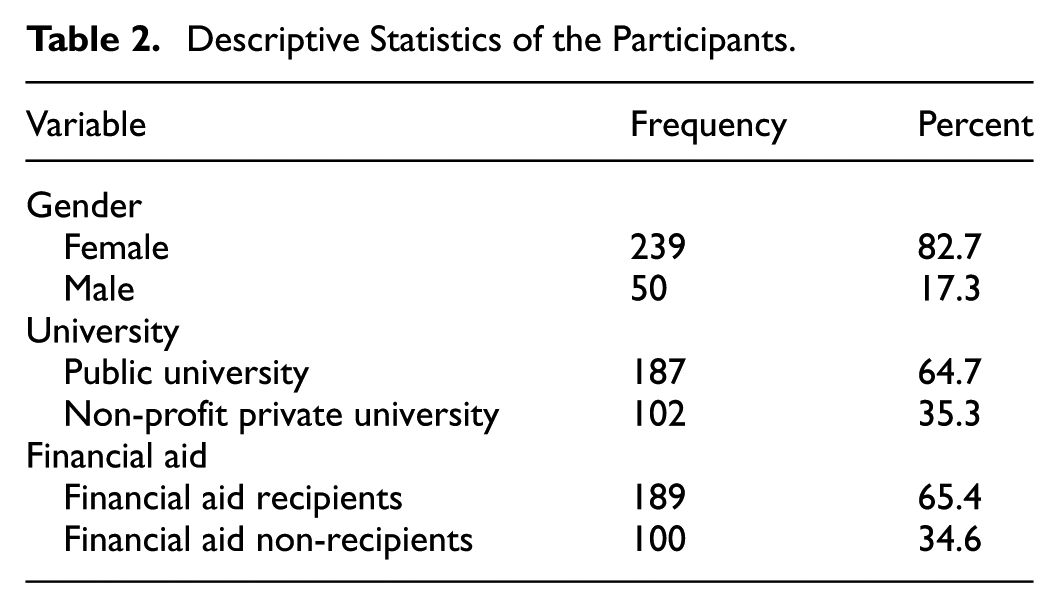
It is evident in Table 2 that the sample achieved the planned proportion of students through quota sampling. Sixty-four percent (64%) of the students are enrolled in the public university, while thirty-five percent (35%) are in the non-profit private university. However, the distribution by gender is not balanced, with 83% of the participants being female and only 17% male. This imbalance reflects the higher preference for the teaching profession among women in Türkiye, which is also evident in education faculties. Moreover, sixty-five percent (65%) of the students receive financial aid, while thirty-four percent (34%) do not.
Data Collection
In this study, the Academic Engagement Scale, developed by Kizilkaya and Doğan (2022), and the Social Capital Scale, developed by M. F. Özbilen and Çekiç (2017), were utilized for data collection. Both scales were developed using data obtained from university students studying in Turkey. Measurement tools were selected based on their conceptual fit, having been previously validated and used in the context of higher education in Turkey. The Academic Engagement Scale consists of 25 items rated on a five-point Likert scale. The minimum score obtainable from the scale is 25, while the maximum score is 125. The subdimensions of the developed scale were named, respectively, as “participation in the course, library, resource access,”“communication with faculty members,” and “participation in scientific and cultural activities.” The fit index values obtained as a result of CFA were determined for the academic belonging scale as χ2/df = 4.164, AGFI = .881, GFI = .903, CFI = .915, NFI = .891, and RMSEA = .060 (Kizilkaya & Doğan, 2022). A χ2/df value below 5 indicates an acceptable level of fit. AGFI, GFI, CFI, and NFI values above .95 indicate a perfect fit, while values above .90 indicate a good fit. An RMSEA value below .05 indicates a perfect fit, and a value below .08 indicates a good fit (Çokluk et al., 2021). All these obtained values show that the fit between the model and the data is within acceptable and good fit limits. The Cronbach’s alpha reliability coefficient for the entire scale is .91 (Kızılkaya & Doğan, 2022), and the reliability obtained from this research sample is .94.
The Social Capital Scale comprises 35 items, also rated on a five-point Likert scale. The lowest score that can be obtained from this scale is 35, and the highest score is 175. The subdimensions of the Social Capital Scale for University Students are “Trust,”“Cooperation and Compliance with Norms,”“Commitment and Belonging,” and “Social Networks and Participation.” The fit index values obtained as a result of CFA were determined for the social capital scale as χ2/df = 3.17, AGFI = .77, GFI = .80, CFI = .92, NFI = .89, and RMSEA = .074, and these values were evaluated by F. M. Özbilen (2019), based on the views of Hu and Bentler (1998) and Gerbing and Anderson (1992), as indicating that the fit between the model and the data is acceptable. The Cronbach’s alpha internal consistency coefficient for the complete scale is .92 (F. M. Özbilen, 2019), while the internal consistency coefficient derived from the research sample is .94.
In the section of the data collection instrument where demographic variables were included, students were asked whether they received financial aid. Students responded by marking either “yes” or “no” to the question, “Do you receive any financial aid (scholarship or grant)?” In this study, financial aid refers to scholarships or grants received by students.
Ethical Considerations
Ethical approval for this study was obtained from the relevant institutional ethics committee of the Social and Human Sciences at Bandirma Onyedi Eylul University on April 14, 2023, with the decision 2023-4. Prior to participation, all respondents were provided with clear information about the purpose of the study, the voluntary nature of participation, and their right to withdraw from the study at any time without penalty. Written informed consent was obtained from all participants before the face-to-face survey administration. The data were collected anonymously, and the principles of confidentiality and privacy were strictly observed.
As the study relied on a self-report questionnaire and did not involve any physical or psychological intervention, it was considered to involve no more than minimal risk to participants. No sensitive or identifiable personal information was requested. The research design aimed to minimize potential harm by ensuring voluntary participation, anonymity, and the right to discontinue participation at any stage without negative consequences. The potential benefits of the study, including contributing to a better understanding of the relationship between financial aid, social capital, and academic engagement in higher education and informing student support policies, were considered to outweigh any minimal risk associated with participation.
Data Analysis
In this study, a two-way MANOVA was used to detect the effects of one or more independent variables on two or more dependent variables. A sequential approach MANOVA was applied for 2 × 2 unequal sample sizes to evaluate the main effects of each independent variable on the dependent variables, as well as the interaction of the two independent variables on the dependent variables (Tabachnick & Fidell, 2013). Before conducting the two-way MANOVA, the critical assumptions (A. Field, 2009; Tabachnick & Fidell, 2013; Warner, 2013) were checked for validity. In this study, the total scores obtained from the scales are treated as continuous variables. The independent variables are the ‘type of university’ and the ‘financial aid’ variable, which are 2 × 2 categorical independent variables. Independence of observation requires that there is no relationship between observations within a group or between groups themselves (Warner, 2013). Since each student can only belong to one subgroup, it can be said that the independence of observations has been maintained. Additionally, the students completed the measurement instruments independently of one another. There should be a linear relationship between the dependent variables for each group of independent variables. When reviewing the distribution plots, it was determined that the distribution is approximately linear.
The multicollinearity assumption was tested using Pearson correlation coefficient analysis. Pallant (2015) noted that correlations around 0.8 or 0.9 are not suitable for MANOVA. Since the singularity problem will arise when both the total score and the subscale scores of a scale are included in the analysis, the subscales of the scales have not been added to the analysis (Pallant, 2015). Table 3 presents the results of the correlation analysis of the dependent variables according to the groups of independent variables.
Correlations Between the Academic Engagement and Social Capital Scores.
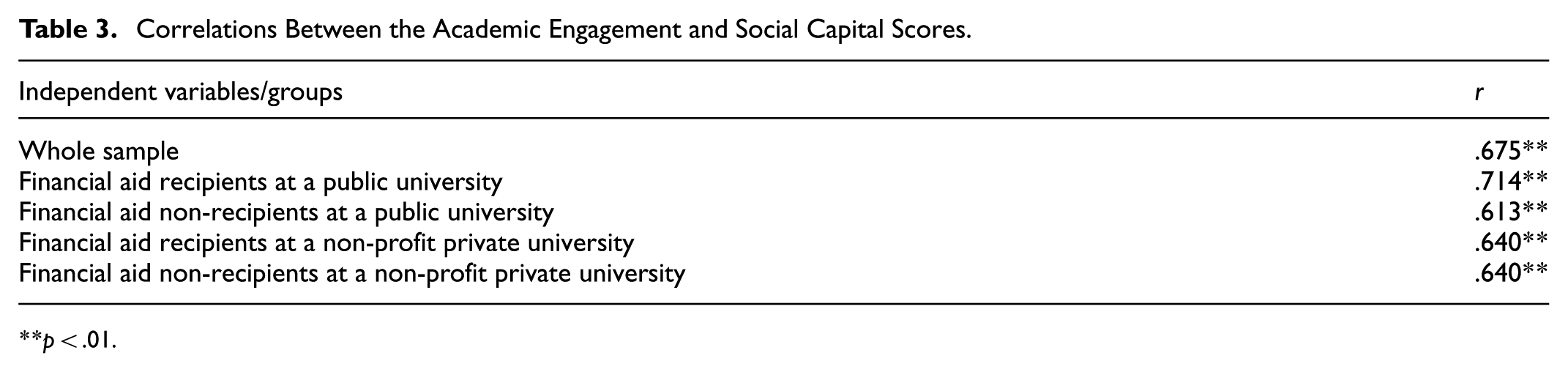
p < .01.
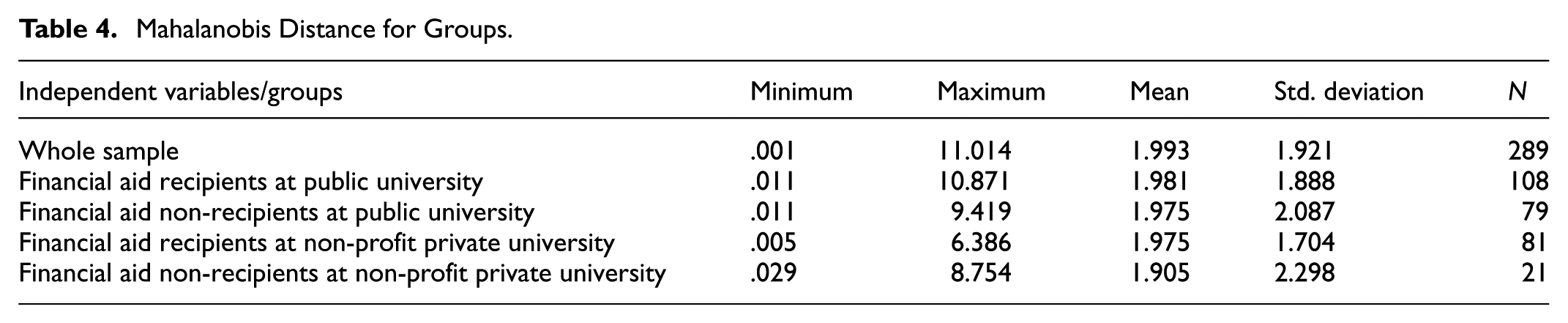
The identified outliers were removed from the dataset. Mahalanobis distance is a measure used to test for multivariate outliers. Outliers were checked in each of the four groups (Tabachnick & Fidell, 2013). The critical value for the Mahalanobis distance for the two dependent variables is 13.82 (Pallant, 2015). Data points above 13.82 were removed from the dataset. It was determined that there were no outliers in the final dataset for each variable group. Table 4 presents the Mahalanobis distance values.
Mahalanobis Distance for Groups.
Tabachnick and Fidell (2013) state that having more than 20 samples in each cell and that the sample size in the smallest cell is greater than the number of dependent variables ensures normality, even with unequal sample sizes. Additionally, the dataset was examined for univariate and bivariate normality. To check whether normality was met, the Kolmogorov–Smirnov test was conducted first. The results of the normality tests Ta that the social capital scores of students receiving financial aid at the public university do not show a normal distribution. Therefore, the means, standard deviations, skewness, and kurtosis values for each group of independent variables were analyzed. The obtained values are presented in Table 5.
Skewness and Kurtosis Value.
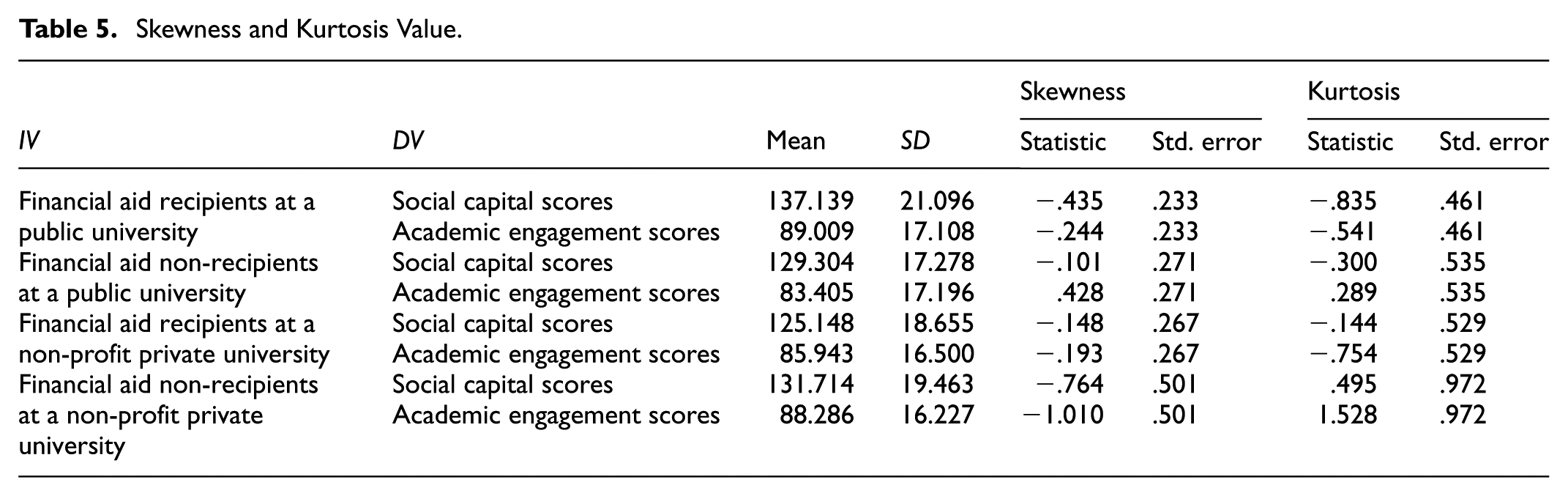
As can be observed in Table 5, z-scores were examined. According to A. Field (2009), values within the range of ±1.96 indicate a normal distribution. Therefore, it can be stated that the data exhibit a normal distribution. When examining the scatter plots of the relationships between the dependent variables, it was observed that the plots are oval-shaped, indicating that the variables show a normal distribution and there is a linear distribution between the two variables (Tabachnick & Fidell, 2013). The assumptions of homogeneity of covariance matrices and equality of variances were tested using Box’s M Test and Levene’s Test of Equality of Variances, respectively. The results of Box’s M Test indicated that Box’s M = 7.552, F (9, 42025.347) = .822, p = .595, showing that the assumption of homogeneity of variance–covariance matrices was met. Additionally, Levene’s Test results demonstrated that the assumption of equal variances was satisfied for both dependent variables, with social capital scores, F(3, 285) = 2.282, p = .079, and academic engagement scores, F(3, 285) = .588, p = .624.
Findings
This section presents the findings of the study in relation to the research questions. First, whether there was a significant difference in social capital and academic engagement scores based on university type was examined (Research Question 1). Second, the differences in these scores according to students’ financial aid status were investigated (Research Question 2). Finally, the possible interaction effect between university type and financial aid status on social capital and academic engagement scores was explored (Research Question 3).
After confirming that the assumptions of MANOVA were met, the analyses were conducted using Wilks’ Lambda as the multivariate test statistic. The results of the multivariate analyses are presented in Table 6.
Multivariate Tests a .
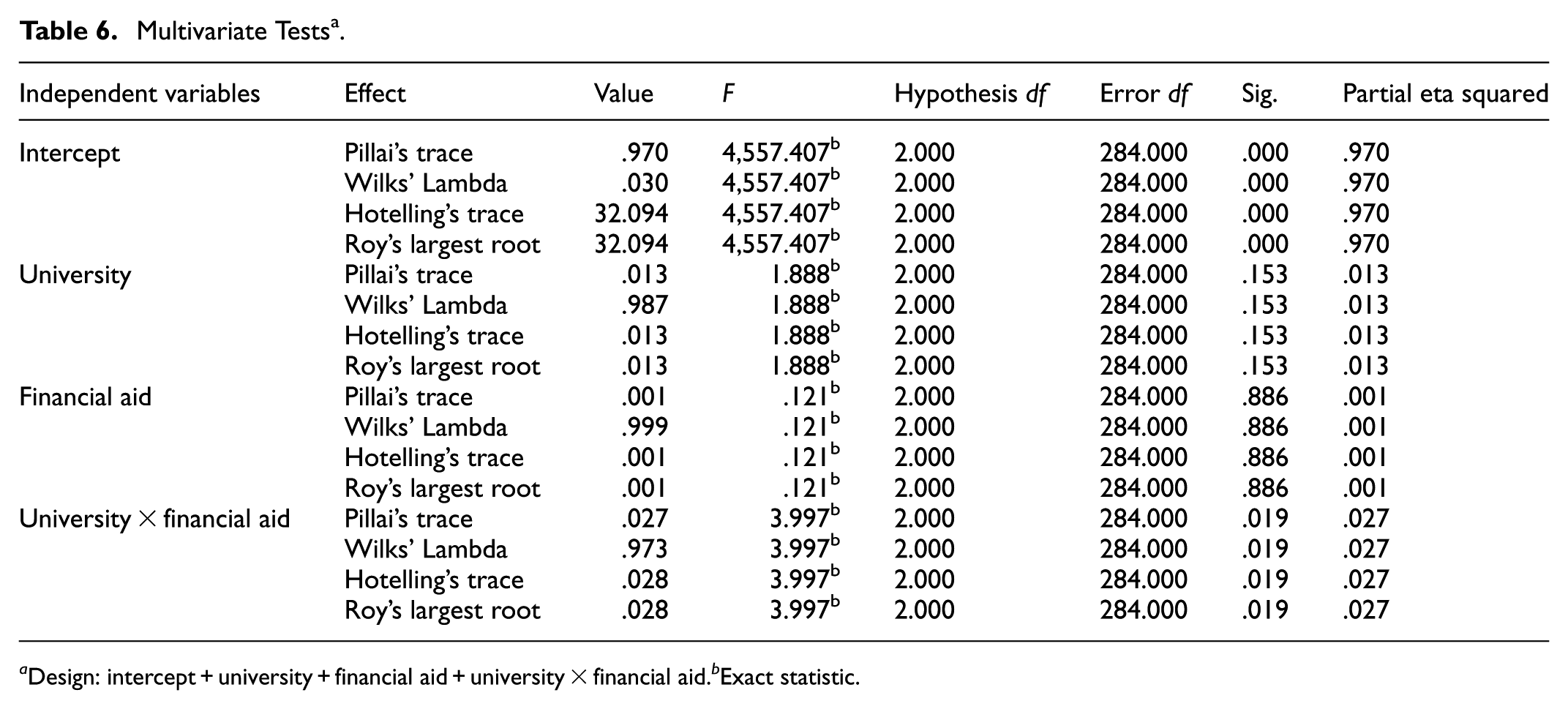
Design: intercept + university + financial aid + university × financial aid.
Exact statistic.
When examining Table 6, it is evident that the type of university did not create a significant difference in social capital and academic engagement scores (λ = .987; F(2, 284) = 1.888, p > .05). Accordingly, the findings indicate that there is no significant difference between the social capital and academic engagement scores of students studying at non-profit private universities and those studying at public universities. Similarly, it was found that whether or not students received a financial aid did not lead to a significant difference in their social capital and academic engagement scores (λ = .999; F(2, 284) = .121, p > .05). Thus, the findings show that there is no significant difference between the social capital and academic engagement scores of students who receive financial aid and those who do not. However, in line with the aim of the study, a statistically significant interaction effect was detected between the type of university and the status of receiving a financial aid on the dependent variables (λ = .973; F(2, 284) = 3.997, p < .05, η2 = .027). Accordingly, the findings indicate that there is a significant interaction effect on social capital and academic engagement scores between students attending non-profit private and public universities based on whether they receive financial aid. The multivariate partial eta squared value is .027, indicating that 2.7% of the variance in the dependent variables is explained by the interaction between the type of university and the status of receiving financial aid. After identifying this statistically significant interaction effect, follow-up univariate ANOVA tests were conducted to determine which dependent variables were affected by this interaction. The follow-up analysis results are presented in Table 7.
Tests of Between-Subjects Effects.
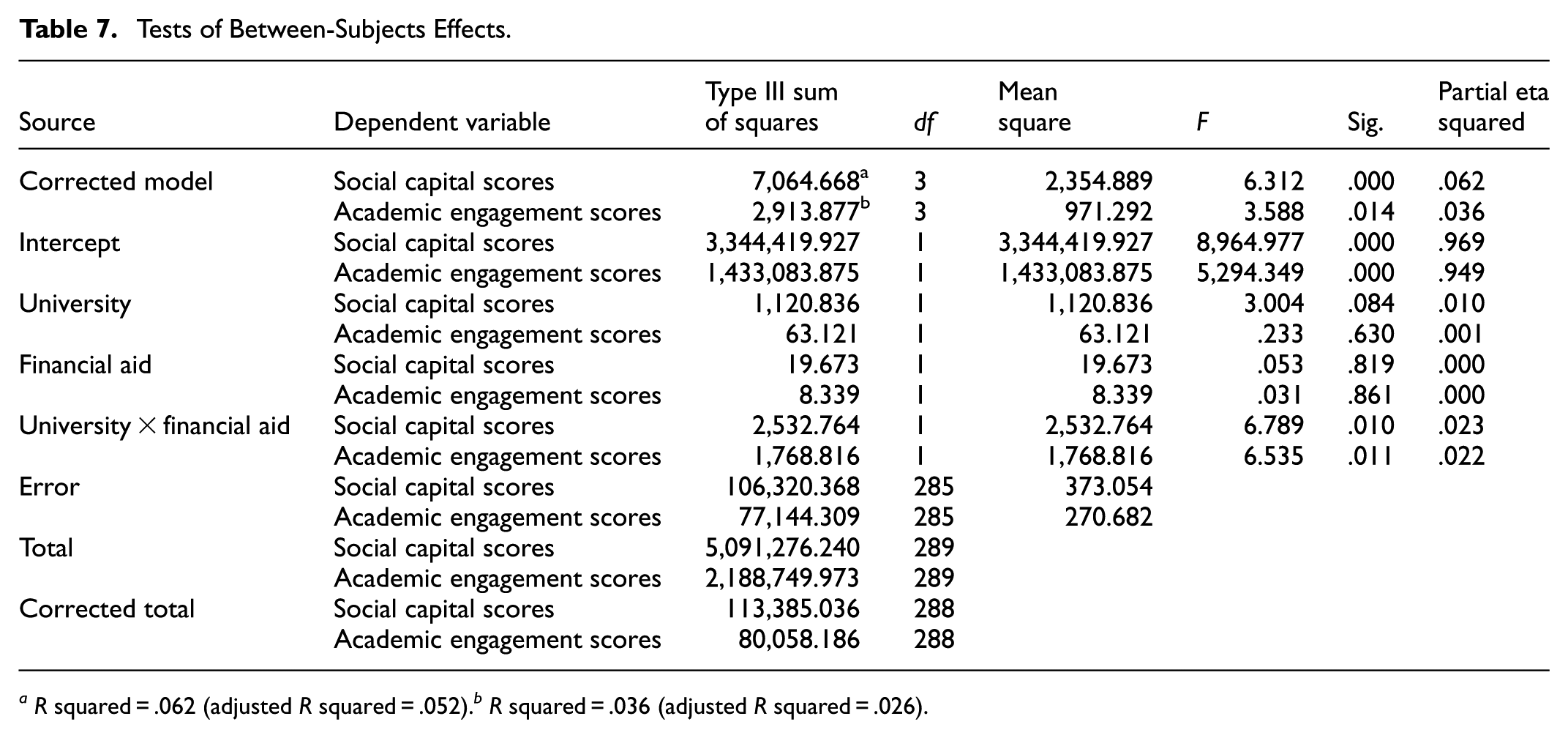
R squared = .062 (adjusted R squared = .052).
R squared = .036 (adjusted R squared = .026).
To minimize the risk of a Type I error, a Bonferroni correction was applied, and the significance level was adjusted to 0.025. This adjusted significance level was obtained by dividing the original alpha level of 0.05 by the number of dependent variables in the study (0.05/2 = 0.025) (Pallant, 2015). Therefore, the interpretation of interaction effects on the dependent variables is based on the Bonferroni-adjusted alpha level of 0.025.
As evident in Table 7, the interaction between the type of university and the status of receiving financial aid has a significant effect on both social capital (F(1, 285) = 6.789, p < .025) and academic engagement (F(1, 285) = 6.535, p < .025). Even if the main effects are not significant in two-factor techniques, it also examines the possibility of an interaction effect emerging where the effect of one independent variable on the dependent variable is dependent on a second independent variable (Pallant, 2015). The findings obtained here suggest that the effect of financial aid on social capital and academic participation creates an interaction effect with the university type variable. To further interpret the significant interaction between university type and financial aid, pairwise simple effects analyses were conducted separately for each dependent variable.
For social capital, in public universities, financial aid recipients reported significantly higher scores than non-recipients (MD = 7.84, 95% CI [2.12, 13.55], p = .008, d = 0.41). In contrast, in non-profit private universities, the difference between recipients and non-recipients was not statistically significant (MD = −6.57, 95% CI [−15.71, 2.58], p = .157, d = −0.34).
Similarly, for academic engagement, financial aid recipients in public universities reported significantly higher scores than non-recipients (MD = 5.60, 95% CI [0.60, 10.61], p = .028, d = 0.33). However, in non-profit private universities, the difference was not statistically significant (MD = −6.43, 95% CI [−13.76, 0.90], p = .085, d = −0.41). Figure 1 illustrates the effect of the interaction between the type of university and financial aid status on social capital.
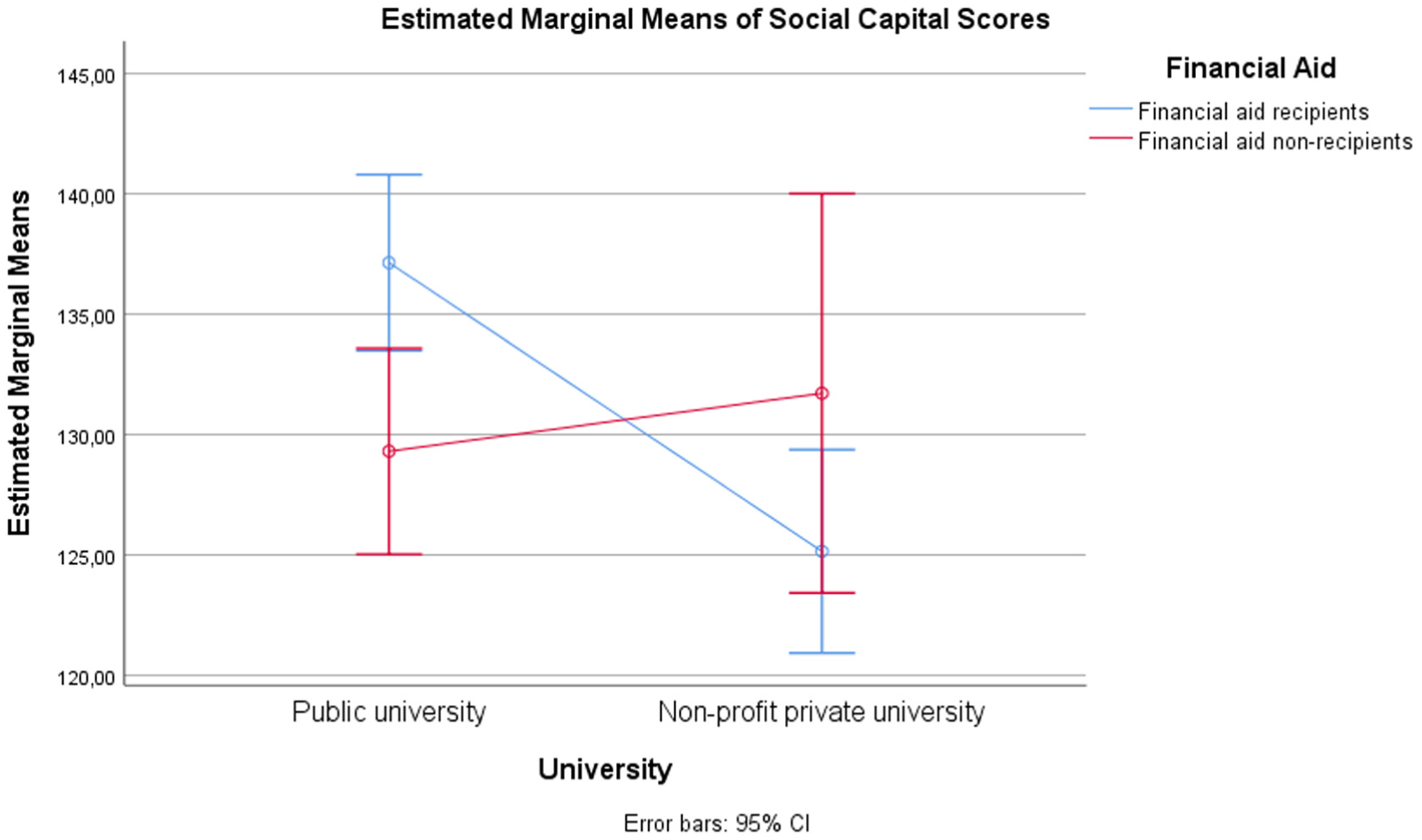
Plot for estimated marginal means for social capital with respect to university and financial aid.
When examining Figure 1, it is evident that, for the dependent variable of social capital, students studying at public universities who do not receive financial aid (M = 129.304, SD = 17.278) have lower social capital scores than those who do receive financial aid (M = 137.139, SD = 21.096). Conversely, for students studying at non-profit private universities, those who do not receive financial aid (M = 131.714, SD = 19.463) have higher social capital scores than those who do (M = 125.148, SD = 18.654), but this difference is not statistically significant. A similar result was found for academic engagement. Figure 2 illustrates the effect of the interaction between university type and financial aid status on academic engagement.
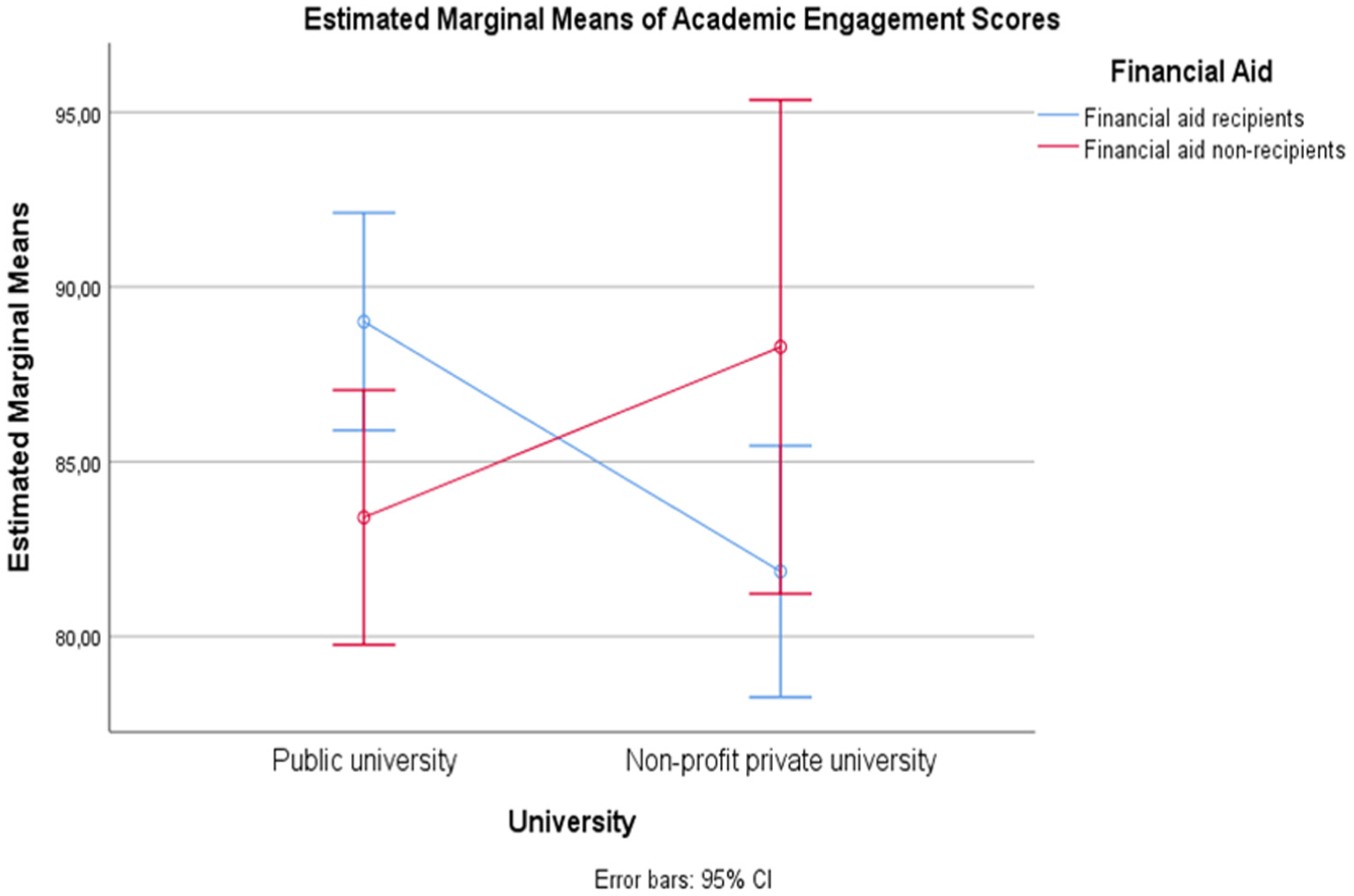
Plot for estimated marginal means for academic engagement with respect to university and financial aid.
When examining Figure 2, it becomes apparent that, for the dependent variable of academic engagement, students studying at public universities who do not receive financial aid (M = 83.405, SD = 17.196) have lower academic engagement scores than those who do receive financial aid (M = 89.009, SD = 17.108). Conversely, students studying at non-profit private universities who do not receive financial aid (M = 88.286, SD = 16.227) have higher academic engagement scores than those who do (M = 81.855, SD = 14.789), but this difference is not statistically significant.
Discussion
As a result of the study, it was found that studying at universities with different funding structures showed no significant difference in social capital and academic engagement. Similarly, receiving or not receiving financial aid also showed no significant difference in social capital and academic engagement. However, the interaction between the type of university and the financial aid variable showed a significant difference, indicating that the effect of financial aid is conditional upon institutional context rather than universal. Even so, the small effect size suggests that the practical implications of these findings should be interpreted with caution, as the observed differences may be influenced by multiple social, cultural, and economic factors.
It was concluded that students studying at public universities who do not receive financial aid have lower social capital scores compared to those who do receive financial aid. This finding suggests that economic capital may play a role in social capital, particularly within the context of public universities. Likewise, Wells (2008) asserted that the effects of social and cultural capital, similar to the effects of financial aid, may also vary by institution type. This pattern may be explained by the fact that limited access to resource-generating social networks and rich social capital can constrain student success (Kahne & Bailey, 1999). According to the experiences of scholarship students in Lebanon regarding the achievement of social justice in higher education, having social capital or a tendency to create social capital at the university is an important factor in reducing inequalities (Nimer & Çelik, 2020). Social capital and status-related inequalities were cited by many students, and the scholarships and internship opportunities provided by the institution, along with financial freedom, which enabled students to make social contributions, emerged as the most fundamental factors motivating first-generation students (Tütüncü Saka, 2023). Communities with diverse social networks and community organizations are in a stronger position to combat poverty and vulnerability and to take advantage of new opportunities. In our era, where volatility and virtuality reduce social interaction, social capital becomes even more important (Prusak & Cohen, 2001). Therefore, it may be beneficial to provide prospective teachers with opportunities that support the development of their social capital and promote more equitable participation.
The study also found that public university students without financial aid had lower levels of academic engagement. This highlights the relationship between economic status and academic engagement, suggesting that students without financial support may lack access to resources such as artistic, scientific, and cultural activities. Academic engagement is the strongest predictor of retention (Tinto, 2006). It has been noted that students from low-income families increase their working hours to cover university expenses (Paulsen & St. John, 2002). This finding seems to be confirmed by Akşab (2024), in a multiple case study examining four Turkish state universities established after the 2000s in terms of student participation, states that financial problems limit students’ academic participation, weaken their academic involvement, and reduce the benefits they will receive from the university experience. Boatman and Long (2016) found that Gates Millennium Scholars (GMS) who received financial aid had higher levels of academic and social participation compared to those who did not receive scholarships but had similar motivation and success potential. Likewise, Desjardins et al. (2002) note that the finding that students receiving financial aid from the state of Minnesota are less likely to drop out after their first year has policy implications at the institutional and state levels, and that even when financial aid is limited, its most effective use has a positive impact on a student’s academic career. Joanis et al. (2022) examine whether students can benefit from pre-existing environmental social capital in their geographic regions. Results suggest that social capital, at both the state and the community level, significantly influences graduation rates, student debt levels, and loan default rates. Therefore, it may be suggested that some students at public universities allocate limited physical and psychological energy to their academic experiences, based on A. W. Astin’s (1984) theory of student involvement, which is insufficient, and they cannot find intense efforts where they can invest time and energy in both quality and quantity. Çeribaş’s (2020) research, based on student opinions about the role of scholarships in providing equal opportunities in education, supports the findings of this study, as it determines that students perceive economic insufficiencies as the primary source of opportunity inequality and want scholarship amounts to be determined according to regional living costs. In Türkiye, families appear to be the main source for covering student expenses in higher education. This indicates that opportunity equality is not provided for students from low-income families (Yavuzer et al., 2005).
There was no significant difference in social capital and academic engagement scores between students receiving financial aid and those not receiving financial aid at non-profit private universities. This finding suggests that financial aid alone may not be a decisive factor in shaping students’ academic engagement and social capital within non-profit private universities. In particular, institutional culture, social integration processes, and the supportive environment offered by the university may play a more dominant role in this relationship. Indeed, the literature emphasizes that financial aid should be evaluated in conjunction with students’ level of commitment and participation in the institution.
It can be argued that financial aids are not only a form of economic support, but also a contextual determinant of the integration process. In this nonprofit private university, which is a non-profit institution where students study, it can be said that even without financial aid, there is sustainable academic participation and social integration, and therefore, in Tinto’s words, commitment to the institution. Financial aid is seen as important not only as a means of access but also as a tool for integration. Parallel to this research finding, Herndon (1984), in his two-year longitudinal study at California State University (CSU), revealed that financial aid is a critical tool for student retention, but that it should be structured in a way that increases student interaction and is achieved through student participation. As stated in Tinto’s (2006) integration model, financial support alone is not sufficient and requires active student participation, and examples of institutional practices are needed. According to Paulsen and St. John’s (2002) financial nexus model, financial conditions in higher education create different effects among social classes. In conclusion, relationships and social networks are a mechanism that positively affects individual productivity (Iyer et al., 2005; Woolcock 1998). Therefore, it can be argued that institutional norms that reinforce individual productivity are effective in a non-profit private university. Findings in the literature regarding the effects of financial aid and socioeconomic variables are inconsistent. In their study, Tomaszewski et al. (2020) found that students from high socioeconomic status are significantly less likely to be absent from school compared to students from middle socioeconomic status. They also reported having a higher sense of belonging, liking school more, and showing greater interest in it. Based on this research, it can be inferred that students from high-income families have advantages in terms of participation in scientific and cultural activities and accessing resources, as well as showing greater interest in their universities and having a stronger sense of belonging. This situation may have influenced academic engagement. As stated Tight (2020) contemporary student lives spread out much further than their course and institution, involving family, friends, social and leisure activities and employment. Critically, what is needed to research this inter-connected broader experience is not just the willingness of students to have their whole lives researched, but also their direct involvement – as those with the easiest access and greatest understanding– as researchers.
Conclusions, Limitations, and Future Research
These findings highlight that the effects of financial aid are context-dependent and vary across institutional types rather than being uniform. Financial aid is associated with higher social capital and academic engagement at public universities; however, this pattern is not supported by statistically significant differences at non-profit private universities. While non-profit private universities may offer students social capital that builds bridges, such as scholarships, alumni clubs, mentorship, alumni networks, and prestigious internship opportunities, there is a need for financial aid offered to a heterogeneous student body in public universities to play a role in facilitating access to these networks. Otherwise, this situation could increase uncertainty instead of reducing inequality. The OECD states that for effective and equitable support, disadvantaged dimensions can be taken into account alongside financial assistance. United Nations Educational, Scientific and Cultural Organization (2017) also emphasizes that equality requires not only funding but also social support services for students.
This study has several limitations. Socioeconomic status could not be directly measured using a comparable indicator across institution types. In addition, the type, amount, and duration of financial aid were not distinguished in the study. Therefore, interpretations regarding economic differences were not empirically controlled and remain inferential. Since this study aims to examine multivariate group differences based on university type and financial aid status, covariate variables that may be related to the dependent variables have not been included; this creates a limitation in the interpretation of the findings. In Türkiye’s education faculties, female students account for approximately 70% and male students for approximately 30% (Council of Higher Education, 2025). In this context, the female–male distribution in the sample largely corresponds to the student profile in Türkiye’s education faculties. However, the relatively high proportion of female participants in the sample (83%) and the use of quota sampling limit the generalizability of the findings. Furthermore, the relatively low number of participants in the non-profit private university/non-recipients of financial aid subgroup may have reduced the stability of statistical estimates and affected the observed interaction effects. The fact that the research was conducted only in Turkey and in a single city may limit the generalizability of the findings to different cultural and educational systems. The self-report nature of the data collection tools may introduce measurement error and response bias based on participants’ perceptions. Measurement invariance was not tested using multi-group confirmatory factor analysis in this study. Therefore, the differences found between groups should be interpreted as context-sensitive and explanatory findings.
It is recommended that researchers examine the academic engagement and social capital of students enrolled in universities with varying funding mechanisms, considering their socioeconomic backgrounds. Furthermore, the potential relationship of socioeconomic status with academic engagement and social capital could be investigated. It is recommended that longitudinal and mixed-method research designs be used in future studies to strengthen causal inferences.
For educational services to meet both societal and individual expectations, it is evident that the financial aid opportunities provided to higher education students impact academic engagement and social capital by addressing the disparities that create inequality in education. The transferable nature of social capital contributes to the persistence of inequality across generations. As the institutional quality of educational services at universities contributes to the strengthening of social capital, it can lead to enhanced social interaction, information, and identity resources. This way, both the stored social capital can be utilized, and its sustainability can be ensured.
Finally, within the context of this study, receiving financial aid at a public university provides a certain economic advantage in terms of social capital and academic engagement compared to those who do not receive such support. This indicates that a greater number of students require financial aid to achieve balance.
It can be argued that students studying at public universities may need to be supported with more cultural and social intervention tools (Bourdieu, 2021) by supporting their access to financial aid programs aimed at reducing financial inequalities, and that they should be part of a collective norm (Coleman, 1988). Social capital demonstrates the importance of interaction in social development. Accordingly, social communication networks can provide financial assistance networks (J. Field, 2006). As Tinto (2006) points out in his article “What Next?,” retention research should be able to generate data at the policy level. While financial assistance strengthens the student’s participation experience, scholarships, grants, etc., can be effective in reducing barriers to equal opportunity by supporting social capital with social control mechanisms (Coleman, 1988), thus achieving effective human capital outcomes (Bourdieu, 1986). Therefore, financial aid programs that do not generate social capital cannot create sustainable participation. To address these disparities, not only is economic support needed, but both non-profit private and public universities could further enhance social and cultural capital for their students and implement initiatives to support students’ academic engagement.
Footnotes

Ethical Considerations
The research was approved by the Ethics Committee of the Social and Human Sciences at Bandırma Onyedi Eylül University on April 14, 2023, with the decision number 2023-4 from the committee meeting. Ethical approval for this study was obtained from the relevant institutional ethics committee of the Social and Human Sciences at Bandirma Onyedi Eylul University on April 14, 2023, with the decision 2023-4.
Consent to Participate
To obtain informed consent from participants, institutional and ethical guidelines approved by the Social and Human Sciences Ethics Committee of Bandırma Onyedi Eylül University were followed. Participants were provided with a consent form that included an explanation of the purpose of the study, the voluntary nature of participation, their right to withdraw from the study at any time without penalty, and information about how confidentiality and anonymity would be ensured.
Informed consent to participate in this study was obtained from all participants prior to data collection. The survey was administered online via Google Forms. At the beginning of the questionnaire, participants were provided with a written informed consent statement explaining the purpose of the study, the voluntary nature of participation, and confidentiality assurances. Only those participants who indicated their consent by selecting the “I agree” option were able to proceed to the survey.
Consent for Publication
Not applicable. The study does not involve any identifiable personal data, images, or videos of individual participants.
Author Contributions
The authors declare the following contributions to the paper: Study design and conceptualization: Cennet Göloğlu, Pınar Kızılhan; data collection: Cennet Göloğlu; analysis and interpretation of results: Cennet Göloğlu, Engin Demir; preparation of the manuscript: Pınar Kızılhan, Engin Demir. The authors have reviewed the results and approved the final version of the manuscript.
Funding
The authors received no financial support for the research, authorship, and/or publication of this article.
Declaration of Conflicting Interests
The authors declared no potential conflicts of interest with respect to the research, authorship, and/or publication of this article.
Data Availability Statement
Data sharing not applicable to this article as no datasets were generated or analyzed during the current study.