




Abstract
Teacher support contributes to students’ active participation in social life by improving their self-confidence and communication skills. The aim of the study is to examine this issue within the scope of the Social Learning Theory (SLT) and the Self-Determination Theory (SDT) by analyzing data collected at two different time points. The effect of teacher support on secondary school students’ social participation is examined in terms of the serial mediation role of self-confidence and communication. A longitudinal research model is used. Maximum diversity sampling formed the participant group, which included 947 secondary school students from different provinces across Turkey’s seven geographical regions. The Teacher Support Scale for Secondary School Students, the Social Participation Skills Scale of Secondary School Students, the Effective Communication Skills Scale and the Self-confidence Scale provided the data. The data were analyzed using an SPSS 25 package program and a Process Macro 4.2 plug-in. It was concluded that self-confidence and communication separately mediated the relationship between teacher support and social participation of the secondary school students. In addition, it was also concluded that self-confidence and communication played a serial mediating role in the relationship between teacher support and social participation of the secondary school students. The recommendations led to the examination of the hypotheses of this study with data collected over more time and with the participation of primary, high school and university students.
Introduction
Social participation is a multidimensional structure related to an individual’s active involvement in the society in which they live, their contribution to social life, and the development of social responsibility awareness (Koutsogeorgou, 2020). In terms of social participation, the secondary school period, which as part of adolescence is one of the fundamental stages of socio-emotional development, where the individual’s social identity, sense of belonging to the society in which they live, and self-concept within social life are shaped (Maurer et al., 2004; Rosen et al., 2022). This is because during this period, individuals begin to define themselves in a social context with their developing cognitive capacities (Skuse, 2003). At the same time, social factors such as peer interactions, teacher-student relationships, and society belonging become increasingly prominent during secondary school (Galotti, 2015). In this context, the social participation levels of secondary school students affect not only their individual development but also their integration into society (Smetana, 2010). One of the most important factors influencing the social participation of individuals in secondary school is the school environment (Hudley & Duran, 2013). In Turkey, the education system is centrally organized under the Ministry of National Education (MoNE) and consists of primary, secondary, and high school levels (MoNE, 2025). Secondary school, covering grades five to eight and typically including students aged 10 to 14, represents a key period for both academic learning and social development (Okçabol, 2008). During this period, the school environment plays a central role not only in students’ academic success but also in shaping their social skills, communication, and participation behavior (Merenbloom & Kalina, 2007).
School environments are important places for individuals to acquire and apply social participation skills (Schwab et al., 2020). Indeed, school-based social interaction significantly determines students’ self-expression, responsibility, and social relationship-building skills (Brint, 2006). The acquisition of these skills is related to the nature of the relationship teachers establish with their students and the level of support they provide (Frymier & Houser, 2000). Teacher support not only provides academic guidance to students but also facilitates their participation in social life by helping to fulfill their socio-emotional needs (Federici & Skaalvik, 2014).
The Self-Determination Theory (SDT; Ryan & Deci, 2017) argues that the satisfaction of the three basic psychological needs of individuals (autonomy, competence, and relatedness) enables them to participate as effective individuals in social life. From this perspective, it can be said that the support provided by teachers can increase students’ social participation by satisfying these needs. Indeed, the SDT argues that individuals’ intrinsic motivation is dependent on their ability to act autonomously in their daily lives, perceive themselves as competent, and establish relationships with their environment (Adams et al., 2017). Therefore, teacher support helps satisfy students’ socio-psychological needs, enabling them to gain self-confidence and actively participate in social life (Ryan & Deci, 2017).
The Social Learning Theory (SLT) states that social participation develops through the interaction of external factors and individual characteristics (Bandura, 1977). In other words, social participation is related to how individuals perceive environmental factors and how they reflect these perceptions in their behavior. In this context, self-confidence, which is the belief that one is competent and effective, serves as an important cognitive bridge in the transformation of environmental support into social behavior (Bandura, 1977). For example, when students receive teacher support, they may feel more competent and become more active in social interactions (Urdan & Schoenfelder, 2006). However, this is not only limited to the individual’s self-confidence but is also related to the presence of communication skills that enable self-confidence to be translated into behavior (Manning & Ray, 1993). Therefore, self-confidence is the individual’s subjective assessment of their capacity for social engagement (Zimmerman & Cleary, 2006), while communication determines how these engagements are expressed in a social environment (McGinnies, 2016). In this context, communication is a decisive variable that enables students to concretely realize their social participation behavior (Bjekić et al., 2020).
The theoretical structure of this study, which aims to examine the variables affecting the social participation of secondary school students, has been developed within the scope of the SDT and the SLT. The study seeks to explain the effect of teacher support on social participation through individual (self-confidence) and social skills (communication) by testing them through a serial mediation model. The present study provides a more comprehensive understanding of how external (teacher support) and internal (self-confidence and communication) factors jointly contribute to students’ social participation by integrating the SDT and the SLT. This approach not only bridges motivational and social-cognitive perspectives but also deepens the contextual interpretation of students’ social engagement in school settings. Therefore, this study contributes to the literature by testing a serial mediation model that links teacher support to students’ social participation through self-confidence and communication. This model highlights how teacher behavior that fosters psychological need satisfaction (as proposed by the SDT) translates into observable social participation behavior through social-cognitive mechanisms (as explained by the SLT).
Literature Review
Social Participation, Teacher Support, and Self-Confidence
Social participation is a multidimensional phenomenon that includes behavior such as feeling a sense of belonging to social groups, taking an active role in group work, and assuming social responsibilities (Piškur et al., 2014). In school environments, teacher support plays a facilitating role in students’ social participation behavior by strengthening their sense of social security (Davis, 2003). According to the SDT, the fulfillment of students’ autonomy, competence, and relatedness needs through teacher support increases their participation in social life (Ryan & Deci, 2017). Indeed, Danielsen et al. (2010) state that students with high teacher support embrace school more and participate more actively in activities. Similarly, Stornes et al. (2008) report that teacher-supported social activities strengthen students’ social interactions with their peers and relationships within the school. Sánchez et al. (2005) found that teacher support had a positive effect on students’ tendency to take social responsibility and their level of assertiveness. Yang and Liang (2025) concluded that teacher-student interaction positively influences students’ engagement in online English as a foreign language learning. Their results further indicated that individual learner traits, such as growth language mindset and components of second or foreign language grit, mediate the effects of different types of interactions on engagement. These results indicate that teacher support increases students’ level of social participation.
Students’ self-confidence levels are also a decisive factor in their social participation processes (Möbius et al., 2014). Self-confidence refers to an individual’s belief in themselves in social relationships (Rodriques, 2000). Within the framework of the SLT, self-confidence is defined as individuals’ subjective perceptions of their own competence and value. This perception is largely shaped by feedback received from the social environment (Bandura, 1977). When considered in the context of the school environment, teacher support contributes to the development of students’ self-confidence by strengthening their self-efficacy beliefs (Maclellan, 2014). Students who feel accepted by their teachers feel more competent, and this increases their self-confidence (Jennings & Greenberg, 2009). Li et al. (2022) state that teacher support enables students to actively participate in their learning environments. Similarly, Hoferichter et al. (2021) and Choi et al. (2023) found that teacher support increases adolescents’ self-confidence and reduces negative effects such as academic burnout through self-confidence. Mitchell and DellaMattera (2010) identify a strong relationship between teacher support and students’ academic self-efficacy beliefs, emphasizing that this support enhances student self-confidence. A study by Zhang et al. (2021) also reveals the positive effect of teacher support on self-confidence by showing that teacher support produces positive behavioral results.
A sequential interaction process takes place within the scope of teacher support and self-confidence variables in the communication established by the students with their social environment (Benabou & Tirole, 2000). The support the student receives from the teacher encourages their participation in social life by strengthening their self-confidence (Frymier & Houser, 2000). A study by de Leeuw et al. (2018) reports that teachers can facilitate students’ participation in social environments through different strategies. Li et al. (2022) determined that teacher support is important in terms of group harmony and made recommendations that teachers should provide support to students in order to build their self-confidence. Similarly, Sánchez-Rosas et al. (2016) concluded that teachers’ behavior aimed at motivating students accelerated their participation in classroom interactions and helped them feel emotionally fulfilled. Coll et al. (2014) determined that teachers’ positive feedback relaxes students and increased their desire to participate in learning environments.
Communication, Teacher Support, and Social Participation
Communication, defined as the capacity of individuals to express their feelings and thoughts in clear, effective, and appropriate ways (Craig, 2005; Luhmann, 1992), is a fundamental psycho-social indicator shaping the quality of relationships individuals establish with their social environment. In this context, teacher support plays a crucial role in developing students’ communication skills by fulfilling their need for relatedness in educational settings, as emphasized by the SDT (Priadi, 2020; Ryan & Deci, 2017). The literature shows that close and supportive relationships between teachers and students have a positive effect on students’ communication behavior. Indeed, Wan et al. (2023) found that teacher support increases students’ empathy and openness levels. Wubbels and Brekelmans (2005) found a significant relationship between the quality of teacher-student relationships and students’ classroom communication behavior. Similarly, Guo et al. (2025) demonstrated that teacher support not only directly and positively influences students’ engagement in learning but also exerts indirect effects through academic self-efficacy and resilience. These findings indicate that supportive teacher-student relationships strengthen students’ individual psychosocial conditions and provide a basis for the current study, which highlights the potential roles of self-confidence and communication in promoting students’ social participation in educational settings. Frymier and Houser (2000) report that communication skills developed through supportive teacher feedback facilitate students’ participation in social environments. Schürer et al. (2025) found that high-quality teacher-student interactions are associated with higher levels of social participation among secondary school students, measured both through self-perception and peer acceptance. Their study further emphasized the role of individual and class-level factors, such as school track, in shaping students’ social participation. Complementing this, Yang et al. (2024) showed that teacher support positively influences students’ willingness to communicate in a second language, both directly and indirectly through foreign language enjoyment. Their findings also indicated that students’ personal traits, such as grit, contribute to enhanced communicative engagement, highlighting the role of individual psychosocial conditions in shaping students’ participation in social and learning contexts.
Individuals’ ability to express their feelings and thoughts is also a pre-condition for social adaptation (Jenson, 2010). Carter et al. (2014) emphasize that students’ interactions with their peers increase their social participation at school. Burleson et al. (1992) determined that children with developed communication skills were accepted more quickly by their peers. Similarly, Garrote (2017) concluded that students’ social participation was related to their communication skills. Research results show that students who can communicate well can take on more active roles in social activities, which increases their social participation.
Self-Confidence, Communication, Teacher Support, and Social Participation
The support students receive from teachers contributes to the development of self-confidence by strengthening their self-perception (Davis, 2001). Increased self-confidence in students supports the development of effective communication skills (Bandura, 1977). Through the development of communication skills, students can participate more actively and cooperatively in social environments (Craig, 2005). Therefore, the relationship between teacher support and social participation can be indirectly explained through the variables of self-confidence and communication. The literature shows that self-confidence and communication can have a serial effect on the relationship between teacher support and social participation.
The Hypotheses
Based on the literature, the following hypotheses were established to test whether secondary school students’ self-confidence and communication play a serial mediating role in the relationship between teacher support and social participation.

The direction of the influence of self-confidence.
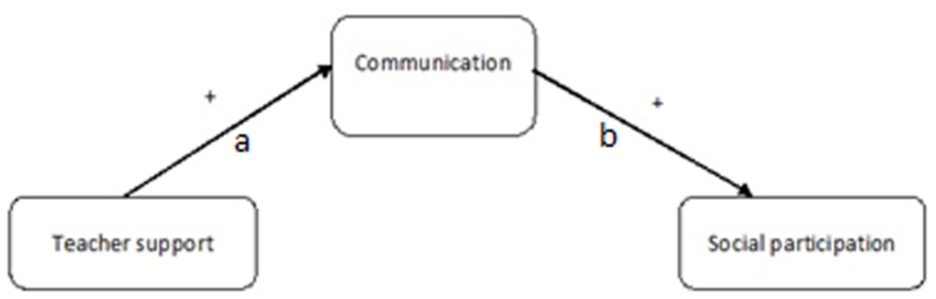
The direction of the influence of communication.

The direction of the influence of self-confidence and communication.
The Present Study
The aim of this study is to longitudinally examine how teacher support affects secondary school students’ social participation through self-confidence and communication. Numerous studies have shown that teacher support has a positive effect on social participation (Coll et al., 2014; de Leeuw et al., 2018; Sánchez-Rosas et al., 2016; Wanders et al., 2020), and self-confidence (Choi et al., 2023; Hoferichter et al., 2021; Maclellan, 2014) and communication (Guo et al., 2025; Schürer et al., 2025; Wan et al., 2023; Wubbels & Brekelmans, 2005). On the other hand, a number of studies determine that social participation plays a role in the overall development of individuals (Foskett, 1955; Katz, 1966), and contributes to learning motivation (Liu, 2020; Sze-Yeung Lai & Chi-leung Hui, 2020; Widjaja & Chen, 2017) and academic achievement (Hershberger & Jones, 2018; Kim et al., 2020; Niia et al., 2015).
However, the literature has not yet sufficiently clarified how the relationship between teacher support and social participation works through sequential psycho-social variables. In other words, no studies have been conducted to comprehensively examine the indirect relationships between teacher support and students’ social participation through mediating variables such as self-confidence and communication. This makes it difficult to fully understand the multi-layered effects of teacher support on students’ social participation in educational environments. Therefore, how students in adolescence internalize the support they receive from their teachers, and how this support is transformed into social participation through self-confidence and communication, is not sufficiently explained. This also carries the risk of treating teacher support as an element limited solely to the academic context in the educational policy development processes.
This study fills the gap in the literature by explaining how self-confidence, as an internal resource, and communication, as a social mechanism create a sequential effect in the relationship between teacher support and social participation. Therefore, the study presents a unique model showing how individual psychological competencies and social skills function as a chain in the relationship between teacher support and social participation. As a result, the study presents a unique model showing how psychological competencies and social skills function sequentially in the relationship between teacher support and social participation.
The study reveals the direct and indirect effects of teacher support on social participation. Therefore, the study will contribute to a comprehensive understanding of structures that focus on students’ social development in the field of educational psychology. In practice, the study will provide teachers with guiding information on how to support students’ social adaptation by developing not only their cognitive development but also their self-confidence and communication skills.
The fact that the study was conducted in the context of two basic theories, the STD and the SLT, gives a unique theoretical depth to the study.
Method
This study was conducted using a longitudinal survey model.
The Participants
The study’s participant group was formed using maximum diversity sampling. This sampling method was chosen to ensure that the individuals included in the study reflected a wide variety in terms of grade level, gender, and regional distribution (Büyüköztürk et al., 2020). Students from sceondary schools in different provinces across Turkey’s seven geographical regions participated in the study. This was done with the aim of increasing the cultural and demographic representativeness of the findings. In addition, gender distribution was also considered in the sample. In the sampling process, schools were first identified. Within these schools, the participants were selected based on voluntary participation and the approval of school administrations. The selection aimed to include schools from both urban and rural areas to reflect socioeconomic diversity. Although the use of maximum diversity sampling increased representativeness, it also relied on the willingness of schools and students to participate, which may have led to a self-selection bias. Furthermore, certain regions or school types might have been overrepresented or underrepresented. In this context, a total of 947 secondary school students were reached, 420 (44.4%) of whom were female and 527 (55.6%) of whom were male. Participating in the study were following: 175 (18.5%) students from the Marmara Region, 154 (16.3%) students from the Aegean Region, 151 (15.9%) students from the Mediterranean Region, 132 (13.9%) students from the Central Anatolia Region, 120 (12.7%) students from the Black Sea Region, 111 (11.7%) students from the Eastern Anatolia Region and 104 (11.0%) students from the Southeastern Anatolia Region participated in the study. The distribution according to grade level is as follows: 245 (25.9%) students in the fifth grade, 209 (22.1%) students in the sixth grade, 257 (27.1%) students in the seveth grade and 236 (24.9%) students in the eighth grade. Therefore, it was thought that the sample group offered a meaningful diversity in terms of the generalizability of the research findings.
Measures
Teacher Support Scale for Secondary School Students (TSSSSS)
The Teacher Support Scale for Secondary Students was developed by Kalkan and Cemaloğlu (2023). The TSSSS is a Likert scale, consisting of 36 items graded on a scale of 1 to 5 points. The score range of the scale varies between 36 and 180. Kalkan and Cemaloğlu (2023) conducted exploratory factor analysis (EFA) and calculated the total variance explained by the scale as 66.56% and the internal consistency coefficient as .95. The developers of the scale also conducted confirmatory factor analysis (CFA) and reached the following results: χ2 = 1,964.16 (p = .00); df = 588; χ2/df = 3.34; RMSEA = 0.08; CFI = 0.95; NFI = 94; IFI = 0.95; and SRMR = 0.07. The scale consists of four factors; emotional support (sample item: The teacher is respectful toward his/her students), instructional support (sample item: The teacher shows how a job should be done), guidance and orientation support (sample item: The teacher gives us knowledge that will be useful in our daily lives), and problem solving support (sample item: If we have a problem, the teacher helps us to solve it).
Social Participation Skills Scale of Secondary School Students (SPSSSSS)
The Social Participation Skills Scale of Secondary Students was developed by Erol and Akpınar (2022). The SPSSSS is a Likert scale, consisting of 20 items graded on a scale of 1–5 points. The scale consists of two factors; openness to social change (sample item: I always participate in activities related to social issues), and active participation and leadership (sample item: I can work in collaboration with a group). The score range varies between 20 and 100. Erol and Akpınar (2022) conducted an EFA and calculated the total variance explained by the scale as 48.71% and the internal consistency coefficient as 0.92. The developers calculated the CFA results of the scale as follows: χ2 = 2.00; CFI = 0.98; TLI = 0.97; RMSEA = 0.06; and SRMR = 0.07.
The Effective Communication Skills Scale (ECSS)
The Effective Communication Skills Scale was developed by Doğan and Sinan (2024). The ECSS is a Likert scale, consisting of 15 items graded on a scale of 1 to 5 points. The scale consists of one factor and the score range of the scale varies between 15 and 75. One of the items of the scale as an example is “I can express myself clearly and coherently verbally”. Doğan and Sinan (2024) conducted an EFA and calculated the total variance explained by the scale as 35.69% and the internal consistency coefficient as 0.7. The developers calculated the CFA results of the scale as follows: χ2 = 115.11; RMSEA = 0.03; SRMR = 0.045; NFI = 0.92; NNFI = 0.97; CFI = 0.98; GFI = 0.95; AGFI = 0.94; IFI = 0.98; PNFI = 0.77; and PGFI = 0.70.
The Self-Confidence Scale (SCS)
The Self-Confidence Scale was developed by Akın (2007). The SCS is a Likert scale, consisting of 33 items graded on a scale of 1–5 points. The scale consists of two factors, self-confidence (sample item: I consider myself a successful person) and external confidence (sample item: I adapt to new environments), and the score range varies between 33 and 165. Akın (2007) conducted an EFA and calculated the total variance explained by the scale as 43.60%z and the internal consistency coefficient as .83. Akın (2007) calculated the CFA results of the scale as follows: χ2 = 700.41; RMSEA = 0.04; NFI = 0.90; CFI = 0.96; IFI = 0.96; RFI = 0.89; GFI = 0.94; AGFI = 0.91; and SRMR = 0.06.
The Data Collection Process
The data were collected at two different time points. T1 data were collected between 5 and 9 November, 2024 and T2 data were collected between 11 and 15 May, 2025. No specific intervention or experimental manipulation was conducted between these data collection periods. The purpose of collecting data at two time points was to observe any potential natural changes or consistency in teacher support and social participation over time.
The Procedure and Ethics
Each stage of this study was conducted in accordance with the Helsinki Declaration (World Medical Association, 2013). Data were collected at two different times. T1 data were collected between 5 and 9 November, 2024 and T2 data were collected between 11 and 15 May, 2025 by way of Google Forms. Written informed consent was obtained from the participating students and their parents. Participation was completely voluntary and it was clearly stated to the students that they had the right to withdraw from the study at any stage. In addition, the confidentiality of the personal data of the participants and the use of the study results only for scientific purposes were committed in line with ethical principles. In addition, permission numbered E-95531838-050.99-135753 was obtained from the scientific research ethics committee of a Ağrıİbrahim Çeçen University.
Analysis
The data collected in the study were analyzed using an SPSS 25 statistical package program and a Hayes (2017) Process Macro 4.2 (Model 6) plug-in. The bootstrap method (5,000 samples, 95% confidence interval) was used in the analysis. Since the research was conducted with a longitudinal model, the data collection process was carried out at two separate timepoints (T1 and T2); measurements were made for all variables of the study at both T1 and T2. In this way, the causal relationships of the variables in the model were evaluated within the scope of temporal continuity.
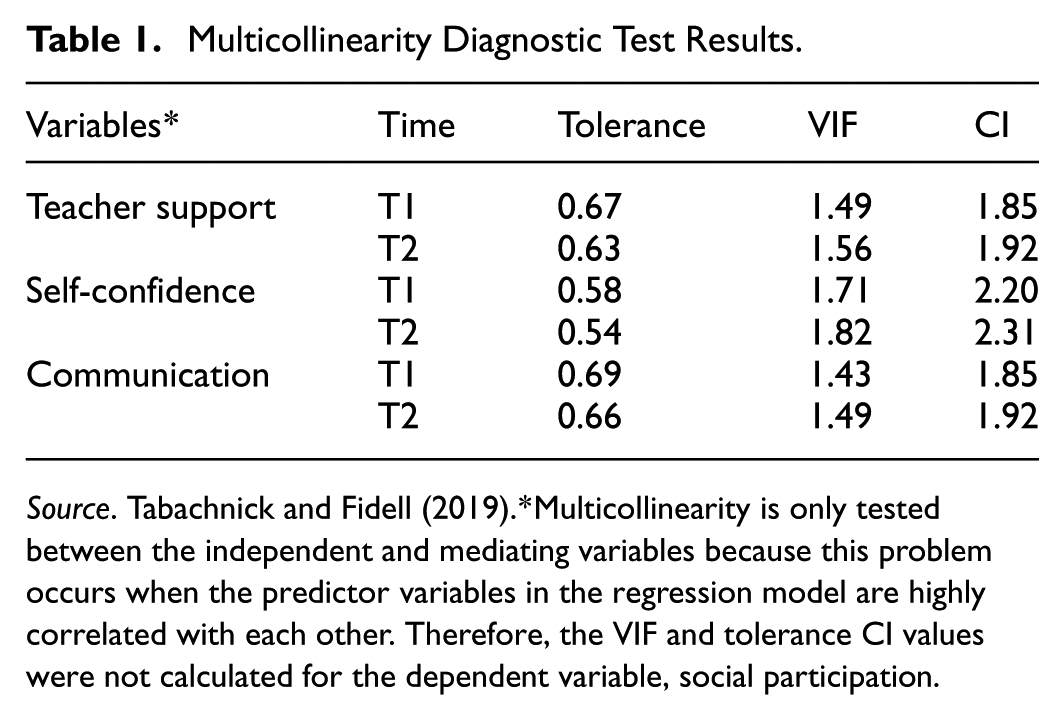
Before analysis, the basic assumptions on which the mediation tests are based were examined. In this context, the normal distribution properties of the data at both univariate and multivariate levels were examined. First, diagnostic criteria such as Tolerance values, Variance Inflation Factor (VIF) and Condition Index (CI) were used to determine the risk of multicollinearity in the data sets. In line with the thresholds suggested by Osborne and Waters (2002), it was taken into consideration that the tolerance values should not be below 0.10, the VIF values should not exceed 10 and the CI values should remain between 10 and 30. In the analyses conducted within this framework, findings indicating multicollinearity between variables were detected. The Cook, Mahalanobis and Leverage’s Distance metrics were examined to identify the outliers. During the tests conducted to determine the risk of multicollinearity, findings indicating multicollinearity were detected. First, the outliers were eliminated from the data sets. However, the risk of multicollinearity continued despite the elimination of outliers (tolerance < 0.10; VIF > 10; CI > 30). It was decided that removing a large number of outliers would impair the authenticity of the data set. Therefore, although the data were converted into Z scores to aid interpretation, it is important to note that standardization alone does not resolve multicollinearity. To ensure that multicollinearity was not a concern, the diagnostics for the Z score data were examined, and it was found that the values were below generally accepted thresholds. The values obtained are shown in Table 1. Therefore, the Z scores were used in the analysis.
Multicollinearity Diagnostic Test Results.
Source. Tabachnick and Fidell (2019).
Multicollinearity is only tested between the independent and mediating variables because this problem occurs when the predictor variables in the regression model are highly correlated with each other. Therefore, the VIF and tolerance CI values were not calculated for the dependent variable, social participation.
The skewness and kurtosis values were examined to determine whether the data were normally distributed. Any values between −2.00 and 2.00 (Byrne, 2013) were taken as a basis. A reliability analysis was also performed for the data. In the reliability analysis, the view that “α > .80 = good” (George & Mallery, 2003) was adopted. The values obtained are shown in Table 2.
Descriptive Statistics and Normal Distribution Values of the Variables.

Results
The Preliminary and Comparison Analysis and Correlations Between the Overall Variables
After the data were converted into Z scores, whether the multicollinearity problem persisted was checked. The results are shown in Table 1.
Table 1 shows that tolerance values are between 0.54 and 0.69; the VIF values are between 1.43 and 1.82 and the CI values are between 1.85 and 2.31. It was determined that there was no multicollinearity problem among the variables.
The skewness, kurtosis and Cronbach alpha values of all the variables at T1 and T2 were analyzed. The values obtained are presented in Table 2.
As can be seen in Table 2, the skewness and kurtosis values of all the data were within the limits of −2.00 and 2.00, indicating that the data were normally distributed. In addition, the reliability values of all the data (α > .80) indicate that the scales are suitable for this study. Since all the measurement tools consisted of Likert-type equal interval scales, parametric tests were found to be applicable in the analyses.
A Paired Samples t test was applied to determine whether there was a change in the scores of the variables between T1 and T2. The results are given in Table 3.
The Paired Samples t-Test Results.

As can be seen in Table 3, there is a statistically significant difference (p < .05) between the T1 and T2 measurements of all the variables. This means that the students made improvements over time in terms of all the variables.
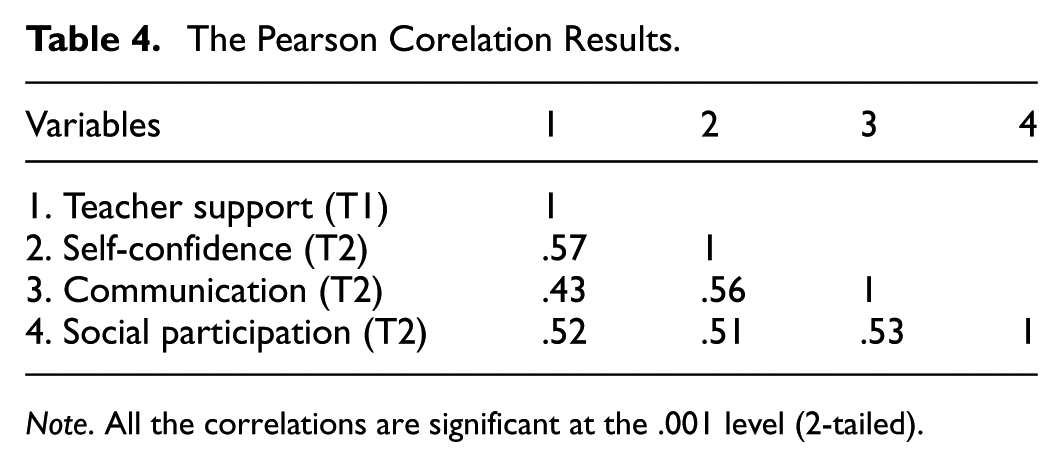
The Pearson correlation results of the variables that form the basis of the hypotheses of the study were examined. The results are given in Table 4.
The Pearson Corelation Results.
Note. All the correlations are significant at the .001 level (2-tailed).
Table 4 shows that teacher support is positively related to self-confidence (r = .57, p < .001), communication (r = .43, p < .001) and social participation (r = .52, p < .001). Self-confidence is positively related to communication (r = –.56, p < .001) and social participation (r = .51, p < .001). Communication is positively associated with social participation (r = .53, p < .001). A correlation coefficient below .30 was accepted as weak, between .30 and .70 as moderate and above .70 as a strong relationship (Tabachnick & Fidell, 2019).
The Results Related to the Serial Mediation Analysis
The study presents the serial mediation roles of self-confidence and communication of the secondary school students in the relationship between their teacher support and social participation in Figure 4 and Table 5. Figure 4 and Table 5 show the results of the regression-based mediation effect analysis using the Hayes Process Macro.

Serial mediation model.
Direct and Indirect Effects.
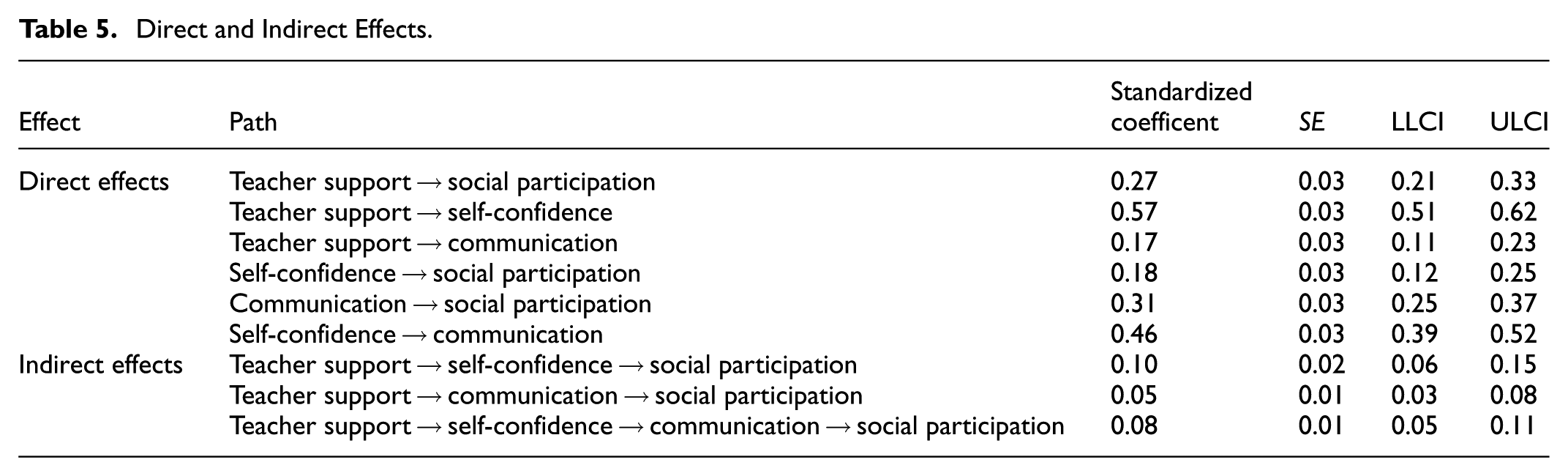
As can be seen in Figure 4, the results reveal significant associations among the variables. Teacher support demonstrates a substantial predictive relationship with both self-confidence ((a1) β = .57 [95% CI: .51, .62], p < .001) and communication ((a2) β = .17, [.11, .23], p < .001). Furthermore, self-confidence exhibites a positive effect on communication ((d21) β = .46 [.39, .52], p < .001). Both self-confidence ((b1) β = .18 [.12, .25], p < .001) and communication ((b2) β = .31 [.25, .37], p < .001) are identified as significant contributors to social participation. Additionally, the impact of teacher support on social participation is found to be significant, with a coefficient of ((c) β = .51 [.45, .56], p < .001). After accounting for the effects of self-confidence and communication, the direct effect of teacher support on social participation decreased but persisted ((c’) β = .27 [.21, .33], p < .001).
Table 5 shows that both self-confidence (β = .10, 95% CI: [.06, .15]) and communication (β = .05, [.03, .08]) play mediating roles in the association between teacher support and social participation, respectively. Additionally, a serial mediating effect was identified, indicating that teacher support influences social participation through a serial mediation process involving self-confidence and then communication (β = .08, [.05, .11]).
A decrease in the prediction level of the independent variable on the dependent variable with the inclusion of a mediating variable in a model is considered as a partial mediation effect (Baron & Kenny, 1986). As can be seen in Figure 4, the coefficent value of the effect of teacher support on social participation decreased from 0.51 to 0.27 when self-confidence and communication were included in the model. Therefore, self-confidence and communication showed a serial partial mediation effect in the relationship between teacher support and social participation.
The results of the study show that self-confidence and communication play a mediating role between teacher support and social participation both separately and serially. The model proposed in the study was found to be statistically significant. Therefore, hypotheses 1 to 3 have been confirmed.
Discussion and Conclusion
In the study, the effect of teacher support on secondary school students’ social participation was examined through the serial mediation of self-confidence and communication variables. The results show that teacher support significantly predicted social participation through self-confidence and communication. Therefore, all the hypotheses of the study were confirmed.
The first hypothesis of the study states that teacher support increases secondary school students’ self-confidence and improves their level of social participation. The results of the study confirmed this hypothesis. In this context, it can be said that students who receive support from their teachers increase their self-confidence and thereby become more active and sociable individuals in social environments. This result supports the SLT (Bandura, 1977), which argues that social participation develops through the interaction of external factors and individual characteristics, and the SDT (Ryan & Deci, 2017) which argues that satisfying the three basic psychological needs of individuals (autonomy, competence, and relatedness) enables them to participate effectively in social life. Indeed, according to the SLT, social participation is related to the individual’s reflection of the effects of environmental factors on his/her behavior. In this context, students who receive support from the teacher, an environmental factor, develop self-confidence and become more active in social interactions (Urdan & Schoenfelder, 2006). When considered in the context of the SDT, teacher support can contribute to the satisfaction of the basic psychological needs of the individual, helping him/her to develop self-confidence and thereby to participate in social life. In this sense, the current findings illustrate how the SDT and the SLT intersect: while the SDT explains the internal motivational mechanism, the SLT elucidates how these internal changes are translated into observable social behavior through modeling and reinforcement processes. Therefore, teacher support functions as both a psychological need satisfier (as proposed by the SDT) and a social model (as proposed by the SLT), bridging internal motivation and external social participation. In the secondary school period, which is a stage of adolescence (Waddell, 2018), the teacher is an important source of support for students not only in terms of academic input but also in terms of social and emotional development (Creese et al., 2013). The teacher’s positive attitude toward the student and the teacher’s helpful feedback contribute to the students’ self-confidence (Maclellan, 2014). Students with high self-confidence can take a more active role in social environments and establish effective relationships with their peers (Gorsy & Panwar, 2015). The result of this study within the scope of the first hypothesis is in line with the results of studies examining the effect of teacher support on self-confidence and social participation (Choi et al., 2023; Danielsen et al., 2010; Hoferichter et al., 2021; Li et al., 2022; Mitchell & DellaMattera, 2010; Sánchez et al., 2005; Stornes et al., 2008; Zhang et al., 2021).
The result obtained within the scope of the second hypothesis shows that teacher support indirectly affects social participation by improving students’ communication skills. When students are supported by teachers, they can be more open to their environment, express themselves more clearly and at the same time develop healthy relationships with other people (Benabou & Tirole, 2000). The result obtained in line with the second hypothesis of the study confirms the SLT. In fact, according to Bandura (1977), individuals learn and internalize social behavior from their role models through observation. Supportive teacher behavior enables students to internalize positive forms of social interaction. Students develop their own social interaction skills by adopting the effective communication behavior they observe from their teachers. Confirmation of the second hypothesis is also important in terms of the SDT (Ryan & Deci, 2017). Indeed, supportive teacher behavior satisfies students’ needs for relationship building by making them feel socially competent and accepted. Therefore, students can communicate and actively participate in social environments by achieving psychological satisfaction. This interpretation underscores the complementarity between the SLT and the SDT: the SLT clarifies the learning pathway, whereas the SDT highlights the motivational substrate. The observed indirect path from teacher support to communication demonstrates how environmental inputs are internalized into sustained social competence. Therefore, teacher support is a factor that supports the development of communication skills through the social learning and internalization processes (Frymier & Houser, 2000). In addition, the result related to the second hypothesis supports the results of studies examining the effect of teacher support on communication and social participation (Frymier & Houser, 2000; Guo et al., 2025; Schürer et al., 2025; Wan et al., 2023; Wubbels & Brekelmans, 2005).
Finally, within the scope of the third hypothesis, it was determined that teacher support predicts social participation serially through self-confidence and communication. This result shows that self-confidence and communication develop in successive processes and social participation increases significantly at the end of these processes. In other words, supportive teacher attitudes enhance students’ self-confidence, which in turn improve their communication skills and ultimately enable them to take part as more active individuals in social environments. This result reveals that self-confidence is a basis for healthy communication with others (Rodriques, 2000) and communication skills are direct determinants of social participation (Luhmann, 1992). Importantly, the confirmation of the serial mediation model offers a theoretical integration between the SDT and the SLT rather than a parallel application of the two frameworks. From the SDT perspective, the pathway from teacher support to self-confidence reflects the satisfaction of competence and relatedness needs, which energizes intrinsic motivation. From the SLT perspective, the subsequent link from self-confidence, communication and social participation illustrates how internally motivated behavior is socially enacted and reinforced through interaction and feedback. This serial mechanism demonstrates that motivational resources (derived from the SDT) are translated into observable social engagement (explained by the SLT), thereby extending both theories toward a dynamic, multi-level explanation of student social participation. The confirmation of the third hypothesis shows that the supportive teacher figure increases students’ self-confidence by increasing their intrinsic motivation and also helps them become more active individuals in social environments by contributing to the development of their communication skills. Therefore, this result supported both the SLT (Bandura, 1977) and the SDT (Ryan & Deci, 2017). There is no specific study in the literature that examines the serial mediation role of self-confidence and communication in the relationship between teacher support and social participation. Therefore, it is thought that the results of this study will contribute to the literature in this context.
Limitations and Suggestions for Future Research
While the current study provides important evidence, it has a number of shortcomings that need to be acknowledged. The main limitation of the study is its reliance on self-reporting assessments for data collection. Self-reporting measures may contain bias that can affect the validity of the results, so future research may consider including multiple methods, such as implicit measures or behavioral observations, to triangulate findings and reduce potential biases associated with self-reporting measures. Maximum diversity sampling was used to determine the sample. While the use of this technique increases representativeness, it depends on the willingness of schools and students to participate, which may have led to self-selection bias. To minimize this bias, proportional representation based on regional student population sizes could be used during data collection. Furthermore, this study focuses on the mediating roles of secondary school students’ self-confidence and communication in the relationship between teacher support and social participation. However, other psychological or sociological constructs may also play a role in this relationship. For example, factors such as personality traits, cognitive processes, or coping strategies could potentially influence how teacher support affects students’ social participation. In addition, this study collected data in only two time periods. By collecting data at three or more time points, the effect of teacher support on social participation could be examined in greater depth. This study was conducted with secondary school students. Another limitation concerns the generalizability of the findings beyond the Turkish context. Although maximum diversity sampling was used to include students from all seven geographical regions of Turkey, the results may still reflect cultural and contextual characteristics specific to the Turkish educational system and social environment. Future studies could replicate the current model in different cultural contexts to test its cross-cultural validity and explore whether the mechanisms proposed by the SDT and the SLT operate similarly in diverse educational environments. This study was only conducted with secondary school students. Similar studies could be conducted with the participation of primary school, high school and university students.
Footnotes
Acknowledgements
We thank all participants who voluntarily contributed to this study.

Ethical Considerations
Ethical approval was obtained from the Ağrıİbrahim Çeçen University ethics committee (ethic reference number is E-95531838-050.99-135753) before starting the study. Each stage of this study was carried out in line with the Declaration of Helsinki (World Medical Association, 2013), and its later amendments or comparable ethical standards.
Consent to Participate
Consent was obtained from all participants included in the study.
Author Contributions
Both authors participated equally in all stages of the study.
Funding
The authors received no financial support for the research, authorship, and/or publication of this article.
Declaration of Conflicting Interests
The authors declared no potential conflicts of interest with respect to the research, authorship, and/or publication of this article.
Data Availability Statement
The datasets generated and/or analyzed during the current study are available from the corresponding author on reasonable request.*