




Abstract
Peer scaffolding is a key to the success of second language (L2) collaborative writing. Despite growing research interest in this area, studies focusing on its application among learners with varying levels of engagement are still scarce. This study investigated what strategies and how Chinese EFL learners employ peer scaffolding strategies in relation to group engagement during a collaborative process writing task, as well as their perceptions of these practices. Seventy-nine English Education majors from a Chinese university participated in this research. Data were collected through audio-recorded discussions, the Learner Group Engagement Scale, and open-ended survey responses. The findings reveal that the students employed multiple types of peer scaffolding strategies corresponding to different dimensions of group engagement. Notably, the moderately engaged students demonstrated peer scaffolding strategies more frequently than their low- and high-engagement counterparts. Furthermore, the students successfully developed their belief systems regarding peer scaffolding, which can be attributed to their dual roles as contributors and reviewers. This study expands the scope of peer scaffolding to any interacting pairs and suggests a non-linear relationship between strategy application and engagement level. Pedagogical implications regarding peer scaffolding strategies are discussed with a view to optimizing collaborative writing tasks in L2 classrooms.
Plain Language Summary
Peer support among classmates plays a particularly vital role in helping everyone achieve success in collaborative learning. Although there is growing interest in researching this area, there are not many studies specifically focusing on how students with different levels of participation use this kind of support. This study looked into how Chinese college students, taking into account their levels of group participation, employed peer support strategies during a collaborative process writing (CPW) activity, and also explored their views on these practices. Seventy-nine English Education majors from a Chinese university took part in the research. The researchers gathered data from recorded discussions, the Learner Group Engagement Scale (LGES), and open-ended survey responses. This study shows that learners used different peer support strategies that matched different levels of group involvement. Interestingly, students who were moderately involved in group work used these peer support strategies more often than those who were either less or more involved. Additionally, the students managed to build a better understanding of peer support, thanks to their roles as both helpers and evaluators in the group. This research broadens the idea of peer support to include any pair of students who interact with each other. It also suggests that the relationship between how often strategies are used and the level of involvement is not straightforward. Finally, the study discusses how these peer support strategies can be used to improve collaborative writing tasks in second language classrooms.
Introduction
Collaborative writing has received increasing attention in the field of second language (L2) education in recent years (Cao et al., 2025; Ebadijalal & Moradkhani, 2023; Storch, 2013; Tao et al., 2022). Informed by social constructivism, collaborative writing describes an activity where multiple writers jointly produce a single text through a negotiated decision-making process with mutually scaffolded behaviors (M. Li, 2013). Through collective scaffolding, learners can benefit from collaborative writing in terms of writing accuracy, language development, critical thinking skills, and social skills (Bradley et al., 2010; Elabdali, 2021; M. Li & Zhu, 2017; Pan & Teng, 2025; Yang, 2018). Scaffolding, derived from Vygotsky’s (1978) Zone of Proximal Development (ZPD), is regarded as a key mechanism in socially mediated learning. Quite a few L2 studies have demonstrated that learners can provide mutual scaffolding in peer collaboration as both individual novices and collective experts (M. Li, 2013; Xu, 2016). In a collaborative writing task, for example, learners co-construct the written product by pooling resources to generate content ideas and focus on form. Compared with teacher scaffolding, peer scaffolding is more timely and developmentally appropriate since it must be within the range of cognitive development (Storch, 2013).
Peer scaffolding is an important indicator that mediates students’ writing performance (Cao et al., 2025). However, not every group member will profoundly engage with peer scaffolding in practice. Some researchers (e.g., Bradley et al., 2010; M. Li & Zhu, 2017; Zheng et al., 2025) have observed that students may act as free riders, benefiting from others’ contributions, or focus on the divided workload with minimal or no reciprocal interaction with others. There is a common distinction between cooperation and collaboration in L2 writing studies. The former involves the division of labor and rare feedback, whereas the latter involves coordinated efforts and elaborate communication (Storch, 2013). Consequently, an activity described as cooperative writing is likely to reduce peer scaffolding since learners are often unaware of their responsibility for providing feedback and the necessity of peer interactions. To the best of my knowledge, such variations in peer scaffolding resulting from differing levels of engagement have not been investigated in the previous literature.
To be effective, collaborative writing must be aligned with the process approach to fully engage learners in joint efforts of understanding how writing is produced. As the process writing approach supports collaborative writing by framing writing as a dialogue within a socially interactive community, it encourages learners to actively participate in providing and receiving constructive feedback, thereby enhancing the effectiveness of collaborative writing (X. Li et al., 2012; Mutwarasibo, 2013). Currently, collaborative process writing (CPW) remains a promising but under-explored pedagogic approach in L2 writing studies (Chairinkam & Yawiloeng, 2021; Winarti & Cahyono, 2020). Also, there have been far fewer L2 studies that describe how learners demonstrate peer scaffolding in relation to group engagement in collaborative learning settings. Therefore, the purposes of this study are twofold: (a) to assess CPW tasks from the perspective of peer scaffolding in a Chinese English as a foreign language (EFL) context; and (b) to explore the patterns of peer scaffolding among EFL learners with different levels of engagement. To this end, it seeks to address three research questions:
What peer scaffolding strategies do EFL learners employ during a CPW task?
Are there differences in peer scaffolding strategies used by lowly, moderate, and highly engaged EFL learners during a CPW task?
How do EFL learners perceive peer scaffolding during a CPW task?
Literature Review
Peer Scaffolding in L2 Learning
Scaffolding, a concept rooted in Vygotsky’s sociocultural theory (1978), refers to temporary support provided within learners’ ZPD to facilitate their transition from assisted to independent performance. Early scaffolding studies emphasized how teachers provide scaffolding for students during classroom interaction. Later, Donato (1994) identified reciprocal scaffolding in peer interaction as positively influencing language development, a phenomenon he termed collective scaffolding. Such scaffolding enables learners to gather their partial knowledge to achieve target-like language use, co-construct new knowledge, and guide one other in solving problems (Storch, 2013). Critically, unlike teacher-led scaffolding, peer scaffolding is continuously accessible throughout collaborative tasks, allowing for dynamic adjustment to students’ needs (Philp et al., 2014). Previous literature has shown the distinctive advantages of peer scaffolding in L2 collaborative writing, including the co-construction of new knowledge, enhanced writing accuracy, increased learning confidence, development of critical thinking skills, and greater learner autonomy (Cheng & Zhang, 2024; Irgin & Bilki, 2024; D. Li, 2011; Pasand & Tahriri, 2017; Weng et al., 2023).
Nevertheless, there is still controversial literature about the functions of peer scaffolding in group interactions. Some researchers (e.g., Kayi-Aydar, 2013) even argued that peer scaffolding was largely absent or ineffective in group work because students might be preoccupied with power dynamics and demonstrated limited engagement with one another. Moreover, even though collaborative writing is generally perceived positively, students cannot seem to trust peer scaffolding for threefold reasons. Firstly, they are concerned about their own ability to provide appropriate suggestions, which would be face-threatening (Philp et al., 2014; Xu, 2016). Secondly, they tend to devalue the assistance from their peers since teachers are generally viewed as the authority figures in EFL contexts (Cheng & Zhang, 2024). Thirdly, they fear that critiquing a peer’s ideas could undermine harmonious relationships (Author, 2024; Yu & Hu, 2017). With these challenges, it may be difficult for learners to fully engage with peer scaffolding, hence making it difficult to maximize the value of collaborative writing.
Amidst the existing studies supporting peer scaffolding, its types have been investigated in different collaborative learning settings. For example, D. Li (2011) conducted a collaborative writing task that required four students to complete an argumentative essay with a focus on using relative clauses. Through this task, she identified seven types of peer scaffolding strategies, such as feedback, simplifying the task, recruitment, and frustration control. Xu (2016) investigated 62 Chinese university EFL learners when they participated in oral discussion activities in small groups. Seven strategies emerged from their dialogues, such as increasing participation, providing words and expressions, providing opinions, and task maintenance. Chairinkam and Yawiloeng (2021) observed five Thai EFL pairs and reported 10 peer scaffolding strategies used during their writing tasks, such as greeting, questioning, agreeing, and suggesting. In light of these findings, learners used multiple peer scaffolding strategies when they worked together. Nevertheless, the above studies were limited to isolated description of peer scaffolding strategies rather than presenting an integrated framework. Thus, the strategies learners employ and their perceptions of peer scaffolding across different engagement dimensions in CPW tasks still warrant further exploration.
Student Engagement in Collaboration
Student engagement refers to a state of student involvement, which defines the learning process and academic outcomes (Fredricks et al., 2004). Engaged learners tend to have a passionate commitment to learning tasks and be involved in activities with ample opportunities for deep learning (Hiver et al., 2024; Storch, 2013). The construct of student engagement is widely portrayed as multifaceted. Svalberg (2009) classically identified three dimensions, including cognitive (self-regulation and thinking), social (interaction and negotiation), and affective engagement (feelings). Philp and Duchesne (2016) expanded this to four dimensions, namely behavioral (participation and efforts), cognitive, emotional, and social engagement.
In collaborative learning settings, student engagement is not merely about learners’ individual state, and it is inevitably influenced by their peers (Järvelä et al., 2016). For this reason, group engagement tends to be more complicated than individual engagement. Some researchers proposed that there should be additional components of group engagement reflecting interactive participation within groups, such as socioemotional interaction (Järvelä et al., 2016), which refers to positive or negative emotions at the group level, and prosocial engagement (Fukuda et al., 2021), which highlights the positive influence of learning supports from ideal peers. Based on the previous literature, combined with the Delphi method and the Analytic Hierarchy Process, Ma et al. (2022) identified behavioral participation, social relations, idea construction, and shared regulation as key indicators of group engagement, establishing a four-dimensional model for further research from a brand-new perspective.
Growing studies have shown that the level of engagement with peer scaffolding could determine learners’ task performance and language development (Wang, 2024; Irgin & Bilki, 2024). Storch (2008) made a distinction between “elaborate engagement” and “limited engagement” according to the degree of responses provided by one party in a pair-work task. She further explained that elaborate engagement is more conducive to learning than limited engagement. Some subsequent studies investigated the effectiveness of group engagement following this distinction (e.g., Edstrom, 2015). Although the aforementioned distinction accounts for the quantity of learners’ engagement with peer scaffolding, it neglects the quality of negotiation content. To foster learners’ deep-level engagement in L2 collaborative writing and better understand their engagement with peer scaffolding, this study aims to investigate learners with varying levels of group engagement from the perspective of peer scaffolding.
Collaborative Process Writing
While traditional writing is teacher-centered and prioritizes grammatical accuracy, process writing emphasizes the developmental process of writing, that is, how ideas are generated, paragraphs structured, and drafts polished, rather than merely on the final product (Graham & Sandmel, 2011; Winarti & Cahyono, 2020). More specifically, the process writing approach comprises distinct stages such as planning, drafting, revising, and editing. Throughout these writing stages, emphasis on collaboration and responsibility motivates learners to take ownership of their learning. As a result, they progressively develop writing proficiency through step-by-step practice (Guo et al., 2021).
The application of the process approach is common in L2 classes, but rare in collaborative learning settings. Taking previous literature into consideration, CPW can be defined as a learner-centered writing method where learners collaboratively produce written work through a phased collaborative process involving interactive negotiation in pairs or groups. It can provide learners with valuable opportunities to engage in discussions on all necessary aspects throughout the entire writing process within a socially interactive community (X. Li et al., 2012; Mutwarasibo, 2013), thereby enhancing their sense of ownership over writing products and accountability for peer interactions.
Among a few attempts, the study by X. Li et al. (2012) combined process writing and collaborative learning in a Chinese native-speaking setting. A total of 59 Primary Four students followed the process of prewriting, drafting, revising, and editing to create their collective work online. The findings confirmed the positive effects of the integration model on group interactions and writing motivation. In EFL contexts, studies have shown evidence that the CPW approach can spark learners’ self-reflection, improving their thinking skills and writing proficiency; meanwhile, the participants also admitted that they helped each other in group discussions to exchange ideas, give feedback, and solve problems together (Mutwarasibo, 2013; Winarti & Cahyono, 2020). However, previous literature has merely demonstrated some insights into peer scaffolding, lacking a comprehensive exploration of the effects of peer scaffolding during CPW tasks. It calls for an in-depth investigation to assess the CPW approach with regard to peer scaffolding based on students’ perceptions.
Method
Participants and Setting
Two classes of third-year undergraduate students who major in English Education participated in the study. They consisted of 73 females and 6 males, who were Chinese native speakers and intermediate EFL learners ranging from 19 to 22 years old. During the first 2 years, they were mainly trained in the basic language skills of English, including listening, speaking, reading, and writing. The course they attended was titled Advanced English with the aim of consolidating their language skills in English, particularly reading and writing. At the beginning of the course, the students voluntarily formed 23 groups of three or four. All group members were familiar with each other since they had spent 2 years of college life together and completed multiple collaborative tasks (e.g., group presentations) in this course.
Collaborative Process Writing Task
In the CPW task, the students were required to read two 200-word excerpts, one about the convenience of online study and the other about the problems with online study, and subsequently write an article including a summary and their comments totaling at least 300 words. The model of the CPW task was modified based on X. Li et al. (2012). The task implementation lasted 3 weeks, during which the students progressively engaged in the writing development process. Table 1 outlines the procedures of this four-stage CPW task.
Procedures for the CPW Task.

Three additional aspects require further clarification regarding task procedures. Firstly, individual contributions are emphasized in the initial stage (individual drafting) to allow students sufficient time to develop their ideas before discussions and to avoid the free-rider problem. Secondly, the writing assessment rubric serves as a beacon guiding students to pay close attention to a wide range of writing features, including organization, idea quality, grammatical accuracy, and word choice. Thirdly, students are encouraged to edit the texts based on teacher feedback, and the exemplar essay helps them deepen their understanding of effective writing.
Data Collection
This study follows an exploratory design of mixed-methods research (Creswell et al., 2008), in which qualitative data are the original data source and quantitative data are collected later for generalizing the conclusions from the qualitative data. Three sources of data adopted in the study are as follows.
Firstly, audio-recorded group discussions were collected and used to explore the peer scaffolding strategies employed during the CPW task. Each group recorded their discussions and uploaded the audio files and their group product to the online learning platform (chaoxing.com). The average discussion duration per group was about 20 min. The researcher used the audio transcription website (tingwu.aliyun.com) to process these recordings, and a postgraduate student majoring in Applied Linguistics conducted manual verification by comparing them with the original recordings. The final transcripts comprised 102,934 Chinese characters.
Secondly, the 38-item Learner Group Engagement Scale (LGES) was used to measure learners’ engagement levels. Adapted from the study by Ma et al. (2022), the scale used in the present study incorporated an emotional dimension, defined as the maintenance of motivated involvement during learning activities (Hiver et al., 2024; Philp & Duchesne, 2016; see Table 2). The 5-point Likert scale was adopted, with responses ranging from 1 (“completely inconsistent with my state”) to 5 (“completely consistent with my state”). The reliability of the five engagement dimensions ranged from 0.79 to 0.90. The KMO measures were all greater than 0.81, and Bartlett’s Test of Sphericity was significant (p < .01), indicating that the scale demonstrates good reliability and validity. The scale used by the participants was originally in Chinese. For the purpose of presentation in this paper, the researcher translated it into English (see Appendix A). The English version was back-translated into Chinese by a separate postgraduate student, followed by a comparison with the original scale. It was found that there were subtle differences in some expressions. After discussions, the researcher revised the wording to ensure consistency with the original meanings.
Learner Group Engagement Scale (LGES).

Thirdly, an anonymous survey with four open-ended questions was conducted online to uncover the students’ perceptions of peer scaffolding throughout the CPW task. In the prompt of the questionnaire, the students were explicitly informed that they had just experienced a four-stage CPW task. They were encouraged to express their real feelings about every stage of the CPW task and their group work as well. The four questions are listed below: Did you encounter any difficulties when you wrote independently? What insights or gains did you get during the group discussion? Did you come across any obstacles during the group discussions? Compared with individual drafting and group drafting, do you perceive any differences? The research procedure of this study is delineated in Figure 1.
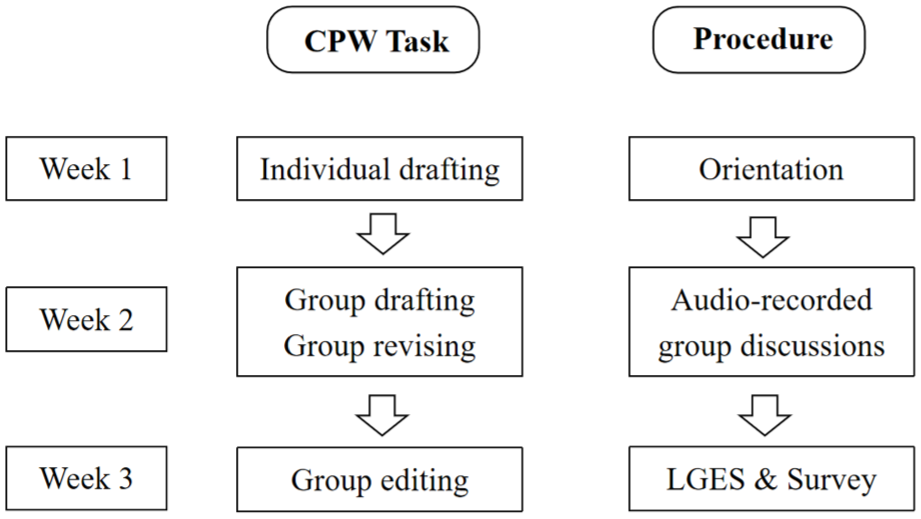
The research procedure.
Data Analysis
In order to identify the peer scaffolding strategies employed during the CPW task, the transcripts of audio-recorded discussions were analyzed following three steps. At first, the researcher listed possible peer scaffolding strategies with reference to previous literature (e.g., D. Li, 2011; Xu, 2016) to make a tentative framework for coding. Then, the transcripts were reiteratively read to identify the instances of peer scaffolding episodes (PSEs). Considering the nature of scaffolding, a PSE should be helpful in engaging learners in peer interaction and solving problems throughout the task completion process. Accordingly, a PSE refers to a conversational sequence where a learner provides interactive assistance to continue the collaborative task. Next, the researcher coded the PSEs according to the tentative framework and refined categories of peer scaffolding by deleting unnecessary ones and adding new ones. Finally, a total of 588 PSEs were identified from the transcripts, which were categorized into five types of peer scaffolding strategies, namely immediate response, recruitment, knowledge sharing, task monitoring, and affective support.
To examine students’ perceptions of peer scaffolding during the CPW task, the data from the open-ended survey were analyzed using thematic analysis (Braun & Clarke, 2006). The researcher examined initial codes through inductive coding and organized the codes into possible themes. There were two main themes emerging through data analysis: positive outcomes and potential obstacles during task completion. To establish the trustworthiness of the coding process, inter-rater consistency was checked between the researcher and an additional rater, which reached 91.1% of agreement after multiple discussions. Before reporting the findings, no translation of the transcripts was made from Chinese into English to avoid distorting meanings.
As to quantitative data collected from the LGES, a total of 59 valid responses were recorded, after excluding incomplete submissions and those disregarded due to patterned answering or multiple selections, with an effective rate of 74.7%. Using 33% and 66% as the grouping critical values respectively, the learners were divided into three groups based on the scores they obtained on the LGES: the low-engaged group (LE, scores < 163, n = 19), the moderate-engaged group (ME, 163 ≤ scores ≤ 183, n = 21), and the high-engaged group (HE, scores > 183, n = 19). The Kruskal-Wallis test was conducted to explore the differences in peer scaffolding strategies used by the three groups, as it does not require the assumption of homogeneity of variances, thereby avoiding erroneous conclusions caused by unequal variances. Separate Mann-Whitney U tests were used as the post-hoc tests. The effect size r for nonparametric tests was calculated by using the equation r = Z/√N, where Z refers to a z-score, and N is the total number of observations (Rosenthal, as cited in Larson-Hall, 2010). The effect sizes r = .2, .5, and .8 are for a small, medium, and large effect, respectively (Cohen, as cited in Larson-Hall, 2010).
Results
Peer Scaffolding Strategies Employed During CPW
Five peer scaffolding strategies have emerged from the data, including knowledge sharing, immediate response, task monitoring, recruitment, and affective support, in descending order of frequency. Firstly, the most frequently used strategy was knowledge sharing (58.2%). By using this strategy, the students pooled their partial knowledge to reach target-like language use, co-construct new knowledge, and guide each other to solve problems. Such sharing methods included providing suggestions (53.5%), responding to inquiries (31.3%), and critiquing others’ ideas (15.2%). Unlike individual writing settings, where students can only rely on their own resources, in collaborative learning settings they engaged in mutual communication, which provided them with additional ideas and shared meaning. The following dialogue shows that two students resolved their cognitive conflict and achieved a common understanding by intellectual negotiation.
It’s convenient to get learning materials from the internet, so online learning is flexible.
Yeah, it’s personalized.
Flexibility doesn’t mean personalization. Flexibility means there’s no limit on time and space.
So you’re saying students don’t have to sit in classrooms; they can study whenever and wherever they want. (Discussions, Class 1, Group 7)
The second strategy is named immediate response (18.2%). To distinguish it from general feedback, the study prescribes that learners directly evaluate others’ contributions without providing new information, thus setting a limit on this type of strategy. The students provided immediate responses through affirming others’ ideas (e.g., “yeah, yeah”) or repeating previous information. They offered immediate responses as scaffolded assistance to monitor their peers’ performance and compensate for their knowledge gaps. One example is presented as follows.
Offline learning is more boring.
Offline learning is more boring?
Don’t you think so? Teachers are just up there lecturing, and I’m like…
Yeah, some offline courses really make me wanna fall asleep. (Discussions, Class 1, Group 11)
Thirdly, the task monitoring strategy (11.6%) focuses on monitoring and regulating task implementation during information processing. In most cases, the students who played a leader-like role would suggest discussion procedures to other members using imperative sentences, like “Let’s read the task directions,” or “Let’s make a conclusion at first.” Some other students emphasized the necessity for revision regarding language use or discourse. The basic functions of this strategy are simplifying tasks, maintaining pursuit of the goal, and motivating learners.
Fourthly, the recruitment strategy (6.1%) indicates that the students recruited others to the discussions to draw their attention to the task. For instance, “What’s your idea?” or “Which solution do you think is the best one?” Sometimes, the speaker would directly call out the name of a particular student. By doing this, the groups achieved meaning negotiation and improved peer engagement through inviting others to participate.
Finally, the students offered positive emotional value, such as praise or encouragement, through affective support (5.9%) to control frustration and reduce stress. Such positive evaluation includes language-related points (e.g., “The sentence structure is perfect”), content-related points (e.g., “I think your examples are comprehensive and detailed”), and general issues (e.g., “You’re awesome”).
Peer Scaffolding Across Different Engaged Groups
Table 3 presents the means for the LE, ME, and HE groups’ engagement in terms of five dimensions. Figure 2 illustrates the means for the frequency of peer scaffolding strategies used by the three groups. The results show that all groups were at a high state of engagement in general. Nevertheless, the LE group reported the lowest mean, especially for social relations (M = 3.77), and indeed seldom used the recruitment strategy as a form of peer scaffolding (M = 0.16). The ME group used peer scaffolding strategies the most frequently, with the exception of the immediate response strategy (M = 1.29). Although the HE group perceived a high level of engagement in all five dimensions (Ms > 4.89), they generally used peer scaffolding strategies at a low frequency.
Descriptive Statistical Results of LGES.

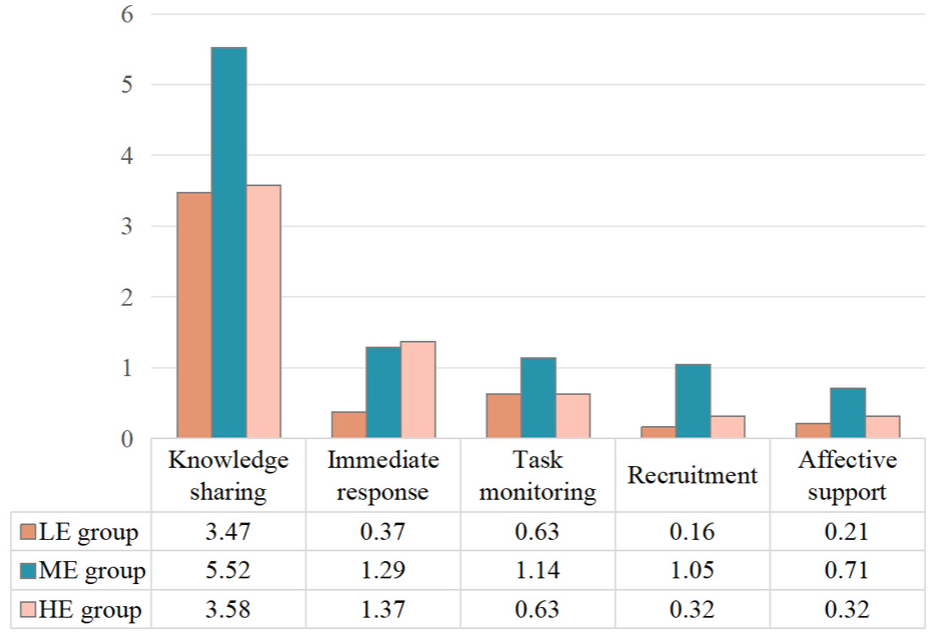
Means for the frequency of peer scaffolding strategies.
Table 4 shows the differences in peer scaffolding strategies employed by the three engaged groups. They were significantly different in terms of immediate response (χ2 = 10.13, p = .006) and recruitment (χ2 = 6.27, p = .044). With respect to immediate response, there was a significant difference between the LE and ME groups (p = .002, Z = 3.155, r = .41), as well as the LE and HE groups (p = .025, Z = 2.236, r = .29). When it comes to recruitment, there was a significant difference between the LE and ME groups (p = .020, Z = 2.324, r = .30). It means that the learners who perceived a low level of group engagement seldom exhibited peer scaffolding strategies, which suggests their reluctance to provide response to their peers and invite others to participate in discussions.
Results From the Kruskal-Wallis Test for Peer Scaffolding Strategies.

p < .05.
Student Perception of Peer Scaffolding During CPW
From the perspective of student perception, peer scaffolding strategies helped them actively engage in their collaborative writing process. Based on the survey, 94.1% of the respondents emphasized the positive outcomes of this CPW task. Specifically, more than half of the students (68.6%) mentioned their improvement in critical thinking skills, with 52.9% of this group expressing an ability to generate more thoughts and different perspectives from others. For instance, one student stated: “My biggest gain from the others was to see one thing from different perspectives. It really broadened my own thinking.” One-tenth of the students rationalized their argumentative logic through group discussions. They tried to make more dialectical comments about online study (i.e., the writing topic of the CPW task) by adopting ideas from others. One student explained that he/she cleared the point of view after debating with others. He or she wrote in the response to the survey, “I can express my idea more precisely after communicating with others because we refined our ideas together at first.” The quote below shows how one student’s feelings changed throughout the CPW task.
In the first stage, I completed the essay by mostly relying on my previous knowledge from a single perspective. Although I finished writing it anyway, the content might be common, as it lacked deep thinking and creative ideas… In the final stage, considering my peers’ and the teacher’s suggestions, I greatly broadened my vision and thoughts. (Survey, Student 21)
In addition, 54.9% of the respondents admitted that they benefited from peer scaffolding in terms of writing abilities, such as discourse knowledge (21.6%), language expressions (11.8%), and so on. For example, one student noted in the survey: “I must gain a better understanding of the discourse. It was useful for organizing the structures of essays.” A similar statement was made by another student that he/she learned from others’ essays to establish a smooth and logical connection between paragraphs. Some students expressed that peer language enriched the words and expressions used in their essays. Moreover, five students (9.8%) admitted that interactive communication facilitated task planning, given their prior uncertainty regarding the task demands. Some students also mentioned their improvement in the capacity of generalization (5.9%) and other aspects (5.9%), such as reading comprehension and error correction.
Meanwhile, some potential challenges emerged throughout the collaborative process. More than one-third of the students admitted that they encountered difficulties during the process of achieving a consensus since different members held different opinions. A lack of collaborative experiences (15.7%) was another challenge when students gathered and organized their ideas together. For instance, some students found it difficult to express their ideas or comprehend others’ ideas at the beginning of discussions. Some others (2.0%) could hardly provide valid feedback because they did not know how to assess others’ ideas and written work.
Discussion
Peer Scaffolding Strategies
In order to answer the first research question, the researcher categorized all the PSEs coded from the audio-recorded group discussions. As a result, this study confirmed five types of peer scaffolding strategies used by Chinese EFL learners in descending order of frequency, including knowledge sharing, immediate response, task monitoring, recruitment, and affective support, indicating varying degrees of underlying group engagement. The finding is in line with the previous studies (e.g., Chairinkam & Yawiloeng, 2021; D. Li, 2011; Xu, 2016) where their students exhibited some similar peer scaffolding strategies in collaborative tasks. This study proposes peer scaffolding strategies within the framework of group engagement, offering a more comprehensive and systematic perspective for peer scaffolding research in L2 learning contexts.
Among these strategies, knowledge sharing is indispensable and beneficial to co-constructing knowledge and the formation process of collective cognition. Previous literature has shown that the reasons why some students avoid providing feedback could be the fear of face-threatening situations (Philp et al., 2014), showing respect for others’ contributions (Wang, 2024), or maintaining interpersonal harmony (Yu & Hu, 2017). Though less frequently, the students in this study did provide feedback on the topic and language-related mistakes, such as word choice and grammatical structure. According to the survey, the assessment rubric and teacher instruction in each writing stage played an important role in pushing them to notice writing content (meaning) and language use (form). More importantly, the knowledge sharing strategy triggers multiple opportunities of self-assessing throughout the group revising and editing stages (Irgin & Bilki, 2024), representing the reciprocity of peer scaffolding.
The immediate response strategy has been infrequently reported in existing literature. D. Li (2011) observed the same response from her students (i.e., “yeah, yeah) and interpreted it as positive feedback aimed at evaluating their peers’ contributions. However, she expressed concerns regarding the quality of dialogic discourse 1 through such responses, noting that these interactions often involve merely approving, repeating, or verifying information, while providing limited corrective feedback. To counter this argument, the researcher contends that this strategy serves as a positive indicator for interlocutors, suggesting that all participants are actively engaged in the task with focused attention and are motivated to contribute more extensively.
The task monitoring strategy manifests the regulatory skills that enable students to control and coordinate the developmental process of individuals and the community, such as task planning and supervision (Ma et al., 2022). Its connotations extend beyond those of the strategies mentioned in previous studies (e.g., D. Li, 2011; Xu, 2016), constituting a more encompassing and advanced concept that incorporates simplifying the task and maintaining the pursuit of task goals. It functions as metacognitive support to initiate task regulation, thereby fostering heightened self-awareness throughout the writing processes (Wen & Castek, 2023). Ultimately, it sees smoother teamwork, propelling groups toward a higher level of collaborative proficiency.
The recruitment strategy facilitates the building of social relationships by means of interactive actions. As posited by Philp et al. (2014), the effectiveness of scaffolding in the context of learning is associated with the social relationships among learners. In this study, the participants proactively articulated their own thoughts or even critiqued others’ ideas. They did so without apprehension about the potential detrimental impact of scaffolded behaviors, as solid relationships have been established through frequent and effective interactions (Wang, 2024). Beyond the task functions of drawing others’ attention (D. Li, 2011) or increasing participation (Xu, 2016), the recruitment strategy serves to foster supportive relationships in groups (e.g., trust, respect), thereby enhancing the effectiveness of scaffolding throughout the collaborative process.
Lastly, the affective support strategy seemed to be easily observable but always low in use frequency (e.g., D. Li, 2011; Xu, 2016). In fact, not everyone possess the instinct to read the signals related to others’ affective and motivational needs and respond appropriately. Nor is everyone adept at expressing empathy for others’ emotions and feelings. Empathy is necessary to understand and interact with others (Casillas et al., 2023), which can predict students’ prosocial behaviors and hence foster group cohesion and collaborative quality. Additionally, mutual respect in peer scaffolding underpins learners’ positive attitudes toward feedback (Zhou et al., 2020). This strategy strengthens a beneficial atmosphere and the closeness among peers, which is crucial for the participants to maintain task engagement and create a safe and comfortable learning environment.
Patterns of Peer Scaffolding Strategies Across Engagement
With respect to the second research question, the researcher compared the peer scaffolding strategies used by the learners across three levels of self-reported engagement. The radar charts below (Figure 3) illustrate the patterns of peer scaffolding strategies in the three groups of engaged learners. Interestingly, the ME group contributed the most peer scaffolding strategies in collaboration, indicating a positive force of peer scaffolding across all dimensions. Briefly stated, the highly engaged learners showed lower scaffolding frequency than the moderately engaged ones, and the lowly engaged learners used them the least.
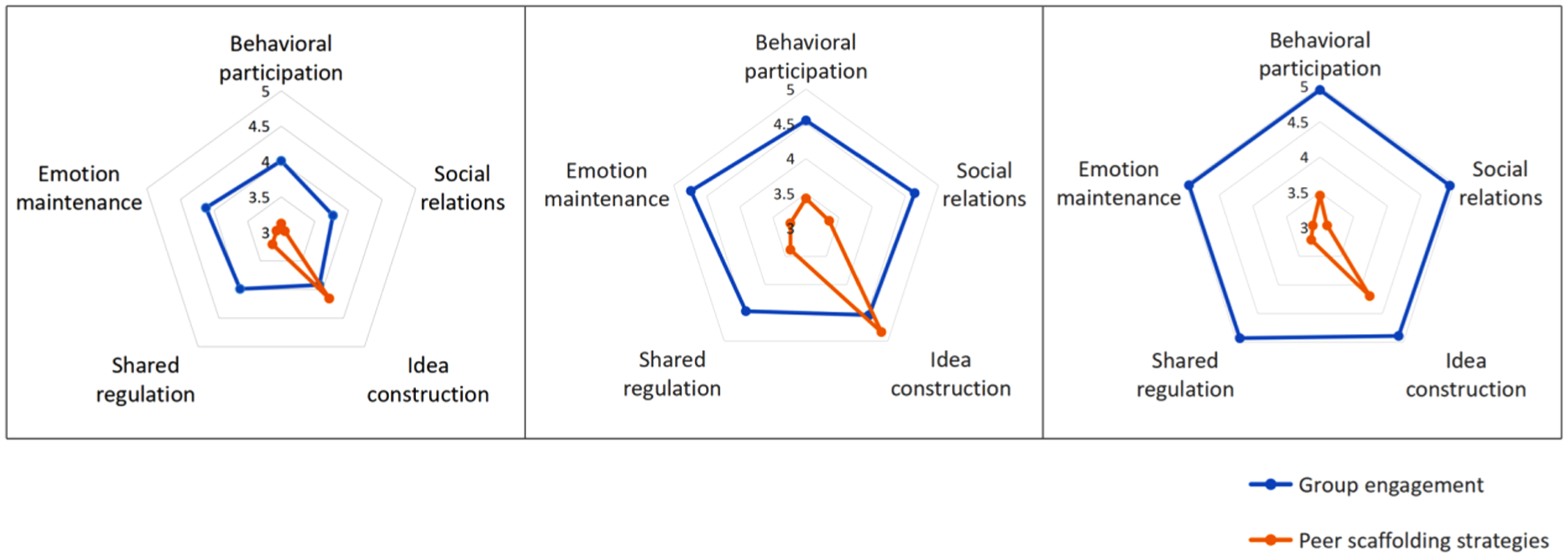
Patterns of peer scaffolding strategies in the LE group (left), the ME group (middle), and the HE group (right).
One reason accounting for this inconsistency lies in the differences between the explicit nature of peer scaffolding strategies and the implicit nature of perceived engagement. For instance, students may experience team cohesion and thus perceive a high level of group engagement in the dimension of emotional maintenance, but they may not necessarily employ the affective support strategy to directly express their praise to the peers. Another explanation is that the performance of Chinese EFL learners may be shaped by the Confucian sociocultural context, where individuals are expected to demonstrate their sense of belonging to the community through humility, thereby avoiding the disruption of the social order that prioritizes “harmony (He)” (Wang, 2024). Therefore, the learners in the ME group chose more moderate options in the LGES, but this does not mean that their actual engagement was lower than that of the HE group.
Accordingly, it is reasonable to claim that in a collaborative L2 writing setting, (a) learners employ multiple peer scaffolding strategies covering five dimensions of engagement, including idea construction, behavioral participation, shared regulation, social relations, and emotion maintenance. (b) The relationship between the frequency of peer scaffolding strategies and the degree of learner perceived group engagement is non-linear. Specifically, learners’ moderate level of engagement yields the highest peer scaffolding frequency, followed by high engagement, and with low engagement showing the least.
The result of the Kruskal-Wallis test shows that the use frequency of the immediate response strategy and the recruitment strategy was significantly lower among the students in the LE group compared to those in the ME group and the HE group. It indicates that the participants in the LE group seldom exhibited synchronous behaviors, meaning that they rarely coordinated their actions with those of their peers. Meanwhile, they did not engage in positive interactions with others to maintain stable social relationships within the learning community. This lack of synchronization and initiative interactions, to a great extend, hinders the learners’ cognitive development (Pan & Teng, 2025) and the successful completion of collaborative tasks (Ma et al., 2022).
Outcomes and Obstacles of Peer Scaffolding
With respect to the third research question concerning student perception, two themes have emerged from the participants’ survey responses: positive outcomes and potential obstacles. It is comforting that most of the students confirmed the effectiveness of peer scaffolding during the CPW task in terms of critical thinking skills and writing abilities. As one of the essential learning skills in the 21st century, critical thinking is the capacity to engage in the process of analyzing and evaluating information to create new knowledge and solve problems in the real world (Heard et al., 2025). Through meaning negotiation, the students evaluated others’ writing, considered multiple perspectives, made decisions based on logic, and integrated suggestions from others into their joint work. These acts created a shared understanding of peer scaffolding among the students (Irgin & Bilki, 2024) and facilitated their reflective thinking (M. Li, 2013; Wen & Castek, 2023). In this context, a reciprocal writing community was established as students explicitly articulated what they thought as they wrote. It seemed that the CPW task yielded ample opportunities for the students to engage with peer scaffolding in a cycle of writing processes, fostering their critical thinking skills in the course of becoming critical writers and readers, contributors and reviewers.
Peer scaffolding also played a key role in facilitating the students’ writing abilities. According to the survey, the students were confronted with many problems in the individual drafting stage, as was found in Mutwarasibo (2013). Through frequent interactions, they were equipped with multiple communicative strategies to form a supportive learning community. The elaborate comments among them can scaffold their writing processes and refine their writing products. Specifically, they deliberated on language use, addressing grammatical accuracy (Pasand & Tahriri, 2017), written discourse (M. Li, 2013), language expressions, and reader awareness alike. The CPW approach has been proven to be effective in creating a collaborative setting where students can explicitly focus on the writing process to learn how to write. In a nutshell, all the students fulfilled their responsibilities during task completion, suggesting that the “free-rider problem” was effectively solved during the CPW task. All group members have transformed from individual novices to collective experts along the continuum of peer collaboration.
Despite the aforementioned advantages of peer scaffolding during CPW, the present study also spotted a few challenges. The first one is that peer scaffolding may not necessarily lead to correct language use and satisfactory outcomes (Storch, 2013). Theoretically, learners will obtain new knowledge through their ZPD when they jointly solve linguistic problems. Nevertheless, the collective decision process remains unstable at times, as it is influenced by learners’ language proficiency levels (D. Li, 2011) and potentially undermined by misleading peer feedback (Philp et al., 2014; Xu, 2016). Moreover, some students had little collaborative experiences and lacked collaboration skills, 2 thereby reducing the effectiveness of peer scaffolding. This situation can be attributed to the persistent emphasis placed on competition rather that collaboration in most EFL contexts (e.g., China, South Korea), in which English is positioned as a subject in high-stakes examinations.
Pedagogical Implications
Supported by sociocultural theory (Vygotsky, 1978), scaffolding is successfully realized since learners have to interact with each other in the writing process. However, effective peer scaffolding is not innate but malleable. Drawing on the key findings of this study, teachers can improve students’ peer scaffolding behaviors by following three steps.
Firstly, teachers should give explicit instructions to help their students build metacognitive knowledge about peer scaffolding strategies before task implementation. The scaffolding practices may be shaped by learners’ personal belief systems initially (Yu & Hu, 2017), while peer scaffolding training is necessary to encourage them to perform peer scaffolding strategies more confidently. If a learner understands what the peer scaffolding strategies are, when and why to use them, and how they can be used in collaboration, the strategies will be more accessible and applicable. With sufficient understanding of peer scaffolding, learners can also develop metacognitive awareness of their own performance and become capable of regulating their teamwork.
Secondly, teachers had better renew their understanding of the relationships between peer scaffolding and group engagement. There is no need to seek a seemingly high level of group engagement, because students’ perceived engagement may be implicit in nature, which is not linearly associated with their acts of peer scaffolding in practice. More attention should be paid to the effective application of peer scaffolding strategies during the completion of tasks, especially for the immediate response strategy and the recruitment strategy, in order to guide students from being individual novices to becoming collective experts in collaboration.
Thirdly, students ought to be encouraged to address problems with the aid of external scaffolding (e.g., teachers, dictionaries, artificial intelligence) in instances where peer scaffolding occasionally fails. Cognitive conflicts frequently arise during interactions, as every group member endeavors to participate in the decision-making process. Teachers are responsible for ensuring that at least the majority of doubts can be resolved, which represents a crucial step in facilitating language development.
Conclusion
Peer scaffolding is an important support for process-oriented writing in collaborative learning settings. This study explored what peer scaffolding strategies were exhibited by Chinese university EFL learners during a CPW task and how they demonstrated these practices in relation to group engagement by drawing on multiple sources of data, including audio-recorded discussions, the Learner Group Engagement Scale, and an open-ended survey.
Firstly, grounded in the analytic framework of group engagement (Ma et al., 2022), the present study identified five peer scaffolding strategies employed by the students, namely knowledge sharing, immediate response, task monitoring, recruitment, and affective support. This finding expands the scope of peer scaffolding to any interacting pairs, rather than restricting it solely to the relationships from experts to novices. Secondly, while all the students exhibited a high degree of group engagement, the moderately engaged learners used peer scaffolding strategies more frequently than their low- and high-engagement counterparts. This reveals a non-linear relationship between the strategy application and engagement level, and the influencing mechanism for the two variables may still be in the “black box.” Thirdly, the majority of students admitted their improvements in terms of critical thinking skills and writing abilities during the CPW task, though some potential obstacles were also perceived. The finding suggests that the learners could develop their positive belief systems toward peer scaffolding by assuming dual roles as contributors and reviewers during multiple writing stages.
In summary, the present study provides evidence for the relationships between peer scaffolding and group engagement, which expands the application of sociocultural theory and enhances its explanatory power in L2 research. Additionally, it offers unique insights and pedagogical suggestions that contribute to a deep understanding of peer scaffolding and group engagement, leading to more effective teaching in L2 writing classrooms.
Limitations and Future Research
The present study has several limitations. Firstly, the one-off task design is a concern, as it may influence the explanatory power of this study. Future research should adopt a longitudinal, multi-measured design, supported by long-term evidence, to shed light on stable patterns of peer scaffolding in relation to engagement. Secondly, the participants recruited for the study were skilled EFL learners from a university in North China, and their language proficiency might mediate how they demonstrated peer scaffolding in collaboration. It calls for more studies examining other L2 learners with different levels of language proficiency in diverse sociocultural contexts to enhance the generalizability of findings. Thirdly, the present study solely used the scale to measure students’ perceived engagement, which implies that the students might be influenced by a variety of subjective factors, such as self-protection awareness. The engagement measurement based on multimodal data (e.g., eye movement, facial expressions) will be more beneficial, offering valuable insights and paving the way for future research.
Footnotes
Appendix A
Acknowledgements
The researcher expressed her heartfelt gratitude to all participants, as well as to graduate students Yuanyi Zuo and Yuxi Wu, who assisted in this study with meticulous care. Additionally, she also extended her thanks to the anonymous reviewers for their thorough review work and the valuable suggestions they provided.

Ethical Considerations
All participants were adults who provided verbal informed consent after being fully briefed. No vulnerable groups were involved.
Funding
The author disclosed receipt of the following financial support for the research, authorship, and/or publication of this article: This research is supported by the Department of Education of Shanxi Province (J20230589), the 12th Batch of China Foreign Language Education Foundation (ZGWYJYJJ12A140), the Research Project Supported by Shanxi Scholarship Council of China (2023-108), and Shanxi Office for Education Sciences Planning (GH-25399).
Declaration of Conflicting Interests
The author declared no potential conflicts of interest with respect to the research, authorship, and/or publication of this article.
Data Availability Statement
The data that support the findings of this study are available on request from the corresponding author upon reasonable request.*