




Abstract
This study explores the psychological foundations of principled behaviour (actions aligned with moral principles and values), focusing on psychological resilience, general self-efficacy, and meaning in life. A path analytic model was tested using cross-sectional data collected from 410 university students (63.4% men, 36.6% women; M = 20.7 years, SD = 2.71) enrolled at a public university in Turkey. Data were gathered through self-report questionnaires administered during class sessions after obtaining institutional ethics approval and participants’ informed consent. SEM-based path analyses suggest that psychological resilience positively predicted general self-efficacy (β = .49, p < .001) and meaning in life (β = .18, p < .001), both of which were significant predictors of principled behaviour (β = .30 and β = .36, p < .001). Although resilience did not directly predict principled behaviour, indirect links via self-efficacy (β = .15, p < .001) and meaning in life (β = .07, p < .001) provided strong mediational evidence. The structural equation model demonstrated an acceptable fit to the data (χ2/df = 2.94, CFI = 0.962, TLI = 0.951, RMSEA = 0.068, SRMR = 0.047). While the cross-sectional design limits causal interpretation, the study offers a theory-informed framework that may guide future longitudinal research. These findings contribute to understanding the psychological mechanisms underlying moral functioning and provide implications for values education, character development, and ethical decision-making among young adults.
Keywords
Introduction
Ethical ideologies have a fundamental role in determining human behaviour and decision-making throughout the course of individuals’ lives. In this regard, scholarly interest in expedient and principled ideologies has grown remarkably over the past two decades (Kılıç & Aypay, 2022; Miller & Schlenker, 2011; Schlenker, 2008; Schlenker et al., 2009). Expedient ideologies are characterised by the belief that moral principles should remain flexible, emphasising that taking advantage of opportunities is rational and deviating from principles is mostly justifiable (Schlenker et al., 2009). Conversely, principled ideologies hold a trans-situational and time-independent characteristic, requiring adherence regardless of personal costs or self-serving interests (Kılıç & Aypay, 2022), and comprise personal integrity, as it reflects a steadfast commitment to principles (Schlenker et al., 2009). Therefore, across this research, we employ the terms principled people for individuals known for their strong sense of integrity and principled behaviour tendencies to signify that individuals with principled ideologies are more likely to act reasonably consistent with their ethical beliefs across various situations and over time as they convert those beliefs into actions as a tendency (Miller & Schlenker, 2011).
Kılıç and Aypay (2022) provided an in-depth definition of principled behaviour tendencies through a study conducted in three phases. In this framework, their results indicated that being principled comprises cognitive, emotional, and behavioural dimensions, along with distinct personality traits. The concept is linked to a wide range of mechanisms, involving righteousness, sincerity, dependability, steadiness, goodwill, authenticity, respect, empathy, and dignity. It also embodies resilience, mindfulness, conscientious responsibility, commitment to personal principles, alignment between internal and external actions, persistence, accomplishment, courage in risk-taking, a strong sense of justice and relief, adherence to established rules, confidence in one’s abilities, clarity about one’s identity, motivation driven from within, caring about values, living purposefully, being determined, and serving as a role model for others. Living by principles also demands personal effort, including the ability to resist fear of punishment, pressures from within or outside oneself, self-serving motives, and attempts at emotional manipulation or deception. Similarly, in a thorough review of over 30 studies, Palanski and Yammarino (2007) documented that integrity has been conceptualised as authenticity, completeness, consistency in difficulty, alignment between words and actions, and ethical behaviour, as well as being considered a substantial component of virtue and strength as personal traits (Peterson & Seligman, 2004).
Encompassing notions like courage in risk-taking, consistency in difficulty, resisting fear of punishment or internal/external temptations, being principled ultimately leads us to consider the term resilience. The concept of resilience is a multifaceted construct, yet the consensus on the definition converges on two core components: exposure to significant adversity or threat and recovery/positive adaptation (Fletcher & Sarkar, 2013; Terrana & Al-Delaimy, 2023). To be more precise, resilience has been defined as competence in adversity (Hamill, 2003), a set of qualities that mitigate the negative effects of adversity (Gilligan, 2001), and the capacity to draw upon internal strengths and external supports effectively when faced with a variety of difficulties (Pooley & Cohen, 2010). It also addresses the capacity to bounce back and recover from stress (B. W. Smith et al., 2008), maintain well-being and adapt positively despite adversity (Ungar, 2013). Given these perspectives, there remains an ongoing discussion about whether resilience should be regarded as a universal trait or a context-specific construct. Hence, further research should be conducted on resilience within specific contexts to ensure the generalisability of findings.
Building on the concept of psychological resilience, self-efficacy arises from social cognitive theory and serves as a significant mechanism that facilitates adaptive responses to adversity and stress. Self-efficacy, described as one’s belief in their ability to manage and succeed in novel and challenging tasks and achieve desired outcomes, reflects a sense of confidence in one’s capability to cope adequately with stressful life demands (Bandura, 1997; Luszczynska et al., 2005; Schwarzer & Warner, 2012). This belief extends beyond specific circumstances, incorporating a generalised competence that influences how individuals manage unfamiliar and demanding challenges across various life domains (Scholz et al., 2002). Developed through previous experiences, general self-efficacy remains a relatively stable trait that guides how individuals interpret and respond to emerging situations (G. Chen et al., 2004; S. A. Smith et al., 2006).
The components of principled behaviour tendencies, such as adherence to personal values, purposeful living, and determination, may lead to a pathway from being principled to meaning in life. The concept of meaning in life includes two important dimensions: the presence of meaning, reflecting the level to which individuals view their lives as meaningful and significant, and the search for meaning, referring to the dynamic, active effort individuals make to establish and/or enhance their comprehension of the meaning of their lives (Steger et al., 2006). To live a purposeful life, clarity in self-concept—the degree to which an individual’s beliefs about the self are well-identified and stable (Campbell et al., 1996)—is essential. People with higher self-concept clarity perceive greater meaning in life (S. Chen et al., 2024), and clarity in self-concept is a personal characteristic of principled individuals (Kılıç & Aypay, 2022). More specifically, principled individuals are inclined to integrate ethical values into their self-identity, fostering a sense of obligation to act in line with their moral convictions (Schlenker et al., 2009). When morality is deeply embedded in one’s self-concept, ethical principles are internalised as personal values rather than external constraints, leading to greater consistency in moral behaviour (Hardy & Carlo, 2005; Schlenker et al., 2009). In this regard, neither moral reasoning nor goodwill alone necessarily result in moral behaviour unless they are deeply integrated into one’s sense of self (Aquino & Reed, 2002; Walker & Pitts, 1998).
The Current Study
While significant correlations between general self-efficacy, meaning in life, psychological resilience, and principled behaviour tendencies have been well documented separately, these relations have not been examined all together. Previous studies have shown that integrity is linked to a wide range of psychological factors (e.g., Kılıç & Aypay, 2022; Killinger, 2010; Schlenker, 2008; Schlenker et al., 2009). Likewise, significant associations have been found between self-efficacy and resilience (Collishaw et al., 2016), resilience and meaning in life (Li et al., 2025; Ostafin & Proulk, 2020), and self-efficacy and meaning in life (Sabouripour et al., 2021). Despite these insights, these studies have not explicitly investigated the roles of psychological resilience, self-efficacy, and meaning in life in explaining principled behaviour tendencies of individuals. In more specific terms, given the interrelated nature of these concepts, further investigation is necessary to uncover their unique contributions as existing research provides limited empirical evidence to comprehensively delineate all these connections. In light of these considerations, the current study aims to examine the links among psychological resilience, general self-efficacy, meaning in life, and principled behaviour tendencies in a sample of university students. The research employs a cross-sectional path analytic model to test theoretically proposed associations which are further explained below.
Psychological resilience, referring to rapidly returning to function normatively after exposure to trauma, can be defined as a broad or general sense of self-efficacy which is a measurable and adaptable psychological mechanism that enhances consciousness of one’s strengths or capabilities to better handle future challenges and to utilise available resources (Lightsey, 2006). As a key protective factor (Luthar & Cicchetti, 2000) and being central to psychological resilience (Lightsey, 2006), self-efficacy regulates emotional well-being and human functioning through cognitive, motivational, affective, and behavioural processes (Hamill, 2003), and be helpful to demonstrate resilience in the face of adversity (Schwarzer & Warner, 2012). Taken together, the following hypothesis was formulated in the present study:
Self-efficacy can exist even if the stressor has not yet occurred or will not happen at all, although one cannot be resilient in the absence of stressor (Schwarzer & Warner, 2012). As self-efficacy refers to perceived ability to overcome problems, cope with adversity, and achieve challenging tasks (Bandura, 1997), and is significantly linked to different dimensions of psychological well-being and resilience (Collishaw et al., 2016; Sabouripour et al., 2021). However, preserving principled beliefs often entails personal costs, particularly in the face of social disapproval, condemnation, or external pressures. This underscores the need for effort and perseverance in the continuation of principled behaviours, and such effort and perseverance may be driven by psychological resilience and self-efficacy. In this regard, one variable underlying the relationship between resilience and principled behaviour tendencies may be self-efficacy. To this end, we proposed the following hypotheses:
Meaning in life, associated with general self-efficacy (Lightsey et al., 2014; Yuen & Datu, 2020), is a significant source in the process of resilience, providing the use of adaptive behaviours and increasing wellbeing. The presence of meaning, in particular, has a significant role in strengthening resilient responses; also, searching for meaning, once integrated into a high sense of meaning, supporting the better use of the resilience protective factors and resources (Platsidou & Daniilidou, 2021). Resilience and meaning in life, both of which are positive resources to cope with stress (Miao & Cao, 2024), significant facilitators of mental health (Hooker et al., 2018; Troy et al., 2023), and significantly associated with each other (Tang et al., 2022; Weber et al., 2020). Drawing on prior work, the following hypothesis was formulated:
According to Morgan and Farsides (2009), the notion of meaning in life encompasses dimensions such as living with purpose, adhering to principles, leading a valued life, engaging in meaningful activities, and achieving personal goals. People experiencing presence of meaning hold a strong sense of self-determination and purpose in life, and are included in the fulfilment of clear and certain personal essential goals (García-Alandete, 2015). In this respect, it is obvious that a principled life perspective, formed by strong personal values and purpose, further reinforces a sense of meaning (Kılıç & Aypay, 2022; Schlenker, 2008). While appearing varied, most definitions consistently depict resilience as an adaptive and resourceful response to adversity, threat, or challenge; reinforcing its significance as a psychological asset that is likely to influence health and overall well-being positively (Bartley et al., 2010). Meaning in life, on the other side, mitigates stress resulting from adversity or negative life events (Appel et al., 2020) and continues positive emotions, supporting the recovery process of individuals (Li et al., 2025). It positively influences resilience through stress reduction and adaptive coping (Miao & Cao, 2024). Another view is that resilience affects how people find meaning in life. Individuals who can effectively manage life’s challenges maintain a stable psychological state. This stability helps them seek meaning during tough times. Resilience is an important positive trait that allows people to adapt and recover from hardships, improving their ability to adjust and discover purpose (Li et al., 2025). Çolak et al. (2021) found that those with higher resilience often see life as valuable, even amid difficulties. By promoting quick recovery from setbacks and encouraging positive reactions to challenges, resilience supports personal growth. It helps people feel more fulfilled and develop a stronger sense of meaning in their lives. In parallel, being principled has been associated with a better life view, characterised by a strong sense of purpose and meaning in life (Kılıç & Aypay, 2022; Schlenker, 2008), and it requires resilience to be resistant against condemnation, pressure, and disapproval. Based on the findings from previous work, the following hypotheses were developed:
Being principled embraces a range of highly valued social traits, including honesty, reliability, sincerity, trustworthiness, keeping commitments, resisting corruption, and being a dependable member of a group (Aquino & Reed, 2002; Killinger, 2010; Schlenker, 2008; Schlenker et al., 2001, 2009; Walker & Pitts, 1998). However, remaining principled can be costly, requiring individuals to uphold commitments even when doing so is disadvantageous, adhere to beliefs despite facing opposition, criticism or threats, resist temptations that challenge fidelity, and prioritise the well-being of the group over personal gain (Kılıç & Aypay, 2022; Miller & Schlenker, 2011; Schlenker, 2008; Schlenker et al., 2001). Achieving such moral consistency is highly likely to necessitate robust psychological resilience. With regard to this, the following hypothesis was proposed:
Concerning the proposed model, the hypotheses of the present study are visualised through Figure 1 below:

The hypothesised model.
Method
Participants and Procedure
This research employed a correlational and cross-sectional design. All procedures involving human participants, data, and samples were conducted in accordance with relevant guidelines and regulations. All ethical requirements were met prior to data collection. Approval was obtained from the ethics committee of the involved institution, and all participants provided their informed consent after they were fully informed about the study's purpose, the voluntary nature of their participation, and their right to withdraw at any time without consequence. During the distribution of survey questionnaires, these ethical principles were reiterated. All potential risks associated with participation were clearly communicated. Participation was voluntary, and participants were assured that their personal data would be kept anonymous and confidential. Anonymity and confidentiality were strictly maintained, and data were securely stored and used solely for research purposes. By following these procedures, a total of 411 undergraduate students were recruited through voluntary participation. One participant was excluded due to missing data, resulting in a final sample size of 410 students (63.4% men, n = 260; 36.6% women, n = 150). A convenience sampling technique was applied. The survey was administered during class sessions, and completion of the questionnaire took approximately 15 min.
Measures
Data were collected from the participants through a set of Likert-type questionnaire booklets involving the Principled Behaviour Tendency Scale (PBTS), the General Self-Efficacy Scale (GSE), the Brief Resilience Scale (BRS), and the Meaning in Life Questionnaire (MLQ).
PBTS
The PBTS (Kılıç & Aypay, 2022) is a 44-item scale including four sub-scales: (1) personality traits associated with principled behaviour and motives behind principled behaviour (22 items), (2) building personal principles (5 items), (3) striving to preserve principles (13 items), and (4) cognitive basis of principles (4 items) to measure principled behaviour tendencies. The scale does not include reverse-scored items. Respondents rate each item on a 5-point Likert scale ranging from completely disagree (1) to completely agree (5). Cronbach’s alpha was 0.95 in the original form. The internal consistency of the entire scale in the current study was 0.93. Confirmatory factor analysis (CFA) initially produced marginal model fit (χ2 = 2663, df = 893, χ2/df = 3.01, CFI = .82, TLI = .80, SRMR = .07, RMSEA = .07). Following model re-specification, the fit indices improved to an acceptable level (χ2 = 1825.64, df = 839, χ2/df = 2.18, CFI = .91, TLI = .90, SRMR = .06, RMSEA = .058, 90% CI [.054, .062]), indicating that the revised model adequately represents the data. All standardised factor loadings ranged from .45 to .78, and internal consistency remained high (α = .93; ω = .94).
GSE
The General Self-Efficacy (GSE) Scale, developed by Schwarzer and Jerusalem (1995) and adapted into Turkish by Aypay (2010), consists of 10 items rated on a 4-point Likert scale ranging from not at all true (1) to exactly true (4). The scale includes no reverse-coded items, and total scores range from 10 to 40, with higher scores reflecting greater self-efficacy. Consistent with prior Turkish validation studies, a two-factor structure emerged: (1) Effort and Resistance (five items) and (2) Ability and Confidence (five items). Confirmatory factor analysis supported the adequacy of this two-factor solution (χ2 = 117.02, df = 34, χ2/df = 3.44, CFI = .94, TLI = .92, SRMR = .04, RMSEA = .07). Internal consistency was satisfactory for both subscales (α and ω between .83 and .85), and the higher-order general self-efficacy construct demonstrated strong reliability (α = .87, ω = .88).
BRS
The Brief Resilience Scale (BRS), originally developed by B. W. Smith et al. (2008) and translated into Turkish by Doğan (2015), consists of six items rated on a 5-point Likert scale ranging from strongly disagree (1) to strongly agree (5). Items 2, 4, and 6 are reverse-coded. Higher scores indicate greater psychological resilience. The BRS has a unidimensional structure, with the original validation study reporting an internal consistency coefficient of α = .83. In the present study, internal consistency was α = .81 and ω = .82, indicating good reliability. Confirmatory factor analysis (CFA) showed standardised factor loadings ranging from .57 to .84, and the model fit indices supported the adequacy of the single-factor model (χ2 = 17.9, df = 6, χ2/df = 2.98, CFI = .99, TLI = .97, SRMR = .02, RMSEA = .07).
MLQ
The Meaning in Life Questionnaire (MLQ), developed by Steger et al. (2006) and adapted into Turkish by Demirbaş (2010), is a 10-item instrument designed to assess two dimensions of meaning in life: Presence and Search. The Presence subscale (items 1, 4, 5, 6, and 9) evaluates the extent to which individuals perceive their lives as meaningful, whereas the Search subscale (items 2, 3, 7, 8, and 10) measures the motivation to find or enhance meaning in life. Items are rated on a 7-point Likert scale ranging from absolutely untrue (1) to absolutely true (7). In the original validation study, Cronbach’s alpha coefficients were .87 for Presence and .88 for Search. In the present study, internal consistency coefficients were α = .85 and ω = .86 for the Presence subscale, and α = .88 and ω = .89 for the Search subscale, indicating high reliability. Confirmatory factor analysis (CFA) revealed standardised factor loadings ranging from .59 to .78 for Presence and from .67 to .84 for Search. The two-factor model demonstrated acceptable fit to the data (χ2 = 107, df = 31, χ2/df = 3.45, CFI = .96, TLI = .94, SRMR = .05, RMSEA = .07), confirming the validity of the MLQ’s bidimensional structure.
Sample Size and Power
This study included 410 university students, a sample size considered adequate for structural equation modelling (SEM). To evaluate its sufficiency, both analytical and simulation-based power analyses were conducted. First, a sensitivity analysis using G*Power (Version 3.1) was performed under the linear multiple regression framework with three predictors for the principled behaviour equation. With α = .05 and a medium effect size (f2 = 0.15, corresponding to β≈ .27–.30), the achieved power exceeded .95. Even for smaller single-predictor effects (β ≈ .12–.15), statistical power remained above .90, confirming that the study was sensitive enough to detect theoretically meaningful effects. Second, a Monte Carlo power analysis was carried out in R using the lavaan package (Version 0.6–17) with 1,000 replications to assess model-level stability and parameter precision. Simulated power estimates for all significant structural paths (PR → GSE, PR → MIL, GSE → PB, MIL → PB) exceeded .90, demonstrating robust detection capability and parameter stability across replications. Finally, the ratio of participants to freely estimated parameters in the model was above the recommended threshold of 10–20 cases per parameter (Kline, 2016), supporting adequate model identification and estimation stability. Taken together, these results confirm that the sample size was sufficient to provide stable parameter estimates and high statistical power for testing the hypothesised SEM structure.
Data Analysis
The present study employed path analysis, a specific form of structural equation modelling (SEM), to test the hypothesised associations among psychological resilience (PR), general self-efficacy (GSE), meaning in life (MIL), and principled behaviour tendencies (PB). SEM was chosen because it enables simultaneous estimation of multiple interrelated paths among latent constructs while accounting for measurement error (Kline, 2016; Schumacker & Lomax, 2016). This analytic approach is particularly appropriate in psychological research, where the constructs of interest are multidimensional and theoretically interdependent.
Data analysis followed a two-step procedure. First, confirmatory factor analyses (CFAs) were conducted to assess the adequacy of the measurement model and to establish convergent and discriminant validity for all latent variables (Brown, 2015). The convergent and discriminant validity analyses reported in Table 2 follow Fornell and Larcker’s (1981) recommendations and the Standards for Educational and Psychological Testing (AERA, APA, & NCME, 2014). These analyses verified that each construct was internally consistent and empirically distinct, thereby ensuring that the structural model was based on psychometrically sound latent variables.
In the second step, path analysis within the SEM framework was applied to examine the directional links among PR, GSE, MIL, and PB. Model estimation and fit evaluation were conducted using Jamovi (Rosseel et al., 2025; Version 2.6.26, the Jamovi Project, 2023), which interfaces with the lavaan package (Version 0.6–17) in R (R Core Team, 2023). The model was estimated using robust maximum likelihood (MLR) estimation. This estimator was selected because the indicators were measured on four- or five-point Likert scales, and given the relatively large sample size (N = 410) and approximately continuous data distributions, treating items as continuous introduces minimal bias (Rhemtulla et al., 2012).
The Jamovi output provided standardised coefficients (β), standard errors (SE), and 95% bias-corrected confidence intervals (reported as Lower and Upper bounds in Table 4). Indirect effects were deemed statistically significant if the corresponding confidence interval did not include zero. To enhance transparency, the manuscript explicitly clarifies that AVE-based validity results constitute part of the measurement validation phase that precedes the SEM path analysis.
The decision to use SEM instead of traditional regression-based mediation models was grounded in three methodological considerations. First, SEM enables simultaneous estimation of multiple direct and indirect relationships within a single model (Byrne, 2013). Second, it explicitly accounts for measurement error, improving the precision and validity of parameter estimates (Kline, 2016). Third, SEM supports theory-driven testing of latent constructs, consistent with the multidimensional nature of PR, GSE, and PB. Importantly, while indirect pathways were tested, causal claims were not made. Given the cross-sectional design, these results represent statistical associations rather than causal mechanisms (Cole & Maxwell, 2003; Rucker et al., 2011).
Prior to SEM, data screening was performed according to Tabachnick and Fidell’s (2007) guidelines. The process included checks for normality, outliers, and multicollinearity. Normality was assessed via skewness and kurtosis, with values within ±2.0 considered acceptable. Univariate and multivariate outliers were detected using standardised z-scores, with scores outside ±3.0 flagged as potential outliers. All observed z-scores were within the acceptable range (−3 to +3). Multicollinearity was evaluated using bivariate correlations, ensuring no values exceeded .90.
Convergent and discriminant validity were examined using the Average Variance Extracted (AVE) and its square root (Fornell & Larcker, 1981). AVE values above .40 indicated adequate convergent validity, while discriminant validity was confirmed when the square root of each construct’s AVE exceeded its correlations with other latent constructs.
Finally, measurement models for all latent variables (PB, PR, GSE, MIL) were assessed via CFA before testing the structural model. Model fit was evaluated using multiple indices: χ2/df, CFI, TLI, RMSEA (with 90% CI), and SRMR, following the standards proposed by Hu and Bentler (1999), Kline (2011), and Hair et al. (2010). Specifically, values of CFI and TLI ≥ .90 indicate acceptable fit, values ≥.95 indicate good fit, RMSEA ≤ .08 represents acceptable fit (≤.06 good fit), and SRMR ≤ .08 denotes satisfactory fit.
Common Method Bias
Given that all data were collected through self-reported questionnaires administered in classroom settings, the potential influence of common method variance (CMV) was carefully assessed. Two complementary statistical procedures were used: Harman’s single-factor test and the common latent factor (CLF) approach. First, an unrotated exploratory factor analysis revealed that the first factor accounted for 26.4% of the total variance, well below the 50% threshold, suggesting that CMV was unlikely to pose a serious problem. Second, a CLF test was performed by introducing a latent factor that loaded on all observed variables in the measurement model. The inclusion of this factor did not substantially improve model fit (CFI = .002, RMSEA = .001), further indicating that common method bias was minimal. Together, these results suggest that the study’s findings are not significantly affected by shared method variance and that the observed associations among psychological resilience, general self-efficacy, meaning in life, and principled behaviour tendencies reflect substantive relationships rather than measurement artefacts.
Results
Before testing the model, preliminary analyses were carried out to determine zero-order correlations, as well as the means and standard deviations of the variables, which are reported in Table 1. The results indicated that meaning in life had the highest mean score among the four variables (M = 4.81, SD = 0.928). On the contrary, psychological resilience and general self-efficacy had the lowest mean scores, which were considerably close to each other (M = 3.09, SD = 0.814; M = 3.07, SD = 0.515). In addition, all variables demonstrated significant correlations, with psychological resilience and general self-efficacy showing the strongest correlation, while the relationship between psychological resilience and principled behaviour was the weakest. The skewness and kurtosis values for each variable were between −1 and +1 (See in additional output). These values show that the statistical appropriateness of the variables is ensured in terms of normality assumptions (Tabachnick & Fidell, 2007). Moreover, all Z-score values fell within the range of -3 to +3, and the absence of multicollinearity was confirmed, as the correlation values between the variables remained less than .90. These results confirm the statistical validity of the data and consolidate the robustness of the current study’s findings for further analysis and interpretation.
Correlations, Means, and Standard Deviations Among Variables.

Note. N = 410. M = mean; SD = standard deviation; PR = psychological resilience; GSE = general self-efficacy; PB = principled behaviour; MIL = meaning in life.
p < .01. ***p < .001.
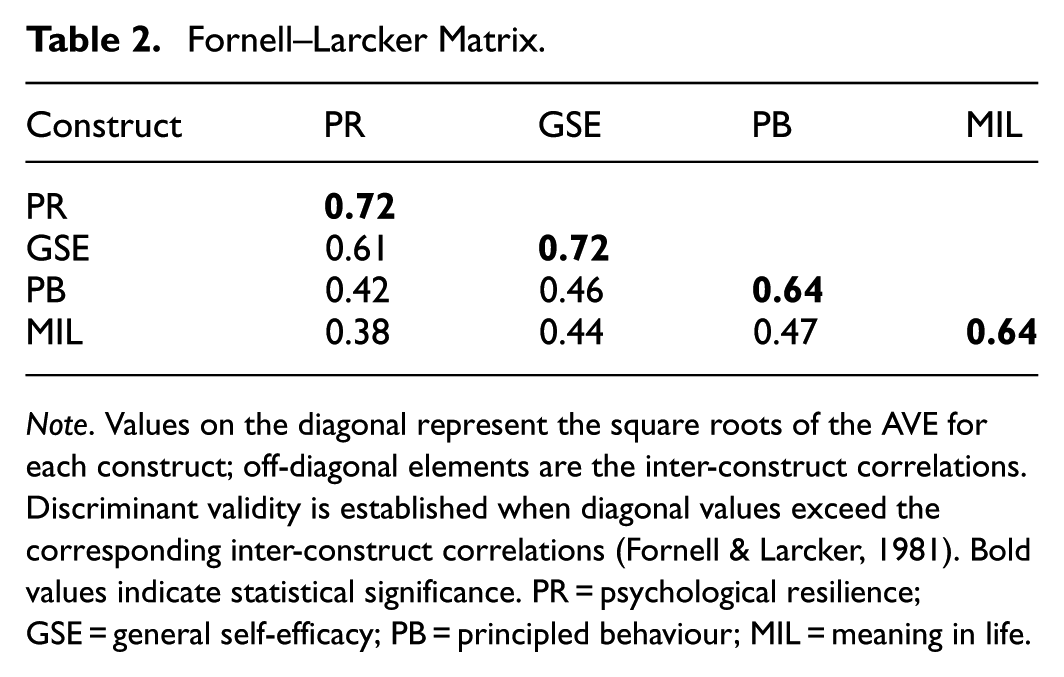
Convergent and discriminant validity were assessed following the procedure recommended by Fornell and Larcker (1981). As shown in Table 2, the average variance extracted (AVE) values for psychological resilience (0.513) and general self-efficacy (0.514) exceeded the conventional threshold of 0.50, indicating adequate convergent validity. Although the AVE values for principled behaviour (0.407) and meaning in life (0.401) were slightly below this criterion, both constructs demonstrated high factor loadings and theoretical coherence, suggesting acceptable convergent validity (Hair et al., 2010).
Fornell–Larcker Matrix.
Note. Values on the diagonal represent the square roots of the AVE for each construct; off-diagonal elements are the inter-construct correlations. Discriminant validity is established when diagonal values exceed the corresponding inter-construct correlations (Fornell & Larcker, 1981). Bold values indicate statistical significance. PR = psychological resilience; GSE = general self-efficacy; PB = principled behaviour; MIL = meaning in life.
The square roots of the AVE values (displayed on the diagonal of Table 2) were greater than the inter-construct correlations, confirming discriminant validity in accordance with the Fornell–Larcker criterion. These results collectively support the psychometric soundness of the measurement models used in this study.
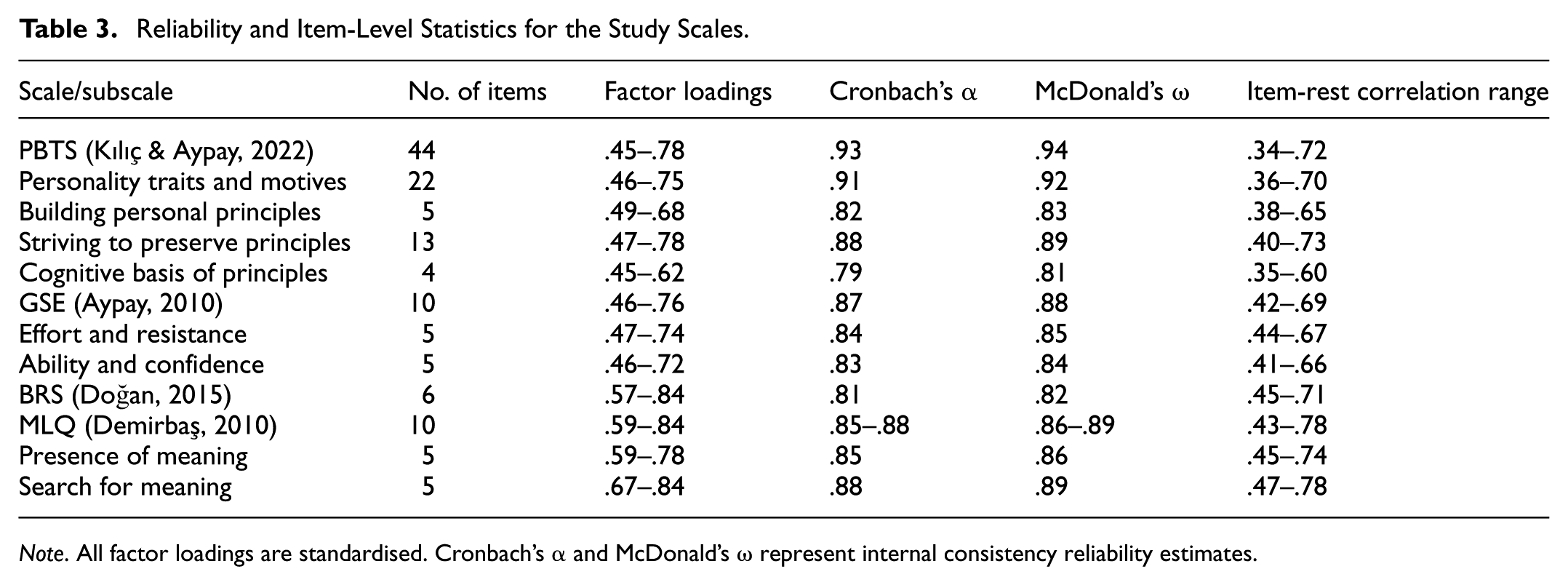
Internal consistency analyses for all measurement instruments are summarised in Table 3. Across the study scales, Cronbach’s α and McDonald’s ω coefficients indicated satisfactory to excellent reliability. The PBTS (Kılıç & Aypay, 2022) demonstrated outstanding overall internal consistency (α = .93, ω = .94), with subscale coefficients ranging from .79 to .91 and corrected item–total correlations between .34 and .72, confirming adequate item homogeneity. The GSE (Aypay, 2010) also exhibited strong reliability (α = .87, ω = .88), and both its Effort-Resistance (α = .84) and Ability-Confidence (α = .83) subscales showed consistent internal coherence. The BRS (Doğan, 2015) yielded acceptable reliability (α = .81, ω = .82) with item–rest correlations ranging from .45 to .71, whereas the MLQ (Demirbaş, 2010) displayed high reliability for both the Presence (α = .85, ω = .86) and Search (α = .88, ω = .89) dimensions. Overall, the close correspondence between α and ω values across all instruments supports the robustness of the internal structure of the measures and attests to their psychometric adequacy for use in the present study. Corrected item–total (item–rest) correlations were within acceptable ranges (.34–.78), confirming item homogeneity. Detailed item-level statistics are presented in Table 3.
Reliability and Item-Level Statistics for the Study Scales.
Note. All factor loadings are standardised. Cronbach’s α and McDonald’s ω represent internal consistency reliability estimates.
Path analysis was conducted to explore the theorised associations among psychological resilience, general self-efficacy, meaning in life, and principled behaviour tendencies. The final structural model demonstrated an acceptable fit to the data (χ2/df = 2.94, CFI = 0.962, TLI = 0.951, RMSEA = 0.068, SRMR = 0.047). indicating that the hypothesised relationships were consistent with the empirical data. Figure 2 presents the visual representation of the path relationships among the latent variables.

Structural model with standardised coefficients (β) and explained variance (R2). Model fit: (χ2/df = 2.94, CFI = 0.962, TLI = 0.951, RMSEA = 0.068, SRMR = 0.047).
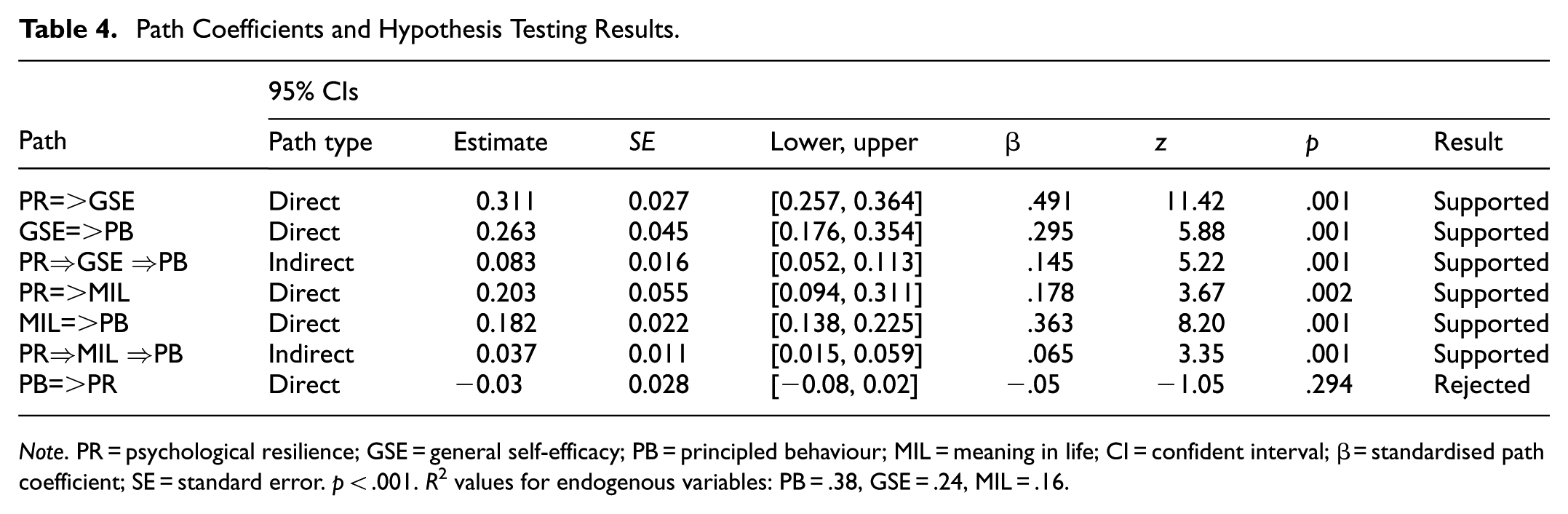
Table 4 presents the standardised path coefficients, standard errors, confidence intervals, and significance tests for the direct and indirect associations in the model.
Path Coefficients and Hypothesis Testing Results.
Note. PR = psychological resilience; GSE = general self-efficacy; PB = principled behaviour; MIL = meaning in life; CI = confident interval; β = standardised path coefficient; SE = standard error. p < .001. R2 values for endogenous variables: PB = .38, GSE = .24, MIL = .16.
These analyses revealed several key findings, as summarised in Table 4. A significant positive link was found between psychological resilience and general self-efficacy (β = 0.49, p < .001), indicating that a one standard deviation increase in psychological resilience is associated with a 0.49 standard deviation increase in general self-efficacy. This result supports Hypothesis 1 by demonstrating that individuals with higher psychological resilience tend to report higher levels of general self-efficacy.
General self-efficacy was found to be significantly and positively associated with principled behaviour tendencies (β = 0.29, p < .001), indicating that a one standard deviation increase in general self-efficacy is associated with a 0.29 standard deviation increase in principled behaviour tendencies. This finding supports Hypothesis 2, suggesting that individuals with higher general self-efficacy tend to exhibit stronger principled behaviour tendencies.
A significant positive relationship was found between psychological resilience and meaning in life (β = 0.18, p< .001), indicating that a one standard deviation increase in psychological resilience is associated with a 0.18 standard deviation increase in meaning in life. This finding supports Hypothesis 4 by suggesting that individuals with higher psychological resilience tend to report greater meaning in life.
Meaning in life was found to be significantly and positively associated with principled behaviour tendencies (β = 0.36, p < .001), indicating that a one standard deviation increase in meaning in life is associated with a 0.36 standard deviation increase in principled behaviour tendencies. This result supports Hypothesis 5, suggesting that individuals who report greater meaning in life tend to exhibit stronger principled behaviour tendencies.
Psychological resilience also demonstrated significant indirect links with principled behaviour tendencies through both general self-efficacy (β = 0.15, p < .001) and meaning in life (β = 0.07, p < .001). These findings suggest that general self-efficacy and meaning in life may function as explanatory variables in the association between psychological resilience and principled behaviour tendencies, supporting Hypotheses 3 and 6.
Lastly, the analysis revealed that the links between psychological resilience and principled behaviour tendencies were mediated by general self-efficacy and meaning in life. The direct path from psychological resilience to principled behaviour was negative and non-significant (β = −.05, p > .05), leading to the rejection of Hypothesis 7. Consequently, the structural model was re-estimated with this path removed. The explained variance in principled behaviour remained virtually unchanged (R2 < .01), indicating that the contribution of the omitted path was negligible. This suggests that the influence of psychological resilience on principled behaviour operates primarily through indirect mechanisms via general self-efficacy and meaning in life, rather than a direct association. The final model accounted for 38% of the variance in principled behaviour (R2 = .38), 24% in general self-efficacy (R2 = .24), and 16% in meaning in life (R2 = .16), indicating a moderate to substantial explanatory power (Figure 3).

Path diagram of the proposed model, excluding the direct path from PR to PB.
Discussion
The present study examined the psychological mechanisms underlying principled behaviour tendencies (PB)—the consistent alignment between one’s moral principles, values, and actions. The findings demonstrated that PB was positively associated with both general self-efficacy (GSE) and meaning in life (MIL), suggesting that individuals who perceive themselves as competent in managing challenges and who find purpose in their experiences are more likely to act in accordance with their ethical standards. Moreover, psychological resilience (PR) indirectly contributed to PB through its positive links with GSE and MIL, indicating that resilience supports principled behaviour primarily by strengthening belief in one’s competence and reinforcing existential purpose. The absence of a significant direct path from PR to PB suggests that the capacity to recover from adversity alone may not be sufficient to explain principled conduct unless it is accompanied by motivational and cognitive factors that sustain moral functioning. Collectively, these findings indicate that principled behaviour is grounded not only in moral reasoning but also in self-regulatory and existential processes that enable individuals to act ethically under pressure or uncertainty.
The standardised path coefficients (β = .29 for GSE → PB; β = .36 for MIL → PB) were of moderate magnitude. In practical terms, these results suggest that individuals with stronger self-efficacy beliefs and a clearer sense of life meaning are substantially more likely to demonstrate consistent, value-driven behaviour. These effects are both statistically and psychologically meaningful, showing that motivational strength and purpose make tangible contributions to moral consistency. This pattern aligns with prior evidence linking principled ideologies to greater meaning and purpose in life (Kılıç & Aypay, 2022; Schlenker et al., 2008) and emphasising self-efficacy as a defining characteristic of principled individuals (Church et al., 2013; Deci & Ryan, 2000; Kılıç & Aypay, 2022). Those who endorse principled ideologies typically base their goals and decisions on stable moral standards (Miller & Schlenker, 2011; Schlenker et al., 2009). This alignment between values and actions is often maintained by internal motivators—peace of mind, dignity, and purpose—that sustain moral clarity during internal or external conflict (Killinger, 2010).
Contrary to expectations, psychological resilience (PR) did not exhibit a significant direct association with principled behaviour tendencies (PB). This result can be understood through several complementary explanations. First, the Brief Resilience Scale (BRS) primarily measures recovery from stress, not moral or value-oriented behaviour, which may limit its predictive scope for PB. Second, the homogeneity of the sample (university students in similar moral-learning contexts) could have restricted variability in both PR and PB. Third, from a theoretical standpoint, PR likely functions as an upstream psychological resource that exerts its influence indirectly—by enhancing motivational mechanisms (self-efficacy) and cognitive frameworks (meaning in life)—rather than directly predicting moral behaviour. This interpretation is consistent with models that conceptualise resilience as a meta-resource supporting other adaptive capacities rather than directly generating moral or prosocial outcomes.
The complexity of resilience as a construct reinforces this interpretation. Existing resilience measures differ in focus (Ahern et al., 2006). To exemplify, the Wagnild and Young (1993) scale emphasises perseverance, self-reliance, and meaningfulness, while the Connor and Davidson (2003) scale targets competence, control, and spirituality. In contrast, the BRS (B. W. Smith et al., 2008) captures recovery capacity—the ability to “bounce back” after adversity. Given this conceptualisation, the absence of a direct PR–PB link is conceptually consistent: stress recovery alone does not necessarily foster moral steadfastness or ethical consistency. Rather, resilience seems to operate indirectly through cognitive and motivational channels that translate psychological strength into principled action. Future studies could employ multidimensional or purpose-oriented resilience measures incorporating proactive coping, existential meaning, and moral commitment to capture the broader moral dimensions of resilience.
Descriptive results further supported the structural findings. Among the four variables, meaning in life had the highest mean, while psychological resilience and general self-efficacy had the lowest and most similar means. Correlations showed that PR and GSE shared the strongest link, whereas PR and PB had the weakest—consistent with prior research identifying self-efficacy as both a key protective factor (Lee et al., 2013; Luthar & Cicchetti, 2000; Martínez-Martí & Ruch, 2017) and a core component of resilience (Lightsey, 2006). From this perspective, resilience can be viewed as an expanded form of self-efficacy—an adaptive psychological mechanism that enhances awareness of one’s capabilities (Kılıç et al., 2020). In this framework, self-efficacy mediates the connection between resilience and meaning, serving as a motivational driver that channels psychological resources into moral consistency.
In summary, all hypothesised associations were supported except for the direct path between PR and PB. The results contribute to a nuanced understanding of the psychological foundations of principled behaviour by illustrating how competence beliefs and life meaning channel resilience into moral consistency. However, given the cross-sectional design, these findings reflect associations rather than causal mechanisms. Future longitudinal or experimental research could clarify causal directions and further illuminate how self-efficacy and meaning in life transform resilience into ethically grounded behaviour across diverse contexts.
Limitations
Several limitations should be acknowledged. First, the reliance on self-reported measures introduces the potential for both response and social desirability bias, particularly because the examined constructs—principled behaviour, self-efficacy, and resilience—are socially valued and morally laden. Participants may have been inclined to present themselves in a favourable light, thereby slightly inflating the mean levels and intercorrelations of these positive traits. Future research should control for social desirability (e.g., via the Marlowe–Crowne scale) or include behavioural observations and informant reports to increase objectivity. Second, nonresponse bias cannot be entirely ruled out. Although participation rates were satisfactory, individuals who declined participation may differ systematically from respondents in moral reasoning, psychological resources, or value orientation. This potential bias could have restricted the variability of the data and attenuated observed effect sizes. Future research should report participation rates in detail and, where feasible, conduct early–late respondent comparisons or follow-up analyses to estimate nonresponse effects. Third, although no a priori power analysis was conducted, a post hoc power evaluation indicated that the final sample (N = 410) provided excellent statistical power for detecting the observed effects. Power estimates exceeded .95 for moderate paths such as GSE → PB (β = .29) and MIL → PB (β = .36), and remained above .90 for smaller paths such as PR → MIL (β = .18), assuming α = .05 (two-tailed). The explained variance for principled behaviour (R2 = .38) reflected a large overall effect (f2 = .61). Thus, the study was well powered to identify meaningful relationships, although very small effects (β ≤ .10) may have gone undetected. Lastly, the correlational and cross-sectional design limits the ability to infer causality. Although structural modelling improved theoretical coherence, temporal precedence and causal direction remain untested. Consequently, the associations reported here should be interpreted as correlational rather than causal. Longitudinal and experimental research is needed to examine the dynamic interplay among psychological resilience, self-efficacy, meaning in life, and principled behaviour tendencies over time.
Future Directions
The present study opens several avenues for future research to advance understanding of principled behaviour tendencies. First, longitudinal designs with lag intervals of approximately 6 to 12 months are recommended to assess temporal and reciprocal influences among psychological resilience, self-efficacy, meaning in life, and principled behaviour. Such intervals are long enough to capture meaningful developmental changes while minimising attrition effects. Second, experimental studies should be conducted to test causal mechanisms more directly. Interventions that enhance resilience or prime meaning in life—such as guided reflection tasks, resilience training modules, or purpose-oriented workshops—could help determine whether targeted changes in these constructs lead to measurable improvements in principled behaviour. Third, future research should prioritise the refinement and validation of the PBTS. This includes examining bifactor structures, testing measurement invariance across gender and cultural groups, and developing short-form or adaptive versions. Such improvements would strengthen the scale’s psychometric foundations and broaden its applicability in diverse research and applied contexts. Fourth, scholars are encouraged to investigate contextual moderators, such as age, gender, and cultural orientation, through multigroup or moderated mediation analyses to explore whether the strength or nature of the observed associations differs across subpopulations. Finally, extending this research to digital environments represents an emerging and important direction. As moral decision-making increasingly unfolds in technology-mediated spaces, future studies should examine how psychological resources such as resilience and meaning in life shape principled behaviour online—encompassing domains like ethical technology use, misinformation resistance, and digital citizenship.
Footnotes

Ethical Considerations
This study was approved by the Ankara Yıldırım Beyazıt University, Ethics Committee of Social and Human Sciences (Ethical Clearance Reference Number: 34) on 12.09.2021.
Consent to Participate
All participants provided written informed consent prior to participating.
Funding
The authors received no financial support for the research, authorship, and/or publication of this article.
Declaration of Conflicting Interests
The authors declared no potential conflicts of interest with respect to the research, authorship, and/or publication of this article.
Data Availability Statement
The data that support the findings of this study are available from the corresponding author upon reasonable request.