




Abstract
This study examined whether family cultural capital is associated with preschoolers’ executive function (EF) problems through two socioemotional pathways: concentration–empathy and peer interaction ability. In a cross-sectional study, we collected data from 354 children (M age = 4.8 years, SD = 0.9) in six public kindergartens in Fujian Province, China, through stratified cluster sampling. Teachers rated children’s EF problems, concentration–empathy, and peer interaction ability, and parents reported family cultural capital using validated instruments. Structural equation modeling showed no significant direct association between family cultural capital and EF problems, but significant indirect associations via concentration–empathy and peer interaction ability. A significant sequential indirect effect also emerged: family cultural capital was associated with higher concentration–empathy, which was associated with better peer interaction ability and, in turn, fewer EF problems. These findings suggest that higher family cultural capital is indirectly associated with fewer EF problems through concentration–empathy and peer interaction ability. They also highlight socioemotional processes as potential pathways linking family resources to children’s EF problems in a non-Western early childhood context. Given the correlational design, longitudinal or experimental studies are needed to test causal pathways and evaluate culturally responsive interventions targeting these mediators.
Plain Language Summary
Executive function helps young children control their behavior (e.g., paying attention, remembering what to do, and inhibiting impulses). We studied 354 preschool children (ages 3–6) in Fujian, China to examine whether family cultural capital (e.g., cultural materials and home cultural activities) is linked to children’s executive-function problems (CHEXI). Parents reported family cultural capital, and teachers rated children’s concentration–empathy (CE), peer interaction ability (PIA), and executive-function problems. Using structural equation modeling, we found no significant direct link between family cultural capital and executive-function problems after including CE and PIA. Instead, the association was indirect: higher family cultural capital was related to higher CE and stronger PIA, and both were related to fewer executive-function problems. We also found a sequential pathway (family cultural capital → CE → PIA → fewer executive-function problems). Because the data were cross-sectional, the findings are correlational and do not establish causality.
Keywords
Introduction
Executive function (EF), an umbrella term for cognitive processes including inhibitory control, working memory, and cognitive flexibility, is a cornerstone of early self-regulation and has been linked to academic achievement, social competence, and mental health across the lifespan (Zelazo & Carlson, 2012). In this study, EF is indexed as teacher-rated EF problems. However, recent critiques emphasize that EF may be culturally constructed, with standard measures often reflecting capacities developed in schooled, industrialized contexts rather than universal cognitive traits (Kroupin et al., 2025). Consistent with this critique, cross-cultural longitudinal evidence suggests that EF growth trajectories during the preschool years can differ between Chinese and U.S. children (Schmitt et al., 2019). Although socioeconomic status (SES) is a well-established correlate of EF disparities, researchers increasingly emphasize more proximal and culturally embedded mechanisms (Duncan & Magnuson, 2012; Valcan et al., 2018).
A useful framework for this shift is Bourdieu’s concept of cultural capital. It suggests that families transmit advantage not only through economic resources but also through culturally patterned practices and materials (Bourdieu, 1986). In this study, we use family cultural capital (FCC) to refer to the culturally enriched resources and routine practices in the home that shape children’s everyday experiences. However, most research linking FCC to EF has focused narrowly on literacy-related inputs, with less attention to socioemotional mechanisms. To theorize these mechanisms, we adopt an integrated bioecological perspective in which FCC shapes children’s everyday experiences and opportunities for social engagement.
CE refers to the ability to sustain attention while accurately inferring others’ emotional states, drawing on both cognitive control and affective perspective-taking (Decety & Jackson, 2004; Rothbart & Jones, 1998). PIA refers to children’s ability to initiate, maintain, and negotiate reciprocal peer relationships. Doing so requires impulse control, attention to social cues, and flexible adaptation (Hughes & Ensor, 2007). Both CE and PIA are theoretically positioned as mediators: FCC-rich environments may provide more frequent opportunities to practice these skills, which may in turn be linked to fewer EF problems.
The strength and form of these pathways may vary across cultures. In Fujian Province, where Minnan and Hakka traditions place different emphases on community participation and scholarly cultivation, FCC may be expressed through practices that engage CE and PIA in different ways.
Thus, this study aims to test a parallel and sequential mediation model in which FCC is associated with EF problems via CE and PIA in a sample of preschoolers in Fujian, China. By integrating Bourdieu’s cultural capital theory with an ecological developmental perspective, we seek to move beyond literacy-centric accounts and advance a socioemotional–interactional model of how cultural resources may promote early self-regulation.
Literature Review
Conceptual Framework: Cultural Capital in a Bioecological Perspective
This study draws on Bourdieu’s theory of cultural capital and Bronfenbrenner’s bioecological model of human development (Bourdieu, 1986; Bronfenbrenner, 1979; Bronfenbrenner & Morris, 2006). This integrated framework helps explain how FCC may be linked to young children’s EF through everyday interactions and developmental processes.
From a Bourdieusian perspective, cultural capital constitutes non-economic resources through which families reproduce advantage across generations. Bourdieu distinguished three primary forms: embodied cultural capital (durable dispositions, tastes, language practices, and behavioral repertoires), objectified cultural capital (cultural goods such as books, artworks, and musical instruments), and institutionalized cultural capital (formally recognized credentials that convert cultural resources into socially legitimized advantage; Bourdieu, 1986). In early childhood, these forms are not merely possessed but enacted. Cultural goods and parental dispositions become developmentally meaningful insofar as they are mobilized in routine practices—such as shared reading, storytelling, family conversations, and participation in culturally valued activities—thereby shaping the kinds of objects, symbols, and social interactions children regularly encounter. Following this tradition, we use FCC to refer to the family resources and practices that structure children’s everyday experiences and opportunities for learning.
Bronfenbrenner’s bioecological model complements this view by specifying how family-level resources may shape children’s competencies through everyday developmental processes. In bioecological terms, development is shaped primarily through repeated interactions with people, objects, and symbols in children’s immediate environments (Bronfenbrenner & Morris, 2006). These processes unfold within nested ecological systems, including the microsystem (e.g., family routines and classroom activities), the mesosystem (e.g., linkages among family, school, and peer contexts), and the macrosystem (cultural values and norms that organize everyday life). Within this framework, FCC can be viewed as a family resource that shapes the frequency, quality, and content of proximal processes.
We therefore treat FCC not as a static inventory of cultural goods, but as a set of family practices and resources embedded in everyday life. Its developmental relevance is expected to emerge through proximal socioemotional processes. In this study, we examine concentration–empathy (CE) and peer interaction ability (PIA) as candidate mechanisms linking FCC to children’s EF in early childhood.
FCC and EF
In this study, FCC is operationalized as a multidimensional construct capturing families’ material investment, time investment, and participation in cultural activities (Shou, 2019). This operationalization reflects Bourdieu’s typology by indexing objectified resources (e.g., access to cultural materials) and embodied practices (e.g., recurring cultural routines) that structure children’s everyday engagement with cognitively and socially meaningful experiences.
EF refers to goal-directed cognitive processes that support self-regulation, including inhibitory control, working memory, and cognitive flexibility, and it develops rapidly during the preschool years (Zelazo & Carlson, 2012). Although socioeconomic status is a well-established correlate of EF, scholars increasingly emphasize more proximal and culturally embedded family mechanisms that shape children’s opportunities to practice self-regulation in daily life (Duncan & Magnuson, 2012; Valcan et al., 2018).
FCC provides a theoretically grounded account of such mechanisms. Homes with higher FCC may support routines and activities that repeatedly engage children’s attention, perspective-taking, and social coordination—demands closely tied to EF. Empirical evidence links culturally enriched family environments to children’s EF-related outcomes, in some studies beyond broader SES indicators (Bernier et al., 2010; Valcan et al., 2018; Waters et al., 2021). A recent systematic review in the Chinese context further suggests that FCC may facilitate achievement outcomes, often through socioemotional and interactional pathways beyond literacy-focused mechanisms (Xie & Hutagalung, 2025). Based on this rationale, we hypothesize that higher FCC will be associated with fewer EF problems (i.e., stronger EF) in preschoolers (H1), and that this association may be realized through socioemotional pathways involving CE and PIA developed in subsequent sections.
PIA and EF
PIA represents another socioemotional competence that may help explain the link between FCC and EF. Managing peer interactions requires constant monitoring of social cues, rapid shifts in perspective, and negotiation skills, all of which place substantial demands on EF (Bierman & Torres, 2016). Successful peer engagement often involves turn-taking, emotional regulation, and adaptation to group norms, behaviors that map closely onto inhibitory control, working memory, and cognitive flexibility.
From an ecological perspective, peer contexts form part of the mesosystem: FCC may be associated with EF not only through home-based resources but also through children’s ability to apply those resources in peer relationships. Children from high-FCC families may experience more diverse social situations, richer conversational models, and greater support for developing prosocial behaviors—factors that may support stronger PIA.
Longitudinal cross-lagged evidence indicates reciprocal links between peer difficulties and EF across development (Holmes et al., 2016), and interventions targeting social problem-solving have been reported to be associated with improvements in EF outcomes (Bierman et al., 2008). This aligns with the proposition that PIA may function as an independent mediator between FCC and EF.
A Sequential Mediation Pathway: From CE to PIA
While CE and PIA may operate independently, they are also likely to be linked in sequence. CE is expressed in social contexts—such as group storytelling or cultural performances—where children sustain attention, empathize with characters, and engage in shared experiences. These experiences may provide contexts in which children apply attentional and empathic skills in real-time peer interactions, which may contribute to stronger PIA.
Theoretically, FCC may support higher CE by providing more opportunities to engage with culturally meaningful content that requires sustained attention and perspective-taking. These skills may be linked to more effective and adaptive peer interactions. In turn, enhanced PIA may be associated with more frequent engagement in situations that require negotiation, rule management, and turn-taking—contexts that are conceptually relevant to EF.
Although few studies have directly tested this sequence, indirect evidence suggests that empathy is associated with peer competence (Denham et al., 2003) and that peer competence predicts EF growth (Blair & Razza, 2007). We therefore propose a sequential mediation model in which FCC is associated with EF via CE and then PIA.
Summary and Hypotheses
Much of the existing SES–EF literature operationalizes FCC through home literacy environments, parental education, or language-rich interactions, with mediation pathways focusing on vocabulary, narrative skills, or general cognitive stimulation. While important, these factors capture only part of the sociocultural processes linking family resources to EF.
The present study addresses this gap by introducing CE and PIA as both independent and sequential mediators. Unlike literacy-focused mediators, CE and PIA reflect regulatory and interactional skills exercised in culturally embedded, socially dense contexts. This perspective may offer a broader account of how FCC may shape EF development and identifies socioemotional targets for early intervention that are often overlooked.
Guided by Bourdieu’s theory of cultural capital and Bronfenbrenner’s ecological systems model, we hypothesize that:
Methodology
Research Design
We adopted a cross-sectional quantitative design to examine whether FCC is associated with preschoolers’ EF problems through CE and PIA, both independently and in sequence. Data were collected concurrently from parents and teachers using four standardized instruments. A structural equation model (SEM) was specified to test the hypothesized mediation pathways (H1–H4).
Ethical Considerations
This study received ethical approval from the Ethics Committee of Longyan University (Approval No. LY2024005L) and was conducted in accordance with the Declaration of Helsinki and relevant institutional and national research standards. The study involved minimal risk: no experimental manipulation, biomedical procedures, or sensitive questions were included. Data collection was non-invasive and embedded in routine kindergarten activities. Teachers rated children’s EF problems, CE, and PIA based on regular classroom and playground observations, and parents completed the FCC questionnaire at home. Children were not removed from routine activities, and no additional demands were placed on them beyond typical school experiences.
To protect confidentiality, all questionnaires were coded using non-identifying numbers; the linkage file was stored in encrypted form and accessible only to the principal investigator. Participants (teachers, legal guardians, and children) were informed that participation was voluntary and that they could withdraw at any time without penalty. The time burden was minimal (approximately 15 min per respondent), and privacy risk was considered negligible. The study posed minimal risk, and the anticipated benefits included improved understanding of modifiable correlates of children’s EF and the provision of anonymized summary reports to participating kindergartens.
Written informed consent was obtained from all participating teachers and from the legal guardians of all participating children prior to data collection. Information sheets described the study aims, procedures, data handling, voluntary participation, and the right to withdraw. Given the children’s age (3–6 years), age-appropriate verbal assent was also sought (e.g., “Is it OK if your teacher writes down how you play with friends?”); no child declined assent.
Participants
Between September 2024 and April 2025, we used a stratified cluster sampling strategy in Fujian Province, China, a region characterized by the coexistence of Minnan and Hakka cultural traditions. The Minnan tradition emphasizes commerce-oriented community engagement, whereas the Hakka tradition values the “reading and farming” ethos. Together, these traditions offer a rich context for examining how FCC relates to EF in early childhood.
From six public kindergartens (three coastal urban and three inland rural), we randomly selected one junior, one middle, and one senior class per school, yielding 18 classes in total. In this regional context, junior, middle, and senior classes typically enroll children aged 3 to 4, 4 to 5, and 5 to 6 years, respectively. This stratified cluster sampling strategy involved stratifying by geographic location and age band and then sampling intact classes as clusters. It was chosen to balance methodological rigor and feasibility while capturing diversity in context and age within a coherent educational setting (Kanaki & Kalogiannakis, 2023). All children in these classes, their primary caregivers, and the lead teachers were invited to participate (N invited = 407; response rate = 91.89%). Inclusion criteria required that Mandarin Chinese (Putonghua) be the exclusive or near-exclusive home language. All participating kindergartens provided instruction solely in Mandarin.
The final analytic sample comprised 354 Mandarin-dominant preschool children (180 boys, 174 girls; age range = 3.2–6.4 years, M = 4.8, SD = 0.9). Item-level missing data were minimal (<2%) and met the MCAR assumption based on Little’s test (p > .05).
We handled missing data using full-information maximum likelihood (FIML) under maximum-likelihood estimation in AMOS. FIML uses all available information without listwise deletion. To assess model fit under potential non-normality, we used the Bollen–Stine bootstrap (5,000 resamples). Indirect effects were evaluated with bias-corrected bootstrap confidence intervals (5,000 resamples). No auxiliary variables were included because the missing rate was minimal and the data met the MCAR assumption (Table 1).
Participant Demographics and Data Distribution.
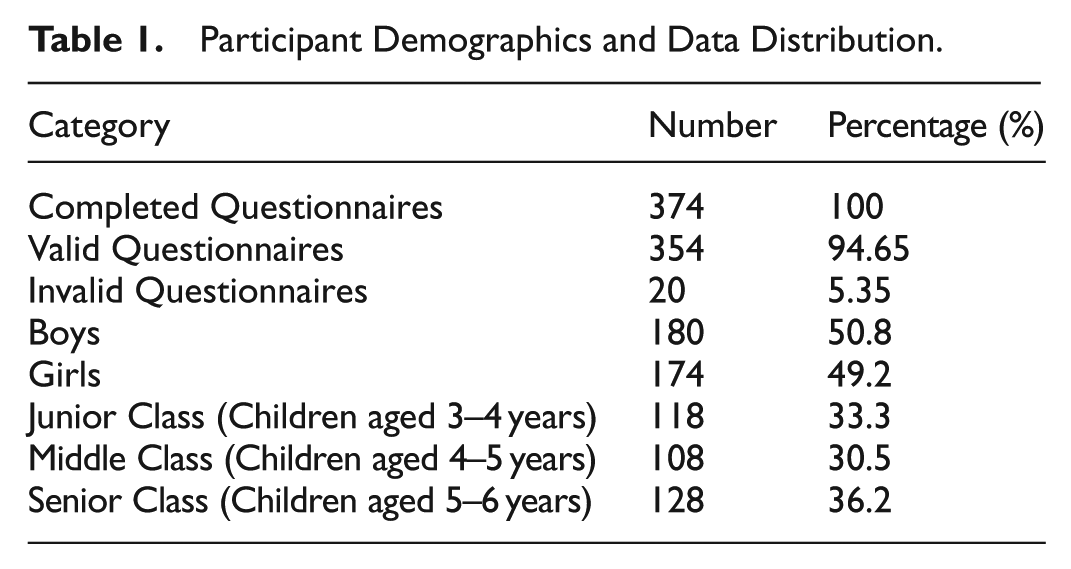
Sample size requirements in SEM depend primarily on model complexity (Bentler & Chou, 1987). Given the four latent constructs and moderate number of indicators in the present model, the sample size (N = 354) was adequate and provided stable parameter estimates.
To assess potential bias from the clustered sampling design (i.e., non-independence of observations within classes), we conducted a design-effect sensitivity check. The intraclass correlation coefficient (ICC) for the primary outcome (EF problems) was small (ICC = .03). With an average class size of approximately 20 children, the corresponding design effect was DEFF ≈ 1.57 (DEFF = 1 + (m − 1)ICC). As a conservative sensitivity check, we inflated standard errors by √DEFF (≈1.25) to account approximately for clustering, and the key structural paths remained statistically significant after this adjustment. Under this adjustment, all key structural paths in the final model remained statistically significant (e.g., FCC → CE: adjusted |t| ≈ 3.15; PIA → EF problems: adjusted |t| ≈ 2.66), suggesting that the main mediation pattern is unlikely to be fully explained by clustering. Nevertheless, future studies should apply cluster-robust inference or multilevel SEM with a larger number of clusters to model clustering directly.
Procedures
Following institutional and school permissions, the research team delivered a 90-min on-site training session for participating teachers 1 week prior to data collection. Led by two PhD-level researchers in developmental psychology, the training covered instrument administration, behavioral observation criteria, and confidentiality safeguards.
Parents completed the FCC questionnaire at home and returned it in sealed envelopes. During the same week, teachers completed CE, PIA, and EF problems ratings based on their observations of children’s behavior in regular classroom and playground activities.
Measures
Four standardized instruments were used to assess FCC, CE, PIA, and EF problems. Because all four were originally developed in English, we followed recommended procedures for cross-cultural scale adaptation. The forward translation into Mandarin Chinese was conducted by the first author, a bilingual researcher with a PhD in linguistics specializing in bilingual development and psycholinguistics. An independent bilingual researcher with a master’s degree in educational psychology, fluent in both Mandarin and English and experienced in cross-cultural assessment, then produced a back-translation into English.
The original and back-translated English versions were compared item by item to identify and resolve semantic discrepancies by consensus, with wording adjusted where necessary to reflect local family routines and preschool practices without altering the underlying constructs. To further ensure clarity and cultural appropriateness, the pre-final Chinese versions were piloted with 20 parents and 8 preschool teachers from non-participating classes. Their feedback indicated that all items were understandable and culturally relevant; only minor refinements were needed, and no substantive content changes were required (Table 2).
Measurement Instruments and Reliability.
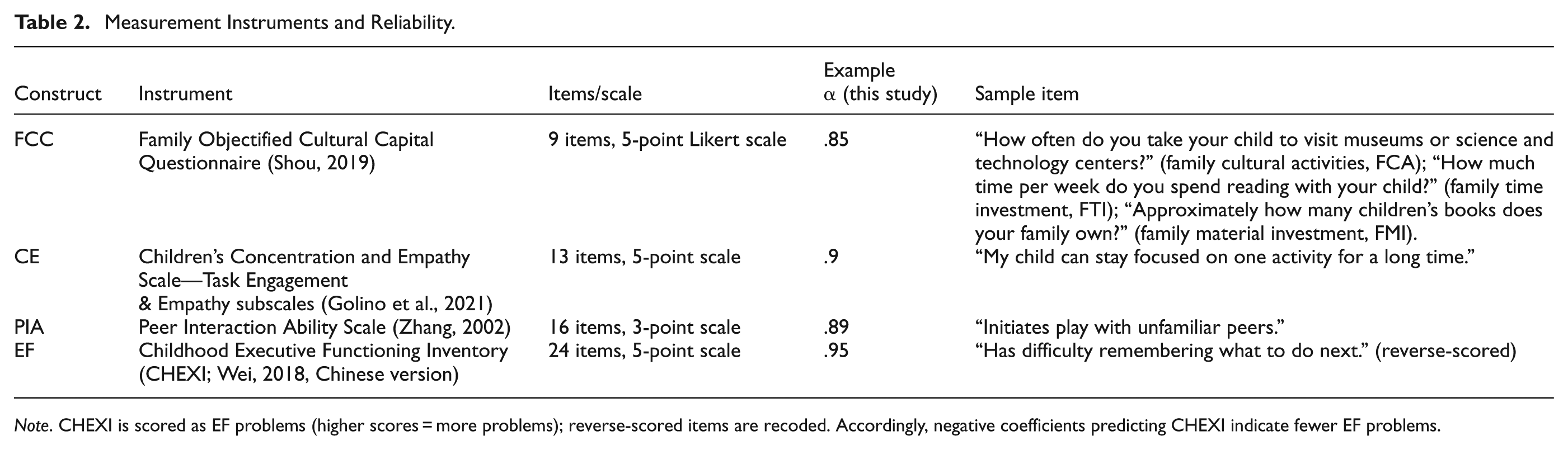
Note. CHEXI is scored as EF problems (higher scores = more problems); reverse-scored items are recoded. Accordingly, negative coefficients predicting CHEXI indicate fewer EF problems.
To control for potential confounding influences, children’s gender (sex coded as 1 = boy, 2 = girl) and class level (treated as a categorical variable) were included as covariates in the final structural equation model. This allowed us to obtain a cleaner estimate of the indirect effects of FCC on EF problems through CE and PIA.
Statistical Analysis and Bias Checks
The structural equation models were estimated in AMOS using the maximum likelihood (ML) method. To test the hypothesized sequential mediation pathway (FCC → CE → PIA → EF problems), gender and grade were included as covariates with direct paths to CE, PIA, and EF problems. Because multivariate normality cannot be assumed, the significance of indirect effects was evaluated using a bias-corrected bootstrap procedure. We generated 5,000 bootstrap samples to derive robust confidence intervals for the mediation effects, which are less dependent on normality assumptions compared to standard asymptotic methods.
To ensure data quality and minimize response bias, several measures were implemented. Teachers received standardized training that emphasized voluntary participation, accuracy, and confidentiality. Furthermore, data cleaning was conducted independently by two researchers, with any discrepancies resolved through consensus to reduce potential subjectivity.
Potential common method bias and multicollinearity were assessed post-hoc. Harman’s single-factor test was conducted, variance inflation factors (VIFs) were examined, and the magnitude of inter-variable correlations was inspected (Hair et al., 2010; O’Brien, 2007). These analyses confirmed that neither issue posed a significant threat to the validity of our findings.
Results
Assessment of Common Method Bias
Harman’s single-factor test showed that the first factor accounted for 21.48% of the variance, below the commonly used 40% threshold. In addition, variance inflation factors ranged from 1.36 to 2.65, tolerance values ranged from 0.429 to 0.733, and inter-variable correlations were all below 0.60. Together, these diagnostics did not indicate severe common-method-related inflation or problematic multicollinearity, although shared teacher-rater variance remains a limitation.
Descriptive Statistics and Correlations
Table 3 presents the descriptive statistics and correlation matrix for the main study variables. The correlations were generally consistent with expectations.
Means, Standard Deviations, and Correlation Matrix.

Note. Following Cohen (1988), we interpret |r| ≈ .10 as small, |r| ≈ .30 as medium, and |r| ≈ .50 as large. Higher scores on CHEXI indicate more EF problems.
p < .05. **p < .01.
Reliability and Validity
All scales demonstrated good internal consistency, with Cronbach’s alpha values exceeding .80 (Table 4).
Scale Reliability Analysis.

Measurement models (CFAs) showed acceptable-to-good fit across instruments (Table 5). Indices in Table 5 refer to CFAs only and do not pertain to the structural (SEM) model. Following commonly cited recommendations (Hoyle, 2012; Hu & Bentler, 1999; Mustafa et al., 2020; Raykov, 2005; Schumacker & Lomax, 2004; Ullman, 2001), χ2/df ratios below 3, RMSEA values below 0.08, and IFI, TLI, and CFI values above 0.90 indicate acceptable fit. Across all CFAs in this study, these criteria were met, indicating adequate measurement fit for the scales.
Measurement Model Fit (Confirmatory Factor Analyses).

Note. Reported indices refer to CFAs for each instrument; they do not pertain to the structural (SEM) model. Common rule-of-thumb cutoffs: χ2/df ≲ 3 (acceptable), RMSEA < 0.05 (close), 0.05–0.08 (reasonable), and IFI/TLI/CFI ≥ 0.90 (acceptable; ≥0.95 very good). RMSEA = Root Mean Square Error of Approximation; CFI = Comparative Fit Index; TLI = Tucker–Lewis Index; IFI = Incremental Fit Index.
Convergent validity and composite reliability were then examined for the CFA models using Average Variance Extracted (AVE) and Composite Reliability (CR). As shown in Table 6, AVE values exceeded 0.50 and CR exceeded 0.70 at the construct level, indicating good convergent validity and composite reliability.
Factor Loadings and Convergent Validity.
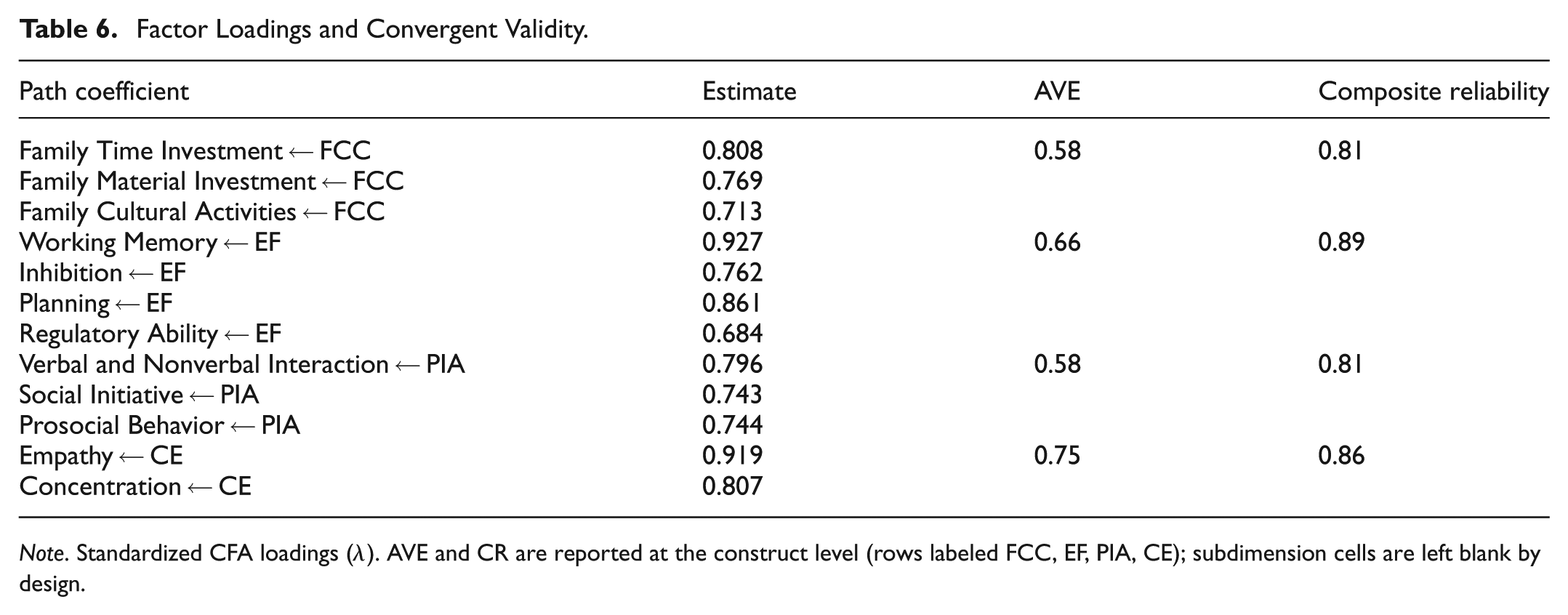
Note. Standardized CFA loadings (λ). AVE and CR are reported at the construct level (rows labeled FCC, EF, PIA, CE); subdimension cells are left blank by design.
Sequential Mediation Effects of CE and PIA
The hypothesized parallel and sequential mediation model was tested using SEM. The overall fit of the structural model was acceptable to good: χ2/df = 2.673, RMSEA = 0.069, CFI = 0.953, TLI = 0.933, SRMR = 0.046. These indices indicate adequate fit of the structural model.
The standardized path coefficients for the final SEM, including the parallel indirect paths via CE and PIA and the sequential pathway FCC → CE → PIA → EF problems, are shown in Figure 1. Gender and class level were included as covariates with direct paths to CE, PIA, and EF problems.
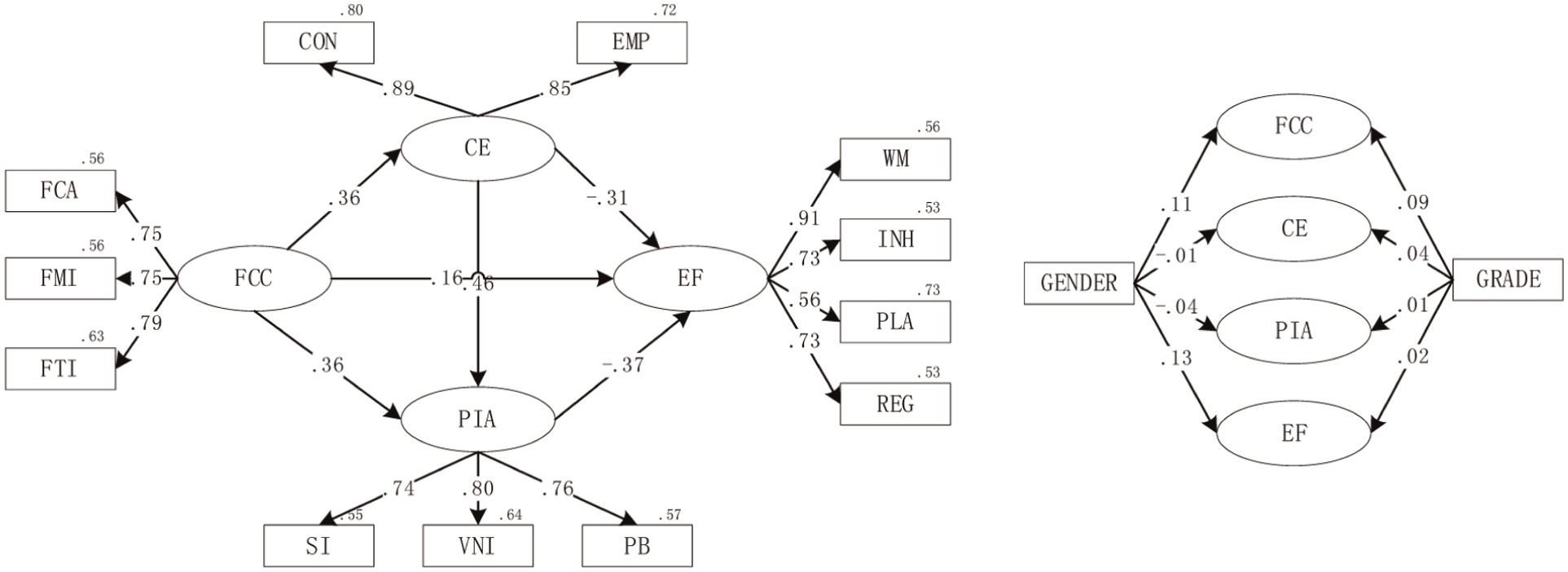
Sequential mediation model linking family cultural capital (FCC) to EF problems via concentration–empathy (CE) and peer interaction ability (PIA).
The total effect of FCC on EF problems was significant (β = −.365, SE = 0.102, 95% CI [−0.559, −0.167], p = .003), supporting H1 at the total-effect level. FCC was positively associated with higher CE (β = .353, p < .001) and PIA (β = .348, p < .001); CE, in turn, was positively associated with PIA (β = .464, p < .001). Higher CE (β = −.316, p < .001) and PIA (β = −.385, p < .001) were each associated with fewer EF problems. The direct FCC → EF problems path was small and nonsignificant (β = −.062, p = .575; Table 7).
Path Relationships.

p < .001.
Three indirect paths linked FCC to EF problems in the fitted model (Table 8). Bias-corrected bootstrap analyses (5,000 resamples) confirmed that all three indirect paths were statistically significant.
Significance of Direct and Mediating Effects.
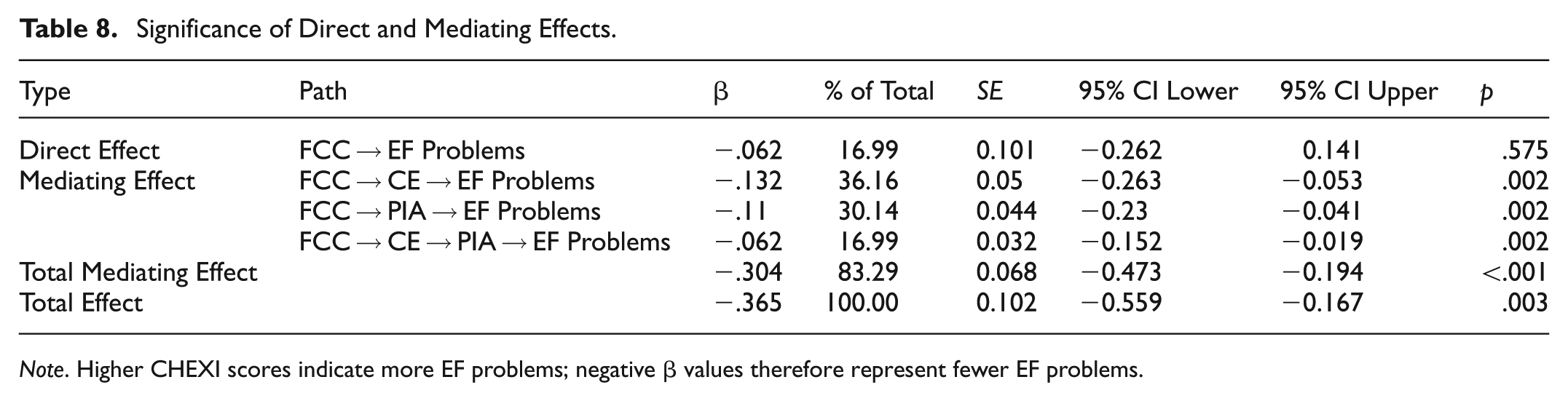
Note. Higher CHEXI scores indicate more EF problems; negative β values therefore represent fewer EF problems.
Analyses of the covariates showed that gender and class level were not significantly associated with CE (β = −.01, p > .05; β = .16, p > .05), PIA (β = −.04, p > .05; β = .01, p > .05), or EF problems (β = .13, p > .05; β = .02, p > .05). Thus, the main pattern of associations was not explained by these demographic covariates.
Taken together, the results were consistent with H2 and H3, showing significant parallel indirect effects via CE and PIA, and with H4, showing a significant sequential indirect effect via CE → PIA.
Discussion
This study examined how FCC relates to preschoolers’ EF problems in a Mandarin-dominant sample from Fujian Province. Using a parallel and sequential mediation model, we found that the association between FCC and EF problems operated primarily through CE and PIA. In this cross-sectional sample, the association between family cultural capital and EF problems appeared to operate less through a simple resources-to-abilities pattern than through socioemotional and interactional processes involved in children’s everyday regulation.
Theoretical Contribution and Broader Relevance
By conceptualizing FCC as a multidimensional construct encompassing resources, everyday practices, and cultural participation, the present findings suggest that its association with EF cannot be reduced to resource possession alone. Rather, in this cross-sectional sample, FCC was associated with EF problems primarily through CE and PIA, which likely reflect how cultural resources are enacted in everyday family routines.
The present findings contribute to the SES–EF literature by situating the FCC–socioemotional–EF linkage within a non-Western, linguistically diverse preschool context. By testing CE and PIA as both parallel and sequential mediators, our model suggests that the association between FCC and EF problems may operate largely through children’s attentional–empathic dispositions and peer coordination skills, rather than through a direct transfer of cultural resources to children’s regulatory functioning. In other words, culturally enriched home environments may be linked to differences in self-regulation partly through how children focus, take others’ perspectives, and manage social relationships.
Breaking down the indirect effects helps clarify how different socioemotional processes may contribute to the overall FCC–EF problems association. In our sample, the independent CE pathway accounted for 36.16% of the total FCC–EF problems association, the independent PIA pathway for 30.14%, and the sequential CE → PIA pathway for 16.99%, together explaining 83.29% of the overall association. This quantification also indicates which aspects of socioemotional functioning are most closely tied to FCC and EF problems in early childhood. CE may capture the more proximal child-level correlates of cultural engagement related to attentional persistence and perspective-taking, whereas PIA reflects how these capacities are expressed and reinforced in everyday peer contexts that place demands on EF.
These results align with integrative SES–EF frameworks that emphasize “support–stimulation–stress” mechanisms in early development, with cognitive–linguistic and socioemotional stimulation playing central roles. Longitudinal evidence from Chinese preschoolers further indicates bidirectional links between family resources, parental involvement, and EF, reinforcing the role of proximal socioemotional processes (Liu et al., 2025). The present findings extend this work by showing, in a Chinese preschool sample, that FCC is linked to EF through children’s concentration–empathy and peer coordination in rule-governed activities.
Mechanisms: From Focused CE to Peer Coordination
The sequential CE → PIA pathway is consistent with a staged developmental interpretation, although alternative explanations remain plausible given the cross-sectional design. Cultural practices such as storytelling, shared reading, or participation in festivals may contribute to higher CE, as they often involve sustained attention and perspective-taking. In turn, children with higher CE may show more adaptive engagement in peer interactions (e.g., turn-taking, negotiation, and conflict resolution). These peer interactions may involve regulatory demands closely aligned with EF, including inhibiting impulses, maintaining rules in mind, and flexibly updating behavior in response to others.
Our findings, together with longitudinal evidence showing that empathy prospectively supports peer relationships in Chinese preschoolers (Zeng et al., 2025), are consistent with the view that CE may precede stronger PIA and that both are associated with fewer EF problems. Future research could test whether the CE → PIA → EF pathway observed here reflects a one-directional pathway or a recurring cycle in which gains in EF also feed back into smoother peer relations and more complex socioemotional engagement.
Implications for Generalizability and Cross-Cultural Transfer
Although the sample comes from a Mandarin-dominant region, it is embedded in Minnan and Hakka traditions that value community participation, intergenerational storytelling, and the “reading and farming” ethos. In this context, FCC was expressed mainly through everyday family and community engagement (e.g., festival participation, family-history storytelling, and cooperative games) rather than through structured extracurricular programs.
Such informal contexts may be especially relevant for understanding how FCC operates in this setting. Similar FCC–EF associations have been reported in Western samples, where FCC often reflects structured arts, music, and enrichment activities. Evidence from other non-Western contexts (e.g., Nigeria) also emphasizes that EF assessment—and the mechanisms linking cultural resources to self-regulation—may depend on local norms (Ezeugwu & Baker, 2025). Taken together, the broader pattern may generalize across contexts: FCC appears to relate to socioemotional capacities that, in turn, relate to EF. However, the specific ways FCC is enacted likely vary with local cultural norms and everyday practices. These findings extend prior work by documenting a socioemotional–interactional pathway in a non-Western, linguistically and culturally diverse context. They also suggest that the structure of cultural experiences (e.g., collaborative, rule-based, perspective-shifting) may matter as much as the specific activities families provide.
Practical Implications
Because CE and PIA accounted for most of the FCC–EF problems association, they may represent useful targets for early support. Intervention reviews suggest that EF is malleable and can improve with repeated practice and gradually increasing demands (Diamond & Lee, 2011). Programs may also be more effective when they integrate social–emotional and physical components rather than training EF in isolation. Building on these findings, we suggest three practical directions for translating everyday cultural practices into activities that support EF-related skills.
First, structured activities that adults join and scaffold may engage both CE and PIA. Caregiver-led programs tend to work best when activities have clear rules, gradually increasing difficulty, and frequent opportunities for collaborative feedback. Embedding this structure in culturally familiar routines (e.g., family games or role-play storytelling) could create everyday opportunities to practice CE and PIA.
Second, brief, regular mindfulness or attention-focusing routines may support CE. Reviews of mindfulness-based interventions suggest that preschoolers can show gains on EF tasks when programs are delivered with sufficient dosage and quality. Embedding brief, age-appropriate attention exercises into home and classroom routines could complement culturally grounded activities that are associated with empathy and narrative engagement. A recent scoping review reports mixed but promising evidence and notes substantial heterogeneity in intervention designs and EF outcomes (Pearce et al., 2025).
Third, peer activities with frequent interaction and predictable structure may support stronger PIA while also engaging regulatory demands relevant to EF. Evidence linking longer preschool attendance and higher-quality teacher–child interactions to stronger EF underscores the value of structured peer tasks. For example, cooperative projects and team-based games can incorporate clear sequencing, role rotation, and visible progress. These designs parallel the CE → PIA sequence in our model by embedding cultural content in coordinated, rule-based interactions that may involve repeated EF-relevant regulatory demands.
Limitations and Directions for Future Research
Several limitations should be considered when interpreting these findings, together with corresponding directions for future research.
First, the cross-sectional design precludes conclusions about temporal ordering or causal direction. Although the model was theory-driven, reciprocal or alternative pathways remain plausible. Multi-wave longitudinal studies and intervention designs are needed to test prospective and potentially bidirectional relations among FCC, CE, PIA, and EF problems.
Second, we did not collect core socioeconomic status (SES) indicators (e.g., parental education, household income, occupational prestige and instability, or household assets), due to several practical considerations: (a) the sensitivity of socioeconomic information in the local cultural context, which may affect response rates and data quality; (b) constraints on questionnaire length to minimize respondent burden; and (c) school-level restrictions on collecting detailed family economic information. Although FCC is conceptually related to family resources, it is not equivalent to SES; therefore, residual confounding by unmeasured SES remains a primary limitation and may partially account for observed associations. Future studies should measure SES directly and test whether the FCC → CE/PIA → EF pathways remain robust after SES adjustment, and whether SES moderates these associations.
Third, CE, PIA, and EF problems were teacher-reported, raising the possibility of shared rater variance that could inflate associations among these constructs. Future work should triangulate measurement using direct EF tasks, observational coding of peer interactions, and multi-informant reports; where feasible, sensitivity checks that model common method variance (e.g., a method factor approach) would further strengthen inference.
Fourth, sampling via intact classrooms introduced a clustered data structure in which children were nested within classes. Although our design-effect sensitivity check suggests that the key conclusions are unlikely to be driven by clustering, standard errors may still be underestimated because clustering was not modeled directly in the primary SEM. Future work should replicate these findings using analytic approaches that explicitly account for clustering (e.g., cluster-robust standard errors or multilevel SEM), ideally with a larger number of clusters to support more stable and precise estimation.
Fifth, although missing data were minimal and handled using FIML, future studies could incorporate auxiliary variables and/or multiple-imputation sensitivity analyses to further assess robustness under alternative missing-data assumptions.
Finally, the study was conducted in a specific cultural and educational context in Fujian Province. Replication across regions with different linguistic ecologies and early education systems will be important for testing generalizability and for examining additional mechanisms (e.g., parenting practices, stress regulation, and classroom processes) that may further explain how family resources relate to EF.
Beyond these methodological issues, the findings also have ethical and societal implications. We avoid deficit-based interpretations and emphasize that differences in FCC reflect modifiable opportunities rather than fixed family deficits. Ethically responsible application of this work implies expanding access to enriching cultural and peer experiences through family–school collaboration and inclusive early childhood policy (Petousi & Sifaki, 2020).
Conclusions
This study provides evidence consistent with an indirect association between FCC and EF problems through two socioemotional pathways: concentration–empathy (CE) and peer interaction ability (PIA). Both mediators showed significant indirect effects, both in parallel and in sequence. CE was positively related to PIA, which in turn was associated with fewer EF problems. Together, the indirect effects accounted for most of the total FCC–EF problems association. These results suggest that the association between family cultural resources and EF problems operates largely through children’s concentration–empathy and peer interaction ability, rather than through a direct link between culturally enriched home experiences and EF problems.
Notably, this mediation pattern was observed in a non-Western, Chinese-speaking sample, a context underrepresented in EF research, and thus extends the evidence base beyond WEIRD (western, educated, industrialized, rich, and democratic) populations. However, given the cross-sectional design, causal interpretations are unwarranted. Future longitudinal or experimental studies should test whether interventions targeting CE and PIA can reduce EF problems in culturally congruent ways.
In sum, this study documents a pattern of associations consistent with a socioemotional–interactional pathway linking FCC with EF problems, with CE and PIA as plausible correlates in early development.
Footnotes
Acknowledgements
The authors thank the principals, teachers, and administrative staff of the six participating kindergartens in Fujian Province for their assistance with participant recruitment and data collection. The authors also thank the preschool children and their families for their time and cooperation.
Ethical Considerations
Ethical approval for this study was obtained from the Ethics Committee of Longyan University (Approval No. LY2024005L). The study was conducted in accordance with the Declaration of Helsinki and all relevant institutional and national ethical standards. The study involved minimal risk: data were collected through non-invasive questionnaires completed by parents and teachers based on routine classroom and playground observations, with no experimental manipulation or sensitive questions. Responses were anonymized using non-identifying codes and stored securely, with access restricted to the research team. The anticipated scientific and educational benefits were judged to outweigh the minimal risks to participants.
Consent to Participate
Written informed consent to participate was obtained from all participating teachers and from the legal guardians of participating children prior to data collection. Participation was voluntary, and confidentiality and anonymity were maintained throughout the study. Given the children’s age, age-appropriate verbal assent was also sought.
Consent for Publication
Not applicable. No individually identifiable participant data are reported in this manuscript.
Author Contributions
Conceptualization: Teng Xie; Wei Zhou. Methodology: Teng Xie; Dong An; Wei Zhou. Formal analysis: Teng Xie; Yayan Liu. Investigation: Teng Xie; Xiaoxia Li; Yayan Liu; Yaxin Xu; Xuan Wang. Data curation: Teng Xie; Yayan Liu. Validation: Dong An; Wei Zhou; Yaxin Xu. Writing—original draft: Teng Xie. Writing—review & editing: Wei Zhou; Xiaoxia Li; Dong An; Yaxin Xu; Xuan Wang. Supervision: Wei Zhou. Project administration: Wei Zhou; Teng Xie. Funding acquisition: Teng Xie.
Funding
The authors disclosed receipt of the following financial support for the research, authorship, and/or publication of this article: This study was supported by the National Social Science Fund of China under the project “Research Project on the Relationship Between Pragmatic Ability and Executive Function in Preschool Children and Its Applications” [
Declaration of Conflicting Interests
The authors declared no potential conflicts of interest with respect to the research, authorship, and/or publication of this article.
Data Availability Statement
The complete de-identified dataset underlying this study is openly available on Figshare at  . All direct identifiers were removed, and the dataset is shared in de-identified form in accordance with the approved ethics protocol. The dataset is distributed under the Creative Commons Attribution 4.0 International License (CC BY 4.0) and may be reused with appropriate citation.
Generative AI Statement
During manuscript preparation, the authors used a generative AI language model (ChatGPT, OpenAI) solely for language editing and synonym refinement. No unpublished participant transcripts, confidential review material, or personally identifiable information were uploaded. All AI-generated suggestions were manually reviewed and either revised or rejected by the authors, who take full responsibility for the final content. No generative AI was used for data analysis, interpretation, or scholarly judgment.