



Abstract
This article conceptualizes risk management not as a technical or administrative function but as an ontological condition of the contemporary university. Building on the works of Ulrich Beck, Niklas Luhmann, Ronald Barnett and post-digital educational philosophy, it argues that modern universities operate within regimes of permanent uncertainty, systemic complexity and institutional liminality. Within such environments, risk is not an external disturbance but a constitutive element of academic life, knowledge production and institutional agency. The university emerges as a risk-bearing institution whose mission—producing knowledge about an unpredictable world—structurally embeds uncertainty into its mode of existence. The paper develops a philosophical framework that explains how risk-oriented governance generates new forms of resilience, adaptability and antifragility. Methodologically, the study employs conceptual analysis supported by a reflective examination of the Ukrainian higher education system functioning under wartime conditions. Ukraine serves as an extreme case that reveals the deeper ontological structure of the university as a system capable of self-reorganization under radical uncertainty. The article concludes that risk management should be understood not as a set of managerial procedures but as a foundational ontological characteristic shaping the future trajectories of universities in a rapidly transforming world.
Keywords
Introduction
Contemporary universities increasingly operate within environments defined not merely by episodic disruptions but by structural and enduring conditions of uncertainty. Political turbulence, economic volatility, demographic shifts, digital transformation, and global crises—from pandemics to military conflict—have destabilized the institutional foundations that traditionally sustained higher education (Barnett, 2000; Peters et al., 2020). In such a world, the university no longer functions within a predictable horizon of norms, routines, and expectations. Instead, it is embedded in a landscape where uncertainty becomes a permanent feature of institutional life rather than an exceptional state requiring temporary managerial response (Luhmann, 1995).
This shift is particularly visible in contexts where social and political ruptures redefine the very conditions of institutional existence. War, for example, exposes the university to radical forms of unpredictability: disruptions of infrastructure, displacement of academic communities, loss of resources, and the need for rapid organizational reconfiguration. Yet even outside extreme situations, contemporary universities face pressures associated with accelerating technological change, intensified competition for talent, transformations of labor markets, and the emergence of new epistemic regimes shaped by artificial intelligence and post-digital cultures (Jandrić et al., 2018; Peters & Burbules, 2004). These forces render the university a vulnerable, fluid and constantly re-negotiated institution.
Against this background, the central question of this article emerges: What if risk is not merely a threat to be mitigated but a constitutive element of the university’s mode of existence? Conventional approaches view risk as an external factor—an obstacle to effective governance, financial stability or strategic planning. However, such interpretations underestimate the deeper ontological condition of the university as an institution whose mission is to generate knowledge about a world that is itself uncertain, contingent and open-ended. As scholars of risk have argued, modernity itself is structured through the experience of uncertainty and anticipatory decision-making (Beck, 1992). Knowledge production presupposes the acceptance of unpredictability; intellectual inquiry requires exposure to the unknown; academic freedom entails the possibility of error, dissent and epistemic conflict. In this sense, the university inhabits risk not only operationally, but ontologically.
This article argues that the modern university exists in a continuous risk regime because uncertainty is interwoven with its intellectual, organizational and social functions. Rather than treating risk as a managerial failure or a temporary crisis, we approach it as a fundamental characteristic of institutional being—a condition that shapes governance, identity, resilience and the capacity for self-transformation (Barnett, 2013). Understanding the university through this ontological lens provides a conceptual foundation for rethinking how contemporary higher education systems navigate complexity and sustain their mission in an increasingly unstable world.
Understanding the university as an institution embedded in ontological uncertainty requires situating this argument within broader theoretical perspectives on risk and complexity. The contemporary literature in sociology, philosophy and educational theory provides robust conceptual tools for explaining why uncertainty is not merely a contextual factor but a structural condition of modern institutions. Approaching risk as a constitutive dimension of social systems allows us to reinterpret the university not simply as an organization exposed to external threats, but as a system whose operations, knowledge practices and governance logics are inseparable from conditions of unpredictability.
To develop this foundation, the next section outlines the theoretical frameworks that conceptualize risk as an inherent attribute of late-modern societies and educational institutions.
Methodological Note
This study adopts a conceptual and philosophical analytical approach, drawing on an interpretative reading of key theoretical frameworks in sociology, systems theory and contemporary philosophy of education. Rather than relying on empirical measurement or statistical modeling, the argument develops through critical synthesis and theoretical reconstruction. The Ukrainian higher education system is introduced as an illustrative case that exemplifies the ontological dynamics of risk discussed throughout the article; it is used not as a source of empirical generalization, but as a paradigmatic context that reveals, with particular clarity, how uncertainty operates as a constitutive condition of the modern university.
Theoretical Frameworks: Risk as an Attribute of Social Systems
Higher education systems today are embedded in conditions shaped not by isolated disruptions but by deep, structural and persistent forms of uncertainty. Political turbulence, demographic volatility, economic fragility, digital acceleration, and global crises—from pandemics to full-scale war—have progressively eroded the institutional stability that once supported the functioning of universities. Under these circumstances, the university no longer functions within a predictable horizon of norms, routines, and expectations. Instead, it is embedded in a dynamic landscape in which uncertainty is not an anomaly to be mitigated but a persistent feature of organizational life (Barnett, 2000; Peters et al., 2020).
The war in Ukraine makes these dynamics particularly visible, exposing universities to radical forms of unpredictability: infrastructural disruption, displacement of academic communities, resource fragmentation, and rapid reconfiguration of institutional missions. Yet even beyond extreme contexts, universities worldwide confront pressures associated with technological innovation, competition for talent, shifting labor markets, and the emergence of new epistemic regimes. These conditions render the university a vulnerable, fluid, and continuously renegotiated institution.
Against this backdrop, a fundamental question arises: what if risk is not merely a threat to be controlled but a constitutive mode of the university’s existence? Traditional accounts conceptualize risk as an external disturbance that complicates governance or threatens institutional performance. Such interpretations, however, overlook the deeper ontological dimension of the university as an institution whose mission is to generate knowledge about a world that is itself contingent, unstable, and open-ended (Beck, 1992). Intellectual inquiry presupposes exposure to the unknown; academic freedom entails epistemic contestability; innovation requires venturing beyond established certainties. In this sense, risk is woven into the very logic of knowledge production.
Understanding risk as intrinsic to the university requires situating this claim within broader theoretical perspectives on modernity, social complexity, and epistemic instability. Across sociology, systems theory, and contemporary philosophy of education, scholars have argued that late-modern institutions are constituted through ongoing engagement with uncertainty. These perspectives illuminate why risk ought not to be treated as an occasional managerial problem but as a structural feature of institutional life.
Ulrich Beck’s theory of the risk society conceptualizes modernity as an era preoccupied with anticipating and managing risks produced by its own technological and economic systems (Beck, 1992). Universities, deeply entangled with processes of innovation and future-oriented knowledge, increasingly inhabit this reflexive order of modernity. They not only analyze risks but also participate in producing new zones of uncertainty through scientific discovery and technological advancement.
Niklas Luhmann extends this argument by analyzing risk as a correlate of decision-making within complex social systems (Luhmann, 1995). For Luhmann, complexity makes full information impossible; thus every institutional decision generates unforeseen consequences. Universities—constantly deciding which research trajectories to pursue, which programs to develop, which partnerships to cultivate—reproduce risk through their own operational logic. Risk, in this view, is not an external shock but a systemic condition arising from the necessity of choice under contingency.
Ronald Barnett’s concept of supercomplexity deepens this understanding by showing that contemporary universities inhabit worlds characterized not only by growing complexity but by proliferating and often conflicting frameworks for interpreting that complexity (Barnett, 2000, 2013). Under supercomplexity, certainty becomes unattainable, identity becomes fluid, and institutional purposes require continual renegotiation. The university, therefore, exists in an ontological state of openness, ambiguity, and epistemic instability.
Postdigital theorists such as Peters, Burbules, and Jandrić further demonstrate how digital and algorithmic transformations generate new forms of uncertainty that destabilize conventional epistemic regimes (Jandrić et al., 2018; Peters & Burbules, 2004). Artificial intelligence, datafication, and platformization blur the boundaries between human and technological agency, amplifying the unpredictability of knowledge production. Universities must therefore navigate environments in which volatility is embedded not only in external conditions but also in the very processes through which knowledge is created, communicated, and validated.
Taken together, these perspectives support a unifying conclusion: the university becomes a risk-bearing institution not because it is exposed to external dangers but because its intellectual, organizational, and social functions are inseparable from conditions of uncertainty, complexity, and rapid transformation. Risk is thus not an operational aberration but an ontological characteristic that shapes how universities understand themselves, act in the world, and imagine their futures.
These theoretical perspectives collectively illuminate why uncertainty should not be interpreted merely as a contextual pressure acting upon the university from the outside, but rather as an inherent condition that shapes the institution’s identity and everyday operations. If modernity is structured by systemic unpredictability, and if universities are embedded within—and indeed help constitute—these dynamics, then the relationship between the university and risk cannot be captured solely through managerial or procedural frameworks. Instead, it must be understood at a deeper ontological level. The university does not simply respond to uncertainty; it exists through uncertainty. This recognition grounds the argument developed in the next section, which reframes risk not as an external disturbance but as a constitutive feature of the university’s mode of being.
Risk as an Ontological Characteristic of the University
Understanding risk as an ontological condition of the university requires a shift from managerial framings of uncertainty to a more fundamental account of how institutions exist and evolve. The university does not merely encounter uncertainty; it inhabits it. Its epistemic, social and organizational functions unfold in spaces where outcomes are indeterminate and meanings are continuously renegotiated (Barnett, 2013; Biesta, 2019). Knowledge production is inherently speculative: it ventures into domains where evidence is incomplete and conclusions remain provisional, where inquiry unfolds within spaces of epistemic plurality and intellectual risk (Kuhn, 1970; Nowotny et al., 2001). Thus, uncertainty is not an external disturbance but a constitutive dimension of the university’s intellectual project.
Academic freedom provides the clearest articulation of this existential entanglement with risk. The freedom to question, reinterpret or overturn established frameworks presupposes exposure to indeterminacy, dissent and potential institutional vulnerability (Altbach, 2015; Deem & Brehony, 2005). As Marginson (2018) argues, academic freedom is not merely a normative ideal but a structural condition enabling the university to fulfill its epistemic purposes. Without risk, freedom collapses into compliance; inquiry collapses into orthodoxy. Risk, therefore, sustains the vitality of academic life by permitting what Peters (2019) terms epistemic venturing—the willingness to inhabit uncertainty as a site of knowledge creation.
Innovation, too, is fundamentally liminal. Universities are laboratories of the possible, where intellectual, technological and organizational innovations are incubated before their implications are fully understood. Innovation emerges through cycles of uncertainty, experimentation and reconfiguration (Benneworth & Jongbloed, 2010; Etzkowitz & Leydesdorff, 2000), mirroring the liminal structure identified by Turner (1969) and expanded by Thomassen (2014). In these threshold spaces—where old ideas lose coherence and new ones remain unstable—risk becomes a generative force. It produces not only vulnerability but also the potential for transformation, expansion and renewal.
Institutionally, universities are continually traversing liminal terrain. Their missions, governance regimes, epistemic orientations and social contracts undergo constant renegotiation in response to shifting political, technological and cultural conditions. These dynamics align with Barnett’s (2000) notion of supercomplexity, a situation in which both the world and the interpretive frameworks for understanding it proliferate, conflict and destabilize one another. Supercomplexity is a paradigmatic form of institutional liminality—an existential state in which certainty is suspended, direction unsettled and risk becomes constitutive rather than accidental.
Luhmann’s (1995) systems theory further clarifies this ontological linkage by showing that risk emerges whenever decisions must be made under conditions of contingency. Because universities operate within multiple environments—political, economic, technological, epistemic—their decisions continuously generate liminal intervals between the promise of innovation and unintended outcomes. Similarly, Beck’s (1992) theory of the risk society demonstrates how modern institutions cannot extricate themselves from systemic risks produced by the very processes of modernization in which universities actively participate.
Thus, liminality provides the conceptual scaffold for understanding why risk is not merely encountered by the university but produced through its ontological commitments. A liminal institution must accept ambiguity as a precondition of its existence. It must sustain openness to multiple futures, negotiate competing epistemic claims and inhabit transitional spaces without the assurance of stability. Risk, therefore, is not an external threat but a structural necessity—a condition through which the university maintains its intellectual vitality, social relevance and capacity for self-renewal.
The university does not simply survive uncertainty; it lives through it. Its ontological mode of being is liminal, and it is precisely this liminality that makes risk an intrinsic, generative and inescapable feature of academic life.
If the university’s fundamental mode of existence is shaped by liminality—by the ongoing negotiation of thresholds between stability and change, knowledge and uncertainty—then governance cannot be understood as a mechanism designed merely to restore order or eliminate unpredictability. Governance itself becomes implicated in the institution’s ontological condition. It must operate within, and respond to, the very uncertainty that structures academic life. Risk is not an object to be managed from a distance; it is a constitutive element of the environment in which governance unfolds. This realization shifts the focus from traditional, hierarchical approaches to control toward new forms of institutional responsiveness that can navigate complexity, ambiguity and continuous transformation. The next section examines how governance must be reimagined when risk is seen not as an operational failure but as an ontological horizon.
Governance, Liminality, and Institutional Agency Under Conditions of Uncertainty
When the university is situated within an ontological framework of risk and liminality, governance cannot rely on stable hierarchies, linear planning horizons or assumptions of predictability. Instead, it must operate in what has been described as a post-hierarchical or adaptive mode—one that acknowledges the partiality of knowledge, the multiplicity of stakeholders and the impossibility of fully anticipating institutional trajectories (Bleiklie & Kogan, 2007; Deem et al., 2007). Traditional governance models assume that uncertainty can be minimized through stricter control or more precise regulation. Yet in an environment characterized by supercomplexity (Barnett, 2013) and systemic contingency (Luhmann, 1995), attempts to suppress uncertainty often generate new forms of fragility.
Adaptive governance, by contrast, recognizes uncertainty as an inherent feature of institutional life. It replaces expectations of stability with capacities for reflexivity, learning and iterative adjustment (Kezar & Holcombe, 2017). Rather than imposing rigid structures, adaptive governance cultivates institutional conditions that allow multiple interpretations, emergent solutions and flexible reconfigurations. Such governance is less a top-down architecture than a dynamic ecology in which departments, research groups and administrative units must negotiate shared vulnerabilities and distributed agency. In this sense, governance becomes a modality of navigating liminal states—providing coordination without eliminating the ambiguity that sustains institutional innovation.
Risk management, within this ontological frame, is not a technical apparatus aimed at reducing exposure to threats. It becomes a practice of responsibilization (O’Malley, 2004): the distribution of responsibility across actors who must continuously interpret uncertain environments and make judgments in the absence of full information. Responsibilization does not denote neoliberal delegation of blame but a deeper normative shift toward cultivating institutional subjects capable of acting under uncertainty. In the context of the university, this means fostering cultures of deliberation, ethical reflexivity and shared agency, where risk is approached as a condition for meaningful decision-making rather than a disturbance to be neutralized.
Decision-making itself becomes a site of complexity. In conditions of fluctuating environments, interdependent systems and unpredictable consequences, governance is shaped by what scholars describe as complexity reasoning or complexity governance (Morin, 2007; Teisman & Klijn, 2008). Decisions cannot be fully optimized or predicted; instead, they must be framed as interventions in evolving systems where outcomes emerge through nonlinear interactions. This requires institutional leaders to embrace what Morin (2007) calls neocomplexity: reasoning that acknowledges uncertainty, integrates multiple forms of knowledge and accepts the inevitability of unintended consequences.
Within universities, complexity governance manifests through distributed decision-making, iterative evaluation and openness to institutional experimentation. It recognizes that central authorities cannot foresee all contingencies, and that resilience emerges from fostering diversity, redundancy and cross-institutional collaboration. In liminal environments, governance becomes less about control and more about enabling the institution to navigate uncertainty, sustain intellectual vitality and reinvent itself in response to changing conditions.
Thus, when risk is understood ontologically, governance becomes a practice of inhabiting uncertainty rather than eliminating it. It provides the conditions under which the university can act, learn and transform within a constantly shifting landscape. Governance in the logic of risk therefore aligns with the deeper ontological structure of the university—an institution that exists through liminality, thrives in experimentation and maintains its mission precisely by embracing complexity rather than resisting it.
If governance must learn to inhabit uncertainty rather than suppress it, then the university’s survival and flourishing cannot depend on restoring lost stability or reconstructing idealized models of institutional order. Instead, the challenge is to cultivate forms of resilience that arise precisely from the institution’s engagement with uncertainty. Resilience, however, cannot be reduced to organizational endurance or technical preparedness. In a university shaped by liminality and ontological risk, resilience becomes a mode of being—a dynamic capacity to adapt, reinterpret, and regenerate institutional forms in response to shifting environments. The next section explores how risk, far from undermining institutional stability, becomes the very condition through which universities sustain and transform themselves.
Resilience and Antifragility as Modes of Institutional Adaptation
When risk is understood as a structural element of the university’s existence, resilience must be conceptualized not as resistance to disruption but as the capacity to engage productively with uncertainty. The ontology of resilience in higher education diverges sharply from engineering metaphors of “bouncing back.” Universities do not return to previous states after crises; rather, they reconstruct their missions, identities, and practices through processes of adaptation and rearticulation (Bleiklie, 2018; Walker & Salt, 2006). Resilience thus refers to an institutional ability to absorb uncertainty, reinterpret it, and incorporate it into new trajectories of development. This process is not ancillary to the university’s purpose but central to its ontological condition as a knowledge-producing institution.
Because universities exist in liminal spaces—between stability and transformation, tradition and innovation—their resilience depends on the cultivation of epistemic and organizational openness. Resilience is enacted when institutions create conditions for alternative interpretations, distributed decision-making, and intellectual experimentation. Such conditions acknowledge that knowledge evolves through uncertainty and that institutional frameworks must remain flexible enough to accommodate shifting realities. As Barnett (2013) argues, universities sustain themselves not by imposing certainty but by fostering “readiness for uncertainty,” an educational and organizational capacity to live with the indeterminate.
The notion of antifragility, introduced by Taleb (2012), further illuminates how universities can benefit from exposure to risk. Antifragile systems do not merely withstand shocks but use them as catalysts for growth, innovation and renewal. Applied to higher education, antifragility underscores that crises—financial, political, technological or geopolitical—can force institutions to rethink outdated structures, reconfigure knowledge practices and develop new forms of academic community. This does not mean that crises are desirable but that engagement with risk can reveal latent capacities for reinvention that remain dormant under conditions of stability. Universities become antifragile when they treat uncertainty as a resource rather than a defect, enabling new modes of intellectual and organizational vitality.
Risk, therefore, is not simply a threat to institutional continuity but a generative force that contributes to the university’s capacity for self-reproduction and self-redefinition. Through encounters with uncertainty, universities clarify their missions, articulate new forms of public value and reorganize themselves to meet emerging challenges. In this perspective, risk management becomes less about control and more about cultivating institutional reflexivity—supporting practices that allow the university to interpret uncertain environments, experiment with alternative responses and integrate learning from crises into long-term development. Risk is thus folded into the institution’s identity: a condition that shapes its future by enabling continuous processes of adaptation and transformation.
Institutional resilience in higher education cannot be separated from ontological liminality. Because the university exists in states of transition—epistemic, political, technological—its resilience depends on remaining responsive to the unpredictable. To be resilient is not to resist change but to inhabit uncertainty as a space of possibility. In this way, resilience becomes an expression of the university’s ontology: a mode through which it maintains coherence not by avoiding risk but by engaging with it creatively and reflexively.
If risk and liminality define the ontological conditions under which universities exist, then contexts of heightened uncertainty reveal these dynamics with exceptional clarity. Situations of geopolitical rupture, systemic instability or societal crisis do not create new forms of uncertainty; rather, they expose and intensify the structural uncertainties already embedded in institutional life. In such environments, the university becomes a site where risk is not merely theorized but lived—where the institution must continuously reorganize itself, reinterpret its mission and sustain its intellectual community under radically altered conditions. The Ukrainian case provides a particularly acute illustration of this ontological reality. It demonstrates how universities respond, adapt and transform when uncertainty is no longer an abstract horizon but a daily condition of existence.
The Ukrainian Higher Education System as a Conceptual Laboratory
The ontological nature of risk becomes most visible in environments where institutional stability is radically disrupted. The experience of Ukrainian universities during the Russian invasion represents such an environment—one in which uncertainty is not episodic but constitutive of everyday institutional life. Research documenting the impact of war on higher education shows that Ukrainian institutions have faced simultaneous challenges of physical destruction, displacement of academic communities, infrastructural collapse and psychological trauma (European University Association, 2022; Makurina & Khozhylo, 2022; Locke, 2022; UNESCO, 2023). Yet despite these profound disruptions, universities have continued to operate, teach, conduct research and maintain governance structures. This persistence illustrates not only organizational durability but the deeper capacity of universities to reproduce themselves through uncertainty—an ontological resilience grounded in their liminal condition.
In wartime Ukraine, governance practices have developed under what might be described as conditions of radical indeterminacy. Decisions concerning safety, academic continuity, mobility, digital infrastructures and student support systems are made without reliable information about future developments, mirroring what recent analyses identify as «crisis-induced resilience» in higher education (European University Association, 2022; Williams et al., 2021). Governance in this context does not seek to eliminate uncertainty but to navigate it—to sustain institutional life amid ongoing disruption. The Ukrainian case thus provides an empirical horizon through which the theoretical argument of this article becomes materially situated: risk is not external noise to be managed but an existential condition through which the university must act.
One of the most innovative responses emerging from the Ukrainian system is the development of technical educational–scientific clusters (TESC, Ukrainian: TONK). These clusters integrate universities, colleges, research centers and industrial partners into networked ecosystems capable of redistributing functions and sharing resources (Bazhan, 2024). Although the TESC model is rooted in Ukrainian institutional practice, its logic resonates with broader scholarship on networked and regional innovation systems, which emphasizes the resilience produced through distributed structures and collaborative interdependence (Benneworth & Charles, 2013; Clark, 1998). TESC clusters exemplify what might be termed networked liminality: organizational forms that operate between hierarchy and flexibility, enabling institutions to adjust rapidly to shocks while sustaining core academic processes (Bazhan et al., 2025).
Cluster-based governance provides a concrete illustration of the ontological arguments advanced in earlier sections. Because TESC structures are inherently relational and adaptive, they enable institutions to reconfigure teaching, research and resource flows in response to rapidly shifting realities. Their liminal character—neither fully centralized nor fully decentralized—allows them to function as conduits through which risk is absorbed, mitigated and transformed. In this sense, Ukrainian cluster initiatives reveal how resilience in higher education can emerge not through the restoration of stable structures but through the cultivation of institutional openness, interdependence and adaptive capacity.
As Ukraine moves toward post-war reconstruction, the dynamics of risk-oriented governance are likely to deepen (UNESCO, 2023). Universities will face pressures to redesign curricula to match new economic and technological needs, rebuild infrastructure, retain displaced academic communities and contribute to national recovery. These processes will require institutions to inhabit uncertainty proactively—what Taleb (2012) describes as antifragility: the ability not simply to endure shocks but to use them as catalysts for transformation. Early indications suggest that Ukrainian universities are already demonstrating such antifragile tendencies, reimagining their missions, expanding international partnerships and developing new models of digital and hybrid education (Makurina & Khozhylo, 2022).
The Ukrainian context therefore serves not merely as a case study but as a conceptual laboratory for understanding the ontological nature of the risk-bearing university. In Ukraine, risk is not theoretical but lived. Universities do not simply survive uncertainty; they reorganize themselves through it. Their experience reveals the depth of institutional liminality, the generativity of adaptive governance and the transformative potential of networked structures such as TESC. Most importantly, it demonstrates that resilience in higher education is not the absence of risk, but the capacity to work through uncertainty as a condition of institutional existence. In this way, Ukraine provides not a predictive model but a powerful conceptual insight into what the global university may become—an institution that must learn not to avoid risk but to inhabit it creatively.
The analysis presented here does not offer a full empirical reconstruction of wartime governance, but a theoretically informed interpretation drawing on existing research and practitioner-level experience within Ukrainian higher education. This clarifies that the Ukrainian case is treated as an illustrative horizon for conceptual reflection rather than a comprehensive empirical dataset.
The Ukrainian case reveals with particular clarity what the preceding theoretical and conceptual analysis has suggested more generally: that risk is not an episodic disturbance to which universities occasionally respond, but a structural and unavoidable element of their institutional condition. If universities persist, adapt and transform within environments of uncertainty, whether moderate or extreme, then the question is no longer how they can eliminate risk, but how they can inhabit it meaningfully. This realization shifts the conversation from operational strategies to deeper ontological reflection. It invites a reconsideration of what the university is, what it might become and how it must reorganize its practices, identities, and forms of leadership in a world where uncertainty has become the dominant mode of social existence. The final section draws together these insights.
Conclusions: The University as a Risk-Bearing Form of Social Being
This article has argued that risk must be understood not as a managerial category but as an ontological characteristic of the contemporary university. Universities do not simply encounter uncertainty; they exist through it. Their epistemic practices, governance arrangements and institutional identities unfold within environments marked by contingency, complexity and liminality. As institutions dedicated to producing knowledge about an unpredictable world, universities are structurally exposed to the unknown. Their mission presupposes openness to error, contestation and transformation. In this sense, risk is not an external threat but a constitutive element of academic life.
Recognizing risk as ontological has significant implications for how universities conceptualize resilience and governance. Rather than seeking stability through hierarchical control or predictive planning, institutions must cultivate capacities for reflexivity, adaptation and collective sense-making. Resilience emerges not through returning to prior states but through the ability to reorganize identities, practices and relationships in response to shifting environments. Antifragility, understood as the capacity to grow through uncertainty, becomes a vital institutional orientation. Risk-oriented governance, therefore, requires forms of leadership that embrace complexity, distribute agency and sustain the intellectual and ethical conditions necessary for navigating ambiguity.
This article makes three principal contributions to the conceptual study of the contemporary university. First, it reframes risk management as an ontological condition of institutional existence rather than a merely technical or administrative function. Second, it develops a liminality-based account of academic freedom, innovation and governance, interpreting these practices as inherently risk-bearing and constitutive of the university’s epistemic and organizational life. Third, it interprets the Ukrainian wartime context as a conceptual laboratory for understanding antifragile and resilience-oriented forms of university governance, illustrating how institutions reorganize themselves through radical uncertainty rather than despite it.
These insights have particular relevance in the context of a global culture increasingly defined by crisis—pandemics, geopolitical fragmentation, algorithmic disruption, environmental degradation and economic volatility. In such a world, universities cannot rely on inherited assumptions of stability or linear development. They must instead learn to inhabit uncertainty as a normal condition of institutional life. This does not diminish the importance of planning or strategy but reframes them as ongoing, interpretive and adaptive processes rather than as instruments of control.
A new institutional logic is therefore required—one in which leadership is not merely administrative but philosophical: capable of interpreting complexity, holding open spaces for deliberation and sustaining the conditions for academic freedom and innovation. Such leadership embraces uncertainty as a horizon for institutional creativity. It recognizes that the university’s social value lies not in its conformity to stable expectations but in its capacity to act amid instability, to imagine alternatives and to support communities navigating an uncertain world.
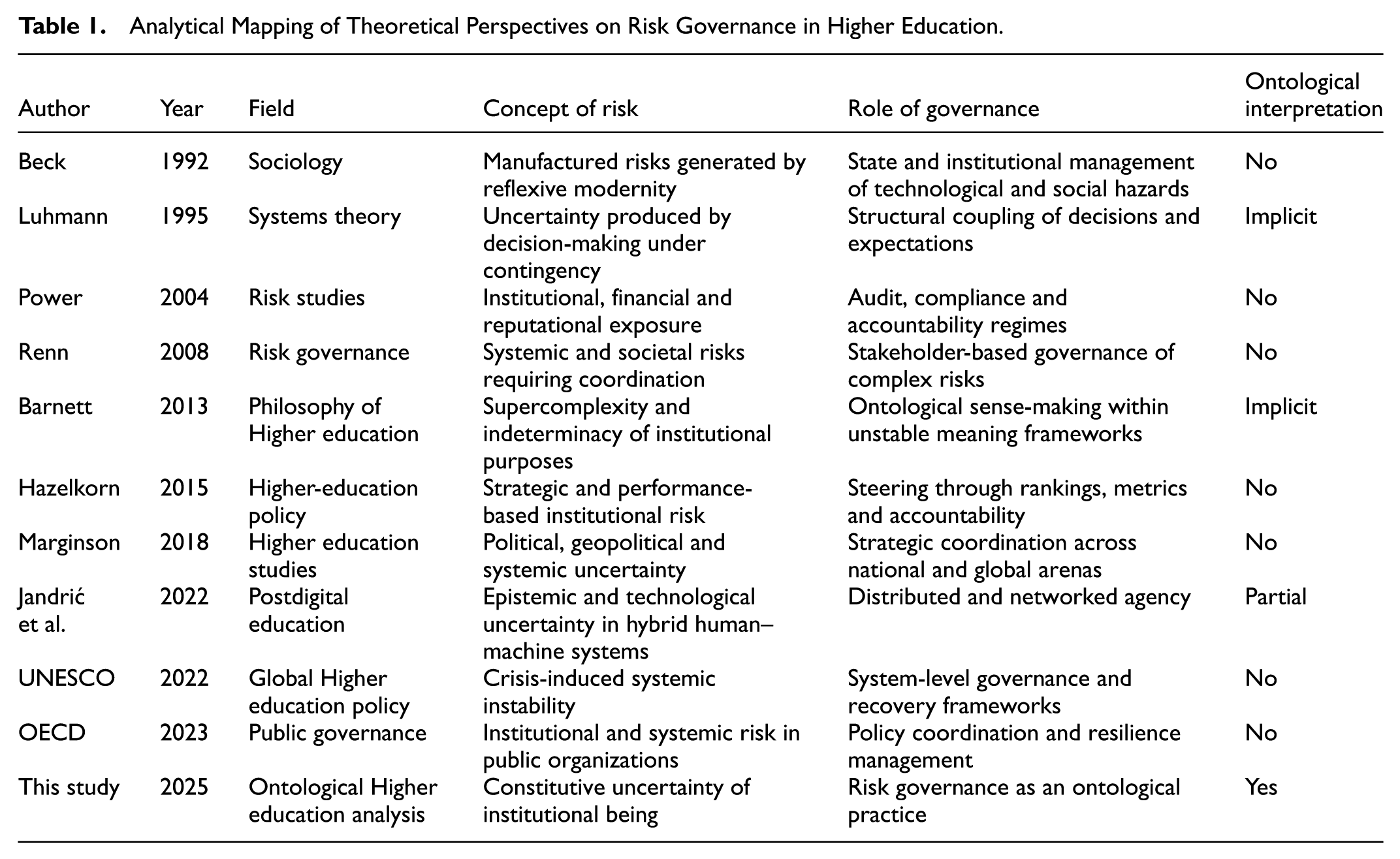
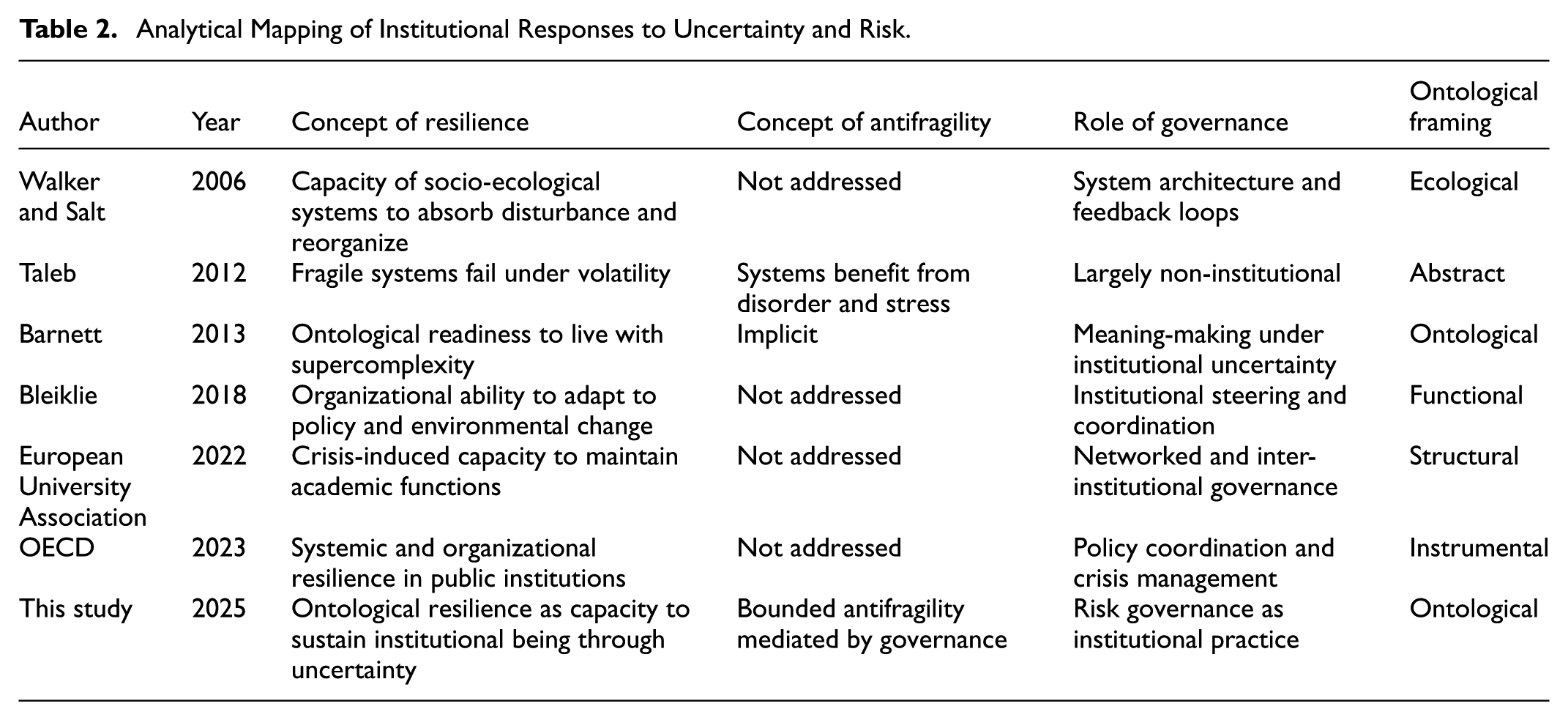
The university, in this understanding, is a risk-bearing form of social being. It endures not by seeking shelter from uncertainty but by transforming it into a source of intellectual vitality and institutional renewal. In a century shaped by crisis, the imperative is clear: universities must learn to inhabit uncertainty creatively, for it is this very condition that makes their continued existence both necessary and possible. Table 1 presents an analytical mapping of theoretical perspectives on risk governance in higher education, emphasizing the conceptual links between risk, governance, and its ontological interpretation. The main institutional responses to uncertainty and risk are summarized in Table 2.
Analytical Mapping of Theoretical Perspectives on Risk Governance in Higher Education.
Analytical Mapping of Institutional Responses to Uncertainty and Risk.
Footnotes
Acknowledgements
The author expresses gratitude to colleagues within the Ukrainian higher education community whose professional experience during wartime conditions has informed the conceptual insights developed in this article.

Ethical Considerations
This study did not involve human participants, animals, or sensitive personal data; therefore, formal ethical approval was not required.
Author Contributions
Author is the sole author of the manuscript and is responsible for the conceptualizsation, analysis, and writing of the article.
Funding
The author received no financial support for the research, authorship, and/or publication of this article.
Declaration of Conflicting Interests
The author declared no potential conflicts of interest with respect to the research, authorship, and/or publication of this article.
Data Availability Statement
No new empirical data were generated or analyzed in this study. All sources used are publicly available and cited in the reference list.
AI Use Disclosure
The author used AI-assisted tools (ChatGPT) for language refinement, structural suggestions, and formatting guidance. All conceptual content, arguments, interpretations, and final text have been fully reviewed, verified, and approved by the author, who assumes full responsibility for the originality and accuracy of the manuscript.
Identifying Information
The author holds the academic degree of Doctor of Pedagogical Sciences and works at the Ukrainian State University of Science and Technologies. This information is provided here only for administrative purposes and has been removed from the anonymized manuscript.