



Abstract
The present study investigates the learning motivation and perceived challenges of Chinese undergraduates majoring in foreign languages within the emerging educational landscape shaped by Large Language Models (LLMs). The purpose is to clarify how LLM-mediated learning environments influence students’ motivational profiles and how individual differences contribute to these variations. A questionnaire survey was administered to 401 students from six universities representing different regions and institutional tiers in China. The study employed validated scales to measure six dimensions of learning motivation and used SPSS for reliability testing, factor analysis, descriptive statistics, and comparative analysis. The findings indicate that intercultural communication and learning situations are the strongest motivational drivers, while external influences play a relatively minor role. It is evident that students who have previously undertaken a Large Language Model (LLM) programme exhibit a more nuanced set of attitudes. While these students recognise the advantages of LLM programmes in enhancing efficiency and comprehension, they also articulate concerns pertaining to professional identity and future career prospects. A range of significant differences were observed across institutional tiers, regions, and demographic groups. This finding indicates the necessity for diversified instructional support. The present study contributes to the understanding of learner motivation in AI-mediated language education and underscores the importance of integrating intercultural competence, digital literacy, and disciplinary knowledge in the development of foreign language programmes. Suggestions for curriculum reform and future research are provided.
Plain Language Summary
This study looks at how Chinese university students who major in foreign languages stay motivated and deal with challenges now that tools like ChatGPT are widely used in education. These large language models (LLMs) can help students improve grammar, translate texts, and practice speaking, but they may also challenge the major itself. Researchers surveyed 401 students from six universities in China. They found that students are mostly motivated by a desire to communicate with people from other cultures and by their actual classroom experiences. At the same time, outside pressures like family expectations or social trends are becoming less important to students. Interestingly, students who had already used LLMs like ChatGPT felt less motivated when it came to career planning. They were unsure about how AI will affect their future jobs in language-related fields. The study suggests that universities need to rethink how they teach foreign languages. This includes using new AI tools wisely while also helping students build critical thinking, cultural understanding, and skills that combine different fields of knowledge. Overall, the study gives useful advice to teachers, curriculum designers, and policymakers about how to improve foreign language programs in a world where AI is becoming more and more common.
Keywords
Introduction
In the context of accelerating globalisation and the rapid advancement of information technology, the emergence of artificial intelligence and Large Language Models (LLMs) has profoundly impacted the field of foreign language education. On one hand, these cutting-edge technologies have transformed the methods of teaching and learning foreign languages, enabling more flexible and personalised instruction through intelligent tools and online platforms. Applications of LLMs in language practice, grammar correction, and translation assistance provide greater possibilities for foreign language educators. On the other hand, the widespread use of LLMs has diminished the instrumental value of foreign language skills, resulting in shifts in market demand for language professionals. With the proliferation of translation software and intelligent assistants, traditional foreign language skills are no longer an absolute advantage in job markets in China. Consequently, many Chinese graduates of foreign language programmes face intensified challenges in the job market (Peng, 2024). Employers have lowered their requirements for linguistic proficiency, impacting the career prospects of foreign language programmes.
Against this backdrop, it is crucial to investigate the current state of learning among Chinese foreign language students, as well as their perceptions, attitudes, and career plans. Such research will provide essential insights for reforming and advancing foreign language programmes to ensure their alignment with contemporary transformations and market demands.
Literature Review
The Development of Foreign Language Education in Post-1949 China
Since 1949, the discipline and programmes of foreign language education in China have gone through three distinct phases: the application-oriented phase emphasising sociological features (1949–1978), the multidisciplinary phase emphasising humanistic features (1979–2020), and the current interdisciplinary phase emphasising integrative features (2021-present).
Prior to the Reform and Opening-up period in China, 1 international exchange opportunities were scarce, and the demand for foreign language professionals was limited. Consequently, foreign language programmes were sparsely distributed. For instance, after the 1952 national restructuring of academic institutions, only 8 English teaching centres, 3 French centres, and 3 German centres remained nationwide, with most institutions prioritising Russian language education (The Advisory Committee of Foreign Language Teaching in Higher Education, 1999). Graduates of these programmes primarily engaged in diplomatic translation, exemplified by the Central Foreign Affairs School (now Beijing Foreign Studies University), which cultivated a substantial number of diplomats for the new republic.
The advent of the Reform and Opening-up era saw a surge in demand for professionals proficient in global languages such as English, as a result of the influx of foreign investment and enterprises. During this period, there was an increase in the number of universities offering foreign language programmes. By the late 1980s, approximately 300 universities were offering English programmes, a figure that rose to 790 by 1998. During this period, the curriculum underwent a transition from a narrow focus on language and literature to a more comprehensive model integrating disciplines such as economics, business, law, and finance (Wen, 2019). In the 21st century, there was a notable increase in the number of students pursuing English programme, as evidenced by the rising admission scores for English programmes at leading institutions such as Beijing Foreign Studies University. For instance, the admission cut-off score in Beijing rose from 544 in 2002 to 608 in 2007. Concurrently, private institutions like New Oriental experienced significant growth, reflecting a growing public interest in English learning.
Over the past decade, there has been a notable decline in the popularity of foreign language programmes at Chinese universities. As evidenced by the Ministry of Education’s publicly accessible Undergraduate Programme Filing and Approval Results (2018–2022), at least 101 universities terminated their undergraduate foreign language programmes over the course of this 5-year period. To illustrate, Jinan University terminated admissions for nine undergraduate programmes, including Korean and German, in 2023. The notable decline in admission scores has served to exacerbate the already considerable challenges faced by foreign language programmes. To illustrate, the general admissions rank for English majors at Beijing Foreign Studies University in Beijing declined from 649 points (ranked 2,707) in 2020 to 631 points (ranked 5,623) in 2024. Concurrently, the employment prospects of foreign language programme graduates have become increasingly challenging. Between 2019 and 2022, the employment rate for graduates in foreign languages and literature decreased by over 8%, widening the gap in comparison to the national average. In 2022, the average employment rate for undergraduate graduates in China was 86%, while the figure for foreign language and literature majors was only 82.9%, ranking 53rd out of 59 major disciplines (Institute, 2023).
These trends have been driven by multiple factors. On one hand, advancements in foreign language education in primary and secondary schools, along with improved university-level instruction, have gradually diminished the relative advantage of graduates of foreign language programmes. On the other hand, developments in translation technologies, particularly LLMs, have intensified employment difficulties for graduates. LLMs, such as the GPT series (Generative Pre-trained Transformer), offer amazing capabilities and expose the potential for transformative applications (Nazir & Wang, 2023). In conclusion, ChatGPT has the potential to be a powerful tool for improving teaching and learning by providing personalised tutoring, automated essay grading, language translation, interactive learning and adaptive learning (Baidoo-Anu & Ansah, 2023).
Nevertheless, the pervasive integration of emerging technologies has also given rise to concerns within the foreign language education community. There is a growing apprehension that students may become unduly dependent on technology, to the potential detriment of their fundamental language learning abilities. It is therefore pertinent to inquire whether the personal development and linguistic advantages of those studying foreign languages will be adversely affected. The implementation of the LLMs has been observed to offer convenience while also influencing the structure of higher foreign language education in China (J. Hu & Qi, 2023). In response, numerous universities are proactively seeking avenues to reinvigorate or transform their foreign language programmes. To illustrate, in 2022, Beijing Foreign Studies University (BFSU) introduced three new inter-university joint training majors: “Spanish + International Journalism and Communication” in cooperation with Renmin University of China (RUC), “English + Information Management and Information System” with Beijing Institute of Technology (BIT), and “English + Finance” with Central University of Finance and Economics (CUFE). In 2023, East China Normal University (ECNU) launched a “bilingual and bimajor” cultivation system for top foreign language talents, which facilitates the integration of knowledge across specialities. In 2024, Fudan University (FDU) implemented a new dual bachelor’s degree programme in English, translation, Russian, German combined with computer science, which is expected to promote the interdisciplinary integration and innovation of the “New Liberal Arts” and “New Engineering” fields.
Research on Foreign Language Learning Motivation
Motivation has long been a central topic in educational psychology, particularly in second language acquisition (SLA). Gardner and Lambert (1959) initially classified language learning motivation into integrative motivation—the desire to integrate into the target language culture—and instrumental motivation, which focuses on pragmatic goals such as career advancement. Dörnyei (2005) later emphasised the role of individual differences, linking motivation to self-identity, a framework validated by subsequent studies (Dörnyei, 2010; Lukács, 2010; Taguchi et al., 2009).
In China, Shichun Gui (1986) pioneered the study of motivation of English majors through a psychosocial investigation. His research demonstrated that high-achieving English majors exhibited stronger learning motivation compared to their peers, with male students generally showing higher motivation levels than female students. L. Liu (1994), using an intervention-based observational approach, argued that motivation was not a critical factor influencing academic performance. Later, Yihong Gao et al. (2003) developed a motivation scale tailored to the Chinese cultural context, which has since served as a foundation for subsequent research. This framework categorised learning motivation into seven types: intrinsic interest, achievement, study abroad, learning situation, social responsibility, personal development, and information media motivation. Subsequent studies have diversified in terms of research subjects and methodologies, while largely adhering to these seven motivational types (Z. Liu, 2012; H. Zhang & Du, 2021).
The majority of foreign language learning motivation research can be characterised by the following trends: The number of papers is increasing; the research perspectives are multidisciplinary; empirical studies account for a large proportion, while theoretical studies account for a small proportion; the subjects are foreign language learners of different educational backgrounds and ages; samples are becoming larger and more sophisticated; dynamic longitudinal studies are developing faster than static cross-sectional studies (J. Li & Liu, 2015). Furthermore, most scholars have determined that there is a significant correlation between foreign language learning motivation and various learning concepts, strategies, and outcomes (Masgoret & Gardner, 2003; F. Zhang & Wu, 2024).
It is noteworthy that research focus, both in China and internationally, has gradually shifted towards the exploration of demotivation since Gary Chambers (1993) introduced the concept into the field of foreign language education (Shan, 2015). In the context of the rapidly evolving digital learning environment, the issue of demotivation and the challenge of sustaining learners’ engagement have emerged as central concerns in the field of foreign language education. Studies have shown that due to enhanced learning experiences, autonomy and critical thinking skills, AI tools have a positive impact on learning motivation (Mohamed et al., 2024). Meanwhile, Arum Kim et al. (2024) highlighted that emerging instructional tools, such as AI chatbots, create a positive learning environment that boosts learners’ confidence in communication, reduces anxiety, and fosters stronger intrinsic motivation.
In summary, although existing studies have provided rich evidence regarding the classification and effects of L2 learning motivation, empirical research that directly examines how the disruptive emergence of LLMs reshapes motivational structures remains limited. Prior work on technology-enhanced language learning (Ghanizadeh et al., 2015; Wu et al., 2024), has mostly highlighted the benefits of digital tools in enhancing engagement, reducing anxiety, and supporting autonomous learning. However, these studies seldom address the unique ambivalence introduced by advanced LLMs, tools capable of performing tasks traditionally associated with human language expertise. Such capabilities may simultaneously strengthen certain forms of motivation while weakening others, particularly those related to career aspirations or the perceived value of linguistic competence.
Synthesising the above literature, this study is grounded in a multidimensional framework of L2 learning motivation (Dörnyei, 2005; Gao et al., 2003) but seeks to extend it into the LLM context. We posit that LLMs act not merely as a learning tool but as a contextual factor that may differentially impact various motivational dimensions, particularly instrumental motives like career planning. Thus, the study is framed to explore both the stable structure of motivation and its dynamic interaction with technological exposure.
Methodology
Research Design
This study employs a quantitative research approach, using a questionnaire survey to collect data on the current learning motivation and status of Chinese undergraduate students majoring in English and other key foreign languages (such as Japanese, French, German, Russian, and Spanish). The aim is to analyse the findings and address the following key research questions:
What are the characteristics of the learning motivation of foreign language majors in the era of LLMs?
How do different types of learning motivation affect students’ learning engagement?
What are the relationships between information technology literacy, institutional level, regional differences, and gender with students’ learning motivation?
In the context of Large Language Models, what expectations do students have regarding the cultivation of foreign language majors?
Participants
A total of 401 undergraduate students majoring in foreign languages were surveyed from six Chinese universities across eastern, central, and western regions. The sample included both prestigious universities (985/211) and general institutions, 2 ensuring representation across institutional tiers. Participants were selected using a convenience sampling method. Among them, 86% were female, reflecting the gender distribution commonly observed in foreign language programmes. The inclusion of students from different regions and school types provides a diverse view of motivational patterns across China. Table 1 presents the demographic data of the participants.
Participants Demographics Table.

Instruments
Drawing on existing Chinese and international research findings, this study designed the Foreign Language Learning Motivation Scale for Undergraduate Students based on the framework of Gardner’s Attitude/Motivation Test Battery (2004). An initial version of the scale was used to survey 113 foreign language programme undergraduates from two universities and 100 valid questionnaires were collected. The initial questionnaire was subsequently revised and finalised based on expert reviews and advice.
An online version of the questionnaire was distributed to foreign language students at participating universities through their respective foreign language teachers. A total of 451 responses were received, of which 401 were valid, yielding an effective response rate of 89%.
The final questionnaire consists of four sections:
Learning Motivation
Current Status and Large Language Model-Related Items
Learning Engagement
Personal Background Information, including gender, grade level, language of study, institutional location, and institutional type.
The first two sections of the questionnaire utilised a 5-point Likert scale, with response options corresponding to: 1 = Strongly Disagree, 2 = Disagree, 3 = Neutral, 4 = Agree, 5 = Strongly Agree.
Each motivational dimension was operationalised as a latent construct measured through multiple Likert-scale items adapted from validated instruments in prior studies.
Data Collection and Analysis
Data were collected through an online questionnaire between September and October 2024. After excluding incomplete responses, 401 valid questionnaires were retained. Then data were analysed using SPSS 27.0. Exploratory factor analysis, Pearson correlation analysis, independent samples t-tests, and one-way ANOVA were conducted to examine the structure of learning motivation and its relationships with individual and contextual variables.
Result
Basic Types of Learning Motivation in Foreign Language Programmes
Exploratory factor analysis extracted six motivation factors: intercultural communication, career planning, learning situation, academic goals, influence of others, and ease of learning. These factors explained 60.14% of the total variance. The overall reliability of the scale was high (Cronbach’s α = .908). Descriptive statistics showed that intercultural communication motivation recorded the highest mean score (M = 4.07), followed by learning situation (M = 3.95) and academic goals (M = 3.92). The results of the exploratory factor analysis and descriptive statistics for each motivation factor are presented in Table 2.
Learning Motivation Factors and Related Data.

Motivation and Learning Engagement
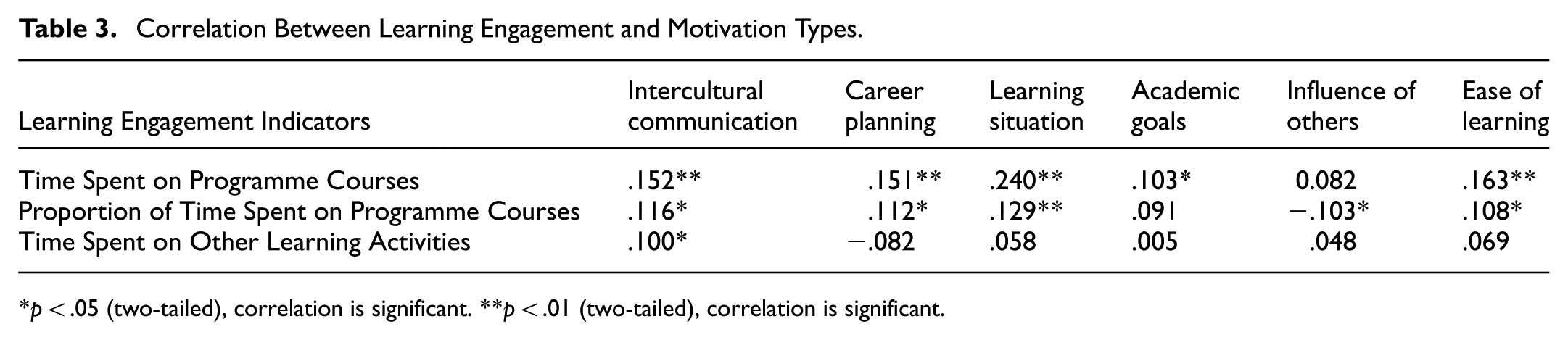
A Pearson correlation analysis was conducted to examine the relationship between learning engagement and the different types of motivation. The resulting Pearson correlation coefficients are presented in Table 3.
Correlation Between Learning Engagement and Motivation Types.
p < .05 (two-tailed), correlation is significant. **p < .01 (two-tailed), correlation is significant.
As shown in Table 3, learning situation is the most significant factor positively influencing the time spent on programme courses and the proportion of time dedicated to programme course learning. Only intercultural communication motivation shows a significant positive impact on other learning activities, such as preparing for examinations, self-learning new skills, and pursuing certification. Conversely, influence of others is negatively correlated with the time spent on programme courses.
Group Differences in Learning Motivation
Independent samples t-tests and one-way analysis of variance (ANOVA) were conducted to examine differences in learning motivation across technology use habits and individual background variables.
Differences by LLM Use
Students who had used LLMs reported significantly lower levels of career planning motivation and influence of others motivation than those who had not used LLMs (see Figure 1). Specifically, students without LLM experience showed higher mean scores in career planning (M = 3.35, SD = 0.70) and influence of others (M = 3.12, SD = 0.79).

Histogram of mean scores for using or not using LLMs and motivation types.
Differences by Region
Students from universities located in central and western regions exhibited significantly higher career planning motivation than those from eastern coastal regions (see Figure 2). In addition, students from western regions reported significantly higher academic goals motivation (M = 4.02, SD = 0.65) compared to students from eastern regions (M = 3.83, SD = 0.73; see Figure 3).

Histogram of mean scores for institutional districts and motivation types.

Histogram of mean scores for place of origin of students and motivation types.
Differences by Academic Year
Significant differences were observed across academic years. First-year students demonstrated significantly higher academic goals motivation than students in other years, while both first-year and second-year students reported stronger career planning motivation than third-year and fourth-year students (see Figure 4).

Histogram of mean scores for grades and motivation types.
Differences by Institution Type
Students from general undergraduate institutions showed significantly higher levels of career planning motivation and academic goals motivation compared to students from “985” and “211” universities. Additionally, students from “211” universities reported significantly higher influence of others motivation than students from “985” universities (see Figure 5).

Histogram of mean scores for institutional levels and motivation types.
Differences by Major Type
Students majoring in English showed significantly higher levels of career planning motivation and academic goals motivation compared to students majoring in other key foreign languages (see Figure 6).

Histogram of mean scores for major languages and motivation types.
Discussion
Summary of Findings
This study examined the learning motivation of Chinese undergraduate students majoring in foreign languages in the era of Large Language Models (LLMs), with particular attention to motivational structure, learning engagement, and individual differences. Several key findings emerge from the results.
First, foreign language majors’ learning motivation exhibits a clear multidimensional structure, with intercultural communication motivation ranking highest, followed by learning situation and academic goals motivation. In contrast, career planning motivation and influence of others motivation occupy relatively lower positions. This pattern suggests that, under the influence of LLMs, students’ motivation is increasingly shaped by intrinsic and meaning-oriented factors rather than purely instrumental or external considerations.
Second, learning engagement is selectively associated with different motivational dimensions. Learning situation motivation shows the strongest and most consistent relationship with time investment in major-related courses, while intercultural communication motivation is more closely linked to engagement in broader learning activities such as self-directed learning and skill development. These findings indicate that different types of motivation may support distinct forms of learning behaviour rather than contributing uniformly to overall engagement.
Third, significant differences in learning motivation are observed across technology use habits, major type, region, academic year, and institution type. In particular, students with LLM experience report lower career planning motivation than those without such experience, while English majors demonstrate stronger career planning and academic goals motivation than students majoring in other key foreign languages. Senior students and those enrolled in elite universities also tend to show lower levels of career-oriented motivation. By contrast, gender and the presence of a second major do not appear to exert a significant influence on learning motivation.
Taken together, these findings portray a motivational landscape characterised by heightened cultural and academic orientation alongside growing uncertainty regarding career prospects, reflecting the profound impact of LLMs on students’ perceptions of foreign language learning and its future value.
Theoretical Interpretation
The observed motivational patterns can be meaningfully interpreted through established frameworks in second language acquisition and educational psychology, particularly the L2 Motivational Self System (Dörnyei, 2005) and demotivation theory (Chambers, 1993).
The dominance of intercultural communication motivation suggests that learners continue to attach strong value to the humanistic and communicative dimensions of language learning, even as technological tools increasingly mediate linguistic tasks. From the perspective of the L2 Motivational Self System, this orientation reflects the salience of the ideal L2 self grounded in cultural understanding, international engagement, and personal growth. Unlike instrumental goals tied to specific occupations, such aspirations are less vulnerable to technological substitution and may therefore remain relatively stable in the LLM era.
By contrast, the comparatively lower level of career planning motivation—especially among students with direct LLM experience—points to a potential process of technology-induced demotivation. Exposure to LLMs, which can perform translation, writing, and language analysis with high efficiency, may undermine learners’ confidence in the long-term instrumental value of traditional linguistic skills. This perception can weaken the linkage between present learning effort and future professional identity, thereby diminishing career-oriented motivation. In this sense, LLMs function not merely as learning tools but as contextual disruptors that reshape learners’ motivational self-concepts.
Differences across academic years further reinforce this interpretation. First- and second-year students, who remain relatively distant from immediate career pressures, tend to maintain stronger academic goals and career planning motivation. In contrast, senior students face the convergence of technological disruption and imminent labour market entry, which may intensify anxiety regarding skill obsolescence and reduce motivational clarity. This pattern aligns with prior research suggesting that motivation is particularly vulnerable during transitional stages of education and career development.
Institutional and regional differences can also be understood in terms of resource distribution and expectation structures. Students from general undergraduate institutions display stronger pragmatic motivation, possibly due to greater perceived pressure to secure employment through measurable academic achievements. Meanwhile, students in elite universities, despite possessing richer academic resources, may experience heightened uncertainty in redefining their competitive advantages under conditions of rapid technological change.
Overall, these findings suggest that LLMs exert a differentiated impact on motivational dimensions, selectively weakening instrumental and career-related motives while leaving intrinsically oriented and culturally grounded motivations relatively intact.
Implications for Motivation Theory and the LLM Context
The present study contributes to motivation research by highlighting the need to recontextualise established motivational theories within technologically disruptive learning environments. Traditional distinctions between integrative and instrumental motivation remain relevant, but the LLM context reveals that instrumental motivation—particularly career planning—has become more fragile and contingent upon learners’ perceptions of technological replaceability.
From a theoretical perspective, the findings suggest that the ideal L2 self should be reconceptualised not solely in terms of occupational attainment but also as a hybrid identity integrating intercultural competence, critical thinking, and technological literacy. Motivation theory must therefore move beyond static goal orientations and account for learners’ ongoing negotiation of identity under conditions of rapid technological change.
In practical terms, the results imply that sustaining motivation in foreign language education requires strategic pedagogical intervention. Rather than avoiding LLMs, educational institutions should incorporate them into instructional design in ways that foreground human–machine complementarity. Practice-based activities involving LLMs can help students develop a realistic understanding of the limits of AI while reinforcing the irreplaceable value of human judgement, cultural interpretation, and ethical reasoning.
More broadly, the study underscores that motivation in the LLM era is not simply a psychological trait but a context-sensitive construct shaped by technology, institutions, and labour market expectations. Addressing motivational decline therefore demands coordinated efforts at the curricular, institutional, and policy levels to help learners reconstruct meaningful and sustainable visions of their future as foreign language professionals.
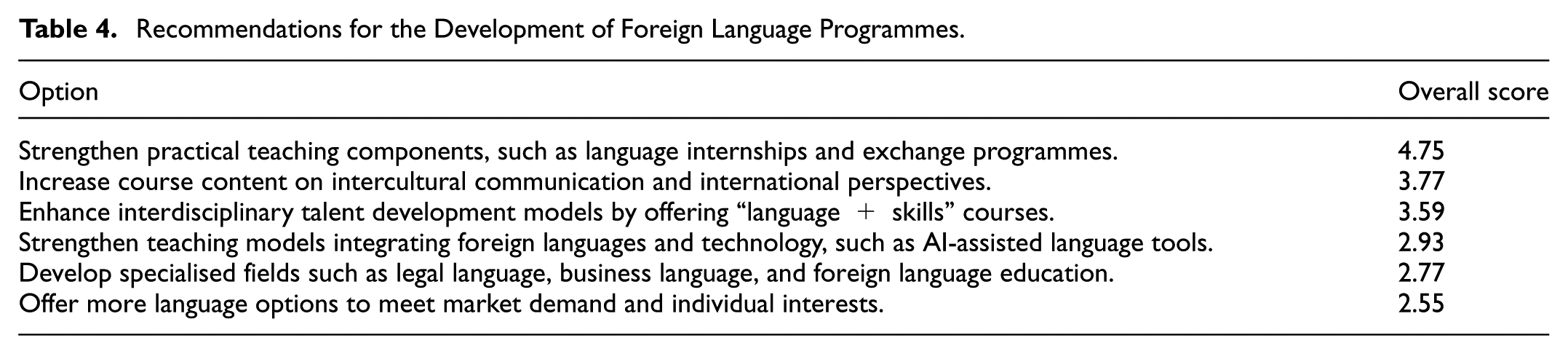
Based on the ranking of priorities, students expressed the strongest preference for practice-oriented teaching activities. This indicates that the construction of foreign language programmes should emphasise practical application, strengthening students’ language skills to ensure their knowledge is applicable in real-world contexts. Additionally, programmes should focus on enhancing students’ intercultural communication abilities and expanding their international perspectives. Students’ preferences regarding the development of foreign language programmes are summarised in Table 4. As Wen (2024) emphasised, the “cultural diversity required for foreign language learning” is critical. Practical courses, such as foreign language debate or business negotiation classes, can gradually develop students’ intercultural competencies for various communicative scenarios. These recommendations align with the findings on students’ motivational types and intensities, further underscoring the importance of tailoring programme development to meet learners’ needs.
Recommendations for the Development of Foreign Language Programmes.
Foreign language majors’ expectations primarily focus on enhancing employability and interdisciplinary learning (see Table 5). These findings offer important insights for improving institutional course design and teaching methods while highlighting the current misalignment between the training objectives of foreign language programmes and the demands of the job market. Educational institutions should guide students to understand industry trends and strengthen partnerships with enterprises. These findings support K. Hu and Gao’s advocacy (2024) for the empirical connection between foreign language programme design, curriculum development, and the advancement of Large Language Models. The students’ needs for employability and interdisciplinary learning reflect the expectations placed on foreign language majors in the context of Large Language Models and point to future areas of development in curriculum design and programme reform.
Recommendations for the Talent Cultivation Model of Educational Institutions.
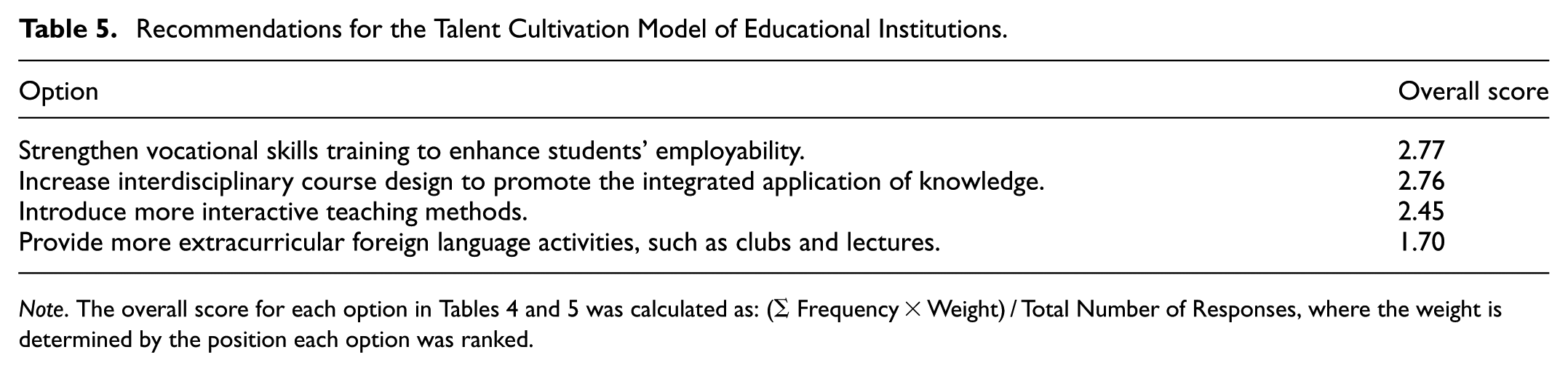
Note. The overall score for each option in Tables 4 and 5 was calculated as: (Σ Frequency × Weight) / Total Number of Responses, where the weight is determined by the position each option was ranked.
To provide a clearer synthesis of the empirical findings, Figure 7 summarises the key motivational patterns, their theoretical interpretations, and corresponding implications for foreign language programme reform in the LLM context (see Figure 7).

Dynamic model: foreign language learning motivation in the LLM Era.
Conclusion
This study adopts the perspective of foreign language majors to examine their learning motivation and perceived challenges in the era of Large Language Models (LLMs). Through an analysis of motivational patterns across different personal backgrounds, institutional contexts, and levels of LLM familiarity, the research provides a timely understanding of how technological change is reshaping learner attitudes and expectations within foreign language education.
The findings reveal that intercultural communication motivation remains the strongest driving force for students and continues to shape their vision of foreign language learning in an increasingly globalised world. Learning-situation motivation—particularly the influence of teachers, classroom environment, and peer interaction—also plays a central role in sustaining learning engagement. In contrast, external influences and ease-of-learning factors show comparatively weaker effects, suggesting a growing trend toward internalised and learner-driven motivations. Moreover, distinct variations emerge across academic years, institutional tiers, regions, and levels of information literacy. Students in higher academic years or elite institutions exhibit lower levels of academic-goal and career-planning motivation, reflecting the real pressures and uncertainties introduced by rapid technological developments, especially the evolving value of language skills in the job market. Students with prior LLM experience also show ambivalent attitudes toward technology: while recognising its benefits, they are increasingly concerned about employability and the unique advantages of human-mediated language competence.
These findings highlight the need for foreign language education to reposition itself in response to the opportunities and challenges brought by LLMs. As the boundaries between linguistic skills, technology, and interdisciplinary knowledge become increasingly blurred, foreign language programmes must transition from traditional language-centred curricula toward more integrated and future-oriented models. This includes establishing micro-credentials and expanding course offerings in Intercultural Communication, Regional Country Studies, Language and Technology, Foreign Language + Data Literacy. Such curricular innovations not only respond to students’ emerging motivational needs but also enhance their long-term employability and professional identity in a rapidly evolving labour market.
At the institutional level, universities should strengthen the alignment between foreign language programmes and societal demands, fostering interdisciplinary collaboration and university-industry partnerships to create more diverse pathways for professional development. Investment in digital resources, especially in under-resourced regions, can help reduce educational disparities and support students’ equal access to high-quality learning environments. Teachers, in turn, must navigate a dual role: integrating LLMs effectively into their pedagogical practice while cultivating students’ critical thinking, creativity, and intercultural competence—core human abilities that AI cannot replicate. Enhancing teachers’ digital literacy and promoting differentiated instruction based on students’ linguistic backgrounds, academic progression, and technological familiarity will be essential.
For students, the emergence of LLMs calls for a balanced approach to technology-assisted learning. While AI tools can enhance efficiency and reduce anxiety, learners must maintain autonomy, avoid overreliance, and actively cultivate the humanistic, communicative, and intercultural qualities that remain central to foreign language education. By engaging in interdisciplinary study, intercultural exchange, and experiential learning, students can better position themselves for future career opportunities and navigate the uncertainties brought by technological transformation.
Overall, this study demonstrates that foreign language learning motivation is undergoing meaningful shifts in the LLM era. By understanding these motivational dynamics and addressing students’ emerging needs, foreign language education can move toward a more adaptive, human-centred, and forward-looking development model. This will ensure that foreign language programmes remain relevant, resilient, and capable of nurturing the next generation of globally competent, technologically informed language professionals.
Limitations and Future Directions
This study has several limitations. First, the relatively small number of foreign language programmes in western regions resulted in fewer language specialisations in the sample compared to eastern regions, potentially limiting the generalisability of the findings. Second, the study relied mainly on quantitative survey data and did not incorporate qualitative methods such as interviews. Future research should expand the sample and combine qualitative and quantitative data to gain deeper insights into students’ learning behaviours and expectations.
The development of foreign language programmes should balance change and continuity. Teachers and students should explore the integration of technology and humanities, aiming to cultivate a new generation of foreign language professionals with humanistic values and technological literacy. This approach addresses the challenges of the LLM era and supports the sustainable development of foreign language education.
Footnotes
Acknowledgements
The authors thank all participants who took part in the survey and provided valuable insights.

Consent to Participate
All collected data is used only for research purposes, and the participants were informed about this research and asked for their consent.
Funding
The authors received no financial support for the research, authorship, and/or publication of this article.
Declaration of Conflicting Interests
The authors declared no potential conflicts of interest with respect to the research, authorship, and/or publication of this article.
Data Availability Statement
The current study’s data are available from the corresponding authors upon reasonable request.*