



Abstract
Prior research highlights the critical roles of satisfaction and emotion in the service recovery process. Building on this foundation, this study examines the sequential cognition—emotion—evaluation process through which service recovery efforts generate positive eWOM. Drawing on cognitive appraisal and social exchange theories, the research investigates perceived justice as a unidimensional trigger for mixed emotions and recovery satisfaction. Analysis of 510 Vietnamese e-shoppers using PLS-SEM reveals that perceived justice significantly influences both affective states and satisfaction, with positive emotion emerging as the strongest driver of recovery satisfaction. Crucially, the relationship between perceived justice and positive eWOM is fully mediated by recovery satisfaction and emotions. Theoretically, the article validates the independence of positive and negative emotions as well as the dual mediating effects of emotions and recovery satisfaction in online settings. To promote positive customer interactions, firms should prioritize not only customer satisfaction and emotional experiences associated with the initial purchase but also ensure high levels of positive emotion and satisfaction during service recovery.
Introduction
While a “zero defects” standard offers clear benefits for customer perception and operational efficiency, its realization remains difficult due to the inherent variability and limited control found in e-retailing encounters. By 2025, Vietnam’s e-commerce surge represents a fundamental transition toward digital consumer culture. This shift is fueled by rapid technological progress and evolving social behaviors. Consequently, the sector continues to demonstrate the impressive growth (Ozan, 2025). However, this landscape continues to grapple with frequent service failures (Nguyen et al., 2022). Although service failures and consumer complaints remains virtually unattainable (Harun et al., 2018), the ability to manage complaints effectively is fundamental to cultivating long-term consumer relationships (Shin et al., 2017; Thanuset & Kampanat, 2024). The online retailing environment is inherently prone to service failures, which creates substantial challenges for e-retailers in terms of timely problem detection and effective resolution. However, customer complaints could be served as a key opportunity for not only service recovery (SR) efficiency but also a critical source of positive electronic word-of-mouth (eWOM) as feedback and retention catalyst. The role of recovery justice in predicting post-recovery customer citizenship, including eWOM as loyalty proxy, remains underexplored within the context of SR (Zhu et al., 2021). Thus, this study examined how the perceived justice (PJ) toward SR translates into advocacy in online settings.
Although research on SR has expanded considerably in recent years, several important issues remain unresolved and warrant further examination. First, while PJ is widely recognized as a critical antecedent affecting post-complaint behavior, the effectiveness of PJ in SR varies significantly across different contexts (Padmavathi & Sunil, 2023). Moreover, previous studies raised some concerns regarding the practical differentiation among the justice dimensions (e.g., DeWitt et al., 2008; Gelbrich & Roschk, 2011; Harun et al., 2018; Liao, 2007). Thus, conceptualizing PJ as a latent construct offers a more parsimonious and accurate reflection of consumer perceptions in the context of online SR. Second, because positive and negative emotions are independent of one another and have asymmetrical effects on behavior (Kuo & Wu, 2012), both types of emotions will provide a more comprehensive understanding of behavioral cues. Besides, this study extends the cognitive appraisal’s cognitive-affective sequence that usually focuses on single emotions by empirically validating the mixed emotions in online SR (DeWitt et al., 2008; Hamilton & Allard, 2023). Third, in the relevant literature, research on PJ focused on aspects such as recovery satisfaction and trust, while overlooking emotional factors involved (Abdelkader Ali et al., 2026; Ali et al., 2023). In the context of SR, customer emotions have been identified as a key affective mediator linking fairness to customer loyalty (Abdelkader Ali et al., 2026). Yet the dual mediating effects of both recovery satisfaction and customer emotions between PJ and positive eWOM in SR contexts remain scarce.
To address these gaps, this study extends cognitive appraisal (CA) theory in the SR literature by conceptualizing PJ as the primary appraisal mechanism that initiates both positive and negative emotional responses. By jointly modeling emotional reactions and recovery satisfaction, the study clarifies the sequential cognition–emotion–evaluation process through which recovery efforts translate into positive eWOM. Given the growing significance of positive eWOM for sustaining long-term business success, these mediating mechanisms deserve closer scholarly attention. Theoretically, the findings advance the understanding of perceived recovery justice within the online sector in Vietnam. It is important to explicitly state that the empirical evidence for this study is drawn from the Vietnamese e-commerce context; therefore, generalization of these findings to other service sectors and cultural contexts should be approached with caution. The theoretical framework integrates three core perspectives to explain the SR contexts. Justice theory is used to analyze how customers form justice perceptions. CA theory explains the sequential process through which fairness-related cognitions transfer into affective outcomes. And social exchange theory (SET) emphasizes the balance between rewards and costs influencing customer decision making. Practically, the findings yield valuable managerial insights. By acknowledging the pivotal mediating roles of recovery satisfaction and emotional responses, firms can develop and execute more effective recovery strategies that strengthen customer engagement and promote positive eWOM.
Literature Review
Perceived Justice
PJ pertains to the extent to which consumers perceive fairness in the handling and resolving of service failures (Maxham & Netemeyer, 2003). According to justice theory, customers assess recovery efforts as either fair or unfair based on specific dimensions of the transactional interaction. The PJ reflects the fairness of the outcome received, the processes employed in addressing the issue, and the quality of interpersonal treatment, respectively. The significance of PJ lies in its strong influence on customer reactions; notably, responses to perceived injustices tend to be more intense than those to perceived fairness (Bondü et al., 2022). Furthermore, SR processes are multidimensional, involving justice perceptions at various levels (Sahaf & Fazili, 2023).
Previous research typically conceptualizes PJ as comprising three interconnected dimensions: distributive, procedural, and interactional justice (Maxham & Netemeyer, 2003; Sahaf & Fazili, 2023). Although these dimensions are commonly regarded as theoretically independent, it is the cumulative effect of all three that shapes the customer’s overall justice perception, subsequently influencing their attitudes and behavioral responses (Ali et al., 2021). Moreover, empirical evidence suggests that consumers may adopt a compensatory approach when forming an overall justice evaluation (Umar, 2022). Several scholars have challenged the value of concentrating solely on separate justice dimensions, advocating instead for the study of overall justice perceptions (Gelbrich et al., 2011; Harun et al., 2018; Homburg et al., 2005). Examining an overall justice perspective broadens the scope of inquiry and addresses limitations of fragmented approaches. Moreover, treating justice as a single construct ensures greater parsimony and avoids problems arising from the strong correlations among its dimensions (Liao, 2007; Tran et al., 2021). Accordingly, as recommended by Ambrose and Schminke (2009) and Harun et al. (2018), adopting a unidimensional approach offers distinct advantages, particularly in digital settings and relationship-focused industries.
Within the CA theory framework, PJ serves as the primary appraisal mechanism—the cognitive trigger in the recovery process. The concept posits that consequential responses and evaluation are not determined solely by an event but by the individual’s cognitive perception of that event. In the context of SR, this study treats PJ as a unidimensional construct that ensures greater parsimony and reflects the reality of digital consumer experiences. Simultaneously, it is proposed to activate the subsequent emotional and evaluative process of the customers.
Emotions
Emotion has been defined as “a mental state of readiness that arises from cognitive appraisals of events or thoughts … and may result in specific actions to affirm or cope with the emotion, depending on its nature and meaning for the person having it” (Bagozzi et al., 1999). According to CA theory, emotions originate from an individual’s evaluation of an ongoing event in which he/she is involved, while justice reflects an individual’s perceptions of how people appropriately treat a human (Dunn & Schweitzer, 2005; Watson et al., 1989). Thus, an individual’s emotion arises in response to an outcome of the self and social judgments. Kuo and Wu (2012) highlight that positive and negative emotions are independent of one another and have asymmetrical effects on behavior. Hence, both types of emotions are individually significant and should be simultaneously considered to provide more comprehensive behavioral cues in the SR process.
Building on CA theory, PJ serves as a key appraisal dimension triggering the affective responses: when customers view the recovery process as fair, they are more likely to experience favorable affective responses such as relief and gratitude, while perceptions of unfairness trigger frustration and anger (Ali et al., 2021; Chebat & Slusarczyk, 2005), even simultaneously (Barford et al., 2020; Larsen et al., 2001). Empirical evidence supports this dual influence, with studies showing that perceptions of recovery justice simultaneously enhance positive emotions and mitigate negative emotions (DeWitt et al., 2008). However, limited research has examined contexts in which positive and negative emotions coexist (Hamilton & Allard, 2023). Therefore, customer emotions are shaped directly by fairness judgments of the recovery process, with justice acting as a cognitive trigger for both dimensions of affective outcomes. Thus, we propose:
Recovery Satisfaction
Recovery satisfaction refers to the extent of customer satisfaction following a firm’s efforts to address and resolve a service failure, particularly regarding customers’ expectations of the recovery process (Boshoff, 2005). Drawing on justice theory, consumers evaluate SR by comparing perceived gains and losses in relation to the effort made by the provider (Huang, 2011). Following a service failure, customers often perceive an imbalance or inequity, leading them to assess the service provider’s effectiveness and fairness through the lens of PJ (Ding et al., 2016). Particularly, it is suggested that in the context of online SR, perceived recovery justice can consistently enhance customer recovery satisfaction as in a traditional environment (Ali et al., 2023). Thus, it is reasonable to expect that customers who perceive higher justice in the recovery process will also report greater recovery satisfaction. We propose that:
While Mattila and Wirtz (2000) confirmed the hierarchical effects of cognitive and affective components on customer satisfaction, particularly in service failure scenarios, relatively few studies have explored the emotional dimensions within the relationship between PJ and satisfaction in the context of SR (Chebat et al., 2005; Del Río-Lanza et al., 2009). The justice-related emotion leads to consumer recovery satisfaction and loyalty (Abdelkader Ali et al., 2026; Dewitt et al., 2008). Customers’ positive emotions are more likely to exert a favorable product evaluation (Isen, 1987). Therefore, experienced positive emotions will help increase post-failure levels of customer recovery satisfaction compared to customers with more negative counterparts (Manthiou et al., 2020). The influence of negative emotion on customer recovery satisfaction was reported in the study of Wei (2021). In this context, despite the service failure, the customer might decrease negative emotion and return to pleasure if the SR may evoke their perceptions of fairness. Besides, previous studies indicated that both positive and negative emotions simultaneously and significantly impact customer recovery satisfaction (Abdelkader Ali et al., 2026; Kuo & Wu, 2012). Thus, we propose:
Positive Electronic Word-of-Mouth
Positive eWOM refers to favorable statements that entail consumers engaging with one another through online platforms, and it plays a critical role in shaping customer perceptions and actions (Grewal et al., 2022). Within the context of SR, customer complaints should be viewed not merely as operational challenges, but as strategic opportunities to determine SR efficiency. These interactions can then transcend simple retention, evolving into positive eWOM. In the digital landscape, positive eWOM functions as a high-value form of customer citizenship behavior and serves as a primary proxy for customer loyalty (Tengilimoglu & Öztürk, 2024). Rather than passive repurchasing, eWOM represents an active endorsement where the customer advocates for the firm. However, the specific influence of recovery justice in driving this advocacy-based loyalty has not been thoroughly verified within the current SR literature (Zhu et al., 2021).
The SET elucidates the exchange between customer recovery satisfaction and the likelihood of favorable future behaviors, such as engagement in positive eWOM (Augusto de Matos et al., 2009; Thanuset & Kampanat, 2024). Empirical studies confirm that recovery satisfaction significantly increases the likelihood of positive eWOM, whereas dissatisfaction often triggers negative eWOM communication (Balaji et al., 2013; Komunda et al., 2012; Luong et al., 2021). Despite these findings, the literature exploring the impact of consumer satisfaction on eWOM specifically within the SR context remains relatively scarce (Ding et al., 2016; Shams et al., 2021). Existing findings strongly suggest that post-recovery satisfied customers are more inclined to advocate for the firm. Therefore, we propose:
According to SET, consumers tend to reciprocate perceived benefits or harms in their exchange relationships with firms (Homans, 1958). When SR evokes positive emotions such as gratitude, relief, or joy, customers perceive the interaction as rewarding and are more inclined to reciprocate by engaging in behavioral reactions, including positive eWOM (Ladhari, 2007; Serra-Cantallops et al., 2018). Conversely, when recovery triggers negative emotions like anger, disappointment, or frustration, customers view the exchange as unfair or costly, leading them to withhold supportive behaviors or even discourage others from engaging with the firm. A customer is more likely to be loyal to a business after experiencing a successful SR (Abdelkader Ali et al., 2026; Dewitt et al., 2008). In this sense, emotions act as affective currencies in the exchange, shaping whether customers repay the firm with advocacy or disengagement. Thus, we propose:
Recovery satisfaction has been considered as a mediator in previous research. Consumers whose recovery expectations are satisfied tend to exhibit positive behavioral outcomes, whereas dissatisfied customers are more likely to develop negative behavioral intentions (Lee et al., 2017). According to Chang et al. (2012), recovery satisfaction has been demonstrated as a key mediator between the influence of justice perceptions on post-complaint evaluations within the online context. In the same vein, recovery satisfaction has been shown to mediate the relationship between recovery justice and customer citizenship behavior in online shopping contexts. (Zhu et al., 2021).
Both positive and negative emotions have been shown to mediate the effect of PJ on customer loyalty in various sectors, particularly in online retailing contexts such as Vietnam as well as the SR in hotel (Kim et al., 2009), and the banking industry (Ali et al., 2021). The indirect relationships between PJ and eWOM among consumers of hotels through emotions have also been highlighted by Hemthong et al. (2025).
The study proposes that the relationship between PJ and positive eWOM is not direct but mediated by the internal psychological process of emotions and recovery satisfaction. The fairness solely does not directly lead to positive eWOM; it must first translate into positive emotional and evaluative states. Besides, this also addresses the lack of research on the dual mediating effects of both recovery satisfaction and emotions in online SR contexts (Figure 1). In this regard, the following hypotheses are developed:
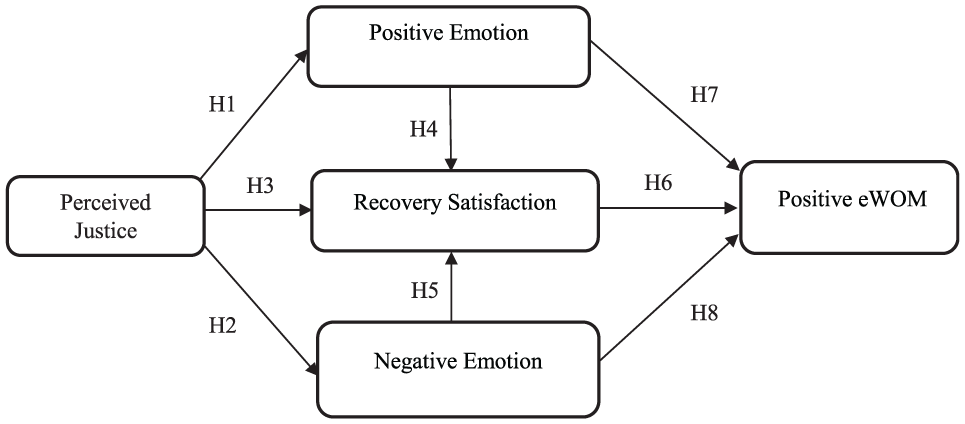
Propose model.
Methodology
Questionnaire Design
Items for measuring PJ is developed by Harun et al. (2018). Item development for recovery satisfaction is based on Del Río-Lanza et al. (2009). The scales of positive emotion and negative emotion are borrowed from Smith et al. (2002) and Dewitt et al. (2008). Moreover, Items for measuring positive eWOM are measured by Luong et al. (2021). A five-point Likert scale, ranging from “strongly disagree” (1) to “strongly agree” (5), was used to measure all items (Appendix 1).
Data Collection
Quantitative research employing an online questionnaire was developed based on previous research. Before full distribution, a pretest was administered to verify the clarity and relevance of the item wording, the accuracy of construct measurements, and the comprehensibility of the back English–Vietnamese translation. Based on feedback from the pretest participants, the Vietnamese version of the questionnaire was revised to ensure that the wording was appropriate and the measures effectively captured the constructs examined in the study.
Data were collected through an online survey administered in Vietnam during the study period. Convenience sampling was employed to select e-shoppers who had lodged complaints and experienced SR within the 12 months preceding their participation in the survey. Respondents meeting the specified criteria were granted access to proceed with the survey. Participants were provided with a URL granting access to the questionnaire using a nonrandom sampling method. A total of 535 responses were obtained, of which 510 were used after removing questionnaires with incomplete or suspected untrue responses.
The sample consists of 510 participants who have encountered and formally reported at least one instance of service failure in online shopping. Of these respondents, 52.5% (n = 268) are female, and 47.5% (n = 242) are male. The vast majority of participants (91.8%) fall within the 18 to 30 age range. For monthly income, 35.9% of people earned from $100 to $300 monthly, and 35.3% of others made $300 to $500 every month, followed by $500 to $700 (18.0%) and more than $700 (10.8%).
Data Analysis
PLS-SEM was employed to analyze models involving mediating structures and complex causal paths (Hair et al., 2014). This second-generation analytical tool offers superior flexibility compared to traditional methods, specifically regarding its ability to handle limited sample sizes, non-normal data distributions, and diverse measurement scales (Chin et al., 2003). Thus, SmartPLS 3.0 was employed to conduct the data analysis in this study. Initial data screening was conducted using SPSS version 20.
Results
Common Method Bias
This study employed a cross-sectional design based on self-reported questionnaire data, which may be susceptible to common method bias (CMB). To mitigate this concern, both procedural and statistical remedies were implemented in accordance with Podsakoff et al. (2003). Participants were briefed on the study’s goals and guaranteed total anonymity and confidentiality. To ensure the integrity of the responses, it was emphasized that the survey sought personal perceptions rather than objectively “right” or “wrong” answers. Statistically, Harman’s single-factor test indicated that the first factor captured 37.76% of the variance, below the 50% threshold, indicating that CMB was not a problem in this study.
Measurement Model
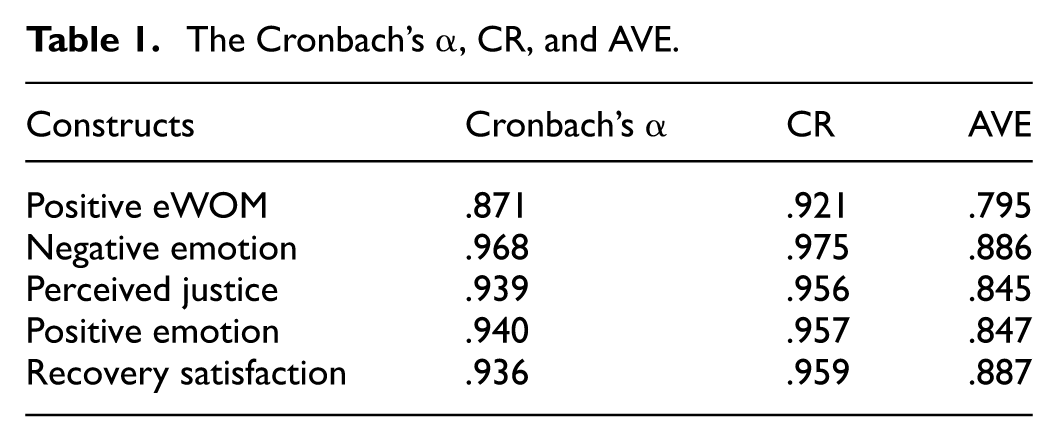
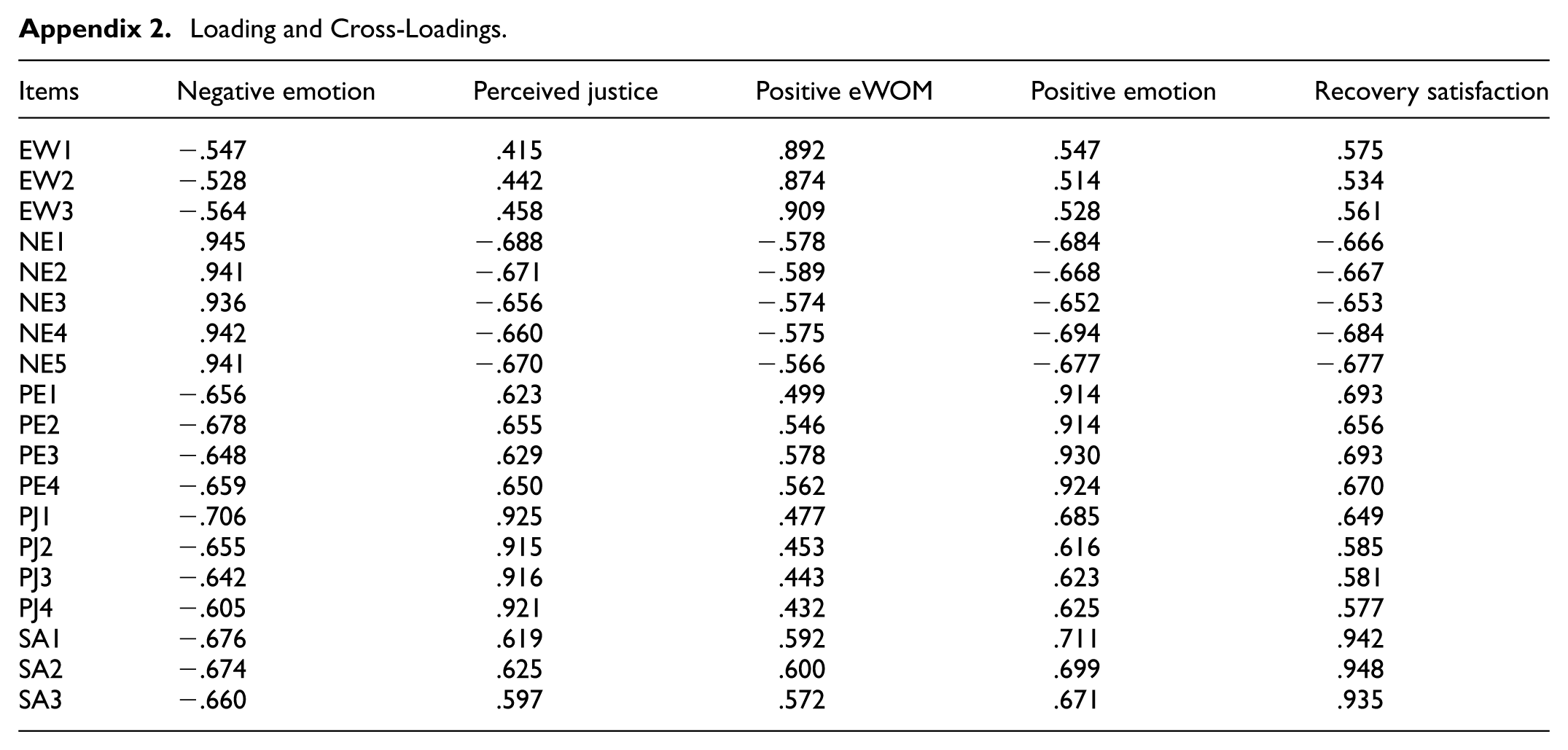
Convergent validity assesses the extent to which items accurately represent the intended construct, while discriminant validity evaluates whether distinct constructs are statistically distinguishable. Table 1 shows that all α coefficients were above .80, indicating strong internal consistency. Furthermore, the factor loadings surpass the acceptable cut-off of .80, and CR values are above .70, supporting the reliability of the measurement model (Appendix 2). Finally, all constructs yielded AVE values above .50, thus indicating satisfactory convergent validity (Hair et al., 2017).
The Cronbach’s α, CR, and AVE.
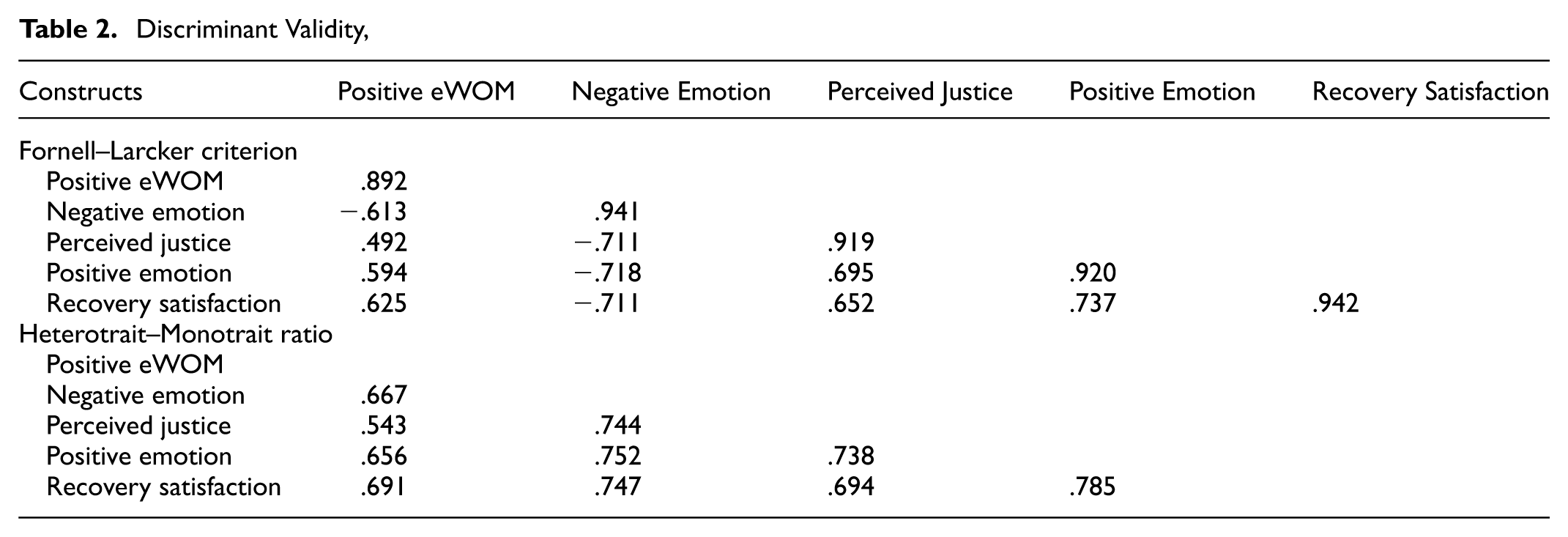
The square root of the AVE for each construct exceeds its correlations with other constructs, indicating adequate discriminant validity (Fornell & Larcker, 1981). Furthermore, all HTMT ratios fall below the recommended threshold of .90, and the item loadings for each construct exceed their corresponding cross-loadings, offering further evidence of satisfactory discriminant validity (Hair et al., 2017; Table 2).
Discriminant Validity.
Results of the Structural Model
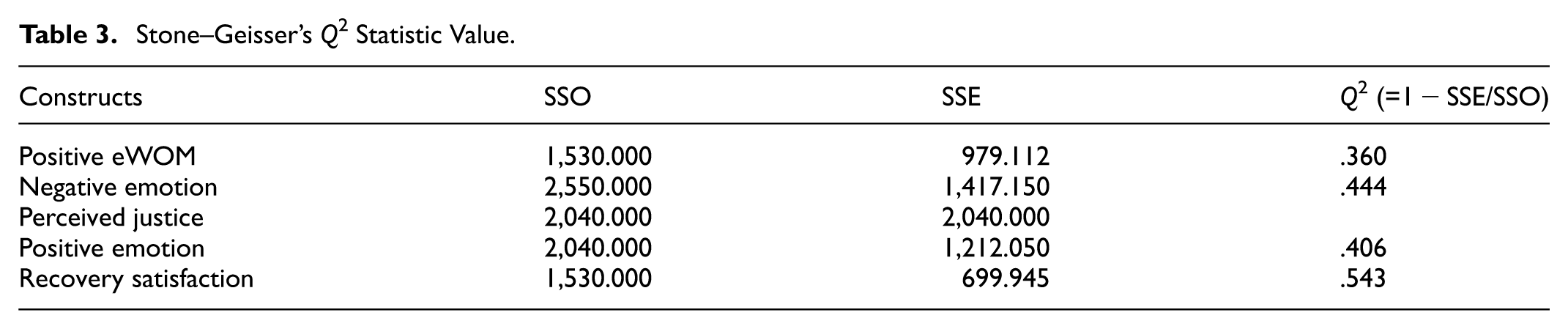
Following the blindfolding procedure, cross-validated redundancy values were evaluated to assess the model’s predictive relevance using Stone-Geisser’s Q2 statistic (Chin, 1998). Table 3 indicates that the Q2 value for the key construct, PJ, exceeds zero, thereby confirming the model’s predictive relevance. Additionally, the SRMR was .078 < .08, indicating a satisfactory model fit (Hu et al., 1999). Hence, the model demonstrates adequate predictive power and goodness of fit.
Stone–Geisser’s Q2 Statistic Value.
Hair et al. (2017) recommend interpreting R2 values of .25, .5, and .75 as indicative of weak, moderate and substantial explanatory power, respectively. Based on these thresholds, the findings suggest that PJ, both positive and negative emotions play a substantial role in shaping recovery satisfaction (R2 = .618). Additionally, PJ, recovery satisfaction, positive and negative emotions exert a moderate effect on positive eWOM (Table 4).
Hypothesis Results.
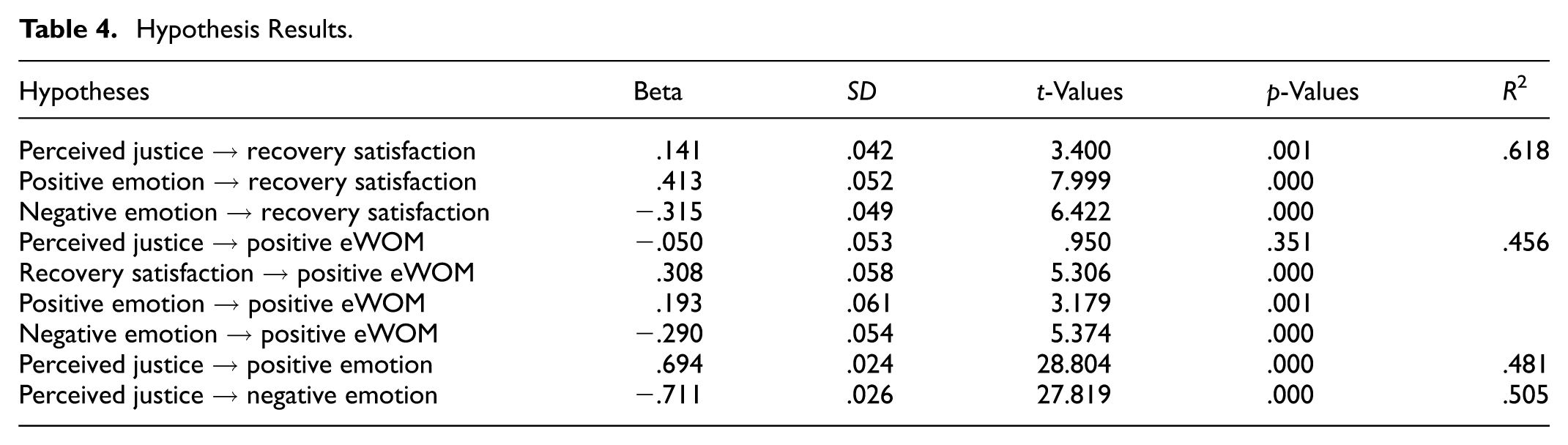
The results of the structural model offer empirical support for the proposed research framework (Figure 2). PJ has a significant positive effect on positive emotions with SR (β = .694, p < .01) and recovery satisfaction (β = .141, p < .01), while exerting a significant negative effect on negative emotions (β = −.711, p < .01). These findings indicate that fairness perceptions play a critical role in shaping customers’ affective and evaluative responses following SR, thereby supporting H1, H2, and H3.
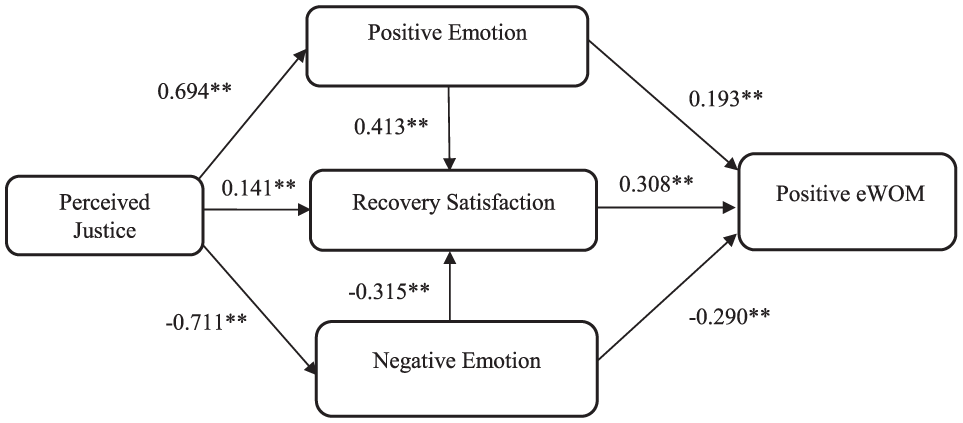
Path results.
Emotional responses, in turn, significantly influence recovery satisfaction. Specifically, positive emotions are positively associated with recovery satisfaction (β = .413, p < .01), whereas negative emotions exhibit a significant negative relationship with recovery satisfaction (β = −.315, p < .01), providing support for H4 and H5.
Finally, recovery satisfaction has a significant positive effect on positive eWOM (β = .308, p < .01). Beyond this indirect pathway, emotional responses also directly influence eWOM: positive emotions enhance positive eWOM (β = .193, p < .01), while negative emotions reduce it (β = −.290, p < .01). Accordingly, H6, H7, and H8 are supported.
The mediation analysis was conducted using the bootstrapping procedure in SmartPLS. This study examines how recovery satisfaction, negative emotion and positive emotion mediate the relationship between PJ and eWOM. The results indicate that all three specific indirect effects are statistically significant, while the direct effect of PJ on positive eWOM is non-significant (Figure 2). Notably, the 95% bias-corrected confidence intervals (CI) for all paths do not contain zero, confirming the robustness of the mediation. Thus, recovery satisfaction (β = .044, p < .01, 95% CI [.019, .079]), positive emotion (β = .134, p < .01, 95% CI [.050, .214]) and negative emotion (β = .206, p < .01, 95% CI [.124, .278]) fully mediate the relationship between PJ and positive eWOM (Nitzl et al., 2016; Zhao et al., 2010). This implies that PJ influences positive eWOM only through emotions and recovery satisfaction; without these three factors, fairness by itself does not directly lead to positive eWOM (Table 5). Thus, H9, H10, H11 are supported.
The Mediation Role of Recovery Satisfaction and Emotions.

Discussion
The study confirms that PJ serves as the primary cognitive trigger in the recovery process, significantly enhancing positive emotions while mitigating negative ones. The findings align with CA theory, which suggests that emotions are not random but stem from an individual’s evaluation of an event. The results corroborate previous research indicating that effective SR increases perceptions of justice, which in turn fosters positive emotional states (Ali et al., 2021; Chebat et al., 2005; DeWitt et al., 2008; Smith et al., 2002).
PJ is identified as a key antecedent that positively influences recovery satisfaction. Customers who perceive higher justice report greater satisfaction with the recovery effort. The results extend the work of Ali et al. (2023), which primarily focused on recovery satisfaction and trust. The study advances their model by introducing the role of mixed emotions. Furthermore, it adopts Liao’s (2007) unidimensional approach of PJ in the specific context of Vietnam’s e-commerce sector. Beyond justice, the study highlights that recovery satisfaction is significantly shaped by the emotions experienced during recovery. In detail, positive emotions exert a strong favorable effect on recovery satisfaction, while negative emotions significantly reduce satisfaction levels of the recovery process. The findings enhance the research by Mattila and Wirtz (2000) by confirming that recovery satisfaction is a complex evaluation driven by both cognitive fairness and affective experiences.
A major finding is that positive emotion exerts the strongest effect on recovery satisfaction, surpassing both negative emotion and PJ. This suggests that while justice triggers the process, it is the affective experience of relief, joy, or gratitude that truly determines whether a customer feels satisfied after a failure. Therefore, positive emotions help increase recovery satisfaction more effectively than simply providing a fair outcome. It validates the CA theory by showing that the “warm glow” of a successful recovery is more influential than the cognitive assessment of fairness alone. In contrast, negative emotions play a distinct role that is independent of positive ones. Even if a firm provides a fair recovery, the presence of negative emotions significantly reduces recovery satisfaction. It also acts as a deterrent to advocacy, which makes customers more likely to seek alternative providers and withhold positive eWOM. This supports the concept of SET that negative emotions serve as affective costs that lead customers to view the exchange as unfair, causing them to disengage from the firm.
The study underscores the direct and significant effect of recovery satisfaction on positive eWOM. This finding aligns with prior research indicating that satisfied customers in the SR context are more inclined to advocate for the firm (Ding & Lii, 2016; Luong et al., 2021). Furthermore, emotions act as direct antecedents to advocacy. As mentioned by Serra-Cantallops et al. (2018), customers experiencing positive emotions after SR are more likely to share positive stories. Conversely, negative emotions lead to a withdrawal of support, making positive eWOM unlikely. To generate advocacy, firms must achieve both high recovery satisfaction and a positive emotional shift; mere problem resolution is insufficient.
A critical finding is that there is no significant direct link between PJ and positive eWOM. Instead, the relationship is fully mediated by emotions and recovery satisfaction. The results provide insight that the perception of justice alone does not automatically lead to advocacy. CA theory posits that a cognitive perception does not lead directly to complex behavioral outcomes like eWOM. Furthermore, under SET, positive eWOM has been treated as voluntary reciprocity to repay the firms for emotions and recovery satisfaction act as the affective benefits of the social exchanges. It must first translate into positive internal psychological states through emotions and recovery satisfaction to drive behavior. This validates the study’s proposed sequential model, highlighting that satisfaction and emotions with the recovery act as a “bridge” explaining how justice perceptions translate into loyalty behavior in the form of eWOM.
Conclusion
Past studies related to service failure have affirmed the relationship among SR, customer recovery satisfaction and positive eWOM. However, the relationships between PJ and recovery satisfaction, as well as between recovery satisfaction and positive eWOM, remain insufficiently explored and clarified (Ding et al., 2016; Padmavathi & Sunil, 2023; Velázquez et al., 2015). Furthermore, measuring consumers’ emotional reactions to the company’s SR is still lacking in extensive research (Abdelkader Ali et al., 2026; Ali et al., 2023; Chebat et al., 2005). In line with prior study (DeWitt et al., 2008), the findings in the current study show that PJ in the aftermath significantly impacts positive and negative emotional responses.
Furthermore, positive emotion and negative emotion significantly impact positive eWOM. While prior research has predominantly adopted a unidimensional focus, examining either negative or positive emotions, this study offers a valuable contribution by incorporating both dimensions. By addressing negative and positive emotional responses simultaneously, it enhances the current understanding of consumer emotions during recovery.
The findings confirm the positive dual effects of recovery satisfaction and emotions on the generation of positive eWOM. The positive customer-to-customer interaction is the result of not only consumer satisfaction and positive emotions with the initial buy but also his or her recovery satisfaction with service failure. The findings also reveal that recovery satisfaction and emotions fully mediate the relationship between PJ and positive eWOM. It is important to emphasize that this empirical evidence is derived specifically from the Vietnamese e-commerce context. Therefore, post-failure satisfactory experiences and positive emotional responses to businesses generate greater opportunities for consumers to praise the company and express a preference over others.
Theoretical Implications
This work contributes to the implications of adopting justice theory by presenting different roles of PJ in predicting satisfaction and emotions with SR. This study contributes that PJ is one latent construct to acknowledge various justice dimensions which supports the approaches of Ambrose and Schminke (2009) and Harun et al. (2018). This unidimensional approach provides a more parsimonious and accurate reflection of how digital consumers form cumulative evaluations of fairness rather than distinguishing between fragmented justice dimensions. Moreover, the contribution lies in supporting the role of recovery justice within a more complicated online setting as the sum of fairness that creates the emotional and evaluative momentum necessary to turn a service failure into positive eWOM.
By extending the CA model, the study addresses PJ as the primary appraisal mechanism—the cognitive trigger—that initiates a sequential process. It moves beyond models that focus on a single emotion by empirically validating the role of mixed emotions (both positive and negative), illustrating how these affective outcomes emerge directly from fairness perceptions. This approach is in line with CA theory that while consumers’ evaluation of fairness during and after the recovery process serves as the cognitive trigger, their emotions emerge as the resulting affective outcomes of these perceptions (Soenen et al., 2019).
The findings clarify the internal psychological process through which recovery efforts translate into advocacy. This manuscript supports the foundational premise established by Ali et al. (2023) that PJ consistently enhances customer recovery satisfaction. However, this study advances previous work—which primarily focused on satisfaction and trust—by introducing mixed emotions into the model to explain the affective bridge that justice must cross to reach recovery satisfaction. By modeling emotions and recovery satisfaction together, the study shows that fairness (cognition) leads to affective states (emotions), which then dictate the final judgment (satisfaction) and subsequent behavior.
A critical contribution is the discovery that PJ does not lead directly to positive eWOM. Instead, this relationship is fully mediated by the dual paths of recovery satisfaction and emotions with SR. This indicates that fairness alone is insufficient for advocacy; it must first be translated into positive emotional and evaluative states, thereby contributing to the dual mediating effects in the link between PJ and positive eWOM in SR.
Drawing on SET, the study frames positive eWOM as a form of reciprocity where customers repay firms for fair treatment. It positions eWOM not just as a loyalty metric but as a high-value customer citizenship behavior, with recovery satisfaction and emotions acting as the affective currencies of the exchange. Ultimately, this finding gains further relevance when viewed through the lenses of justice theory, CA theory, and SET to establish the sequential cognition—emotion—evaluation path.
Managerial Implications
The study offers strategic insights into turning consumers’ complaints into opportunities for advocacy. Firstly, firms must recognize the importance of recovery satisfaction and emotional experiences for long-term loyalty. Because positive emotion is the strongest driver of recovery satisfaction, recovery strategies should be designed specifically to foster feelings of relief, gratitude, or joy. Staff should be trained to deliver consistent justice cues that convey overall fairness. It includes offering clear procedures, timely responses, and financial compensation where appropriate. These actions could play the role of cognitive triggers for reducing negative emotions and reinforcing recovery satisfaction.
Human agents and automated systems should also incorporate empathy into the recovery process. By training the emotional intelligence, acknowledging customer frustration and expressing sincere empathy can foster positive emotional shifts necessary to prevent a customer from disengaging and moving to a competitor. Managers should track recovery satisfaction separately from initial or general purchase satisfaction. This allows firms to identify how effectively they are managing complaints and to create specific conditions that encourage advocacy and positive eWOM. Ultimately, rather than viewing customer complaints as operational failure, firms should treat them as a retention catalyst. By creating emotionally positive recovery experiences, online providers can motivate customers to share positive ones, effectively turning a service failure into a powerful source of positive eWOM.
Limitations and Future Research
We acknowledge several limitations for future research. Firstly, the findings may lack generalizability due to the sample’s concentration in the 18 to 30 age range. Future research should prioritize the recruitment of diverse participants to ensure the results are representative of a broader demographic. Secondly, the proposed model was evaluated within the context of service failures in the Vietnamese online retailing industry. Future studies could explore SR across different retailing contexts to enhance external validity. However, cultural values and consumer digital behaviors in Vietnam may differ from those in other emerging or developed markets, generalization to other sectors and cultural contexts should be approached with caution. Thirdly, individual differences in personality and behavioral tendencies may condition the observed effects. Future research should consider incorporating potential moderating variables such as trust, assertiveness, or aggressiveness to provide a more nuanced understanding. Fourthly, this study focuses exclusively on customers who initiated complaints. As a result, it remains uncertain whether customer-initiated complaints elicit different reactions to recovery efforts compared to those initiated by service providers. Future research could examine scenarios where firms proactively identify and address service failures before customers voice complaints.
Footnotes
Appendix
Loading and Cross-Loadings.
| Items | Negative emotion | Perceived justice | Positive eWOM | Positive emotion | Recovery satisfaction |
|---|---|---|---|---|---|
| EW1 | −.547 | .415 | .892 | .547 | .575 |
| EW2 | −.528 | .442 | .874 | .514 | .534 |
| EW3 | −.564 | .458 | .909 | .528 | .561 |
| NE1 | .945 | −.688 | −.578 | −.684 | −.666 |
| NE2 | .941 | −.671 | −.589 | −.668 | −.667 |
| NE3 | .936 | −.656 | −.574 | −.652 | −.653 |
| NE4 | .942 | −.660 | −.575 | −.694 | −.684 |
| NE5 | .941 | −.670 | −.566 | −.677 | −.677 |
| PE1 | −.656 | .623 | .499 | .914 | .693 |
| PE2 | −.678 | .655 | .546 | .914 | .656 |
| PE3 | −.648 | .629 | .578 | .930 | .693 |
| PE4 | −.659 | .650 | .562 | .924 | .670 |
| PJ1 | −.706 | .925 | .477 | .685 | .649 |
| PJ2 | −.655 | .915 | .453 | .616 | .585 |
| PJ3 | −.642 | .916 | .443 | .623 | .581 |
| PJ4 | −.605 | .921 | .432 | .625 | .577 |
| SA1 | −.676 | .619 | .592 | .711 | .942 |
| SA2 | −.674 | .625 | .600 | .699 | .948 |
| SA3 | −.660 | .597 | .572 | .671 | .935 |
Acknowledgements
The authors sincerely appreciate the constructive comments and suggestions provided by the anonymous reviewers, which have greatly enhanced the quality of this article. The authors also extend their gratitude to all participants whose involvement made the survey possible.

Ethical Considerations
This study involves a non-interventional survey conducted with adults and does not involve physical or psychological interventions. Formal ethical approval was not sought as the research posed minimal risk to participants, involved no intervention or deception, and did not collect any personal or sensitive information. According to the regulations of the university where it was conducted, this type of study does not require ethical approval.
Consent to Participate
This study involved the voluntary participation of individuals through an anonymous questionnaire. All participants were informed about the purpose of the study, the voluntary nature of their participation, and their right to withdraw at any time. They were assured of the confidentiality of their responses and their right to withdraw from the study at any time without penalty. No identifying information was collected, and all responses were recorded anonymously to protect participant confidentiality.
Author Contributions
Thi Huong Giang Vo: Writing – review & editing, Writing – original draft, Resources, Conceptualization, Supervision, Data curation, Formal analysis. Duy Binh Luong: Writing – review & editing, Validation, Visualization, Supervision, Project administration, Methodology, Software, Investigation, Formal analysis, Data curation, Conceptualization.
Funding
The authors received no financial support for the research, authorship, and/or publication of this article.
Declaration of Conflicting Interests
The authors declared no potential conflicts of interest with respect to the research, authorship, and/or publication of this article.
Data Availability Statement
The datasets are available upon reasonable request from the corresponding author.*