



Abstract
Serious games are pedagogic tools aiming to serve educational or informative purposes by incorporating fun aspects of games with serious elements of learning. Serious games are an emerging trend in medical and nursing education since they provide the ideal opportunity to increase knowledge and enhance decision-making and problem-solving skills by actively involving learners. However, serious game initiatives on hospital management education have been given less attention. This is the first contemporary systematic review addressing the significant research gap by synthesizing existing evidence on serious games in the hospital management field, to highlight their potential in enhancing managerial and administrative skills. Robust search algorithms were implemented in Scopus and PubMed yielding 892 results. Overall, 36 serious games emerged with half of them being digital. Regarding game design, most were multiplayer games, while several required team collaboration. Serious games’ main learning target was categorized according to Katz’s three-skill approach for effective administration, including technical, interpersonal, and conceptual skills acquisition. Serious game learning activity type, teaching subject, and geographical distribution were also explored. The findings stimulate interest and increase awareness of using serious games to enhance hospital personnel’s knowledge and skills in managerial roles and administrative processes. Furthermore, the review intended to inspire academics and health care policymakers to convey administrative skills and basic management concepts to various hospital employees and health care/management students through game-based learning.
Keywords
Introduction
The daily working life of hospital executives and health care professionals assigned administrative duties and managerial roles resembles a series of game-like challenges. They should be able to determine strategies and predict outcomes similarly to chess players, develop tactics and maneuver like poker experts, and act as cooperative team players to improve organizations’ productivity and outcomes. 1 But what if game-based learning could actually be used to enhance hospital management knowledge and experiences and increase administrative skills acquisition?
Literature indeed supports that game-based learning, including serious game utilization, strongly impacts learner motivation and cognitive outcomes, making it a powerful motivation driver. 2 More specifically, according to a popular definition by Alvarez, serious games serve educational or informative purposes by combining serious elements of learning with playful and fun aspects of gaming, capitalizing on the innate human inclination to play but also incorporating game mechanisms into the learning experience. 3 Serious games are proven to be effective pedagogical tools, especially compared with conventional educational methods, 4 and gamification has long been used in science education to enrich the teaching experience, enhance information transfer, and increase learner involvement. 5
Along this line, serious games and game-based learning have become a flourishing trend in health care professionals’ education. 6 Numerous systematic reviews report on serious games being developed and implemented in the medical and nursing field,7–9 considering they provide learners with the perfect opportunity to increase knowledge, enhance decision-making and problem-solving skills, and gain valuable practical experience in risk-free environments.10,11 However, serious game initiatives on hospital management education have been given less attention, although it has been reported that they can be powerful training and management development tools for improving team performance, enhancing resource allocation skills, and increasing leadership abilities in hospital personnel. 4
According to the above, within health care organizations, serious games can be seen as alternative management tools designed to address challenging administrative issues by utilizing gaming experiences to simulate realistic scenarios and reflect real-life work situations. 12 This is particularly useful considering that health care managers are frequently acting at the complex interface of conflicting objectives, such as ensuring high-quality care, promoting employee well-being, and fulfilling efficiency needs and political regulations. To this end, serious games enable health care managers and hospital executives to evaluate different decisions, experience their potential outcomes, and hence strengthen strategic planning abilities and successful decision-making processes in practice. 10
The current systematic review was inspired by a previous extensive review conducted 15 years ago by Kraus and colleagues on hospital management games from an operations research perspective. 13 This is the first contemporary systematic review to address this existing research gap by reporting on the development and implementation of digital and analog serious games in the hospital management field, to highlight the most recent serious game initiatives that can improve managerial and administrative competencies. Furthermore, apart from providing an updated and comprehensive synthesis of the state-of-the-art knowledge in the field of hospital serious games, it explores the extent of serious game digitalization and stimulates interest in using serious games to enhance hospital personnel’s knowledge and skills in managerial roles and administrative processes. The overall objective was to provide useful insights by summarizing all the available studies in the literature, to motivate academics and health care policymakers to convey administrative skills and basic management concepts to a wide variety of hospital employees and health care students through game-based learning.
Material and Methods
Literature reviews are increasingly important in navigating the expanding volume and rapid dissemination of research, enabling synthesizing and contextualizing the latest scientific developments. As the pace of publication accelerates, different types of reviews (e.g., integrative reviews, structured reviews, systematic reviews) have emerged for maintaining an up-to-date understanding of the state-of-the-art knowledge.14,15
For the present article, a systematic literature review on studies developing and implementing serious games to enhance hospital personnel’s knowledge and skills in managerial roles and administrative processes was conducted in the PubMed and Scopus databases. The overarching research question (RQ) formed in order to guide the systematic review was: “What are the global trends in the development and implementation of serious games in hospital management over the past twenty years, in terms of format, geographic distribution, gameplay characteristics, and targeted educational objectives or skills?”
In addition, four specific RQs were developed to inform the analysis: How many serious games in the hospital management field have been developed and implemented in the past 20 years? Are digital serious games more common than analog serious games? Are hospital management serious game initiatives distributed equally around the globe? Is any country a leader in the field? What types of serious games are most commonly implemented? What are their main gameplay characteristics? What are the most common educational subjects of the emerged serious games? Which hospital management skills do they most often try to enhance?
To form the search algorithms that would answer the above RQs, we investigated keywords used in relevant studies and algorithms implemented by similar review articles. Keywords focused on two main categories: (1) hospital management and health care administration-related key terms, and (2) serious games and game-based learning search terms. As a result, three robust search algorithms were implemented: two in Scopus (technical/multidisciplinary database) and one in PubMed (health-specific database). The PubMed search algorithm utilized the most relevant MeSH terms along with other common keywords. In the Scopus database, a high-precision search algorithm was first implemented utilizing four basic key terms and examining only the titles of the articles. Furthermore, a supplementary broader search algorithm was created to locate relevant studies that did not emerge from the first algorithm. The second search algorithm utilized multiple related keywords to provide a more extensive review of the literature. Search algorithms can be found in Supplementary Data (Table 1).
Summary of Studies Included in the Systematic Review
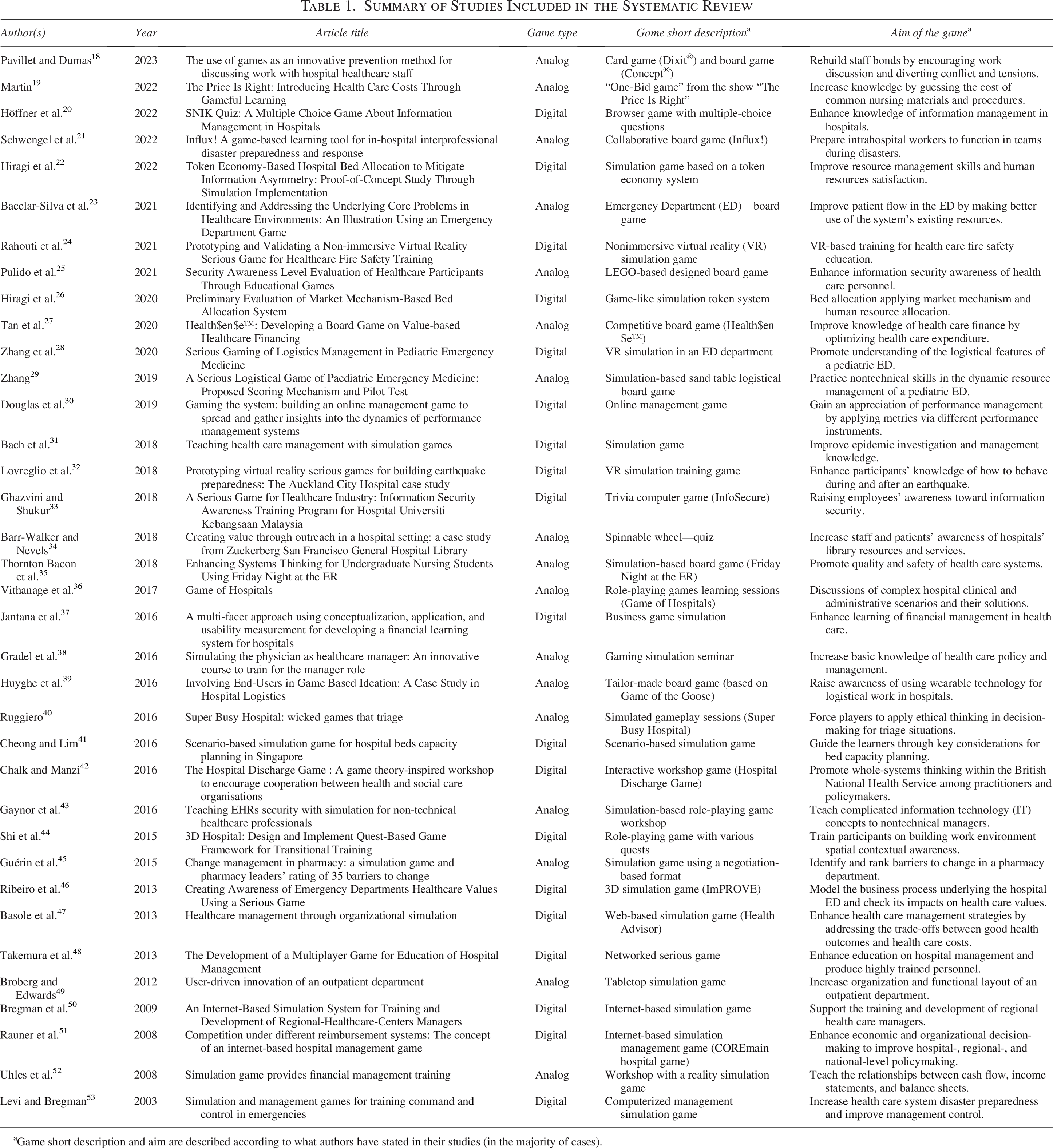
Game short description and aim are described according to what authors have stated in their studies (in the majority of cases).
Among the inclusion criteria set were the following: publish period from 2003 to 2023, English language, studies categorized as articles/reviews/conference papers/conference reviews/editorial doctype (in the supplementary algorithm of Scopus), and studies developing and/or implementing serious games targeting to enhance hospital management/administration knowledge and skills acquisition. The selected time horizon, spanning from 2003 to 2023, was strategically chosen to provide a comprehensive and up-to-date synthesis of the current knowledge in this field that has experienced rapid advancements over the past two decades. The PubMed and Scopus database selection was made based on their accessibility, their inclusion of high-quality peer-reviewed journals, the high-quality multidisciplinary coverage, and their standardized indexing methodologies, making them ideal sources for retrieving studies on serious games for hospital management.
The main exclusion criteria included: studies focusing on game theories without developing a serious game, studies introducing serious games aiming to enhance hospitals’ personnel care provision skills, and studies that were not retrieved in full-text form.
A three-step process was followed to screen the eligible articles. Initially, the relevance of the studies was examined according to their title. Consequently, the abstracts were screened to select studies of interest. Finally, the article’s full text was reviewed to determine the included studies. The initial screening on article titles aimed to quickly exclude articles that were clearly irrelevant to our RQ. This step helped to efficiently narrow down the pool of potential studies. The abstract screening involved a more in-depth evaluation to determine whether the study’s objectives, methods, and findings aligned with our inclusion criteria. At this stage, studies that did not meet the relevance were excluded, ensuring that only pertinent articles proceeded to the full-text review. During the full-text review, the eligibility of each article was assessed comprehensively against the predefined inclusion and exclusion criteria. This rigorous process ensured that only high-quality and relevant studies contributed to the final synthesis. Figure 1 describes the undertaken methodological steps (flow diagram according to Preferred Reporting Items for Systematic reviews and Meta-Analyses guidelines), which demonstrates the systematic review process per stage in numbers. 16

Study selection flow diagram (according to PRISMA 2020 flow diagram for new systematic reviews, which includes searches of databases and other sources). PRISMA, Preferred Reporting Items for Systematic reviews and Meta-Analyses.
Overall, 892 articles emerged from the search algorithm, and upon removing duplicates, 810 articles were screened. After thorough review, 34 studies were finally included according to the inclusion and exclusion criteria. Furthermore, two more relevant publications were included via the backward snowballing technique. Backward snowballing technique involved reviewing the reference list of included studies to identify other relevant articles that may not have been captured through database searches. 17 This method helps to mitigate publication bias and ensure comprehensive coverage of the literature.
Results
Overall, 36 studies were included in the systematic review.18–53 The main characteristics of the identified studies (first author, publication date, title, game type, game short description, aim of the game, and reference) are listed in Table 1. The majority of them (77.8%) were published during the past decade, while altogether, more than 1700 participants were enrolled. The participants’ number was derived from 26 studies that clearly stated the participants’ sample. Enrolled participants were mostly hospital personnel and health care professionals (50.0%) or health-related students, and students in management, informatics, and other disciplines (33.3%). A 16.7% included a varied study sample of hospital personnel, academics, researchers, students, health care managers, and policymakers. To calculate the overall sample size, we excluded studies that: (1) did not provide a clear participant number18,19,43,50,51; (2) enrolled hospital personnel, patients, and community members without separating the number of participants in each group 34 ; and (3) did not mention being pilot tested.31,46,53 According to the above, the precise number of participants was estimated at 1772.
To address RQ1, “How many serious games in the hospital management field have been developed and implemented in the past 20 years? Are digital serious games more common than analog serious games?” we located and removed studies reporting on the same digital tool in more than one publication. Accordingly, one study was excluded, 26 and the most recent publication of the specific serious game was included. 22 Furthermore, a study introducing two entirely distinct games was located. 18 Therefore, we concluded that 36 serious games have been developed during the past vicennium to enhance hospital management knowledge and skills. Regarding serious game types, notably 50% of them were digital and 50% were analog. Figure 2 depicts the exact number of analog and digital games developed per triennial during the understudy period.
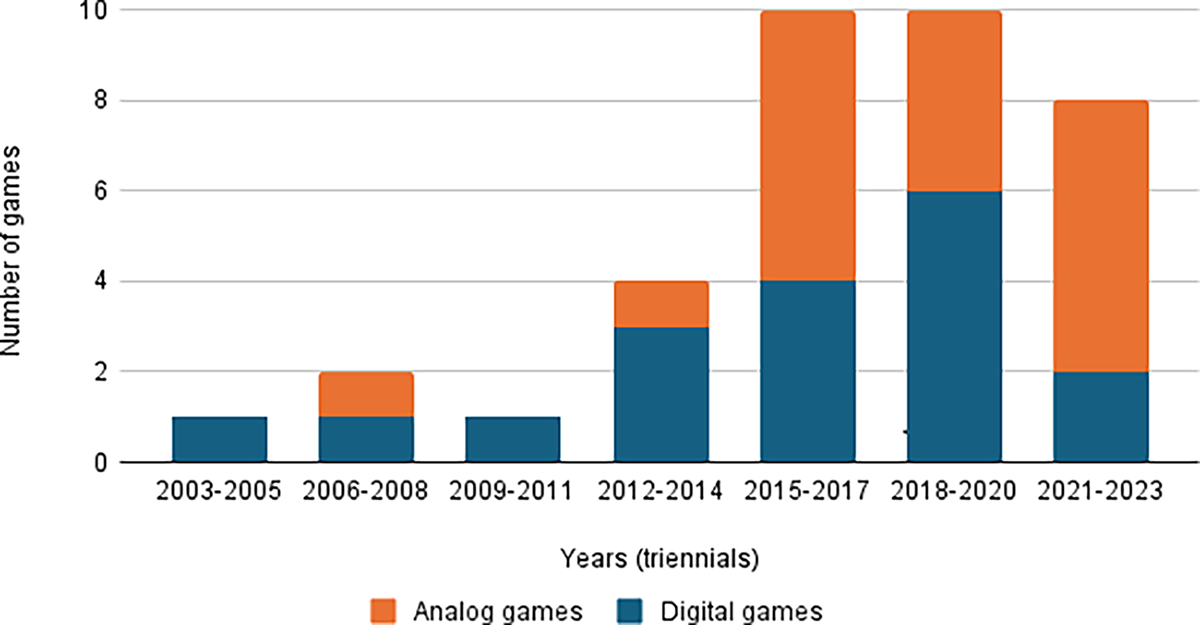
Number of identified serious games in digital or analog form per triennial (2003–2023).
Responding to RQ2, “Are hospital management serious game initiatives distributed equally around the globe? Is any country a leader in the field?” we categorized the studies according to their development sites. Consequently, 19 countries from 4 continents were identified. In Figure 3, the countries are depicted along with chromatic information regarding the number of published articles per country. The pioneer country in utilizing serious games for hospital management educational purposes was the United States, counting eight published articles. Also, the United Kingdom and Japan showcased a slightly increased number of publications (n = 3), while all the other countries followed with one or two relevant articles published. Analytical information on the number of studies each country yielded, along with references to those articles, can be found in Supplemental Data (Table 2).

Number of studies published on hospital management serious games per country (2003–2023).
Learning Activity Type Implemented by the Identified Serious Games

Multiple studies reporting on the same digital tool are excluded.
Studies reporting on the same digital tool are not excluded.
RPG, role-playing game.
To answer RQ3, “What types of serious games are most commonly implemented? What are their main gameplay characteristics?” we categorized the emerging serious games into four broad groups according to the type of learning activity implemented. To this end, the categories were: (1) simulation games, (2) quizzes, (3) role-playing games, and (4) board games/card games. Several serious games presented multiple learning activity features; however, the classification was made according to the games’ predominant characteristics. For the serious game with the two publications, we included only the most recent article to avoid any overestimation. According to the results, the most common serious game type was by far simulation games (61.1%). Table 2 presents more information on the frequency and percentage per serious game learning category type, along with the relevant reference numbers. Furthermore, regarding game design features, it was estimated that 63.9% of the serious games were multiplayer games,18,19,21–23,25,27,29,35,36,38–40,42,43,45,49–53 while 44.4% of them18,21,25,29,35,36,38–40,42,45,49–53 also required teamwork-based collaboration.
To address “What are the most common educational subjects of the emerged serious games? Which hospital management skills do they most often try to enhance?” (RQ4), serious games were categorized into six broad thematic groups according to the teaching subject: (1) upper management games (52.8%), (2) financial literacy games (11.1%), (3) work organization games (8.3%), (4) information security/cybersecurity games (11.1%), (5) building information modeling games (11.1%), and (6) other (5.6%). The “upper management games” category allows the participants to make decisions and enhance top management skills by filling roles in the higher organization hierarchy. In “financial literacy games,” players enhance financial knowledge and basic accounting skills by engaging in activities including cash flow, budgeting, and expenditure optimization. “Work organization games” focus on improving daily work environment aspects, such as enhancing team building and planning workflow organization. “Information security games” aim to provide knowledge about information management, including electronic health care records and digital security. “Building information modeling games” encourage collaborative working in designing, exploring, and using buildings. Finally, serious games that did not fit into any of the above categories were included into the “others” group.
Regarding the skills that the identified serious games attempt to enhance, categories according to Katz’s three-skill approach for effective administration were created, 54 including technical (38.9%), interpersonal (5.5%), and conceptual (55.6%) skills acquisition. Technical skills include among others: financial skills, digital literacy, designing work environments, and data analysis. Interpersonal skills revolve around effective communication, human behavior understanding, and motivating and empowering others. Conceptual skills are essential for top management since they focus on viewing the organization as a whole, evaluating situations, and making important strategic decisions. 55 The majority of serious games tried to enhance multiple skills, with the most common being decision-making, strategic thinking, and team collaboration (Supplementary Data, Fig. 1). Therefore, we initially classified the games according to their main target in line with Katz’s three-skill approach but also provided a more analytical description of the different skills each game enforced, depicted as subcategories of the technical, interpersonal, and conceptual skills in Figure 4. Relevant information is summarized in Table 3 (educational subject, Katz’s three-skill categorization, analysis of skills each game tries to enforce, and game content description).
Summary Table of Included Studies Educational Subject, Three-Skill Approach Categorization, Targeted Skills Enforcement, and Game Content Description
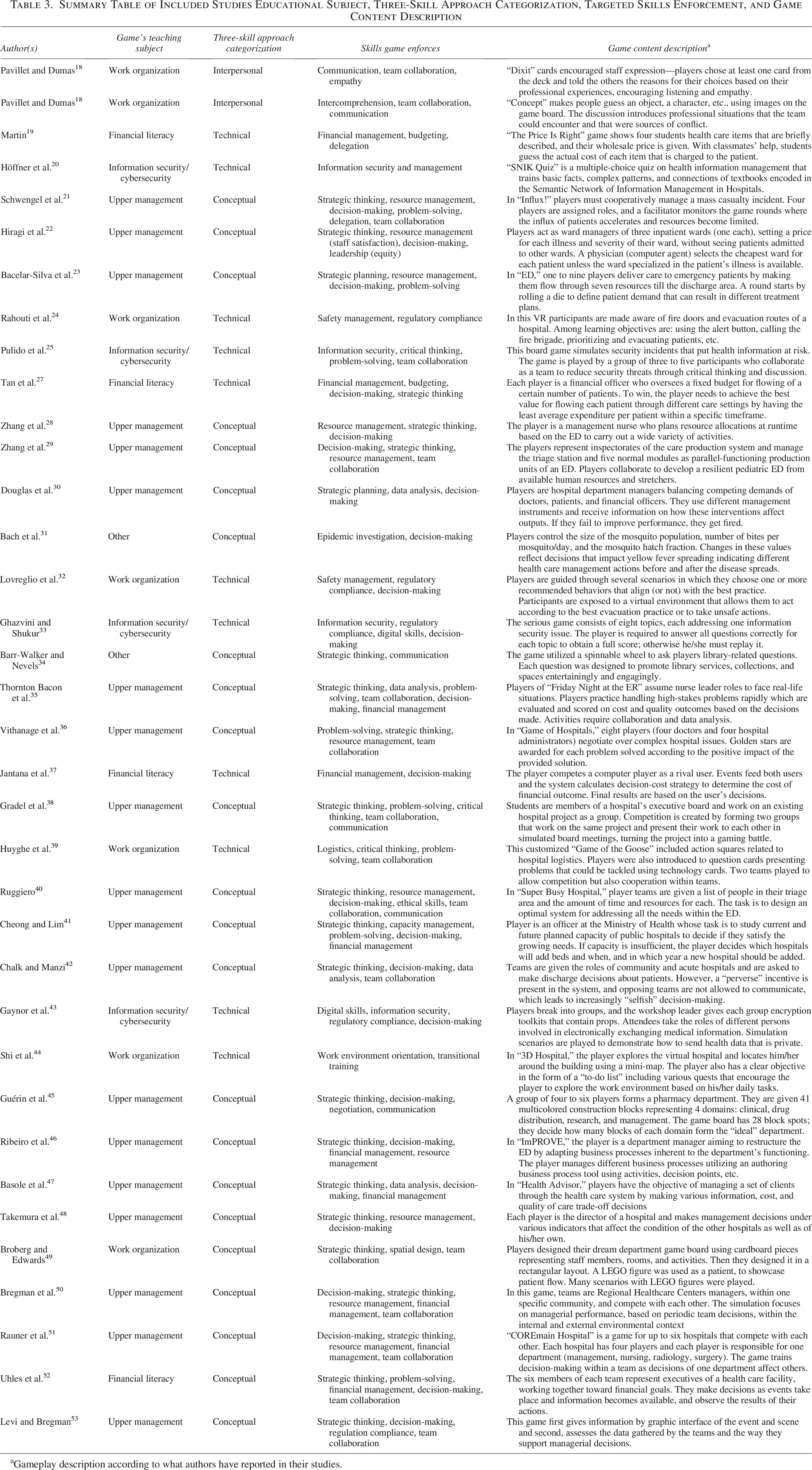
Gameplay description according to what authors have reported in their studies.

Classification of managerial skills the identified serious games try to enforce, according to Katz’s three-skills approach for leadership.
Discussion
This is the first contemporary systematic review reporting on the development and implementation of digital and analog serious games in the hospital management field. A similar-themed extensive review was conducted 15 years ago, revealing 13 hospital management games published during 1978–2008. 13 More recent relevant reviews include a systematic review on gamification in health care management that, however, excluded articles referring to serious games, focusing solely on the application of game elements in nonplayful environments (gamification). 56 Furthermore, a systemized literature review assessed operational research and management science (ORMS) games that could be utilized in health care. Nonetheless, the review did not reveal any relevant ORMS serious games for health care but identified six games that could be adapted to serve health care purposes. 57
The current findings suggest that serious game application in the health care management field has not increased tremendously over the past years; rather, a steady increase is observed in the triennials from 2015 and onward. Noteworthy, analog serious games have become more common in the past 10 years compared with digital ones. This observation opposes the literature, which supports that the COVID-19 pandemic accelerated digital educational tools transformation, with several serious digital games being developed in various health-related disciplines.8,58,59 This finding can be partially explained according to one of the included studies, which supports that board games increase social relatedness and enrich players’ experience, while participants (older working adults) are more familiar with board game format and assimilate the rules quicker compared with digital games. 27 Furthermore, the majority of the identified serious games were multiplayer games requiring team collaboration; similarly, literature supports that board games provide better opportunities for between-player discussion and allow more room for players to engage in deeper thinking, enhancing further knowledge acquisition compared with digital games. 60
Concerning the geographical distribution of the identified serious games, results indicate a moderate distribution mainly in European, North American, and Asian countries. This is consistent with a recent bibliometric analysis, which also places North America and Europe as the continents with the highest number of serious game-associated publications. 61 Furthermore, according to our findings, the United States is the leader in the field, counting eight distinct serious games in the hospital management field. Indeed, literature agrees that the United States is the largest contributor to serious game development, according to several studies focusing on the health care sector or other disciplines.11,61,62
Regarding the most common learning activity type, simulation serious games have the lion’s share. Especially, virtual simulation usage has globally increased in the past years since it is proven to improve learners’ experience at all educational levels, subjects, and contexts. 63 Simulation games utilize reality-based scenarios with action-oriented activities, 64 resulting in powerful educational tools for promoting teamwork and collaboration,65,66 but also aid in mastering managerial and leadership skills, such as complex and dynamic decision-making.67,68 To this end, a systematic review of different serious game genres identified, justifiably, simulations as the most prominent serious game genre. 68
As regards the most common subject among the identified serious games, upper management skills-themed games were the most predominant. This was expected since this category incorporates a wide range of important managerial and administrative duties including strategic planning, decision-making, and resource management allocation, which are key skills for all successful hospital executives. However, important game subjects such as financial literacy and information security games also emerged. Several members with higher administrative roles in hospitals are doctors or nurses, which creates a difficulty to understand complicated financial processes; thus, providing financial lessons in the form of serious games is considered rather helpful. 37 Additionally, data security is a complex concept for many health care managers; therefore, basic training on understanding data encryption and health care record privacy is considered crucial. 43
Finally, Katz’s three-skill approach theory 54 was embarked to classify the basic skills categories that the identified serious games tried to enhance. In an eminent article published in 1955, Katz introduced the necessary “manager skills” based on three categories: technical, interpersonal, and conceptual skills. 69 Interpersonal skills are important at every management level, technical skills are most important at lower and middle management levels, and conceptual skills are most important at the top management level. 70 We chose to incorporate the specific theoretical model since it is widely accepted by the scientific community and could incorporate perfectly all the individual subcategory skills within its main three-skill classification.
Summarizing, the literature supports that today’s management education needs to exceed traditional teaching models. 71 This document offers a coherent literature review on multiple serious games being developed regarding different educational subjects, targeting diverse populations, and enhancing several different managerial skills. This systematic review could serve as inspiration and guidance both for academics and health care stakeholders for including innovative serious games as part of hospital management training programs either at the postgraduate level or for lifelong training of hospital personnel. More specifically, academic institutions can leverage these innovative serious games to enrich their curricula, making learning more engaging and practical for students who are preparing for administrative roles in health care. Hospitals and other health care organizations can incorporate these educational tools into their training programs to ensure staff development of critical managerial competencies in an affordable, enjoyable, and interactive manner, ultimately leading to improved operational efficiency and patient care quality. For hospital personnel, serious games offer an easily accessible way to continuous learning and skills improvement, adapt to evolving challenges, and stay current with best practices, while simultaneously fostering team cohesion and enhancing their overall daily working life.
Furthermore, health care policymakers can greatly benefit by supporting the integration of serious games into ongoing educational and professional development initiatives, recognizing their potential to standardize and elevate health care managers’ competencies. Overall, the adoption of serious games tailored to specific stakeholder needs can foster a more competent, adaptable, and innovative health care management workforce, positively impacting organizational performance and patient outcomes.
Limitations
A potential limitation lies within selection bias; “serious games” is a relevantly old term (1970) that became popular over the past 15 years. However, only 13 of the included articles utilized the term “serious game” within their text. Therefore, multiple robust search algorithms were created including a wide range of relevant keywords to minimize the risk of misidentifying relevant studies. Furthermore, another limitation lies within the classification of “learning activity types” and “game’s teaching subject” categories. Their classification has a scientific basis; however, due to the heterogeneity of the reported information, we improvised to a certain extent to be able to report the data in more homogenous categories.
Conclusions
Serious games have conquered many scientific fields, and although in hospital management education the advances are rather modest, there are plenty of opportunities and benefits that learners could reap. This article can be perceived as a useful guideline for those who want to lead the way for more synchronous, fun, and engaging learning experiences as it provides a wide spectrum of distinguished serious games that could be exploited by academics, hospital managers, and health care policymakers to enhance hospital management knowledge and health care administrative skills acquisition to create more successful and high-performing hospital executives. Future research should launch a discussion regarding the approval of health-related serious games by an official authority body. The need is more imperative regarding serious games implemented for patients’ disease management. 72 However, the entire health care community could greatly benefit from the establishment of such an authority with the task of certifying health care–related serious game applications.
Authors’ Contributions
V.E.C.: Conceptualization (lead), methodology (lead), formal analysis (lead), investigation (lead), writing original draft (lead), and writing—reviewing and editing (equal). C.P.: Methodology (supporting), formal analysis (supporting), and writing—reviewing and editing (equal). N.V.: Methodology (supporting), formal analysis (supporting), and writing—reviewing and editing (equal). J.F.: Conceptualization (supporting), methodology (supporting), formal analysis (supporting) writing—reviewing and editing (equal), and supervision (lead).
Footnotes
Acknowledgment
Dimitra Sifaki-Pistolla is acknowledged for her support in preparing the world diagram.
Author Disclosure Statement
No competing financial interests exist.
Funding Information
No funding was received for this study.
Supplemental Material
References
Supplementary Material
Please find the following supplemental material available below.
For Open Access articles published under a Creative Commons License, all supplemental material carries the same license as the article it is associated with.
For non-Open Access articles published, all supplemental material carries a non-exclusive license, and permission requests for re-use of supplemental material or any part of supplemental material shall be sent directly to the copyright owner as specified in the copyright notice associated with the article.
