




Abstract
Objective:
Topographical disorientation refers to the partial or complete loss of the ability to navigate environments. Traditionally, it has been assessed with “paper and pencil” tests, but recent technological advances have introduced more ecological assessment methods. One such technology is virtual reality (VR), which enables assessment orientation within a three-dimensional environment without the need for actual open spaces. Our aim was to design a test to assess cognitive skills related to topographic orientation in VR environments.
Materials and Methods:
A battery of neuropsychological tests was administered together with a gamified VR task where participants learned to navigate in a large-scale virtual environment. The sample comprised 40 young adults (11 male; ages 18–35) with no history of neurological impairment.
Results:
After item reliability analysis, a test with solid internal consistency (Cronbach’s alpha = 0.737) was developed. Additionally, a positive correlation was found between the skills of perception, retention, and visuospatial information processing and the VR test (ps ≤ 0.05).
Conclusion:
This study successfully developed a reliable gamified VR test, aligned with cognitive processes involved in anterograde topographic orientation. Although this tool still requires further studies to establish normative data and measures of specificity and sensitivity in clinical populations, it represents a crucial first step toward implementing this technology in the ecological evaluation of cognitive processes that are difficult to explore in clinical settings.
Keywords
Introduction
Topographical orientation skills (TOS) are crucial for human survival, as they enable humans to create mental maps of the surrounding environment, allowing us to navigate and locate objects and locations within them efficiently. 1 TOS are a part of our spatial behavior, that is, any behavior aimed at orienting our body or any of its parts through space (both real or imagined movement), which allows us to establish relationships between us and other points of reference to locate things and move around the environment. 2
When classified by time of acquisition, TOS are divided between gathering information about new environments, creating new mental maps (anterograde topographical memory), or using information from familiar environments to guide us through them (retrograde topographical memory). These two memory storage concepts are called topographical “mnesias.” 3 Apart from this, TOS can function from two different spatial perspectives, depending on the reference point we use to locate ourselves in the environment we want to navigate. First, we have egocentric topographical memory, which places us as the reference point for establishing spatial relationships with other objects or locations. An example of this would be remembering that “my bedside table is located to my right when I am lying in bed.” The other perspective is allocentric topographical memory, which instead uses external stimuli to establish spatial relationships. An example of this would be remembering that “my school is right in front of the church in my town square.” 4
Spatial navigation works through an integration of two concepts called path integration and environmental cues, also known as typographic “gnosias.” Path integration is the process by which our body updates its position and adjusts its own trajectory over time according to sensory feedback (internal and external). 5 Environmental cues are visual stimuli used as reference points from our surrounding environment placed as markers on our mental map. These markers are combined with our path integration information to create a “mental compass” that allows us to navigate the world. 5 Effective navigation depends on the individuals’ ability to estimate their own position and that of surrounding objects, emphasizing that the better these two sources of information are combined, the better his navigational skills will be.6–8
In addition, our executive functions (EF), whose networked functioning is closely related to the activity of the prefrontal cortex of the brain, also play an important role in TOS. One of the many functions of EF is to regulate our behavior when we move around, planning optimal transit routes, plotting alternative paths, and estimating the time of arrival to our destination. They are responsible for integrating perceptual and memory information to finally generate an effective spatial behavior adapted to the demands of the environment. 9 All these mechanisms work together to allow us to orient ourselves properly, enabling us to perceive, process, and memorize internal and external stimuli.
However, whenever TOS do not function as intended, what is called topographical disorientation might appear. Topographical disorientation is defined as the decrease or total loss of TOS due to either acquired brain damage or to the loss of cognitive abilities as a result of aging.10,11 This deficit greatly affects the autonomy and independence of individuals, since they gradually or suddenly lose the ability to navigate their environment without guidance, significantly limiting their quality of life.12,13
Until relatively recently, topographical disorientation was assessed using classical “pencil and paper” tests, assessing the cognitive domains comprising TOS separately. However, many studies have shown that the use of assessment methods that make use of new technologies such as virtual reality (VR) results in much more environmentally friendly and effective assessment and rehabilitation methods,14–18 due to several reasons. In the first place, tests that immerse patients in three-dimensional interactive environments where they have to physically move around are much more akin to real spatial navigation than “paper and pencil” tests.12,14,15,19–23 Presenting patients with a much more realistic environment means that they must use all their cognitive skills combined to orient themselves, which is sometimes harder than tasks that measure separate domains in somewhat out-of-context scenarios. This may result in lower scores but might identify potential deficits in the interaction of cognitive skills when oriented to a real goal.17,24 These virtual environments allow researchers to introduce patients to a variety of places and situations that would otherwise be very hard to recreate inside a clinic or lab environment due to space and mobility constraints and allow almost total control of experimental conditions. Additionally, new technologies allow for more precise measurements that traditional tests that use a simple scoring system and an examiner using a chronometer might not be able to register. Measures like recording precise timing, head movement, eye tracking and, such might add a lot of potentially useful information that might help clarify and facilitate more precise diagnosis. 18 Many research teams have been developing different and ever more complex applications of these technologies over the last decades, trying to provide health care professionals with more advanced and precise tools to support assessment and treatment of their patients.14,15,17,18,25–27
Objectives
This work aimed to develop a VR neuropsychological test that assesses anterograde topographic orientation skills (ATOS), providing a more ecological assessment than traditional “paper and pencil” methods based on Ibáñez and Macías. 9 The virtual environment where the test takes place was created using the open-source software Unity. 28 The main objective was to develop an ATOS assessment test using VR technology, with high ecological validity, solid reliability, and final scores consistent with the results obtained from other validated “paper and pencil” tests. Additionally, the study sought to initiate the establishment of standard measures, enabling the construction of scoring scales for the test and average response times to the items. In addition to these primary objectives, a secondary aim was to explore whether there were differences in performance between males and females, as there are varying opinions in the literature regarding their existence.29–32
Materials and Methods
Participants
This study involved 40 healthy young college students (11 males and 29 females), aged 18–35 years (X = 22.6, SD = 3.25), without prior history of diagnosed neurological or neuropsychological impairment. A score above a percentile 2 on the Montreal Cognitive Assessment (MoCa) screening test (Pc > 2) was required to participate. This was done to include as wide a range of scores as possible so that during the data analysis, it could be observed how people with low cognitive performance responded to the test. All participants belonged to a middle to upper–middle socioeconomic level range (X = 2001–3000 €/month), with a mean of 18.08 years of schooling (SD = 2.030).
Instruments
Neuropsychological assessment tests
Standardized neuropsychological assessment tests were used with the purpose of having a reference point to obtain a convergent validity. The tests performed in the study were as follows:
VR task
The Oculus Rift device was used for the VR test 42 in conjunction with a free app called Microsoft Maquette, which uses the open-source graphic engine tool Unity. It allowed the generation of a virtual environment where conditions like which paths the participants chose, what visual stimuli they received at any moment, and how this map changed when the paths were blocked or altered could be controlled. Some pictures from within the virtual environment, called Meadows, can be seen in Figure 1 (for a complete description of the VR task, please refer to the Supplementary Data).
Meadows virtual environment.
Procedure
All measurements were collected at the Human Neuroscience Laboratory of Loyola Andalucía University, carried out by personnel trained in the administration of the neuropsychological tests. Parallel to the administration of the neuropsychological tests, participants completed the questionnaire to collect their main sociodemographic characteristics. The assessment process, including all the standardized neuropsychological tests, the questionnaire, and the VR task, was administered in a single session lasting approximately 2 hours.
All tests were administered in the same order to maintain consistency throughout the entire assessment. The VR task was the last one to be administered and was divided into the following phases (for a detailed description of the procedure, please refer to the Supplementary Data):
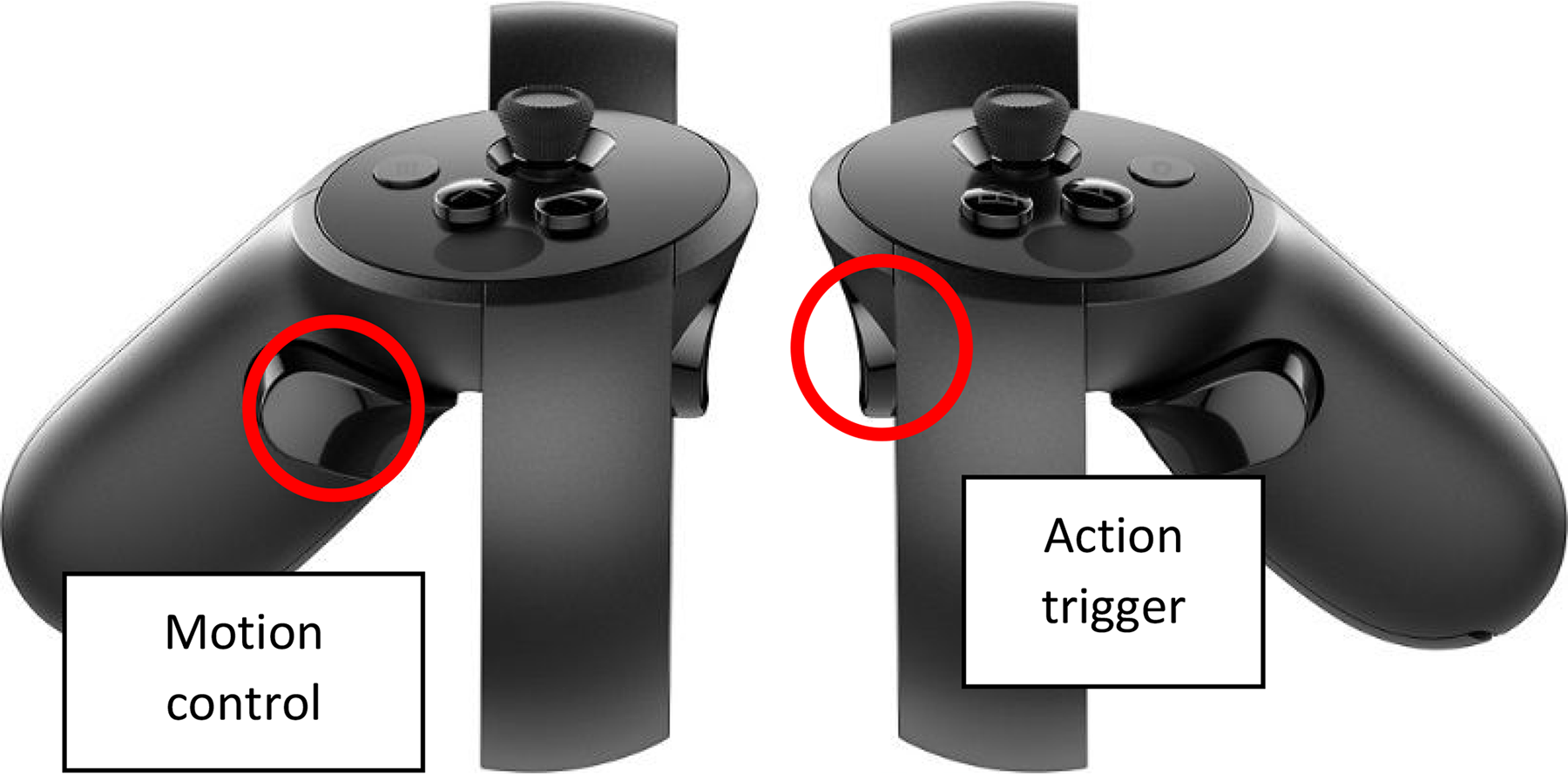
Learning phase: After the VR headset was adjusted to ensure comfort and good image visibility, participants were introduced to a training virtual environment to familiarize themselves with the motion controls. Tour phase: This phase was carried out through the viewing of a narrated video, in which the participants were guided through the main virtual environment. Names of key locations and objects that they had to remember were highlighted. Walkthrough tour phase: In this phase, participants were instructed to repeat the path they had seen in the video. To continue on to the next phase, they had to be able to name all previously highlighted locations and objects. Assessment phase: It was divided into two blocks of questions, the imagination section and the movement section.
Imagination section: From outside of the Meadows virtual environment, participants were asked to respond based solely on their memories of the environment. Questions were also divided into allocentric and egocentric location reference points. Movement section: This block of questions was conducted within the Meadows virtual environment. Participants had to move throughout the environment to locate requested locations.
In the imagination section, scores were based on whether the participants remembered the location of the requested item based on the viewpoint provided. In the movement section, scores were given depending on participants’ ability to find requested locations and objects; mistakes were also counted.
Results
A normality assessment analysis of the VR test results was performed, and it was determined that the final scores of the participants conformed to a normal distribution, so no transformation of variables was necessary.
When analyzing the reliability of the VR test items, a Cronbach’s alpha of 0.734 was obtained. The items where the participants’ response variance was equal to zero were removed. This was due to the fact that all participants got the location of these items right, possibly indicating that they were too easy. After this first reliability analysis, a second analysis was performed, excluding the rest of the items that referred to the same object as items eliminated before, to check whether the entire object should be eliminated from the test. A Cronbach’s alpha of 0.737 was obtained, showing a medium level of reliability, 43 so it was decided to remove the objects entirely.
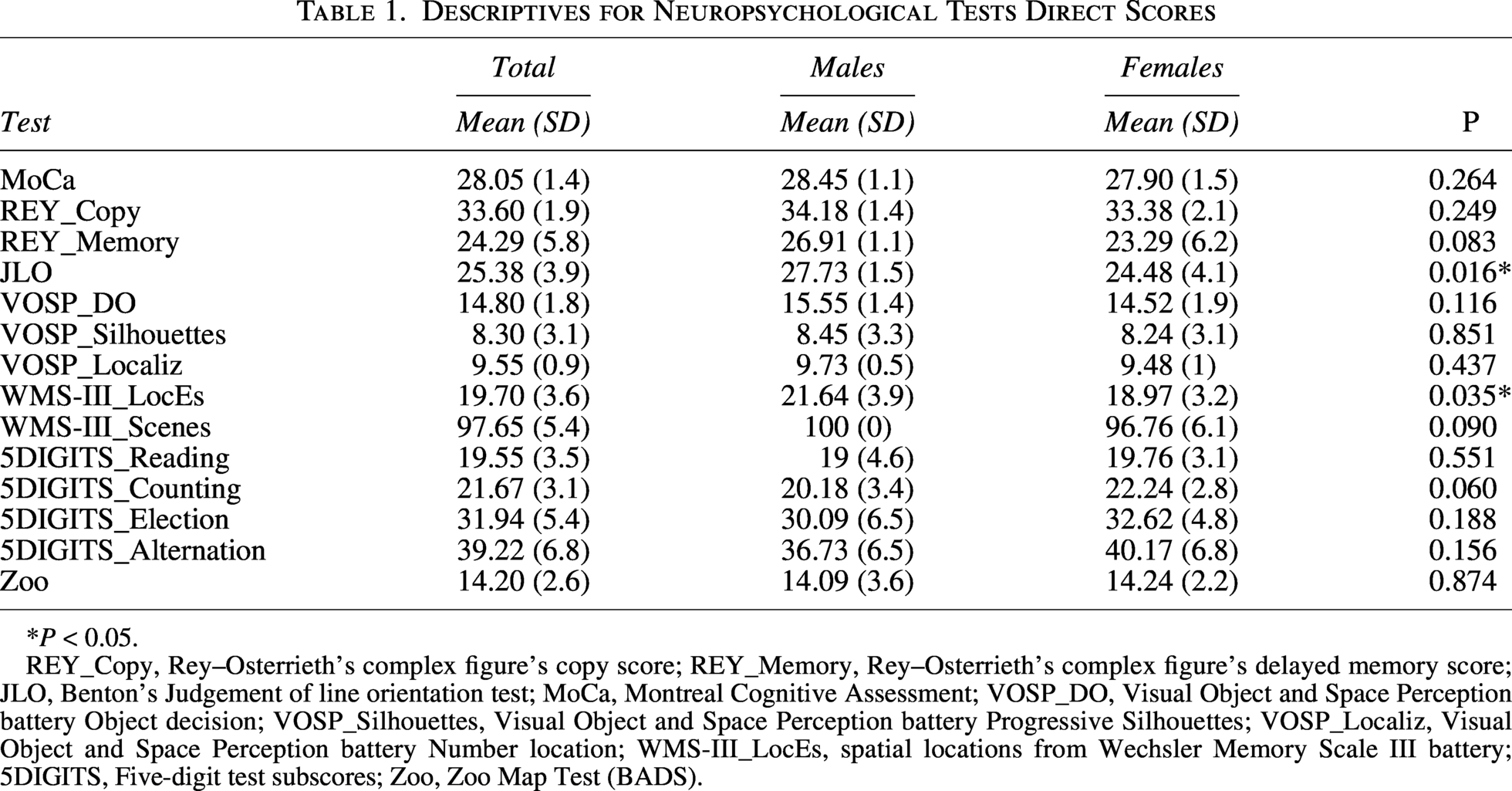
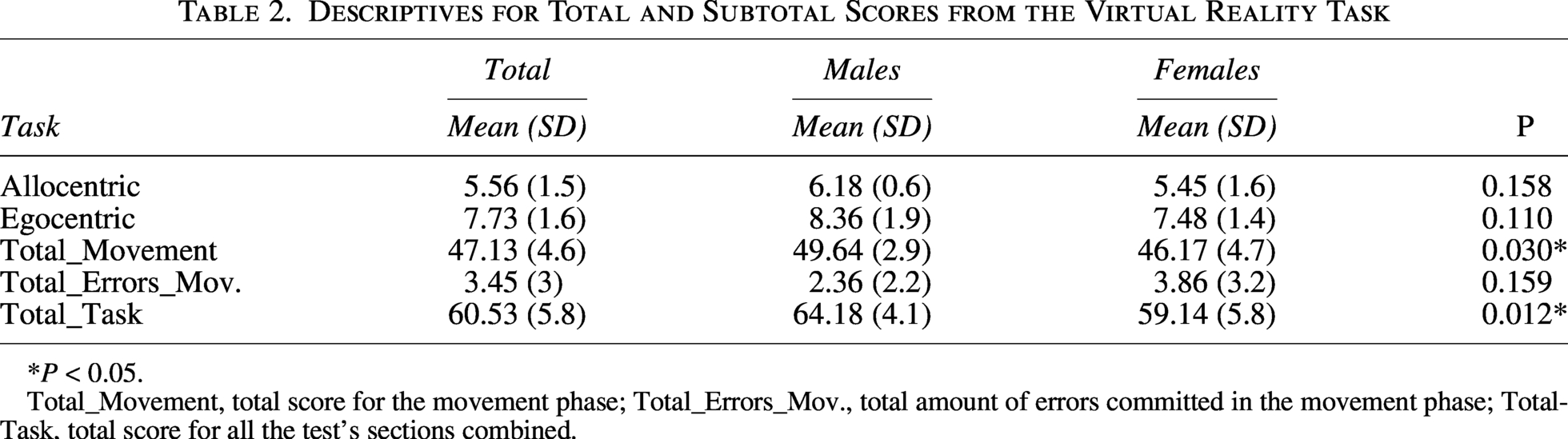
When analyzing the results of the participants in the VR task, we wanted to observe their performance both in the final score and in the subtotals (Table 2). The overall performance in the neuropsychological tests was observed, together with the differences in performance between males and females. A one-factor ANOVA analysis found significant differences in several of the scales (Tables 1 and 2).
Descriptives for Neuropsychological Tests Direct Scores
*P < 0.05.
REY_Copy, Rey–Osterrieth’s complex figure's copy score; REY_Memory, Rey–Osterrieth’s complex figure's delayed memory score; JLO, Benton’s Judgement of line orientation test; MoCa, Montreal Cognitive Assessment; VOSP_DO, Visual Object and Space Perception battery Object decision; VOSP_Silhouettes, Visual Object and Space Perception battery Progressive Silhouettes; VOSP_Localiz, Visual Object and Space Perception battery Number location; WMS-III_LocEs, spatial locations from Wechsler Memory Scale III battery; 5DIGITS, Five-digit test subscores; Zoo, Zoo Map Test (BADS).
Descriptives for Total and Subtotal Scores from the Virtual Reality Task
*P < 0.05.
Total_Movement, total score for the movement phase; Total_Errors_Mov., total amount of errors committed in the movement phase; Total-Task, total score for all the test's sections combined.
Table 1 shows significant differences between sexes only in the results of the JLO (spatial perception) and WMS-III Spatial localization (spatial working memory) tests. Additionally, there were significant differences found in both the final results of the VR task and in the movement subscale (Total_Movement; Table 2). In all cases, male participants showed higher performance.
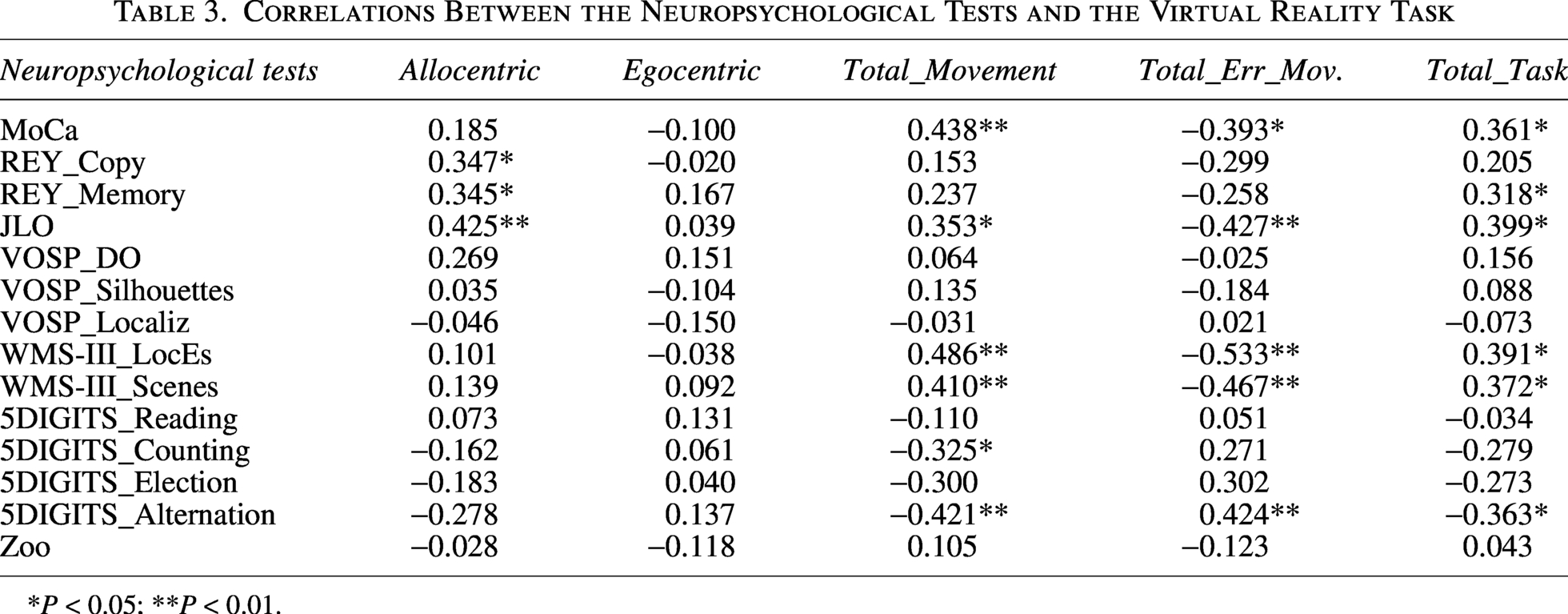
Once the differences between groups were explored, a comparison between neuropsychological tests and the VR task results for the entire sample was performed. It was found that there was a significant positive correlation between the results of several of the neuropsychological tests and the results of the VR task (Table 3).
Correlations Between the Neuropsychological Tests and the Virtual Reality Task
*P < 0.05; **P < 0.01.
Table 3 shows that there were a large number of correlations between the different neuropsychological tests and the VR task, both with the final and the subtotal scores. Correlations found with the total score of the VR task were particularly interesting, a significantly positive correlation (P < 0.05) could be observed with the neuropsychological tests of REY’s memory, MoCa, JLO, and WMS-III: Spatial localization and Scenes, and with the alternation subscale of the 5-digit test. We could observe that correlations also appeared between the topographic allocentric memory subtotal and both Rey’s figure scores (P < 0.05), in addition to a strong correlation with JLO (P < 0.01).
For a more exhaustive analysis of the results, the measure of errors committed in the movement phase was analyzed separately. This was done because the way in which errors were accounted for in the movement score did not take into account the number of errors, only the commission of at least one. Therefore, it could not be known whether the commission of more than one error could be related to other variables. A negative correlation (P < 0.05) between the subtotal of errors committed in the movement phase and the MoCa scores was found. In addition, it could be observed that there was a strong negative correlation (P < 0.01) between the JLO test and both parts of the WMS-III, and positive one with the Alternation subscale of the 5-digit test.
Discussion
One of the most important findings was that the VR task had strong internal consistency and reliability (Cronbach’s alpha based on standardized items = 0.737). This is a major improvement over previous prototypes. 23 However, the test can be improved in several ways and there are certain aspects of the experimental VR task that need to be perfected.
Starting with the relationship between the results and the neuropsychological tests, statistically significant correlations were found with tests of visual perception (JLO), spatial memory (REY_memory and both parts of the WMS-III) and EF (5DIGITS_Alternacy), being these the domains that according to the literature make up the TOS.4,6 This serves as a further approximation to the creation of a VR test able to adequately measure the TOS as a whole, in a single unified measure rather than using several tests that measure these domains separately. Thus, achieving a more complete, ecological, and comprehensive assessment of these skills. After further studies, a more refined VR program could be used as the main measure to assess and treat topographic disorientation in an ecological environment, together with other validated instruments. Within this analysis, we consider it important to highlight the difference in scores that could be appreciated between sexes. This difference was found both in the results of the VR task (Table 2) and in the neuropsychological tests (Table 1).
The significant correlation between the final VR results and the MoCa test indicated that the VR task showed some dependence on participants’ general cognitive performance, in contrast to prior prototypes where it did not show any correlation. However, this may be due to the small sample size in previous phases and the expansion in complexity of the VR task itself, with this iteration of the test being much larger and with more diverse items. 23 In any case, it should be noted that 40 participants are still a small number of people to robustly assess the role of general cognitive performance in TOS. Furthermore, no correlation was found between the results of the Zoo map test and the VR task. This being one of the tests expected to correlate the most with the task, due to the similarity of both measurement approaches and its involvement in problem-solving and route planning.44,45 However, some authors suggest that it is not a “pure” spatial cognition measure. According to Oosterman et al. 46 the zoo map test reliably indicates planning ability and may serve as an indicator of other cognitive domains involved in TOS, but not as a direct measure of spatial cognition. This overlap in measurements can sometimes make the results inaccurate.
Relationship between neuropsychological tests and the subtotal scores of the VR task was explored, as the imagination and movement sections of the task brought different aspects of the TOS into play. The task was divided into two sections called imagination and movement, to observe the difference in performance when participants answered questions based only on their memory versus their performance when they navigated the virtual environment and used motor processes and environmental cues to reorient themselves and adapt their navigation within the environment. In the imagination section, significant correlations were only found with items using allocentric TOS, but none with egocentric TOS items. This may be because when not using themselves as a reference point, participants had to concentrate on mentally drawing the map of the environment and rotate it so that they were able to generate the spatial relationships between objects that were asked. This contrasts with egocentric TOS items, where participants had themselves as the reference point and did not have to mentally rotate the entire map. This hypothesis would be in line with Chen et al., 47 who found that spatial memories encoded with egocentric coordinates tended to decay faster than allocentric ones, and therefore, allocentric memories provide more stable information about familiar spaces over time.
In the movement phase, it was observed that both the total movement scores and the error scores correlated with the general cognitive performance, perception, spatial memory, and EF. Both measures showed correlations with perception and spatial memory tests; however, the relationship found with the alternation measurement was especially interesting, since, together with general cognitive performance, it showed a difference between this phase and the imagination section. These measures indicate that, when moving, participants also had to bring their cognitive flexibility skills into play as the terrain changed.
In addition, multiple differences were found, both in the VR test and in the neuropsychological tests, between the results of males and females. The differences of particular interest were the most significant, being in all cases higher for males. We were able to observe that the total results of the VR test were higher in males due to their higher scores in the movement section, with no significant differences in the imagination section. This indicated that the gender difference appeared when the participants had to move through the virtual environment. On neuropsychological tests, the male group scored significantly higher on measures of spatial perception and memory, but not on measures related to general cognitive performance or EF, which fits with some findings in the literature on gender differences in TOS.29,30,32 These differences in the movement subtest scores between sexes could be explained by the disparity in perceptual and spatial memory skills, in conjunction with the use of different navigation strategies as suggested in the literature 32 ; however, a more comprehensive study would be necessary to clarify this.
Limitations and future directions
Despite many improvements compared to previous prototypes, there are still aspects and limitations that should be discussed. First, although the sample size has been increased, the sex ratio of participants remains too uneven (11 men and 29 women). Since we found significant differences between groups, a comparison between two equal groups would have been preferable to derive a solid conclusion. However, due to the difficulties in participant recruitment, it was impossible to gather a balanced sample.
Second, the teleportation method used to navigate the environment, although adopted for practical reasons, might have also hampered the ability of participants to realistically orient themselves compared to a free-moving style of navigation. The main reason for this is that jumping around the environment might pose a bigger than normal shift in perspective and differ from the more natural progression of movement where we perceive a progressive change of our surroundings. However, this method was adopted to facilitate the use of these environments inside any clinic or office and also so patients with impaired mobility could be assessed.
Finally, another limitation was the internal consistency of the study. A good way to check the consistency of measures during the creation of a test is to perform a test–retest measure with 10% of the participants. We decided not to use this measure, despite the value it could bring to the validation of the VR task, due to the very nature of the task. Being a test for assessing anterograde TOS, the condition for inclusion of participants was that they had never been inside the virtual environment where the task takes place. Thus, if we had conducted a test–retest measurement in which we reintroduced participants to the environment after a few months, it would no longer be a completely new environment for them, and so, they would still retain memories of the first time they had been there, and the evaluation would be contaminated by the memories stored in their retrograde topographical memory.
Future studies should aim to develop VR tasks with solid internal consistencies that use virtual environments to assess and train people with topographical disorientation, using new technologies for precise measurement of cognitive deficits in patients. It is paramount that, while not completely substituting classical paper and pencil tests, these tasks serve as a more modern complement to already validated instruments to ensure a comprehensive and ecological neuropsychological assessment.
Conclusion
A novel VR prototype task with solid reliability was successfully created and presented as a game. This test will be refined and improved upon in future iterations, but it already represents a significant advancement compared to previous ones. Some of the most relevant conclusions drawn from this study include:
We have successfully created a VR task consistent with previously validated measurement tools used to assess the cognitive components of anterograde TOSs. A Cronbach’s alpha (α = 0.737) indicates that the task has a strong reliability and shows potential for further improvement in the future. In contrast to the previous prototypes, significant differences were found in performance of males and females in both traditional neuropsychological tests and the VR task. A significant relationship has been established between general cognitive performance, executive functions, and performance in the movement phase of the VR task, indicating that efficient movement depends on these abilities.
Authors’ Contributions
P,R.-P.: Methodology, software, validation, formal analysis, investigation, data curation, writing—original draft, visualization, and project administration. J.A.I-A.: Conceptualization, methodology, validation, resources, writing—review and editing, visualization, and supervision.
Ethical Considerations
This study has been approved by both the ethics committee of Loyola Andalucía University and the Biomedical Research Ethics Committee of the Junta de Andalucía (code: UUM32AGM3AH4ENPKW3XZ22FY6ZDS39) and followed the biomedical research ethics guidelines of the Declaration of Helsinki. All study participants read and signed the informed consent form prior to the administration of the tests.
Footnotes
Author Disclosure Statement
Authors manifest that there were no conflicts of interest while conducting this research.
Funding Information
This research did not receive funding from public or private sectors or nonprofit entities. The necessary funding was provided by Loyola Andalucía University, which also supplied technical resources and materials from the Human Neuroscience Laboratory. The authors declare no conflicts of interest.
Supplemental Material
Supplemental Material
References
Supplementary Material
Please find the following supplemental material available below.
For Open Access articles published under a Creative Commons License, all supplemental material carries the same license as the article it is associated with.
For non-Open Access articles published, all supplemental material carries a non-exclusive license, and permission requests for re-use of supplemental material or any part of supplemental material shall be sent directly to the copyright owner as specified in the copyright notice associated with the article.

