



Abstract
We first conducted a synthesis of literature to identify essential transition teacher competencies to guide curriculum development for a personnel preparation program. The synthesis yielded a list of 67 competencies needed by transition teachers. Using the 67 competencies, we next created an electronic survey in which respondents were asked to rate importance of transition teacher competencies. The survey was administered to two groups: national experts and transition practitioners. Expert respondents were 52 individuals. Practitioner respondents were 231 teachers, specialists, or coordinators from five states. Results indicated substantial similarities in ratings across all respondents irrespective of sample membership or service to transition-age individuals with mild/moderate or severe disabilities. Findings are discussed in regard to personnel preparation and targeted knowledge and skills.
An ongoing challenge facing educators today is ensuring young adults with disabilities receive transition planning and services that allow them to be successful in postsecondary education, employment, and independent living on exit from secondary schools (Blalock et al., 2003). To meet this challenge, a key ingredient is for young adults to receive services from competent transition teachers. Hence, teacher training programs must ensure personnel are competent to deliver effective transition services (Blalock et al., 2003; Kohler & Greene, 2004; Morningstar & Clark, 2003).
To frame the competencies needed by transition educators, Kohler (1996) developed the Taxonomy for Transition Programming, which identifies five key components of effective transition planning for young adults with disabilities: student-focused planning, student development, family involvement, interagency collaboration, and program structure and attributes. In addition, the Division on Career Development and Transition (DCDT; 2000) published Transition Specialist Competencies, which describe the competencies categorized according to (a) philosophical, historical, and legal foundations of special education; (b) characteristics of learners; (c) assessment, diagnosis, and evaluation; (d) instructional content and practice; (e) planning and managing the teaching and learning environment; (f) managing student behavior and social interaction skills; (g) communication and collaborative partnerships; and (h) professionalism and ethical practices. The competencies identified in these publications lay the groundwork for developing transition-training programs; however, an up-to-date review of literature related to best practices in transition training is warranted to develop an all-encompassing competency list. In addition, competencies from the current literature need to be operationally defined to ensure reliable interpretation.
Because of the dynamic nature of transition and the variety of individuals involved in the transition process, defining competencies of transition personnel becomes an extremely complex yet important task, not only for reasons of personnel preparation but also for delineation of roles and responsibilities. Greene and Kochhar-Bryant (2003) defined transition leaders (including teachers and transition specialists) as professionals with skills and expertise in special education and transition. The DCDT (2000) defined transition specialists as individuals who plan, coordinate, deliver, and evaluate “transition education and services at the school and system level in conjunction with other educators, families, students, and representatives of community organizations” (p. 1). For the purposes of our research, we defined transition teachers as secondary-level professionals who provide direct services to young adults with disabilities related to moving from school to employment, postsecondary educational opportunities, and independent living. We consider transition teachers responsible for assessing skills, teaching young adults in appropriate settings to increase academic and functional skills related to transition, and providing transition-related services to prepare young adults for postsecondary education, employment, and independent living.
Aligning curricula to competencies identified as essential is an important component in developing a personnel preparation program for transition teachers (Morningstar & Clark, 2003). Correspondence between curriculum content and competency data help ensure personnel preparation is guided by empirical evidence in relation to knowledge and skills that transition teachers will need to be effective. The authors of this research were in the process of developing a master’s degree program in special education with a concentration in transition. We needed evidence to guide selection of course topics, assignments, and applied experiences.
To determine competencies essential for teachers exiting a master’s-level program in transition, we synthesized the literature and administered a survey to national experts and transition practitioners. The rationale for two survey samples was to strengthen the data set and investigate similarities and/or differences in ratings between these two groups. Our goals in synthesizing the literature and administering the survey were to (a) identify teacher competencies in transition related to best practices, programs, and services to lay the groundwork for coursework for personnel preparation; (b) examine similarities and/or discrepancies across survey samples in ratings of importance of specific competencies; and (c) identify targeted teacher skills for a master’s-level program based on evidence from the literature and ratings of competency importance across survey samples.
Method
Participants
We established two survey samples: (a) national transition experts and (b) transition practitioners from school districts of five states. Samples are described below.
National transition experts
We selected participants because of their involvement and leadership in some facet of transition. Specifically, we selected participants who had performed the role of editor and/or reviewer for one of two refereed journals (Career Development and Transition for Exceptional Individuals or Teacher Education and Special Education), and/or held leadership roles in DCDT, in the Council for Exceptional Children (CEC), or the National Association for Special Education Teachers (NASET). We inspected vitae of 137 individuals to determine whether they had (a) published five or more articles on transition-related topics in peer-reviewed journals, (b) presented five or more papers at national conferences on transition, and (c) served as a member of a national organization related to transition. We excluded individuals from the sample if their publications, presentations, or membership did not meet these criteria or were related to topics not specific to transition (e.g., special education law, secondary education, inclusion, supported employment, vocational rehabilitation). We removed 36 original sample members who did not meet these criteria. One additional person was removed when we learned he had moved out of the United States. The resultant 100 participants comprised the survey sample.
Transition practitioners
The transition practitioner sample included five states in which the transition leaders had (a) strong representation as authors in the research literature and who, based on the literature, (b) established systems of transition practitioner support and personnel preparation, and (c) Internet sites with sufficient contact information. The five states were Florida, Kansas, Minnesota, Oregon, and Wisconsin. To locate participants, we conducted Internet searches aimed at identifying specialists, teachers, and/or coordinators in the field of transition from each targeted state. Websites such as those of state departments of education, state-level special education transition program, district and school, and any other applicable state or district transition were searched and used in compiling samples from each state. The initial survey sample included 241 individuals identified as teachers, specialists, or coordinators in the field of transition from the following four states: Florida, Kansas, Minnesota, and Oregon. For Wisconsin, the state-level transition coordinator forwarded the e-mailed survey link and information to 232 transition specialists and/or coordinators across the state. We were not provided with the list of names of those practitioners. The total number of practitioners in the sample was 473.
Survey Development
We developed the survey instrument for rating competencies using an expert consensus process based on a model with demonstrated effectiveness (Fink, Kosecoff, Chassin, & Brook, 1991; Johnson, 1977). Regarding competency validation, the six steps of expert consensus were as follows: (a) identify the competencies through multiple sources, (b) categorize and organize competencies, (c) develop an instrument, (d) establish a sample of experts, (e) collect data, and (f) analyze data for the purpose in which the competencies will be used, that is, to create and implement a 2-year master’s-level university program to prepare transition teachers.
Identification of transition competencies
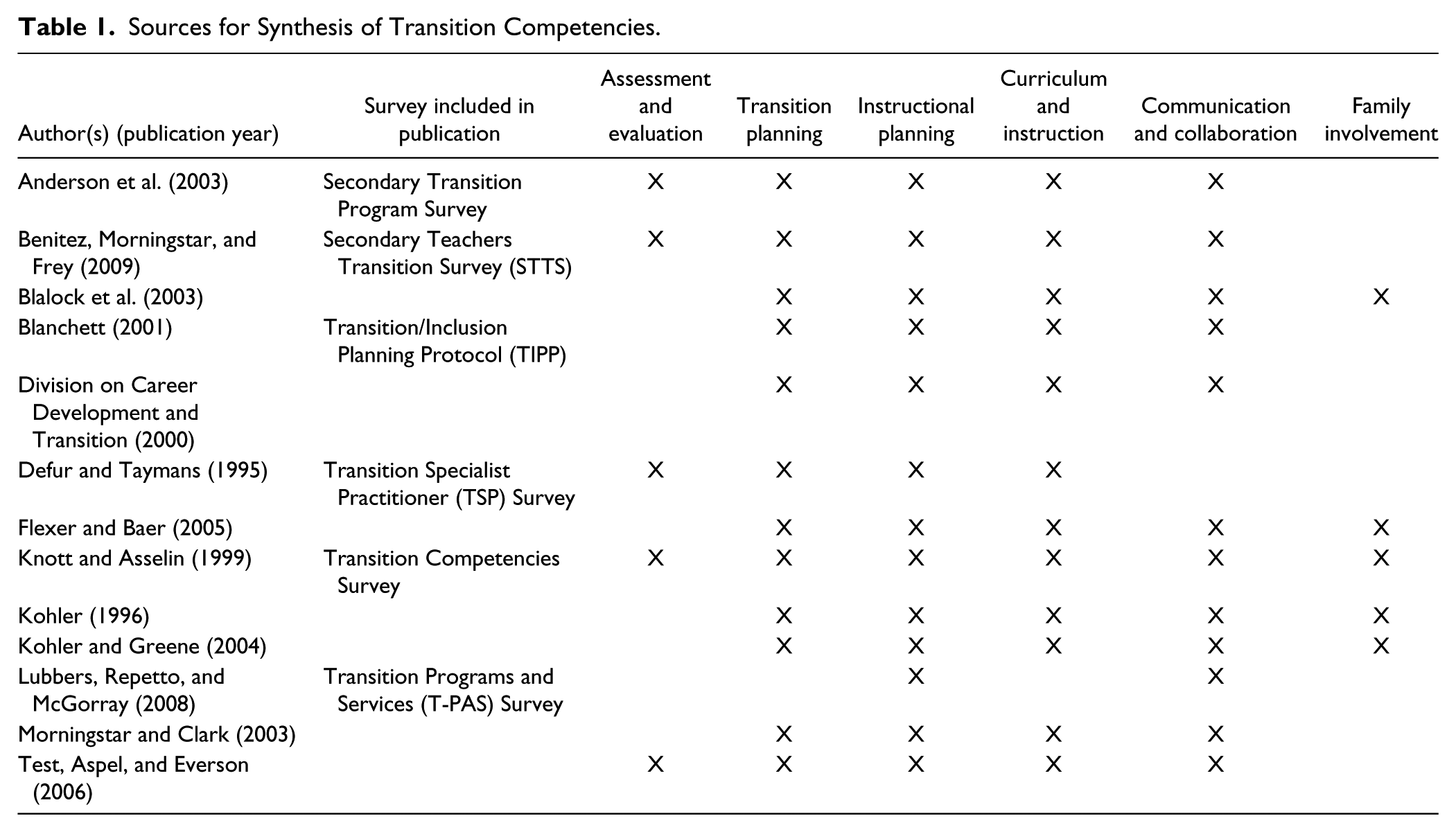
We identified competencies from a comprehensive review of the current transition literature by (a) identifying effective transition planning and service delivery practices and (b) examining national standards for inclusion in the survey (CEC, 2012; DCDT, 2000). We examined previous surveys related to transition competencies (e.g., Secondary Teachers Transition Survey [STTS]; Benitez, Morningstar, & Frey, 2009). Table 1 displays the sources from which we derived competencies. The competencies contained in these publications yielded a total of 147 transition competencies.
Sources for Synthesis of Transition Competencies.
Categorization and organization of the competencies
We used a content analysis data-reduction method (Miles & Huberman, 1994) to reduce the number of competencies in the original list. We first divided competencies into groups that were similar in content area (e.g., all assessment-related competencies were placed in one group). Next, we selected category headings based on the groups of competencies. The six categories, similar to those included in the Taxonomy for Transition Programming (Kohler, 1996), are shown in Table 2. Furthermore, the first four categories are in chronological order, in terms of the process that transition teachers follow to deliver services and provide support, with family involvement throughout the process and communication and collaboration all-encompassing, as shown in Figure 1.
Categories of Transition Competencies.


Categories of competencies that form transition services process.
Once the competencies were grouped into categories, we reviewed each one within a given category to identify themes or subcategories. Then, we examined individual competencies within subcategories. Researchers compared and organized key phrases and words, sometimes combining competencies when the comparison revealed similar intent. In some cases, we reworded competencies using descriptive and operational language. For each competency, we developed and edited operational definitions and/or examples to help respondents more clearly understand objectives, actions, or responsibilities to be carried out. Finally, we reexamined competency statements and definitions for (a) alignment within category (i.e., competencies fitting under the appropriate heading); (b) phraseology, grammatical ease, and clarity; and (c) match of the operational definition and/or examples to the competency statement. This process resulted in a list of 64 transition competencies.
Pilot testing
Once the competency items had been thoroughly reviewed, we asked three university faculty members who were considered experts in transition (who were not members of the survey samples) to meet with us and “think out loud” while ranking the competencies into groups based on importance. Researchers took systematic notes during this process and further edited competencies based on expert feedback to increase clarity, reduce redundancy, and ensure completeness of the listed competencies. We added three competencies as a result of expert feedback, producing a final list of 67 competencies organized in the six categories described previously. These competencies, along with resulting survey data, are shown in Table 3. Operational definitions are available from the first author.
Transition Teacher Competencies Ordered by Percentage of Experts Who Rated an Item as Essential.
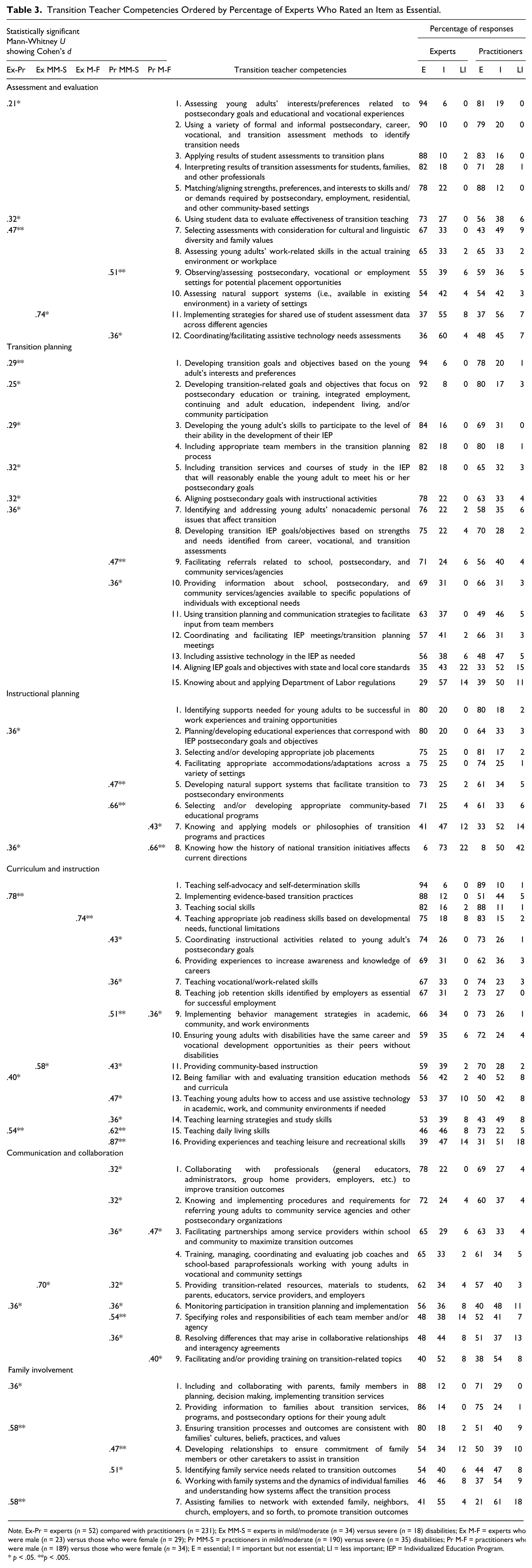
Note. Ex-Pr = experts (n = 52) compared with practitioners (n = 231); Ex MM-S = experts in mild/moderate (n = 34) versus severe (n = 18) disabilities; Ex M-F = experts who were male (n = 23) versus those who were female (n = 29); Pr MM-S = practitioners in mild/moderate (n = 190) versus severe (n = 35) disabilities; Pr M-F = practitioners who were male (n = 189) versus those who were female (n = 34); E = essential; I = important but not essential; LI = less important; IEP = Individualized Education Program.
p < .05. **p < .005.
Survey instrument and data collection
The survey instrument sought information in three areas: (a) participant demographics, number of years working in transition, and emphasis area (i.e., working with individuals with mild/moderate disabilities or severe disabilities); (b) ratings of priorities for competencies needed on graduation from a master’s-level transition program, above and beyond competencies expected of a regular special education teacher; and (c) recommendations for competencies that may not have been addressed in the list provided. Specifically, the survey asked participants to rate each competency related to effective transition teacher performance on graduation from a master’s program (1 = essential; 2 = important, but not essential; 3 = less important).
On completing rankings for each category, respondents were prompted to review their answers to ensure not all competencies were marked as essential. Reviewing competencies with attention to the number of essential ratings was an attempt to create differentiation in ratings of importance for each competency. Finally, survey respondents were asked if there were any additional competencies not listed that should be added. We used Survey Gizmo® to develop and manage the online survey. Survey Gizmo® software collected data that were exported into a spreadsheet.
Response Rate
We sent initial invitations to participate in the survey via e-mail to all participants. To increase the response rate, a follow-up e-mail was sent to nonrespondents after approximately 2 weeks, with a phone call made 2 weeks later to explain the purpose of the survey and request participation. If a voicemail was left, an additional follow-up phone call was made approximately 1 week later. The exception was the Wisconsin practitioners, for whom the state-level transition coordinator sent the initial e-mail to transition staff in the state and a follow-up e-mail approximately one month later. Thirteen respondents who were not in original sample completed the survey. Their responses were removed from the analysis as their roles could not be verified. Overall response rates for completed surveys based on the total original sample were 52% for experts and 49% for practitioners. Recommendations for survey response rates for valid findings vary, though high response rates (e.g., above 70%, Fink, 2002) are typically deemed best to claim validity of findings. In a recent meta-analysis of survey research, Shih and Fan (2009) reported that Internet survey response rates were, on average, 33% and that mailed paper survey response rates were slightly better than e-mail surveys but that neither typically reached recommended survey response rates. Our survey response rates for completed surveys were reasonable given Shih and Fan’s findings, though potentially not representative of the selected samples or of the population of transition experts and practitioners.
Data Analysis
We analyzed data in multiple ways. First, we used visual inspection (Tufte, 2001) to reveal trends, similarities, and discrepancies in responses. Second, we calculated Mann-Whitney U statistics as well as Probability of Superiority (PS: U/n1n2) and Cohen’s d effect sizes (Grissom, 1994; Grissom & Kim, 2005) for each item to determine differences between groups in item-level responses. Mann-Whitney U statistics indicate whether responses from one group are greater in magnitude than another group, which suggests that differences in item-level ratings are large enough to be worthy of consideration. The PS signifies the magnitude of the difference between group responses and is calculated directly from the Mann-Whitney U. However, Cohen’s d is more commonly reported for effect size differences and as such was calculated from the PS and included in the results. Finally, correlations between percentages of essential responses among experts and practitioners (the equivalent of correlations between item-level rankings) indicated the magnitude of agreement in aggregate rankings of competencies, overall and within categories. Analyses were conducted for the following groups: (a) experts and practitioners, (b) male and female respondents, (c) those respondents who focused mainly on mild/moderate versus severe disabilities, and (d) practitioners by state.
Results
We organized data from the two surveys in terms of visual analysis (trends, similarities, and differences), differences in rankings between experts and practitioners, and item-level differences in ratings (Mann-Whitney U statistic) between subgroups of participants (expert/practitioner, those who serve mostly mild/moderate or severe populations, male/female, and practitioners by state: Florida, Kansas, Minnesota, Oregon, and Wisconsin). Results are described below.
Trends, Similarities, and Differences
Table 3 presents percentages of transition competency ratings by experts and practitioners. Figure 2 shows trends in percentages of respondents from different groups who marked competencies as essential. Overall, response trends between experts and practitioners were very similar. No items were rated by all respondents, either collectively or in the subgroup analysis, as essential or as less important. Recurring themes of self-advocacy and the young adult’s interests and preferences were found in many of the items most often rated as essential. Themes of remote skills and knowledge (e.g., history of transition, transition models and philosophies) were typically rated lower in importance by all groups. Response patterns (i.e., ranked order of competencies based on percentage of essential ratings) between experts and practitioners, males and females, and those serving mild/moderate or severe disabilities showed few discrepancies in the top and bottom items in each category. As shown in Figure 2, the highest and lowest ranked three items in each category were the same in almost all cases except as subsequently described, though the order of those three items may have been different. The four items with the greatest absolute discrepancy in agreement between experts and practitioners are listed below.
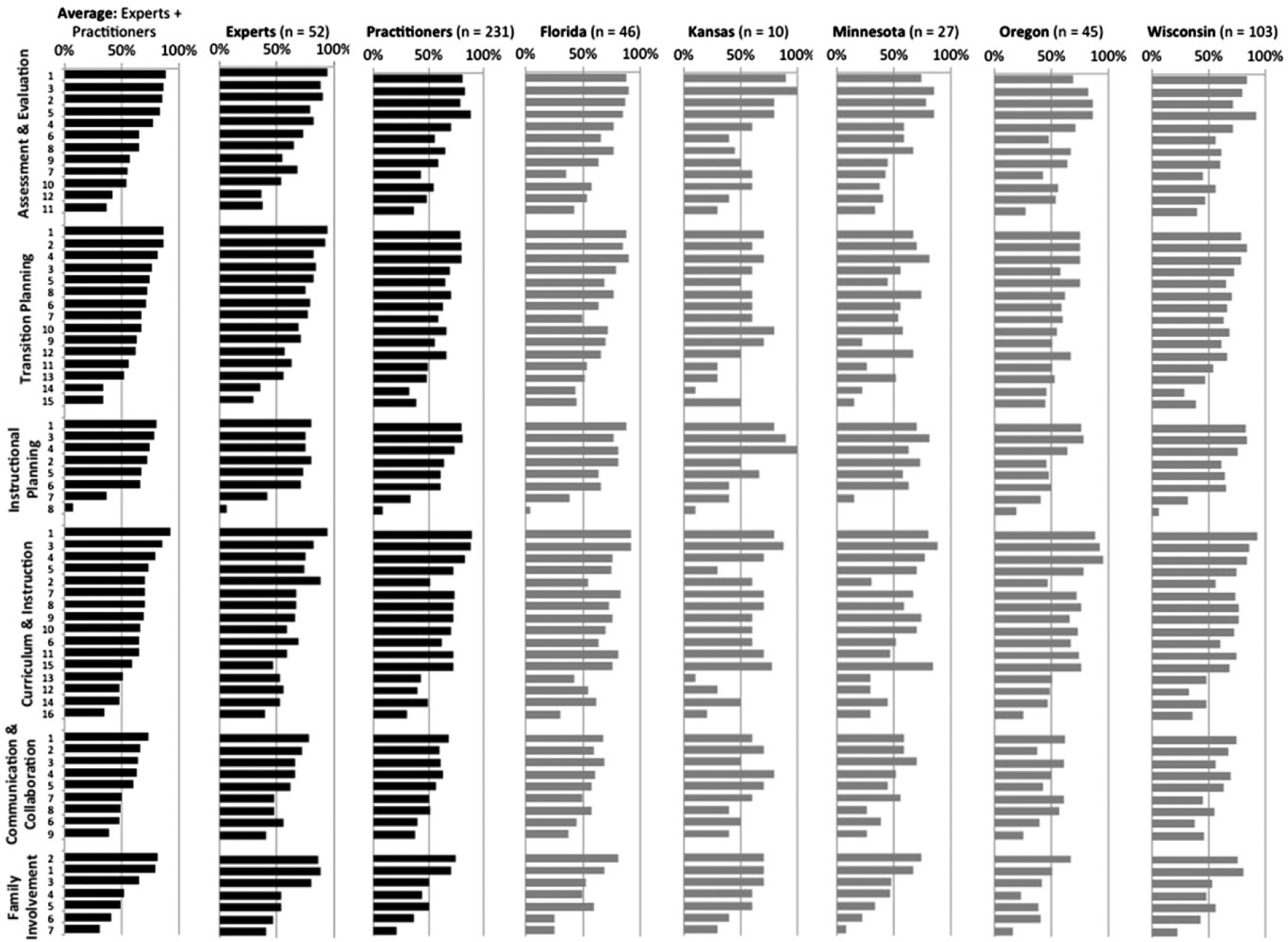
Percentage of respondents who marked numbered competency as essential.
Curriculum and instruction: Implementing evidence-based transition practices (essential: experts 88%, practitioners 51%).
Curriculum and instruction: Teaching daily living skills (essential: experts 46%, practitioners 73%).
Assessment and evaluation: Selecting assessments with consideration for cultural and linguistic diversity and family values (essential: experts 67%, practitioners 43%).
Family involvement: Ensuring transition processes and outcomes are consistent with families’ cultures, beliefs, practices, and values (essential: experts 80%, practitioners 51%).
Implementing evidence-based transition practices was ranked in the highest two items for Curriculum and Instruction by experts, with teaching daily living skills ranked in the lowest two items, but practitioners ranked both these items near the middle compared with others in the category. The third and fourth items (selecting assessments with consideration for cultural and linguistic diversity and family values, and ensuring transition processes and outcomes are consistent with families’ cultures, beliefs, practices, and values) fell near the middle of the ranked items for experts, but lower in aggregated importance for practitioners.
Differences in Rankings of Items (Mann-Whitney U)
The Mann-Whitney U statistic was calculated to determine if item rank differences between experts and practitioners were statistically significant. While the Mann-Whitney U statistic does not assume the underlying distribution is normal, it is based on the assumption that participants are randomly selected, which is not the case in this study. Rather, participants were intentionally selected based on specific criteria. Because of this, conclusions should be drawn cautiously from Mann-Whitney statistics. Response rates were approximately 50%, which were large enough for adequate statistical power (Hilton & Mehta, 1993) though indicative of potential bias in responses. Nonetheless, the Mann-Whitney U statistic provided an indication of the degree to which item rankings among experts and practitioners who responded to the survey were similar.
The percentage of essential responses was used to rank items. The Mann-Whitney statistic (U = 1831, Z = −1.843) was not statistically significant at p = .05, which suggested that experts and practitioners ranked items similarly. The Pearson product–moment correlation between item rankings was r = .81 (statistically significant at p < .001), indicating a strong relationship between expert and practitioner rankings of the competencies.
Item-Level Differences in Ratings (Mann-Whitney U)
The Mann-Whitney U statistic was also used to determine item-level differences in responses between experts and practitioners. For those items that demonstrated a statistically significant difference, the PS was calculated as a measure of effect size indicating the degree to which one group rated an item higher, for example, more important, than the other group. Cohen’s d was calculated from the PS, as it is a more commonly reported measure of effect size.
Overall, the Mann-Whitney U test was statistically significantly different for 18 of 67 competencies, or 27% of the items. The 18 competencies are listed in Table 3. These differences signify that one group (e.g., experts or practitioners) indicated the item was more essential to the knowledge and/or skills of transition teachers than the other group. Three themes were apparent among differences in reviewing the items. First, experts and practitioners rated several items supporting the inclusion of young adult’s interests and preferences in planning and decision making differently. Second, two items that included cultural and linguistic diversity were rated differently. Third, items that included evidence-based practices, history of transition, education methods and curricula, and using student data to evaluate teaching were rated differently, indicating that experts place a higher emphasis on these “academic” items than practitioners.
Item-Level Differences in Ratings Among Subgroups of Experts
Few competencies were rated differently by experts who focused on mild/moderate versus severe disabilities, or who were male or female. In fact, with only 3 of 67 competencies indicating a statistically significant difference in ratings based on disabilities served (i.e., implementing strategies for shared use of student assessment data across different agencies; providing community-based instruction; providing transition-related resources and materials to students, parents, educators, service providers, and employers), and only one item different between male and female respondents (teaching appropriate job readiness skills), it seemed experts rated items with substantial agreement between subgroups.
Item-Level Differences in Ratings Among Subgroups of Practitioners
Mann-Whitney U indicated many differences between subgroups of practitioners (e.g., male/female, those serving mild/moderate or severe populations) on item-level rankings of competencies, particularly those serving mild/moderate or severe disabilities. In fact, 23 of 67 items were rated with statistically significant differences by practitioners who worked mostly with individuals who had mild/moderate versus severe disabilities. In addition, item-level analysis involving state-by-state comparisons indicated substantial differences in rankings of competencies. Again, we picked these states because they were well represented in the authorship of transition publications in refereed journals, so differences between state-level rankings of items infer potentially different transition practices.
Discussion
In this study, we build on previous efforts related to transition competencies (e.g., Benitez et al., 2009; DCDT, 2000; Kohler, 1996; Morningstar, Kim, & Clark, 2008) by (a) conducting a comprehensive review of literature to develop a list of competencies for transition teachers, (b) developing operational definitions for each competency, and (c) surveying experts and practitioners to determine their perceptions of importance of each competency. The survey findings revealed similarities in responses between the experts and practitioners. These similarities were present across all respondents, irrespective of whether they were experts or practitioners, male or female, and/or those who provide services to students with mild/moderate or severe disabilities. This finding is consistent with DeFur and Taymans (1995), who noted that transition competencies were similar across a variety of professional roles and expectations. However, the similarity in competencies for teachers serving students with mild/moderate and severe disabilities differs from findings by Baer, Daviso, Flexer, McMahan-Queen, and Meindl (2011). The latter study involved a postschool outcome survey of former students with intellectual disabilities in which authors found the need for differential instructional programs and supports, particularly inclusive career and technical education for students with severe disabilities. Future research should more closely examine differences in competencies related to the level of disability of the student in transition.
Similarities found in this study suggest that competencies rated by experts closely align to those rated by practitioners. The huge majority of competencies rated similarly may suggest a lack of “preparation-to-practice gap” although more research is needed. If ratings of experts involved in preparation continue to align with ratings of practitioners given additional research, it may indicate that best practices are indeed evidence-based and represent what works in the field.
Although the overarching finding from the survey was the similarity in ratings between experts and practitioners, important information can also be gleaned from the differences in responses. Although the nature of this survey did not allow for exploration of why these differences were present, we might speculate about potential explanation. For example, the item of greatest discrepancy in agreement between experts and practitioners was Curriculum and instruction: Implementing evidence-based transition practices. We might speculate that practitioners are less aware of empirical bases for their practices or that they focus more on what appears to work for them in the field. The second item with greatest discrepancy was Curriculum and instruction: Teaching daily living skills. We might speculate that practitioners view the functional and social significance of these skills by virtue of frequent encounters with young adults having limited repertoires. The third item with greatest discrepancy was Assessment and evaluation: Selecting assessments with consideration for cultural and linguistic diversity and family values. Interestingly, Benitez et al. (2009) found that transition practitioners felt least prepared for multicultural-related competencies. Thus, the practitioner perceptions in this study may be related to their lack of preparedness and/or familiarity in providing appropriate cultural and linguistic assessments. A similar speculation stemming from the study by Benitez et al. may be related to the fourth item with greatest discrepancy, which was Family involvement: Ensuring transition processes and outcomes are consistent with families’ cultures, beliefs, practices, and values.
We should note that although each competence was ranked on a scale of importance, they all play a role in ensuring successful postschool outcomes for students with disabilities. Several of the participants who made comments at the end of the survey expressed similar viewpoints. One participant’s remarks reflected this theme: I truly believe every competency you listed is an essential part of my position as a Transition Program Specialist, involved in supervising and training teachers on transition compliance, transition services, transition assessment, post school outcomes, etc.
Limitations
Four limitations of this study should be considered when interpreting results. First, the survey did not allow participants to revise or delete competencies, which may have limited the expression of their opinions. Second, disaggregating transition services to students with disabilities beyond the traditional mild/moderate and severe disabilities clustering approach may be viewed as a limitation, as deeper inquiry into the types of competencies related to the types of disabilities would afford additional interpretation. Third, some participants did not respond to questions, resulting in missing responses. Finally, nonresponse bias may be present. The nonrespondents may have possessed differing views in comparison with those who responded.
Implications for Research and Practice
Our aim in this study was not to suggest whose opinions (experts or practitioners) better reflect the competencies of transition teachers. Rather, the identified differences in opinion between the two groups, for example, indicated areas of competence for which future investigation is necessary to determine why these differences exist. Future researchers should also seek to broaden data collection to differentiate types of professional positions (e.g., teachers vs. coordinators) while also expanding inquiry into the content, frequency, and duration of transition competencies.
Similar to previous surveys (e.g., Benitez et al., 2009, DeFur & Taymans, 1995) and lists of transition standards (i.e., CEC, 2012; DCDT, 2000), our findings reflect that transition teachers are expected to possess knowledge and skills that, in some respects, are qualitatively different from those of special education teachers. For example, planning transition in integrated employment and postsecondary educational settings and selecting/developing appropriate job placements were two of many competencies considered essential in our surveys, yet vastly different from what most special educators would be required to do. Our findings suggest that teacher educators and national organizations must consider transition competencies alongside other teacher competencies and make tough decisions about teaching priorities. Clearly, adding new knowledge and skills to already burgeoning lists required of teachers is not the answer. But educators and organizations may need to tailor college coursework and in-service training opportunities for transition teachers by identifying critical competencies, prescribing training content, and setting standards to be attained. Nontraditional learning environments, such as online training, webinars, or cross-discipline training (e.g., special educators alongside vocational rehabilitation counselors) may represent some of the options that need to be explored.
Findings from this study add to previous ones (e.g., Benitez et al., 2009; DeFur & Taymans, 1995) to create a data set of specific competencies related to transition. Although it is unrealistic to fully address large numbers of competences in a personnel preparation program, our findings may assist in allocating time and attention to certain ones. Furthermore, the findings from this study may be useful for state credentialing processes, in-service education, and the determination of roles and responsibilities of professionals involved in transition. For example, states considering a credential in transition specialization may examine the competency list and resulting data to develop standards and evaluation procedures. However, we delimit the impact of our findings and call for future research to clarify and strengthen the importance of various competencies. For example, data are needed on potentially different sets of competencies of secondary educators responsible for transition plans (i.e., transition teachers) compared with individuals responsible for job development, placement, and interagency collaboration (i.e., transition coordinators or specialists). Transition teachers and coordinators/specialists are likely to require different sets or rankings of competencies.
Because special education insists on teacher accountability based on student outcomes, a focus on evidence-based practices becomes crucial. Teachers must have access to data not only on what knowledge is considered essential in the field but also what practices (i.e., competencies) are likely to be associated with successful student outcomes. Although this study falls short in providing a connection between competencies and student outcomes, it informs the teacher of a continuum of important-to-less-important practices based on survey responses. Hopefully, this study lays the groundwork for future research investigating the relationship between competencies and postschool outcomes.
Conclusion
In our study, the synthesis of transition competencies and development of operational definitions represented an attempt to reduce redundancy and increase clarity. In turn, surveys completed by national experts and transition practitioners provided evidence for the importance of transition competencies. Although the practitioner survey was limited to five states, findings provide some degree of generalization into the range and level of perceived importance of transition teacher competencies. These competencies may inform transition personnel preparation programs by serving as a guide for curriculum decisions. Ultimately, personnel preparation programs are one of the strongest variables in ensuring successful postschool outcomes for students with disabilities (Benitez et al., 2009; Blalock et al., 2003; Kohler & Greene, 2004). Aligning personnel preparation programs with empirical evidence will help ensure that program content will be appropriate for the types of knowledge and skills that transition teachers need to be successful in the field.
Footnotes
Declaration of Conflicting Interests
The author(s) declared no potential conflicts of interest with respect to the research, authorship, and/or publication of this article.
Funding
The author(s) disclosed receipt of the following financial support for the research, authorship, and/or publication of this article: The research reported here was supported by the U.S. Department of Education, Office of Special Education Programs, Grant H325K100501. The opinions expressed are those of the authors and do not represent the views of the U.S. Department of Education.