



Abstract
Competitive employment (i.e., employment in community settings among people without disabilities for minimum wage or higher) improves quality of life for people with disabilities who have individualized support needs (ISN). However, attaining competitive employment can be challenging for people with ISN. This study used a mixed methods design to evaluate the perspectives of 68 families who attended the Family Employment Awareness Training (FEAT). Findings indicated that families who attended FEAT (a) accessed competitive employment resources following FEAT and (b) reported competitive employment outcomes for their family members with ISN following FEAT. We discuss implications of these findings and recommendations for future research.
Competitive employment (i.e., employment in community settings among people without disabilities for minimum wage or higher) results in numerous benefits for people with disabilities who have individualized support needs (ISN) and require services and supports in the workplace (Buntinx et al., 2008). People with ISN have various disabilities and “require services, supports, accommodations, or modifications over and above what is available to all employees in order to experience success at competitive jobs” (Francis, Gross, Turnbull, & Parent-Johnson, 2013, p. 1).
Benefits of competitive employment include enhanced self-esteem, independence, and quality of life (Boeltzig, Timmons, & Butterworth, 2008; Verdugo, Martin-Ingelmo, Jordán de Urríes, Vicent, & Sánchez, 2009). Despite these benefits and various policies (e.g., Impairment Related Work Expenses) and programs (e.g., Vocational Rehabilitation) designed to facilitate competitive employment, individuals with disabilities continue to face higher unemployment rates than people without disabilities (Schmidt & Smith, 2007; Schur, Kruse, & Blanck, 2005). People with ISN are also frequently placed into segregated settings such as sheltered workshops or enclaves that offer few challenges or variety and sub-minimum wage pay (Carter et al., 2010; Migliore, Mank, Grossi, & Rogan, 2007; National Disability Rights Network, 2011).
While competitive employment rates for people with ISN are discouraging, high familial expectations for competitive employment and knowledge of available services and supports can increase the likelihood of people with ISN securing and maintaining competitive employment (Carter, Austin, & Trainor, 2011; Cimera, 2008). For instance, with high familial expectations for competitive employment, people with ISN are five times more likely to work (Carter et al., 2011). In addition, knowledge of employment resources (e.g., employment-related services and supports) can improve expectations for competitive employment by making competitive employment seem more realistic and obtainable (Hasnain & Balcazar, 2009).
Adult training programs are one way to improve expectations and knowledge (Deutschlander, 2010; Migliore, Butterworth, Nord, & Gelb, 2011; Sprague et al., 2012). The Family Employment Awareness Training (FEAT) is an example of an adult training program designed to raise employment expectations and knowledge among people with ISN, their families, and professionals to improve competitive employment outcomes. Consistent with Adult Learning Theory (Merriam, Caffarela, & Baumgartner, 2007), FEAT conducted face-to-face trainings that emphasized active learning and practical use of training materials and information. FEAT combined numerous effective instructional strategies and activities to raise participant expectations and knowledge, including lecture, positive examples, break-out sessions, networking opportunities, and individual/group activities (E. Hall, 2007; Ison et al., 2010; Kearney & De Young, 1995; Migliore et al., 2011; Shriner, Schlee, Hamil, & Libler, 2009). FEAT also offered follow-up technical assistance, a practice found to increase mastery of information and increase participant outcomes (Joyce & Showers, 2002). A pilot study on the immediate influence of FEAT indicated that participants experienced increased expectations for competitive employment and knowledge of employment-related services and supports following FEAT (Francis, Gross, Turnbull, & Parent-Johnson, 2013). Moreover, a follow-up study on the influence of FEAT, 1 to 2 years later, revealed participants rated their expectations as average and their knowledge as above average (Francis, Gross, Turnbull, & Turnbull, 2013). However, this study did not indicate if FEAT influenced participant behavior or employment outcomes.
The purpose of this study was to investigate families’ perspectives of FEAT 1 to 2 years after attendance because families are the most likely group to influence competitive employment outcomes for people with ISN (Developmental Disabilities Assistance and Bill of Rights Act [DD Act], 2000; Timmons, Hall, Bose, Wolfe, & Winsor, 2011). Specifically, we sought to gather their perspectives on accessing employment resources and competitive employment outcomes for their family members with ISN because these were targeted outcomes of FEAT. To do so, we used a mixed-method design (Creswell, 2009), distributing a FEAT Follow-Up Survey and using a FEAT Interview Protocol to investigate the following questions:
Do families report accessing resources related to competitive employment after attending FEAT?
Do families report that their family members with ISN gained competitive employment positions following FEAT?
Method
Participants
We originally recruited participants to attend FEAT through local schools and parent training and information centers. Between June 2010 and November 2011, 324 individuals attended FEAT (Francis, Gross, Turnbull, & Parent-Johnson, 2013). For this study, we distributed recruitment letters to FEAT attendees who provided contact information when registering for FEAT in 2010-2011, noting that attendees from a single family should “collaborate to complete a single survey for each family member with a disability for whom [they] attended the training.” Because our unit of study was the family, we condensed the 324 FEAT attendees into family units (i.e., parents, siblings, and members with ISN) when the registration information and surname clearly indicated familial status. This and missing contact information resulted in 220 potential family units. Of that number, 114 (52%) responded. However, we excluded six family units from the final sample because they indicated that although they registered, they did not attend FEAT. One family unit in the final sample of 108 completed a Spanish version of the survey.
We report only on family data in this manuscript (surveys, n = 68; interviews, n = 13) for the following reasons: (a) families are the most likely group to influence competitive employment outcomes for people with ISN (DD Act, 2000; Timmons et al., 2011), (b) the FEAT program was designed for families, (c) families (including the member with ISN) constituted the largest participant group, and (d) all data reported in this manuscript related to families (e.g., professionals were not asked about competitive employment outcomes). Table 1 displays demographic information of the families who returned the FEAT Follow-Up Survey.
Demographic Information for Participants.
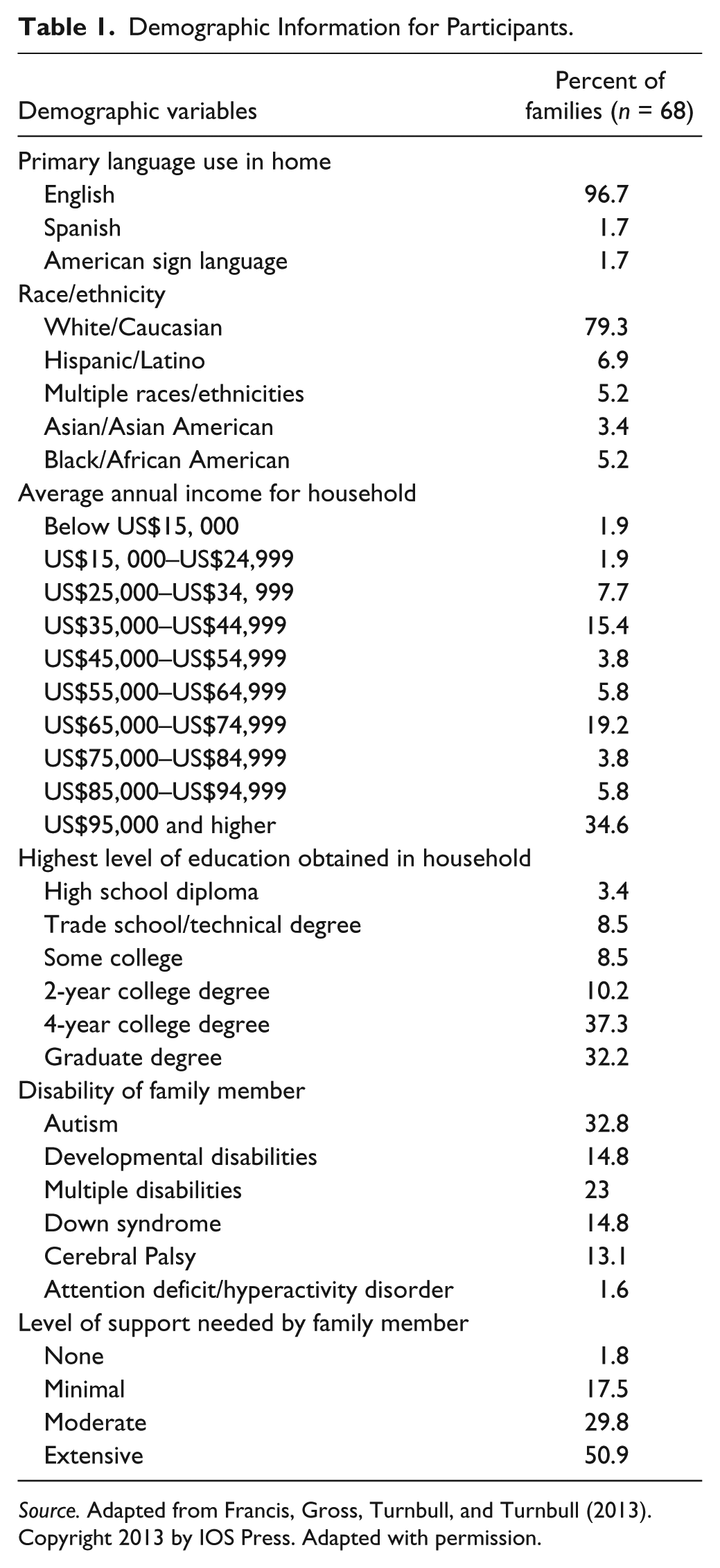
Source. Adapted from Francis, Gross, Turnbull, and Turnbull (2013). Copyright 2013 by IOS Press. Adapted with permission.
We offered family units the opportunity to participate in a semi-structured interview about their experiences seeking, obtaining, or maintaining employment for their family member with ISN. Twenty-six families volunteered to participate in follow-up interviews. We purposefully selected for maximum diversity (Merriam, 2009) across multiple characteristics and interviewed families until we reached saturation (we ceased to find new data; Glaser & Strauss, 1967) with 13 interviews. Table 2 displays demographic information for the family units interviewed.
Demographic Information and Selection Criteria for Interview Participants.
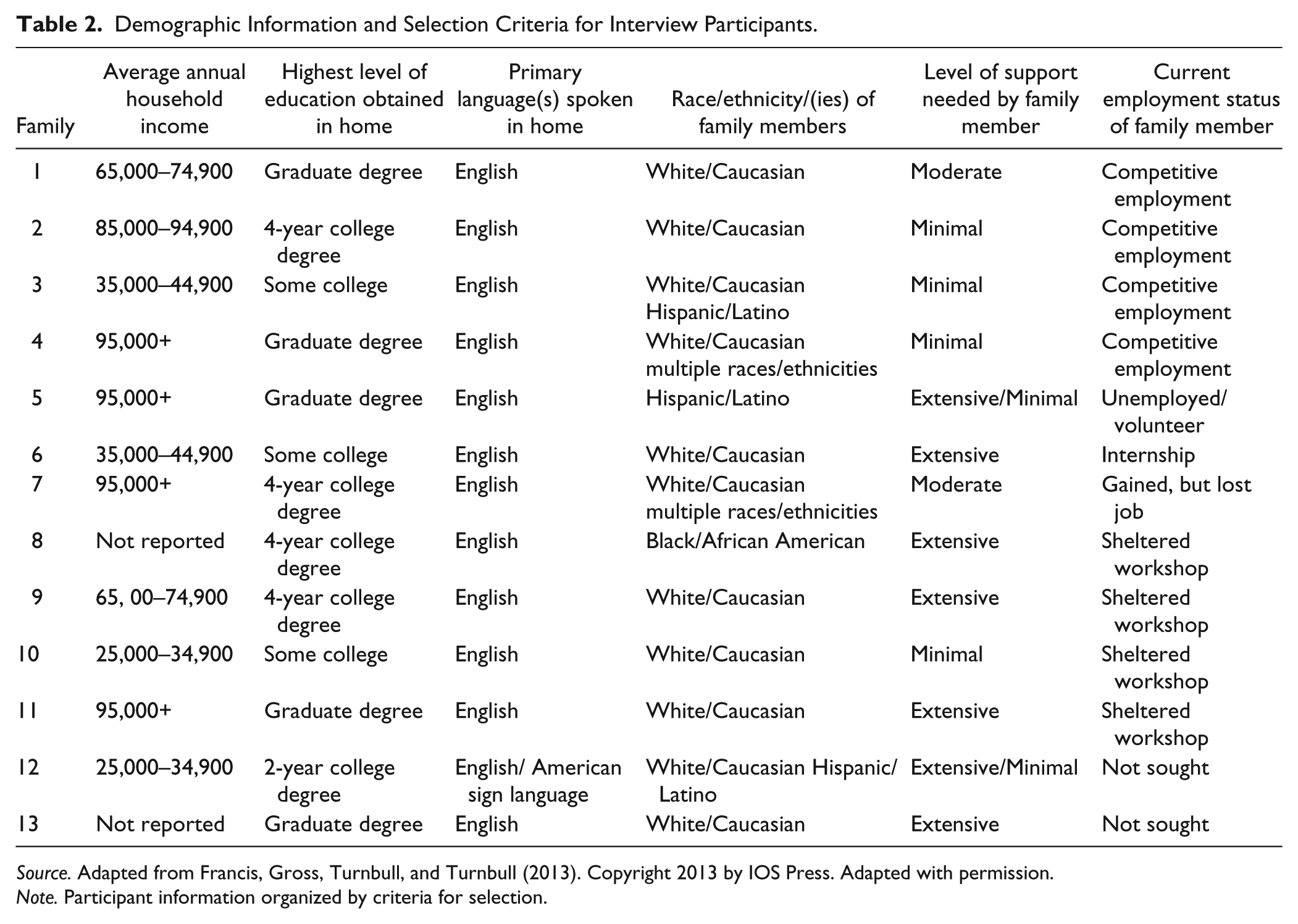
Source. Adapted from Francis, Gross, Turnbull, and Turnbull (2013). Copyright 2013 by IOS Press. Adapted with permission.
Note. Participant information organized by criteria for selection.
Procedure
We administered the FEAT Follow-Up Survey and FEAT Interview Protocol to assess families’ perspectives regarding resource use and competitive employment outcomes. The following section describes the FEAT program, instruments used in this study, and data analysis methods.
FEAT
FEAT was a product of collaboration between university researchers and state parent training and information center leaders, funded by Kansas’ state Medicaid agency. The program was designed to increase expectations for competitive employment and knowledge about employment-related resources among families. However, professionals (e.g., teachers, transition specialists, case managers, job coaches) also attended the program. The FEAT team used design-based research methodology (Kelly, Lesh, & Baek, 2008) to design, develop, and pilot FEAT. Each FEAT training took place over two 8-hr days for 2 days, with Day 1 focusing on increasing expectations and Day 2 dedicated to enhancing knowledge.
The FEAT curriculum addressed expectations for competitive employment by encouraging participants to “build the dream of employment” by (a) presenting real-life stories of successful competitive employment from Kansas and across the nation; (b) conducting a break-out session for family members with ISN targeting identifying interests, strengths, needs, and job development; and (c) facilitating rotating discussion groups of local competitively employed people with ISN, employers, and entrepreneurs with ISN. The curriculum also addressed knowledge of employment resources by (a) presenting information about job supports, funding sources, benefits, programs, and organizations; (b) conducting a break-out session for family members with ISN on disability disclosure and self-advocacy; (c) facilitating rotating discussion groups of local service programs, agencies, and organizations (e.g., workforce centers, rehabilitation services); and (d) guiding participants to create employment action plans.
The training and materials were also offered in Spanish. All participants were encouraged to sign up for follow-up technical assistance services provided by FEAT staff. Although several trainers conducted the 11 FEAT trainings held around the state of Kansas from 2010 to 2011, the FEAT development team used a train-the-trainer model, provided a scripted training manual, and assisted with delivery of the training curriculum at each site. A repeated-measures ANOVA indicated that the variances between trainings did not significantly influence knowledge levels (Francis, Gross, Turnbull, & Parent-Johnson, 2013).
Instrumentation and design
We used two instruments, a FEAT Follow-Up Survey and a FEAT Interview Protocol to measure participant perspectives.
FEAT Follow-Up Survey
We developed and distributed a FEAT Follow-Up Survey (Francis, 2013) using research-based guidelines recommended by Dillman, Smyth, and Christian (2009) to measure FEAT’s longer-term influence. Two native Spanish speakers, both professionals in the field of developmental disabilities and presenters of FEAT in Spanish, worked independently and then collaborated to translate all survey materials into a “neutral” or “universal” form (Eremenco, Cella, & Arnold, 2005). This ensured Spanish translations accurately represented all survey concepts (Dillman et al., 2009). Because all participants had the option to complete a paper or electronic version of the survey in English or Spanish, we assigned participants individual identification numbers to prevent duplication of responses.
FEAT Interview Protocol
We used the FEAT Interview Protocol (Francis, 2013) to conduct 13 semi-structured interviews with family units (i.e., parents and their children with ISN) in person (n = 7) or via telephone (n = 6). Two interviewers conducted each interview. One acted as the primary interviewer, and the second handled logistical issues (e.g., consent forms, recording devices) and took notes, similar to an assistant moderator role in focus group research (Shank, 2006). We began each interview by introducing the study and ourselves, explaining confidentiality measures, and encouraging interviewees to discuss their experiences fully and honestly. We audio-recorded the interviews with participants’ consent and transcribed the interviews to ensure thick descriptions and accurate representation of data. The mean length was 74 min, with interviews lasting between 48 and 116 min. During interviews, participants described their families and then answered several open-ended questions about FEAT and their employment-related experiences (e.g., tell me about your child’s job, tell me about your experiences helping your child gain employment, did attending FEAT impact your child’s road to employment). The interviewers debriefed after each interview by discussing key themes, information obtained (or not obtained), compelling findings, and potential changes to the protocol.
Data Analysis
We used SPSS statistical software (Version 20.0) to calculate data frequencies for the Follow-Up Survey on accessing resources, employment outcomes, and FEAT’s influence.
We used NVivo qualitative software (Version 10) to manage the analysis of the interview data. Using basic interpretative qualitative analysis (Merriam, 2002), we (a) identified general themes found among and across responses, (b) coded the data into categories, (c) revisited codes to determine accuracy and appropriateness, and (d) recoded data as necessary (Creswell, 2009). During this process, the FEAT team collaborated to discuss the codes and ensure a common understanding of the categories and themes. We also used several methods to ensure trustworthiness of the qualitative analysis (Creswell, 2009; Maxwell, 2005) such as (a) transcript checks (comparing written transcripts with original interview recordings), (b) peer debriefing (reviewing and questioning interpretations of qualitative data with colleagues), and (c) comparison (comparing data from contrasting cases of participants).
Results
The purpose of this study was to determine the perspectives of families who attended FEAT in 2010 and 2011. We combined the quantitative (survey) and qualitative (interview) data in these results to address our research questions. In this section, we report percentages, frequencies, and qualitative themes that emerged from the interviews.
Research Question 1: Resources Accessed
Survey data
We used survey data to determine (a) the percentage of families who used FEAT information/materials and how they used it, (b) the number of services and supports accessed/used by families since attending FEAT, and (c) the percentage of families that used FEAT technical assistance and how they rated it. We used interview data to derive information on behavior related to competitive employment.
FEAT information/materials
In all, 65% (n = 41) of families indicated they used FEAT information/materials (e.g., web resources, information packet, resource CD) after attending the program. Families reported using the information/materials several ways: (a) sharing information with friends (n = 29, 44.1%), (b) sharing information with family (n = 26, 38.2%), (c) sharing information with professionals (n = 23, 33.8%), (d) looking at or using web resources (n = 22, 32.4%), and (e) sharing information with colleagues (n = 15, 22.1%).
Services and supports
Families accessed/used an average of five employment-related services and supports after attending FEAT. The minimum number of services and supports accessed/used was zero (n = 6) and the maximum was 10 (n = 1). Those most frequently accessed/used were as follows: (a) case management (n = 22, 32.4%), (b) Community Developmental Disability Organization (regional, single points of entry for obtaining services through the developmental disabilities system in Kansas; n = 16, 23.5%), (c) Home and Community-Based Services Waivers (n = 15, 22.1%), (d) Vocational Rehabilitation (n = 10, 14.7%), and (e) job coaching (n = 9, 13.2%)/assistive technology (n = 9, 13.2%).
FEAT technical assistance
A total of 41% (n = 26) of families indicated they used FEAT technical assistance. Of those, 42.9% (n = 12) indicated they strongly agreed that the assistance they received was helpful, 35.7% (n = 10) agreed, 14.3% (n = 4) neither agreed nor disagreed, 3.6% (n = 1) disagreed, and 3.6 % (n = 1) strongly disagreed.
Interview data
Participants reported accessing resources by (a) networking and connecting with community resources, and (b) seeking and/or obtaining employment services and supports.
Networking and connecting with community resources
First, families reported networking and connecting with members of the community to help their family members with ISN gain competitive employment. Many families contacted community employers to inquire about employment or volunteer opportunities. One family, discouraged by several fruitless application submissions, described how they contacted a manager at Wal-Mart to ask for “tips” on getting through the application process:
So, [the store manager] had kind of given my husband a hint anytime you fill one of those [online applications] out you either strongly agree or strongly disagree, don’t do a whole lot in the middle. So, that’s what my husband advised [her son] to do, and so he did that this time and actually did get an interview.
In addition to contacting community employers, families also networked with other families or community organizations to find employment, service providers, or general day-to-day support. Families networked with individuals online through support groups, at parent trainings and conferences (including FEAT), and through organizations such as Special Olympics and Partners in Policymaking. Parents outlined numerous benefits to networking in this way, including (a) learning “different techniques” to assist their family members with ISN, (b) obtaining social and emotional support for all family members, (c) gaining advocacy and empowerment skills, (d) finding job leads, and (e) acquiring quality service providers for their family members with ISN. Several families also reported sharing materials and information learned at FEAT with other families, and school and employment professionals.
Seeking and/or obtaining employment services and supports
Second, families discussed actively and sometimes “aggressively” searching for, advocating among, and/or securing services and supports designed to help their family members with ISN to obtain, learn, or maintain employment. Many families described “looking into information” about a certain program or “setting up an appointment” with an agency (e.g., supported employment provider, assistive technology). In addition, families sought support from community organizations indirectly related to employment. For instance, one family reported applying for services and supports such as “reduced rates for the bus system” to support their family member’s transportation to and from work. Families also enrolled their members in vocational and community college classes to expand and hone their skills. Regardless of the type of organization, agency, or program they approached, families reported frequently having to advocate for appropriate services and supports for their family members. Several families recounted contacting potential support sources “on so many different occasions” and asking employment agencies “questions until I’m out of them.”
Research Question 2: Competitive Employment Outcomes
Survey data
We examined competitive employment by measuring a range of employment outcomes on the FEAT Follow-Up Survey, from “not yet sought employment” to “competitively employed.” We also included a 5-point Likert-type scale question on the Follow-Up Survey to measure families’ perceptions of FEAT’s influence on how they help their family members with ISN gain and/or maintain competitive employment.
Competitive employment outcomes
At the time of the survey, 15 families (22.1%) reported that their family member with ISN gained a competitive employment outcome (i.e., a competitive job or an internship/volunteer position) after attending FEAT. Of these families, 7 (46.7%) reported that their family member gained competitive employment, and 8 (53.3%) reported that their family member gained an internship or volunteer position.
A majority (n = 8, 57.1%) reported that their family member worked between 0 and 10 hr a week, 21.4% (n = 3) worked between 11 and 15 hr, 14.3% (n = 2) worked between 26 and 30 hr, and 7.1% (n = 1) worked between 31 and 35 hr a week (one participant did not respond to this question).
Perceived influence of FEAT
Almost 67% of families responded that they “strongly agreed” (n = 14, 31.1%) or “agreed” (n = 16, 35.6%) that FEAT positively influenced the way they help their family members with ISN gain and/or maintain competitive employment. In all, 22% (n = 10) responded that they “neither agreed nor disagreed,” and 11.1% indicated that they disagreed (n = 2, 4.4%) or strongly disagreed (n = 3, 6.7%) that FEAT positively influenced how they help their family members.
Interview data
Interview participants described their family member with ISN’s job status and job preferences. They also reported that FEAT influenced how they (a) sought out employment opportunities for their family members with ISN, (b) shared information/materials with others, and (c) “reached out to” services, supports, and resources.
We interviewed four people with ISN who were competitively employed and two who were interning or volunteering at competitive jobsites. Two of the competitively employed individuals worked at different Wal-Mart stores, one worked at a local bakery, and the last individual worked at a hotel. One individual interned at a coffee shop, and another volunteered at a hospital. Although the employer did not pay the individual interning at the coffee shop, he earned customers’ tips. Of these six, five had gained their positions after FEAT. The length of employment ranged from approximately 3 weeks (Wal-Mart) to 7 years (hospital). Job descriptions and tasks varied, but general tasks included (by position) (a) customer service, retrieving carts, and cleaning (Wal-Mart); (b) customer service and cashier work (Wal-Mart); (c) cleaning and washing dishes (bakery); (d) cleaning (hotel); (e) clerical work (hospital); and (f) making drinks, cleaning, and stocking materials (coffee shop). Overall, the people with ISN reported feeling grateful for their positions, and two families indicated that their children enjoyed their jobs.
Employment preferences
Although families expressed gratitude for the current positions, four of the six also expressed dissatisfaction and articulated preferences for different jobs, responsibilities, pay rates, or hours. For example, a family described their son’s attitude toward his current job pushing carts at Wal-Mart: “He still [would] rather probably be inside [the store], but it’s at least that’s a step in.” The other individual with ISN working at Wal-Mart also noted he did not “want to have this job forever.” He and his family went on to describe preferred employment “where the bar is higher and the income is higher” that aligned with his interest in video games. Similarly, the individual working at the bakery expressed his desire to work more hours and do more baking instead of cleaning. He also suggested he would be great at customer service if given the chance. Last, the mother of the individual volunteering at a hospital questioned why her daughter, who had volunteered for 7 years and done “a very good job,” had not been offered a paid position.
Perceived influence of FEAT
Families reported taking action as a result of attending FEAT, which included seeking employment opportunities: “We started looking for employment and volunteer opportunities because of the reasons that you made us aware of. So we really appreciate the training you gave us very, very much.” Families also shared information with others. Many families reported sharing information/materials with friends, professionals, and people with whom they worked. One mother shared information with her colleagues; together, they provided FEAT information/materials to military families at a local Army base: “We’re sharing some of the information, like gosh, this is what you can do if your child doesn’t want to just clean.” Families also “reached out to” services, supports, and resources they learned about at FEAT. Families sought out formal support from agencies and programs (e.g., Vocational Rehabilitation) and sought informal support from their communities (e.g., churches). One mother, who worked as a case manager, explained how FEAT influenced her behavior in both her roles: “I think [the FEAT program] is something that I really need to be a part of as a case manager, as well as a parent of a child that is transitioning.”
Discussion
Results of this study indicated many families who attended FEAT in 2010-2011 (a) accessed resources related to competitive employment following FEAT, (b) reported competitive employment outcomes for their family members with ISN following FEAT, and (c) indicated FEAT positively influenced how they help their family members with ISN gain and/or maintain competitive employment. In addition to accessing resources to benefit their own family members with ISN, families reported disseminating FEAT information/materials. This finding is encouraging because it supports the idea that FEAT’s benefits extended beyond participants as they shared information and materials with others.
While one cannot attribute the competitive employment outcomes families reported to FEAT alone, it is encouraging that close to 70% of families believed or strongly believed that FEAT positively influenced how they help their family members with ISN get or maintain competitive jobs. However, many interviewees with competitive employment outcomes expressed dissatisfaction with their current positions or worked well below part-time.
These findings reflect national data on employment of people with ISN. People with ISN who are competitively employed typically do not work full-time (Hendricks & Wehman, 2009; Mank, 2007). As evidenced by the woman with ISN volunteering for 7 years, these findings also reflect the exploitation that people with ISN experience (Abbas, 2012). Although FEAT improved employment outcomes for many participants, the majority of participant outcomes are not ideal. Ideally, we would prefer full or part-time competitive employment outcomes for 75% or more participants. Emphasizing available FEAT technical assistance may improve outcomes.
Limitations
Although the results from this study are promising, it has several limitations that can be addressed in future research. For example, we provided all survey materials in both English and “neutral” or “universal” Spanish (Eremenco et al., 2005). However, we received only one completed Spanish survey (we received 12 Pre-/Post-Questionnaires in Spanish; Francis, Gross, Turnbull, & Turnbull, 2013). Therefore, the Spanish-speaking population that attended FEAT appears to be underrepresented in our follow-up data. Moreover, the education and income levels of participants do not reflect the greater population of Kansas. Nearly 90% of survey participants and 100% of interviewees reported attending college (only one potential interviewee did not report attending college, but we were unable to interview her). These percentages are substantially greater than the 61.1% of the general population of Kansans who reported attending college (U.S. Census Bureau, 2012). Although the percentage of participants reporting annual household incomes of US$75,000 or more is comparable with statistics for Kansan families (44.2% compared with 41.7%), this study has an underrepresentation of families reporting incomes of US$24,999 or lower (3.8% compared with 14.7%). These data on education attainment and income may indicate a skewed population of “joiners,” a more motivated group of families who are more likely to attend and take action.
Implications for Future Research
Future research should investigate outcomes of other participants, including professionals and people with ISN (apart from their families). This includes exploring the efficacy of FEAT as a professional development program designed for school staff. Researchers should also continue targeting culturally and linguistically diverse participants, participants from varied socioeconomic groups (i.e., low income), participants without a college education, as well as people with ISN.
Although pre- and post-FEAT comparison data would strengthen this study, the Pre-/Post-Questionnaires did not request that participants provide information about resource use or competitive employment. We also thought it unethical to deny access to potential participants who wanted to attend FEAT. Consequently, this study did not include a control group. Using the FEAT Follow-Up Survey to develop a more comprehensive Pre-/Post-FEAT Survey would allow researchers to measure the same constructs (e.g., access of resources) before and after FEAT, thus strengthening future research. Future research should include wait-list control groups or a quasi-experimental design to assess the impact of a program on participant outcomes.
In addition, this study did not consider mediating or confounding variables (e.g., type of disability, number of family members with ISN, transportation, socioeconomic status (SES); E. Hall, 2007; Hessing, Arcand, & Frost, 2004; Ison et al., 2010). An analysis of multivariate regression of mediating or confounding variables on outcomes such as behavioral change and competitive employment would contribute to the literature.
To gather stronger evidence of behavioral change due to FEAT, future research should investigate steps participants took toward competitive employment before and after attendance (e.g., developing an employment goal on a Person-Centered Plan) along with employment outcomes. This information would add to knowledge on how FEAT influenced behavior and would also provide information about differences in behavior (e.g., steps taken) between people who did and did not obtain competitive employment. Families, professionals, and people with ISN could use the information as guidance while seeking competitive employment.
Implications for Improving Practice
Low expectations and poor knowledge levels among school and agency staff (Schmidt & Smith, 2007; Schur et al., 2005), poor transition plans or services from schools (National Council on Disability, 2010; Timmons et al., 2011), and a breakdown in collaboration between families, school staff, and employment service providers (J. P. Hall & Fox, 2004; Timmons et al., 2011) are three major contributing factors to the unemployment rates of people with ISN. These factors result in confusion, misinformation, low expectations, and poor knowledge across families, people with ISN, and school/agency professionals. However, trainings such as FEAT, designed specially for professionals, could mitigate many of these barriers.
We designed the current FEAT program to help families and their members with ISN to develop high expectations for employment and gain knowledge about competitive employment resources (Francis, 2013). Practitioners would likely benefit from a reconfiguration of the existing FEAT program that places an emphasis on appropriate and effective Individualized Education Program goals, high school work experiences, fostering self-determination, transition to adult life, collaborating with families, and networking among various professionals and community employers. Expanding FEAT from a family-focused program to a professional development program could improve the ways professionals (a) provide services to people with ISN, (b) provide information and materials to families and people with ISN, and (c) collaborate with families and other professionals. These improvements could ultimately reduce the advocacy efforts families often must engage in to find or obtain appropriate services and supports for their family members and increase competitive employment rates.
Two limitations of this study included the underrepresentation of Spanish-speaking participants and the overrepresentation of participants from higher SES groups. As a result, researchers, educators, and employment professionals must strategically consider how to recruit diverse families using a variety of methods over and above informational flyers and emails. Some methods found to bolster family participation in trainings such as FEAT include calling families personally (Quezada, Díaz, & Sánchez, 2003), visiting families in their homes, spreading information through parent-to-parent connections/support groups, and collaborating with schools and community groups (Hepburn, 2004).
Additionally, participants citied numerous barriers related to accessing employment-related services and supports, and only 22% of participants reported competitive employment outcomes. However, a majority of participants indicated that they perceived that FEAT had a positive influence. In light of these findings, it is interesting that less than half of participants reported accessing FEAT technical assistance. These findings imply that simply providing trainings and making technical assistance available is not enough to improve competitive employment outcomes. Although technical assistance is essential to mastering and enhancing knowledge and increasing participant outcomes (Joyce & Showers, 2002), families of individuals with ISN require more practical and comprehensive hands-on support, which may include following up with families personally and offering assistance instead of waiting for families to make a phone call. Considering the number of participants who described networking with and sharing materials with other families, this may also include harnessing and facilitating family-to-family support as a more organic and lasting form of technical assistance.
Conclusion
Results of this study indicated that families who attended FEAT accessed employment resources after attending the program. Some families also reported competitive employment outcomes for their family members with ISN. Further, most families believed or strongly believed that FEAT positively influenced how they help their family members with ISN gain and/or maintain competitive employment. These findings contribute to literature on employment training programs and support the notion that FEAT changed families’ behaviors and enhanced competitive employment outcomes for people with ISN.
Footnotes
Authors’ Note
The opinions expressed are those of the authors and do not represent views of the Office of Special Education Services or the U.S. Department of Education. The survey and interview protocol can be obtained from the lead author upon request.
Declaration of Conflicting Interests
The author(s) declared no potential conflicts of interest with respect to the research, authorship, and/or publication of this article.
Funding
The author(s) disclosed receipt of the following financial support for the research, authorship, and/or publication of this article: The research reported here was supported by the Office of Special Education Services, U.S. Department of Education, through Grant H133B031133 to the University of Kansas.