



Abstract
Self-determination skill development is a central construct in the field of secondary special education. Recently, there has been discussion to revisit the motivational theoretical roots that influence the conceptualization of self-determination in special education, and merge motivational theories with instructional practices. Self-determination can be taught in a variety of formats, but one popular means is through self-determination curricula. To determine how motivational theories are reflected in self-determination instruction, a curriculum analysis was completed. Three motivational theories (contextual theory, self-determination theory, achievement goal theory) and three self-determination curricula (Steps to Self-Determination, Whose Future Is it Anyway?, and ME! Lessons for Teaching Self-Awareness and Self-Advocacy) were analyzed. Results indicated variability of the presence of motivational theory across curriculum.
The field of secondary special education and transition has intervened to address the high disengagement and low motivation of students with disabilities through a variety of practices. One such practice is instructing students to promote their self-determination skills. Self-determination instruction provides an opportunity for students to become more autonomous in their learning, gain self-regulation, and decision-making skills (Wehmeyer & Schwartz, 1997) while increasing levels of self-determination (Wehmeyer, Palmer, Shogren, Williams-Diehm, & Soukup, 2013). Furthermore, Shogren and Shaw (2016) reported that higher levels of autonomy in students with high incidence disabilities (i.e., learning disabilities, emotional disturbances) is considered a strong predictor for positive adult outcomes including financial independence, employment, social relationships, housing, and postsecondary education.
Recently there has been reclamation in the conceptualization of self-determination. Shogren et al. (2015) described the history of self-determination and returns attention to the theoretical processes that contribute to the motivational foundation of what we now describe as self-determination. In their article, causal agency theory becomes the basis for the conceptualization of this article’s understanding of self-determination. “Causal Agency Theory represents the layers of human agency that fall in between the drive to meet basic psychological and biological needs and the agentic self” (Shogren et al., 2015, p. 258). An agentic person engages in self-regulated and goal-directed action, continuously evaluating their actions and outcomes (Little, Hawley, Henrich, & Marsland, 2002; Shogren et al., 2015). Furthermore, it is within different environments and interactions with others in which individuals begin to develop their causal agency. Causal agency is more than the development of skills, “it implies that the individual acts with an eye toward causing an effect to accomplish a specific end or to cause or create change” (Shogren et al., 2015, p. 258). The reconceptualization of self-determination through the lens of causal agency theory reorients our understanding of what self-determined action means by further considering the motivational components, in combination with the instructional practices and curricula content that incite such behavior and action.
Motivation
Brophy (2004) suggests a difference between motivation to learn and motivation. Although the two constructs are similar, they differ on the origin of the motivational catalyst. Motivation to learn implies a contextual influence on motivation, whereas motivation implies activation of an internal influence. Brophy views motivation to learn as a schema or “skills, values, and dispositions that enable students to understand what it means to engage in academic activities with the intention of accomplishing their learning goals with awareness of the strategies they use in attempting to do so” (Brophy, 2004, p. 17). However, motivation explains student persistence and quality of behavior in education contexts (Brophy, 2004). There are multiple theoretical frameworks that attempt to explain motivation, motivation to learn, and the relationship between motivation and engagement including (a) contextual theory, (b) self-determination theory, and (c) achievement goal theory.
Contextual Theory
Contextual theory views motivation using an ecological perspective based on Bronfenbrenner’s (1986) seminal paper on human development. Proponents of contextual theory suggest that there is no one thing that is attributed to what makes students motivated and engaged. The theory is based on the foundation that a student has a dynamic relationship with multiple systems (e.g., micro-, and meso-system) and positive achievement is an outcome of students who are affectively, behaviorally, and cognitively engaged. The focus on micro- and meso-systems of the classroom comes from the assumption that contextualized views “recognize no single individual characteristic or classroom feature will be sufficient for explaining motivation” (Perry, Turner, & Meyer, 2006, p. 4) and therefore must account for combinations of various contextual influences. This model suggests that environmental factors (e.g., instruction) impact personal factors (e.g., motivational beliefs), which impact student engagement. In turn, student engagement impacts student outcomes.
Lam, Wong, Yang, and Liu (2012) provide a bi-categorical contextual model, which includes instructional contexts and social relatedness contexts. As the model stands currently there are other environmental variables unaccounted for that may influence engagement. The probability of identifying what distinct factors directly impact engagement through an ecological framework could potentially be reduced by not accounting for other systemic influences (e.g., school or classroom level rules, school climate). The two subsequent motivational theories (self-determination theory and goal achievement theory) focus on what influences engagement by narrowing the theoretical perspective to the individual’s interaction with his or her environment.
Self-Determination Theory
Self-determination theory is a macro-theory of human motivation that crosses multiple life domains and contributes to understanding basic personality development and behavioral self-regulation (Ryan & Deci, 2000). Self-determination theory is considered to be an organismic theory, which takes into consideration an individual’s ability to evaluate novel experiences, and assimilate, explore, and integrate those experiences into one’s identity (Ryan & Powelson, 1991). The theory assumes that individuals are naturally curious, self-motivated, eager beings that are innately driven to understand and explore what is personally satisfying and rewarding (Deci & Ryan, 2008a).
Deci and Ryan (2008b) state that self-determination theory addresses issues such as basic psychological needs, life goals and aspirations, relations of culture to motivation, and the impact of social environments on motivation, affect, behavior, and well-being. The macro-theory functions on the assumption that individuals must have certain basic psychological needs satisfied for effective functioning and psychological health and well-being. “The concept of human needs turns out to be extremely useful because it provides a means of understanding how various social forces and interpersonal environments effect motivation” (Deci & Ryan, 2008b, p. 183). Self-determination theory views these basic psychological needs as within individual variables and focuses on the degree to which these basic psychological needs have been met. The basic psychological needs include feelings of autonomy, competence, and relatedness (Deci, Vallerand, Pelletier, & Ryan, 1991; Ryan & Deci, 2000).
The need for autonomy is defined as the experience of choice in the initiation, maintenance, and regulation of activity and the experience of connectedness between one’s actions and personal goals and values (Connell & Wellborn, 1991; Deci et al., 1991; Ryan & Powelson, 1991). The need for competence is defined as the need to experience oneself as capable of producing desired outcomes and avoiding negative outcomes (Connell & Wellborn, 1991; Ryan & Powelson, 1991). The need for relatedness encompasses the need to feel securely connected to the social surroundings and the need to experience oneself as worthy and capable of love and respect (Connell & Wellborn, 1991; Deci et al., 1991; Ryan & Powelson, 1991). In addition, research has focused on how to increase an individual’s basic psychological needs through autonomy supportive classrooms. Autonomy support is defined as the degree to which socializing agents take the target individual’s perspective; act in ways that encourage choice and self-initiation; provide meaningful rationales and relevance; and refrain from using language or displaying behaviors that are likely to be experienced as pressure toward particular behaviors. (Benita, Roth, & Deci, 2014, p. 260)
Through working in an autonomy supportive environment, and impacting an individual’s basic psychological needs, human motivation is also impacted (Ryan & Powelson, 1991).
Within this theory, motivation is commonly divided between intrinsic and extrinsic motivation. Ryan and Deci (2000) state “perhaps no single phenomenon reflects the positive potential of human nature as much as intrinsic motivation, the inherent tendency to seek out novelty and challenges, to extend and exercise one’s capacities, to explore, and to learn” (p. 70). Intrinsically motivated behaviors are engaged out of an individual’s own volition. These behaviors are typically exhibited because an individual finds inherent pleasure in doing the activity without need for reward or reinforcement (Deci et al., 1991). In contrast, extrinsic motivation is characterized by engagement in an activity for the sake of an outcome that is separate and different than the activity itself (Ryan & Deci, 2000; Vansteenkiste, Lens, & Deci, 2006). Self-determination theorists hold that environments can be structured to be supportive of one’s intrinsic needs for autonomy to be met, and when this occurs learning outcomes are enhanced (Reeve, Jang, Carrell, Jeon, & Barch, 2004).
Achievement Goal Theory
Achievement goal theory is a framework that is used to explain academic motivation and why students become engaged in learning (Meece, Blumenfeld, & Hoyle, 1988). The initial application of achievement goal theory suggested that students engage in learning primarily for two reasons: mastery or performance. Students who are mastery oriented focus on developing new skills and value learning (Ames & Ames, 1981; Ames & Archer, 1988; Barron, Evans, Baranik, Serpell, & Buvinger, 2006) whereas students who are performance oriented are concerned with showing evidence of ability and achieving success in comparison with peers (Ames & Archer, 1988; Barron et al., 2006). Moreover, it is theorized that students who are mastery oriented attribute success to the amount of effort dedicated to learning whereas students who are performance oriented attribute the amount of success to ability and luck (Ames & Ames, 1981). Not only does goal orientation affect student’s attribution to success but it also appears to affect engagement. For example, students who are mastery oriented may be more willing to take on challenging tasks that encourage effortful learning than performance-oriented students. This suggests that mastery-oriented students may become more behaviorally and affectively engaged due to the challenge of the task and the sense of self-empowerment that comes from mastering a task (Anderman & Patrick, 2012). Furthermore, Brophy (2010) suggests that performance-oriented students may have little interest in learning and may want to disengage when faced with challenges.
Review of the Theories
All three motivational theories reviewed attempt to explain why students become motivated and engaged in school. Contextual theory uses an ecological approach to explain how micro- and meso-systems function in the class, and how the dynamic relationship between the student and these systems impact student engagement. Self-determination theory assumes that students must have three basic psychological needs (autonomy, competence, and relatedness) fulfilled to become engaged. Self-determination theory research also focuses on student motivation (intrinsic vs. extrinsic regulatory type) and the degree to which learning environments support student autonomy. Achievement goal theory specifies that students have different goal orientations that are determined by a student’s rationale for learning (i.e., wanting to learn and comprehend vs. wanting to outperform other students).
One strength of the three theories is their coherence regarding the role of the learning environment on student learning and engagement. On the other hand, one gap in motivational research is the lack of individuals with disabilities included or identified as participants (Deci, Hodges, Pierson, & Tomassone, 1992), and the lack of focus on how to teach the skills that are needed to act agentically. Yet, in the field of secondary special education and transition, one practice is directly conceived from motivational theory, teaching self-determination.
Self-determination instruction gives credit to self-determination theory (Wehmeyer, 1995); however, limited explicit attention has been given to motivational elements when designing and implementing self-determination instruction. However, given the origins of self-determination instruction in self-determination theory and more broadly in motivational theories, an examination of the extent to which self-determination curricula reflects motivational theories is needed. This rationalizes the need to examine self-determination curricula to understand the interaction between motivation and self-determination curricula and instruction.
Self-Determination Curricula
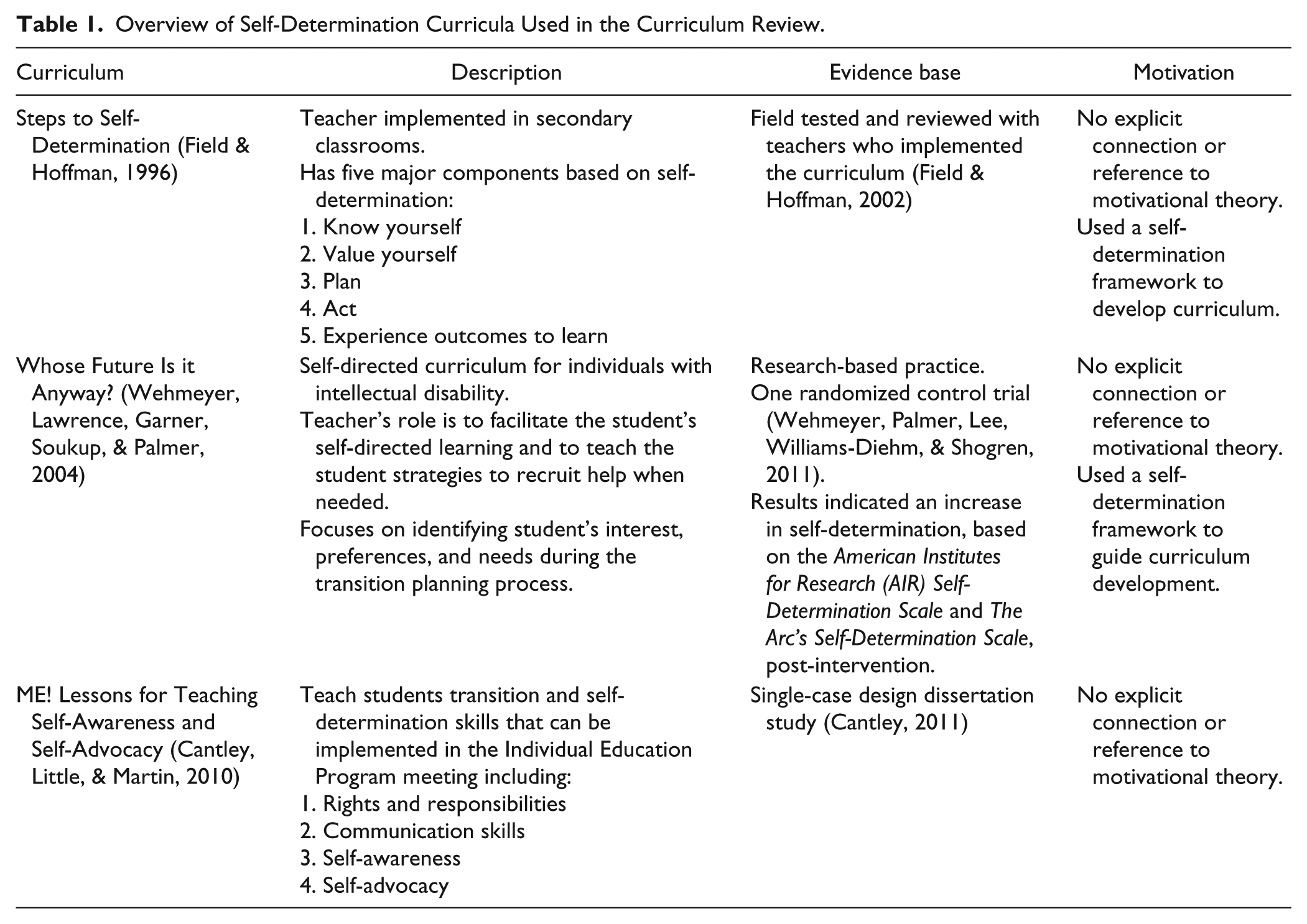
Three self-determination curricula were selected for review including Steps to Self-determination (Field & Hoffman, 1996), Whose Future Is it Anyway? (Wehmeyer, Lawrence, Garner, Soukup, & Palmer, 2004), and ME! Lessons for Teaching Self-Awareness and Self-Advocacy (Cantley, Little, & Martin, 2010). All three curricula have been used in classroom settings to help promote self-determination in students with disabilities. Each curricula focus on promoting self-determination in a variety of ways through different forms of implementation (e.g., classroom based vs. self-directed) or content (e.g., focus on Individual Education Program planning vs. identifying preferences, interests, and needs).
Steps to Self-Determination is a curriculum that teaches self-determination on a broad basis, teaching students about self-determination, goal setting, and communication. It has five major components including know yourself, value yourself, plan, act, and experience outcomes to learn (Field & Hoffman, 1996). Whose Future Is it Anyway? is a self-directed curriculum that identifies a student’s preferences, interests, and needs during the transition planning process. It challenges students to investigate topics such as self-awareness, communication, goal setting, problem solving, and decision making (Wehmeyer, Lawrence, et al., 2004). The curriculum contains six sections focused on (a) identity development, (b) making decisions, (c) obtaining resources, (d) identifying goals and goal planning, (e) communication during meetings, and (f) types of meetings. Last, the ME! Lessons for Teaching Self-Awareness and Self-Advocacy was developed to help educators teach students transition and self-determination skills around the Individualized Education Program. The lessons covered topics such as rights and responsibilities, self-awareness, and self-advocacy. See Table 1 for an overview of all three curricula including description, evidence base, and motivational framework.
Overview of Self-Determination Curricula Used in the Curriculum Review.
Self-Determination, Special Education, and Motivational Theories
Wehmeyer (1995) defined self-determination as “acting as the primary causal agent in one’s life and making choices and decisions regarding one’s quality of life free from undue external influence or interference” (p. 22). Later, the definition was revised to state that self-determined behaviors are volitional actions to improve one’s quality of life (Wehmeyer & Field, 2007), and this conceptualization was characterized as a “functional model” of self-determination based on an understanding that the function of self-determined behavior was to increase volitional action. Recently, Rowe et al. (2015) conducted a Delphi study to operationalize the definition of self-determination. This definition states “self-determination is the ability to make choices, solve problems, set goals, evaluate options, take initiative to reach one’s goals, and accept consequences of one’s actions” (p. 9). As mentioned previously, Shogren et al. (2015) introduced causal agency theory, which attempts to bring together motivational elements from self-determination theory, particularly the focus on structuring environments to promote autonomy and intrinsic motivation, with elements from Wehmeyer’s functional model of self-determination that explicates strategies to teach skills, such as those identified by Rowe et al. (2015; e.g., making choices, setting goals, etc.). As such, causal agency theory attempts to emphasize the importance of motivational and instructional elements. With the reconceptualization of self-determination through a causal agency lens, self-determination is recognized as human agentic action. In this case, an individual is agentic when she is the origin of her own behavior, learns from failures, perseveres in the face of obstacle, and has a sense of well-being (Little et al., 2002). Further, environments can support and enhance self-determination by addressing the psychological needs for autonomy, relatedness and competence, and intrinsic motivation. In all cases, these definitions of self-determination within special education are clearly related to motivation in the sense that they view the individual as the causal agent in their lives. In addition, it is the individual’s volitional actions leading to active engagement that should determine the course of one’s life.
Promoting the development of self-determination in special education is conceptually organized around teaching a broad umbrella of specific skills (e.g., goal, setting and decision making). Wehmeyer, Field, Doren, Jones, and Mason (2004) report two rationales for addressing self-determination in special education. First, being self-determined, empowered, and a self-advocate is a civil right. Second, teaching self-determination is a tool for educational effectiveness and improving educational outcomes. Through instruction of self-determination skills, students with and without disabilities can become causal agents in their learning and life (Wehmeyer & Field, 2007) by acting on the learned skills while assuming adult roles (Wehmeyer, Field, et al., 2004). This increases their ability to be autonomous individuals, a skill critical for students who have experienced historic challenges (Wehmeyer, Palmer, Agran, Mithaug, & Martin, 2000).
Motivation and Self-Determination Curricula
Understanding how opportunities provided by the environment can interact with an individual’s skill is a critical component of motivational theory, and there is a critical need for further consideration of motivation elements within teaching practices to promote self-determination. In a position paper by the Council for Exceptional Children’s Division on Career Development and Transition, Field, Martin, Miller, Ward, and Wehmeyer (1998) suggested the use of curricula to teach self-determination skills. In addition, the authors suggested that teachers realize that “self-determination is a function of the interaction between an individual’s skills and the opportunities provided by their environments” (Field et al., 1998, p. 119). Because the development of causal agency in adolescents with disabilities is critical for future life success, it is important to understand how motivation is represented in how causal agency is taught, which has traditionally been through instruction utilizing self-determination curricula. Our research question is as follows: What motivational components from three major motivational theories are present within three self-determination curricula?
Method
This manuscript reviews three self-determination curricula (a) Steps to Self-Determination (Field & Hoffman, 1996), (b) Whose Future Is it Anyway? (Wehmeyer, Lawrence, et al., 2004), and (c) ME! Lessons for Teaching Self-Awareness and Self-Advocacy (Cantley et al., 2010; will be cited as the ME! Lessons hereafter). These three curricula have been selected because they cover different aspects of self-determination. Steps to Self-Determination has a broad contextual focus that uses experiential learning and Whose Future Is it Anyway? has a more narrow focus to help students direct and participate in the transition planning process. The ME! Lessons are a structured approach to develop student’s self-awareness and self-advocacy skills. By focusing on these three curricula, theoretical components of motivation across these three curricula can be examined within the general application of self-determination.
Analysis Procedures
First, the major components of each motivational theory were identified. After an extensive review of the literature, each component was identified by (a) importance to the theoretical model identified through theoretical definitions and visual models by the developers and authors of each motivational theory, and (b) influence and representation of the component in previously conducted research (previous intervention research was given preference). The evaluation yielded a total of eight motivational components in contextual theory, six components in self-determination theory, and five components in achievement goal theory (see Table 2). The first author originally defined components after an extensive review of the literature. The first author trained the second author on the operational definitions and coded the first lessons in each curriculum together prior to blind coding each lesson. Prior to completing the curriculum analysis, an iterative process was conducted between the first and second authors to further concretely define and align components and definitions with each motivational theory.
Operational Definitions of Motivational Components.
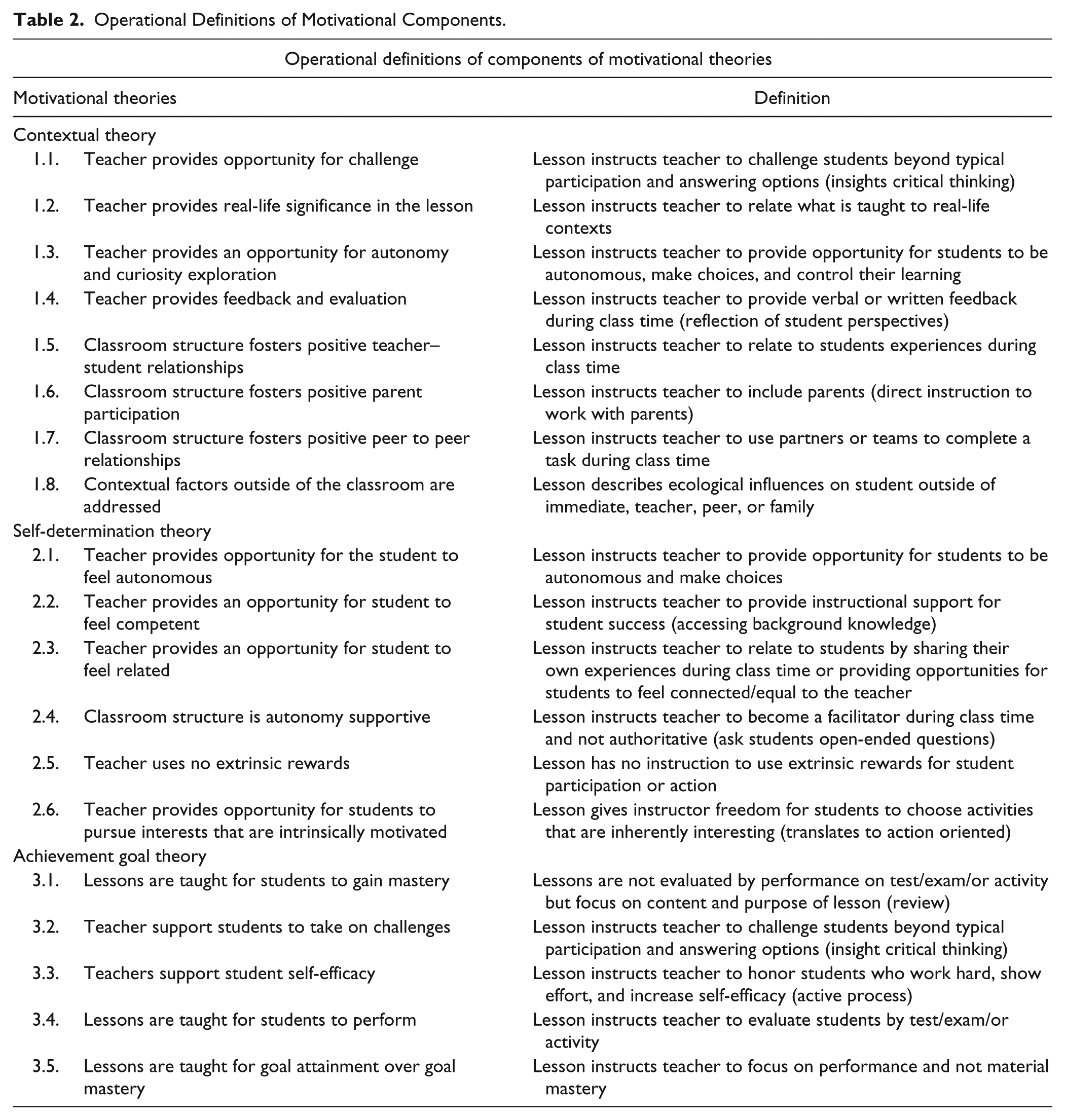
Second, each curriculum (Steps to Self-Determination, Whose Future Is it Anyway?, and ME! Lessons) was analyzed by lesson. Lessons were examined to determine the presence or absence of a motivational component across each theory. Lessons were determined to have a component if at any point in the lesson a component was present, as determined by the operational definition (see Table 2 for list of operational definitions of each component). Decisions on the presence of a component were made based on the explicit instruction of the curriculum to the teacher/instructor to fulfill a certain task. For Whose Future Is it Anyway?, the presence of a component was based on what the curriculum told the student to complete. The first and second authors of this manuscript did not indicate the presence of a motivational component if we believed something was implied. For example, contextual theory Component 1.6 states, Classroom structure fosters positive parent involvement; if within a lesson there was no instruction for the teacher to include parents during class time or after class, there would be no mark for that component. This process was repeated for each theory and component.
The first two authors completed the evaluation of the three curricula. After, the authors reviewed each lesson for the presence of the motivational components individually and then compared. Initial inter-rater agreement was calculated using percent agreement by adding all agreements and dividing by the total number of possible agreements (Gisev, Pharm, Bell, & Chen, 2013). Results for each motivational theory across curricula ranged from poor to moderate (i.e., 60.4%–76.5%) to acceptable (i.e., 80% or higher). Following our initial comparison, any discrepancy between the identification of the presence and/or absence of a motivational component was discussed. The authors came to consensus, by providing examples in the lesson that align with the operational definition of the motivational component. These discussions were completed until each lesson across the three curricula had 100% agreement.
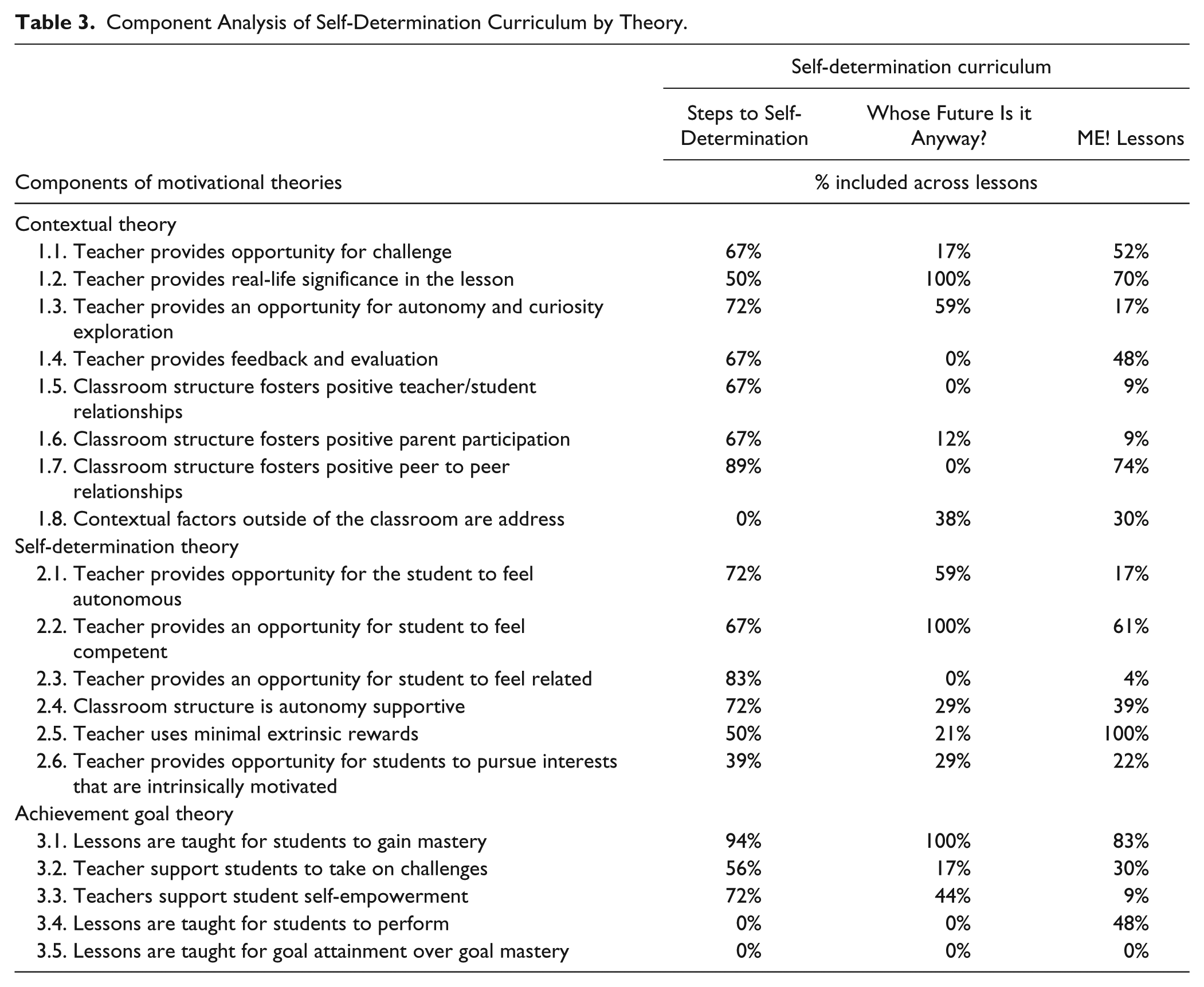
The component analysis consisted of using a dichotomous indicator (yes/no) of the presence of a component of one of the three motivational theories. Table 3 provides a summary report of the component analysis. Each theory is presented along with the corresponding components. Percentages are presented as an indicator of how frequent each component was included across the lessons of the three curricula.
Component Analysis of Self-Determination Curriculum by Theory.
Results
Results from the curricula review indicate that all three curricula have a varying degree of motivational components that are present throughout lessons, despite none of the curricula making explicit reference to motivational theories The Steps to Self-Determination curriculum had, overall, the most motivational components from all three motivational theories (e.g., contextual theory, self-determination theory, and achievement goal theory) present across its 18 lessons. The ME! Lessons had the second most motivational components present followed by Whose Future Is it Anyway? with the fewest motivational components present throughout the lessons.
Second, there were some motivational components that were found across the lessons of the three curricula more consistently than others. For contextual theory, the motivational components Teacher provides real-life significance in the lesson (Component 1.2), Classroom structure fosters positive peer-to-peer relationships (Component 1.7), and Teacher provides opportunity for autonomy and curiosity exploration (Component 1.3) were found to be most prevalent among the three curricula. The least observed motivational components were Classroom structure fosters positive parent participation (Component 1.6), Classroom structure fosters positive teacher–student relationships (Component 1.5), and Contextual factors outside of the classroom are addressed (Component 1.8).
When evaluating the three curricula for self-determination theory motivational components, the components Teacher provides an opportunity for student to feel competent (Component 2.2) and Teacher uses minimal extrinsic rewards were most prevalent. The motivational components of self-determination theory that were least observed were Teacher provides an opportunity for student to feel related (Component 2.3) and Teacher provides opportunity for students to pursue interests that are intrinsically motivating (Component 2.6).
The motivational component of achievement goal theory that was present most across the three curricula was Lessons are taught for students to gain mastery (Component 3.1). This result is inversely correlated with the component that was least present: Lessons are taught for goal attainment over goal mastery (Component 3.5).
An additional finding was Whose Future Is it Anyway? was consistently rated with the fewest motivational components observed across all three motivational theories. This trend is believed to be due partly because it is a self-directed curriculum, rather than a curriculum taught in the classroom. This eliminates Opportunities for teachers to provide feedback (Component 1.4), Foster positive teacher–student relationships (Component 1.5), and opportunities of peer-to-peer relationships (Component 1.7). This was also reflected in the self-determination theory component, Teacher provides an opportunity for student to feel related (Component 2.3).
Similar to this finding, achievement goal theory is based on a framework that a classroom is on a continuum between a mastery or performance orientation (Ames, 1992). The overwhelming majority of lessons across all three curricula were Mastery oriented (Component 3.1). Due to the mastery-oriented lessons and the dichotomous nature of the theory, it is understandable that there were little to no lessons that suggested to Teach lesson for performance (Component 3.4) or Prioritizing goal attainment over goal mastery (Component 3.5).
Lastly, Whose Future Is it Anyway? had three motivational components (one from each motivational theory) present in every lesson. The three found in the Whose Future Is it Anyway? curriculum include Teacher provides real-life significance in the lesson (Component 1.2); Teacher provides an opportunity for student to feel competent (Component 2.2), and Lessons are taught for students to gain mastery (Component 3.1). The ME! Lessons had one motivational component present in every lesson: Teacher uses minimal extrinsic rewards (Component 2.5).
Discussion
Recent literature within the field of special education has emphasized rooting self-determination in theory to define it not as a set of skills, but as a set of characteristics individuals develop and implement as causal agents within their environments integrating both motivational components as well as instructional components related to promoting causal agency (Shogren et al., 2015). Understanding the extent to which self-determination curricula utilize components drawn from motivational theories is one step in identifying ways in which self-determination instruction can support and engage students. Subsequently, understanding how motivational theories impact instruction and utilizing specific strategies that support engagement (e.g., creating an autonomy supportive classroom) can then be applied to instruction. Results from the curricula review provide a number of issues for the field to consider.
One of the main findings of the analysis was the high degree of variability within and between curricula. All three curricula varied in how often they instructed teachers to implement different motivational components, which may be related to the fact that none of the curricula explicitly mentioned a focus on motivational theory. Thus, the inclusion of motivational components did not appear to be systematically integrated into any of the curricula. Unfortunately, very few components were present within all lessons of a given curriculum. As a curriculum, Whose Future Is it Anyway? contained three motivational components present across all lessons, more than the other two curricula, yet still had the fewest motivational components throughout the lessons. The ME! Lessons had only one lesson with all of the motivational components present, and Steps to Self-Determination had no motivational components present in all lessons despite the higher prevalence of components overall across all lessons.
It is predicted that the presence of the three motivational components (Teacher provides real-life significance in the lesson, Teacher provides an opportunity for student to feel competent, Lessons are taught for students to gain mastery) across all lessons in Whose Future Is it Anyway? is due to a number of characteristics within the curriculum. The colloquial language and the amount of review that can be found across the lessons provides an opportunity for students to feel competent and gain mastery during each lesson, while the focus on numerous post-school outcomes using examples provides real-life significance.
The high degree of variability in the ME! Lessons is likely due to the varied activities and methods of student evaluation outlined in each lesson plan. The single motivational component (Teacher uses minimal extrinsic rewards) present across all lessons of the curriculum is due to the absence of explicit instructions for teachers to provide verbal or tangible extrinsic rewards following student action.
While Steps to Self-Determination had no motivational components present across all lessons, it did have the most components present overall, which is likely due to the sequential nature of the curriculum. As students are introduced to new concepts, they are asked to participate in progressive activities in and outside of class in ways that tap into different motivational components. By explicitly planning for and aligning elements of motivational theories to lessons, it may enable more consistent engagement producing conditions that enhance the motivation of students and enable them to further develop skills to act as causal agents.
Limitations
The high degree of variability could also be explained by the emphasis many motivational components have on the structure of the classroom environment and specific teacher behaviors. Though some lessons provided specific directions for teachers to target motivational components related to classroom structure and teacher behavior, each curriculum did so without consistency. For example, Component 1.7, Classroom structure fosters positive peer to peer relationships, was not coded as present in any lessons of Whose Future Is it Anyway? because there were no explicit instructions for students to work with partners or groups to complete an activity. However, teachers using this curriculum in their classroom may modify certain activities to be partner or group based to tap into this motivational component. The inability to observe how teachers deliver the curricula and utilize motivational components beyond what is explicitly called for in the lessons is a major limitation of the review. The lack of curricula observation in an applied setting could bias our findings, especially those concerning Whose Future Is it Anyway?. Due to the intent that the curriculum is self-directed by the student, a number of the teacher-related motivational components could not be coded (e.g., Teacher provides feedback and evaluation). Though the curriculum is intended to be self-directed, some students may need additional support from their teacher to engage the curriculum, and teachers may target these motivational components inherently absent from the curriculum.
Another limitation that led to the variability of some of the motivational components from achievement goal theory is the continuum between performance and mastery. Though performance and mastery are not always dichotomous, in our review, it was rare for lessons to include both goal attainment and goal mastery orientations. This continuum is believed to have impacted the absence of Component 3.5, Lessons are taught for goal attainment over goal mastery, from all curricula and Component 3.4, Lessons are taught for students to perform, from Steps to Self-Determination and Whose Future Is it Anyway?
Implications for Research and Practice
Given the limitations outlined in this review, future research should examine instruction using self-determination curricula to identify the specific motivational components that are present in teacher instruction, not just in curricula. Direct observations may provide more clarity regarding whether or not variability of motivational components still exist during instruction. Understanding how teachers utilize components that already exist in curricula and supplement those that may be absent could inform development of new and modification of existing curricula. Observations in special education and general education classrooms may shed light on how teachers use motivation differently depending on the context and subject matter.
Specifically to the self-determination curricula review, our component analysis suggests self-determination curricula are lacking in fostering teacher–student relationships, parent participation, and actively challenging students to strengthen self-efficacy, make decisions, and think critically. Teachers using self-determination curricula may need to build in additional opportunities to (a) share their own experiences to ensure students feel related and foster positive relationships; (b) engage parents and families within and outside of class time; (c) expand discussions and activities to increase self-efficacy, encourage decision making and critical thinking; and (d) help students pursue intrinsically motivating interests.
Correlational research suggests that learning environments that are autonomy supportive (Reeve et al., 2004) and have positive teacher-, peer-, and parent interactions in and outside of the classroom (Froiland, 2011; Van Ryzin, Gravely, & Roseth, 2009) are associated with positive student outcomes (e.g., academic belongingness and engagement). Creating an autonomy supportive environment is critical to ensure students with disabilities interact with an environment that is advantageous to develop an agentic self. One simple strategy to increase autonomy support in the classroom is to ensure that students have choice in how they engage in content (e.g., let students determine how they want to show competence over the content on an assignment). Enhancing self-determination curricula by providing more support for teachers to create autonomy supportive environments could be useful, and further enhance student self-determination and outcomes.
Future research should also examine the long-term effects of self-determination instruction on intrinsic motivation and the agentic self. Immediate effects of self-determination are promising, but lasting impacts are still being researched. With the reconceptualization of self-determination that refocuses to the development of the agentic self, the primary question to be addressed seems to be the following: Would increasing motivational theoretical principles within instruction increase self-determination within individuals with disabilities?
Conclusion
Self-determination continues to be an important instructional topic to increase positive outcomes for students with disabilities. This curricula review analyzed three curricula for the presence of motivational components that would support students in becoming more agentic. None of the three curricula was found to be more inclusive of motivational components than another. Yet, as with most curricula, effects are found not solely by the content but also how the teacher instructs students using the curricula. Creating an autonomy supportive environment for students utilizing motivational theoretical principles could enhance the effects of self-determination instruction, and further research is needed to promote the development of strategies to enable this outcome.
Footnotes
Declaration of Conflicting Interests
The author(s) declared no potential conflicts of interest with respect to the research, authorship, and/or publication of this article.
Funding
The author(s) received no financial support for the research, authorship, and/or publication of this article.