




Abstract
Instruction in academic core content provides students with moderate to severe disabilities a full educational opportunity that promotes current and future options in the community and can complement acquisition of daily living skills. However, high school teachers face many challenges in balancing instructional priorities given the mission to ensure all students are college and career ready. This article describes methods for designing instruction that is relevant, meaningful, and addresses multiple priorities during academic core content instruction for high school students with moderate to severe disabilities.
Keywords
The emergence of the standards-based instruction era has changed the expectations for students with moderate to severe disabilities (SwMSD). The push for all students to be college and career ready has raised expectations for academic and transition outcomes. Partially as a result of the Higher Education Opportunities Act (P.L. 110-315), engagement in college and postsecondary education opportunities for SwMSD are rapidly increasing (Newman et al., 2010). As Kearns and colleagues (2011) point out, college is not the end goal, but merely a possible stepping-stone on the path to a happy and fulfilling adult life. Therefore, Kearns et al. interpret college and career readiness for SwMSD as the achievement of skills required for success in current and future environments.
High school teachers of SwMSD are tasked with helping their students become college and career ready by assisting students in setting and making progress toward meaningful goals related to self-determination, social and communication skills, and other individualized needs. Federal law also mandates that teachers provide academic core content instruction that is aligned with grade-level standards (Individuals With Disabilities Education Improvement Act, 2004). Although these have been seen as competing priorities in the past (e.g., Agran, Alper, & Wehmeyer, 2002), academic core content instruction can complement acquisition of goals in other areas (e.g., social skills instruction embedded into a group science lesson).
Educators face several challenges when educating SwMSD. Most SwMSD require more time to learn skills than other students with disabilities, experience more difficulty in learning complex skills, and require programming to ensure generalization of acquired skills (Westling & Fox, 2009). The impact of standards-based instruction on the adult lives of SwMSD is yet to be seen, but increased academic opportunities will provide students an increased level of skills over prior generations (Spooner & Browder, 2014). Our purpose is to outline ways high school teachers of SwMSD can address multiple priorities during academic core content instruction.
Mathematics
Bree is an 11th-grade student with Down syndrome and a moderate intellectual disability. During her recent person-centered planning (PCP) meeting, Bree shared she enjoys playing video games with her siblings and friends and wants to become more independent in spending money. Bree’s teacher, Ms. Correa, developed unit plans for her algebra class this semester and wants to make sure she embeds Bree’s interests and goals into the instruction on the common core standard, “Understand solving equations as a process of reasoning and explain the reasoning” (CCSS.Math.Content.HSA.REI.A.1; corestandards.org ).
One mathematical process that is emphasized throughout state standards is mathematical problem solving (Common Core State Standards Initiative, 2015). It is important for students to know what they are going to do, how they will go about doing it, and the rationale behind their choices. This iterative cognitive process is cyclical as students choose a strategy, monitor progress, and make changes as necessary along the way. Metacognition in problem solving may be interrupted for SwMSD due to a lack of self-monitoring skills. Self-monitoring, a component of self-management, consists of self-observation and self-recording and can assist an individual in becoming aware of their behavior to regulate it. Self-monitoring can enhance the skills and independence of SwMSD across multiple domains and contexts. Educators can address multiple priorities in mathematics by anchoring instruction in meaningful tasks, incorporating self-monitoring strategies, and planning for generalization.
Anchoring Mathematics Instruction
To make mathematics meaningful and relevant to students, educators should anchor mathematics instruction in a real-world context by considering how the mathematical content is necessary for independence in various domains of adult living. Ms. Correa considered how Bree will use the concepts and reasoning from algebra in current and future environments. For example, games played using the Internet may allow players to purchase additional credits to use within the game, often with scenarios of “two credits for US1$ or five credits for US2$.” A player who is able to understand the proportion of price to credit would also need to be able to set up and solve an equation to make a more cost-effective decision.
Pictorial Self-Instruction
One instructional method that has recently proven successful in both increasing self-monitoring abilities and teaching SwMSD conceptual and procedural steps of solving real-world problems is pictorial self-instruction (e.g., Root, Browder, Saunders, & Lo, 2016). In pictorial self-instruction, individuals use a task analysis that has pictures, and possibly text, corresponding to each step. Ms. Correa chose to use pictorial self-instruction to teach Bree how to use and solve for variables within tasks that incorporate Bree’s desire to be more independent in budgeting. Ms. Correa identified each step Bree should complete to determine how long it would take her to acquire a desired amount of money given how much money she could make at a part-time job.
First, income must be understood as a constant value for a given amount of time spent working, such as US$8 every hour. Next, the goal amount of money is identified, such as US$50 for a new video game. To plan how long it will take to purchase the game, an equation can be set up that has the constant multiplied by an unknown to equal the cost, or 8x = 50. The value of x will determine how many hours of work will pay for the video game. After identifying the steps necessary to solve the problem, Ms. Correa created a student-friendly task analysis. Educators should create the task analysis based on students’ literacy and communication abilities. SwMSD can be taught to self-monitor by checking off each step as it is completed. The specific steps and format should differ based on the needs of individual students. For example, if a student does not know how to use a calculator, the task analysis would need to be expanded.
Plan for Generalization
Given the ineffectiveness of “train and hope” (Stokes & Baer, 1977), instruction should plan for generalization to real-world contexts from the beginning by considering stimuli students will encounter in the natural environment. Ms. Correa knew real-world applications of mathematical problem solving would not involve a lot of text, as is seen in word problems, but rather tables and graphic displays. By using realistic stimuli for solving the problem, such as screen shots from real video games, educators are using several generalization techniques including using sufficient exemplars, training loosely, and programming common stimuli (Stokes & Baer, 1977) to teach a variety of skills including academic and personally relevant curriculum.
Science
Grey is a 10th-grade student with autism and a moderate intellectual disability. Grey told his team during his PCP meeting that he was interested in working with his peers during small group instruction and enjoys building and constructing models. With encouragement from his team, he helped set goals related to problem-solving and communicating when he disagrees with his peers. The goals relate directly to the practices of science (as recommended by the Next Generation Science Skills [NGSS]) of (a) asking questions and defining problems, (b) engaging in argument from evidence, and (c) obtaining, evaluating, and communicating information. His life sciences teacher and special educator co-planned his life sciences course this semester to determine how to include his goals into science and engineering instruction. For example, they considered the NGSS standard of “Evaluate the evidence supporting claims that changes in environmental conditions may result in: (1) increases in the number of individuals of some species, (2) the emergence of new species over time, and (3) the extinction of other species” (HS-LS4-5).
When students are taught science and engineering, they have the opportunity to learn science content (e.g., physical science), but more importantly, teachers can promote students’ use of science practices (e.g., questioning, arguing based on evidence) and to generalization to other academic areas. Teachers are encouraged to use their state standards and the NGSS Lead States (2013) to develop grade-appropriate learning expectations students will need to be college and career ready. Learning the practices of science not only encourages students to “think like scientists” but also promotes foundational skills of mathematics, communication, and social conscience, as well as personal skills such as time management and organization.
Although all practices promoted by the NGSS can be considered important to learn, Knight, Wood, McKissick, and Kuntz (2016) suggest collapsing them into questioning, connecting and observing, and communicating. Students should learn how to ask questions that can be addressed using scientific methods. Students also need to connect their learning to background knowledge and other academic skills, using observations to justify current claims and make future predictions. Finally, students need to learn how to communicate their findings to others, including providing evidence to support claims, and using reasoning to draw conclusions from data.
Anchoring Science and Engineering
When teachers design instruction to focus on real-world applications, students are more likely to make the connection between their own life and the world in which they live. A unit exploring engineering content might provide a real-world scenario in which students have to solve the problem of keeping their lunch cold without using a refrigerator. Teachers could present this problem, and ask students to work in cooperative learning groups to plan, build, test, and retest building a container that can keep contents as cold as possible. In life sciences, students might explore the impact of humans on the Earth by asking questions about the ways in which our impact on the environment is evident in their neighborhoods or by finding solutions to the problem of human impact (e.g., designing an urban vertical garden). Not only did Grey’s co-teachers consider grade-level standards and content, but they also determined how he will use science and engineering practices in his high school and postsecondary experiences (i.e., keeping your lunch cold and gardening skills are both important for young adults to learn).
Inquiry-Based Science Instruction
Research has shown that inquiry-based instruction is beneficial for SwMSD in terms of increasing engagement, and acquiring science vocabulary and big ideas of a lesson (Knight et al., 2016). During elementary and middle school, students focused on asking inquiry-worthy questions, dictating which materials to use, and completing the steps in the experiment. In high school, the emphasis should shift to college and career readiness, life enriching skills, self-determination, and fostering communication with classmates. Engagement in the practices of science should favor increased self-directed forms of inquiry, including opportunities to pursue their own lines of inquiry to (a) pose their own questions, (b) construct their own explanations based on evidence, (c) determine variables to isolate, and (d) form logical arguments to communicate findings. To accomplish this, teachers can use the system of least prompts (SLP) along with task analytic instruction.
Using Visual Supports
Graphic organizers are one visual support that can help students to understand complex information, to organize what they have learned, and to increase self-determination skills (Smith, Spooner, Jimenez, & Browder, 2013). Grey’s co-teachers reviewed previous lessons with the class, which encouraged the science practices of connecting and observing during the what do you
Plan for Generalization
Finally, Grey’s teachers embedded methods to increase generalization of science to cross-cutting concepts and other content areas. Cross-cutting concepts in science can be thought of as big ideas that transcend a science domain (e.g., Earth and space), thus providing students with connections across the curriculum. For example, patterns, similarity and diversity, cause and effect, scale, proportion, and quantity are cross-cutting concepts that are important, not only in science, but also in mathematics, daily living, and transition. When creating the plans for an urban vertical garden, Grey and his peers needed to use skills learned during English Language Arts (ELA) courses. First, they had to conduct research on the Internet. Grey used text to speech to listen to the directions for how to create the plans, used a graphic organizer to take notes, and then communicated these plans to his peers. Together, he and his peers developed a step-by-step plan, including screen shots from the Internet to remind them how they were going to initially design the garden.
Literacy
Temple is an 11th-grade girl with spastic cerebral palsy and a moderate intellectual disability. She has no vocal verbal speech and limited motor skills. For communication, she is beginning to use the IPad app, GoTalk NOW, which is positioned on her wheelchair using a mounting system. During her recent PCP meetings, she expressed interest in working with children, as well as participating in theater. In the following IEP meeting, Temple and the team identified that she needed to work on social skills, acquisition of common words in her current and future environments, and become more proficient with her GoTalk NOW. Her teacher, Mr. Buckingham, has planned with the general education ELA teacher on how to incorporate instruction on Temple’s targeted goals. In reviewing the Common Core State Standards (CCSS), specifically the essential elements in 11th-grade ELA, Mr. Buckingham and the gen ed teacher agree they need to address 11th-grade standards related to language, speaking and listening, and knowledge of word meanings (CCSS.ELA-Literacy. SL.11-12.1, CCSS.ELA-Literacy.L.11-12.1, CCSS.ELA-Literacy.L.11-12.4; www.corestandards.org ).
Access to literacy materials that are grade-level appropriate and instruction in grade-aligned ELA standards are essential. Accessible materials can serve as a platform that will lead to instruction in personally relevant content, age-appropriate social situations, and transition skills needed for postschool outcomes. State standards in ELA require students to access and understand a variety of texts encountered in daily life as well as to develop skills in writing, research, and communication. High-quality instruction in the area of literacy will help SwMSD effectively acquire and demonstrate their understanding of content knowledge through reading, writing, speaking, and listening (Kearns et al., 2011), and ultimately be college and career ready.
In addition to the ELA-focused skills needed to be college and career ready, skills of daily living, including social skills are needed for a happy and fulfilling adult life. Social skill instruction typically occurs very early on in school or even before kindergarten for students without disabilities, yet for SwMSDs, social skills instruction is ongoing (Westling & Fox, 2009). Educators can address multiple priorities within literacy instruction by creating natural opportunities for social skills practice within meaningful activities, using accessible materials that are considerate of the student communication needs (www.nimac.us), and systematically teaching targeted skills.
Meaningful Literacy and ELA Instruction
Themeatic ELA units that include a variety of carefully selected texts, including narrative and informational text, can be used to foster college and career readiness. For example, a lesson could focus on tying the theme of a grade-aligned fictional novel back to the students’ own lives through a comparison of characters’ actions to their own actions in a similar situation. In addition, a follow-up lesson could use an informational text that provides more information on a topic that was highlighted in the narrative text.
Mr. Buckingham planned a unit on social justice. After working closely with the general education ELA teacher from 11th grade, he chose Number the Stars as his fictional novel along with the play version of Diary of Anne Frank. The initial lessons focused on reading the adapted version of Number the Stars (with the support of National Instructional Materials Access Center [NIMAC], which provides accessible formats for students with disabilities; www.nimac.us), answering a variety of comprehension questions about the targeted chapter using the SLPs, and instruction in targeted vocabulary words (using constant time delay) chosen carefully by Mr. Buckingham. Each day, these lessons were concluded with a writing activity that focused on writing opinion paragraphs, using assistive technology, related to the character’s actions after being stopped by the Nazi regime. The writing activity ended with a discussion of what the students would do if in a similar situation as the characters and related it to events occurring today.
After completing several weeks of instruction on the fictional novel, Mr. Buckingham switched gears to focus on the play, Diary of Anne Frank. The focus of one particular lesson targeted a variety of grade-aligned standards, as well as social skill instruction on taking turns and waiting your turn to say your line, with multiple opportunities provided to Temple to use her device. This was followed by a lesson where Mr. Buckingham used a KWHL graphic organizer and systematic instruction to identify what the students
In the above example, Mr. Buckingham was able to target the skills identified by Temple and her IEP team (vocabulary, communication, social skills), as well as incorporate her interest in theater and tie the Unit and Lessons to real-world applications. Mr. Buckingham used several strategies that have strong research support for teaching grade-aligned ELA skills, including using accessible materials such as adapted books, response options, and systematic instruction.
Adapted Books
In addition to identifying grade and age-appropriate texts, texts will need to be adapted for students to increase accessibility, interest, and engagement. There may be changes made to the book, text, and in some cases, supports added (www.nimac.us). In regard to changes to the book, it is important to consider student capabilities. For example, is the student able to hold the book, can they turn the page on their own? If not, this may require educators to physically alter the book to increase accessibility. In regard to changes to the text, if students are nonreaders or reading at a much lower readability level than the identified grade-appropriate text, the text complexity may need to be reduced. Educators are encouraged to preread the text before adapting to avoid taking out essential parts or text that supports teaching a targeted skill (e.g., symbolism). After prereading the text, the educator should rewrite the text to reduce overall word count and text complexity. Educators should consider the grade readability level they are trying to target before starting, and then a Lexile analyzer (www.lexile.com) should be used to check the newly adapted text for the readability level. Finally, some students may need supports like Braille, picture, photo, or even object supports added to the text to promote comprehension and engagement, especially if they are a nonreader or have a visual impairment
Providing Response Options
For students, like Temple, who cannot generate their own response to activities and questions asked throughout the lessons, it is critical to provide response options or a response board. In Temple’s case, Mr. Buckingham preprogrammed relevant response options into her communication system, but in general, educators need to consider the wide range of communication modes and abilities students may exhibit when preparing for instruction. When asking comprehension questions or conducting instruction on other targeted ELA skills, it is strongly encouraged to provide four response options reflecting the correct answer, a close distractor from the targeted text that day, another close distractor from a recent text, and a highly disparate distractor (Browder, Spooner, & Meyer, 2011). As students gain skills in responding to comprehension questions, the distractors can become more difficult.
Systematic Instruction
According to Spooner, Knight, Browder, and Smith (2012), several systematic instructional strategies were identified as evidence-based practices for teaching academics to SwMSD. For example, task analytic instruction along with systematic prompting and feedback has been successfully used to teach literacy skills, such as comprehension and vocabulary, to SwMSD (e.g., Browder, Trela, & Jimenez, 2007). In addition to academics, systematic instruction has been found effective for teaching a wide range of additional skills such as teaching communication and social skills (Browder, Wood, Thompson, & Ribuffo, 2014).
Summary
To balance the multiple instructional priorities for SwMSD, teachers can consider methods for providing academic core content in ways that are also relevant, meaningful, and necessary in current and future environments. In all of the above vignettes, teachers began by using PCP and IEP goals based on student and team input. The IEP team was careful to include relevant transition skills in addition to the core academic areas. In all content areas, teachers should consider the use of visual supports, evidence-based instructional strategies, and generalization of learned skills. The preceding examples illustrate research-based methods for providing SwMSD a full educational opportunity, addressing the multiple priorities integral for successful transitions to adulthood. Table 1 provides a list of resources teachers may find useful for developing meaningful lessons for SwMSD that address multiple instructional priorities.
Free Resources to Support Core Academic Instruction.
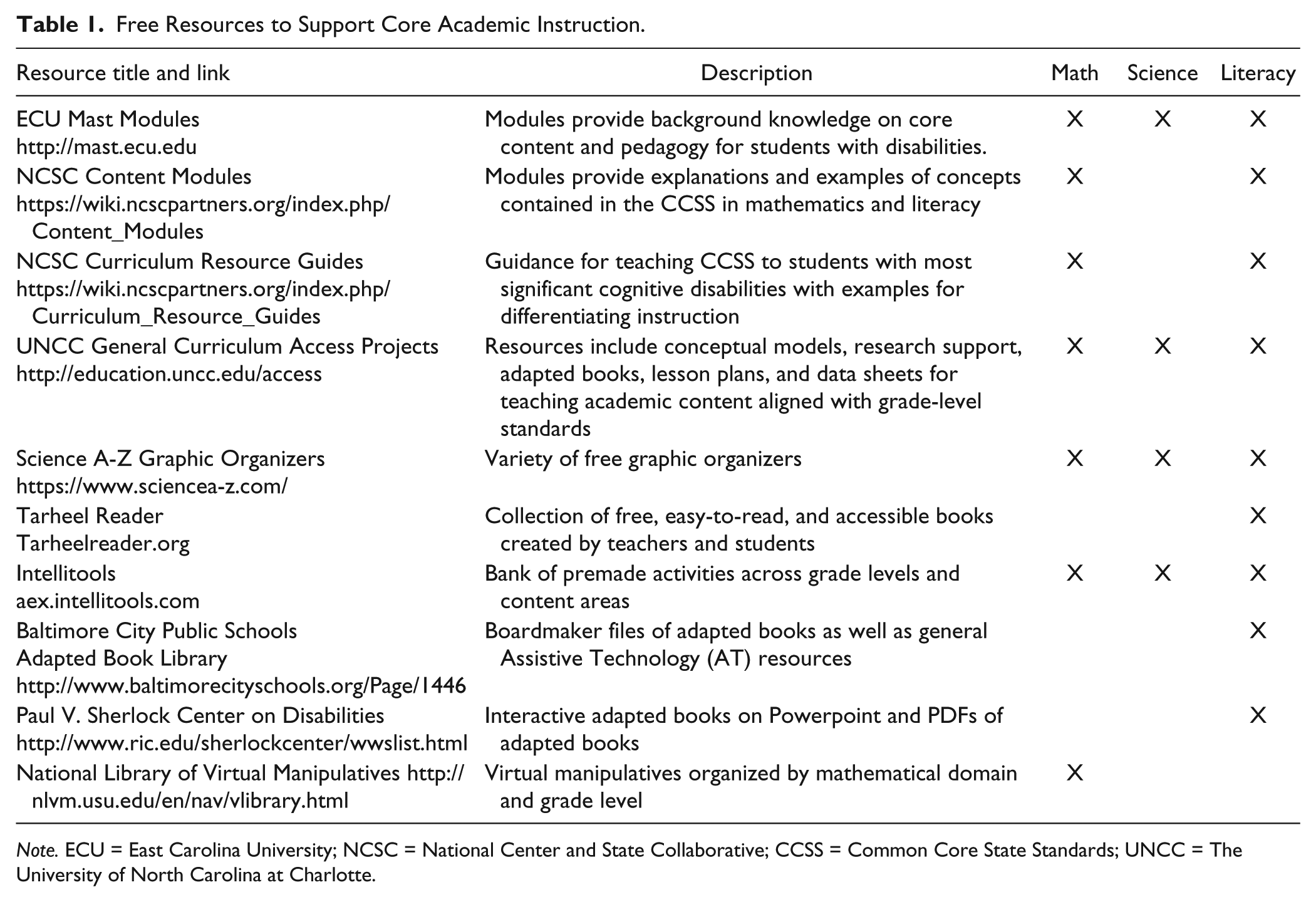
Note. ECU = East Carolina University; NCSC = National Center and State Collaborative; CCSS = Common Core State Standards; UNCC = The University of North Carolina at Charlotte.
Footnotes
Declaration of Conflicting Interests
The author(s) declared no potential conflicts of interest with respect to the research, authorship, and/or publication of this article.
Funding
The author(s) received no financial support for the research, authorship, and/or publication of this article.