




Abstract
Researchers have previously shown that video prompting can promote vocational skill acquisition for students with autism, and in a prior study, we demonstrated a model to train a paraprofessional to implement this practice. In this study, we evaluated (a) the degree to which the paraprofessional generalized implementation to new students and situations, and (b) the degree to which his implementation resulted in participants acquiring a vocational skill. The paraprofessional implemented the video prompting procedure with high fidelity without any additional training, and all three participants mastered the photocopying skill and generalized their implementation. These results suggest that focused coaching on video prompting implementation with one student may enable paraprofessionals to effectively generalize implementation when targeting similar skills with other students.
Individuals with autism spectrum disorder (ASD) have difficulty obtaining and maintaining employment, and this population yields one of the lowest rates of paid employment at only 55% (Shattuck et al., 2012). For those who are employed, research also shows that when compared with workers with emotional disturbance, learning disabilities, and language impairment, employees with ASD are the most likely to be fired (27%) yet the least likely to quit (28%; Newman, Wagner, Cameto, & Knokey, 2009). Unfortunately, these disappointing statistics equate to more than just poor employment rates. This high unemployment rate limits the opportunity to experience many of the benefits that accompany gainful employment, such as being part of a collective purpose, being engaged in meaningful activities, and even overall quality of life (Creed & Watson, 2003).
Although there are many aspects that must coincide for an individual to obtain employment, systematically teaching vocational skills to individuals with ASD is a critical component. Previous research has identified several evidence-based interventions targeting vocational skill acquisition for individuals with ASD. In their review of the literature, Seaman and Cannella-Malone (2016) examined studies from 2010 to 2013 and found 20 studies evaluating preemployment, specific vocational skill training, and job retention interventions. Similarly, Bennett and Dukes (2013) searched the peer-reviewed literature for studies focused on teaching employment skills to individuals with ASD from 1995 to 2010 and found 12 studies targeting vocational interventions. The practices in these studies ranged from video modeling and picture prompts (Mechling & Gustafson, 2008) to virtual reality (Smith et al., 2014), and focused on skills such as performing in air-inflated mascots (Allen, Wallace, Greene, Bowen, & Burke, 2010), food preparation (Johnson, Blood, Freeman, & Simmons, 2013), and job interview skills (Strickland, Coles, & Southern, 2013).
For an individual to become competitively employed—and to maintain that employment—he or she must work as independently as possible and limit his or her reliance on other personnel (Van Laarhoven, Johnson, Van Laarhoven-Myers, Grider, & Grider, 2009). Interventions such as video prompting, an evidence-based practice (Wong et al., 2015) in which the learner watches each step or task in a chain and performs the step before advancing to the next step in the chain (Sigafoos et al., 2007), have successfully been used for teaching vocational skills to individuals with ASD (e.g., Bennett, Gutierrez, & Honsberger, 2013) and has several benefits specific to employment. First, this intervention allows trainers on the job site who may not be educated in evidence-based practices (e.g., job coaches, paraprofessionals) to systematically implement an evidence-based instructional strategy. Second, video prompting can be implemented on a device such as an iPhone, which allows the intervention to be portable and inconspicuous in a work setting (Cihak, Kessler, & Alberto, 2007). Finally, if instruction is occurring in a classroom or training setting, the prompts can include video of an environment in which the skill would normally be performed (i.e., the place of employment setting), improving the likelihood that the skill will generalize from the video to that environment.
Even with the advantages that vocational training may provide to individuals with ASD, there are several limitations in the current literature for not only video prompting but also other evidence-based vocational interventions for teaching vocational skills. First, Seaman and Cannella-Malone (2016) found that these studies are primarily focused on individuals 22 years of age and older. Though it is laudable that there is an expanding literature base on this topic, there is still very little research that targets vocational skill acquisition while students are still in school. During this critical time before the student turns 22 years, they can still receive services in schools or other relevant educational sites under the Individuals With Disabilities Education Act (IDEA), which can include vocational settings. Second, it was determined that maintenance was only measured in 57%, and generalization in 33% of the recent studies evaluating vocational interventions for individuals with ASD. Without these measures, it is impossible to tell if these interventions, which were most commonly implemented in a classroom setting for a short period of time, would still be effective in a vocational setting.
A final, and crucial, limitation of the vocational skills interventions literature is that there are no identified studies that train any type of practitioner to teach vocational skills to students with any disability, let alone ASD. In their study that evaluated the efficacy of video prompting in employment settings, Van Laarhoven et al. (2009) suggested that future research investigate methods for training practitioners to use video technology with hopes that it could be more widely used in applied settings. Similarly, Cihak et al. (2007) also recommended that future research attempt to replicate these studies across natural support instructors (e.g., job coach, coworker, and parent) in the community workforce. However, there has been limited research targeting these recommendations. In fact, the results of a systematic literature review of all practitioner training studies (Brock et al., in press) shows that there have not been any studies that train practitioners to use video technology.
To address these gaps, Seaman, Cannella-Malone, and Brock (2017) conducted a study examining the efficacy of a training package teaching a paraprofessional to implement the core components of video prompting; writing a task analysis, creating the video segments, and implementing video prompting with a student with ASD. Furthermore, they measured the effects of paraprofessional-implemented video prompting on the vocational skill acquisition of this student. Results indicated not only that the paraprofessional rapidly mastered all three components of video prompting but also that the student mastered his vocational task (i.e., envelope filling) when the paraprofessional implemented video prompting. Moreover, both the paraprofessional and student’s skill acquisition maintained over 6 weeks and generalized to a new vocational task.
However, there were several limitations to this study. First, the researchers were unable to verify if the video prompting training and paraprofessional-implemented video prompting would generalize to a school-based volunteer employment setting for the paraprofessional and student, respectively. Second, the study did not assess generalization across students or skills for the paraprofessional. To address the specific limitations of Seaman et al. (2017) and the more general limitations of the current literature, the present study addressed the following research questions:
Method
Participants
After receiving institutional review board and district approval, we recruited one paraprofessional and students from the cross-categorical classroom he worked in who (a) were 13 years or older, (b) qualified for the state alternate assessment, (c) followed at least two-step directions, and (d) had an interest in eventually obtaining employment. Participants included three middle school students with ASD and their classroom paraprofessional.
Mr. Cooper
Mr. Cooper was a 64-year-old White male paraprofessional who had been working with the student participants for 5 months at the start of this study. He had a high school diploma and had been employed as a paraprofessional for 3 years. In addition, he was previously trained to implement video prompting in Seaman et al. (2017). Mr. Cooper was trained to prepare and implement the main components of video prompting in a previous study: writing a task analysis, creating the video, and implementing video prompting with error correction. The classroom teacher recommended him for this training because, at the time, he was new to the school and she felt that he would benefit from the training and be eager to participate.
Sheldon
Sheldon was a White 13-year-old male with ASD who had medical diagnoses of Fragile X syndrome and epilepsy. He was in sixth grade and the most recent educational information from 2011 stated that he was assessed using the Kaufman Test of Educational Achievement–Second Edition (KTEA-II) and obtained a composite reading score of 58, a math composite of 50, a concepts and application composite of 45, and a written language composite of 61. With the mean of all composite scores being below 100, he scored below average across all areas. Additional testing on the Woodcock–Johnson Test of Cognitive Ability–Third Edition (WJ-III) in 2014 showed that Sheldon was performing well below average in the areas of verbal ability, thinking ability, processing speed, and short-term memory. Sheldon’s teacher recommended him for this study because he communicated in 3- to 4-word sentences, followed two-step directions, and vocally expressed a desire to be employed in a restaurant in the future.
Leonard
Leonard was a White 14-year-old male with intellectual disability and ASD. Leonard was in seventh grade and had an above average rating on the Gillian Autism Rating Scale (Gilliam, 1995), indicating a high likelihood of autism, and showed below average performance on the WJ-III in the areas of thinking ability, processing speed, and short-term memory. Leonard’s classroom teacher recommended him for this study because he followed multistep directions, communicated in full sentences, and was reported to have a strong desire to work.
Howard
Howard was a White 15-year-old male with ASD. He was in the eighth grade in a cross-categorical classroom and had an above average rating on the Gillian Autism Rating Scale (Gilliam, 1995), indicating a high likelihood of autism. In addition, he had a composite score of 73 on the Adaptive Behavior Assessment System–Second Edition (Harrison & Oakland, 2003). Howard’s skill set made him an ideal candidate for this study—he communicated verbally in 4- to 5-word sentences, could easily follow one- and two-step directions, and found videos to be highly reinforcing. He further indicated that he would like to work in an office when he graduated high school. Howard’s classroom teacher recommended him for this study because he followed multistep directions, communicated in full sentences, and stated that he wanted to be employed in the near future.
Setting and Materials
All baseline, training, instructional, generalization, and maintenance sessions took place in the mail room of the student’s middle school building. The mail room contained a photocopier, the mailboxes of all the staff members of the students’ middle school, and various office supplies. In all sessions, materials were present that would both enable the paraprofessional to implement video prompting and the students to complete the photocopying requests. For the paraprofessional, an iPhone 5s with a video prompting app downloaded (inPromptu; Cannella-Malone & Wheaton, 2011), a blank piece of paper, and a pencil were provided. The inPromptu app is a free iOS application available for download on Apple mobile devices that allows users to film, edit, and store video clips. Also available to Mr. Cooper, upon request, were any materials that he had created during a previous session (i.e., task analysis and video prompts).
For the student participants, a copy machine, extra paper, and the documents to be copied paper-clipped to a completed photocopy request form were available. Teachers and staff used this system to request photocopies prior to the study. The request form specified (a) the number of copies, (b) the date they were needed by, (c) whether one- or two-sided copies were needed, and (d) whether or not stapled or unstapled copies were desired.
Dependent Measures and Recording
Data on performance on the photocopying task were collected by a member of the research team during each baseline, intervention, generalization, and maintenance session. Each step of the photocopying task the participant performed correctly on the paraprofessional-created task analysis was scored as correct or incorrect. Two types of correct responses were coded; steps could be scored as independently correct or correct after viewing the video segment. An independent correct response was defined as the student accurately completing a step without viewing that segment of the video. A correct with video response was defined as the student accurately completing a step during or within 5 s of a video prompt to complete the task and/or completion of the first viewing of the video segment. If the student did not complete a step correctly following the video prompt, stopped for more than 5 s after starting to complete the step, or incorrectly completed a step, the step was scored as incorrect. A percentage correct was calculated for each session by dividing the number of steps completed correctly (either independently or with the video) by the total number of steps and multiplying by 100. The photocopying steps were as follows: (a) remove the paper clip from the packet; (b) place photocopying form on a counter or other surface not on the copy machine; (c) put all papers to copy into the top tray face up, in order; (d) press “no. of sets”; (e) change to number of copies on the photocopy form; (f) press close; (g) press “1 sided > 1 side”; (h) press “finishing”; (i) press “style”; (j) press “staple” if indicated on the photocopy form; (k) press blue start button; (l) take paper out of top tray when finished; and (m) take paper out of bottom tray.
Measures for Mr. Cooper
We assessed Mr. Cooper’s fidelity with writing a task analysis, video creation, video prompting implementation, and error correction. Writing the task analysis consisted of dividing a task (i.e., photocopying) into its component steps to assess and teach the skill (Wong et al., 2015). Video creation consisted of identifying an actor and materials, filming the steps of the task analysis using the video camera on the iPhone, and editing the steps using the inPromptu app. Video prompting implementation consisted of positioning the student in front of the task, playing one video segment at a time, and providing the student 5 s to respond. In addition, if the student did not complete the step correctly or failed to attempt the step within 5 s, Mr. Cooper was trained to implement an error correction procedure that consisted of blocking the incorrect response, verbally telling the student what was done incorrectly, and playing the video segment a second time. If the student completed the step incorrectly a second time, Mr. Cooper completed the step for the student. These components were selected because they are essential in the accurate implementation of a video prompting procedure.
Data were collected throughout the baseline, intervention, generalization, and maintenance phases. Prior to student baseline, task analysis creation was measured and we coded whether each step (a) was a step that was necessary to complete the task, (b) was listed sequentially, and (c) included no more than one discrete task. Video creation fidelity was also measured prior to baseline, and we coded whether each filmed step (a) had a video that matched the corresponding task analysis step and (b) had a voice recording that matched the corresponding task analysis step. Video prompting implementation was measured simultaneously during student intervention, generalization, and maintenance phases. We coded whether Mr. Cooper completed the following for each step: (a) said “Watch this,” and pressed play, (b) if the student did not start the step immediately when the clip ended said, “Now you do it,” and (c) when the student completed the step correctly, moved on to the next step OR when the student completed the step incorrectly, implemented the error correction procedure. A percentage correct was calculated by dividing each component completed correctly by the total number of steps for the component.
Experimental Design
A multiple-probe-across-participants design was used and included baseline, intervention, maintenance, and generalization phases (Gast, Lloyd, & Ledford, 2014). Baseline measures were taken simultaneously for all participants, and intervention for the first student began once a stable baseline was reached across five sessions. Intervention for subsequent participants began once an increasing or stable trend over at least three sessions was seen for the previous participant and baseline responding was stable.
Reliability
The first author conducted all observations in this study, and a second trained observer attended 34% of all observations balanced across participants and phases. Both observers were doctoral students in a special education program. The first author trained the second coder through verbal instruction and observation of the procedures. The criterion to begin data collection was 80% agreement or above. Interobserver agreement for the target behaviors was calculated by dividing the agreements on occurrence of the multiple targeted behaviors by agreements plus disagreements multiplied by 100. Overall agreement was 99% (range = 97%–100%) across all variables, and 100% across paraprofessional implementation fidelity variables.
Procedures
Prebaseline procedures
Mr. Cooper’s implementation fidelity of the three components of video prompting (i.e., task analysis creation, video creation, and video prompting implementation) was measured as he was trained in these components 3 months prior to the current study (Seaman et al., 2017). Subsequently, one of the goals of this study was to measure the generalization of that training over environments, students, and tasks. Task analysis creation consisted of dividing a task (i.e., photocopying) into its component steps to assess and teach the skill (Wong et al., 2015). Prior to student baseline, Mr. Cooper wrote a task analysis and created a video of the photocopying task according to the fidelity steps described above. He was asked to “show me how you would prepare to teach the photocopying task to your students.” During this time, the only support provided was access to the same laminated fidelity sheet with which he self-monitored his performance during his previous training. The video that was created featured the same completed photocopying form that was used throughout baseline and intervention sessions (i.e., two copies, one-sided, and stapled).
Mr. Cooper’s training was conducted in a previous study. Three training sessions were required, each lasting approximately 45 min. For both the task analysis and video prompting components, he was provided with a laminated handout that consisted of a description of the practice, the rationale for that practice, and a fidelity checklist (e.g., the steps for writing a task analysis). Next, the trainer modeled each of the components. Following this, Mr. Cooper rehearsed the procedure until he completed the steps on the fidelity checklist with at least 80% accuracy. During this time, he was instructed to self-monitor his performance by putting a check mark next to the step on the fidelity checklist as he completed the step. Following each rehearsal, the trainer provided verbal feedback and Mr. Cooper had the opportunity to ask any questions throughout the training session. Training for the video prompting implementation was identical to the training described above with the addition of a scripted role play between the trainer and Mr. Cooper following the trainer model. Finally, coaching and feedback were provided following each intervention session.
Baseline
During the baseline condition, the student was brought to the school’s mail room and given the completed photocopying form and asked to “show me how to make these copies.” Upon completion of the task, the student was thanked for participating and given a high five regardless of his performance. No training or support was provided to the student during this time.
Intervention
During intervention, Mr. Cooper told each student, “We’re going to watch a video to learn how to be a Copy Crusader.” Then, the student was given the completed Copy Crusader form with the prompt “show me how to make these copies.” The video prompting procedure was then initiated according to the fidelity steps described above. If the student made an error, Mr. Cooper verbalized what was done incorrectly and showed the video prompt again. If the student made an error following a second viewing of the video prompt, Mr. Cooper completed the step for them and they were allowed to proceed with the task. Each step was viewed once per session. Mastery criterion was 2 days at 100% accuracy.
Generalization
Across all participants, a novel photocopying form was probed to determine if they could generalize their training to actual copy request forms submitted by school staff members. In this phase, a different, novel photocopying form submitted by school staff members was used for each probe. These probes were measured in the same manner as the intervention task, and all procedures described in intervention were in place.
Maintenance
Maintenance probes were conducted at 3 and 6 weeks after mastery criterion was met. The procedure and setting for the maintenance sessions were the same as those used during intervention sessions.
Social Validity
Mr. Cooper rated his perceived proficiency of the video prompting preparation and implementation both after the initial training in a previous study and after the current study. This proficiency questionnaire used the following 5-point scale (1 = not effective at all, 2 = not very effective, 3 = somewhat effective, 4 = quite effective, 5 = very effective). In addition, Mr. Cooper evaluated his attitude toward and use of technology before his initial training, after his initial training, and after the current study. He rated his frequency of using technology using the following 3-point scale: 1 = never, 2 = infrequently, 3 = frequently and his attitude toward technology using the following 5-point scale: 1 = strongly disagree, 2 = disagree, 3 = neutral, 4 = agree, 5 = strongly agree.
Results
A multiple-probe experiment was conducted by a paraprofessional across three student participants, allowing for three opportunities to demonstrate experimental effects. All three students demonstrated a substantial increase in the photocopying skill immediately after the paraprofessional-implemented video prompting, demonstrating a functional relation between the video prompting and student skill acquisition. Data are described in further detail below and summarized in Figure 1.
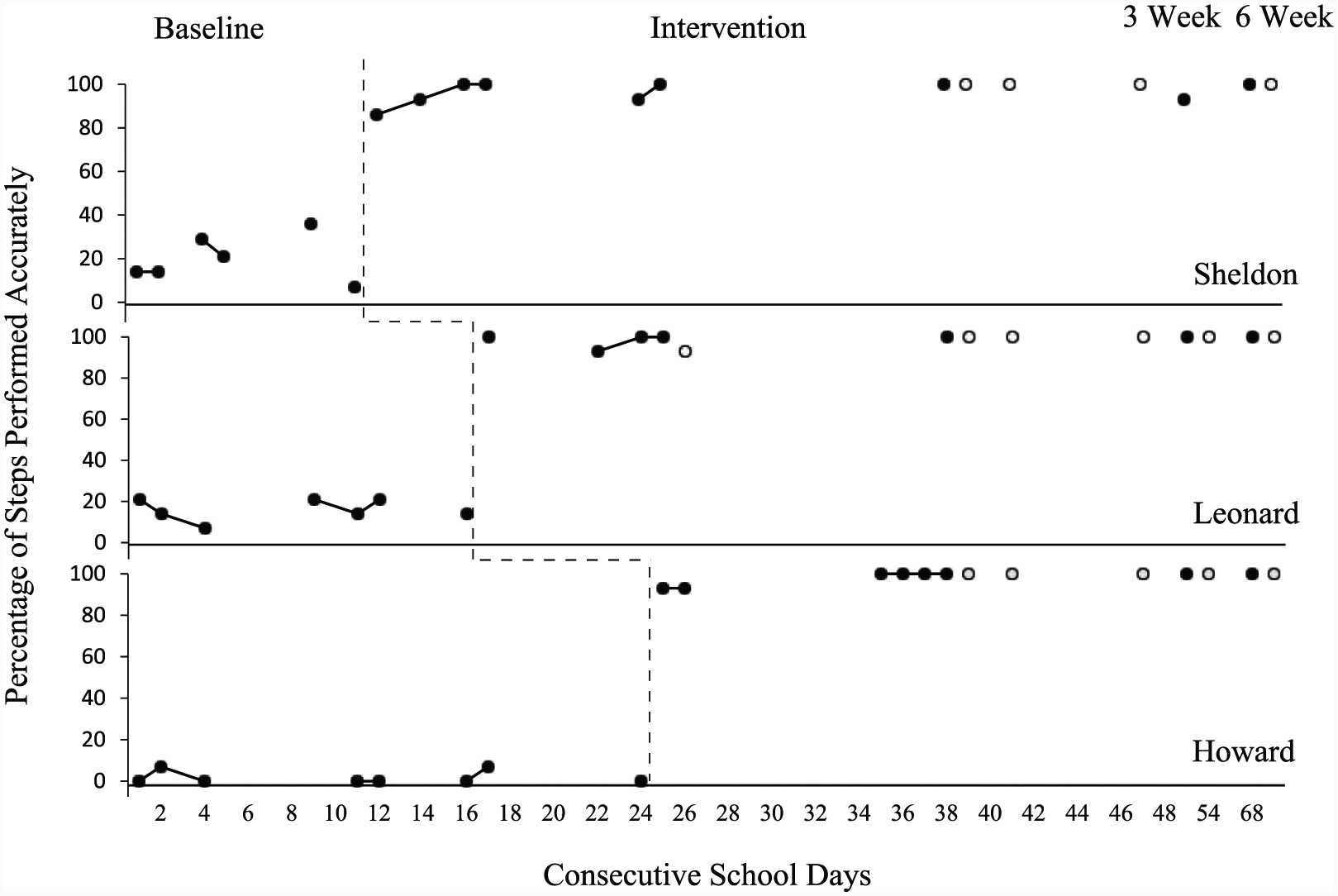
Participants’ percentage of photocopying steps performed accurately.
Student Performance on Photocopying Task
Sheldon
During the baseline phase, Sheldon exhibited a low, slightly variable baseline while performing the photocopying steps with between 7% and 36% accuracy. When Mr. Cooper implemented video prompting, Sheldon’s accuracy exhibited a steep, upward trend. He reached 100% accuracy after three sessions, and achieved mastery after six sessions. Maintenance probes were conducted at both 3 and 6 weeks, during which time the vocational task was completed independently (i.e., without any video prompts). Maintenance probes indicated that the photocopying skill maintained at 100% accuracy over this period of time.
Leonard
During the baseline phase, Leonard’s data displayed a low, stable trend (range = 7%–21%). Following the paraprofessional-implemented video prompting, his accuracy immediately increased to 93%, and then 100% the following session. This high accuracy maintained for the remainder of the study, and mastery was met after three intervention sessions. Maintenance probes were conducted at both 3 and 6 weeks, during which time the vocational task was completed independently (i.e., without any video prompts). Maintenance probes indicated that the photocopying skill maintained at 100% accuracy over this period of time.
Howard
During the baseline phase, Howard’s performed the Photocopying steps with 0% accuracy for most sessions, with the exception of two sessions during which he performed the task with 7% accuracy. Immediately after Mr. Cooper began implementing the intervention, Howard’s performance increased to 93% and then 100% accuracy, sustaining at 100% for the remainder of the study. Maintenance probes at 3 and 6 weeks indicated that the photocopying skill maintained at 100% accuracy over this period of time. Video prompts were still in use during these probes.
Generalization
A generalization task was probed following mastery of the photocopying task, and results indicate that the vocational training generalized to novel photocopying forms for all participants. For Sheldon and Howard, the training generalized immediately with 100% accuracy. For Leonard, the training generalized with 93% accuracy for the first probe, and then to 100% accuracy for all remaining probes.
Paraprofessional Generalization
To measure the generalization of Mr. Cooper’s training from the previous study across environments, students, and tasks, his generalization of the three components of video prompting (i.e., task analysis creation, video creation, and video prompting implementation) was measured as he was trained in these components 3 months prior to the current study (Seaman et al., 2017). These three components were measured (a) with a different vocational task, (b) in a different environment (i.e., from the training environment in Study 1 to the school-based volunteer employment setting in the current study), and (c) with different students. Mr. Cooper’s fidelity for both the task analysis and video creation components that were completed during the prebaseline phase was 100%. Fidelity for video prompting implementation and error correction was at 100% fidelity for 36 out of 40 sessions, with two sessions at 80% and two sessions at 93% fidelity. Errors are described in greater detail in the “Discussion” section. Mr. Cooper’s mean fidelity data for Sheldon’s intervention was 99% (range = 93%–100%), 99% (range = 93%–100%) for Leonard’s intervention, and 97% (range = 80%–100%) for Howard’s intervention.
Social Validity
Mr. Cooper indicated that dependent on the student (i.e., he did not believe the intervention worked as well for Howard), he would be very likely (i.e., 5 on a 5-point scale) to use video prompting with students in the future. This was an improvement from the initial posttest from quite likely (i.e., 4 on a 5-point scale). In addition, he indicated that the video prompting strategy was quite effective (i.e., 4 on a 5-point scale). This was a change from the first posttraining questionnaire for which he answered that he was believed video prompting was very effective (i.e., 5 on a 5-point scale) for his student. All other responses from the second posttraining questionnaire were consistent from the first to second intervention (i.e., the first study responses to this study).
There was a modest change in the social validity rating between the degree to which Mr. Cooper indicated the strategy was effective, although there was little room for improvement given the rating at baseline. Specifically, his preintervention technology questionnaire improved from an indication that he agrees that he “would be a better educator if I knew how to use technology” (i.e., 4 on a 5-point scale) to that he strongly agrees that he “would be a better educator if I knew how to use technology” (i.e., 5 on a 5-point scale). In addition, he improved from an indication that he believes that he agrees that “technology breaks down too often to be of very much use” to an indication that he disagrees with this sentiment. All other responses from the second posttraining questionnaire were consistent from the first to second intervention (i.e., the first study responses to this study).
Discussion
It has been well documented that students with ASD are at risk for very poor vocational outcomes (e.g., Shattuck et al., 2012). In previous studies, researchers have demonstrated that video prompting is an effective means to teach vocational skills to students with ASD. In a prior study, we showed that focused coaching enabled a school-based paraprofessional to implement the core components of video prompting with fidelity and promote improved outcomes for a student with ASD (Seaman et al., 2017). In the present study, we measured the same paraprofessional’s implementation of video prompting with three additional students with ASD and tested the efficacy of his implementation on their acquisition of a vocational task. Without any further training support, he independently implemented the video prompting procedure with high fidelity across all three students, and all three students rapidly acquired mastery of the vocational skill. Furthermore, they maintained mastery over time, and generalized the skill to authentic job tasks. These findings extend the literature related to paraprofessional training and practitioner-implemented video prompting in a number of key ways.
First, findings from this study suggest that paraprofessional-implemented video prompting is an effective means to teach vocational skills to transition-age students with ASD. In previous studies, researchers have shown positive outcomes for research-implemented video prompting (e.g., Banda, Dogoe, & Matuszny, 2011), and in one study, researchers evaluated teacher-implemented video prompting (Johnson et al., 2013). However, this is the first study to demonstrate the efficacy of paraprofessional-implemented video prompting, as well as the preparation of the intervention (i.e., writing the task analysis and creating the video). Testing paraprofessional implementation may be especially important, given that paraprofessionals now outnumber licensed special education teachers in schools (U.S. Department of Education, 2013), and paraprofessionals are often tasked with instruction related to vocational skills (Pickens & Dymond, 2014). Video prompting may be especially well suited for paraprofessional implementation because once the paraprofessional initially creates the video prompts, it is relatively easy to deliver the same prompts correctly and consistently—especially compared with other prompting topographies that afford many more opportunities for practitioner errors (e.g., verbal, live model).
Second, focused coaching to implement video prompting with one student in a previous study enabled the paraprofessional to independently implement video prompting with high fidelity when targeting a different vocational skill with three different students with ASD. The initial training (described in more detail in Seaman et al., 2017), featured modeling, role play, and feedback. Once trained to fidelity in both the training context and with one student, he was able to independently implement video prompting with the three students in this study to teach a different vocational skill. These findings highlight the importance of supporting paraprofessionals to generalize training to an authentic setting through performance feedback, and suggest that at least for some paraprofessionals, this initial investment of time might promote effective implementation across other students and skills.
Third, students made rapid progress despite Mr. Cooper struggling with implementation of the error correction procedures. Instead of blocking the incorrect response, verbally telling the student what was done incorrectly, playing the video segment a second time, and then modeling the correct step if needed, he either (a) proceeded to the next step without implementing the error correction procedure, (b) replayed the video without providing any additional direction, or (c) implemented the error correction procedure and then provided additional verbal prompts such as, “you need to do it like this.” His incorrect implementation errors were somewhat obscured by rapid student acquisition of the task; once they demonstrated mastery of all steps, he was no longer required to provide error correction to deliver the video prompting procedure with high fidelity. The efficacy of his implementation (even with these errors) is remarkable, and suggests that for at least some students with ASD, perfect implementation is not required to promote skill acquisition. However, for other students who might not acquire skills as rapidly with video prompting, similar implementation errors would be more likely to have an adverse effect on skill acquisition.
Implications for Practice
The results from this study yield important implications for paraprofessionals and teachers who work with transition-age students with ASD, or any school and district staff members involved in transition and employment (e.g., transition coordinators). Special education teachers and administrators should consider investing the time and effort in training paraprofessionals to implement video prompting. Results from this study demonstrate that a paraprofessional can implement the core components of video prompting with high fidelity, and this implementation can improve outcomes for students with ASD. Furthermore, an initial investment in training may promote generalization to new and untrained tasks, and high fidelity implementation with other students when targeting similar goals.
Limitations and Future Directions
Limitations of this study highlight opportunities for future research. First, only one paraprofessional participated in this study. Given that the profiles and skill levels of paraprofessionals are heterogeneous, it is unclear if other paraprofessionals would be more or less successful with implementation given the training provided in this study. In future studies, researchers could replicate and build on this training model with other paraprofessionals. Second, although this study was implemented in the students’ school-based employment setting, it is important to note that the students were still in middle school, and photocopying was an unpaid, volunteer position. Future studies may benefit from evaluating practitioner-implemented video prompting in more traditional (e.g., paid, full-time) employment settings. Finally, this intervention was paraprofessional-directed rather than self-directed video prompting. Although this is not a limitation of this study per se, the added fidelity steps of the paraprofessional initiating the video prompts detracts from some of the benefits (e.g., independence) that self-directed video prompting affords in an employment setting. Future researchers should evaluate the paraprofessional training package and document if the package could be applied in a self-directed video prompting intervention.
Conclusion
Findings for this study show that given prior training to implement video prompting with one student, a paraprofessional can independently and effectively implement video prompting to teach similar skills to other students. Paraprofessionals—who outnumber special education teachers—are critically important members of special education teams, and training them in effective instructional methods is a means to improve outcomes for many students with ASD. Given that the nature of video modeling mitigates opportunities for instructor error, this particular practice might be especially well suited for paraprofessional implementation. Equipping middle and high school paraprofessionals to implement this practice could maximize the time that students with ASD acquire and practice employment skills while still receiving support under IDEA. These extra years of effective instruction have the potential to facilitate more rapid pathways to adult employment and improve the quality of life for individuals with ASD.
Footnotes
Declaration of Conflicting Interests
The author(s) declared no potential conflicts of interest with respect to the research, authorship, and/or publication of this article.
Funding
The author(s) received no financial support for the research, authorship, and/or publication of this article.