




Abstract
This study describes an intervention developed to implement several best transition practices with a high risk/high need population. In all, 116 students with disabilities from a charter school for dropouts participated. All students were interviewed at different points in time to track their progress as they completed the program. Records of participant’s activities and outcomes were collected. Results suggest a positive impact on students’ graduation rate (95%), enrollment in vocational rehabilitation (100%), proportion of students obtaining certificates for employment (56%), and paid internship (37%). Overall, 35% of the vocational rehabilitation cases were closed successfully with students meeting the 90-day employment requirement after graduation. Results inform future work on the implementation of interventions designed to help low-income minority youth with disabilities.
People with disabilities in the United States experience higher rates of unemployment (10.7%) compared with those without disabilities (3.8%; U.S. Department of Labor, Bureau of Labor Statistics, 2017). Many times employers will not hire people with disabilities because they are not well informed on what it entails and might not want to provide all the accommodations that the person might require (Kaye, Jans, & Jones, 2011). According to a survey of service providers conducted by researchers from the Aspen Institute Workforce Strategies Initiative (Jain, Conway, & Choitz, 2015), nearly 6.7 million young adults between the ages of 16 and 24 years are out of school and out of work. The April 2017 unemployment rate for youth with disabilities, 16 to 19 years old, was 27.4% compared with a rate of 14.1% for youth without disabilities, and for those 20 to 24 years old, the rate was 21.1% which is 3 times higher than the national average of 7.3% for youth without disabilities of that age (U.S. Department of Labor, Office of Disability Employment Policy, 2017).
The period of transition from high school to the workforce is even more difficult for minority youth, particularly for African American young adults, who have an unemployment rate of 20.7%. The situation in Chicago is critical. A report by the Great Cities Institute at the University of Illinois at Chicago (UIC; Cordova, Wilson, & Morsey, 2016) concluded that in 2014, for the 16 to 19 years old in Chicago, only 12.4% of Blacks, 15.0% of Hispanic/Latinos, and 24.4% of Whites (non-Hispanic or Latinos) were employed. These rates compared with the national average of 28.8% suggest that youth in Chicago are less likely to be employed. In addition, 47% of the 20 to 24 years old Black men in Chicago were out of school and out of work in 2014 compared with 20% of Hispanic men and 10% of White men in the same age group. A recent review of trends in high school dropout and completion rates found that in 2013, young adults with disabilities had a lower high school completion rate (81.3%) than their peers without disabilities (92.4%; McFarland, Stark, & Coi, 2016). During the 2012–2013 school year, the national adjusted graduation rate for White students (87%) was 16 percentage points higher than the national rate for Black students (71%) and 12 percentage points higher than the national rate for Hispanic students (75%).
Transition outcomes for ethnic minority youth with disabilities who live in poverty in urban communities are very limited (Hasnain & Balcazar, 2009; Langi, Oberoi, Balcazar, & Awsumb, 2017). The social and contextual needs of these youth challenge educators and include limited English proficiency, high rates of mobility and dropout, exposure to community violence, and teenage parenthood, among others (Fabian, 2007; McDonald, Keys, & Balcazar, 2007; Schwartz & Gorman, 2003; Taylor-Ritzler, 2007). In Chicago, many minority students who complete high school do not have high levels of success in enrolling in postsecondary educational settings or securing jobs that pay above minimum wage or jobs that include benefits like health insurance (Awsumb, Balcazar, & Alvarado, 2016). In fact, graduating students with disabilities who do not have the appropriate training and preparation have a very low likelihood of finding a job that would offer them career advancement, which translates into fewer opportunities for social mobility.
The Add Us In (AUI) Chicago Consortium developed the Jobs for Youth Program that provided youth with disabilities from low-income minority communities employment and vocational training opportunities to prepare them for transition after high school. The intervention was implemented by the university in partnership with the state vocational rehabilitation (VR) agency and a local charter school for dropouts. The program offered several of the best practices for transition programming (see Kohler, 1996; Kohler, Gothberg, Fowler, & Coyle, 2016), as well as some of the in-school interventions related to improved transition outcomes for youth with disabilities identified by Test et al. (2009). These include the following: inclusion in general education (e.g., Blackorby & Wagner, 1996), interagency collaboration and coordination among providers serving the youth (e.g., Repetto, Webb, Garvan, & Washington, 2002), vocational education (e.g., Baer et al., 2003; Flannery, Slovic, Benz, & Levine, 2007), paid employment/work experience (e.g., Benz, Lindstrom, & Yovanoff, 2000), case management support (e.g., Garcia-Iriarte, Balcazar, & Taylor-Ritzler, 2007; Rutkowski, Daston, Van Kuiken, & Richle, 2006), and family engagement (e.g., Fourqurean, Meisgeier, Swank, & Williams, 1991; Kim & Morningstar, 2005). These best practices were introduced in the Jobs for Youth Program to help participants graduate from high school and find employment after graduation. The purpose of this study was to evaluate the short-term transition outcomes of special education students participating in the Jobs for Youth Program over a period of 5 years. The research questions included the following:
Method
Participants and Setting
Overall, the intervention included 116 junior and senior students attending a charter school for dropouts receiving special education services distributed in five cohorts from school years 2012 to 2016. A total of 70 males (60%) and 46 females (40%) were involved in the intervention, ranging in age from 18 to 22 years (M = 18.92, SD = .98). Among the participants, 97 (84%) were African American, 12 (10%) Latino, four (3.4%) Caucasian, and three (2.6%) self-identified as other race. All students were of low socioeconomic status and had a documented disability with an Individual Education Plan (IEP). The type of disabilities included 92 (79.3%) with a learning/behavioral disorder, four (3.4%) intellectual/developmental, five (4.3%) mobility/physical, three (2.6%) psychiatric, and 12 (10.4%) other. The demographic characteristics of the students by cohort are presented in the “Results” section.
The Jobs for Youth Program was implemented at a charter school for dropouts with an enrollment capacity of 4,000 students attending 20 small school sites anchored in 15 of the poorest and most violent neighborhoods of Chicago, drawing a diverse body of students citywide (73% African American, 24% Latino, 49% female, 51% male). The charter school sites had from 141 to 328 seats allocated with an average attendance of 78.3%. Approximately 18% of the students received special education services each year, and 20% were classified as homeless because they did not have a permanent residence. Unfortunately, during the 5 years of the study, an average of 34 students from the charter were shot in the community (ranging from 24 during the 2013 school year to 69 during the 2016 school year) and a total of 32 students died due to gun violence.
Intervention Components
The Jobs for Youth Program introduced several best practices for transition preparation including the following:
Inclusion in general education: Students were all included in general education classrooms according to the least restrictive environment requirements as indicated in their IEP. There were almost 60 itinerant special education teachers who work with the general education teachers to help them adapt curricula to meet the needs of students with disabilities. However, prior to this intervention, the transition needs of the special education students were limited to goal setting and classroom training because of lack of resources.
Interagency collaboration: Funding for the Jobs for Youth Program came from two primary sources: a grant from the Office of Disability Employment Policy, U.S. Department of Labor to the UIC, which allowed UIC to set up a subcontract with the school to provide funds to pay for the case manager; and the state VR agency funds to pay for the internships, certificate trainings, and students’ transportation (as needed). The UIC conducted the project evaluation and coordinated monthly meetings with representatives from the charter school and the VR office supervisor where all the participating youth cases were open. During these meetings, participants discussed students’ progress and/or challenges and considered ways to remove barriers as they arose. The team also planned next steps regarding the implementation of the intervention components and participants’ recruitment. The VR office supervisor assigned a counselor to manage all of the cases and to coordinate with the school’s case manager to gather all the necessary documentation necessary to open the cases and develop the Individualized Plan for Employment. This was the document that authorized the payment of all educational and internship activities, as well as any other expenses as needed by each participant. During the second year of the project, the charter school became a vendor for the VR agency to be able to pay the internships’ salaries directly to students, making it easier for employers to participate in the program, which otherwise would have been required to file a complex paperwork process. At this point, the charter hired a job developer to assist in the process of securing internship sites. In addition, during the third year of the project, the charter received a large contract from the VR agency to expand the internships to more students with disabilities and the charter was also successful in securing a grant from a local foundation to expand the paid internships to the regular student population.
Vocational education: Students were encouraged to enroll in certificate training classes by their special education teachers. In fact, most of the internship jobs required training certificates before the students could start working (e.g., Occupational Safety and Health Administration [OSHA], food service, retail customer service, etc.). Classes were provided either at their school sites by certified teachers or at the City Colleges of Chicago. Students had to pass an exam upon completion of the training to obtain their certificate. The duration of the certification courses ranged from a few days to a couple of weeks depending on the type of course. The certification course and certification exam were both paid for by the charter school and reimbursed by the VR agency. This represented additional savings for participating employers. Several teachers from the school sites became certified to be able to teach the classes through a program from the City Colleges of Chicago.
Paid internships: Internships, which were officially classified by the VR agency as on-the-job training, lasted 8 weeks. School principals were notified about the types of jobs available in the community by the job developer and invited junior year special education students to participate. Employers notified the job developer about the type of certificate required for the position(s) available (e.g., food handling, OSHA). Employers found the program appealing as they were able to conduct on-the-job training of students free of charge for 2 months. Employers were encouraged to treat all participants as regular employees. Throughout the internship period, the businesses were required to fill out a weekly time sheet with evaluation questions about the student and his or her progress and growth during the internship. These evaluations were then sent to the student’s VR counselor on a weekly basis.
Case management support: The case manager was in charge of obtaining the students’ documentation, copies of their IEP, and other legal documents to facilitate the process of opening their VR cases. This required frequent contact with the students’ families. Once students were enrolled and had an open VR case, they selected the type of certification class that matched their employment interests (the list of classes is included in the “Results” section). The case manager offered additional assistance to students such as providing them with bus cards to get to their job interviews. She also provided bus cards for the students’ transportation to their internship sites for the first 2 weeks, until they received their first paycheck, as many of these families did not have the necessary resources for the students’ travel. Students viewed her as a mentor, seeking advice such as what to do when an employer asked them to do a task they had never done before. Students confided in the case manager both on school-related issues and personal problems.
Family engagement: The case manager was an individual from the same community the students came from and understood the culture. She developed a close relationship with the students’ families. Families openly talked to the case manager about their concerns over their youth working. Many families worried that their youth may lose their disability benefits. The case manager understood that many of the families counted on that monthly income to pay for necessary expenses. She would talk to the families about the overall importance of the program, what steps they needed to take to comply with Social Security Administration policies regulating the money the youth were going to earn, and the long-term benefits the program could have for their youth’s future. These discussions were critical to guarantee participation in the program.
Measures and Procedures
Participants were recruited by their special education teachers who explained the project and invited them to participate. Throughout the entire program, the university held monthly meetings with the partner agencies. During these meetings, updates were given on how the recruitment of new participants was progressing as well as information on how the students in each cohort were doing in their certification classes and internships. Any issues/barriers that partners or participating students had during program implementation were discussed. The purpose of these meetings was primarily to troubleshoot and identify steps that could be taken to help students achieve their long-term employment and/or vocational goals, which could be sustained after the program ended. The program also assisted students by helping them obtain new professional clothing for their interview and/or employment tasks. The VR agency provided most of the funds for the transportation and new clothing with some assistance from UIC’s grant.
The job developer would ask potential employers what type of certification the students needed to qualify for employment at their job sites. This information was then shared with the students who were interested in those jobs. The school helped students become certified before they went to the job sites according to the employer’s needs, and the case manager completed the necessary paperwork. This allowed the employers to simply focus on training the students on the job.
All participants signed a consent form and responded to an intake interview, which included general contact and demographic information, as well as education and work history. It also asked students about their goals for employment and education in the future. Students were called by phone every 2 months by UIC project staff to track their progress in attaining their employment and/or education goals and to identify what barriers and/or successes they had encountered. The case manager from the school also used the information provided by the students in the intake form to help them identify training and internship opportunities. Last, the students were called to complete an exit interview at the end of their program (approximately 6 months after graduation for each cohort), which asked information regarding their transition outcomes (particularly with regard to employment and education), barriers, supports, and a question to assess their satisfaction with the program.
The following short-term outcomes were identified to track the impact of the intervention: (a) dual enrollment: identified whether or not the student participated in certificate training (yes/no) and passed the exam to obtain the certificate (yes/no), (b) paid internships: identified if the student participated in an internship (yes/no), (c) hired after internship: identified whether the student was hired after the internship period as a part-time employee (yes/no), (d) graduation from high school: examined school records to identify whether the participating students graduated (yes/no), (e) college enrollment after graduation: identified students who attended college during follow-up calls to participants (yes/no), and (f) employment after graduation: contacted VR counselors to identify the cases that were successfully closed (yes/no) according to VR criteria (Status 26, which means that the student was able to work for at least 90 days). In addition, during the research team’s monthly meeting, staff from the charter school and the supervisor of the VR office, where all the cases were handled, reported progress with each cohort’s outcomes (e.g., number of students enrolled in certificate programs, internships, etc.).
Results
Descriptive statistics were run on SPSS version 24 for the demographic variables (gender, race/ethnicity, and type of disability) and the main outcomes (number of students who obtained vocational certificates, participated in paid internships, were hired from the internship, graduated from high school, enrolled in college classes after graduation, and/or had their VR cases successfully closed [Status 26] after working for more than 90 days). Table 1 provides a breakdown of the demographic characteristics and short-term outcomes by cohort. With regard to the demographic variables of the cohorts, chi-square tests for equal proportions were conducted. It was found that the proportion of males was significantly higher than females in 2013. There were also a large proportion of African American students in the program, and most of the students had learning disabilities or behavioral disorders compared with other types of disabilities. With regard to the short-term outcomes, a total of 43 students (37%) participated in the paid internships, 13 (11%) were hired after completing their internships, and 110 students graduated from high school (95%). Of the students who did not graduate, four were still in school at the end of data collection, one transferred to a military school, and another was incarcerated. A total of 15 (13%) students enrolled in college classes after graduation. All of the participants had VR cases open, and a total of 41 (35%) found jobs and had their VR cases successfully closed after 90 days of consecutive employment (Status 26). We conducted a test of trend in proportions to find out if the proportions of the outcomes over the years significantly changed. The results in Table 1 indicate that the first cohort (2012) had fewer outcomes with regard to internships, hiring after the internship, college enrollment, and VR success, although this group had a high number of students getting certificates. The last cohort (2016) had the largest proportion of students enrolled in vocational certificate trainings, one of the highest number of internships, and the largest proportion of VR successful closures. Finally, all of the cohorts had a successful record of high school graduation.
Characteristics and Transition Outcomes by Cohort, the Jobs for Youth Program.
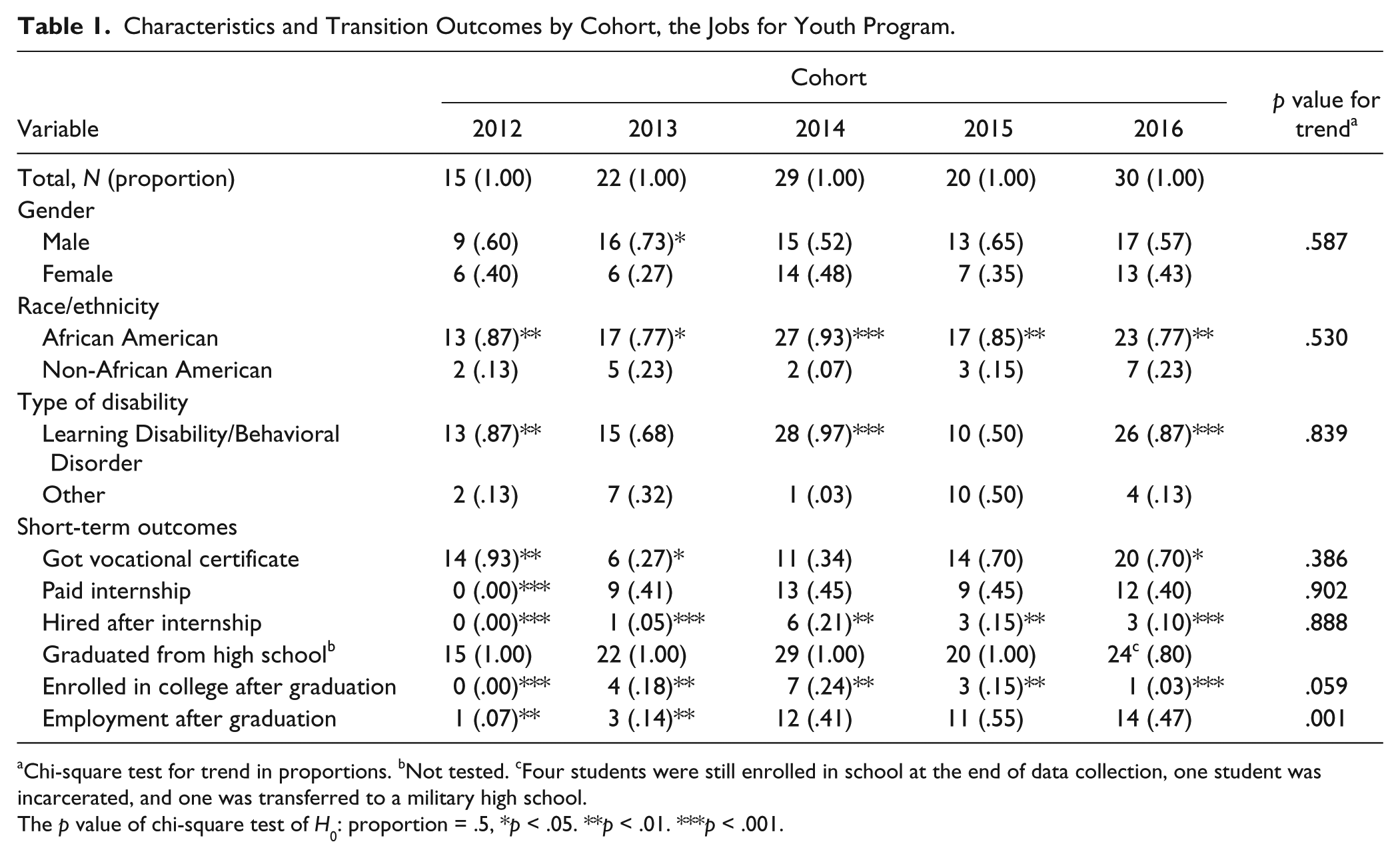
Chi-square test for trend in proportions. bNot tested. cFour students were still enrolled in school at the end of data collection, one student was incarcerated, and one was transferred to a military high school.
The p value of chi-square test of H0: proportion = .5, *p < .05. **p < .01. ***p < .001.
Certifications
The records showed that out of the pool of 116 participants, 74 students (64%) took certification classes and 65 (56%) passed their certification exam. Table 2 lists the types of certificates that the students obtained. As mentioned, most of the internship sites required students’ certification before they could be hired for the job.
Types of Certificates That Participants Earned.
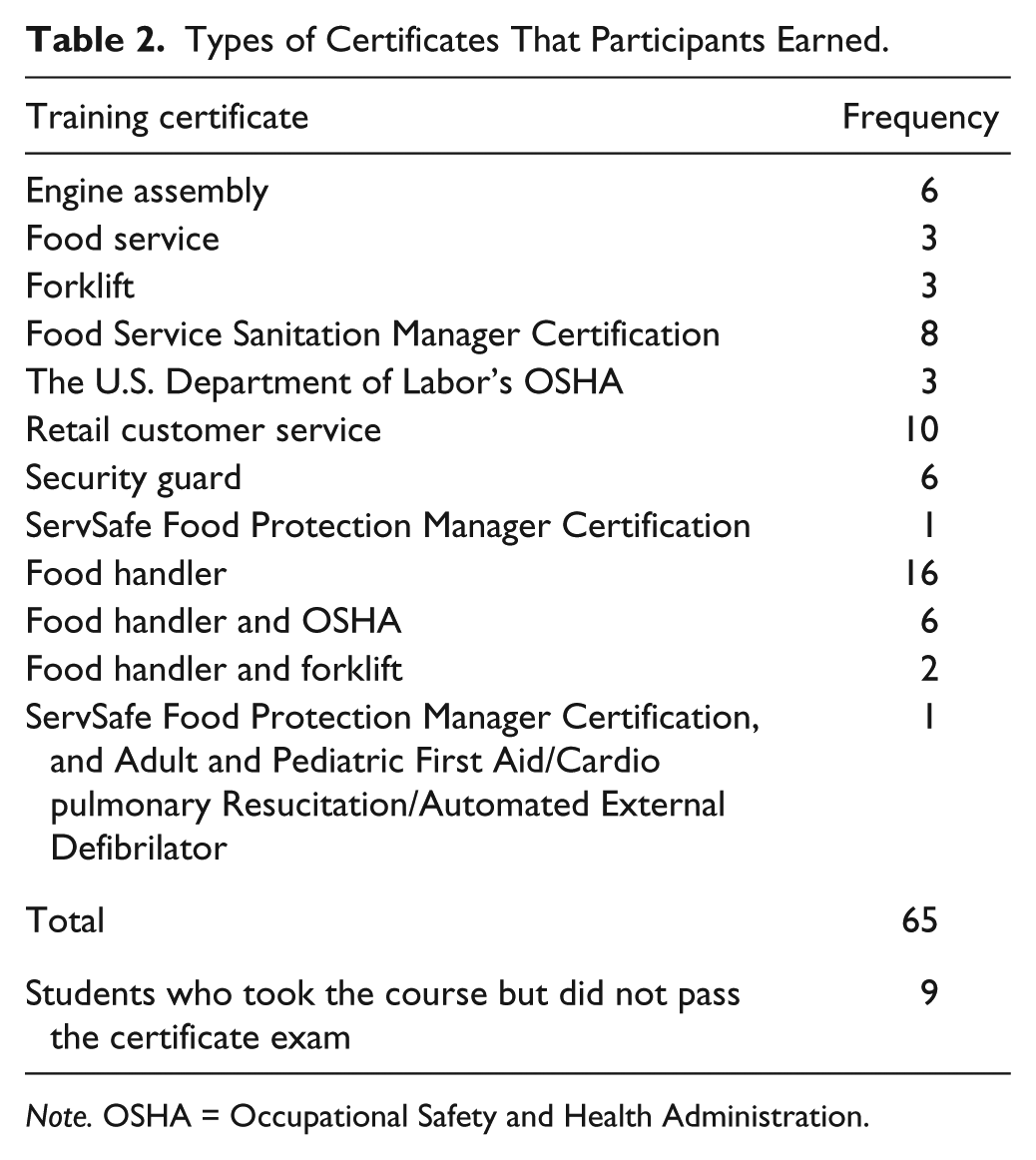
Note. OSHA = Occupational Safety and Health Administration.
Changing Lives
Overall, participants felt very satisfied with the program particularly for the opportunities it offered them to work and learn new skills. Allowing these students to work and earn money helped many of them change their perspectives on life. For some of the youth, this was the first time that they earned a salary. Students would receive their first check and immediately go to the case manager because they had never seen a check before in their lives. They had to learn how to cash a check and how to open a bank account. The case manager would even help students set up savings plans, so they could learn to be responsible with their earnings. Students went from not even having US$2.50 for the bus fare to having money in their own bank accounts. In addition, some of the employers mentioned that the internships also allowed them to learn more about what it means to have an employee with a disability and better understand a range of accommodations needed. Ultimately, the exposure could potentially positively influence their decisions about hiring an individual with a disability in the future.
Many students reported that for the first time, they were able to physically see a tangible product of their education and labor. All of them had grown tired of the education system and dropped out of high school in the past. They had a negative perception of school, especially as they were always being categorized as “disabled.” In fact, many students were unaware of what their disability was; they simply said that they were “slow” because the only knowledge they had was that they have an IEP in the system. The program allowed many students to change their mind-set when it came to education. They were able to take a vocational training course and see the tangible outcomes of their efforts from the course. Students began to understand that the effort they put into the class and certification exam was a critical step in their successful employment attainment and financial earnings. On the other hand, some students reported facing security concerns going to and from the job sites because of gang activity in their communities. The case manager helped them make adjustments in their schedules so they could go directly to work from their school sites and/or identify safe ways to go to work. Another barrier identified had to deal with some of the family’s perceptions about the possibility of losing the disability benefits because of the employment. The case manager had to explain to those families how the Social Security Administration rules allow employment and that benefits are only gradually reduced depending on the income.
After the Jobs for Youth Program, one of the students from the program turned his whole life around. He used to be a gang member and was involved in dangerous activities. The student participated in the dual enrollment and paid internship, and at the time of follow-up data collection, he was working part-time at a fast-food restaurant and was a full-time college student. He went back to the case manager to show her a picture of how he used to look and dress before, so she could see the difference. He told the case manager, “Without the program I would be dead or in jail by now. Being in jail is the same as being dead, so I would be dead.” The experience in the program changed his whole life-course.
Discussion
The purpose of this study was to evaluate the short-term transition outcomes of special education students participating in the Jobs for Youth Program. Except for the graduation rate, the outcomes of the participating students were relatively modest (e.g., 37% participated in paid internships, 35% got jobs, and 13% enrolled in college classes). However, these results are encouraging when comparing them with our analysis of the state VR agency’s data that indicate that over a period of 5 years, 58.3% of the students who were accepted for VR services through the transition preparation program did not complete their rehabilitation goals and only 9.2% had competitive or supported employment to reach successful VR closures (Balcazar, Oberoi, & Keel, 2013). It should be noted that prior to this intervention, none of the students with disabilities in this charter school had opportunities to participate in paid internships or vocational trainings and the charter school was never invited to participate in the VR transition preparation program. In addition, these students come from very challenging communities and home environments that make it very difficult for them to access employment and/or vocational training opportunities on their own. As has been identified in the literature, developing job experience is one of the strongest predictors of a successful transition (Benz et al., 2000; Fabian, 2007; Hasazi, Gordon, & Roe, 1985; Test et al., 2009), and paid internships is an effective strategy to help students with disabilities develop an employment track record.
Best Practices
This program catered to minority youth with disabilities from low-income neighborhoods in Chicago. The program introduced multiple best practices to increase the chances of success for the participating students. Students received transition planning and case management support, participated in a dual enrollment program which offered them certificate training for multiple jobs, and participated in paid internships; the charter school entered in partnership with the state VR agency and the university; and the case manager engaged with family members to gather their support for the students’ participation in the program. Building trust with families and establishing relationships was an important factor to help support the transition of the students (Geenen, Powers, Lopez-Vasquez, & Bersani, 2003; Landmark, Zhang, & Montoya, 2007). Overall, the collaboration between the charter school, the VR agency, and the university allowed for the implementation of best practices for the Jobs for Youth Program. This supports previous research findings that suggest that quality, sustainable collaborations are a key component for model transition programs (Hasazi, Furney, & DeStefano, 1999).
As mentioned, the charter school became a VR vendor and was able to pay for the majority of services up-front, including the certification classes, transportation for students to go to and from work during their first few weeks of work, and their salaries during the internship periods. All the costs were later reimbursed by the VR agency. This allowed for better implementation of the program with employers. The Jobs for Youth Program was meant to help low-income minority students with disabilities by providing them with the resources they needed to succeed. Many of the students did not have money for transportation or lacked the resources to afford appropriate attire for their interviews and jobs. Program staff knew students did not have US$20 to pay for their transportation to the job sites during their first 2 weeks of work and that without this money, they would lose their job.
Study Limitations
One of the main challenges of the program was the inability of the university staff to contact and follow-up with all participants, including the exit interview. Almost half of the phone numbers, mostly cell phones and some home numbers, would be disconnected or the students would not accept incoming calls from university staff, a problem that is common in many follow-up data collection efforts (Balcazar, 2001). For the students who did have a working number and a voicemail box setup, voice messages were left, but students rarely returned calls. We had to rely on the monthly reports from the case manager and the VR office supervisor collaborating in the project to collect most of the outcome data. The case manager kept individual files for each participant, which contained the information needed. She had the trust of the students, and they were in some cases even eager to talk to her and let her know about their achievements. The case manager also had access to the VR database, so she was able to gather the employment and educational data for the students in the system. The UIC staff was also allowed to review graduation records from each cohort. So the case manager was able to collect the information necessary to complete the exit interviews.
The results from the study cannot be generalized to many populations because it only had participants who were at least 18 years of age, a majority who had a learning or behavioral disability, and came from low-income minority communities in a large urban city. On the other hand, this is a population that typically presents serious service barriers and faces many challenges in meeting their employment and/or educational goals (Taylor-Ritzler et al., 2001).
Future Directions
For more than 15 years, the charter school was excluded from receiving VR transition support services to help students with disabilities enhance their transition preparation. Due to the success of the Jobs for Youth Program, the school continues to collaborate with the VR agency to provide students with disabilities the transition assistance they need, and it is also continuing the internship program. As noted, the school decided to expand the internship program to include students without disabilities. The school administrators know that just getting a diploma is not enough for these youth who often face many barriers to achieve social mobility or just meet their basic needs. Future research could examine ways to help under-resourced schools implement transition best practices and develop or strengthen their partnerships with VR agencies.
Future research could also examine the documents and paperwork required by VR agencies to set up internship programs with potential employers. In this case, employers reported that it was fairly easy for them to start the process as they were not directly engaged in paying the students and did not need to set up a contract with the VR agency. VR agencies could benefit from learning about effective ways to streamline the process of employers’ participation in programs like on-the-job training and vocational evaluation.
Future research could also focus on developing strategies to disseminate interventions designed for students in schools and neighborhoods that are at-risk of dropout and/or have limited employment and educational opportunities. This program was successful in part because it provided students with the supports they needed to succeed, such as culturally appropriate case management, bus cards, and professional attire.
Finally, another important area of future research relates with the potential barriers that some low-income families may raise regarding government assistance, that is, denying their youth’s participation in this type of employment program due to fear of losing their Supplemental Security Income (SSI) or Social Security Disability Insurance (SSDI) benefits. This is due, in part, to the lack of awareness about policy changes enacted by the Social Security Administration that have increased the flexibility of the amount of earnings that can affect those benefits over time and the reporting requirements. This lack of information generates fear among community members, which adds to their historical mistrust of government agencies. Effective ways to educate parents about the benefits of employment experiences for their youth and the ways in which the SSI/SSDI benefits are affected are needed. The findings from this project suggest that many minority youth with disabilities can benefit from programs that allow them to engage with employers, understand the value of vocational education, and benefit from supportive case managers. This way, they can realize that they have choices and that those choices can lead to a better quality of life.
Footnotes
Declaration of Conflicting Interests
The author(s) declared no potential conflicts of interest with respect to the research, authorship, and/or publication of this article.
Funding
The author(s) disclosed receipt of the following financial support for the research, authorship, and/or publication of this article: Funds for this project were provided by a grant from the Office of Disability Employment Policy, U.S. Department of labor, Award Number: OD-22553-11-60417.