




Abstract
Amid rapid growth in the higher education movement, access to inclusive higher education for students with intellectual disability (ID) remains limited. This study used “community conversations” to explore how stakeholders in three communities envisioned the inclusion of students with ID on their local college campus and the supports needed to launch new postsecondary programs. Conceptualizations of inclusion extended beyond the experiences students might have and addressed skill development, training and supports, campus and community attitudes, and potential partnerships. Stakeholders identified a constellation of people and resources needed to support successful college experiences. We offer recommendations aimed at spurring inclusive higher education experiences and highlight community conversations as a promising approach for informing the initial movements of local planning teams.
The proliferation of postsecondary education (PSE) programs for students with intellectual disability (ID) is introducing new contexts for learning, relationships, and inclusion. For decades after the passage of the Education for All Handicapped Children Act in 1975, attention focused primarily on creating access to neighborhood K-12 schools, as well as supporting the involvement of students in the breadth of classes, clubs, and other activities comprising a typical school experience. Indeed, 94% of students with ID now attend schools alongside their peers without disabilities (U.S. Department of Education, 2016). Despite this progress, the postgraduation pathways of students with and without ID have continued to diverge. Although nearly two thirds (63%) of students without disabilities enroll in some type of postsecondary school within 4 years of high school exit, just one quarter (28%) of graduates with ID have the same experience (Newman, Wagner, Cameto, Knokey, & Shaver, 2010).
This postschool landscape, however, is in the midst of change. The Higher Education Opportunities Act of 2008 introduced new provisions aimed at increasing access to PSE (e.g., eligibility for financial aid), funded cohorts of model demonstration programs, and established a national technical assistance center. More than 270 colleges and universities now host programs specifically aimed at supporting the enrollment of young adults with ID (www.thinkcollege.net). Descriptions of the design and delivery of these diverse programs appear more frequently in the literature. Moreover, early studies suggest promising outcomes may accrue for students with ID who enroll in these higher education programs (e.g., Butler, Sheppard-Jones, Whaley, Harrison, & Osness, 2015; Grigal et al., 2016; Moore & Schelling, 2015).
What might it take to further expand the availability of inclusive higher education programs throughout the country? Half (50%) of all youth with ID (Grades 7 to 12) expect to pursue PSE after graduation (Lipscomb et al., 2017). Yet, less than 6% of the 4,724, 2- and 4-year colleges in the United States have established formal programs for students with ID. Presently, six states have only two programs, 11 states have just one program, and three states have no programs. The literature references multiple approaches that might be used to encourage exploring and establishing new programs, including minigrants, communities of practices, regional summits, and statewide strategic planning (Mock & Love, 2012; Parent-Johnson et al., 2014; Wheatley, 2017). To date, studies have not examined these pathways for informing and spurring the launch of new campus programs.
The present study applies the “community conversation” approach (Carter & Bumble, 2018) as a way of examining how postsecondary campuses think about the launch of new programs for students with ID. A community conversation is a structured conversational process for addressing issues important in the lives of people with disabilities and their communities (Carter et al., 2009). Drawing on the World Café (Brown & Isaacs, 2005), a cross section of citizens attend a 2-hr event comprised of three rounds of small-group discussions and one whole-group discussion. They work together to identify actionable solutions that align with their community’s culture, priorities, and available resources. By design, it introduces new voices, stays focused on local solutions, provides an efficient way to engage a large group in dialogue, and increases local awareness of the issue (Carter & Bumble, 2018). Community conversations have been used to explore the inclusion of individuals with ID in K-12 schools, workplaces, faith communities, and other activities (e.g., Carter, Bumble, Griffin, & Curcio, 2017; Carter, Swedeen, Cooney, Walter, & Moss, 2012; Molfenter et al., 2018). They have yet to be used to explore issues related to inclusive higher education.
One early consideration for higher education institutions when designing new programs is how they conceptualize the inclusion of students with ID on their campus. This initial vision is likely to shape the program models, practices, and partnerships they first explore and ultimately pursue. Existing programs across the country reflect much more diversity than consistency in implementation. Wide variations exist in their size, scope, configuration, and curricula. For example, “inclusion” on some campuses is limited to coursework and a subset of campus activities; others extend students’ involvement into residential life, employment experiences, student organizations, and other aspects of student life. Although quality indicators and recommended practices for PSE programs have been proffered (e.g., Carter, 2017; Grigal, Hart, & Weir, 2012, 2013), the concept of “inclusion” has yet to be carefully examined in the research literature. It is unclear whether a common initial conception exists across different campuses, as well as whether it is shared across stakeholders invested in the same campus.
Starting a new higher education program can be a complex endeavor requiring the involvement of myriad people and resources. Although a core set of potential program partners has been suggested in the literature (e.g., faculty, administrators, students, families, disability support services, secondary schools; Grigal & Hart, 2010; Papay & Griffin, 2013), knowing which individuals and supports are essential to engage during planning and early implementation must be discerned at the local level. A cross section of stakeholders from both within and beyond a given campus community could be helpful in identifying the constellation of resources and partnerships needed to translate an initial vision into an actual program. However, it is unclear what ideas such individuals are likely to generate when considering their own vision for their particular campus. The capacity of a campus community to identify a sufficiently broad and relevant range of allies and assets could affect their early success in program development.
The purpose of this study was to examine how three communities envisioned the emergence of a new inclusive higher education program for students with ID and the supports needed to enable its launch on a local campus. Each program received a small minigrant to host a community conversation event aimed at exploring the development of PSE opportunities for students with ID. In addition to exploring how community conversations could be applied to PSE issues, we addressed three research questions:
Method
Campuses
Three campuses across Tennessee self-selected to participate in this study through a minigrant application process. Applications were open to 2- and 4-year campuses interested in developing a new program for youth with ID. We disseminated a statewide call for applications through members of our statewide employment consortium, websites and listservs of the Department of Education and disability agencies, and the state’s inclusive higher education alliance. In addition, we sent the announcement out directly to all community colleges and existing inclusive higher education programs in the state.
A small team evaluated the three applications using a rubric addressing their (a) establishment of a core planning team with the support of campus administration, (b) attendee recruitment strategy, (c) proposed use for funds, (d) steps already taken toward program development, and (e) goals for campus change. We initially planned to support two campuses; but after considering scoring, geographic locale, and campus characteristics we decided to fund all three applicants. Each campus committed to sending two planning team members to an initial training, hosting one community conversation event, and communicating progress regularly with the research team. We provided each team US$1,000 minigrant to cover event expenses (e.g., postage, meeting space, food), technical support to plan and carry out their event, and help moving forward on key ideas shared at their event.
Campus A was a 4-year public university in a midsize city with a population of 131,947. The school served 19,693 undergraduate and 2,357 graduate students; 64% were White, 21% were Black/African American, 5% were Hispanic/Latino, 3% were Asian, 3% were two or more races, and 3% were nonresident aliens. Campus B was a 4-year public university in a small city of 66,677 surrounded by mostly rural counties. The school served 11,065 undergraduate and 2,957 graduate students; 82% were White, 6% were Black/African American, 4% were nonresident aliens, 3% were two or more races, 2% were Hispanic/Latino, 1% were Asian, and 1% were unknown. The application for Campus C was submitted by a K-12 school district partnering with a 2-year community college and a 4-year private university. Both campuses were located in a small suburban area with a population of 28,703. The university served 1,196 undergraduate students; 75% were White, 12% were Black/African American, 5% were two or more races, 4% were Hispanic/Latino, 3% were nonresident aliens, and 1% were Asian. The community college served 10,244 undergraduate students; 83% were White, 7% were Black/African American, 4% were Hispanic/Latino, 3% were two or more races, 2% were Asian, and 1% were nonresident aliens.
Preparation and Training
Two planning team members from each campus attended a group-based, 6-hr training with the research team. Prior to the training, each team received a guide outlining the community conversation process (Swedeen, Cooney, Moss, & Carter, 2011). The training included (a) presentations on program development; (b) group discussions about campus values, priorities, and climate; (c) instruction on planning, structuring, and recruiting for a community conversation; (d) recommendations for effective postevent action; and (e) lunch with program alumni. We also provided event planning tools and time to address questions and concerns.
During the training, we encouraged teams to personalize their recruitment, planning, and event to suit their campus’ unique goals and characteristics. However, we required events adhere to a common structure including (a) an initial presentation explaining the context for the event, (b) three 15- to 20-min rounds of small-group discussion in which attendees switch tables between rounds, (c) a 15- to 30-min whole-group discussion, and (d) recording of all ideas generated during the small- and whole-group discussions (Swedeen et al., 2011). Following the training, we developed recruitment flyers and an online registration site for each team. We also provided feedback on recruitment strategies, event presentations, and logistical plans.
Community Conversations
Local teams planned and carried out events for each campus in spring 2017. At least three members of the research team attended each event to record observations, collect data, and provide any needed on-site support (e.g., signing-in attendees, handing out surveys).
Attendee recruitment
Each campus planning team set an initial goal of 40 to 80 attendees, aiming for diverse representation across campus and community stakeholders (see “Attendees” section). Teams started recruitment about 4 to 6 weeks prior to the event, and we provided sample templates of flyers, press releases, and electronic invitations. In addition, we created an online registration system for events. This allowed teams to access attendee contact information and stakeholder roles to inform their recruitment. Although all teams sought to recruit similar stakeholder groups, each community employed unique approaches (e.g., sending flyers home with high school students, publishing stories in local newspapers, relying on personal networks).
Attendees
A total of 172 campus and community members attended the three events. On anonymous end-of-event surveys, attendees identified themselves as having one or more of the following roles: a family member (n = 57; 41.6%), representative of a community organization (n = 25; 18.2%), traditional college student (n = 16; 11.7%), staff from a local high school (n = 16; 11.7%), disability agency or provider (n = 14; 10.2%), faculty member (n = 8; 5.8%), person with a disability (n = 6; 4.4%), campus administrator (n = 5; 3.6%), representative of key campus services (e.g., residential life, health and medical services; n = 3; 2.2%), or representative of campus disability services (n = 2; 1.5%). The remaining participants did not identify their role. Some differences in attendees were evident across events (see Table 1).
Attendees Across Events.
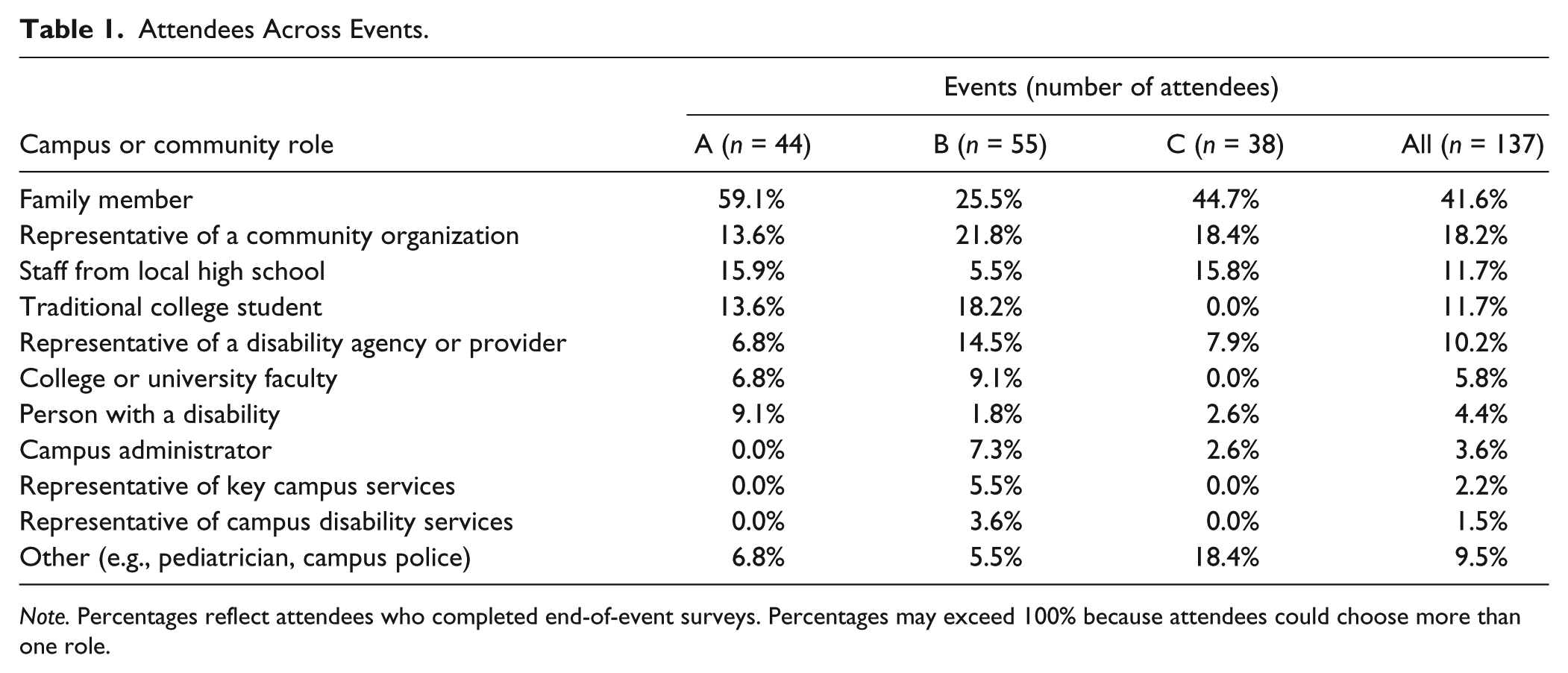
Note. Percentages reflect attendees who completed end-of-event surveys. Percentages may exceed 100% because attendees could choose more than one role.
Event structure
All events used the community conversation approach (see Carter & Bumble, 2018), which employs an adaptation of the World Café model (Brown & Isaacs, 2005). Events were 2 hr in length and followed a similar structure. When attendees arrived, they checked-in at a registration table, had refreshments, and sat at a table with four to six other community members. A facilitator from the local planning team welcomed everyone, discussed the relevance and importance of inclusive programs, and shared the agenda for the evening (10-30 min). Next, attendees met and exchanged ideas over three rounds of small-group discussions (about 15–20 min each). Questions addressed across events were
What would inclusion for students with intellectual disability look like on our campus? (Rounds 1 and 2)
Which people, resources, and supports would be important to involve within and beyond our campus to be successful? (Round 3)
At each table, a “table host” led introductions and recorded attendee-generated ideas. Planning teams chose and enlisted table hosts prior to the event. A member of the research team provided a brief orientation (5–10 min) in which he or she emphasized the importance of capturing complete ideas (e.g., students should attend academic class vs. academics), provided facilitation guidelines, and distributed data collection sheets. Although there were no specific criteria for table hosts, we encouraged choosing individuals who were part of the planning team, likely to record comprehensive notes, and could keep the conversations solutions-focused. Each attendee received blank place mats to write down additional ideas if they chose to do so.
Attendees switched tables between each round; which allowed for attendees to converse with an average of 12 to 18 other community members throughout the evening. The event closed with a whole-group discussion (10–20 min) in which attendees shared the most compelling ideas they heard, as well as suggestions on next steps. A member of the research team transcribed all comments and projected them onto a large screen so attendees could see the breadth of ideas generated by the group. At the conclusion of each event, we asked attendees to complete a short, anonymous survey about their experience and campus perceptions.
Within this structure, each planning team individualized their events. Campus A hosted their event on a weekday evening in a university meeting room. Although décor was limited, the team served unique refreshments and made attendees feel relaxed in the casual environment. The group facilitator focused on the background of inclusive higher education, sharing metrics on enrollment and information on existing programs across the country. Campus B hosted their event on a weekday evening at a museum conference center. They served appetizers donated by community organizations and placed candies on each table. At the opening of the event, a program alumni from another state shared his experience participating in a university study abroad program. Campus C hosted their event midday in a city library meeting room. Attendees had lunch and sat at tables decorated with quotes from and photos of self-advocates. A local state senator supplied an impact statement that was read at the opening of the event about the importance of inclusive higher education programs, which set a tone of urgency for the conversation.
Data Sources
We used table host conversation notes and end-of-event surveys as primary data sources.
Conversation notes
We compiled a comprehensive list of all the ideas generated at each of the events by combining attendee notes (i.e., place mats), whole-group discussion notes, and notes taken by table hosts during the three small-group discussions rounds. We collected a total of 38 place mats (Campus A: 10; Campus B: 14; Campus C: 14), three sets of whole-group discussion notes, and 26 sets of table host notes (Campus A: 10; Campus B: 10; Campus C: 6).
End-of-event surveys
After the whole-group discussion, we invited attendees to complete an anonymous, seven-item survey before leaving. Three questions addressed their perceptions of the events, one question focused on future action they might take on their campus as a result of attending the event, and three questions asked about their campus’ potential to house an inclusive higher education program. We also asked attendees to rate their agreement with the following statement—It is important to expand access to youth with intellectual and developmental disabilities in these areas—across 13 areas of campus life (e.g., Greek life, on-campus housing, service opportunities; see Table 2). Attendees used a 4-point, Likert-type scale ranging from 1 (strongly disagree) to 4 (strongly agree). Furthermore, we asked attendees which of 10 community or campus roles best identified them (e.g., family member, campus administrator, disability provider). We received completed surveys from 137 of 172 attendees (79.7%).
Importance of Access Across Areas of Campus Life (N = 137).
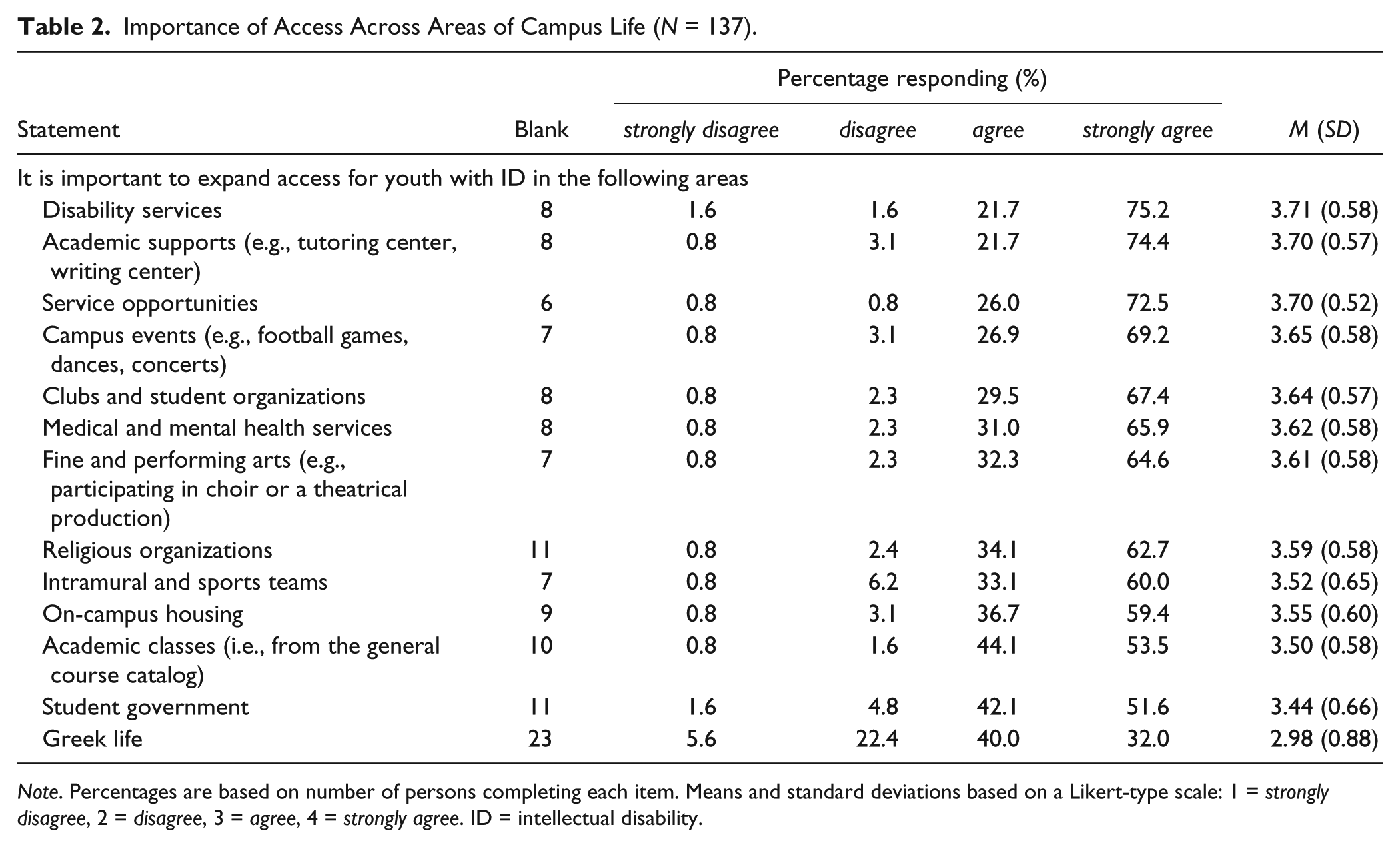
Note. Percentages are based on number of persons completing each item. Means and standard deviations based on a Likert-type scale: 1 = strongly disagree, 2 = disagree, 3 = agree, 4 = strongly agree. ID = intellectual disability.
Data Analyses
We transcribed all event data into spreadsheets. All cohesive phrases, sentences, or individual words (if written alone in a line of text) were placed in separate cells as distinct “ideas” (e.g., training for the peer supports, have an internship experience, social stories, self-advocacy). Because whole-group discussion notes and place mats often mirrored small-group discussion data, we only included novel ideas from these sources. We also removed ideas that were vague (e.g., “it needs to improve,” “more specialty-type interests,” “joint effort”) or personal notes resulting in 700 unique ideas. We organized ideas by event, table, and round.
We conducted both qualitative and quantitative analyses to address our research questions. Qualitative coding involved three members of the research team—two individuals from the special education department (i.e., a graduate student and a faculty member) and the assistant director of an existing inclusive higher education program. All coders had prior involvement in research using community conversations. We adopted this team approach to help attenuate bias throughout our coding process and triangulate our findings across researchers.
We analyzed the data using a constant comparative approach (Strauss & Corbin, 1990). First, after an initial review of the data, two team members independently used open-coding to group similar concepts (e.g., areas of inclusion, program decision points, campus needs) and met to develop a preliminary set of overarching themes through comparison and consensus. Themes relating to RQ1 were experiences, skills, supports, principles, attitudes, training, and partnerships. Themes relating to RQ2 were school systems, disability providers and organizations, surrounding community, and campus community. Second, the three researchers used these themes to independently code each idea and generated their own underlying categories or labels for each item (e.g., an emergency phone is a good idea was coded with the theme supports and the category technological supports; peer buddy to help get to classes was coded with the theme supports and the category peer supports). After coding, we met to discuss discrepancies to consensus and adapt the themes to reflect any emergent findings. During this coding process, we added two themes, program components (RQ1) and student networks (RQ2) and developed definitions for each theme. Because some ideas could be interpreted in multiple ways, 47 ideas were double-coded (resulting in 747 coded items; see Tables 3 and 4).
Dimensions of Inclusion Identified Within and Across Events.
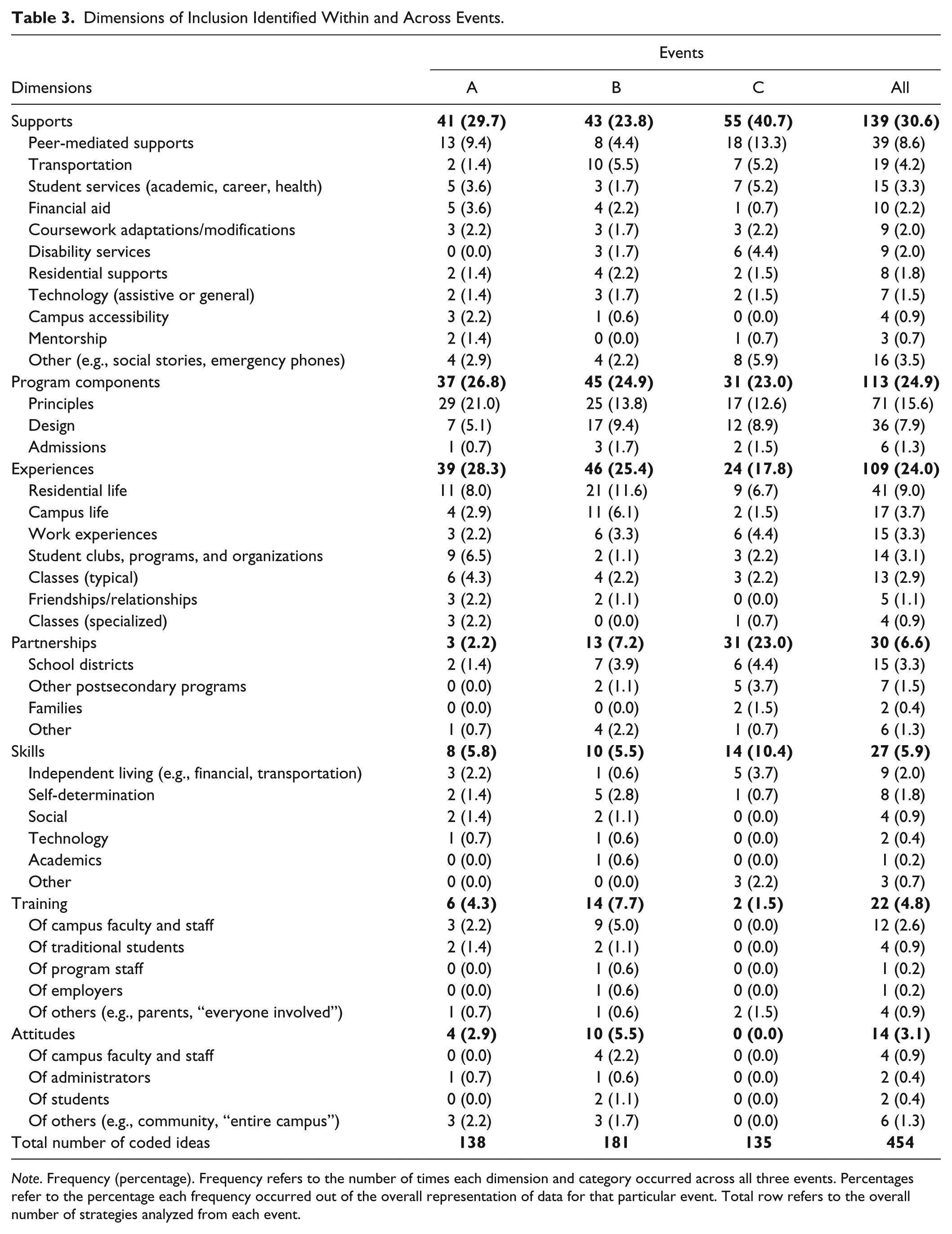
Note. Frequency (percentage). Frequency refers to the number of times each dimension and category occurred across all three events. Percentages refer to the percentage each frequency occurred out of the overall representation of data for that particular event. Total row refers to the overall number of strategies analyzed from each event.
People, Resources, and Supports Identified Within and Across Events.

Note. Frequency (percentage). Frequency refers to the number of times each dimension and category occurred across all three events. Percentages refer to the percentage each frequency occurred out of the overall representation of data for that particular event. Total row refers to the overall number of strategies analyzed from each event. ROTC = Reserve Officers’ Training Corps; VR = Vocational Rehabilitation; DIDD = Department of Intellectual and Developmental Disabilities.
Third, we generated a complete list of the categories researchers assigned to each idea. We clustered similar categories (e.g., peer supports, peer-mediated supports, peer mentors) and two members of the research team created a draft of each theme and its underlying categories. This draft was shared with the third researcher and refined based on feedback. Throughout the analysis process, we kept an audit trail including raw data (i.e., original data sheets and transcriptions), process notes (i.e., coding decisions across researchers and rounds of coding, meeting notes, personal memos, team communications), and analysis products (i.e., coding scheme following each successive round of coding). Our final coding framework included 12 themes and 78 categories. Although we felt this was a large number of categories and we attempted several different approaches to condensing, we determined each was necessary to convey the nuances in these data.
Frequencies of community-generated themes and categories raised at each event are reported in Tables 3 and 4. Given the design of these events and our approach to data collection (e.g., one attendee could raise each idea at multiple tables, an idea might only be listed once by a table host despite being discussed at length), frequencies may not necessarily equate with the priorities attendees placed on each idea. However, these frequencies do provide insight into how widely ideas were discussed across events. We summarized end-of-event surveys using descriptive statistics. We shared findings with each campus team.
Results
How Do Stakeholders Conceptualize Higher Education Inclusion?
Across events, we coded 454 unique ideas (range = 135–181 per event) addressing RQ1. Seven dimensions of inclusion emerged, most with multiple categories. Table 3 displays the number of times each dimension was discussed within and across all community conversation events, as well as the percentage of all ideas reflecting each of the 40 categories and seven dimensions. In addition, our end-of-event survey (see Table 2) addressed views regarding the importance of expanding access for youth with ID in different campus areas.
Supports
When asked to consider what inclusion might look like on their campus, most attendees focused on supports (30.6% of ideas)—the formal and informal assistance needed for students to access opportunities for personal and professional growth on campus. Accessing peer-mediated supports to assist with academics (e.g., tutoring, in-class support), social inclusion (e.g., Best Buddies, attending sporting events together), and independence (e.g., helping develop routines, teaching students to navigate campus) were mentioned most often. Attendees differed in how these peers might be used and whether (and how) they should be compensated. Some attendees suggested one-to-one pairings; others thought an organized network of peers acting in a variety of roles would be beneficial. Other identified supports included the need for accessible transportation around campus, access to traditional student services (e.g., student health, career, and writing center), and financial aid (i.e., scholarships, grants) to make college affordable. In terms of classroom adaptations and modifications and disability services, ideas were very general and centered on academic success through the expansion of both. Residential supports were more explicit (e.g., assistance with laundry, creating dorms specifically for students with ID). Other supports mentioned across events included technology (e.g., iPads, laptops, and assistive technology to access academic content), increasing campus accessibility by providing auditory directions and wheelchair-accessible housing, and providing mentorship to students.
Program components
Almost one quarter (24.9%) of ideas shared by attendees related to how a formal program for students with ID within a campus is conceptualized, organized, and operated—and how this might affect campus inclusion. Many attendees highlighted guiding principles that would help encourage access (e.g., “same opportunities available for students of all abilities” and “ultimate goal: don’t turn anyone away”), individualize experiences (e.g., “very individualized, each person with own program based on interests”), and increase expectations (e.g., “start and end with high expectations”). However, some attendees accented safety and protection (e.g., “Greek life is out of the question. Too dangerous, too impressionable”; “How would students be fully integrated but fully protected?”). Program design also surfaced as a prominent discussion point across events. Attendees discussed a wide range of program features (e.g., staffing, student scheduling, curriculum, internships, student supervision) that would be essential to supporting inclusion. Graduation options (i.e., certificates and diplomas) were also suggested. Finally, some discussion addressed specific admissions details as part of their discussion of which students would be included on their local campus.
Experiences
A similar percentage of ideas (24.0%) considered the diverse experiences individuals with ID might have as part of an inclusive higher education program. Most discussions branched into residential life as attendees reviewed potential housing options. Inclusive living environments (e.g., “dorm integration with peers,” “integrated assisted living”) received the most attention, although some suggested distinct living contexts such as a “special house” or “dorm specifically for people with disabilities.” Some attendees considered living at home the safest scenario. Although suggestions varied, most attendees expressed commitment to providing on-campus housing options for students. In terms of campus life and student clubs, programs, and organizations, ideas aimed to provide opportunities for students to explore their interests and try new things through diverse campus activities (e.g., intramurals, hiking clubs, arts, Greek life). Discussions around classes addressed both typical courses (e.g., auditing, credit options, the need to move students beyond life skills classes) and specialized offerings only for students with ID (e.g., classes in nutrition, health, career exploration). Experiencing friendships and relationships was discussed least often and addressed generic opportunities to “spend time with general peers” or called for some kind of “social aspect” to their experience.
Partnerships
Community partnerships needed to plan and develop an inclusive program represented 6.6% of the total ideas. Many emphasized stronger relationships between school districts and college campuses to inform transition programming and introduce students with ID to college possibilities earlier in their schooling. The remaining ideas encouraged partnerships with other postsecondary programs (e.g., community colleges, 4-year colleges, vocational programs) and securing involvement and support of families.
Skills
The knowledge and abilities students with ID might gain through an inclusive higher education program surfaced in 5.9% of ideas. Independent living skills were mentioned most often and related to building general skills, financial management strategies, transportation skills, and daily living routines. Additional ideas addressed self-determination (e.g., self-advocacy and goal-setting), social skills (e.g., taking more responsibility, knowing how to make friends), and general technology and academic skills.
Training
A small strand of ideas (4.8%) centered on educational opportunities that would be needed for stakeholder groups to support or participate in inclusive programs. Most training topics were applicable to faculty and staff to facilitate their understanding of expectations for students, characteristics of students with ID, strategies for including students in their classes, and specific program goals and objectives (e.g., “workshops for the faculty to teach how inclusion works and how to implement it in their classrooms”). Other trainings were directed toward teaching traditional students to provide peer supports, preparing program staff for their roles and responsibilities, and increasing awareness among employers.
Attitudes
A small number of attendees discussed the beliefs, perspectives, and behaviors needed to support an inclusive program on their campus (3.1% of ideas). They not only felt that faculty and staff buy-in was essential (e.g., “identify the faculty that are genuinely interested and want to be involved,” “buy-in from housing staff”), but also recognized administrators were needed to advocate for the program and support fund-raising. In addition, they identified support across the student body and the general community as critical to creating an inclusive environment.
End-of-event survey results
We included 13 items in our end-of-event survey regarding the importance of access for youth with ID across diverse areas of campus life (see Table 2). The majority (range = 93.1%–98.5%) of attendees agreed or strongly agreed that access was important across all areas except Greek life (72.0%). The largest rates of disagreement occurred regarding access to intramural and sports teams, student government, Greek life, and on-campus housing.
What Individuals, Resources, and Supports Do Stakeholders Identify as Integral to Developing Inclusive Higher Education Programs?
Across events, we coded 293 unique ideas (range = 57–123 per event) addressing RQ2 (see Table 4). Ideas surfaced around 25 categories of individuals, resources, and supports from five overarching domains: campus community, surrounding community, disability providers and organizations, school systems, and student networks.
Campus community
Resources and supports found on college campuses reflected 62.1% of ideas. Attendees indicated postsecondary program staff were critical to making decisions about program design (e.g., curriculum, supports, modes of communication), providing needed training, and developing relationships with school systems and local employers. Recommendations also included traditional students from across campus (e.g., special education majors, graduate students, students with disabilities on a standard diploma track) who could provide social, academic, and other supports (e.g., suitemates, mentors). Some prominent campus offices and departments mentioned were housing and residential life to provide input on housing options and supports, faculty and faculty affairs to increase awareness and buy-in, and disability services to determine how they might support enrolled students (e.g., assistive technology, accommodations). Administrator involvement was emphasized across two events.
Surrounding community
Some attendees took an outward approach, identifying resources that would be needed beyond the campus (22.9% of ideas). Transportation was the most common suggestion; attendees felt students needed transportation to campus that was both safe and convenient. Businesses were critical to developing potential jobs, internships, and career exploration sites (e.g., “make it known to community and business owners that we need opportunity for these students”). Likewise, some attendees cited involvement and collaboration from the general community (e.g., “Without the community support, it won’t be successful.”).
Disability providers and organizations
A small number of ideas were related to disability providers and organizations (6.5%). Vocational Rehabilitation and Department of Intellectual and Developmental Disabilities were the most commonly cited disability providers (e.g., providing monetary supports, supporting job placement). Attendees also shared the importance of disability-focused organizations (e.g., the Arc) that might advocate for families and youth or provide transportation funding. The remaining ideas were residential living programs to provide training for youth and case managers.
School systems
A small number of attendees discussed engaging school systems (5.8% of ideas). Within secondary schools, these stakeholders included paraprofessionals, transition specialists, special educators, and administrators to provide an array of support (e.g., introduce students and families to higher education options, attend trainings about higher education, and align transition programming with college prerequisites). Two ideas pointed to other postsecondary institutions that might offer dual enrollment while students are still in high school.
Families
Only 2.7% of ideas referred to the involvement of families (e.g., “families on board and have the ability to support students”). However, families were mentioned in a variety of roles including serving on the board and advocating for transportation.
How Do Attendees View Existing Partnerships and the Community Conversation Events?
Attendees’ perceptions of their own campuses were mixed. While 77.3% of attendees felt that strong partnerships existed that might support an inclusive program, 20.2% disagreed and 2.5% strongly disagreed. Most attendees (93.6%) felt that their campus had the capacity to support a program; nearly all (95.9%) indicated that their campus needed further education on the benefits and importance of inclusive higher education. Almost all attendees (97.8%) felt that the event was a good investment of their time. As a result of the event, the majority of attendees (97.1%) gained understanding of what a program might look like, and most (93.3%) learned about resources, opportunities, or connections they previously did not know about. Although some attendees (11.9%) disagreed, most (88.1%) indicated they were leaving the event with specific steps they might take to expand access to inclusive higher education for youth with disabilities.
Discussion
Burgeoning interest in PSE options for students with ID raises pressing questions about the starting points and possibilities for individual campuses. Although descriptions of existing programs and individual program elements abound in the literature, less is known about how campuses navigate the early stages of exploration and eventual launch. We examined findings from three community conversation events on diverse campuses. We discuss findings related to the configuration of stakeholders, their conceptions of inclusion, the constellation of supports they identified, and the views they held about their campuses.
Configuration of Stakeholders
Inviting a diversity of perspectives is an essential element of the community conversation approach (Carter & Bumble, 2018). All three planning teams were successful at recruiting people to their event, but the combination of stakeholders who attended varied. For example, the large majority of attendees in Community A and Community C identified as having roles outside the college campus—primarily family members of individuals with ID, representatives of community organizations and agencies, and high school special education staff. Their involvement makes sense given the advocacy role parents assume in the lives of their children and the commitment schools and disability groups have toward improving transition outcomes. Missing, however, were substantial numbers of inside campus stakeholders, such as traditional college students, faculty, campus administrators, disability services, and generic student services. In other words, these events reflected “outside” entities calling for “inside” changes. The engagement of community stakeholders should be coupled with the presence of individuals who collectively know all corners of the campus well and are in a position to encourage or implement change. In contrast, Community B was more successful at securing the involvement of a wider range of stakeholders. Although Community A and Community C are still exploring their next steps, Campus B is presently on pace to pilot a new program next year.
Conceptualizations of Inclusion
Educational inclusion has historically been discussed narrowly in terms of settings (i.e., the locations in which students spend their time) and proportions (i.e., the ratios of people with and without disabilities). Stakeholders at all three events addressed higher education inclusion in much broader ways. When addressing the experiences students might access, responses extended beyond coursework (both typical and specialized) and encompassed residential life, campus life, student organizations, employment, and relationships. Moreover, they addressed the skills students would develop (e.g., independent living, self-determination, social, academic) that would provide indicators of inclusion being carried out successfully. However, it was discussion about the provision of needed supports that permeated these conversations about inclusion on their campus. Although specialized and individualized supports (e.g., disability services, adaptations, assistive technology, accessibility) were frequently referenced, so too were supports generically available to any student on the campus (e.g., student services, peer assistance, transportation). We were surprised by the attention given to both training and attitudes—each of which was framed as being essential to ensuring inclusive experiences. Training was suggested as a way of ensuring staff and students felt confident and competent; attitudes of multiple groups were referenced as evidence of a welcoming and supportive campus. Partnerships with secondary schools, other colleges, and families were seen as necessary to ensuring students arrived at campus ready for college and that programs were well-supported.
Connecting these various dimensions of inclusion was the presence of a strong program. In other words, attendees affirmed the importance of a strong program structure within each campus that ensured all of the other elements—experiences, skill development, supports, training, attitudes, and partnerships—were adequately addressed. In discussing the salience of a strong program, stakeholders identified the need for core values or principles (e.g., person-centered practices, individualization, high expectations, zero reject). They also suggested the need for solid staffing (to ensure the program can run effectively) and clear admissions policies (to ensure they are focused on serving the right population of students). Figure 1 illustrates the different dimensions of inclusion discussed by campus and community stakeholders and the ways in which each interacts with the others. Consistent with prior discussions of the PSE movement (Carter, 2017; Grigal et al., 2013), higher education inclusion requires consideration of much more than a student’s daily activities.

Dimensions of inclusion in higher education identified by stakeholders and the ways in which each might interact with the others.
Constellation of Supports
These 139 stakeholders were able to identify a wide range of people and resources that could be drawn upon to support a new program on their campus. Supports from within the campus community (e.g., other students, residential staff, student services, faculty, and administration) were emphasized across the events. This lengthy list could serve as a reference guide to other campuses interested in launching a new program. The attention given to supports from beyond the campus was also noteworthy. Entities essential to getting students to campus (e.g., transportation, families), providing employment (e.g., businesses), publicizing college possibilities (e.g., media, schools), preparing students for college (e.g., schools, families), providing financial supports (e.g., financial institutions), addressing collateral needs (e.g., disability organizations, providers), and others (e.g., faith communities, residential programs) all received attention during the rounds of conversation. Consistent with community conversations on other topics, these findings highlight the power of this approach for identifying a range of formal and informal supports that can be drawn upon to support the inclusion of people with disabilities. Moreover, they build upon the constellation of supports identified as reflective of best practices (Grigal et al., 2012; Papay & Griffin, 2013).
Campus and Community Conversation Views
Attendees perceived the community conversations quite favorably and the vast majority reported leaving the event with new ideas, clear intentions, and different views of their campus. Such findings are consistent with those of other studies as the events are intentionally designed to engage diverse community members in ways that promote awareness and information sharing related to a single issue (see Carter & Bumble, 2018). At the end of the event, most attendees affirmed that their campus had sufficient capacity to support a program. Yet they still felt the community needed further education on the benefits and importance of inclusive higher education. Although community conversations may offer a good starting point for dialogue, additional efforts are likely to be needed to ensure further movements will be made on each campus.
Limitations and Future Research
Several limitations suggest areas for future research. First, views regarding the conceptualization of higher education inclusion and critical supports are likely to vary across stakeholder groups. Although we encouraged campus teams to invite a broad mix of voices from within and beyond their campus, some stakeholders were less prominent at the three events. For example, only a small number of campus-level administrators, representatives of generic campus services (e.g., career center, student health, residential life, disability services), and young adults with ID were in attendance. Future studies should examine the ways in which the particular combination of attendees might shape the ideas a community generates, as well as whether different campus stakeholders tend to hold substantially different perspectives on these topics.
Second, the quality and clarity of notes taken by each table host affects subsequent data analyses. Although we oriented each table host to his or her roles and responsibilities, provided templates for his or her note-taking, and circulated throughout the room to observe the conversations and table hosting, we cannot verify the accuracy and comprehensiveness of each set of written notes. Future projects should identify new avenues to balance the benefits of informal conversation with its inherent challenges, capturing the full conversation at each table in ways that are unobtrusive and do not inadvertently stifle or change the ongoing discussion.
Third, we cannot yet speak to whether the events were successful at achieving one of their multiple purposes—to motivate movement toward development of a new program on their campus. Although one campus plans to launch a pilot program next fall, the other campuses are still exploring options. The distance from conception to launch can be multiple years (Plotner & Marshall, 2015). Future studies should incorporate a longer term focus that follows programs from their conception to their commencement and the ways in which ideas shared at the community conversation event were enacted. To date, longitudinal research addressing the impact of community conversation as an intervention is rare within the literature.
Implications for Practice
This initial application of community conversations to higher education has implications for practice. First, community conversations provided an efficient and feasible avenue for exploring inclusive possibilities on diverse college campuses. Each of three events recruited a sufficient number of attendees, assembled a cross section of stakeholders who might not otherwise have met, generated an average of almost 100 recommendations for needed people resources and supports, and tailored their event to reflect their campus culture. Moreover, external support for carrying out these events was fairly limited. For institutions interested in enrolling students with ID, community conversations represent a practical consideration.
Second, active efforts may be needed to recruit stakeholders whose attendance was more limited. Families, community agencies, and secondary educators were fairly well-represented across these events. Less prominent were a variety of campus-level stakeholders who could bring important insight into the opportunities and supports needed to support the breadth of campus experiences identified as important by attendees. For example, residential staff could speak about on- and off-campus housing considerations, disability services could speak to academic supports, career services could speak to internship and employment opportunities, a bursar could address financial resources, advising staff could address course selection, and student life staff could address the array of campus groups and social activities.
Third, the specific questions around which a conversation is structured can be adapted to focus attention on more targeted aspects of campus life or new directions for program expansion. For example, existing programs that do not offer residential options could focus their conversation on the movements needed to support access to dorms, campus apartments, and off-campus housing options (e.g., What steps should we take to expand residential options for students with ID?). Likewise, programs interested in deepening campus life involvement could aim their conversation toward an exploration of potential social, recreational, and service opportunities (e.g., How might we connect students to out-of-class experiences that align with their interests? What could we do to create communities of belonging for all of our students? How can we partner with student leaders to better support inclusion in campus groups?). Community conversations may be especially useful for newly funded transition and postsecondary programs for students with intellectual disabilities (TPSID) model demonstration programs charged with expanding the scope and reach of their programs (Think College National Coordinating Center, 2017).
Footnotes
Declaration of Conflicting Interests
The author(s) declared no potential conflicts of interest with respect to the research, authorship, and/or publication of this article.
Funding
The author(s) disclosed receipt of the following financial support for the research, authorship, and/or publication of this article: Partial support for this work came from a Transition and Postsecondary Programs for Students with Intellectual Disabilities (TPSID) grant from the Office of Postsecondary Education, U.S. Department of Education and the Vanderbilt Institute for Clinical and Translational Research grant support (UL1 TR000445 from National Center for Advancing Translational Sciences [NCATS]/[NCATS]/National Institutes of Health [NIH]).