



Abstract
Engagement and academic success in middle school is critically important to ensure students with disabilities complete high school and have a viable path to and through postsecondary education. Although most middle school students say they want to pursue postsecondary education or training, a significant proportion are not actively engaged in college and career readiness (CCR) activities in middle school. This transition in practice article highlights the importance of early CCR instruction for middle school youth with and without disabilities. Lessons learned from developing an online CCR curriculum and implementing it with middle school youth in inclusive middle school settings will be shared. Access to and comfort with technology, the need for age-appropriate content, and strategies for universally designed curriculum will be addressed. Recommended practices and available resources will be offered to expand educator focus on CCR with middle school youth with a wide range of disabilities.
College and career readiness (CCR) have become key priorities in education in the United States (Hein, Smerdon, Lebow, & Agus, 2012). CCR reflects a variety of academic and noncognitive factors, a complex combination of reciprocal academic behaviors (Farrington et al., 2012; Morningstar, Lombardi, Fowler, & Test, 2015). Conley (2011) purports “a student who is ready for college and career can qualify for and succeed in entry-level, credit-bearing college courses leading to a baccalaureate, certificate, or career pathway-oriented training programs without the need for remedial or developmental coursework” (p. 1). In addition to the efforts focused on ensuring students leave high school ready for college and careers, it has become increasingly clear that CCR efforts can and should include middle school to have a stronger impact (Maitre, 2014). CCR activities prior to high school enrollment can focus on self-reflection, helping students become aware of their interests and skills to support future college and career planning. Intervention in middle school is crucial for keeping students on a college-ready trajectory, especially for students who struggle academically or socially due to disability or other at-risk issues (Neild, Balfanz, & Herzog, 2007).
Opportunities for exploration can be especially important for students with disabilities, who lag behind their peers without disabilities in both college attendance and post-school employment (ACT, 2008) and face unique challenges in the job market (Ross & Bateman, 2018). Three quarters of students with disabilities expect to obtain some postsecondary education (Lipscomb et al., 2017). Far fewer, however, actually apply to college and the rate varies depending on the students’ disability. For example, only 24% of youth with intellectual disability have taken a college placement or entrance examination compared with 47% of students with specific learning disabilities (Lipscomb et al., 2017). Although it is recommended CCR activities begin in middle school (Brand, Valent, & Danielson, 2013), there are no requirements under Individuals With Disabilities Education Act for this to occur. What, then, do students with and without disabilities in middle school know about college and careers?
Middle School Students’ College and Career Knowledge
As we began to explore the need for a CCR curriculum, some informal focus groups were conducted with middle school students with disabilities to get a sense of what they understood about postsecondary planning and careers. The students shared they knew going to college had some connection to jobs but were unclear about the exact connection. When asked what students need to do to prepare for college, students had a variety of responses, including “don’t get in trouble,” “get better grades,” “don’t be late for all your classes,” and “don’t be skipping classes.” When asked if they should take any specific classes to get ready for college, they were uncertain. These conversations were similar to findings from Bushaw (2007), who surveyed more than 1,800 middle school students to ascertain the views on their preparation for success in their current school, in high school, and in postsecondary settings. He found students had high expectations for attending college but knew very little about the courses they needed to take to prepare themselves for college.
According to Bushaw (2007), middle school students who had poorer grades or whose parents had little education have less information about what is required of them to graduate from high school and feel less prepared to succeed once they get there. In our conversations, middle school students with disabilities were asked how they could learn more about college, students said either their parents or siblings would tell them what they needed to know. There was no indication from these students that their teacher had been talking to them about college. Middle school students were interested in talking about college and careers but lacked direct instruction from their teachers on these topics. In a study involving eighth- and ninth-grade special educators, Weidenthal and Kochhar-Bryant (2007) found some middle school teachers believe middle school students are too young to talk about postsecondary goals.
This is concerning as findings from a study titled The Forgotten Middle indicated academic achievement in eighth grade had a larger impact on [students’] CCR at graduation from high school than did anything that happened academically in high school (ACT, 2008). Engagement and academic success in middle school is critically important to ensure all students complete high school and have a viable path toward postsecondary education and future employment. However, too strong a focus on academic achievement may stymie exploration. A recent article by Burkins, Yaris, and Hoffmann-Thompson (2016) related that too often the CCR activities in middle school focus on academic metrics and provide fewer opportunities for students to look inward, to explore their interests and passions. “We find that middle school, when students’ quests for identity are on overdrive, is an optimal time to help students deeply explore the rich and diverse possibilities for futures that connect to the things that bring them joy” (Burkins et al., 2016, p. 20). Supporting middle school students, including those with disabilities, in developing career knowledge and a college-going identity helps students see the relevance of school and remain engaged throughout middle school and high school (Hooker & Brand, 2010).
Over the past 5 years, we have been involved in a project aimed at developing an online tool to address CCR for middle school youth with and without disability. This tool, called Future Quest Island (FQI), was comprised of a web-based curriculum and teacher toolkit that addressed topics such as college awareness, career exploration, goal setting, and online safety. Using technology in the classroom offers both benefits and challenges. As a benefit, technology can provide a responsive and flexible instructional medium for students with and without disability. It can also lead to challenges in terms of accessibility for students with disabilities and support for both teachers and students. This article offers some of the lessons learned while creating a technology-based curriculum to support early CCR with middle school students with and without disability. This curriculum, FQI, is being finalized for broader dissemination and is not yet available to the public. Nevertheless, the lessons learned can be applied by educators with existing available web-based resources in a variety of settings and subjects. Our hope is readers will use this information to expand their focus on CCR with middle school youth including those with a wide range of disabilities and feel more empowered to use existing technology. For a brief description of the FQI project, see Figure 1. To view a video overview of FQI, go to https://futurequestisland.weebly.com.

The Future Quest Island (FQI) project.
CCR in Middle School: Where to Start?
Early middle school is a good time to focus on foundational knowledge, such as career awareness, as well as initial secondary and postsecondary options and aspirations (Glaser & Warick, 2016; Hein et al., 2012). This entails helping students recognize the difference between jobs, occupations, and careers and build their basic knowledge of the postsecondary education options available to them as pathways to their chosen career (National Association for College Admission Counseling, 2016). Addressing career or college awareness begins with self-exploration and self-reflection (Carvalho, Pocinho, & Fernandes, 2018; Hooley, Marriott, & Sampson, 2011). Younger students can begin developing their personal self-concept; as they progress into upper elementary school, students can extend this sense of self and begin examining their own interests and develop self-confidence to achieve their future goals (Hanover Research, 2012).
Operationalizing CCR with middle school students with and without disabilities requires a recognition that many of these students are just beginning to have ideas about what they are interested in, the kinds of jobs that exist, and the kinds of education required to get those jobs. This phase of their learning is exploratory. Students are just beginning to develop a more adult sense of self and have emerging knowledge of career and college options. Often, this knowledge may be based on personal experiences, such as having a brother or sister who has gone to college or has started a new job (Grigal & Papay, 2018). But middle school students, especially those with disabilities, may have few opportunities in their daily academic schedule to consider or explore what they might want to do in the future and may not see the connection between their current academic success and their future postsecondary options and career possibilities (Brand et al., 2013).
Focus on Dreams First
Some CCR activities focus specifically on academic measures, such as a student’s ability to read independently or standardized measures of progress (Burkins et al., 2016). When approaching the vast topic of their future college options or careers with middle school students, the goal is to engage their interest. Therefore, we recommend beginning with an activity not academic in nature. While FQI addressed a variety of CCR-related topics, the first activity all students participated in was called “Future Forecaster.” This activity offered students the chance to begin conceptualizing their futures after high school in a fun and engaging way. The activity itself was presented a little bit like a game show, with flashing lights and sounds, and a board listing many different options for the future. The student pushed a button to select where they would go to college, what their career would be, the place they would live, the pets they would own, and the transportation they would use. Some forecasts were silly while others were probable, as they were generated randomly by the tool. This activity launched the student into other parts of the island on their “Future Quest.”
While using the Future Forecaster activity, students were very excited to have their futures forecasted, even when the game produced silly predictions like, “you will live in a yurt and own 15 pet pigs.” This activity reflects an important dynamic when working with younger students on topics related to CCR. The discussions do not need to become too serious in the early stages. The Future Forecaster activity was successful because it allowed students to fantasize about their futures without the limits of “reality” bogging them down. This fostered motivation and engagement and set the stage for deeper discussions later on.
To implement CCR with middle school students, teachers can use many other existing online tools to do similar kinds of exploration, allowing students to fantasize about fun and possibly unlikely futures. The resources in Table 1 offer some tools and activities to support initial conversations. At this stage of early CCR exploration, educators should be wary of taking the topic of future planning too seriously too soon so students can dream big about their possible future self. If students share some “big dreams” and are met with doubt or told they are being unrealistic, their motivation and engagement will likely wane.
Online Resources for College and Career Readiness.
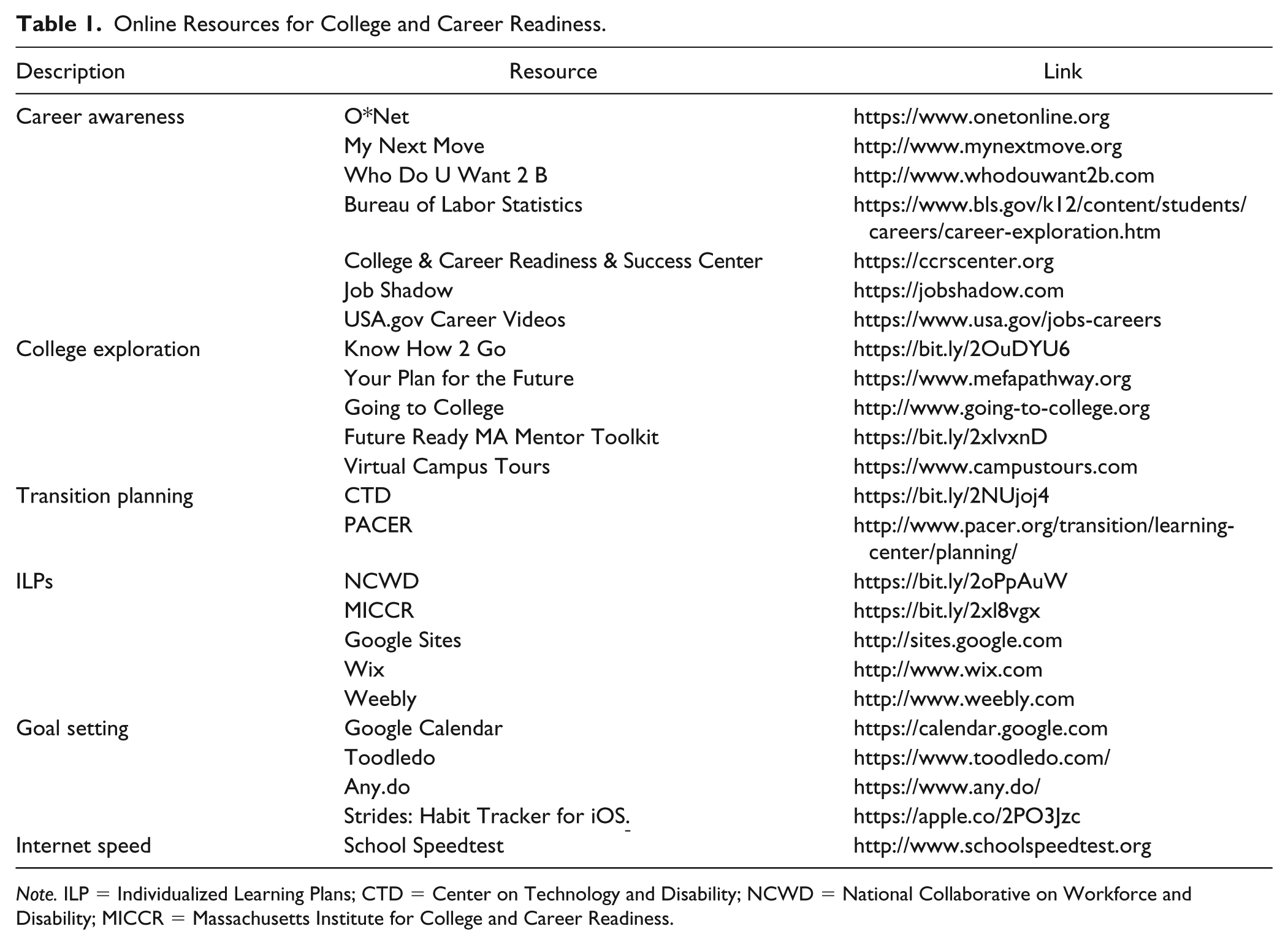
Note. ILP = Individualized Learning Plans; CTD = Center on Technology and Disability; NCWD = National Collaborative on Workforce and Disability; MICCR = Massachusetts Institute for College and Career Readiness.
CCR Focal Areas
Career Exploration
Career exploration entails learning about an array of career options, understanding the pathway to those careers, and reflecting about careers aligned with individual interests and skills (Flexer, Simmons, Luft, & Baer, 2001) and has been identified as a research-based practice connected to positive post-school outcomes for students with disabilities (Test, Fowler, Kohler, & Kortering, 2010). Hooley et al. (2011) assert career development activities have greatest effect on academic achievement when they are introduced at a younger age, and technologically supported career development can increase access to career development as well as its effectiveness. Students with disabilities have been shown to benefit from online curricula focused on employment-related skills. Izzo, Yurick, Nagaraja, and Novak (2010) found students with disabilities demonstrated significant gains in transition skills when using a computer-aided transition curriculum. The National Career Development Association (NCDA) recommends middle school educators place a strong emphasis on increasing self-understanding through career exploration for all youth but not on helping youth make specific occupational choices. During these years youth should be helped to become aware of the concepts of career interests, career aptitudes, and work values as they apply to various occupations and to themselves. (NCDA, 2011, p. 3)
Career exploration was addressed via an activity called Career Outfitters, a series of lessons in which students explored various careers by “dressing up” their avatars in the career closet. Students virtually “tried on” different business/occupation clothing and apparel, including many STEAM (Science, Technology, Engineering, Arts, Mathematics) careers. Each outfit/apparel was connected to three careers, and each career had information about the type of education required, career outlook, and salary outlined from O*Net’s My Next Move site, the Nation’s primary source of occupational information from the Department of Labor (www.mynextmove.org). Students then wrote about their future career choice(s), which were connected to both the student’s individualized learning plan (ILP) and to future goal setting activities in the curriculum. Similar to the Future Forecasting activity, the student’s interest and motivation was initially spurred by the avatar dress up activity. Then, after the students tried on various careers, they connected those careers with their particular interests, and ultimately, their goals.
Middle school educators can use existing resources, like O*Net, a database of nearly a thousand occupations sponsored by the U.S. Department of Labor’s Employment and Training Administration (see Table 1) to begin career exploration activities. O*Net’s My Next Move website provides the ability to search careers by keyword, browse careers by industry. Students can answer questions about themselves to match their interests with careers. Similar to the career outfitters activity, teachers can ask students to draw themselves in a specific career outfit or can let students search through online images to find careers of interest. We recommend teachers use a universal design approach, so students have multiple means of representing their work, either through a written summary, video, recording, or drawing.
Postsecondary Options and Aspirations
Middle school is an important time to launch college awareness activities as students will soon be making choices affecting where they can attend college (Glaser & Warick, 2016). As students advance toward high school, their course choices and grades may directly impact their college options. For some students thinking about college comes with additional challenges. Those who come from low-income backgrounds, or have parents with little or no postsecondary education, may find a college education is not be seen as a priority (Madaus, Grigal, & Hughes, 2014). Students with disabilities may not be encouraged to consider college due to low expectations on the part of their families and their teachers (Grigal & Papay, 2018). Elmore, Veitch, and Harbor (2018) interviewed college students with disabilities about their college preparation experiences. One student, Ann, who was blind, related her experience: I only had a vague conception of college growing up. I started learning more during late middle school/early high school when representatives from universities would come in talking about college. But they would not go to the classes where students with disabilities were, like the resource room . . . It was as if the disabled students in the resource room didn’t need to hear about college and scholarships. (Elmore et al., 2018, p. 12)
The FQI curricula were designed to be used in inclusive settings, ensuring all students with and without disability would have access to the same college information. It included lesson plans and activities to familiarize students with early college concepts such as vocabulary terms (e.g., salary, bachelor’s degree, career), postsecondary options, and transitioning through high school. We used mixed media to introduce students to college through virtual campus tours (https://www.campustours.com/), videos of campus life, and interviews with college students. Students also completed a scavenger hunt using postsecondary vocabulary (i.e., community college, university) where they learned about undergraduate, graduate, and postgraduate degrees through materials and videos. Using the college exploration resources provided in Table 1, middle school educators can introduce students to early college concepts through readiness quizzes, exploration activities, and online campus tours.
Goal-Setting and Planning
College and career exploration provides students with the chance to consider what they might do to pursue the interests they identified. Setting desired goals and identifying steps needed to meet those goals is another critical aspect of CCR. For students with disability, this can be particularly important as they approach the age when transition planning occurs. To facilitate development of goal setting skills, FQI supported students to create and monitor long-term and short-term school, career, personal, social, online safety, and postsecondary goals. To ensure both teachers and students had ongoing access, student goals were stored in an electronic ILP for frequent review and progress monitoring. The students’ ILP allowed teachers to assess students’ acquisition of skills and curriculum progress, as well as document the students’ evolving career interests. Students used these materials for student-led individual education program meetings, high school applications, team meetings, and shared them with school personnel, family, and friends. Educators can use online platforms like Google Sites, Weebly, or Wix to help students build an electronic ILP and/or online transition plan. Goal setting and monitoring activities can be facilitated using mobile apps and web 2.0 tools such as Google Calendar, Toodledo, Any.do, and Strides: Habit Tracker for iOS.
Challenges, Strategies, and Lessons Learned
Acknowledge Students’ Background
When middle school educators choose colleges and career materials, it is important they offer students a way to see themselves in these scenarios. This includes recognizing students from families with limited means, or those from families who have never attended college may have little to no experience talking about college. In particular, some culturally diverse or economically challenged students may have been underserved and may require additional enrichment opportunities to genuinely believe college is possible. These students may require supplemental activities to learn the content knowledge and communication skills needed to achieve their future college aspirations and career goals (Turner & Danridge, 2014). Teachers can initiate conversations around college affordability by sharing information on how universities offer scholarships to make college affordable for students in different income brackets. For example, Stanford University offers a “zero parent contribution for parents with income below $65,000, and Stanford will not expect a parent contribution toward educational costs.” Students may be relieved to learn that their families do not have to be “rich” for them to attend college and more likely to consider it in their future.
Finding the Time
Some middle schools build time into the weekly schedule to address a variety of nonacademic subjects, including college and career exploration. For others, it may be a challenge to have a whole class period on a weekly basis that allows students to explore careers. If scheduling precludes a dedicated class period to address career exploration, schools can incorporate career exploration into other subject areas such as English, science, or social studies. The educators we worked with in developing FQI indicated the curriculum helped them to consider other ways of incorporating college and career exploration into their existing subject matter instruction. For example, a middle school science teacher created an extension activity to teach students about types of careers in science. Students were separated into groups and given a paper bag filled with hints about a specific science career. They used Chromebooks to access the O*Net website (see Table 1), to discover which career they were given, the postsecondary requirements, necessary skills, and average salary for that career. Students then shared what they liked and disliked about the career, and whether they would consider it in the future.
Access to Technology
Technology can be effective in motivating and supporting CCR with students with disabilities. For example, the EnvisionIT curriculum, a teacher-guided, digital CCR curriculum, helped students with disabilities improve reading and information technology literacy skills (Lombardi et al., 2017). Teachers planning to use technology in their instruction should consider some planning and logistical issues. First, not all schools have the same access to existing technology. Some schools have a dedicated computer room, others have a technology cart, and these resources are not always available, especially during mandatory testing time. Therefore, when opting to implement an online curriculum, teachers must know what type of device(s) is needed and available and confirm software is up-to-date. In addition to the hardware and software concerns, it is also necessary to address issues related to different platforms (iOS vs. Android) and ensure the school’s network has sufficient Internet speed to support the application. In using existing online tools or technologies to support CCR, educators should
Ensure students have access to technology or allow students to use personal mobile devices.
Confirm their school has the latest Internet browser release (i.e., Chrome), Operating System (Windows XP, Mac OS 10.5, Chromebook), and/or mobile device with latest release.
Verify their school has a high-speed Internet connection by working their school’s technology director to conduct an Internet speed test (http://www.schoolspeedtest.org).
Plan for unforeseen technology mishaps by downloading and printing curriculum materials ahead of time.
Accessibility and Age-Appropriateness
Given the range of disabilities potentially present in a middle school classroom, accessibility is critical for technology to be effective (Kellems et al., 2015). For example, a tool that relies on the ability to read may be difficult for a student who does not read or an individual who has a visual impairment. To address this, the FQI tool included text-to-speech features and nonreading versions of some materials to ensure teachers could use the materials with students of all abilities. Using existing embedded accessibility features offered in technology tools allows teachers to be more responsive to all learners.
As educators consider other online tools such as My Next Move or Job Shadow.com (see Table 1), they should consider how each student will interface with the materials. If videos are used (i.e., https://www.usa.gov/jobs-careers), ensure captioning is available. If there are large or long amounts of text, consider providing short summaries or graphic representation of essential content. Using available online materials to support CCR opens a wonderful set of educational tools for teachers, but it is important to ensure those materials are not only accessible from a disability perspective but are geared toward the age and appropriate level of discussion effective with middle school youth. Middle school educators should review the online content and consider the depth and reading level of the content prior to using it for instruction.
Conclusion
The potential to support exploration of college and careers for middle school youth with and without disability is impacted by access to appropriate resources, availability of time, and the capacity of educators to engage in motivating and personalized lessons. With planning, it is possible to address some aspects of CCR using existing web-based resources (see Table 1). Educators looking to address CCR with middle school youth should keep activities at an exploratory level, meeting students where they are in terms of age appropriate materials and activities. Educators must also consider accessibility issues in terms of hardware, software, and content. Finally, and perhaps most importantly, learning about college and careers in middle school should be fun, engaging, and meaningful. Educators should support students to dream big about all of their possible futures, so they might connect their early learning with a successful transition into high school and, ultimately, into their future college and career plans.
Footnotes
Declaration of Conflicting Interests
The author(s) declared no potential conflicts of interest with respect to the research, authorship, and/or publication of this article.
Funding
The author(s) disclosed receipt of the following financial support for the research, authorship, and/or publication of this article: Funds for this project were provided in part by a grant from the U.S. Department of Education, Award Number H327510012.