




Abstract
Religious organizations often serve as mainstays of communities, especially rural communities with otherwise limited support to promote improved transition outcomes. Yet, religious organizations appear not to be utilized as agencies in transition service partnerships. This article addresses involving religious organizations in the transition process through interagency collaboration by providing strategies, supported by literature, for engaging religious organizations as collaborative partners for community-based instruction and skill development opportunities for students preparing for adult life. Suggestions demonstrate how religious organizations and school systems can have mutually beneficial partnerships.
“How can I provide community-based experiences for my students?” Ms. Hernandez wondered. After completing her licensure program in a large city, she was offered a position in a rural setting, contrary to her plans. Nonetheless, Ms. Hernandez was excited to collaborate with local partners to develop community-based instruction opportunities. However, after teaching for 2 months and learning about her students’ strengths, preferences, interests, and needs, she is not sure how to provide quality community-based instruction to her students. Her community has a family restaurant and a church. Although one student wants to learn about working in a restaurant, the restaurant is currently inundated with the number of people employed. In addition, Ms. Hernandez has students who want to learn about other careers, including becoming a (a) musician, (b) disability rights advocate, (c) politician, and (d) child care worker. With the nearest town over 20 miles away and limited access to school transportation, Ms. Hernandez wonders how to provide meaningful community experiences that prepare students for adult life. If she were teaching in the city, she would have a million ideas. However, Ms. Hernandez needs help providing these critical experiences with only a restaurant and a church.
By trying to promote favorable transition outcomes, Ms. Hernandez is encountering commonly identified barriers to employment experiences in rural communities: (a) transportation, (b) partnerships, and (c) exposure to career experiences (Test & Fowler, 2018). Data from the National Longitudinal Transition Study (NLTS) 2012 indicated students with disabilities who attended rural schools were less likely to receive academic help outside school hours than peers without disabilities and peers with disabilities who attended schools in urban and suburban settings (Lipscomb et al., 2017).
Interagency collaboration is one strategy to address barriers faced by students with disabilities preparing for adult life (Rowe et al., 2015). Interagency collaboration is the intentional process of collaborating across programs, disciplines, and agencies to foster positive postschool outcomes (Rowe et al.). Furthermore, interagency collaboration was identified as a predictor of positive postschool outcomes. More specifically, students receiving supports from more community agencies were more likely to be engaged in postsecondary employment or education (Test et al., 2009).
Interagency collaboration often involves agencies within the disability service system (e.g., vocational rehabilitation; Noonan et al., 2008). However, resource availability was identified as a barrier to interagency collaboration in rural communities (Test & Fowler, 2018). Ergo, considering all community agencies as potential partners for interagency collaboration may assist in filling service delivery gaps. For example, religious organizations often act as “anchor institutions” for rural communities, where the religious organization “fills in the gap of absent or hard-to-reach social services” (Institute for Emerging Issues, 2018, p. 1). Although several guides provide step-by-step directions for building interagency partnerships (e.g., Maryland Seamless Transition Collaborative [MTSC]; Del Valle et al., 2014; Communicating Interagency Relationships and Collaborative Linkages for Exceptional Students [CIRCLES]; Povenmire-Kirk et al., 2015), none have focused on religious organization partnerships. Therefore, the purpose of this article is to (a) describe the potential role of religious organizations within the transition process, (b) provide specific examples of utilizing interagency collaboration strategies for partnering with religious organizations, and (c) offer considerations for developing these partnerships, while maintaining the proverbial separation between church and state.
Had students discussed religion when Ms. Hernandez was learning their strengths, preferences, and interests, she would have had an ideal opportunity to speak with the local church and invite them to collaborate. However, because religion was not documented during students’ transition assessments or Individualized Education Program (IEP) meetings, Ms. Hernandez was unsure if the church could provide opportunities for her students, especially students who did not consider themselves religious. Furthermore, she was cognizant of the need to separate church and state, and, therefore, was cautious to partner with the church. However, knowing the important role religious organizations can play in communities, she wondered if the church, in general, could help address this gap. Then, she realized churches are like other community agencies that can provide supports and resources to students. Instead of religious orientation, Ms. Hernandez decided to focus her partnership on student supports and resources.
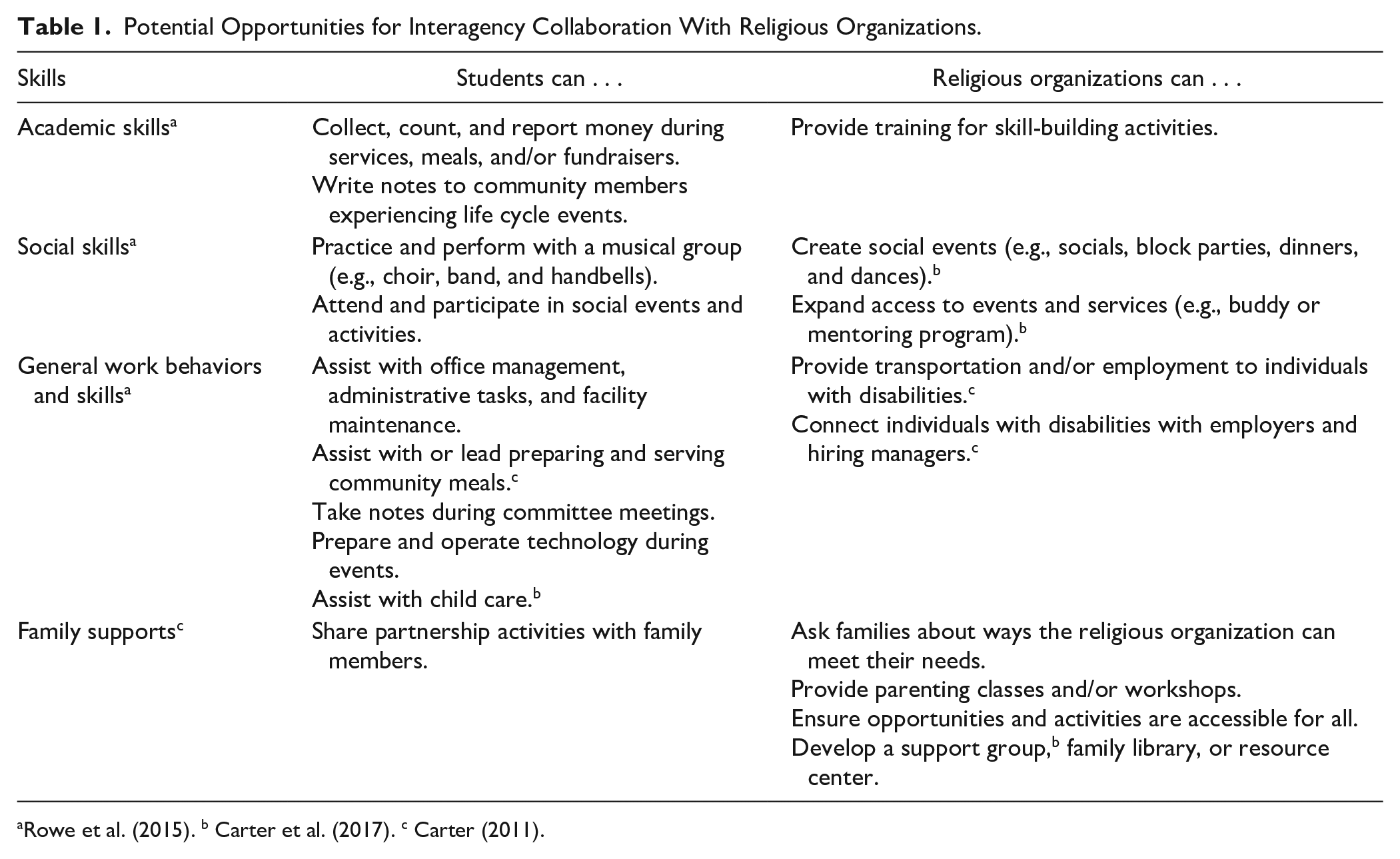
Because religious organizations may not be the initial consideration for providing transition services and experiences for students with disabilities, it is noteworthy Kohler et al. (2016) listed church groups as potential interagency collaboration partners. Although Ms. Hernandez has access to a local church, other religious organizations (e.g., synagogues, mosques, and temples) could be relevant for interagency collaboration. Partnerships with religious organizations could benefit students with disabilities by offering social supports (e.g., community meals), resource supports (e.g., transportation), and employment supports (e.g., facilities and training programs; Carter et al., 2017). Table 1 provides a list of potential activities categorized into community experiences (Rowe et al., 2015).
Potential Opportunities for Interagency Collaboration With Religious Organizations.
Why Religious Organizations?
With facilities often unused throughout the week (Carter et al., 2016; Terrill et al., 2016), a mission that often includes aspirations to form meaningful alliances with their community (Carter et al., 2017), and dedicated volunteers (Clerkin & Swiss, 2013), religious organizations may offer resources for developing community and/or employment experiences to practice social and career development skills (Rowe et al., 2015). Many religious organizations have not explored partnering with local education agencies and organizations serving individuals with disabilities (Larocque & Eigenbrood, 2005).
Religion can play an important role in the lives of students with disabilities and their families, providing support and meaning (e.g., Liu et al., 2014). Similarly, religious faith was found to be a predictor of positive quality of life outcomes across two domains, including autonomy and parent Relations (e.g., child chooses free time activities; Biggs & Carter, 2016) and peers and social support (e.g., child spends time with friends; Biggs & Carter, 2016). Regardless if students with disabilities consider themselves religious, they stand to benefit from interagency collaboration with these organizations if the partners maintain a focus on providing quality transition services, which promote in-school predictors of postschool success (Mazzotti et al., 2016; Test et al., 2009) and address students’ strengths, preferences, and interests (Individuals with Disabilities Education Act [IDEA], 2004). Similarly, Carter (2011) called for religious communities and organizations to support individuals with disabilities each day of the week, not just within the religious programming of the organization.
To support students, religious organizations can support the caregiving role family members serve (Gallagher et al., 2015). Despite these considerations, special education and transition literature have not extensively addressed religious organization partnerships, and the scarcity of methodology on this topic might make finding ideas and practices difficult for families and practitioners looking to build partnerships with religious organizations (Ault, 2010; Slocum, 2016). Available strategies and definitions for interagency collaboration (e.g., Rowe et al., 2015) appear to be relevant for partnership with religious organizations. Based upon interagency collaboration and religious organization research, the following examples outline steps for engaging religious organizations as interagency collaboration partners.
Step 1: Map Resources
Ms. Hernandez utilized strategies for developing interagency partnerships by exploring potential community agencies. First, she contacted the pastor of the church, arranged a meeting to gauge interest in partnership, and mapped resources offered by the religious organization.
Implementing Step 1
Practitioners can map assets and resources to identify agencies and gaps to support youth with disabilities (in both inclusive and disability-specific settings). Then, practitioners can map organization assets and resources to determine possible activities and opportunities. Last, partners can define the purpose, target population, activities, services, and partners/personnel of each activity (National Center on Secondary Education and Transition [NCEST], 2005). Practitioners can use A Guide to Developing Collaborative School-Community Business Partnerships (Luecking et al., 2015) and the Community Resource Mapping Tool (NCEST, 2005) to discover resources offered by the religious organization. These resources will help practitioners focus on student skill development and service delivery gaps in their community, rather than religion.
Step 2: Match Interests
Next, Ms. Hernandez shared her plans with students and families and asked them to sign a release of confidential information. Then, she encouraged interested students to create mini-presentations about their strengths, interests, preferences, and needs to show the pastor how partnering would benefit both parties. During the meeting, Ms. Hernandez learned the church provided several activities and resources that could benefit her students, including kitchen and dining facilities, child care opportunities, musical groups, and public speaking opportunities in which students could participate. The pastor expressed interest in partnership, but explained the process for decision-making in the church, which involved approval from multiple committees. Ms. Hernandez agreed to attend one committee meeting, where the pastor believed her presence would help with the decision-making process. Once the church agreed to partner, she shared the information with students to see which opportunities they would be interested in participating. After she explained the opportunities to develop job skills and engage in their community, Ms. Hernandez’s students, regardless of religiosity, expressed interest in partnering with the church.
Implementing Step 2
Practitioners can use transition assessments to document students’ strengths, interests, and preferences (IDEA, 2004) to drive instruction and maintain a focus on students’ postschool goals. When describing student strengths, interests, and preferences, practitioners should use nontechnical language when describing transition services and partnerships because faith community leaders may not know special education technical jargon or be familiar with the services interagency collaboration partners typically offer (Carter et al., 2016; Francis & Jones, 2015).
Step 3: Move Toward a Shared Vision
After Ms. Hernandez found she shared common interests with her students and the pastor, she collaborated with the pastor to determine the purpose of their partnership. Together, they developed their shared vision statement: “With this partnership, we provide mutually-beneficial opportunities where students apply academic, social, general work behaviors, transferable skills, and serve our community, in a supportive environment.”
Implementing Step 3
A shared vision is critical to developing a lasting partnership (Rowe et al., 2015). Potential partners should develop a shared vision statement that outlines the partnership’s purpose(s) and goal(s). A shared vision should outline agreed-upon mission and vision statements of transition services and programs. Partners can ensure a shared understanding of educational and agency policies and procedures. Particularly when partnering with religious organizations, the shared mission and vision statements should focus on skills students need for adult life (e.g., social, job-specific, and transferrable skills) and not religiosity. This step ensures that all entities understand the purpose of the partnership from the outset.
Step 4: Make an Agreement
Next, Ms. Hernandez worked with church staff to draft and implement a formal interagency agreement between the school and religious organization. They discussed the mission, responsibilities, policies, and resources involved in the partnership, as well as communication and data collection strategies. Ms. Hernandez acknowledged the community organization provided programs and services that were religious in nature, but their partnership focused solely on skill development opportunities. One student, who wanted to work with young children, considered herself religious and wanted to care for children who attend the religious organization, so parents could participate in religious activities. Another student, who aspired to become a musician and did not consider himself religious, expressed interest in singing in the church choir, recognizing the music might contain more religious themes. Other students who desired to be a politician or disability rights advocate stated they were drawn to the opportunity to prepare a brief speech each week to welcome guests to the community meal.
Implementing Step 4
Practitioners should create an interagency agreement, which outlines (a) the partnership mission, (b) partner responsibilities, (c) partnership policies and procedures, (d) shared resources, and (e) ways to communicate information with partners and the general community (Kohler et al., 2016; Rowe et al., 2015). The agreement should also include ongoing data collection and evaluation of the partnership (Kohler et al., 2016). Everyone involved in the partnership should have clear roles and responsibilities (Kohler et al., 2016). Because spirituality and religious expression are important aspects of human experience, persons with disabilities should choose to express or not express this aspect in a manner they see fit (American Association on Intellectual and Developmental Disabilities and The Arc, 2010). However, that decision rests with students and families and should not be dictated by practitioners. Regardless of religious affiliation, students will benefit from the partnership by developing job-specific and transferrable skills needed for adult life. If religious organizations contravene the agreement by providing religious guidance, partners can remind the religious organization of the initial agreement. Partners may review stakeholder roles and responsibilities, perhaps while assessing students’ IEP progress data. If needed, partners can meet more frequently to review roles and discuss action steps.
Step 5: Implement the Partnership
After drafting the agreement, Ms. Hernandez shared it with her principal and district transition staff to ensure their support. The principal agreed to modify the instructional schedule to provide community instruction time. The partnership consisted of three components, where students (a) joined volunteers in preparing and serving the weekly community lunch, (b) assisted with organization and delivery of the community food and clothing pantry, and (c) received instruction and participated in specific opportunities related to their interests (e.g., joining musical groups). Program leaders were excited to have new, regular volunteers. Because the district was unable to provide transportation, Ms. Hernandez requested support from the church board of trustees, and the church agreed to provide transportation to and from school.
Implementing Step 5
The opportunities listed in Step 5 are common to religious organizations (Carter et al., 2017) and focus on skill development opportunities in lieu of religious content. If an administrator is unable or unwilling to devote instructional time for community-based instruction specific to this partnership, the practitioner could still make the partnership work by creating an after-school club. While future expansion will likely be planned, it is best to start with a few manageable initiatives that could demonstrate success (Luecking et al., 2015). Religious organization leaders may need to provide instruction for students on participating in these skill-based activities. Partners should (a) establish procedures for sharing data among agencies, with appropriate release of information and confidentiality; (b) evaluate interagency policies and procedures on a regular basis; (c) coordinate the development of policies and procedures for service delivery; and (d) share resources between school and community agencies (Luecking et al., 2015).
Step 6: Support Partners
The church pastor addressed concerns about knowing which strategies or what language should be used to support individuals with disabilities. Therefore, Ms. Hernandez agreed to consult with the district transition coordinator and provide initial and yearly professional development sessions to the congregation. This was a benefit to the congregation, who considered this training to be integral to their mission of serving their community.
Implementing Step 6
A significant barrier to partnership is clergy and leaders do not receive training often on strategies designed to promote belonging for individuals with disabilities (Francis & Jones, 2015). Practitioners should consider offering cross-agency professional development (Holzberg et al., 2018) and supporting partners with understanding disability and transition services (e.g., development sessions to the congregation on disability awareness, effective practices for individuals with disabilities; Vogel et al., 2006). Religious organizations may indirectly benefit from these partnerships; however, their benefits occur because students develop and utilize new skills.
Practicing Partnership: Beyond Charity
After considering the role religious organizations can potentially play in providing transition services for students with disabilities, Ms. Hernandez realized the opportunity and importance of partnering with her local church. She learned her community is replete with opportunities for students with disabilities to learn and practice employment and social skills. Her students contribute to a community organization and their community at-large in a meaningful way through self-determined interests. Ms. Hernandez was pleased she partnered with her local church because of the strides her students have made through opportunities present in their partnership. Two students prepare for their futures as a disability advocate or politician by preparing speeches they share with the congregation at least weekly. Another student frequently shares about the new friends he made by joining the church choir. Last, the student who has been providing child care services during church has now started her own child care business. People in the community recognize and respect her demonstrable skills as a child care worker and feel confident in her abilities to care for their children.
Religious organizations can benefit students with disabilities in three important ways: (a) providing community-based instruction and experiences, where students learn social and employment skills (Carter et al., 2017; Rowe et al., 2015); (b) developing skills and giving back to their communities (Carter, 2011; Gaventa, 2005); and (c) providing human capital for activities and programs necessary for the religious organization and the community-at-large. Students with and without religious affiliations stand to benefit from partnerships with religious organizations when partners maintain a focus on skill development and students’ strengths, preferences, interests, and needs. Although Ms. Hernandez’s situation occurred in a rural context, partnerships with religious organizations can be relevant in any setting as religious organizations often act as community institutions in a variety of settings (e.g., Barrett, 2010).
Some practitioners may not know how to approach partnering with religious organizations because of religious content. However, by focusing on student needs and skill development opportunities, practitioners can ensure partnerships with religious organizations benefit students and do not put undue focus on religiosity. Instead, partnerships should focus on what students need for adult life. Therefore, when developing these partnerships, practitioners can consider religious organizations as they would any community agency, including the way the agency can benefit students preparing for adult life. Particularly in contexts where religious organizations are mainstays and practitioners face limited available resources, religious organizations can provide crucial opportunities for community-based instruction and community experiences that propel students toward their futures. By following these steps, practitioners can develop partnerships with religious organizations, provide students with authentic and meaningful opportunities to engage in their communities, and help prepare students for adult life.
Footnotes
Declaration of Conflicting Interests
The author(s) declared no potential conflicts of interest with respect to the research, authorship, and/or publication of this article.
Funding
The author(s) received no financial support for the research, authorship, and/or publication of this article.
