



Abstract
Parents of youth with disabilities require knowledge to support their children in secondary school. In the 21st century, online asynchronous training is one way to provide knowledge to parents in learning secondary transition concepts. We explored the use of an asynchronous online intervention on three parents’ knowledge of the secondary transition process and confidence levels in supporting their children with disabilities. We used a single-case, concurrent multiple baseline design across three transition areas to evaluate parents’ knowledge of secondary transition planning. Preliminary evidence showed the asynchronous online training improved parents’ knowledge of secondary transition for two participants who completed the entire training program across all three transition areas. Limitations and recommendations for future research and practice are discussed.
Keywords
Youth with disabilities often face challenges during the transition from secondary school to postschool services (Newman et al., 2011; Sanford et al., 2011). Based on the National Longitudinal Transition Study-2 (NLTS2), youth with disabilities experienced lower rates of postsecondary education enrollment (46% compared with 63%; Newman et al., 2010); lower salary rates per hour (US$9.00 compared with US$11.00; Newman et al., 2011); and lower levels of living independently (36% compared with 44%; Sanford et al., 2011) than their peers without disabilities. In addition, youth with disabilities experienced significantly higher unemployment rates (8.0% compared with 3.7%; U.S. Bureau of Labor Statistics, 2018) and lower postsecondary education enrollment (61% compared with 84%; National Center for Education Statistics [NCES], 2017) than their peers without disabilities. Supporting youth with disabilities at the secondary level is essential to promote optimal adult outcomes.
Parents play an important role throughout the lives of youth with disabilities, including the role they play in the transition to adulthood. Studies show that parents can effectively support students with disabilities in improving academic performance (Pierson et al., 2021), motor performance (Ku et al., 2020), and social skills (Dogan et al., 2017), along with reducing challenging behaviors (Kunze et al., 2021). In an effort to identify factors related to postschool success, researchers identified 23 predictors that correlate to improved student postschool outcomes, with parent involvement and parent expectations being two predictors of postschool employment for youth with disabilities (Mazzotti et al., 2021; Mazzotti et al., 2016). Based on a systematic review of NLTS2 secondary analysis studies, Mazzotti et al. (2016) identified parent expectations as a predictor of postsecondary education outcomes for youth with disabilities. Parent expectations toward their children’s abilities, skills, and choices for their future have demonstrated significant and positive relationships related to increasing students’ high school graduation rates, employment rates, and enrollment in postsecondary education (Carter et al., 2012; Papay & Bambara, 2014). In addition, parent involvement has improved secondary transition planning and further promoted postsecondary employment, education, and independent living success for youth with disabilities (Mazzotti et al., 2021; Rowe et al., 2021).
Rowe et al. (2015) defined parent involvement as “parents/families/guardian [being] active and knowledgeable participants in all aspects of transition planning (e.g., decision-making, providing support, attending meetings, and advocating for their child)” (p. 122). Despite well understood benefits of parent involvement, effectively involving parents in the transition planning process remains challenging (Hirano et al., 2018). Hirano and colleagues (2018) used qualitative synthesis methods to identify barriers to parent involvement for families of adolescents with disabilities. They synthesized results from 22 studies and found that the lack of secondary transition resources and information were key barriers to parents’ involvement in the transition planning process. Training families on secondary transition planning offers a feasible solution to the barriers that impact parent involvement (Francis et al., 2013). Parent training has been shown to increase parents’ knowledge (e.g., transition services, their children’s self-advocacy); expectations (e.g., toward their children’s competitive employment); and involvement (e.g., in their children’s educational activities) in the transition planning process (Francis et al., 2013; Rowe & Test, 2010; Taylor et al., 2017; Young et al., 2016). For example, Rowe and Test (2010) developed an intervention to deliver transition information to parents of youth with disabilities and found all parents’ transition knowledge increased substantially after the training.
Generally, studies on parent training in secondary transition for youth with disabilities have used a variety of face-to-face training methods, including workshops on the transition to employment (e.g., N = 168, Francis et al., 2013); Volunteer Advocacy Program-Training (N = 41, Taylor et al., 2017); and offering brochures with and without training on transition service resources (N = 29, Young et al., 2016). All trainings from these studies were found effective for improving parent knowledge of supporting youth with disabilities in the transition planning process. Despite the effectiveness of face-to-face training and ongoing in-person feedback, these approaches often require large amounts of time and resources from educators or service providers, which is rarely feasible (Dewey et al., 2017).
In the 21st century, leveraging technology to deliver parent training may improve access and flexibility to better support parents’ needs. Technology has been applied in parent trainings, such as computer-based instruction (CBI; Rowe & Test, 2010), synchronous online trainings (Lindgren et al., 2016), and asynchronous online trainings (Blackman et al., 2020). For example, Rowe and Test (2010) used an in-person supervised CBI intervention to deliver transition knowledge to parents of youth with disabilities. The CBI program was delivered through Microsoft PowerPoint with audio recorded ScreenFlow. Results indicated that all four parent participants gained knowledge of the transition planning process after receiving the training. To alleviate the need for in-person supervision and to improve equal access for parents to receive training on secondary transition, asynchronous online training may provide a feasible solution (Rowe & Test, 2010).
Compared with in-person and synchronous training, asynchronous online training offers a more flexible, cost-effective, and accessible model that can be particularly suitable for training parents (O’Lawrence, 2016; Pollard et al., 2014). Asynchronous online training refers to online training using prerecorded audio/video-based web recordings (Skylar, 2009). Learners who participate in asynchronous online trainings are provided with flexible time to respond to directions or questions (Skylar, 2009), which offers a potential solution for conveying secondary transition knowledge and increasing access for families who want to attend trainings but encounter challenges related to transportation and time conflicts (Peña, 2000). Prior studies have applied online systems and instruction in parent trainings, including in vivo, online tutorials combined with live remote coaching sessions to increase parents’ knowledge and skills on increasing students’ positive behaviors (Blackman et al., 2020; Ortiz et al., 2020). To our knowledge, the Rowe and Test (2010) study was the first and only study that used technology to improve parents’ secondary transition planning knowledge; however, the training was delivered in-person along with supervision from the researchers. To determine the extent to which asynchronous online training may improve parents’ knowledge of the secondary transition planning process, this study explored the use of an asynchronous online parent training intervention on secondary transition planning knowledge of three parents of youth with disabilities. This study aimed to answer the following research questions:
Method
Participants and Setting
Eligibility criteria for participation in this study included (a) being a parent of a child ages 14 to 21 years with a disability; (b) being able to read English at the fifth-grade level (the average reading level for American citizens in the United States; NCES, 2013); and (c) having access to a computer, laptop, iPad, or another equivalent device with internet connection. After obtaining university Institutional Review Board approval, the first author recruited participants through a southeastern state’s parent training and information (PTI) center. The PTI center shared a flyer on their social media website (i.e., Facebook). The recruitment flyer indicated that each parent who completed the training would receive a US$100 gift card. Fifteen parents met eligibility criteria and expressed an interest in participating. Due to funding limitations, only the first four parents who contacted the first author participated. All other interested participants received an email expressing appreciation for their interests and received training materials in PowerPoint format after the study ended.
The initial four participants reported they had been involved in their child’s individualized education program (IEP) meetings prior to the study. Of the four participants, two completed the study (i.e., Kathy and Laura). One participant (i.e., Erin) dropped out after three probes (did not meet mastery criterion) due to other priorities, and another participant (i.e., Irene) dropped out after 12 probes (during the intervention of her second content area—transition services). In this study, we reported data for the three participants who received training across at least two transition content areas.
Participants
Kathy was the mother of a 17-year-old boy receiving services for other health impairment (OHI) under the Individuals with Disabilities Education Improvement Act (IDEA; 2004). Kathy self-identified as White and indicated her age was 50 or above. Laura was the mother of a 16-year-old boy receiving services for OHI under IDEA; she self-identified as White between the ages of 40 to 50 years old. Irene was the mother of a 19-year-old boy receiving services for autism spectrum disorder under IDEA. Irene self-identified as White with an age of 50 or above.
Setting
All training took place online via ObaVerse (OBA, www.obaverse.net); therefore, physical training locations varied. Participants could choose any location with internet access and a device that could support the online training system. All participants reported they completed their training sessions at home.
Training Materials
Online platform
We used OBA to develop the training modules. OBA is a free online learning platform which integrates a wide range of webinar/video chat tools. OBA can be accessed through any internet-capable device (e.g., desktops, tablets, smart phones). OBA uses a responsive design, which is an approach to web design that aims to make webpages render well on a variety of devices. OBA users do not need to install any device applications. This design delivers an optimal user experience. OBA’s online learning platform offers a secure learning environment. OBA employs industry practices for data storage and encryption for collection of general user data, and aligns with the regulatory requirements for working with K–12 students, including the Americans with Disabilities Act (ADA), Family Educational Rights and Privacy Act (FERPA), and Children’s Online Privacy Protection Act (COPPA) guidelines.
Training modules
We adapted the training modules developed by Rowe and Test (2010), which was the only previous training program that used technology to improve parents’ transition planning knowledge. Specifically, we used Microsoft PowerPoint 2018 to convert Rowe and Test’s materials into online video presentations, which were recorded and shared on YouTube and presented to participants through OBA. There were four training modules: (a) Introduction (7 min); (b) Postsecondary Goals (17 min); (c) Postsecondary Transition Service Providers (43 min); and (d) Postsecondary Transition services (30 min). The first author developed all training modules using OBA with a 13-inch MacBook Air (2017). To help the participants better understand the asynchronous online training platform, we included the 7 min introduction module to explain (a) the purpose of the training and (b) how to navigate the online OBA system. The three transition content modules (i.e., Postsecondary Goals, Postsecondary Transition Service Providers, Postsecondary Transition Services) consisted of the same format/setup with one prerecorded video and three probes. The Postsecondary Goals module consisted of definitions of postsecondary goals, reasons for developing postsecondary goals, and strategies for developing appropriate postsecondary goals. The Postsecondary Transition Service Providers module included definitions of postsecondary transition service providers, importance of including service providers in the transition process, understanding the role service providers, and description of which service providers could be helpful for specific student needs. The Postsecondary Transition Services module included definitions of postsecondary transition services and explanation of multiple types of transition services. Each of the three content modules consisted of a case study that allowed the participants to see how the content of the modules can be applied to real-life situations. To accommodate participants with diverse reading and learning levels, each case study in the content module was audio recorded, captioned, and presented in text with key sentences highlighted (i.e., strengths and needs of the case student). We used Microsoft PowerPoint 2018 to embed audio for each case study into the modules to support parents’ reading comprehension, using the first author’s self-recorded audio as read-aloud functionality (Schiavo et al., 2021).
Dependent Variables
Knowledge of secondary transition planning
The primary dependent variable was parents’ knowledge of secondary transition planning, measured as the total number of points (out of 13) earned on a single transition content area on the knowledge probe. Each probe, adapted from Rowe and Test (2010), included one case study of a youth with a disability and seven questions in each of the three content areas (i.e., Postsecondary Goals, Postsecondary Transition Service Providers, Postsecondary Transition Services) for a total of 21 questions. Case studies in the probes were based on case study resources from the National Technical Assistance Center on Transition. There were 12 case studies in total, and no case study was used more than once for each participant. We used the random selection function in Microsoft Excel 2018 to randomly assign a case study to each probe. Each case study was at or below a fifth-grade reading level (the average reading level for American citizens in the United States, NCES, 2013) and included the case student’s background, interests, strengths, and needs.
Each participant read through the case study, then, answered the 21 questions based on the case study’s specific case scenario. Participants completed all 21 questions across the three transition content areas on each probe so that we could gather data for all three content areas concurrently. All probe questions were open-ended questions and remained the same each week. Each of the three content areas had one key content area question (e.g., “What are postsecondary goals?”) and six supporting questions (e.g., “What areas do students have postsecondary goals?”). The content area question was scored as incorrect (0 point) or correct (1 point), and the six supporting questions for each content area were scored on a 3-point Likert-type scale (i.e., 0 = totally incorrect or no response; 1 = partially correct; 2 = totally correct), totaling 13 potential points for each content area. Participants could not receive partial points.
Parents completed all probes in OBA with only one attempt but no time limit for each probe. Participants could choose to read the captioned case study or listen to the case study through the prerecorded audio as a read-aloud function. Participants were asked to type their response in a textbox for each of the 21 open-ended questions across the three content areas. Upon submission of each probe, participants received the message: “Thank you for completing the probe.” We measured each participant’s correct responses based on their probe completion submitted in OBA using a scoring rubric (see Supplemental Figure S1 in the supplemental materials). The first author coded all of the data as the primary coder.
Perceived confidence in transition planning
A secondary dependent variable was parents’ perceived confidence level in supporting their child’s secondary transition planning. Each participant completed a survey pre- and post-intervention. There were six questions on a 5-point Likert-type rating scale (i.e., 1 = strongly disagree, 5 = strongly agree) addressing the degree to which the participant felt confident in (a) managing overall secondary transition planning, (b) identifying appropriate transition agencies and services, (c) communicating with educators/professionals about their child’s secondary transition needs, (d) assisting in the implementation of identified transition activities for their child, (e) locating information or resources for secondary transition services that do not currently exist in their child’s school or community, and (f) advocating for their child’s quality transition planning.
Experimental Design
We used a single-case, concurrent multiple baseline design across three content areas (i.e., Postsecondary Goals, Postsecondary Transition Service Providers, and Postsecondary Transition Services) replicated across participants (Gast et al., 2018). To demonstrate the potential impact of the intervention, we obtained a minimum of three baseline data points and three intervention data points for each participant across all content areas (Horner et al., 2012; Kratochwill et al., 2013). When a participant met the mastery criterion by scoring at least 10 of 13 points and correctly answered the key content area question for three consecutive probes on a target content area, the participant was directed to the next transition content area training module. Selection of the first content area for training was based on the predictable and stable pattern of data in baseline (Kratochwill et al., 2013). Selection of the next content area for intervention was based on the participant’s baseline data indicating a lower and more stable pattern.
Procedures
Pre-baseline
Prior to baseline, each participant completed the 7-min introduction module in OBA to learn about the process for completing probes and navigating the OBA system. Each parent also completed the pre-intervention survey to indicate their confidence level in applying transition knowledge in their child’s IEP meetings and one demographic survey reporting the parent’s age, residence, gender, ethnicity, relationship with the identified child, as well as diagnosis and age of the identified child.
Baseline
During baseline, each participant completed three probes (with each probe consisting of 21 questions and covering all three content areas of secondary transition) based on their schedule but within a 1-week period. Participants received no training or performance feedback regarding their responses to the probe questions. To minimize the possibility of participants checking their answers in a prior probe that might affect their responses in the following probes in the same or other content areas, we set up each probe in OBA to close automatically after participants submitted their responses.
Online training
During training, each parent completed one target training module (i.e., 17-min module on Postsecondary Goals, 43-min module on Postsecondary Transition Service Providers, or 30-min module on Transition Services) and three probes per week in OBA. We structured the training modules in OBA for each participant to have 1 week to first watch a training module, and then, complete three separate probes within the same week. A module for each week was not released until the previous week’s work was completed, and a participant could not return to the previous week’s module or probes. No correct answer or guidance was provided after each probe. Participants had the option to review any part of the module within the week of their target content area as many times as they chose within that specific timeframe. If a participant did not meet criterion by scoring at least 10 out of 13 points and correctly answering the key content area question (i.e., “What are postsecondary goals?,” “Why is collaboration important in transition planning?,” “Name two transition services.”), the parent was informed to repeat the same content module and respond to three probes with different case studies the following week. Training continued until a parent met the mastery criterion for the targeted content area for three consecutive probes, at which point the participant entered the maintenance condition for the targeted content area and received training for the next content area.
Maintenance
Due to the nature of the multiple baseline across transition content areas design, maintenance for a specific content area started immediately after a participant met the mastery criterion for three consecutive data points for that content area and continued through the end of the study. During the maintenance condition, participants received no training for the targeted content area and received no performance feedback regarding their responses to the probe questions as in the baseline condition. Procedures for completing probes were identical to those during the baseline condition.
Procedural Fidelity
Procedural fidelity is the degree to which researchers implemented procedures of all experimental conditions as planned (Ledford & Wolery, 2013). Due to the nature of the asynchronous online training and the online probe format, we measured procedural fidelity by monitoring the OBA system to ensure the system was accessible and operating as designed. The fourth author checked and tested the system before the study began to ensure all training modules were working properly, and the content was delivered as developed (e.g., audios were working, case studies were available, probes were presented as designed). The fourth author identified a technical issue, which showed participants were unable to self-enroll in the training. The first author fixed the issue before starting the study.
Data Analysis
We conducted a visual analysis of graphed data to determine trend, level, stability/variability, and vertical differences in the data (Kratochwill et al., 2013). This allowed us to evaluate both the promise and potential of the intervention by examining the relation between the primary dependent variable (i.e., knowledge of secondary transition planning) and the asynchronous online training. Using a non-parametric approach, we also calculated Tau-U to obtain an effect size that demonstrated the magnitude of a change associated with the intervention (Vannest & Ninci, 2015). According to Vannest and Ninci (2015), when conducting an effect size in addition to visually analyzed data for a single-case study, researchers “improve the credibility, reliability, and defensibility of their findings” (p. 403). In Tau-U, effect sizes below 0.65 are considered small/minimal effects, effect sizes between 0.66 and 0.92 are considered medium/moderate effects, and effect sizes between 0.93 and 1.00 are considered large/strong effects (Rakap, 2015). However, it is important to note that we used the Tau-U results as supplemental support, as visual analysis should drive the data analysis due to a very small number of participants (n = 2) in this study.
Social Validity
We gathered social validity data to collect information from parent participants at the end of the study on the appropriateness and usefulness of the training content and procedures (Wolf, 1978). Each participant completed an 18-item questionnaire addressing the following components: (a) Ease of the online training (e.g., “the online system was easy to use,” “the webpages were clear,” “it was easy to attend the courses”); (b) the usefulness and appropriateness of the training content (e.g., “course content was relevant to my needs,” “lectures were engaging,” “training module presents concepts in simple and clear terms,” “there was value in the practical exercises”); and (c) satisfaction of the training (e.g., “I was satisfied with the training,” “I would recommend the training to others,” “I can use the training content immediately in my child’s IEP meeting”). The participants rated their perception using a 5-point Likert-type scale (1 = strongly disagree, 2 = disagree, 3 = neutral, 4 = agree, 5 = strongly agree). In addition, there was one open-ended question (i.e., “Please tell us how we can improve the training”) for the participants to provide feedback about the overall training experience.
Interrater Reliability
The fourth author collected interrater reliability (IRR) data by scoring 33.3% of the probes for the knowledge of secondary transition planning across all experimental conditions and participants. We compared probe scores from the first author (primary coder) and fourth author item-by-item and calculated IRR by dividing the number of agreements by 13 and multiplying the quotient by 100. The overall IRR for the probes was 95% (range 91%–100%). The first and fourth authors discussed any disagreements and came to consensus during meetings to reach 100% agreement.
Results
Results of this study showed the promise and potential of the asynchronous online parent training on two parents’ knowledge of secondary transition planning (i.e., Kathy and Laura). Because Participant 3 (Irene) dropped out after 12 probe sessions, we present the null findings of those data here (Kratochwill et al., 2018; Therrien & Cook, 2018). Both parents who completed the study (i.e., Kathy and Laura) reported their confidence levels improved regarding communicating with educators or professionals about their child’s secondary transition needs and advocating for their child’s quality transition planning. Irene dropped out of this study after 12 probes due to personal time constraints.
Knowledge of Secondary Transition Planning
Kathy
Figure 1 shows Kathy’s scores on the secondary transition probes. During baseline, Kathy’s mean score was 6.7 (range 6–8) in the Postsecondary Transition Services area, 3.5 (range 1–5) in the Postsecondary Goals area, and 2.0 (range 0–3) in the Postsecondary Transition Service Providers area. Kathy’s baseline data showed stability with zero trend for both the Postsecondary Transition Services and Postsecondary Transition Service Providers areas, whereas there was an overall increasing trend with high stability across the last three baseline data points for the Postsecondary Goals area. During the training condition, Kathy met mastery in three probes for all content areas with a clear change in performance level, high stability, and a mean score of 12 (range 11–13) for the Postsecondary Transition Services area, 11 (no range) for the Postsecondary Goals area, and 13 (no range) for the Postsecondary Transition Service Providers area. During the maintenance condition, Kathy retained a high mean score of 12.4 (range 12–13) in the Postsecondary Transition Services area, 11 (no range) in the Postsecondary Goals area, and 12.5 (range 12–13) in the Postsecondary Transition Service Providers area. On average, it took Kathy 45 min (range 10–132 min) to complete each probe.

Kathy’s Scores for Each of the Three Content Areas on Secondary Transition Probes.
Laura
Figure 2 shows Laura’s scores on the secondary transition probes. During baseline, Laura’s mean score was 9 (no range) in the Postsecondary Goals area, 4.8 (range 4–5) in the Postsecondary Transition Service Providers area, and 8.7 (range 7–10) in the Postsecondary Transition Services area. Laura’s baseline data paths showed high stability with zero trend for all content areas. Despite that Laura had high levels of accuracy for the Postsecondary Goals and Postsecondary Transition Services areas during baseline, possibly due to preexisting knowledge, there remained room for improvement for her to benefit from the online training program. During the training condition, Laura met mastery in three probes for all content areas with a mean score of 10.7 (range 10–11), 13 (no range), and 11 (no range) in the Postsecondary Goals area, Postsecondary Transition Service Providers area, and Postsecondary Transition Services area, respectively. During the maintenance condition, Laura retained a high mean score of 10.2 (range 10–11) in the Postsecondary Goals area, 11 (no range) in the Postsecondary Transition Service Providers area, and 11 (no range) in the Postsecondary Transition Services area. On average, it took Laura 26 min (range 21–29 min) to complete each probe.

Laura’s Scores for Each of the Three Content Areas on Secondary Transition Probes.
Irene
Figure 3 shows Irene’s scores on the secondary transition probes. During baseline, Irene’s mean score was 8.7 (range 8–9) in the Postsecondary Transition Service Providers area, 4.5 (range 4–5) in the Postsecondary Transition Services area, and 5.0 (range 0–7) in the Postsecondary Goals area, with overall high stability and zero trend in baseline data paths in all three content areas (except two outliers in sessions 8–9 for the postsecondary goals area). Irene achieved mastery in three probes with a mean score of 11.3 (range 11–12) in the Postsecondary Transition Service Providers area. For the Postsecondary Transition Services content area, Irene completed one training module but did not meet the mastery criterion on her three probes following the training module. Specifically, Irene submitted probes 8 and 9 without responding, resulting in 0 points for all three content areas. Irene reported she had limited time during that week for the training and was rushed to completing all tasks before the deadline. In Session 10, Irene completed a booster session by watching the Postsecondary Transition Services training module again but did not achieve mastery across the three probes (with a mean score of 6.3, range 6–7). Irene discontinued the study after probe 12. On average, Irene took 13 min (range 1–43 min) to complete a probe.
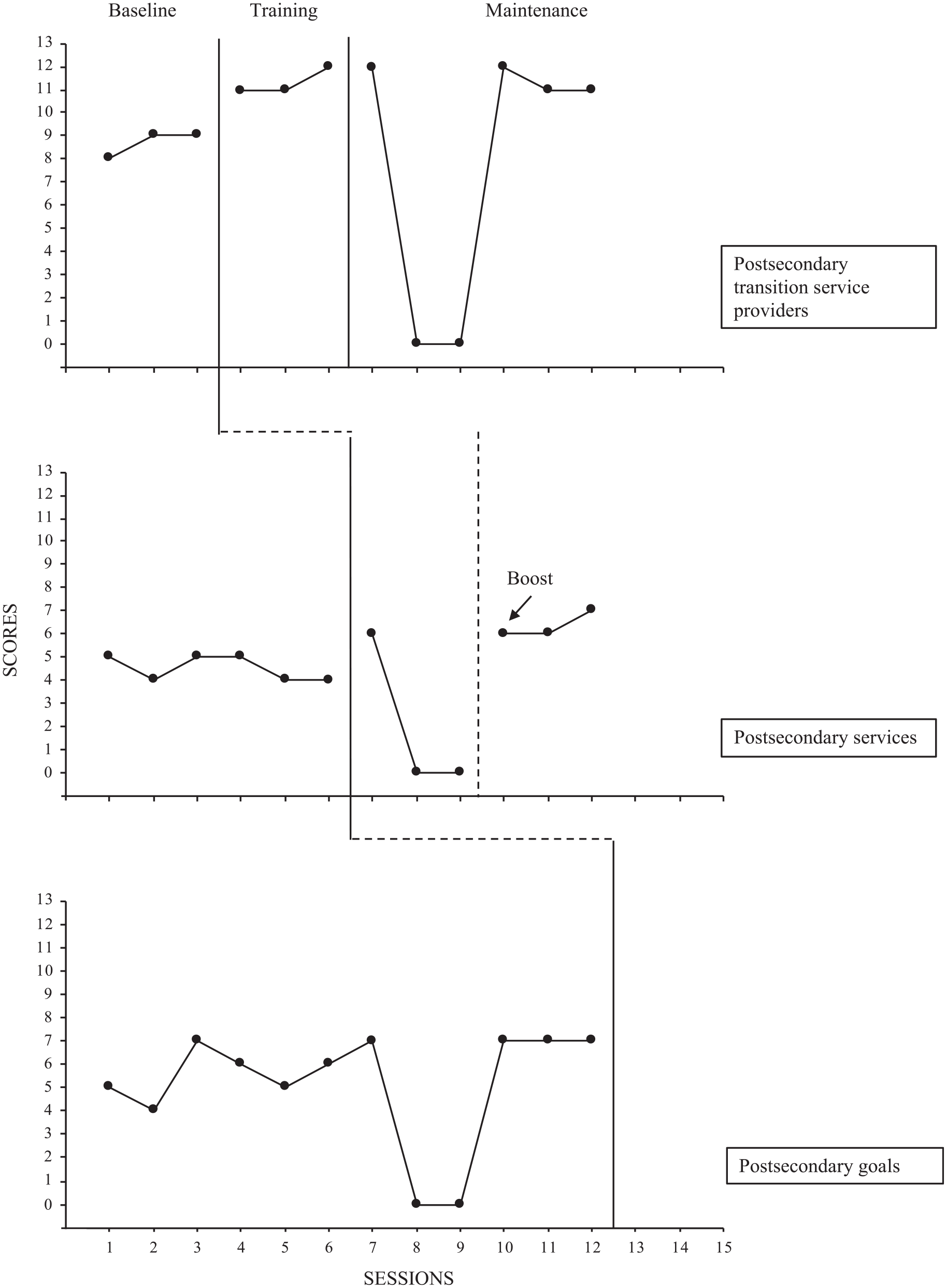
Irene’s Scores for Each of the Three Content Area on Secondary Transition Probes.
Non-parametric effect size analysis
We calculated Tau-U (Vannest & Ninci, 2015) to further determine the intervention results for Kathy and Laura, who completed the entire training. We did not calculate the Tau-U for Irene because Tau-U was used to compare differences between phases, and without the participant completing the intervention phase, the calculation could not be performed. Tau-U results were 1.0 for this study (p < .01, 95% CI = .64), which means the intervention was very effective to increase the transition knowledge of Kathy and Laura. Omnibus Tau-U results for both participants were effective (Tau-U = 1.0, p < .01, 95% CI = .49; Tau-U = 1.0, p < .01, 95% CI = 0.49, respectively).
Perceived Confidence in Transition Planning
Kathy and Laura completed the pre- and postintervention survey. Kathy rated “agree” for all six items in the preintervention survey with a mean score of 4.0 (no range), and rated “agree” for two items and “strongly agree” for four items in the postintervention survey with a mean score of 4.7 (range 4–5). Specifically, Kathy provided a higher rating for her confidence level in the areas of managing overall secondary transition planning, communicating with educators/professionals about her son’s secondary transition needs, locating information or resources for secondary transition services, and advocating for her son’s quality transition planning. Laura rated “agree” for three items and “neutral” for the remaining three items in the preintervention survey with a mean score of 3.5 (range 3–4). Her rating increased to a mean score of 4.2 (range 3–5) in the post-intervention survey with increased confidence level in the areas of communicating with educators/professionals about her son’s secondary transition needs, assisting in the implementation of identified transition activities for her child, and advocating for her child’s quality transition planning.
Social Validity
Kathy and Laura completed the social validity questionnaire after the training concluded. The two participants had varied responses toward the online training. Kathy strongly agreed with the statements that the online module was easy to use, webpages were clear, and the training process went smoothly; whereas, Laura disagreed or strongly disagreed with these items. On a scale of 1 (strongly disagree) to 5 (strongly agree), the social validity results showed Kathy rated higher scores and satisfactions (with a mean of 4.2 and a range of 3–5) toward the training than Laura (with a mean of 2.2 and a range of 1–5). For the open-ended question, both Kathy and Laura identified the need for more specific resources for their children.
Discussion
We explored the use of an asynchronous online training intervention on three parents’ knowledge of secondary transition planning. Results showed two participants (Kathy and Laura) completed the entire training program and improved knowledge of secondary transition planning across the three content areas (i.e., Postsecondary Goals, Postsecondary Transition Service Providers, Postsecondary Transition Services) after completing the training intervention. A third participant’s (Irene) knowledge improved in the Postsecondary Transition Service Providers area, but she subsequently left the study after the fourth week due to personal time constraints. In addition to the improved knowledge, the two parents who completed the entire training reported an improvement in their perceived confidence levels in communicating with educators/professionals about their child’s secondary transition needs and advocating for their child’s quality transition planning based on pre- and postintervention surveys.
Parents continue to experience barriers in accessing training to support their youth with disabilities in the secondary transition planning process (Young et al., 2016). Although online systems and instruction have been used to train parents (Blackman et al., 2020; Ortiz et al., 2020), this study was the first to leverage an asynchronous online platform (i.e., OBA) to train parents on components of secondary transition planning. The two parent participants who completed the training modules demonstrated improvements and retained knowledge during the maintenance condition. Specifically, data for Kathy were pronounced with a clear change in level from baseline to the training condition for all three content areas. Even though Laura also improved her knowledge in all three content areas with no overlapping data between baseline and training condition, she had high levels of accuracy for the Postsecondary Goals and Postsecondary Transition Services areas during baseline, making her improvement in knowledge in these two areas less marked. The overall results for Kathy and Laura extended the parent training modules implemented by Rowe and Test (2010) using an asynchronous approach to providing parents training. Consistent with prior research using various formats to train parents (e.g., workshops, CBI, and brochure; Francis et al., 2013; Rowe and Test, 2010; Young et al., 2016), this study supported the promise and potential of asynchronous training on parents’ knowledge of secondary transition planning. Results of this study indicated that converting a face-to-face training to an asynchronous online training yielded positive results, suggesting that the online asynchronous training may offer a potential option for training parents on components of secondary transition.
Parents of youth with disabilities are often overwhelmed by high stress levels (Valicenti-McDermott et al., 2015). Studies pointed out that the benefits of online training for adult learners is the ability to provide flexible time (Lakhal & Bazinet, 2015), which may accommodate parents’ daily stress. In the current study, the online asynchronous training provided a self-paced learning environment for parents to acquire transition planning knowledge. Data collected in OBA revealed that parent participants accessed the asynchronous online training modules in different timeframes (i.e., different times of a day and different days of a week), which showed parents completed the training modules based on their availability. In addition, data from this study showed that parents engaged in the training modules at a different learning pace and viewed the training modules at varying times (i.e., 2–4 times for Kathy, 1–7 times for Laura, and 1–2 times for Irene) based on their own learning needs to achieve mastery. Previous research provided one-time and one-fits-all training opportunities for parent participants (Francis et al., 2013; Rowe & Test, 2010; Taylor et al., 2017; Young et al., 2016). The asynchronous training in our study offers another way to support parents by providing them the opportunity to participate in training based on their own capacity and needs. This asynchronous online training potentially allowed parents to control their own pace, place, and time to learn about secondary transition planning to support their child with a disability.
In addition to the improved knowledge of secondary transition planning, this study also showed improved self-reported confidence levels of Kathy and Laura in communicating with educators/professionals about their child’s secondary transition needs and advocating for their child’s quality transition planning after they received the training. The improved knowledge combined with increased confidence levels in secondary training planning and engagement highlights the potential benefit of such parent training modules for parents of youth with disabilities.
Despite positive results in two parents’ knowledge of secondary training planning and their change in confidence level, it is important to note that the social validity results for the two participants who completed the entire training showed substantial variations in their responses. Specifically, Kathy strongly agreed with the ease of use of the online module, the smoothness of the training, and the clearness of the webpage, whereas Laura reported the opposite. Results showed Laura had high baseline scores in both Postsecondary Goals and Postsecondary Transition Services during baseline. It is possible that Laura did not regard the training as helpful due to her higher knowledge level prior to the training. Due to the variations in participants’ prior knowledge, social validity data, and the high participant attrition rate, feasibility of the asynchronous online training program remains inconclusive.
Limitations and Directions for Future Research
Despite the positive results from the current study, several limitations should be noted. First, participants of this study were recruited solely from one PTI center in a southeastern state through their social media website. According to Cooc and Bui (2017), parents who were White from middle- or higher-class backgrounds were more likely to contact centers/agencies for resources and services. All participants took the initiative to contact the PTI for this training study. They self-identified themselves as White females, and the two participants who completed the entire training were both White, female, and mothers of children receiving OHI special education services under IDEA (2004). This substantially limits generalizability. For future studies, recruitment should include a broader range of diverse participants (e.g., parents of color and parents from low socioeconomic status) through various recruitment channels (e.g., schools and local religious organizations).
Second, there was a high attrition rate (i.e., 50%) in that two participants dropped out of the study due to other priorities and personal time constraints. Specifically, Erin dropped out after three probes (without receiving the training; data not reported), and Irene dropped out after 12 probes during her second content area training. This result was consistent with findings from a prior study on high dropout rates in online courses compared with face-to-face courses (Kranzow, 2013). Other factors that may contribute to this may include participants’ experiences, course design, interactions, and supportive learning environments (Lee & Choi, 2011), and the unprecedented impact of COVID-19 (Rowe et al., 2020). It is essential to identify other potential factors affecting parents’ attrition. Unfortunately, we did not obtain social validity data from Erin and Irene to explore their perceptions because both parents did not respond to the first author’s prompt regarding completing the training program and staying in the study. Future research is warranted to identify parents’ online learning habits and difficulties parents encounter when using an online learning system. Additional research is needed to develop and validate various asynchronous training modules for parents with diverse needs.
Third, this study used a single-case, concurrent multiple baseline design across three transition content areas, which were replicated across participants; as a result, participants were required to complete probes repeatedly. Despite each case study being different for each probe, repeatedly completing 21 identical questions 3 times a week might have created fatigue for participants, possibly also contributing to attrition. In addition, participants might have gained some knowledge simply by taking the probes over time (Cooper et al., 2020). An examination of the participants’ data indicated that with the exception of Kathy’s scores for the Postsecondary Goals area, which indicated a slight increase during probes 4 to 6 (potentially presenting the testing threat to internal validity), changes in knowledge scores were likely due to the training. A related limitation was that participants completed three probes each week based on their own schedule, which made it difficult to determine if parents’ knowledge score was a reflection of performance on a single day or over a 1-week timeframe. Future researchers may consider (a) using a multiple probe across participants design to limit the potential exposure to the probes repeatedly, (b) requiring one probe per week to more consistently show learning over time, and (c) collecting long-term maintenance data (e.g., 1 month posttraining). Also, future research should evaluate the intervention with more participants either through additional single-case and/or group experimental studies to replicate and determine if this promising intervention results in robust effects.
Finally, the completion time for each probe for the participants ranged from 1 to 132 min. This variation in completion time may be due to the OBA system continuously counting completion time until parents submitted their responses. It is possible that parents initiated their probes and completed other tasks and later returned to complete the probes afterward. Future studies may examine if parents use the “save for later to complete” function in the OBA system to more precisely capture probe completion time when parents are actively completing a probe.
Implications for Practice
Several implications for practice emerged. First, feedback from the two participants who completed the training suggests a need to customize case studies to align more with their child’s personal experiences, which can provide parents opportunities to learn from material that is more relevant to their own child’s and family’s needs. This feedback aligned with prior studies that stressed the benefits of making learning materials relevant to personal experiences toward adult learners (Lee & Choi, 2011). To increase alignment of the training materials with the parents’ unique needs, professionals who wish to provide these training materials to parents may consider understanding more about parents’ specific needs on transition knowledge and skills prior to offering the training. Alternatively, professionals may offer a follow-up session after parents completed the training to further enhance connection of the content to family needs. Second, this study showed parents appreciated flexible timeframes and schedules from this online training. Yet, half of the parent participants (n = 2) left the study due to the lack of time availability based on their personal situations. One possibility is that despite some level of flexibility, parents were still required to complete one module and three probes within a specific timeframe for the purpose of collecting research data. In practice, when providing or developing an asynchronous online training for parents, it may be helpful to understand parents’ specific available timeframes and set up automatic reminders to their preferred communication modalities (e.g., text, email, or phone call). In addition, practitioners and professionals may structure the training program in such a way that parents complete the training modules and probes (to check for understanding) anytime based on their needs. This model will likely allow for flexible completion of training in the absence of adhering to restrictions associated with collecting research data. Finally, this study showed two parents’ secondary transition knowledge increased and maintained after completing the asynchronous online training with improved confidence level. Positive outcomes and flexibility through this asynchronous online system represent a promising avenue for educators and policy makers to integrate virtual secondary transition training into conventional parent involvement and empowerment efforts.
Supplemental Material
sj-docx-1-cde-10.1177_21651434221142801 – Supplemental material for Exploring Asynchronous Online Parent Training on Transition Knowledge of Parents of Youth With Disabilities
Supplemental material, sj-docx-1-cde-10.1177_21651434221142801 for Exploring Asynchronous Online Parent Training on Transition Knowledge of Parents of Youth With Disabilities by Wen-hsuan Chang, Valerie L. Mazzotti, Ya-yu Lo, Stephen M. Kwiatek and David W. Test in Career Development and Transition for Exceptional Individuals
Footnotes
Acknowledgements
The authors thank Dr. Dawn A. Rowe for sharing her training materials from her previous published journal article (Rowe & Test, 2010) for use in the study and providing support during the development of the study.
Authors’ Note
This study was completed while Wen-hsuan Chang and Stephen M. Kwiatek were at the University of North Carolina at Charlotte. Dr. Chang is now at Texas A&M University, College Station. Dr. Kwiatek is now at Utah State University.
Declaration of Conflicting Interests
The author(s) declared no potential conflicts of interest with respect to the research, authorship, and/or publication of this article.
Funding
This study was supported by the Council for Exceptional Children’s Division on Career Development and Transition (DCDT) graduate student grant.

Supplemental Material
Supplementary material for this article is available on the Career Development and Transition for Exceptional Individuals website with the online version of this article.
References
Supplementary Material
Please find the following supplemental material available below.
For Open Access articles published under a Creative Commons License, all supplemental material carries the same license as the article it is associated with.
For non-Open Access articles published, all supplemental material carries a non-exclusive license, and permission requests for re-use of supplemental material or any part of supplemental material shall be sent directly to the copyright owner as specified in the copyright notice associated with the article.
