




Abstract
Unethical behavior within collegiate sports departments appears to be commonplace. Athletic programs at a number of high-profile universities have been sanctioned by the National Collegiate Athletic Association in the past decade. When athletic departments participate in corrupt behavior, the possibility of whistle-blowing exists. Although organizational scholars have developed theoretical models describing whistle-blowing processes, it is unclear whether these models accurately depict whistle-blower’s experiences in the collegiate sports industry. Thus, the purpose of the present study was to generate a model describing the experiences of whistle-blowers operating in the intercollegiate sports industry. Thirteen whistle-blowers were interviewed for this study; analysis of case studies revealed that whistle-blowing occurred over five stages and was significantly affected by the collegiate athletics context. Of particular consequence was the hypermasculine, highly competitive collegiate sports environment.
Unethical behavior within collegiate sports departments appears to be commonplace (Benford, 2007; Humphreys, 2012). When athletic departments participate in corrupt behavior, the possibility of whistle-blowing exists. Whistle-blowing is defined as “the disclosure by organization members (former or current) of illegal, immoral, or illegitimate practices under the control of their employers, to persons or organizations that may be able to effect action” (Near & Miceli, 1985, p. 4). Organizational scholars have become increasingly interested in this form of dissent and have developed a number of theoretical models depicting the whistle-blowing process (Henik, 2008). These models typically describe stages experienced by a potential whistle-blower, including observing an alleged wrongdoing, making sense of it, decision making about how to respond, encountering individual and organizational reactions, and reflecting upon the case.
Existing models were developed to capture whistle-blowing cases in traditional organizations; it is unclear whether they would reflect the experiences of whistle-blowers in a sports context, particularly an intercollegiate athletic department. Although they share much in common, scholars have recognized key distinctions between traditional and sport organizations. Adcroft and Teckman (2009) assert “sport and business are, therefore, the same but different and also different but the same” and that “whilst the management of sport and business both deal explicitly with concepts like strategy and organisational behaviour, how they manifest themselves in the two different contexts will differ fundamentally” (p. 12). Thus, questions arise about whether traditional whistle-blowing models accurately capture the collegiate sports landscape. It is unclear how whistle-blowing in collegiate sports is similar or different than engaging in the same behavior in a nonsport setting. The purpose of this study is to generate a model, based upon actual whistle-blowing cases, describing the experiences of whistle-blowers operating in the intercollegiate sports industry in order to discover similarities and differences between traditional whistle-blowing models and a model situated in a collegiate sports context. Next, we explore distinctions between traditional and collegiate sport organizations, which might influence whistle-blowing processes.
Distinguishing Between Traditional and Sport Organizations
We argue there are key traits that differentiate traditional organizations and their collegiate sport counterparts. First, unlike traditional for-profit organizations, collegiate sport programs must negotiate the uneasy tension between creeping commercialization into what is intended to be an arena for amateurs (Brand, 2001). Although some groups, such as coaches, athletic directors, apparel companies, and television networks, operate profitably due to the commercial aspects of collegiate sport, a primary contributor to the consumption of collegiate sport, the athlete, does not benefit financially (Hums, Barr, & Gullion, 1999). The National Collegiate Athletic Association (NCAA) is criticized in its struggle to run what is intended to be an amateur operation in an increasingly professional fashion (Benford, 2007), a condition not found in other industries.
Second, although employees and even consumers may identify with a particular organization, it is unlikely that their (vicarious) identification levels rival that of collegiate sport fans, a group that includes boosters, alumni, students, and even fans with no connection to the university other than an attachment to a sport team. Phrases such as “a matter of life and death,” and “religiously follow” are used by college football fans (Zagacki & Grano, 2005), because collegiate sports “represent one of the symbolic threads that can either bring communities together or tear them asunder” (O’Rourke, 2003, p. 64). Research indicates fans experience deep, affective connections to their favorite teams, which may lead to behaviors not found in traditional organizations, including proffering coaches and athletes with levels of praise, criticism, and scrutiny that are rarely seen in business (Smith & Stewart, 2010). These highly identified stakeholders place increasing amounts of weight on coaches and athletes to win at any cost (Zagacki & Grano, 2005). This condition leads to a third distinction between traditional and sport organizations: hypercompetitiveness. In many collegiate sports, a very public, vocal pressure has emerged to beat one’s rivals, win championships, and inflame the passions of players and fans alike (Foster, Greyser, & Walsh, 2006), in other words, win at all cost (Benford, 2007).
Finally, although scholars have long contended that organizations are gendered (Acker, 1990), sport represents an arena where this distinction is especially pronounced. A number of scholars refer to collegiate sport as a hypermasculine arena (Richardson & McGlynn, 2011; Ott, 2012; Walker & Sartore-Baldwin, 2013). As Walton and Helstein (2008) argue, sport is “constructed as one of men’s ‘last’ cultural and educational spaces” (p. 370). Those who do not engage in the traditional gendering of sport are viewed as outsiders (Meân & Kassing, 2008) and represent threats to the hegemonic practices and discourses that are in place. Although even traditional masculine occupations, such as firefighter, police officer, military officer, and coal miner, include women, collegiate sport teams are completely demarcated by sex (Butterworth, 2008). It is unclear whether and how this dimension of collegiate sports programs might affect whistle-blowing.
Whistle-Blowing: Literature and Models
Organizational scholars have employed conceptual arguments using various theoretical frameworks to develop models depicting the whistle-blowing process. These include models developed by Greenberger, Miceli, and Cohen (1987), Gundlach, Douglas, and Martinko (2003), Henik (2008), and Near and Miceli (1995). Henik (2008) reviewed traditional models of whistle-blowing, recognizing that most describe the process as occurring over five stages (see Figure 1). Stage 1 is initiated by a triggering event, for example, witnessing wrongdoing. In Stage 2, the observer considers what action, if any, to take. Stage 3 is marked by the observer taking action by either remaining silent or blowing the whistle. If whistle-blowing occurs, the organization reacts to the observer’s actions in Stage 4. Finally, in Stage 5, the whistle-blower assesses the organization’s responses and considers what action is now warranted. Further actions at this point include silence, escalating whistle-blowing efforts, or leaving the company. Scholars have added various factors to this traditional model in attempts to clarify the whistle-blowing process. For example, Henik’s model (2008) proposes that emotions, for example, anger, will follow observation of wrongdoing and act as antecedents to the decision-making process and whistle-blowing behavior (or silence). Gundlach et al.’s (2003) social information processing model likewise includes a number of variables, including intrapersonal factors, interpersonal factors, wrongdoer impression management tactics, and wrongdoer power, which impact individual’s decisions to blow the whistle. This model pays particular attention to casual explanations and judgments about responsibility of the unethical behavior as well as the observer’s emotions and cost–benefit analysis. Of particular importance are attributions about the wrongdoing acts, the wrongdoer’s impression management tactics and power, and the observer’s emotions, for example, resentment.

Traditional whistle-blowing model (adapted from Henik, 2008).
Greenberger et al.’s (1987) framework expands Stage 2 of the traditional model by proposing a number of group-related factors that may affect observers’ decisions to blow the whistle. Specifically, their model addresses group norms and highlights the characteristics of the work group, for example, size; the situation, for example, ambiguity of wrongdoing; the observer, for example, idiosyncrasy credits; and group norms, for example, norms about wrongdoing, as potential influencers of whistle-blowing decisions. Closely related to Stage 4 of the traditional model, the authors also offer a number of group-related consequences that might occur if one group member becomes a whistle-blower. For example, the group may attempt to restore normalcy by encouraging the whistle-blower, or deviant, to conform to previously existing values. This goal can be achieved via direct retaliation, ostracism, withdrawal of rewards, or reasoning.
Finally, in their model of effective whistle-blowing, Near and Miceli (1995) expand on the latter portion of the traditional model, initiating at the point where the observer has blown the whistle. Their model offers a number of individual and situational variables that may influence whistle-blowing outcomes. They posit that individual variables, such as credibility and perceived power of the whistle-blower, complaint recipient, and wrongdoer, and situational variables, including characteristics of the wrongdoing and characteristics of the organization, influence an organization’s willingness to change and ultimately terminate wrongdoing. Support for either the whistle-blower or the wrongdoer is expected to moderate individual variables and the organization’s willingness to change. Further, the whistle-blower’s use of external channels is expected to moderate the situational variables and the organization’s willingness to change.
Although these models contribute a great deal toward understanding personal, situational, and organizational factors believed to influence individuals considering whether to blow the whistle, it is unclear whether they accurately capture the experiences of actual whistle-blowers in intercollegiate sports. Certainly, many dimensions of these models likely will hold true for whistle-blowers in most organizations. It seems reasonable that many whistle-blowers will be influenced by their emotions and group norms, conduct cost–benefit analyses, and be measured against their credibility as the traditional models predict. However, a number of critiques can be offered, which call into question the fit of these models for whistle-blowers in this industry. First, the reviewed models do not account for the influence of industry characteristics, despite the evidence that industry characteristics affect whistle-blower experiences (Barnett, 1992). For example, these models fail to consider how gendered properties might affect whistle-blowing processes. Next, these models generally ignore the influence of external stakeholders in affecting whistle-blowing cases. Although recent scholarship has considered external stakeholders’ roles in whistle-blowing cases (Johnson, Sellnow, Seeger, Barrett, & Hasbargen, 2004), we have little empirical evidence of how they are perceived and how they affect the experiences of whistle-blowers. This is especially true in the collegiate sports industry that is marked by the influence of tightly coupled stakeholders, including fans, boosters, corporate sponsors, and the NCAA (Dowling, 2001).
Finally, these models fail to consider how industry characteristics might influence retaliation, a frequent organizational response to whistle-blowing. Despite research indicating much whistle-blowing occurs without reprisal (Near & Miceli, 1996), interpretive studies of whistle-blowers recognize organizational retaliation as a typical response. Studies based upon interviews with actual whistle-blowers reveal a very high percentage of them encountered retaliation (Rothschild & Miethe, 1999). In addition, the retaliation was often serious in nature, including job loss, industry blacklisting, public slander, and death threats (Richardson & McGlynn, 2011; Rothschild & Miethe, 1999), and often resulted in depression, anxiety, and unhealthy coping strategies (Alford, 2007). Retaliation, whether actual, perceived, or in the form of a threat, can have a deterring effect on whistle-blowing behaviors (De Maria, 2006). Although research has indicated this trend may be related to industry, for example, Masser and Brown’s (1996) study of nurses, we know little about how industry characteristics may foster retaliatory responses.
Thus, we sought to examine the experiences of actual whistle-blowers in the collegiate sports industry with a specific aim of developing a model describing how this course of action unfolds over time. Further, our goal was to assess whether the organizational models described earlier approximate the experiences of whistle-blowers in the collegiate sports context.
Method
The research reported here is part of a larger investigation examining experiences of collegiate sports whistle-blowers. We utilized a survey methodology for this study and received approval from our university’s Institutional Review Board before data collection commenced.
Data Collection
The Internet was utilized extensively for locating collegiate sports whistle-blowers. We identified 42 whistle-blowers as prospective participants and were able to contact 19 of them. Six of these individuals declined interviews or did not return messages, while 13 (N = 13) agreed to participate in the study. We informed participants that their university and individual identities would remain confidential at all times. Participants were located in every region of the United States and included two coaches, three faculty members, three athletic support staff members, one teaching assistant, one athletic administrator, one athletic academic support staff member, one university administrator, and one athletics booster. Their ages ranged from the upper 20s to the upper 50s. Whistle-blowers included four men and nine women. We changed their names for this report.
Nine participants agreed to phone interviews; four requested that we electronically mail the survey questions to them for their completion. Of the nine phone interviews, eight participants gave their consent for us to record their interviews, while one preferred the interviewer take notes. The survey questions consisted of open-ended questions of the individual’s history with the university, the type of wrongdoing they encountered, their decision-making processes, the responses they encountered, and the long-term effects on their attitudes about college athletics, their careers, and lives. Interviews were unstructured (Arthur & Nazroo, 2003), an interview process involving “a broad agenda which maps the issues to be explored across the sample, but the order, wording and way in which they are followed up will vary considerably between interviews” (p. 111). We pursued unforeseen topics as they arose and probed for additional information when appropriate. Interviews ranged in length from 45 to 105 min. Interaction was more limited with those participants who were e-mailed the protocol, but we did contact them for clarification or for additional information when needed. The transcribed interviews, along with those completed via typed responses, resulted in 115 double-spaced pages of data.
Analysis
We used a constant comparative approach for data analysis (Strauss & Corbin, 1998). Our unit of analysis for the data was each complete thought expression, or incident, stated by the participants. After reading all interviews and completed questionnaires in their entirety to become familiar with the data, we coded six interview transcripts in tandem. During the initial round of coding, we read each of these incidents, discussed its meaning relative to existing whistle-blowing models, and placed it into emergent categories. Using an electronic copy-and-paste technique, some incidents were placed into categories based upon existing whistle-blowing models, for example, observed wrongdoing, or were placed into new categories, for example, external stakeholder influence, where appropriate. As we created categories, they were marked with an in vivo label that acted as a descriptor and a definition that explained characteristics of the incidents within (Strauss & Corbin, 1998). In vivo codes included terms that captured noteworthy meanings and participant’s own words to capture their experiences (Charmaz, 2006). Subsequent incidents were similarly reviewed and compared to previously coded incidents (Charmaz, 2006).
Next, we analyzed the remaining seven transcripts independently, one at a time. We met after analyzing each new transcript, discussing the coding of statements and the emergence of new themes from the data. Incidents coded similarly by both the authors were placed into their respective categories. When we differed on the placement of an incident, we discussed the incident in relation to each category’s definition until we reached consensus on its placement. The initial round of coding yielded 67 categories. Although our data set was relatively small, we believe theoretical saturation (Strauss & Corbin, 1998) was reached. Each successive interview produced fewer and fewer new categories and participants’ experiences were very similar; the final transcript analyzed produced no new data categories.
In the next phase of analysis, we engaged in axial coding (Strauss & Corbin, 1998), which “brings previously separate categories together under a principle of integration” (p. 221). More specifically, we printed all category names onto note cards, placed them onto a large conference table, and grouped them together based upon common meanings and similar patterns. This process led us to eliminate categories that were very small or did not seem to ultimately fit with the emerging model and to combine categories into overarching themes, where appropriate. For example, we combined the categories cultural context in which whistle-blowing occurred, heightened role of sports on campus, highly identified fans, sports as big business, and sports as religion into the theme highly competitive culture. Next, we organized themes into approximate chronological order so that they represented a proposed model depicting whistle-blowers’ experience in collegiate sport. During this stage, it was obvious that much of our data fit with preexisting whistle-blowing models. However, there also appeared to be key distinctions between what existing models anticipate happening to whistle-blowers in traditional industries and the experience of whistle-blowers in the collegiate sports context.
Results
The model developed from the interview data (see Figure 2) suggests collegiate sport whistle-blowers’ experiences proceed through five stages and are influenced by industry context. This context is displayed visually in the model as a frame that encompasses the entire model; this representation reveals the gendered constructions and competitive environment of collegiate sport that influence each stage of the whistle-blowing process. The model “begins” with Stage 1 that depicts a focal individual observing organizational wrongdoing. Next, the individual contemplates whether to blow the whistle; he or she is influenced by cost–benefit analysis, conversations with trusted others, a sense of idealism, and other factors. In Stage 3, the individual blows the whistle. Stage 4 describes the institution’s response to the whistle-blower’s claims; responses may range from ending the wrongdoing to overt retaliation. As institutional leaders respond to whistle-blower concerns, so too might external stakeholders, including the news media, fans and boosters, and the NCAA. We used circular arrows around Stage 3 and Stage 4 to emphasize that whistle-blowing is a process that rarely stops with one report. For all participants, the initial report was followed by institutional and stakeholder responses, requiring the whistle-blower to repeat their charges, often to those in higher positions. In the model’s final stage, the whistle-blower assesses the situation, considering whether blowing the whistle was appropriate and effective. Each component of the model is subsequently explained.
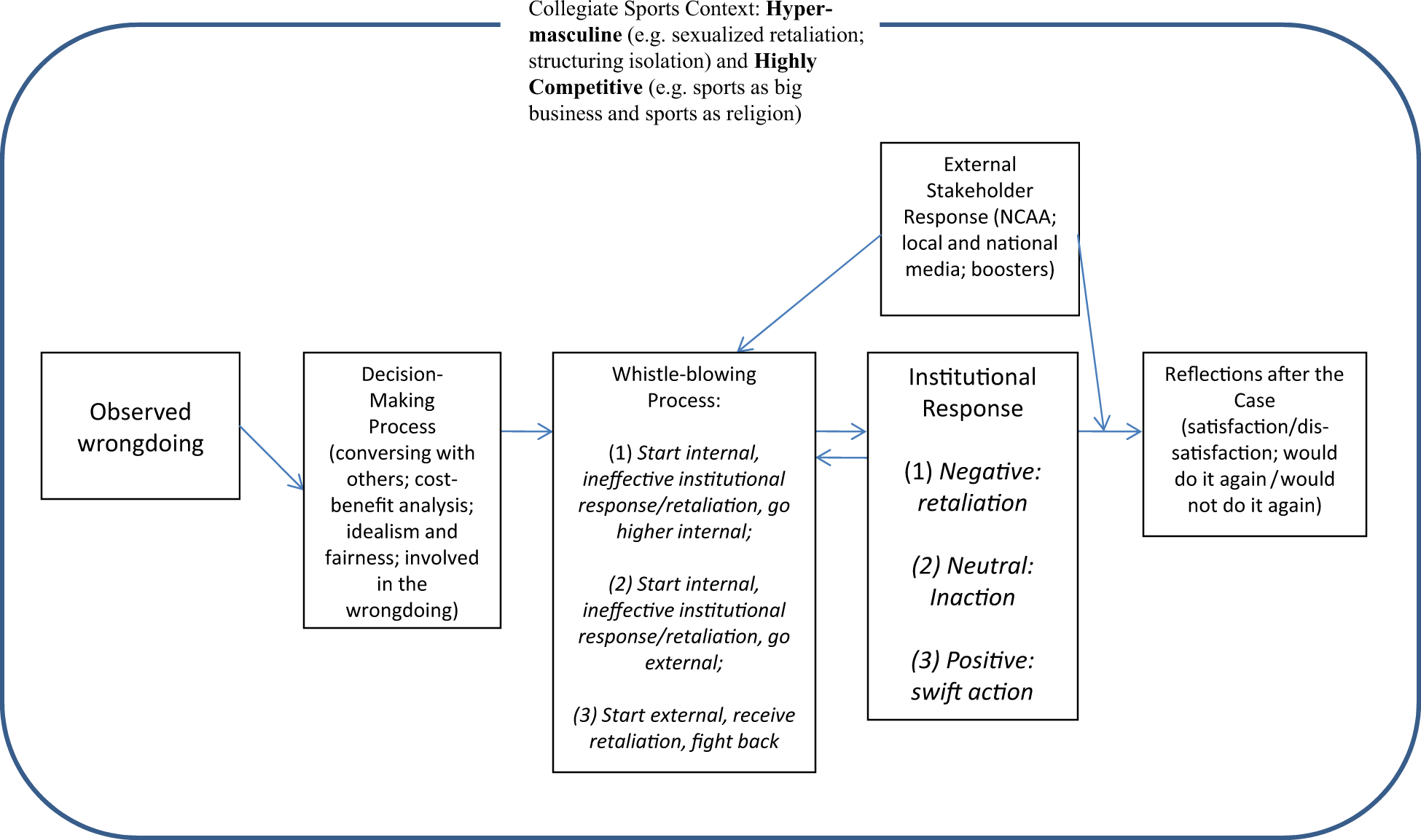
Proposed model of the whistle-blowing process in collegiate sports.
Collegiate Sports Context
The model is framed by a context that highlights the role of the hypermasculine and highly competitive nature of collegiate sport on whistle-blowing processes. The presence of industry context distinguishes this model from other whistle-blowing models, which ignore how an industry may affect whistle-blowers’ cases. Most whistle-blowers in the present study acknowledged the role the hypermasculine and competitive climate of collegiate athletics played in their cases. This context permeated all aspects of their experiences and thus we portray as it encompasses the entire model. Whistle-blowers indicated that women’s voices are diminished in college sport, that retaliation against them often took on gendered and sexualized tones, and that gender played a central role in how they were characterized.
In this study, several whistle-blowers suggested there were definitive norms guiding communication within and around the athletic department, and these norms often dictated that women (and men) not rock the boat. Whistle-blower Brad commented, Gender makes a difference in the way that men and women interact. Aside from anything else, it was clearly in the athletic department, male dominated, and the (modus operandi), or how you went about doing things, was not amenable to females’ modes of communication.
Whistle-blower Alice suggested the gendered nature of the athletic department conditions insiders to support the status quo. She said, “Many of my colleagues, who would come to my office to apologize for not speaking out in support, appeared to be afraid of losing their position in the good old boy network.” Sport, and collegiate sport in particular, is an intensely masculine arena (Hardin & Greer, 2009). Attempts to alter the structure of athletic departments have produced mixed results. For example, researchers have found that while Title IX banned sex discrimination in collegiate athletics, it has not resulted in increases in media coverage for women sports (Huffman, Tuggle, & Rosengard, 2004) nor resulted in nongendered media representations (Hardin, Dodd, & Lauffer, 2006). Whistle-blower Ashley commented that her university created an administrative position dedicated to representing women with inequality or unfair treatment concerns. Ashley brought her initial whistle-blowing report to the individual in this position but received no support. She said, I also think the position of a (female administrator representative) is total crap. They are not there for the women coaches, even though they are supposed to be. In three jobs that I have previously held I did not feel comfortable talking to my SWA. I feel as if they have no real power and are just pawns in this whole big game.
Thus, despite changes to policy, structure, and rules, the hypermasculine context of collegiate sport persists and can influence various aspects of the whistle-blowing process.
Finally, it is worth mentioning that 9 of 13 whistle-blowers in this study were women. Although research is inconclusive about which sex is more prone to blow the whistle (Vadera, Aguilera, & Caza, 2009), women may be more prone to become whistle-blowers in collegiate sport. In this hypermasculine context, women are “outsiders within” (Yoder & Aniakudo, 1997); they are close enough to be considered members but detached enough to “see patterns that those too close to the center cannot discern” (p. 326). As whistle-blower Jane remarked about transitioning from one university to another, “When (the college) was checking my references, they were told time and time again, ‘She’s not a good old boy. She will speak her mind.’” Such a response indicates some women in collegiate sport may be able to better perceive unethical behavior because of their outsider standing and also feel comfortable speaking out about it.
The second contextual characteristic is collegiate sport’s highly competitive culture that is both fostered and fueled by money and creates identification levels with fans that borders on religious zealotry. Intercollegiate athletics is infused with unprecedented financial levels through billion dollar contracts with television networks, shoe and apparel companies, and other corporate stakeholders (Benford, 2007). Such financial arrangements foster “structural corruption—the soul-destroying compromises that even selective institutions are compelled to make to sustain Division IA programs in football or basketball” (Dowling, 2001, p. 85). As whistle-blower Brian reported, “There is so much money involved. It’s all about money. I wish they would just open it up and have no rules about cheating and let the most money go buy the best players.” The presence of such huge financial stakes leads to collegiate athletic departments becoming impervious to real change (Benford, 2007). Additional data support this claim, revealing that whistle-blowing in collegiate sport may be especially challenging because of stakeholder/financial involvement in cases. When asked whether she was satisfied with the outcome of her particular case, Alison stated, “… in this particular case, the justice system did not work. It was too controlled—everyone was controlled. Who supports our judges and who are they out rubbing elbows with? Its big bucks and big bucks are associated with (this university).” This example exemplifies how the influence of money in collegiate sport, and the desire to keep the money flowing, can allow wrongdoing to continue and ultimately stifle those who dare to speak out.
Highly identified fans, which are common in intercollegiate athletics (Wann, Hunter, Ryan, & Wright, 2001), likewise resist change to and are protective of their favorite athletic programs. Researchers have found that team identification is closely related to social identity threats (Wann & Grieve, 2005), leads to increased verbal aggression in fans (Wann, Carlson, & Schrader, 1999), and intentions to illegally help one’s team (Wann et al., 2001). Such high identification levels lead to a fan base that is likely threatened by the “negative” accusations of a whistle-blower. Whistle-blower Alice said, “In a state where the population is undereducated, college football is religion. Citizens live through difficult workweeks for the spiritual experience of college gameday. To attack their one source of identity and solace is to undermine their raison d’etre.” For many fans, college football is an ideology; they are simply unable to absorb information that threatens the myths they hold about their favorite teams (Heffernan, 2011).
Thus, the collegiate athletic context is marked by several characteristics likely to impinge on whistle-blowing cases, including its gendered nature and its highly competitive climate. Studies indicate highly masculine climates stifle dissent, even when organizational members are being victimized (Pershing, 2003). Based upon results of such research, as well as the present study, industry context should be prioritized in whistle-blowing models as it produces an environment where dissenting voices are marginalized. As whistle-blowers’ cases proceed, this context can influence each stage of their experiences.
Stage 1: Trigger Event
Stage 1 of the present model was similar to that of traditional whistle-blowing models that depict an observer noticing a triggering event in the form of wrongdoing (Henik, 2008). Whistle-blowers in this study reported a variety of athletic department wrongdoing types, including academic fraud, for example, tutors writing papers for athletes; academic integrity issues, for example, misuse of academic counseling programs; and payment to recruits and/or players.
Stage 2: Decision-Making Processes
Most whistle-blowing models propose that the next major step in a whistle-blowing process after a triggering event is the deliberation process. The focus of the deliberation differs across models. Henik (2008) focuses on recognition/assessment of wrong act, cost–benefit analysis, and assumption of personal responsibility to act, while Greenberger et al. (1987) downplay cost–benefit analysis and highlight group-level factors. Gundlach et al. (2003) likewise include cost–benefit analysis but add attributions, wrongdoer impression management strategies, emotions, and judgment of responsibility to the deliberation process. The present model identified cost–benefit analysis as critical in the decision-making process, along with several other factors. Most participants in this study reported engaging in contemplative assessments of whether blowing the whistle was an appropriate step to take. Results suggest decision making is a complex process motivated by a myriad of factors. In considering this decision, whistle-blowers talked with relevant others, weighed the costs and benefits of whistle-blowing, acted out of their own sense of idealism and fairness, and considered their own involvement in the wrongdoing.
Conversing with others
Most participants did not decide to blow the whistle without first seeking counsel and advice from peers, colleagues, friends, and administrators. Brett, who witnessed academic corruption at his football-intensive university, said “I must have talked to 35 people around campus over this time trying to figure out how to do something about it.” Similarly, Andrea noted, “The first people I sought advice from were senior colleagues; some were dismissive, some were supportive, but not vocal; quietly supportive.” Conversations with relevant others is predictive of whistle-blowing intentions and allows affected individuals an opportunity to make sense of unusual, even traumatic, events (Dougherty & Smythe, 2004).
Cost–benefit analysis
Scholars have consistently included cost–benefit analysis as a critical factor influencing whistle-blowing deliberations. In this equation, observers consider whether the potential costs associated with blowing the whistle, including retaliation, outweigh the expected rewards, including possibly ending the wrongdoing (Miceli, Near, & Dworkin, 2008). Several whistle-blowers in the present study reported engaging in this deliberation. Bob, a compliance officer who blew the whistle on serious transgressions within the athletic department, said, I struggled initially over what to do. I knew that this would open a can of worms and it was a path the university did not want to take. On the other hand, I had to do the right thing because to me there clearly was a violation.
In the present study, each individual valued the rewards more than the costs of whistle-blowing.
Idealism and fairness
Participants in the present study reported being motivated by a sense of idealism or fairness, which influenced their decisions for blowing the whistle. Bob, who struggled over whether to whistle-blow, said “I believe in telling the truth and doing the right thing. While I debated keeping it quiet, I knew I had to go forward and investigate and report according to established policy—no matter how bad it hurt.” Faculty member Brett’s story revealed consideration of cost–benefit analysis and a sense of idealism in his decision. He said I expected hostility, pressure and other kinds of things. I even sort of did a rough calculation that I might be giving up 2 years of life expectancy doing this, but one of the things my life work was in building (the major) here at (university), and here these guys are turning it into a jock major and in effect destroying what amounts to my life’s work.
As Heffernan (2011) asserts, while whistle-blowers are like most people, they have a “pronounced sense of right and wrong” (p. 203). Similarly, whistle-blowers in the present study found a particular behavior objectionable that influenced them to report it.
Involved in the wrongdoing
Although most studies conceptualize whistle-blowing as prosocial behavior (Dozier & Miceli, 1985), some participants in the present study were involved in wrongdoing. They reported blowing the whistle because of guilt or knowledge that the unethical behavior would ultimately be discovered. Brian, a coach who belonged to an unethical staff, said when asked why he decided to blow the whistle, “I wish I could tell you it was ethical, but it wasn’t … I did it … because I knew it was about to blow up and be something that would cost the university, the kids and the players.” Researchers overwhelmingly position whistle-blowers as being altruistic and operating out of a sense of fairness; while most whistle-blowers in the present study fit this profile, a couple of them were involved in the wrongdoing and reported it either because they knew they would eventually be caught or because they had a story to tell. Interestingly, previous research has ignored the possibility of complicity as a motivator of whistle-blowing (Mesmer-Magnus & Viswesvaran, 2005; Miceli et al., 2008) though it obviously prompted some individuals to report wrongdoing. Stage 2 of the model suggests decision-making factors vary greatly but provide the impetus for engaging in whistle-blowing.
Stages 3 and 4: Whistle-Blowing Activity and Organizational/Stakeholder Response
Although whistle-blowing models (Greenberger, Miceli, & Cohen, 1987; Henik, 2008) generally recognize the mutual influence between the decision stage and the organizational response stage, they generally portray these stages as discrete from one another. We likewise present these as discrete stages but include a circular arrow connecting them in order to demonstrate their mutual influence. Further, these arrows highlight that the whistle-blowing decision is a process rather than a static event. Based upon the data, participants in this study engaged in whistle-blowing behavior over a protracted period of time. Their initial whistle-blowing efforts were typically met with inaction, or retaliation, causing them to decide whether to continue their efforts with higher ranking targets or those external to the organization. It is important to note that much of the retaliation in these stages was gendered in nature; in other words, the hypermasculine nature of collegiate athletics manifested as sexualized and segregated retaliatory responses. We recognized three patterns that typified whistle-blowing cases, each of which included (gendered) retaliation.
Start internal, ineffective institutional response/retaliation, go higher internal
This first pattern comprised seven whistle-blowers’ experiences. They initially blew the whistle to someone they believed could affect action. Next, they received either no response or a negative response in the form of retaliation or a leaked report, from those within the institution or from external stakeholders. This response caused whistle-blowers to take their reports to someone higher in the chain of command. Andrea’s case was typical of this pattern. She said, I went from direct communication from program director to department chair and got unsatisfactory responses. The problem wasn’t dealt with so I went to the dean. I went to the head of Affirmative Action. The general reaction was lip service; I was called ‘trouble-maker’ by one. I never went external, but (my report) was leaked by someone in the university.
This and other cases illuminate that whistle-blowing is not a “one-decision” process; instead, whistle-blowers are often required to make a number of decisions about reporting their concerns to parties increasingly higher in the hierarchy.
Start internal, ineffective institutional response/retaliation, go external
This second pattern was demonstrated by four whistle-blowers. It followed a similar path as the first pattern but ended with the whistle-blower, eventually making an external report. A key distinction between these cases and the previous ones is that the level of external stakeholder retaliation was much higher for this group. Whistle-blower Alice’s case exemplifies this second pattern. As a faculty member, she noticed major academic dishonesty within the football and track programs at her school. She reported her concerns to the dean, provost, chancellor, and general counsel of the university, respectively, but was consistently thwarted in her calls for an investigation and remedial action. She suggested the Provost was the most duplicitous, that he would “run to the hills” whenever someone asked him questions. After 4 years of futile efforts, she spoke on record to an investigative reporter of Entertainment and Sports Programming Network (ESPN) and the story broke nationwide. University administrators, fans, and some local media retaliated seriously against Alice. As she reports, I discovered the General Counsel had bugged my phone and knew I was on my own…. The Department Head who had approved what I had done came to my office to say that it was foolish to expect justice, that one should look after themselves…. The air was let out of my tires, I was physically intimidated on campus by both students and faculty, my children and I were spat on at the mall, drivers would flip the finger as they drove alongside my vehicle.
All whistle-blowers following this pattern experienced severe retaliation in the form of death threats, slander, allegations of their own corrupt behavior, and/or physical intimidation. Most retaliatory behavior came from stakeholders linked with the athletic department, including boosters, local news media, and alumni.
Start external, receive retaliation, fight back
Two whistle-blowers demonstrated this final pattern. They initiated the process outside the traditional chain of command; both faced severe retaliation and were inclined to fight back against their detractors. For example, Bill involved himself in academic dishonesty by writing papers for basketball players as a member of the team’s academic support staff. He felt guilty about his own actions and reported them, along with other unethical activity he witnessed, to a local beat reporter. Once his story became public, Bill received death threats he believed came from associates of the powerful head coach that he had reported. Like many of the whistle-blowers in this study, he was castigated by anonymous others on the team’s fan website. He created his own username for the website and began to defend himself.
Similar to the patterns discussed earlier, these cases exemplify whistle-blowing as a process that occurs over time. Participants admitted they were obliged to make reports to various targets over time after being rebuffed by their initial complaint recipients. Thus, the present study emphasizes that whistle-blowing is a process (Miceli et al., 2008) rather than a one-time effort. More specifically, it is more accurate to suggest that whistle-blowers make several decisions about blowing the whistle rather than just one. Research that merely addresses a singular decision to blow the whistle may be missing the important secondary decisions to report to different, and often higher-level, targets.
Further, all of the whistle-blowers experienced some retaliation, much of which was gendered in nature. We found that retaliation was (a) sexualized and (b) emphasized that (female) whistle-blowers were intruders on the male domain of athletics. Subjects routinely encountered retaliation sexual in nature. For example, Alice reported how she was characterized on the team’s fan website and in hate mail, saying, The chat boards and hate mail followed suit with slanders about my ‘need to get laid’ or that I was clearly a ‘lesbian’ that hates men. Some of the threats contained ribald stories of my being gang-raped by the AD or the coach to the athletes or all.
Alicia faced accusations from fans on sports talk radio that she was sexually involved with the football coach. She said, “Some of the negativity I got from fans was based on my physical appearance or my sex life, not on facts. I doubt very seriously if they would have made any comments at all if I was a man.” Interestingly, a male whistle-blower, Brett, also reported sexualized types of retaliation. When asked how he was characterized by hate e-mail and on a fan website, he said, “I was called ‘cocksucker’ and a ‘faggot.’” Using homosexual labels within sport serves to label them as interlopers or trespassers on this traditional male domain (Daniels, 2005).
This gendered retaliation preserves the “locker room” that is collegiate sport. Allain (2008) argues the locker room is a hypermasculine arena in which expressions of vulnerability and sensitivity are taboo; this space is policed through implicit norms that punish those who act in nonmasculine ways. Voices of dissent within this space are marginalized quickly by those in power, even in cases where there is an obvious victim, such as the Rutgers women’s basketball team (Gill, 2011) and Katie Hnida at the University of Colorado (Butterworth, 2008). In effect, (gendered) retaliation intends to silence whistle-blowers while preserving the status quo of a collegiate athletics system structured to “police” itself (Zimbalist, 1999).
Stage 5: Whistle-Blower Reflections
In the final stage of Henik’s (2008) representative model and the present model, whistle-blowers assess whether the organization’s responses met their expectations and reflect upon whether blowing the whistle was worth the costs afflicted on their lives. In their model of “effective whistle-blowing,” Near and Miceli (1995) suggest a number of factors influence whether whistle-blower’s protests ultimately lead to wrongdoing termination. These include the organization’s willingness to change, its dependence upon the wrongdoing, less bureaucratic structure, and power of the wrongdoer. Each of these factors was mentioned, either directly or indirectly, as affecting the success of the whistle-blower’s calls for an end to wrongdoing. In sum, nine participants in the present study were not satisfied with the university’s resolution of their cases, two were satisfied, and two cases were still “in progress.” Eight whistle-blowers reported they would blow the whistle again if faced with a similar situation, three said they would not do so, and two were undecided. On balance, it appears that despite an experience replete with retaliation, and generally unsatisfactory outcomes, participants in the present study believed blowing the whistle was critical for ending unethical behavior.
The primary reasons whistle-blowers expressed dissatisfaction with their cases were the system that caused the unethical behavior remained intact and that wrongdoers were not held accountable. When asked whether she was satisfied with the resolution of her case, Ashley, who blew the whistle on an unscrupulous coach, said, “No, he still has a job and I do not think he should be working with young people.” Even those participants who acknowledged satisfaction with the resolution of their cases were not completely pleased with the outcome. For example, Alicia won a lawsuit after being dismissed from her job as retaliation for her whistle-blowing. Still, she said, “I think I deserved a lot more money than I got and I could have held out longer and I could have gone to court, but it would have taken another three years and I was sick of it.”
Despite facing retaliation and seeing little institutional change, most participants said they would still blow the whistle on unethical behavior. Whistle-blowers are generally recognized as idealistic reformers (Liebes & Blum-Kulka, 2004; Rothschild & Miethe, 1999) who knowingly risk their own careers, and sometimes lives, to do “the right thing.” Alicia said, “If I stand by and don’t at least try to do something about it, I’m just as bad as everybody else who just sits by and lets it happen. I don’t want to contribute to the problem.” Still, some whistle-blowers seemed too scarred and jaded by the process and wished they had never made the decision. This attitude is personified by whistle-blower Andrea. When asked whether she would blow the whistle if given the chance to do things over, she remarked, “No, absolutely not. I would have packed up and left. I’ll never be the same person and I’ll never get back that time.” This response indicates that those wishing to reform college athletics face a monumental task, replete with a number of personal costs, anxieties, and stresses.
Discussion
The purpose of the present study was to develop a model describing the experiences of whistle-blowers in the collegiate sports industry. Scholars have developed whistle-blowing models depicting this process, regardless of industry, offering entry points for research. However, at least two critiques of these models persist: they are not grounded in the experiences of actual whistle-blowers, and they ignore the effects of context, including industry. The model generated for this study was grounded in experiences of actual whistle-blowers. Further, results of the present study suggest contextual factors play a significant role in whistle-blowing cases at least in the collegiate sport industry. In particular, the gendered construction of sport and its increasing competitiveness, marked by financial concerns and highly identified fans, may impinge on all stages of the whistle-blowing process. These stages included (1) observation of wrongdoing, (2) decision-making processes, (3) whistle-blowing processes, (4) institutional and external stakeholder responses, and (5) reflections after the case. We characterize Stages 3 and 4 as mutually influencing one another, which further illuminates that whistle-blowing is a process rather than a one-time event. Next, we discuss ways our model contributes to understanding whistle-blowing, and how the context of collegiate sport affects this process.
First, our model both aligns with and makes contributions to traditional whistle-blowing models. Related those models, whistle-blowers in the present study reported using cost–benefit analysis (Greenberger et al., 1987), conversing with others before deciding to blow the whistle (Gundlach et al., 2003) and reflecting on their cases after they have been resolved (Henik, 2008). However, the present model also adds nuance to and diverges from traditional models. For example, the model developed for this study recognizes that the decision-making process for whistle-blowing can be influenced by motivations not recognized or emphasized prior to this study. These include participation in unethical behavior or a sense of idealism and fairness. The decision to whistle-blow because of involvement in wrongdoing or values of idealism opens many avenues for future research, including their respective effects on whistle-blower’s credibility and trust.
Next, the present model highlights the mutual influence between whistle-blowing behaviors and responses by the institution and relevant stakeholders. In other words, this study addresses the question “what now?” after someone has blown the whistle. Henik (2008) summarizes traditional whistle-blowing models by noting that after Stage 3, “the process shifts to the organization in Stage 4, as it reacts to the report” (p. 112). Thus, this type of model presents Stages 3 and 4 as generally discrete events. However, researchers recognize that “it is management’s response that shapes the potential whist-blower’s subsequent actions” (Rothschild & Miethe, 1999, p. 119). When managers ignore their concerns, or engage in retaliation, many whistle-blowers are emboldened and persist with their allegations (Rothschild & Miethe, 1999). Likewise, participants in the present study truly engaged in a whistle-blowing process; each faced circumstances that inclined them to report wrongdoing to multiple audiences over a period of time. The present model offers three paths that the relationship between whistle-blowing action and institutional response may undergo. Future research should investigate these various paths in order to understand factors contributing to whistle-blowers’ persistence through the stages and to which paths lead to effective termination of wrongdoing.
Despite some potential overlap, we argue several aspects of the whistle-blowing model developed for this study may relate primarily to collegiate sport contexts. For instance, unlike traditional whistle-blowing models, we included a contextual boundary around the model to emphasize the hypermasculine, highly competitive sports environment and its influences throughout the whistle-blowing process. The gendered nature of collegiate sport is especially critical to whistle-blowing cases. Scholars have long recognized that masculine perspectives are viewed as legitimate, while feminine perspectives are de-legitimized in and around sport (Butterworth, 2008; Hardin et al., 2006). Media commentary of female athletes, particularly that which compares men and women’s athletic competence and achievements, suggests men represent the standard and women athletes the “other” (Kane, 1996). The net result of these media portrayals and structures is a culture that hegemonically divides “insiders” and “outsiders.” This division has maintained despite Title IX legislation that dramatically increased female participation in collegiate sport; still, many critics contend that female participation in collegiate sport remains at the margins of what is a profitable, media-rich industry (Cooky & Lavoi, 2012). We argue these strong, gendered divisions and norms serve to silence those who might speak out against unethical behavior, as attempts to change this masculine culture are typically met with strong resistance (Kane, 1996). Sport has been recognized as an “ideological production and legitimacy of male supremacy” (Kane, 1996, p. 95); whistle-blowers represent an act of resistance to that supremacy.
Second, the hypercompetitive context of the collegiate sports industry has profound implications for whistle-blowers. Specifically, whistle-blowing cases were affected by two outcomes of this highly competitive environment: increased commercialization and highly identified fans. Scholars suggest that as collegiate athletics has become increasingly commercialized, so too has it become impervious to reform attempts (Benford, 2007; Dowling, 1991). Stieber (1991) argues “the market structure within which collegiate amateur athletics operates results in exploitation of our athletes, and that the reaction to the exploitation will be a litany of infractions that will continue, and continue … and continue” (p. 446). The result of this structure for reform attempts is that calls to make fundamental overhauls to address wrongdoing will be met instead with minor policy and personnel changes (Stieber, 1991), a reality expressed by a number of whistle-blowers in this study. These conditions also explain why whistle-blower claims were met with such strong resistance; each whistle-blower in the present study experienced moderate to severe retaliation from stakeholders ranging from college administrators, athletic department members, local and national media outlets, and fans. In particular, highly identified fans were able to carry out retaliation while not tied directly to the university, a condition not typical of most industries.
Thus, the present study reveals a potential negative outcome of recent attempts by athletic departments to foster brand loyalty and identification with university students and their fan bases (Ross, Bang, & Lee, 2007). The intent of these attempts is to engender affective attachments between fans and athletic departments in order to increase fans’ attendance, consumer behavior, and gift giving to their favorite teams (Kwon & Trail, 2001). However, strong identification levels do not come without concerns. Fans who identify strongly with their favorite teams have been found to engage in a number of harmful behaviors (Partridge, Wann, & Elison, 2010). The present study identified another potential concern with high identification: low tolerance for dissenting opinions. This low tolerance manifested as psychological, emotional, and even physical retaliation against whistle-blowers. Thus, future research should investigate how collegiate sport brand campaigns indirectly lead to climates in which dissent, or contradictory opinions, is devalued.
A final distinction characterizing whistle-blowers in collegiate sport is they are not just reporting a wrongdoing, but rather they are challenging the myth(s) of this industry. As Kellner (2003) contends, “The sports spectacle is at the center of an almost religious fetishism in which sports become a surrogate religion and its stars demigods … Sport stars constitute its saints and deities, while sports events often have a religious aura of ritual” (p. 69). Much like those who publicly question religious beliefs, ideals wrapped in patriotism, or American values such as freedom and liberty, the collegiate sport whistle-blower publicly brings to light possible contradictions to long-held myths. As critics contend, the NCAA claims to be the bastion of amateur athletics while pursuing multibillion dollar television contracts and apparel deals (Smith, 2010); although the NCAA contends the word “student” comes first in the term “student-athlete,” most prominent universities compromise their academic standards for athletes (Sack, 2008), and while the NCAA assumes the role of watchdog over collegiate athletics, a long-term pattern of unethical behavior and various abuses suggest cheating is the norm (Benford, 2007). As whistle-blower Brad commented I always thought the NCAA was policing (student athletes). Afterwards I realized that not only were the athletic program and coaching staff and administration to blame for the corruption, but the NCAA was too. The NCAA was simply a front to make it look like there was some policing going on, when they indeed had no intention of actually doing anything to cut into any kind of profitability.
To raise questions about one aspect of an athletic department’s operations, as whistle-blowers like Brad do, is to pull back the curtain and reveal the delicate nature of these myths. This helps to explain the exceptionally negative response received by so many whistle-blowers in the present study. Researchers should pursue inquiry that examines specific industry characteristics that affect whistle-blowing processes, including organizational narratives and cultural myths.
Conclusion
The present study suggests whistle-blowing in the collegiate sport context is similar, but different, to that which occurs in traditional industries. Results of the current study extend understanding of whistle-blowing models by highlighting the influence of industry characteristics on each stage of the whistle-blowing process. Whistle-blowers noted the influence of hypermasculine and highly competitive organizational cultures in producing an environment that delegitimizes dissent in collegiate sports. These industry characteristics influenced the experiences of whistle-blowers throughout the whistle-blowing process, from the initial witnessing of unethical activity to their reflections on the effects of their attempt to halt organizational wrongdoing. Considering whistle-blowing is often the only line of defense against unethical, illegitimate, or illegal organizational activities, it is critical this line of research persists.
Footnotes
Declaration of Conflicting Interests
The author(s) declared no potential conflicts of interest with respect to the research, authorship, and/or publication of this article.
Funding
The author(s) received no financial support for the research, authorship, and/or publication of this article.