




Abstract
Across the world, organizational personnel in various industries are integrating natural environment issues into existing organizational practices. In the intercollegiate sports world, environmental efforts are undertaken as part of a strategic effort involving collaborative processes across university units. The purpose of this study is to develop a more comprehensive and detailed understanding of collaborative processes and practices between personnel in athletics departments and sustainability offices at universities and colleges in the United States. In-depth interviews were conducted with athletics and sustainability department personnel at colleges and universities in the United States. A total of 13 schools were included in the study with 17 participants agreeing to be interviewed. All interviewees were from the middle management level and higher in their respective organizations. Five central themes related to these relationships were found: relationship development, relationship communication, relationship decision-making development, collaborative efforts, and relationship challenges. The themes raise important issues about the diversity of relationships, the communicative and decision-making processes, and the involvement of stakeholders in environmental efforts as well as future research in this area.
Across the world, organizational personnel in various industries are integrating natural environment issues into existing organizational practices. The need to take action stems from strategic/competitive threats, governmental intervention and policy formation at all levels, stakeholder demand, and personal value systems (Hillman & Keim, 2001; Pfahl, 2010; Shrivastava & Scott, 1992; Thibault, 2009). These actions require organizational personnel of all types to evaluate or to reevaluate personal perspectives and organizational practices regarding the environment; a true self-greenewal (Shrivastava & Scott, 1992). In organizational contexts, environmental operations can be at odds with organizational goals and objectives (e.g., manufacturing needs vs. environmental impact; Casper, Pfahl, & McSherry, 2012; Etzion, 2007; Hansla, Gamble, Juliusson, & Gärling, 2008; Pfahl, 2010; Sharma, 2000; Shrivastava & Scott, 1992).
Sport organization personnel operate in an industry that is highly visible and comes with a significant environmental footprint to address (e.g., stadia) in conjunction with a variety of stakeholders (Casper et al., 2012; Chernushenko, 1994; Inoue & Kent, 2012; Mallen, Adams, Stevens, & Thompson, 2010; Pfahl, 2011; Thibault, 2009). To address these issues, various stakeholders and sport organization personnel are forming partnerships (e.g., corporations and nonprofit organizations) to develop environmentally related projects and revenue-generating opportunities (Casper et al., 2012; Jamal & Getz, 1995; McCullough, 2013; McCullough & Cunningham, 2010; Pfahl, 2013; Pfahl & Ott, 2010; Trendafilova, Pfahl, & Casper, 2013).
At the intercollegiate level of the sports world, environmental efforts are undertaken as part of a strategic effort involving collaborative processes across university units (Evangelinos & Jones, 2009; Graedel, 2002; Poncelet, 2002, 2004; Wals & Corcoran, 2004a, 2004b). Athletics department personnel at all levels of intercollegiate athletics are beginning to understand and to examine their role in on-campus environmental activities. For many, this begins with the American College and University Presidents’ Climate Commitment (ACUPCC, 2013) an agreement that brought environmental issues to the fore at signatory institutions (Casper et al., 2012; Swearingen White, 2009). Intercollegiate athletics department personnel are enabled and constrained by different aspects of planning, conducting, and evaluating strategic environmental operations (e.g., cost management, revenue generation, community engagement requirements, and resource consumption; Benford, 2007; Duderstadt, 2009; Judge & Douglas, 1998; Smart & Wolfe, 2000; Thibault, 2009). Further, there is potential for significant variation among collaborative relationships within intercollegiate athletics contexts because of differences in academic units, budget, and resource differences across the levels of intercollegiate sport (e.g., National Collegiate Athletic Association [NCAA] Division I, II, and III) and personal motivation for change. Such diversity makes it challenging to understand the ways environmental issues are addressed and to develop best practices from which to learn.
This exploratory study examines 13 collaborative relationships between university sustainability offices and intercollegiate athletics departments from around the United States. It focuses on the ways in which the two entities communicate environmental action to and with each other. The result is a better understanding of how environmental issues are perceived and environmental actions are developed and taken between two academic organizational units. Such understandings will help to develop a foundation for more comprehensive research into the intricacies of collaborative efforts between athletics and sustainability departments. The next section examines the contextual literature related to this study. Following this, the findings of the examinations into the collaborative relationships are provided. Finally, the implications of the collaborative efforts and how they impact the processes and outcomes of environmentally oriented work between athletics and sustainability department personnel are discussed.
Literature Review
Broadly speaking, the relationship between individuals, society, and the natural environment can be characterized as a tension between perceptions as to how the needs of both an individual and society in general are balanced against the perceptions of the needs of the natural environment (Scott & Gough, 2003). Collaboration is a common way of cultivating relationships to leverage competencies in order to create innovative solutions to environmental problems, especially complex ones, and within the constraints of current resource situations (Gray, 1989; Woodland & Hutton, 2012). Reconciling differing viewpoints about the perceptions of society and the environment is a step toward developing integrated, co-constructed, collaborative solutions to environmental problems (Berger & Luckmann, 1966; Dixon & Dougherty, 2010; Eisenberg & Riley, 2000; Gray, 1989; O’Riordan, 1989; Scott & Gough, 2003). Through dialogue, the foundations of collaboration can be laid.
Foundations of Collaboration
Collaborative processes related to environmental activities are a common practice (Poncelet, 2002, 2004; Westley & Vredenberg, 1991). The development and conduct of the collaborative processes are enabled and constrained by the levels of environmental awareness and knowledge of the actors involved (Casper et al., 2012). Collaboration refers to the processes different parties use to engage with each other to find solutions to challenges and problems (Gray, 1989). It occurs among individuals, although these individuals could come from various backgrounds and communities with each person bringing his or her own perspective and past experiences (Poncelet, 2002). This means that environmental actions are ultimately grounded in individual awareness and knowledge of environmental issues, yet, an individual’s awareness, knowledge, perceptions, and beliefs are shaped by his or her exposure to broader societal discussions about the environment (Casper et al., 2012; Mayer & McPherson Frantz, 2004; Schultz, Shriver, Tabanico, & Khazian, 2004; Steg & Vlek, 2009).
Collaboration is more than mere cooperation because parties need to integrate various decision making and other processes in a complex form to achieve mutual goals (Gray, 1989; Jamal & Getz, 1995). Grounded in dialogue, individuals involved in a collaborative effort will co-construct understandings of each other, develop shared goals and objectives, and work to find a solution/solutions to a situation they face (Amey, 2010; Currah, 2000; Hartman, Hofman, & Stafford, 2002; Judge & Douglas, 1998; Poncelet, 2002; Sharma, 2000; Wals & Corcoran, 2004a, 2004b; Williams Woolley, 2009; Zeleny, 1982). This study utilizes a framework proposed by Gray (1989) to understand collaborative activities between athletics department and sustainability department personnel. He discussed five characteristics of collaboration: (1) independence of stakeholders, (2) emergent solutions via dialogue, (3) joint ownership of decisions, (4) shared responsibility for the collaboration, and the (5) fluidity or emergence of organizational processes or structures (Gray, 1989). The integration of these elements requires a close-knit relationship where each side understands the breadth and depth of the other’s actions, viewpoints, perceptions, processes, and cultures (Jamal & Getz, 1995). Collaborative efforts are further complicated by the fact that environmental issues intersect with other social, economic, and political issues, many of which are beyond the immediate control of each party and yet must be addressed. Examples of these include grassroots organizations demanding change or accountability or governmental institutions establishing laws and regulations (Horne, 2006).
Faraj, Jarvenpaa, and Majchrzak (2011) identified five tensions that exist in collaborative relationships, especially given the value system–driven nature of environmental issues (DeLuca, 1999a, 1999b, 2005; Delicath & DeLuca, 2003). These tensions include the positive and negative consequences of passion, an emotional driver of environmental issues, of time, of socially ambiguous identities, of social disembodiment of ideas (i.e., co-construction of meaning and decontextualization), and temporary convergence (Faraj, Jarvenpaa, & Majchrzak, 2011). The issues of passion, time, and the potential ambiguity of the environment are in tension with each other in organizational contexts and with the elements of Gray’s (1989) framework.
Intercollegiate Sport and Sustainability
Collaborative efforts in and among organizations often arise from a need to comply with regulations, organizational policies and actions, or a belief by a person or group of people who see a need to take environmental action (Gray, 1989). As noted earlier, the development and signing of the landmark ACUPCC brought environmental issues to the forefront of university-level planning and action (Swearingen White, 2009). Personnel at the 665 ACUPCC (2013) institutions continue to plan for environmental activities with and across various units on their campuses to produce initiatives to achieve various outcomes including consistent environmental analyses (e.g., energy audits), strategic and tactical environmental plans, and operational benefits (e.g., revenue generation and costs savings; Pfahl, 2011; Swearingen White, 2009). Limited research exists examining the relationship between two key academic units, athletic departments, and sustainability offices, regarding environmental issues. Studies related to athletics departments were often issue oriented or strategic (e.g., Cunningham & Rivera, 2001; Smart & Wolfe, 2000). Sustainability office studies were often related to pedagogical efforts or reports of actions (e.g., de la Harpe & Thomas, 2009; Shephard, 2008).
“Driven by student demand and university commitments to sustainability, college sports are joining all major professional sports leagues to send stronger environmental signals to society and the marketplace” (Natural Resources Defense Council [NRDC], 2013, p. 10). Working with partners like the NRDC, intercollegiate athletics can utilize experiences and skills gained by personnel at the professional level of sport, especially given the outreach to a broad and diverse spectrum of stakeholders (e.g., intercollegiate fans) within higher education institutions (NRDC, 2013). Thus, pressure to address environmental issues in intercollegiate athletics emanates from a variety of sources including the ACUPCC, nongovernmental organizations, governing bodies (e.g., NCAA), fans, and many other stakeholders.
An athletics department is a high-profile member of many campus communities and is increasingly expected to join other campus units to address university environmental goals and objectives (Casper et al., 2012; Inoue & Kent, 2012; Jin, Mao, Zhang, & Walker, 2011). Athletics is also a platform for marketing and community goodwill efforts driving athletics department personnel toward addressing environmental efforts internally and through collaborative efforts (Casper et al., 2012; Pfahl & Ott, 2010). Athletics and sustainability departments function in connected, but different strategic realms (Benford, 2007; Duderstadt, 2009; Smart & Wolfe, 2000). Further, NCAA-level activity on this issue provides additional requirements and rationale for athletics department personnel to examine environmental issues in their operations (NRDC, 2012, 2013; National Collegiate Athletic Association [NCAA] Schools Big on Environmental Initiatives, 2008). Yet, collaboration is challenged by the need to focus athletics department resources on revenue-generating operations to maintain the department’s financial health (Duderstadt, 2009; Smart & Wolfe, 2000). Also, athletics department personnel can lack the environmental skills or training to identify and to act upon environmental issues properly, making it imperative that they collaborate with other university units or risk contravening university initiatives (e.g., ACUPCC; Benford, 2007; Casper et al., 2012; Duderstadt, 2009; Hart, 1995; Murray & Murray, 2007; Poncelet, 2002, 2004; Sarkis, Gonzalez-Torre, & Adenso-Diaz, 2010; Smart & Wolfe, 2000; Teixeira, Jabbour, & Jabbour, 2012).
In the case of athletics and sustainability departments, the individual function of each area within the university community does not automatically guarantee collaboration (Owens & Halfacre-Hitchcock, 2006; Swearingen White, 2009; Woodland & Hutton, 2012). An element of shared identity (i.e., university community) can help to frame the idea of a collaborative effort because it helps to create we aspect to the idea of working together to address environmental issues (Kochmann, 2012). Thus, intercollegiate athletics and sustainability departments offer an interesting, cross-cultural context in which to examine collaborative efforts to address environmental issues.
Linkages Between Collaboration and Individual Awareness and Knowledge
Individual or groups/communities of individuals provide the foundation for collaborative experiences. Understanding how these stakeholders move within Gray’s (1989) framework requires understanding of the individuals in the collaborative effort. The Values–Beliefs–Norms (VBN) framework (Stern, 2000) was developed to help link the contextual elements that surround individual levels of awareness and knowledge through examination of individual-level factors facilitating or prohibiting environmental behaviors (i.e., actions; Scherbaum, Popovich, & Finlinson, 2008; Spaargaren, 2003; Stern, 2000; Stern, Dietz, Abel, Guagnano, & Kalof, 1999; Stern, Dietz, Kalof, & Guagnano, 1995). In collaborative situations, the contextual elements and VBN elements that drive perceptions of the environment are co-constructed by the relevant actors in order to allow for successful environmental planning and action. The co-construction emerges from the need to establish an understanding of environmental problems, ways to address them (including resource usage), and measuring systems to gather data for continuous planning purposes. The levels of agreement and disagreement in these processes have the potential to play a significant role in the success or failure of a relationship. The VBN is an important way to understand individual perceptions of environmental issues; perceptions that drive how situations are understood, for example, which impacts actions taken.
Therefore, understanding the other party’s/parties characteristics and how to work with and within them becomes a key challenge. The dialogic exchange between collaborative parties is particularly important because it drives the other characteristics and is the foundation for synthesizing the differences and commonalities among collaborative partners (e.g., problem identification, resource usage, and stakeholder positions; Currah, 2000; Hartman et al., 2002; Poncelet, 2004; Wals & Corcoran, 2004a, 2004b). However, dialogue is fluid and contextual leading to variations across contexts (Anderson, Baxter, & Cissna, 2004; Baxter & Montgomery, 1996). Thus, making direct comparisons among contexts is challenging (e.g., State School X with Private School Y). Collaborative efforts fall into the strategic realm making a natural resource–based view of an organization an aspect of the relationship. It provides an additional contextual lens through which to view individual VBN elements and organizational environmental issues because of the need to allocate finite organizational resources to address a variety of environmental issues (Casper et al., 2012; Hart, 1995; Hart & Milstein, 2003; Pfahl & Ott, 2010; Nguyen, Trendafilova, & Pfahl, 2014; Shrivastava & Scott, 1992; Stern, 2000).
Collaborative efforts regarding environmental issues have been called multistakeholder environmental partnerships (MEPs) because they develop across a variety of social, economic, political, ideological, and spatial (e.g., regional) constructs (Poncelet, 2002, 2004). MEPs reflect a postmodern or pluralistic belief of environmental actions where a collection of contextual solutions can be studied, amended, or adopted as needed as opposed to unilateral understanding of causes and development of solutions as in the case of a university or college context (Austrom & Lad, 1986; Brown, 1991; Wals & Corcoran, 2004a; Westley & Vredenburg, 1991).
In the tactical execution of an environmental plan, athletics department personnel might seek additional stakeholders for assistance (e.g., waste management companies), but at the strategic level, athletics department personnel would collaborate with sustainability office personnel to determine strategic directions per university mandates (see, e.g., Casper et al., 2012). Thus, this study focused only on the latter collaborative level because it is the foundational decision-making dyad for strategic planning and day-to-day activities on campus, driving all other collaborative activities. Although other stakeholders are involved (e.g., waste management companies and food vendors), decisions about the inclusion of those stakeholders rest with the athletics and sustainability departments, in whole or in part. The goals, objectives, and tactics co-constructed in the relationship will lead to any number of outcomes.
In the end, collaborative processes offer insight into the outcomes of environmental actions taken because they help to tell the story of how the results were obtained (Amey, 2010; Dutton & Duncan, 1987; Poncelet, 2004; Sharma, 2000). Oftentimes, the outcomes of environmental efforts are used solely to judge the success or failure of an environmental strategy without contextualizing the situation (Pfahl, 2011). The study of environmental efforts should be a holistic endeavor versus one that focuses only on an end result.
Collaborative relationships in intercollegiate athletics create a cross-functional effort to utilize various resources for a variety of outcomes (Casper et al., 2012; Denison, Hart, & Kahn, 1996; Esty & Winston, 2006; Galbreath, 1973; Hart, 1995). Individual awareness, knowledge, and actions (i.e., VBN) related to environmental issues and collaborative processes with partners (e.g., strategy development) will impact how resources are viewed and used in collaborative environmental efforts (e.g., strategic planning processes and organizational learning; Ajzen, 1991; Casper et al., 2012; Gray, 1989; Hart, 1995; Judge & Douglas, 1998; Sharma & Henriques, 2005; Sharma & Vredenburg, 1998).
In sum, the realm of intercollegiate athletics is a fertile ground for collaborative opportunities related to on-campus environmental initiatives between athletics department and sustainability department personnel, especially in developing strategies to conserve and to deploy various tangible and intangible resources (Casper et al., 2012; Hart, 1995; Hillman & Keim, 2001; Poncelet, 2004; Russo & Fouts, 1997; Zeleny, 1982). The literature revealed three key areas to examine (1) environmental responsibilities of intercollegiate athletics and sustainability departments, (2) the linkages between awareness, knowledge, and the VBN framework, and (3) the ways in which collaborative efforts impact and are impacted by environmental issues (e.g., resource usage). By examining the collaborative process between university sustainability and athletics department personnel, more can be learned about how collaborative relationships are developed within intercollegiate athletics settings as well as the factors enabling and constraining the accomplishment of environmentally related goals in a broad sense (Buysse & Verbeke, 2003; Pfahl, 2011). The review of the literature provided the foundation for the study’s two guiding research questions:
The methodology used to examine this collaboration is discussed in the next section.
Methodology
Qualitative study via exploratory, in-depth interviews was deemed necessary to capture the contextual nature of the collaborative relationships. The use of qualitative interviews allows for complex textual descriptions based on personal experiences with a given issue without privileging a particular paradigm or perspective over another (Charmaz, 2000). This methodology was deemed appropriate due to the nature of the contextual collaborative processes examined (Black, 1965; Charmaz, 2000, 2001; Glaser & Strauss, 1967; Sharma & Vredenburg, 1998). Further, the interpretive nature of the research, from the perspective of the respondents and the researchers, means that generalization within the study contexts versus beyond them is required (Yin, 2003).
In qualitative research, there is no defined, singular benchmark upon which to measure repeatability or upon which to establish traditional reliability (Merriam, 1998). However, in order to address the issue of validity and reliability, we utilized the triangulation method (Patton, 2002). More specifically, in addition to the data collected through interviews, we looked at websites information related to the objectives of the study. Also, to achieve credibility, transferability, and dependability, we included a member check approach (Creswell, 2007; Leedy & Ormrod, 2001; Merriam, 1998), which is a form of validation that has been suggested as particularly appropriate for qualitative research (Silverman, 2003).
The study utilized an interconnected conceptual web of collaboration (Gray, 1989), the factors shaping environmental perceptions, strategy, and actions (Casper et al., 2012; Stern, 2000), and a resource-oriented view of organizational responses to environmental efforts (Hart, 1995) to examine environmental collaboration contexts in both style and substance. Grounded theory methods were used in the study as they are well placed in contexts where interpretive understandings of practices are derived from continuous analysis and explanation of the practices within the context (Charmaz, 2000; Strauss & Corbin, 1990). In addition, this method allows for an investigation of the issues related to interorganizational and intraorganizational communication issues surrounding environmental issues (Creswell, 2007).
Participants/Subjects
As this study was developed to explore various collaborative processes and relationships at the intercollegiate level, it was important to understand that the participants in the collaborative efforts would differ in terms of roles and responsibilities in general and about environmental issues in particular. Potential participants were selected through a purposeful sampling method that included personal contacts of the researchers and individuals who accepted invitations to participate sent to athletics department and sustainability offices. The latter were discovered through a search of universities with active sustainability and athletics programs noted in the Association for the Advancement of Sustainability in Higher Education Bulletin (AASHE) from 2007 to 2010 (Table 1). The AASHE bulletin was used because it is the preeminent organization in the area of university-level sustainability and provided insight into active universities and colleges where there is/was active sustainability effort and athletics department engagement. Thirty-five public and private universities and colleges were identified in the search with a minimum of 70 potential respondents (i.e., one athletics person and one sustainability person) depending upon department size and responsibilities. The AASHE-based invitations were offered by placing telephone calls to the respective athletics departments and sustainability offices and finding the best person to speak with about the relationships. Each researcher was responsible for a set number of interviews and all utilized a common interview protocol. All Internal Review Board protocols were followed. The average interview lasted 1 to 2 hr.
Institutional Description.

aData taken from university or college source, U.S. News & World Report, or Forbes for main campus where respondents were located.
It is acknowledged that a limitation of the study involves a higher number of sustainability personnel than athletics department personnel. The people within the contexts studied had cultural competence in this area and the smaller sample size would provide insight into relationships, as determined by the purpose of the study, not necessarily saturation or a typology of relationship engagement styles (Flick, 2011; Guest, Bunce, & Johnson, 2006; Morse, 1994; Romney, Batchelder, & Weller, 1986). Since this study sought to understand processes, it is possible that the sustainability department members might paint themselves in a better light, but the data gathered do not support this.
Data Gathering Process
The relevant athletics department or sustainability office person at each institution was invited to be interviewed across three main areas: personal perspectives about the environment, strategic partnership development, and initiatives undertaken (Appendix A). A total of 13 schools were included in the study with 17 participants agreeing to be interviewed. Of these 17, 12 held positions in sustainability offices, 4 held positions in athletics departments, and 1 was part of a hybrid operation combining both entities. At three schools, both the school’s sustainability and athletics department person were interviewed. All interviewees were from the middle management level and higher in their respective organizations. While interviewing one person from each office at each school was the goal of the study, initial contact and a minimum of two follow-up efforts to each person did not achieve this goal.
Additionally, an examination of each participating institution’s athletic department website was conducted to see whether environmental messaging was in place. A large Midwestern public university did have a spotlight for individuals reducing overall energy consumption across the campus. A large Eastern public university had a comprehensive section devoted to athletics department environmental initiatives. A large Midwestern university had a comprehensive section detailing their zero waste initiatives. Tips for fans and a discussion of environmental initiatives were found on the webpage of a large Southern university.
Data Analysis
Athletics department and sustainability office personnel were interviewed with a bespoke interview protocol (Appendix A) coupled with follow-up questions during the interview sessions. The transcription of the interviews elicited 99 single spaced pages of data. Interview data were given a close, line-by-line textual analysis (Black, 1965; Leff, 1992; Slagell, 1991) and consequently given a coded word or phrase. When new observations failed to provide additional insight, the category development process was completed.
Review and analysis of the transcripts resulted in 60 initial, distinct descriptions of information (i.e., initial and open codes). Continued review determined whether the categories were interrelated (axial coding) and produced 25 codes of significance. The third-level codes were grouped (selective analysis) into 10 primary themes/categories to better understand the collaborative efforts. A final analysis produced five central themes, which relate to key areas of interest to explore in collaborative relationships (Table 2): relationship development, relationship communication, relationship decision making development, collaborative efforts, and relationship challenges.
Thematic Category Development.

No edits were made to the illustrative quotations used in this article. The next section provides a discussion of each of the themes.
Results and Discussion
The five themes reflect similarities and differences in the processes of collaboration between the athletics department and sustainability office personnel (among the institutions that took part in the study). Additionally, the themes are presented individually although they are interconnected. Each theme is also discussed in relation to the guiding questions of the study. The first research question sought to understand the ways in which personnel in both offices developed partnerships that reflected Gray’s (1989) framework (four themes). The second research question explored the challenges faced in the collaborations and is studied via the remaining theme.
Relationship Development
Many of the details of how collaborative relationships developed were different. However, they did have several characteristics in common. They include a lack of university mandate, the initiative by individuals, and engagement via committees.
Lack of university mandate
The respondents indicated there was no direct mandate from a higher administrative power (e.g., president’s office) to initiate the relationships, although two interviewees indicated their institution signed the ACUPCC. The interviewees were nearly unanimous as to the main contact points in the relationship indicating that middle and higher level athletics department personnel are engaged with their counterparts in sustainability offices. In one case, however, the relationship was developed between “a front line level manager through these actual projects” (Interview B), meaning it was a person below the middle level management position.
Initiative by individuals
Second, in all but two situations, the relationships began with direct outreach from a sustainability office person to someone in the athletics department. The majority of the planning for initial contact, and later the enactment of environmental actions and initiatives, was done by sustainability department personnel. One example of this outreach occurred at a large Midwestern university where a member of the sustainability office received a grant to fund on campus events. Her plan was to act first to “convince them [athletics department] and we essentially said ‘we’ll take care of everything’ (Interview C).” In this case, the sustainability office handled “everything: planning, execution, measurement, and even follow-up reporting” (Interview C).
Similarly, another large Western university sustainability person said he set out to show the athletics department, “this is how you save money, this is how you prevent scope creep in the project, this is good for the campus, this is a line with campus mission of sustainability” (Interview P). At one large Western university, the sustainability person was new and did not have much of a relationship at the moment, but contact had been made. Specifically, he said, “I was introduced to [athletics department contact], but the first real interaction [we] had was a football game last fall that was a, I wouldn’t call it a green day, it was a recycling day” (Interview L). At this game, he mentioned the athletics contact was “trying to get a good idea of what was being thrown out. Get an assessment of what was going into the trash and hopes on developing plans on how to reduce that” (Interview L).
In three cases, the person interviewed was not the person who initiated contact, but rather, it was the preceding person in his or her position who did. At a large Southern university, the sustainability office’s director said her predecessor initiated a proposal for a tailgating recycling program. The athletics staff at the time saw, “the athletic program is a big part of the identity of the institution and…they recognize the need to be a part of the [university] culture” (Interview A). This process is similar to a large Northern institution where someone from the athletics department was on an environmental committee for sustainable efforts, although the relationship actually, “started long before that…where my predecessor working with [an on-campus program] and he initiated a lot of contact with middle management [in the athletics department]” (Interview K). This element was repeated in another instance where the university involved had a solid and public environmental strategy that prompted the sustainability office personnel to approach athletics department personnel. Due to the structure at this university, the sustainability office reported to the Office of the President, which helped when approaching athletics personnel “to engage with us and figure out ways to improve and reduce their old [environmental] footprint” (Interview D).
Environmental committees
Finally, at the two remaining institutions, committees were formed to manage the environmental strategy by placing sustainability and athletics personnel together at the table. The formal and informal conversations at these meetings enabled the relationships to begin, as one of the participants indicated: The working group makes recommendations that are then filtered up to the athletics administration. Ultimately, the athletics department has the final say, but the working group is made up of campus experts in waste reduction, energy, sustainability, athletics, and academics. (Interview G)
These examples show that most of the sustainability efforts on campus were led by individual contact rather than university mandates, mostly from the side of the sustainability office personnel. This is not unexpected, as it is their job to be proactive regarding environmental issues. What was surprising was the preemptive act and willingness to take on a disproportionate share of the workload prior to even having meetings with athletics department personnel. Further, the lack of outreach by athletics department personnel is instructive as it shows, in those cases, that environmental issues are not yet a significant part of athletics department strategic planning, but the significant assistance, support, and communication from sustainability personnel is welcomed (or expected). With all of the tasks facing both sustainability and athletics department personnel, communication of expectations and plans is central to the success of any venture.
Relationship Communication
Communication was highlighted in all collaborative opportunities and is the central point around which all other themes are connected. It helps both sides understand the other and drive individual and collaborative actions (Amey, 2010; Currah, 2000; Hartman et al., 2002; Judge & Douglas, 1998; Poncelet, 2002; Wals & Corcoran, 2004a, 2004b; Williams Woolley, 2009). The respondents noted communication as being top down, but indirect, from university administration meaning most of the relationship development process was left to sustainability office and athletics department personnel.
As one athletics department person from a large Northern institution stated, “I know the university has put such an emphasis on the recycling component and being green, it really makes us think what are we really doing beyond just recycling” (Interview I). A similar note was sounded in another instance as the sustainability person said, “athletic and campus can be, um, there’s a group within the campus, there’s a segment of the campus population that would be even more supportive of athletics and athletic affairs if they knew that athletics is more sensitive to some of these sustainability initiatives and taking tangible steps to achieve them” (Interview P).
Yet, for any commitment communicated and following in the trend of making the first contact, sustainability personnel were often in charge of leading communication efforts in the relationship, especially related to resource use (Baxter & Montgomery, 1996; Hart, 1995; Hart & Milstein, 2003). In a large Midwestern university, the sustainability person never had opposition from athletics personnel, but “they were always needing me to be the leader on it and me to tell them what I need from you both financially, time commitment, and staff cooperation, access to this and that. So I have always been the aggressor so to speak” (Interview H).
Another instance, at a large Southern university, illustrated the communication challenge when sustainability personnel need to take the lead. He noted, “we haven’t seen where athletics [said] this is important enough for us to allocate some resources and push this through. If we keep driving it, they are very willing. But it has not been the other way around” (Interview M). Further, one interviewee shared that their meetings took place on a monthly basis: When there are opportunities as we discover opportunities through our athletic facilities or as we implement something successfully throughout the campus and we realize that athletic facilities are the next opportunity, we meet with our counterparts, and you know, present the case, lay the foundation. And, many times, they are supportive. (Interview P)
These examples illustrate how sustainability personnel took lead roles in environmental initiatives. This is most often due to the nature of the office and the fact that athletics has other strategic priorities. Interestingly, in none of the interviews did respondents note a failed effort or major problem as a result of poor communication, only the need for constant communication in the process (Gray, 1989). As the relationships developed between the two offices, how the collaborative efforts were conducted varied a great deal.
Relationship Decision-Making Development
The interviews provided insight into how the relationships worked on a daily or event-by-event basis. It is important to remember that due to the contextuality of environmental communication and decision making in this context (e.g., fluctuating budgets and securing volunteer help), personal relationships are important (Casper et al., 2012; Etzion, 2007; Hansla et al., 2008; Pfahl, 2010; Sharma, 2000; Shrivastava & Scott, 1992). As one sustainability person noted, “it is just about the personal, the personalities of the individual players involved” (Interview B). The examples of decision-making account for those driven by the sustainability office, the athletics department, or by a combination of both areas.
For example, at a large Southern school, a sustainability official said, “We wanted to understand what they were doing in their facilities. The interest [in a relationship] came out of planning for [an event] which is an annual event” (Interview G). In the cases where committees were formed to work on sustainability issues, the decision making was more balanced. In one case, though, athletics “signs off on the ones they want to move forward with” (Interview G). This particular point reflects decision-making authority that shows where authority lines are drawn within the collaboration (Faraj et al., 2011; Gray, 1989; Hart, 1995; Hart & Milstein, 2003). In an interesting twist on the relationship dynamics, one athletics department member from a small Eastern university noted, “the sustainability office, they are sort of a hands off. They are like, we will give you the information on how to do it and how to make these things happen, but it is your initiative and you have to pay for it” (Interview F).
Every interview included some discussion of the changing nature of the relationship over time (Baxter & Montgomery, 1996; Faraj et al., 2011). One sustainability official noted this decision-making variation in his program, where leadership changes per event as “sometimes we might be the catalyst, then sometimes we are just a partner. It really varies just depending upon the initiative” (Interview D). This comment is important because it highlights both the event-oriented nature of many of the relationships and the fluidity of most contexts and the decision-making process.
In only one instance was there a clear weak relationship between the two parties. This particular athletics department–sustainability office relationship is at a large Midwestern university. Here, the sustainability director indicated athletics is not a priority platform from which to launch her initiatives. She further explained, “assessing the feasibility of a stronger relationship you might consider other points like how important or how essential is this to campus sustainability efforts on campus?” (Interview B). She went on to describe the decision-making process in the relationship as “tolerant and pragmatic, but I would not say that they were welcoming or encouraging or displayed any sort of enthusiasm” (Interview B). This single example illustrates the importance of linking communication processes with the decision-making process and understanding the people in the relationship to overcome challenges related to the collaborative efforts.
These examples, as well as others to come, reflect the fluidity of independence each stakeholder has in relation to environmental issues (Gray, 1989). The need for collaboration involves dialogue and shared decision making, even if it is skewed toward one party in the relationship (Gray, 1989). How these efforts play out in the long term remains to be seen as contexts shift and relationships remain fluid (Gray, 1989).
Collaborative Efforts
Most relationships were based upon public external events (e.g., green game) rather than internal initiatives, such as water reduction within an athletics department or among athletic facilities. These events were the tangible foundation of a relationship, but also helped to bring relationship challenges to the forefront of the relationship as it develops. Tailgating and/or facility/stadia recycling events were the most common event on which the parties collaborated (Table 3).
Primary Environmental Activities Undertaken.
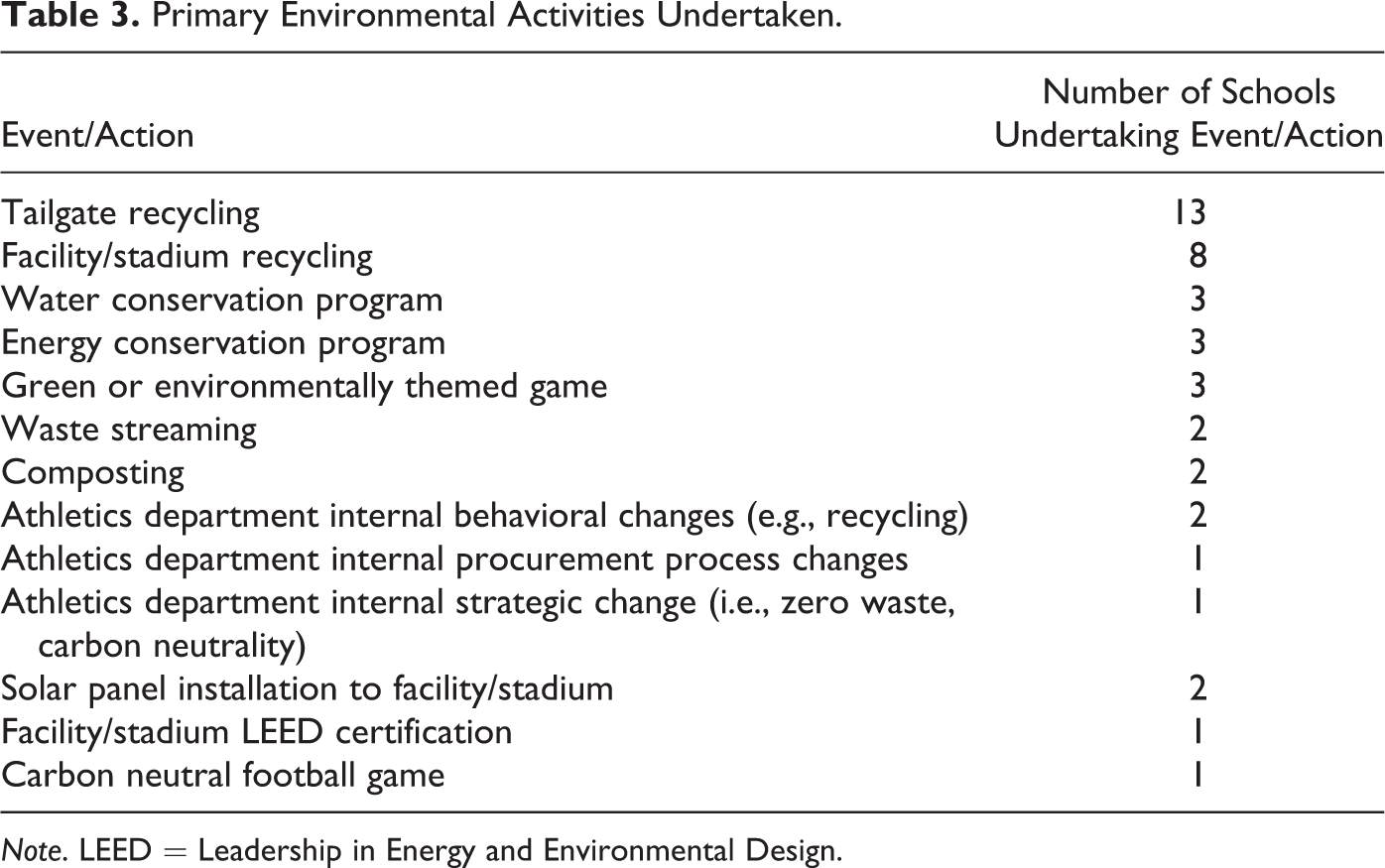
Note. LEED = Leadership in Energy and Environmental Design.
Events not only provide a visible platform for all collaborative processes to be shown to stakeholders and recycling efforts have shown to be a common starting point, but they also demonstrate a clear and early resource commitment (Casper et al., 2012; Hart, 1995; Hart & Milstein, 2003). These events provided opportunities to engage with fans and to tie in with campus sustainability planning (e.g., resource reduction and certification of new/existing buildings; Hart, 1995; Hart & Milstein, 2003). In describing one recycling event, it was said, “the recycling bins were always there, but [the event] drew attention to it” (Interview F).
Additionally, one sustainability person noted, “the [tailgate] recycling program got started before we ever did our strategic planning process…it was a good opportunity to begin the conversation with the [athletics department] about how to do things that were ultimately going to be more significant” (Interview A). In another instance, the sustainability office took on responsibilities attributed to the athletics department to avoid difficulties and problems. For the stadium recycling, they “negotiated on behalf of athletics [with vendors]…we even tried to negotiate food contracts and get them at good price” (Interview C). As the complexity of creating and managing environmental events escalates, so too do the challenges to the relationship (Baxter & Montgomery, 1996; Faraj et al., 2011; Hart, 1995; Hart & Milstein, 2003; Russo & Fouts, 1997). While the interviews included mainly useful and positive information, challenges to success were also identified.
Relationship Challenges
The second research question sought to learn more about challenges faced in the collaborative processes. Each institution has its own challenges, but there were a few common points noted by the respondents. The interviews offered insight into different challenges to collaborative relationship, with some being significant, but not insurmountable. The main challenges revolved around interpersonal and cultural issues. Both of these challenges set a tone for the relationship’s potential success or failure.
Interpersonal issues
The first of the issues is interpersonal in nature and relates back to the importance of communication in the relationships. As one person noted, the relationship’s sustainability “depends on the A.D.’s [athletics director’s] level of commitment. What value they see in it, if any” (Interview M). This comment does not mean the athletics director would make all decisions but does imply that the relationship can be hindered or thwarted if there was not appropriate buy-in or mandates to the athletics department (Casper et al., 2012; Spaargaren, 2003; Stern, 2000; Stern et al., 1999; Stern et al., 1995). Additionally, this reflects the linkages between collaborative efforts and university mandated calls to action. However, sustainability office personnel can also contribute to this if they do not want to pursue a relationship, for example, one sustainability person noted, “I just don’t like that particular decision making environment [top down]. And some might say that an athletics department is as close as you get to a corporate environmental as you can within a university structure” (Interview B). Both instances show how quickly relationships can be harmed by interpersonal perspectives prerelationship (e.g., sociohistoric background; Amey, 2010; Poncelet, 2004).
Culture
The second issue is that of culture where sustainability personnel might be expected to foreground environmental issues on campus, but athletics departments are not necessarily held to the same expectation. Culture changes take time and relationships need to understand the magnitude of this task and the fundamental perceptions of others if efforts are to succeed. In one case, this point was made clear by a sustainability person, “Our current culture [sustainability office] is just bottom line driven. If it helps me save money and doesn’t cost me more, I am willing” (Interview M). Similarly, an athletics department person said, “I think we have done a good job of getting everybody involved, I don’t care if it is from the athletic director down to the custodial staff, they have done a good job of turning lights off” (Interview N). Budget issues also play a role in these collaborations because they impact all actions, not just environmental ones (Hart, 1995; Russo & Fouts, 1997). Athletics department business is driven more by bottom line concerns than others creating a different culture than in less constraining conditions (Hansla et al., 2008). One sustainability person indicated that these budget issues were important: Sometimes they [athletics department personnel] say look, financially I’m not able to do that. I realize this is a good pay back. Hold on to the idea and let’s come back together when we have better or more reasonable financial opportunities …. I think athletic departments typically have ups and downs in terms of their revenue streams and budgets and so forth and you really have to be patient and sort of endure the ups and downs and cement the partnerships. (Interview P)
The findings of this study coalesce into a model of collaborative actions related to environmental issues in intercollegiate sport. The first three themes represent a potential sequential, yet perhaps not entirely linear, process of collaboration (see Figure 1). Initial contact is made (Theme 1), strategies, goals, objectives, and tactics (Theme 2) are co-constructed implementation of decision making takes place (Theme 3). External events (Theme 4) and collaborative relationship challenges (Theme 5) both occur and impact the collaboration in various ways.
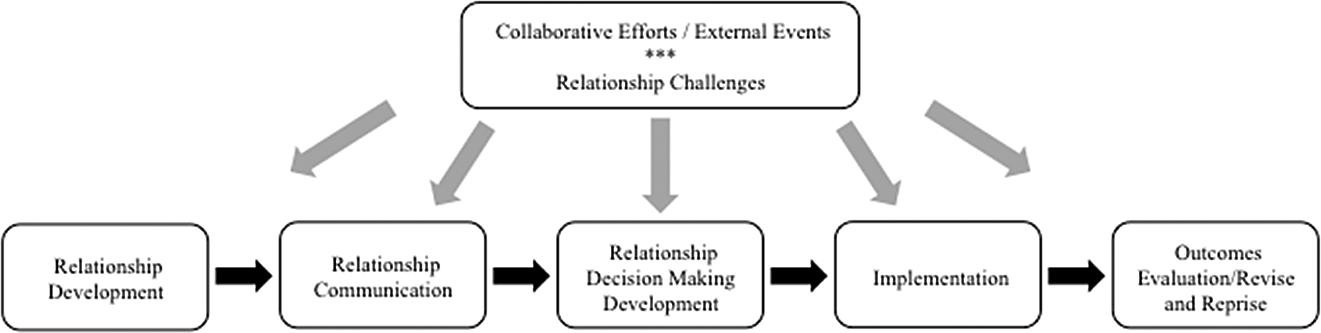
Model of thematic connections.
Implications and Conclusions
This exploratory study offers insights into the relationships and collaborative efforts between athletics department and sustainability department personnel and could assist intercollegiate scholars seeking to understand these processes in greater detail. The impacts of such collaborative efforts reflect the growing importance of sport and the environment and the actions needed to address environmental issues in sport (Inoue & Kent, 2012; Thibault, 2009). The themes identified in this study raise important issues about the diversity of relationships, the communicative and decision-making processes, and the involvement of stakeholders and resources usage.
Diversity of Relationships
The respondents reflected the multiplicity of ways to go green. Such diversity not only involves the personalities and nature of the collaborators themselves (and relevant stakeholders) but also the ways the relationships are created, enacted, and developed over time (Poncelet, 2002, 2004). The respondents also expressed a range of interactions from cordial, yet limited engagement (e.g., a recycling event only) to highly involved collaborations (e.g., joint planning and decision making). Thus, each relationship is contextual, both within the broad scope of green collaborative efforts and within the context itself over time. Areas of future research could explore the first two areas of the model (Figure 1). There is a need to articulate clearly the driving forces behind the contact between units, as it will help to clarify the relationship itself (e.g., foundational assumptions) and all subsequent collaborative efforts.
As noted earlier, an individual’s awareness and knowledge of environmental issues are shaped by exposure to them (Casper et al., 2012; Stern, 2000; Stern et al., 1999; Stern et al., 1995). The collaborative relationships described here reflect this diversity of perspectives from which diverse collaborative practices emerge. While it is intuitive that sustainability personnel should have a strong awareness and knowledge of environmental issues, it was interesting to see the athletics department personnel at least being aware of the issues, and in some cases, knowledgeable about them (Stern, 2000).
However, when making strategic, tactical, and resource decisions, the respondents did discuss how resource issues are at work in different decisions, albeit across a wide spectrum of relationships (Hart, 1995; Scott & Gough, 2003). This is important, as it reaffirms environmental efforts do not have a prescribed starting point but do need to get started. Future research should continue to explore contextual constraints that determine strategy development and actions. If commitment to environmental change is authentic, then the change must start somewhere (Amey, 2010; Babiak & Trendafilova, 2011; Gray, 1989; Pfahl, 2011; Sharma, 2000). Additionally, future research can document the different ways relationships are enacted and offer a typology of environmental collaboration efforts (Owens & Halfacre-Hitchcock, 2006; Richardson & Lynes, 2007). Sport managers across all platforms need to be aware of how things are done in other settings in order to help contextualize and plan within their own context. From these beginnings, more nuanced understandings of the individual relationship elements can take place (e.g., communication styles and resource allocation).
The higher number of sustainability personnel interviewed, however, is a limitation to the study. Athletics department personnel are asked to participate in broader campus initiatives (e.g., through the ACUPCC mandates); therefore, it is not surprising that the sustainability office personnel are leading the way, but athletics department personnel are certainly involved and beginning to address this issue as well (Casper et al., 2012; Jin et al., 2011; NRDC, 2012; NCAA Schools Big On Environmental Initiatives, 2008). Subsequent studies can target athletics department and sustainability department personnel to a more nuanced view of the collaboration. While this exploratory study attempted to balance both sides through participant selection efforts, it is necessary to include both parties in future studies, and in larger studies, other MEP members. Next, the communication processes, especially those driving decision making, are discussed.
Communicative and Decision-Making Processes
Communication and decision-making processes are among the many different elements at work within environmental collaborations. The relationships examined in this study meet Gray’s (1989) five characteristics of collaboration. The athletics department and sustainability offices are independent entities but do have a shared responsibility for collaboration in a fluid environment, grounded in dialogic interaction and joint decision making (Ajzen, 1991; Judge & Douglas, 1998; Sharma & Henriques, 2005; Sharma & Vredenburg, 1998). However, the respondents indicated the sustainability office plays a greater role in forming the context of the decisions with athletics department personnel retaining different levels of decision-making power (e.g., sign off and full vote on a committee).
Collaboration requires a deeper understanding of the other, but it appears when sustainability personnel lead the way, the athletics department personnel remain focused on other priorities (Sharma, 2000). Communication and decision-making process are where awareness and knowledge meet to take action (Casper et al., 2012; Gray, 1989; Jamal & Getz, 1995). The relationship between the two will be less than optimal because the joint ownership of decisions does not reflect a joint ownership of the strategy (Jamal & Getz, 1995; Poncelet, 2002; Sharma, 2000; Zeleny, 1982). It is one thing to share in decision-making processes, but another to generate the ideas, plans, goals, and so on, that ultimately require a decision. Additional studies in this area can contribute to narrowing the gap for more efficient and effective collaborative work to commence (Judge & Douglas, 1998; Thibault, 2009).
A concerted effort toward communication and education between the two areas are necessary to become joint partners and to move from a dyadic to a wider MEP situation (e.g., unified vision, mission, planning, and evaluation; Wals & Corcoran, 2004a). The institutions studied here appear to be in the early stages of MEP formation, as it relates to environmental issues despite having MEP stakeholders within both systems of the collaborative dyad. These stakeholders (e.g., waste management firms) exist in a functional sense but were not direct members of the collaborative efforts, although they could take on more significant roles in the future. Additional research into the roles of different stakeholders in environmental situations is of increasing importance, both to the overall environmental effort and to the communication and decision-making processes of the collaborators. This is especially true if other stakeholders have experience in environmental matters (e.g., a waste management company and a power company).
Understanding how to weave dialogue, planning, decision making and other relationship elements together in a collaborative relationship is critical in order to understand environmentally related actions and outcomes (Amey, 2010; Poncelet, 2004; Sharma, 2000). No outcome (e.g., environmental education intervention and electricity usage) is complete without understanding what the process was to achieve it. If the process is flawed, then the results will be less than optimal. The results of this study showed sustainability personnel took a greater lead in developing the relationships with athletics departments, but additional work to understand how these relationships were built is needed. This means that sustainability personnel must make a greater effort to develop strategic plans ahead of meeting with athletics personnel. Cost issues, time and resources needs, and roles for each department must be developed to facilitate the exchange. While these elements can be fluid and co-constructed as part of the collaborative effort, sustainability personnel need to bring direction to the initial development of the relationship. Future studies can help to develop a better understanding of the interpersonal communication process used to discuss collaboration. A typology of tactics might even be developed from this research. Despite the interpersonal nature of the relationships, a significant stakeholder, the university or college, is always present.
Stakeholder Involvement and Resource Usage
Gray (1989) noted collaborative efforts often arise from a need to comply with a variety of mandates and/or because individuals see a need for change in conjunction with a web of stakeholders (i.e., MEPs; Poncelet, 2002, 2004). The results of this study showed the university and its stance on environmental issues is an important stakeholder, but not always an active one. In only a few interviews did a significant presence from the university administration come into play. Athletics and sustainability offer two intriguing areas for university strategy. Both are visible means of educational outreach, marketing, and publicity, yet both seem to be at odds with each other (e.g., watering synthetic field hockey turf to avoid athlete injuries).
Further, in the current economic environment, university administrators are managing daily and strategic processes with budgets that are, at best, challenging. Resource usage (e.g., electricity) and allocation (e.g., project funding) would have been expected to be forefront in these collaborations but were not often seen that way (Hart & Milstein, 2003; Pfahl, 2010; Sharma & Henriques, 2005; Sharma & Vredenburg, 1998). Athletics department personnel did mention this, but it was not a major discussion point about the collaborations. This particular finding underscores the need to explore factors external to the relationships that influence collaboration (e.g., mega/task environment factors). In many cases, this involves a resource-based view of the firm that will assist with this task as resources are generated both internally (i.e., athletics department revenue generation) and externally (e.g., university allocation of student fees to athletics departments; Benford, 2007; Duderstadt, 2009; Hart, 1995; Hart & Milstein, 2003; Smart & Wolfe, 2000).
As noted earlier, this study did not include other stakeholders related to an athletics or sustainability department (e.g., food vendors) and these stakeholders were not described in any detail by the participants. Further, this study did not include university administration personnel, but future research can trace the strategic and collaborative threads from university planning down to athletics and sustainability department planning along with actions to determine the use and importance of other directives beyond the ACUPCC since some universities and colleges might not be a signatory to it (Casper et al., 2012; Evangelinos & Jones, 2009; Graedel, 2002). Including the MEP stakeholders is important as they provide resources (e.g., technical expertise and natural and human resources) that are used in the partnership. When resource allocation and usage is factored into the study of these relationships, it is possible to see how budgets, personnel job duties, and resource usage for all stakeholders are challenged by green efforts (Ajzen, 1991; Hart & Milstein, 2003; McCullough & Cunningham, 2010; Pfahl, 2010; Sharma & Henriques, 2005; Sharma & Vredenburg, 1998; Shrivastava & Scott, 1992). Additional research into the nature of the extended MEP is needed to form a holistic view of environmental operations related to intercollegiate athletics.
This study provided greater insight into the process of sustainability endeavors between athletics departments and university sustainability offices, but it is not comprehensive. More insight into collaborative relationships among athletics and sustainability department personnel is needed to improve our understanding of environmental awareness, knowledge, and actions (e.g., outcomes and measures of success). The result will be a more balanced and contextual understanding of sustainability efforts that should lead to improved awareness, knowledge, and actions by all members of the collaborative effort.
Footnotes
Appendix A
Declaration of Conflicting Interests
The author(s) declared no potential conflicts of interest with respect to the research, authorship, and/or publication of this article.
Funding
The author(s) received no financial support for the research, authorship, and/or publication of this article.