




Abstract
The lack of appropriate measurement to assess athlete-coach interaction and athletes’ psychological states has historically plagued sport studies research (i.e., an encompassing term for sport psychology, management, sociology, and communication) and may partially explain the lack of empirical research regarding athlete-coach interaction within the emerging field of sport communication. Without valid and reliable tools to assess athlete-coach interactions, understanding the antecedents and outcomes of these relationships, which is a central aim of sport communication research, cannot be accomplished. This article develops and demonstrates validity for a measure of the coach confirmation instrument (CCI) via two studies. In Study 1, an exploratory factor analysis and parallel analysis produced a 15-item, two-factor measure (challenge and acceptance). In Study 2, a confirmatory factor analysis confirmed this two-factor structure had an acceptable-to-good fit using a variety of fit indices. Additionally, preliminary degrees of validity for the CCI were demonstrated through Pearson correlations with athletes’ feeling of being confirmed, coach satisfaction, and perceptions of coach verbal aggression. Collectively, these studies indicate the CCI is a structurally stable measure, which demonstrates good reliability and initial degrees of face, concurrent, convergent, discriminant, and content validity.
Scholarly understanding of what constitutes effective athletic coaching has evolved within the last decade. Winning is no longer deemed the sole indicator of an effective coach. Instead, coaching scholars now recognize additional aspects of effective coaching, such as coaches’ knowledge of their profession (Coté & Gilbert, 2009), athletes’ acquisition of life skills that extend beyond sport (Camiré, Forneris, Trudel, & Bernard, 2011), and athletes’ satisfaction with their relationships with coaches and teammates, as well as their participation in sport (Becker, 2009). A central determinant in cultivating these effective outcomes, especially those concerning athletes’ satisfaction and relationships, is coaches’ behavior or communication with athletes (Vella, Crowes, & Oades, 2011). With this in mind, sport scholars from a variety of disciplines (e.g., sport psychology, management, communication) are called to identify and better understand specific behaviors that coaches can enact to increase their effectiveness (Becker, 2009; Turman, 2003, 2008).
Cranmer and Brann (2015) identified one such potentially effective coaching behavior—coach confirmation, which refers to the “transactional process by which coaches communicate to players that they are endorsed, recognized, and acknowledged as valuable, significant individuals” (p. 195). In this preliminary article, Cranmer and Brann theorized that communicative behaviors that foster positive introspection, like confirmation, may increase coaches’ effectiveness through creating positive affective and relational sporting experiences for athletes. Although coach confirmation is theorized to be an important behavior that coaches should enact, there is a dearth of empirical evidence to support this notion—primarily due to a lack of valid and reliable psychometric measurement of coach confirmation. Until such a measurement is created, this behavior, which is ripe for future research, will continue to go underexplored, and generalizable findings that may assist coaches in their efforts to be more effective (i.e., a central goal of sport communication research; Turman, 2008) cannot be produced. The purpose of this article, therefore, is to report on the development of a quantitative assessment of coach confirmation (i.e., Study 1) and the demonstration of preliminary degrees of validity for that measure (i.e., Study 2).
Study 1: Development of the Coach Confirmation Instrument (CCI)
Buber (1957), an existential philosopher and theologian who focused on the human condition across contexts, first theorized about the concept of confirmation as an interactional phenomenon that enables individuals to establish healthy identities and make connections with others. The construct has been extended to encompass interactions that leave recipients feeling endorsed, recognized, and acknowledged (Laing, 1961; Sieburg, 1985) or unique, valuable, and connected with others (Dailey, 2010). These feelings are achieved via the reception of specific verbal and nonverbal messages that leave individuals feeling challenged or accepted (Dailey, 2010). Despite its communicative nature, confirmation has only recently received considerable attention from communication scholars. To date, these scholars have explored the benefits of receiving confirmation in a variety of contexts, including health (Dailey, McCracken, & Romo, 2011; Dailey, Richards, & Romo, 2010; Dailey, Romo, & McCracken, 2010; Dailey, Romo, & Thompson, 2011), instructional (Ellis, 2000, 2004; Schrodt, Turman, & Soliz, 2006), and familial settings (Dailey, 2008, 2009, 2010; Ellis, 2002). Cranmer and Brann (2015) recently extended confirmation to the athlete-coach relationship.
The extension of confirmation into sport literature is noteworthy as confirmation varies by both situational factors and the relational dynamics between senders and recipients (Dailey, 2009; Ellis, 2000; Laing, 1961). As such, coaches may be an important source of confirmation to recognize because of the unique influence that sporting experiences and interactions with coaches have on the social, cognitive, emotional, and physical development of young athletes (Camiré et al., 2011). Interactions with coaches—specifically those that athletes find confirming—can be profound experiences that affect athletes throughout their life span. Further, given the prosocial and functional nature of confirmation, this construct may have implications for effective coaching, including fostering athlete learning, affective evaluations of sport, and relationships with teammates (Cranmer, Brann, & Anzur, 2016). Together, these features underscore the importance of investigating confirming communication within sport.
Despite the potential importance of coach confirmation, there has been a dearth of research on the construct. The lone investigation of the confirming behaviors and messages that coaches enact led to the identification of six themes of coach confirmation (Cranmer & Brann, 2015). These themes indicate that confirming messages can (a) differ in unique ways that meet the communicative needs and preferences of athletes (individualized communication); (b) address a variety of topics that span athletes’ personal lives, such as family, significant others, or academics (personal communication); (c) acknowledge athletes’ performances or contributions to the team (recognition); (d) challenge athletes to improve their performance in the future (improvement); (e) express confidence in players’ abilities to accomplish tasks in the future (encouragement); or (f) demonstrate coaches’ investment of time and resources in an effort to help their team and its players accomplish goals (investment).
The findings regarding these six themes distinguish coach confirmation from the manifestations of confirmation in similar contexts. For example, athletic coaching is often suggested to be a form of instruction (Cranmer & Goodboy, 2015; Turman, 2003, 2008), and although some underlying commonalities may be argued, the competitive and collectivist environment that distinguishes athletic teams from classes of students are underscored through themes of athlete development (i.e., encouragement, improvement) and the salience of individual athletes’ needs or contributions (i.e., individualized communication, personal communication, recognition). This is not surprising given that sport and traditional classrooms are very different instructional contexts. For instance, participation in athletics is a physical endeavor, features salient group goals (i.e., winning), requires interdependence between athletes to accomplish these goals, explicitly labels and limits athletes’ participation based on ability, and often is comprised of gendered teams (Cranmer & Goodboy, 2015; Turman, 2003, 2008). As such, it is not surprising that athletes would find different behaviors as confirming when compared to students.
Cranmer and Brann (2015) provided insight into the thematic aspects and nuances of coach confirmation and distinguish sport as a unique context of confirmation. However, the underlying structure between these themes and the ability to quantify coaches’ use of confirmation has avoided scholarly exploration. The creation of a quantitative measure would produce further understanding of the structure and nature of this coaching behavior and could prove useful for future research. From this point forward, such an instrument will be referred to as the CCI. A preliminary version of the CCI was developed and the structure of that measure was empirically determined.
Method
Sample and Procedures
Participants in Study 1 were 184 former high school athletes (97 men and 87 women) from three introductory communication courses at a mid-Atlantic university. This sample size met Bentler and Chou’s (1987) recommended ratio of five participants for every item in the preliminary CCI. Participants ranged in age from 18 to 22 (M = 20.34, SD = 1.50), were racially homogenous (i.e., 87.6% White), and played a variety of sports. See Table 1 for sample demographics from Study 1.
Participants’ Demographics.
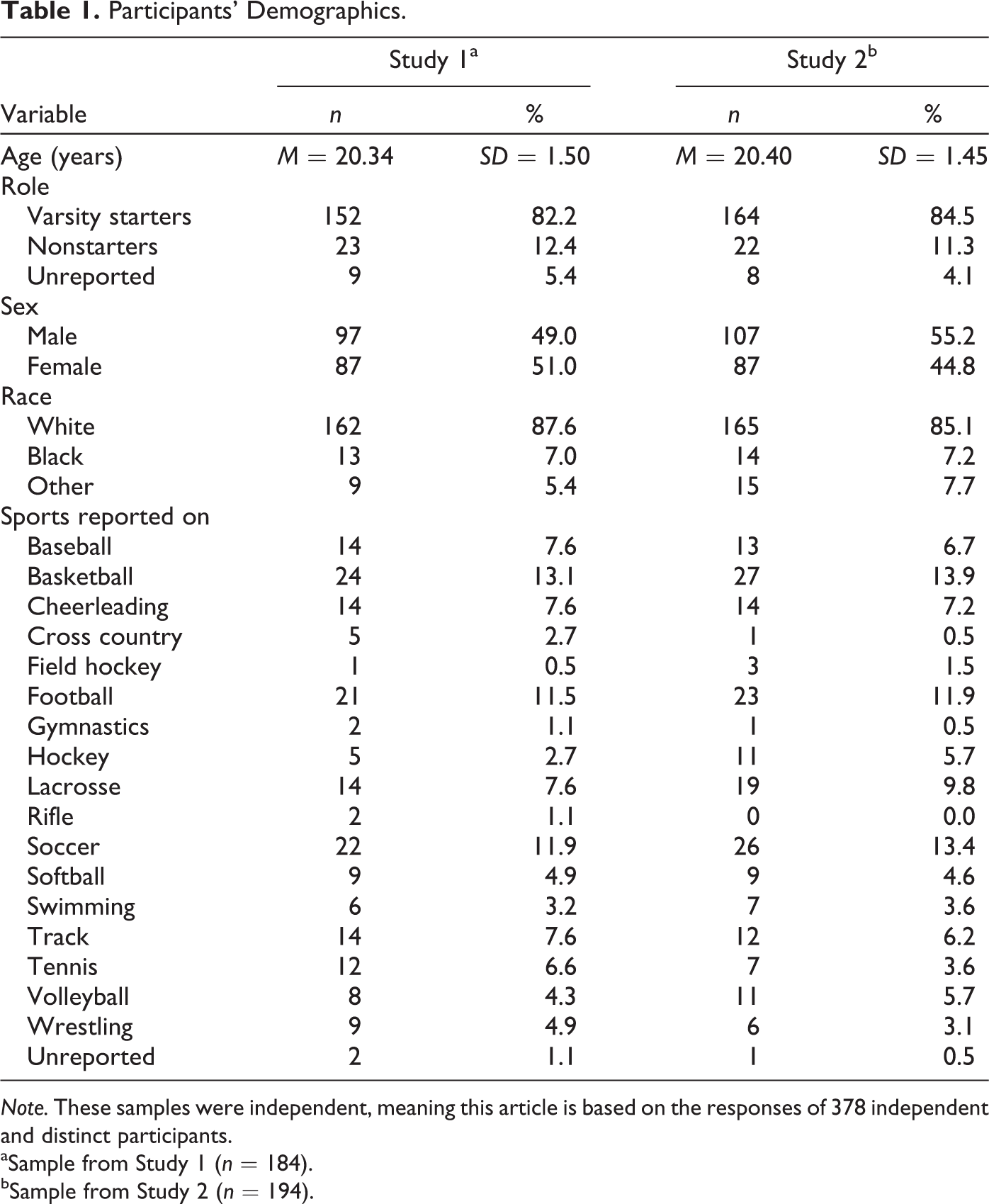
Note. These samples were independent, meaning this article is based on the responses of 378 independent and distinct participants.
aSample from Study 1 (n = 184). bSample from Study 2 (n = 194).
These participants were solicited with an institutional review board (IRB)-approved recruitment script and instructed to complete a paper questionnaire during class time. Oral and written instructions were provided to complete the questionnaire regarding a single team that they were a part of during their senior year of high school (secondary school) and the head coach of that team. Similar retrospective techniques have been utilized by previous studies that have assessed athlete-coach communication (Cranmer & Myers, 2015; Kassing & Anderson, 2014).
Measurement
The questionnaire consisted of the preliminary version of the CCI and demographic questions, including participants’ sex, age, race, sport, starting status, and team winning percentage.
Coach confirmation was operationalized with a preliminary 36-item version of the CCI, with 6 items coinciding with each of the aforementioned themes of coach confirmation. Participants’ responses to items were recorded using a 5-point Likert-type scale that ranged from never true (1) to always true (5). These items were inductively derived via a series of approximately 20 minute interviews with collegiate athletes aiming to obtain the things that head coaches say and do that are deemed confirming by athletes (Cranmer & Brann, 2015). Each item was directly taken from participants’ interview responses and only altered in tense, plurality, and grammar when appropriate. No additional items from other contexts, additional articles, or alternative scales were included in the CCI. Further, the items of the CCI were subjectively examined by two communication scholars who had experience evaluating confirmation in alternative contexts (i.e., health and instructional contexts) to ensure that these items were true to the conceptualization of confirmation. Collectively, these two procedures demonstrate degrees of face validity (i.e., the items appear to measure the intended construct) of the CCI (Cohen & Swerdlik, 2005; DeVellis, 2012).
Data Analysis
The CCI was subjected to an exploratory factor analysis (EFA) using maximum likelihood factoring and promax rotation. The factor structure of the CCI was determined by the five criteria recommended by McCroskey and Young (1979), which require factors to (a) have an Eigenvalue of 1.0 or greater, (b) account for at least 5% of the variance, (c) be discernable via a scree plot test, (d) consist of at least 3 items, and (e) have items with a loading of at least .60 on one factor but less than .40 on any other factors. The CCI was also examined with a parallel analysis (Horn, 1965), which is a Monte Carlo simulation that corrects for potential sampling bias that may influence the matrix rank of items by constructing “correlation matrices of random variables based on the sample size and number of variables in the real data set” (Hayton, Allen, & Scarpello, 2004, p. 194). The factors that correspond with eigenvalues that are greater than the average random eigenvalues are retained (Horn, 1965). This correction makes parallel analysis “one of the most accurate methods for determining the number of factors to retain [within a construct]” (Hayton et al., 2004, p. 192).
Results
The EFA produced a two-factor solution that consisted of 15 of the original 36 items and accounted for 68.82% of the variance. Factor 1, labeled challenge, accounted for 58.86% of the variance (Eigenvalue = 11.51, M = 4.08, SD = .86), consisted of 11 items, and produced a Cronbach’s α coefficient of .95. Factor 2, labeled acceptance, accounted for 6.88% of the variance (Eigenvalue = 1.57, M = 4.10, SD = .92), consisted of 4 items, and produced a Cronbach’s α coefficient of .92. The observed two-factor solution was further supported by parallel analysis (Factor 1, raw data Eigenvalue = 20.26, percentile random data Eigenvalue = 2.07; Factor 2, raw data Eigenvalue = 2.15, percentile random data Eigenvalue = 1.92). See Table 2 for items and factor loadings of the CCI.
EFA Factor Loadings for the CCI.
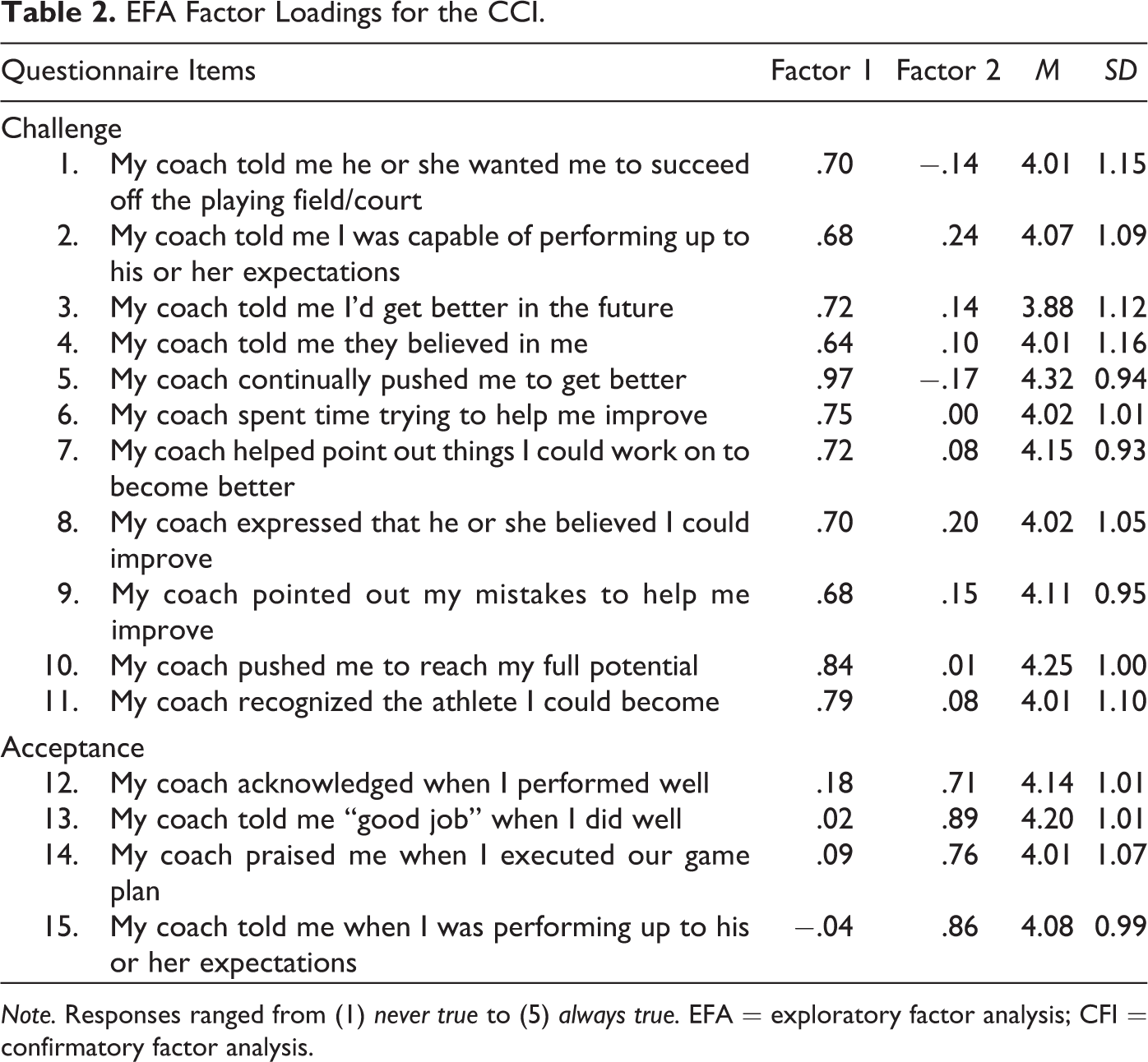
Note. Responses ranged from (1) never true to (5) always true. EFA = exploratory factor analysis; CFI = confirmatory factor analysis.
Discussion
The results of Study 1 suggest that the underlying structure of coach confirmation consists of two factors (challenge and acceptance). The challenge factor consists of items that coincide with the previously mentioned confirming themes of personal communication, recognition, encouragement, investment, and most apparent improvement (Cranmer & Brann, 2015). However, the central feature that binds these items is a coach’s focus on the future attainment of success or fulfillment of an athlete’s potential. In contrast, the acceptance factor consists of items that coincide with the confirming theme of recognition (Cranmer & Brann, 2015). The unique feature of these items, however, is a coach’s recognition or validation of an athlete’s current or past efforts and accomplishments. The disproportionate distribution of items across the two dimensions of the CCI was not intentional and could be attributable to the difference in how constructs are structured via qualitative and quantitative analyses.
The factor structure of the CCI is supported both theoretically and empirically. Dating back to the work of Buber (1957), the duality of confirmation has been recognized by confirmation theorists. Across interpersonal, health, and familial contexts, Dailey and colleagues have asserted that confirmation communicates either challenge or acceptance to receivers (Dailey, 2008, 2009, 2010; Dailey, Romo, et al., 2011). These scholars note that challenge communicates “to individuals that are capable of achieving a greater potential,” whereas acceptance provides receivers with “validation and security” in their current state (Dailey, Romo, et al., 2011, p. 554). As such, the two-factor CCI is largely supported by extant confirmation theory and research. The two-factor CCI also has a large degree of empirical support. This study utilized McCroskey and Young’s (1979) standards for EFA—which incorporates both the Kaiser criterion (Kaiser, 1960) and Cattell’s (1966) scree test—and Horn’s (1965) parallel analysis. Collectively, these three distinct means of factor reduction offer compelling empirical evidence regarding the structure of the CCI.
It should also be noted that the CCI differs from Ellis’ (2000) measure of instructor confirmation. This measure indicates that answering questions, having an interactive teaching style, and demonstrating concern for students comprise confirmation. However, a dimension that taps into the challenging aspect of confirmation—which is included in both the early theorizations about the construct (Buber, 1957; Laing, 1961) and empirical research within the family (Dailey, 2008, 2010), health (Dailey, McCracken, et al., 2011; Dailey, Romo, et al., 2011), and now sport context—is missing. Further, while concern acknowledges students’ current states, no dimension of instructor confirmation actually validates or praises students for their contributions or ideas. As such, the instructional operationalization of confirmation may lack content validity, as praising students’ accomplishments and challenging them to learn are germane to learning and confirmation, but are not represented in a theoretically or empirically consistent manner.
Study 2: Preliminary Validation of the CCI
The development of measurement requires demonstrations of the degrees of validity. Although this requirement cannot be achieved within a single article, the purpose of Study 2 was to (a) confirm the previously established factor structure and (b) demonstrate preliminary degrees of validity for the CCI.
Kline (2011) argued that EFAs are mere statistical exercises without a confirmatory factor analysis (CFA) to corroborate the structure of a measure. Unlike an EFA, which explains a maximum amount of variance and determines factor structures, a CFA examines a priori models based on theoretical assertions or previous research. Within this article, an EFA produced a two-factor structure that consists of 15 items—11 challenge items and 4 acceptance items. Based on the results of this EFA and the theoretical assumptions of CFA (DeVellis, 2012), the following hypothesis was forwarded:
In general, validity refers to evidence that an instrument measures the construct it purports to measure (Kerlinger, 1986). One means of validating a novel measure is through the demonstration of concurrent validity, which is indicated through the observation of a theoretically consistent relationship between a measure and some sort of criterion assessed at the same time (Cohen & Swerdlik, 2005). Of all the potential criterion variables that could be associated with the reception of confirmation from a coach, recipients’ psychological response of feeling confirmed is a natural outcome to consider (Ellis, 2000). In other words, the confirming behaviors that comprise the CCI must be associated with athletes’ feelings of being confirmed for the measure to be valid. Given the items of the CCI were inductively derived from the findings of Cranmer and Brann (2015), the following hypothesis was forwarded:
Another means of validating a measure is through the demonstration of convergent validity, which refers to establishment of significant associations between theoretically related measures (DeVellis, 2012; Kerlinger, 1986). One particular construct that should be related to coach confirmation is athletes’ satisfaction with their coaches. Athlete satisfaction is a complex and multifaceted construct that involves athletes’ affective evaluations of various components of sporting experience, including interactions with coaches (Chelladurai & Riemer, 1998). Sport communication scholars have found that athletes’ satisfaction with their coaches is largely a function of coaches’ communicative behaviors. For instance, antisocial forms of communication such as verbal aggression (Kassing & Infante, 1999) or behavioral alteration techniques (Martin, Rocca, Cayanus, & Weber, 2009) are associated with decreases in athlete affective evaluations of coaches. More importantly, coaches’ use of supportive communication—a prosocial behavior aimed at assisting athletes—is associated with an increase in athlete satisfaction (Cranmer & Sollitto, 2015). With this in mind, it is logical to assert that endorsing, recognizing, and acknowledging athletes (i.e., confirmation) should also be associated with increases in athletes’ affective evaluations of their coaches (e.g., satisfaction). Therefore, the following hypothesis is forwarded:
While demonstrating relationships between constructs is foundational to scale development, measures can be invalidated if those relationships are so high that one cannot distinguish between a novel measure and related constructs. Discriminant validity addresses this concern as “discriminability means that one can empirically differentiate the construct from other constructs that may be similar” (Kerlinger, 1986, p. 421). Given confirmation is a coaching behavior, it is necessary to distinguish the CCI from assessments of other related coaching behaviors that may influence athletes’ internal evaluations of themselves. One such behavior to consider is coaches’ use of verbal aggression. Verbal aggression is considered to be a destructive form of communication, as it encompasses the purposive attacking of another’s self-concept (Infante & Wigley, 1986). Verbal attacks can range from insulting a person’s appearance, intelligence, and character to threats, teasing, or the extensive use of profanity (Infante, 1987). Across contexts, being the recipient of verbal aggression is associated with numerous negative outcomes (e.g., emotional distress, damaged self-concept, decreased well-being; Infante, 1987). Within sport, coaches’ use of verbal aggression is negatively associated with athletes’ affect toward their coaches (Kassing & Infante, 1999; Martin et al., 2009), perceptions of coach credibility (Kassing & Infante, 1999; Mazer, Barnes, Grevious, & Boger, 2013), and sportsmanship behaviors toward others (Kassing & Infante, 1999). Given that coaches’ use of verbal aggression damages athletes’ self-concepts, which is in direct contrast to coach confirmation—which makes athletes feel recognized, endorsed, and acknowledged—coaches’ use of verbal aggression should be negatively associated with their use of confirmation (i.e., indicating convergent validity). Yet, verbal aggression and confirmation are theoretically distinct concepts and, therefore, the relationship between them should not be isomorphic (i.e., indicating discriminant validity). With this in mind, the following hypothesis was forwarded:
Method
Sample and Procedures
Participants in Study 2 consisted of an additional and distinct sample of 194 former high school athletes (107 men and 87 women) from two introductory communication courses at a mid-Atlantic university, who did not participate in Study 1. Participants in Study 2 ranged in age from 18 to 22 (M = 20.40, SD = 1.45), were racially homogenous (i.e., 85.1% White), and reported on a variety of sports. See Table 1 for sample demographics from Study 2.
The procedures utilized in this study were identical to Study 1. Participants were solicited with an IRB-approved recruitment script and completed questionnaires during class time regarding a single team they were a part of during their senior year of high school (secondary school) and the head coach of their teams.
Measurement
Participants completed questionnaires that consisted of the CCI, their psychological response of feeling confirmed, satisfaction with their coach, and perceptions of a coach’s use of verbal aggression. Additionally, demographic questions such as participants’ sex, age, race, sport, starting status, and team winning percentage were included.
Coach confirmation was operationalized with the 15-item CCI, which was created during Study 1. Participants’ responses to items were recorded using a 5-point Likert-type scale that ranged from never true (1) to always true (5). Previous Cronbach’s α reliability coefficients ranged from .92 to .95 for this measure.
Athletes’ feelings of confirmation from their coaches was operationalized with the Perceived Confirmation Inventory (Sieburg, 1975). This 5-item measure assesses participants’ psychological response of feeling confirmed (e.g., “I believe my coach trusted me”) by a particular source. Responses were recorded on a 5-point Likert-type scale that ranged from strongly disagree (1) to strongly agree (5).
Athletes’ satisfaction with a coach was operationalized with Kassing and Infante’s (1999) coach satisfaction measure. This 4-item measure assesses participants’ satisfaction with playing for a particular coach (e.g., “You would play for this coach again if given the opportunity”). Answers were recorded on a 7-point Likert-type scale that ranged from strongly disagree (1) to strongly agree (7). Previous Cronbach’s α reliability coefficients have ranged from .90 to .95 for this measure (Cranmer & Myers, 2015; Cranmer & Sollitto, 2015; Kassing & Infante, 1999).
Athletes’ perceptions of coach verbal aggression was operationalized with Kassing and Infante’s (1999) measure of coach verbal aggressiveness. This 4-item measure assesses participants’ reports of coaches' verbally aggressive influence tactics (e.g., “Shouted at us or used strong language to tell us off”). Responses were recorded on a 6-point Likert-type scale that ranged from strongly disagree (0) to strongly agree (5). Previous Cronbach’s α reliability coefficient for this scale was reported to be .80 (Kassing & Infante, 1999). See Table 3 for full descriptive statistics, internal reliabilities, and correlation matrix for Study 2.
Study 2: Descriptive Statistics and Correlation Matrix.
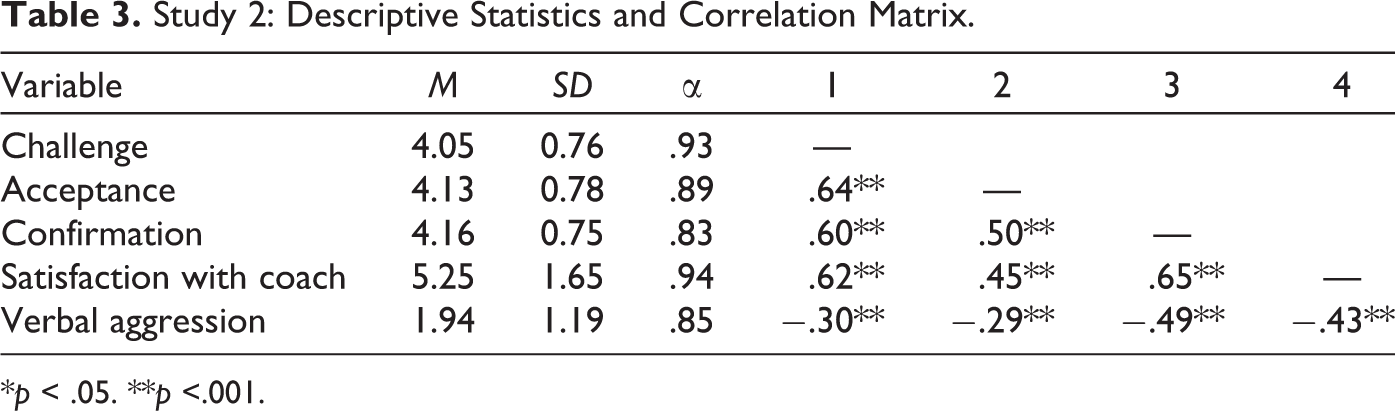
*p < .05. **p <.001.
Data Analysis
Hypothesis 1 regarding the structure of the 15-item CCI was examined with a CFA using AMOS 19. Model fit was assessed using Bentler comparative fit index (CFI), Steiger-Lind root mean square error of approximation (RMSEA), and the standard root mean square residual (SRMR). CFI scores that range from .90 to .95 are deemed acceptable, with scores of .95 and above considered good (Hu & Bentler, 1999). RMSEA and SRMR scores that range from .08 to .07 are deemed acceptable, with scores of .06 and below considered as good (Hu & Bentler, 1999). All additional hypotheses were examined via a series of Pearson correlations, which are deemed appropriate for demonstrating initial degrees of validity during scale development (DeVellis, 2012).
Results
Hypothesis 1 predicted that the two-factor CCI would be confirmed. This hypothesis was supported. Results of a CFA indicated that the two-factor model fit the data at an acceptable level, χ2(89) = 207.27, p < .001, ratio between chi-square value and degrees of freedom (CMIN/DF) = 2.33; CFI = .94, RMSEA = .08, SRMR = .05. All 15 items loaded significantly (ranging from .62 to .89) at the p < .001 level on their respective factors. Additionally, this measure continued to demonstrate good internal reliability for both the challenge (α = .93, M = 4.05, SD = .76) and acceptance factors (α = .89, M = 4.13, SD = .78).
Hypothesis 2 predicted that athletes’ responses to the CCI would be positively related to their feelings of confirmation. This hypothesis was supported as both challenge (r = .60, p < .001) and acceptance (r = .50, p < .001) were related positively to athletes’ feelings of being confirmed.
Hypothesis 3 predicted that athletes’ responses to the CCI would be positively related to athletes’ reports of satisfaction with coaches. This hypothesis was supported as both challenge (r = .62, p < .001) and acceptance (r = .45, p < .001) were related to athletes’ satisfaction with their coaches.
Hypothesis 4 predicted that athletes’ responses to the CCI would be negatively, but not isomorphically, related with coaches’ use of verbal aggression. This hypothesis was supported as both challenge (r = −.30, p < .001) and acceptance (r = −.29, p < .001) were related negatively to coaches’ verbal aggression, but neither relationship approached levels of isomorphism given these factors share only roughly 9% variance with verbal aggression, respectively.
Discussion
The purpose of this article was to develop a reliable and valid psychometric measurement of coach confirmation. The results of Studies 1 and 2 demonstrate preliminary degrees of reliability and validity of the CCI. In particular, a 15-item measure with two factors was found. These two factors were found through EFA and confirmed through parallel analysis and CFA. Together, these procedures suggest a consistent underlying structure of coach confirmation has been identified, but future research should still evaluate the structure of this measure (Kline, 2011). The CCI also demonstrated good internal reliability (i.e., above .80; DeVellis, 2012) for both the challenge (α = .93–.95) and acceptance factors (α = .89–.92) across two studies. The observed Cronbach’s αs indicate that each factor of the CCI has low levels of random error, which provides researchers with the ability to have confidence that any significant findings that may be gathered using the CCI are not based on chance—assuming that the other measures utilized are also reliable (DeVellis, 2012).
The CCI also demonstrated preliminary degrees of five types of validity. First, the face validity of the CCI was established via the use of inductively derived items and the assessment of the instrument by multiple confirmation scholars (DeVellis, 2012). Second, concurrent validity was indicated through the demonstration of strong correlations between the CCI and the criterion of athletes’ feelings of confirmation, which shared 36% variance with the challenge factor and 25% variance with the acceptance factor. These results provide empirical evidence that the CCI, which is a behavioral measure, is associated with athletes’ feelings of being confirmed—a psychological criterion. Third, convergent validity was demonstrated through the observed significant correlations with athletes’ satisfaction with their coaches and their coaches’ use of verbal aggression. This offers insight that the CCI is related to both athletes’ affective responses to coaches and perceptions of coaches’ communication styles in a theoretically consistent manner. Fourth, the discriminant validity of the CCI was evident given the small-to-moderate correlations with coaches’ use of verbal aggression—a similar construct that involves coaches communicating in a manner that influences athletes’ self-concept. These observed relationships demonstrate that, while coaches’ communicative behaviors are related, confirmation is distinct from verbal aggression. Fifth, content validity, which refers to the extent that the full domain of a construct is represented in a measure, was established through the inclusion of items that represent a variety of the inductively derived themes identified by Cranmer and Brann (2015) and the emergence of factors that are consistent with the dual nature of confirmation (Buber, 1957). In particular, both the challenge and acceptance dimensions of confirmation theory were found through multiple forms of empirical analysis—an EFA, parallel analysis, and CFA (Dailey, 2008, 2009; Dailey, Romo, et al., 2011). Thus, it appears a full understanding of coach confirmation is present within the CCI.
Implications
This article has heuristic value because the development of appropriate and valid measurement is required for the advancement of social scientific knowledge (DeVellis, 2012). Duda (1998) acknowledged this reality when she offered a critique of measurement within sport studies. Although nearly two decades have passed, within the emerging field of sport communication, Duda’s criticisms of psychometric measurement are still applicable. Sport communication scholars have largely relied on measures either from noncommunicative fields (e.g., sport psychology, management, sociology) or alternative communicative contexts (e.g., instructional, organizational, interpersonal communication). As a result, much of the limited empirical record within the communication studies and sport disposition is based on measurement that is either not explicitly communicative in nature or nongermane to the sport context—as few scholars have attempted to develop measurement (cf. Kassing & Infante, 1999; Turman, 2008). The lack of appropriate measurement raises some concern regarding whether the foundation of research within sport communication is built on sturdy terrain. Further, the lack of such measurement may impede the development of future athlete-coach communication research, which will be restricted without the availability of true sport communication measures. With this in mind, the development of the CCI and additional athlete-coach communication instruments may provide researchers with the tools to help address the dearth of knowledge regarding athlete experience (Wenner, 2015).
This article may also have practical implications for coaches and sport practitioners. Cranmer and Brann (2015) have forwarded confirmation as an effective coaching behavior. Study 2 provided empirical support for this notion as athletes’ satisfaction with their coaches was positively associated with both dimensions of coach confirmation. Thus, coach confirmation appears to be a communicative behavior that is related to an increase in coach effectiveness. Coaches may consider incorporating challenge and acceptance of their athletes into their coaching philosophies in an effort to improve their effectiveness. For instance, coaches should acknowledge athletes’ performances with verbal praise (e.g., “good job”) and nonverbal gestures (e.g., a pat on the back) as well as recognize when athletes do not perform up to standards, give athletes specific ways to better their performance, and hold athletes accountable to meeting reasonable expectations (see Cranmer et al., 2016, for further insight regarding how to enact confirmation in athletic coaching). Interestingly, challenge appears to account for sizably more variance within athletes’ satisfaction. This is likely the result of the sporting context, whereby coaches’ efforts to help athletes improve is often interpreted as a sign of an athletes’ ability or importance to their team. Future research is needed to understand the conditions under which this behavior or particular dimensions of this behavior are effective.
Limitations
The results of this article should be considered with the full acknowledgment of its limitations. The current data are retrospective in nature, which, although common within sport communication research, may increase the susceptibility of participants’ self-reports to inaccuracies and rumination effects. However, if such effects exist within these samples, those effects were not dependent on participants’ age. Second, this study is limited in scope as confirmation was assessed from a single source (i.e., head coaches) and in other-report format. Although this decision was purposive because head coaches are especially salient figures within sport and athletes’ recognition of confirmation is likely more important than coaches' attempts to be confirming (Cranmer & Brann, 2015), this focus fails to provide insight regarding how multiple sources may perceive coaches’ use of confirmation or influence athletes’ experiences (Dailey, 2009). Third, several scholars have suggested that confirmation is but one end of a continuum that is countered by disconfirmation (Dailey, 2010; Ellis, 2000), which was not examined within this article. Given that previous attempts to assess both confirmation and disconfirmation within a single psychometric measure have failed (Ellis, 2000; Schrodt et al., 2006), confirmation was assessed alone because of its prosocial outcomes and obvious implications for coaches and sport practitioners.
Future Research
Future studies should address the limitations of this article, further validate the CCI, and continue the development of the construct of coach confirmation. Attempts should be made to build upon this article. In particular, the use of a variety of athlete populations, especially across competitive levels (e.g., youth, high school, collegiate), the avoidance of retrospective data, and the consideration of multiple sources (e.g., assistant coaches, trainers, parents, teammates) and viewpoints (i.e., self and other-report) of coach confirmation is needed. These efforts will provide a more holistic understanding of confirmation within the athletic contexts. The examination of disconfirmation and scale development for this construct also should be considered to provide the full spectrum of confirmation and disconfirmation within sport.
Second, the validation of a measure requires multiple scholars to conduct numerous studies that employ various theoretical frameworks over time (DeVellis, 2012). Specifically, the factor structure of the CCI should continue to be confirmed using CFA (Kline, 2011), and its validity should be explored through the examination of additional relationships with theoretically relevant constructs and outcomes. These efforts should be utilized to continue the refinement of the assessment of coach confirmation and in an effort to add to coaching effectiveness literature.
Finally, given that the purpose of athlete-coach communication research is to identify communicative behaviors that coaches can enact to increase their effectiveness (Turman, 2008), the influence of confirmation on athletes’ experiences needs to be more fully investigated. For example, the antecedents (e.g., athletes’ ability or leader-member exchange) and contexts (e.g., team culture) of coaches’ use of confirmation still require further attention. Additionally, how coach confirmation can be used to motivate athletes or increase their affective experiences could demonstrate the role of communication within effective coaching. Further, the incorporation of Dailey’s confirmation theory into these future works may provide a theoretical mechanism that would explain the comparative importance of challenge and acceptance for predicting indicators of effective coaching.
Conclusion
Although scale development is a continual process, this study provides preliminary evidence that the CCI is a reliable and valid psychometric measure of coaches’ use of confirming behaviors. The extension of confirmation to the context of sport and the development of CCI provides sport communication scholars with a novel construct with which to examine athlete-coach interactions. Given the importance of confirmation in human development across contexts (Buber, 1957; Dailey, 2010), the continued examination of coach confirmation through the use of the CCI is advisable for producing generalizable understandings of the potential influence that athlete-coach communication may have on athletes’ sport, social, and communicative outcomes.
Footnotes
Declaration of Conflicting Interests
The author(s) declared no potential conflicts of interest with respect to the research, authorship, and/or publication of this article.
Funding
The author(s) received no financial support for the research, authorship, and/or publication of this article.