



Abstract
This study focuses on comparing the uses sought and gratifications obtained when consuming media related to eSports and traditional sports; in doing so, relevant areas of overlap and distinction are ascertained. In all, more than 1,300 American eSports participants were queried as to their interest in both eSports and traditional sports fan/followership. Results revealed that eSports participants sought out media for both eSports and traditional sports for similar motivations, specifically social sport, fanship, and Schwabism. However, it is the magnitude of the motives that truly set eSports fans apart, with participants showing far more dedication and desire to engage with eSport content than in any other realm of the traditional sporting arena.
As two of the most burgeoning subfields of communication, sport and gaming scholarship has seemingly jointly moved to the forefront of many discussions of media, spurred by the notion that the science of play should not be discounted in the shaping of modern human habits (Billings, 2017). Rapidly expanding mobile media options have continued the mainstreaming of fandom via everything from fantasy sport to YouTube video productions, blurring the lines between spectator and performer (Bowman & Cranmer, 2014). At the nexus of this gaming and sports focus is the rapidly ascending world of eSports. With roots embedded in the mainstreaming of gaming as early as the 1970s, enhanced Internet speed and access has caused the burgeoning industry to excel, with over 205 million people participating (Casselman, 2015); while selling out professional sporting arenas for major competitions (Carr, 2016), eSports now is a global player in the digital gaming marketplace. eSports has existed in some form for many decades (via closed online competitions as well as programs such as Entertainment and Sports Programming Network [ESPN]’s Madden Nation), yet, as Peckham (2016) illuminates, eSports now occupies spaces familiar to the traditional sports fan, with ESPN and Turner Broadcasting serving as exemplars of recent major investment in rendering competitions to the masses.
Many in the popular press (see Fischer, 2017) are actively attempting to explicate the manner in which eSports does (or does not) fit into traditional sport spaces, leading to, for instance, an entire panel being dedicated to the subject at South by Southwest 2017. The similarities are evident, as millions of people become fans of premier players within various eSports game platforms, yet most avid eSports players and followers are not followers of traditional sports as unpacked in a variety of sports media products (Aaron, 2015). The constituencies for both sports and eSports fans number in the hundreds of millions—if not more—making discerning the commonalities (or lack thereof) pertinent to understanding the vast and expanding digital gaming space. This study focuses on the uses sought and gratifications obtained within each of these two groups; in doing so, relevant areas of overlap and distinction are ascertained. In all, more than 1,300 American eSports participants were queried as to their interest in both eSports and traditional sports fan/followership. As such, an important delineation is offered, showing that while both are enacting fandom in similar manners, the reasons why they opt to consume media to advance their fandom is demonstrably different.
Literature Review
Before delving into the intricate world of eSports fandom, one must understand the approach endorsed while discerning motivations for fandom—and the degree in which they do or do not match with traditional sport identification and followership. Given that the focus of this study is on reasons for seeking a given form of media content, the uses and gratifications approach (Katz, Blumler, & Gurevitch, 1973) appears most pertinent to the task at hand. As originally conceived, the approach is used to illuminate the reasons why one opts to consume different media options, bifurcating such decisions between uses sought and gratifications obtained within the formulation of a given media choice. Katz and Blumler (1974) contend that this approach is undergirded by three primary assumptions, each of which are potentially quite pertinent to eSports interests: Audiences are (a) goal oriented in their behavior, (b) active in their media use, and (c) aware of their needs and use specific media to gratify those needs. Such principles have been applied in a variety of contexts related to sport (Clavio & Kian, 2010), mobile/social media (Billings, Qiao, Conlin, & Nie, 2017), and the fantasy games that percolate from such competitions (Spinda, 2016). Nevertheless, eSports motivations have not been interrogated via a similar lens.
Once considering that five reasons persist to explain why people opt for one form of media over another (Windahl, 1981), such motivations can be applied to the context of the relatively new world of eSport. Such decisions are rooted in psychology (Rubin, 1994; Ruggiero, 2000) and are used to explain how people navigate their social world. One can quickly surmise relationships between eSports and traditional sport fandom based on the aforementioned decisions: Both groups would seemingly be motivated by escape, relaxation, and diversion mechanisms exemplified by broader notions of gaming, for instance. However, the immense history of traditional sport runs in stark contrast to the history of eSports; one can grow up with embedded, tacit understandings of the importance and relevance of sport, yet the same cannot be said of eSports for all but the youngest of people who call themselves eSports fans. To wit, one may have shared memories of hundreds of sports game viewings (live and mediated) with family and friends, yet youth are just as likely to use eSport as a vehicle for seeking traditional sport fanship as they are to use to traditional sport fanship as a gateway into the eSports world, given that both have established underpinnings over several decades that envelope one’s entire life. Thus, it is crucial to understand the history of eSport before one can place it within the context of its relationship (or, often, lack thereof) with traditional sports fanship.
Raney (2006) claims that traditional-mediated sports viewing is “more than an ignoble, and potentially [is] a beneficial, human pursuit” (p. 327), positing many motivations for sports fandom, ranging from eustress to mood management to the desire for community building. All of these motivations seemingly have potential relationships with eSports fandom, particularly in an age of sports media in which simultaneous screens and the expansion of the definition of sport (see Billings & Brown, 2017) dictate a modern evolution of what constitutes sport as well as what fans will do to consume it in myriad forms.
eSports: A History
With an origin tracing to October 19, 1972, when the first video game competition occurred at Stanford University (Baker, 2016), electronic sports (dubbed eSports) steadily gained market space, with exponential growth happening over the last decade. Eight years later, the first large-scale video game competition attracted, overall, 10,000 participants when Atari held the Space Invaders Championship in New York City (Players Guide, 1982).
The evolution of eSports can be traced to two distinct periods: (a) arcade and (b) Internet eras (Lee & Schoenstedt, 2011). During the arcade era (i.e., 1980–1990), eSport competitions regularly produced record-breaking performances in games such as Pac-Man, Ms. Pac-Man, Donkey Kong, Jr., Centipede, and Burger Time (Ramsey, 2015), becoming a legitimate sport by having a centralized governing body, formal record keeping, set guidelines, and the promotion and encouragement of fair competition (Borowy & Jin, 2013). The 1990s featured the rise of the Internet and local area network (LAN) technology, allowing people to connect online while replacing consoles (Griffiths, Davies, & Chappell, 2003). LAN events were a place where gamers would link their PCs within a high-speed LAN, so they could play together, making eSports a social activity, pitting one group against the other (Jansz & Martens, 2005). Video games and competitions were, thus, exponentially more accessible as they eventually migrated almost entirely online.
Ultimately, large eSport tournaments (e.g., 1990 Nintendo World Championships) started to occur in the United States. The 1990 Nintendo World Championships was played on the Nintendo Entertainment System, traversing 29 international cities (Pitcher, 2014). The format in which the championship was conducted was in-person qualifiers at various locations with three age categories in which participants could compete (i.e., 11 and below, 12–17, and 18 and above; Whiteman, 2008). Competitors had to achieve a high score according to a custom cumulative scoring formula in Super Mario Bros., Rad Racer, and Tetris within a time limit of 6 min and 21 s (Nintendoplayer, n.d.). In 1994, Nintendo held a second World Championship called Nintendo PowerFest ‘94, played on the Super Nintendo Entertainment System (SNES), while Blockbuster Video hosted their own World Video Game Championships, sponsored by both Nintendo and GamePro magazine (Ganos, 2015). Other countries were also eligible to compete in the World Game Championships for Blockbuster with competitors hailing from the United States, Canada, the United Kingdom, Australia, and Chile (Lampbane, 2006). Still, none of these tournaments used any Internet-based gaming platform that typifies today’s prevalence of eSports.
One could argue that the first “true” eSport competition was 1997s Red Annihilation tournament for Quake (Nagpa, 2015), a first-person shooter (FPS) game drawing over 2,000 participants (Jansz & Martens, 2005). Unlike the Nintendo tournaments, where qualifiers were done in person, the 1997 Red Annihilation tournament required online qualifiers. Shortly afterward, other independent entities began working with a wide range of corporations to establish eSport tournaments and circuits. The genre of the games was primarily FPS games titled Counter-Strike and Quake or multiplayer online battle arena (MOBA) such as Warcraft. Also during the latter half of the 1990s, yearly conventions were formed, organized, and held for video games such as Quake. For example, Quakecon (n.d.) remains a steady facet of the industry, meeting annually for over 20 years in Dallas, TX.
At the turn of the 21st century, eSports grew tremendously by increasing the number of global entities in competitions (e.g., the World Cyber Games, Intel Extreme Masters, and Major League Gaming); in the year 2000, there were 49 tournaments with the average professional player earning US$3,061 annually through tournament awards (eSports Earnings, 2000). South Korea took the concept of eSports to new heights, embracing it within popular culture. In an attempt to grow the culture of eSports, the South Korean government created the Korean eSports Association in 2000 (2013), a department embedded in South Korea’s Ministry of Culture, Sports, and Tourism agency and hastened by massive Internet bandwidth growth (Huhh, 2007). PC bangs, a place where South Koreans rent time to play on a computer, were fundamental in growing eSports, becoming social spaces where interaction and fandom could emerge (Huhh, 2007) by placing a human face to people from this virtual world (Huhh, 2007).
In the second decade of the 21st century, the popularity and emergence of online streaming software hastened rapid eSports growth. Twitch, launched in 2011, was the main provider for eSport competitions shown online, as it was (and is) free for everyone as well as the most common way everyone watched eSports (Twitch, 2016). In 2013, users spent over 12 billion min on Twitch watching eSports (O’Neill, 2014), most notably League of Legends (LoL) and Dota 2. Due to the success and profitability of Twitch, a variety of competitors emerged including Beam.pro, Azubu.tv, and Hitbox.tv.
LoL, currently the most popular eSport, is an example which provides a context to the growth of eSports globally. In 2011, they surpassed 15 million players and over 1 million matches played daily (Riot, 2011). By 2014, that number rose to 67 million monthly and over 27 million daily users (Riot, 2014). In 2016, LoL achieved an all-time high of 100 million active monthly users just 5 years after they had hit 1% of that total (Tassi, 2016). Today, LoL has 12 different professional circuits worldwide with high viewership ratings. In 2016, the LoL World Championship offered over 370 million total hours of live eSports available to watch during a 15-day period (Riot, 2016a), rendered in over 23 broadcasts and 18 different languages (Riot, 2016a). Additionally, LoL fans watched over 60 billion game min on Twitch (Steiner, 2017). Toward the end of 2016, traditional sports organizations such as the Major League Baseball (MLB) and the National Basketball Association (NBA) entered the eSport scene, embracing the inevitable mainstreaming of the competitions based on astounding viewership, followership, and logged hours. In September 2016, the Philadelphia 76ers, an NBA team, acquired, merged, and now manage two eSport teams (NBA, 2016). Moreover, BAMTech, a company owned by MLB who produces video streaming and technology services for MLB, are contractually obligated to pay at minimum US$300 million to Riot games until 2023 (Kwilinski, 2016), funding the streaming rights to LoL.
The online gaming industry continues to see rapid growth. In 2016, SuperData confirmed the eSports market is worth US$892 million and is expected to reach US$1.23 billion by 2019 (Minotti, 2016). The market in Asia is currently the largest with a value of US$328 million (Minotti, 2016), followed closely by North America and Europe which come in second and third, respectively. As for viewership, there were an estimated 214 million self-identified eSports fans in 2016 with an expected escalation to over 303 million by 2019 (Minotti, 2016). In the United States, eSports viewers are predominantly male and under 25 years of age, a figure roughly representative of the estimated 85% of men (61% of them aged 25 or younger) in the country who participate in online games (Minotti, 2016). Through initial glances at these calculations, one can comprehend how eSports is currently in transition from an emerging market to becoming an established one (Minotti, 2016).
Overall, eSports has changed greatly from tournaments for US$5,000 and in small convention centers to now selling out Olympic Stadiums and massive arenas such as the L.A. Staples Center and Madison Square Garden, with millions of dollars offered in prize money (Gilbert, 2015; Guzman, 2015). Even that live participation and prize money are dwarfed by the sheer magnitude of consumption minutes, now measured in terms of hundreds of billions of content viewing each year.
Intersections Between Traditional Sports and eSports
The world of traditional sports constructs an experience in which a culture is formed where loyal fans are able to show support for their team through their words and actions. For example, fans may wear specific gear or clothing representing the logo of their favorite team or the number or image of their favorite player. Although these actions may be done in stadiums or at sports events, spectators can further show their team support either in online communities or postings on social media sites, such as Facebook, Twitter, and Instagram, converging in-person and online interactions for sports teams. Through social media, athletes can also achieve celebrity-like status. For example, the more followers a player has on Twitter, the higher the possibility of achieving more popularity and monetary rewards (Li & Huang, 2014).
In eSports, the influence of professional teams on players and spectators is similar in many ways. For example, professional eSports teams develop team logos that both the players and spectators wear during matches and other-related events (Thompson & Cake, 2016). Furthermore, since there is growing consumer interest in this area, eSports often act as outlets for prominent companies similar to traditional sports. For example, companies such as Monster and Red Bull participate in supply drops—bonuses that aid participants in a variety of manners during matches—as a way of fusing their brands within games (Thompson & Cake, 2016).
eSports is also a way for gamers to increase profits and recognition. For example, in 2014, an international tournament promoted by Dota 2 had a prize pool of US$10 million (Lahlou, 2014). Additionally, the tournament was held in a sold-out stadium in Seattle and broadcasted on ESPN (Lahlou, 2014). ESPN also dedicates an increasing number of hours in its broadcasting to eSports (Gaudiosi, 2016). Although a cable subscription is expected for that type of viewership, similar events are mostly held over online platforms, where spectators can view the tournaments for free (Lahlou, 2014), increasing the availability of eSports to audiences by allowing them to be more accessible to both players and spectators—again similar to traditional sport fandom. ESPN has also added a platform on its website specifically dedicated to news related to eSports to increase its reach to audiences (Gaudiosi, 2016), while Turner Sports has enacted similar entanglement between traditional and eSports digital offerings at even larger magnitudes.
Even the most recent 2016 Olympic Games conducted an eGames Showcase (Riot, 2016), a 2-day event taking place at the British House in the Parque Lage mansion in August 2016. The first day consisted of players competing in Brazil in various exhibition matches, while the second day showcased top gamers from different countries in a double elimination tournament of Nintendo’s Super Smash Bros. The top gamer was awarded a gold medal, with the second place finisher receiving a silver medal and the third a bronze medal, mimicking traditional Olympic competitions. Before the games, eGames founder and Chief Executive Chester King clearly indicated the eSports tournaments were not meant to take away from the International Olympic Committee (IOC) or traditional sports but instead were aimed at recognizing the 115 million people that competitively play games around the world (Bevins & Dave, 2016). King also added the IOC allowed him to use the moniker “eGames” (Bevins & Dave, 2016).
The competitive nature of eSports also intertwines with consumption and practical uses. The spectacle of gaming tournaments has been increasing the practice of not only watching the games but also stressing the need for the governing of eSports to institutionalize practices (Seo & Jung, 2014). As in traditional sports, rivalries are also forming between eSports teams, bolstering the competitiveness of these games. With the increase in competition, there is a greater need, or peer pressure (Lee & Schoenstedt, 2011), for gamers and players alike to develop better computer gaming skills. In response to this instance, brands, such as Red Bull, are also going one step further and developing technical training labs for eSports players to improve their skills (Thompson & Cake, 2016).
Because of the young audience that eSports attracts, it would be advantageous to understand the rationales behind eSports media use and the similarities with reasons for traditional sports consumption. Defining those rationales would help eSports organizations attract a more diverse audience; moreover, traditional sport organizations could learn how to attract a passionate, niche audience as well. Therefore, this study examines the similarities and differences in eSports participants’ motivations behind participating in both eSports and traditional sports media consumption. Consequently, the following research questions are proposed:
Method
To better understand the intersections of eSports and traditional sports media consumption, a survey of active eSports participants in the United States (defined as anyone who reported having played eSports in the last 6 months) was distributed through Qualtrics, an online survey and data management software. Participants were recruited using a convenience sample of members of several eSports-related forums. The survey provided measures related to uses and gratifications, consumption of both types of eSports-related and traditional sports-related media, and demographic information.
Participants
A sample of 1,319 eSports participants was recruited. The sample consisted of 1,291 males (97.9%) and 28 females (2.1%). The sample was predominately Caucasian (860 participants, 65.2%), with Asian (201 participants, 15.2%) and Hispanic (139 participants, 10.5%) being the highest represented minority groups. The mean age of the respondents was 21.67 years (SD = 4.04). The majority of respondents lived in suburban areas (738 respondents, 56%), with 447 respondents (33.9%) living in urban areas and 134 respondents (10.2) in rural areas.
Variables and Measurement
To measure consumption of both eSports and traditional sports media, participants were asked how many hours per week they (a) consume eSports-related media and (b) consume traditional sports media using a series of open-ended questions. Participants were asked about consumption of both types of sports using (a) print media, (b) podcasts and streaming video, (c) radio, (d) social media, (e) television, and (f) websites and blogs not used for streaming video. Consumption was also inquired about based on genre of eSports material using similar items. Participants were asked about their consumption of five specific genres: (a) FPS (e.g., Call of Duty), (b) massively multiplayer online role-playing games (MMORPG; e.g., World of Warcraft), (c) fighting (e.g., Street Fighter V), (d) sports (e.g., Madden NFL 17), and (e) MOBA (e.g., LoL). These genres were represented in the top 100 games in eSports based on prize money (eSports Earnings, 2017). Despite the sample being heavily male, gender did not have a significant effect on consumption hours for eSports-related media (including watching competitions and ancillary media coverage on all available platforms; M total = 16.25, SD total = 18.44, t = 0.399, p = .69) or traditional sports-related media (M total = 6.92, SD total = 13.29, t = 1.217, p = .224).
To measure uses and gratifications, participants were asked to identify their level of agreement or disagreement to statements using a 7-point Likert-type scale (anchored by 1 = strongly disagree and 7 = strongly agree). Items were adapted primarily from Billings and Ruihley’s (2013, 2014) analyses of traditional sport and fantasy sport motivations for play, as these items appeared most applicable to the eSport player experience. The following motivations were measured (foundational research citation included): arousal (Wann, 1995)—measured using 3 scale items (α = .83), camaraderie (Seo & Green, 2008; Ruihley & Hardin, 2011)—measured using 3 scale items (α = .76), competition (Ruihley & Hardin, 2011)—measured using 4 scale items (α = .7), escape (Seo & Green, 2008)—measured using 3 scale items (α = .77), passing time (Seo & Green, 2008)—measured using 3 scale items (α = .81), self-esteem (Spinda & Haridakis, 2008)—measured using 3 scale items (α = .7), and social sport (Hur, Ko, & Valacich, 2007)—measured using 3 scale items (α = .8).
In addition, two other uses and gratifications variables were measured in this research: fanship (Seo & Green, 2008)—measured using 3 scale items (α = .85) and Schwabism (a form of information seeking specifically designed to advance one as a sports expert; Ruihley & Hardin, 2011)—measured using 3 scale items (α = .75).
Recruitment and Procedure
Upon Institutional Review Board approval, participants were recruited via several online message boards and mobile applications directly relating to eSports. Once eSports players agreed to participate, they followed a hyperlink (included in all recruitment material) connecting them to the online survey instrument. After reading and agreeing to the informed consent statement, participants were first asked the media consumptions, uses and gratifications scale items for eSports. Then, participants were asked the media consumption, uses and gratifications scale items for traditional sports. Finally, after receiving a thank-you message, participants were asked to complete demographic questions. The questionnaire was pretested using 47 eSports participants in order to test scale reliability and validity as well as face validity and editing of items. SPSS Statistics software (Version 23.0) was used to analyze the data.
Results
The first research question asked what uses and gratifications would motivate eSports enthusiasts to consume eSports-related media. A multiple regression was conducted to answer this question, and based on the regression model, social sport (β = .076, t = 1.987, p = .047), fanship (β = .122, t = 2.769, p = .006), and Schwabism (β = .105, t = 2.754, p = .006) are significant, direct predictors of eSports-related media consumption, R 2 = .103, F(9, 1309) = 16.75, p < .001. Table 1 provides the regression table for Research Question 1.
Regression Table for Research Question 1: Motivations for eSport-Related Media Consumption.

Note. R 2 = .103, F(9, 1309) = 16.75, p < .001. SE = standard error.
The second research question asked what uses and gratifications would motivate eSports enthusiasts to consume traditional sports-related media. A multiple regression was conducted to answer this question, and based on the regression model, competition (β = .213, t = 3.711, p < .001), social sport (β = .195, t = 3.634, p < .001), fanship (β = .239, t = 3.761, p < .001), and Schwabism (β = .185, t = 3.885, p < .001) were significant, direct predictors of traditional sports-related media consumption. Also, self-esteem (β = −.089, t = −2.366, p = .018) and passing time (β = −.111, t = −2.392, p = .017) were significant, inverse predictors of traditional sports-related media consumption, R 2 = .303, F(9, 1309) = 63.231, p < .001. Table 2 provides the regression table for Research Question 2.
Regression Table for Research Question 2: Motivations for Traditional Sport-Related Media Consumption.
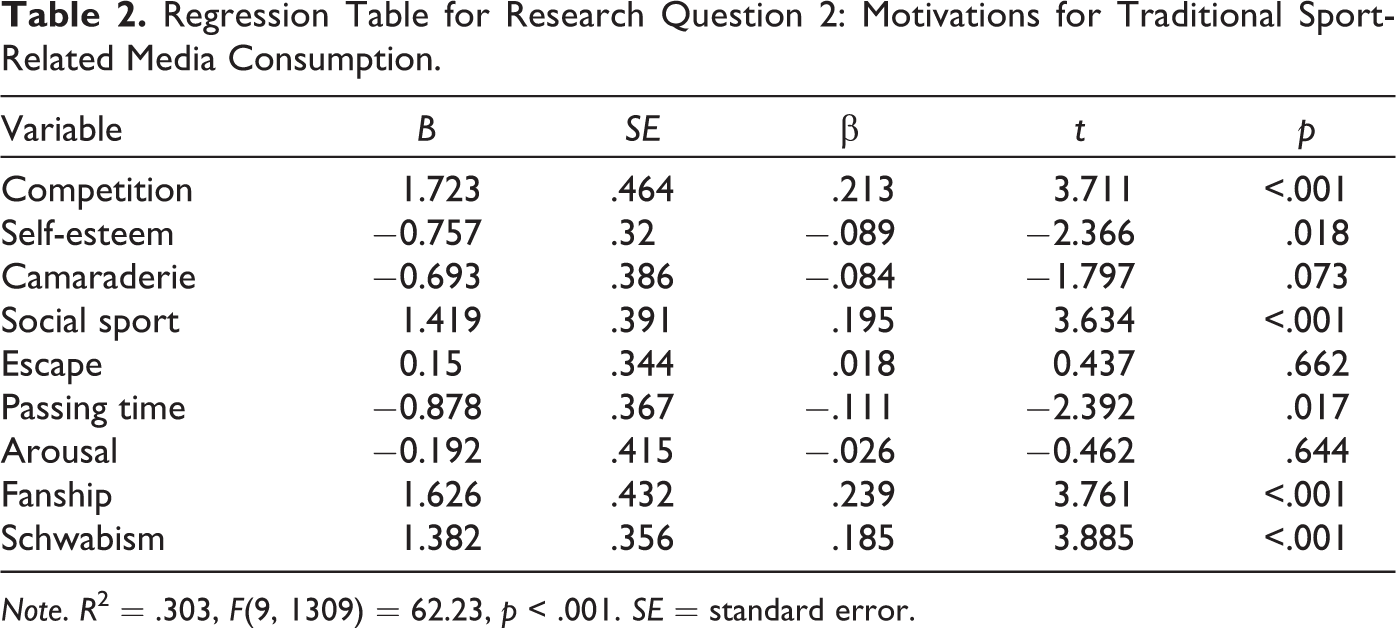
Note. R 2 = .303, F(9, 1309) = 62.23, p < .001. SE = standard error.
The third research question asked whether certain uses and gratifications differed for eSports media consumption compared to traditional sports media consumption. A multivariate, repeated-measures analysis of variance with a Bonferroni post hoc analysis was conducted for the nine uses and gratifications. The analysis revealed that there were significant differences among the nine uses and gratifications for the two types of sports media consumption, Wilks’ λ = .436, F(1, 1317) = 188.26, p < .001,
Mean Uses and Gratifications Scores for eSports and Traditional Sports Media Consumption.
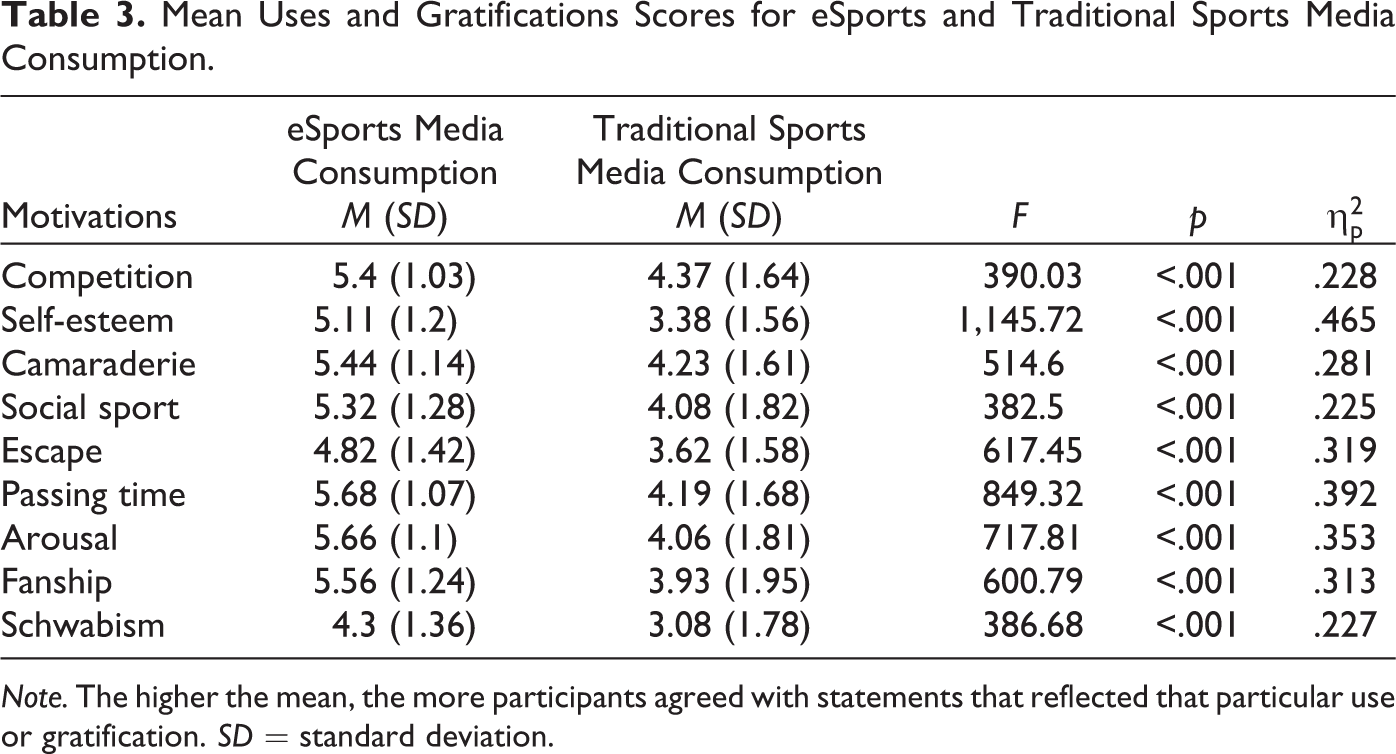
Note. The higher the mean, the more participants agreed with statements that reflected that particular use or gratification. SD = standard deviation.
The fourth research question asked whether participation in specific genres of eSport would predict the consumption of eSports-related media. A multiple regression was conducted, and based on the regression model, participation in FPS (β = .166, t = 7.565, p < .001), MMORPG (β = .097, t = 4.408, p < .001), fighting (β = .428, t = 19.463, p < .001), sports (β = .084, t = 3.853, p < .001), and MOBA (β = .32, t = 14.557, p < .001) eSport competitions were all significant, direct predictors of eSports-related media consumption, R 2 = .376, F(5, 1313) = 158.57, p < .001. All of the predictors entered into the model were significant.
The final research question asked whether participation in specific genres of eSport would predict consumption of traditional sports-related media. A multiple regression was conducted, and based on the regression model, only participation in sports-related eSports competition was a significant, direct predictor of traditional sports media consumption, β = .366, t = 14.094, p < .001; R 2 = .144, F(5, 1313) = 44.289, p < .001.
Discussion
The results of the study easily trifurcate, as the aims were to delineate eSports consumption motivations, sports consumption motivations, and a contrast between the two. If one were to simply focus on the results of the first two research questions, one would dub the motivations for both forms of consumption to be quite similar as social sport, fanship, and Schwabism motives emerged with positive βs in both cases. The negative predictors for traditional sport consumption regarding self-esteem and passing time could, at least in the case of the latter, be part of the zero-sum game of overall fandom: eSports fans simply do not have the need or desire to pass the time via traditional sport content use, presumably because of their strong avidity in the eSport realm. It is important to note that this sample was not at all intended to be representative of traditional sports fan motives, as it instead focused on self-identified eSports fans to determine their relationship with traditional sport fandom; sampling via a subreddit is, admittedly, more likely to yield more dedicated participants than the overall eSport-dedicated population. Nevertheless, we find that regardless of the two forms of sport fandom, social sport, fanship, and Schwabism appear to be core personal elements driving the uses sought with the core of their fanship. Moreover, one could even conclude that people placing importance on these three functions are the ones most likely to seek out eSports to begin with, as these same desires appear to be transferred in other areas of their lives. Thus, eSports fans seemingly crave social aspects, fanship aspects, and the desire to share knowledge/be right that is embodied in the factor of Schwabism.
However, the findings in the third research question complicate the linearity of such relationships a bit, showing that while these two forms of fandom have similar predictors for consumption, the overarching contrast of motivations show that eSports fans are clearly seeking out consumption in this realm in higher levels for each motivation tested. In fact, with the sole exception of eSport Schwabism means as compared to traditional sport competition means, one could rightly assert that motivations are always higher for eSport consumption than for traditional sport consumption within this group. One could surmise this is simple logic based on the surveying of eSports fans, yet it does illuminate that while eSports fans often exhibit behaviors akin to also being fans of traditional sport, their eSport fanship is demonstrably different than any other manner of the uses sought and gratifications attained via watching more traditional sports. eSports are not something traditional fans dabble with as a side hobby but, rather, represent a primary form of fan identification, media consumption, and overall identity. Wann (2006) argues that traditional fanship is part and parcel of one’s identification with a team, athlete, or sport; what this study shows is that one can develop such an identification within sport without being a traditional sport fan. Such a case is not generally found in other new digital activities related to digital media. For instance, Yang, Billings, and Ruihley (2017) found that traditional fanship built desires to identify with one’s favorite team without diminishing the core traditional sport media consumption motivations. Here, we find that eSports functions differently from traditional sports fandom, with some overlapping elements in terms of top predictors for consumption, yet with eSports clearly subsuming any notion or desire for major traditional sports viewership or ancillary consumption. The fact that consumption of sports-related eSports media was the only direct predictor of traditional sports media consumption only emphasizes the bifurcation found within this study.
In regard to uses and gratifications approaches (Katz et al., 1973), this study highlights that the interactive nature of eSports (typically on a laptop as the primary screen) differs from the more passive nature of traditional sports fandom (typically using television as a primary screen). Studies have shown sports fans seek out social media as a way to augment already avid viewership levels, using Twitter (Clavio & Kian, 2010) and Snapchat (Billings et al., 2017) as exemplars. It appears the desired migration of sports fans to a second screen that offers bolstered uses sought and gratifications obtained becomes more seamless for the eSport participant. As the second screen concept (Ainasoja, Linna, Heikkilä, Lammi, & Oksman, 2014; Giglietto & Selva, 2014) pertains largely to the desire to fuse the social (interactive) with the passive (consumptive) elements, one need not seek out the desires on two separate devices—as most sports fans do now, with a television as primary screen and a mobile device as secondary screen. Rather, eSports allows for the complete immersion of these motives into one-stop shops such as Twitch or simply via multiple, concurrently active windows on one’s computer. The result appears to be a consuming, focused experience in which eSports participants become fans in a fused manner in which the separation is much less pronounced.
Limitations to the study still persist, as future works should endeavor to segment out different types of eSport participation from each other, determining core difference between multiplayer online battle arena consumption and first-person shooter games, for instance. Moreover, this study was formed with core metrics built around traditional sport uses and gratifications, somewhat making these core factors base elements for comparison with eSports. Future studies would be wise to endeavor to uncover whether there are entirely different motivations for eSport consumption that are not rooted in traditional sport media consumption—or even overall media use, in general (Rubin 1994; Ruggiero, 2000).
Conclusion
This study featured a new way of understanding a rapidly ascending demographic: avid eSports fans. By exploring the key elements driving them to consume massive amounts of content—and even more hours of interactive/social engagement in the process, it appears eSports fans seek out eSports content in a manner that complements without mirroring traditional sport fandom. eSports fans also are frequently fans of traditional sport options, yet these do not predicate eSports consumption but rather are part and parcel of being a person who seeks the motivations Raney (2006) outlined over a decade ago. However, it is the magnitude of the motives that truly set eSports fans apart, showing far more dedication and desire to engage with eSport content than in any other realm of the sporting arena. As such, eSports consumers should be regarded as major players within the sporting world—all while acknowledging they do not seek out any other sport-based media product with nearly the avidity that is found in the specific—and growing—eSports landscape.
Footnotes
Declaration of Conflicting Interests
The author(s) declared no potential conflicts of interest with respect to the research, authorship, and/or publication of this article.
Funding
The author(s) received no financial support for the research, authorship, and/or publication of this article.