




Abstract
Through the lens of agenda-setting theory, this article investigates whether women’s sports coverage in mainstream newspapers increased after the passage of Title IX, consistent with the expectation that greater equality in athletics and the requirement that schools provide equality in publicity would lead to greater volume and prominence in coverage. Researchers conducted a quantitative content analysis of randomly selected front pages of sports sections from large-, medium-, and small-city newspapers for 10-year intervals in the period 1932–2012 (40 years before and after Title IX’s 1972 passage). Numbers of articles and photos and the square area devoted to them in each year were calculated. The researchers found traditional patterns of story placement and inequality persisted in large-city newspapers over the 80-year span, but small-city and medium-city newspaper coverage changed in favor of women’s sports. Thus, this article explores the thesis that proximity to women’s sports correlates to greater equality of coverage and the advancement of women’s sports. This article provides a springboard for future investigation into a larger question of the role local media play in advancing social change and social movements and suggests local media might be more effective, even if unintentionally, than big media.
Title IX of the Education Amendments of 1972 says, “No person in the United States shall, on the basis of sex, be excluded from participation in, be denied the benefits of, or be subjected to discrimination under any education program or activity receiving Federal financial assistance…” (U.S. Department of Health, Education, and Welfare, 1979, p. 71,413). It was the first comprehensive federal law to prohibit sex discrimination at educational institutions—public or private—that receive federal funding, even indirectly. The law requires educational institutions to maintain policies and programs that do not discriminate based on sex. Under Title IX, men and women are expected to receive equal treatment in all areas of schooling, including financial aid and scholarships, work-study employment, facilities, housing, scholarships, and, most relevant to this study, athletics. Moreover, in regard to athletics, the law mandates that educational institutions demonstrate equality not only in matters relevant to sports participation but also in promotion and publicity of men’s and women’s sports and of male and female student-athletes.
Scholars have suggested that Title IX marked a significant moment in women’s quest for equality, especially in athletics (e.g., Kane, 1989; Kane & Buysse, 2005; McGinnis, McQuillan, & Chapple, 2005; Messner, 1988, 2002). As evidence of this, proponents of Title IX point to the fact that since the passage of the law, for example, opportunities for women to participate in athletics have changed dramatically. Indeed, of the 7.7 million high school athletes in the United States in 2010, over 3 million were girls (National Federation of State High School Associations, 2014), while fewer than 300,000 of the 4 million high school athletes in 1972 were girls (National Federation of State High School Associations, 2014). The number of female athletes at National Collegiate Athletic Association (NCAA) schools increased from fewer than 30,000 to nearly 200,000 in the same period (NCAA, 2013), though it should be noted that the NCAA did not sponsor sports until the 1980s (NCAA, 2005). Meanwhile, increases in girls’ and women’s sports participation have not translated into commensurate increases in the volume of media coverage about girls’ and women’s sports, making this one of the most widely examined areas of “contested terrain” since the passage of Title IX (Messner, 1988).
Several researchers have focused on inequity of coverage of men’s and women’s sports, including in terms of volume and prominence of coverage (e.g., Fink, 2015; Lumby, Caple, & Greenwood, 2010; Zurn, Lopiano, & Snyder, 2006). Nearly all such research has focused on relatively narrow time frames—and typically only post-Title IX periods. Thus, while there has been much focus on inequity in sports media coverage, there has been little opportunity afforded to speculate on the actual impact of Title IX or broader social changes, like the women’s liberation movement. Yet in an exploratory study comparing the front pages of two Minneapolis–St. Paul, Minnesota, newspapers’ sports sections from 1940, 1950, 1960, 1970, 1980, 1990, 2000, and 2005, Kaiser and Skoglund (2006) found, counterintuitively, no significant difference in the newspaper coverage of women’s sports. They recommended doing a more rigorous study on major newspapers.
Some previous research has focused on specific high-profile athletic events (e.g., Crossman, Vincent, & Speed, 2007; Mason & Rail, 2006; Vincent & Crossman, 2012), on sports-specific media (e.g., Hardin, Lynn, Walsdorf, & Hardin, 2002), or on national or big-city media (e.g., Chang, Crossman, Taylor, & Walker, 2011; Vincent & Crossman, 2012). There has been less effort to examine possible differences in the overall everyday coverage of men’s and women’s sports in general-consumption media or to examine general-consumption media of different sizes. Still, Wann, Schrader, Allison, and McGeorge (1998) found inequitable coverage of men’s and women’s athletics in different-sized university newspapers, with greater inequity appearing at the larger universities than at medium-sized or small universities, which raises the question of whether media sizes are related to the replication and perpetuation of inequality.
Therefore, animated by gaps in the existing literature and with a dual purpose, the present work examined an 80-year span of general sports coverage in newspapers from cities of different sizes. First, this study sought to discern whether Title IX and related movements have had an impact on gender equality in sports coverage, the Kaiser and Skoglund (2006) research being the impetus and the 80-year span allowing an adequate historical perspective. Second, this study analyzed whether newspapers of different circulation and city sizes have shown differing degrees of movement toward or intransigence against equality, with Wann et al.’s (1998) findings as the motivation.
Review of the Literature
Decision makers involved in the production of news media ultimately are the people who set the agenda for media consumers, in terms of what the consumers believe is important, by publishing or broadcasting stories on certain topics and not on others (Graber, 1988). Graber (1988) determined the stories that caught the attention of readers did so because of their location in the newspaper, because of the size of their headlines, and because of their length; moreover, newspaper readers indicated that they believed the most important news stories were exactly those that caught their attention. By featuring certain stories more prominently than others, newspaper decision makers suggest which events are most deserving of readers’ attention (Althaus & Tewksbury, 2002). When agenda-setting occurs over an extended period, it instills in media consumers a dominant judgment of the importance—or, by corollary, the unimportance—of a phenomenon and establishes a hegemonic pattern (McCombs, 2005). Thus, the paucity of women’s everyday sports coverage has served to cast women’s sports as inferior to and less important than men’s sports (Godoy-Pressland & Griggs, 2014; Lumby et al., 2010) and, over time, has created and perpetuated a masculine media hegemonic pattern (Cooky, Messner, & Hextrum, 2013).
A few researchers have taken a long-term view to examine what, if any, changes might have occurred or where they occurred in the coverage of men’s and women’s sports. In a study that showed men’s and women’s sports coverage trends over a period notably encompassing the passage and implementation of Title IX, like the present research, Reid and Soley (1979) examined the coverage of women in Sports Illustrated from 1956 to 1976 and found little change over those two decades in the amount of coverage or amount of feature story coverage of women in sports. Another researcher (Bishop, 2003) extended this research to 1996 and found little change over the next two decades of coverage. In another study, Urquhart and Crossman (1999) analyzed a Canadian publication’s coverage of the Winter Olympics from 1924 to 1992. They found that women received more print space after 1960 and attributed the increase and anomalous ebbs and flows in coverage to correlate to women’s participation rates in the Olympics and to Canadian women athletes’ success. It should be noted that Canada did not have a watershed policy change in the 1924–1992 period like the United States had with Title IX in 1972.
Cooky, Messner, and Musto (2015) found the volume of coverage of women’s sports to be extremely and consistently low in Los Angeles network television affiliates’ sports coverage and Entertainment and Sports Programming Network’s SportsCenter from 1989 to 2014. While this research took a long-term view, the period that was analyzed resided exclusively after the passage of Title IX. In a study that also relied on data from a period well after the passage of Title IX and from another specific athletic event context—the 1994, 1996, and 1998 Olympics—Eastman and Billings (1999) found the proportion of coverage of men’s and women’s sports to remain at the same imbalanced, men’s sports-dominated levels from one Olympics to the next. Smith (2011) found social media coverage of men’s and women’s sports in the United States actually to have increased in disparity, thus raising the question of how inequality might have changed—even increased—in other media and over a longer period.
With Title IX being a watershed moment for women’s sports, a casual observer might expect to see a discernible pre- to post-Title IX increase in the volume of everyday, prominently placed women’s sports coverage, even in the face of hegemonic resistance. After all, reporters ostensibly would have much more women’s sports activity available to cover, and they would supposedly be receiving from educational institutions equal amounts of publicity about men’s and women’s sports and about male and female student-athletes. Yet existing research has shown that, even well after the passage of Title IX, the overall amount of media coverage of women’s athletics was and continued to be far less than the amount devoted to men’s athletics (e.g., Eastman & Billings, 2000; Fink, 2015; Lumby et al., 2010; Sage & Furst, 1994; Wann et al., 1998). Thus, there should be no expectation to find equity at any level.
Still, Wann et al.’s (1998) findings among American university newspapers suggested that the size of a newspaper’s audience might be inversely related to equity in coverage of men’s and women’s sports. Yet little research has examined small versus large market media. One exception was Hull’s (2016) study on the Twitter activity of local sports broadcasters versus bigger market broadcasters in the United States in which he found an inverse relationship between media market size and percentage of tweets about women’s sports. Because Wann et al. (1998) and Hull’s (2016) research examined relatively short periods well after the passage of Title IX, questions remain regarding whether Title IX had an impact or whether the inverse relationship between market size and equality of coverage always existed.
In addition, Neveu (2002) observed a phenomenon in France in which local press provide more friendly coverage of social movements to which they are situated more closely than larger press do, as long as they do not experience opposition. Coverage of a social movement is different from coverage of women’s sports, though the mere coverage of women’s sports provides implicit and sometimes explicit support of a social movement narrative and thus in general could be considered a challenge to hegemonic sports media coverage. Thus, local press could be greater agents of social change than bigger press. Taking this proximity thesis, as it will be called here, to its logical extreme, Kirste (2015) discussed how everyday home movie producers—often parents—commonly filmed girls playing sports and thus produced a collection of work exhibiting far greater equality than typical media.
Given all the literature suggesting coverage of women’s sports has not increased over time, and yet given Title IX’s requirements to provide equality of opportunity to participate in sports and to provide equality of promotions and publicity, the present study investigated the following research question and posited a pair of corresponding null hypotheses.
Given the literature suggesting the possible existence of an inverse relationship between media market size and volume of coverage of women’s sports (Hull, 2016; Wann et al., 1998), the following research question was posited, along with a corresponding hypothesis.
Finally, given the combination of increased women’s sports participation and supposedly also publicity about women’s sports and female student-athletes, as well as the nascent proximity thesis implied by Neveu (2002) and Kirste’s (2015) observations, the following hypothesis was extended from the second research question, as well.
Method
A quantitative content analysis was conducted on a random sample of front pages of sports sections of three large-city daily newspapers, three medium-city daily newspapers, and three small-city daily newspapers from 1932, 1942, 1952, and 1962 (the four decade intervals preceding the 1972 passage of Title IX) and from 1982, 1992, 2002, and 2012 (the four decade intervals following the passage of Title IX). While no one reader would probably consume information from all of these newspapers in a day, the data set extracted from them would nevertheless generally represent the everyday sports media available at the times. Medium-city newspapers were included to provide a trend check.
The large-city newspapers chosen were the Washington Post, The New York Times, and the Chicago Tribune. The Washington Post was chosen for analysis because there is evidence to suggest it is influential with federal policy makers, relevant to Title IX (Hess, 1984); The New York Times was chosen because of its agenda-setting role within the news media (Dearing & Rogers, 1996); and the Chicago Tribune was chosen for its non-East Coast perspective and because in 1932, Chicago was the second most populous city in the United States, behind New York, and fell from that position only in the 1990 census, when Los Angeles moved into the second place position and Chicago fell to third (U.S. Census Bureau, 1998), where it and its greater metropolitan area remained through the period of analysis (U.S. Census Bureau, 2013). In addition to the residence of the important newspapers used here, all of these cities were categorized as “large” for the purposes of this study because their metropolitan area populations were in the national top 10 for the entire period of analysis (U.S. Census Bureau, 2013).
The three medium-city newspapers chosen were the Chattanooga (Tennessee) Times, the Albany (New York) Times Union, and The Peoria (Illinois) Star. These were chosen because of their proximity to the three large-city newspapers and characterized as “medium-sized” because their populations were around 100,000 in both 1932 and 2012 (U.S. Census Bureau, 2013), because each constitutes a distinct metropolitan area in its own right, and because none of them house Major League Baseball, National Basketball Association, National Football League, or National Hockey League teams. To find a newspaper fitting these criteria near Washington, DC, was difficult, because most nearby cities’ populations had increased considerably between 1932 and 2012; therefore, the Chattanooga Times was accepted, even though situated 600 miles from Washington, DC, because Chattanooga is a Southern city—that is, south of the Mason-Dixon line—like Washington, DC, and potentially provides a different regional perspective than the New York or Illinois areas. The availability of other choices notwithstanding, the Albany Times Union was chosen because of the city’s status as New York’s state capital. The Peoria Star was chosen not only because it fit the criteria but also because of the enduring, vaudeville-era phrase “Will It Play in Peoria?” and because Peoria has been called the “ideal place to take the pulse of the nation on political campaigns and proposed legislation” (Groh, 2009).
The small-city newspapers were chosen similarly in terms of geography and for having populations of around 10,000—the minimum to be defined as a “micropolitan” area, according to the U.S. Office of Management and Budget (2000)—in both 1932 and 2012 (U.S. Census Bureau, 2013) and also for having daily newspapers: Bluefield (West Virginia) Daily Telegraph, Oneonta (New York) Daily Star, and Canton (Illinois) Daily Ledger. Again, to find a newspaper fitting the criteria near Washington, DC, was difficult because most nearby cities’ populations increased considerably between 1932 and 2012. In addition, it was a challenge to find three newspapers in cities of the desired size whose newspapers existed in available archives and whose newspapers had run continuously during the period. Some small-city newspapers’ back issues have not been preserved in archives, and many others that existed in 1932 had gone out of business by 2012—indeed, often just before 2012—or by then had been amalgamated into larger cities’ newspapers.
The data set included 12 front pages of the sports sections from each of the nine newspapers for each of the years 1932, 1942, 1952, 1962, 1982, 1992, 2002, and 2012, for a total of 864 pages. All of the newspapers analyzed contained a daily sports section. Consequently, the pages to be retrieved were chosen by extracting random numbers 1 through 365 (the number of days in 1942, 1962, 1982, and 2002) or by 366 (the number of days in 1932, 1952, 1992, and 2012, which were leap years) through a random integer generator at random.org. Different random numbers were drawn for each newspaper and thus the dates selected for each year of each newspaper were independent of one another. Most of the front pages of the sports pages for the corresponding dates were retrieved from microfilm and microfiche, though PDFs were available in online databases in the case of the recent large-city newspapers. In the rare instances where an edition of a newspaper was missing from the available resources, researchers procured the front page of the next day’s sports section.
For the purposes of this study, prominence was defined by (1) the simple numerical appearance of sports articles and photographs about women and men on the first page of a newspaper’s sports section; (2) the specific position of articles and photographs on the first page of the sports section, either above or below “the fold,” with appearance above the fold being defined as more prominent than appearance below the fold; and (3) the amount of space on the first page of the newspaper’s sports section devoted to relevant articles and photographs.
The number of articles covering solely men’s, solely women’s, and mixed/coed athletic activities (i.e., either articles about mixed/coed sports or articles containing mentions of both male and female athletes/sports) on each newspaper’s front sports pages was recorded. The number of articles beginning in the top half of the front sports page (above the fold) covering men’s, women’s, and mixed/coed athletic activity in each newspaper was recorded. The term “athletic activity” was applied liberally to include every conceivable sport, competition, and physical pursuit, as well as professional and Olympic sports, as it was thought that Title IX would not only have increased participation in women’s high school and collegiate athletics but that it would also increase social acceptance of women’s participation in this wide range of physical and competitive activity.
The number of photographs covering solely men’s, solely women’s, and mixed/coed athletic activities on each newspaper’s front sports page was recorded, as was the number of those photographs appearing above the fold. As with articles, photographs were coded and counted liberally to include as much activity as possible. Photographs were analyzed and coded separately from the articles they accompanied. Therefore, for example, a photograph of a man accompanying a mixed/coed article was coded as a men’s athletics photograph, and a photograph of a woman athlete accompanying a mixed/coed article was coded as a women’s athletics photograph. Only photographs that pictured both male and female athletes were coded as mixed/coed photographs.
The amount of print space and the amount of photographic space devoted to solely men’s, solely women’s, and mixed/coed athletic activity were recorded in square millimeters. Measuring square area is a standard practice in analyzing photographic content; for articles, measuring square area is one of several standard procedures, along with word count or measurement of column inches (Lynch & Peer, 2002). Measuring square area made sense for this study because of the newspapers’ different layouts and changing type sizes—especially headlines—during the period under analysis. Measuring square area also reduced the challenges presented by fluctuating sentence and word structures, which create differing levels of readability over time (Fowler & Smith, 1979). Ultimately, this allowed for an analysis of the real estate occupied by men and women on the sports pages. The square area measurements were standardized to a uniform page size to take into account the various sizes of the pages retrieved from the archives.
A standard process and commonly accepted procedures were used to check the reliability of the coding scheme. Two undergraduate research assistants were recruited and trained to code 10% of the sample of newspapers. There were no discrepancies found between the coders’ and the primary investigator’s work; therefore, the agreement percentage was 100%, and the full sample could be coded confidently.
The quantitative analysis here involved the χ2 test, which has long been a common statistical methodology to determine statistical significance of the relationship between groups (Fry, 1938). χ2 allows for an analysis of goodness of fit, which is a standard test with no serious substitute and allows for testing whether there was a relationship between two categorical variables (Cochran, 1952). Specifically, goodness of fit tests the relationship between the observed incidences obtained from one data group and the observed instances obtained from another group. Within the present work, χ2 tests were used to test the relationship between newspaper publication years and between media market sizes. Because multiple independent statistical tests were performed on a single data set, a Bonferroni correction (p = .001) was utilized to reduce the risk of Type I errors (Cabin & Mitchell, 2000).
Findings
Number of Articles
Table 1 shows the percentage of articles about men’s, women’s, and mixed/coed sports in the 1932, 1942, 1952, 1962, 1982, 1992, 2002, and 2012 editions of the selected large-, medium-, and small-city newspapers. Percentages are presented to show coverage trends more clearly than presenting raw numbers of articles would have allowed—newspaper formats changed drastically over the period under analysis, with the average number of articles appearing on the front page of the sports section being 18.2 in 1932 and 6.6 in 2012.
Percentage of Articles About Men’s, Women’s, and Mixed/Coed Sports, 1932, 1942, 1952, 1962, 1982, 1992, 2002, and 2012.
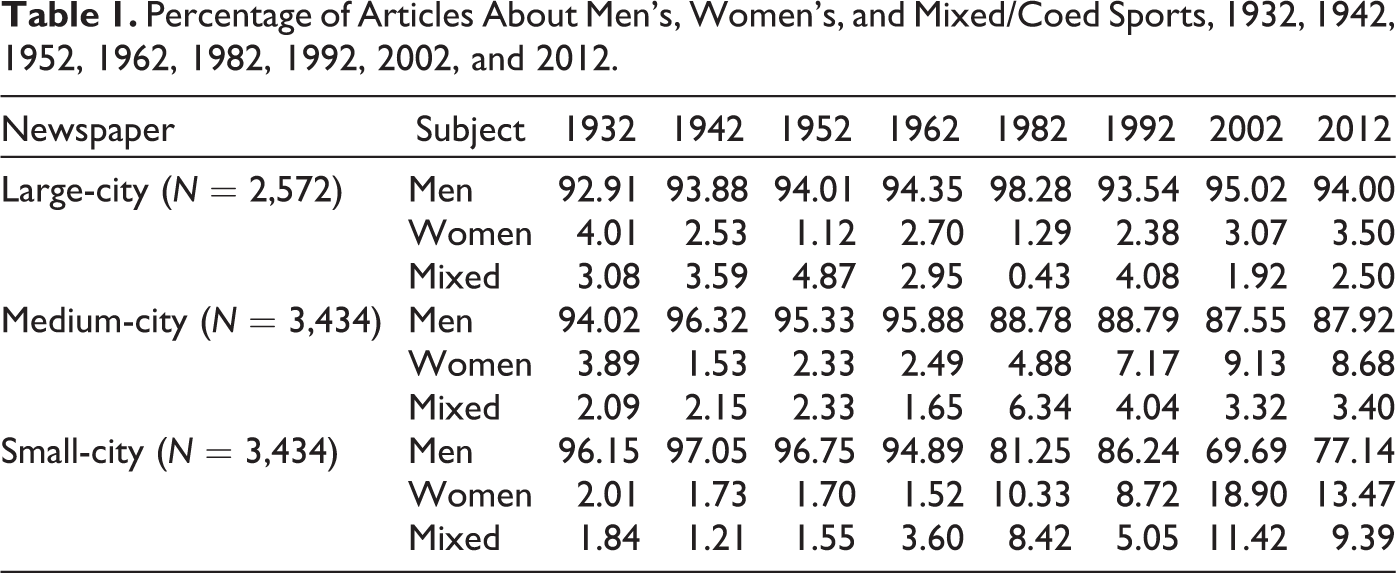
The difference in the proportion of articles devoted to men’s sports in the large- and medium-city newspapers was significant, overall, χ2(7, n = 6,080) = 61.7, p < .001, as was the difference between medium- and small-city newspapers, χ2(7, n = 6,321) = 48.4, p < .001. The number of articles devoted to women’s sports and coed sports was so small in some years as to make statistical tests unreliable, but the men’s article statistics by corollary provide insight into women’s and coed coverage, because if articles were not about men’s sports, then they contained coverage of women under the coding scheme used here.
In addition, for the pre-Title IX (pre-1972) years, there was no significant difference between large- and medium-city newspapers or between medium- and small-city newspapers, in terms of the proportion of articles devoted to men’s sports. However, the difference between large- and small-city newspapers was significant, χ2(3, n = 4,195) = 17.3, p = .001, with the small-city newspaper in this period devoting more articles to men’s sports. In other words, there was a correlation between the size of the newspaper and the amount of coverage of women’s sports: The smaller the newspaper, the smaller the amount of women’s sports coverage.
For the post-Title IX years, there was a significant difference between the large- and medium-city newspapers, χ2(3, n = 1,763) = 18.1, p < .001, with the large-city newspapers devoting more articles to men’s sports. There was also a significant difference between the medium- and small-city newspapers, χ2(3, n = 1,677) = 35.8, p < .001, with the medium-city newspapers devoting more articles to men’s sports. Thus, there was also a significant difference between the large- and small-city newspapers, χ2(3, n = 1,792) = 33.7, p < .001. The upshot of this is that the changes in the proportions of articles devoted to men’s, women’s, and coed sports appeared in the post-Title IX era and were more pronounced the smaller the newspaper. In other words, an inverse relationship obtained between the newspaper market size and the proportion of articles devoted to women’s sports—exactly the opposite of what was a found with the pre-Title IX era small-city newspapers.
Indeed, aggregating pre- and post-Title IX numbers and comparing them yielded no significant difference between the proportions of articles devoted to men’s and women’s sports in the large-city newspapers, χ2(1, n = 3,008) = 0.253, p = .615, including when coed sports articles were added to the number of women’s sports articles, χ2(1, n = 3,106) = 3.67, p = .055. Yet for medium-city newspapers, the proportion of articles devoted to men’s and women’s sports was significantly different between the two periods, χ2(1, n = 3,343) = 46.8, p < .001, including when coed sports articles were added to the number of women’s sports articles, χ2(1, n = 3,434) = 55.5, p < .001. Similarly for small-city newspapers, the proportion of articles devoted to men’s and women’s sports was significantly different between the pre- and post-Title IX eras, χ2(1, n = 3,293) = 199.0, p < .001, including when coed sports articles were added to the number of women’s sports articles, χ2(1, n = 3,434) = 273.0, p < .001.
Number of Articles Above the Fold
Percentage of Above-the-Fold Articles About Men’s, Women’s, and Mixed/Coed Sports, 1932, 1942, 1952, 1962, 1982, 1992, 2002, and 2012.
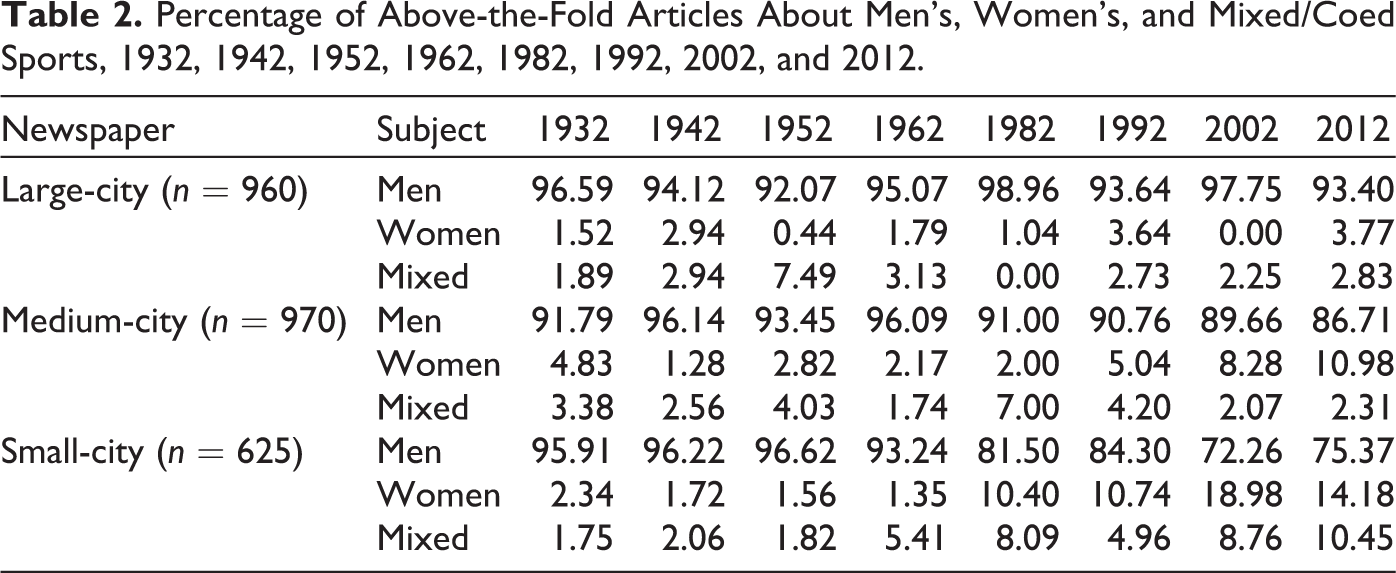
For the pre-Title IX (pre-1972) years, there was no significant difference between large- and medium-city newspapers, between medium- and small-city newspapers, or between large- and small-city newspapers, in terms of the proportion of above-the-fold articles devoted to men’s sports. For the post-Title IX years, there was no significant difference between the large- and medium-city newspapers, χ2(3, n = 863) = 8.82, p = .032, though the percentages shown in Table 2 show a trend toward greater men’s sports coverage in the large-city newspapers. There was a significant difference between the medium- and small-city newspapers, χ2(3, n = 922) = 23.3, p < .001, with the medium-city newspapers devoting more articles to men’s sports. Thus, the above-the-fold findings largely mirror the full-page findings.
Indeed, aggregating pre- and post-Title IX numbers and comparing them yielded no significant difference between the proportions of above-the-fold articles devoted to men’s and women’s sports in the large-city newspapers, χ2(1, n = 1,286) = 2.38, p = .123, including when coed sports articles were added to the number of women’s sports articles, χ2(1, n = 1,344) = 8.88, p = .003. Yet for medium-city newspapers, the proportion of articles devoted to men’s and women’s sports was significantly different between the two periods, χ2(1, n = 1,409) = 16.9, p < .001, including when coed sports articles were added to the number of women’s sports articles, χ2(1, n = 1,455) = 12.8, p < .001. Similarly for small-city newspapers, the proportion of articles devoted to men’s and women’s sports was significantly different between the pre- and post-Title IX eras, χ2(1, n = 1,798) = 177.0, p < .001, including when coed sports articles were added to the number of women’s sports articles, χ2(1, n = 1,879) = 135.0, p < .001.
Number of Photographs
Table 3 shows the percentage of photographs depicting men’s, women’s, and mixed/coed sports in the 1932, 1942, 1952, 1962, 1982, 1992, 2002, and 2012 editions of the selected large-, medium-, and small-city newspapers. As with articles, percentages are presented to show coverage trends more clearly than presenting raw numbers of photographs would have allowed. Even as newspaper formats changed over the period under analysis to contain fewer articles on the front pages of the sports section, they changed to contain more photographs, increasing from 2.0 on average each day in 1932 to 4.2 on average each day in 2012.
Percentage of Photographs About Men’s, Women’s, and Mixed/Coed Sports, 1932, 1942, 1952, 1962, 1982, 1992, 2002, and 2012.
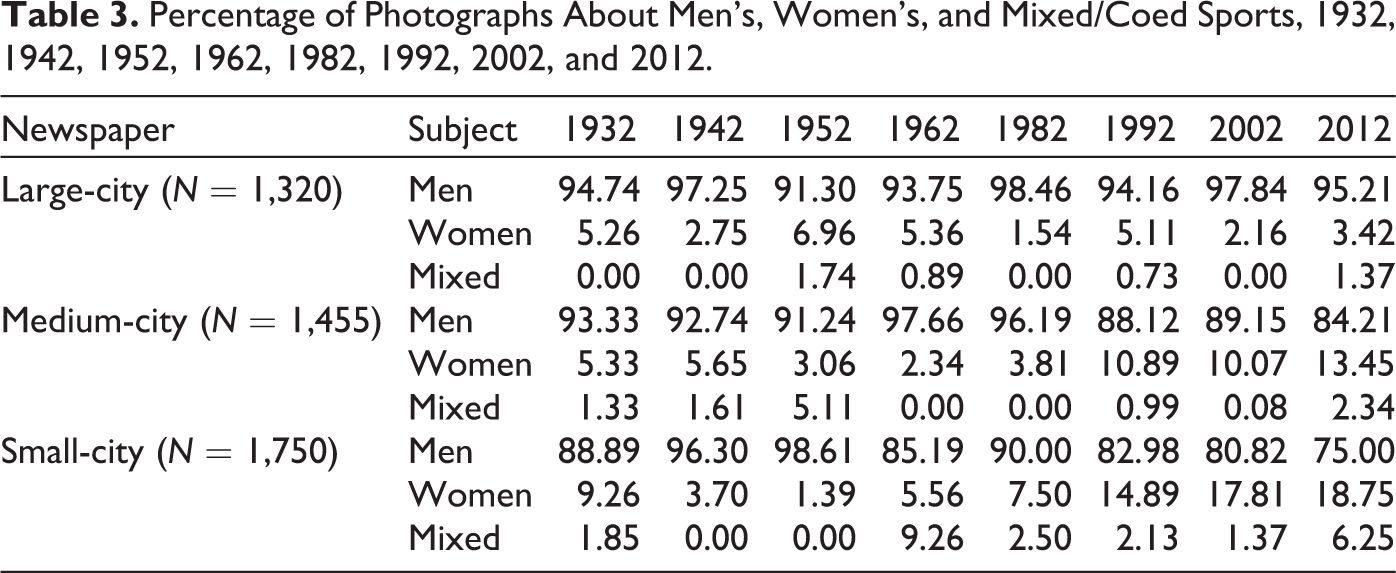
The difference in the proportion of photographs depicting men’s sports in the large- and medium-city newspapers was not significant, χ2(7, n = 1,804) = 15.5, p = .030, overall, though the difference between medium- and small-city newspapers was significant, χ2(7, n = 1,418) = 42.5, p < .001. Just as with articles, the number of photographs depicting women’s sports and coed sports was so small in some years as to make statistical tests unreliable. Yet the men’s photograph statistics by corollary provide insight into women’s and coed coverage, because if photographs did not depict exclusively men’s sports, then they depicted women in sports under the coding scheme used here.
Aggregating pre- and post-Title IX numbers and comparing them yielded no significant difference between the proportions of photographs depicting men’s and women’s sports in the large-city newspapers, χ2(1, n = 958) = 2.56, p = .110, including when coed sports photographs were added to the number of women’s sports photographs, χ2(1, n = 964) = 2.63, p = .105. Yet for medium-city newspapers, the proportion of photographs depicting men’s and women’s sports was significantly different between the two periods, χ2(1, n = 954) = 12.7, p < .001, though not when coed sports photographs were added to the number of women’s sports photographs, χ2(1, n = 970) = 7.53, p = .006. For small-city newspapers, the proportion of photographs depicting men’s and women’s sports was significantly different between the pre- and post-Title IX eras, χ2(1, n = 608) = 15.1, p < .001, including when coed sports articles were added to the number of women’s sports articles, χ2(1, n = 625) = 13.4, p < .001.
Number of Photographs Above the Fold
Percentage of Above-the-Fold Photographs About Men’s, Women’s, and Mixed/Coed Sports, 1932, 1942, 1952, 1962, 1982, 1992, 2002, and 2012.
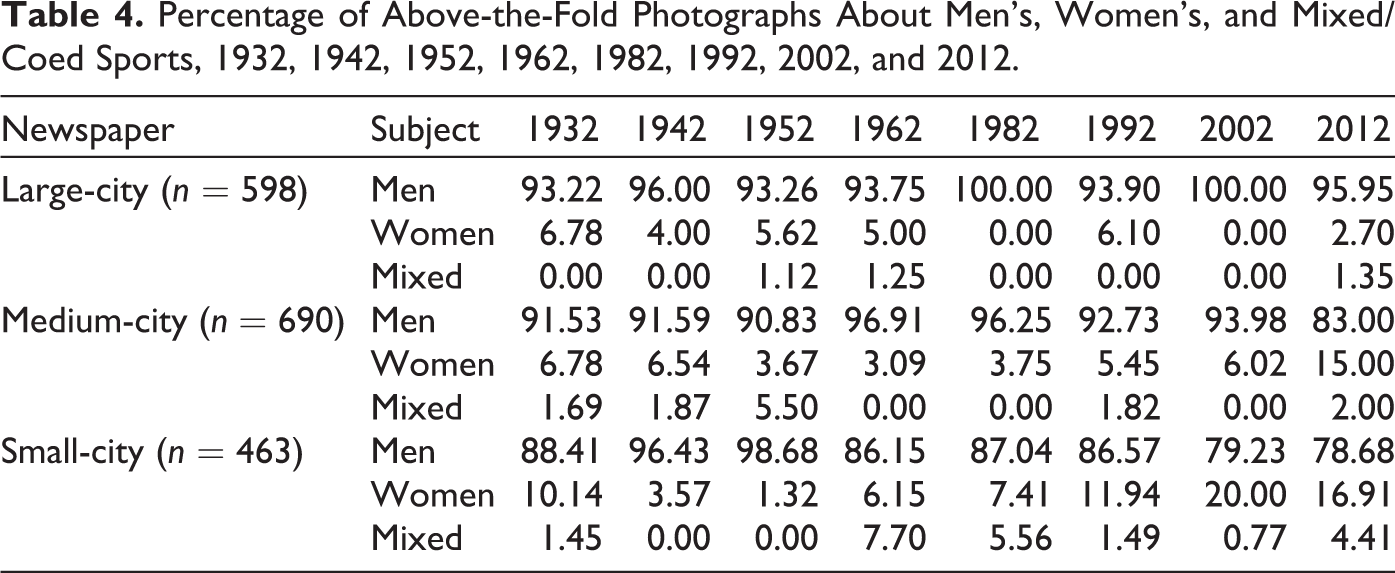
Aggregating pre- and post-Title IX numbers and comparing them yielded no significant difference between the proportions of above-the-fold photographs depicting men’s and women’s sports in the large-city newspapers, χ2(1, n = 602) = 1.06, p = .304, including when coed sports photographs were added to the number of women’s sports photographs, χ2(1, n = 605) = 1.39, p = .238, or in the medium-city newspapers, χ2(1, n = 678) = 3.02, p = .082, even when coed sports photographs were added to the number of women’s sports photographs, χ2(1, n = 690) = .797, p = .372. Yet for small-city newspapers, the proportion of photographs depicting men’s and women’s sports was significantly different between the pre- and post-Title IX eras, χ2(1, n = 448) = 14.8, p < .001, including when coed sports articles were added to the number of women’s sports articles, χ2(1, n = 463) = 13.0, p < .001.
Area of Articles and Photographs
Percentage of Square Area of Articles About Men’s, Women’s, and Mixed/Coed Sports, 1932, 1942, 1952, 1962, 1982, 1992, 2002, and 2012.
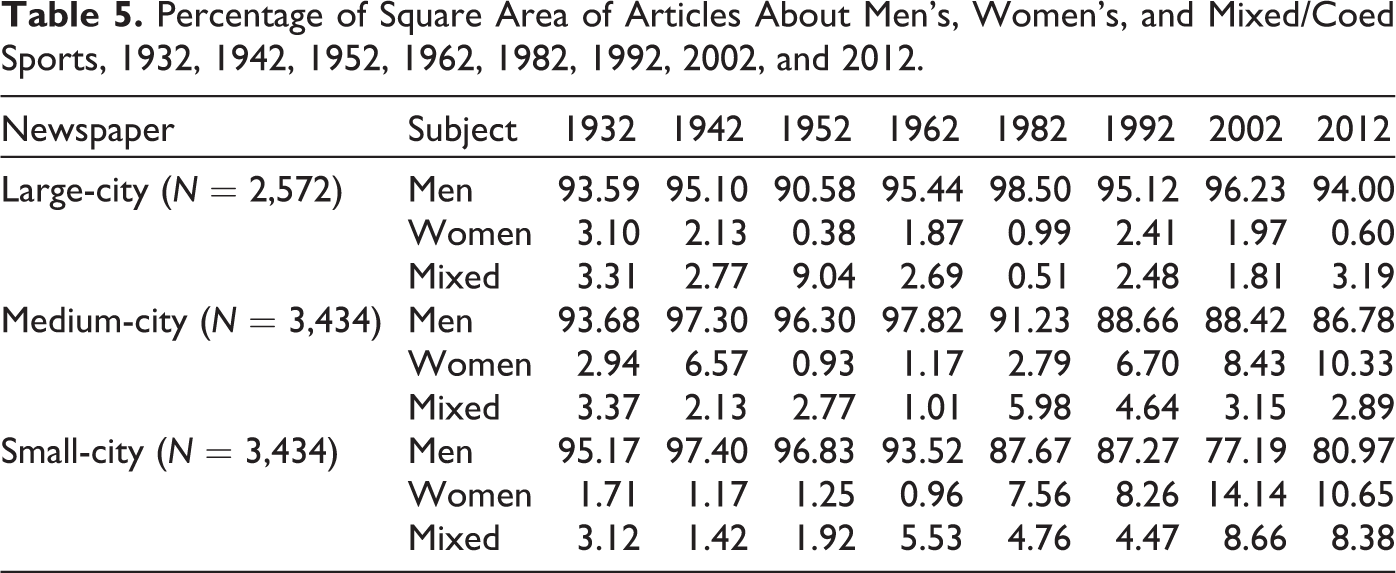
Percentage of Square Area of Above-the-Fold Articles About Men’s, Women’s, and Mixed/Coed Sports, 1932, 1942, 1952, 1962, 1982, 1992, 2002, and 2012.
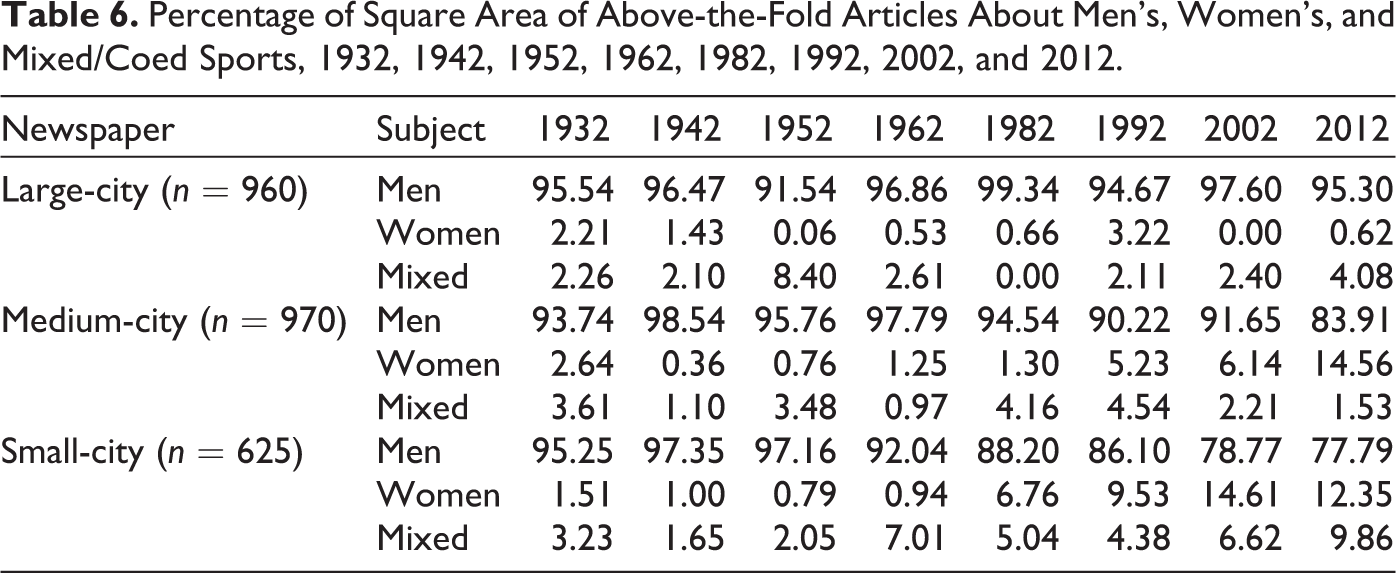
Percentage of Square Area of Photographs About Men’s, Women’s, and Mixed/Coed Sports, 1932, 1942, 1952, 1962, 1982, 1992, 2002, and 2012.
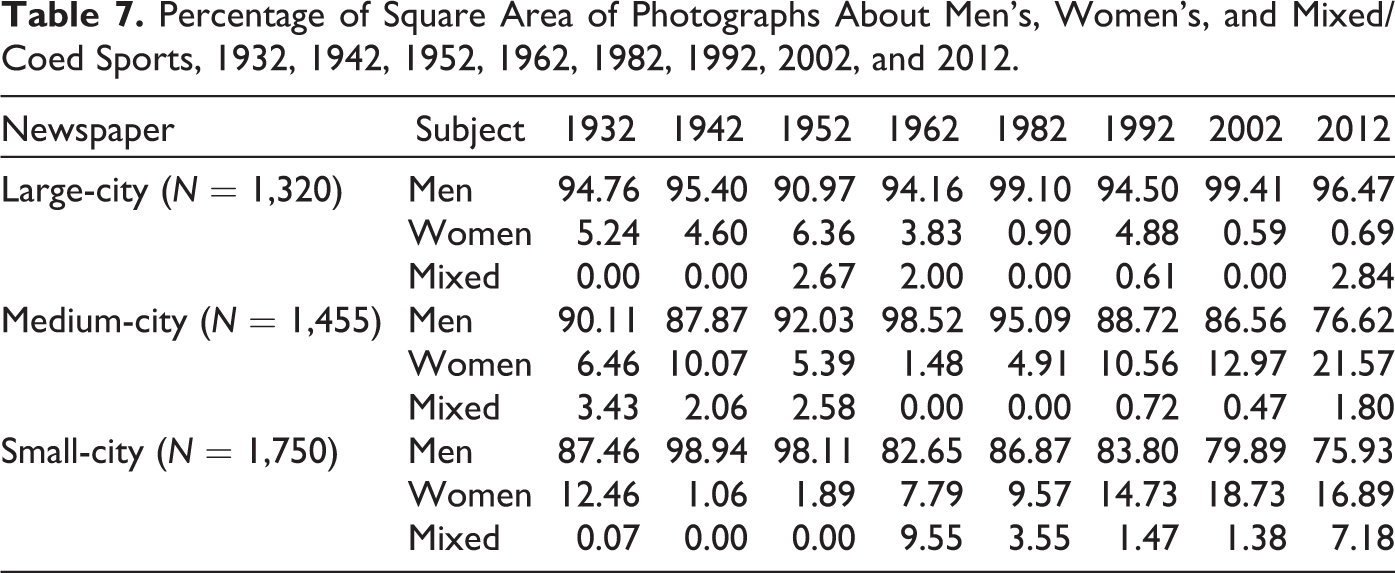
Percentage of Square Area of Above-the-Fold Photographs About Men’s, Women’s, and Mixed/Coed Sports, 1932, 1942, 1952, 1962, 1982, 1992, 2002, and 2012.

Discussion
A cursory review of the data in Table 1 reveals a shift in men’s and women’s sports coverage trends in the medium- and small-city newspapers sometime between 1962 and 1982. Given the increase in girls’ and women’s participation in sports and the mandated increase in publicity about women’s sports and female athletes, it is easy to suggest that Title IX was at least partly to credit for this shift in newspaper coverage. Still, Title IX cannot be identified definitively as the sole or even the main reason for the coverage shift, especially inasmuch as other societal changes were taking place in this period. Moreover, the trend in photographic coverage as shown in Table 3 does not shift as distinctly as the article coverage in that same space. In any case, the medium- and small-city newspapers show a change toward greater equality of coverage for girls’ and women’s sports while the large-city newspapers do not.
Consequently, the first and second hypotheses—that there would be no significant difference in the quantity of prominently placed (1) articles and (2) photographs about women’s sports in U.S. newspapers pre- and post-Title IX—were supported by the full-page large-city newspaper data. The number of articles and photographs devoted to women’s athletic activities and the number of articles and photographs about women’s athletics starting above the fold were also not significantly different in the post-Title IX period than in pre-Title IX period in the large-city newspapers. By contrast, the first hypothesis could be rejected by the medium- and small-city newspaper article data. Yet the second hypothesis could be rejected by the medium-city newspapers only when coed photographs were not considered. Still, the second hypothesis could be rejected by the small-city newspaper photographs data, with and without coed photographs included in the analysis.
A closer consideration of the evidence from the large-city newspapers would suggest that the situation might be even less positive for female athletes than the data suggest at first glance. Given the increased participation of women in athletics and the supposedly increased publicity about women’s sports and female student-athletes since the passage of Title IX, the lack of a commensurate increase in the volume of prominent newspaper coverage of women in athletics in the large-city newspapers could be considered a regression: The activities of the few women involved in athletics in 1932 arguably were more likely to appear prominently than the activities of the many women involved in athletics after 40 years under Title IX. In other words, for front-of-sports-page coverage to have remained similar from 1932 to 2012 in the large-city newspapers, the hegemonic pattern suggesting that men’s sports are more important than women’s sports would have to have been strengthened through day-to-day agenda-setting. The medium- and small-city newspapers reflected at least marginal improvement for women and a possible weakening of the hegemonic pattern, at least in regard to articles, if not always in the case of photographs.
The third hypothesis—that the smaller the newspaper market is, the greater will be the quantity of prominently placed articles and photographs of women’s sports in the newspaper—was not supported by the pre-Title IX data. In fact, for the small-city newspapers, significance was obtained in the opposite direction of what was hypothesized, in looking at the whole-page article data from this period. For the post-Title IX period, both the article and photograph data generally supported the hypothesis. Consequently, the fourth hypothesis—that, over time, smaller market media will demonstrate greater strides toward equality than larger market media in the quantity of prominently placed articles and photographs about men’s and women’s sports—was supported by the data.
In light of these last findings and Neveu’s (2002) observations, more investigation would be warranted into the nascent proximity thesis asserted here. Future researchers should look at media coverage of a variety of social change movements and investigate whether counterhegemonic phenomena, like women participating in sports, are more readily featured in more local media than in regional or national media. In the large-city newspapers analyzed here, historically significant national and international events did not appear to have the impact on the coverage of women in prominent places in the sports pages that a casual observer might have expected.
The present study’s findings mirror Eastman and Billings’s (1999) research on Olympic coverage from 1996, “The Year of the Woman,” in which they observed that women’s sports coverage failed to grow and, indeed, was less salient than in 1994 or 1998. To wit, not only was there no significant difference observed in the present study in the number of articles and photographs devoted to women’s sports on the front pages of the sports sections before and after the historically significant passage of Title IX, but there was no observed effect of one-off historical national or international events like the Olympics. For example, Mildred “Babe” Didrikson medaled thrice in a record-shattering performance at the 1932 summer Olympics in Los Angeles, the 1932 winter Lake Placid Olympics took place in the state of New York in which three of the newspapers analyzed are situated, the 1952 summer Olympics marked the first time men and women competed together (in equestrian events), the 2002 winter Olympics were held on U.S. soil (in Salt Lake City), and the 2012 summer Olympics in London marked the first time the United States sent more women than men to compete (International Olympic Committee, 2017). The data set was limited in size, and while the random selection of pages used in the present study was an attempt to control for extraordinary events, a more comprehensive sample might provide better representativeness and thus provide greater confidence in assessing the coverage and asserting these events’ lack of impact.
The significant impacts obtained from the medium- and small-city newspaper data appear to have been obtained primarily by an increase in the prominent coverage of regional and local girls’ and women’s sports. Consequently, future researchers should focus on public perceptions of the role of different sizes of media in advancing equality, especially inasmuch as coverage in smaller, local media could serve to undermine intransigent anti-equality hegemonic practices reinforced by larger, national media and thus blunt big media’s agenda-setting ability. For example, evidence from the pre-Title IX data set suggests that women’s athletic activities had to be extraordinary in their level of achievement to be given prominent coverage in the newspapers, and this continued to be the case for the large-city newspapers after Title IX, though everyday women’s sports activities were more likely to appear prominently in the medium- and small-city newspapers in the post-Title IX period. By contrast, in both the pre- and post-Title IX periods, run-of-the-mill men’s athletic activities were regularly covered prominently in all the newspapers.
Future researchers should also investigate the extent to which educational institutions met their responsibilities to provide equality in publicity and promotions of men’s and women’s sports and of male and female student-athletes. Even at the local level, where changes in coverage have been greatest, the changes have come slowly and have fallen far short of demonstrating equality. Researchers might investigate whether this reflects (1) schools not meeting their obligations, (2) sports editors who are not under a Title IX-type mandate perpetuating traditional hegemonic patterns, or (3) both.
Incidentally, a reading of the prominent pre-Title IX coverage of women’s sports leads to the conclusion that much of women’s athletic activity was considered extraordinary, in its mere existence, and thus warranted prominent placement in the newspapers. Because this is a post hoc observation, rigorous future research is needed to determine its substantiality. This phenomenon should be explored further, especially in regard to what constitutes normal, everyday activity by gender at different times in history. Interviews with newspaper editors and newspaper readers could provide insight into these questions. This, in turn, could lead to the development of a formal theory of media proximity and social change.
Along the same line of inquiry, future research should investigate the extent to which full articles versus “teaser” headlines, blurbs, and headlines directing readers to inside pages for full articles appear on the front pages or sports sections, by gender. A cursory review of the data suggests that the latter is more common for women’s sports than for men’s. This casual finding corresponds directly with findings elsewhere that analyzed televised sports news (Duncan & Messner, 2005). With about half of readers accessing newspapers online and half in print (Barthel, 2016), future researchers should also investigate to what extent online and print readers are presented with the same information. To wit, with basically unlimited space online, it might be the case that newspapers present more women’s sports coverage online than in print; there might be differences in prominence of coverage online versus in print, as well.
Overall, Messner’s (2002) ghettoization and containment model appears to fit the data analyzed here, the significant marginal increase in girl’s and women’s sports coverage notwithstanding. Even decades after Title IX passed and in the wake of dramatic increases in girls’ and women’s sports participation at all levels, the most prominent places in all the selected newspapers’ sports sections were disproportionately dominated by men’s sports. Ghettoization, as Messner (2002) explained, ensures the containment of any challenge that girls’ and women’s sports might pose to the inequitable distribution of status and prestige afforded male and female athletes in society and to men’s domination in the sports media. The tendency for newspapers to ghettoize girls’ and women’s sports might be greater in newspapers that devote more real estate to sports overall. Indeed, it appears that the hegemonic containment forces have been strong over time and have possibly even become strengthened to ghettoize increasingly more girls’ and women’s sports participation, particularly if a manifestation of ghettoization is understood to be relegation to nonmajor media—in this study, for example, to the smaller market newspapers.
It should be noted that during data collection, it was observed that the sheer amount of sports coverage increased substantially in the newspapers from 1932 to 2012. This discovery was consistent with Messner’s (1988) observations about the rise of mass spectator sports after World War II and the transformation of athletics to “a spectacle, an object of mass consumption” (p. 201). Consumers’ overall increased demand for sports coverage might help to explain why coverage of women’s athletics activities did not increase commensurately with the increased participation of women in athletics: It may have been the case that as the media offered increased sports coverage, the coverage of women’s athletics was relegated to deeper in the sports sections to make room for more men’s athletics coverage on the front page. This idea would dovetail with Wann et al.’s (1998) note that the number of university newspaper pages devoted to sports was three, two, and one for large, medium-sized, and small schools, respectively, and inequality was greater the larger the school. Moreover, this phenomenon should be considered with regard to the overall decreasing number of articles appearing and thus the increased value of the space on the front pages of the sports pages.
This study’s findings demonstrate that, even in a local media context in which the media are situated physically close to the subject being covered, hegemonic forces prevail in terms of proportions of what is covered. Shor, Rijt, Mitsov, Kulkarni, and Skiena (2015) noted general underrepresentation of women in printed news; further research should be conducted to compare such general coverage to sports coverage. Researchers should also test Laucella, Hardin, Bien-Aimé, and Antunovic’s (2016) speculation that the composition and diversification of general news or sports departments could benefit women’s sports coverage, especially in light of Kaiser’s (2011) finding that in later reporting on Title IX relevant to women in sports, female reporters appeared to take a postfeminist stance and reported on the law much as their male counterparts did. If the reporting on sports in general followed similar patterns by reporter gender, then there would be little expectation for proportional coverage of men’s and women’s sports in any location, let alone in the most prominent places. Indeed, qualitative research conducted by Lowes (1999) suggests that sports newsroom conventions predetermine disproportionate coverage of major-league men’s sports and preclude covering much of anything else.
A limitation of the present research was the focus on numerical data. Qualitative research should be conducted to gain greater information about changes in sports coverage over time. What was said about girl’s and women’s sports and how those sports were presented in narrative and photographic format, regardless of the space devoted to them, could provide additional insights into men’s and women’s roles in both sport and society at large. Differences in the quality of coverage over time were noted in a casual, incidental way in the present study, but a rigorous analysis would be warranted. That said, the present research highlights the fact that the quality of coverage of women’s sports is only one facet of equality: Being covered in the first place is paramount.
Conclusion
The present study confirms much research showing inequality in coverage of men’s and women’s sports. Yet it also shows trends over time, pre- and post-Title IX, that other studies have not investigated, to show that anti-equality hegemonic forces have perhaps strengthened in regard to the largest media that serve as agenda-setters. At the same time, by considering media from different market sizes, it reveals differences in coverage. Moreover, by both looking at media trends over time and considering different market sizes, which previous studies have not done, this study allows for the assertion of a thesis regarding proximity of media to social phenomena and ultimately a media relation to social change, which deserves more investigation. If sport mirrors society (Frey & Eitzen, 1991; Rasmussen, 1999), then one can reasonably assume the same media proximity principles observed and also the tenacity of hegemonic forces highlighted here would apply to other social change phenomena.
Footnotes
Declaration of Conflicting Interests
The author(s) declared no potential conflicts of interest with respect to the research, authorship, and/or publication of this article.
Funding
The author(s) received no financial support for the research, authorship, and/or publication of this article.