



Abstract
This study explored how potential national biases unfolded within the Australian broadcast of the 2016 Rio Summer Olympics. Applying social identity theory and self-categorization theory, this study content analyzed a total of 45 prime time broadcast hours of Australia’s Seven Network’s coverage of the Rio Games. Although the majority of top 20 most-mentioned athletes were Australian, non-Australian athletes were mentioned more frequently regarding total name mentions. Moreover, Australian athletes and non-Australian athletes were described in significantly different manners when ascribing reasons for athletic success and failure. This study contributed to the literature by uncovering how in-group members were portrayed in the Australian sports context while also providing insight into how consumers’ media consumption could potentially affect how the network broadcast the Olympics from a nationally partisan perspective.
Billings (2008) asserts, “Olympic telecasts render the biggest of stories on the grandest of stages” (p. 1) and, with over 7,000 hr of live competitions occurring often simultaneously over the course of 17 days of competition, even the heaviest of viewers witness mere slices of the overall event, with a local television network deciding which events are most pertinent to show to a nationalized audience. In Australia, the Seven Network was the exclusive free-to-air broadcaster of the 2016 Games, reaching 17 million total viewers within a possible total of 24 million Australians (Idato, 2016).
Prior studies (e.g., Chalip, 1992; Chalip, Green, & Vander Velden, 2000; Eagleman, Burch, & Vooris, 2014; Scott & Kunkel, 2016) have explored the content of the Olympic Games from multiple perspectives, ranging from the story lines embedded into the coverage to sex, race, and ethnicity. However, a primary focus has involved the role of national biases—particularly the degree of focus on a nation’s “home” team as opposed to Olympians from other nations. Billings, Angelini, and Wu (2011) found that the home nation broadcasters prioritized the home athletes in both the United States and China, and Ličen and Billings (2013) conducted similar analyses from a nationalized perspective within Slovenia. However, while the Olympics in an Australian context has received some focus on studies (e.g., Eagleman et al., 2014; Knight, MacNeill, & Donnelly, 2005; Scott & Kunkel, 2016; Toohey, 1997), no quantitative content analysis has explored the Australian rendering of the games specifically regarding salience and descriptive renderings—a significant void given the prominence of Australia in terms of medal winnings, Olympic focus, and its role as a prior host of the Summer Games in 1956 and 2000. Further, to the best of our knowledge, no study has been conducted on a Southern Hemisphere country in a study of this nature.
Focusing on the Australian Olympic telecast through a nationalized perspective could be particularly insightful, as many have argued it is among the most home nation focused of all Olympic media (Angelini, Billings, & MacArthur, 2012; Angelini, MacArthur, Smith, & Billings, 2015; Billings, Angelini, & Wu, 2011; Rowe, Petzold, & Gilmour, 2010). Former U.S.-based National Broadcasting Corporation (NBC) President of Sport and Olympics Dick Ebersol once referenced Australia to argue that “they will put a camera on one of their swimmers who’s not going to finish any better than fifth. We would never do that in a million years” (in Billings, 2008, p. 43). Thus, this study concentrates on the role of nationalized focus in the 2016 Rio Summer Olympic Games as conveyed through Australia’s Seven Network’s main channel. This study breaks ground through focusing on quantitative measures of salience and description, advancing important insights as to the nature of home versus “other” distinctions within Australian Olympic media content, which is an area of inquiry that has not yet been examined.
Related Literature
For decades, the Olympics were the “biggest show on television” (Billings, 2008) and arguably the most important sporting event in the world. Cities clamored to host the Olympic Games with budgets increasing to showcase a nation and be declared a world city. In recent times, however, the Olympic Games have begun to lose their luster and prestige (Hughes, 2012) in part because of cost overruns related to the hosting of the games and the impact of globalization (Madden & Giesecke, 2012; Rowe, 2017). Short (2017) suggested that the Olympic Games are in “crisis” (para. 1) because nations consider them boondoggles; both the 2022 and 2024 events only had two bidding cities.
Moreover, the Olympics Games are shaped by media because the events one witnesses are determined by a nation’s identity and culture and the financial interests of the rights holder. In the Australian context, sport has been noted as being one of the two examples of “compelling content” by the Australian Competition and Consumer Commission (2006). In Australia, sport takes a prominent place in societal life. Australians consider themselves to be keen sport fans (Rowe, 1999); Adair and Vamplew (1997, p. ix) argue that sport occupies a prominent place in Australian society and culture because “enthusiasm for sport has been described widely as characteristic of being [italics original] Australian,” demonstrated regularly via sport attendance as over half the nation attend spectator sporting events each year (Ward, 2009).
In relation to this study, the Australian government and sport are linked through the provision of live sports television, mainly via free-to-air channels, because of the government’s protectionist legislation, limiting the events that can be shown on subscription television (Hutchins & Rowe, 2009). This antisiphoning legislation regulates sports broadcasting by preventing pay-TV from being able to acquire popular sport programs and events through the legislated anti-siphoning list (Australian Government, 2017). The federal government maintains the antisiphoning list, ensuring that popular sporting events such as the Olympic Games, Commonwealth Games, both the Australian Football League (AFL) and National Rugby League Grand Finals, and other major sporting events can be seen by the maximum number of Australians (Rowe, 2018). Such a policy links sport and politics, underscoring the notion that watching sport on television is a right of all Australians, rather than only those who can afford subscription television.
Theoretical Framework
Comprising social identity theory (Tajfel & Turner, 1979) and self-categorization theory (Turner, Hogg, Oakes, Reicher, & Wetherell, 1987), the social identity approach—used to examine group processes, intergroup relations, and self-concept from a social psychological perspective—is of great influence in explaining a variety of group-mediated phenomena (Hornsey, 2008). According to Tajfel and Turner (1979), human interaction is on a spectrum ranging from pure interpersonal to pure intergroup. The purely interpersonal interaction—viewing people entirely as individuals without any social categories—is believed to be rare, as human beings generally derive parts of their self-concepts from the social groups to which they belong (Tajfel & Turner, 1979). Toggling between the two ends of the spectrum results in different levels of one’s self-concept, influencing how people see themselves and others (Tajfel & Wilkes, 1963; as cited in Hornsey, 2008).
Rather than focusing on “the social identity theory of intergroup behavior” (Turner et al., 1987, p. 42), self-categorization theory primarily emphasizes “the social identity theory of the group” (Turner et al., 1987, p. 42). As such, self-categorization theory dictates that one category must become psychologically salient for individuals to identify themselves as in-group members, with principles governing the salience primarily resting on fitness and accessibilities (Oakes, 1987; Oakes, Turner, & Haslam, 1991). Sharing the same culture, language, and geographical location with home athletes, audiences are likely to perceive high levels of similarity to categorize home athletes and themselves within the same group. Also, considering the magnitude of Olympic viewership worldwide, the category becomes highly accessible when audiences are primed into the Olympic contents from a variety of media platforms.
To promote a positive and secure self-concept, people are likely to skew attitudes to favor in-group affiliations (Tajfel & Turner, 1979). During the Olympic competitions, a sense of antagonism is frequently involved, nurturing a quest for superiority over other sides (Billings, MacArthur, Licen, & Wu, 2009). The comparison with out-groups makes the concept of in-groups more salient (Hornsey, 2008), residing within the dichotomy of “us versus them” pervasive in sports culture, squarely under the umbrella of the social identity approach.
Nationalized Sporting Events
According to Anderson (1983), a nation can be viewed as an “imagined political community” (p. 6), in which a social identity is constructed and shared. People living in the same nation “will never know most of their fellow-members, meet them, or even hear of them, yet in the minds of each lives the image of their communion” (p. 6). In this regard, members of a nation share a common understanding of what it means to be a citizen while subsequently cultivating a sense of loyalty to that state (Rothi, Lyons, & Chryssochoou, 2005).
Nationalism can be identified as a belief of a nation’s superiority over other countries (Kosterman & Feshbach, 1989). In antagonistic competitions, sport effectively creates a sense of belonging by defining the national identity (Hobsbawm, 2012). The dichotomy of “us versus them” is pervasively established in sports culture, breeding a sense of national consciousness as each side claims superiority (Billing, Angelini, & Wu, 2011). In this sense, sport is inherently nationalized (Bairner, 2001; Billings et al., 2009). For example, de Cillia, Reisigl, and Wodak (1999) suggested that the personal pronoun “we” helped to signify a nation and “replac[es] differences in origin, confession, class, and life-style” (p. 164). Use of nationalistic discourse serves to bring people together despite a nation’s large heterogeneity, aiding the formation of a homogenous nation regardless of differences among people (Scott, Zakus, & Hill, 2012).
The Olympic Games are an intriguing site for study as this event attracts myriad national interests. Further, the media are able to propagate many of the intangible features related to the concept of the nation, such as “sharing a common culture, attached to a clearly demarcated territory” (Guibernau, 2004, p. 23), and “embodying a moral force that supersedes temporal and spatial limits, creating allegiances to a cultural ideal” (Hall, 1996, p. 226). To facilitate the promotion of the “home” nation requires media to create insiders and outsiders: in-groups and out-groups. However, this concept suggests that there is a requirement that individuals view themselves and accept others as members of the same group (Gellner, 1996). For example, Finnish media tend to advance the notion of a White country, downplaying other cultural/racial signifiers, such as the racial classification of Mongols during Olympic telecasts (Tervo, 2002).
Sports media tend to frame competitions—especially international sports competitions—as national rituals (Lee & Maguire, 2009). Numerous studies suggest that sports media are likely to devote more coverage to home athletes, and the dialogue tends to substantially favor their “own” athletes (Billings, 2009; Vincent & Crossman, 2012). This nationalized sports narrative pervades media outlets throughout the world, from the United States (Angelini et al., 2012), to Australia (Rowe et al., 2010), to China (Billings et al., 2011), to Canada (Angelini et al., 2015), and beyond. The use of nationalism can also aid the creation of a collective sense of identity inspiring viewers to regularly consume media, building and maintaining audiences (Cormack, 2000) by reinforcing and reproducing beliefs and expectations that confirm one’s identity (Jakubowicz, 2006).
During the telecasts of the Sydney 2000 Olympic Opening Ceremonies, the interpretive program shown to the world confirmed Australia as a predominantly White, masculine nation, with many of the narratives around the performances focusing on “Australian manhood” (Hogan, 2003, p. 111). Another prominent story line prior to the Sydney Olympics was that of indigenous reconciliation and indigenous athletes’ portrayals in mainstream media (Elder, Pratt, & Ellis, 2006). The inclusion of story lines with which audiences can identify helps media to build a narrative “that builds an argument, story, or experience that [media] believe will move their audiences in some way” (Jakubowicz, 2006, p. 604), resulting in a program that is “clearly readable by one’s own nation/public, will strongly resonate for that public, and will create a sense of ‘feeling at home’ for that citizenry” (Billig, 1995, p. 126). Thus, these concepts were featured during the opening ceremony with both ethnic diversity and reconciliation between White and indigenous Australians (Heinz Housel, 2007; Hogan, 2003). However, these mediated story lines masked the disadvantage faced by indigenous Australians, such as the marginalization, the high incarceration rates in Australian jails, and violation of land rights (Hogan, 2003).
A difference in the media coverage around international sporting events is commonplace (Billings et al., 2013; Scott, Billings, Harris, & Vincent, 2018; Xu, Billings, Scott, Lewis, & Sharpe, 2017), occurs worldwide (Li, Stokowski, Dittmore, & Scott, 2016; Scott et al., 2012; Tervo, 2002; Yan & Watanabe, 2014), and can change over time (Watanabe, Nie, & Yan, 2013). For example, the description of Chinese Olympic athletes was examined between 1984 and 2000, finding that traditional commentary focused on winners and losers based on results at the Olympics while contemporary commentary showed more respect for failure and athletic achievement (Watanabe et al., 2013). In contrast, Chinese media described home athletes at the 2014 Incheon Games as dominating the competition while describing opposing nations as lacking competitiveness (Li et al,. 2016). Further, Chinese media also attempted to positively spin the failure of Chinese athletes, a potential product of international events evolution (Watanabe et al., 2013).
As previously mentioned, one tactic media employ to attract and retain viewers is through the use of “we or us versus them” statements (Billig, 1995; O’Donnell, 1994). Billig (1995) found that the media constantly attempt propagate a sense of nationhood in consumers, dubbed banal nationalism. National colors and flags are two symbols enabling the media to embed nationalistic discourse into the coverage of an event (Billig, 1995; O’Donnell, 1994). Billings and Hundley (2010) noted that nationalism can be a prime motivator for consumers to watch sport to the point that people will watch a sport in which they would traditionally have little interest apart from patriotism. For example, Silk and Falcous (2005) reviewed NBC’s announcers’ commentary during the opening ceremony of the 2002 Salt Lake City Winter Olympics, uncovering that announcers embedded pro-American discourse during the parade of nations when each country entered the stadium. Thus, the American broadcast created a distinct discourse around the parade of nations creating two groups, those that were with “us” and the “other” who were not.
Moreover, the mediated sport contents have a significant impact on audiences’ perception of nationalism. Billings et al. (2013) explored the effect of Olympic media consumption on nationalized attitudes across six countries including Australia, indicating that nationalism consciousness significantly increased with the rise of media consumption. Billings, Brown, and Brown-Devlin (2015) found that there was a positive correlation between a nation’s athletic success and the influence it could have on citizens’ nationalized cognitions.
Salience via Name Mentions in the Olympic Telecast
The Olympics are one of the most popular global events, providing the most evident exemplar for sport-based nationalism (Ličen & Billings, 2013). However, contents of the Olympic telecast are primarily produced by the Olympic Broadcasting Services (2016), leaving limited room for the network to separate home and foreign athletes. In this regard, researchers usually apply measures of name mentions to examine the salience of nationality in the Olympic broadcasts (Billings & Angelini, 2007; Billings & Eastman, 2002).
In the United States, Billings and his colleagues have employed name mentions to examine the nationalism in the Olympic broadcasts since 2000 (Billings & Eastman, 2002). American athletes occupy no less than 60% of all seats in each list of top-mentioned athletes. In terms of total name mentions, NBC usually devoted 40–60% of the total mentions to home athletes, indicating a substantial favoritism toward home athletes in the American Olympic context (Billings, Angelini, & MacArthur, 2018) given that Americans roughly win 11–13% of the medals in a Summer or Winter Games.
The measures of name salience in nationalized Olympic broadcasts have also applied in Canadian sports culture. Angelini, MacArthur, Smith, and Billings (2015) examined the Canadian broadcast of the 2014 Winter Olympics, finding that Canadian athletes received 48.5% of the total name mentions and all of the top 20 most-mentioned athletes were Canadian. In Australia, no literature has examined the nationalized Olympic telecast applying the measures of name mentions. However, Australia sent 422 athletes, which accounted for 3.76% of total athletes competing at the games and it was the fourth largest team sent to Rio. Nevertheless, given that Australian Olympic telecasts seemingly correlate with other nations on ancillary measures, two hypotheses were constructed based on proposed cross-national similarities:
Nationalized Descriptions in the Olympic Telecast
Beyond the salience of name mentions, the measure of nationalized Olympic descriptions has been widely applied in a large body of studies pertaining to analyses of nationalism and sport (Eagleman, 2011; Mishra, 2014). Prior studies exploring the nationalized descriptions in the Olympic telecasts have primarily focused on two areas: (a) attribution of success and failure and (b) characterizations of physicality/personality (Angelini et al., 2012). In the United States, the network coverage is likely to attribute home athletes’ success and failure to more subjective variables such as consonance, concentration, and commitment, whereas the coverage would disproportionately attribute foreign athletes’ success and failure to more objective descriptors, such as experience and skill (Angelini et al., 2015). A similar narrative pattern has also been revealed in Canadian and Slovenian Olympic telecasts (Angelini et al., 2015; Ličen & Billings, 2013).
Regarding descriptions of personality and physicality, the networks in both the United States and Slovenia skewed to depict home athletes as outgoing/extroverted (Angelini et al., 2012; Ličen & Billings, 2013). In Canada, however, the network was more likely to make neutral comments about home athletes while also emphasizing foreign athletes’ emotion and background (Angelini et al., 2015). Although no consensus has been achieved within such different contexts, such studies demonstrate that networks employ distinctive narratives in portraying home and foreign athletes concerning their personality and physicality in the Olympic broadcasts.
In an Australian sports context, Rowe, Petzold, and Gilmour (2010) analyzed coverage within selected Australian newspapers, online platforms, and broadcasts of the 2008 Olympics, indicating that the Australian sports narrative was closely tied with political and national ideology with special favoritism to home athletes. However, Eagleman, Burch, and Vooris (2014) examined the online media coverage of the 2012 Olympics across six countries including Australia, finding that media content within the Australian online platform Nine News did not provide any significant difference in terms of nationality, serving as “a model news practice for other outlets to follow in the future” (p. 466). The incongruence revealed in prior studies invites further examination, yet other cross-national quantitative analyses aid in the formulation of three hypotheses regarding athlete depiction:
Method
A total of 45 broadcast hours of Australian prime time coverage were utilized during the 17 nights of the Australia-based Seven Network’s 2016 Summer Olympics (August 5–21), 3 hr per night (with opening and closing ceremonies excluded as they were not depicting live Olympic competitions). The Seven Network is owned by Seven West Media, which is one of Australia’s leading media companies. Seven West Media operates the Seven Network, 7Two, and 7mate television channels as well as many newspapers, radio stations, and websites (Seven West Media, 2017a). The Seven Network was the official free-to-air broadcaster in Australia for the 2016 Rio Olympic Games and owns the rights to the Olympics until the 2020 Tokyo Games. In addition to the Olympics, the Seven Network owns the rights to other major mega events including the 2018 Commonwealth Games and 2017 Rugby League World Cup (Idato, 2014). Further, the Seven Network also holds the rights to the AFL, which is one of the Australia’s most popular sports (Seven West Media, 2017b). The Seven Network televises many popular television shows and is often the ratings winner in many of Australia’s major television markets (Oztam, 2017).
The Seven Network broadcast over 900 hr on multiple channels and platforms; however, given the highest ratings are for prime time coverage each night, these hours were selected for the sample as they hold the potential for the largest impact. Only comments spoken by network-employed individuals were analyzed for descriptors and mentions of athlete names because this dialogue can be largely scripted and supervised by Seven Network editors and producers (see Billings, 2007). Those network employees included host commentators (e.g., Hamish McLachlan), on-site reporters (e.g., Nathan Templeton), special assignment reporters (e.g., Tom Williams), color commentators (e.g., Giaan Rooney), and all play-by-play announcers for both individual and team sports (e.g., Basil Zempilas).
The unit of analysis used was the name of the athlete and the verbal descriptor including all adjectives, adjectival phrases, adverbs, and adverbial phrases spoken by Seven Network employees. All descriptors were coded for (a) the sex of the athlete (man or woman), (b) the ethnicity of the athlete (Asian, Black, Hispanic, Middle Eastern, White, or Other), (c) the nationality of the athlete (Australian or non-Australian), (d) the athlete’s sport, and (e) the word-for-word descriptive phrase. The Billings and Eastman (2003) taxonomy, later advanced in Billings et al. (2008), was then used to classify all the descriptors coded. Based on this taxonomy used, the commentary was divided into three categories: (a) attributions of success or failure in the athlete’s performance, (b) depictions of an athlete’s personality or physicality, including those external variables that are not attributable to the athlete’s performance, and (c) neutral comments, which often included play-by-play dialogue.
Descriptors were classified into one of the 16 categories, which include comments about (a) concentration, (b) strength-based athletic skill, (c) talent/ability based athletic skills, (d) composure, (e) commitment, (f) courage, (g) experience, (h) intelligence, (i) athletic consonance, (j) outgoing/extroverted, (k) modest/introverted, (l) emotional, (m) attractiveness, (n) size/parts of the body, (o) background, and (p) other. The Appendix provides detailed examples for each classification. In addition, a second type of coding looked at the commentators’ use of the athlete’s names, counting every mention of every athlete, by name, by any on-air employee of Seven Network.
Three researchers from the research team were trained in the coding protocol. One of the coders has a PhD and the remaining two coders are PhD students, both of whom have completed and published content analysis projects in the past. The lead researcher conducted training sessions involving the coding book, each of the individual categories of the taxonomy, and a breakdown of the total sample of the broadcasts. During these sessions, the three coders were instructed by the lead researcher on how to code the broadcasts and approximately 15% of the total data set was coded by each coder. After completion of the coding, the lead researcher coded the three coders’ samples to calculate for intercoder reliability using Cohen’s (1960) formula and reliabilities were determined for the following variables: (a) the sex of the athlete (K = 1.00), (b) the ethnicity of the athlete (K = 0.98), (c) the nationality of the athlete (K = 1.00), (d) the sex of the announcer (K = 1.00), (e) the word-for-word descriptor or descriptive phrase (K = 0.81), and (f) the name of the sport being discussed (K = 0.99). Overall intercoder reliability using Cohen’s κ exceeded 0.96. These scores represent a good level of reliability between the researchers for their coding of the broadcasts into the appropriate categories. Wimmer and Dominick (2006) suggested that intercoder reliability measures should be higher than 0.70, which was attained. Once this process was completed, each of the three coders coded their sample in isolation.
Once all data were analyzed and tables created, χ2 analysis was employed to determine significant differences between groups by using the percentage of overall comments as expected frequencies. For example, because 40.79% of all attributions for personality/physicality were about Australian athletes, it was expected that roughly the same proportion (40.79%) of comments about outgoing/extroverted, modest/introverted, emotional, attractiveness, and so on should be established as expected frequencies for Australian athletes, and that significant deviations would be substantially more meaningful than employing 0.50 as an expected frequency for each individual category.
Results
In all, 11,429 mentions and 8,604 descriptors were found within the database of Australian prime time coverage of the 2016 Rio Olympics.
Hypothesis 1 predicted that the majority of the top 20 most-mentioned athletes would hail from the home nation: Australia. Table 1 lists the top 20 most-mentioned athletes within the Seven Network’s prime time telecast in Rio.
Top 20 Most-Mentioned Athletes.

As Table 1 highlights, 14 of the top 20 most-mentioned athletes (70%) were, indeed, Australian. While a foreign athlete was the most-mentioned (Jamaica’s Usain Bolt), Australian Olympians represented seven of the top 10 athletes in Rio. Hypothesis 1 is supported.
Hypothesis 2 pertained to Australians dominating the overall mentions within the prime time telecast. Table 2 offers results by two overarching groups: Australians and all other countries combined.
Total Name Mentions by Nationality.
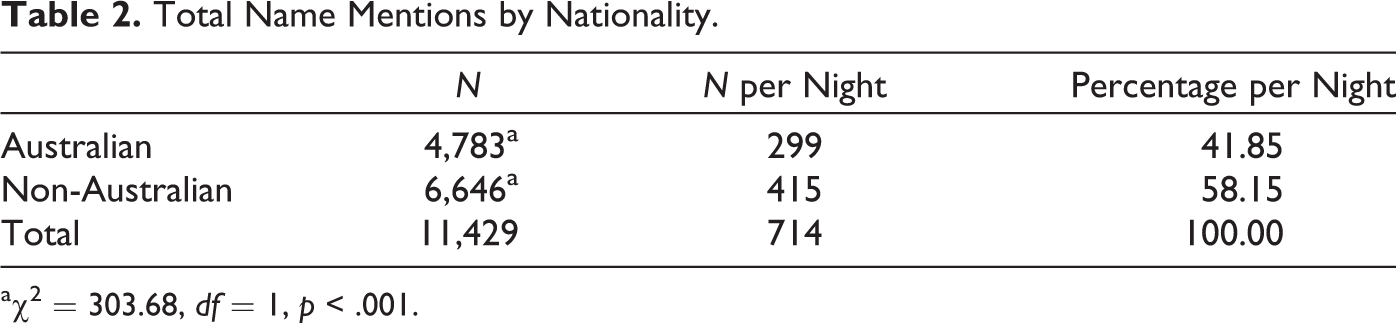
aχ2 = 303.68, df = 1, p < .001.
As Table 2 indicates, there was a significant difference between the mentions of Australians and the mentions of non-Australians; however, it was in favor of the non-Australians, who received the majority (58.15%) of all mentions within the broadcast, significantly more than the Australian mentions (41.85%; χ2 = 303.68, df = 1, p < .001). Given that Hypothesis 2 posited greater salience of Australian athletes, Hypothesis 2 is not supported.
Hypothesis 3 posited that Australians would have their successes attributed to demonstrably different rationales than non-Australians. Table 3 reports differences in these nine taxonomical areas.
Descriptive Analysis of Success/Failure by Nationality.
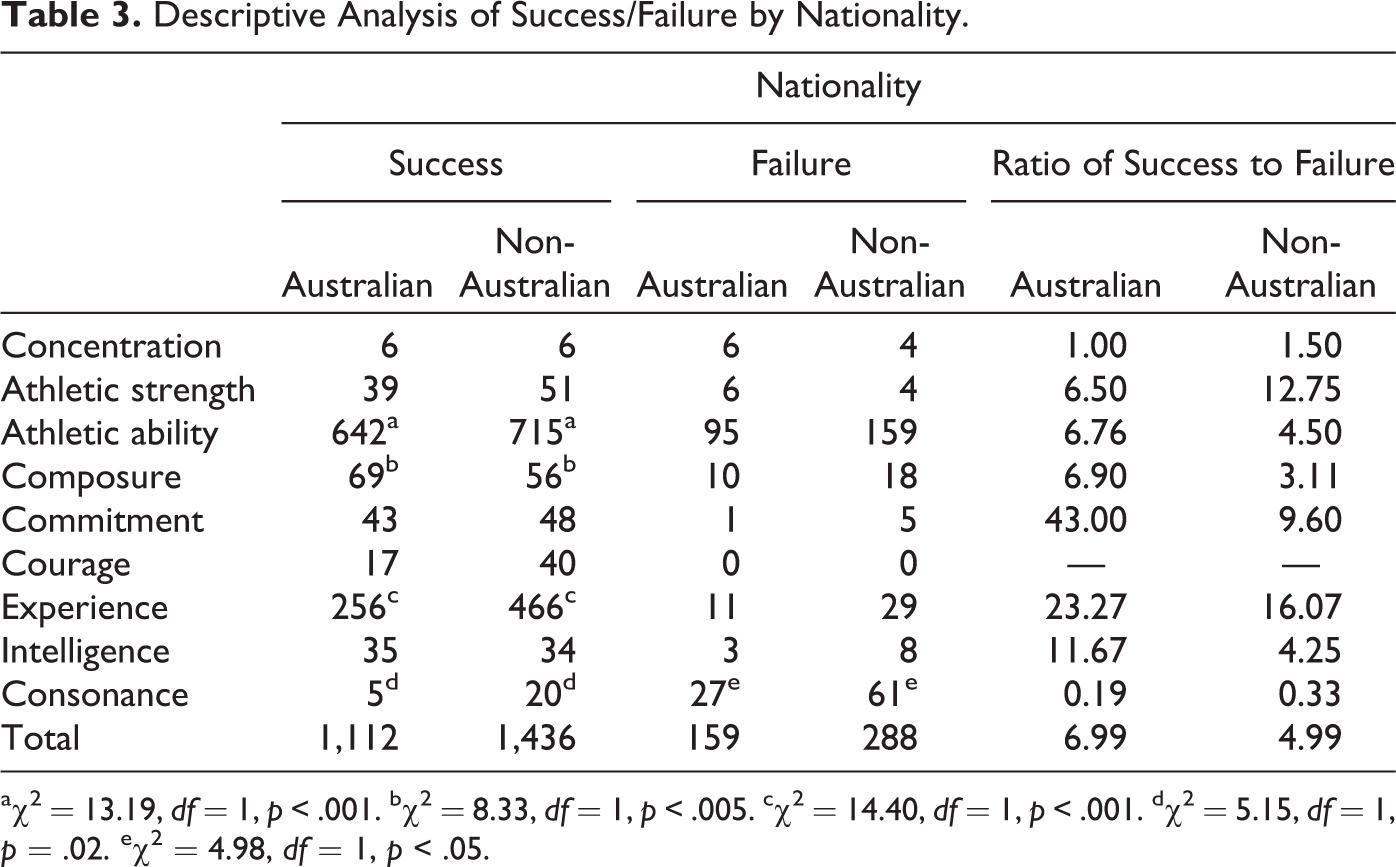
aχ2 = 13.19, df = 1, p < .001. bχ2 = 8.33, df = 1, p < .005. cχ2 = 14.40, df = 1, p < .001. dχ2 = 5.15, df = 1, p = .02. eχ2 = 4.98, df = 1, p < .05.
As shown in Table 3, four significant differences were detected regarding the depiction of success by nationality. Australian athletes were more likely to have their successes attributed to athletic ability (χ2 = 13.19, df = 1, p < .001) and composure (χ2 = 8.33, df = 1, p < .005), whereas non-Australians were more frequently characterized as succeeding because of experience (χ2 = 14.40, df = 1, p < .001) and consonance (χ2 = 5.15, df = 1, p = .02). Given that significant differences were found in nearly half of the possible pair comparisons, moderate support is lent for Hypothesis 3.
Hypothesis 4 pertained to the same taxonomical categories but regarding the failures of athletes from both Australian and beyond. The aforementioned Table 3 offers insights regarding this hypothesis as well, showing a single significant difference in how the failures of athletes deviated by nationality. Non-Australians were more likely to be said to have failed because they lacked consonance—largely an element of luck such as “just wasn’t their night”—within their performances (χ2 = 4.98, df = 1, p < .05). Meager support is offered for Hypothesis 4.
The final hypothesis, Hypothesis 5, pertained to presumed differences regarding how Australians and non-Australians were characterized in the areas of personality and physicality. Table 4 offers the results in each of these eight classification areas.
Descriptive Analysis of Personality/Physicality Descriptors by Nationality.

aχ2 = 15.65, df = 1, p < .001. bχ2 = 19.38, df = 1, p < .001. cχ2 = 5.44, df = 1, p = .02. dχ2 = 66.57, df = 1, p < .001. eχ2 = 14.64, df = 1, p < .001.
As Table 4 illuminates, five differences in on-air dialogue were detected. Australian Olympians were more likely to be characterized based on being modest/introverted (χ2 = 15.65, df = 1, p < .001), emotional (χ2 = 19.38, df = 1, p < .001), attractive (χ2 = 5.44, df = 1, p = .02), and background (χ2 = 66.57, df = 1, p < .001). Meanwhile, far more comments were directed toward non-Australian Olympians that were unclassifiable and labeled as “other” (χ2 = 14.64, df = 1, p < .001). Because the majority of the tested categories yielded significant differences, support is offered for Hypothesis 5.
Discussion
This study endeavored to identify how the Seven Network’s main channel portrayed home nation interests during prime time telecasts of the 2016 Rio Olympic Games. This study breaks new ground in a quantitative, statistically driven study that is the first of its kind in both the southern hemisphere and Australian contexts. In this section, results in regard to each of the hypotheses findings are discussed. Conclusions and future directions are then outlined.
Hypothesis 1 posited that the majority of the top 20 most-mentioned athletes would be Australian and this was, indeed, the case with 70% of the athletes in the top 20 most-mentioned athletes hailing from Australia. It is notable that Jared Tallent would feature second on a top 20 list as he is a racewalker, an event that would receive scant coverage at any time. However, Tallent was granted the gold medal from the 2012 London Olympic Games in June 2016 before the Rio Games and he has been an outspoken anti-doping advocate (Colasimone, 2016). In contrast, it was unsurprising to see Australian swimmers in the top 20 list as Australia typically does well in the pool during the Olympics and Mack Horton was an outspoken anti-doping athlete at Rio, during which Horton and Chinese swimmer Sun Yang had issues around Yang’s participation at Rio because of his previous doping scandal (Levy, 2016). Additional examination of the top 20 list revealed five boomers (members of the Australian men’s basketball team) who were also players in the National Basketball Association. Moreover, the boomers’ medal hopes were quite high and their fourth place finish was their highest placing since 2000. Further inspection of the top 20 list also indicates that many of the foreign athletes could be considered global superstars including Usain Bolt, Michael Phelps, and Mo Farah—all of whom were among the most mentioned in the United States as well (Billings et al., 2018). These athletes, and others, would have received considerable hype and promotion prior to and during the Rio Olympics in an attempt for the Seven Network to attract as many viewers as possible to meet its capitalistic goals. Further, this result also suggests that the Seven Network was attempting to create a telecast appealing to a large segment of the in-group Australian audience.
Privileging the in-group is seemingly in line with that found in previous American studies (see Billings, 2008), even as the Australians offered a subpar performance in Rio compared to prior Games, ranking 8th on the medals chart in terms of overall medals won and 10th in terms of gold medals won. As Australian citizens share many of the group characteristics with their Olympic athletes, there are high levels of similarity between these groups (Oakes, 1987; Oakes et al., 1991), somewhat blunting any notion of athletic underperformance as compared to typical expectations. It is, therefore, not surprising that Australian athletes were featured heavily in the top 20 list. There have also been many studies conducted on the American networks’ top 20 lists and American athletes often constitute between 60% and 90% of the athletes in these lists, and, as previously mentioned, Canada’s Canadian Broadcasting Corporation featured 100% of the top-mentioned athletes hailing from the home nation. Thus, the Seven Network seemingly promotes Australian athletes to a predominantly Australian audience. The use of nationalistic symbols—in this case Australian athletes—is anticipated as networks must narrativize their programming to meet the expectations of their audiences to capture and maintain viewer interest. Further, Australia sent the fourth largest team to Rio (Australian Olympic Committee, 2016a), so there would be many opportunities to discuss Australian athletes.
Even though Australia sent a large team to Rio, Hypothesis 2 was not supported because non-Australian athletes were mentioned more often by the Seven Network. Nearly 60% of all mentions were toward non-Australians—surprising when paired with the top 20 list. Further, many studies in this area have found that national media outlets will cover and create dialogue about home athletes substantially more (Billings, 2009; Rowe et al., 2010; Scott et al., 2018; Vincent & Crossman, 2012). Thus, this finding can be described as encouraging when compared to some of the findings as far as avoiding heavy nationalism within the overarching structure of the broadcast. It is surprising that the Australian network was more internationally oriented, particularly given the reputation other nations confer upon Australian networks (Billings, 2008). Networks choose who and what is shown on television during the Olympic Games, with results of this study suggesting that non-Australian athletes were mentioned significantly more often than Australians. Perhaps some of this finding is due to Australians not faring as well as expected in Rio with Australia achieving its worst result since the 1992 Barcelona Games (Martino, 2016). Thus, the Seven Network might have decided to show other events and athletes rather than Australians due to the lack of success. Also, such findings must be mitigated with the notion that the amount of coverage focusing on the Australian team still nearly duplicated the coverage of all nations—combined. As such, the finding was less than expected, but still indicated a fairly strong tilt to home nation athletes compared to their overall proportion of all nations competing.
In terms of the depiction of Australian and non-Australian athletes, Australians were more likely to be characterized as being successful because of their athletic skill and composure, whereas non-Australians’ success was attributed to experience and consonance. The difference in the depictions of athletes is quite stark as Australians were considered more skillful and composed than foreign athletes despite Australians not enjoying much success in Rio. Further, announcers of the Seven Network, could, presumably, be familiar with Australian athletes, particularly as the Seven Network covers quite a lot of sport on free-to-air television. Thus, it might be easier for announcers to conjure subjective commentary on these athletes.
By featuring Australian athletes more than any others, the Seven Network was able to create a nationalized broadcast, which might have aided the fusion of Australians in a more homogenous group. Thus, the salience of being Australian might have been a tactic employed by the Seven Network in an attempt to foster and maintain interest in the Australian team by television viewers (Turner et al., 1987). One can assume that many Australian viewers possess similarities in culture, language, and place of residence with the competing Australians in Rio; thus, there would presumably be a high level of similarity between these two groups (Oakes, 1987; Oakes et al., 1991). This level of fitness may result in viewers favoring members of the in-group when consuming Olympic media (Tajfel & Turner, 1979), which may increase the amount of coverage that a person consumes.
Australia sent the fourth largest team to Rio with 422 athletes competing in the Games (Australian Olympic Committee, 2016b), which constituted only 3.76% of the total athletes (International Olympic Committee, 2017) who participated in Rio. Given the far higher frequencies of Australian athletes at every level of the telecast, the Seven Network broadcast seemingly rendered an unabashedly Australia-centric telecast. This type of coverage of a sporting event confirms what others have found in this area (Rowe et al., 2010; Scott et al., 2018; Vincent & Crossman, 2012).
Australian announcers might not always be familiar with international athletes, meaning comments of experience are more objective in nature and can easily be drawn upon by the Seven Network commentators. Very little preparation is needed to draw on an athlete’s experiences, as these can be noted on announcer prep sheets, whereas notions of athletic ability and composure may require more knowledge of athletes to be able to draw upon these variables. Non-Australian athletes were also described as having a disproportionate amount of success attributed to consonance. This notion that foreign athletes’ success would often be the result of luck or having a good night would seem surprising yet—when matched with the characterization of experience—it might be that international athletes had superior experience and this was coupled with Australian telecaster lack of familiarity with non-Australian athletes, an assumption that could also explain the only significant result regarding failure: lack of consonance in non-Australians.
In terms of the description of Australian athletes, three variables that are subjective in nature were used significantly more – modest/introverted, emotional, and attractive; along with one objective variable – background. The first three variables suggest that announcers painted a more well-rounded and colorful picture of Australians than non-Australians. Non-Australian athletes were described significantly more as “other,” suggesting that announcers on the Seven Network used many “outside the box” comments, which were difficult to classify. These characterizations suggest that Australians were presented a person who enjoys the thrill of victory, exhibited their emotions readily, were relatively good-looking, and whose background presented a good story for viewers to consume. Sport broadcasters should seek to create additional commitment in viewers to continue to consume Olympic broadcasting.
Implications, Limitations, and Future Directions
In terms of ramifications on a grander scale, this research contributes to theory and practice in equal measure. First, the research uncovered how the media portrayed Australian and non-Australian athletes at the Rio Olympics Games. It was demonstrated that the Seven Network created an Australia-centric telecast with 70% of the top 20 list being Australian, meaning that broadcasters could portray high-visibility in-group members more than others as sport telecasts have the ability to unite a nation around its flag and its members who are representing the nation. Thus, it was no surprise that the majority of the top 20 list was Australian. Surprisingly, non-Australian athletes were discussed more often than was expected.
It is noteworthy that this study collected the data of the top 20 most-mentioned athletes by counting the numbers of name mentions without controlling for the number of competitions each athlete was in or the amount of time each competition lasted in duration. Given that half of the most-mentioned athletes competed in swimming and track and field (where competing in more than one event is possible and typically likely), one could surmise that the sheer number of medal events could cause inflated totals for athletes in these competitions. However, other competitions have single medals awarded, yet have competitions lasting multiple hours at a time (as opposed to a 10-s sprint), making direct comparisons difficult to ascertain.
Eagleman et al. (2014) incorporated such measures and mentions, taking the unique characteristics of different sports into consideration, and Delorme (2014) offers additional measures for determining equity of identity representation within Olympic media. Given that Australia sent 422 athletes competing in the 2016 Rio Games, making up 3.76% of the total athletes (Australian Olympic Committee, 2016b; International Olympic Committee, 2017), the Seven Network, indeed, devoted greater salience to home athletes with 41.85% of the total name mentions. However, it should be noted that a nation’s broadcaster will often devote more coverage to home nation athletes, with the only central question being of the degree and ratio for such favouritism. Other nations at the top of the medals table devote more than half of all coverage to home nation athletes, making the finding in this study meaningful and noteworthy. Nevertheless, additional metrics would be useful applications for understanding Australian Olympic media equity in the future.
As this study used the existing taxonomy of Billings and Eastman (2003), it may be useful in the future to create an Australian version of the taxonomy as there may be differences in the way in which athletes are described. An adapted taxonomy for Australian purposes may, then, help to reduce the number of “other” comments because categories could be created based on the locality of the broadcaster. To wit, the taxonomy used arose from American Olympic telecasts that promote a “big five” Olympic sports in prime time: swimming, gymnastics, track and field, diving, and beach volleyball (Billings et al., 2018); the Australian telecast featured a “big six” with track and field, swimming, rowing, kayak/canoeing, basketball, and cycling each receiving at least 3 hr of coverage (Xu et al., 2017). Thus, it is quite possible that a lack of ideal fit with the taxonomy arises from different types of commentary employed in sports such as rowing, kayak/canoeing, and cycling that emerged as primary sports in Australia yet not in the United States.
This research also breaks new ground in the quantitative statistically driven analysis of the Olympic Games. Much of the research in this area has been Ameri-centric; thus, adding to this body of knowledge is useful—particularly with sport scholars and practitioners when assessing a media outlet’s bias. Further, this study uncovered that the portrayal of in-group and out-group members differed in terms of the amount of coverage and the number of mentions these groups received. By creating a telecast that featured Australians most, audiences were provided with cues that reinforced their identity. Nationalism has been shown to be a prime motivator to watch sports, so creating a telecast of “us” versus “them” dialogue and discourse can aid a broadcaster to garner additional viewership in sport events. From the perspective of a broadcaster, a central aspect critical to perceived success is maximizing viewership—and thus, revenues from advertisers and sponsors. During global mega events, generating viewership becomes even more important as much of the world places a laser-like focus on these events. Thus, it was important for the Seven Network to telecast a 17-day program that would keep viewers tuning in daily to maximize interest in the Olympics telecast.
It is also beneficial for the Seven Network to capture, build, and maintain audiences during both the period of the Olympic Games and after the Games are over and regular programming begins. The information gleaned from this research is beneficial to the media to understand how nations telecast and portray both home country and foreign athletes and this line of inquiry also has implications for sport managers and sport scholars. Further, this line of inquiry is beneficial to athletes who may use information gained by this study for branding purposes. For example, this study found that the media portrayed Australian athletes as emotive; subsequently, an athlete could attempt to show emotions with the press in an attempt to garner more media attention.
Limitations of this research and future directions are acknowledged. This research only studied the free-to-air broadcaster’s main channel in Australia. The Seven Network broadcast the Games on several channels and streamed online. To this end, it would be useful for a study to be conducted on all the media from a nation’s Olympics coverage in order to support or challenge the generalizability of the findings. Likewise, the portrayal of home or foreign athletes during the broadcasting of the Olympics will be different from country to country, so it would be useful to study several nations’ coverage at once, particularly those who have similar ambitions regarding medal wins (e.g., the Unites States and China) or who are geographically close (e.g., New Zealand and Australia or the Netherlands and Germany).
Additionally, this study only investigated the coverage of the 2016 Rio Olympic Games. Future studies are needed to better understand how the Australian broadcaster portrayed Australian and non-Australian athletes during both the Summer Olympics—when Australia, historically, has greater success—and during the Winter Olympics—where Australia’s success is considerably minimal. Results of these analyses will provide additional information on the portrayals of athletes.
Conclusion
Media possess the ability to influence perceptions of consumers through who or what is shown on television. Therefore, it is important to study how national media outlets broadcast major sporting events. This line of inquiry remains important to future studies as it relates to the inevitable ties of sport and nationalism. This study provides a snapshot into how one network broadcast the Rio Olympic Games as well as how much coverage was given to both home and foreign athletes. Furthermore, results of this study indicate that Australian athletes were described differently than non-Australian and also that the majority of the top 20 most-mentioned athletes were Australian. Interestingly, non-Australian athletes were mentioned significantly more frequently than Australians. Thus, this research contributes to the literature by advancing how in-group members are described on television and showcases the coverage of the Rio Olympics in a new and novel context.
Footnotes
Appendix
Examples for Each Classification in Billings and Eastman’s (2003) Taxonomy.

| Classification | Example |
|---|---|
| Concentration | “In the zone.” |
| Strength-based athletic skill | “He shows superior strength in his event.” |
| Talent/ability-based athletic skills | “She has unbelievable technique.” |
| Composure | “Comes apart.” |
| Commitment | “Highly disciplined.” |
| Courage | “Once again shows her courage.” |
| Experience | “World champion.” |
| Intelligence | “Another good read.” |
| Athletic consonance | “Was lucky getting a mark after two fouls.” |
| Outgoing/extroverted | “All that personality.” |
| Modest/introverted | “He is the quiet one.” |
| Emotional | “Didn’t cry.” |
| Attractiveness | “She’s grown up beautifully.” |
| Size/parts of body | “So long armed.” |
| Background | “Is back after having two children.” |
Declaration of Conflicting Interests
The author(s) declared no potential conflicts of interest with respect to the research, authorship, and/or publication of this article.
Funding
The author(s) received no financial support for the research, authorship, and/or publication of this article.