



Abstract
Despite the growth of female participation in sports, media coverage of female athletics remains stagnant. Scholarship regarding the treatment of female athletes in magazines, newspapers, and news and highlight programming has shown that sports journalism organizations demonstrate ambivalence with minimal coverage that reinforces gender stereotypes. This study examined 1,587 Instagram images from the primary accounts of the four major American sports networks. The resulting data indicate that women’s athletic coverage lags significantly behind men’s athletics. Females are more likely to appear alongside a male and are more likely be shown in culturally “appropriate” sports and in nonathletic roles.
Female athletic participation has seen considerable growth over the past four decades (Cooky, Messner, & Hextrum, 2013; Cooky, Messner, & Musto, 2015; Johnson, 2014). Audience surveys indicate that most global sports fans are interested in women’s sports, including a majority of male sports fans ( Global interest in women’s sports, 2018). However, the balance of media coverage featuring male and female athletes and athletic events has seen little change, especially on sports networks’ (SNs) news and highlight shows. Researchers observe that female representation on national studio highlight programming “remains dismally low” (Cooky et al., 2015, p. 1). Hardin & Greer (2009) argue that gender stereotypes will struggle to change unless “mediated images are more inclusive of women in a variety of sports” (p. 207). Yet scholarship has found that female visual representation in television (TV) and print media still “lags behind” that of male counterparts (Godoy-Pressland & Griggs, 2014, p. 808). Social media platforms (SMPs) differ from traditional media in that space is not a finite resource restricted to time (broadcast) or print space (newspapers). These limitations are often used by SNs to justify the abundance of popular or profitable sports content. This study examines whether the proliferation of content distribution platforms results in more equitable gender coverage in the day-to-day sports coverage.
The growth of SMPs, driven by shifting audience habits, offers the national sports media additional avenues for reaching and engaging audiences. SMPs uniquely offer fans immediate access to sports content and to a burgeoning sports-minded community that traditional platforms do not (Hull & Lewis, 2014). Additionally, social networks allow two-way dialogue between fans and athletes and with sports news and information brokers (Hull & Lewis, 2014; Hutchins, 2011). In many cases, sports fans rely heavily on SMPs as a way to access news and information (Greenwood, Perrin, & Duggan, 2016; Gottfried & Shearer, 2016; Yoder, 2016).
Reacting to the demand for sports media coverage on SMPs, National Broadcast Corporation (NBC) Sports strategically provided more content on digital and social platforms during the 2016 Summer Olympics than it had during any previous Games (NBC Sports Staff, 2016). Other broadcast networks have committed to distributing content on SMPs. ESPN has publicized its intent to dominate non-TV screens, which includes SMPs accessed on mobile devices (Thompson, 2015). Each of the major SNs in the United States has a large presence on the three most popular SMPs: Facebook, Instagram, and Twitter (Gottfried & Shearer, 2016). All have tens of thousands—and in some cases millions—of followers.
Yet, the SMPs of the major sports news networks remain generally unexplored by sports media scholars. Content shared by SNs on these platforms often includes visual depictions of athletes and athleticism. Previous scholarship about gender representation and framing theory raises questions about whether SNs underrepresent and reinforce gender differences on their SMPs as they do in traditional televised programming. Mass communication scholars have utilized framing theory as a framework for understanding how audience members make decisions influenced by media producers’ discriminatory selection, emphasis, and exclusion of content (Billings, 2008; Goffman, 1974). The theory suggests that how information is framed can influence audience perceptions (Goffman, 1974). Therefore, there is a need to better understand how SNs frame content for viewers.
The purpose of this study is to examine how major SNs visually frame gender on SMPs and whether the same gender biases that exist in traditional televised programming likewise emerge on social platforms. The study will look exclusively at the Instagram accounts of four major American SNs: ESPN, FOX Sports Media Group (FOX Sports), NBC Sports, and the Columbia Broadcast System Sports (CBS Sports). Instagram, which is a photo- and video-sharing social network, was selected as the platform of study because of its popularity among sports fans as a source of news and highlights (Patel, 2015; Thompson, 2015) and for its emphasis on the visual as the primary means for message sharing—an intrinsic association it shares with SN programming. Pew Research Center ranks Instagram as one of the top four SMPs for news consumption (Gottfried & Shearer, 2016).
Literature Review
SNs and Contractual Affiliations
SNs play a significant role in the way sports information reaches sports audiences. Research suggests that SNs assign greater salience to major professional sports leagues and collegiate athletic conferences with which they have broadcast partnerships (Johnson & Romney, 2017). These agreements give SNs exclusive access to athletes and athletic events that drive traffic to SN properties––including their SMPs––where news, information, highlights, and photojournalism are disseminated. How gender is framed to SNs’ large followings on SMPs contributes to the public’s perceptions of gender and female athleticism.
The authors acknowledge that national SNs lean towards showcasing male athletes and their athletic achievements. As mentioned, SNs have lucrative contractual affiliations with most men’s professional and National Collegiate Athletic Association (NCAA) leagues and teams (Badenhausen, 2012; Karp, 2013). Additionally, men’s seasons tend to be longer, which provides more opportunity for coverage. There is a proliferation of men’s off-season programming such as professional sports draft coverage that is increasingly popular. As a result, the authors expect SN SMPs will likely include a higher percentage of men’s sports coverage on their SMPs.
However, many SNs also have broadcast agreements with women’s sports leagues, meaning the contractual relationship between SNs and male sports leagues and teams does not fully explain the disparity in coverage. Audiences want more sports and information about female sports ( Global interest in women’s sports, 2018). Furthermore, SNs claim to be journalistic organizations (Steinberg, 2018; Stiegman, 2012). If that is the case, the expectation of professional journalism standards is presumed––regardless of gender. SNs' commitment to sports journalism suggests that SMPs’ content reflect all sports, including female athletics. SNs’ lack of heterogeneity in their sports coverage has been examined and while the issue is not exclusive to female sports, the increase in female sporting participation warrants more of their attention (Schreiber, 2008). SNs do have limited female sports content, but most of the coverage is shared either on female-specific sites or during times in a sportscast where there are fewer viewers (Cooky et al., 2015). Demoting female sports coverage to less prominent parts of news and highlight shows, or to websites with less promotion and traffic, does little to engender interest in female leagues. ESPN publishes espnW, a female-focused website with its own social media presence. Yet, the espnW site is not a prime feature of ESPN’s primary website (ESPN.com), and its social media metrics are far below the network’s main SMP channels. As Cooky, Messner, and Musto (2015) have shown, gender representation in sports programming is far from equitable and the little female coverage that is shared is underwhelming.
This research extends the analysis of gender representation to SN SMPs to determine whether there likewise exists an underrepresentation of female athletes and coverage on SNs’ primary social media channels despite the growth of female athletics and interest in their sports. SMPs present broader opportunities for SNs to showcase female athletes and to provide news and information about their athletic events. Unlike in TV where time is a fixed commodity and where there exists pressure to maintain viewership, SMPs present fewer disadvantages of showcasing broader sports coverage. Therefore, SNs might feel more free editorially to share female content on SMPs than they would during news and highlight show programs.
Framing of Gender in Sport
A robust body of scholarship is clear: Female athletes have long been marginalized in TV and news coverage in favor of male athleticism (Angelini & Billings, 2010; Angelini, Billings, & MacArthur, 2012; Billings, Brown, & Brown, 2013; Billings et al., 2008; Billings & Eastman, 2003; Billings, MacArthur, Licen, & Wu, 2009; Clavio & Eagleman, 2011; Cranmer, Brann, & Bowman, 2014; Davis & Tuggle, 2012; Fink & Kensicki, 2002; Godoy-Pressland & Griggs, 2014; Hardin, Chance, Dodd, & Hardin, 2002; Cooky et al., 2013; Cooky et al., 2015). Such marginalization is evident in gender-representation studies of televised Olympic coverage, where female participation has increased yet for many years significant media coverage of female athletes and events did not (Angelini & Billings, 2010; Angelini et al., 2012; Billings et al., 2009; Billings et. al., 2013; Davis & Tuggle, 2012; Godoy-Pressland & Griggs, 2014). These studies showed that males historically receive a higher portion of prime-time coverage than female athletes (Billings & Eastman, 2003; Billings et al., 2008). In the 2012 Summer Games in London, researchers found that the language used by the mostly male broadcasters often framed female athletes “as ‘girls’ rather than ‘women’” and “gave them secondary status compared to male athletes” (Kian, Bernstein, & McGuire, 2013, p. 143). Additionally, stories that focused on female athletes often emphasized female body parts that appealed to the mostly male journalists covering the Games (Kian et al., 2013). Scholars argue that such decisions lead to “ambivalent” media coverage about women, and worse, they can “trivialize women’s efforts and success” (Wensing & Bruce, 2003, p. 387). Musto, Cooky & Messner (2017) observe that female athletic achievements have made recent inroads in the national sports discourse; yet, despite these successes, the dialogue surrounding female athletics is generally indifferent. The authors describe this apathy as “gender-bland sexism” and suggest that female athletes are framed in uninspired ways and appear dull and lifeless compared to their male counterparts (p. 573). Bruce (2016) chronicles the complex duality of feminism and sport and suggests that even as more female sports coverage exists, women are still framed as the “other”—or the interloper—in a traditional masculine space.
Researchers have discovered positive signs regarding equality in Olympic gender framing. The examination of recent primetime Olympic events indicates that broadcast executives are giving female athletes and events coveted viewing slots. Coche and Tuggle (2016) noted that NBC placed more female athletes and their events in primetime slots than men. The pattern was repeated in the 2014 Winter Olympics in Sochi (MacArthur, Angelini, Billings, & Smith, 2016). The official Olympic broadcasters of other countries followed suit (Xu, Billings, Scott, Lewis & Sharpe, 2019). Olsson’s (2016) study of major American and British news publications revealed more balanced coverage between male and female Olympic events. These encouraging markers suggest that broadcasters and news organizations are offering more equitable coverage between male and female athletes.
However, the equitable coverage of female athletics is limited to large dual-sex events like the Olympics. Outside of these events, equitable news sports coverage of day-to-day female sporting events is remote. Cooky et al.’s (2015) follow-up study of female news coverage on SNs’ news and highlight shows reveals that significantly more time is devoted to male sports than to female sports. In addition to a lack of female sports highlights on these programs, the authors discovered that there exists a “stark contrast between the exciting, amplified delivery of stories about men’s sports and the often dull, matter-of-fact delivery of women’s sports stories” (p. 261). They concluded that the underrepresentation of women in sports news coverage insinuates that female athletes are “covered in ways that convey the message to audiences that women’s sport is less important, less exciting, and therefore, less valued than men’s sports” (p. 264).
Visual Framing of Women in Sport
The lack of female sports news coverage by SNs is conspicuous, but it is more troubling that females who are shown are often framed along gender stereotypes when they are visually depicted in media coverage (Cranmer et al., 2014; Godoy-Pressland & Griggs, 2014). Female athletes are frequently portrayed in ways that represent traditional female attributes such as grace, beauty, balance, and aesthetics (Godoy-Pressland & Griggs, 2014). A number of studies have utilized analytical tools to identify visual representation of female athletes in sports news coverage. These include a content analysis of sports images, examining the frequency of photos depicting female athletes, the sports the athletes are represented in, the way athletes are framed within the image, the angle of the camera, the focus of the image, the position of the athlete, and the location portrayed within the image (Godoy-Pressland & Griggs, 2014, p. 809).
Utilizing visual framing analysis, Fink and Kensicki’s (2002) examination of Sports Illustrated magazine coverage found that women were visually overrepresented in traditionally feminine sports and were routinely portrayed outside the field of play. The authors concluded that women continue to be depicted along “stereotypical and traditional conceptions of femininity that supersede their athletic ability” (p. 317). Clavio and Eagleman (2011) performed a content analysis of images shared on popular sports blogs and found that men received more frequent photographic coverage than women. In addition, Clavio and Eagleman found that the female images that were shared were more likely to be sexually suggestive. A visual analysis of images published in ESPN The Magazine’s “The Body Issue” found that images included in the magazine de-emphasized female athleticism and displayed female athletes in more overtly sexual poses compared to their male counterparts (Cranmer et al., 2014). The sexual exploitation of female athletes in both discourse and visual representation is well noted (Bruce, 2016; Daniels, 2012; Kane, LaVoi & Fink, 2013; Weaving, 2012).
Hardin, Chance, Dodd, and Hardin (2002) examined 1,425 images of athletes participating in the 2000 Summer Games from five American daily newspapers to determine whether the photos reinforced gender differences in sports media coverage. Researchers recorded the gender of the athletes in the photos, the placement of the dominant subjects in the photos, the photo angle, whether the athletes were shown in a state of activity or passivity, and whether the athletes were part of a team or individual sport. Hardin et al. (2002) elucidate that it is stereotypically more appropriate for female athletes to compete in individual sports than team sports. In addition, the researchers noted whether the sport could be categorized as one of the following: “strength” sports, “in which one opponent overpowers another by physical strength”; “aesthetic” sports, “where success is determined on the basis of grace and proper form”; and “neutral” sports, which “contained all other sports” (Duncan & Sayaovong, 1990, p. 104). Hardin et al. discovered “some improvements in newspaper coverage of female Olympians” (p. 64), but there still existed gender bias in favor of male athletes, who were more likely to be the dominant focus of the photos. Female athletes were more often shown in a state of passivity.
Research Questions
The current study examined images shared on the four major SNs’ Instagram feeds to understand how gender differences are framed. The variables examined include the gender of the dominant photo subject, whether the subjects are in a state of movement in the field of play or in a state of passivity outside the field of play, the type of sport (strength, neutral, or aesthetic) depicted in the images, and whether images depict athletes in team or individual sports.
The body of scholarship overwhelmingly suggests that in sports media, male sports are seen as more salient and their participants are represented as relying heavily on athleticism, while female sports are ignored and female athletes are more likely to be represented with a focus on traditional female attributes such as beauty and aesthetics. Recent research has also shown that SN SMPs exhibit framing bias in their selection of images to share on social media—specifically in exhibiting stereotypical differences (Johnson & Romney, 2017). Built on the framework of previous scholarship, yet driven by new challenges and opportunities presented by social media, this study proposes the following research questions:
Method
The researchers conducted a quantitative content analysis of the primary Instagram accounts of the four largest American SNs: ESPN, Fox Sports, NBC Sports, and CBS Sports. The authors gathered a random sample of screenshots of all Instagram posts the SNs shared from 15 randomly selected weeks between July 2015 and July 2016. 1 The researchers determined to use the period of July 2015 to 2016 in order to draw a sample from a whole calendar year. It was determined that several SNs did not begin regularly using Instagram until this period. During the period in which the sample was selected, Instagram had not yet introduced its photo galleries feature (2017), meaning all posts contained a single image. The researchers also acknowledge that since 2013, video has been a major component of the content on Instagram. However, the researchers determined to exclude videos for this particular study in order to provide fair comparison, as video and images are separate media and the nature of video would allow for the inclusion of more subjects through a longer period of time. The researchers acknowledge this omission and hope to include video in a future study.
Each week of this calendar year had an equal chance of selection. The researchers settled on 15 randomly selected weeks because it represented slightly more than one fourth of the images throughout the year. The sample would increase the chances of fair representation throughout the year and allow representation from different sporting seasons. Each of the four seasons of the year was represented in the randomly selected weeks. 2 Additionally, every month of the year was represented except for March and April 2016 and October 2015. 3 Instagram does not feature an advanced search function capable of collecting posts from specific date ranges; therefore, the authors used Picodash—a third-party data gathering site that used Instagram’s application program interface (API) to allow for more thorough search parameters—in order to gather the sample. Despite taking a random sample rather than a census of the population, this project still produced more than 1,500 images for analysis.
Coding
The unit of analysis for this study was each image shared in an Instagram post. A team of two coders was trained to examine each screenshot and code for six variables germane to this project. Coders were instructed to code based on the content of the photo itself and not include the text of any posts or comments. Independent variables included the network that shared the post and the gender of the primary subject(s) of the photo. Images that contained a nonhuman primary photo subject were removed from the sample because they could not be coded based on the gender of the photo subject(s). Coders were instructed to identify only the gender of the primary photo subject(s) of an image. If an image contained other people in the background of the photograph, spectators for example, coders were trained to ignore them. If an image contained multiple photo subjects of different genders, a third category (“mixed”) was chosen.
Dependent variables included the nature and type of sport represented in the photograph, whether the primary photo subject was portrayed in an active or passive context, and whether the primary subject of the photograph was an athlete. 4 Sport nature was identified using established literature on biased representation in sports media. The researchers followed Hardin et al. (2002) in using the definition outlined by Duncan and Sayaovong (1990), who divided sports into three categories: strength, aesthetic, and neutral.
For the purposes of the present study, however, Duncan and Sayaovong’s definition was slightly modified because Instagram presents new challenges as compared to traditional media. For example, while many previous studies focused on newspaper images that perhaps primarily focused on athletic competition, the nature of social media often leads to self-published images that often feature moments away from the field. Therefore, the researchers added options for “nonathletic” roles which included all images that did not contain moments captured from a sport’s field of play, such as “selfies,” moments captured during the subject’s daily lives, postgame interviews, or images taken in the broadcast booths. In addition, while previous scholars have listed basketball among the neutral sports (Duncan & Sayaovong, 1990; Hardin et al., 2002), the authors included it among strength sports because of its commonalities with other strength sports, including an emphasis on athleticism, physical contact, and impeding the progress of the opponent. Strength sports included such competitions as American football, basketball, hockey, rugby, wrestling, or boxing. Examples of aesthetic sports included gymnastics or diving, whereas neutral sports included such sports as baseball, soccer, golf, or horse racing. Coders also identified whether a sport was primarily competed as a member of a team or as an individual. For this “sport type” variable, coders were instructed to identify “team” sports as those involving more than two individuals working together. If an image contained more than one sport, coders listed the image as containing “multiple sports” for both the nature and type variable.
Finally, a photo that implied motion or narrative elements (Kress & Van Leeuwen, 1996) was coded as being active, whereas portraits, snapshots, or selfies that appeared to be “staged” were labeled as “passive” photos.
Analysis
After training concluded, the researchers conducted a check for intercoder reliability using approximately one tenth of the overall sample of images (n = 189). Using a Cohen’s κ (Lombard, Snyder-Duch, & Bracken, 2002), the coders tested each of the variables for reliability. The initial intercoder reliability analysis returned results in the acceptable .80 range (Lombard et al., 2002) for three of the variables: sport nature (K = .861), sport type (K = .852), and network (K = .964). Coders were retrained to code for gender, athletes, and active/passive images. Another 190 images were coded for a second reliability check in which the gender (K = .914), athletes (K = .851), and active/passive (K = .820) variables passed by an acceptable margin. The coders proceeded to code the full sample, after which χ2 tests were conducted to test the relationships between the independent and dependent variables. Finally, Cramer’s V was used to measure effect sizes, using Cohen’s (1988) general guidelines for small, medium, and large effects.
The total sample included 1,856 images, of which 268 did not contain a primary human subject. Because it would not be possible to code for gender in an image without a human subject, those 268 images were removed from the overall sample (N = 1,587). Of the different networks, ESPN (n = 616) posted the most images, with CBS Sports (n = 508) and Fox Sports (n = 495) sharing similar numbers, and NBC Sports (n = 237) sharing the fewest.
Results
The first research question asked whether SNs’ Instagram accounts showed ignored female athletes. Results showed that the networks disregarded women in general, not just toward women’s athletics. Of the 1,587 images, only 52 contained a primary female subject. In addition, only 94 contained both men and women, with the rest containing primary male subjects (n = 1,441). A χ2 test of independence was conducted between the gender variable and whether the image’s primary subject was an athlete. The results of this test (Table 1) were statistically significant (χ2 = 132.72, df = 2, p < .01). More than 85% (n = 1,231) of the 1,441 images that contained a primary male photo subject depicted an athlete. Conversely, only 53.8% (n = 28) of the 52 images containing primary female subjects depicted athletes. The relationship between these two variables showed a medium-sized effect (Cramer’s V = .29) based on Cohen’s (1988) effect size levels at two degrees of freedom (Privitera, 2012).
Percentages of Photo Subjects Who Are Athletes by Gender.
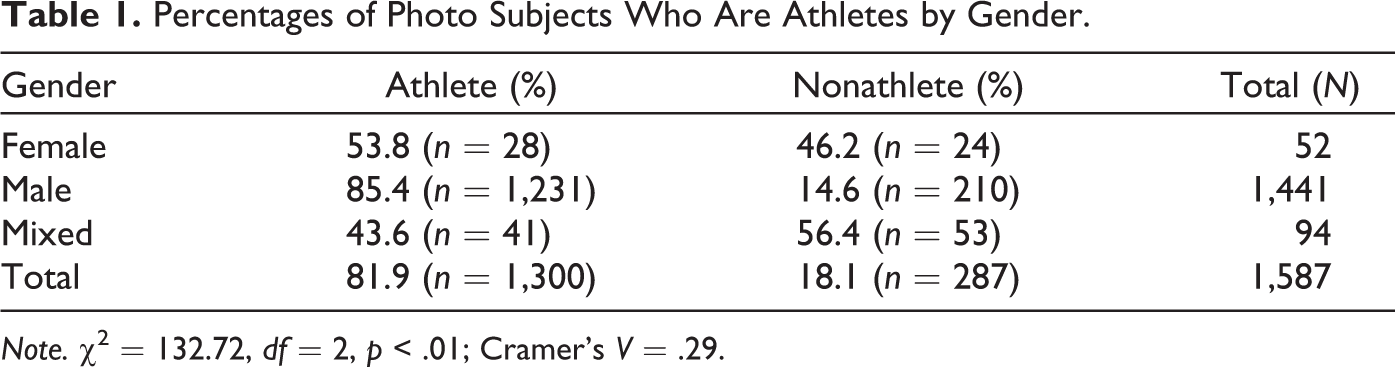
Note. χ2 = 132.72, df = 2, p < .01; Cramer’s V = .29.
The second research question explored the passivity of images that contained a female photo subject. A χ2 test was conducted between the gender and active/passive variables. The statistically significant results of this test (χ2 = 50.849, df = 2, p < .01) can be found in Table 2. These findings also ignored female athletics, as more than 40% (n = 21) of the images containing a female subject depicted them in passive poses. Conversely, 80% (n = 1,156) of images with male subjects depicted them in active contexts. The relationship between gender and passivity of photo content did show an effect, but it was small (Cramer’s V = .18).
Active or Passive Photo Subjects by Gender.
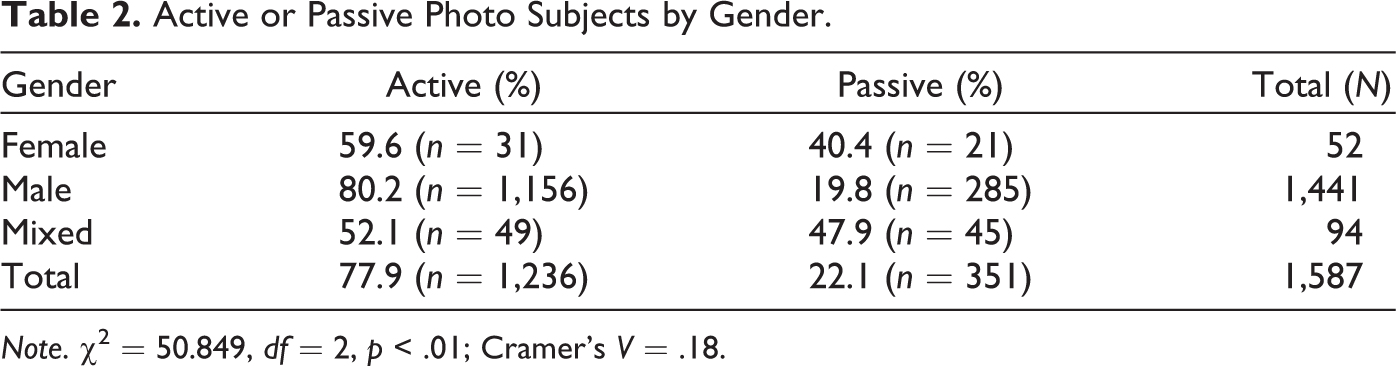
Note. χ2 = 50.849, df = 2, p < .01; Cramer’s V = .18.
The third research question explored the types of sports in which female athletes were depicted. A χ2 test was conducted between the gender variable and the sport nature variables (Table 3). For sport nature, a statistically significant difference was found (χ2 = 167.69, df = 4, p < .01, Fisher’s exact p < .01), with only 9.6% (n = 5) of images that contained a female subject depicting strength sports and just over a third (n = 18) depicting neutral sports. More than 53.8% of images (n = 28) with female photo subjects were from identified as being from nonathletic contexts meaning they showed women away from the field of play. This was compared to men’s athletics in which only 25.9% (n = 373) featured nonathletic contexts. More than 52.4% (n = 755) of images featuring a male primary photo subject depicted strength sports, compared to 20.8% (n = 300) in neutral sports and 25.7% (n = 370) were portrayed outside of the field of play. A Cramer’s V showed a medium-sized effect (V = .23) based on Cohen’s (1988) effect-size guidelines at greater than three degrees of freedom (Privitera, 2012).
Sport Representation of Photo Subjects by Gender.

Note. A Fisher’s exact test was performed to confirm statistical significance because several cells contained expected frequencies of fewer than five images. Fisher’s exact p < .01. χ2 = 175.1, df = 8, p < .01; Cramer’s V = .23.
The fourth research question asked whether men and women were equally depicted in team or individual sports. For comparing the sport type variable by the gender of the primary photo subject, a χ2 test for independence (Table 4) returned results that were statistically significant (χ2 = 197.87, df = 4, p < .01). Because there were fewer than five images depicting individual sports and showing both male and female photo subjects, a Fisher’s exact test was also conducted, which confirmed significance (p < .01). More than 30% of images (n = 16) with a female primary photo subject depicted individual sports, while only 7% (n = 103) of images with male subjects were from individual sports. More than 66% of images (n = 373) with male photo subjects depicted team sports, as opposed to eight total images (15.4%) that depicted women’s team sports. The relationship between gender and whether images contained individual or team sports also showed a medium-sized effect (Cramer’s V = .25) based on Cohen’s (1988) guidelines for effect size at greater than three degrees of freedom (Privitera, 2012).
Individual or Team Sports by Gender.
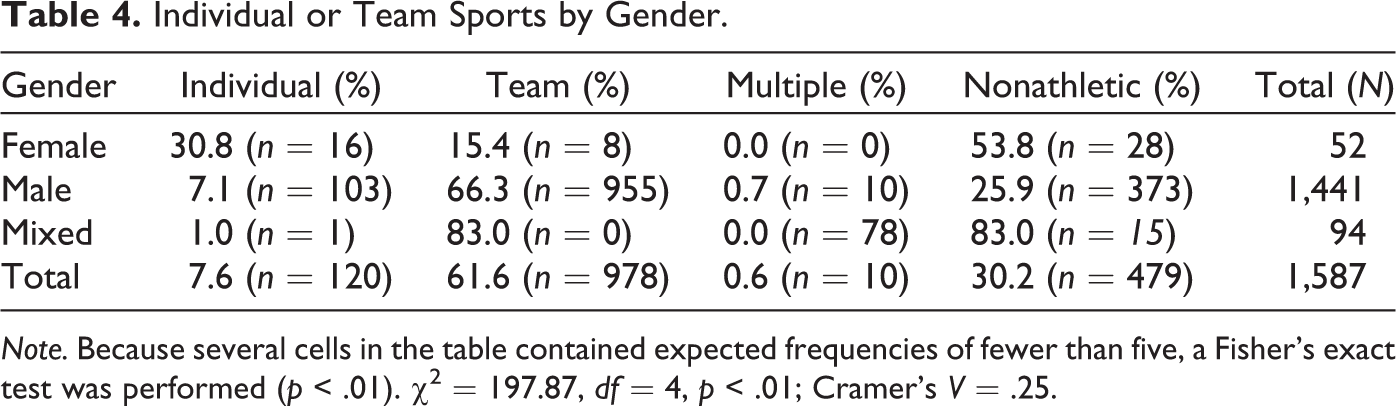
Note. Because several cells in the table contained expected frequencies of fewer than five, a Fisher’s exact test was performed (p < .01). χ2 = 197.87, df = 4, p < .01; Cramer’s V = .25.
Discussion
The findings of this study support analogous scholarship on gender representation in sports. Much like in TV broadcasts and print media, female athletes and news coverage about their competitions are woefully underrepresented on the SMPs of national SNs. As previous scholarship elucidates (Angelini & Billings, 2010; Angelini et al., 2012; Billings et al., 2009; Billings et al., 2013; Cooky et al., 2015; Davis & Tuggle, 2012; Godoy-Pressland & Griggs, 2014; Wensing & Bruce, 2003), the lack of visual representation, and the framing of female athletes along gender stereotypes, marginalizes their athletic achievements and makes building a fan base more difficult.
The most significant finding presented in this study is the overall lack of female athletes and female-specific athletic news coverage on the major SNs’ Instagram accounts. Only 3.2% (n = 52) of the nearly 1,500 images posted to the primary Instagram accounts of the four major U.S. SNs exclusively featured female photo subjects—a shockingly low figure that falls below findings of other studies looking at gender representation in sports magazines, blogs, or newspapers (Clavio & Eagleman, 2011; Cranmer et al., 2014; Fink & Kensicki, 2002; Hardin et al., 2002). In the few instances, when females do appear in the SNs’ Instagram posts, they are more likely to be accompanied by a male in the image (n = 94) than to appear by themselves (n = 52). This revelation is worrisome and could suggest to SMPs’ audiences that female athleticism is validated by a male presence. Wensing and Bruce (2003) assert that the lack of accurate female representation in sports can “trivialize women’s efforts and success” (p. 397). Overall, the scarcity of female representation on SMPs is evident despite a robust increase in female participation in sports, sporting events, and fandom (Cooky et al., 2015; Johnson, 2014).
As noted earlier, the researchers expected that SNs were more likely to feature men’s athletic content. However, contractual affiliation and/or the perception that men’s sports are more interesting to their audiences seems like a shallow justification for the near nonexistent representation of female athletes on their social media channels––even as many female sporting games are nationally broadcast by the SNs examined here. That just more than 3% of total images contained a female athlete appears to be a misstep by SNs in their daily coverage on their SMPs. As Cooky et al. (2015) suggest, the lack of coverage slows interest in female sports and the exclusion of female representation perpetuates destructive gender stereotypes.
When female athletes are visually represented on SN SMPs, the athletes are frequently posed in ways that scholars argue will reinforce gender stereotypes (Clavio & Eagleman, 2011; Cranmer et al., 2014; Fink & Kensicki, 2002; Hardin et al., 2002). Of the few images that contained a woman as the primary photo subject(s), almost half (40%, n = 21) showed subjects in a state of passivity and not in the act of participating in sport. Such passive depictions divest females of recognition of their athletic prowess by placing equal emphasis on their nonathletic characteristics such as beauty and grace. Conversely, nearly 80% (n = 1,156) of images where men are the dominant photo subjects show athletes participating in athletic poses. This may lead audiences to identify athleticism as a male characteristic. The findings of this study are similar to Fink and Kensicki’s (2002) visual analysis of female photojournalism coverage in Sports Illustrated. Fink and Kensicki noted that by frequently showing female athletes outside the field of play, or in passive poses, SNs reinforce the idea that femininity and beauty are salient values that supersede athletic abilities.
The results of the current study indicate that female athletes are less likely to be shown playing strength sports, which are thought to be inconsistent with cultural definitions of femininity and more in line with masculine hegemony. In addition, previous studies showed the media placed a heightened emphasis on presenting women in aesthetic sports—sports that are stereotypically considered “gender appropriate” for their emphasis on beauty and grace. However, our study did not contain many images that depicted aesthetic sports. Yet, far from showing progress in eliminating stereotypical portrayal of the sexes, the findings of this study indicate the opposite. The lack of images depicting aesthetic sports did not correspond with a marked increase in female participation in neutral or strength sports; rather, more than 50% of images containing a primary female subject showed the women in a context away from the field of play (n = 28). Thus, far from showing progress in an increased effort to remove stereotypical portrayals of the sexes on their SMPs, the results from our study reveal that SNs have actually regressed and are showing women specifically in the nonathletic roles.
Coulomb-Cabagno and Rascle (2006) offer empirical evidence for the perception that competing in team sports is more culturally appropriate for men than women. The media have historically been more likely to depict female athletes competing in individual events where beauty and grace are judged and appreciated (Hardin et al., 2002). The evidence from our study suggests such depictions are still the norm. Female athletes are more likely to be shown competing in an individual sport, as opposed to men who are overwhelmingly shown playing team sports. Nearly a third of female photo subjects were depicted in individual sports—compared to only 7% of male photo subjects.
The study’s most concerning revelation could be that the sample represents day-to-day sports coverage on SN SMPs, as opposed to large, dual-sex events such as the Olympic Games, where news coverage of female competitions appears to capture the national consciousness and the coverage is more fair, although females have yet to gain the upper hand (Hardin et al., 2002). However, when the Games close and the traditional sports cycle returns, sporting event coverage of female athletes fades, and the news cycle is again dominated by traditional men’s sports. The results of this study more align with the findings of studies that examine female news and information coverage in everyday sports coverage. Like the discovery by Cooky et al. (2015) that female news and information coverage is scarce in studio highlight programming, this study further substantiates this pattern: The marginalization of female sports bleeds into the SN SMPs.
This research has limitations. As previously noted, much of the previous scholarship on gender and representation in sports media has focused on large, dual-sex events such as the Olympics. The sample of the current study, consisting of images taken from posts from July 2015 to July 2016, did not contain an Olympic event, which could explain the lack of images of aesthetic sports—such as gymnastics—that are prevalent in the Olympics. The 2016 Olympiad occurred in the following month, August 2016. However, as previously stated, our study represents day-to-day coverage, whereas an event such as the Olympics could largely be seen as an outlier. Thus, we argue that the findings of this study may be more relevant because they focus on the typical practices of SN SMPs in their day-to-day coverage. Another limitation of this study lies in selecting a sample rather than taking a census of the entire population of images. However, the images were selected using random methods, and all images had an equal chance of selection. The researchers also acknowledge the limitation that there are more men’s sporting events that occur in North America, including longer seasons for some sports that are played by both men and women; however, this limitation does not account for the huge disparity in images, with men in having appeared in more than 27 times as many photographs as women.
In addition, in following previous research (Duncan & Sayaovong 1990; Hardin et al., 2002), images were not coded for the specific sport represented in the image, only the nature of the sport—such as strength or aesthetic sports—following the trends of previous research. Scholarship has shown that SNs do tend to more actively promote sports leagues with which they are contractually affiliated (Johnson & Romney, 2017), meaning that such extra attention to affiliated sports could have influenced the results of this study. Finally, the analysis involved a quantitative coding scheme and did qualitatively code the images for deeper descriptions of content.
Future research could expand this study to include the videos that are prevalent on Instagram, which is an increasingly popular platform for sports highlights. Scholars could also explore SN SMP’s coverage of major dual-sex events such as the Olympics. Scholars could examine whether women’s sports leagues with which an SN is contractually affiliated receive more attention than those with which they have no contractual obligations. Finally, future research could employ a qualitative coding scheme to more fully gauge the content of the photos. Such an exploration could assist researchers in discovering deeper differences between the way male and female athletes are portrayed.
Footnotes
Declaration of Conflicting Interests
The author(s) declared no potential conflicts of interest with respect to the research, authorship, and/or publication of this article.
Funding
The author(s) received no financial support for the research, authorship, and/or publication of this article.
