




Abstract
Much like the nation as a whole, the development of football in China has accelerated at unprecedented rates in recent years. The investment toward, participation in, and consumption of the sport has surged in the years following the Chinese Communist Party’s implementation of major 2015 reforms intended to (1) develop the domestic professional football league, (2) grow the sport’s popularity among the country’s 1.4 billion population, (3) increase youth participation, (4) develop the national team to be the best team in Asia, and (5) aggressively bid for a men’s FIFA World Cup. Despite these significant levels of State and private investment theretoward, there are still significant concerns within the Chinese and international media publics about the footballing nation—specifically as related to the performance of the Chinese men’s national team. In this article, we present a comparative analysis of Chinese- and English-language news media representations that frame how east and west media publics might “read” various aspects of Chinese football (commercial, cultural, ideological, etc.). In so doing, we identify and analyze major themes which, as popularized in different popular media contexts, articulate the men’s national team’s performance to broader (inter)national anxieties about the state of football and the geopolitical trajectories of the People’s Republic.
Keywords
In 2015, the Chinese government released an ambitious plan to significantly expand the nation’s commercial, developmental, and built football infrastructure. According to the 50-point Chinese Football Reform and Development Program document (2015), the Chinese Communist Party (CCP) in conjunction with the Chinese Football Association (CFA) identified the development of football as an “unprecedented opportunity” that needed “great emphasis” and which will have “a significant social impact on the adoring masses” (Wilson, 2016, p. 1). In the document, the CCP outlined how the guiding ideologies, fundamental principles, and reform strategies endogenous to President Xi Jinping’s broader vision for the nation would be used to “transform” footballing China into a world superpower.
By many accounts, this great transformation is well underway. According to one report, 31% of China’s nearly 1 billion urban population actively follow the sport—a football fan inventory equivalent to the population of the United States (L. Yu, Newman, Xue, & Pu, 2017). Moreover, it has been estimated that by early 2020, China will have created over 25,000 “special football schools”—training academies that are typically attached to primary and middle schools and exist with the expressed purpose of increasing the nation’s footballing talent pool (see China announces plans to build 50,000 soccer academies, 2017, p. 1). It is also expected that by 2020, China will have over 30 million elementary and middle school students enrolled in organized and academy-based football training programs (Medium- and Long-Term Development Plan of Chinese Football, 2016). 1
Indeed, football in China is robust and growing. However, the fortunes of the nation’s most high-profile team—the men’s senior national team—remain a source of considerable public unrest and political disquiet. While the Chinese women’s national team continues to sustain success and generate great national pride, their male equivalents are often derided in the Chinese media as “cowards” or the nation’s “chronic illness”—largely due to (perceived) consistent underperformance in international competitions. In light of the considerable resources and ambitions to achieve a level of sustained footballing excellence, the men’s national team’s most recent failures—such as the inability to qualify for the 2018 Fédération Internationale de Football Association (FIFA) World Cup (ca. 2016–2018) and the early exit from the 2019 Asian Cup—have served as catalysts for intensified national and international media scrutiny. While the unprecedented growth of the sport in recent years demonstrates the political and economic capacities of the CCP and its sports administration ancillaries, the continued underperformance of the men’s national team has persistently been used in the media to tell bigger stories about the state of the sport, the CCP, and the nation.
In this article, we provide a comparative analysis of recurrent narratives used to frame how media publics in and outside China are intended to read a national team in “crisis.” To do this, we contrast (a) how (censorship prone) private and State news media in China frame the causes, effects, and solutions of the underperforming national team with (b) how equivalent Anglophonic media in the West—major English-language news media sources in Europe and North America—similarly or contrastingly depict the team’s performance. The aim of this analysis is thus to provide new insights into the discursive conditions under which the footballing publics in China and abroad make sense of the men’s national team’s failings—as associated to or disassociated from broader themes of State governance, sport administration, the marketization of public sport, the politics of labor migration, and concerns over the dialectics of sport and State. By contrasting media representations of the team’s performance and/as linked to the State—specifically contrasting the stories being told to the Chinese media public versus those being told to Western audiences—we are able to not only critically interpret framings of and endogenous to sport (e.g., failures of administration, unmotivated players, poor coaching) but also how sport is mobilized as a (geo)political strategy in various media contexts. These frames, and the different framings, provide a lens through which audiences in and outside China might “read” football as constituted by, or constitutive of, the contemporary Chinese State. In its more favorable gleanings, football emerges as symbol of, or engine for, the sustained emergence of China in the globalizing fields of geopolity and economy. In less corroborative renderings, media–sport intermediaries point to the men’s national team’s failings as symptomatic of an “authoritarian” state, disorganized or bureaucratic national sport administration, and a source of consternation for anxious/apprehensive Western media. 2 By putting the frames in comparison, what becomes clear is that the team’s performance provides a generative tabula rasa from which media reporting turns to political intermediation—and as such gives rise to ideologically-oriented storytellings about not only a football team but the state of the nation more generally.
The Politics of Mediating (Footballing) China’s “Great Leap Forward”
To understand the articulations of sport, media, and nation forged in and around the Chinese men’s national team (CMNT), it is important to first contextualize those contributions to the public sphere within the broader politics of ascending China. Despite its considerable human population, rich cultural history, and extraordinarily complex postdynastic political economy, until recently China has tended to be widely trivialized, caricaturized, or exoticized in mainstream Western media (Lawson, 2013; Manzenreiter, 2010; Suspitsyna, 2015; Wang, Morais, & Buzinde, 2009). However, following the free market reforms (kai fang) installed by Deng Xiaopeng and the CCP in the late 1970s and early 1980s and China’s great leap forward into the core of the global (geo)political economy in the decades that followed, China has very much become a point of focus across the public spheres of many Western nation-states.
In an age of swelling international populism (see P. Lewis et al., 2019), political intermediaries often entropically position the well-being of Western nations against the rise of China’s political and economic influence. In the West, populist conservative leaders such as U.S. President Donald Trump and UK Prime Minister Theresa May routinely implicate China and the CCP as threats to the global standing of their respective nations. For example, in expressing his concerns about Sino-American trade imbalances, in 2016 President Trump famously proclaimed that “China is raping our country.” This was, in effect, a doubling down of his declarations from a year prior, when he stated “Because it’s an economic enemy, because they have taken advantage of us like nobody in history. They have; it’s the greatest theft in the history of the world what they’ve done to the United States. They’ve taken our jobs” (quoted in Stracqualursi, 2017, pp. 1-2). In linking State and sport, Trump tweeted in 2012 (in response to accusations that some Chinese Olympic athletes had used performance-enhancing supplements): “No surprise that China was caught cheating in the Olympics. That’s the Chinese M.O.—Lie, Cheat & Steal in all international dealings” (quoted in Stracqualursi, 2017, p. 2).
More balanced Western perspectives tend to provide analysis of, or fetishize, China’s role (a) in expanding global capitalist regimes of accumulation, (b) in emerging as a major player in the globalization of culture and commerce, and (c) in providing a counterpoint to the liberal democracy that is privileged in Western political economic discourse (see Hsu, 2006; Huang, 2008). Most generally, these discourses focus on the unique mixture of State government and economic marketization that has defined China’s “great transformation” (Wu, 2008). 3 In crafting an edificial “Other,” many Western observers also tend to overlook or disregard the unprecedented leaps in quality of health, education, and quality of life more generally experienced by the vast majority of Chinese over the past 40 years.
The role of sport—as ideological apparatus, social technology, economic engine, and public good—in the context of China’s ascendance has been researched at length by sport scholars (e.g., see Brownell, 1995; Larmer, 2005; Li, 2009b; Qin, 2004; Tan & Bairner, 2010; Yi, 2012; Xiao, Li, & Yang, 2007; Xiong, 2007; Wei, Hong, & Lu, 2010). As many scholars have illustrated, major reforms in the sport infrastructure across various levels—including youth sport (Hai, 2011; Z. Yu & Wang, 2008), community and mass sport (Tian, 1999; Tian, Yang, & Liu, 2008; Zheng, Chen, Tan, & Lau, 2018), grassroots sport and sport for development (Xu, Ouyang, & Liu, 2006; X. Yu, 2007), commercial sport (Geng, Burton, & Blakerriore, 2002; Hong, 1997), mega-event sport (Close, Askew, & Xin, 2006; Preuss & Alfs, 2011), and elite sport (Hong, 2010; Hong, Wu, & Xiong, 2005)—have on the one hand transformed China into a “major sport power” (Li, 2009a; Tan, 2015) and on the other have repositioned sport at the center of various “soft power,” nation-building initiatives (Manzenreiter, 2010; Tan, Huang, Bairner, & Chen, 2016). This centrality of sport (and primacy given to policies and reform thereof) to the broader China nation-building project has, of course, come under close inspection from Western policy analysts. Drawing upon Cold War era tropes alluding to State-sponsored doping, youth athlete internment, or the deficiencies of central administration, Western observers often situate sport within a broader nationalistic media politics.
Such are the (geo)politics of mediating China (Lei & Liang, 2017). On the one hand, these discursive constructions of China merely provide evidence of an intensified politics in media—where State actors and action in China (as elsewhere) provide content for political commentary, public vitriol, and low-cost/highly consumed media products. Sport events, policies, once activated in the public domain, open gateways to modernization, investment, interconnectivity, and promotion of the social interests of the Chinese population. On the other hand, however, mediations of sporting China are enmeshed in a politics of mediation. In these discourses, we see media actors within various national contexts narrativizing China and Chinese sport in ways that align with dominant national-based politics, which echo anti-China populisms and ideologies. Our task here is to read these politics of mediation as wielded in Chinese- and English-language (and associative national–political contexts) coverage of a national team that is failing to play its part in helping the nation realize its sporting dreams.
Indeed, the CCP was explicit in stating in the 2015 Chinese Football Reform and Development Program that their goal was to “increase significantly the international competitiveness of the men’s national team to reach globally the highest ranks” (see Wilson, 2016, p. 3). Seemingly satisfied with the level of performance of the women’s national team equivalent (given no such directive for that team), the General Office of the State Council expressly mapped out in the Reform document how the Chinese Football Association as a “public good” should endeavor to: Carefully build the [men's] national team. Bring into play the systematic superiority. Strengthen organizational leadership. Enhancing national pride and social responsibility. Carry forward the Chinese sports spirit. Create superb techniques, a tenacious style; fight tough battles so that the national football team can make our country proud. Give excellent performances to gain the confidence of the people and stimulate youthful enthusiasm to promote the development of football in the country. Intensify reforms. (Wilson, 2016, p. 9)
Method
Our analysis focuses on how various media actors inside and outside China have sought to frame the team’s (under)performance in relation to these directives and the political systems within which they are constituted. To facilitate this study, we conducted a qualitative content analysis of online and print news media and corresponding public statements from Chinese Football Association for the 4-year period that included all men’s national team World Cup Qualifying matches through to the conclusion of the 2019 Asian Cup (ca. February 1, 2015, to February 28, 2019). This time period was selected given the significance placed on such major tournaments within the Chinese Football Reform and Development Program document and the considerable public attention given to the team therefrom. 4 The ebbs and flows of the team’s performance in these sequential events, and eventual lack of success in each, provides a generative context from which to analyze the implications of state governance and sport administration in times of national sporting crisis.
We chose to utilize content analysis given our aim was to provide a comparative review of the domestic and international media content surrounding the performance of the team. Amongst various analytical methods in qualitative research, qualitative content analysis is a commonly used technique for examining and interpreting data by reviewing or evaluating both printed and electronic (computer based and Internet transmitted) material (Bowen, 2009; Corbin & Strauss, 2008). The focus of this comparative analysis—the first translation-based comparative analysis of its kind—was on how the failings of the CMNT were correspondingly or differentially mediated in national (Chinese) versus international/Western outlets. Hence, we looked at how the team’s performance was “framed” in relation to broader political considerations.
Framing not only conveys an issue but also establishes an association with a particular concept (Simon & Xenos, 2000). Scheufele (1999) argued that framing is a constant process where outcomes of certain processes serve as inputs subsequently; media frames, as the outcomes of some organizational pressures or ideologies, become the inputs that influence audiences. In sport contexts, media framing has been widely used by a number of scholars to discuss the role of media in affecting audiences’ perceptions on various topics including political ideology, individual athletes, and mega-sport events (e.g., Antunovic, 2017; Cassilo & Sanderson, 2018; Dashper, 2018; Falcous, Hawzen, & Newman, 2018; N. Lewis & Weaver, 2015; Misener, 2013; Mutz & Gerke, 2018; Naraine & Dixon, 2014; Park, 2015; Saleem, 2007; Sanderson, et al., 2016). Further, media content, as Entman (2007) argues, reflects bias toward the interests of certain political power. Through these prevalent discourses of Chinese football (with respect to the content comparison between Chinese and Western media sources), we analyzed how public intermediaries—including journalists, authors of editorials, experts, key state actors, and other contributors to public news media discourse—mobilized (implicitly or explicitly) different ideologies and framings that serve particular political interests. Importantly, it should be acknowledged that while this not a study of media production, the content published in each context would invariably be influenced by institutional constraints. The Chinese-language articles analyzed here would likely have been subject to governmental regulation, oversight, and censorship—and as such, we sought to understand how such regulation might come to be expressed in what subjects and languaging were included/excluded in this media coverage. Likewise, Western news articles covering the CMNT (as detailed below) tended to be published in for-profit, private media outlets (often in commerce-oriented publications such as Bloomberg or Forbes). As such, it could well be the case that contributors to these outlets were subjected to commercially driven imperatives. 5
To identify the news articles relevant to our study, we first searched web databases for mainstream content 6 of the Chinese news sources Xinhua.net, People’s (Renmin) Daily, East Day, and China News Network. These are the four major Chinese State-owned press agencies and most widely read/distributed news sources in China. 7 Given the absence of a meta-search platform for Chinese news, we utilized a key word search for each site/source looking for common terms used to describe the men’s national team—such as “nanzu (male football),” “guojiadui (national team)” + “zuqiu (football),” and “Shijiebei (World Cup)”—and identified an initial 536 Chinese-language articles for analysis. For the parallel analysis of English/Western media, we utilized Google News, Nexis Uni, and Access World News search engines using key words such as “Chinese/China football,” “Chinese/China soccer,” and “Chinese men’s national team.” This search yielded an additional 230 articles for analysis. Following a review of the content yielded by the initial extraction, we eliminated those articles that were deemed irrelevant to the narrativizing processes of football and politics/policy in China. In most cases, these omitted articles either (1) reported on the results of a match without any additional commentary about the state of the game or the causes/effects of the results or (2) were focused on some other aspects of the domestic game, such as player signings in the CSL or construction of new stadia. For example, a 2019 article reporting only the details (terms of transfer, salary, or match statistics) of the CMNT player Wu Lei’s transfer from Shanghai SIPG to Spanish club Espanyol was not included in the analysis, whereas articles providing commentary about how this transfer might affect Wu Lei’s development, the national team, or future CMNT players were included in the analysis. After omitting those articles that did not meet such inclusion criteria, we were left with 65 Chinese-language articles and 61 English-language articles to analyze. It is worth noting here that the proportion of articles that were more fact based/less opinion based was higher in the Chinese-language media than in the English-language equivalents—suggesting that China’s practice of media censorship which has long been claimed to stifle journalistic freedom might also correlate to curbing editorialized content as well. Relatedly, we should also note that during the process of data collection, it became clear that long-form columns were not as prevalent in Chinese media as they were in Western media—and rather, these dissenting or critical perspectives usually came in the form of quotes from attributable to someone other than the author.
Once we had pared down the total sample to the 65 Chinese-language and 61 English-language articles, we utilized open coding 8 to categorize the content into major themes based on salience or prevalence. 9 Our coding process was as follows: we first assembled the texts that meet inclusion criteria using the search engines which would give us the best data in each respective media context, developed a coding scheme, translated the Chinese articles, then inductively organized those most regularly occurring topics into themes, then cross- or member-checked to confirm that our classifications were consistent, and then generated the analysis presented below. In some instances, an article’s content was associated with more than one theme—as indicated in the quantitative figures imbedded in Table 1. For example, the 2015 China News article “Chinese Football Has Gone the Wrong Way in the Past 30 Years” provides indictment of both failures of the football administration and a lack of character amongst the current players. In total, we analyzed and thematized over 66,000 words of newsprint, which appeared in outlets that are aggregately circulated to over 25 million readers annually (e.g., Xinhua News is circulated to over 3 million readers, the People’s Daily to over 2.5 million, the New York Times to over 2 million).
Overview of Themes From Chinese- and English-Language Media.
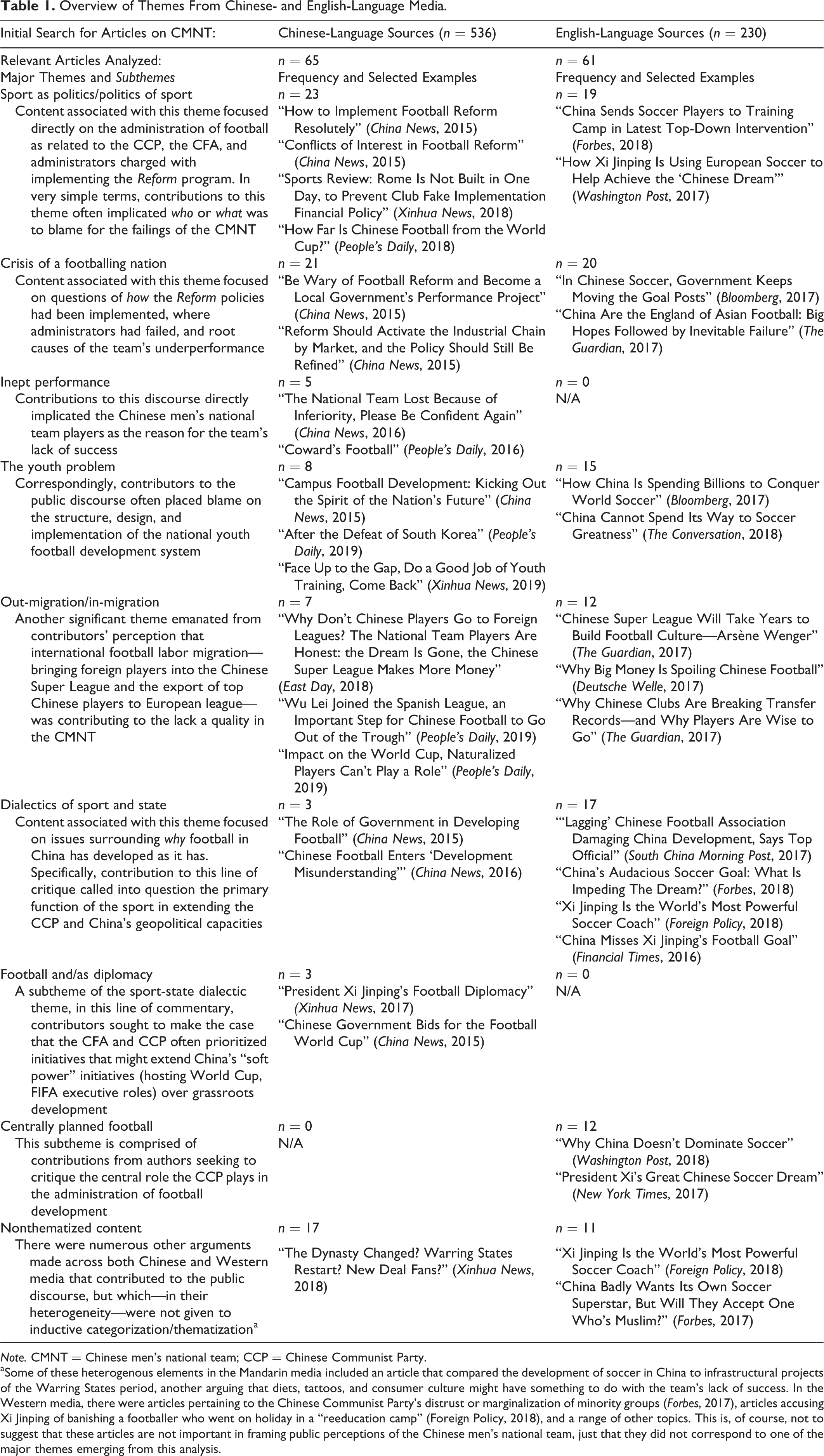
Note. CMNT = Chinese men’s national team; CCP = Chinese Communist Party.
aSome of these heterogenous elements in the Mandarin media included an article that compared the development of soccer in China to infrastructural projects of the Warring States period, another arguing that diets, tattoos, and consumer culture might have something to do with the team’s lack of success. In the Western media, there were articles pertaining to the Chinese Communist Party’s distrust or marginalization of minority groups (Forbes, 2017), articles accusing Xi Jinping of banishing a footballer who went on holiday in a “reeducation camp” (Foreign Policy, 2018), and a range of other topics. This is, of course, not to suggest that these articles are not important in framing public perceptions of the Chinese men’s national team, just that they did not correspond to one of the major themes emerging from this analysis.
Framing Football and/as China
Based on our analysis, in what follows we present the major themes, or “frames,” which writers for mainstream Chinese-language media and English media sources provided in their analyses of the causes and effects of the CMNT's failures in major international tournaments.
Sport as Politics, the Politics of Sport
In terms of quantity and degree of emphasis, this is the most prevalent theme in both Chinese and Western media outlets associated with content focusing on the political- and policy-based dimensions of contemporary national football governance. This thread engaged with a broader set of considerations as to the role of government in developing the game, the function of the game in Chinese society, and what impact the team and its performance might have on the health of the body politic (in terms of foreign policy, national consensus, soft power, etc.).
In the months following the publicization of the 2015 Reform document, Chinese media outlets generally turned their focus toward how the government might best invest its fiscal and human resources to optimize the effects of these reform initiatives. In a series of articles featured on the China News site, contributors offered analysis of how the significant State intervention outlined in the Reform and Development Program would alter the state of football. For example, in the article “News Watch: China’s Football Reform Launches ‘National Strategy’” (2015), the author proffered that “What surprised many observers is that the opening of the ‘Program’ clearly clarified the reform plan that was decided by the CPC Central Committee and the State Council. For the first time in history, the development of football was set at the national level, and its height and intensity were unprecedented.” This is consistent with most public commentary responding to the reform program; acknowledging the fact that a broad-sweeping football reform project was being undertaken at the State/national level was unprecedented. Both in the document and in the China-based media analysis thereof, there was a consensus that significant State involvement would be required to advance the economic, administrative, and on-field performance aspects of the football sector (and its national team corollaries).
Perhaps most noteworthy, Chinese journalists usually argued that it was essential that the State serve as the primary actor/administrator of this transformation: The high standard of football reform can be described as unprecedented, but it is necessary to be wary of the local government’s old mistakes in making quick successes and failures, and it cannot be a tool for local governments to pursue political achievements. (Be wary of football reform and become a local government’s performance project, 2015, p. 1)
Another China News article pronounced that these reforms would require central planning and should seek to produce actual and substantive changes in the system: We have left the original way and have fallen into a new way. Everyone is concerned about how the new way is established. In fact, this method is real. After the reform, no matter what is left, it cannot be hung in the air and will fall. (Chinese football reform, 2015, p. 1)
Perhaps portentously, the Chinese news media also engaged in debates about central tenets of the Reform document. For example, one recurring dictum on the Reform document was that individual professional clubs within the CSL—as well as the League itself—should act in ways that will lead to development and success for the men’s national team. In a 2015 article titled “The Club Should Focus on the Overall Situation and Fully Cooperate with the National Team,” the author didactically endorsed this directive: For possible conflicts between national teams and clubs, the reform program emphasizes the coordination of the needs of the national team and the club. The club should focus on the overall situation and fully support the construction of the national team. (p. 1)
The Crisis of a (Footballing) Nation
Throughout the review period, it was commonplace to find articles emanating from Chinese media reflecting on the root causes for the men’s national team’s perceived underperformance. For many contributors to the national discourse/discord, the problem was rooted in how young national team players were training and developing. For others, the source of the problem lies in who was involved in Chinese football. As we turn to each theme, it is important to note that the explanations tend to articulate back to individual-level or, in some cases, organizational-level (or meso level) explanations for the national football problem.
Performing ineptitude
The quality of the men’s national team players, or lack thereof, was frequently implied (or stated explicitly) in Chinese news media narratives. Indeed, the players were widely implicated by the domestic media as the team experienced failures along the World Cup qualifying campaign and later the Asian Cup. Following a 3-2 defeat to Asian rivals South Korea in early September 2016, a domestic sportswriter penned in an article titled “The National Team Lost Because of Inferiority, Please Be Confident Again” that the team’s failures were attributable to a lack of confidence (in both the team and the nation thereof): This match allows us to see the progress of the Chinese team, but we do not believe that the Chinese team has improved, or the Chinese team may not have enough arrogance, and there is an emotion called inferiority, which is gradually accumulating in 15 years. This match is actually lost to oneself and lost in such a long period of inferiority. So please be more confident. (p. 1)
What, then, were the reasons given for this lack of “spirit,” for failed performance and for this crisis of national sporting performance?
The youth problem
The most pronounced rationale for the men’s national team’s struggles was what was perceived to be a failing youth football development system. Despite the CCP allocating a reported 100 million RMB specifically for youth football development (“The budget for youth soccer is 100 million RMB,” 2016), journalists both inside and outside China were frequently citing an underperforming youth development program and the primary reason for the national team’s lack of success. In the early days after the launch of the 2015 Reform, the media tended to focus on what needed to be done to achieve successful development (for a more academic assessment of the state of youth football, see Qian et al., 2017). In a 2015 article titled “The Biggest Difficulty Comes from the Inside,” one author explained: “What Chinese football really should do is to do a good job of youthful training, and don’t even think about it as a strong team in Asia” (p. 2). Commentators across the various news sources we reviewed explained that if the State carefully invested its resources in grassroots youth football, campus football, and structured football training academies, then the national team would soon see improved results. In one postreform article, the author made the case that for the nation to effectively cultivate talented youth players, they would need to reorient the development infrastructure away from the existing “utilitarian model” (focusing on short-term performance) toward a more holistic approach: The development of…football should work hard to promote popularization and avoid the tendency of professionalization and utilitarianism. Schools should focus on cultivating children’s sense of struggle, competition, and team awareness in football, and building the foundation of the nation’s future with the health and beauty of each individual. (Campus football development, 2015, pp. 1-2) Although China’s plan to become the world’s best footballing nation has many flaws, it is attracting a large number of fans to the game and, while the country may not produce the “Chinese Messi” the government wants, the large-scale investment in academies will improve the base level of Chinese football in the future, as well as the nation’s interest in the game. (p. 2)
This critique of the planning, administration, and bureaucracy of youth football development was even more pronounced in the Western media. However, the attribution strategies and discourses deviated considerably from those in the Chinese media. For example, in Western media, it was quite common for commentators to suggest that China’s failures to develop high-quality youth footballers was due to cultural norms. On the one hand, the case was made that the players who were playing the game at youth levels were doing so involuntarily, and as such, the players lacked agency in their own development and investiture. Making the case for a more choice-driven, market-centric approach (similar to the pay-to-play model in the United States), one U.S.-based writer claimed: If you’re a spending a lot of money and there’s not enough money coming into the business, it’s not sustainable…. Participation in sports at a young age is essential to building a healthy consumer market, it will breathe financial life into the sport. (What China can learn from US soccer, 2018, p. 1) The bulk of China’s 1.38 billion people live in central and eastern China, where cities are among the most densely populated in the world. Urban real estate prices there are sky high, so recreational space in cities—like soccer fields that can be used for pickup games and local leagues—are few and far between. (China cannot spend its way to soccer greatness, 2018, p. 2) Parental pressure has been found to be one of the most significant sources of Chinese teenagers’ high levels of stress and anxiety. As a parent, too, I heard many other parents complain that their kids were maxed out. Adding athletics to their children’s agendas seems an unlikely choice. (p. 2) Money can buy overseas talent, but it can’t fill a national team. Professional sport is rarely seen as a career in China. Pan Guohong, a headmaster at the Tangdong Primary School in the southeastern city of Guangzhou, said parents favor academic subjects and fear injuries could derail prospects in China’s fiercely competitive school system. (p. 1) In the area of youth development and culture, the prevailing narrative is that China’s education is rigid, individualistic and focuses on rote thinking—and that football requires improvisation, creativity, innovation, teamwork and strong mentorship from parents or coaches who nurture and inspire. (p. 3) Football is still developing at the grassroots and a lot of potential talent is not yet involved in the game…. Yet it is among the country’s aspiring migrants where the talent may really lie; middle-class kids are more interested in sitting at a computer than carving a path on the field. (p. 1)
Out-migration/in-migration
Where, then, should current and future CMNT players best locate themselves—if not within the Chinese system—to best develop their skills? This topic occupied the pages of many of the media outlets we reviewed over the period of analysis.
The export strategy
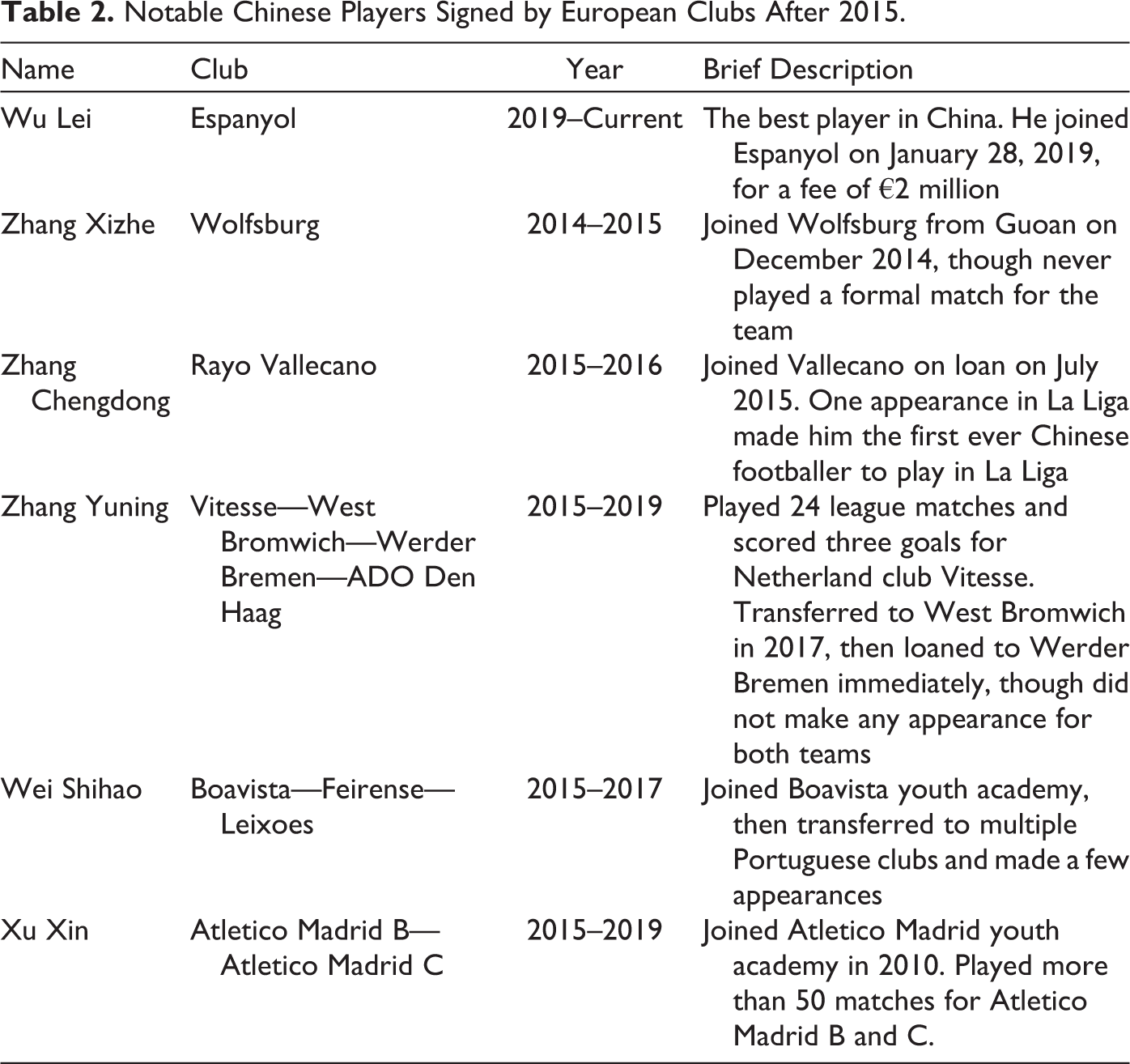
For many commentators, the solution would be to have Chinese national team players train and compete abroad. Indeed, throughout the period of analysis, the media tended to laud those top-performing Chinese players who had signed to play for European clubs. As is illustrated in Table 2, many key men’s national team players left for Europe from 2015 to 2019—with marginal success and typically in ways that turned media enthusiasm for the out-migration of players into pointed critiques of the respective players’ determination and commitment. This incited considerable debate as to how exposure to hypercompetitive foreign team environments might negatively affect Chinese players’ confidence and thus performance. In one 2015 article, a China News author explained that “Chinese players can’t be blindly confident, and they can’t be arrogant” as they shift to play for European clubs. In the same article, the author goes on to state “Chinese football does need to go abroad to play, but it is not simply to go out. Instead of going to be a ‘water dispenser administrator’ or ‘sales midfielder,’ it is better to play in the Chinese Super League” (p. 3). The point being made here was that only under the right conditions should Chinese players seek to advance their careers abroad. In many instances, the argument was made that such a move would fail, as the players lacked the confidence or skill to sustain their place on a European-based club. As an example, when top Chinese men’s player Wu Lei joined the Spanish club Espanyol in early 2019, the Chinese media were quick to remind their readers of the failures of Chinese players who had previously played in Europe. As one journalist wrote:
Notable Chinese Players Signed by European Clubs After 2015.
A series of failure cases have brought a lot of blow to the confidence of Chinese players. If Wu Lei can succeed, it will encourage more players to go abroad. Therefore, Wu Lei will be an important step for Chinese football to emerge from the bottom. (p. 1)
From a contrasting perspective, some journalists and commentators suggested that players’ failures abroad were attributable to the “pull factors” of Chinese football, where the top Chinese players enjoyed comfortable and lucrative professional arrangements back home in China. In the news outlet East Day, one contributor summarized a popular critique of Chinese national team players who had historically sought to ply their trade abroad this way: “We have to retreat. We can’t play abroad and we can return to China to make money. The enthusiasm may not be as strong as others. Playing in the domestic league means a significant increase in income” (Why don’t Chinese players go to foreign leagues?, 2018, p. 1).
The import strategy I: Importing expert foreign players/coaches
Perhaps the most divisive issue (in terms of the media public) which emerged from our analysis was the perceived effects investments in foreign players and coaches would have on the development and performance of the CMNT players. From 2012 until 2019, more than 35 top international players were brought into the CSL—often for transfer fees in excess of US$50 million and with salaries that on the high-end exceeded US$35 million per season (Chinese Football Super League shocked the world, 2015). On the one hand, many observers in China were quick to celebrate the in-migration of world-renowned players such as Paulinho (June 2015), Hulk (June 2016), Oscar (December 2016), Carlos Tevez (December 2016), and Marek Hamsik (January 2019) as a “game-changing” way to enhance intra- and inter-squad competition throughout the Chinese league (Wang, 2017). In theory, by bringing these top-class players into each CSL squad, current and future Chinese national team players would benefit from exposure to and modeling of their expertise and acumen.
However, many commentators in the Chinese media were quick to point out that increased spending on international players would not necessarily translate to improved performance from Chinese players. In 2015, one writer cautioned: Chinese clubs have money to be willful, but burning money is difficult to cover the problem of Chinese football. When Chinese players are as popular as international players, Chinese players have gained recognition in Europe more than domestic value, then Chinese Super League can become a true First league in Asian. (Chinese Football Super League shocked the world, 2015, p. 1)
Rather than envisaging the role of these imported players as beneficial to the development of Chinese national team players, the opposite case was usually made. Arguing that the money would be better spent on player development, one writer suggested: “China, as a football-underdeveloped country, has a poor foundation. Burning money cannot burn a bright future. Instead, it will lead to false prosperity due to long-term high investment and low output” (How far is Chinese football from the World Cup?, 2018, p. 1). This critique was corroborated in Western media, where contributors were overwhelmingly attenuated to the significant contracts being offered foreign players who joined the CSL. The case against big-spending was, in the Western media, one part fueled by apprehensions about the economic stability of the league and one part a question of the degree to which Chinese players were ready to compete with top international talent. In The Economist, one writer posited: Officials have also been trying to curb the buying of stakes in foreign clubs—Chinese investors shelled out about $2bn on them last year. The government says this is part of an economy-wide clampdown on currency outflows. But it also wants to make the point that foreign talent won’t necessarily help China’s. (Chinese football clubs are struggling with new curbs on foreign players, 2017, p. 2).
The import strategy II: Importing (Naturalized) Chinese players
In the Chinese media, there were growing concerns over how the CFA might look to “naturalized” players as a short-term “fix” for the player development problem. This process of “naturalization,” in China as elsewhere in world football, is the process where a player is granted citizenship status to a nation and thereby made eligible (it not cap-tied to another country) to play for the new country’s national team. Many nations/teams have used this approach in recent years to recruit players with paternal ties or others means of eligibility to augment the national team player pool (Bahrain, Qatar, etc.). In a 2015 article titled “The Biggest Difficulty Comes from the Inside,” a China News author chided the naturalization of foreign-born players as a bad remedy for poor development and planning: The naturalized player is a short-sighted act of quick success and instant benefit. It does not help the development of Chinese football. “Naturalization” is not as good as “planning”. (p. 1)
Most articles during the review period picked up on this theme, claiming that naturalized players are “not really Chinese” or assuring the reader that these “imports” would never take the place of current national team players.
However, on the heels of the World Cup Qualifying and Asian Cup failures, the CFA relaxed the regulations allowing foreign-born players to obtain Chinese citizenship and hence eligibility to be classified as Chinese national players (for the purposes of Chinese players filling team quotas in CSL rosters). As of this writing, it is unclear if the CFA will allow naturalized players to represent the men’s national team. However, what is clear is that in the Chinese media, the shift in policy is seen as a positive attempt to deepen the player pool, promote competition amongst the players for roster spots, and bring internationally cultivated acumen to the team. One contributor to People.cn (2019) lauded the relaxed regulations for player naturalization but suggested these newly Chinese would likely have no direct impact on efforts to qualify for the next World Cup: “The naturalized player is a positive attempt in the reform of Chinese football. It is by no means an act of quick success and instant benefit, and it has nothing to do with the task of impacting the World Cup” (p. 1). In both Chinese and Western media, we see a common framing of the problem (inadequacies of the players and hence their developmental modalities) and a critique of the proposed (or perceived solutions), namely the in-migration of new players to (a) improve on the field competition for current CMNT members or (b) become naturalized members of the team. We also see a transposition of blame away from sources of authority, be they at the team level (the coaches) or at more structural levels (the CFA or the government more generally).
Dialectics of State and Sport
From the perspective of football intermediaries presenting their case to the Chinese media-consuming public, there were various explanations as to what football reform was intended to do and how it could best be achieved. As compared to domestic and international narratives, what becomes clear is that the interrelations of State and sport were differentially constructed within national and international frames, shifting from national stories of sport for development and diplomacy to (domestic and foreign) preoccupations with effective football policy and administration to Western media’s ideologically oriented characterization of sport under the governance of the CCP. We turn to each, in order.
Football and/as diplomacy
From the launch of the 2015 reforms, Chinese media consistently made claims in support of one major thesis: that the major reforms and initiatives to improve football were directly tied to broader efforts toward increased international diplomacy (sport and otherwise) by the CCP. In their efforts toward expanding football with the aim of someday hosting a World Cup, commentators argued that the mega-event could (much like the Olympics) help boost the nation’s geopolitical position and connectivity. In the weeks following the launch of the 2015 reforms, during the 65th Plenary Session of FIFA which was held in Zurich, Switzerland, the Chairman of the Chinese Football Association, Cai Zhenhua, stated in an interview with CCTV that “China has an urgent willingness to bid for the World Cup, but the timing needs to be planned. The Football Association hopes to achieve this goal as soon as possible.” This urgency, much like the performance of the national team on the world stage, was said to be linked to the nation’s broader political imperatives. Following a 2017 meeting between President Xi Jinping and FIFA President Gianni Infantino, one author made clear mention of China’s intent to connect football development to broader diplomatic, aspirations: “Xi Jinping appreciated that Infantino was committed to the development of football and paid attention to the Chinese football industry after he became the president of FIFA. He stressed that China will actively support the work of FIFA and is willing to make due contributions to the development of world football. China has a broad prospect for cooperation with FIFA. Only two years later, as a Chinese government official, Du Zhaocai was running for Vice President of FIFA’s Asian Confederation, the links to soft power were being made more explicitly: “In fact, the position of the vice president of the AFC is more practical for the promotion of soft power in Chinese football. In particular, in September this year, it will enter the top 40 of the 2022 World Cup. Therefore, if Du Zhaocai can compete for the success of the vice chairman of East Asia in the first half of the year, then the impact of Chinese football may be able to remove more artificial obstacles” (pp. 2-3). This association of football governance and the CCP’s soft power polity were extensive, if implied, throughout the texts we analyzed.
Centrally planned football?
Indeed, policy and governance were significant aspects of Chinese-language discourse. There was a cacophony of public discourse on the role that the CFA, and the CCP more generally, has played in regulating the commercial and player development aspects of the domestic game. Many of these contributions to the public sphere dealt with the seemingly “irrational” or “whimsical” ways in which the CFA introduced changes to player eligibility in the CSL. Commenting on the imperative to create a more systematic and rational approach, one journalist wrote: “Procedural legitimacy is the premise of the promulgation of the ‘fairness’ policy of Chinese professional football. Managers should conduct in-depth research, rigorous argumentation, and extensive solicitation of opinions in order to achieve a stable development of the league” (The dynasty changed? Warring states restart? New deal fans?, 2018, p. 1). For example, as is the case in other professional leagues around the world, the CSL has a series of (ever-changing) rules as to who is eligible for gameday rosters and starting lineups. For instance, the CFA required all CSL clubs to start at least one U-23 player and have one on the substitute before the 2017 season. A year later, this rule was changed to “the number of foreign players in their starting lineups should match the number of under-23 players, while at least one under-23 player should be included in the starting XI” (CSL season kicks off with new rules in tow, 2018, p. 1).
Perhaps the exemplar or flashpoint of this public consternation came near the end of the 2018 CSL season, as rumor of a series of major changes to club eligibility was being bandied about social media. In response, some contributors argued that a central governing body was essential to providing uniformed guidelines and oversight of team and player development: “Administrators must strictly guard against clubs not implementing policies; using third-party monitoring is also an important factor in determining success or failure” (Sports review: Rome is not built in one day, 2018, p. 1). Yet, for the majority of journalists and public intermediaries in China, the unstable policy environment with respect to player eligibility became a source of great concern: “There is no real professional league that will change the rules during the season. If the policy lacks stability and persuasiveness, it will inevitably affect the league order” (The end of the league is wonderful and highlights professional attitude, 2018, p. 2). Some further speculated that this central-yet-incongruous governance system would create unstable economic conditions for league and player development: “The uncertainty of the policy still makes the market’s valuation of the Super League brand still relatively embarrassing” (Where should the brand of Chinese football super professional league go?, 2018, p. 1).
These concerns of irrationality and central governance of Chinese football were more pronounced in Western media. In an article sarcastically titled “Xi Jinping Is the World’s Most Powerful Soccer Coach” (2018), an author to Foreign Policy wrote: “Then there is also the unpredictability of the CFA, which gets column inches in the Western media for banning tattoos or suspending players for giving a sarcastic thumbs-up, and of the political system as a whole” (p. 1). The issue of bureaucracy, while not predominant in Chinese media, seemed of central concern to Western pundits. In one 2016 USA Today article, Western experts provided their assessment of how central government bureaucracy was to blame for China’s slow development in international football: But [one expert] warned there were similarities with the government’s approach to economic planning that, despite its successes, can lead to inefficiency or graft. One example is the wave of interest that followed the 2002 World Cup run, which quickly fizzled out when the domestic league was hit by rampant corruption scandals. “The leadership sketches a hugely ambitious and yet ambiguous vision and people lower down the chain—government bureaus, provincial governments—and those hoping to curry favor, especially in business, pick it up and run with it.” (China’s football revolution kicks into overdrive, 2016, pp. 1-2)
Chinese (Football) politics
These framings and critiques of centralization seem to provide segue to, nay give life to, broader criticisms from outside of China about the role that the State plays in administering and governing football activities. At the extreme, Western intermediaries were intent on not only tracing lines of governance from the CCP to the CFA to the national team and its players but in seizing the slow development of football as a crisis or “authoritarianism.” As one U.S.-based academic boldly claimed: China’s soccer troubles are a case study in the limits of authoritarianism. When the government decided to allocate significant resources toward Olympic success—a process that included recruiting children as young as 6 years old, often separating them from their parents, and, as most experts believe and the World Anti-Doping Agency may soon show, using performance-enhancing drugs with abandon—they achieved their goals. In many Olympic sports, high performance is a matter of biomechanics and discipline. To be sure, neither are irrelevant to soccer—but they are not decisive, and too much discipline can actually be a handicap. (Why China doesn’t dominate soccer, 2018, pp. 2-3)
In The Guardian (UK), New York Times, Forbes, and elsewhere, contributors consistently made the case that the centralized approach to sport governance/administration was the major contributor to an underperforming men’s national team. These critiques tended to center on an assumption that football policy makers were acting autonomously and irrationally. Regarding one 2017 change to CSL player eligibility, a Guardian writer exclaimed: “… the General Administration of Sport, a government organ that controls the Chinese football association, suddenly decreed a new directive. The move appeared ill-thought through, showed disregard for the realities football clubs face and undermined confidence in the league” (China are the England of Asian football, 2018, p. 1). In echoing the critique of shortsightedness emanating from Chinese media, a contributor to Fox Sports (2018) wrote: There’s no question that those involved in Chinese football are all trying to find the best way to accelerate the growth of the game, but rather than these constantly shifting, seemingly poorly thought out ideas that simply crush one problem upon the next, what’s needed is a patient, long-term vision for the game. (p. 2)
Conclusion: A State (of) Mediated Football and “Authoritarian Determinism”
While in the Chinese media, it was quite common to see reports and commentaries about the causes and effects of the men’s national team’s success and failure and how those performances relate to players' efforts, administrative missteps, and the place of football in Chinese culture more generally, outside of China the topic of the men’s national team’s performance (while less frequently engaged) was often a gateway to broader discussions and critiques about the structure of the Chinese body politic. Both inside and outside of China, what becomes clear through our analysis is that the (failed) football event provided a means through which broader articulations of sport, performance, identity, and geopolitics could be reassembled along particular political ideologies. Our task here was to sort out how those ideologies were expressed in and to the Chinese national readership in comparison with those outside China.
At the most basic level, we might surmise that once thematized as we have done above, it becomes clear that the contrasting frames and discourses emanating from domestic and Western media sources regarding the issues facing the CMNT break along the lines of policy versus politics. In other words, the Chinese media tended to focus on the effectiveness of football reform policies—speculating as to their future effects and reflecting upon where, in practice, these reforms have failed to deliver the intended sporting outcomes. In this way, the Chinese media seemed to frame the performance of the CMNT in ways which would have us read the crisis as one specific to the individual (i.e., player confidence, a local government agent, etc.) or of meso-level administrative execution (i.e., disorganized sports administration bureaus, underdeveloped coaching systems, etc.). In this way, it was common to see various types of transposition or diffraction (or perhaps we might say, disarticulation), whereby the root of the problem was transposed onto individual or organization actors/actions and away from broader structure regimes. This finding in many ways corroborates a long-standing critique of contemporary China, whereby censorship practices and the media environment in the People’s Republic limit media actors’ ability to levy a systematic critique of government falterings (see Tang & Huhe, 2014). It was often the case that the Chinese media relied on partial stories that selectively disassociated the players and team from the CFA or the CCP—ascribing abjection to the individuals whilst maintaining positive themes of the Chinese State’s involvement in sport.
By contrast, journalists and public intermediaries in the West—most notably in the United States—deployed tropes of maladroit centralization, structural determinism, and authoritarianism in line with prevailing ideological (Western) antipathies toward ascending China. Indeed, media actors representing U.S. State institutions similarly constructed partial stories, conjured up revised histories, or claimed expertise around the inner working of football administration in China despite no concrete engagement with on-the-ground football administration practice. Consider, again, the Washington Post article “Why China doesn’t dominate soccer.” In that article, the author goes on to deride the CCP by claiming that “China’s soccer troubles are a case study in the limits of authoritarianism” and argues that the repressive State control of individual freedoms in China is akin to those of former Eastern European police states. While such hyperbole aligns well within the Trumpist U.S. mediascape, it certainly appears less analytical and more hyperreal than firsthand engagement with China’s football culture would suggest. A less politically involved reading of these and other Western representations of the plight of the Chinese men’s national football team might lead us to the question of extrapolation, whereby sporting intermediaries use rhetorical strategies that form loose causal articulations between player–team (performance)–sport administration–the CFA–the CCP–authoritarian governance structures. There tended to be very little discussion around sport and the public good, increased access to sport and public health, the growth in football-related jobs, and other positive outcomes from the Reform. The analysts themselves often relied on conjecture, the platitudes of Western moralism, and tropes of authoritarianism to evoke a certain positionality. Indeed, it was often the case that the analysis of Chinese football in the Western media was underpinned by what has been referred to as an authoritarian determinism (Guan, 2019), where framings of the nation’s football shortcomings provided the platform for a de facto critique of the CCP: one which articulates well to the anxieties and apprehensions of a rising China which pervade Western media in the Trump era but often lacked concrete empirical associations from national governance structures to on-the-field player development.
Hence, what becomes clear through this analysis is that failure, in the case of the Chinese men’s national football team, is generative. It produces storylines, spectacle, anxiety, and so on. But it also produces political narrative and new political ontologies—whereby a game’s outcome is, depending on who is mediating the event, an opportunity to authorize various political interconnectivities. From one perspective, the team’s performance articulates to cowardly players, wrong-headed administrators, in- and out-migrating laborers, or shortsighted policy makers. From another, footballing failure is symptomatic of a faltering communist government structure, of authoritarianism, or of the nation itself. In either case, football in China continues to be both political and politicized and put to use to frame and reproduce many of the dominant cultural politics and geopolitics from which the East–West divide is sustained.
Footnotes
Declaration of Conflicting Interests
The author(s) declared no potential conflicts of interest with respect to the research, authorship, and/or publication of this article.
Funding
The author(s) received no financial support for the research, authorship, and/or publication of this article.
