




Abstract
The claim that “anything is possible in women’s sports” frequently employed by both sports journalists and general audiences highlights the widespread perception of a seemingly uncontested truth about female athletes and their (in)ability to perform consistently at peak levels in comparison to male athletes. We focus on this treatment of female athletes in the world of women’s tennis and contest the “common sense” and “experience” justifications of the unpredictability in women’s sports with actual data to reveal clear media bias. Utilising a database of the Association of Tennis Professionals and Women’s Tennis Association tournaments dating back to the late 1960s and covering approximately 225,000 fully described matches, we examine the “anything can happen in women’s tennis” assumption through logistic regression, focusing on the effect of rank differential on the winning probability in the match while controlling for other factors (tournament type and stage, court surface, age differential, and elite players). The results are rather shocking. The women’s matches do not show higher instability or lower predictability at all, but rather the contrary—the men’s matches show lower dependence on the rank difference. The results are robust as checked for data sets of the year 2000 onwards and those including only special events such as Grand Slams.
It is indecent that spectators should be exposed to the risk of seeing the body of a woman being smashed before their eyes. Besides, no matter how toughened a sportswoman may be, her organism is not cut out to sustain certain shocks. Her nerves rule her muscles, nature wanted it that way.
The above view of the female athlete’s body as inherently offensive and biologically doomed by founder of the modern Olympic Games Baron Pierre de Coubertin may be more than 100 years old but still resonates in the minds of many sports journalists and experts. Even though women now participate in the vast majority of Olympic and other sports, and an abundance of analytic literature and recommendations how to treat women’s sports and female athletes exist, women’s athletic and competitive ability continues to be underestimated by both men and women alike. The assumption that gender overarchingly determines the degree of an athlete’s physical performance and psychological stability is still very much present.
The pejorative phrase “anything is possible in women’s sports” and its variations, used by sports journalists as well as general audiences, reflects a widespread perception of a seemingly uncontested truth about female athletes and their (in)ability to perform consistently at peak levels in comparison to male athletes. This unequal treatment is often supported with appeals to “common sense” or references to past competitions of which the author or speaker has had personal experience, as Bruce (2012) describes: Sports journalists’ decisions appear to be based on historical precedent and tradition (thus privileging established male sports), anecdotal evidence and intuition (based on their experiences and ideological beliefs rather than critical public feedback or research) and their belief that a predominantly male audience is not interested in women’s sport for its own sake. (pp. 130–131) The duel of Petra Kvitová and Julia Putinceva from Kazakhstan will be written in history as one of the most unbelievable duels and as the definition of women’s tennis. You can win any match but you can also lose it. (ram TN.cz, 2018) I usually just watch Wimbledon and maybe 1 or 2 other events a year but find the men’s game really easy to follow because it’s pretty much the same guys on top but with women’s tennis I always feel lost like so much has changed in the last few months. (EdwardBigby, 2017)
However, this approach is not new, as the years in which the quoted statements were published could suggest. Tandon (2010) discussed on ESPN.com “the WTA unpredictability” and related it to various factors, including inconsistency in performance and lack of the players’ resistance to stress. “Anything is possible in women’s tennis,” said the coach of the Czech women’s national team, Jan Kukal, before the match of his team with Italy in 2013 (Plašil & Marek, 2013).
In some cases, female players themselves adopt the “common shared knowledge” stance on the unpredictable nature of their sport and perpetuate the belief in their statements, like Karolína Plíšková did in this case, “I know a lot of people who are more likely to watch women’s tennis because there can happen more surprises. Men’s matches are more stereotypical” (Němý, 2018). Anderson (2008) described it as the acceptance of hegemonic masculinity’s (Messner, 1988) perspective.
As one of the most popular and most bet on sports around the world, tennis has especially detailed data available for essentially all matches played at the professional level decades into the past. We thus aim to test the common sense and “experience” justifications for the claim that female tennis players are less predictable and less results-stable than their male counterparts. To do so, we utilise a large database going back to the late 1960s and listing approximately 225,000 matches together for Association of Tennis Professionals (ATP) and Women’s Tennis Association (WTA) tournaments. We test the hypothesis of the “anything can happen” assumption utilising logistic regression focusing on the effect of the rank differential on the final outcome of the match. We show that no “anything can happen” effect in women’s tennis exists compared to men’s tennis, but rather, to the exact contrary—the results of men’s tennis turn out to be less predictable than the women’s with respect to the rank differential of players. The same results are shown for both data sets starting from 2000 and 1968, as well as those of only special events such as Grand Slam tournaments or the Olympics. These empirically robust results thus cast important doubt on the accuracy of perceptions of the unpredictability of women’s tennis in comparison to the men’s game.
Literature Review
Women’s Sport in Mediasport
Sports and mediasport (Wenner, 1998) are widely believed to be very gendered institutions and spaces where men’s hegemony and dominance have been reinforced by many strategies, for example, strengthening the position of male athletes or “normality” of men’s sport and the “otherness” of women’s sport, and marginalising the achievements of female athletes being among the most frequent ones (Anderson, 2008; Bernstein, 2002; Bissel, 2006; Messner, 1988; Vincent, 2004; Yip, 2018). We can find multiple content analyses focusing on the comparison of women’s and men’s sports coverage in all types of media, including the newest online media outlets, presenting very similar results: Women’s sports are underrepresented and at the same time the coverage of female athletes centres more often on the soft news features of their performance (e.g., clothes, visual impression, sexualization or infantilization of the athlete’s image as well as details about personal lives) over actual athletic competence (Bernstein, 2002; Domeneghetti, 2018; Kian, Bernstein, & McGuire, 2013; Kian, Fink, & Hardin, 2011; Konjer, Mutz, & Meier, 2019; Vincent, 2004; Vincent, Pedersen, Whisenant, & Massey, 2007).
However, some authors have suggested the emergence of a new, “neutral” treatment of women’s sports by the media focused on plain information about events. This “boring” coverage may be the result of journalists’ fears of being accused of sexism (Cooky, Messner, & Musto, 2015).
Suggestions of how to better cover women’s sports include hiring and retaining journalists without prejudices, chiefly with the aim to refer to female athletes in an attractive but not preoccupied way (Cooky et al., 2015). This can be also reflected in what Bruce (2016) called the discourse of the pretty and powerful, meaning that athletes’ femininity is pronounced in the media coverage but within athletes’ rules and under their control. That is something made possible by the extension of the Internet and social media, through which the athletes can directly spread the narratives and pictures they like. And last, but not least, recommendations also suggest discovering whether the ubiquitously invoked anecdotal evidence and common sense justification of the variability of women’s athletic performance have any factual basis, as we do in this article, and if not, then reflecting it in its media coverage.
Media Coverage of Female Tennis Players
At the 1900 Olympic Games in Paris, Charlotte Cooper became the first ever female Olympic champion (Fuller, 2018), with lawn tennis, later tennis, being one of the few “acceptable” sports for women. Although tennis holds a special position with both the women’s and men’s games enjoying similar amounts of media coverage, especially as the biggest events share the same venues (Bissell, 2006; Bruce, 2012; Domeneghetti, 2018; Fuller, 2018; Kian et al., 2013; Kian & Clavio, 2011; Kian, Fink, & Hardin, 2011), the balanced quantity of media coverage does not translate into equal quality (Bissell, 2006; Quayle et al., 2019; Vincent et al., 2007; Yip, 2018). Women’s tennis remains “the other,” while “the standard” of tennis is the men’s game (Messner, Duncan, & Jensen, 1993; Vincent, 2004).
Quotations from the content analyses of women’s tennis media coverage from the beginning of the 21st century document explicit objectification of female players’ bodies and a sexualization one can hardly believe made it to publication, such as this description from a Daily Mail article, analysed by Vincent (2004): At the end of the spectrum, there’s Scary Spice in the person of Venus Williams, 6ft 2in of sinuous black muscle. At the other end, there’s Baby Spice in the tasty shape of Anna Kournikova, long blonde tresses plaited into a pigtail, breasts trussed up in the designer sports bra she richly endorsed. Between these extremes there sprawls a sultan’s seraglio of other vixens, all tanned and trained to appeal the most jaded appetites. (p. 443)
Regardless, following the tradition of de Coubertin’s view previously referenced here, female tennis players are regularly labelled with negative descriptors regarding their mental stability and force. While male tennis players are acknowledged as tough warriors, fighting until the very end, women are “more likely to be framed as failures due to some combination of nervousness, lack of confidence, lack of being ‘comfortable’, lack of aggression, and lack of stamina” (Messner et al., 1993, p. 130). “[M]entality is constructed as a weakness in the women’s matches,” adds Quayle et al. (2019, p. 15). These findings resonate with the results of analyses by Bissell (2006), Vincent (2004), and Yip (2018) that also found female players to be represented as more psychologically fragile and less mentally resilient.
In the past 15 years, this style of reporting can be partially influenced by the strongly mediatized rivalries between the two male stars Roger Federer and Rafael Nadal. Their matches have been almost worshipped by both the fans and media, a tendency even extending into scholarly articles, for example, “Why Roger Federer is a GOAT: An account of sporting genius” (Higgins, 2018). There was no narrative like that about women’s tennis in the same time.
Studies Analysing the Differences in Female and Male Tennis Players’ Performance
Our article is not the first to compare the media coverage of men’s and women’s tennis. However, to the best of our knowledge, it is the first to use sports data analysis only, as opposed to any kind of media analysis or interviews with media professionals, to examine one of the most widespread media narratives perpetuating the inferiority of female tennis players.
Several studies from the field of psychological, behavioural, or economic sciences (De Paola & Scoppa, 2017; Jetter & Walker, 2015; Magnus & Klaasen, 2010; Wozniak, 2012) analysed tennis performance data in relation to gender differences but on smaller samples (in all cases except for Jetter and Walker, 2015, even significantly smaller and limited data sets).
While analysing the results of the final sets of Wimbledon matches from 1992 to 1995, Magnus and Klaasen (2010) found a significant difference between women’s and men’s competitions, stating that “men are closely equal in quality” (p. 467) meaning that there is a higher probability of an upset in the result of the match (when presupposing the higher ranked player should win) in men’s competition. This finding is in strict opposition to anecdotal and common sense evidence presented in the media by journalists, coaches, and players.
Wozniak (2012) and Jetter and Walker (2015) focused on the “hot-hand effect,” analysing any differences between women and men in influences of the previous matches on their competitive performance. Wozniak (2012) revealed gender differences and similarities: “[B]oth men and women are more likely to enter tournaments after doing well, but women are affected by their last tournament while men’s previous performance can affect entry beyond the next tournament” (p. 158). The higher ability women also react positively to the results from their last tournament while men do not (Wozniak, 2012). Jetter and Walker (2015) found, in their examination of the hot-hand effect, no gender differences at all, then went further to analyse the “clutch-player effect” and found that “top-ranked female players are at least as likely as males to perform well in important matches.” (p. 107)
Contrary to those results, the most recent study of De Paola and Scoppa (2017) had the following findings: [W]omen losing the first set are much likely to play poorly in the second set. This suggests that women are more discouraged when facing the pressure of falling behind and receiving negative feedback. The gender differential is stronger in high-stake matches. On the other hand, when players are tied in the third set we do not find any gender differences in players’ reactions suggesting that women are as able as men to handle pressure if they do not lag behind. (p. 444)
The empirical evidence of the “anything can happen” in women’s tennis is thus not as clear-cut as it might seem from the practices of some sport commentators. However, most of the reviewed studies limit their sample with respect to some specific features that could influence the results. To overcome such an issue and to provide a robust evidence in favour or against the claimed effect, we present a detailed analysis of the possible effect gender plays in the winning probabilities of tennis matches based on a large data set of almost 225,000 matches dating back to the late 1960s with no additional ad hoc restrictions on the sample.
Methods and Data Set
There are multiple ways to define the “anything can happen” assumption, which is well illustrated in the previous section. In our analysis, we study the probability that the better player, that is, the player with the better rank at the start of the match wins the match and how it is affected by other factors. The rank differential between the higher ranked and the lower ranked player is our key variable of interest as it is expected that the greater the rank difference between the players, the greater the likelihood of the higher ranked player actually winning is as well. To do so, we utilise the broad data set of Jeff Sackmann (https://github.com/JeffSackmann), specifically the ATP and WTA databases. Jeff Sackmann is the founder of TennisAbstract that collects detailed data about tennis results and statistics and makes them freely available also for research purposes. In addition to the historical databases we study, the provided data cover point-by-point statistics of professional games for a more recent period after 2011. The data sets we examine go back to 1968, and we cover the period up to April 2018. Each record contains information about surface, draw size, tournament level, tournament date, match number, winner/loser seed, winner/loser name, winner/loser hand, winner/loser rank, winner/loser age, match score, tournament round, and a few more identification variables. After removing the observations with missing data on the variables of interest, the core sample contains 224,890 observations (matches ranging from futures for men and WTA international for women up to the Grand Slams and the Olympics), which is unprecedented in the topical literature.
To find whether there is a distinction between the role of rank difference on the final probability of winning the match for men and women tennis players, we construct a logistic regression model with an explained variable being the better ranked player winning the match. As explanatory variables, we include the rank difference as the main variable of interest and then we also include other control explanatory variables that are expected to play a role in the likelihood of winning a match, specifically the age difference between players, the tournament level, surface, round of the tournament, and whether at least one of the players is ranked in the Top 5, Top 10, or Top 100 of the respective ranking. The selection of control variables is not random and is based on prevailing expectations about tennis match dynamics and data availability. Specifically, one would expect that the better players have better focus during high-level tournaments such as the Grand Slams, the Olympics, the Masters, and similar, so that the probability of the better player winning the match would be on average higher for such types of tournaments. A similar interaction is expected for the phase of the tournament as the better players may be eliminated during the early rounds of the tournaments before they get into the rhythm while the worse players may be more motivated and surprise the field. Tennis court surfaces might play a role as well as one might speculate that for faster surfaces, there is a higher chance of worse players overperforming, or in other words, the variance of results might be higher. For very specialised court surfaces, specifically clay, one would assume there are players focusing on the specific type of court so this would influence the probability of winning as well.
Probability of the better ranked player winning p is then modelled using the binary logistic regression as
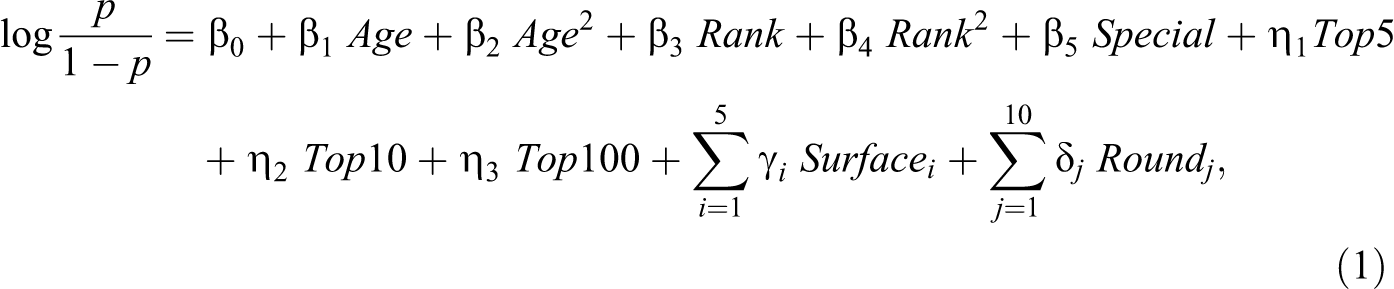
where Age represents the age difference between the higher ranked player and the lower ranked player, Rank is the rank difference between the two, Special represents a dummy variable that is equal to one if the tournament is of a special category (Grand Slam, Olympics, Fed Cup, Davis Cup, and variations of Players’ Championships) and zero otherwise, Surface represents the set of court types (Carpet, Clay, Grass, Hard, and not specified or others), Round is a set of different round levels, and Top5, Top10, and Top100 are dummy variables equal to one if at least one of the players is ranked up to Rank 5, Rank 10, and Rank 100, respectively, and 0 otherwise. Variables Age and Rank are also included in their squared form as it is expected that the effect of age difference and rank difference will be diminishing.
The model can be further expanded for detection of differences between men and women. Specifically, we are interested in the effect of the rank differential on the probability of winning the match. If the rank differential is more important for predicting this probability for men than for women, we consider men’s matches to be more stable and more predictable, that is, the “anything can happen” effect for women would be reflected in the rank differential playing a weaker role in the model for women. We thus extend the model in the following way:
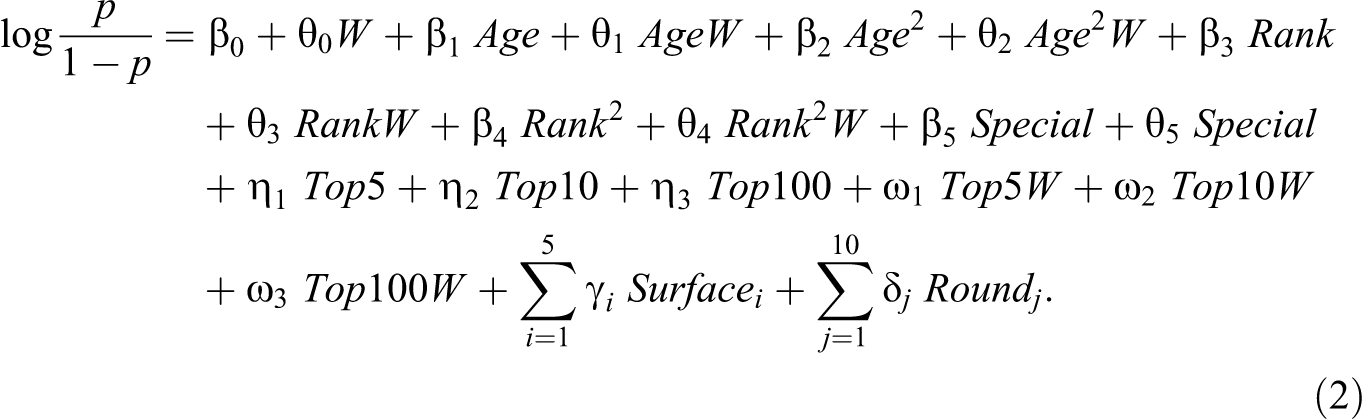
The model thus adds partial effects (represented by the dummy variable W that is equal to one if we consider the women tennis match and zero otherwise) for the age differential, rank differential, special events, and the highly ranked players. Our main hypothesis that the men’s tennis matches are more stable and predictable with respect to the players’ quality than women’s tennis matches is represented by parameters θ3 and θ4. If the “anything can happen in women’s tennis” effect is valid, the θ3 parameter will be negative, that is, our null hypothesis is that θ3 < 0 against the alternative that θ3 ≥ 0, which would suggest that the results in women’s tennis are in fact more predictable with respect to the rank differential than in men’s tennis. Value of the θ4 parameter specifies the shape of the partial effect, and it will be discussed in more detail with the other results if found significant.
Results
Before jumping to the estimates of the model of interest, we investigate the basic statistics of the analysed data set with respect to the men–women separation and focusing on the quantitative variables. In Table 1, we can see that the unconditional probability of the higher ranked player winning is very close for men and women, specifically around 66% and 67% for men and women, respectively, that is, slightly higher for women. Thus, without knowing any further details about the match, the probability of the better ranked player to win the match is around 67%. However, the standard deviation of 47% suggests high uncertainty of this average winning probability and thus calls for further inspection.
Descriptive Statistics of the Quantitative Variables.
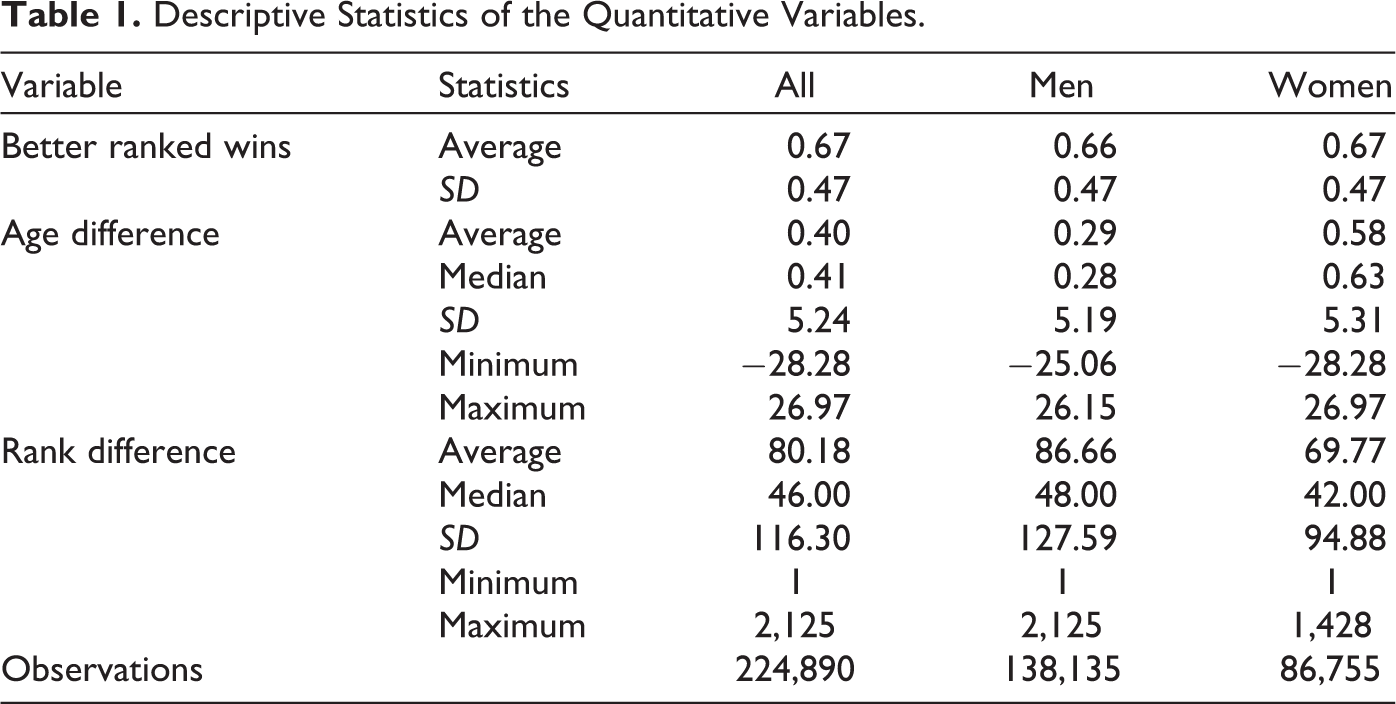
For the explanatory variables, we inspect the age difference and rank difference in more detail. The average age difference is rather small for both men and women (less than 1 year) but with a very high standard deviation above 5, which suggests potentially high information value for our model. The range of the age difference is rather wide, and we observe that the winner could be up 25 years or 28 years younger for men and women, respectively, or up to 26 or 27 years older for men and women, respectively. For the rank difference, we find more stable statistics with an average rank difference of 87 and 70 for men and women, respectively, and comparable standard deviations. The much lower median values suggest that there are several extreme observations that drag the average levels higher. The rank differences vary from 1 to 2,125 for men and from 1 to 1,428 for women. Overall, we have 224,890 recorded matches, split between 138,135 for men and 86,755 for women. The data set is thus quite well balanced.
Even though the range of rank differences is found to be rather wide, a more detailed inspection of the rank differences quantiles (Figure 1) uncovers that around 80% of matches in the sample are between players who are not further than 100 ranks from each other. Going further, around 99% of the recorded matches show the rank difference below 500. This is true for both men’s and women’s matches, and it will be taken into consideration for the final model interpretation and presentation.
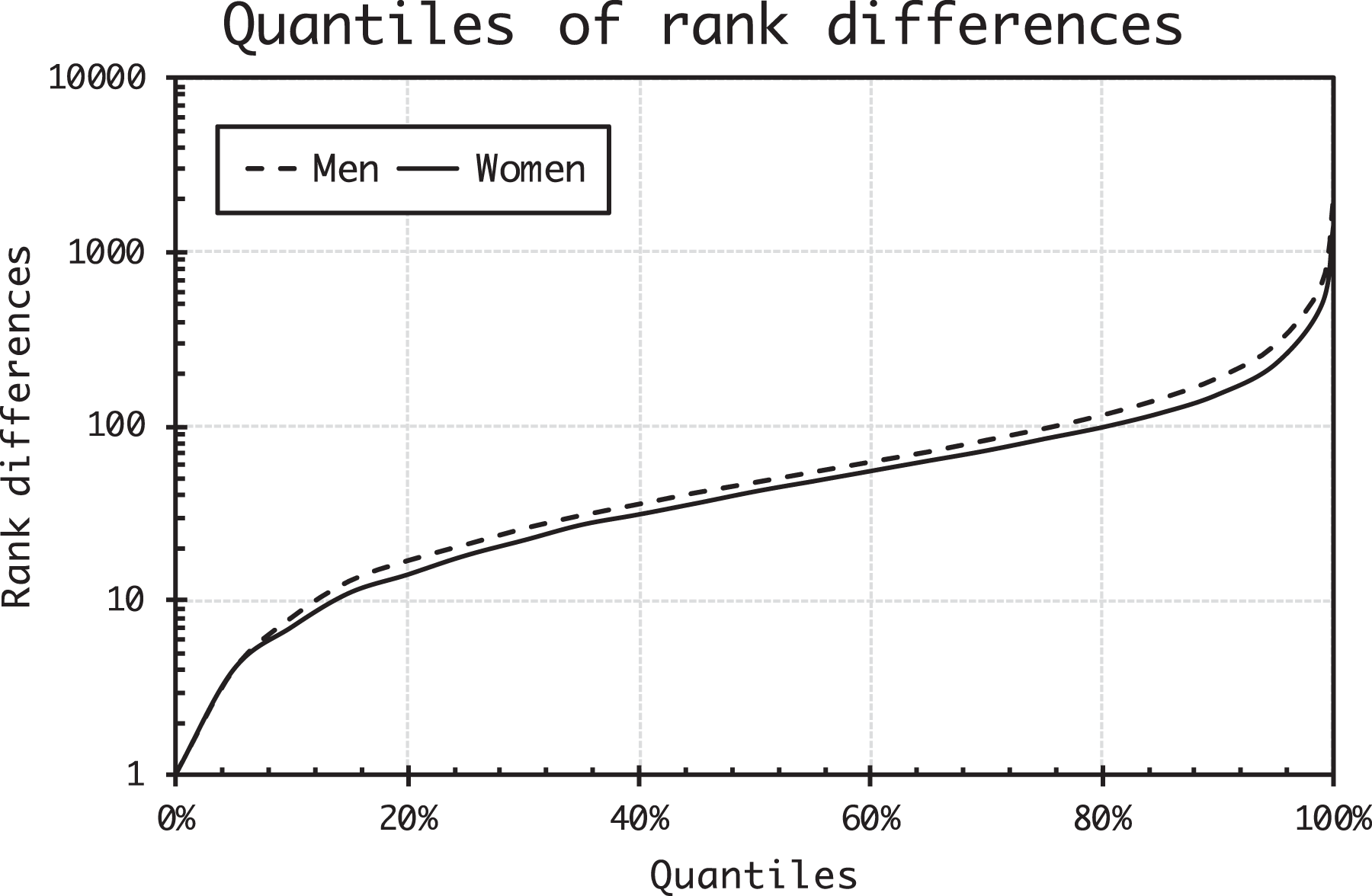
Quantiles of rank differences.
Estimated models for the whole sample are shown in Table 2. We find that most of the selected variables are statistically significant. In fact, for the model according to Equation 1, the left part of Table 2, only the squared effect of age is found insignificant; other variables are highly significant and the signs are of the expected value. The effect of age is negative which suggests that the older the player is compared to the opponent, the lower the probability of winning is. The insignificance of the squared form suggests that the effect is linear. A strong and statistically significant effect is found for the Special tournaments, which confirms the expectations that the better players focus more on the more important events. The effects of the highest ranked players are also found to be statistically significant and strong. Surface and the stage of the tournament (Round) also play a significant role but we do not delve into details as these are not essential for our main hypothesis.
Model Estimates for the Whole Sample.
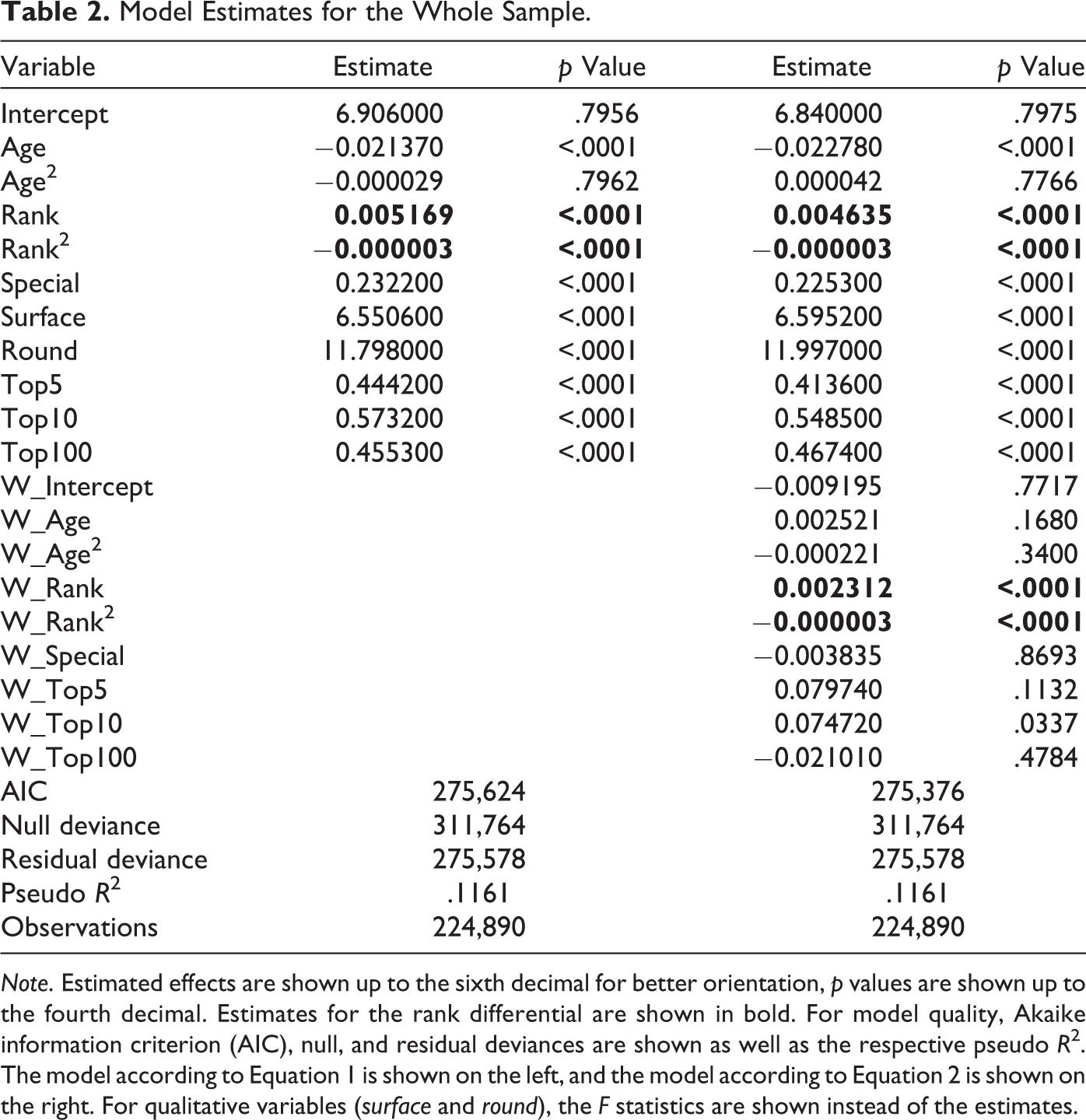
Note. Estimated effects are shown up to the sixth decimal for better orientation, p values are shown up to the fourth decimal. Estimates for the rank differential are shown in bold. For model quality, Akaike information criterion (AIC), null, and residual deviances are shown as well as the respective pseudo R2. The model according to Equation 1 is shown on the left, and the model according to Equation 2 is shown on the right. For qualitative variables (surface and round), the F statistics are shown instead of the estimates.
Expanding the model to distinguish between the effects for men and women, we arrive at the model according to Equation 2 summarised in the right part of Table 2. There, we find that the “anything can happen in women’s tennis” hypothesis is strongly rejected, and in fact, the opposite result prevails—the effect of the rank differential is much higher for women compared to man, approximately by 50%. The other effects do not seem to be gender-dependent. Interestingly, the squared effects for the rank differential are negative and significant both for men and women which suggests concave partial effects, that is, the difference between having a rank differential of 1 and 10 is higher than having a rank differential of 91 and 100. The negative estimate of θ4 shows that this slowing down is faster for women. Such shape generally implies that at some point, in this case for some rank differential and higher, the partial effect declines.
To put these results into a better perspective, we present Figure 2 that shows conditional probabilities of winning observed from the data (top) and probabilities implied by the model in Table 2 (bottom). As expected, the observed probabilities are much noisier than the ones implied by the model but most important patterns are evident. As discussed above, 99% of the matches are between players with a rank differential below 500 and we thus show only such matches in the figure. Both charts show that the probabilities for the women’s subsample are higher than the ones for men. For the observed conditional probabilities, this is transparent for rank differentials up to 100, then the probabilities become too noisy. For the model-implied probabilities, the pattern is apparent. The negative estimate of θ4 is reflected by the curves getting closer with an increasing rank difference. For much higher rank differentials, the expected probability for women would fall below such probability for men. However, this would represent only a tiny portion of the data set (less than 0.1% of all matches). The model thus shows strong evidence for the non-existence of the “anything can happen in women’s tennis,” but rather quite the contrary.
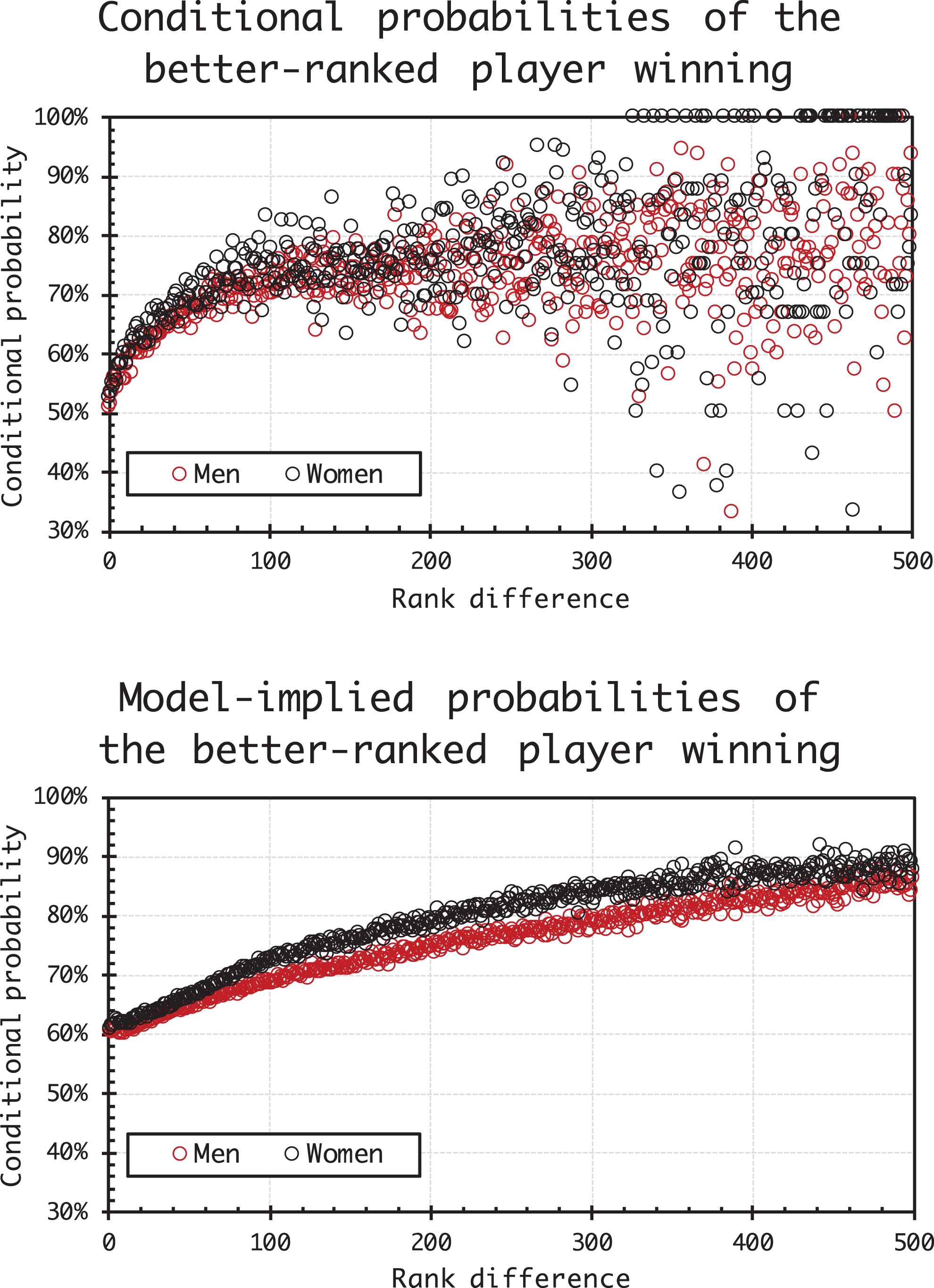
Observed and model-implied probabilities of the higher ranked player winning.
To make sure that the results are not driven by the sample reaching back to the late 1960s, we have performed the same analysis for two additional samples—one starting from the year 2000 and one starting from the year 2000 and covering only Special-level tournaments. The former is summarised in Table 3 and the latter in Table 4.
Model Estimates for the Sample From Year 2000 Onward.
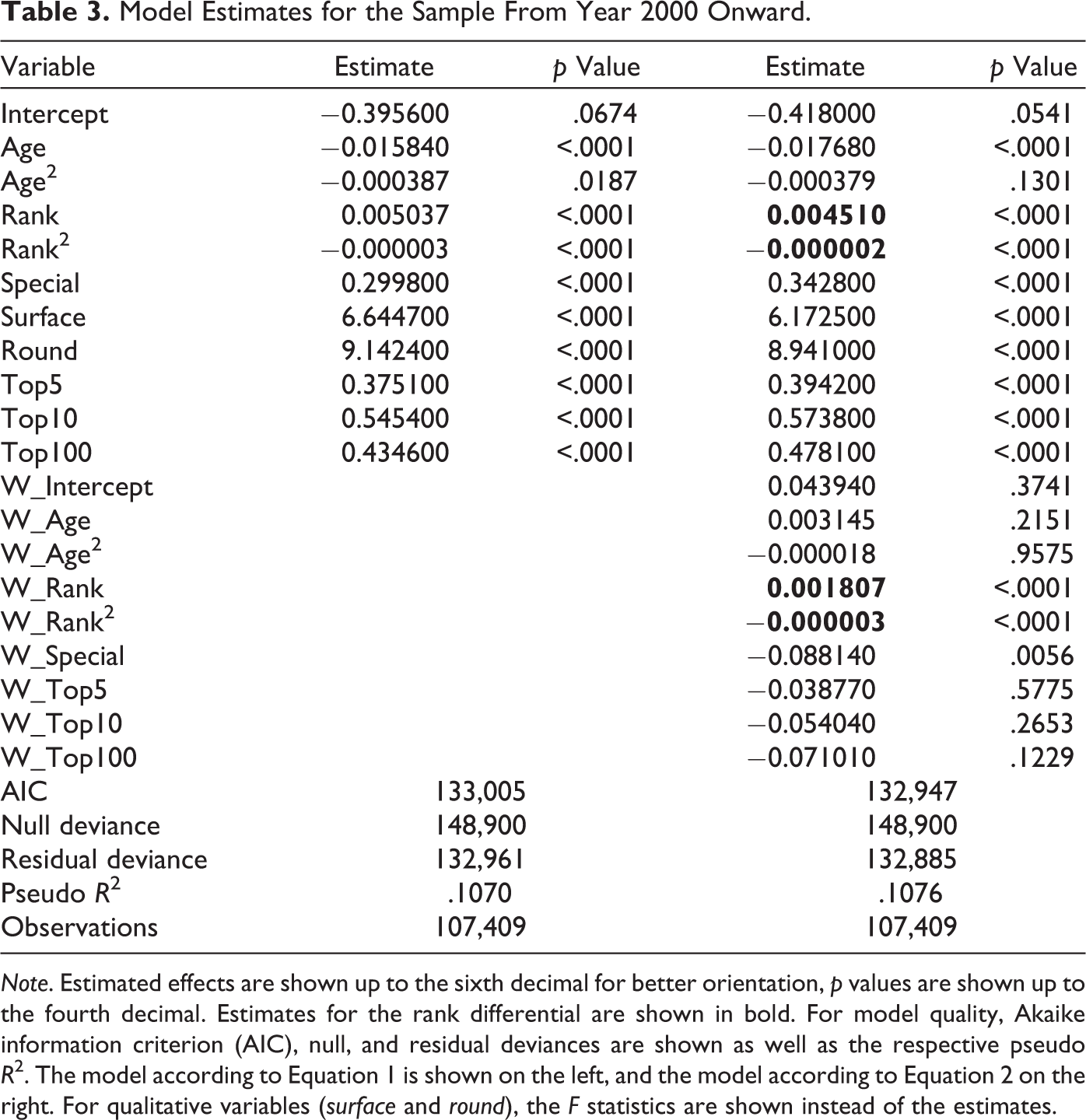
Note. Estimated effects are shown up to the sixth decimal for better orientation, p values are shown up to the fourth decimal. Estimates for the rank differential are shown in bold. For model quality, Akaike information criterion (AIC), null, and residual deviances are shown as well as the respective pseudo R2. The model according to Equation 1 is shown on the left, and the model according to Equation 2 on the right. For qualitative variables (surface and round), the F statistics are shown instead of the estimates.
Model Estimates for the Sample From Year 2000 Onwards and Only for Special Events.
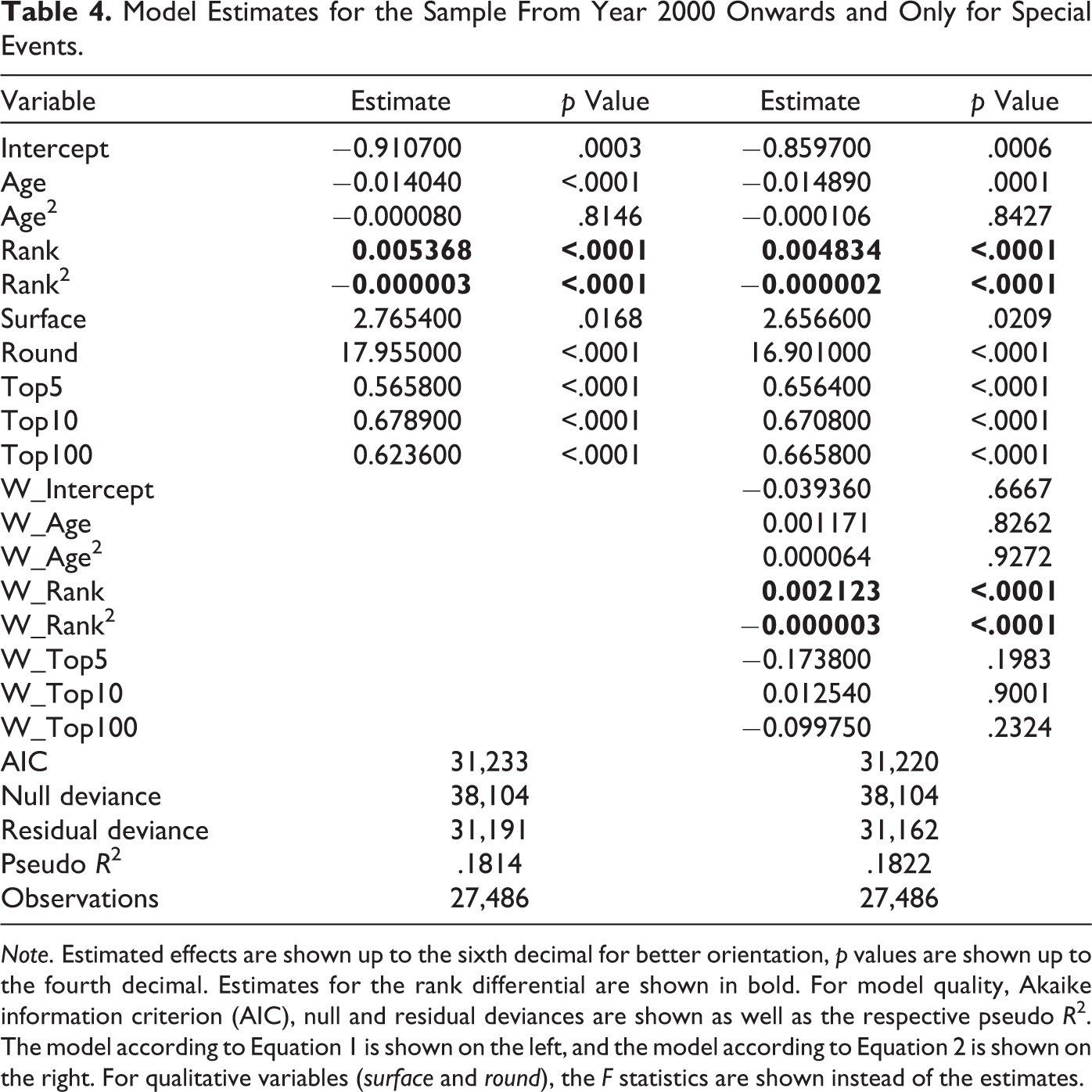
Note. Estimated effects are shown up to the sixth decimal for better orientation, p values are shown up to the fourth decimal. Estimates for the rank differential are shown in bold. For model quality, Akaike information criterion (AIC), null and residual deviances are shown as well as the respective pseudo R2. The model according to Equation 1 is shown on the left, and the model according to Equation 2 is shown on the right. For qualitative variables (surface and round), the F statistics are shown instead of the estimates.
The results confirm the findings for the whole sample analysis. For the 2000 onwards sample, we find that the effect of the rank differential is slightly lowered for women players as the additional effect is around 31% higher than for men, compared to the 50% comparison for the whole sample. When the 2000 onwards sample is limited to special events tournaments only, the additional effect increases to around 44%. The effect is thus more pronounced for the more important tournaments in favour of women in the shorter data set. The other effects captured by the model remain in the same logic as for the original model.
Overall, we have found strong evidence for the non-existence of the “anything can happen in women’s tennis” effect. On the contrary, we have uncovered that the results in the ATP (men) are less predictable with respect to the rank difference between the players compared to the WTA (women) matches. The results are robust across different samples.
Discussion and Conclusions
When comparing the literature on women’s tennis media coverage with the results of our analysis, one must wonder at the stark contrast between the empirical evidence and the interpretation of anecdotal evidence and individual experience. The ideological perspective of hegemonic masculinity (Anderson, 2008; Messner, 1988; Messner et al., 1993) in both sport and sports journalism has succeeded in asserting a narrative of difference and unpredictability within women’s tennis, based in gendered notions of female psychological instability and physical inferiority. The results of our analysis show that in a very broad sample of almost 225,000 matches between 1968 and 2018, there is no support to be found for this narrative.
In testing the narrative hypothesis of an existent or non-existent “anything can happen” effect, the transformation of the research question into an empirically testable hypothesis is essential. Here, we treat the “anything can happen” effect as the dependence or likelihood of the better ranked player to win the match with respect to the rank difference between the players, or more specifically, how the strength of this dependence differs for men and women tennis players. This reflects the prevalent attitude present in the media coverage and fan discussions, as the incapacity of an individual with a higher ranking to win the match is often interpreted differently, depending on the player’s gender. In addition to the presented literature review focusing on media coverage and social media discussions, we perform two robustness checks to control for two phenomena—the prestigious tournaments effect and the recent years effect. The former is applied to check the validity of the common perception that women tennis players break down more easily and frequently (compared to men) during the most important tournaments of the seasons. And the latter control is to see whether the specific situation of the tennis ladders after the year 2000, when both the ATP and WTA rankings were dominated by a small group of players (predominantly the Big Three of Federer, Nadal, and Djokovic for men and Serena Williams for women), might help to explain the differences between men’s and women’s match success rates with respect to their rankings. The period after 2000 also well represents the period when most sports commentators actually remember the match histories and can base their commentary on personal experience and memory. However, both control samples confirm the results from the original large sample—There is no actual empirically valid “anything can happen” effect for women present. If anything, the men’s matches are less predictable than the ones of women. The results for the data set of special events correlate with the above-mentioned findings of Jetter and Walker (2015, p. 97) that top female players appear more likely to compete well in high stakes tournaments, even though Jetter and Walker (2015) considered only the matches from the Grand Slams while we have included the Olympic Games as well.
The unpredictability of professional tennis, and any sports discipline for that matter, is a part of its attractiveness, and our analysis shows that a lot of uncertainty in both men’s and women’s tennis still exists that cannot be predicted by statistical models. However, there is a sharp distinction between the narrative of such uncertainty and unpredictability in men’s and women’s divisions. In the cases of surprising results in men’s sports, journalists, fans, and some researchers generally talk about the “clashes of titans,” “more competitiveness,” and “more close equality in quality”; while in women’s sports, the unpredictability is more often attributed to female emotional instability and used as argument for the lower maturity and therefore the lower status of women’s sport (Domeneghetti, 2018; Kian & Clavio, 2011; Magnus & Klaasen, 2010; Quayle et al., 2019). This can be also illustrated by the results of our analysis that, from a certain perspective, allow for interpreting the lower predictability in men’s tennis not as a sign of the “anything can happen” effect in men but as a sign of their “equality in quality.” However, such different perspectives and treatments pose a problem. What is perceived as the advantage in one case is dismissed as the weakness in the other and the pattern of assessment has remained unchanged.
It is certainly a hard job to be a sports journalist and especially a commentator. One has to be quick-witted, always ready to say something, ideally interesting and meaningful at the same time. There is the necessity to distinguish the specifics of a single match or performance as well as to place it in its proper context, to be aware of unique aspects of a game or athlete as well as overall, general conditions which shape our appreciation and meaning of what we view. The media coverage of female athletes continues to be laden with sexism and double standards and when journalists struggle to avoid it, they often end up with another extreme—a boringly neutral, inactive, and uninteresting presentation in the case of women’s sports, as Bruce (2012), Cooky, Messner, and Musto (2015), and Quayle et al. (2019) pointed out. Our results lend strong credence to the conclusions of Bruce (2012, p. 131) that “rather than being gender neutral, many journalists are instead ‘gender blind(ed)’” and perpetuate gender stereotypes of female athletes as inferior, subject to emotion and physical weakness, when no such empirical evidence exists. Living in the era of a continuous (big) data collection in many areas of personal lives and society in general, one would hope that the sports coverage will utilise such data availability to present sportsmen and sportswomen without preconceptions.
Footnotes
Declaration of Conflicting Interests
The author(s) declared no potential conflicts of interest with respect to the research, authorship, and/or publication of this article.
Funding
The author(s) disclosed receipt of the following financial support for the research, authorship, and/or publication of this article: This work was supported by the Faculty of Social Sciences, Charles University (PROGRES Q19).
