




Abstract
Talk radio has grown exponentially in the United States. The growth in talk radio was ignited by the Telecommunications Act of 1996, which allowed station owners to purchase more stations without antitrust scrutiny. One of the most popular formats on the radio is sports talk radio. Sports talk radio provides a unique entry point to understand how callers and hosts discuss racism in sport. The purpose of this study is to advance our understanding of race on the radio by examining how sports talk radio hosts discuss racism. The researcher interviewed 15 sports talk radio hosts over the phone to better understand how they discuss racism on the airwaves. After reviewing the transcripts and going through several rounds of data analysis, three themes were discovered: We can smell it, race is not always about race, and Black/White binary.
“You said there was a different standard, right? That Black athletes are held to a different standard.
I’m not getting into the race card with you guys. But if that is what you guys want to do, then you can go there. Black guys in America get treated differently, period.
Sure but do you think that professional athletes get treated differently? When they hand suspensions, do they say well this guy is Black and this guy is White?
We done with this interview?”
The excerpt above was an exchange between former National Football League (NFL) player Brandon Marshall and former WEEI (850 AM) Boston sports talk radio hosts Kirk Minihane and Gerry Callahan about the wide receiver’s statement about racism in sport (Gartland, 2017). During a segment on Inside the NFL on Showtime, Marshall speculated that the judge’s decision to lift Tom Brady’s suspension for his role in a cheating scandal was grounded in a double standard that gives leniency to Whites. In this short exchange, it was evident that the two hosts framed the judge’s opinion in terms of color-blind neutrality knowing that most people today, and even more a judge, would not explicitly name race as a motivating factor. In 2019, Kirk Minihane left Entercom, the owner of WEEI, to join Barstool Sports, a media entity renowned for its racy content. In 2016, Emily Austen lost her job at Fox Sports for making racist comments about minorities on a Barstool Sports broadcast (Olmstead, 2019). In September 2019, the founder of Barstool Sports, Dave Portnoy, was criticized for insinuating that college football fans were alienated by the University of Notre Dame’s second ever Black mascot (Boren, 2019). The exchange between Marshall and the WEEI hosts, and new media platforms like Barstool Sports and Breitbart Sports providing a haven for racially insensitive remarks, reflects the spectrum of discussions that occur on sports talk radio. On the one hand, you have two hosts (Kirk and Callahan) on a mainstream platform trumpeting liberal talking points, and on the other, you have hosts spewing anti-other speech on far right broadcasts.
Through everyday conversations like the ones above, it is clear that sports talk on radio can often be a proxy for race (Farred, 2000). Sports talk radio hosts discuss obvious acts of racism by team owners, media members, and callers, but these discussions are nestled within color-blind discourse (Bennett, 2007). Sports talk radio hosts rarely interrogate institutional racism, much less sport’s articulations with wider racist practices, including racial profiling, mass incarceration, and housing discrimination. When sports talk radio hosts rebuke racist callers, they only stabilize the dominant racial order, meaning, “not mobilizing race in talk” (Bennett, 2007, p. 60). Instead of using the platform to expose the institutional racism that gives security to team owners, listeners, and media contemporaries, sports talk radio hosts merely discuss the low hanging fruit: overt acts of racism by individuals.
The purpose of this study is to examine racism on sports talk radio by investigating how sports talk radio hosts discuss racism in sport. Using Bonilla-Silva’s concept of color-blind racism, I tease out how 15 sports talk radio hosts fail to engage racism in sport critically. Sport talk radio hosts neatly discuss racism within the strictures of the Black/White binary, they treat race as a consequence of Black plenitude in football and basketball, and they admonish the racism of individual callers, thereby failing to see them as symptoms of more entrenched racism. Spectator sport provides an opportunity to engage racism because two of the most popular leagues—the National Basketball Association (NBA) and NFL—are numerically dominated by African Americans. However, when sports talk radio hosts discuss a racialized story after it has already been framed by the media, they are treating racism as an aberration (Burdsey, 2011). What follows is a literature review on sports talk radio and the emergence of color-blind racism and its relationship with sport.
Literature Review
The Growth of Sports Radio
Sports talk radio coincided with political and technological changes in the 1980s. As AM listeners deserted for the improved quality on FM stations, radio managers found the format of the former favorable to talk radio (Gullifor & Thurwanger, 2008). The first all-sports radio station was WFAN 600 AM and the two most well-known talk shows on the station were Imus in the Morning and Mike and the Mad Dog (Hirshon, 2015). Whereas there were no sports radio stations in 1986, by 2012, according to Hirshon, the number of stations had jumped to 700. Coincidentally, the beginning of WFAN in 1987 happened alongside the Federal Communication Commission’s (FCC’s) abandonment of the Fairness Doctrine (Nylund, 2007). When the FCC stopped implementing the Fairness Doctrine, it enabled station managers to narrowcast, giving rise to “the now notorious hate radio of political shows, and the twenty-four-hour sports stations” (Haag, 1996, p. 458). In fact, one of the dominant personalities in conservative talk radio, Rush Limbaugh, was signed by Entertainment and Sports Programming Network (ESPN) in 2003 to be “the voice of the fan” (Hartmann, 2007, p. 51) for its football coverage.
The Telecommunications Act of 1996 enabled sports talk radio to become a media juggernaut (Nylund, 2007). The availability of programming on national networks provided a boon to local stations, which found “producing their own play-by-play sportscasts, even local sport events, to be prohibitively expensive” (Gullifor & Thurwanger, 2008, p. 211). After WFAN abandoned 1050 AM, Disney bought the rights to the frequency for US$78 million and converted it to ESPN 1050, a direct competitor of the New York station (Gullifor, 2006).
The corporate takeover of sports radio because of deregulation obscures the root causes of the alienation that listeners experience. Douglas (2002) argued that the irony in the ascendancy of talk radio was that the isolation that listeners felt while commuting from suburbia was created by deindustrialization and deregulation. Nylund (2004) noted that the popularity of the Jim Rome Show is bolstered by deregulation, enjoyed by the parent company, masking its “anti-democratic” (p. 475) inflections in maintaining corporate dominance. Whereas Haag (1996) sees a democratization of sport talk radio where the views of the individual are debated, Goldberg (1998) noted, “in the end, it adds up to a little more than the commitment to purchase marketed merchandise, to root for the same team no matter how exploitative of fan sentimentality” (p. 216).
Sports talk radio has become a space for multimedia corporations such as Fox Sports, ESPN, and National Broadcasting Company (NBC) Sports to exploit racial tension, encourage debate, and curate content for emerging audiences. Oates and Henry (2019) found that the installation of ESPN Radio enabled the parent corporation to extend its brand and nestle talk radio within its media information hierarchy: print journalism, talk radio, and television. In so doing, ESPN has used its signature television programs like Pardon The Interruption and First Take not only to borrow from “modes of presentation well established in political talk radio and television, and on sports talk radio” (p. 17) but also to exploit racial tension by choreographing debates between White and Black co-hosts. Although a sports talk radio show cannot supersede the timeliness of a trending Twitter hashtag, program directors can still use the platform to create synergy with the parent corporation’s programs. An executive in Serazio’s (2019) work noted, “If we have a game on radio or we have a game on TV, we’re hoping that they’re promoting on our talk show the next morning. That’s where you get your new audiences” (p. 68). In addition to purchasing and partnering with popular websites like Bleacher Report, Outkick The Coverage and Barstool Sports, Disney, Fox Sports, and NBC Sports use sports talk radio as just another brand extension to “keep fans with them across platforms and locales” (Gantz & Lewis, 2014, p. 767).
As it relates to race, sport talk radio hosts are progressive in some areas and retrograde in others. In examining the monologues of nationally syndicated radio hosts, Bennett (2007) discovered that sports talk radio hosts failed to critically engage institutional racism when the criminal behavior of Black athletes was discussed. For instance, Bennett pointed out that when the police shooting of football star Steve Foley was discussed on the Jim Rome Show, the sport talk radio host did “address racial profiling a little” (p. 98), but the host still blamed the victim. Additionally, when sport talk radio hosts juxtapose the good Black with the bad Black, the success of the former is attributed to White “disciplinary structures” (Grano, 2010, p. 256). In scenarios such as these, sports talk radio hosts not only have the power to hang up on a caller who spews hate speech, they can also put the caller on the defensive probing for clarification (Hutchby, 1996). Bob Sturm, co-host on the Bob and Dan Radio Show on Sportsradio 1310 in Dallas, has been known to censure callers who reduce Black athletes to athleticism (Tettleton, 2014).
Sport Talk Radio and Latino/as
Discussions about race on the radio neatly fall into the White domination/Black resistance paradigm that forecloses the possibility of the listening audience being informed about other minorities. The White/Black binary obscures the struggles of Latino/as which reduces their plight to equal opportunity and meritocracy (Valdivia, 2010). Mariscal (1999) found Jim Rome to be regressive because even though he rebuked callers who use code words for African Americans, he “recycle[d] stereotypes about Latinos” (p. 116). On the other hand, Moraga (2018) argued that Max Bretos and Marly Rivera, two Latino/a hosts on ESPN Deportes, failed to delicately discuss racialized issues not related to Latino/as and African Americans. The works of Moraga (2018) and Mariscal (1999) underscore the limitations of sports talk radio hosts discussing racism because of how easily they hitch their opinions to familiar tropes about racism.
Color-Blind Racism
Since the end of de jure segregation in 1965, a new order of racism emerged in America (Bonilla-Silva, 2015). Where de jure racism was grounded in law, the new racism masks the “unequal distribution of power and resources according to racial identifications and designations within U.S. society” (Cramer, 2017, p. 59). Whereas before Whites explained away minorities’ lower economic status with essentialist claims about biology, according to Bonilla-Silva and Dietrich (2011), the socio-economic status of African Americans is now attributed to “market dynamics, naturally occurring phenomena, and their alleged cultural deficiencies” (p. 192).
Bonilla-Silva (2006) has established four frames of color-blind racism: (1) abstract liberalism, (2) naturalization, (3) cultural racism, and (4) minimization of racism. Abstract liberalism enables Whites to attribute the economic realities of the racial status quo to the free market (Bonilla-Silva & Forman, 2000). Naturalization of racism “allows dominant culture to explain away racial phenomena by suggesting that they are natural occurrences” (Martinez, 2009, p. 588). Martinez (2009) noted that even Chicano/a students internalize the naturalization of racism because “stereotypes and prejudgments are just something all Mexicans have to live with” (p. 593). With regards to cultural racism, Bonilla-Silva and Embrick (2001) found that Whites attribute Black poverty to laziness, violence, and welfare dependency. The minimization of racism locates racism within individuals or the past. Whites implore racial minorities to “put our racist past behind us” (Bonilla-Silva et al., 2004, p. 563), which functions to obscure systemic racism and minimize the need for structural responses such as affirmative action.
Color-Blind Racism in Sport
Sport is amenable to color-blind racial racism because of its purported meritocracy and the public display of racial difference (Leonard, 2004). This is not to say that sport was not serviceable to the construction of race in the pre–civil rights era, but the inclusion of racial minorities in social institutions enables overt racism to recede and more covert forms to surface. Whites argue that sport is the “great equalizer” (Hartmann, 2000, p. 231) and African Americans who aren’t successful are seen to be bereft of the right cultural values. As it relates to cultural racism, the belief that African Americans are naturally athletic leads to White contempt (Modiano, 2017). Similarly, Winograd (2011) noted how in athletic biographies, African Americans were lauded for their athleticism but rarely was there commentary on “how these athletes prepared for games” (p. 341).
As modern sport celebrates the success of minorities, it becomes serviceable to color-blind racial ideology because of how inequality is obscured (Leonard, 2004). Sanderson (2010) found that when Black head coaches complain about the job market, Whites dismiss their complaints as examples of reverse racism. Bimper (2015) noted how the numerical representation of athletes of color in sport even convinces Black athletes that racism has been minimized. The mere inclusion of minorities in White-dominated institutions registers as “politics itself” (Khan, 2016, p. 41), which makes it difficult to mobilize against institutional racism. Khan’s (2016) discussion of communicative capitalism and how it neatly complements color-blind racism in the context of sports demonstrates how the mere discussion of racist incidents masquerades as political, even as nothing is done to destabilize systemic racism.
Sport enables Whites to use code words to invoke racial minorities without directly referring to race. This language includes descriptions of African Americans as naturally athletic, predisposed to crime, and in need of White guidance (Grano, 2010). One of the most common tropes is “Black brawn versus White intellect” (Deeb & Love, 2018, p. 99). Burdsey (2011) discovered that English cricket players cloaked racist beliefs in microinsults to denigrate Muslim teammates. The less serious insults were interpreted as jokes by the Muslim players, which led Burdsey (2011) to conclude that “color-blind ideology is so entrenched in Western sport that minority ethnic participants, as well as those of those dominant racial groups, can at times endorse its interpretive framework” (p. 275). For Cleland (2014), club supporters did not necessarily have to mention Muslims by name as they only needed to invoke ideas about terrorism, depraved areas, and a nostalgic Britishness. Cleland and Cashmore (2014) demonstrated how Nottingham Forest football club (F.C.) fans invoked the diversity of Leicester by chanting, “You used to be English, but not anymore” (p. 650) at a match against Leicester City F.C.
Although sport talk radio hosts admonish callers who use code words to refer to minority athletes, discussion of racism in sports media leaves the status quo intact because there is no discussion of interlocking systems of power. For example, after examining the media reactions to Don Imus’s racist and sexist characterizations of the Rutgers University women’s basketball team in 2007, Wachs et al. (2012) found that journalists largely shifted blame for the incident onto individuals and not the “dominant culture” (p. 430). These reporters did not deconstruct how class, sexuality, and gender cohere to reproduce dominant racial narratives (Wachs et al., 2012). Also discussing the Don Imus incident, Cooky et al. (2010) explored how the media deployment of class markers to redeem the young women on the basketball team only distanced them from marginalized “women within poor, Black communities” (p. 153). By depicting the Rutgers University women’s basketball team women as “young ladies of class” (Cooky et al., 2010, p. 152), the media stabilized White feminine norms.
The controversy surrounding former Los Angeles Clippers owner Donald Sterling is instructive of how media pundits focused on individual racism at the expense of institutional racism (Cramer, 2019). After Sterling was caught on tape making racist statements, the NBA commissioner cited player diversity to underscore progress (Cramer, 2019). However, according to Cramer (2019), “men who occupy White positionality far outweigh women and people of color in decision making positions in the NBA” (p. 277). Lavelle (2016) found that while media pundits easily scapegoated Sterling as a racist because of his anti-Black statements, his discriminatory housing practices were papered over. Whereas media stories about racism are choreographed by publishers, editors, and journalists, sports talk radio has an element of spontaneity. This study provides a unique opportunity to understand how racism is framed when discussed by hosts.
Methodology
The purpose of this study is to understand how sports talk radio hosts discuss racism on the airwaves. As talk radio is a phenomenon that “places sport within the material contexts of everyday life,” (Silk et al., 2005, p. 5), it is important to investigate how what happens on the airwaves can either reproduce or contest existing ideologies. As the participants are from a population that has yet to be engaged in the academic literature, this interpretive qualitative study seeks to understand how 15 sports talk radio hosts “make meaning” (Merriam, 2002, p. 7) through engaging racism on their platforms. Qualitative researchers believe there is no singular material reality, but the social worlds that participants inhabit is no less meaningful to them. According to Hatch (2002), one of the many benefits of qualitative research is that scholars can better understand a particular social world from the perspective of the people to whom it is existential.
Participants
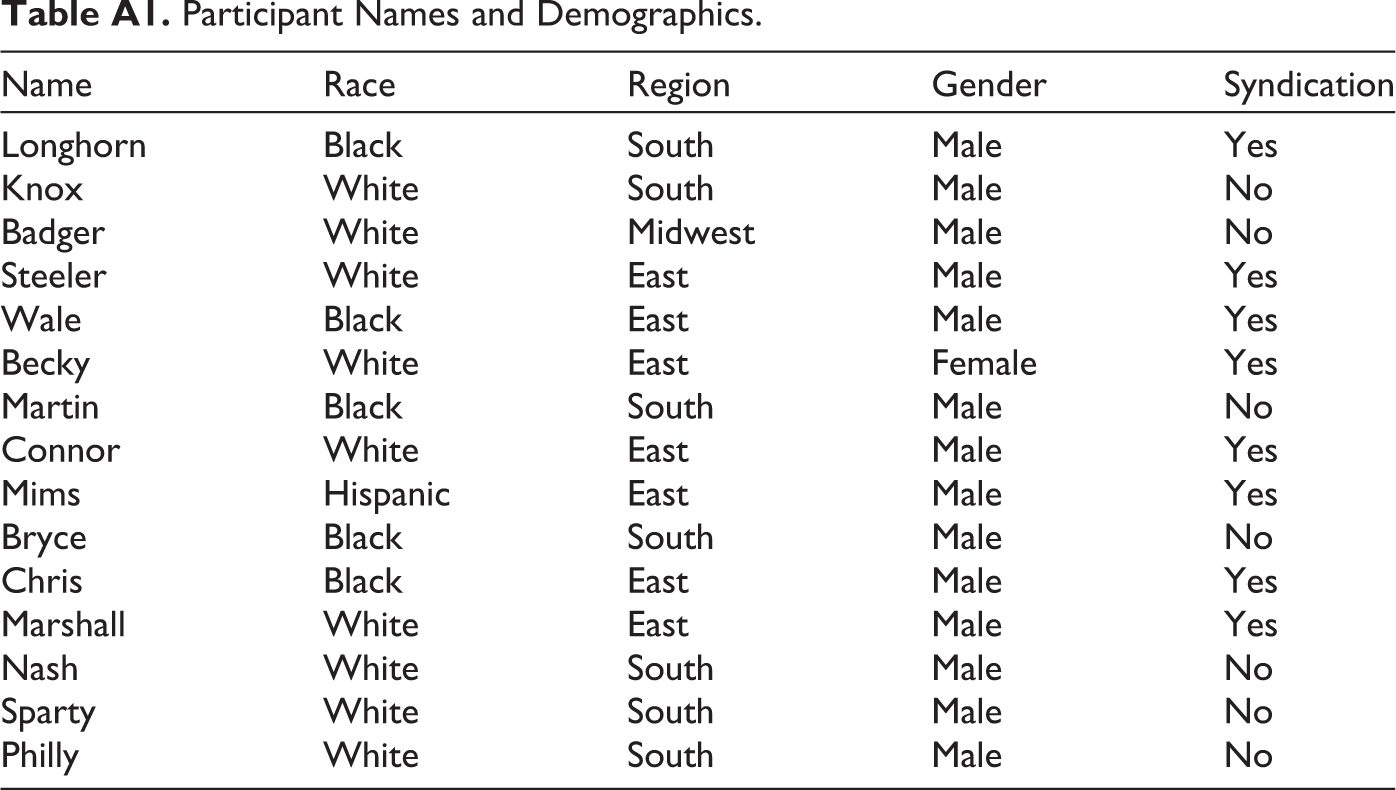
A total of 15 sport talk radio hosts whose programs are broadcast on traditional terrestrial radio stations were interviewed (see Appendix for participant names and demographic information). Although none of the participants are located on the West Coast, what made this sample expansive was that some of the hosts’ programs are in syndication, meaning that they have the financial backing of a media corporation to distribute and license their content beyond the local market. There was only one woman who participated, but her participation is indicative of the marginalized position of women on sports talk radio (Hardin et al., 2013).
Data Collection
A convenience sample was used for this project. The project was first approved at my educational institution. To recruit participants, I followed sports talk radio hosts on Twitter, then sent them direct messages to invite their participation. After sending the informed consent documents, I coordinated a time to interview the participants over the phone. Once saturation was reached after the 15th interview, I stopped data collection. Although “new data will always add something new” (Mason, 2010, p.16), going beyond the 15th interview would not add any meaningful information, thus making additional inquiry counterproductive. During the 15th interview, it was clear that the participant was highlighting the same things that were said in the previous interviews.
Instrument
The 15 semistructured interviews, which were grounded in the literature on color-blind racism and media studies, lasted no more than 1 hr. The semistructured interview protocol enables the researcher to address the topics while being flexible to the flow of the conversation (Glesne, 2011). I asked questions about the participants’ backgrounds, how they discussed racialized incidents, and how they would describe their on-air style. The interviews were recorded on a digital recorder and transcribed verbatim in Dragon Naturally Speaking Version 6 for Mac. After transcription, the transcripts were sent to the participants to verify the accuracy of the recorded interviews.
Data Analysis
Before I continue with the analysis section, it is important to state my positionality and address the power relations between me and the participants (Milner, 2007). As an African-American male who has a PhD in sport studies, I am keenly aware of the institutional racism in America. The participants were made aware of my racial background and my scholarship. After transcribing the interviews, I coded the data in Microsoft Word for Mac. I chose in vivo coding to use the words of the participants (Saldana, 2009). After the first cycle of in vivo coding, I used descriptive coding to capture the essence of the text with a word or phrase (Saldana, 2009). I then used pattern coding to reduce the codes to concepts, which were then written as themes. Following three rounds of coding, I used thematic analysis to locate patterns and to answer the research question (Grbich, 2007).
Findings and Discussion
In this section, I will discuss the themes I discovered in reference to the research question: How do sports talk radio hosts discuss racism on the airwaves? I discovered three themes through an analysis of the data: We Can Smell It, Race Is Not Always About Race, and Black/White Binary. Throughout this section, pseudonyms are used to refer to participants.
Theme 1: We Can Smell It
The participants explain how they can easily identify racist discourse within a caller’s argument. Whether it is referring to a Black athlete as a thug, or complaining that the team’s starting quarterback is not athletic, the participants can “smell” code words. For example, some callers refer to all Black athletes as criminals. Longhorn remembered this exchange: He called Lebron [James] a thug. And I abhor that word. Because it seems like that word is reserved for Black people. We’re always the thugs. They didn’t call those people in Waco Texas who went off stabbing and shooting at people. They didn’t call them thugs. They call those folks in Baltimore and Ferguson, Missouri thugs. So, I went off on him. A lot of people say. Oh. I want an athletic quarterback. Do you mean you want a Black quarterback? The word Black is kind of synonymous with athleticism for some reason. You see it with fans all of the time.
Participants have an opportunity to disrupt the racism of a particular caller’s argument, because, according to Hutchby (1996), the caller goes first and is left to defend the statement. Among the interviewees, Badger challenges callers by probing. He said: We have the occasional caller that will you know cast a wide net as far as the stereotype of the race of an athlete. And I think we do a pretty good job of not allowing that to just go out there unchallenged.
In addition to abruptly ending the call, participants may take the second position to force a defensive stance; this can shame the caller by probing for more clarification. Such a strategy enables listeners to hear the racism undergirding the statement and it forces the individual to backpedal. Steeler remembered: There was a woman last week during the anthem protest. Sounded like an older woman who said, you know what these boys need to stand up. And I said wait a second. Are you referring to Black and White players? And she insisted that she was referring to both. But yeah, I don’t hear too much thug and things like that. But make no mistake. We also have a Black head coach here in. There is no doubt in my mind that a certain percentage of people want him to fail because he is Black.
As storylines have already been framed by the media, the participants can navigate controversial and racist narratives without being seen as race-baiting. With regard to Donald Sterling, the participants could approach the racist angle because of the tapes. Wale noted: It is like trying to say global warming isn’t real. You know the data is in. I think most people that I encountered didn’t really have an issue with him losing his team. To me that was a five-foot jump shot. It wasn’t that difficult of a thing for me to navigate around because not too many people were standing up for Donald Sterling.
Theme 2: Race is Not Always About Race
Within this theme, the participants explain how some stories are racialized because they involve Black athletes. Whether it is a Black coach angering the fan base because of losing or Black athletes being in the news for behavioral suspensions, the participants believe that some issues only appear to involve racism because of their incidental relation with Black athletes. Philly is often in situations where he calls for a Black head coach’s job. Philly remembered: MST had a Black coach, and I called for his job. And people were really angry at me…And it created quite a stir and I said look, I call it like it is. He wasn’t getting the job done. I’m going to give you my opinion for better or worse. And I would have done it if the guy was White.
The participants also dismiss narratives about racism by attributing the misgivings of individuals to personality flaws. While the majority of participants believed that Sterling was unequivocally racist, Martin believed that the controversy was an example of political correctness gone wrong. He said: Do I like Donald Sterling? No! I think he’s a jerk, but he’s been a jerk for 30 something years…And we finally just took something and we ran with it, and then we turned it into the biggest race issue.
The supposedly incidental relationship that race has with issues involving Black athletes becomes apparent when the participants discuss salary disputes, contract holdouts, and collective bargaining impasses. As two of the most popular professional leagues in the United States, the NBA and the NFL are dominated in number by Black players, and race is inescapable when discussing the disparity between labor and management. Marshall noted: I say the owners are overwhelmingly and almost entirely White. And the labor force is particularly in football and basketball is overwhelmingly Black…And I think that people who might be union members themselves but are frustrated with professional athletes cannot get past the amount of money involved.
The participants also defend themselves against allegations of racism when they critique athletes of color. While comments about Black athletes being thugs are obviously underwritten by racial animus, according to the participants, every comment about athletes living up to the expectations of professionalism should not warrant scrutiny. After his team’s Super Bowl loss in 2016, Carolina Panthers quarterback Cameron Newton was criticized for not answering questions. Becky said: There will be times when I am talking about an issue that has nothing to do with race. Cam Newton and his behavior at the Super Bowl. I got accused of being a racist because he is African American. My position is that you need to be a professional.
Theme 3: Black/White Binary
Within this theme, the participants explain how their discussions of racism are colored by majority/minority relations, meaning White oppression and Black resistance. Participants’ understanding of racism is influenced by their interaction with Black people. Connor’s experiences at a mixed-race high school awakened him to racism. Connor said: I’ll never forget. I took a Black girl to prom. It wasn’t I’m dating her or anything like that. She was a good friend of mine. There were people in my family who wouldn’t talk to me…I always feel comfortable saying however I feel.
A Black/White binary not only colors participants’ willingness to discuss racism, it also informs their understanding of the palette of the audience. According to Martin, listeners want to fulfill their voyeuristic needs when listening to Black hosts tell it like it is: The listener has to listen because of the politically correct format that we are forced to cover. Listeners they like hearing the objectivity of African American broadcasters because you are going to generally hear it from a more urban perspective.
This Black/White binary influences the talking points of participants when they discuss issues that have nothing to do with Black athletes. In Major League Baseball (MLB), where only 8.7% of the players are African Americans and more than 28% of the players are Latino, a discussion about most managers being White can be condensed into the Black/White binary. Mims said: You look at the disparity of African American coaches right [in the NBA], so you do the same thing with Major League Baseball…You have these White owners who hire people who are White because they are comfortable around those people. I think that doesn’t always necessarily mean they always end up the best candidates.
In everyday sports talk radio conversations, the presence of Black athletes gets interpreted for racial progress. Some fans believe that Afro-Latinos from the Dominican Republic, Venezuela, and Colombia are Black, and because of that, the league does not have a diversity problem. Back in 2010, USA Today held a roundtable to examine the decline of Black players in baseball. Former Minnesota Twins player Torii Hunter railed against Afro-Latinos for being imposters (Sanchez, 2010). Similarly, Bryce believes that listeners don’t see a diversity problem in baseball, noting: A lot of our listening audience thinks that the players in the American League and the National League in Major League Baseball are Black. Well a lot of them are Hispanic. And they don’t look at baseball as being racist.
Conclusion
This article illustrates how 15 sports talk radio host discuss racism on the airwaves. The participants rebuke callers who use code words to refer to Black athletes, and they broach racial issues cautiously because most of the sports they discuss are numerically dominated by Black athletes. Participants believed themselves to be progressive in how they lecture the listening audience on racism; however, these hosts did not challenge institutional racism because they only engage the symptoms of it. Even when a host admonishes a caller for using racially coded words, the structural nature of racism remains unchecked because racism is seen as located within the individual. On the other hand, while callers are checked for using code words to describe or make racially disparaging remarks about racial minorities, sports talk radio hosts deploy professionalism and character to refer to narratives about Black deviance.
Participants have an opportunity to unpack racial issues as the stories that garner the most attention on radio involve Black athletes, but they claim that race is merely incidental. When leagues are dominated by Black athletes in terms of numerical representation and White owners when it comes to governance, league policies will undoubtedly affect the former more adversely than the latter. The Black/White binary is also problematic as some participants use it to inform their engagement with issues that are specific to Latinos and Asian Americans. Hiring in the management ranks is unsatisfactory as White males predominantly govern the sport, but the low number of Latinos and Asian American managers should not be reduced to what has affected Black Managers: equal opportunity. The numerical dominance of African Americans in select sports, coupled with neat liberal talking points about meritocracy, gets interpreted as political. Unfortunately, the veneer of a political discussion leads to nothing getting done!
While sports talk radio is often a conservative institution because of how it champions racial progress and hides institutional racism, its regular encounters with racism offer opportunities for transformation. There are times when prominent sport talk radio hosts challenge the apolitical landscape and bring attention to institutional racism. After ESPN fired Jemele Hill in 2017 for calling President Trump a racist on Twitter, the company banned all employees from discussing politics. But in July 2019, after President Trump told four congresswomen of color to return to their country, Dan Le Batard, co-host of the Dan Le Batard Show With Stuggotz, railed against his network, ESPN, for acting “cowardly” (Bieler, 2019).
Sport provides opportunities to directly engage with and challenge social ills because of its purported meritocratic nature and the large number of racial minorities who compete in the most popular leagues. Sports talk radio is a unique site to explore how racial ideologies are either reproduced or contested daily. Although sport talk radio hosts stabilize the dominant color-blind racial ideology, sports talk radio is still a rich site to engage what bears the low hanging fruit, systemic racism.
Footnotes
Appendix
Participant Names and Demographics.
| Name | Race | Region | Gender | Syndication |
|---|---|---|---|---|
| Longhorn | Black | South | Male | Yes |
| Knox | White | South | Male | No |
| Badger | White | Midwest | Male | No |
| Steeler | White | East | Male | Yes |
| Wale | Black | East | Male | Yes |
| Becky | White | East | Female | Yes |
| Martin | Black | South | Male | No |
| Connor | White | East | Male | Yes |
| Mims | Hispanic | East | Male | Yes |
| Bryce | Black | South | Male | No |
| Chris | Black | East | Male | Yes |
| Marshall | White | East | Male | Yes |
| Nash | White | South | Male | No |
| Sparty | White | South | Male | No |
| Philly | White | South | Male | No |
Acknowledgments
The author would like to thank Mary Douglas-Vavrus and Raj Chetty for their careful review of the article.
Declaration of Conflicting Interests
The author(s) declared no potential conflicts of interest with respect to the research, authorship, and/or publication of this article.
Funding
The author(s) received no financial support for the research, authorship, and/or publication of this article.
