




Abstract
Based on the fact that Twitter penetration in Germany is comparatively low this study analyzes the adoption of Twitter by German sports journalists. It questions how far influences on adoption that were proven to be important in the well-established diffusion of innovation theory can help to explain the Twitter usage among sports journalists. As influences for circumstances of adoption, the type of innovation decision and communication channels are identified. In addition, perceived attributes of Twitter concerning relative advantages, compatibility with norms and values and complexity are specified. A representative online survey with members of the German Association for Sports Journalists reveals that many sports journalists are reluctant concerning Twitter usage. Three Twitter user types were identified: Non-users, Occasional Information Seekers, and Regular Active Users. These user types differed clearly in terms of the circumstances of adoption: management decisions and the adoption by near peers favor the usage of Twitter. Further, compatibility and complexity are influential. For relative advantages, surprisingly, results are less distinct. Overall, this study shows that the diffusion of innovation theory is a helpful approach to explain Twitter usage in German sports journalism and advocates its application for the adoption of other digital innovations in sports journalism.
Social media brings multiple changes and opportunities in the field of journalism: Sources such as clubs or athletes can deliver content via social media to journalists and to their audiences. In an extreme case sources can even bypass journalists so that journalists might be eliminated from the gatekeeping process (Bro & Wallberg, 2015). However, journalism can also benefit from social media usage. It can help to monitor news and find sources. Thereby information on social media can provide content for journalistic stories. Social media platforms can also be used as a further channel to distribute news, promote content or to get in touch with audiences (Heravi & Harrower, 2016; Li et al., 2017; Nölleke, Grimmer and Horky, 2017).
These threats and chances in mind, this study contributes to the question of why social media is or is not adopted in journalism by applying Rogers’ (2003) diffusion of innovation theory, an approach that helps to explain how new ideas, practices or objects are communicated and adopted by members of a social system. Rogers’ theory has already been applied to technical innovations in media and journalism, where it has proved to be a fruitful approach in this context (Garrison, 2001; Singer, 2004). Adopter categories, as one aspect of diffusion theory, have already been applied to social media in journalism (English, 2014). However, the influencing factors for the adoption of innovation have not yet focused on social media in journalism. This study aims to analyze the extent to which variables provided by diffusion of innovation theory can help to explain the adoption of social media in digital sports journalism.
As the subject of study, the adoption of Twitter by German sports journalists serves well. There are two reasons for this: First, Twitter has led to a radical transformation in journalism (Broersma & Graham, 2013; Hedman & Djerf-Pierre, 2017; Lasorsa et al., 2012; Moon & Hadley, 2014; Reed & Hansen, 2013). With its short and information or opinion focused tweets it provides information rapidly and allows a faster pace for news. Also, information from influential people or organizations is publicly accessible to everyone, so journalists need to find other ways to increase the value of their content. Twitter also changes the channels for communication. It allows for direct approaches to sources and discourse with other journalists and with audiences. With regard to sports journalism Pegoraro (2014) described Twitter as a “disruptive innovation in sports communication” that, like other web 2.0 developments, changed the traditional model of sports delivery (p. 133). Therefore, Twitter is a platform with high potential to broad adoption also in Germany.
However, and this is the second reason for the choice of Twitter as the study subject, journalists in Germany are hesitant with regard to Twitter adoption. While Lasorsa, Lewis and Holton already asserted in 2012 that Twitter is adapted to existing practices by journalists in the US, usage in Germany is fairly low. In 2011, in 64 percent of the news departments in Germany Twitter was regarded as “relatively unimportant” (Neuberger et al., 2013). Nuernbergk (2016) found out that in March 2014 only 26% of political journalists at the German Federal Press Conference—the elite political journalists in Germany—had a Twitter account. However, the usage seems to be rising. A Cision (2017) study said that 36 percent of journalists in Germany use microblogs such as Twitter for research. In their newest study on social media Nuernbergk and Schmidt (2020) found that Twitter is the social medium that is used most by German political journalists. Now, 72 percent of the journalists at the German Federal Press Conference have Twitter accounts. For German sport journalists there is no reliable data on Twitter usage so far. However, due to the situation in political journalism, it can be assumed that there are users and non-users. A situation in which there are both users and non-users would provide good conditions for the research on adoption. A comparison of characteristics of these groups may reveal influences on adoption.
The results of this study are relevant from different perspectives. First and foremost, the results reveal how far the well-established diffusion of innovation theory is applicable to explain the adoption of Twitter in digital journalism in Germany. If it is indeed applicable and the results show strong influences on adoption, these influences might also help to explain the adoption of other trends and software tools in digital journalism.
Further, the results emphasize the impact of Twitter on sports journalism in Germany. Results show how far Twitter is integrated in the daily routines and which functions are used foremost. Therewith, it will be shown how far German sports journalists depend on Twitter as a source, and how far it changes communication channels with other journalists or with their audiences. From a practical perspective, the results are also important for prospective sports journalists. The indicated influence of Twitter usage and associated advantages and disadvantages can be discussed in the education of sports journalism students.
Literature Review
Before focusing on diffusion of innovation theory, contextualization for the usage of Twitter in Germany will be provided. People in Germany are reserved concerning the usage of Twitter. Reuters Institute Digital News Report 2020 said Twitter is in fifth position on the top social media and messaging platforms (Newman et al., 2020). According to this source, of the 13 percent of the population who use Twitter, 6 percent use it for news. There are no major differences compared to the usage in 2018 (Newman et al., 2018). Concerning the frequency of usage Frees and Koch (2018) found for Germany that only 1 percent of the population uses Twitter on a daily and 4 percent on a weekly basis. Frees and Koch (2018) conclude that Twitter is used in a specialized niche-community.
Journalists very likely belong to that niche because Twitter usage in journalism exceeds these low percentages by far. As cited above, Nuernbergk and Schmidt (2020) found that almost three quarter of the political journalists at the German Federal Press Conference now have a Twitter account. The Twitter users among these political journalists are on average younger than non-users. 57 percent of them use Twitter to read information on a daily basis. However, only 41 percent of the journalists who have an account tweet on a daily basis (Nuernbergk & Schmidt, 2020). Bruns and Nuernbergk (2019) emphasize, on the basis of the same data, that a smaller group of “particular enthusiastic adopters” (p. 201) who tweet very frequently stands out.
Their study also revealed that German political journalists tweet less compared to Australian political journalists. Another comparative study by Gulyas (2017) confirms the reluctant social media usage by German journalists. With regards to microblogs, usage is the lowest compared to a list of other European countries, Canada and the US. Reasons for minor usage in Germany might be overall patterns of media use and news consumption, and the comparatively low influences of market forces (Bruns & Nuernbergk, 2019).
For sports journalists in Germany, there is hardly information about Twitter usage. A study by Nölleke et al., (2017) that is based on a non-representative sample revealed that 44 percent of the surveyed sports journalists use Twitter frequently to gather news from the field of sport. Regardless of the usage by journalists, in corporate sports journalism Twitter is used (Horky & Hestermann, 2016). For example, Bayern Munich’s German Twitter account has almost 5 million followers and multiple posts every day. Athletes in Germany use Twitter as well, albeit in very different frequency and manner (Theobalt et al., 2019).
Adoption and Ways of Implementation
In the following literature review details on diffusion theory and on influences on adoption are presented and specified for the adoption of Twitter by sports journalists.
The basic idea of the diffusion of innovation theory is to investigate how an innovation, defined as an “idea, practice or object that is perceived as new by an individual or other unit of adoption” (Rogers, 2003, p. 12), is communicated and adopted by members of a social system. With regard to adoption, first, it is crucial to mention that the manner of adoption varies (Rogers, 2003) and different implementations of an innovation are possible.
This is also shown for Twitter in sports journalism. Deprez et al.’s (2013) study of Belgium sports journalists in Flanders describes different intensity of innovation usage by journalists. Although 46% of the surveyed sports journalists had a Twitter account, only 34% of them were considered regular users. In addition to intensity, different functions of usage were identified. In Flanders, journalists were found to use Twitter rather passively as an information source. On the other hand, Twitter is also used actively as a platform for distributing news and updates and for dialogue with the audience (Deprez et al., 2013).
The active usage was also investigated by Sheffer and Schultz (2010) for sport journalists in the US. Their data indicated that sports reporters used Twitter more frequently to post their personal opinions than to promote traditional or other media outlets or to post breaking news, update information, or ask their audience questions. Further, the usage depended on the circulation or market size of the media outlet that the journalists work for (Sheffer & Schultz, 2010).
Sherwood and Nicholson (2013) investigated the use of Twitter and other web 2.0 platforms for newspaper sports journalists in Australia and concluded that they use the technology “on their terms” (p. 954). Nearly all of the 27 interviewed journalists claimed they used Twitter for research. 20 of the interviewees had a personal account that they use to follow a mix of people. While some journalists saw a benefit in following athletes on Twitter, others said athletes were not “newsworthy” enough. There were also different approaches to use Twitter for breaking news. Some interviewees saw it as an advantage on the competition while others denied a benefit for their employer. Concerning the use of Twitter as a source in their own story, not even half of the interviewees claimed to use tweets (Sherwood & Nicholson, 2013). Now, years after Sherwood and Nicholson conducted their study, using tweets as sources in a story has become more common. In the US, tweets are even routinely used as vox populi as Tworek (2018) has pointed out.
A study that focused on the content of sports journalists’ tweets also shows that Twitter is used in different ways. Sheffer et al. (2018) investigated the use of image restoration strategies when American sports journalists tweeted about #deflategate. Although the majority covered the scandal applying traditional journalistic norms, there was also a strong use of image repair in the tweets.
Circumstances of the Innovation Decision
The diffusion of innovation theory provides several variables for the investigation of the determinants of adoption (Rogers, 2003). Among the most seminal are two variables related to the circumstances in which the innovation decision is taken. Rogers (2003) describes three types of innovation decisions. In an optional innovation decision, the choice to adopt or reject an innovation is made by an individual independent of the decisions of other members of a social system. In a collective innovation decision, the choice to adopt or reject is made by consensus among the members of a system, and in an authoritative innovation decision the choice is made by a few individuals who possess power. Although these three types of decisions range on the same continuum, decisions are often authority-driven in organizations, like workplaces.
For Twitter in newsrooms, different innovation decisions are possible albeit there is evidence for an authority decision. Deprez et al. (2013) showed for Flanders that intensity and manner of usage varies in different media outlets, which might also be due to management decisions. Gillis and Johnson (2015) showed that in the US, the management’s decisions in the form of social media policies are of significance for employees. Further, in an interview study by English (2014, p. 7), restrictions were placed on a participant; the participant stated that he uses Twitter “either to satisfy newsroom structures or because they were told to have an account by senior staff.”
In cases with no strict authoritative decision or with individual room for the manner of usage, communication channels are important influencing factors, which is in accordance with the diffusion of innovation theory. Rogers (2003, p. 18) defined communication channels as “[…] the means by which messages get from one individual to another” and observed that a positive evaluation of an innovation from “other individuals like themselves who have already adopted the innovation” is particularly effective. In accordance with this, adoption depends on previous adoption by “near peers” (Rogers, 2003, p. 19). One of the first indications of the significance of near peers for Twitter usage is the different ways of usage by younger and older journalists that was detected in several studies (Gillis & Johnson, 2015; Heravi & Harrower, 2016; Roberts & Emmons, 2016; Schultz & Sheffer, 2010).
Perceived Attributes of Twitter
Apart from these circumstances of adoption, the characteristics of the individual were also found to be critical, particularly the attributes of innovations perceived by potential adopters. According to Rogers (2003), 40 to 87 percent of the variance of innovation adoption can be explained by perceived attributes. In particular, relative advantages, compatibility with norms and values, and the complexity of innovations were proven to be influential attributes in this regard.
Relative advantage is the degree to which an innovation is perceived “as being better than the idea it supersedes” (Rogers, 2003, p. 229). In diffusion research, it is generalized that “the relative advantage of an innovation, as perceived by members of a social system, is positively related to its rate of adoption” (Rogers, 2003, p. 233). Relative advantage is one of the strongest predictors of an innovation’s rate of adoption.
In research on the use of Twitter in sports journalism, advantages regarding sourcing, publishing, assessing audiences, and the possibility of branding have been discussed. With regard to sourcing, sports journalists profit from Twitter for monitoring the news (Sherwood & Nicholson, 2013). They follow other media outlets, athletes, and administrators to stay on top of stories and directly access their latest news (English, 2014), which provides them the advantage of being able to bypass PR officials (Price et al., 2013). Twitter is also useful to obtain a steady supply of stories. Price et al. (2013, p. 11) indicate that Twitter might be useful “to track sources that go ‘under the radar’, thereby enabling journalists to pick up on chatter from members of the public that might previously have gone unreported.”
With regard to publishing and accessing audiences, sports journalists consider Twitter as a platform that provides them an opportunity to promote news stories through their tweets and links (English, 2014; Schultz & Sheffer, 2010). Price et al. (2013, p. 11) call Twitter a “cross-promotional device” that can direct followers to print publications or to URLs of news articles. Thus, Twitter as a platform can be used to reach new audiences with new kinds of content apart from objective reporting. This enables criticism and commentary (Sanderson & Hambrick, 2012) and, thus, adds to the “traditional writing and editing roles” (English, 2014, p. 7). Shermak (2018) shows that content apart from traditional game coverage catches audiences’ attention. He investigated how a specific group of sports journalists uses Twitter in live coverage. While there were lots of tweeting play-by-play outcomes, some reporters used Twitter also for analysis or non-game-related information very successfully.
Journalists can also use Twitter to foster interaction with audiences. Followers can be asked for their opinion on an issue before deciding whether or not it is suitable to publish a piece on the topic (English, 2014). Such interaction, along with more personal conversation and content, provides journalists with the possibility of standing out as individual voices in their Twitter feed and, therefore, growing their popularity and personal branding (Price et al., 2013; Roberts & Emmons, 2016).
Another possible advantage of Twitter for sports journalist might be the chance for networking, especially with other sport journalists. Hanusch and Nölleke (2018) analyzed Australian journalists’ interactions with each other on Twitter. One of their findings was that sport journalists were a “particularly tight-knit group” (p. 38) on Twitter which is an indicator for its networking possibilities.
Apart from relative advantages, the perceived compatibility of an innovation is an important influence on its adoption. According to Rogers (2003, p. 240), “Compatibility is the degree to which an innovation is perceived as being consistent with the existing values, past experiences, and needs of potential adopters.” The adoption of innovation theory assumes that the compatibility of an innovation as perceived by members of a social system is positively related to its rate of adoption.
In research on the use of Twitter in journalism, interviewed journalists expressed doubts regarding the compatibility of Twitter with journalistic standards and a journalist’s self-conception; the issues mentioned as part of the compatibility included the credibility and reliability of sources. Journalists surveyed by Gillis and Johnson (2015) expressed skepticism regarding social media as a credible and reliable platform for sourcing news stories. Statements by journalists in McEnnis’ (2013) or Reed and Hanson’s (2013) studies also reveal problems with standards for accuracy on Twitter. For example, one journalist expressed concerns regarding the common practice of retweeting information that was not personally verified by the journalist himself (Reed & Hanson, 2013).
In addition, journalists also expressed doubts regarding the loss of exclusiveness. They mentioned the fear of losing their behind-the-scenes access at a time when information is easily available on Twitter (Price et al., 2013). In the non-representative survey on German sports journalists by Nölleke et al., (2017) three quarters of the participants agreed that social media made it more difficult to provide news exclusively. There are also doubts about journalists’ independency. In Reed and Hanson’s (2013) study, one of the interviewed journalists said that his news judgement decision is influenced by updates on social media.
The complexity of an innovation is the third perceived attribute of an innovation that influences adoption. “Complexity is the degree to which an innovation is perceived as difficult to understand and use” (Rogers, 2003, p. 257). Complexity is negatively related to the adoption of an innovation. Although it might not be complex and difficult to read and post content on Twitter, there can be problems with using the platform. Sports journalists express uncertainty regarding what they can or cannot say on Twitter (Price et al., 2013). Another aspect of complexity might be the intricacies of the day-to-day working life in the field of journalism, which may make the time-consuming nature of Twitter a significant concern with using it (Price et al., 2013).
Assumptions
This literature review showed how research on Twitter in sports journalism provides specifications for influencing factors identified in diffusion research. According to Rogers (2003), there is no single means of innovation adoption. Adopters tend to use innovations on their own terms. The varying ways of implementation described tend to indicate that there might be several types of Twitter users. These user types might be differentiated by the amount of usage and by the functions utilized (Deprez et al., 2013). Therewith it can be shown how far Twitter is integrated in daily work routines. The following assumption can be made on this basis: 1) There may be various types of Twitter users among German sports journalists.
Rogers (2003) identified the type of innovation decision and the communication channels as important factors influencing innovation decision. For Twitter in sports journalism, it has been indicated that Twitter usage might be a free choice that every single journalist may have to make or it may depend on management’s decisions. English’s study (2014) indicated that journalists may use Twitter to satisfy newsroom structures or because management has requested them to use the platform. This leads to the assumption that authoritative innovation decisions favor the usage of Twitter.
2a) Twitter adoption is more likely for journalists who are subject to a management decision to use Twitter as compared to journalists who take an optional innovation decision.
In addition to the kind of innovation decision, Rogers (2003) referred to communication channels as an important influence. In addition, the subjective evaluation of near peers who have already adopted the innovation works in favor of the adoption.
2b) Twitter adoption is more likely for journalists whose near peers have already adopted Twitter than for journalists whose near peers are not using Twitter.
In the diffusion of innovation theory, the perceived attributes of an innovation explained most of the variance of adoption. Rogers (2003) emphasized two kinds of attributes that are positively related to adoption—relative advantage and compatibility with norms and values. The complexity of an innovation, a third attribute, is negatively related to adoption. These attributes were specified in research on Twitter adoption. Sourcing, publishing, assessing audiences, and the possibility of branding have been identified as relative advantages. With regard to compatibility with norms and values, journalists expressed doubts regarding compatibility of Twitter with journalistic standards and journalists' self-conceptions. With regard to the complexity of an innovation, single journalists mentioned in interview studies that they are uncertain regarding what to publish on Twitter and are also aware of the time-consuming nature of Twitter. Thus, with regard to the perceived attributes of Twitter and with reference to Rogers’ hypothesis, the following three assumptions can be made:
3a) Relative advantages perceived by sports journalists are positively related to their adoption of Twitter.
3b) Compatibility of Twitter with norms and values perceived by sports journalists is positively related to their adoption of Twitter.
3c) The high complexity of using Twitter perceived by sport journalists is negatively related to their adoption of Twitter.
Methodological Summary
Data Collection
The methodological approach is based on the procedure in diffusion studies in which variance research is considered appropriate for investigating variables related to innovativeness (Rogers, 2003). In most diffusion studies, individual innovation adoption is the dependent variable, whereas the characteristics of the individual and his attitudes are investigated as independent variables (Karnowski, 2017). In order to collect this data for the present study, a representative online survey was conducted. The population of the survey included all members of the German Association for Sports Journalists. From the database of members, 320 sports journalists who provided their contact details were randomly selected. Journalists in the sample received a written invitation to participate in the survey and were also contacted over the phone to remind them to participate. The data collection process lasted for 4 weeks at the beginning of 2018. There was a total of 147 participants in the survey and a response rate of 46% was achieved. Participants work for different kinds of media (45% print, 26% TV, 14% online, 9% radio, 7% other), they are predominantly male (91% male, 9% female), on average 46 years old and the majority has a university degree (69% with degree, 31% without degree). 75 percent of the participants are employed at a media outlet while 25 percent work as freelancers.
Measurements
The participants were questioned in order to obtain information for several measurements. First, it was asked if they use Twitter. Participants who answered in the affirmative were asked how long they use the platform during the day and if they have their personal account.
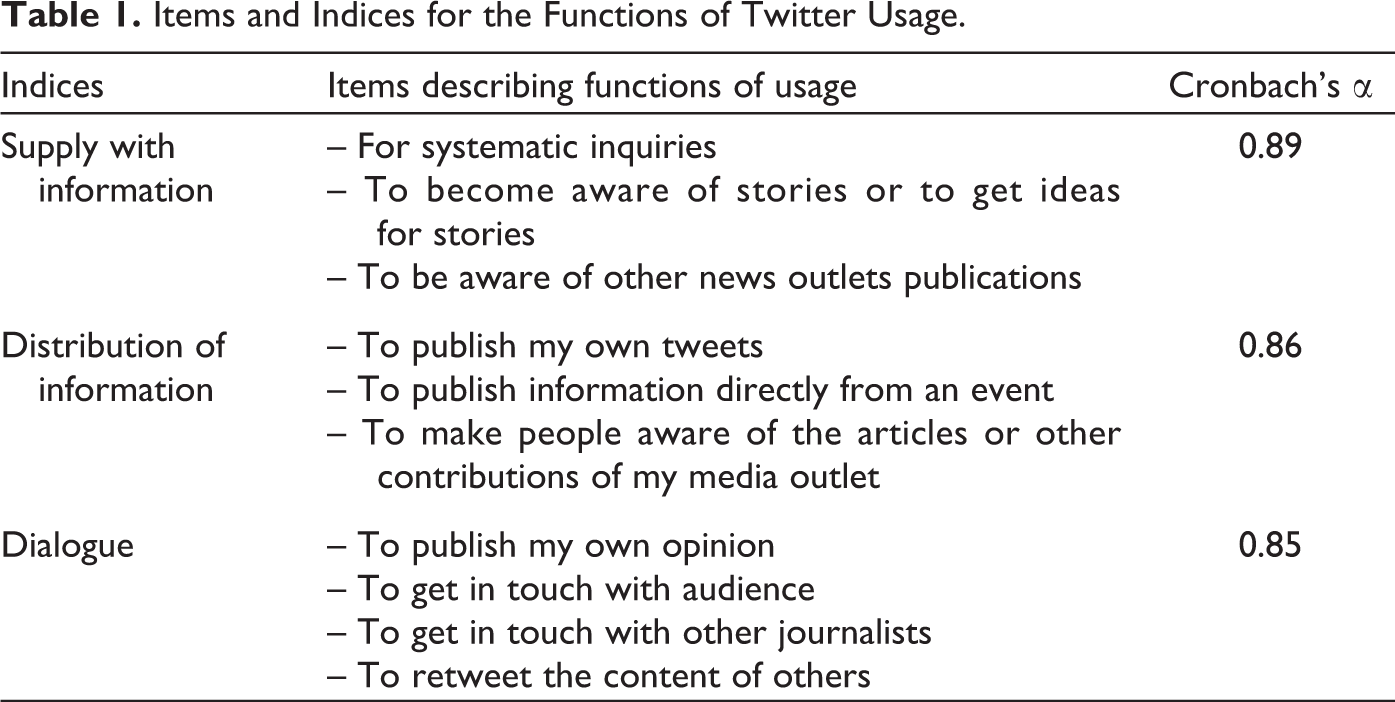
In order to describe the functions and intensity of usage, 10 items were applied. Answers were provided on a 5-point ordinal scale ranging from “less than once a month” (1) to “daily” (5). For further analysis, 3 indices were built from these 10 items and checked for internal consistency. Table 1 presents the details for these items and indices.
Items and Indices for the Functions of Twitter Usage.
Second, the circumstances for the innovation decision were identified. The participants were asked what kind of innovation decision it was—was it their choice to use Twitter or was it directed or desired by their management? As an indicator for near peers as interpersonal communication channels, sympathy for colleagues was used, as socioeconomic status and education might be similar among colleagues in a newsroom. The question that was posed to the participants was “Think of those of your colleagues who you like a lot. Do they use Twitter?”
Third, in order to measure the perceived attributes of Twitter, sports journalists were asked to rate, on a 5-point-scale, the extent to which they agreed with several statements regarding Twitter. According to Rogers (2003, p. 265), there are no fixed measures for the attributes of an innovation. Measurements must be created afresh in each diffusion study in order to ensure that the measurements are suitable for the specific innovation. For the measures of relative advantage, compatibility, and complexity, as many aspects as reasonable with regard to the length of the questionnaire were included in the survey. Students in a research project seminar formulated statements for each attribute based on the studies mentioned in the literature review above. A discussion over a long list of items resulted in 22 statements that included the assumed most important aspects. As an orientation for the wording for these measures, the items of Moore and Benbasat’s (1991) study were used. The statements were randomized in the survey. For further investigation, indices were calculated 1 (see Table 2).
Items and Indices for Perceived Attributes of Twitter.

The students from the research project seminar pretested the questionnaire with sports journalists they know. As a result of the pretest. formulations of some attributes of the innovation were clarified.
Data Analysis
In line with the assumptions of the study, the first step was to analyze whether various types of Twitter users can be differentiated. Therefore, a cluster analysis was applied as an explorative procedure that builds groups in a sample on the basis of similarities in variables (Backhaus et al., 2008). In order to build the clusters of Twitter users, the intensity and functions of usage were used. A two-step-cluster analysis 2 yielded almost equal-sized groups and, thus, good preconditions for the subsequent analysis.
In the next step, comparisons were conducted among the identified user types. Along with diffusion research, possible differences can reveal influences on the manner of innovation adoption. For assumptions 2a) and 2b), the type of innovation decision and the usage by peers were compared. For assumptions 3a), b), and c), the perceived attributes of Twitter were analyzed. In addition to tests for the assumptions, comparisons of the groups concerning the kind of media, gender, age, level of education and employment situation were conducted to reveal possible patterns. When population variances were similar, ANOVA and Tukey as post-hoc test were applied. When the assumption of homogeneous variances was violated, the more robust Welch’s test and the Games-Howell procedure were applied (Field, 2013). In addition to p-values of the post-hoc test, the effect size was calculated using Cohen’s d, particularly its standardized version r (Hemmerich, 2015).
A Report of the Results
The results from the above analysis reveal details regarding the usage of Twitter among German sports journalists. Overall, 71.4 percent of sports journalists in the sample stated that they use Twitter. However, it was found that usage clearly differs among journalists. Only 43 participants—not even a third of the journalists in the sample—said they use Twitter on a daily basis. On average, all surveyed users are on Twitter for 43 minutes a day, with a standard deviation (SD) of 102. While half of the users stated that they use Twitter on average for 10 minutes or less a day, there are 4 users in the sample who reported being on Twitter for 8 or 9 hours a day.
Further, almost two-thirds (64%) of the Twitter users in the sample have a personal Twitter account. With regard to the different functions of usage, Twitter as a supply for information was reported most often, with an average of 3.27 on the 5-point scale (SD = 1.3). Twitter as a function of distribution of information was reported less often, with an average of 2.1 on the 5-point scale (SD = 1.2), and Twitter for dialogue was barely reported, with an average of 1.7 on the 5-point scale (SD = 0.9).
Types of Twitter Users
With regard to assumption 1), the analysis revealed that there are different types of Twitter users. The two-step cluster analysis revealed two types of users—Occasional Information Seekers (OIS) and Regular Active Users (RAU); both differ mostly in terms of the time that they spend on Twitter as well as by the frequency of distribution of information and dialogue. While OIS only spend on average 6 minutes per day on Twitter to mainly get information supply, RAU use Twitter on average for 86 minutes per day and seem to value all functions of Twitter. They integrated Twitter further in their daily routines and also use it for the distribution of information and to get in contact with audience and other journalists. The third type is the Non-users. Table 3 presents details regarding the differences among the user types.
Types of Twitter Users among German Sports Journalists.
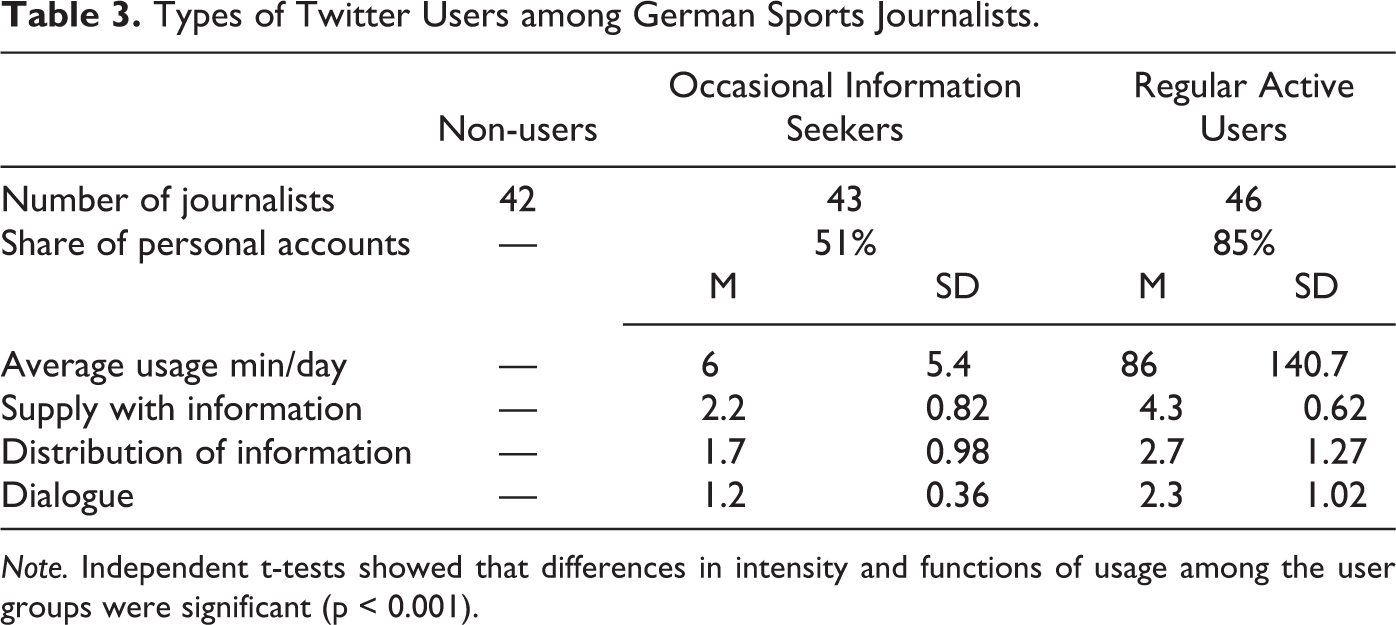
Note. Independent t-tests showed that differences in intensity and functions of usage among the user groups were significant (p < 0.001).
There were no significant differences between the user types regarding the type of media that the participant works for, gender and employment situation. However, the groups differed regarding age and level of education. With an average age of 41 years (SD = 9.9) Regular Active Users were younger than Occasional Information Seekers (M = 46 years, SD = 11.2) who were younger than Non-users (M = 51 years, SD = 9.8). ANOVA (F (2, 119) = 9.71, p < 0.0001) revealed a significant difference between Regular Active Users and Non-Users (p < 0.0001, d = 1.03, r = 0.46). Concerning the level of education, the percentage of participants with a university degree varied among the user types. 77 percent of the Regular Active Users, 76 percent of the Occasional Information Seekers and 51 percent of the Non-Users had a university degree. There were significant differences among the types: Welch’s F-ratio (2, 79.59) = 3.71, p = 0.029. The Non-users varied significantly from the Regular Active Users (p = 0.037, d = 0.56, r = 0.27).
Circumstances for the Innovation Decision
In order to examine possible influences on innovation adoption, differences between the user types were analyzed. With regard to assumption 2a), the type of innovation decision between the user types was compared. Overall, the share of the innovation decision was almost equal. For half of the participants (51%), Twitter usage was directed or desired by management. There were major differences between the types of Twitter users. For only 16% of the Non-users, usage was directed or desired by management. For the Regular Active Users, it was directed or desired for almost 70% (see Figure 1). Welch’s test revealed a significant effect of the innovation decision among user types: Welch’s F-ratio (2, 62.27) = 12.66, p < 0.0001. Further, there were significant differences between the Non-users and both the Occasional Information Seekers (p = 0.04, d = 0.63, r = 0.30) and the Regular Active Users (p < 0.0001, d = 1.23, r = 0.52). However, there was no significant difference between the Occasional Information Seekers and the Regular Active Users (p = 0.09, d = 0.49, r = 0.24).
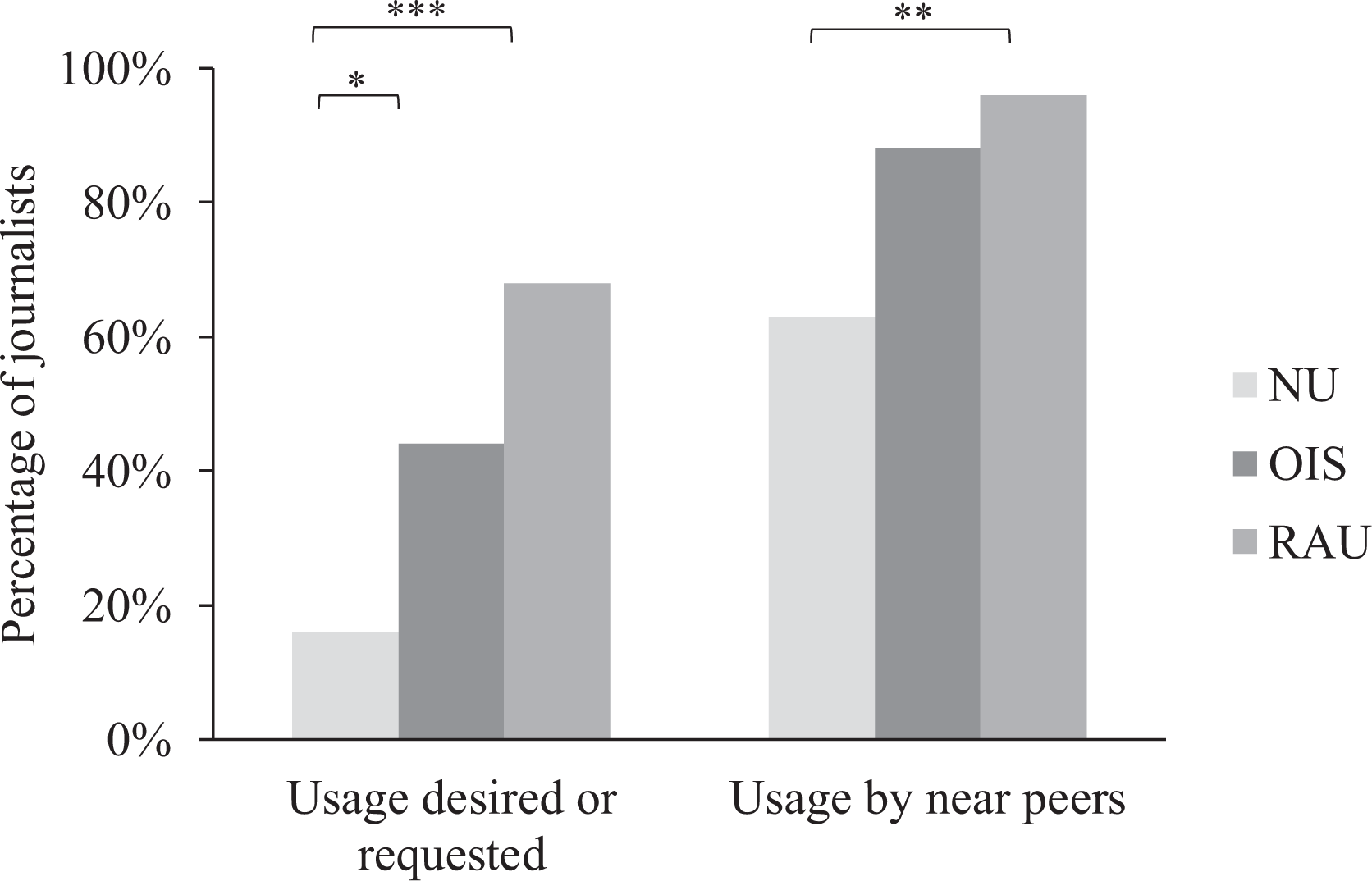
The percentage of journalists in each of the three types of innovation users that state 1a) that usage is desired or requested and 1b) that their near peers use twitter. Note. NU = Non-users; OIS = Occasional Information Seekers; RAU = Regular Active Users. Significance of differences among the user types: ***= p < 0.00, **= p < 0.01, *= p < 0.05.
For assumption 2b), it was asked if near peers use Twitter. A total of 84% of the participants said that their near peers use Twitter. Further analysis revealed differences between the user types. Almost two-thirds (64%) of the Non-users stated that their near peers use Twitter. Among the Regular Active Users, almost all near peers (95%) used Twitter (see Figure 1). There were significant differences among the types: Welch’s F-ratio (2, 61.87) = 6.30, p = 0.003. The Non-users varied significantly from the Regular Active Users (p = 0.003, d = 0.85, r = 0.39). The difference between Non-users and Occasional Information Seekers was almost significant (p = 0.053, d = 0.57, r = 0.27), while the usage by near peers between Occasional Information Seekers and Regular Active Users had no significant effect (p = 0.407, d = 0.28 r = 0.14).
Perceived Attributes of Twitter
With regard to the perceived attributes of Twitter, the relative advantages, compatibility, and complexity were analyzed. Assumption 3a) focused on relative advantages. As depicted in the methodology section, three indices were created from the items on advantages: access to information, reach and dialogue, and branding. For all types of users, agreement with these advantages was fairly high (see Figure 2). Surprisingly, even Non-users were aware of these advantages (see Figure 2). With regard to access to information, there were slight differences among the user types. While the agreement of the Non-users (M = 3.09, SD = 1.10) was the lowest, Occasional Information Seekers (M = 3.54, SD = 0.79) and Regular Active Users (M = 4.12, SD = 0.64) experienced greater advantages of access. Welch’s F-ratio revealed significant differences among the types (2, 44.71) = 11.23, p < 0.0001. The effect between Non-users and Regular Active Users was the clearest (p = 0.001, d = 1.15, r = 0.5), followed by the difference between Occasional Information Seekers and Regular Active Users (p = 0.003, d = 0.81, r = 0.37). There was no significant difference between Non-users and Occasional Information Seekers (p = 0.247, d = 0.47, r = 0.23).
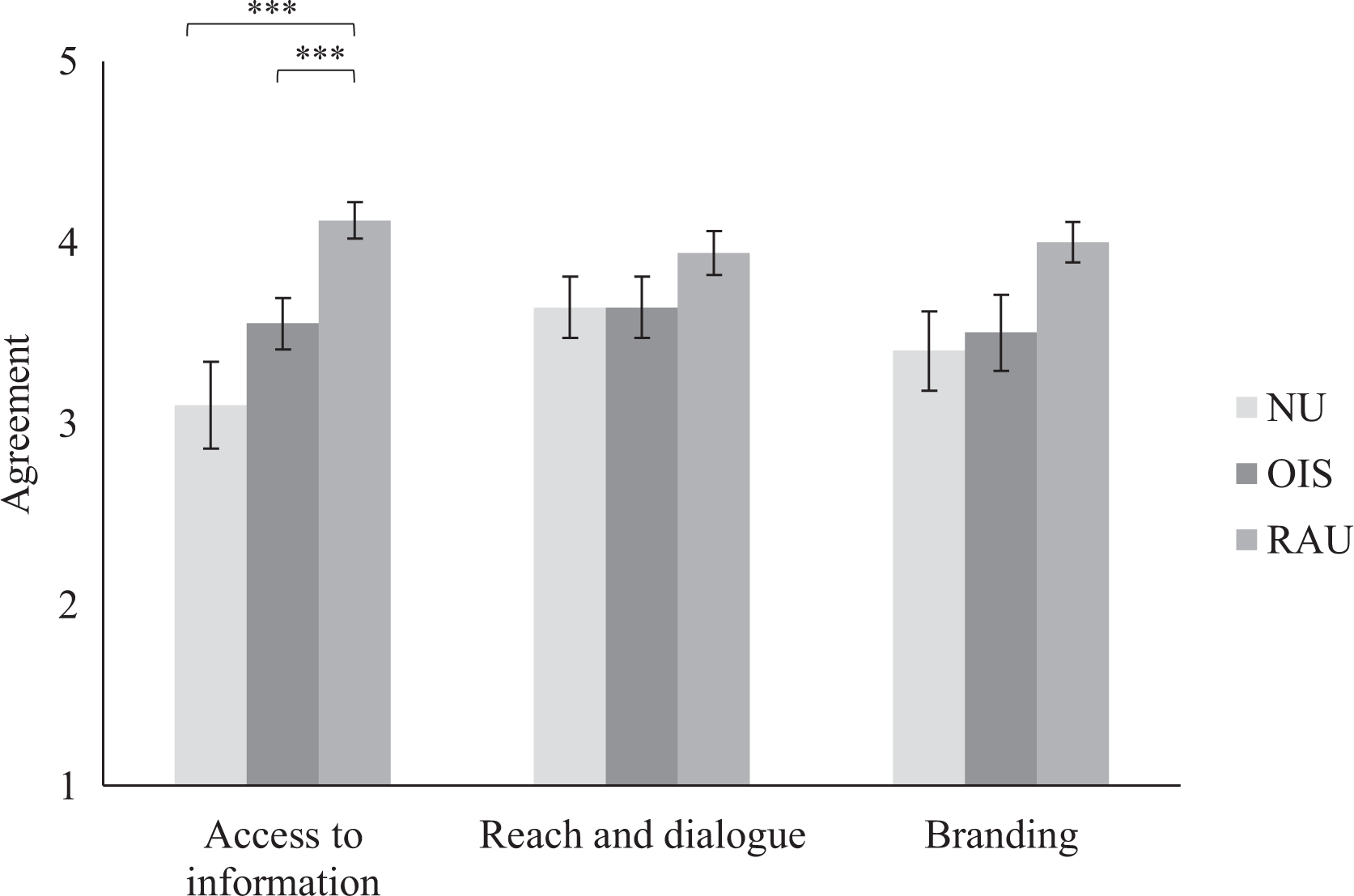
Agreement of journalists by type of innovation users to relative advantages concerning a) access to information, b) reach and dialogue, and c) branding. Note. NU = Non-users; OIS = Occasional Information Seekers; RAU = Regular Active Users. Significance of differences among the user types: ***= p < 0.00, **= p < 0.01, *= p < 0.05. Bars represent standard errors.
The measures of reach and dialogue included items regarding the reach of the audience as well as interaction with users. The agreement of Non-users (M = 3.64, SD = 0.84) and Occasional Information Seekers (M = 3.64, SD = 0.95) was on the same level. The agreement of Regular Active Users was slightly higher (M = 3.95, SD = 0.74). However, ANOVA revealed no significant differences between the user types F (2, 97) = 1.66, p = 0.196. The outcome for branding was similar: For the index that contained items like self-presentation and audience-building, there were slight differences among the types in the sample, but Welch’s test was not significant: F (2, 44.52) = 3.27, p = 0.05.
Assumption 3b) dealt with the compatibility—that is, the lack of compatibility—of Twitter with journalistic norms and values. It turned out that Non-users stated problems with Twitter and journalistic norms and values more often than other users. A lack of quality standards included the aspects that “content cannot be checked thoroughly” and that “professional standards cannot be met.” The Non-users agreed with a lack of quality standards more often (M = 4.13, SD = 0.84) than the other two types of users. Remarkably, the users agreed fairly often—the agreement value for Occasional Information Seekers was 3.72 (SD = 1.02) and that for Regular Active User was 2.93 (SD = 0.83) (see Figure 3). As revealed by ANOVA, the differences among the groups were partially significant (F (2, 105) = 16.22, p < 0.0001). There were differences between Non-users and Regular Active Users (p < 0.0001, d = 1.44, r = 0.58) as well as Regular Active Users and Occasional Information Seekers (p < 0.0001, d = 0.85, r = 0.39). There was no significant difference between Non-users and Occasional Information Seekers.
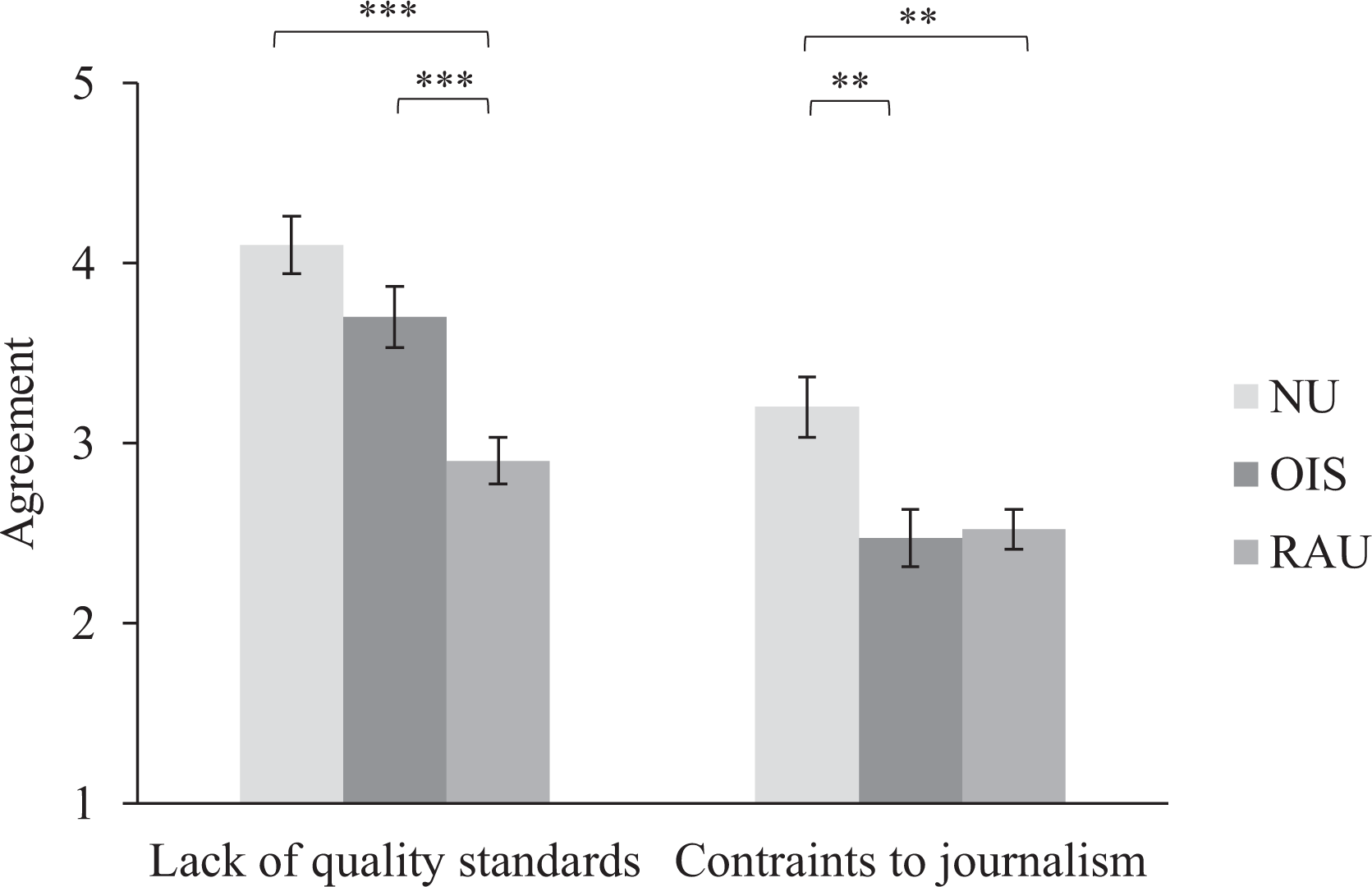
Agreement of journalists by type of innovation users to compatibility concerning a) lack of quality standards and b) constraints to journalism. Note. NU = Non-users; OIS = Occasional Information Seeker; RAU = Regular Active Users. Significance of differences between the user types: ***= p < 0.00, **= p < 0.01, *= p < 0.05. Bars represent standard errors.
The Non-users also considered that journalism was more constrained with Twitter (M = 3.23, SD = 0.81) as compared to Occasional Information Seekers (M = 2.48, SD = 0.94) and Regular Active Users (M = 2.52, SD = 0.74). However, the scores for these items are comparatively low for all types. Some of these small differences were significant (F (2, 95) = 6.53, p = 0.002). The effect between Non-users and Regular Active Users was higher (p = 0.005, d = 1.44, r = 0.58) than the effect between Non-users and Occasional Information Seekers (p = 0.004, d = 0.85, r = 0.39). However, there was no significant difference between Regular Active Users and Occasional Information Seekers (p = 0.969, d = 0.06, r = 0.03).
Assumption 3c) dealt with the complexity of Twitter. Again, the results differ by user types. For Non-users, Twitter is more complex than for Occasional Information Seekers. Further, it is more complex for Non-users than it is for Regular Active Users (see Figure 4). Complexity was measured with two indices. The first one is a lack of available time, which included items like constant availability and abstraction from other tasks. The agreement of Non-users was the highest (M = 4.08, SD = 0.74), but Occasional Information Seekers (M = 3.34, SD = 0.89) and Regular Active Users (M = 2.83, SD = 0.62) agreed to that challenge as well. The differences were significant (ANOVA: F (2, 93) = 19.93, p < 0.0001). The effect was the highest between Non-users and Regular Active Users (p < 0.0001, d = 3.02, r = 0.83), followed by the effect between Non-users and Occasional Information Seekers (p = 0.002, d = 1.88, r = 0.68) and the effect between Regular Active Users and Occasional Information Seekers (p = 0.01, d = 0.68, r = 0.32).

Agreement of journalists by type to complexity concerning a) lack of available time and b) difficulty with handling. Note. NU = Non-users; OIS = Occasional Information Seekers; RAU = Regular Active Users. Significance of differences between the user types: ***= p < 0.00, **= p < 0.01, *= p < 0.05. Bars represent standard errors.
The results are similar for the difficulties with handling that refer to uncertainties regarding what to post and technological problems. Again, Non-users state difficulties more often (M = 3.51, SD = 0.83) than Occasional Information Seekers (M = 3.04, SD = 0.85) and Regular Active Users (M = 2.41, SD = 0.60). The differences were partially significant (F (2, 84) = 15.371, p < 0.0001). The effect was the highest for Non-users and Regular Active Users (p < 0.0001, d = 1.53, r = 0.61), followed by the difference between Regular Active Users and Occasional Information Seekers (p = 0.002, d = 0.86, r = 0.4). However, there was no significant difference between Non-users and Occasional Information Seekers (p = 0.093, d = 0.56, r = 0.27).
Discussion
Based on the diffusion of innovation theory, several assumptions were made for the adoption of Twitter by German sports journalists. With reference to Rogers’ (2003) statement that the manner of adoption varies, the first assumption dealt with the differentiation of types of Twitter users. This study provides support for this assumption. It was evident that there is no single manner in which Twitter may be adopted. Sherwood and Nicholson’s (2013, p. 954) statement that journalists use social networks “on their terms” is supported for sports journalists in Germany. Moreover, apart from Non-users, two types of Twitter users were identified—Occasional Information Seekers and the Regular Active Users—who differed primarily in accordance with the duration of their activity on Twitter and the functions they use Twitter for. With the differentiation of two user types it is possible to draw a clearer picture concerning the influences on adoption. In doing so, it was shown that sports journalists who use Twitter for a few minutes per day and journalists who use it for a few hours per day clearly differ concerning the circumstances of adoption and Twitter’s perceived attributes. Regular Active Users seem to have integrated Twitter in their daily routines. One reason might be that they are on average younger and therewith are more likely to have normalized social media in their private life as well.
However, active usage of Twitter was fairly seldom. As Bruns and Nuernbergk (2019) emphasize for political journalists in Germany, there is a smaller group of particular enthusiastic adopters in sports journalism as well. With regard to Deprez et al.’s (2013) results that there was rather passive Twitter usage by sports journalists in Flanders, it raises the question if the passive usage is an European phenomenon. Further, an explanation for the little activity of sports journalists might be the low diffusion of Twitter in Germany. Without a critical mass network, the effects with regard to the audience might be comparably low. However, advantages with regard to sources and networking among journalists still exist, so that journalists might even benefit from Twitter despite the low penetration in Germany.
As a next step, influencing factors that were proven to have a strong impact based on the diffusion of innovation theory (Rogers, 2003) were investigated. As assumed in 2a), Twitter adoption is more likely for journalists whose management expects them to use the platform than for journalists for whom this is an optional innovation decision. In this regard, there were considerable differences among the groups. A fewer number of Non-users stated that usage is desired or requested than the number of Occasional Information Seekers, who in turn stated this less often than Regular Active Users. The fairly clear differences among the groups reveal that management decisions are a decisive influence. This result is in line with the journalist interviewed by English (2014, p. 7), who revealed that Twitter was used “to satisfy newsroom structures.” However, it must be considered that, overall, only half of the participants in this study stated that usage is desired or requested by their management. This freedom of choice is fairly high for a workplace. This might be due to Innere Pressefreiheit, a German expression that can be translated with “inner freedom of press” and refers to the autonomy of journalists in a newsroom. Innere Pressefreiheit might also be an explanation for why management decisions are not obeyed by all surveyed journalists—for 16% of the Non-users, there is an authority decision by the management that they do not comply with.
Despite the autonomy argument, there also appears to be dependency on near peers and, thus, the importance of the communication channels as the means to exchange information about Twitter. As assumed in 2b), Twitter adoption is more likely for journalists whose near peers have already adopted Twitter than for journalists whose near peers are not using Twitter. However, again, the number of Non-users whose near peers use Twitter causes us to question the importance of this influence. Further, two thirds of the Non-users had near peers who use Twitter. Thus, it is possible that for innovations like Twitter that are visible in media channels and in newsrooms, interpersonal communication channels are not as important as for innovations with less visibility. Another explanation for the influence of near peers might be the collectivity of an innovation decision. In cases with no strict authority decision maybe the journalists in the newsroom agreed on a collective innovation decision to use Twitter.
In addition to the circumstances for the innovation decision, the diffusion of innovation theory emphasizes the perceived attributes of an innovation. Referring to Rogers (2003) these attributes explained most of the variance of adoption. In assumption 3a), it is assumed that relative advantages perceived by sports journalists are positively related to their adoption of Twitter. For Twitter in sports journalism, this assumption can only be partially supported. There were only significant differences between the user types with regard to access to information. Non-users perceived this advantage less often than Occasional Information Seekers, who perceived this advantage less often than Regular Active Users. The differences between the latter two types can be explained by the varying share of personal Twitter accounts; it is plausible that a personal account enhances an easy access to information. Apart from advantages in access to information, surprisingly, there were no significant differences in the assessment between the user types. In contrast to the diffusion of innovation theory, the relative advantages do not appear to be strong predictors for the usage of Twitter. In order to explain why Non-users do not use Twitter, other perceived attributes of the innovation might help.
Based on Rogers (2003), 3b) assumes that the compatibility of Twitter with norms and values perceived by sports journalists is positively related to their adoption of Twitter. When journalists have doubts regarding the compatibility of Twitter usage with their norms and values, they do not adopt its usage. The data supports this assumption—Non-users expressed doubts regarding the compatibility with journalistic standards and journalist’s self-conceptions more often than users. Doubts about accuracy standards as they were expressed in McEnnis’ (2013) and Reed and Hansons’ (2013) studies still appear to exist in German sports journalism.
The criticism of Twitter is also evident for assumption 3c) that supposes that perceived high complexity is negatively related to Twitter adoption. Both indices for this assumption—lack of available time and perceived difficulties with handling—support the assumption. There were significant effects for all user types. As suggested by Price et al. (2013), clear job descriptions and guidelines for the usage of Twitter in newsrooms might help to reduce complexity for journalists.
To sum up, we found that the influencing factors suggested by the diffusion of innovation theory can help to explain the adoption of Twitter by German sports journalists. The circumstances for the innovation decision—particularly the type if innovation decision—appear particularly important. Unfortunately, a regression analysis that could expose the strongest influences was not possible here due to the small number of participants. However, it appears that the perceived attributes of an innovation that explained, according to Rogers (2003, p. 221), 40%–87% of adoption are not as important in this study. Although the tendencies support the assumptions regarding perceived attributes, the differences among user types are not always distinctive. In particular, there were no clear differences with regard to relative advantages.
Conclusion
This study aimed to analyze the extent to which influential variables from the diffusion of innovation theory can help to explain the adoption of Twitter in sports journalism in Germany. Variables related to circumstances as well as the perceived attributes of an innovation were included in this study. Three types of Twitter users—Non-users, Occasional Information Seekers, and Regular Active Users—were identified and they differed in terms of innovation decision and communication channels. With regard to perceived attributes, there were differences in compatibility and complexity. Contrary to the assumption in diffusion research, the relative advantages of the innovation played a minor role.
Concerning theoretical contributions this study revealed that the diffusion of innovation theory is helpful in explaining the adoption of digital innovations in sports journalism. The theory must be applied to the adoption of other innovations and might help to predict their success. For example, in sports journalism, the establishment of data journalism would be an interesting case. In Germany data journalism is often neglected in sport reporting. With its potentially relative advantages and possibly high complexity, explanations might be provided. Future studies must particularly focus on the role of relative advantages of innovations and also expand the number of variables. Rogers (2003, p. 15) emphasizes that “an adopter experience with one innovation obviously influences that individual’s perception of the next innovation […].” Therefore, technology clusters must be considered in future studies to analyze if a journalist has affinity to digital technology at all.
With regard to the methodological approach, the items and indices used in this study might provide an orientation. However, the operationalization of communications channels must be clearer; not only the usage by near peers but also their evaluation must be considered. Also, there must be further differentiation concerning the accounts used by journalists. In addition to the usage of private accounts, the usage of official accounts of the news outlet must be investigated to shed further light on the impact of journalist’s autonomy in the newsroom.
In addition, future research must work with a larger sample. It is a limitation of this study that the number of participants was too small to conduct regression analysis to specify the most important predictors of Twitter adoption. It should also be considered to choose another population for sample selection. There is a possibility that association members are more likely to have certain characteristics such as an older age. If this would be the case, Twitter usage could be underestimated here. Further, interview studies must be considered to specify the perceived attributes and to detect other influences on adoption.
In addition to theoretical contributions for diffusion research, the results reveal that German sports journalists are reserved when it comes to Twitter as a digital innovation. Surprisingly, the number of journalists who used Twitter in 2018 with personal accounts was fairly low. Considering that political journalists in Germany use Twitter to a higher degree (Nuernbergk, 2020), the reluctant usage does not seem to be a national particularity but a national sport-specific particularity. One reason might be that sport reporting is less controversial, so advantages of Twitter for sport journalism might be less important compared to the political beat.
Compared to the Twitter usage by journalists in other countries such as the US, where Twitter is “normalized” (Lasorsa et al., 2012) for years now, the low level of adoption by German sports journalists is striking. This implies that many German sports journalists miss out on an opportunity for information gathering, for networking and for branding. As revealed by this study, the circumstances of an adoption are fairly influential. Thus, in order to change the situation, clear management decisions and newsroom guidelines regarding innovations that do not degrade Innere Pressefreiheit could help. Moreover, possible problems with complexity might be resolved by providing workshops on specific innovations. Further, a discussion of relative advantages, compatibility, and complexity of digital innovations must also be facilitated in the education of sports journalism students. Students should be given the possibility to discuss how to use communication channels to build professional relationships via social media and how to develop their personal brand.
In conclusion, this study advocates the application of diffusion research for the adoption of digital innovations in sports journalism. This study revealed that the rather old theory of diffusion of innovation provides a good framework for digital innovations in sports journalism when variables are specified for specific innovations. In this regard, it is hoped that this study provides an approach to explain the adoption of other digital innovations in sports journalism.
Footnotes
Author Note
Sports journalism students helped to collect the data for this study in a research project seminar. I would like to thank my students for their engagement with this study. I also want to thank the Association for German Sports Journalists for access to their members’ database.
Declaration of Conflicting Interests
The author(s) declared no potential conflicts of interest with respect to the research, authorship, and/or publication of this article.
Funding
The author(s) received no financial support for the research, authorship, and/or publication of this article.
