



Abstract
The purpose of this study was to examine the crisis of systemic sexual abuse, sexual harassment, and misconduct in the NWSL within the frameworks of situational crisis communication theory (SCCT) and image-repair theory (IRT). Specifically, this research engaged with three data sources (1) the Yates Report which details team by team allegations, (2) team statements in response to the allegations being made public, and (3) social media interactions in response to all statements. Based on the Yates Report, the Portland Thorns, Chicago Red Stars, and Racing Louisville (as well as the NWSL and USSF) were placed firmly within the preventable crisis cluster, which is marked by organization misconduct and management misdeeds. In terms of SCCT strategies, commonly used approaches were ingratiation and apology. In terms of image repair, commonly used approaches were corrective action, bolstering, and mortification, with corrective action being the most frequently utilized strategy across all statements. Within the preventable cluster, the two statements that received the highest interaction rates and like ratios were those that employed scapegoating, shifting blame, and corrective action. The implications of these findings as well as the utility of SCCT and IRT within the crisis communication landscape are discussed.
Keywords
The National Women’s Soccer League (NWSL) experienced unprecedented growth in 2022. The league expanded to include its 11th (Angel City FC) and 12th (San Diego Wave) teams, with the potential to expand to 14 or 16 teams in 2024 and beyond (Silverman, 2022). With these teams and the purchase of the Washington Spirit in 2022 for a price of $35 million, the league was also increasing its valuation and revenue. Ticket revenue was up 125% (Bachman & Radnofsky, 2022), club commercial revenue increased 33%, and league commercial revenue jumped 24% over the previous year (Greenberg, 2022). Consumers also tuned in to watch the league. Regular-season viewership on Paramount + was up 29%. The NWSL title game was moved to CBS primetime and as a result, garnered an average of 915,000 viewers (a 71% increase over the previous year’s championship) (Greenberg, 2022). Even the players saw a benefit as the league’s first collective bargaining agreement (CBA) was signed in 2022, increasing minimum player salaries by 160% and introducing free agency (Silverman, 2022). Throughout most of 2022, the NWSL and its major stakeholders were seeing positive momentum for the league.
However, on October 3rd, 2022, a bombshell report was made public providing ample evidence of the U.S. Soccer Federation’s (USSF) and NWSL’s failure to protect their players and for repeatedly ignoring the players’ allegations of abuse and inappropriate conduct from coaches and administrators (Yang, 2022). The investigation, led by former Attorney General Sally Q. Yates, interviewed over 200 players, coaches, owners, and front office staff and reviewed millions of documents from the USSF. The subsequent “Yates Report” spanned 173 pages, clearly articulating the failings of the teams, leagues, and federation towards the players. The report had numerous findings of years long investigations of sexual and verbal/emotional abuse into coaches and general managers Paul Riley (former North Carolina Courage and Portland Thorns head coach), Rory Dames (former Chicago Red Stars head coach), Rickie Burke (former Washington Spirit head coach), Craig Harrington (former Utah Royals head coach), Alyse LaHue (former Gotham FC general manager), Farid Benstiti (former OL Reign head coach), and Christy Holly (former Racing Louisville head coach) (Yang & Linehan, 2022). In addition to the abuse either fostered or acted upon by these individuals and clubs, the report also stated that the Portland Thorns tried to interfere with access to relevant witnesses, Racing Louisville refused to produce relevant documents, and the Chicago Red Stars unnecessarily delayed production of certain documents (Yang, 2022).
The Yates Report marked a key moment and potential insurmountable obstacle for the NWSL and its growth. Players like Becky Sauerbrunn called for many owners, executives, and officials who failed to prevent this abuse to be fired from their positions. Supporter groups like the Lavender Legion (Racing Louisville) and Rose City Riveters (Portland Thorns) publicly bashed the front office of their teams and demanded resignations. Many sponsors (Union Wine Company, Providence, Alaska Airlines, etc.) also published statements showing support for the players, stating that many would wait to see how ownership and management responded before renewing or cancelling their sponsorships. With a crucial media rights deal coming in the next year in addition to the momentum the NWSL had garnered over the past year, eyes turned to how the clubs would respond to this crisis. As Angel City FC forward Sydney Leroux posted on social media, “There is no damage control. Just damage” (Carlisle, 2022, para. 15).
The purpose of this study was to examine the crisis of systemic sexual abuse, sexual harassment, and misconduct in the NWSL within the frameworks of situational crisis communication theory (SCCT) and image-repair theory (IRT). Specifically, this research engaged with three data sources (1) the Yates Report which details team by team allegations, (2) team statements in response to the allegations being made public, and (3) social media interactions in response to all statements. While studies have investigated how sport organizations have responded to crises in the past (e.g., Brown & Billings, 2013; Brown et al., 2015; Frederick & Pegoraro, 2018), to the knowledge of the authors, none have examined a league that was witnessing unprecedented growth immediately before the crisis went public. Additionally, this crisis was not an isolated incident, as multiple teams, personnel, and administrators were involved. The systemic nature of this crisis makes an examination of crisis communication a worthy avenue of investigation. Furthermore, this study is significant as it applies both SCCT and IRT to the analysis, which is rare in sport communication research (see Brown et al., 2015 for another example). While sport communication research indicates that SCCT works better for organizational crisis communication (Brown et al., 2015), the current study’s findings demonstrate the compelling applicability of IRT (in concert with SCCT) to organization generated crisis communication efforts, thereby highlighting the utility and nuance(s) of both frameworks within the crisis communication landscape. Additionally, this study demonstrates the ubiquity of corrective action as well as the acceptance of scapegoating and shifting blame tactics, indicating that stakeholders are searching for someone to blame during a crisis.
Literature Review
Much of the research in the realm of sport, social media, and crisis communication has applied SCCT (see Coombs, 2007) and/or IRT (see Benoit, 2014; Benoit, 1997). Therefore, a review of these two frameworks is necessary.
SCCT and IRT
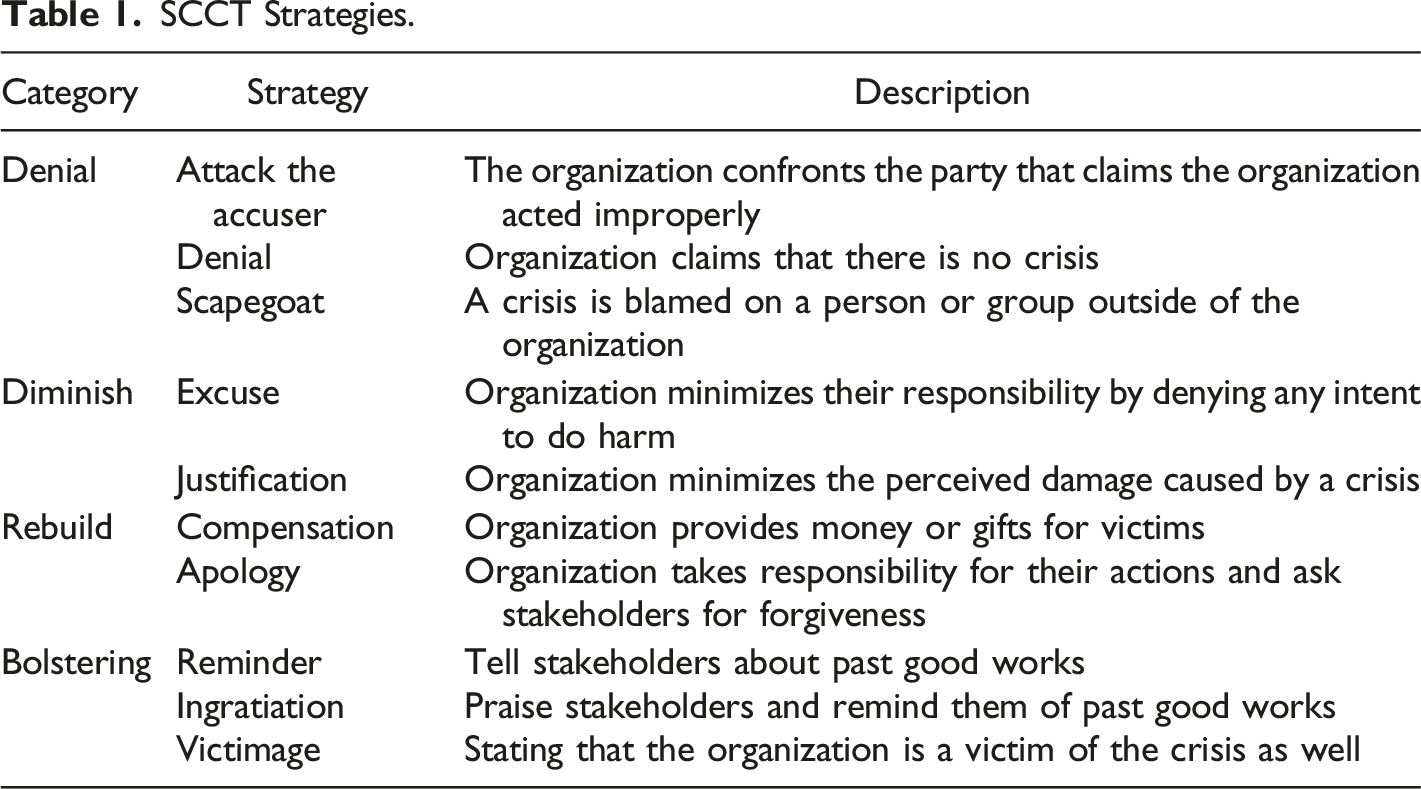
According to Coombs (2007), “Situational Crisis Communication Theory (SCCT) provides an evidence-based framework for understanding how to maximize the reputational protection afforded by post-crisis communication” (p. 163). SCCT has its roots in Attribution Theory, which contends that individuals will attribute responsibility for an event and have an emotional reaction to that event (or crisis). SCCT expands upon Attribution Theory by predicting the reputational threat posed by a crisis and prescribing response strategies to address the crisis and protect reputational assets. According to Coombs, there are three factors that shape the reputational threat: (1) initial crisis responsibility, (2) crisis history, and (3) prior reputational threat. Initial crisis responsibility refers to the attribution of responsibility for the crisis placed on the organization by its stakeholders. Within SCCT, there are three crisis clusters based upon the attribution of crisis responsibility. These clusters include victim (weak attribution of crisis responsibility; the organization is a victim of the crisis), accidental (minimal attribution of crisis responsibility; organization’s actions leading to the crisis were unintentional), and preventable (high attribution of crisis responsibility; organization knowingly put people at risk, took inappropriate actions, or broke the law). A preventable crisis is marked by intentional management misconduct and/or organizational misdeeds (see Coombs & Holladay, 2002). Crisis history refers to if an organization has dealt with a similar crisis in the past and prior reputational threat refers to how well or poorly organizations have treated stakeholders. All three elements are evaluated prior to determining crisis response strategies.
SCCT Strategies.
IRT Strategies.
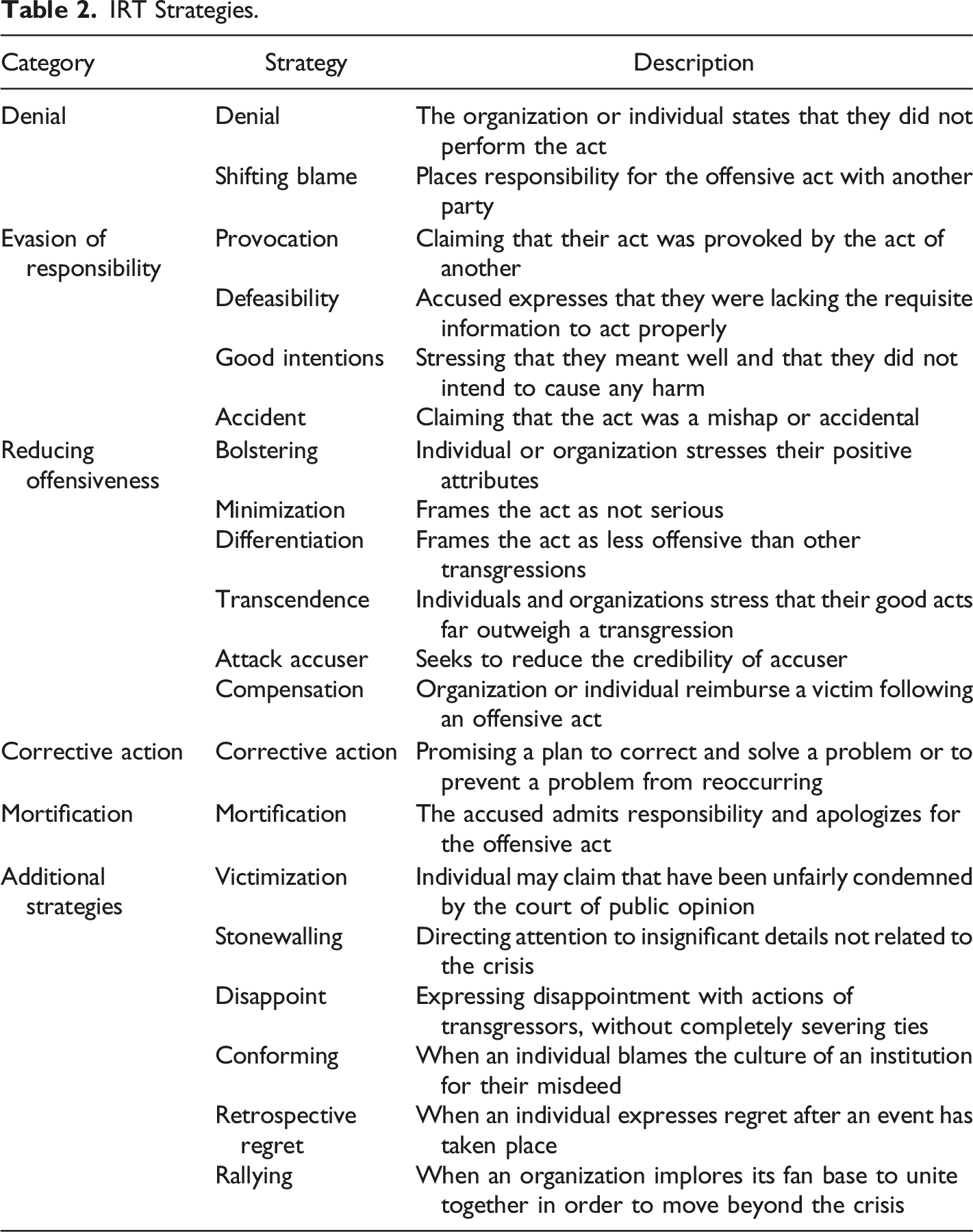
Along with defining strategies for engaging in image repair, Benoit (1997) provides suggestions for effective image-repair discourse. He argues that an organization should avoid false claims, and if at fault, the organization should admit fault and/or wrongdoing in a timely manner. An organization should also provide a course for corrective action, noting that if an organization does not live up to its corrective promises, their reputation and image could sustain further damage. He also suggests that using a combination of strategies can be effective, as certain strategies may complement one another and enhance the persuasion efforts of the organization. In line with that suggestion, scholars have argued that in order to engage with one’s fan base and increase the likelihood of long-term success in terms of image repair, an individual or organization should utilize a mixture of corrective action, mortification, and rallying (Frederick et al., 2021). This finding correlates with Benoit’s later works where he suggests that we often “think better” of people who promise corrective action and engage in mortification (see Benoit, 2014, p. 29).
Both IRT and SCCT have been applied extensively in sport research. In addition to empirical research, scholars have dedicated extensive texts to the critical examination of these frameworks within a sport context (see Billings et al., 2018; Blaney, Lippert, & Smith, 2013). Recently, scholars have applied these frameworks to research examining the intersection of sport and social media. Since this research will focus on team statements released via social media and users’ interactions with those statements, subsequent sections of the literature review focus on the intersection of sport, social media, and crisis communication.
SCCT, Sport, and Social Media
The body of research employing SCCT to evaluate the intersection of sport and social media has examined a collegiate institution in the midst of an impermissible benefits scandal (Brown & Billings, 2013) and a collegiate institution embroiled in a sexual assault scandal perpetrated by a former coach (Brown et al., 2015). Additionally, this line of research has explored a league-wide response to a team-specific crisis (Spackman et al., 2021), as well as responses related to improper athlete behavior (Jackson & Thaker, 2021), responses related to poor team performance (Utz et al., 2021), and responses related to a ball tampering scandal (Morgan & Wilk, 2018).
One key finding from this body of research is that fans will often engage in reputational repair on behalf of their athletes and institutions, which is evidenced by the utilization of ingratiation, reminder, attack the accuser, denial, and scapegoating techniques (see Brown & Billings, 2013; Brown et al., 2015; Jackson & Thaker, 2021). Furthermore, the use of these tactics highlights how fans engage in reputational repair to alleviate stress related to allegations involving their organizations (Brown & Billings, 2013), place blame while remaining loyal to other key figures in their organizations (Brown et al., 2015), and protect athletes from reputational threats (Jackson & Thaker, 2021). While fans will often come to the defense of their athletes and organizations, it is important to note that sentiment is often negative during the crisis phase as individuals try to make sense of the crisis, place blame, and cautiously move forward (Morgan & Wilk, 2018).
In terms of SCCT and crisis communication responses from athletes, teams, and leagues, a couple of key findings can be gleaned from existing research. First, there can be divergence in crisis communication rhetoric from team personnel and crisis communication rhetoric from fans. A specific example comes from Jackson and Thaker (2021). In this study, personnel claimed to be a victim of the crisis and expressed disappointment in the actions of an athlete, while fans engaged in reputational repair on behalf of the athlete (Jackson & Thaker, 2021). Second, even when leagues engage in appropriate crisis communication strategies based on their crisis cluster, they receive negative commentary via social media due to the reactive nature of their crisis communication efforts (Spackman et al., 2021). Finally, the sender of the crisis communication message often matters more than the content of the message, indicating that users attribute crisis responsibility to differing degrees based on the source of the response (Utz et al., 2021).
It is important to note that in their work, Brown et al. (2015) applied both SCCT and IRT to their data analyses. The authors determined that IRT was inadequate for examining their dataset, further contending that SCCT works better for organizational crisis communication, while IRT works better for individual crisis communication efforts.
IRT, Sport, and Social Media
Research utilizing IRT to examine the intersection of sport and social media has evaluated collegiate institutions and allegations of funneling money to recruits (Frederick & Pegoraro, 2018), responses related to sexual assault involving a team doctor (Frederick et al., 2021), and crisis in college sport across a spectrum of severity (Roussin et al., 2022). Research has also explored crisis communication efforts involving athletes accused of substance abuse (Allison et al., 2020; Hambrick et al., 2015) and athletes creating toxic work environments (Schmittel & Hull, 2015). IRT research has also explored how journalists employ IRT strategies on behalf of organizations (Sheffer et al., 2018) and how government officials utilize IRT following bad performances by local sport teams (Compton & Compton, 2022).
Collegiate institutions have been a key focus of IRT scholars. Thus far, research examining these entities has shown that they often engage in similar image-repair tactics regardless of the severity of the crisis, frequently employing bolstering, stonewalling, and corrective action (Roussin et al., 2022). Additionally, fan narratives in response to these crises shift over time from support and fandom to a more critical view of each university’s handling of their respective crisis (Roussin et al., 2022). Previous research has demonstrated that both support and rejection of crisis communication efforts exist. Often this is exhibited by users showing support for the university and comparing the university to more egregious offenders (Frederick & Pegoraro, 2018). Rejection often occurs with users calling on an organization to change its culture and take ownership for its mistakes (Frederick et al., 2021). While these institutions often use multiple image-repair strategies, scholars have argued that corrective action and mortification are the most appropriate strategies to employ to garner fan engagement during a particularly wicked crisis (Frederick et al., 2021).
With regard to IRT research involving athletes, scholars have revealed that image repair often varies across platforms. This divergent use of image-repair tactics across traditional media and social media can often confuse and alienate fans and impede the forgiveness process (Hambrick et al., 2015). Research has also shown that the image-repair strategies employed by athletes via social media may be more indicative of their true feelings toward the crisis (Schmittel & Hull, 2015). However, this is not always positive, as athletes have been shown to engage in bolstering, attacking accuser, and stonewalling tactics via social media (Hambrick et al., 2015; Schmittel & Hull, 2015) which are not always received positively during a crisis. Similar to SCCT research, IRT research has also revealed that fans will engage in image repair on behalf of athletes. Research has demonstrated that support exists despite the transgression (i.e., using a banned substance vs. a DUI) and the image-repair strategies being used (i.e., attack accuser and defeasibility vs. corrective action and mortification) by the athlete (Allison et al., 2020). Allison et al., (2020) further contend that fans adopt similar arguments to those being employed by athletes.
Beyond sport institutions and athletes, IRT research has revealed that personnel outside of sport organizations will engage in image repair on behalf of sport entities. This research has demonstrated that journalists will engage in minimization and stonewalling tactics to repair the image of sport entities that exert significant power, and that sport media have a vested interest in covering (Sheffer et al., 2018). Additionally, research has revealed that government officials will engage in image repair following a team’s disappointing season by employing bolstering, attacking accusers, and corrective action (Compton & Compton, 2022). This research further contends that these tactics serve as an inoculation message, allowing fans to resist discouragement and maintain their support of the team.
The existing body of research demonstrates the versatility and applicability of SCCT and IRT to crisis scenarios in sport requiring crisis communication. Employing SCCT and IRT, three research questions guided this study:
How does the Yates Report frame each NWSL team-specific crisis within the SCCT crisis clusters?
What SCCT or image-repair strategies do NWSL teams employ in their statements?
How do users interact with team statements via social media?
Method
Data Collection and Data Analysis
To address RQ1, a full copy of the Yates Report was retrieved. The full (unredacted) report was widely available online for public consumption (see Yates, 2022). For RQ2, a total of 30 statements were collected via screenshot from October 3 through October 11, 2022. In terms of users’ interactions with statements via social media (RQ3), we gathered pertinent metrics for each statement including the total number of followers for each team and/or organization, likes and retweets for each statement (Twitter), likes and comments for each statement (Instagram), and likes and loves for each statement (Facebook). These metrics were used to determine interaction rates and like ratios.
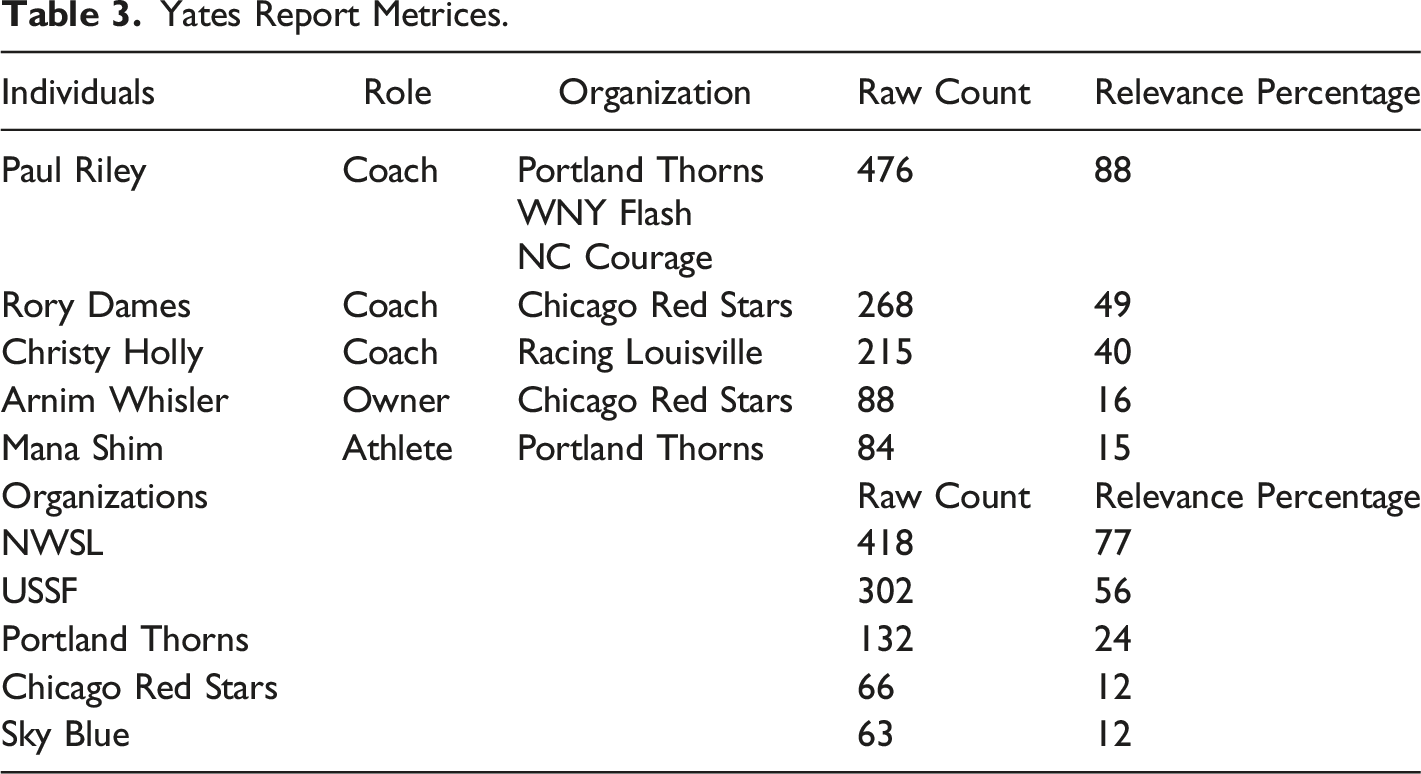
To begin with, the authors conducted a thorough read through and analysis of the entire Yates Report to address RQ1. This process involved reading the report in its entirety and making note of keywords and statements that were used to characterize specific teams involved in the crisis. Based on how the teams’ actions were characterized, we coded teams within the SCCT crisis clusters. For example, if a statement read, “Team A actively concealed information and did not act appropriately while handling Coach A’s misconduct,” that team was placed in the preventable crisis cluster as they knowingly acted inappropriately. Additionally, Leximancer was used to determine keywords and relevant concepts within the dataset. Leximancer is a qualitative software that conducts thematic and semantic analysis on written words as well as visual text (Bals et al., 2012). Leximancer analysis identified the names of individuals and organizations that were most relevant within the dataset and produced a raw count of words and proper names as well as the relevance of those word and names to the overall text. Relevance is defined as the percentage representation of the count value of each concept divided by the single highest count value (Heath & Swabey, 2014). Therefore, the most frequent concept (e.g., word or proper name identified) will always have 100% relevance, regardless of whether it occurs in a context block of text. Using Leximancer provided a supplemental analysis by indicating the most prominent individuals and organizations referred to within the Yates report.
A deductive thematic analysis was employed to examine team statements (RQ2). The strategies within both SCCT and IRT served as the frameworks guiding the coding of each statement. In line with a deductive approach, if a statement could not be coded within either framework, it was set aside for further analysis. This approach is in line with previous image-repair studies in sport (Frederick & Pegoraro, 2018). Multiple strategies could appear in a single statement. Each line of text within a statement served as the unit of analysis. The sample of statements was split between two of the authors. Each statement was coded for both SCCT and IRT strategies. Notes were also provided pertaining to key quotes or terms used in each statement. Once coding was complete, the authors reviewed each other’s codes/notes and discussed all statements in detail to resolve any discrepancies and reach consensus regarding the strategies being employed.
To answer RQ3, we calculated both the interaction rate and like ratio for all statements. The interaction rate was calculated by dividing interactions by followers at the time each statement was released. For example, if a team had 200,000 followers at the time of their statement, and a statement had 2,000 likes and 1,500 retweets on Twitter (3,500 total interactions), the interaction rate was .0175 for that statement on Twitter. A similar process was used for the like ratio. In this instance, only the likes (2,000) would be divided by the total followers (200,000), for a like ratio of .0100 for that statement on Twitter. For Instagram, like counts for each post were used while on Facebook, the like ratio was comprised of likes and loves on each post to ensure all supportive reactions were included. Likes were chosen as they are considered a “numeric representation of social acceptance” (Rosenthal-von der Pütten et al., 2019, p. 76).
Results
RQ1: How Does the Yates Report Frame Each NWSL Team-Specific Crisis Within the SCCT Crisis Clusters?
Within the report, primary attention was paid to the actions of three former head coaches, Paul Riley (Portland Thorns), Rory Dames (Chicago Red Stars), and Christy Holly (Racing Louisville). When discussing the Portland Thorns Notably, the Thorns did not investigate [Mana] Shim’s allegations of Riley’s escalating sexual harassment and hostile work environment, his retaliation against Shim when she asked him to stop, or his harassment against [Sinead] Farrelly or any other player. The Thorns did not investigate whether Farrelly may have also been subject to harassment or had a relationship with Riley that involved sexual misconduct, despite suggestions in both interviews and documentary evidence that this maybe the case. (p. 66) Shim and Farrelly recall their interviews appeared to focus on identifying potential legal claims against the Team [Thorns] and “what [they] knew so it could be kept within the club.” Farrelly recalls, “they just wanted to know what I knew and who I told.” Her understanding was that this information “needed to stay within the club.” (p. 66)
In terms of the Chicago Red Stars, the report also recounts the team’s negligence and lack of due diligence when vetting their coaches. For example, “But, neither Whisler nor anyone else at the Red Stars ever conducted a background check on Dames or undertook any due diligence before hiring him, relying instead on the reputation of Eclipse” (p. 93). The report also discusses how the team owner (Armin Whisler) often defended Dames against allegations rather than removing him from his position of power. According to the report: Bailey distributed Press’s concerns to Whisler, owner of the Red Stars, who complained that the National Team players wanted “this league to shut down” and simply had an “axe to grind” with Dames. Dames offered to resign in light of the complaints, but Whisler declined to accept. (p. 94) Regardless, “[e]veryone knew” about Dames’s verbal and emotional misconduct. Numerous witnesses reported Whisler has been aware of Dames’s verbal and emotional abuse for decades. Players and staff recall raising complaints about Dames’s verbal and emotional abuse nearly every year that Dames coached at CRS. One player, for example, remarked that she raised concerns about Dames to Whisler over multiple years, and every year, Whisler would ask: “Was he a little bit better this year?” Over time, this player became less vocal, realizing that “it was a lost cause.” (p. 95)
With regard to Racing Louisville, much of the criticism in the Yates Report emanated from the organization’s lack of due diligence when hiring Christy Holly. For example: Racing Louisville did not to reach out to any players or staff who worked directly with Holly at Sky Blue (including his former General Manager). Still, Racing Louisville conveyed to us that they considered their due diligence sufficient, and at the time felt that they had a good understanding of Holly’s character. (p. 152) Players at Racing Louisville reported verbal abuse, manipulative behavior, and another relationship (this time with a young staff member) that created a toxic environment. Just as at Sky Blue, there were efforts by players and a staff member to report this to team management, which management acknowledged but ultimately resolved, giving Holly the benefit of the doubt. That is, until the club became aware of Holly’s sexual misconduct towards a player. Racing Louisville swiftly took action and removed Holly. But the team chose not to share the “cause” of its action with the public, other players in the League, or with our investigation, citing a mutual non-disclosure and non-disparagement agreement it entered with Holly. (p. 128-29)
Based on these excerpts, it is clear that the Yates Report is framing the team-specific crises of the Portland Thorns, Chicago Red Stars, and Racing Louisville within the preventable crisis cluster, which is marked by organization misconduct and management misdeeds. While the report makes it clear that the Portland Thorns, Chicago Red Stars, and Racing Louisville acted inappropriately in their handling of their crises, it is evident that they hindered the Yates investigation as well. As stated in the report’s executive summary: The Portland Thorns interfered with our access to relevant witnesses and raised specious legal arguments in an attempt to impede our use of relevant documents. Racing Louisville FC refused to produce documents concerning Christy Holly and would not permit witnesses (even former employees) to answer relevant questions regarding Holly’s tenure, citing non-disclosure and non-disparagement agreements it signed with Holly. The Chicago Red Stars unnecessarily delayed the production of relevant documents over the course of nearly nine months. (p. 3-4) …despite statements committing to transparency and cooperation with our investigation, some of which were made publicly, certain teams—including the Portland Thorns, the Chicago Red Stars, and Racing Louisville—have taken certain actions that have hindered our investigation. (p. 25)
The report also heavily criticized the efforts of the NWSL (and the USSF) when addressing this crisis, firmly placing the league within the preventable crisis cluster. One excerpt pertaining to the Portland Thorns and Paul Riley reads: In March, April, and May of 2021 Lisa Baird, NWSL Commissioner, received three complaints from Shim, Farrelly, and an anonymous complainant raising again Riley’s sexual misconduct at the Thorns. These complaints directly expressed concern that Riley continued to coach in the NWSL and requested investigation by the League into Riley’s sexual misconduct. The NWSL took no action in response to these requests. Instead, the League referred back to the 2015 Thorns internal investigation, and responded to Shim and Farrelly that the League had “reviewed its files” and determined that the matter had been “investigated to conclusion.” Shim and Farrelly were both told that the League could not share any further information. (p. 83)
Yates Report Metrices.
Strategy Use.
RQ2: What SCCT or Image-Repair Strategies Do NWSL Teams Employ in Their Statements?
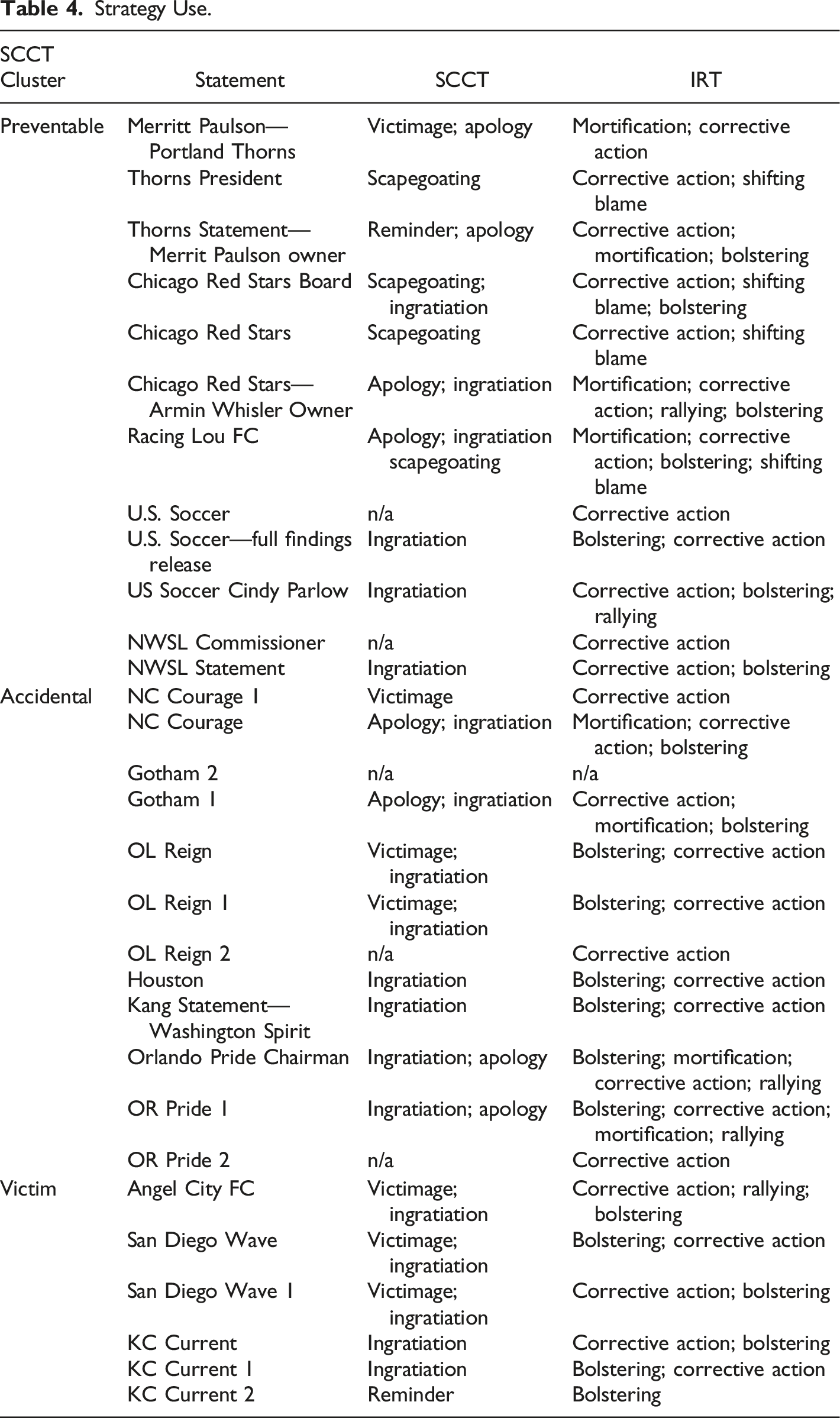
In total, 30 statements were released by either the NWSL, NWSL teams, NWSL personnel, or governing bodies (i.e., U.S. Soccer). Of the 30 statements, one could not be coded within the frameworks of SCCT and image repair. This particular statement was simply a follow up on a previous message, without the use of crisis communication strategies. Therefore, the final sample of statements was 29 (N = 29). In terms of SCCT strategies, commonly used approaches were ingratiation (n = 19), apology (n = 8), victimage (n = 5), scapegoating (n = 4), and reminder (n = 2). In terms of image repair, commonly used approaches were corrective action (n = 24), bolstering (n = 21), mortification (n = 8), rallying (n = 5), and shifting blame (n = 4). Apology and mortification are equivalent SCCT and image-repair strategies. Ingratiation and reminder are forms of bolstering, making these strategies relatively equivalent to bolstering within image repair. Finally, scapegoating (SCCT) is similar to shifting blame (IRT) as both deal with placing blame on another party. There were four statements where SCCT could not be applied, as the organizations only employed the image-repair strategy of corrective action, which does not have an equivalent strategy under SCCT. For a complete breakdown of strategy use, see Table 4.
Examples of ingratiation (SCCT) and bolstering (IRT) were marked by organizations praising their stakeholders (i.e., players and fans) coupled with reminding stakeholders of their good works. For example: I am deeply appreciative of all the players who courageously came forward to share their personal and often painful stories… As we’ve said from the time we hired Sally Yates and her team at King & Spalding in 2021, we are committed to full transparency and to thorough and immediate action – which is why we are releasing the report in its entirety today, and sharing our plan to address its recommendations. (U.S. Soccer—Cindy Parlow) San Diego Wave commends the courage of individuals who came forward and shared their NWSL experiences with the USSF investigation and the ESPN 60 documentary…Since our club’s founding, San Diego Wave FC has been committed to player welfare and to creating a safe and welcoming environment for athletes and staff. (San Diego Wave FC) We support and admire those who came forward, as well as those who suffered but chose to keep their experience private. When I purchased the Washington Spirit, I pledged to build a culture of excellence off the field to match the players’ performance on the field. (Washington Spirit)
Examples of apology (SCCT) and mortification (IRT) include “I apologize to our players, the organization, and the Portland community for the mistakes we made, including not being publicly transparent about Paul Riley’s termination” (Portland Thorns) and “Our club is dedicated to providing a safe, inclusive and respectful environment, and we apologize to our players who may have experienced otherwise” (Orlando Pride). One example of scapegoating (SCCT) and shifting blame (IRT) comes from the Chicago Red Stars Board of Directors: The Board of Directors of the Chicago Red Stars voted this morning to remove Arnim Whisler as Chairman of the Board, to transition him out of his board seat immediately with the Chicago Red Stars (Chicago Women’s Soccer Academy, LLC) and to codify his removal from any further participation with either club or board operations. The Board was deeply disappointed after reading the Yates report and believes the club cannot move forward in rebuilding trust with players, staff and the Red Stars community with his continued involvement. (Chicago Red Stars)
Corrective action was the strategy most employed, appearing in 24 of 29 statements. Many of these corrective action statements pertained to continuing to cooperate with the investigation and improve reporting processes moving forward. For example: The Courage commit unequivocally to continuing to implement solutions, improve our processes and take appropriate recommendations outlined in the Yates report. We are dedicated to fostering an environment of equity, respect and player safety in every aspect of our team operations, and look forward to working closely with the NWSL, the NWSLPA and our players, coaches and staff in advancing these core values across the league and women’s soccer. (NC Courage)
In terms of secondary SCCT strategies, victimage appears in several statements. This strategy falls under the umbrella of bolstering within SCCT. However, victimage is quite different from ingratiation and reminder, as the individual or organization claims that they are also a victim of the crisis rather than praising stakeholders and reminding them of past good works. For example, “The abuse and misconduct detailed in the Yates report are reprehensible and unacceptable…What effects one player or one team affects us all” (Angel City FC). In terms of more peripheral image-repair strategies, rallying (i.e., let’s come together as a fan base) was employed. “I also ask our entire Chicago Red Stars community to continue supporting our deserving players and staff in their pursuit of championship” (Armin Whisler, Chicago Red Stars) is an example of rallying.
RQ3: How Do Users Interact with Team Statements via Social Media?
Likes and Interactions.
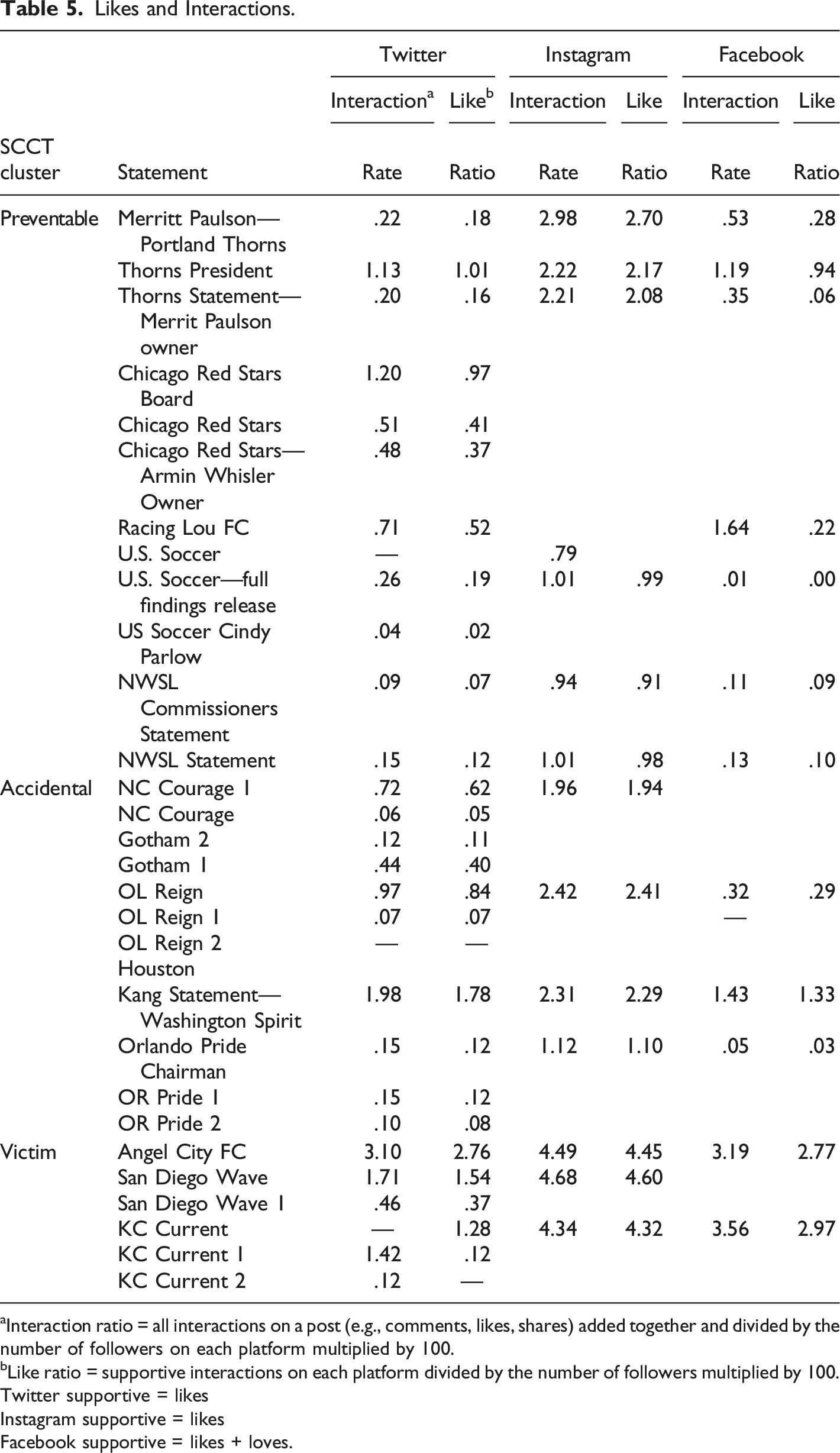
aInteraction ratio = all interactions on a post (e.g., comments, likes, shares) added together and divided by the number of followers on each platform multiplied by 100.
bLike ratio = supportive interactions on each platform divided by the number of followers multiplied by 100.
Twitter supportive = likes Instagram supportive = likes Facebook supportive = likes + loves.
Discussion
During a preventable crisis, Coombs (2007) suggests that entities engage in rebuilding strategies such as apology and compensation. He further contends that these strategies should be employed during a preventable crisis, regardless of the crisis history of the organization involved. The teams within the preventable cluster (Thorns, Red Stars, and Racing Louisville) all abided by Coombs’ suggestion by employing apology (SCCT)/mortification (IRT) in at least one of their official statements. This was usually combined with ingratiation (SCCT)/bolstering (IRT) and corrective action (IRT). Previous research employing IRT recommends using a mix of corrective action, mortification, and rallying when engaging in image repair during a particularly severe (or wicked) crisis (see Frederick et al., 2021). Again, organizations within the preventable cluster mostly followed these guidelines by utilizing corrective action in addition to appearing apologetic for their actions. This could be seen as an attempt to expedite the forgiveness process, as scholars have argued that owning up to mistakes is usually viewed favorably among vested constituents (see Hambrick et al., 2015). It is important to note that the NWSL and USSF did utilize ingratiation and corrective action. However, they did not clearly apologize for being complicit in the crisis that impacted nearly every organization within the league. Time will tell what impact this will have on these entities. It is clearly a missed opportunity, with a high likelihood of generating what Grebe (2013) terms a double crisis (a crisis caused by the mismanagement of an existing crisis).
Coombs (2007) suggested that organizations within the accidental cluster could employ diminish strategies such as excuse and justification. However, these organizations followed a similar trend of those within the preventable cluster by appearing apologetic, suggesting that changes needed to be made, and stressing positive attributes while also thanking victims for coming forward. This finding runs counter to Spackman et al. (2021), who found that a league in the accidental cluster employed diminishment and bolstering tactics. One could argue in favor or against the approach used by NWSL teams in the accidental cluster. From one perspective, using rebuilding strategies despite being outside of the preventable cluster suggests that organizations were wanting to demonstrate a united front of owning up to past mistakes and improving processes and procedures moving forward. On the other hand, engaging in these strategies suggest elevated crisis attribution, culpability, and responsibility, which could lead to heightened scrutiny from stakeholders. This coupled with the occasional use of victimage is a suspect choice marred by inconsistency. Finally, the organizations within the victim cluster (San Diego Wave, KC Current, and Angel City FC) used ingratiation and corrective action. However, they also engaged in victimage, which makes sense for these organizations, considering they would have the most logical connection to this strategy as they were not named in the report or involved in the crisis (to our knowledge). Rather than saying nothing, praising stakeholders, uniting with the other NWSL teams in corrective efforts, and assuming the role of another victim in the crisis appears to be a logical choice.
The prevalence of corrective action within these statements illustrates the utility of applying both SCCT and IRT to analyses of individuals’ and organizations’ crisis communication efforts. While Coombs (2007) suggests heavy implementation of rebuild strategies during a preventable crisis, there is no clear equivalent to corrective action within SCCT strategies. One could easily argue that corrective action (i.e., preventing a crisis from reoccurring and charting out corrective steps moving forward) aligns well with the rebuild approach. To accurately capture the nuances of statements and rhetoric pertaining to a crisis scenario, scholars should be mindful that corrective action is a frequently leveraged strategy that is often used in concert with demonstrations of contrition and remorse (i.e., apology and/or mortification). Furthermore, ingratiation does not have a truly equivalent strategy within IRT (Brown et al., 2015). While bolstering (IRT) is used to stress the positive attributes of an organization, ingratiation praises stakeholders and/or reminds them of past good works. Utilizing these two frameworks will assist in teasing out these subtle (but important) differences within crisis communication rhetoric.
Within SCCT, Coombs (2007) argues that bolstering strategies such as reminder, ingratiation, and victimage should be seen as supplemental to the primary strategic approaches of denial, diminish, and rebuild. Bolstering approaches are seen as complementary at best (Brown et al., 2015). Furthermore, scholars examining crisis communication under the lens of image repair have argued that reducing offensiveness tactics such as bolstering are relatively ineffective, too bold, and should be avoided (Roussin et al., 2022). Therefore, it is interesting that these organizations relied heavily on both ingratiation (SCCT) and bolstering (IRT). Statements were often coded as both ingratiation and bolstering as they simultaneously praised stakeholders and reminded them of positive organizational attributes and good works. While previous research identified ingratiation as a strategy used by fans to support an organization involved in a crisis (Brown & Billings, 2013), the current study saw ingratiation being used repeatedly by organizations to praise arguably their most important stakeholders (i.e., players and staff) for their bravery in “coming forward,” thereby bringing systemic mistreatment to light. This likely was an attempt by the organizations to endear themselves to multiple stakeholder groups by coupling gratitude (appeasing players and staff) with reminders of good works and positive attributes (appeasing fans and ownership).
It is worthy of note, that the organizations with the highest attribution of responsibility (Thorns, Red Stars, and Racing Louisville) employed scapegoating (SCCT) and shifting blame (IRT) tactics in their statements. In these instances, individuals within team leadership either took the blame or were blamed for the crisis, effectively separating (or distancing) them from the organization. Within SCCT, scapegoating is situated within denial strategies, which Coombs (2007) argued should only be leveraged when a crisis involves rumors or challenges. Neither were present in this crisis scenario, with overwhelming evidence suggesting culpability. While previous research has documented that fans will often engage in scapegoating to protect the reputation of their teams and organizations (Brown et al., 2015; Jackson & Thaker, 2021), using scapegoating and shifting blame as strategies within organization generated statements could be a risky move as it suggests a crisis has been completely remedied with the ouster of an egregious offender.
In terms of users’ interactions with the statements, a couple of conclusions can be gleaned from the data. First, when crisis attribution is high (i.e., preventable cluster), it appears that scapegoating and shifting blame tactics are positively received, which does contradict popular wisdom pertaining to denial and evasion of responsibility tactics (see Frederick, et al., 2021). It is important to note that these tactics were usually used in concert with ingratiation, mortification, and/or corrective action. In these instances, stakeholders may be looking for someone to blame or a party that is deserving of judgment and/or scorn. As Benoit (2014) argues, shifting blame can be effective as it provides a target for an audience’s ill will. By serving these individuals up, stakeholder groups can effectively distance or separate the most egregious offenders from team culture, thereby leaving their fandom and allegiances in-tact. Second, statements from new ownership could be used strategically to highlight corrective action in action. New owners can be leveraged as symbols to represent new beginnings, which align well with the rebuilding approach of SCCT and the corrective action tactics of IRT. This tactic would be particularly useful if the organization falls within the preventable or accidental clusters. Third, leveraging victimage strategies along with bolstering and corrective action tactics appear to be effective when an organization falls within the victim cluster. This coupled with rallying provides stakeholders with positive attributes and emotions to align with, as the organization(s) seek to find their way and establish positive rapport amidst the backdrop of a league-wide crisis. Finally, it is important to note that when Instagram was utilized it generated the most interactions and likes among users. This could be due to an overlap in user demographics, as the largest age group using Instagram is 25–34 years of age (McLachlan, 2022), which is also the largest fan demographic of women’s soccer (Cagle, 2023). This finding suggests that Instagram should be employed more frequently during crisis communication efforts involving the NWSL.
Limitations and Directions for Future Research
This study was not without limitations. First, this study only analyzed one snapshot in time, analyzing statements released around the time the Yates Report was released to the public. Future research should continue to evaluate how the NWSL, USSF, and the NWSL organizations leverage SCCT and IRT as they continue to rehabilitate their image and reputation. Second, this study only examined how the Yates Report framed organizational crises. There were various ancillary and team-based reports that chronicled some of the abuse that was taking place. Future research endeavors could examine those documents (if available to the public) to determine how an organization is discussed within the frameworks of SCCT and IRT. Third, the primary focus of this study was to determine how the organizations were discussed in the Yates Report, the strategies the league and its organizations employed in their efforts to repair damage to their reputation and image, and the extent of social media engagement with these statements. The content of users’ comments was not included in the analysis. Examining the narratives of social media users was beyond the scope and intent of this study. However, future qualitative and quantitative work dissecting the amount and nature of these comments is warranted. This type of analysis will illuminate how an organization’s crisis history, coupled with their crisis communication rhetoric is received and interpreted by vested stakeholders and constituents. Fourth, it is important to note that interaction rates and like ratios may not necessarily capture all individuals who consume specific social media messages or consume social media platforms more broadly. Finally, this work focused on NWSL team statements. While statements from the NWSL and USSF were analyzed, future work should pursue targeted case studies examining the crisis communication efforts of these organizations as their culpability was frequently highlighted in the Yates report.
Conclusion
In September of 2021, the Athletic released an article detailing the abuses carried out by former head coach Paul Riley following his firing from the North Carolina Courage. The article also discussed the systemic issues within the NWSL and the sport of women’s soccer in the United States. According to Linehan (2021, para. 17): There was not one trigger. It was incident after incident, building upon themselves, revealing the scope of the sport’s problems and leading the players to understand that the only way to bring about great change was to refuse to be silent.
Footnotes
Declaration of Conflicting Interests
The author(s) declared no potential conflicts of interest with respect to the research, authorship, and/or publication of this article.
Funding
The author(s) received no financial support for the research, authorship, and/or publication of this article.
