




Abstract
This longitudinal study examined how emerging adults psychologically distance themselves from parents. Every week during their first semester at college, participants (n = 71, M age = 18 years [SD = 0.48]) read hypothetical vignettes describing emotionally salient situations they could encounter at college. Participants then provided information about whether they would regret not being in immediate contact with parents versus peers when dealing with the aftermath of these situations. Results suggested that participants were separating themselves from parents in a dynamic manner over time, which was revealed in varying levels of regret for not possibly being in immediate contact with parents following emotional events. Moreover, compared to participants with negative representational models of parents, participants with positive models reported more consistent patterns of regret for not having immediate parental contact. This study provides new insights into normative attachment dynamics beyond childhood and how emerging adults reorganize their attachment hierarchies.
A normative aspect of development beyond childhood is the gradual movement away from parents and parental figures (Allen, 2008; Scharf & Mayseless, 2007; Youniss & Smollar, 1985). By adolescence, many individuals will have begun to exert greater independence from their parents by engaging in semi- or fully autonomous behaviors that increase their intellectual, social, and emotional self-reliance (Erikson, 1994; McElhaney, Allen, Stephenson, & Hare, 2009; Smetana, 2011). The adaptive value of such behaviors typically manifests later in emerging adulthood as individuals prepare themselves for undertaking a variety of adult-like roles and responsibilities (Arnett, 2014). While turning from parents, adolescents and emerging adults also begin actively turning to people outside of the family, including peers and romantic partners (Allen, 2008; Brown & Larson, 2009; Scharf & Mayseless, 2007). Although this preference for age-mates emerges in the context of physiological changes (e.g., sexual maturation and the desire to form a stable sexual pair bond; see Hazan & Zeifman, 1994) and meeting social expectation norms (e.g., adolescents are expected to make friends and explore with them), theoretical and empirical evidence indicates that individuals require support from peers and romantic partners to fulfill important attachment-related needs (see Ainsworth, 1989; Brumbaugh & Fraley, 2006; Hazan & Shaver, 1994; Kobak & Herres, 2012).
In their early review of the literature, Hazan and Shaver (1994) described how maturing individuals will begin expressing their various attachment-related needs to adult peers who can adequately provide emotional support and security in both ordinary and extraordinary times. For example, although parents continue providing security to their older children (see Trinke & Bartholomew, 1997), their children’s security seeking is increasingly targeted toward other people outside of the family unit. As a consequence, older individuals begin seeking and maintaining greater proximity to adult peers to ensure that they are available when needed. In later reviews and empirical studies examining these views, Fraley and his colleagues (e.g., Brumbaugh & Fraley, 2006; Fraley & Davis, 1997) reported that although parents remain highly relevant in their children’s emotional lives, young adults begin transferring attachment-related needs to best friends and romantic partners as these relationships blossom over time. In more recent research, Kobak and his colleagues (e.g., Kobak, Rosenthal, & Serwik, 2005; Kobak, Rosenthal, Zajac, & Madsen, 2007; Rosenthal & Kobak, 2010) have provided evidence that individuals may even begin shifting their personal attachment hierarchies during adolescence, while most individuals are still living with their parents. They have reported that by mid-adolescence, romantic partners begin to adopt higher positions in individuals’ attachment hierarchies than parental figures (e.g., as adolescents grow older and enter emerging adulthood, they demonstrate a marked preference for using romantic partners to meet their social affiliative and support-seeking needs; Rosenthal & Kobak, 2010). Overall, this prior research lends support to the prevalent notion that changes do occur in individuals’ general reliance on parents and peers to meet their attachment-related needs in adolescence and beyond. However, it is largely unknown what discrete psychological processes may assist individuals in turning away from parents and toward peers as they age.
The present investigation’s principal aim was to examine whether individuals engage in the process of psychological distancing as a means of gradually turning away from parents and toward peers while engaging in normative developmental tasks. In the late adolescent years, one of the most salient developmental tasks for individuals is moving away from home for the first time to attend college (see Bernier, Larose, & Whipple, 2005; Larose & Boivin, 1998; see also Arnett, 2014). During this period, individuals are presented with a variety of new challenges that could be potentially rewarding or stressful. Moreover, because college students continue to view their parents as key sources of security and utilize them as secure bases and safe havens (see Kenny, 1987; Trinke & Bartholomew, 1997), attachment-related themes are prominent as these students are often directly—or indirectly—faced with challenges to their own security and are required to manage a variety of attachment-related feelings, thoughts, and emotions on an ongoing daily basis (e.g., emotions related to the potential or actual prolonged separation from an attachment figure; see Bowlby, 1973).
This attachment-related psychological distancing from parents can be viewed as being embedded in more normative developmental processes researchers have oftentimes referred to as separation–individuation or autonomy-relatedness seeking (see Arnett, 1998, 2014; Blos, 1967; Holmbeck & Hill, 1986; Moore, 1987; Steinberg, 1990). For example, although a wealth of developmental research demonstrates that adolescents and emerging adults remain emotionally tied to their parents, these relationships typically become much more egalitarian, and adolescents and emerging adults begin to exhibit greater psychological autonomy from their mothers, fathers, and other principal caregivers (Youniss & Smollar, 1985). Although the cost of such autonomy may be the straining of the adolescent–parent relationship and the possible emergence of maladaptive levels of psychological distancing (see Smetana, 1996), the potential benefits include the important ability to separate oneself far enough away from one’s parent in order to transfer attachment-related needs to age-mates successfully without hesitation or regret. In a paradoxical sense, such distancing may also explain findings indicating that emerging adults achieve a greater sense of familiarity with parents regarding their worldviews, more power in these relationships (compared to other social relationships), and greater satisfaction over time as they are given the chance to independently develop a sense of self in relation to others (see Lefkowitz, 2005; Noack & Buhl, 2005; Shulman & Ben-Artzi, 2003; Smetana, 2015).
In past research, the measurement of psychological distancing has typically relied on using self-report questionnaires administered at a single time point (e.g., Bell & Bell, 2009; Hoffman, 1984; Levine, Green, & Millon, 1986; Rice, Cole, & Lapsley, 1990; see also Rice, 1992, who collected longitudinal data with one self-report measure). Although self-report questionnaires provide some insights into how individuals feel they are separating themselves from parents, such measures are both inherently biased and prone to producing spurious findings stemming from common-method variance effects (Paulhus & Vazire, 2007; Podsakoff, MacKenzie, Lee, & Podsakoff, 2003). Other studies have employed Q-sorts (e.g., Grotevant & Cooper, 1986; see also Bengtson & Grotevant, 1999) or rating schemes (e.g., Bell & Bell, 2009; Oudekerk, Allen, Hessel, & Molloy, 2015) to code behaviors related to psychological separation. However, these methodologies also only provide a single, snapshot-based assessment of psychological distancing, which likely understates ongoing relational dynamics between emerging adults and their parents. These methodologies may also fail to take into account emerging adults’ proclivity to repeatedly engage in hypothetical thinking and abstract reasoning (Piaget, 1972; see Amsel, 2011, for a review), which may, over time, lead emerging adults to frequently modify their views of relationships with parents implicitly and/or explicitly (see Allen & Land, 1999).
We designed the present longitudinal study to overcome the constraints of potentially biased self-report questionnaires and single-assessment methodologies by employing a novel experimental task of psychological distancing. More precisely, this task assessed emerging adults’ psychological distancing from parents implicitly, in terms of how much possible regret emerging adults would feel if they were not in immediate contact with parents during different emotionally salient (i.e., positive and negative) hypothetical situations. Regret is generally conceptualized and measured in terms of the degree to which people are happy and/or content with certain life circumstances or alternatively feel disappointed with these circumstances and wish they were different for better personal outcomes (Gilovich & Medvec, 1995; Marcatto & Ferrante, 2008; Roese & Summerville, 2005). For example, people may regret “missed opportunities” in life and wish that the past could be revised to make oneself feel better in the present. Hypothetically, during emerging adulthood, individuals could be happy or content with situations in which an attachment figure might not be immediately available; on the other hand, emerging adults could sometimes regret not having immediate contact with parents, particularly in good and bad times. We expect that experiencing such regret—against the backdrop of normative developmental changes in emerging adulthood—would be reflective of the extent to which emerging adults are psychologically distancing themselves from attachment figures. In other words, if an emerging adult feels relatively modest regret regarding not being in contact with a parent during some good or bad time, this person is likely engaging in psychologically distancing from the parent. On the other hand, if an emerging adult feels regretful, this person is maintaining a certain degree of psychological connectedness to the parent.
Distinguishing between regret for not being in immediate contact with parents during positive or negative times also facilitates a more precise examination of how more general emotional factors might contribute to psychological distancing. Previous research demonstrates that when “good things happen,” many individuals are naturally inclined to share good news to bolster their own well-being (Gable, Reis, Impett, & Asher, 2004). For example, sharing good news serves as a catalyst for additional social and emotional support and reinforces intrapersonal motives and desires to continue on a good life trajectory (Gable, Gonzaga, & Strachman, 2006). Likewise, it is widely believed that sharing bad news with others during negative times can be very beneficial in maintaining and protecting one’s sense of well-being (e.g., Collins, Ford, & Feeney, 2011). The open sharing of such bad news can also indicate a person’s overall ability to cope with life stress (Genzler, Contreras-Grau, Kerns, & Weimer, 2005). Thus, in this study, the examination of regret in both positive and negative situations is important in understanding how emerging adults balance psychological distancing from parents with their higher order needs for maintaining overall personal well-being.
Another principal aim of the present investigation was to examine how individuals’ attachment-related mental representations of their parents moderated longitudinal changes in their psychological distancing from parents. An abundance of evidence indicates that representational knowledge generalizes and contributes to subsequent developmental processes (cf. Blatt, Auerbach, & Levy, 1997; Sigel, 1999), and a wealth of data shows that stable attachment representations contribute to many cognitive, emotional, and social processes beyond childhood (for reviews, see Allen, 2008; Dykas & Cassidy, 2007, 2011; Mikulincer & Shaver, 2007). Preliminary studies have broadly linked attachment representations to self-reported psychological distancing (e.g., Lapsley & Edgerton, 2002; Mattanah, Hancock, & Brand, 2004; Rice, FitzGerald, Whaley, & Gibbs, 1995), but no studies have examined such links experimentally in the ways proposed in the present investigation. Also, with respect to our more specific study objectives, researchers have reported attachment-related differences in how adults respond to the aftermath of positive and negative life events (Gentzler & Kerns, 2010; Gosnell & Gable, 2013), including how regretful people are after these events (Joel, MacDonald, & Plaks, 2011; Saffrey & Ehrenberg, 2007; see also Schoemann, Gillath, & Sesko, 2012, for experimental evidence). However, no extant studies have specifically focused on attachment-related regret in the context of child–parent relationships, including those found in emerging adulthood, or have assessed regret experimentally over an extended period of time. Thus, we examined the possibility that when emerging adults begin reorganizing their attachment hierarchies and begin transferring their attachment-related needs from parents to peers, they apply previously acquired attachment-related knowledge to their decision-making regarding psychological distancing (e.g., to regulate accompanying behavioral and social–emotional states; see Allen & Miga, 2010; Scharf, Mayseless, & Kivenson-Baron, 2004). For example, tapping into knowledge regarding a parent’s past capacities to serve as a secure base (see Bowlby, 1973) would be particularly useful in forecasting whether the parent will be available, responsive, and sensitive in the future and could assist individuals in making decisions regarding whether and how to turn away from parents and toward peers.
In summary, using a novel longitudinal design, we examined whether emerging adults who are entering their first semester of college and living on campus demonstrate a normative trend in turning away from parents and toward age-mates in emerging adulthood (as described in previous research; e.g., Hazan & Shaver, 1994) and whether this trend is moderated by their attachment-based representational models. Our two overarching hypotheses were as follows:
This complementary set of hypotheses is based on the idea that regardless of the emotional context, individuals who possess positive attachment-based knowledge (a) openly foresee their parents as being some part of their present and future emotional lives and will therefore (b) nondefensively express regret that parents could be absent during both good and bad times (according to a schematically based, secure cognitive processing perspective; see Dykas & Cassidy, 2011). This degree of regret is tempered over time, however, as emerging adults begin meeting peers at college and start transferring their attachment-related needs to them.
In contrast, individuals who have more unfavorable representational knowledge of their parents will (a) foresee more strained emotional relationships with their parents in which parents might be predictably unavailable, unresponsive, and/or insensitive when needed, and thus (b) limit their regret for not possibly having immediate contact with parents in the future as a means of engaging in an adaptive cognitive strategy (i.e., suppression) to both regulate their emotional states and avoid any potential psychological pain of not having their attachment-related needs met in the future (see Bowlby, 1980; see also Dykas & Cassidy, 2011). Moreover, this relatively low degree of regret is expected to remain consistent over time as these emerging adults turn more frequently to peers for needed emotional and social support.
Method
Participants
Participants were 71 undergraduate students beginning their first semester of college at a moderately sized (approximately 7,000 students) public university in the northeastern United States (82% female; 70% White; mean age = 18 years [SD = 0.48, range = 18–19]). These students—who had not attended college previously and were living on a college campus for the first time—were recruited from sections of an Introduction to Psychology course at the beginning of the semester to participate in a College Transition Study. This study aimed to “shed light on how individuals make the college transition, from living off campus with families to living on campus with other students.” All potential participants were explicitly informed that this study would last the entire duration of the fall semester (i.e., from the first week of September to the second week of December) and that participating in the study would require a rather substantial time commitment, in which they would need to complete a series of measures twice a week for 16 weeks. Participants were also informed they would need regular access to an Internet-connected computer, smartphone, or tablet to complete the study on a private and secure website using a unique identification number. All participants received course credit for their Introduction to Psychology course at the end of the study as compensation for their time.
Measures
Parent as a Secure Base Scale–Revised
We used Cassidy and Woodhouse's (2003) 13-item scale to assess participants’ attachment-related representations concerning the degree to which their parent serves as an available, responsive, and sensitive secure base . Participants completed separate scales for their mother and father (Cronbach’s α = .93 and .94, respectively) and rated items (such as “My mother/father is there for me in times of trouble.”) on a 5-point Likert-type scale ranging from almost never true (1) to almost always true (5). For the mother and father versions of this scale, we summed the items (independently within each scale) to create total parent as secure base scale scores for mother and father. Validity data indicate that this measure is linked to individuals’ Adult Attachment Interview classifications (George, Kaplan, & Main, 1996) and other perceptions of parents’ sensitive caregiving and attachment relationships (e.g., Cassidy, Ziv, Rodenberg, & Woodhouse, 2003; Feeney & Cassidy, 2003; Woodhouse, Dykas, & Cassidy, 2009). These scores have also been linked to adolescents’ secure base behaviors in laboratory-based settings and parents’ self-reported degree of attachment-related anxiety/avoidance and hostility (Jones & Cassidy, 2014).
Hypothetical experience and outcome task
We created this 16-week, multitrial Internet-facilitated task (based on a win or lose experimental paradigm; Kassam, Morewedge, Gilbert, & Wilson, 2011) to assess how emerging adults would respond to emotionally salient situations and outcomes they might experience at college. Each week, trials were conducted on Mondays and Wednesdays when we e-mailed participants instructions to visit a secure website to read a short vignette describing a hypothetical situation involving the self and that ended with an unknown outcome and ambiguity regarding whom the participant would encounter immediately after the experience (see the Appendix for example vignettes). These vignettes were carefully crafted and edited for simplicity, readability, and face validity by four undergraduate research assistants to reflect common experiences many college students might have (or could envision having) in academic and nonacademic settings. These vignettes were also further checked by six undergraduate students (who were recruited from the first author’s college courses as volunteers and who were unaware of the study objectives) to ensure they were appropriate for the study. Of the 32 vignettes, one half were classified as describing a positive situation (i.e., an event that would be happy, rewarding, and/or exciting), whereas the other one half were classified as describing a negative situation (i.e., an event that was moderately stressful, disappointing, and/or worrisome). Over the course of the entire study, the order in which participants read positive and negative vignettes across consecutive trials was randomized, so that they would not know whether to expect receiving a positive or negative hypothetical situation from one trial to the next. Moreover, to protect against any potential experimental effects in our design, we counterbalanced the trial order, so that half of the participants read the vignettes in reverse order from the other half.
After reading each vignette, participants were instructed to click on an Internet link that would open a website page telling them whom they would encounter immediately following the hypothetical situation they had just read. The outcome presented was either A Parent or A Classmate, and all participants received the A Parent and the A Classmate outcome for only half of the 32 trials (i.e., the A Parent outcome was only presented in 16 trials). However, across the duration of the study, we randomized whether participants received the A Parent or A Classmate outcome, so that they would remain both unbiased and unable to predict which outcomes they would receive from one trial to the next. Also, to protect against any potential experimental effects, we counterbalanced the outcome order, so that half of the participants viewed the outcomes in opposite order from the other half in the study (e.g., for each vignette, one half of the participants would receive the A Parent outcome, while the other half would receive the A Classmate outcome for each trial).
After learning the specific outcome of the hypothetical situation, participants used separate 10-point Likert-type rating scales (that were embedded on the website page, adjusted for the person encountered) to respond to the following three questions that implicitly, yet relatively straightforwardly measured regret as a multifaceted experience encompassing varying levels of happiness and disappointment, as well as revisal of choice (cf. Gilovich & Medvec, 1995; Marcatto & Ferrante, 2008; Roese & Summerville, 2005): (a) from (1) not at all happy to (10) extremely happy, “How happy would you be talking to a (parent at home/classmate at college) first rather than a (classmate at college/parent at home)?,” (b) from (1) not at all upset to (10) extremely upset, “How upset would you be talking to a (parent at home/classmate at college) first rather than a (classmate at college/parent at home)?,” and (c) from (1) I would feel significantly worse to (10) I would feel significantly better, “Overall, if we changed the situation and you talked to a (classmate at college/parent at home) first, how would it make you feel?” Thus, in summary, if the hypothetical situation concluded with an encounter with a parent, participants rated how happy and upset they would be talking to a parent, as well as the extent to which they would feel better talking to a classmate instead of a parent; the reverse was true when the hypothetical situation concluded with an encounter with a classmate.
Procedure
During the first 2 weeks of the fall semester, participants provided demographic information and completed the mother and father versions of the Parent as Secure Base Scale. Then, during the following 16 weeks, participants completed the Hypothetical Experience and Outcome Task. All study administration and data collection were conducted online using Limeservice, a secure Internet-based survey software. At the end of the study, general results were shared with participants as a means of debriefing students about the study and its underlying research objectives.
Results
Descriptive Data and Data Reduction
Participants’ mean scores on the mother and father versions of the Parent as a Secure Base Scale–Revised were 4.36 (SD = 0.76, range = 2.38–5.00) and 4.05 (SD = 0.98, range = 1.00–5.00), respectively (Prior to creating these means scores, missing data analysis indicated that any missing values across all the secure base items were missing completely at random; Little’s Missing Completely at Random (MCAR) Test χ2 = 18.19, p = .87). As expected, these mean scores were highly correlated (r = .59, p < .0001) and a subsequent principal components exploratory factor analysis revealed that these scores loaded onto a single factor explaining 80% of the variance (factor loadings were .89 for both mother and father, respectively; eigenvalue = 1.59). Therefore, we combined the mother and father parent as a secure base scores into a new parent as a secure base composite score using the linear combination of their independent factor loadings. This new composite score, representing a generalized representation of parent secure base use, was used in all subsequent analyses. Higher scores represented the extent to which a participant held more positive secure base representations, whereas lower scores represented the extent to which a participant held more negative secure base representations.
For the Hypothetical Experience and Outcome Task, participants’ weekly engagement in the task was relatively high, and less than 5% of the data were missing at random (Little’s MCAR χ2= 9.15, p = .33). The raw mean scores for all three regret-oriented items across all trials (i.e., the happy, upset, and situation change items measuring regret for the outcomes associated with the positive and negative hypothetical scenarios) were 6.90 (SD = 2.79), 3.33 (SD = 2.65), and 5.77 (SD = 2.20), respectively; all ranges were 1.00–10.00. As expected, these scores were correlated (ranging in magnitude from .35 to −.62). Thus, we conducted another principal components exploratory factor analysis to assess joint variance. This analysis revealed that the three Hypothetical Experience and Outcome Task scores loaded onto a single factor explaining 65% of the variance (eigenvalue = 1.96); the factor loadings were −.87, .83, and .72 for the happy, upset, and situation change items, respectively. Using a linear combination of the factor loadings, we aggregated these three scores and computed a new composite regret score. This composite score was used in all subsequent analyses, and higher scores represented how much an individual regretted talking to one person over another as the outcome to a specific hypothetical situation (i.e., each regret score represented the degree to which a person was unhappy and felt worse talking to one individual over another and desired to talk to either a parent or classmate first instead).
Test of Hypotheses
To test our two hypotheses, we conducted two general linear mixed model analyses using the SAS® 9.4 mixed procedure and its robust restricted maximum likelihood approach for simultaneously accommodating missing data and estimating repeated, fixed, and random effects (Wolfinger & Chang, 1995). The overarching aim of these two sets of analyses was to examine how participants’ regret scores for being in immediate contact with parents or peers changed over time as a function of their representational models of attachment. To this end, in both analyses, the statistical models were identical, but one analysis examined participants’ responses to the positive hypothetical situations, while the other analysis examined participants’ responses to the negative hypothetical situations. In our models, participants’ regret scores served as the repeated factor. The fixed factors were the hypothetical situation trial number (Trial; 32 levels: 1–32), whether the hypothetical situation ended with the participant having immediate contact with a parent or a classmate (Outcome; 2 levels: parent and classmate), and participants’ continuous parent as a secure base composite scores. Trial group assignment (Group; two levels: forward trial order and reverse trial order) served as a random factor. We included all main effects and first-order, second-order, and third-order interactions in our models. A general power analysis (set at .80) indicated that the present study’s sample size was much larger than the minimum sample size needed (n = 39) to detect at least a second-order interaction between participants’ secure base composite scores and trial number (p <. 05).
In Table 1, we present the summary of results obtained in these two sets of mixed model analyses used to test Hypotheses 1 and 2. We also discuss these results below and illustrate specific patterns of results in several related tables and graphs. All of our findings are based on portions of data that have been reduced using factor analyses; thus, the means and all other associated statistics presented in our tables and graphs represent statistically estimated data that are structurally different from the raw data participants provided in the original study. We did not examine main effects in the presence of interactions and only presented post hoc tests where appropriate. Moreover, given the relatively large number of trials obtained from the Hypothetical Experience and Outcome Task, we do not present any post hoc tests at specific trial points (e.g., t tests between means at T1 and T2 ) to maintain a reasonable statistical error rate. Our post hoc interpretations of any significant trial-related findings relied on the inspection of data plots in the generated graphs.
Summary of the Mixed Model Analyses Examining Regret Scores for the Hypothetical Situations.

Note. Significant findings are in bold text. In the analysis for Positive Situations, the F value degrees of freedom for all effects including Trial Number were (29, 812); all other F value degrees of freedom were (1, 812). In the analysis for Negative Situations, the F value degrees of freedom for all effects including Trial Number were (29, 805); all other F value degrees of freedom were (1, 805).
Hypothesis 1
In our first set of analyses, the presence of a significant two-way Outcome × Secure Base Composite Score interaction and a series of post hoc t tests supported our hypothesis that compared to emerging adults possessing negative attachment-related representational models of parents, emerging adults possessing positive representational models of parents experience more regret when faced with the possibility that they will not have immediate contact with parents during emotionally positive situations. More precisely, after approximating low, moderate, and high secure base composite scores (based on whether participants fell −1 SD below the mean, at the mean, or +1 SD above the mean on the secure base composite score, respectively), we estimated—as a function of these three attachment-related groups—the degree to which participants reported regret for the different outcomes of the hypothetical positive situations (i.e., whether these situations ended with the participants being in immediate contact with a parent or a classmate). As can be seen in Table 2, significant results emerged in two of the three t tests. Participants with low secure base composite scores did not demonstrate a significant difference in hypothetical regret for immediate contact with either parents or classmates (Cohen’s d =. 12); however, participants with moderate (Cohen’s d =. 42) and high secure base composite scores (Cohen’s d =. 46) demonstrated significant differences in hypothetical regret, such that they experienced more hypothetical regret for not having immediate contact with parents versus classmates.
Differences in Participant’s Regret Scores for the Hypothetical Positive Situations as a Function of Outcome and Attachment.
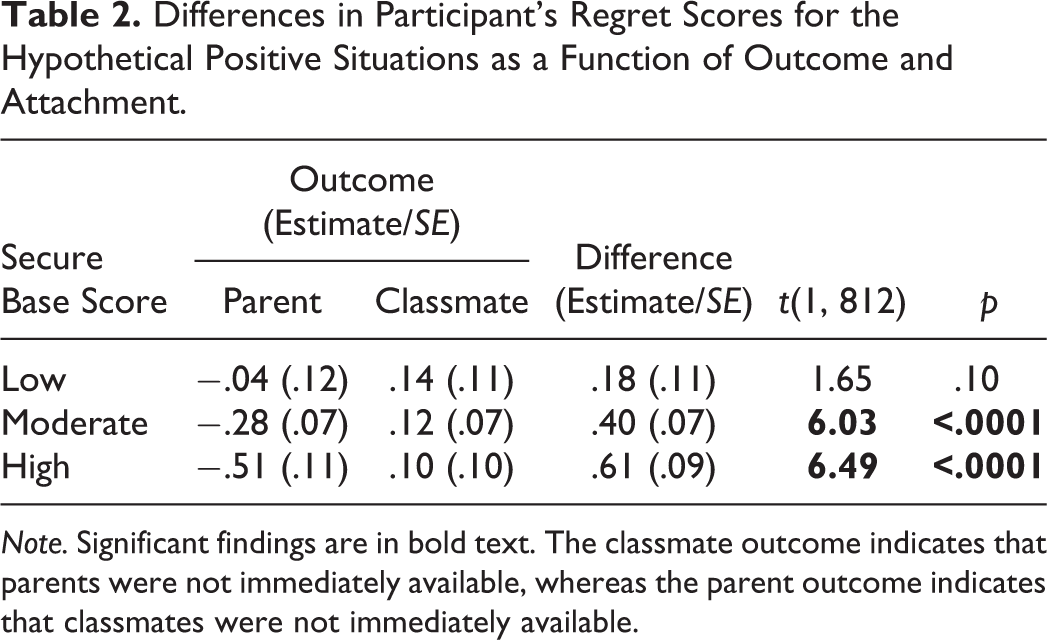
Note. Significant findings are in bold text. The classmate outcome indicates that parents were not immediately available, whereas the parent outcome indicates that classmates were not immediately available.
Interestingly, despite these general attachment-related findings, no evidence emerged that regret for not being in immediate contact with parents during emotionally positive situations lessened over time as emerging adults spend more time at college away from parents. Instead, the presence of a significant two-way Trial Number × Outcome interaction (and the post hoc interpretation of this interaction) suggested that emerging adults’ regret scores fluctuated more generally across the semester (see Figure 1). At first (approximately the first one third of the semester; Trials 1–9), emerging adults generally felt more hypothetical regret for not having immediate contact with parents than for not having immediate contact with classmates, but regret for not having immediate contact with parents (and classmates) decreased after emerging adults had been physically away at college after a few weeks (approximately the second one third of the semester; Trials 10–23). However, when the United States’ Thanksgiving-to-Christmas holiday season approached and the academic semester’s end neared (approximately the last one third of the semester; Trials 24–32), emerging adults began to reexperience relatively higher levels of hypothetical regret for not having immediate contact with parents and relatively lower levels of regret for not being in immediate contact with classmates.
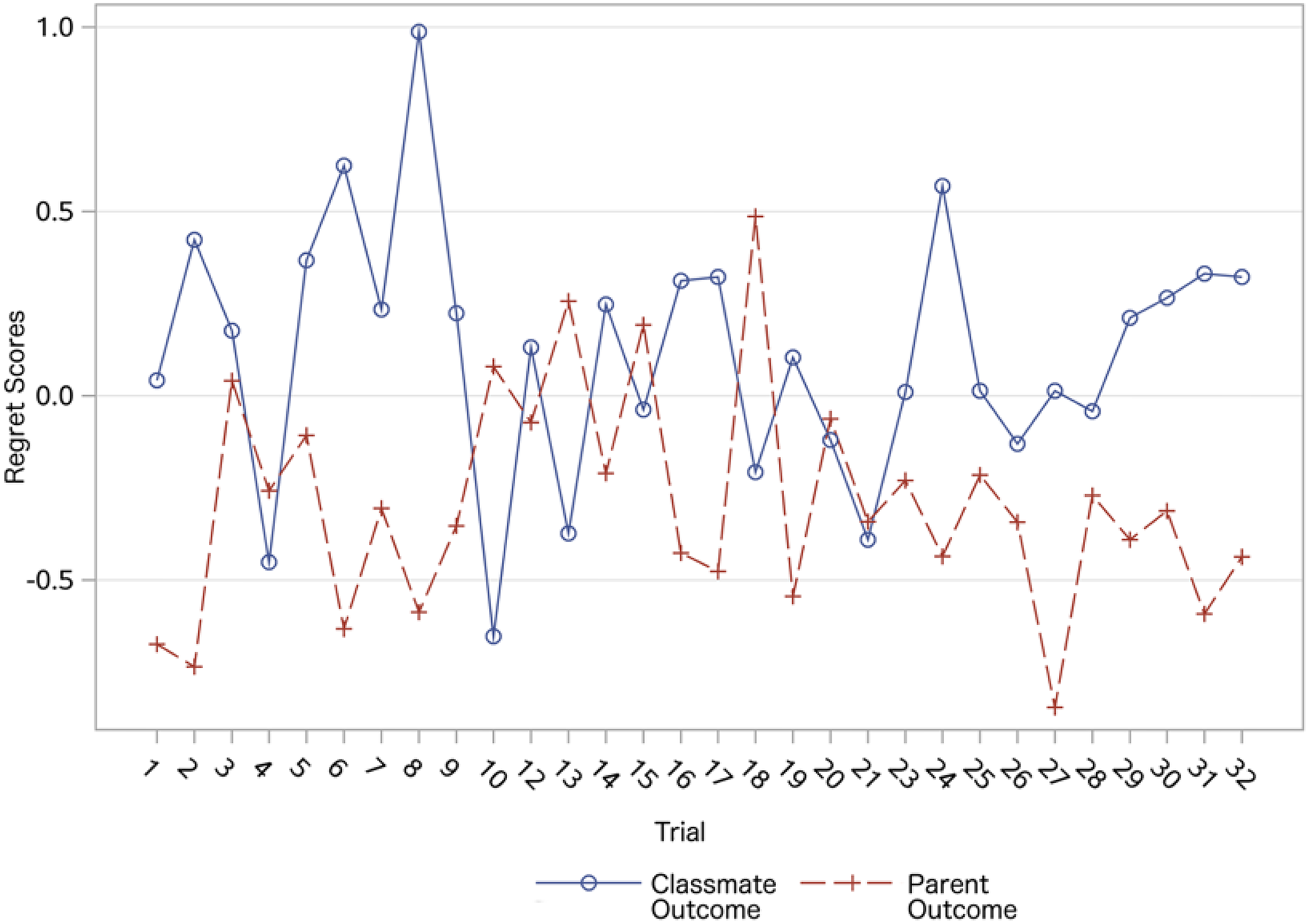
Plot of regret scores for hypothetical positive situations as a function of trial number and outcome. The classmate outcome indicates that parents were not immediately available, whereas the parent outcome indicates that classmates were not immediately available.
In summary, compared to emerging adults possessing negative representational models of parents, emerging adults possessing positive representational models of parents experienced more regret when faced with the possibility that they would not have had immediate contact with parents during positive times. However, over the course of the semester, emerging adults generally fluctuated in their relative degree of regret for parents being hypothetically absent during these times, with the highest levels of regret being at the beginning of the semester and at the very end.
Hypothesis 2
In our second set of analyses, a significant three-way Trial Number × Outcome × Secure Base Composite Score interaction and the subsequent post hoc examination of the three plots presented in Figure 2 (in which we examined the statistically approximated low, moderate, and high secure base composite scores described in the previous section) supported our hypothesis that emerging adults’ regret for not being in immediate contact with parents during emotionally negative situations changes across the first semester at college as a function of their secure base representations. As illustrated in the top plot, when posed with hypothetical negative situations over the course of the semester, participants with low secure base composite scores consistently alternated between reporting higher levels of regret for having immediate contact with parents versus peers. Moreover, for over one half (56%) of the trials, these participants typically reported more regret for contact with parents than peers. In contrast, and as illustrated in the bottom plot, participants with high secure base composite scores consistently reported more regret for being in immediate contact with classmates than with parents over the course of the semester (i.e., in 72% of the trials, these participants reported greater levels of regret for having immediate contact with classmates); however, over time, the discrepancies between the levels of regret for immediate contact with classmates and for parents appeared to subside as regret for being in immediate contact with parents decreased over the semester. As illustrated in the middle plot, participants with moderate secure base composite scores showed a similar pattern to participants with high secure base composite scores, but the degree of difference in levels of regret for immediate contact with classmates and parents was not as profound and was much more stable over the course of the semester.
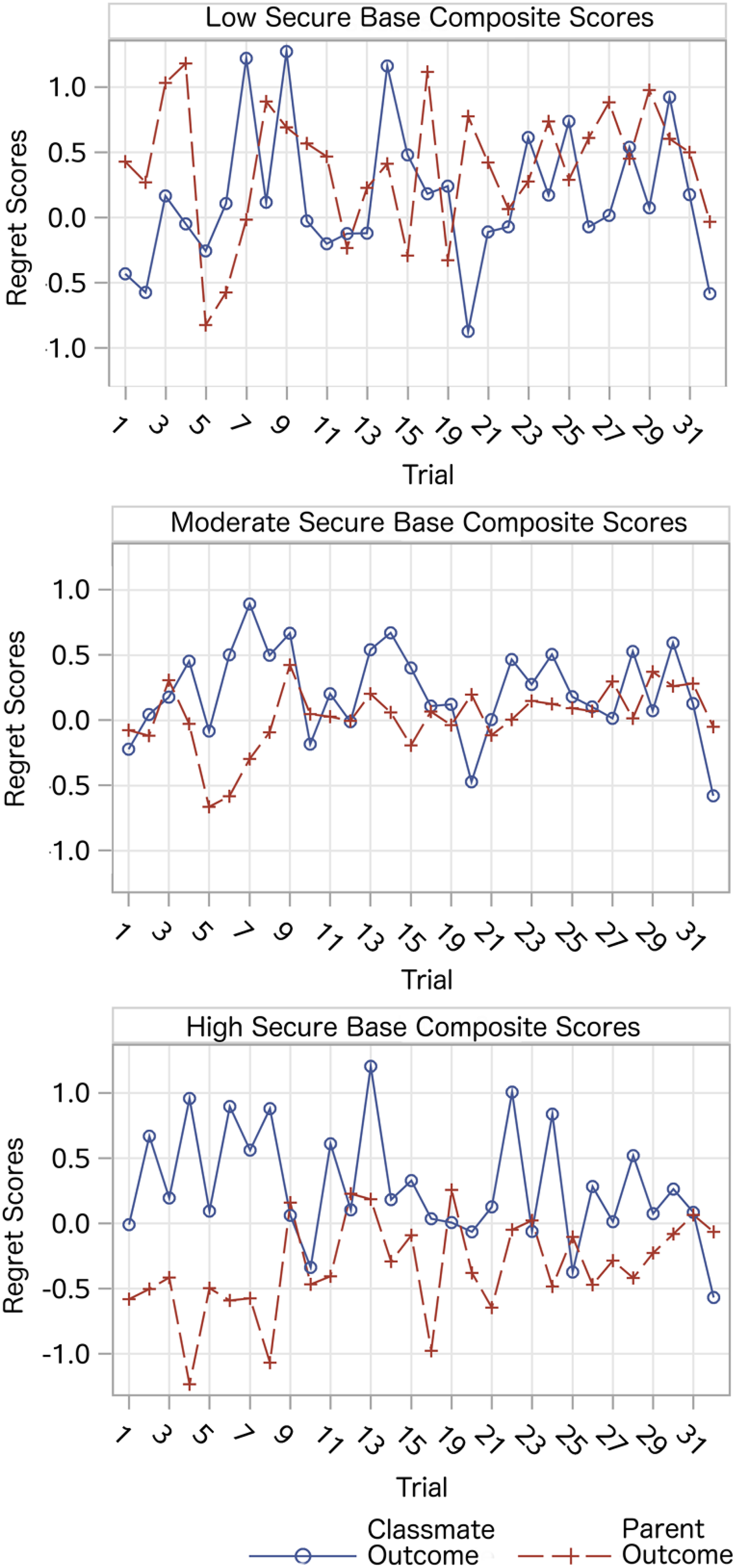
Plot of regret scores for hypothetical negative situations as a function of trial number, outcome, and secure base composite scores. The classmate outcome indicates that parents were not immediately available, whereas the parent outcome indicates that classmates were not immediately available.
Discussion
This short-term longitudinal study is the first to examine processes by which emerging adults gradually turn from parents through psychological distancing. By focusing on how much college students might have hypothetically regretted being (or not being) in immediate contact with parents during positive and negative times, we were able to examine the means by which emerging adults were either maintaining psychological closeness to or seeking a greater degree of psychological distance from parents over time. Overall, we obtained intriguing results that were largely consistent with our hypotheses, despite one notable exception. These results indicated that emerging adults separate themselves from parents in a highly dynamic manner during a transformative period of development. More precisely, rather than engaging in a relatively steady trajectory of psychological distancing from parents over time (and engaging in a permanent developmental shift away from parents), participants instead continued to show varying levels of regret that parents could not be immediately available during both good and bad times. Our results also indicate that some of these patterns were moderated by the quality of emerging adults’ representational models of their parents’ capacities to serve as secure bases. In the sections below, we discuss these findings in greater detail.
With regard to how emerging adults processed hypothetical positive college situations, emerging adults began the 16-week college semester by demonstrating relatively higher levels of regret for not being in immediate contact with parents compared to peers, but this amount of regret subsided over time (i.e., about one third of the way into the semester). This developmental trend could reflect earlier findings that parents are important persons with whom adolescents and young adults share positive information (Kenny, 1987; Trinke & Bartholomew, 1997), especially during salient transitional periods that are stressful and/or marked by the absence of friendships and strong peer relations. Initially, physical separation from parents may also cause college students to adaptively regret that their parents might not be involved in the positive aspect of their lives, as a means of protecting and maintaining the enduring importance of the attachment relationship. However, as college students remain at college and begin developing stronger peer relations and new friendships (and as preexisting friendships formed prior to college decline in quality; see Oswald & Clark, 2003), they likely have more frequent and socially exciting opportunities to share good news with new classmates over parents (Derlega, Anderson, Winstead, & Greene, 2011). As a result, the disproportional desire to continue sharing good news with age-mates in hypothetical situations (over less physically available parents) may relate to the underlying process through which emerging adults stimulate higher levels of intimacy, disclosure, and connectedness in these blossoming extrafamilial relationships (Derlega et al., 2011; Fraley & Davis, 1997; Swenson, Nordstrom, & Hiester, 2008; see also Gable et al., 2004). The hypothetical need to share positive news with age-mates may also help emerging adults transfer their deeper attachment-related needs to others on campus (Larose & Boivin, 1998). Overall, these positive changes in relationships with peers could be linked to the reduction in regret for not being in immediate contact with parents and aid the process of psychological distancing from parents and psychological bonding with other adults (Fraley & Davis, 1997).
Yet, nearing the end of the semester (i.e., during the last one third of the study), the initial amount of regret participants felt for not immediately sharing positive information with parents reemerged. Although this unexpected finding needs to be explored more closely in future replication studies (because it is unclear why emerging adults would engage in higher levels of psychological distancing and then reverse and/or postpone such distancing weeks later), it may indicate that participants had undergone an implicit process by which they were cued to emotionally reconnect with family during the holiday season, which lasted over the last portion of this study. This cuing may stem from many factors, including remembering and reminiscing about the “good times” with parents that have occurred during past holiday seasons, regardless of the underlying quality of their representational models of parents. As Fivush and her colleagues have noted (Fivush, 2008; Fivush, Habermas, Waters, & Zaman, 2011), reminiscing about positive autobiographical memories is a common developmental process, and emerging adults might engage in these processes leading to fluctuations in how they psychologically separate from parents. Future studies examining how emerging adults might vacillate between psychologically distancing themselves from parents and psychologically reconnecting with parents according to cue-inducing emotional events (e.g., holidays and other transcendent events such as weddings, births, and deaths) would be helpful in discerning our present findings.
In addition to this general developmental finding, a separate finding emerged indicating that individual differences in emerging adults’ representational models of parents were linked to how they processed hypothetical thoughts and emotions in the context of positive situations. More precisely, the degree of regret expressed for being with peers—compared to being with parents—was the most similar for emerging adults possessing the least positive representations and the most disparate for emerging adults possessing the most positive representations. These results could suggest that emerging adults who possess relatively negative attachment-related knowledge about their parents may be more willing (in the service of defending against potential psychological pain) to psychologically distance themselves from parents and turn toward age-mates; such an explanation is consistent with previous data indicating that insecure persons typically become more peer oriented through childhood and into adolescence, compared to secure persons (e.g., Freeman & Brown, 2001). On the other hand, emerging adults who possess relatively positive attachment-related knowledge might be more hesitant to psychologically distance themselves from parents and move toward peers. Such hesitancy could range from factors related to implicit and biased information processing patterns (i.e., these individuals automatically default to thinking about being with parents in times of joy because that is the schema to which they are accustomed; see Dykas & Cassidy, 2011) to explicitly wanting to openly communicate with parents first about joyous events. This latter explanation is consistent with theory and data indicating that open communication about personal events is valued and practiced in secure child–parent attachment relationships (for reviews, see Bretherton, 1990; Kobak & Madsen, 2008).
With regard to how emerging adults processed hypothetical negative college situations, a more complex picture arose concerning how emerging adults may have been psychologically distancing themselves from parents. The nature of this distancing was directly tied to emerging adults’ attachment representations, such that participants who possessed the most negative representational models of parents were highly inconsistent in whether they regretted being in immediate contact with parents versus classmates (i.e., alternating between demonstrating more regret for being in immediate contact with parents versus peers over the course of the study). Such a finding could be related to an underlying process in which these individuals were defensively suppressing the idea of being with parents during times of hypothetical distress because they possess predictive knowledge of their parents as being unavailable when needed and would thus engage in this cognitive strategy to avoid the reoccurrence of psychological pain that may arise in future distressing situations (Bowlby, 1980; see also Dykas & Cassidy, 2011). However, there were also some times in which these individuals appeared to regret their parents’ hypothetical absence, suggesting that although relationships with parents can be tenuous overall, individuals who possess relatively poor representational models of their parents continue to be motivated to cognitively and/or emotionally connect (or reconnect) with parents. Such a motivational process is a core feature of Bowlby’s theory, stating that attachment—and the maintenance of attachment bonds—is a fundamental need for all humans across the life span (Bowlby, 1969/1982; see also Kobak & Madsen, 2008). Even emerging adults who report previous struggles with parents show a desire to maintain (albeit sporadically) psychological bonds to attachment figures over time.
On the other hand, emerging adults who possessed more positive representational models of their parents were much more consistent in reporting that they regretted having immediate contact with peers rather than parents when considering negative hypothetical events. This finding is expected, given that the attachment system is activated during times of stress and threats, and one might experience more regret for not having immediate contact with an attachment figure. However, as hypothesized, this regret subsided over time and to the point where the degree of regret expressed for being in immediate contact with peers—compared to parents—was relatively similar. This finding lends support to the notion that individuals who possess positive secure base knowledge predict that their parents will be available for them and will regret the possibility that parents may not be principally available in the future to cope with difficult situations. But, over time, there is a reduction in regret for not having immediate contact with parents, which indicates that these individuals could be gradually psychologically distancing from their parents and turning toward peers to potentially meet their attachment-based needs in the normative ways described earlier.
In light of this investigation’s main objectives, methodology, and results, some limitations and caveats should be considered when interpreting the results. Most notably, this study’s conceptual framework focused largely on the uniqueness of the college environment. Such a framework might not be appropriate when studying young adults who permanently leave home (perhaps to begin working full-time). Our results might also not be generalizable to young adults currently embedded in different life circumstances (e.g., poverty, military enlistment; for reviews, see Berzin & De Marco, 2010; Kelty, Kleykamp, & Segal, 2010). All of the participants in the present study were also attending a regional college within their home state, which precluded any meaningful examination of how physical proximity to parents might have moderated the links examined in this study. Future researchers conducting similar studies may consider recruiting participants from larger, more geographically diverse colleges that admit students from many states and/or regions. These recruitment strategies could be especially important in corroborating recent meta-analytic evidence that the physical distance between students and their parents could contribute to students’ adjustment and well-being (Mattanah, Lopez, & Govern, 2011).
Relatedly, as part of our recruitment strategy, we did not purposely include or exclude participants from different family backgrounds (e.g., single-parent, dual-parent, divorced parent, blended/stepfamilies). Although we attempted to address any confounding influences related to participants’ different family backgrounds by using both a generalized composite secure base score and the generic A Parent outcome in the Hypothetical Experience and Outcome Task, our inability to model and examine participants’ family backgrounds in our statistical models is a study limitation. Future studies should consider examining these different family backgrounds and the more explicit relationships emerging adults have with their mothers and fathers, especially in light of evidence regarding how these different relationships—particularly cross-sex relationships between fathers and daughters—have potentially unique impacts on well-being across development and in emerging adulthood (Cabrera & Tamis-LeMonda, 2013; Demir, 2010; Field, Lang, Yando, & Bendell, 1995; Nielsen, 2012; Rohner & Veneziano, 2001). Our sample was also largely racially White and female, which precluded the analysis of race- and gender-related effects in our statistical models. Future researchers should consider how to recruit more racially and ethnically diverse samples and males (especially given robust evidence of gender-related volunteer bias in studies examining emerging adults’ social relationships; see Demir, Haynes, Orthel-Clark, & Özen, 2017). However, despite a lack of males in the present study, we note the overwhelming paucity of gender- specific hypotheses and findings in recent studies on attachment dynamics in emerging adulthood, suggesting that gender may not be a major moderator (e.g., see Bernier et al., 2005; Larose, Bernier, & Tarabulsy, 2005; Scharfe & Cole, 2006).
Our study also relied on the use of a brief self-report instrument to measure the quality of participants representational models of parents. Although emerging psychometric data support the validity of this measure, future researchers should examine whether our results can be replicated using other established attachment measures (e.g., the Adult Attachment Interview or self-report measures of attachment such as the Experiences in Close Relationship Inventory; Brennan, Clark, & Shaver, 1998). For example, a wealth of data lends support to the notion that emerging adults possessing anxious or avoidant attachment styles may engage in different patterns of psychological distancing from their parents. More specifically, the coping-based worry about whether other people will be available, responsive, and attentive in times of need may lead emerging adults scoring high on attachment-related anxiety to minimize psychological distance from their parents (see Shaver & Mikulincer, 2012). On the other hand, emerging adults who score high on attachment-related avoidance and minimize their attachment-related needs may engage in higher levels of psychological distancing from both parents and peers when experiencing different emotional states (e.g., to potentially cope with parental unavailability and the perceived emotional unavailability of others more generally; Mikulincer & Shaver, 2005).
Finally, given our decision to use a new experimental paradigm to assess hypothetical regret, we essentially hedged our bets and only included two possible outcomes for all of our hypothetical situations. Future researchers using a similar paradigm may consider deconstructing the A Parent outcome into more specific A Mother and A Father outcomes; similarly, the A Classmate outcome could be disentangled into either A Friend or A Romantic Partner outcomes to examine differences among affectional bonds. (However, it may be important to consider how emerging adults who prefer to be romantically single might differently select friends when romantic partners are currently nonexistent; see Shulman & Connolly, 2013.) Using these different possible outcomes could be quite beneficial in testing additional research questions. For instance, these more precise outcomes could be used to ascertain whether there are differences in how adolescents seek psychological distance from mothers versus fathers. These outcomes could also be used to examine well-established developmental models, which predict that emerging adults’ relationships with peers—and later romantic partners—become more impactful over time (e.g., we would predict that most emerging adults would experience more regret not being in contact with a romantic partner than not being in contact with a parent or a classmate; Fraley & Davis, 1997; see also Szwedo, Hessel, Loeb, Hafen, & Allen, 2017). This strategy would require researchers to poll participants to determine whether a mother and/or father are present in their life and whether they have established high-quality friendships and romantic relationships.
In conclusion, this study provides several new insights into both the normative and representationally based ways in which individuals turn from parents and toward peers in emerging adulthood. Psychologically distancing oneself from parents, in the service of reorganizing attachment hierarchies, is often portrayed as a steady developmental process. Yet, our data demonstrate that such distancing is relatively uneven. This process is also moderated by how emerging adults have internally represented their parents’ attachment-related capacities to provide a secure base. These findings provide greater specificity to understanding attachment-related dynamics in emerging adulthood and contribute to a more robust understanding of how child–parent relationships change over time.
Footnotes
Appendix
Acknowledgments
We thank the students who participated in this research. We also thank Erika Dobereiner, Courtney Hadjeasgari, and the other members of the Relationships Across Development Laboratory for assisting with the development of the vignettes used in this study.
Author Contributions
Matthew J. Dykas contributed to conception, design, and acquisition; drafted the manuscript; critically revised the manuscript; gave final approval; and agreed to be accountable for all aspects of work ensuring integrity and accuracy. Demi G. Siskind contributed to conception, design, and acquisition; drafted the manuscript; critically revised the manuscript; gave final approval; and agreed to be accountable for all aspects of work ensuring integrity and accuracy.
Declaration of Conflicting Interests
The author(s) declared no potential conflicts of interest with respect to the research, authorship, and/or publication of this article.
Funding
The author(s) received no financial support for the research, authorship, and/or publication of this article.
Open Practices
Data and materials for this study have not been made publicly available. The design and analysis plans were not preregistered.