




Abstract
This study examines how, for emerging adults attending residential colleges, family incomes and the socioeconomic status (SES) composition of high schools are jointly associated with academic behaviors in college. Using a one-time survey, daily surveys, and additional data collection on high school SES composition, this study measured 221 college students’ (17–25 years old) SES backgrounds and academic behaviors. Findings indicated that three academic behaviors (study time, in-class engagement, and help-seeking) were predicted by an interaction between family income and high school context. Among students who attended high schools that serve many low-income students, higher family income was significantly associated with more beneficial academic behaviors in college; among students who attended high schools that serve few low-income students, there was no association between family income and academic behaviors. Results indicate that colleges may need to be especially prepared to support students from lower income families who matriculated from lower SES high schools.
Keywords
The transition from high school to residential college can be difficult for emerging adults, as they must navigate changes in residence and social networks while simultaneously managing increased independence and more rigorous academic demands (Conley, Kirsch, Dickson, & Bryant, 2014). For students from families with lower socioeconomic status (SES), this process can be even more challenging (Mahatmya & Smith, 2016). Although students from all SES backgrounds report high aspirations for college (Silva, 2016), students from lower SES backgrounds feel less prepared for college than their higher SES peers (Aries, 2012). As emerging adults continue to navigate college, SES endures as an important factor in their experiences—compared to their higher SES peers, for example, lower SES students tend to participate less in extracurricular activities, earn lower grades, and, ultimately, are less likely to graduate with 4-year degrees (Terriquez & Gurantz, 2014; Walpole, 2003).
With efforts to diversify socioeconomic representation within higher education (e.g., The Executive Office of the President, 2014), it is increasingly important to examine the processes underlying associations between SES and college outcomes. Indeed, recent research has explored how students’ SES backgrounds are associated with psychological processes that, in turn, contribute to SES gaps in college achievement (e.g., Jury et al., 2017). The current study advances this body of research in two ways. First, in addition to psychological processes, the current study examines whether SES is associated with behaviors that predict academic success (e.g., class attendance and studying), and we assessed these behaviors with daily surveys. Second, and more importantly, this study goes beyond students’ SES by also examining the broader SES contexts in which students are immersed before they transition to college. Specifically, we examine how the SES composition of students’ high schools is associated with their academic behaviors once in college.
Predicting Academic Outcomes: Psychological Processes and Academic Behaviors
To date, research has primarily focused on psychological processes that explain associations between SES and college achievement. In a review of barriers faced by low-SES college students, Jury et al. (2017) noted that students from lower SES backgrounds are more likely than their higher SES classmates to feel emotional distress, endorse avoidance-oriented goals, and have lower levels of academic self-efficacy (confidence in their ability to succeed in college). In addition, lower SES students often report that they do not feel like full members of their college communities, and in turn, this lower sense of school belonging is associated with lower academic success in college (Johnson, Richeson, & Finkel, 2011). It is important to note that these psychological processes are not due to personal deficits among students from lower SES backgrounds; instead, these psychological processes are due to structural barriers that prevent lower SES students from being fully prepared for and welcomed into college environments (Stephens, Brannon, Markus, & Nelson, 2015).
Although it is important to identify the psychological processes that contribute to associations between SES and college achievement, it is also important to examine the ways in which these processes manifest in students’ behaviors. Achievement-supporting behaviors such as attending and participating in class, seeking help from professors and peers outside of class, and studying are robust predictors of college grades, retention, and completion (Fredricks, Blumenfeld, & Paris, 2004). In fact, daily actions such as study habits and class attendance are stronger predictors of college grades than students’ college admission standardized test scores (Britton & Tesser, 1991; Credé, Roch, & Kieszczynka, 2010).
Lower SES students tend to engage in fewer academic behaviors than their higher SES peers. Compared with students from higher SES backgrounds, those from lower SES backgrounds report spending less time attending class and studying (Soria, Stebleton, & Huesman, 2013) and lower rates of class participation (Soria & Stebleton, 2012). In addition, lower SES students feel less comfortable reaching out to professors and peers for help (Jack, 2016; Schwartz et al., 2018). Structural barriers often get in the way of lower SES students’ behavioral engagement (Bozick, 2007). For example, compared to their higher SES peers, lower SES students tend to have a less clear understanding of the behavioral norms of college and need to spend more hours working for pay, both of which can make it difficult for lower SES students to fully engage in college (Soria et al., 2013; Walpole, 2003). However, all of the studies that have examined links between SES and academic behaviors have relied on qualitative interviews and/or retrospective reports of behaviors, which may be subject to memory biases (Bolger, Davis, & Rafaeli, 2003). One goal of the current research, therefore, is to assess the ways in which SES predicts daily behaviors that can enhance or impede academic performance in college.
Socioeconomic Context
In addition to measuring academic behaviors daily, the current study adds to extant literature by including context as a component of SES. To date, psychological research has primarily focused on SES as an individual variable—examining how students’ socioeconomic standings (typically assessed by family income and/or parental education) relates to academic outcomes once in college (Jury et al., 2017). Obviously, family incomes and educational histories have tangible influences on students’ resources and experiences in college (Sirin, 2005). However, SES does not operate solely at this individual level. SES is a societally constructed phenomenon in which different classes exist only in their relation to one another (Krieger, Williams, & Moss, 1997). It makes sense, therefore, that students’ socioeconomic contexts—the relative wealth and status of those around them—would be associated with academic outcomes, above and beyond their own SES (Jack, 2016). Indeed, Coleman et al. (1966) suggested that more than any other school factor, “the social composition of the student body is more highly related to achievement, independent of the student’s own social background” (p. 325).
Although most psychological research has not accounted for SES context, one important exception is research guided by cultural mismatch theory (Stephens, Fryberg, Markus, Johnson, & Covarrubias, 2012). According to cultural mismatch theory, colleges are strongly “classed” environments—reflecting, promoting, and favoring the cultural ideals of the middle and upper classes. Thus, behavioral patterns that are adaptive in higher SES families (e.g., self-reliance, independence, and innovation) match well with the behavioral expectations typical of college campuses. As a result, higher SES students have an easier time adapting to and ultimately succeeding in college environments, whereas the opposite is true for lower SES students (Kraus & Stephens, 2012; Stephens et al., 2012).
Research on cultural mismatch theory has included context in discussions of SES and college achievement, yet this research has primarily examined SES (mis)matches between students’ families and colleges (Stephens et al., 2012). Family SES is certainly one predictor of students’ cultural experiences (Lareau, 2003), yet families are not the only “classed” environments in which emerging adults have been embedded prior to college. In particular, the SES composition of students’ high schools—which may be associated with, but are distinct from, their family SES—clearly shapes emerging adults’ experiences as they enter college (Engberg & Wolniak, 2010). For example, high school resources (e.g., college counselors) help prepare students for success in college, yet these resources are much more available in schools that primarily serve wealthy students (Bridgeland & Bruce, 2011; Bruce & Bridgeland, 2012). Even when support resources are available, high schools serving lower SES students tend to emphasize entering the labor market, whereas high schools serving higher SES students are more likely to emphasize “college for all” (Martinez & Deil-Amen, 2015). Furthermore, students’ subjective sense of their relative SES is highly influenced by the SES composition of their environments, and this subjective social status is associated with academic achievement, above and beyond objective SES indicators (Diemer, Mistry, Wadsworth, López, & Reimers, 2013). Thus, in addition to family SES, the SES composition of students’ high schools is likely to be associated with academic outcomes in college.
Indeed, when transitioning into college, high school SES context and family SES likely interact to predict college experiences and outcomes (Jack, 2016). From the perspective of cultural mismatch theory, lower SES students who matriculate to college from higher SES high schools have already successfully navigated at least one cultural mismatch between their family and school environments. In one of the few studies to examine the joint influence of family and high school SES on college adjustment, Jack (2016) demonstrated that although many students from lower SES backgrounds avoid interacting with college professors, those lower SES students who had attended wealthier preparatory high schools are comfortable proactively engaging with college professors (as are their peers from middle-class backgrounds, regardless of what type of high school they attended). Lower income students, therefore, are not a homogeneous group; their college experiences may differ dramatically depending on the SES context of their high schools. Benner and Graham (2007, 2009) found a similar interaction between individual identity and school context in the domain of ethnicity. African American and Latin American students who moved to a high school in which their ethnic background was less represented among the student body than it had been in middle school demonstrated decreased school belonging and increased academic anxiety. Among White and Asian students, however, there was no association between this ethnic incongruence and school belonging or academic anxiety. If this finding generalizes to SES, lower SES students who transition from a high school in which their SES is well represented to a college populated primarily by higher SES students may be especially likely to face academic challenges.
In this study, we consider how both family SES and the SES context of students’ high schools are associated with academic behaviors once in college. Although SES has many components (Diemer et al., 2013), this study focused on income. Family income is a particularly important determinant of the economic and social resources that are available to students, both before and during college (Sirin, 2005). Furthermore, when predicting college persistence, family income is the strongest SES predictor, stronger than parental education or wealth (Terriquez & Gurantz, 2014). The most well-established measure of high school SES context is also based on family income—federally assisted meal programs subsidize school meals for children from families with incomes at or below 185% of the federal poverty level (Harwell & LeBeau, 2010). The consistency of free or reduced lunch (FRL) eligibility across schools and states makes it a common (if also contested, see Harwell & LeBeau, 2010) assessment of schools’ aggregated poverty status (Sirin, 2005). Thus, this study examines how (1) family income and (2) the income composition of students’ high schools are jointly associated with students’ academic behaviors once in college.
Hypotheses
We hypothesized main effects of both family income and high school context; we expected that students from lower income families and students from high schools that serve many lower income families would report less adaptive academic behaviors than their respective peers from higher income families and high schools that serve few lower income families. Critically, however, we hypothesized that these main effects would be qualified by an interaction between family income and high school context. Specifically, we expected that students from high schools that serve few lower SES families would have relatively adaptive academic behaviors, regardless of their families’ incomes. In other words, we expected that attending a higher SES high school would attenuate associations between family income and academic behaviors in college.
In addition, we hypothesized that psychological and structural processes would account for associations between SES and academic behaviors. As discussed above, cultural mismatch theory suggests that SES gaps in college outcomes are due, in part, to institutional structures that privilege higher SES students. These institutional structures influence other factors like the demands on students’ time and students’ thoughts and feelings about college, which, in turn, influence college achievement (Stephens et al., 2012). We explored three variables—time spent working for pay (Bozick, 2007), school belonging (Ostrove & Long, 2007), and academic self-efficacy (Jury et al., 2017)—as potential mediators of associations between SES and academic behaviors.
Method
Participants, Recruitment, and Procedure
Participants were drawn from five private colleges in Minnesota—all are teaching-focused schools that serve between 2,000 and 3,000 primarily White undergraduates, and all have low student:faculty ratios and high rates of on-campus residence. Differences between the colleges include religious affiliation (religiously affiliated vs. secular), location (rural, suburban, or urban), and selectivity (acceptance rates range from approximately 20–80%; www.usnews.com, 2017). As evidenced by Pell Grant recipients, a minority of students at all schools were from low-income backgrounds (13–29% of the student bodies).
At each school, the offices of institutional research used internal data to facilitate recruitment via stratified random sample. First, the offices generated two lists of students: (1) students from backgrounds that are traditionally underrepresented in college (underrepresented ethnic backgrounds, lower socioeconomic background, or first-generation college attendees) and (2) all of the remaining, currently enrolled, full-time undergraduates. Next, college officials randomly selected 85 students from each list and provided the researchers with those students’ e-mail addresses. Across the five schools, a total of 850 students were contacted—425 traditionally underrepresented and 425 well represented.
Data were collected via online surveys and included a one-time survey assessing participants’ backgrounds (e.g., family income) and seven daily surveys focusing on each day’s experiences (e.g., class attendance). Throughout the first week of November 2015, potential participants received up to four e-mails containing information about the study and a link to complete the one-time survey. Altogether, 303 students completed at least part of the one-time survey (35.6% response rate). Between schools, response rates ranged from 25.9% to 45.3%, and within schools, response rates were similar between traditionally underrepresented and well-represented students (χ2 = 2.82, p = .421). During the second week of November, all students who completed any part of the one-time survey were invited to complete the daily surveys. This week was selected because officials at each school indicated that it was a “typical” week for their students (e.g., no breaks or major exam periods). Starting on Sunday and continuing for a total of 7 days, participants were invited to log onto a webpage that linked to the daily surveys. Each day’s link was only active from 8 p.m. to 2 a.m., so participants had to complete each survey toward the end of the day, and they could not complete multiple daily surveys in one sitting. Students could earn up to US$35 in online gift cards for participating (US$11 for the one-time survey, US$2 for each daily survey, and a US$10 bonus for completing at least 5 of the 7 daily surveys). As additional incentives for the daily surveys, four US$25 gift cards were raffled each day for participants who completed that day’s survey. These incentives resulted in high rates of participation: The median number of daily surveys completed was 6 of the 7 possible (M = 5.5, SD = 1.8).
The current study includes data from the N = 221 students who met the study’s inclusion criteria. An additional 82 students completed some part of the survey(s) but were excluded—65 students did not attend a public high school in the United States and 17 students did not complete key study measures. Participants included 61 first years, 38 sophomores, 62 juniors, and 60 seniors, and their ages ranged from 17.8 to 24.5 (M = 20.35, SD = 1.35). One hundred forty-two participants (64.3%) identified as female, 77 (34.8%) identified as male, 1 (0.5%) identified as nonbinary, and 1 (0.5%) did not provide gender information. In terms of the race/ethnicity, 165 (74.7%) participants identified as White, 16 (7.2%) identified as Asian, 10 (4.5%) identified as Latino, 9 (4.1%) identified as Black, and 21 (9.5%) identified as Multiracial or some other race.
Measures
Control variables
Participant race and gender were assessed on the one-time survey. As a single index of prior achievement, Scholastic Aptitude Test (SAT) scores (reported by 13 [5.9%] participants) were converted to American College Test (ACT) scores (reported by 203 [91.9%] participants; The College Board, 2016). Five (2.3%) participants did not report test scores. Self-reported test scores were confirmed for the majority of students (n = 183, 82.8%) who authorized access to school records (ACT scores: M = 28.13, SD = 4.32, range = 17–36).
SES
Two different measures of SES were used in the current study.
Individual SES: Family income
On the one-time survey, participants reported their family’s annual income for the previous year (2014). There were 12 response options, ranging from 1 = less than US$10,000 to 12 = more than US$750,000 (median = 5, between US$50,000 and US$75,000; range = 1–11).
High school SES context: FRL eligibility
On the one-time survey, participants reported the name, city, and state of the high schools they attended. Using this information, researchers determined (via departments of education websites) the percentage of the student body eligible for FRL at each high school. Across high schools, percentages of students eligible for FRL ranged from <1% to 100% (M = 28.53, SD = 17.36).
Academic Behaviors
This study employed three different measures of academic behaviors, all of which were derived from participants’ daily reports.
In-class engagement
Each day, participants indicated how many classes they had scheduled. If participants had at least one class, they were asked four additional items: “How many classes did you attend today?” (1 = attended all classes, 0 = missed one or more classes), “Were you late to a class or classes?” (1 = on time for all classes, 0 = late to at least one class), “Did you ask a question in class?” (1 = yes and 0 = no), and “Did you participate in a class discussion?” (1 = yes and 0 = no). These 4 items were summed for each day. Thus, daily in-class engagement could range from 0 (did not do any of the behaviors) to 4 (did all of the behaviors). Participants who reported having no scheduled classes were assigned “missing” for that day’s in-class engagement. Means of these daily sums were calculated for each participant; thus, this variable indicates the number of in-class engagement behaviors that participants did on an average day (M = 2.97, SD = 0.76, range = 1–4).
Help seeking
Each day, participants indicated whether or not they engaged in four behaviors that demonstrate seeking help outside of class: “e-mailed a professor or TA,” “met with a professor or TA/attended office hours,” “met with a study group,” and “attended a review session” (1 = yes and 0 = no). These 4 items were summed for each day, so participants’ daily help seeking could range from 0 to 4. Means of these daily sums were calculated for each participant (M = 0.74, SD = 0.52, range = 0.00–2.80).
Study time
Each day, participants indicated how much time (in hours) they spent “studying or doing school work (outside of class).” A mean of these daily reports represents each participant’s average daily study time (M = 3.68 hours, SD = 1.62, range = 0.50–10.60).
Proposed mediators
Three different mediators were tested in this study.
Work time
On each daily survey, participants indicated how many hours they spent “working at a job.” Average daily work time was calculated as the mean across days of the study (M = 1.05 hours, SD = 1.00, range = 0.00–5.60).
School belonging
We used Hagborg’s (1998) 11-item adaptation of Goodenow’s (1993) Psychological Sense of School Membership Scale. On the one-time survey, participants were asked to rate the truthfulness of statements such as “I feel like a real part of my college” (1 = not at all true to 5 = completely true). The mean of these items was used as an overall index of participants’ school belonging (α = .90, M = 3.94, SD = 0.70, range = 1.91–5.00).
Academic self-efficacy
On the one-time survey, participants used a scale from 1 (not at all) to 11 (extremely) to rate how confident they were that they could successfully complete 11 academic tasks (e.g., research a term paper, take good class notes; Solberg, O’Brien, Villareal, Kennel, & Davis, 1993). The mean of all items was used as an overall index of academic self-efficacy (α = .86, M = 8.84, SD = 1.32, range = 2.09–11.00).
Results
Sample Descriptives
As expected, family income and high school context were correlated (see Table 1) such that higher income students tended to come from schools with lower percentages of students eligible for FRL. However, as shown in Figure 1, median splits of family income and high school FRL eligibility revealed that 40.3% of participants are in the “off-diagonal” quadrants—48 (21.7%) participants came from families with lower incomes but attended high schools with low FRL eligibility (lower left quadrant of Figure 1), and 41 (18.6%) participants came from families with higher incomes but attended high schools with high FRL eligibility (upper right quadrant of Figure 1). Of the remaining participants, 68 (30.8% of the whole sample) came from families with lower incomes and high schools with high FRL eligibility, and 64 (29.0%) came from families with higher incomes and high schools with low FRL eligibility.
Bivariate Correlations.
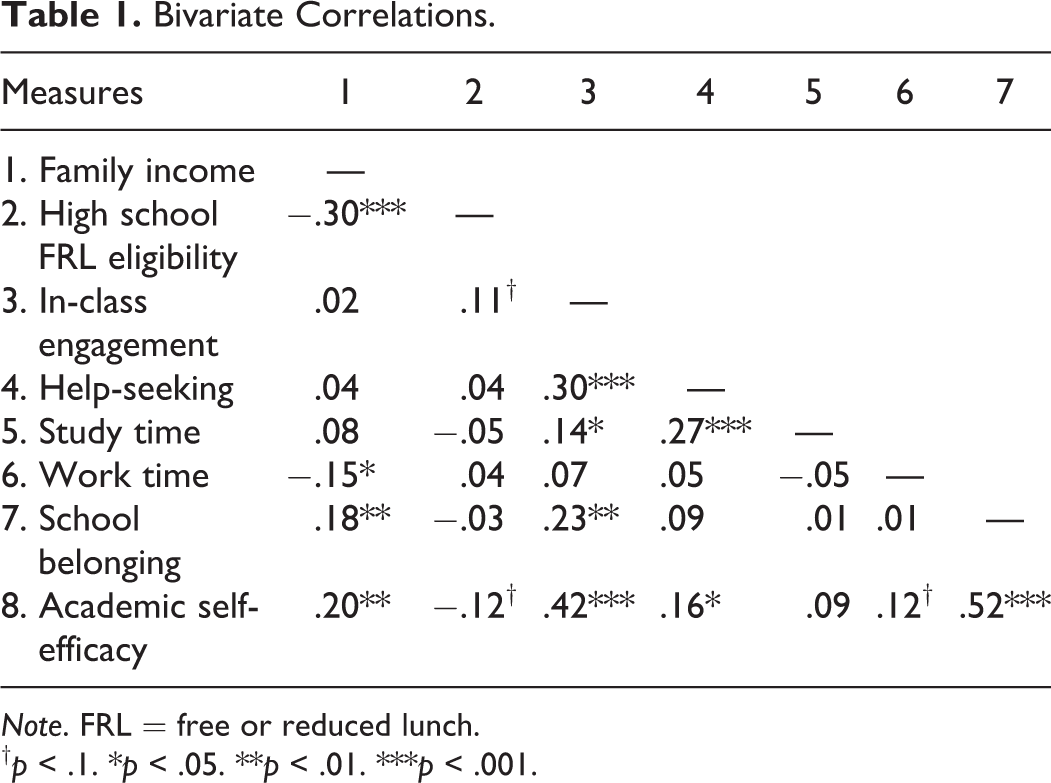
Note. FRL = free or reduced lunch.
† p < .1. *p < .05. **p < .01. ***p < .001.
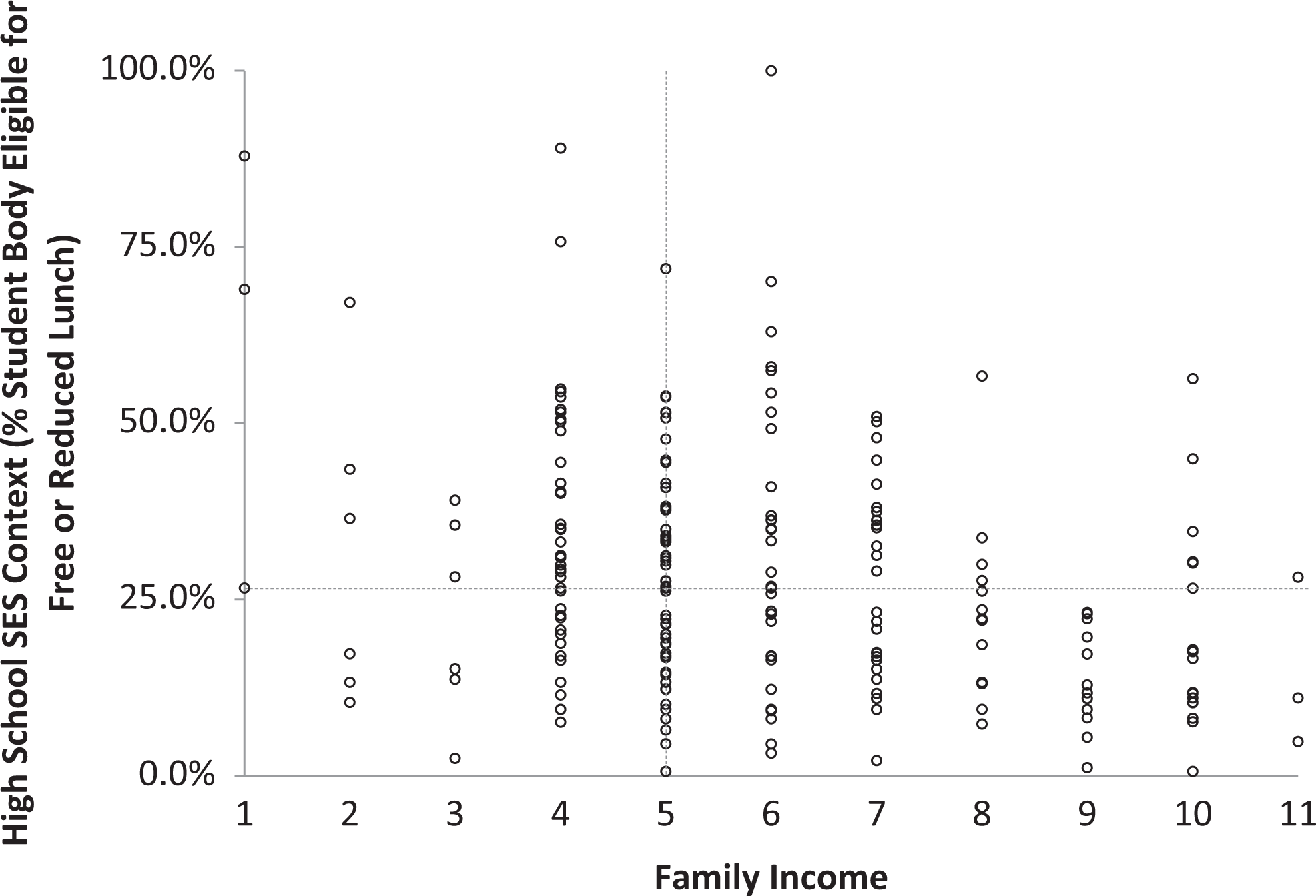
Scatterplot of participants’ family incomes by percentage of students eligible for free or reduced lunches in their high schools. Dashed lines represent sample medians.
A series of analyses of variance included participant class standing (e.g., first year, sophomore), gender, and race as predictors of SES, academic behaviors, and proposed mediators. These analyses indicated that class standing was not associated with either family income or high school FRL eligibility, not associated with any of the academic behaviors, and not associated with school belonging. Class standing was, however, associated with two of the proposed mediators—work time, F(3, 210) = 6.82, p < .001, η2 = .089, and academic self-efficacy, F(3, 210) = 4.42, p = .005, η2 = .059. In both cases, follow-up tests indicated that first-year students differed from juniors and seniors: First-year students worked fewer hours and reported lower academic self-efficacy than their junior and senior classmates who did not differ from one another.
Across the eight analyses, only one effect of gender was significant: Female students worked longer hours than male students, F(1, 210) = 6.09, p = .014, η2 = .028. Participant race was associated with both family income, F(4, 210) = 3.52, p = .008, η2 = .063, and high school FRL eligibility, F(4, 210) = 6.97, p < .001, η2 = .117. For income, follow-up tests with the Bonferroni correction revealed that the effect of race was due to White participants reporting higher family incomes than Black participants. For high school FRL eligibility, follow-up tests revealed that Black participants, on average, attended high schools with more students eligible for FRL than White or Multiracial participants, whose high schools did not differ. Race was not associated with any of the measures of academic behavior, nor with work time. Race, however, was associated with two of the proposed mediators—school belonging, F(4, 210) = 2.45, p = .047, η2 = .045, and academic self-efficacy, F(4, 210) = 5.99, p < .001, η2 = .102. Follow-up tests indicated that these racial effects were due to Black students reporting lower school belonging and lower academic self-efficacy than their White or Multiracial peers, who did not differ from one another.
Academic Behaviors
A series of hierarchical linear models (HLMs; Raudenbush & Bryk, 2002) were run with each academic behavior—in-class engagement, help-seeking, and study time—as outcomes. The three key predictors were family income, high school FRL eligibility, and their interaction. Both family income and high school FRL eligibility were centered on the sample’s grand mean. All analyses controlled for participant class standing, gender, race, and ACT scores.
As a main effect, family income was not associated with any of the academic behaviors (see Table 2). High school FRL eligibility, however, was associated with in-class engagement: Students who attended high schools with higher percentages of students eligible for FRL tended to be more engaged in their college classrooms. High school FRL eligibility was not directly associated with either help-seeking or study time. For all three academic behaviors, there was a significant interaction between family income and high school FRL eligibility. To interrogate these interactions, we created two recentered high school variables—one centered at low FRL eligibility (the sample’s 10th percentile: less than 10% of the high school student body eligible for FRL) and one centered at high FRL eligibility (the sample’s 90th percentile: more than 50% of the student body eligible for FRL). Corresponding interaction terms between family income and these recentered high school variables were also created. Rerunning the same HLMs described above with these recentered predictors allowed for simple slope analyses, which indicated the strength and significance of the association between family income and academic behaviors among participants who attended low FRL high schools versus those who attended high FRL high schools.
HLM Results: Predicting Academic Behaviors From Individual SES, High School Context SES, and Their Interaction.
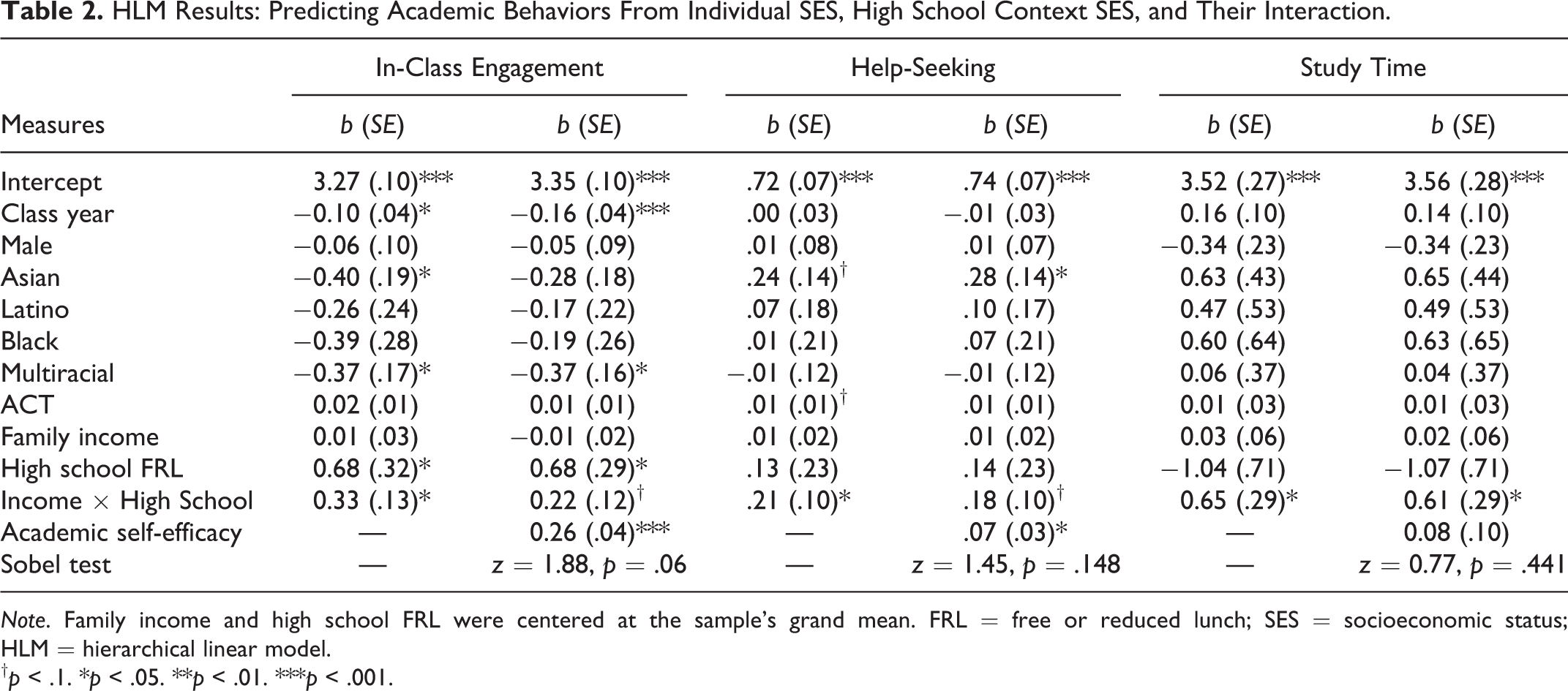
Note. Family income and high school FRL were centered at the sample’s grand mean. FRL = free or reduced lunch; SES = socioeconomic status; HLM = hierarchical linear model.
† p < .1. *p < .05. **p < .01. ***p < .001.
Across all three academic behaviors, these simple slope analyses indicated the same pattern of results. As shown in Figure 2, for students who attended high schools with low FRL eligibility, there was no association between family income and academic behaviors. For students who attended high schools with high FRL eligibility, however, higher income was significantly associated with more in-class engagement and more study time and marginally associated with more help-seeking behaviors.
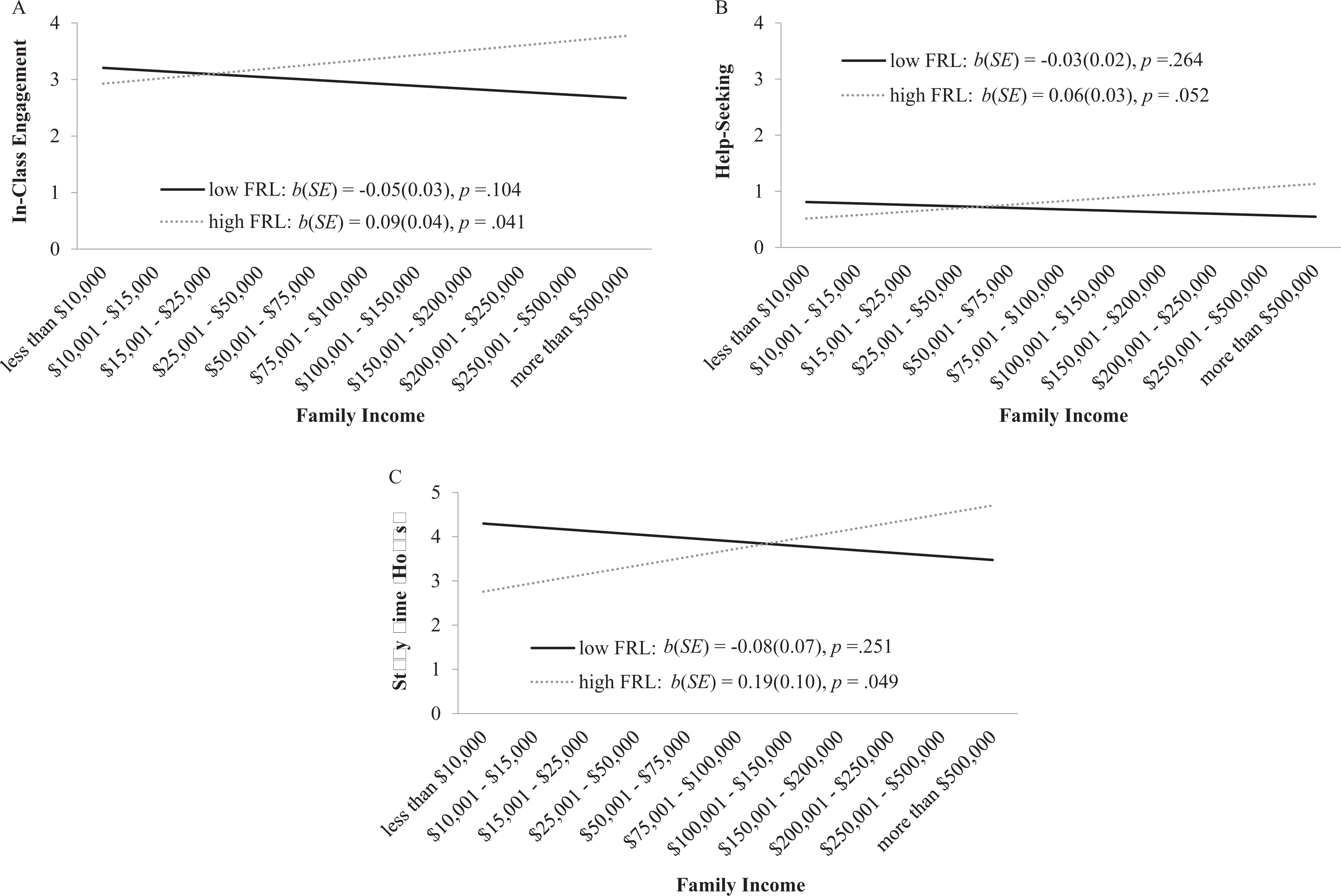
Associations between individual socioeconomic status (family income) and (A) average daily in-class engagement, (B) help-seeking behaviors, and (C) study time among students from high schools with low rates of free or reduced lunch (FRL) eligibility (<10%; solid lines) and students from high schools with high rates of FRL eligibility (>50%; dotted lined).
Mediation Analyses
Finally, we tested whether time spent working for pay, school belonging, and academic self-efficacy could account for the joint influence of family income and high school FRL eligibility on students’ academic behaviors. First, a series of HLMs predicted each potential mediating variable (Path a; MacKinnon, Fairchild, & Fritz, 2007). These models included the same key predictors (family income, high school FRL eligibility, and their interaction) and control variables (participant class standing, gender, race, and ACT scores) as described above. As a main effect, family income was significantly associated with less work time, b (SE) = −0.09 (0.03), p = .002; marginally associated with higher school belonging, b (SE) = 0.05 (0.02), p = .056; and marginally associated with higher self-efficacy, b (SE) = 0.07 (0.04), p = .077. High school FRL eligibility, however, was not directly associated with any of the potential mediators: work time b (SE) = 0.25 (0.39), p = .513; school belonging, b (SE) = 0.45 (0.30), p = .140; nor self-efficacy, b (SE) = 0.16 (0.51), p = .760.
In order to be a mediator, the critical test was whether each variable was predicted by the interaction between family income and high school FRL eligibility. Work time, b (SE) = 0.24 (0.16), p = .130, and school belonging, b (SE) = 0.01 (0.12), p = .913, did not meet this criterion and were thus excluded as potential mediators. Academic self-efficacy, however, was predicted by a marginally significant interaction between family income and high school FRL eligibility, b (SE) = 0.41 (0.21), p = .051. Simple slope analyses indicated that, similar to the pattern observed for academic behaviors, among students who attended high schools with low FRL eligibility, family income was not associated with academic self-efficacy, b (SE) = 0.00 (0.05), p = .960, but among students who attended high schools with high FRL eligibility, higher income was associated with higher levels of academic self-efficacy, b (SE) = 0.17 (0.07), p = .013.
Next, we added academic self-efficacy to the HLMs predicting each academic behavior from SES and control variables. Results are presented in Table 2. Academic self-efficacy was not associated with study time, and as such, it could not mediate the interaction between family income and FRL eligibility on study time. Academic self-efficacy was, however, a significant predictor of both in-class engagement and help-seeking behavior. Furthermore, with academic self-efficacy in the models, the formerly significant interactions between family income and high school FRL eligibility were attenuated and became only marginally significant. However, for in-class engagement, the mediated effect (Sobel, 1982) was only marginally significant, and for help-seeking behavior, the mediated effect was not significant. Given these marginally and nonsignificant results, we did not formally test mediation with a bias-correcting bootstrapping procedure (Hayes, 2009).
Discussion
Although students from lower SES backgrounds are pursuing postsecondary education at rapidly increasing rates, their college outcomes tend to be different than those of their more economically advantaged peers (Adelman, 2006). One key variable that distinguishes lower and higher SES college students is behavioral engagement (Jack, 2016; Soria et al., 2013). Importantly, the current study suggests that this “behavior gap” between lower and higher SES students may only exist among college students from high schools that primarily serve lower income students. Across all of the academic behaviors included in the current study (in-class engagement, help-seeking, and study time), the same pattern emerged: Family income was never significant as a main effect; family income was only positively associated with academic behaviors among students who matriculated to college from high schools that serve many low-income students. Among students from high schools that serve few low-income students, there was no association between family income and academic behaviors in college.
Overall, our work also offers indirect but important support for cultural mismatch theory (Stephens et al., 2012). Our findings suggest that family income is positively associated with academic outcomes only among those who attended high schools that served high numbers of low-income students. Among those participants, then, students who came from higher SES families may not have experienced a cultural mismatch at college; in our study, the cultural mismatch appears most significant among students whose individual family backgrounds and high school contexts were culturally different from their colleges. Indeed, researchers have suggested that high schools, like families, can serve as cultural socializers (e.g., Stephens, Markus, & Phillips, 2014). This study’s results are consistent with that hypothesis—that high schools serving many higher SES may socialize students according to academic conventions that are commonly embedded within the cultures of middle- and upper class families.
A particular strength of this study was that we used daily reports to assess academic behaviors. We did not ask participants to retrospect over a long period of time to estimate how much they typically study or attend class; indeed, such retrospective reports can have low internal consistency (e.g., Stephens, Hamedani, & Destin, 2014). Instead, we asked students to report on their behaviors every day, and measures aggregated from daily reports tend to have especially high reliability and validity because they avoid many retrospective memory biases (Bolger et al., 2003). We can, therefore, be confident in our measures of academic behaviors and of the role that family and high school SES contexts play in predicting these behaviors.
The differential effect of family SES, depending on high school context, was not explained by the amount of time students spend working for pay, their sense of school belonging, or their academic self-efficacy (at least as these variables were measured in the current study). In addition, our analyses controlled for prior achievement (i.e., ACT scores), so it is unlikely that academic preparation could account for our results. Furthermore, all analyses controlled for class standing. Thus, there is no evidence that the current results could be explained by selective attrition (i.e., students from lower SES families and high schools stopping out of college at higher rates, leaving a disproportionate number of higher SES students in the upper years, when students may be more engaged in college). Finally, previous research suggests that emerging adults from lower SES backgrounds are highly motivated to work hard (Silva, 2016), and family income is not systematically associated with academic motivation during the transition from high school to college (Ratelle, Guay, Larose, & Senécal, 2004). It is unlikely, therefore, that these results are due to income differences in motivation.
Why, then, is family income associated with college behaviors for students from high schools that serve many low-income families, but not for students from high schools that serve few low-income families? One possibility may be related to the negative stereotypes that students from lower SES backgrounds face in regard to their academic abilities (Jury et al., 2017). Stereotype threat research suggests that when lower SES students are in situations in which these negative stereotypes are salient, their academic performance suffers, often because contending with concerns about confirming these negative stereotypes depletes the cognitive and self-regulatory resources that students need for academic success (Croizet & Claire, 1998; Johnson et al., 2011). However, not all students who face negative stereotypes are equally susceptible to stereotype threat—people for whom the stereotyped identity is less salient and people who have positive intergroup interactions, for example, are less likely to experience the performance decrements associated with being a member of a negatively stereotyped group (Ambady, Paik, Steele, Owen-Smith, & Mitchell, 2004; Mendoza-Denton, Page-Gould, & Pietrzak, 2006). It is possible, therefore, that when they transition into the higher SES context of college, lower income students from schools with higher rates of poverty are more sensitive to their social class membership or to the stigma of being from a lower SES background. Indeed, after transitioning into an elite college environment, many students who come from both lower income families and lower income high school contexts report being especially aware of their social class and feel a need to manage this identity (Radmacher & Azmitia, 2013). In addition, these students report avoiding academic behaviors (such as seeking help from professors) specifically because they fear being judged and find these experiences to be emotionally taxing (Jack, 2016). Thus, although all students from lower SES families may have to contend with a potentially stigmatized identity, perhaps students who attended high schools with higher SES peers were able to develop adaptive identity management strategies in high school that they deployed during college (Silva, 2016). Future research could include these identity variables to determine the role they may play in associations between SES and academic behaviors in college.
Another possible explanation for our findings lies in the differential resources available in students’ high schools. Access to college counselors, for example, is associated with support for applying for financial aid (Terriquez & Gurantz, 2014) and with the development of skills and preparation that bolster college success (Brown & Trusty, 2005). Although college counselors benefit all students, high school students from lower SES families rely on these resources more than their peers from higher SES families (McDonough, Korn, & Yamasaki, 1997; Schwartz et al., 2018). Indeed, Belasco (2013) found that, although visiting a high school guidance counselor is associated with increased college enrollment for all students, the association between counselor visits and college enrollment was especially strong among students from lower SES families. Students from lower income families benefit the most from guidance counseling, yet high schools that serve many low-income families have, among other relatively limited resources, fewer counselors (Bridgeland & Bruce, 2011). Thus, low-income college students who attended low-income high schools are likely to be “doubly disadvantaged” in the transition to college (Jack, 2016). Future studies might consider directly assessing some of these other aspects about students’ high school contexts to elucidate the interaction between family SES and high school context in predicting college behaviors.
Although identity processes like stereotype threat and differential high school resources like college counselors may account for this study’s findings, it is somewhat surprising that the hypothesized mediators—time spent working for pay, school belonging, and academic self-efficacy—did not play a role in the joint association between family income, high school SES context, and academic behaviors. For school belonging and self-efficacy in particular, previous research has demonstrated that these psychological processes account for associations between SES and academic outcomes (e.g., Stephens et al., 2012). For example, Ostrove and Long (2007) found that although family SES was associated with college students’ academic adjustment, this association was completely mediated by the students’ sense of belonging at college. In the current study, self-efficacy, in particular, seemed to be a promising explanation for the results. Self-efficacy was predicted (albeit marginally) by the same interaction between family SES and high school SES context—among college students from high schools that serve few low-income families, there was no association between income and self-efficacy; among students from high schools that serve many low-income families, however, those who came from lower SES families tended to feel less confident in their abilities to succeed in college. However, students’ self-efficacy did not mediate the link between SES and academic behaviors. It is possible that this lack of mediation is due to the fact that we measured students’ general academic self-efficacy (i.e., self-efficacy across a number of academic domains and behaviors). Previous research indicates that specific self-constructs are the best predictors or specific behaviors (Choi, 2005). Therefore, if we had measured self-efficacy more specifically (e.g., how confident are you speaking in class?), we might have seen self-efficacy account for SES effects.
Importance of Academic Behaviors
Previous research has primarily examined how SES is associated with college students’ psychological outcomes (e.g., motivation and emotional distress; Jury et al., 2017). Although these psychological outcomes are important in their own right and they are ultimately associated with academic success (e.g., Walton & Cohen, 2007), actual behaviors are more proximal predictors of achievement (Kuh, 2009). Thus, the focus on academic behaviors is a particular strength of this study. Active involvement in college academic life, such as attending class and study groups, are essential for promoting higher grades and persistence in college (Fredricks et al., 2004). What is more, longitudinal research has demonstrated the temporal precedence of behavioral engagement’s role in college success—the amount of time and energy that college students dedicate to their academic pursuits is consistently and prospectively linked to students’ ultimate retention and academic achievement in college (Astin, 1999).
In addition, the focus on academic behaviors is important because it provides a potential lever for intervention—if schools can support students’ academic behaviors, especially among students from lower SES families and high schools, SES differences in college achievement may be attenuated (Stephens, Hamedani, et al., 2014). On the one hand, these interventions could take the form of supporting students themselves. For example, the current study suggests that although general self-efficacy may not account for SES differences in academic behaviors, it is nonetheless strongly related (as a main effect) to both in-class engagement and help-seeking behaviors above and beyond any effects of SES. Thus, academic self-efficacy may be an important resource that all students can draw upon to support their in-class engagement and help seeking, and interventions to bolster students’ confidence for academic engagement could help low-SES students maintain high levels of academic behaviors. Other potential student-based interventions could include conveying the importance of these academic behaviors and helping students develop a self-conception that includes these behaviors (e.g., Stephens et al., 2015), as well as educating students about the role that family and high school SES plays in academic behaviors (e.g., Stephens, Hamedani, et al., 2014).
On the other hand, interventions to increase academic behaviors among students from low-income families and high schools should not solely focus on the students themselves. In most cases, successful academic behaviors in college are facilitated by the middle-class norm of independence (Stephens et al., 2012). For example, class participation typically requires comfort with speaking out in front of the whole class and seeking help requires comfort with approaching professors to self-advocate. Other interventions, therefore, could change the culture of colleges, so that successful behaviors rely less upon the skills and norms that are more common among higher SES families and the high schools that primarily serve them (Stephens, Markus, et al., 2014). For example, professors could structure these behaviors, so that more students feel comfortable with them. Participation in class could be done in small groups or with written reflections. Rather than waiting for students to reach out for help, professors could reach out to students and invite them to office hours, perhaps even before there is a “problem” so students come to see their professors as a resource that is at their disposal.
Limitations and Future Directions
Although this study has many strengths, there are some limitations that we hope will be addressed by future research. First, our SES measures were limited (Diemer et al., 2013). For school SES context, we used eligibility for free and reduced lunch. Although this is a commonly used assessment—and it is notable that although all of our participants attended selective, private colleges, their high schools represented the full range of FRL eligibility—the use of FRL is not without critiques (Harwell & LeBeau, 2010). For example, FRL eligibility does not capture the more proximal effects of peer reference groups (van Ewijk & Sleegers, 2010). Given that FRL is based on family income, our use of family income as a measure of individual SES was appropriate. In addition, family income plays a very direct role in a family’s ability to pay for college and provide other resources for students (Terriquez & Gurantz, 2014). There are, however, many other important ways to operationalize individual SES, including wealth, parental occupational status, and parental education (Kraus & Stephens, 2012; Krieger et al., 1997). When considering academic behaviors in college, parental education, in particular, is likely an important predictor because it is associated with the cultural capital that facilitates success in college (Snibbe & Markus, 2005). It will be important for future research to disaggregate family income and parental education to better understand the role that parental education plays in college students’ academic behaviors, especially among students from different high school settings. For example, perhaps parental education is only associated with academic behaviors in college if the students attended a high school where few of their peers’ parents had attained a college degree.
In addition to being unable to examine the role of parental education, the current study was unable to fully examine the intersecting roles that racial and ethnic background may have played in these results. Previous research has demonstrated that, like students from lower SES backgrounds, students from racial backgrounds that are traditionally underrepresented in college (e.g., Black, Latino, and Indigenous students) often face negative stereotypes and marginalization in college environments (Walton & Cohen, 2007). In our analyses, we controlled for race, so although SES and race were somewhat confounded in our sample, the demonstrated effects of SES were not artifacts of race. We did not, however, have large enough subsamples to examine potential interactions between race and SES.
Other measures in our study had limitations as well. First, although daily measures eliminate many problems with self-reported data, they are still self-reports. It would be interesting to see whether the same SES patterns emerged with more objective measures of behaviors (e.g., classroom observations or productivity monitoring software). Second, we assessed three academic behaviors, but there are others that are important for success in college (e.g., distributing studying over several sessions and using effective study strategies; Benjamin & Tullis, 2010; Roediger, Putnam, & Smith, 2011). Future research could examine whether the interaction between high school SES context and family SES applies to these behaviors as well. Finally, as mentioned above, our proposed psychological mediators, school belonging, and academic self-efficacy were measured at a general level (i.e., belonging to the whole school and self-efficacy for academics, overall). Perhaps if these were assessed more specifically (e.g., belonging to particular classes and self-efficacy for specific behaviors), we would have seen these psychological processes play a role in the links between SES and academic behaviors.
A final limitation of the current study is that all of the participants were recruited from small private colleges. Although the SES contexts of the colleges varied somewhat, they all had relatively low representation of lower income students. The relative disadvantage of students from lower income backgrounds who attended high schools with higher rates of poverty is likely to be especially pronounced at more elite, private institutions where the dominant institutional norms and expectations may differ dramatically from those that were exhibited among these students’ previous home and school contexts (Jack, 2016). As Engberg and Wolniak (2010) noted, the effect of high school context on college outcomes was strongest among students attending 4-year institutions. It will be critical for future research to examine these associations among students at other types of institutions (e.g., public universities or community colleges), as the disconnect between high school and college contexts might not be as stark at those institutions (Terriquez & Gurantz, 2014).
Conclusion
In their “road map for an emerging psychology of social class,” Kraus and Stephens (2012) wrote that social class is not a trait of individuals; instead, “social class is rendered meaningful through the contexts that people inhabit over time” (p. 644). Research to date has explored the ways in which individual SES informs the student experience in college contexts; the current study extends this literature by demonstrating that high school contexts attenuate associations between individual SES and the college experience. Although this study did not elucidate the reason why the interaction between family income and high school SES context is associated with college students’ behaviors, it nonetheless suggests that family income, alone, is not a predictor of academic behaviors in college. High school contexts matter, too, and not all high schools are equal. Socioeconomic inequality pervades K–12 schooling experiences at every level—state, district, school, and classroom—as well as structurally through curricula and tracking (Hochschild, 2003). When they are in high school, college-bound emerging adults are developing the social capital and academic habits that will serve them in college (Stephens, Markus, et al., 2014). Colleges may need to be especially prepared to support students from lower SES high schools. For example, colleges must take responsibility for unveiling the “hidden curriculum” that pervades predominantly middle- and upper middle-class institutions (i.e., make behavioral expectations clear) and making those curricula normative (e.g., reducing any stigma associated with going to office hours). In addition, college can change the culture that privileges middle-class conventions, especially as they look to more SES diverse high schools as places from which to recruit students who will help them increase their SES diversity.
Footnotes
Author Contribution
C. Gillen-O’Neel collected the primary data; supervised the conception, design, acquisition, analysis, and interpretation of the study; performed the statistical analyses; drafted the bulk of the manuscript; critically revised the manuscript; gave final approval; and agreed to be accountable for all aspects of work ensuring integrity and accuracy. E. Roebuck conceived of the study, contributed to conception and design, collected the archival data, drafted parts of the manuscript, gave final approval, and agreed to be accountable for all aspects of work ensuring integrity and accuracy. J. M. Ostrove participated in the design of the study and interpretation of the results, drafted parts of the manuscript, and critically reviewed the manuscript. All authors read and approved the final manuscript.
Declaration of Conflicting Interests
The authors declared no potential conflicts of interest with respect to the research, authorship, and/or publication of this article.
Funding
The authors received no financial support for the research, authorship, and/or publication of this article.
Open Practices
All data and materials have been made publicly available via the Open Science Framework and can be accessed at https://osf.io/cdj4q/. The complete Open Practices Disclosure for this article can be found at  . This article has received the badges for Open Data.