



Abstract
We examined helicopter parenting (e.g., intervening, assisting with tasks that emerging adults are capable of performing independently) during the transition to university relative to positive parenting (autonomy support, warmth, age-appropriate involvement) and academic motivation. Participants were n = 460 full-time, first-year undergraduates who completed surveys in September and December. In a latent profile analysis, differences were prominent for positive parenting (three profiles featured relatively low, moderate, and high levels). Amotivation was highest in combination with lower positive parenting. Intrinsic motivation was highest in combination with higher positive parenting; helicopter parenting was similar across profiles and was not meaningfully associated with end-of-semester well-being. End-of-semester outcomes were poorest for low positive parenting, but supplemental analyses showed disadvantages were already evident in September. Perceptions of parents during the transition to university likely reflect continuity from adolescent parenting environments. Results do not support the narrative that helicopter parenting is common or a barrier to student success.
Emerging adults and their families are increasingly aware of the value of a college education, with high school graduates pursuing degrees in record numbers. Yet today’s college students are often portrayed as less capable than previous generations and overly dependent on their parents (LeMoyne & Buchanan, 2011). Helicopter parents have been a recurring target in media coverage of Canadian and U.S. university students over the past decade; they are actively engaged in helping their adult children to succeed, but in ways that feature intervening, micromanaging, or providing unnecessary assistance with tasks their children can do for themselves (LeMoyne & Buchanan, 2011). The negative tenor of media coverage of parent involvement (e.g., Miller & Bromwich, 2019) reveals broad social ambivalence toward the idea that parenting continues into emerging adulthood. Nevertheless, involved parents have taken on an increasingly important role in promoting student success during the transition to university (Savage & Petree, 2013). In this study, we consider whether the association between helicopter parenting and student success and well-being depends on the relative presence or absence of other, established dimensions of positive parenting (autonomy support, emotional warmth, and age-appropriate involvement) and on the nature of students’ academic motivation to attend university. We test whether different configurations of helicopter parenting, positive parenting, and academic motivation are positively versus negatively associated with indices of success and well-being measured at the end of students’ first semester.
Parenting: From Adolescence to Emerging Adulthood
In childhood and adolescence, parenting characterized by emotional warmth, firm expectations, and autonomy support is widely acknowledged to promote positive outcomes across development 1 (Steinberg, 2001). Authoritative parents (Baumrind, 1971; Maccoby & Martin, 1983) are both demanding and responsive, providing affection, setting limits, and facilitating adolescents’ developing independence (e.g., Steinberg et al., 1992). Importantly, relationships with parents persist beyond adolescence, with almost 98% of Americans aged 25–32 reporting an active relationship with at least one parent (Hartnett et al., 2018). Yet the nature of parenting in emerging adulthood—and to what extent it resembles parenting in adolescence—is poorly understood (Lowe & Dotterer, 2018; L. J. Nelson et al., 2011).
As adolescents age into emerging adulthood and adopt formal legal responsibility for themselves (age 18 in the United States and Canada), parent–child roles and responsibilities are gradually renegotiated, drawing new boundaries between emerging adults and their families of origin (Tanner, 2006). Longitudinally, authoritative parenting in adolescence reinforces positive outcomes during the transition to adulthood (Masten et al., 2004) and predicts more years of postsecondary education (Hill & Wang, 2015). However, authoritative parenting assessed during the university years is weakly or unrelated to student success and well-being (Joshi et al., 2003; Strage & Brandt, 1999; Turner et al., 2009). Autonomy support and emotional warmth are two components of authoritative parenting that continue to confer benefits for adolescents making the transition to university (e.g., Budescu & Silverman, 2016; Inguglia et al., 2016; L. J. Nelson et al., 2015). Less clear is the extent to which parent involvement contributes positively to students’ transition to university.
Parent Involvement During the Transition to University
The first year of university is developmentally significant because of a confluence of multiple, simultaneous transitions (Graber & Brooks-Gunn, 1996). Students navigate a broader range of academic choices and expectations compared to high school, they form new social groups and leave others behind, and many move away from home. Even high-achieving students sometimes struggle to keep up with new academic, social, familial, and financial demands (e.g., Schulenberg et al., 2004), and evidence suggests that parents help ease the strain of the transition to university (Wintre & Yaffe, 2000). Students who report greater parental autonomy support, warmth, and age-appropriate involvement report fewer depressive and anxiety symptoms, fewer externalizing behaviors, and greater psychological well-being (Inguglia et al., 2015; Mendoza et al., 2019). Outcomes such as better adjustment to university, higher grades, higher self-esteem, and lower stress are associated with greater attachment to parents (e.g., trust, open communication; Hiester et al., 2009), greater parent support (Cutrona et al., 1994; Li et al., 2014), and parent–child openness in communication (Burke et al., 2016). Some parents, however, may struggle to balance the continuing economic dependence of emerging adults alongside their gradual progression toward autonomy in other domains of their lives (Aquilino, 2006). Helicopter parenting appears to typify failure to achieve or maintain this balance.
Helicopter parenting during the transition to university
Helicopter parenting can be broadly defined as a form of control in which parents actively solve problems or complete tasks that their grown-up children are capable of doing independently (LeMoyne & Buchanan, 2011; Padilla-Walker & Nelson, 2012). Helicopter parenting is viewed as a style of parent behavior characterized by excessive involvement rather than its own dimension of parenting (see Luebbe et al., 2016; Padilla-Walker & Nelson, 2012; Schiffrin et al., 2014). There is no consensus in the literature on what exact behaviors constitute excessive involvement, and thus, a diverse variety of self- and parent-report survey measures capture everything from imposing behavioral limits and rules, micromanaging academic and personal life tasks, providing financial support, seeking detailed information about daily life, and giving advice too frequently (Fingerman et al., 2012; LeMoyne & Buchanan, 2011; Luebbe et al., 2016; Padilla-Walker & Nelson, 2012; Schiffrin et al., 2014; Segrin et al., 2012). Across diverse measures, some of which arguably reflect support rather than excessive involvement, helicopter parenting is associated with a mix of negative and positive outcomes, including feeling less engaged at school (Padilla-Walker & Nelson, 2012), more depressive symptoms (Cui et al., in press; Schiffrin et al., 2014), coping poorly with stress (Pedersen, 2017), greater life satisfaction (Fingerman et al., 2012), an improved sense of competence (Shoup et al., 2009), higher quality parent–child relationships (Padilla-Walker & Nelson, 2012), and fewer risk behaviors (if parents are also warm; L. J. Nelson et al., 2015).
The line between age-appropriate parent involvement and helicopter parenting may depend on the extent to which behaviors facilitate versus interfere with students’ own goals and daily lives (Schiffrin & Liss, 2017). In adolescence, behavioral control strategies such as imposing a curfew and insisting on being kept informed of the child’s whereabouts are developmentally appropriate. In emerging adulthood, these behaviors interfere with autonomy goals and are linked to depression, social anxiety, and less self-efficacy (Kouros et al., 2017; Reed et al., 2016; Schiffrin et al., 2014). In contrast, advice, support, and regular communication with parents remain developmentally appropriate in emerging adulthood and are likely beneficial (Burke et al., 2016; Li et al., 2014). This latter set of exemplars appears in some studies purporting to measure helicopter parenting, highlighting the lack of clear boundaries between the kinds of involvement that might seem to be facilitating versus interfering. In this study, we separately measure helicopter behaviors using an instrument that emphasizes parent intervening and problem-solving tendencies.
To date, studies have shown primarily simple associations (correlations, main effects, and occasionally mediated effects) between helicopter parenting and indicators of student success and well-being. Exceptions are two studies in which parental warmth stood out as a potential moderator that, when present, was associated with more positive outcomes (e.g., fewer risk behaviors; L. J. Nelson et al., 2015; and better school engagement; Padilla-Walker et al., 2019). In both studies, however, levels of helicopter parenting were low. Mixed findings and diverse measurement suggest a need to consider additional moderators of helicopter parenting (e.g., autonomy support and age-appropriate involvement may operate similarly to warmth). Academic motivation in particular may provide critical context to understand some of the discrepant associations between helicopter parenting and student outcomes.
Helicopter Parenting and Academic Motivation
Students may disclose very different motives for attending university if their involved parents help to facilitate their own goals compared to students whose involved parents’ efforts interfere with their own goals (or whose parents set goals that they are expected to pursue). From the perspective of self-determination theory (e.g., Ryan & Deci, 2000), a sense of autonomy, competence, and relatedness or connectedness to others are basic needs that promote success by enhancing intrinsic motivation toward personal goals (Deci & Ryan, 2008). Intrinsic motivation prompts exploration, seeking out challenge, and mastering skills out of an inherent sense of enjoyment or to satisfy curiosity. Autonomy-supportive parents tend to have more intrinsically motivated children (Grolnick et al., 1997). Longitudinally, intrinsic motivation for academic work was highest during the first year of university and declined sharply in later years but remained higher in students reporting greater levels of parental autonomy support (Pan & Gauvain, 2012). Other students may lack motivation toward university and feel unsure of their goals (amotivated), and some may primarily feel motivated to attend because of external pressures. Students who express academic motivation for reasons such as wanting to satisfy their parents’ wishes may be described as externally regulated. No studies have tested whether helicopter parenting and academic motivation are associated, but the above findings suggest that helicopter parenting may co-occur more often with academic amotivation or external regulation and less often with intrinsic motivation.
An adaptive parenting environment at the transition to university should feature autonomy-supportive, warm parents who participate in their child’s education with an eye toward facilitating their child’s goals (Burke et al., 2018). Students in such environments who are also intrinsically motivated toward their academics may not be at a disadvantage if their parents are also excessively involved. Evidence for this comes from a recent study showing that greater maternal warmth combined with modest helicopter parenting was associated with higher academic engagement (Padilla-Walker et al., 2019). It is unclear whether students who lack academic motivation or are externally regulated are at a commensurate disadvantage if they also experience helicopter parenting, though one study showed that academic management (e.g., parents intervening to complete school projects) was associated with lower perceived academic achievement and weaker attachment to college (Luebbe et al., 2016). In other studies, helicopter parenting also predicted more external, performance-related goals toward academics (Schiffrin & Liss, 2017) and correlated with academic worries (Greene et al., 2019). Taken together, these findings suggest that students’ motivation toward academic work may be an important moderator relevant to understanding when parents’ behaviors (positive and helicopter) promote or inhibit student success. To the extent that cumulative disadvantages are worse, we might expect that helicopter parenting combined with low autonomy support and external regulation or amotivation may be particularly maladaptive.
Current Study
Given the limited scope of the literature to date, plausible interactive associations between helicopter parenting and other domains are necessarily speculative and numerous. Testing all potential combinations as predictors of just one outcome measure results in a model that is intractably large even before effects of sociodemographic covariates are considered (Helicopter parenting, three measures of positive parenting, and three measures of academic motivation gives 27 or 128 terms in a regression analysis if all higher order terms are included). Latent profile analysis (LPA) is an alternative to conventional regression tests of moderation for summarizing, in a discrete set of sample subgroups, only the most prominent variable configurations (Lanza & Rhoades, 2013). This indirect application of LPA (Bauer, 2007) leverages subgroups identified in the analysis to assist in interpreting associations among variables that apply to the population as a whole. Profiles are not intended to reflect qualitatively distinct population subgroups.
Our first aim was thus to identify a set of profiles that highlight commonly occurring combinations of positive parenting, academic motivation, and helicopter parenting. Our aim was exploratory, but we anticipated that high levels of positive parenting (e.g., high autonomy support) would combine with high intrinsic motivation and low to moderate helicopter parenting. We also anticipated that high external regulation or amotivation would combine with high levels of helicopter parenting. Such a combination might be especially prognostic of difficulties during the transition to university if dimensions of positive parenting, such as emotional warmth, are also rated low.
Our second aim was then to test whether the combinations identified by our LPA were differently associated with end-of-semester success and well-being (measured here as depression and anxiety symptoms, academic and social adjustment, burnout, and estimated final grades). Based on our review of the literature, modest helicopter parenting that occurs within an otherwise positive parenting environment (e.g., high autonomy support, warmth) and where academic motivation is relatively intrinsic may contribute positively to student success and well-being. In contrast, helicopter parenting may serve to hinder student success and well-being when students are externally motivated or amotivated toward their academics, and perhaps especially so within a less positive parenting environment. All research questions and hypotheses, as well as the analysis plan for this article, were preregistered prior to data analysis. We note any deviations from our preregistered plan in this article, including a series of unplanned, supplemental regression analyses in which we test a limited number of two-way interactions between helicopter parenting and each dimension of positive parenting and academic motivation as predictors of end-of-semester outcomes. Study materials and statistical output are also available at our project link: https://osf.io/gh8qb/wiki/home.
Method
Participants and Procedure
Participants were first-year undergraduate students at a large Canadian university recruited to complete online surveys aimed at understanding success and well-being during the transition to university. Students were eligible to participate if they had not previously attended college or university and were age 19 or younger. Over 1,000 students responded to an initial three-question eligibility screening survey, of which n = 744 were eligible to participate and provided contact information, and n = 478 initiated an intake survey. Six people were excluded because they subsequently reported being 20 years old; five were excluded due to an incomplete demographics section and no other questions answered; the remaining responses were removed due to abnormally fast completion times. The final sample size was n = 460, for a participation rate of 61.8% of eligible screened respondents.
Participants were recruited during orientation week for first-year students in September 2018. Undergraduate recruiters handed out postcards and candy across campus, inviting students to complete online eligibility screening questions. Eligible students were invited to provide their name and e-mail address and were contacted with an invitation and a link to our full intake survey. Students who completed the intake survey received a CAD10 amazon.ca gift code and were entered into a draw to win a CAD200 amazon.ca gift code. Students were recontacted on December 1 with an invitation to complete an end-of-semester follow-up survey offering the same compensation, and n = 386 (84%) participated. Informed consent was obtained from all participants prior to completing both the intake and follow-up surveys.
The sample was gender balanced (n = 248 men, n = 202 women; 2 identified as both male and female; 5 chose not to answer), and ages ranged from 16.3 to 19.9 years old (M = 18.33, standard deviation [SD] = 0.48). Participants were ethnically diverse: 47.4% self-identified as White/Caucasian, 11.7% as Southeast Asian, 11.7% as South Asian, 7.6% as Black, 5.2% as West Asian/Middle Eastern, 3.9% as Indigenous (First Nations, Métis, or Inuit), 1.4% as Latino/a/x, 10.2% as multiple ethnicities, and 0.4% as another ethnicity.
Most participants (90.8%) reported having two parents in their lives, and 84.9% reported usually having two parents in their home while growing up. Students with two parents in their lives reported a weighted maximum combined parent income of CAD109,000, and students from single-parent families reported a weighted maximum combined parent income of CAD43,250. 2 Both values fall below 2015 provincial median incomes for these family types (CAD110,935 and CAD49,428, respectively; Munger, 2016). Most participants’ parents attended university (71.0%), and a further 7.1% reported having aunts, uncles, or grandparents (but not parents) who attended university. In total, 14.1% were the first in their family to attend university, and another 7.8% were first in their family along with one or more siblings. We defined first-generation students as encompassing these latter two categories (21.9%), consistent with a definition provided by the Higher Education Quality Council of Ontario (Browne & Doyle, 2010).
Just 29.8% of students reported working while studying, and those who worked reported putting in 12.8 hours per week on average. Living situations while in university included campus residence (55.4%), living with parents (34.4%), and living off-campus, either alone or with roommates (10.2%). Participants also came from a range of academic faculties, including arts (36%), science (17.6%), engineering (37%), business (6.7%), and other or multiple programs (2.4%). Relative to Fall 2018 enrolment reports, students in engineering were slightly overrepresented in our sample while students in arts were slightly underrepresented.
Measures
Sociodemographic characteristics at intake
Demographic measures collected at intake were gender (coded as male vs. female/Other), age, degree program (coded as arts, engineering, and science/business/Other), current living situation, first-generation student status, international student status, whether they grew up in a two-parent family (vs. fewer than two parents), parents’ combined past-year income (ranging from 1 [less than CAD5,000] to 12 [CAD200,000 or greater]), working while studying (yes vs. no), and typical weekly hours worked.
Student perceptions of their parents
The Perceptions of Parents Scale–College Version (POPS; Grolnick et al., 1997) assessed students’ agreement with each of the 21 items describing parent behavior, on a scale ranging from 1 (not at all true) to 5 (very true). Questions were asked separately about mothers and fathers. Warmth was the mean of 6 items (e.g., “my father/mother clearly conveys his/her love for me”), age-appropriate involvement was the mean of 6 items (e.g., “my father/mother spends a lot of time with me”), and autonomy support was the mean of 9 items (e.g., “my father/mother allows me to decide things for myself”). Items within each subscale were first calculated as the higher score reported by either parent. Scale reliability estimates based on aggregated items were high: Omega (ω) total estimates were ω = .87 for warmth, ω = .81 for involvement, and ω = .86 for autonomy support. Higher mean scores indicate greater parent warmth, involvement, and autonomy support, respectively.
Helicopter parenting was measured with a 5-item instrument (Padilla-Walker & Nelson, 2012) assessing students’ reports of parents’ age-inappropriate intervening/problem-solving behaviors (e.g., “My parent makes important decisions for me; e.g., where I live, where I work, what classes I take,” and “My parent solves any crisis I might have”). Participants responded to 5 items about their mother and father, on a 5-point scale ranging from 1 (not at all like him or her) to 5 (a lot like him or her). Mother–father items were aggregated as described for the POPS subscales. Higher mean scores indicate exposure to more helicopter parenting behaviors (ω = .78).
Student self-assessments of academic motivation
Academic motivation was measured using the 28-item Academic Motivation Scale (AMS; Vallerand et al., 1992). Participants endorsed statements corresponding to why they attend university on a 5-point scale ranging from 1 (does not correspond at all) to 5 (corresponds exactly). The AMS includes three intrinsic motivation scales (intrinsic motivation to know, toward accomplishment, and to experience stimulation), three extrinsic motivation scales (identified, introjected, and external regulation), and amotivation. We consolidated the three intrinsic motivation subscales given high correlations found in other research (e.g., Carbonneau et al., 2012) and clear evidence for a single-factor structure in the present sample. Intrinsic motivation was the mean of 12 items (e.g., “I experience pleasure and satisfaction while learning new things”), external regulation was the mean of 4 items (e.g., “In order to obtain a high-paying job later on”), and amotivation was the mean of 4 items (e.g., “Honestly, I don’t know; I really feel that I am wasting my time in school”). Identified and introjected measures of extrinsic motivation were excluded from this study given their high correlations with intrinsic motivation in other studies (e.g., Ratelle, Guay, Vallerand, Larose, & Senécal, 2007). Scale reliability estimates were high (ω = .92 for intrinsic motivation, ω = .82 for external regulation, and ω = .84 for amotivation).
End-of-Semester Measures of Well-Being
The Center for Epidemiologic Studies Depression Scale (CES-D; Radloff, 1977) assessed depressive symptoms at baseline and follow-up. Participants respond to 10 statements based on how often they felt similar to the prompt during the past 2 weeks (e.g., “I was bothered by things that usually don’t bother me”), on a 4-point scale: 0 (rarely or none of the time [less than 2 days]), 1 (some or a little of the time [2–5 days]), 2 (occasionally or a moderate amount of time [6–9 days]) and 3 (most or all of the time [10–14 days]). Higher mean scores reflect more depressive symptoms (intake ω = .83; follow-up ω = .84)
The GAD-7 (Spitzer et al., 2006) assessed anxiety symptoms at baseline and follow-up. Participants indicated how often they were bothered by each of seven problems during the past 2 weeks (e.g., “worrying too much about different things”; “feeling nervous, anxious, or on edge”), rated on the same scale as the CES-D. Higher mean scores reflect more anxiety symptoms (intake and follow-up ω = .90)
The Student Adaptation to College Questionnaire (SACQ; Baker & Siryk, 1999) assessed at follow-up students’ adjustment to social and academic demands at university. Participants responded to statements describing their university experience on a 9-point scale ranging from 1 (doesn’t apply to me) to 9 (applies very closely to me). Nineteen items measured social adjustment (e.g., “I feel that I have enough social skills to get along well in the university setting”), and 24 items measured academic adjustment (e.g., “I have been keeping up to date on my academic work”). For both subscales, higher mean scores reflect better adjustment (ω = .87 for social and ω = .86 for academic adjustment).
Burnout was measured at follow-up using the 5-item Exhaustion subscale of the 15-item Maslach Burnout Inventory-Student Survey (Schaufeli et al., 2002). Participants reported how they felt about their academic work (e.g., “I feel emotionally drained by my studies”) on a 7-point scale ranging from 1 (never) to 7 (always). Higher mean scores reflect more burnout (ω = .85).
On the baseline and follow-up surveys, participants reported their expected final grades for the semester, on a scale ranging from 8 (mostly “A”) to 1 (a mix of “D” and “F” grades).
Analysis Strategy
We performed exploratory factor analyses for every multi-item measure used in this study, using PROC FACTOR in SAS (Version 9.4) with maximum likelihood estimation and squared multiple correlations as priors. These analyses established whether unidimensional structures were supported for each measure, and factor loadings were used to calculate ω reliability.
LPA
We applied a LPA to examine patterns of co-occurrence among well-established dimensions of positive parenting (autonomy support, warmth, age-appropriate involvement), student academic motivation, and helicopter parenting. Profiles derived from these measures were compared across all sociodemographic characteristics measured at intake and across end-of-semester measures of well-being.
We used a three-step approach (e.g., Asparouhov & Muthen, 2018; Bakk & Vermunt, 2016) in Mplus software (Version 8.1; Muthén & Muthén, 1998-2017), where we (1) first establish the distributions of variables within some number of k latent profiles (means and variances of LPA indicators varied within each profile), (2) assign cases to their most likely profile, and (3) estimate the means and proportions of covariates and end-of-semester outcome variables in each profile. Crucially, estimates obtained in the third step adjust for uncertainty in profile assignment that occurs during the second step. We correct for multiple testing in our tests of mean and proportion differences across profiles using the Benjamini–Hochberg false discovery rate procedure (Benjamini & Hochberg, 1995).
We tested one-, two-, three-, and four-profile solutions 3 and chose a solution on the basis of several indices of classification quality and model stability: (1) the Akaike information criterion (AIC; Akaike, 1974), (2) the Bayesian information criterion (BIC; Schwarz, 1978), (3) the sample size-adjusted BIC (SaBIC; Sclove, 1987), (4) the Lo–Mendell–Rubin likelihood ratio test (Lo et al., 2001), (5) the bootstrapped likelihood ratio test (BLRT; McLachlan & Peel, 2000), (6) entropy (values closer to 1 suggest better fitting models), and (7) the proportion of times of 1,000 randomly selected start values the final maximum likelihood solution was obtained (solution %).
Missing data
The final sample for this study includes n = 450 participants who had complete data for at least one of the indicator variables used in the analysis, comprising 97.8% of the total participants. Missing observations (n = 10; 2.2%) were deleted from our analysis, and cases with partial data were retained using full information maximum likelihood estimation. When the number of cases missing is very small, deletion does not tend to be associated with biased parameter estimates and standard errors (e.g., Graham & Coffman, 2013).
Results
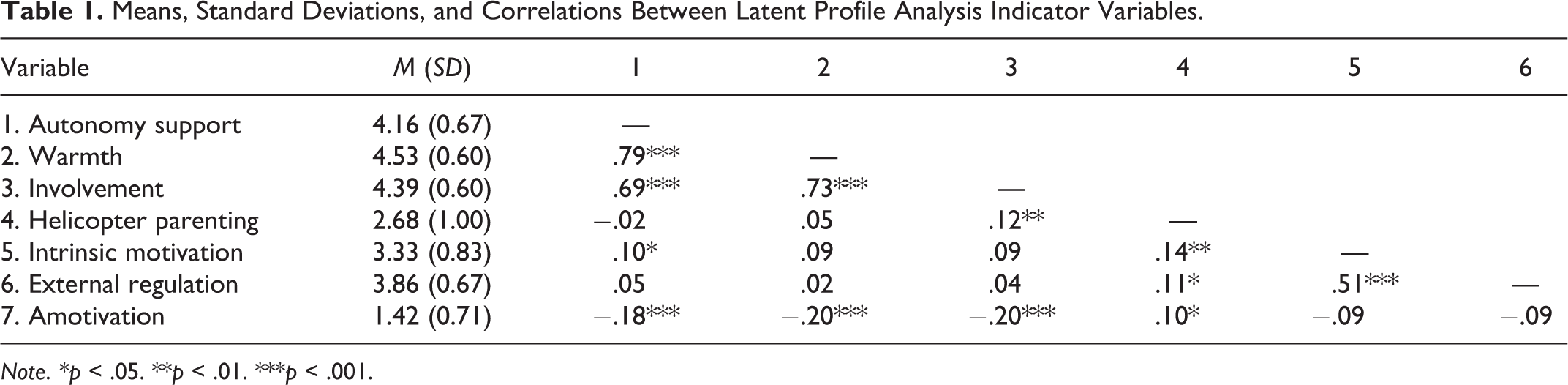
Means, SDs, and correlations between LPA indicator variables are presented in Table 1. Positive parenting measures (autonomy support, warmth, and age-appropriate involvement) were near the scale maximum values and highly intercorrelated. Students’ intrinsic motivation and external regulation scores were both high, while amotivation was low and negatively correlated with positive parenting. Helicopter parenting was also low, with the mean falling below the scale midpoint. We observed weak positive correlations between helicopter parenting and age-appropriate involvement, intrinsic motivation, external regulation, and amotivation. Helicopter parenting was uncorrelated with autonomy support and warmth.
Means, Standard Deviations, and Correlations Between Latent Profile Analysis Indicator Variables.
Note. *p < .05. **p < .01. ***p < .001.
Profile Enumeration
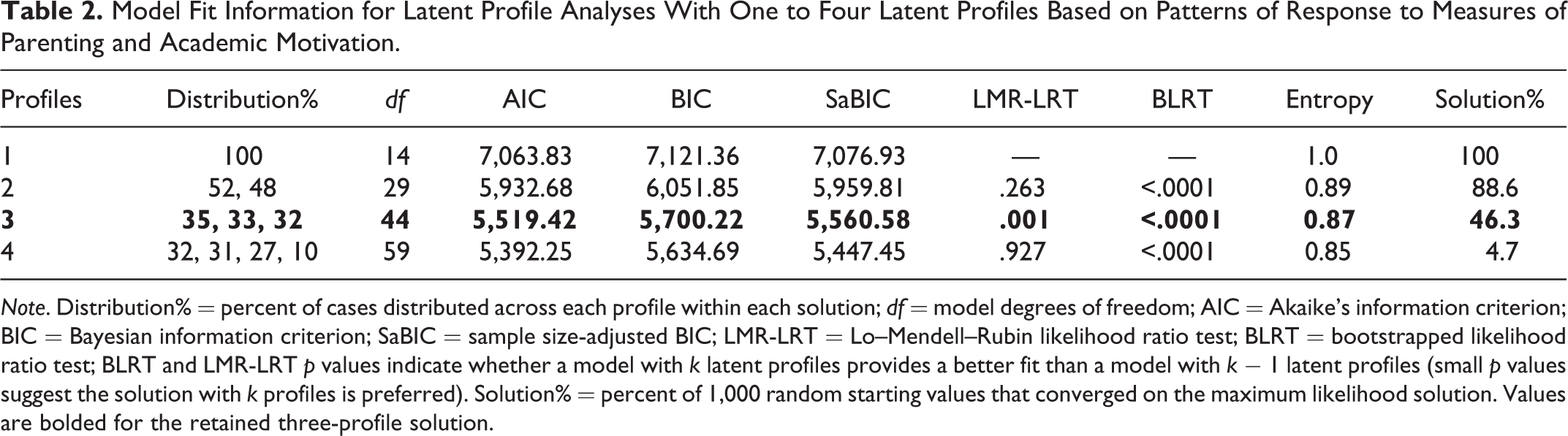
Table 2 shows model fit statistics for the one- through four-profile solutions tested. Information criteria (AIC, BIC, SaBIC) and the BLRT pointed to a four-profile solution, while the remaining measures preferred fewer profiles. Improvements in information criteria from three- to four-profile solutions were considerably smaller than the improvements from one to two and from two to three profiles. The maximum likelihood solution for the four-profile model was selected in just 4.7% of random sets of starting values, signaling potential model instability. Moreover, one of the profiles comprised just 10% of the sample, limiting power and generalizability of the pattern suggested by that profile. For these reasons, and consistent with procedures detailed in our preregistered analysis plan, we retained the three-profile solution. Modification indices inspected for the three-profile solution identified unmodeled residual associations that suggested potential local dependence between positive parenting measures in one of the three profiles (see Oberski et al., 2013). However, results were unchanged when the analysis accounted for residual associations.
Model Fit Information for Latent Profile Analyses With One to Four Latent Profiles Based on Patterns of Response to Measures of Parenting and Academic Motivation.
Note. Distribution% = percent of cases distributed across each profile within each solution; df = model degrees of freedom; AIC = Akaike’s information criterion; BIC = Bayesian information criterion; SaBIC = sample size-adjusted BIC; LMR-LRT = Lo–Mendell–Rubin likelihood ratio test; BLRT = bootstrapped likelihood ratio test; BLRT and LMR-LRT p values indicate whether a model with k latent profiles provides a better fit than a model with k − 1 latent profiles (small p values suggest the solution with k profiles is preferred). Solution% = percent of 1,000 random starting values that converged on the maximum likelihood solution. Values are bolded for the retained three-profile solution.
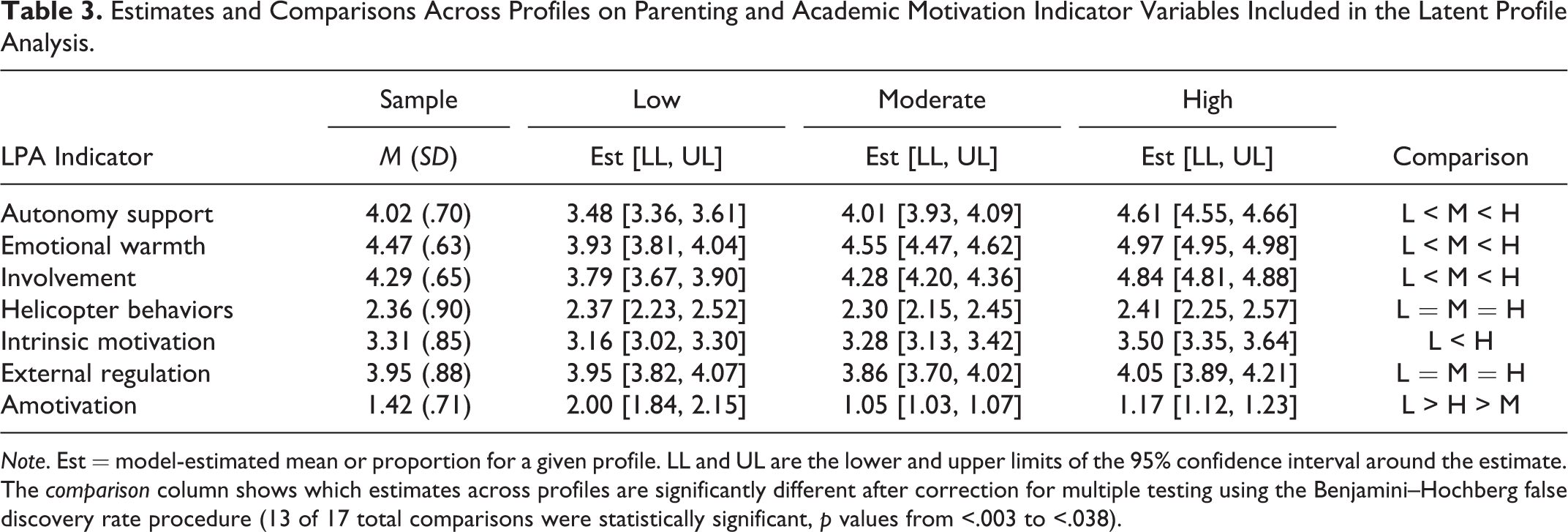
Table 3 shows mean scores for each profile indicator and confidence intervals around scores in each of the three profiles, presented in Figure 1 as deviations from the overall sample mean of each indicator. The most prominent differences across profiles were mean levels of the three indicators of positive parenting: autonomy support, emotional warmth, and age-appropriate involvement. Mean scores on each indicator were about 0.5 units below the sample mean in the first profile, at the sample mean in the second profile, and about 0.5 units above the sample mean in the third profile. We thus labeled the profiles low (32% of the sample), moderate (35% of the sample), and high positive parenting (33% of the sample), but note that these are strictly intended to serve as convenience labels and do not imply typological, naturally occurring groups in the population. Wald χ2 tests of model constraints showed that mean differences in positive parenting were statistically significant across all pairs of classes (low vs. moderate; low vs. high; moderate vs. high; all p < .0001). Stated in terms of effect size, mean differences in positive parenting between pairs of profiles were large, ranging from two thirds of an SD to 1.63 SDs. In contrast, helicopter behaviors were rated similarly, and close to the sample mean, in all profiles. Profiles differed somewhat on academic motivation, with amotivation rated highest in the low profile and rated lowest in the moderate profile (a 1.34 SD difference). Intrinsic motivation in the high profile was significantly greater than in the low and moderate profiles (modest mean differences of 0.40 and 0.26 SDs, respectively), which did not differ from each other. There were no differences across profiles in external regulation, all of which had scores close to the sample mean.
Estimates and Comparisons Across Profiles on Parenting and Academic Motivation Indicator Variables Included in the Latent Profile Analysis.
Note. Est = model-estimated mean or proportion for a given profile. LL and UL are the lower and upper limits of the 95% confidence interval around the estimate. The comparison column shows which estimates across profiles are significantly different after correction for multiple testing using the Benjamini–Hochberg false discovery rate procedure (13 of 17 total comparisons were statistically significant, p values from <.003 to <.038).

Estimated positive parenting, helicopter parenting, and academic motivation in each profile, presented as deviations from the sample mean, with 95% confidence intervals around each estimate. Scores of 0 are at the sample mean. Positive and negative scores are above and below the sample means, respectively.
Sociodemographic Differences Across Profiles at Intake
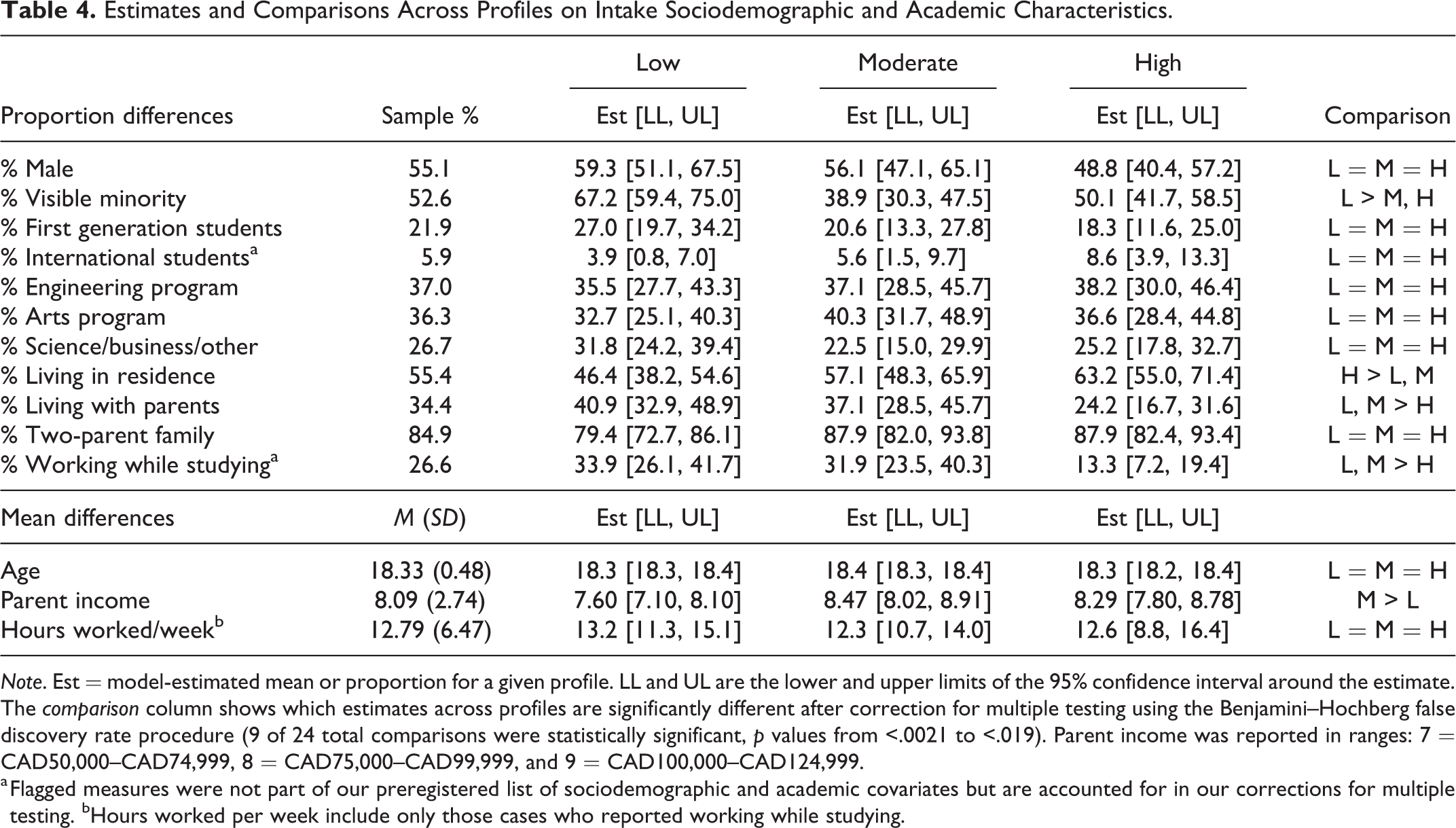
The variable configurations highlighted in each profile may also reflect systematic sociodemographic differences. To test this possibility, we show in Table 4 estimated differences across profiles in sociodemographic characteristics captured during the intake assessment. The low profile exhibited slight economic disadvantage. Parents’ estimated combined annual income was CAD90,000 4 ; over CAD20,000 less than the moderate profile. The low profile also comprised more students identifying as a visible minority or as Indigenous. In contrast, the high and moderate profiles exhibited a mix of socioeconomic advantage. Both profiles had high and similar estimated proportions of students coming from two-parent families, and White/Caucasian students were more heavily represented. The high profile exceeded the low profile on estimated proportions of students living in residence (and fewer living with parents), and fewer students in the high profile worked while studying. The moderate profile had significantly higher estimated parent income than the low profile. There were no significant differences across profiles on gender, age, proportion of first-generation students, proportion of international students, proportions of students enrolled in different programs on campus, or hours worked by those who reported working.
Estimates and Comparisons Across Profiles on Intake Sociodemographic and Academic Characteristics.
Note. Est = model-estimated mean or proportion for a given profile. LL and UL are the lower and upper limits of the 95% confidence interval around the estimate. The comparison column shows which estimates across profiles are significantly different after correction for multiple testing using the Benjamini–Hochberg false discovery rate procedure (9 of 24 total comparisons were statistically significant, p values from <.0021 to <.019). Parent income was reported in ranges: 7 = CAD50,000–CAD74,999, 8 = CAD75,000–CAD99,999, and 9 = CAD100,000–CAD124,999.
a Flagged measures were not part of our preregistered list of sociodemographic and academic covariates but are accounted for in our corrections for multiple testing. bHours worked per week include only those cases who reported working while studying.
End-of-Semester Outcomes
Table 5 shows estimated differences across profiles in end-of-semester measures of well-being. Similar to the findings for sociodemographic characteristics, scores in the low profile were poorer on all measures compared to the moderate and/or high profiles. Burnout, social adjustment, and academic adjustment assessed in December were poorer in the low profile compared to both moderate and high profiles (mean differences ranging from 0.46 to 0.81 SDs). In the low profile, depression and anxiety were higher (mean differences of 0.48 and 0.38 SDs, respectively, compared to the moderate profile) and expected final grades lower (mean difference of 0.34 SDs, compared to the high profile). However, we also administered these measures at intake and performed a supplemental analysis 5 to determine whether change in each of these measures relative to intake differed across profiles. Depression, anxiety, and grades change scores shown in Table 5 were calculated by subtracting each end-of-semester measure from its intake counterpart. There were no significant differences between any pair of profiles on depression, anxiety, or grade change scores, suggesting that differences on these measures were already present at intake. However, change scores in all three profiles were negative and significantly different from zero, indicating that depression, anxiety, and expected grades worsened across the semester (exceptions: Change in anxiety for the low profile, and change in expected grades for the moderate profile, were not significant). Stated in terms of effect size, mean changes ranged from 0.18 SDs (small reduction in expected grades for the high profile) to 0.56 SDs (modest increase in depressive symptoms for the high profile).
Estimates and Comparisons Across Profiles on End-of-Semester Outcomes.
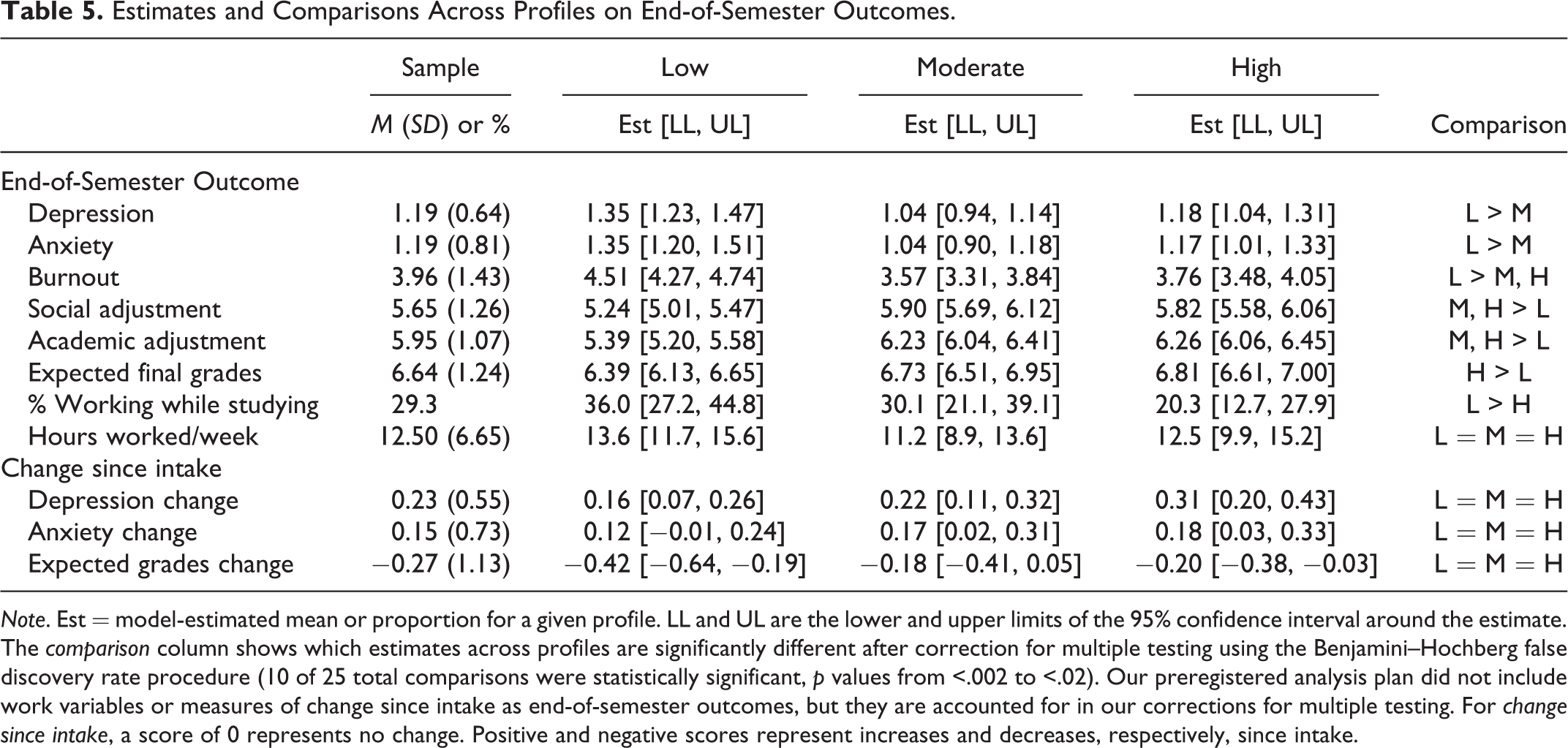
Note. Est = model-estimated mean or proportion for a given profile. LL and UL are the lower and upper limits of the 95% confidence interval around the estimate. The comparison column shows which estimates across profiles are significantly different after correction for multiple testing using the Benjamini–Hochberg false discovery rate procedure (10 of 25 total comparisons were statistically significant, p values from <.002 to <.02). Our preregistered analysis plan did not include work variables or measures of change since intake as end-of-semester outcomes, but they are accounted for in our corrections for multiple testing. For change since intake, a score of 0 represents no change. Positive and negative scores represent increases and decreases, respectively, since intake.
Supplemental Analyses
None of the profiles we identified revealed distinct, contrasting variable configurations tied to different levels of helicopter parenting. Indeed, the profiles and their associations with end-of-semester outcomes largely summarize main effects of positive parenting. As an exploratory, supplemental analysis, we performed regression analyses to rule out the possibility that our profile configurations masked smaller, but potentially meaningful, two-way moderating associations between helicopter parenting, dimensions of positive parenting, and student academic motivation (these tests were exploratory and not part of our preregistered analysis plan). We regressed each end-of-semester outcome on intake measures of helicopter parenting, dimensions of positive parenting, student academic motivation, and all their two-way interactions with helicopter parenting. We adjusted for the same set of intake covariates we included in the LPA.
Three interactions emerged between helicopter parenting and intrinsic motivation for end-of-semester depressive symptoms, social adjustment, and academic adjustment. Note that plots depicting these conditional associations suggest effects that are small, restricted, and that may not replicate in a new sample. With these cautions in mind, we observed that helicopter parenting was associated with more depressive symptoms (Figure 2A) and poorer academic adjustment (Figure 2B) only when intrinsic motivation was near the sample mean or lower (comprising 50% of the observed data for the interaction predicting depressive symptoms and 43% for the interaction predicting academic adjustment). Raw data in Figure 2 highlight the small sizes of these effects, and the 95% confidence regions around the simple slopes depicted in each panel (+ and −1 SD from the mean of intrinsic motivation) largely overlapped. 6 Helicopter parenting was unrelated to social adjustment except when intrinsic motivation was very high (1.4 SD above average or higher, comprising 7.2% of the observed data), at which point helicopter parenting predicted better social adjustment. Results suggest that effects of helicopter parenting behaviors on depressive symptoms and academic adjustment are not meaningfully different at varying levels of intrinsic motivation, and given our cautions above may not represent true associations in the population. These findings increased our confidence that helicopter parenting, as measured in this study, plays a limited role in student success during the transition to university.

Supplemental analysis: Interaction effects showing associations between helicopter parenting in September and end-of-semester depressive symptoms and academic achievement, moderated by intrinsic motivation reported in September. Lines show simple slopes of helicopter parenting at low (1 SD below average) and high (1 SD above average) intrinsic motivation. Gray-shaded areas are 95% confidence bands around each simple slope. Observed data are shown as a scatterplot, color coded by intrinsic motivation.
Discussion
This study identified common combinations of perceived helicopter parenting, positive parenting, and academic motivation at the beginning of students’ first semester of university and tested whether some combinations were associated with relatively greater or poorer well-being by the end of the Fall semester. Varying levels of positive parenting was the strongest distinguishing characteristic across profiles. Helicopter parenting was virtually identical across profiles. As anticipated, intrinsic motivation was highest in the profile that also showed the highest ratings of positive parenting. Amotivation was highest in the profile that showed the lowest ratings of positive parenting. End-of-semester outcomes were poorest in the low positive parenting profile for all measures. Below, we discuss three key findings emerging from this study.
A Positive Parenting Environment at the Transition to University Features Autonomy Support, Emotional Warmth, and Age-Appropriate Involvement
First, we found that positive parenting was typical in this sample. Two thirds of participants were classified in the high and moderate profiles, likely due in part to some continuity of already-established positive parenting from adolescence into emerging adulthood (e.g., Lindell & Campione-Barr, 2017). This interpretation is consistent with other longitudinal studies showing that family positivity and stability are typical. Stable, low levels of parent–child conflict characterized 65% of one sample of undergraduates tracked over a 19-month period (S. C. Nelson et al., 2015). Similarly, the most common profile in another first-year sample (46.7%) was of consistently good mental health co-occurring with family support that grew stronger over the course of the year (Azmitia et al., 2013). However, positive parenting in the present study is embedded in a larger picture of sociodemographic advantage and initial well-being that was evident to a greater extent in the high and moderate profiles (e.g., higher family incomes, fewer working while studying), and may to some extent reflect advantages that are more typical of university-attending students compared to emerging adults attending community college or completing vocational training. Students who arrived on campus reporting the most positive parenting environments also tended to be the least depressed and anxious and expected to earn at least a mix of As and Bs during their first semester. Better apparent end-of-semester outcomes relative to the low profile likely reflect differences that were already present within the first weeks of the transition to university and that may also be due to other important indicators of success and well-being not included in this study.
Mean positive parenting scores in the low profile were lowest but were also above the midpoint of the measure, a caution against characterizing this profile as emphasizing poor autonomy support, low warmth, and age-inappropriate involvement. Some students may have evaluated their parents less favorably in part because of other sources of disadvantage operating during the transition to university. We anticipated that less positive parenting and high amotivation would co-occur with helicopter parenting behaviors, but this was the only parenting measure that did not discriminate across profiles.
Helicopter Parenting Occurs Infrequently and Is Not Associated With Advantages or Disadvantages During the Transition to University
A second key finding from this study was that helicopter parenting was no more or less prevalent when paired with any other combinations of positive parenting and academic motivation. Indeed, estimated mean scores across profiles on helicopter parenting differed by 0.11 points or fewer (about 12% of an SD). Our findings are similar to those from an LPA conducted by Padilla-Walker et al. (2019) with a community sample of 19-year-old emerging adults, mostly in college, using the same helicopter parenting measure as in this study. Profiles were labeled “warm helicopter” and “controlling helicopter,” for example, but estimated mean scores on helicopter parenting across profiles ranged from about 1.3 to just over 2.5 on the same 1–5 scale and similarly failed to differentiate profiles.
One plausible conclusion is that helicopter parenting occurs too rarely to be a systematic indicator of problematic parenting. Indeed, 87% of students in this study responded negatively to the prompt “My mother (father) intervenes in settling disputes with my roommates or friends.” If more extreme parent behaviors occur only rarely, it is unlikely that helicopter parenting poses a widespread problem for student success and well-being during the transition to university. Another possibility is that helicopter behaviors occur equally often but have different impact in different families. In the context of warm, autonomy-supportive parenting, occasional helicopter-like behaviors may be perceived as supportive; as examples of parents stepping in when they see a need, even if the emerging adult is capable of handling the problem on their own. This possibility calls into question whether specific behaviors truly constitute helicopter parenting if they are only occasional and context-dependent (e.g., calling a cell phone provider on your child’s behalf to settle a billing dispute). The skewed distribution of scores on the measure of helicopter parenting in this study suggests that few students perceived their parents to be consistently, excessively intrusive. For those few students, however, our supplemental regression analyses did indicate slightly poorer end-of-semester depressive symptoms and adjustment to university when intrinsic academic motivation was low.
Intrinsic Academic Motivation Co-Occurs With Positive Parenting
Third, and contrary to our expectations, parent helicopter behaviors were rated similarly by students assigned to profiles that featured higher and lower academic motivation. The only evidence supporting co-occurring helicopter parenting and poor academic motivation came from the supplementary analysis noted above. Our LPA showed that high positive parenting generally went along with high intrinsic motivation and that these students fared better than others by the end of the semester. In contrast, the combination of less positive parenting and higher amotivation in the low positive parenting profile suggests that some students may be struggling with a more challenging transition to university or some degree of stage-environment misfit (e.g., Rogers et al., 2018). In other research, lower autonomy support prior to the transition out of high school predicted more depression and emotional exhaustion 1 year after high school (Duineveld et al., 2017). Ambivalence toward one’s program of study and a desire for more independence may be at odds with the levels of autonomy support present in some students’ families, providing additional context for poorer well-being observed in this profile at the beginning and end of the first semester.
Study Limitations
Our self-report data reflect students’ perceptions and experiences of their parenting environments and offer a critical perspective needed to understand outcomes associated with parenting behaviors (Morris et al., 2002). However, students’ and parents’ perspectives do not necessarily agree (e.g., Segrin et al., 2012), and our findings generalize only to how students perceive their parenting environments. Other dimensions of parent behavior not measured here (behavioral control, psychological control) may offer additional insights to help explain why helicopter parenting in particular did not discriminate. We also acknowledge the possibility that helicopter parenting emerges gradually and is not a source of impairment during the first few weeks of the semester. We restricted our parenting measures to the baseline administration in this study in an effort to reduce respondent burden, but later or repeated assessments of parenting behaviors across the first year of university—positive and helicopter—would be informative. Reaching further back in the life course, it also remains to be tested whether helicopter parenting is an extension of oversolicitous/overprotective parenting in childhood and adolescence for some emerging adults (Brenning et al., 2017) versus failure on the part of some families to renegotiate age-appropriate boundaries for parent involvement.
Separate models capturing students’ perspectives on their mothers’ and fathers’ parenting may also be fruitful, given differences in maternal and paternal parenting (Dyer et al., 2014) that may be obscured in this study by combining reports across mothers and fathers. However, an important limitation of classification-based methods including LPA is the inherent subjectivity in model selection and heightened potential for identifying spurious, nonreplicable profiles (e.g., Bauer & Curran, 2003; Masyn, 2013). Side-by-side comparisons of mother and father models, without also cross-validating the results in new data (see Lanza & Rhoades, 2013), run the risk of attributing maternal and paternal differences where none exist.
One important limitation may be ambiguity in the definition and measurement of helicopter parenting. We are aware of six published questionnaire measures of helicopter parenting (LeMoyne & Buchanan, 2011; Luebbe et al., 2016; Odenweller et al., 2014; Padilla-Walker & Nelson, 2012; Schiffrin et al., 2014; Segrin et al., 2012), but no single consensus operational definition. A behavior such as rewriting an academic paper for your child (Luebbe et al., 2016) is a face valid exemplar, but many others are ambiguous or highly appropriate when context is taken into account (e.g., buying plane tickets home for an emerging adult living away from home to go to university, Segrin et al., 2012). The oversupply of helicopter parenting measures in a nascent field of study that lacks a consensus operational definition risks building a cumulative body of evidence compromised by the jingle fallacy (that scales measure the same construct because they bear similar names). Findings across studies have largely not been replicated with consistent measures, and there may be important unexamined cultural and regional differences in this construct. We caution that further measurement validity work is needed.
Conclusion
In sum, we found that characteristics of positive parenting—autonomy support, warmth, and age-appropriate involvement—continue to be meaningful during the transition to university. Helicopter parenting, in contrast, was infrequent and did not co-occur systematically with positive parenting and student academic motivation. This finding suggests that concerns featured in popular media around helicopter parents as an impediment to student success should be tempered. More generally, our results do not support the notion that too much parent involvement promotes negative outcomes, at least within the first semester of university. On the contrary, students who perceived less age-appropriate involvement (and warmth and autonomy support) were the ones who fared worse. Evidence of lasting benefits to well-being associated with parental involvement from this study and others (e.g., Mendoza et al., 2019; Wintre & Yaffe, 2000) reinforces the view that parents can play an active role in promoting student success during the transition to university.
Footnotes
Author Contributions
Andrea L. Howard contributed to the conception and design and to the acquisition, analysis, and interpretation; drafted the manuscript; critically revised the manuscript; gave final approval; and agreed to be accountable for all aspects of work ensuring integrity and accuracy. Sean M. Alexander contributed to the acquisition, analysis, and interpretation; drafted the manuscript; critically revised the manuscript; gave final approval; and agreed to be accountable for all aspects of work ensuring integrity and accuracy. Leigh C. Dunn contributed to the acquisition and interpretation, drafted the manuscript, critically revised the manuscript, gave final approval, and agreed to be accountable for all aspects of work ensuring integrity and accuracy.
Declaration of Conflicting Interests
The authors declared no potential conflicts of interest with respect to the research, authorship, and/or publication of this article.
Funding
The authors disclosed receipt of the following financial support for the research, authorship, and/or publication of this article: This research was supported by funding from an Insight Grant awarded to A. Howard by the Social Sciences and Humanities Research Council of Canada.
Open Practices
The analysis plan for the study reported here was preregistered and can be accessed at https://osf.io/gh8qb/wiki/home. The complete Open Practices Disclosure for this article can be found at  . This article has not received the badges for Open Data and Open Materials.