




Abstract
The current study explored whether and to what extent different procreative options (natural conception, adoption, homologous techniques, and heterologous techniques) were perceived as enriching or threatening to young adults’ expectation of identity motives fulfillment. Our sample consisted of 1380 Italian young adults (62.9% women) aged between 18 and 33 years who participated in a national online survey on young adulthood. Results showed that participants expect natural conception to be more enriching to their identity, whereas they expected heterologous techniques to be more threatening to their identity compared to all other procreative options. Moreover, participants perceived adoption in the event of one’s partner’s sterility to be more enriching to their identity compared to both homologous and heterologous assisted reproductive techniques. Data were also analyzed taking into account the participants’ sex, age, and religious beliefs.
Keywords
Background
Young adulthood is a critical period in which significant life course changes occur, such as leaving the parental home and preparing to assume adult roles related to getting married and having children (Rindfuss, 1991). During this period, young adults construct meaning and use this information in anticipating their future life trajectories (Hall & Walls, 2016). A growing body of research has explored young adults’ attitudes and expectations about marriage (e.g., Willoughby & Hall, 2015); sexual and fertility behavior (e.g., Abramowitz, 2018; Holland & Keizer, 2015); and work–family conflict (Thoman et al., 2021) and childbearing, whether and when to enter parenthood (Brauner-Otto & Geist, 2018). Yet, little is known about young adults’ expectations about different ways of becoming parents.
In the last few decades, indeed, the transition to parenthood has become increasingly complex. If for centuries, the birth of a child was experienced as a natural occurrence, out of personal control, now individuals have the possibility to plan whether and when to have children. In addition, in recent years, great changes have occurred with regard to how one can become a parent. Increasingly, individuals may become parents via experiences that differ from natural conception, not only through adoption, but also by employing assisted reproductive technologies (ARTs), with homologous and heterologous techniques (e.g., Furstenberg, 2014). In the case of homologous techniques, the gametes are from the couple of prospective parents so that the child shares their same genetic heritage. In contrast, heterologous techniques involve gametes external to the couple, the so-called donors (egg, sperm, or embryos); in this case, the child’s genetic heritage may be completely extraneous to those of his/her parents, or may be in common with only one of the parents.
Regardless of how it occurs, the transition to parenthood brings relevant changes in several areas of life, and, especially, a profound restructuring of one’s identity (e.g., Cowan & Cowan, 1992). In particular, becoming a parent is associated with the satisfaction versus threat of basic individual needs (i.e., identity motives). Identity motives are motivational pressures toward particular ways of perceiving oneself, and are especially relevant in guiding future behaviors (Vignoles et al., 2008). Before the transition to parenthood, individuals have expectations on how their identity will be redefined: Previous research has suggested that expectant parents be given “anticipatory guidance” that may or may not facilitate the adjustment to the new situation, in terms of the acquisition of a parental identity and the sense of fulfillment in their parenting role, also impacting children’s development (O’Laughlin & Anderson, 2001).
Literature so far has been primarily focused on individuals already making the transition into parenthood (e.g., prospective parents). The aim of the current study was to explore whether and to what extent different procreative options (natural conception, adoption, homologous techniques, and heterologous techniques) were perceived as enriching or threatening to young adults’ expectations of identity motives fulfillment. Young adults are therefore a unique target population when studying expectations about their identity motives fulfillment with regard to different procreative options.
Becoming a Parent: Identity Enrichment or Threat?
Parenthood is one of the most intense family transitions as it brings profound changes in different life domains (e.g., Belsky & Kelly, 1994; Cowan & Cowan, 1992). In particular, becoming a parent involves a great identity change. In general, new parents enrich their identities not only by adding new aspects to their identity structure, but also by reorganizing the already-existing elements of the self-concept (Strauss & Goldberg, 1999). However, parenthood is not always experienced as an opportunity for enrichment and growth: Transitioning to parenthood may involve feelings of self-loss and difficulties in integrating the new elements into the identity structure (Laney et al., 2015). Similar to other significant life transitions, therefore, the identity change deriving from the transition to parenthood can enrich or threaten the identity itself (Cigoli & Scabini, 2007).
Psychosocial literature has investigated how becoming parents can be an occasion of enrichment and/or threat to identity motives, that is, motivational pressures toward particular ways of perceiving oneself. Vignoles et al. (2006, 2008) showed that people, in the construction of their identity, are motivated to enhance feelings of self-esteem, continuity, distinctiveness, belonging, efficacy, and meaning. In particular, literature exploring the link between identity motives and the transition to parenthood has primarily focused on the motives of meaning in life (i.e., the need to find significance or purpose in one’s own existence), self-esteem (i.e., the motivation to maintain and enhance a positive self-concept), and belonging (i.e., the need to maintain and enhance feelings of closeness to other people).
Having children is a source of meaning in people’s lives, providing valuable goals to pursue, and defining personal life purposes (Delle Fave & Massimini, 2004; Nelson et al., 2014). Parents are more likely to report thoughts about meaning in life and daily meaningful moments more frequently than non-parents (Nelson et al., 2013). In addition, parents report that spending time with their children is experienced as highly meaningful and rewarding compared to other daily activities (Nelson et al., 2013; White & Dolan, 2009). Moreover, becoming a parent positively contributes to an individual’s sense of meaning, by providing an opportunity to buffer death-related anxiety and experience personal growth (Taubman-Ben-Ari, 2012).
The transition to parenthood also affects self-esteem. Research has shown that parents, especially mothers, report a decrease in self-esteem during the year after the birth of the first child, in response to stress and demands associated with the new parental role (Bleidorn et al., 2016; Chen et al., 2016; van Scheppingen et al., 2018). However, this negative impact on self-esteem can be buffered through cumulative parenting experience (Chen et al., 2016). Indeed, parenting could be considered in the long term as an opportunity to master the challenges associated with parenting and to consequently experience a sense of control over the self, which may lead to increased self-esteem (Erol & Orth, 2011; Robins & Trzesniewski, 2005).
The need to belong is another identity motive significantly affected by the transition to parenthood. Childbirth represents an opportunity for parents to activate or reconstitute their social bonds, which can fulfill their needs of support (Baumeister & Leary, 1995; Levitt, 2005). In particular, following the birth of a child, contact with parents and other family members tends to increase (Bost et al., 2002), thus increasing the emotional connection and sense of belonging to close family members (Doherty & Feeney, 2004).
In summary, research has documented that the transition to parenthood is a critical event that may or may not fulfill identity motives, while the individuals’ expectations on how their identity motives will or will not be fulfilled by the new parent identity role have been understudied. Moreover, there is a gap in the literature about the expectations on how identity motives will or will not be fulfilled by different paths to parenthood.
Different Procreative Options: Tasks and Challenges
As already mentioned, individuals may become parents via experiences that differ from natural conception, not only through adoption but also by using ARTs. These new paths to parenthood may carry specific challenges, which add complexity to the normative developmental tasks.
With regard to adoption, parents find themselves facing additional challenges related to absence of the genetic link with the adopted child. They are expected to engage in an inner “entitlement process” (Cohen et al., 1996), where they assume the new role as parents of that particular child, turning something that is different into something that is a part of the family; they are expected to acknowledge and give value to the different origin of the child, which is often also associated with cultural and ethnic differences (Ferrari et al., 2019), and they often find themselves having to cope with children who are physically, emotionally, and behaviorally compromised due to early adversities (Canzi et al., 2018).
When it comes to ART, parents must confront some specific challenges as well. They must endure highly demanding and stressful physical procedures. They may approach parenthood with very high expectations of themselves as parents, experiencing excessive concern about their performance and that of their child, developing unrealistic concerns and an overprotective parenting style (McMahon & Gibson, 2002). Some studies have indeed documented that couples who pursued ART, compared with those who conceived spontaneously, reported lower confidence in their own parenting ability (Hammarberg et al., 2008). In case of heterologous techniques, the situation is even more complex, due to the “procreative inequality” between partners: When having a child through gamete donation, only one parent can transmit the genetic heritage, and the other consequently becomes the so-called “social parent,” who does not have genetic ties to the child (Canzi et al., 2019).
In summary, even if different paths to parenthood share some similarities, they are also unique. Thus, we expected that young adults, when anticipating different paths to parenthood, may have different expectations related to identity motive fulfillment.
The Current Study
In the current study, we aimed to explore whether and to what extent different procreative options (natural conception, adoption, homologous techniques, and heterologous techniques) were expected by young adults to be threatening or enriching to their identity motives. In line with the literature (e.g., Baumeister & Leary, 1995; Bleidorn et al., 2016; Nelson et al., 2014), we focused on the identity motives more strongly associated with the transition to parenthood, that is, self-esteem, meaning, and belonging. We hypothesized that, when anticipating becoming a parent thought adoption or ARTs, given the additional challenges these paths to parenthood pose, young adults would expect lower fulfillment of identity motives compared to natural conception.
A second aim was to explore whether and how socio-demographics (sex and age) and religious beliefs interacted with procreative options in affecting young adults’ expectations of identity motives fulfillment. To this regard, we hypothesized that women would expect to be more threatened than men when anticipating becoming a parent through adoption or ARTs compared to natural conception, given the greater investment women place on maternity. Literature, in fact, supports the idea that the parental role is more important, emotionally-charged, and central to self-identity for women than for men (Arendell, 2000; Simon, 1992). Maternity touches on crucial dimensions of personal identity that take on importance and priority with respect to the self, boosted also by the physical experience (i.e., pregnancy and breastfeeding).
With respect to age, we hypothesized older individuals expect to be more threatened than younger individuals when anticipating becoming a parent through adoption or ARTs compared to natural conception. Older individuals may perceive the experience of parenthood as more proximal and may more carefully consider the challenges posed by paths to parenthood that are different from natural conception.
We also considered the role of religious beliefs. We hypothesized that religious young adults would expect to be more threatened than atheistic young adults when anticipating parenthood via ARTs compared to natural conception and adoption. Indeed, religious beliefs are strongly connected to family plans and may shape individuals’ expectations regarding different procreative options. Most religions, including Christian ones, encourage childbearing and highlight the importance of family ties, promoting more traditional choices regarding marriage and family (Grasmick et al., 1990; Jensen & Jensen, 1993). Conversely, no religious affiliation is associated with higher acceptance of childlessness and lower fertility (Bulcroft & Teachman, 2004; Koropeckyj-Cox & Pendell, 2007). However, religious beliefs can also influence the types of medical treatment perceived as acceptable, raising greater ethical and moral concerns (Canzi et al., 2020; Best et al., 2019; Greil et al., 2010). Indeed, most religions discourage or even prohibit ARTs (Lindheim et al., 2014; Sallam & Sallam, 2016; Schenker, 2005) promoting other options to face infertility, such as adoption (Belanger et al., 2008; Hollingsworth, 2000; Lamb, 2008; Park & Wonch Hill, 2014; Van Laningham et al., 2012).
Method
Participants and Procedure
The data of the current study derive from the database of “Rapporto Giovani,” which is a nation-wide Italian survey, launched in 2015 by the Toniolo Institute of Advanced Studies with the inclusion of the CARIPLO Foundation and IPSOS Ltd as executive partners. Every year, a survey is carried out in order to explore several aspects of the life of Young Italian People. Participants were chosen with a stratified sampling technique representative of young adults residing in Italy (by gender, age, geographical origin, education, marital status, etc.). In selecting respondents without children and respondents for whom religious faith was reported 1 , our sample resulted in 1380 Italian young adults (62.9% women and 37.1% men) aged between 18 and 33 years (Mage = 25.89, SD = 4.25). Considering place of residence, respondents were distributed as follows: 25.1% lived in the Northwest of Italy, 15.6% in the Northeast, 16.7% in the Center, and 42% in the South of Italy or on an island, whereas .5% lived abroad. With regard to the level of education, 5.6% had completed only middle school and 61% had completed only high school, whereas 33.4% had reached a university degree. With regard to respondents’ relationship status, 55.6% were in a stable romantic relationship, of which 14% were married. Most participants had parents who were married or cohabiting (88.6%), some had parents who were separated or divorced (11.2%), and only two had unmarried and uncohabiting parents (.2%). None of the participants had children yet. Finally, most participants were Christians (65%), 10.4% reported to believe in a “personal God” without any specific religious affiliation, and 24.6% were atheist. With regard to the perceived importance of religion in one’s own life 2 , Christians reported a medium-high level of religiosity (M=3.23, SD = 1.05), young adults believing in a “personal God” reported a medium level of religiosity (M = 2.36, SD = 1.25), whereas atheistic young adults reported a low level of religiosity (M = 1.37, SD = .76).
The survey was carried out by a mixed methodology: Computer Assisted Telephone Interviewing and Computer Assisted Personal Interviewing, and by Computer Aided Web Interviewing subsequently going more in-depth. More technical details are found at this website: https://www.istitutotoniolo.it. Participants were informed about the main objectives of the study, asked to provide their informed consent to their participation, and were advised that their participation was free and voluntary. The study was approved by the Family Studies and Research University Centre and it followed the APA ethical guidelines for human research (http://www.apa.org/ethics/code/).
Measures
Identity threat. Participants were asked to imagine having a child through natural conception, adoption, homologous techniques, and heterologous techniques, and, for each procreative option, to complete the identity threat scale (Manzi et al., 2006) with respect to three identity motives: self-esteem, meaning, and belonging. When focusing on heterologous techniques and adoption, participants were specifically asked to imagine pursuing these procreative options because of their partner’s sterility, in order to prevent the interference of a sense of guilt in their response. In order to prevent potential order effects, the questions were randomly presented. The scale consists of a set of items (Manzi et al., 2006) measuring the individual’s expectation that the satisfaction of identity motives for self-esteem, meaning, and belonging would be threatened or enriched if they became parents. Each motive was represented by two items, one worded positively, and the other negatively. We created a composite index for each motive by reversing the positively-worded item, and then averaging the two items. Item examples are “I expect to feel worthless” (threat to self-esteem), “I expect to feel that my life is meaningful” (enrichment of meaning), and “I expect to feel isolated” (threat to belonging). Higher scores indicate higher threat to identity motives, whereas lower scores indicate higher enrichment to identity motives. The scale showed good reliability (rrange = .69–.76).
Analytical Strategy
In order to test the effect of each procreative option on the level of the identity motives, we performed a repeated measure ANOVA with procreative options as the within-subjects factor. In addition, in order to explore the roles of sex, age, and religious belief, we performed three mixed-design ANOVA, of which we entered a between-subjects variable in each (sex: women and men; age: 1 = born between 1982 and 1986, 2 = born between 1987 and 1991, and 3 = born between 1992 and 1997; and religious belief: 1 = Christians, 2 = people believing in a “personal god”, and 3 = atheistic people), with procreative options as a within-subjects factor. Sidak multiple comparisons tests were used to explore significant interaction effects. Statistical and post-hoc power analyses were performed using SPSS™ 21 (IBM Coorporation, Armonk, NY, USA).
Results
Results showed a significant main effect of procreative options on all the identity motives (F[3,4137] = 322.416, p = .000, ηp2 = .19, power = 1 for esteem; F[3,4137] = 134.876, p = .000, ηp2 = .09, power = 1 for meaning; F[3,4137] = 136.321, p = .000, ηp2 = .09, power = 1 for belonging). Specifically, participants perceived lower threat to self-esteem, meaning, and belonging when focusing on natural conception compared to all other procreative options. When thinking about the heterologous techniques, participants reported higher levels of threat to all the identity motives compared to all other procreative options. Moreover, when thinking about adoption, participants reported lower levels of threat to self-esteem and belonging compared to homologous techniques, whereas no significant differences were found between these two procreative options with regard to meaning (Figure 1). Means and SDs of identity motives (esteem, meaning, and belonging) for each procreative option (natural conception, adoption, homologous techniques, and heterologous techniques).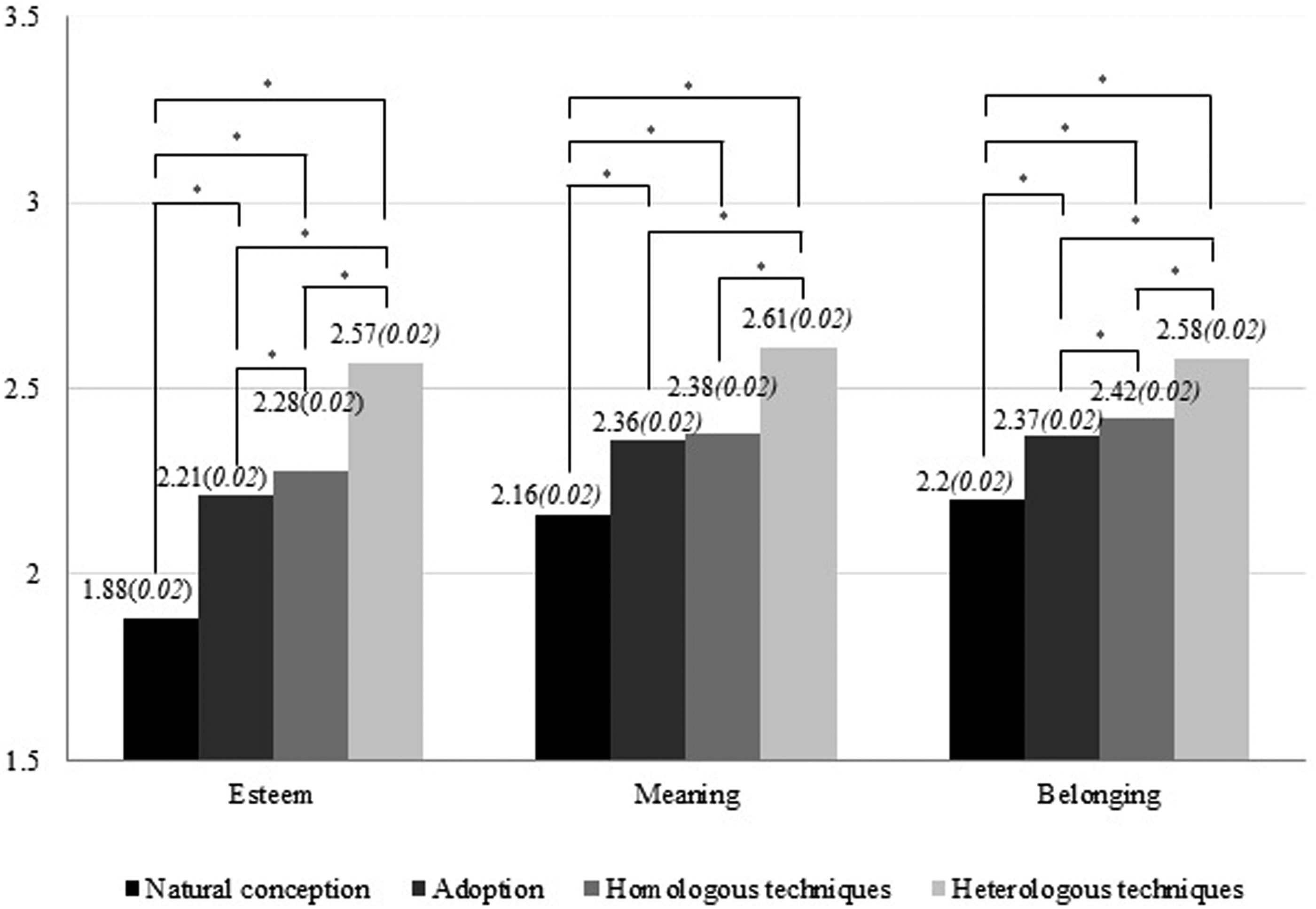
A significant, but irrelevant (as the effect size is small) main effect of sex was found for self-esteem (F[1,1378] = 7.609, p = .006, ηp2 = .005, power = .79) and belonging (F[1,1378] = 5.417, p = .02, ηp2 = .004, power = .64). No significant main effect of sex was found for meaning. A significant, but irrelevant, interaction effect of procreative options X sex was found for self-esteem (F[3,4134] = 11.223, p = .000, ηp2 = .008, power = .99), meaning (F[3,4134] = 7.088, p = .000, ηp2 = .005, power = .98), and belonging (F[3,4134] = 6.080, p = .000, ηp2 = .004, power = .95).
Neither significant main effect of age groups, nor a significant interaction effect procreative options X groups of age were found for self-esteem, meaning, and belonging.
A significant, but irrelevant, main effect of religion was found for self-esteem (F[2,1377] = 5.610, p = .004, ηp2 = .008, power = .86), for meaning (F[2,1377] = 4.440, p = .012, ηp2 = .006, power = .76), and for belonging (F[2,1377] = 3.076, p = .046, ηp2 = .004, power = .59). A significant procreative options X religious belief interaction effect emerged for meaning (F[6,4131] = 7.375, p = .000, ηp2 = .011, power = 1]. Multiple comparisons tests (Figure 2) highlighted that Christians and people believing in a "personal God" perceived lower threat to meaning when focusing on natural conception compared to all other procreative options, whereas atheistic people perceived lower threat to meaning when focusing on natural conception, compared only to heterologous techniques. Significant, but irrelevant, procreative options X religious belief interaction effect emerged for esteem (F[6,4131] = 5,165, p = .000, ηp2 = .007, power = .99) and for belonging (F[6,4131] = 5,485, p = .000, ηp2 = .008, power = .99). Means and SDs of meaning for each procreative option (natural conception, adoption, homologous techniques, and heterologous techniques) distinguishing for religious belief (Christians, people believing in a “Personal God,” and atheistic people).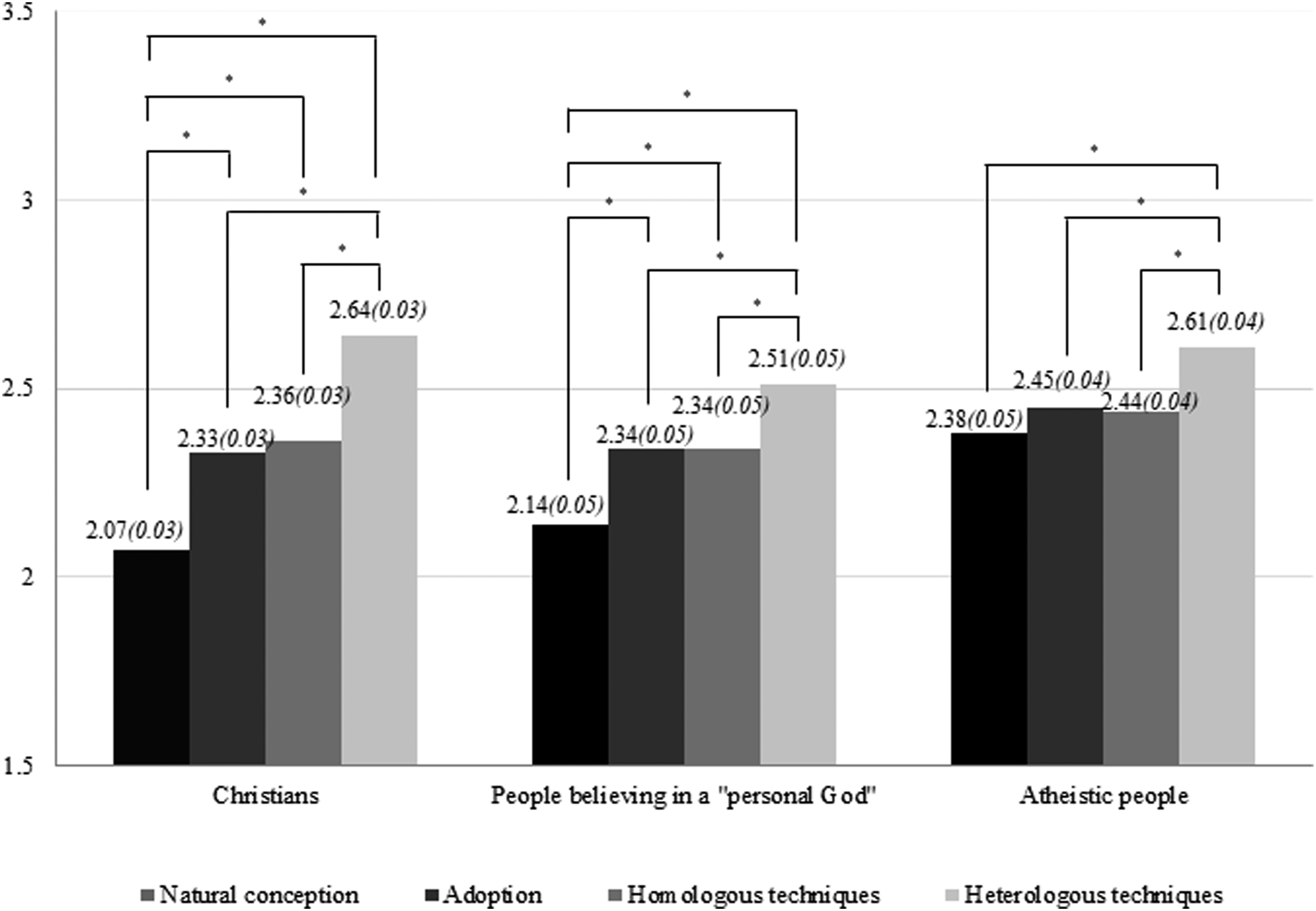
Discussion
The current study, the first to our knowledge, explored whether and to what extent different procreative options (natural conception, adoption, homologous techniques, and heterologous techniques) were perceived as enriching or threatening to young adults’ expectation of identity motives fulfillment, also exploring the roles of sex, age, and religious belief.
The study presented a relatively clear pattern of findings. Globally, young adults perceived natural conception as more enriching to their identity, enhancing a positive conception of oneself, one’s own existence, significance, and feelings of closeness to other people, compared to all other procreative options. In contrast, the heterologous techniques turned out to be the most challenging procreative option in respondents’ perceptions. Indeed, the heterologous techniques were associated with higher levels of identity threat for all motives compared to all other procreative options. Some studies have suggested that for mothers who conceived through ART, the process of assuming a maternal identity may be related to lower self-esteem and lower sense of competence during post partum adjustment, although these effects seemed to disappear over time (Cohen et al., 2000; Gibson et al., 2000; McMahon, 1999). Authors have argued that this could be attributed to the extra psychological demands related to infertility these mothers face (Fisher et al., 2012). Our data, additionally, suggest that just imagining having a child through ART may lead young adults to perceive a greater threat to identity and to anticipate future possible concerns, especially when it comes to heterologous techniques. The involvement of gamete donors in the process of becoming a parent may raise questions about one’s own identity and also about how to manage the meaning of genetic origins (Canzi et al., 2019).
Our results also revealed a positive attitude toward adoption as a form of parenthood in the event of one’s partner’s sterility: Adopting a child seemed to have a more positive impact on identity with regard to esteem and belonging, when compared to homologous and heterologous techniques. Despite a general negative trend in the existing data about the number of parents deciding to adopt a child compared to those pursuing ARTs (Park & Wonch Hill, 2014), from a psychological point of view imagining adopting a child turned out to support and enrich identity. This could be due to the fact that participants were asked to anticipate the transition to parenthood. Further studies should explore the disconnection between having a positive attitude toward adoption and actually engaging in this practice, considering the individual (e.g., infertility and humanitarianism) and contextual factors (e.g., availability of children and adoption-related policies and practices) that may influence the response.
Surprisingly, no differences emerged in relation to respondents’ sex and age groups. This is probably due to the peculiar features of the Italian context, characterized by a marked postponement of the transition to adulthood and a prolonged time living in the parental home (Carrà et al., 2014; Crocetti et al., 2015). Youth, both female and male, in this age range, despite large, share developmental similarities that may flatten differences when anticipating the transition to parenthood.
A significant effect of religious belief was found. Specifically, for Christian young adults and those believing in a “personal God” natural conception was perceived as more enriching to one’s own existence compared to all other procreative options. In contrast, atheistic young adults perceived lower threat to meaning when focusing on natural conception compared only to heterologous techniques. Although the importance of having children may be universal, religious beliefs may significantly contribute to shaping how the transition to parenthood is expected to be experienced (Schenker, 2005). It is worth noting that in our sample, heterologous techniques were perceived as more threatening to the identity motives of meaning and belonging than natural conception, regardless of the religious belief. Despite the idea that religious beliefs are associated with greater ethical and moral concerns about the heterologous techniques (Greil et al., 2010), from a psychological point of view the involvement of gamete donors in the process of becoming a parent may raise questions about one’s own identity, regardless the type of religious beliefs. Our data are in line with research that has documented a more controversial attitude toward heterologous techniques in the general population (Daniluk & Koert, 2012; Stöbel-Richter et al., 2009).
This study includes some limitations. First, some potential confounding variables (e.g., ethnicity, individual’s psychological well-being, relationship status, sexual orientation, gender identity, life situation, having already thought about this topic, and intentions to have children) should be considered in order to have a more complete portrait of this complex phenomenon in the future. A young adult, for example, may have an idealized view of parenthood, thus affecting the way he/she anticipates the transition to parenthood, as well as their expectations about certain procreative options rather than others. Second, no participants who belong to other religions (for example, Judaism, Islam, Hinduism, and Buddhism) were included in the current study. Future research should explore whether and to what extent these religious beliefs may influence young adults’ expectations as threatening or enriching to one’s own identity motives when anticipating different procreative options. Third, the potential downsides of the study design should be considered: Within-participant design might suffer from repeated measures biases and related effects, such as practice, boredom, and fatigue. Finally, the study is cross-sectional, which limits the opportunity of causal inferences. Longitudinal studies specifically focused on the transition to parenthood are required to confirm our findings.
Despite the above limitations, our results may be informative for all health professionals working in the field of infertility. A deeper understanding of how the different procreative options guide young adults’ identity construction and future behaviors is important in order to identify possible resources and challenges related to this critical transition, as well as to develop more effective counseling strategies. Indeed, it is largely documented that the level of preparation for childbirth and parenting is significantly associated with the quality of child-parent relationships later on (Gadsden et al., 2016). Moreover, our data suggest the crucial role of religion in shaping personal expectations, which should be considered when providing intervention.
Footnotes
Declaration of Conflicting Interests
The author(s) declared no potential conflicts of interest with respect to the research, authorship, and/or publication of this article.
Funding
The author(s) disclosed receipt of the following financial support for the research, authorship, and/or publication of this article: This study is supported by Istituto Giuseppe Toniolo di Studi Superiori
Transparency and Openness Statement
The raw data, analysis code, and materials used in this study are not publicly available because of local legal and privacy restrictions (Italian Data Protection Code – Legislative Decree No. 196/2003). However, the raw data supporting the conclusions of this manuscript can be made available by the corresponding author to qualified researchers upon request, following the completion of a privacy and fair use agreement. No aspects of the study were pre-registered.
