



Abstract
College students who live off campus vs. on campus substantially differ, which may be due to socialization or self-selection. We examined longitudinal differences in academics and activities, alcohol use and adjustment, and sexual behaviors between college students who remained on campus vs moved off campus (N = 607). Findings provide more support consistent with selection than with socialization effects. At the start of college, students who eventually moved off campus were less likely to work, drank alcohol more frequently, felt better about their self-image in social relationships, and recently had more kissing and penetrative sex partners than their peers who stayed on campus. When there was support for differences in change over time, it generally indicated that the two groups became more, not less, similar. In support of Developmental Systems Theory (Lerner & Walls, 1999), findings suggest students shape their own environments, and have implications for developing targeted prevention programming.
Introduction
Compared to their on-campus peers, college students who live off campus are more likely to drop out of school, drink heavily, and engage in unprotected sex (Benz et al., 2017; DiBello et al., 2018; Schudde, 2011), but also have higher self-esteem and more positive peer interactions (Valliant & Scanlan, 1996). What explains these differences? One possibility is socialization effects, with the context of where students live directly affecting these emerging adults. Ecological Systems Theory (Bronfenbrenner, 1986) suggests that interactions with one’s environment influence development through the socialization process. Moving off campus may lead to increased changes for students who previously lived on campus, compared to their peers who remain on campus. Compared to the on-campus environment, the off-campus environment may influence students to engage in behaviors that are sometimes less healthy. Another possibility is selection effects, with students selecting environments consistent with their preexisting beliefs and behaviors. According to Developmental Systems Theory, individuals produce and shape their own environments (Lerner & Walls, 1999), suggesting that differences may not be caused by the environment, but be a result of individuals’ choices in line with preexisting preferences.
For many emerging adults, the college years are a period of semiautonomy (Goldscheider & Davanzo, 1986), during which they live away from their parents for the first time, are not fully financially independent, and are still supervised by adults such as professors, resident advisors, and other authority figures. In addition, this time corresponds to a period of individual exploration in terms of identity in areas such as love, work, and worldviews (Arnett, 2000). This exploration likely leads to changes in a number of domains, including academics, alcohol use and adjustment, and sexual behaviors (Arnett, 2000; Conley et al., 2020; Lefkowitz et al., 2019; Schulenberg et al., 2013). At four year nonprofit universities in the United States, about 60% of private university students, and about 40% of public university students, live on campus (Urban Institute, n.d.). For students who live on campus, the residential experience provides an environment with a large peer network and easy access to academic, health, and social supports and programming. In contrast, moving off campus, which many emerging adults do at some point during college, may increase autonomy through greater independence and less supervision, potentially decrease regular exposure to peers, and decrease access to campus-based supports and programming.
In fact, living off campus has been linked to a range of negative outcomes and risky behaviors (Lau et al., 2013; O’Connell, 2014; Sharmer, 2005; Ward & Gryczynski, 2009), but also to some positive behaviors (De Araujo & Murray, 2010b; Sikhwari et al., 2020; Valliant & Scanlan, 1996). However, due to the cross-sectional nature of most of this research, scholars generally have not considered socialization vs. selection effects, and therefore, we have little support to suggest whether differences between students living on and off campus are due to living environment (socialization effects), consistent with Ecological Systems Theory (Bronfenbrenner, 1986), or due to students’ preexisting characteristics (selection effects), consistent with Developmental Systems Theory (Lerner & Walls, 1999. Considering how students differ at the start of college, when many students live on campus, and after a residence transition, when some students move off campus, can inform university policy and prevention around housing choices and approaches to addressing potential risk factors for students living off campus. Thus, in the current paper, we used longitudinal data from students who lived on campus at the start of college and examined general changes over time, as well as how students who eventually moved off campus differed from their on-campus peers both before and after the residence transition. Specifically, we focused on assessing academics and activities, alcohol use and adjustment, and sexual behaviors.
Academics and Activities
The college years provide an opportunity for exploration in interests, including future vocation and leisure (Arnett, 2000; Foubert & Urbanski, 2006). Among college students, living environment relates to academic outcomes and other indicators of university engagement. For instance, compared to on-campus students, students who live off campus are more likely to drop out of college and have more negative views about persisting in college (Schudde, 2011; Walsh & Robinson Kurpius, 2016). Research on associations between living environment and GPA is mixed, finding that compared to students who live off campus, students who live on campus either have higher GPAs (De Araujo & Murray, 2010b; Sikhwari et al., 2020), lower GPAs (Simpson & Burnett, 2019), or similar GPAs (López Turley & Wodtke, 2010). Although we know of no research that directly assesses differences in attitudes toward grades based on living environment, differences in GPA and persistence attitudes suggest that students who live on campus may have more positive attitudes about grades. In addition to academics, students who live on campus participate in more campus-sponsored extracurricular activities, such as athletics and clubs (Alfano & Eduljee, 2013; De Araujo & Murray, 2010a; Newbold et al., 2011) and work fewer hours per week than their off-campus peers (Kuh et al., 2001; Newbold et al., 2011).
Alcohol Use and Adjustment
The college years also involve substantial exploration in risk taking in a range of domains, including alcohol use (Arnett, 2000; Schulenberg et al., 2013), as well as some challenges to individual and social adjustment (Conley et al., 2020; Friedlander et al., 2007; Haktanir et al., 2021). Students who live off campus tend to differ from their on-campus peers in terms of alcohol use and adjustment (Brunt & Rhee, 2008; Valliant & Scanlan, 1996), though the direction of the association varies by construct assessed. Research consistently demonstrates greater alcohol-related risk for off-campus students. Compared to their on-campus peers, students living off campus and/or in Greek (fraternity or sorority) housing are more likely to drink (Brunt & Rhee, 2008; DiBello et al., 2018), are more likely to drink heavily (Benz et al., 2017; Boyd & D’Arcy, 2004; Ward & Gryczynski, 2009; Tyler et al., 2018), and drink more often (Benz et al., 2017; Roemer & Walsh, 2014). In addition, longitudinal data suggest that students who remain on campus tend to have lower alcohol risk consequences in both their first and second years, whereas students who transition off campus or to Greek housing tend to have more drinking-related consequences (Cleveland et al., 2018), consistent with selection effects.
In terms of adjustment, we consider self-esteem and social adjustment, although past research in both areas has been mixed. Some researchers find that off-campus students have better self-esteem than on-campus students (Valliant & Scanlan, 1996), whereas others find no difference (Roemer & Walsh, 2014). Although we know of little research that directly addresses social adjustment and living environment, students who live off campus may be more oriented toward peers and more socially skilled than their on-campus peers. One longitudinal study found that first year students who live on campus report more positive peer interactions than their off-campus peers, but that after their first year, students who move off campus have more positive peer interactions (Holmes, 2019), consistent with socialization effects. In terms of orientation toward friends, Astin (1984) suggests that students living on campus may have better interpersonal self-esteem and be more satisfied with friendships than other students. In addition, students who live off campus view themselves as mattering to friends more than do students who live on campus (Astin, 1984), suggesting that off-campus students may be more oriented toward friendships.
Sexual Behaviors
The college years provide an opportunity for substantial exploration in sexual behavior (Lefkowitz et al., 2019). Living environment during college has also been shown to be associated with emerging adults’ engagement in riskier sexual behaviors. Specifically, compared to on-campus students, students who live off campus are more likely to be sexually active, have more sexual partners, more frequent casual sex, and are more likely to have unprotected vaginal sex (DiBello et al., 2018; Hicks et al., 2013; Hittner & Kryzanowski, 2010; Schneider & Morris, 1991). Most of the prior work in this area has focused on sexual behavior as a behavioral risk, but we also recognize that during emerging adulthood, consensual, protected sex is normative, developmentally appropriate, and frequently linked to positive wellbeing (Vasilenko et al., 2014). Thus, although we do not know of prior work on college students’ living environment that has considered it, in addition to penetrative sex, we consider kissing as a normative and relatively low risk behavior (Lefkowitz et al., 2018). In addition, we consider condom use given its association with sexually transmitted infections and unintended pregnancy.
Current Paper and Hypotheses
Most prior research in this area relies on cross-sectional designs, which provide no support for whether these differences exist independent of living environment or residence transition (DiBello et al., 2018). In addition, prior research does not always distinguish living off campus with roommates from living off campus with family. In the current paper, we exclude students who live with their parents because living with parents is uncommon for students at four-year nonprofit universities in the United States (Urban Institute, n.d.), reasons for living with family are distinct from reasons for living alone or with roommates, and we suspect that the potential selection and socialization effects of living with family would differ from selection and socialization of living alone or with roommates. Thus, in the current paper we consider students who lived on campus their first year of college and then either remained on campus or transitioned to living off campus alone or with roommates. By examining students before they move off campus, we test support for (1) whether the two groups of students differed at the start of college (consistent with selection) and/or (2) whether students who moved off campus changed more than students who remained on campus (consistent with socialization). Ecological Systems Theory (Bronfenbrenner, 1986) suggests that interactions with one’s environment influence development through socialization, in which case we would expect evidence consistent with socialization. Developmental Systems Theory (Lerner & Walls, 1999) suggests that by moving off campus, some students actively shape their own environment to match their preexisting goals and experiences, in which case we would expect evidence consistent with selection. We specifically focus on academics and activities (self-reported GPA, academic goals, extracurricular activities, work status), alcohol use and adjustment (alcohol use, self-esteem, social adjustment, and peer social goals), and sexual behaviors (kissing, penetrative sex, and condom use) to test these two hypotheses. Given this transitional period, we also consider changes over time for all students regardless of residence transition.
Method
Participants
As part of a longitudinal study, 1137 first year students at a large land-grant university in the United States with mandatory first year on-campus housing received e-mail invitations to the [PROJECT NAME BLINDED]. Eligible individuals were less than 21 years old, US citizens/permanent residents, and living within 25 miles of campus. We used stratified random sampling with replacement to achieve a diverse sample with respect to gender and race/ethnicity. In total, 744 students (65% of invited students) provided informed consent and participated in Semester 1 (S1). As reported elsewhere, students who participated did not differ from students who did not on race/ethnicity or age, but were more likely to be women (Patrick et al., 2011). For the current analyses, we use data from S1 (Fall 2007, first year) through Semester 4 (S4, Spring second year when they reported on Fall second year GPA). We use the terms S1, Semester 2 (S2), Semester 3 (S3), and S4 to refer to data collection waves, and the terms Year 1 and Year 2 to refer to the period measured (e.g., Year 1 refers to both S1 and S2 waves). Overall participant retention at S4 was 88%. Our analytic sample consists of the 607 participants who (1) completed the survey at S1 and S3; (2) lived on campus at S1; (3) at S3, attended the same university as at S1; and (4) at S3 either lived on campus, or off campus alone or with roommates. We excluded participants who dropped out of college, transferred to another university, or lived with their parents at either S1 or S3. See Figure 1 for CONSORT diagram with more details. Participants (52% female) averaged 18.4 (SD = 0.4) years of age at S1. By Fall of their second year of college, 67% of participants continued to live on campus and 33% had moved off campus. Twenty-six percent of the sample identified as Hispanic/Latino American ethnicity, 30% as Asian American/Pacific Islander, 21% as Black/African American, and 44% as White/European American. At S1, 98% of the sample identified as heterosexual, 1% as bisexual, <1% as gay or lesbian, and <1% as other. The analytic sample did not differ from the remainder of the sample by gender, race/ethnicity, or age at S1. CONSORT Diagram of Participant Inclusion.
Each semester participants received an email with a secure survey link including electronic informed consent. They received $20 (S1 & S2) to $30 (S3 & S4) for completing the surveys.
Measures
All measures were assessed at both S1 and S3, unless otherwise indicated.
Residence Transition
Participants answered a multiple-choice question about where they currently live. Responses were coded as either on campus or off campus. We coded participants as either living on campus both semesters (stayer) or transitioning from living on campus at S1 to off campus at S3 (mover).
Academics and Activities
At S2 and S4, participants reported their S1 and S3 GPAs, respectively, on a 4.0 scale. To assess academic goals, participants answered three items about the extent to which they considered getting good grades to be important, difficult, and stressful on a 5-point scale from 1 = not at all to 5 = very (Rhoades & Maggs, 2006). As per the original measure, we combined responses for difficult and stressful (α = .67 at both S1 and S3). Participants reported whether or not they participated in any clubs (coded as 0 = no, 1 = yes), and whether they currently had a full time or part time job or not (coded as 0 = no job, 1 = any job).
Alcohol Use and Adjustment
Participants reported how frequently in the past 30 days they had any drink containing alcohol, ranging from 0 = never to 7 = every day. To assess individual adjustment, participants answered the 10-item Rosenberg (1965) Self-Esteem Scale on a 5-point scale from 1 = never true to 5 = almost always true (e.g., “I feel good about myself,” α = .84, .86). To assess social adjustment, participants responded to the 9-item Self-Image in Social Relationships Scale on a 6-point scale from 1 = not at all to 6 = very well (e.g., “I do not have a particularly difficult time in making friends,” Offer et al., 1982, α = .71, .75). To assess social goals, another indicator of social adjustment, participants answered three questions about the extent to which making friends is important, difficult, and stressful on a 5-point scale from 1 = not at all to 5 = very (Rhoades & Maggs, 2006). We combined responses for difficult and stressful as per the original measure (α = .79, .87).
Sexual Behaviors
Participants who reported ever kissing (86% of analytic sample at S1) or ever having penetrative (vaginal or anal, 51% of analytic sample at S1) sex at or before a given semester answered questions about their behavior in the past 12 weeks (Lefkowitz et al., 2019). Based on these items, we created three measures: number of people the participant kissed in the past 12 weeks; number of people the participant had penetrative sex with in the past 12 weeks; and, among participants who had penetrative sex in the past 12 weeks, frequency of using condoms in the past 12 weeks, on a scale from 0 = never to 4 = every time. For the measures of number of people the participant kissed in the past 12 weeks and number of people the participant had penetrative sex with in the past 12 weeks, any participant who reported they had never engaged in the behavior in their lifetime was coded as 0 partners.
Plan of Analysis
Means and standard deviations of study variables.
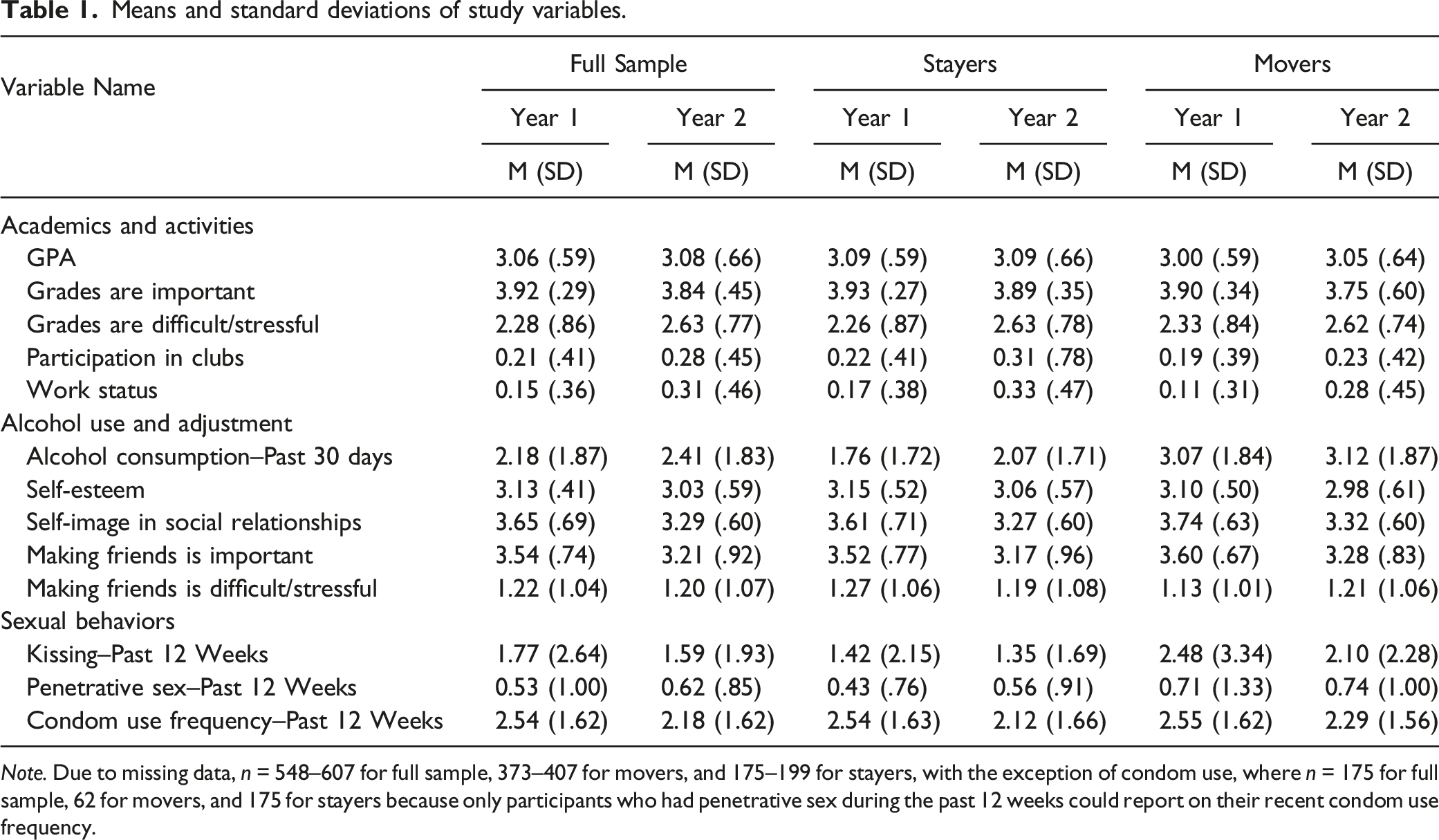
Note. Due to missing data, n = 548–607 for full sample, 373–407 for movers, and 175–199 for stayers, with the exception of condom use, where n = 175 for full sample, 62 for movers, and 175 for stayers because only participants who had penetrative sex during the past 12 weeks could report on their recent condom use frequency.
Correlations Between Year 1 and Year 2 Variables.
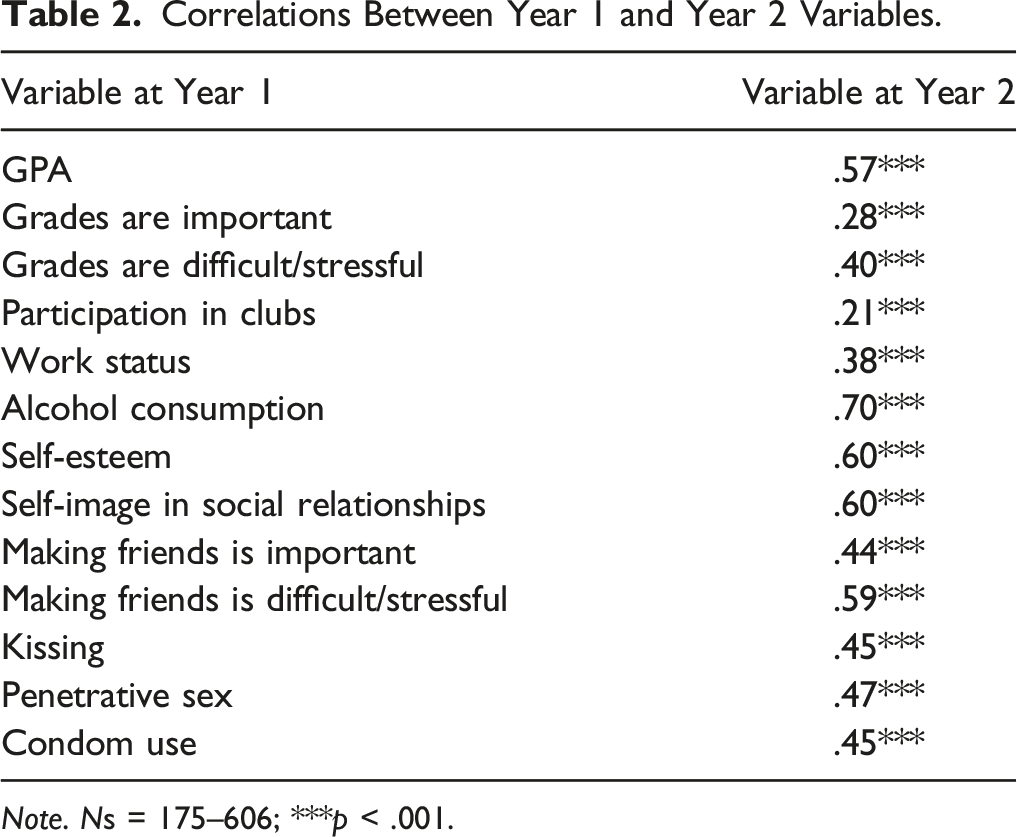
Note. Ns = 175–606; ***p < .001.
To look at change over time and to test for support for selection and socialization effects, we carried out three sets of 13 t-tests. First, we performed paired t-tests between Year 1 and Year 2 for the full sample to see if students, regardless of residence transition, changed over time. Second, we performed independent samples t-tests to compare students who eventually moved off campus to students who stayed on campus on their Year 1 measures to see if they differed prior to the residence transition. Third, we created difference scores between Year 2 and Year 1 measures, and performed independent samples t-tests comparing the difference scores of students who moved off campus to students who stayed on campus to determine if changes over time differed depending on residence transition.
Results
t-tests.
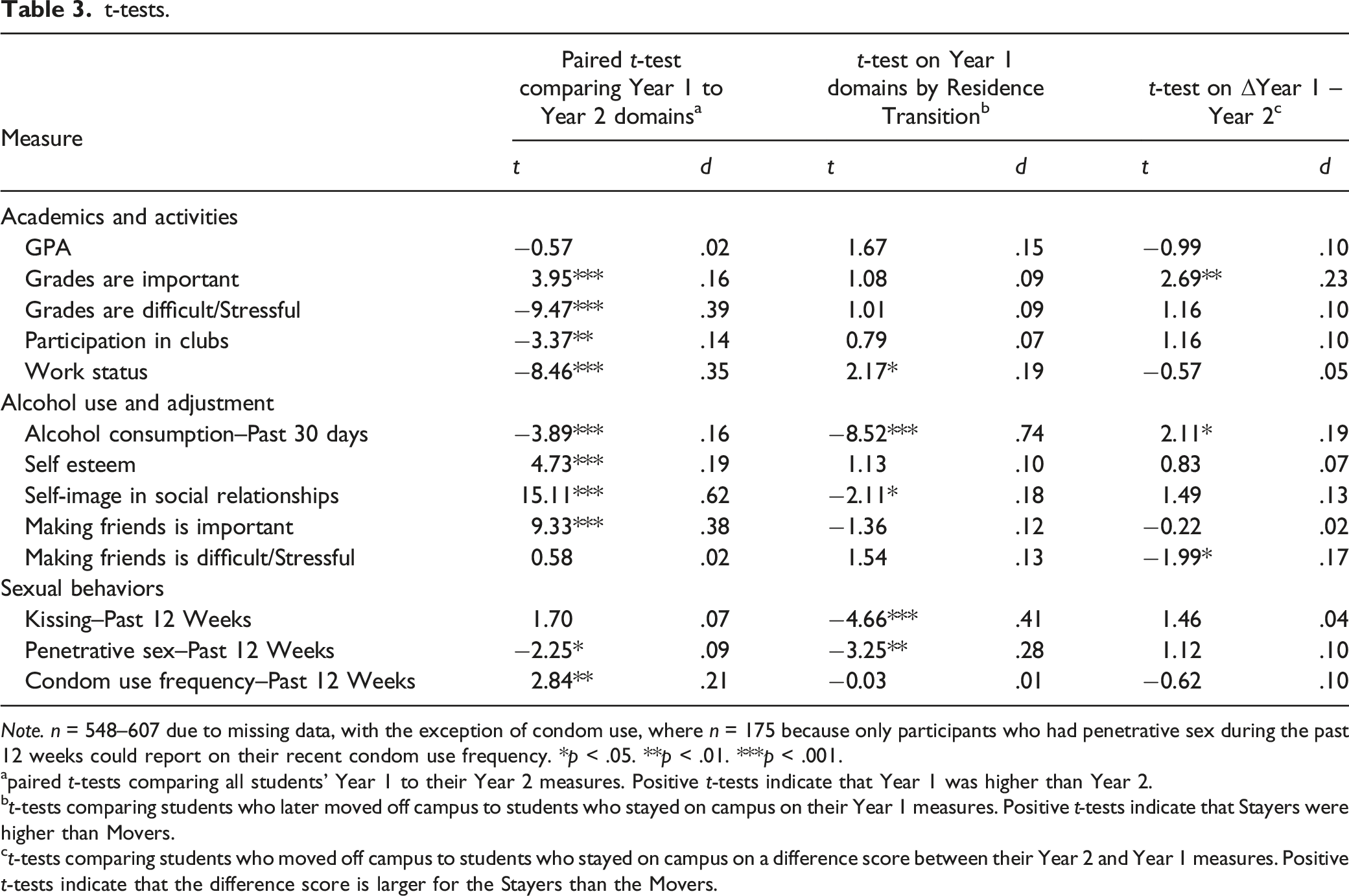
Note. n = 548–607 due to missing data, with the exception of condom use, where n = 175 because only participants who had penetrative sex during the past 12 weeks could report on their recent condom use frequency. *p < .05. **p < .01. ***p < .001.
apaired t-tests comparing all students’ Year 1 to their Year 2 measures. Positive t-tests indicate that Year 1 was higher than Year 2.
bt-tests comparing students who later moved off campus to students who stayed on campus on their Year 1 measures. Positive t-tests indicate that Stayers were higher than Movers.
ct-tests comparing students who moved off campus to students who stayed on campus on a difference score between their Year 2 and Year 1 measures. Positive t-tests indicate that the difference score is larger for the Stayers than the Movers.
Five t-tests comparing students who moved off campus to students who stayed on campus on Year 1 measures were significant. The effect size was small for work status, self-image in social relationships, and penetrative sex, small to medium for kissing, and medium to large for alcohol consumption. At the start of college, students who eventually moved off campus were less likely to work, drank alcohol more frequently in the past month, felt better about their self-image in social relationships, recently had more kissing partners, and recently had more penetrative sex partners compared to students who stayed on campus. The eight t-tests for GPA and academic goals (ds = .09–.15), participation in clubs (d = .07), self-esteem (d = .10), social goals (ds = .12–13), and recent condom use frequency (d = .01) were not statistically significant.
Three t-tests comparing students who moved off campus to students who stayed on campus on changes from Year 1 to Year 2 were significant. All effect sizes were small. Students who moved off campus perceived grades as less important in their second year than they had in their first year, and this change was greater than for students who stayed on campus. The t-tests for the other four indicators of academics and activities were not statistically significant (ds = .05–.10). Students who stayed on campus increased their drinking more than students who moved off campus, although the students who lived off campus still drank more than their on-campus peers at Year 2. Finally, students who stayed on campus perceived making friends as less difficult/stressful in Year 2 than in Year 1, whereas students who moved off campus perceived making friends as more difficult/stressful in Year 2 than in Year 1. The other six t-tests of indicators of individual and social adjustment (ds = .02–.13) and sexual behaviors (ds = .04–.10) were not statistically significant.
Discussion
In the current paper, we compared students who remained on campus their second year of college to students who moved off campus their second year, in order to consider selection and socialization effects. If students who moved off campus differed from students who stayed on campus at the start of college, it would suggest selection effects, consistent with Developmental Systems Theory (Lerner & Walls, 1999). If the students who moved off campus changed more than students who remained on campus, it would suggest socialization effects, consistent with Ecological Systems Theory (Bronfenbrenner, 1986).
Overall, our findings suggest changes over time for students in all domains regardless of residence transition, and are more consistent with a pattern of selection effects, though there was some evidence consistent with socialization effects. When there were differences in change over time for students by residence transition, the changes tended to be small, tended to indicate decreased rather than increased gaps between the two groups, and in most cases, tended to indicate more change for students who stayed on campus than for students who moved off campus. These findings provide some support for Developmental Systems Theory (Lerner & Walls, 1999).
In terms of alcohol use, both students who remained on campus and students who moved off campus increased their frequency of drinking with time. Contrary to prevailing theories about living off campus and alcohol use (Cleveland et al., 2018), students who stayed on campus increased their alcohol use frequency more than students who moved off campus, although students who moved still drank more than students who stayed after the transition. However, consistent with prior research (Benz et al., 2017; Roemer & Walsh, 2014), the much larger difference was that at the start of college, students who moved off campus consistently drank alcohol more frequently than their peers who remained on campus. That is, although there was some evidence of differential change over time, it was not in the expected direction, and by second year, students living off-campus still engaged in riskier drinking behaviors than students who remained on campus. Given university policies around alcohol on campus, these predominantly underage students may have viewed off-campus living opportunities as less restrictive, and may have chosen to move off campus in part to have increased autonomy around drinking. Often, universities provide substantial alcohol prevention programming early in college, but administrators should consider ways to continue this education across college, and in particular, target these specific students before or after they move off campus, given their access to potentially risky drinking without adult supervision.
In terms of social adjustment, students who moved off campus felt more positive about themselves in social relationships at the start of college, supporting prior research that off-campus students have more positive peer interactions (Holmes, 2019). Marshall et al. (2010) suggest that students with strong social skills may be more successful at finding off-campus roommates, and these skills may result in the choice to live off campus. With time, however, both groups decreased in self-esteem, felt less positive in social relationships, and decreased their emphasis on making friends. Evidence suggests that during the first year of college, students become less satisfied with, committed to, and invested in their relationships with their high school best friends (Oswald & Clark, 2003). In addition, loneliness tends to increase during the first semester of college (Hopmeyer et al., 2022). Thus, students may start college with an optimism about new social relationships and first year experiences may dampen these expectations as well as lead to degradation in preexisting relationships. These experiences with both existing and new friendships during the first year of college may shape all students’ social adjustment, regardless of whether they remain on campus or not. However, in Year 2, students who moved off campus found making friends more difficult and stressful than they had prior, whereas students who stayed on campus found making friends less difficult and stressful. As with alcohol use, although there was some evidence consistent with socialization effects and Ecological Systems Theory (Bronfenbrenner, 1986), the results did not support prior cross-sectional results in terms of the direction of differences (Holmes, 2019). Students who moved off campus may have lost some of the on-campus resources and supports that encourage interactions with other students, which could have led to these perceived challenges in making friends. This information is important for university-based mental health services as social relationships may be an area that contributes to student mental health concerns, such as depression or anxiety.
There also was evidence consistent with selection effects in terms of sexual behavior. Specifically, in support of prior cross-sectional research on vaginal sex (DiBello et al., 2018; Hicks et al., 2013), at the start of college students who later moved off campus tended to have recently kissed and had penetrative sex with more partners than students who stayed on campus, though among sexually active students, the groups did not differ on condom use. Although having more penetrative sex partners increases risk of sexually transmitted infections (STIs) and unwanted pregnancy, kissing does not bring substantial health risk and is linked to positive feelings (Lefkowitz et al., 2018). Given that it is normative by the college years, and often linked to pleasure, vaginal sex is also generally associated with positive consequences among college students (Vasilenko & Lefkowitz, 2018). Thus, although we predicted riskier sexual behavior for students living off campus, the lack of differences in unprotected sex, combined with more engagement in kissing and penetrative sex, may actually translate to generally more positive wellbeing for students who eventually transition off campus. With time, both groups tended to have more penetrative sexual partners, consistent with prior cross-sectional research (Herbenick et al., 2010). In addition, among sexually active students, both groups tended to use condoms less frequently by their second year, suggesting increased risk of STIs and another important area for university prevention programming beyond the first year.
By their second year, both groups of students tended to view grades as less important and more difficult and stressful than they had in their first year, and become more likely to get involved in clubs and find work. However, we did not find evidence for preexisting differences or group divergence over time in self-reported GPA, perceiving grades as difficult/stressful, or participation in clubs, although students who stayed on campus were somewhat more likely to work at the start of college. Although prior research has found that off-campus students work more hours (Kuh et al., 2001; Newbold et al., 2011), our findings suggest differences prior to moving off campus rather than after the transition. The only evidence for differences based on residence transition was that emerging adults who transitioned off campus tended to view grades as less important after they moved than they had at the start of college, whereas emerging adults who remained on campus did not change much— though the magnitude of change was relatively small for the students who moved off campus as well. Prior research has been mixed on GPA differences by living environment, and our longitudinal findings support some cross-sectional research that has suggested no differences (López Turley & Wodtke, 2010). The fact that students did not differ by self-reported GPA at the start of college is supported by the fact that they did not differ in academic goals. Finally, although prior research has demonstrated that on-campus students participate in more extracurricular activities than their off-campus peers (Alfano & Eduljee, 2013; De Araujo & Murray, 2010a), we did not find such differences. However, our research differs from prior work in several ways, including using purposeful rather than convenience sampling, focusing on students at the start of college rather than older students, and including only off-campus students living alone or with roommates rather than also including students who live with family. For instance, living with family may decrease opportunities for exploration in some of the areas we considered, including alcohol use and sexual behavior. In addition, some prior research recruited from universities where opportunities to live on campus were limited (e.g., De Araujo & Murray, 2010a), and in such instances, living environment may have been less due to choice and more to circumstance. In such situations, moving off campus may be less about selection and therefore not linked to individual characteristics.
There are some limitations to the current research. First, the students came from one university in a college town where students living off campus generally have easy access to the university and small downtown area. At different types of universities, selection effects may differ. For instance, students at universities in large cities may choose to live on or off campus for different reasons, and such reasons may differentially impact their adjustment. Second, we compared on-campus and off-campus living environment at a general level, but there is substantial variation in types of housing within both categories. Both on-campus and off-campus students’ living environment may differ by number of roommates, size of dwelling (and thus number of other individuals in the building), function (e.g., Greek housing), and access to campus. Variation within on-campus and off-campus housing may have socialization effects. For instance, evidence suggests that living in Greek housing may socialize students to increase their heavy drinking over time (Larimer et al., 2000; Park et al., 2009). Future research should consider this variation within each type of living environment. Third, we considered a limited number of outcomes, but other outcomes may differ by living environment in distinct ways or may demonstrate socialization effects. For instance, students who live off campus in their first year are more likely to drop out of college (Schudde, 2011). Because we limited our sample to students who remained at the same university, our study design did not allow us to consider whether students who moved off campus were more likely to transfer to other universities or drop out of college completely. In addition, living environment may be associated with other outcomes we did not assess, such as on-time graduation, overall satisfaction with the college experience, or physical health and illness, and future longitudinal studies should consider these other factors. We also relied on self-reported GPA, and institutional report of GPA may have yielded different results not affected by memory or self-presentation effects. Finally, future research should consider students’ reasons for choosing to move off campus or remain on campus, which could help to explain preexisting differences between the groups. For instance, students who choose to transition off campus may explicitly express a desire for more autonomy whereas students who remain on campus may emphasize the importance of academics or engagement in university life.
In summary, findings suggest, consistent with Developmental Systems Theory (Lerner & Walls, 1999), that students may shape their own environments depending on personal characteristics and behaviors in a range of domains, including alcohol use, social adjustment, and sexual behavior. When we did see findings consistent with socialization effects in support of Ecological Systems Theory (Bronfenbrenner, 1986), they generally suggested small differences in changes between students who stayed on campus and moved off campus, and often the change indicated that the two groups became more, not less, similar. University administrators should recognize that living environment may be limited in influencing students who live on versus off campus. Instead, administrators should understand potential preexisting differences between students based on living environment choices, and thus consider ways to support both types of students across university transitions. This information could inform administrators’ decisions about when, and which, students can live off campus, and how to plan and implement targeted prevention programming.
Supplemental Material
Supplemental Material - Selection and Socialization Effects of Living On vs. Off Campus
Supplemental Material for Selection and Socialization Effects of Living On vs. Off Campus by Eva S. Lefkowitz and Tracy L. Walters in Emerging Adulthood
Footnotes
Author Contributions
Lefkowitz, E. contributed to conception and design; contributed to acquisition, analysis, and interpretation; drafted manuscript; critically revised manuscript; gave final approval; agrees to be accountable for all aspects of work ensuring integrity and accuracy.
Walters, T, contributed to interpretation; critically revised manuscript; gave final approval; agrees to be accountable for all aspects of work ensuring integrity and accuracy.
Declaration of Conflicting Interests
The author(s) declared no potential conflicts of interest with respect to the research, authorship, and/or publication of this article.
Funding
The author(s) received no financial support for the research, authorship, and/or publication of this article.
Transparency and Open Practices
The raw data contained in this manuscript are not openly available for download due to privacy restrictions set forth by the institutional ethics board. The syntax for data analyses are available by request from the first author. The majority of the measures used in this study come from other sources, and citations for the original source are provided within the text. This study did not include a pre-registration plan.

Supplemental Material
Supplemental material for this article is available online.
References
Supplementary Material
Please find the following supplemental material available below.
For Open Access articles published under a Creative Commons License, all supplemental material carries the same license as the article it is associated with.
For non-Open Access articles published, all supplemental material carries a non-exclusive license, and permission requests for re-use of supplemental material or any part of supplemental material shall be sent directly to the copyright owner as specified in the copyright notice associated with the article.
