



Abstract
The current study elucidates the role that close relationships play on emerging adults’ psychological distress. We examined the associations between maternal, paternal, and romantic partner strain and well-being outcomes, as well as the moderating role of overall social support. Data were collected from 469 undergraduates through an online survey. As expected, maternal and paternal strain were negatively associated with satisfaction with life (SWL) and positively associated with loneliness; however, romantic partner strain did not significantly relate to either well-being variable. Additionally, although overall support was associated with the well-being variables, the interactions between overall social support and strain were not significant, suggesting no moderating effect of support. These findings suggest that maternal and paternal strain can contribute negatively to their children’s psychological well-being regardless of emerging adults’ overall perceptions of support from their social networks. Implications for theories of social support and interventions for college students are discussed.
Keywords
Emerging adulthood is a highly transitory period marked by increasing independence, with many emerging adults leaving home for the first time to attend college (Arnett, 2000; Brewer et al., 2018). Unfortunately, this transition is associated with a heightened risk for anxiety, depression, and suicidal ideation (Hirsch & Barton, 2011). There is growing evidence suggesting psychological distress among college-aged students is associated with the functioning of interpersonal relationships (Finch et al., 1999; Shu et al., 2020). As emerging adults move away from home and parents, their social support networks naturally evolve. As such, it is crucial to study emerging adulthood relationships and how they impact well-being. While positive effects of emerging adults’ close relationships have been identified (e.g., social support; Adamczyk, 2016; Lee et al., 2018; Lee & Goldstein, 2016), the role of negative aspects of relationships (i.e., social strain) in emerging adults’ mental health outcomes remains understudied. To fill this gap, this study examined the effects of strain from three of emerging adulthood’s most impactful close relationships -- romantic partners, mothers, and fathers -- and the moderating role of overall social support as a protective factor in loneliness and life satisfaction.
Social Strain
Social strain has been conceptualized as negative interpersonal interactions caused by perceived conflict, intrusion, criticism, or disappointment (Gee & Rhodes, 2007). Although positive aspects of relationships (e.g., social support) dominate the literature, research has also linked social strain to both physical and mental health outcomes (August et al., 2007; Bertera, 2005), sometimes even predicting health outcomes over social support. For example, in a longitudinal study, strain exclusively predicted both negative and positive affect in adults (Newsom et al., 2003). Strain has also been shown to positively predict depressive symptoms among women (Sherman et al., 2011). Similarly, Bertera (2005) showed that strain from close relationships (partner, family, friends) better predicted adults’ anxiety and mood disorder episodes than social support. Baumeister et al. (2001) argued that, relative to positive social experiences, negative interactions have a greater impact on psychological well-being because they are more salient. Likewise, Lincoln (2000) suggested that individuals generally anticipate positivity coming from the people they rely on for social support, making unanticipated negative interactions within these close relationships especially memorable.
Overall social strain, conceptualized as strain experienced across all social interactions, has been shown to predict emerging adults’ depressive symptoms (Finch et al., 1999), and even suicidal ideation and behaviors (Hirsch & Barton, 2011). Additionally, overall social strain has been significantly associated with college students’ physical health symptoms (e.g., coughing, insomnia, upset stomach), and remained the only significant predictor even after social support was added to the model (Edwards et al., 2001). The psychological effects of relationship strain on emerging adults have also been displayed longitudinally; for example, negative affect has been shown to increase from first to second year of college among students who reported experiencing higher rates of strain (Fiori & Consedine, 2013). In addition, other research found that emerging adults who had at least one depressive episode in high school were affected by social strain in their first year of college (Sheets & Craighead, 2014). Moreover, in an 18-month follow up, participants who reported interpersonal strain were significantly more likely to have experienced depressive recurrence. Interestingly, the results of the study also demonstrated that interpersonal stress was significantly more impactful on depression than non-interpersonal stressors (e.g., academics, finances), which have regularly been identified as sources of psychological distress (e.g., Jones et al., 2018; Joo et al., 2008). Taken together, existing research suggests that social strain negatively affects emerging adults’ psychological and physical health. However, it is a limitation that previous research has generally operationalized social strain so broadly. Social strain is commonly measured with The Test of Negative Social Exchange (TENSE; Ruehlman & Karoly, 1991) which asks the respondent how often they had recently experienced negative interpersonal interactions with “someone” rather than specifying the source of strain. In contrast, research on the impact of strain from specific individuals, which we refer to as relational strain, is lacking. Thus, the current study adds to the literature by assessing mental health outcomes associated with strain from specific important figures in emerging adults’ lives.
Relational Sources of Support and Strain in Emerging Adulthood
Romantic Partners
Previous studies suggest that romantic partners and parents are among the most important relationships during emerging adulthood (e.g., Adamczyk, 2016; Ainsworth, 1989; Collins, 2003; Mounts et al., 2006). Classic developmental theories postulate that although parents are typically the most prominent figures in childhood, romantic relationships begin to rival parental bonds in adolescence and early adulthood (Ainsworth, 1989; Erikson, 1993). And, as individuals enter emerging adulthood, romantic relationships continue to develop and deepen. For example, compared to adolescent couples, 18 to 20-year-olds in romantic relationships have been shown to be more interdependent (i.e., partners spend more time together and share thoughts and emotions; Adams et al., 2001), setting the stage for greater intimacy, and the potential for greater impact on mental health.
Research has shown that individuals who are in romantic relationships enjoy health benefits compared to single individuals (e.g., Braithwaite et al., 2010; Markey et al., 2007), but recent research suggests that those benefits depend on the quality of the relationship. For example, Barr and Simons’s (2014) dyadic study of young (M age =23.6 years), unmarried adults found that negativity in the relationship, reported by either or both partners, predicted negative health outcomes. Similarly, other studies of emerging adults have found that romantic partner strain is positively associated with depressive symptoms (Chow & Ruhl, 2014; Sheets & Craighead, 2014) and even physical assault or sexual coercion within the relationship (Mason & Smithey, 2012). These serious negative sequelae underscore the importance of understanding romantic partner strain in college students’ romantic relationships.
Parental Relationships
Although emerging adulthood is associated with new close relationships, interactions with parents may still play an important role in well-being; this may be especially true for more recent generations. Millennials have shown less motivation to individuate from their parents compared to prior generations; they are less averse to communicating with and receiving guidance from their parents (Pizzolato & Hicklen, 2011), and are more likely to move back in with their parents after college (Dey & Pierret, 2014). These continued connections with parents could be beneficial for current emerging adults, as support from parents is associated with less loneliness and better quality of new friendships, making for a smoother transition to college (Mounts et al., 2006).
Despite the potential benefits of continued parental support, some studies have found the opposite. For example, Adamczyk and Segrin (2015) found that college students’ greater perceived family support was related to lower satisfaction with life. In addition, Eshbaugh (2010) found that, among college women, high family support was associated with more loneliness, as well as further intensifying the negative effects of low romantic support. These findings suggest that perhaps overreliance on family support can weaken connections formed in college (Eshbaugh, 2010; Lee & Goldstein, 2016). Indeed, a recent study has shown support for that explanation; in college students’ first year, closer ties at home predicted higher levels of homesickness, whereas closer ties at college predicted less homesickness (Landa et al., 2020).
While effects of support from parents are more thoroughly studied, in recent years, studies have emerged highlighting the continued prevalence of strain in parental interactions during emerging adulthood. Although parental conflict is assumed to reduce in emerging adulthood, when the child typically leaves for college and experiences more independence, it can remain consistent into emerging adulthood (Ibaraki & Manoogian, 2021). One emerging topic in psychological research that suggests a negative impact of strained parental relationships on emerging adults’ well-being is helicopter parenting. Helicopter parenting can be defined as an inappropriate level of involvement in a child’s (of all ages) lifestyle and decision making (Schiffrin et al., 2019), and tends to be measured through the child’s reports (Bradley-Geist & Olson-Buchanan, 2014). Although research on helicopter parenting literature is limited, there is a consistent finding that the college students’ perception of parental intrusion is positively associated with psychological distress (e.g., depressive and anxious symptoms; Cook, 2020; Cui et al., 2019; Kouros et al., 2017).
Strain in parents’ relationships with their emerging adult children can also occur in the form of parental criticism, identified by the expression and perception of a lack of fulfillment of the parents’ expectations (Curran & Hill, 2022). Parental criticism in the US and other Western countries has shown to be steadily increasing over the past 30 years (for review, see Curran & Hill, 2022) and has been found to result in children’s perfectionism (Curran & Hill, 2022), and subsequent negative health outcomes, such as feelings of helplessness, burnout, and even suicidal ideation (Flett et al., 2022). A theoretical framework explaining the causal model has linked parental criticism and perfectionism with attachment theory (Hewitt et al., 2017). According to Hewitt and colleagues, perfectionism is a response to only receiving intermittent fulfillment of requirements of a secure attachment, such as a sense of esteem and belonging, as well as unavailability and unresponsiveness on the part of the parents. The desire to avoid criticism is theorized to engender impossible expectations for oneself and subsequently, negative mental health outcomes (Flett et al., 2022; Hewitt et al., 2017).
Overall, aspects of strain with one’s parents (e.g., intrusion, criticism) are less studied compared to positive aspects of relationships, but as reviewed above, recent studies reflect that parental strain is prevalent in emerging adulthood and can have deleterious effects on well-being (e.g., Flett et al., 2022). One limitation of research on the impact of family relationships on mental health is that studies tend to view family members in aggregate, either with the umbrella term “family” or the combined effects of mother and father (e.g., Bernardon et al., 2011; Eshbaugh, 2010; Lee & Goldstein, 2016). However, less is known on how individual parental relationships impact emerging adults’ well-being during the transition to college.
Mothers
Developmental theories emphasize mothers’ role in development (Ainsworth, 1989; Erikson, 1993; Suh & Fabricius, 2020), and more recent studies continue to reflect the positive impact of maternal relationships on children’s mental health outcomes. For example, perceived maternal support has predicted fewer depressive symptoms among adolescents, as well as buffered the relationship between romantic stress and depressive symptoms (Anderson et al., 2015). On the other hand, maternal relationships can be associated with negative outcomes when strain is experienced within these relationships. In fact, studies have shown that the majority of emerging adults’ daily negative interpersonal interactions occur with their mothers (Laursen, 1995) and commonly spark negative emotions like frustration (McCarthy et al., 1998). Other research has found that conflict with mothers is associated with poorer adjustment to college (Icart, 2019). Given the continued significance of mothers in emerging adults’ lives, the effects of maternal strain on their psychological well-being warrants further study.
Fathers
Studies that explore paternal relationships also suggest that fathers contribute to emerging adults’ well-being. For example, Bryd-Craven et al. (2012, Study 2) found that female college students who reported father-daughter relationships characterized by rejection and coercion (i.e., strain) had significantly higher levels of cortisol (an objective measure of psychological stress) before and aftera discussion about distressing life events (Byrd-Craven et al., 2012). Although mothers have been classically, and often stereotypically, portrayed as the primary caregiver in a child’s life, studies that explore effects of both maternal and paternal relationships have found similar associations with well-being. For example, Amato (1994) and Barnett et al. (1992) both reported that late-adolescent and adult respondents’ relationship quality with both parents significantly and negatively predicted levels of psychological distress.
Despite the growing interest in the effects of paternal relationships, these relationships are rarely examined within the same study. When maternal and paternal relationships with adult offspring were viewed separately, Barnett et al. (1991) showed that the two types of relationships contained similar amounts of support and strain and were associated with daughters’ mental health. However, when both parental relationships were simultaneously entered into the regression model, only maternal relationship quality predicted daughters’ psychological well-being. Additionally, it has been suggested that the effects of parental relationships differ by the child’s gender; Branje et al. (2010) found that, among Dutch emerging adults, maternal relationship quality predicted both daughters' and sons’ depressive symptoms, but paternal relationship quality only predicted sons’ depressive symptoms.
Recent helicopter parenting research also suggests some differences between intrusion from mothers and fathers. Available evidence suggests that helicopter parenting is more common among mothers than fathers (Love, Cui, Allen, et al., 2020; Love, May, Cui, et al., 2020; Schiffrin et al., 2019; Schiffrin et al., 2021); however, the impact of intrusion frequency on mental health outcomes is less clear. In one study, although college students reported that their mothers were more commonly intrusive than their fathers, both sources of strain were associated with more depressive and anxious symptoms as well as lower satisfaction with life (SWL; Schiffrin et al., 2019). However, in another study that reported higher levels of maternal versus paternal helicopter parenting, only paternal, not maternal, was associated with higher self-reported anxiety among female college students (Love, May, Cui, et al., 2020). One possible explanation may be that female college students feel closer to their mothers, therefore paternal over-involvement is perceived as more inappropriate (Love, May, Cui, et al., 2020). Although the literature has produced various findings on romantic, maternal, and paternal relationships, there lacks a clear understanding of the impact of relational strain from each individual on emerging adults’ mental health. However, each of the three figures may play an important role in their psychological well-being.
Social Support
An examination of the impact of strain from romantic partners and parents should take place with a consideration of emerging adults’ level of overall social support from their broader social network. A plethora of research has shown that social support has a range of demonstrated benefits on both physical and mental health (e.g., Coyne & Bolger, 1990; Holt-Lunstad et al., 2017; Lee, et al., 2018). In addition, the “buffering hypothesis” posits that perceiving strong social support mitigates the relationship between stressful life events and negative health outcomes (Cohen & Willis, 1985). However, studies on the buffering effect predominantly measure social support’s ability to moderate the association between general stress and well-being. Studies that have found that support tends to buffer the effects of stress for emerging adults has predominantly measured stress with the Perceived Stress Scale (Cohen et al., 1983), in which no specific stressors are mentioned (e.g., Lee, et al., 2018; Segrin & Passalacqua, 2010). Given the literature reviewed above that suggests that relational stress (i.e., strain) can negatively impact psychological functioning, it is important for research to extend the buffering hypothesis to stressors within interpersonal relationships. To our knowledge, the buffering hypothesis as specifically applied to relational stress has been supported by two studies. Specifically, a study of adult women found that social support and strain (both from their overall social networks) interacted such that those who had high support and low strain were least likely to be depressed (Sherman et al., 2011). Likewise, a study of adolescents showed that maternal support buffered the relationship between romantic stress and depressive symptoms (Anderson et al., 2015). Given emerging adults’ developmental challenges as they are in the process of individuating from parents (Arnett, 2000; Erikson, 1993), it is unclear whether these results would be generalizable. The current study extends this examination of the buffering effects’ applicability to the effects of strain from emerging adults’ relationships with their romantic partners, mothers, and fathers.
Goals of the Present Study
The transition to college can be stressful for emerging adults and has been associated with an increased prevalence in psychological distress (e.g., Hirsch & Barton, 2011). The present study aimed to elucidate how strain from three significant relationships during emerging adulthood -- romantic partners, mothers, and fathers -- impact psychological well-being. Additionally, as all close relationships contain negative and positive aspects and there is research showing that both can affect psychological well-being (e.g., Braithwaite et al., 2010; Chow & Ruhl, 2014; Lee & Goldstein, 2016), we examined the role of social strain as well as social support. We tested the buffering effect of support from one’s social network on the impact of strain from romantic partners, mothers, and fathers. Because the theory that social support mitigates the effect of stress on well-being (Cohen & Willis, 1985) has been widely supported, it is logical that the buffering effect applies to stress coming from within close relationships. However, few studies (Anderson et al., 2015; Sherman et al., 2011) have tested this hypothesis. The current study explored the relationship between social strain, support, and two well-being outcomes: loneliness, and satisfaction with life (SWL). Loneliness and SWL have been shown to be strong predictors of mental health including depressive symptoms and suicide attempts (Barg et al., 2006; Cacioppo et al., 2006; Pavot & Diener, 2008) and both have been associated with emerging adults’ interpersonal relationship functioning (e.g., Adamczyk, 2016; Lee & Goldstein, 2016; Mounts et al., 2006; Ratelle et al., 2013).
Hypotheses
1) Higher strain in relationships with romantic partners, mothers, and fathers would be associated with lower SWL and higher levels of loneliness. 2) Overall social support would moderate the relationship between strain from romantic partners, mothers, and fathers and SWL and loneliness.
Specifically, for Hypothesis 2
Methods
Procedure
An online survey was completed by a total of 469 undergraduates at an urban, mid-size university between October 2017 and November 2019. Students enrolled in psychology courses could choose to take the survey in exchange for class credit. Participants had to be 18 or older and consent was obtained online. The survey contained questions on socio-demographics, social support, strain, and psychological well-being. The study was initially approved in October 2017 by the Institutional Review Board at The George Washington University (IRB number 081,747). Its risk level is considered not greater than minimal risk under 45 CFR 46/21 CFR 56.
Measures
Relational Strain
Relational strain (i.e., strain experienced within specific relationships) was measured using a modified version of the Social Support Network Questionnaire (SSNQ; Gee & Rhodes, 2007), which is used to examine the positive and negative aspects of one’s social network. Respondents identified up to seven people who were available as sources of support plus up to three additional individuals with whom they were likely to have negative interactions. Subsequently, respondents indicated the extent to which, during the past 6 months, they could expect each individual to be a source of five different types of strain, each of which was measured with a single item: disappointment (“let you down”), intrusion (“trying to control your decisions”), conflict (“having fights or strong disagreements”), criticism (“criticize you”), and discrimination (“treat you differently or make you feel bad”). Items were rated on a five-point scale (1= “never” to 5= “always). Relational strain scores were calculated by averaging responses on all five types of strain for romantic partners, mothers and fathers identified by the respondents. The original SSNQ has shown strong internal consistency (α=.90) among ethnic minority pregnant and parenting adolescents (Gee & Rhodes, 2007). The version used in this study used a slightly modified version that included discrimination-based strain and limited social network size to seven members (the original SSNQ allowed for unlimited nomination of individuals to the network). Internal consistency of the strain subscale for the three subsamples used for our analyses were adequate: romantic strain (α=.76), maternal strain (α = .78), and paternal strain (α = .79).
Overall Support
Perceived overall social support was measured using the 12-item Multidimensional Scale of Perceived Social Support (MSPSS; Zimet et al., 1988). The MSPSS asks respondents to rate on a 7-point scale (1 = “very strongly disagree” to 7 = “very strongly agree”) the level of support they receive from three different sources: friends, family, and a “special person.” To create the variable, a mean score of the items was calculated. Example items include, “There is a special person who is around when I am in need” and “I can talk about my problems with my family.” The internal consistency of the MSPSS was high (α = .95).
Satisfaction with Life
Satisfaction with Life is a component of subjective well-being that represents a positive dimension of general psychological functioning (Pavot & Diener, 2008; Sheets & Mohr, 2009). Global cognitive judgments of satisfaction with one’s life (SWL) were measured using the five-item Satisfaction with Life Scale (Diener, et al., 1985). Items are rated on a seven-point scale (1= “strongly disagree”; 7= “strongly agree”). A mean score of the items was calculated. Example items include “If I could live my life over, I would change almost nothing” and “In most ways my life is close to ideal.” The SWL scale demonstrated strong internal consistency (α = .88).
Loneliness
Loneliness, conceptualized as a lack of satisfaction with social connections, either physical or emotional (Rook, 1984; Weiss, 1987), was measured using an eight-item short form of the UCLA Loneliness Scale (Hays & DiMatteo, 1987). Participants indicated how often they identified with each statement on a four-point scale (1= “never”; 4 = “often”), with sample items including “…I feel left out” and “…there is no one I can turn to.” To create the variable, a mean score of the items was calculated. This scale demonstrated strong internal consistency (α = .85).
Overall Strain
The Test of Negative Social Exchange (TENSE; Ruehlman & Karoly, 1991) is an 18-item scale that measures the frequency of negative social interactions with one’s general social network (i.e., overall strain). Items were rated on a five-point scale (1= “not at all” to 5= “almost every day”) and a mean score was calculated. Example items include “During the last month, indicate the frequency with which someone took you for granted.” and “During the last month, indicate the frequency with which someone prevented you from working on your goals.” Items were averaged to compute an overall strain score. TENSE was included as a covariate in order to isolate the strain caused by specific close relationships from overall negative interactions. The TENSE showed excellent internal consistency (α = .93) in this sample.
Analytic Plan
Participants were divided into overlapping subsamples of those who reported having a romantic partner (n = 157, 34%), mother (n = 424, 91.8%), and/or father (n = 363, 78.6%) as part of their social support network. All subsamples were of adequate size to achieve a power of .95, effect size of .15 and alpha of .05 (G*Power; Erdfelder et al., 1996). Seven respondents did not report on a romantic partner, mother, or father and were therefore excluded, leaving a total sample of 462 undergraduates. Once the sample was finalized, there remained no missing data in the dataset. The sample was primarily female (77.8%) and mostly comprised of 18- to 20-year-olds (M = 19.3, SD = 2.1). A majority (61.8%) of the sample self-identified as White, 22% identified as Asian, 10.8% identified as Black, and 10.6% as Hispanic/Latinx. Respondents were able to select as many racial/ethnic groups that applied, and 8% chose more than one.
Social Support and Strain Indicators: Means and SDs by Subsample.
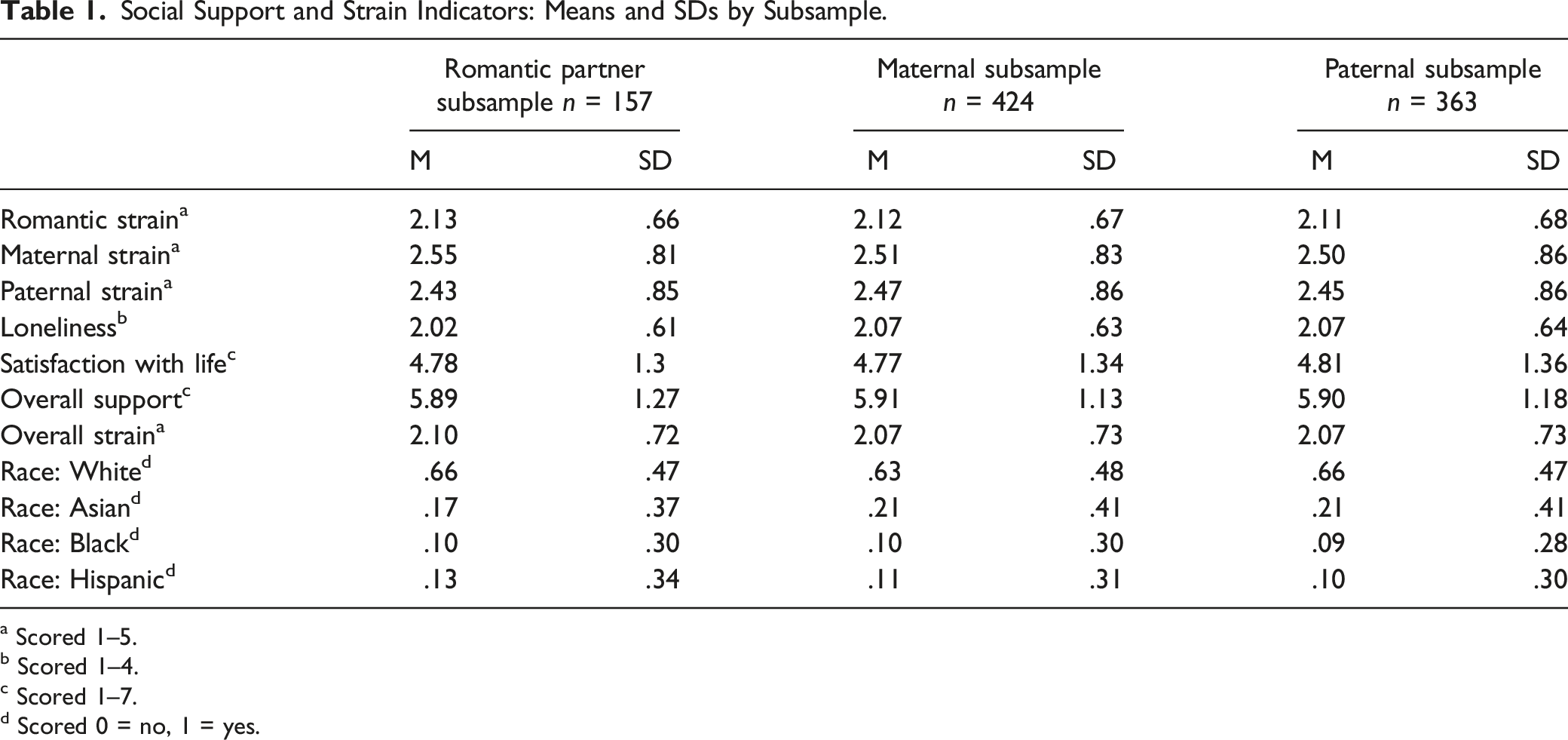
a Scored 1–5.
b Scored 1–4.
c Scored 1–7.
d Scored 0 = no, 1 = yes.
Bivariate Pearson Correlations.

Note. *p < .05; **p < .01.
Next, Hypothesis 1 (that higher strain in relationships with romantic partners, mothers, and fathers would be associated with lower SWL and higher levels of loneliness) was tested with hierarchical linear regressions using SPSS 28. Six models examined the association between each of the three sources of strain (romantic partner, mother, father) and the two outcome variables (SWL and loneliness). Covariates (overall strain, race/ethnicity) were entered in the first step of each model. Strain variables were added in the final step for each hierarchical regression, and the change in R2 and strain coefficients were used to draw conclusions.
Analysis for Hypothesis 2 (that overall support would moderate the relationship between strain from romantic partner, mothers, and fathers and SWL and loneliness) was conducted using Model 1 from Hayes’ PROCESS Macro for SPSS 28 (Hayes, 2018). Again, six multiple regression models were tested in order to represent the three sources of strain (romantic partner, mother, father) and both outcome variables (loneliness and SWL). In these tests, all variables (i.e., predictor, moderator, covariates, outcome) were entered simultaneously.
Results
Associations Between Relational Strain and SWL and Loneliness
Romantic Partners
SWL
Step 1 showed that overall strain was significantly and negatively associated with SWL (β = −0.23, p < 0.01), but no racial covariates were associated with SWL (ps > 0.05). When romantic strain was entered in Step 2, overall strain remained significant (β = −0.20, p = 0.02), but romantic partner strain was not associated with SWL (β = −0.12, p = 0.16). Further, the addition of romantic strain did not significantly affect the R2 value (Δ R2 0.01, p = 0.16).
Loneliness
Step 1 showed that overall strain was significantly and positively associated with loneliness (β = 0.24, p < 0.01), but no racial covariates were associated with loneliness (ps > 0.05). In Step 2, when romantic strain was entered into the regression, overall strain remained significant (β = 0.19, p = 0.03) but romantic partner strain was only marginally positively associated with loneliness (β = 0.15, p = 0.06). Further, the addition of romantic strain increased the R2 value, but only to a marginal degree (Δ R2 0.02, p = 0.06).
Mothers
SWL
Step 1 showed that overall strain was significantly and negatively associated with SWL (β = −0.25, p < 0.01), as was self-identification as Black (β = −0.15, p = 0.01). When maternal strain was entered in Step 2, overall strain (β = −0.17, p < 0.01) and self-identification as Black (β = −0.14, p = 0.01) remained significant. Further, results showed that maternal strain was significantly and negatively associated with SWL (β = −0.25, p < 0.01), as well as significantly affected the R2 value of the model (Δ R2 0.06, p < 0.01).
Loneliness
Step 1 showed that overall strain was significantly and positively associated with loneliness (β = 0.27, p < 0.01), but no racial covariates were associated with loneliness (ps > 0.05). When maternal strain was entered in Step 2, overall strain remained significant (β = 0.21, p < 0.01). Maternal strain was also positively associated with loneliness (β = 0.20, p < 0.01) and significantly affected the model’s R2 value (Δ R2 0.03, p < 0.01).
Fathers
SWL
Results of Step 1 reflected that overall strain (β = −0.28, p < 0.01), as well as self-identification as Black (β = −0.14, p = 0.03) were significantly and negatively associated with SWL. When paternal strain was entered in Step 2, overall strain (β= −0.22, p< 0.01) and self-identification as Black (β = −0.13, p = 0.04) remained significant. Further, results showed that paternal strain was significantly and negatively associated with SWL (β = −0.23, p < 0.01), as well as significantly affected the R2 value of the model (Δ R2 0.05, p < 0.01).
Loneliness
Step 1 showed that overall strain was significantly and positively associated with loneliness (β = 0.27, p < 0.01), but no racial covariates were associated with loneliness (ps> 0.05). When paternal strain was entered in Step 2, overall strain remained significant (β = 0.23, p < 0.01). Paternal strain was also positively associated with loneliness (β = 0.17, p < 0.01) and significantly affected the model’s R2 value (Δ R2 0.03, p < 0.01).
Moderation Analyses
Romantic Partners
SWL
Romantic Strain and Overall Support: Moderation Analysis.

Note. *p < .05; **p < .01.
Loneliness
Romantic strain was not significantly associated with loneliness (β = 0.11, p = 0.15), but overall support was negatively associated with loneliness (β = −0.08, p = 0.04). Again, the interaction (romantic strain x overall support) was not statistically significant (β = 0.03, p = 0.65), implying that overall support did not moderate the relationship between romantic strain and loneliness.
Mothers
SWL
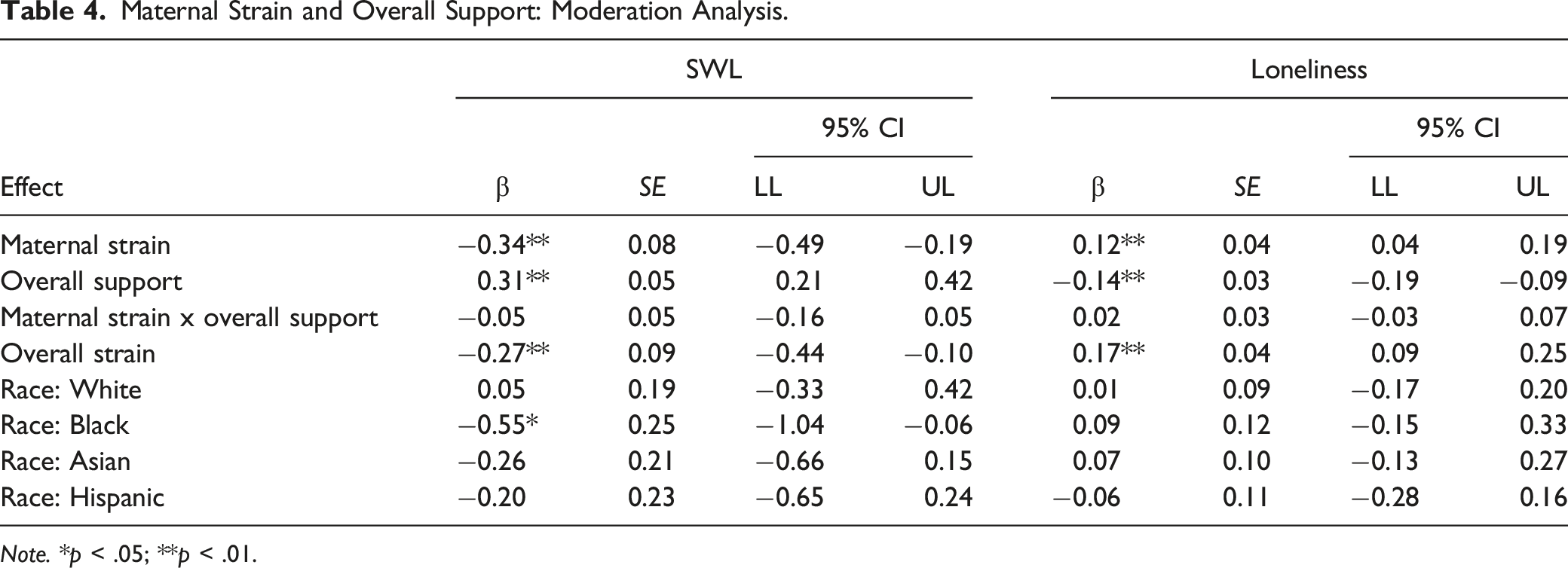
Maternal Strain and Overall Support: Moderation Analysis.
Note. *p < .05; **p < .01.
Loneliness
Maternal strain was significantly and positively associated with loneliness (β = 0.12, p < 0.01), and overall support was negatively associated with loneliness (β = −0.14, p < 0.01). However, the interaction term (maternal strain x overall support) was not significant (β = 0.02, p = 0.49), demonstrating that overall support did not moderate the relationship between maternal strain and loneliness.
Fathers
SWL
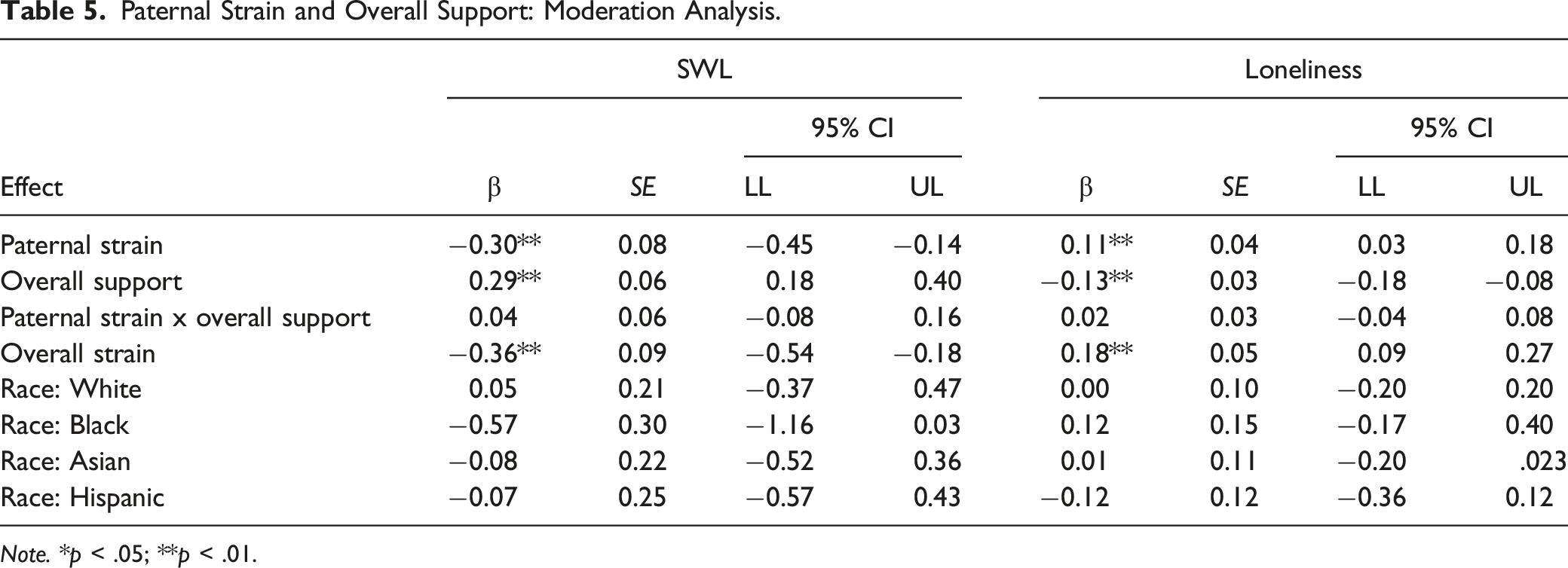
Paternal Strain and Overall Support: Moderation Analysis.
Note. *p < .05; **p < .01.
Loneliness
Paternal strain was positively associated with loneliness (β = 0.11, p = 0.01) and overall support was negatively associated with loneliness (β = −0.13, p < 0.01). However, the interaction term (paternal strain x overall support) was not associated with loneliness (β = 0.02, p = 0.51), demonstrating that overall support did not moderate the relationship between paternal strain and loneliness.
Of note, because all interaction terms were nonsignificant, we conducted an additional set of regression analyses in which we removed them in order to elucidate relationships between the variables. None of the results of the regressions without interaction terms differed meaningfully from the numbers reported here.
Discussion
The current study examined the associations between close relationships and psychological well-being among college students. The associations between strain from three of the most important figures in the lives of emerging adults (romantic partners, mothers, and fathers) and SWL and loneliness were examined. Additionally, this study tested overall social support as a moderator of those associations. As hypothesized, results showed that maternal and paternal strain were negatively associated with SWL and positively associated with loneliness, above and beyond control variables (overall strain and race). However, romantic partner strain was not significantly associated with either SWL or loneliness. Additionally, while overall support was shown to be consistently positively associated with SWL and negatively associated with loneliness, it did not significantly moderate the associations between any of the three types of relational strain and the well-being variables.
Our findings are consistent with previous research suggesting the continued importance of emerging adults’ relationships with their parents (Anderson et al., 2015; Ibaraki & Manoogian, 2021; Steinberg & Davila, 2008) despite the addition of new close relationships (e.g., romantic partners) when they leave home. Previous research has shown that recent generations of emerging and young adults have high levels of closeness with their parents (Dey & Pierret, 2014; Pizzolato & Hicklen, 2011). College students in the current study frequently nominated their mothers and fathers on their self-reported social networks, with almost all of the sample including at least one parent. Moreover, the findings that maternal and paternal strain were associated with SWL and loneliness reinforce previous research that parents have continued influence on their children’s mental health as they transition to adulthood, including literature on helicopter parenting, defined as an inappropriate level of parents’ involvement in their offspring’s lives (Schiffrin et al., 2019), and criticism, defined as parents’ display of discontent in the child not meeting expectations (Curran & Hill, 2022). Although research on parental strain is relatively sparse compared to support, recent studies have consistently shown a positive association between parental strain and psychological distress (e.g., Cook, 2020; Cui et al., 2019; Flett et al., 2022). The current study’s findings bolster the importance of continued research on parental strain its effects on emerging adults’ wellbeing, including aspects such as intrusion (i.e., helicopter parenting) and parental criticism.
Contrary to our expectation, romantic strain was not significantly associated with SWL and loneliness. This finding was surprising given previous literature that romantic partners are important figures in emerging adults’ psychological well-being (Adams et al., 2001; Chow & Ruhl, 2014; Sheets & Craighead, 2014). While, at first glance, the current study’s findings appear to imply that romantic partners do not contribute to emerging adults’ mental health, there are some caveats to this conclusion. First, mean scores of reported romantic strain were significantly lower than those of maternal and parental strain, perhaps implying that our sample did not experience enough romantic strain (on average) to impact their SWL or loneliness. Additionally, one cannot be sure how respondents understood the term “romantic partner.” Because emerging adulthood is a developmental stage in which romantic relationships start to become more committed and enduring (Arnett, 2015), it may be that there was a wide variation in the nature of the relationships (e.g., length, seriousness) reported on by respondents. Such factors may moderate the effects of emerging adults’ romantic relationships on their psychological well-being. The current study did not collect data on the nature of these romantic relationships; thus, future studies would benefit from probing further into the qualitative aspects of romantic relations that affect their associations with mental health variables.
The finding that overall support did not interact with relational strain was also not anticipated, given the widespread support in previous research for the buffering hypothesis (Cohen & Willis, 1985). The buffering hypothesis predicts that high levels of social support will protect individuals from the negative effects of experienced stress. However, the vast majority of the studies that bolster the buffering hypothesis involve stress from specific events (e.g., Arnberg et al., 2012) or regularly experienced general stress (e.g., Lee & Goldstein, 2016; Raffaelli et al., 2013); few have tested social support’s ability to buffer the effects of stress from specific close relationships (Anderson et al., 2015; Sherman et al., 2011). The current study is the first to attempt to apply the theory to the interaction between overall support and strain from romantic partners, mothers, and fathers. Especially because the topic tested is understudied, our nonsignificant results can be considered to be just as informative as if they had been statistically significant. Studies that invoke previously supported theories but obtain null results should not simply be regarded as “false,” rather as potentially elucidating parameters of the theories. Given the complexity and variety of human experiences, cognitions, and emotions, it should be expected that behaviors and perceptions would vary across different situations (Earp & Trafimow, 2015). In the case of the current study, the results that the interaction between strain and support were all null which may imply that the buffering hypothesis does not apply to interpersonal relationship stress. However, these findings should be replicated and extended to expand the literature on the buffering hypothesis and relational stress.
Although the current study’s findings did not find an interaction between overall support and relational strain, maternal and paternal strain significantly predicted SWL and loneliness. Therefore, it can be inferred that regardless of the level of support, strain from mothers and fathers can contribute to lower SWL and greater loneliness. These findings highlight the importance of reducing strained relationships between emerging adults and their parents, even if emerging adults have generally supportive social support networks. Although overall support was not a moderator for strain, it did demonstrate a main effect, showing positive associations with SWL and negative associations with loneliness. Thus, maintaining a strong support network can contribute to psychological well-being among college students. Given research documenting high rates of psychological distress among college students (e.g., Hirsch & Barton, 2011), increasing the overall quality of their support networks may be helpful even if it does not specifically reduce the negative impacts of maternal, paternal, and romantic partner strain.
Limitations and Future Directions
While the current study has many important strengths, it also has several limitations. First, the current study used a cross-sectional, correlational design and therefore its results cannot imply causation or directionality. In fact, it may be that emerging adults’ mental health is a predictor of their social support and strain. For example, depression and anxiety in emerging adulthood have been found to correlate with both lower perceived romantic support and higher conflict in later adulthood (Leach & Butterworth, 2020). Mental health status has been shown to alter perceptions of close others’ behaviors. In one study on partnered college students, participants with high (vs. low) levels of social anxiety reported receiving less support from their partner in a recorded interaction, although outside observers did not notice any difference (Porter & Chambless, 2017). Thus, more longitudinal studies are needed to better understand the factors involved in the relationship between interpersonal strain, social support, and emerging adults’ well-being.
There are also caveats involving our sample. Although we did not find any significant differences between genders on our outcome variables, given the sample’s gender imbalance (mostly female), our findings may be more representative of females than males. Studies have found gender differences in emerging adults’ relationships with both mothers, fathers, and romantic partners. For example, women in emerging adulthood tend to engage in more mutually open conversations with their mothers compared to males in the same developmental stage (Domene et al., 2011), but males have shown a stronger association between paternal relationships and substance use (Bronte-Tinkew et al., 2006). In addition, it has also been shown that compared to males, female emerging adults tend to be less agreeable and initiate more conflict within romantic relationships (Suh et al., 2004). Future studies should examine gender differences in emerging adults’ social relationships.
Additionally, the overall mean support and SWL scores within our sample were relatively high, and the mean relational strain and loneliness were relatively low. In one sense, these findings caution against over-generalization of our results to other populations that may not report the same level of well-being. However, it is also important to note that our findings suggest that even minor elevations in an individual’s perceived level of parental strain can leave those in this age group vulnerable to a degradation in mental health.
Other future directions for research on relational strain and emerging adults’ well-being involve examining racial and ethnic differences. Although self-reported racial identities were solely used as a covariate in the current study, the results did show that there was a significant association between self-identifying as Black and well-being in some of the models. It is possible that results might differ for Black students in predominantly White institutions (such as in this sample) versus at historically Black colleges and universities. In addition, our results show that mothers and fathers are both important figures in the lives and well-being of college students; strain in maternal and paternal relationships were associated with SWL and loneliness. However, a limitation to the current study is that we did not directly compare the impact of support and strain from mothers and fathers, as it was beyond the scope of the research. Further, other interactional effects could be tested, for example, one could examine if support from one parent buffers the negative effects of strain from the other.
Overall, future studies could utilize a broader and more diverse sample of young adults to get a more generalizable picture of college students in the US. Another way to do so would be to recruit participants from colleges and universitas from across the country. And further, researchers could explore if findings in a college student sample are generalizable to young adults who do not intend to enroll in collegiate institutions. It has been found that mental health disorders are more common among non-college attending emerging adults, as are lower levels of social support (Kovess-Masfety et al., 2016). Additionally, protective factors in high school, such as parental support, can even predict college attendance the ability to cope with stress, and involvement in social activities (Follingstad et al., 2021).
This study’s findings have important implications for future interventions. The transition to college is an important time for many emerging adults, and colleges should emphasize the importance of maintaining and strengthening social support and learning to more effectively cope with strain in their parental relationships. This message could be emphasized at pre-college visits and summer orientations as students prepare for their transition. Students could also be connected to resources such as on-campus counseling or workshops to help them manage the new dynamics in their social networks, which may occur as a result of the transition to college. The results from this study also suggest that mothers and fathers remain influential for students in this developmental stage, so future interventions could emphasize the importance of maintaining or improving positive connections with parents. Additionally, colleges could connect parents to programs that may help to mitigate the new parent-child relationship strain that may come with emerging adults’ increasing independence, potentially avoiding behaviors such as being overly intrusive.
Conclusion
As the entrance into college has been identified as a developmental stage with a heightened risk for psychological distress (Hirsch & Barton, 2011), this study offers insight into the role that close relationships play in emerging adults’ mental health. While social support is a commonly studied predictor of psychological outcomes, our study highlights that social strain also has an important influence on well-being. The present study shows that strain in close relationships (specifically with mothers and fathers) is associated with lower life satisfaction and higher loneliness. Further, a lack of significant interactions between overall support and relational strain implies that the associations between parental strain and well-being are present, regardless of the perceived level of support. These findings suggest the need for future research on the role of relational strain on mental health to inform interventions that target reducing psychological hardship for emerging adults during their college years.
Footnotes
Declaration of Conflicting Interests
The author(s) declared no potential conflicts of interest with respect to the research, authorship, and/or publication of this article.
Funding
The author(s) received no financial support for the research, authorship, and/or publication of this article.
Open Research Statement
This research was not pre-registered. The data used in the research are available. The data can be obtained via email. The materials used in the research are available. The materials can be obtained via email.
