




Abstract
To advance our knowledge on White youth’s anti-racism, this preregistered study applies a person-centered approach to identify White Dutch emerging adults’ profiles of critical consciousness (critical reflection, motivation and action) and emotional responses to racism (White empathy, guilt, and fear). Additionally, relations between profile membership and subjective wellbeing were examined. Based on data from 338 White Dutch emerging adults (17–21 years old, M = 19.44, SD = 1.28, 73% female, 20% male, 4% non-binary), three latent profiles were identified: “uncritical and insensitive”, “average”, and “anti-racist”. Youth in the “anti-racist” profile tended to feel less positive about the future than those in the “average” profile, but no differences between profiles were found for life satisfaction and future negative emotions. These results highlight the distinct ways in which critical consciousness dimensions co-occur with different emotional responses to racism, and call for further research into the interrelatedness of critical consciousness and emotional processes.
Racism is embedded in many societies around the globe, including the U.S. and European countries such as the Netherlands (Felten et al., 2021; Kennedy et al., 2023; Roberts & Rizzo, 2021). Based on socially constructed categories, it provides advantages to some and disadvantages to others. White people have the privilege of ignoring issues of racism, thereby implicitly perpetuating it (Hazelbaker et al., 2022; Woolverton & Marks, 2022). To avoid placing the sole responsibility for disrupting racism on those who are disadvantaged by it, it is crucial to understand White people’s engagement with anti-racism (Jemal, 2017). This is particularly so for White emerging adults, given that they are in the midst of finding personal meaning and purpose in life, which sets the stage for their future (Zarrett & Eccles, 2006).
Critical consciousness (CC) is an important process in this regard, as it refers to the process through which people develop awareness of social inequities such as racism, experience a sense of agency and responsibility to enact change, and engage in behavioral efforts to create this change (Freire, 2000; Watts et al., 2011). Among White youth, this process is likely accompanied by various emotional responses, such as feelings of guilt, shame, and empathy (Spanierman & Heppner, 2004), which can shape their CC development in fundamental ways (Woolverton & Marks, 2022). Adolescents demonstrate distinct profiles based on patterns of both CC and emotional responses to racism (Godfrey et al., 2019; Spanierman et al., 2006). As of yet, research identifying such patterns has mostly focused either on CC (Briggs et al., 2023; Desmarais & Christophe, 2024; Godfrey et al., 2019; Maker Castro et al., 2025; Schwarzenthal et al., 2024) or on emotional responses to racism (Spanierman et al., 2006, 2009, 2012; Spanierman & Heppner, 2004). Given the interrelatedness of these experiences, the present study expands this earlier work by examining the way in which CC and emotional responses to racism co-occur among White emerging adults.
CC is theorized to be an asset to positive youth development (Gonzalez et al., 2021), particularly for marginalized youth (Diemer et al., 2016). Most of the research on the association between CC and wellbeing, however, has examined how dimensions of CC in isolation from another relate to wellbeing outcomes (Maker Castro et al., 2022). Furthermore, what the association between CC and wellbeing looks like for youth from more privileged groups, such as White youth, remains unclear (Maker Castro et al., 2022). Importantly, this association might depend on White youth’s emotional responses to racism (Tyler et al., 2020). As such, the present study adds to this literature by examining how patterns of CC dimensions and emotional responses to racism relate to wellbeing among White emerging adults.
Critical Consciousness Profiles
The CC framework was originally developed by Paulo Freire to describe how marginalized people learn to reflect on their oppression and its causes, and engage in actions to liberate themselves (Freire, 2000). This process has later been conceptualized to consist of three dimensions: critical reflection (critical analysis and awareness of societal inequities and its structural causes), critical motivation (perceived capacity and commitment to change injustice), and critical action (behaviors taken to create such change) (Diemer et al., 2015; Watts et al., 2011). These dimensions are theorized to develop dynamically and reciprocally: critical reflection, for example, is expected to spark critical action, which in turn can further promote critical reflection (Diemer et al., 2021; Watts et al., 2011). However, empirical findings on associations between CC dimensions among youth are mixed (Heberle et al., 2020), suggesting that dimensions interplay and co-occur in complex ways.
Recently, scholars have therefore recognized the urgency to identify profiles of CC among youth using person-centered approaches (Godfrey et al., 2019). Such approaches allow to capture complex configurations of variables and provide insight into the patterns in which CC dimensions co-occur. Results from this work point to the existence of three to four profiles of CC. Godfrey et al. (2019), for example, examined patterns of CC among ethnic-racial minority early adolescents in the U.S., and identified four latent classes that primarily differed in levels of critical reflection and motivation (termed political efficacy in this study). In contrast, Desmarais and Christophe (2024) identified four profiles among Black and Latine emerging adults in Canada, which were differentiated by the levels of critical action in particular. Briggs et al. (2023) and Maker Castro et al. (2025) each identified four profiles of CC among Black adolescents and an ethnic-racially diverse sample of U.S. college students, respectively, characterized by varying levels across all three dimensions. The only study that was located in the European context included measures of critical reflection and action, but not motivation, and identified three profiles of CC among an ethnic-racially diverse sample of German adolescents (Schwarzenthal et al., 2024).
Although the constellation of profiles differed across these studies, most identified profiles characterized by relatively low levels across dimensions (acritical bystanders or uncritical), and relatively high levels across dimensions (liberated actors or actionists) (Briggs et al., 2023; Godfrey et al., 2019; Maker Castro et al., 2025; Schwarzenthal et al., 2024). Additionally, combinations of relatively high levels of reflection but relatively low levels of action were found (precritical bystanders or armchair activist) (Briggs et al., 2023; Maker Castro et al., 2025; Schwarzenthal et al., 2024), as well as combinations pointing in the direction of youth engaging in action with relatively lower levels of reflection (acritical or precritical actors) (Briggs et al., 2023; Maker Castro et al., 2025). Profiles identified by Desmarais and Christophe (2024) differed from the other studies, as all profiles were labeled critical or liberated due to their relatively high levels of reflection, combined with different levels of action across different forms of action.
Importantly, none of these studies examined profiles of CC among a sample of relatively privileged emerging adults only. Belonging to a highly (vs. low) stigmatized group was related to a lower likelihood of being in an “armchair activist” (vs. uncritical or actionist) profile among adolescents in Germany (Schwarzenthal et al., 2024). In addition, ethnic-racial background did influence the likelihood of U.S. college students being in certain trajectories of CC profiles over time (Maker Castro et al., 2025). The fact that privileged groups of youth have not been in the center of attention of this work is not surprising, given the original conceptualization of CC as a ‘pedagogy of the oppressed’ (Freire, 2000). It fits the broader scope of CC research among youth, which has not extensively focused on White youth (Heberle et al., 2020).
Despite initial reservations about whether CC can conceptually be applied to members from more privileged social groups given its original framing as liberation of oppression (Diemer et al., 2016), scholars have recently delineated how CC in the context of racism specifically among White people relates to anti-racist allyship (Frisby & Diemer, 2024). Importantly, CC among White people is different from CC among marginalized individuals as it encompasses coming to understand how societal structures cause inequalities that uphold their own privilege, rather than their marginalization (Frisby & Diemer, 2024). CC about racism, related to critical race consciousness, reflects beliefs and actions that not only condemn but also challenge the system of racial oppression (Bañales et al., 2023). As such, it moves beyond anti-bias, which traditionally involves eliminating individual-level prejudice (Escayg, 2018), and beyond the mere absence or opposite of racism, to anti-racism (Cooper et al., 2022). Understanding White youth’s CC in the context of racism is crucial, as their active engagement and true solidarity is necessary for societal change (Freire, 2000; Jemal, 2017). Therefore, the present study expands on previous work by adopting a person-centered approach to CC among White emerging adults.
Emotional Responses to Racism
When confronted with racism, White people often respond with distinct emotional reactions (Spanierman & Heppner, 2004). Three particular emotions that have been identified are White empathy, White guilt, and White fear. White empathy reflects ‘anger and sadness about the existence of racism’, White guilt reflects ‘remorse, shame, and responsibility about one’s privileged position’, and White fear reflects ‘irrational mistrust, anxiety, and avoidance of people of color’ (Spanierman & Clark, 2021).
In order to capture the complex and nuanced experiences of White individuals, it is necessary to understand the patterns in which these affective experiences occur (Spanierman et al., 2006). Therefore, previous work has applied cluster analyses to White emotional responses to racism (i.e., White guilt, White empathy, and White fear). This work has consistently identified five patterns among White U.S. college students (Mcconnell & Todd, 2015; Spanierman et al., 2006, 2009, 2012). The first pattern, labeled unempathic and unaware or oblivious, is characterized by low levels of empathy and guilt, and moderate levels of fear. The second pattern, labeled empathic but unaccountable, is characterized by high levels of empathy, and low levels of guilt and fear. The third pattern, labeled informed empathy and guilt or anti-racist, is characterized by high levels of empathy and guilt, and low levels of fear. The fourth pattern, labeled fearful guilt, is characterized by moderate levels of empathy, and high levels of guilt and fear. The fifth pattern, labeled insensitive and afraid, is characterized by low empathy and guilt, and high levels of fear. Replications of these profiles among other samples of White youth, who are not college students, and in other national contexts, however, are currently lacking.
Critical Consciousness in Tandem With Emotional Responses to Racism
Theoretical models of anti-racism development among White people highlight the interconnectedness of cognitive (including critical reflection), emotional, and behavioral responses to racism. The White racial identity development model, for example, describes different phases and schemas through which White people view their own ethnic-racial identity (Helms, 2020). The first phase, internalized racism, is made up of three schemas that maintain the current status quo (contact, disintegration, and reintegration), whereas the second phase includes three schemas that challenge the status quo (pseudoindependence, immersion/emersion, and autonomy) (Helms, 2020). These phases are not only characterized by different cognitive reflections about race and whiteness, but also by different emotional experiences (Moffitt et al., 2022). Similarly, the integrative model for the development of anti-racist behavior in White adolescents describes how emotional responses to racism can act as mediating variables in the process of translating cognitive reflections on White identity and racism into anti-racist behaviors (Woolverton & Marks, 2022). The critical race consciousness framework additionally describes attunement between emotional responses to racism and both cognitive reflections and behavioral actions as part of the ongoing process of racial reflexivity that is necessary to critically reflect on and act against racism (Bañales et al., 2023).
Empirical work has also demonstrated associations between CC domains (or closely related constructs) and emotional responses to racism. White youth with highest levels of empathy and guilt and lowest levels of fear, for example, display most racial and privilege awareness (similar to critical reflection) (Mcconnell & Todd, 2015; Parks et al., 2023; Spanierman et al., 2006) and are most willing to and are actively confronting White privilege and racism (critical action) (Kordesh et al., 2013; Mcconnell & Todd, 2015). At the same time, associations between emotional responses to racism and critical action need to be examined in tandem with other CC domains. White guilt, for example, has been identified as a facilitator of support for compensatory forms of affirmative actions, but not for non-compensatory forms (Iyer et al., 2003), and it does not necessarily relate to individuals’ anti-racism actions (Keum, 2021). However, White guilt does relate to more civic action among White youth when accompanied by high levels of social responsibility and civic efficacy (similar to critical motivation) (Dull et al., 2021). Therefore, instead of examining associations between separate emotional responses to racism and CC domains, an integrative approach is needed to understand these complex and nuanced patterns. This will provide a more complete picture of White people’s anti-racism development, by including cognitive, affective, and behavioral aspects.
Two recent studies provide first insights into parts of these patterns (Parigoris et al., 2024; Parks et al., 2023). Specifically, both Parks et al. (2023) and Parigoris et al. (2024) examined profiles of emotional responses to racism and attitudes that are relevant for critical reflection among White adults in the U.S., and identified four profiles. Whereas Parigoris et al. (2024) included indicators of empathy, guilt, shame, and anger, Parks et al. (2023) included indicators of empathy, guilt, and fear. In both studies, one of the profiles was characterized by the highest levels of empathy, guilt, and levels of awareness of racism (critical racial attitudes and emersion profiles, also characterized by the lowest levels of fear) (Parigoris et al., 2024; Parks et al., 2023). Additionally, both studies identified a profile characterized by the lowest levels of empathy, guilt, and awareness of racism (uncritical racial attitudes and reintegration profiles, also characterized by moderate levels of fear) (Parigoris et al., 2024; Parks et al., 2023). In between these two profiles, the studies found different ‘moderate’ profiles. Parigoris et al. (2024) identified one characterized by low levels of empathy and guilt, but moderate levels of awareness (incongruous racial attitudes profile) and one characterized by moderate levels across indicators (ambivalent racial attitudes profile). Parks et al. (2023) in contrast identified a profile characterized by moderate levels of empathy and guilt, but low levels of awareness (disintegration profile), and one characterized by high levels of empathy, moderate-to-high levels of guilt, and moderate levels of awareness (pseudo independence profile). Parigoris et al. (2024) furthermore examined associations between profiles and racial justice actions, which revealed that those with highest levels of empathy, guilt, and awareness of racism reported the highest degrees of anti-racist action. However, these previous studies did not include indicators of critical motivation and critical action in their latent profile analyses. Additionally, it is as of yet unclear how these results extend beyond White adult populations in the U.S. We therefore build upon these findings, by examining how emotional responses (i.e., empathy, guilt, and fear) interact with CC domains in the context of racism (i.e., reflection, motivation and action) in different patterns among White youth in the Netherlands.
Associations With Subjective Wellbeing
CC is conceptualized as a developmental asset, particularly for marginalized youth (Diemer et al., 2016), as it reflects a process of empowerment and liberation (Maker Castro et al., 2022). Gonzalez et al. (2021) furthermore propose CC as one of the elements that is crucial for positive development for all youth in their critical positive youth development framework. This framework implies that the development of the five Cs of positive youth development literature (caring, connection, character, competence, and confidence) (Lerner et al., 2005), lays the foundation for critical reflection and motivation, which together with the five Cs contribute to critical action (Gonzalez et al., 2021). As such, CC is framed as fundamental to youth’s thriving and healthy subjective wellbeing.
On the other hand, CC, and particularly critical reflection, may conflict with youth’s system justification motive, which reflects people’s ‘social and psychological needs to imbue the status quo with legitimacy and to see it as good, fair, natural, desirable and even inevitable’ (Jost et al., 2004). According to system justification theory, beliefs that society and the system are fair have a palliative function and thus make people feel better (Jost & Hunyady, 2003). Particularly for members from advantaged groups, system justification ideologies, and thus not engaging in CC, can have positive effects on their wellbeing (Jost & Hunyady, 2003). These theoretical frameworks result in different expectations when it comes to the association between CC and youth’s subjective wellbeing: according to the critical positive youth development framework, wellbeing would be most positive for youth with highest levels of CC, whereas according to system justification theory this would be the case for youth with lowest levels of CC.
Subjective wellbeing is a multidimensional construct tapping into how people asses and evaluate their lives (Diener et al., 1999, 2018). It encompasses both a cognitive evaluation of the overall quality of one’s life (life satisfaction), and affective responses, such as positive and negative emotions (Diener et al., 1999, 2018). Previous empirical research on the association between CC and youth’s subjective wellbeing has mostly focused on adolescent samples, rather than young adults, and has not extensively examined youth from privileged groups (Maker Castro et al., 2022). A systematic review of the literature describes that CC, particularly reflection and motivation, seems to be positively related to the subjective wellbeing of adolescents of color (Maker Castro et al., 2022), but studies comparing youth from different backgrounds suggest that relations may be weaker or even negative for White youth (Frost et al., 2019; Tyler et al., 2020).
Furthermore, most of these studies examined associations of CC dimensions to subjective wellbeing in isolation from one another (Maker Castro et al., 2022), but research using person-centered approaches suggests that the combination of CC dimensions is particularly relevant (Godfrey et al., 2019). Most consistently, relatively high critical reflection is found to be negatively related to subjective wellbeing (i.e., lower life satisfaction, more depressive symptoms, stress, and anxiety) if it is coupled with low levels of critical motivation and/or critical action (Godfrey et al., 2019; Maker Castro et al., 2025; Schwarzenthal et al., 2024). It is less clear how combinations that include high levels of critical action relate to wellbeing, as some studies do not find worse subjective wellbeing outcomes for these profiles (Schwarzenthal et al., 2024) whereas others do (i.e., more depressive symptoms and anxiety) (Desmarais & Christophe, 2024). The association appears to be complex: in the study by Maker Castro et al. (2025), only those who grew in critical action over time were at risk for more negative subjective wellbeing outcomes (i.e., more stress and anxiety), but those who already were high in critical action were not.
Notably, these previous studies did not include measures of emotional responses to racism, which can simultaneously relate to White youth’s wellbeing (Maker Castro et al., 2022). White guilt, for example, can lead to a negative mood, whereas high levels of White empathy may buffer associations between awareness of racial privilege and negative emotional responses (Todd et al., 2010). Parks et al. (2023) in their profile analysis of, among other things, awareness of racism and emotional responses to racism found that subjective wellbeing outcomes were worst for White adults who displayed high levels of awareness, White empathy and guilt, and low levels of fear (i.e., highest levels of depression, anxiety and stress, and lowest levels of life satisfaction). In contrast, those who displayed the lowest levels of awareness combined with low levels of empathy and guilt and high levels of fear reported the most positive wellbeing outcomes (i.e., lowest levels of depression and anxiety, stress, and highest levels of life satisfaction) (Parks et al., 2023). The question remains, however, what associations would look like if the other dimensions of CC (i.e., motivation and action) are simultaneously taken into account. In the current study, we therefore build upon these findings to examine how profiles of CC (i.e., reflection, motivation and action) and emotional responses to racism (i.e., White empathy, guilt and fear) relate to subjective wellbeing among White emerging adults in the Netherlands.
Present Study
In this study, we aim to (1) investigate White Dutch emerging adults’ profiles of CC and emotional responses to racism and (2) relations between latent profile membership and measures of subjective wellbeing (i.e., life satisfaction and future emotions). Based on previous research identifying three to four profiles of CC dimensions (Briggs et al., 2023; Desmarais & Christophe, 2024; Godfrey et al., 2019; Maker Castro et al., 2025; Schwarzenthal et al., 2024) and five profiles of emotional responses to racism (Mcconnell & Todd, 2015; Spanierman et al., 2006, 2009, 2012), we expect to find three to five profiles of CC and emotional responses to racism among White youth (H1). Apart from a profile that will resemble the most anti-racist profile (i.e., high empathy and guilt, low fear, plus high critical reflection, motivation and action) and the most uncritical and insensitive profile (i.e., low empathy and guilt, high fear, low critical reflection, motivation, and action), we expect to find profiles in between that will show various combinations of emotional responses to racism and CC dimensions. We expect the profile resembling the most anti-racist profile to report more positive subjective wellbeing (i.e., higher life satisfaction, more positive and fewer negative future emotions) than ‘in between’ combinations (H2a), based on previous associations between (combinations of) CC dimensions and wellbeing (Godfrey et al., 2019; Maker Castro et al., 2022, 2025; Parks et al., 2023; Schwarzenthal et al., 2024) and the critical positive youth development framework (Gonzalez et al., 2021). At the same time, based on these previous empirical studies and system justification theory (Jost & Hunyady, 2003), we expect that the most uncritical and insensitive profile will also report more positive subjective wellbeing than ‘in between’ combinations (H2b). In particular, if profiles resemble combinations of high reflection with low motivation, action, or empathy, subjective wellbeing is expected to be worse.
The current study is conducted among White young adults in the Netherlands, a country with a highly diverse population in terms of ethnic-racial background (CBS, 2024b). The Dutch context has long been characterized by denial of racism (Essed & Hoving, 2014), with color-evasive social norms evident in both school (Sijpenhof, 2020) and home contexts of White youth (de Bruijn et al., 2024), despite the widespread experiences of racism reported by people of color (CBS, 2024a). However, attention for the anti-racist movement in the Netherlands has been rising in the past few years (Ghorashi, 2020), as has acknowledgement of institutional forms of racism and the Dutch role in slavery (Felten et al., 2021; Hendriks et al., 2024). At the same time, the political climate is characterized by increased support for (radical) right-wing parties. To illustrate, during data collection for the present study, radical right-wing populist party Party for Freedom, whose party sentiments reflect extreme Islamophobia and anti-immigration, were the biggest party in parliament (van Holsteyn & Irwin, 2024; Vossen, 2011). As such, CC in the domain of racism is highly relevant in this dynamically changing context.
Methods
This study’s hypotheses and analyses were preregistered. An overview of measures, data, syntaxes and preregistration of the study and hypotheses can be found in an open repository: https://osf.io/dxrkj/. The data of this project have been used in one previous publication (de Bruijn, 2025).
Sample and Procedures
Participants were recruited through various channels: youth organizations and student associations, snowballing, the researchers’ network, face-to-face recruitment on campus and social media advertisements. Two inclusion criteria were applied: participants had to (1) be between 17 and 21 years old and (2) self-identify as White 1 . Participation involved reading an online information letter, giving consent digitally, filling out an online survey of about 20–30 minutes, and opting to receive a digital gift card of €5 as reimbursement. In total, 403 participants participated in the study, but 40 only filled out background characteristics (and no other questions) and 25 indicated to identify with another ethnic-racial background in addition to White. As such, a total of 338 participants were included for the present study (M age = 19.44, SD age = 1.28, 73% female, 20% male, 4% non-binary). The majority of participants (98%) and their parents (95% of mothers, 97% of fathers) were born in the Netherlands. Most were living with (one of) their parents (67%) and still in school (94%; 10% high school, 7% secondary vocational education, 82% tertiary higher education).
Measures
Critical Consciousness
Critical Reflection
An adapted version of the measure used by Bañales et al. (2020) was drawn on to measure critical reflection. Participants rated 18 statements about the causal attributions of the educational achievement gap between young people with and without a migration background on a five point Likert scale ranging from strongly disagree (1) to strongly agree (5). Answers to five items were selected to reflect the structural attributions subscale and thus critical reflection (e.g., ‘Teachers expect young people without a migration background to do better in school than young people with a migration background’), based on results from a factor analysis. Details about the adapted version and the factor analysis can be found in de Bruijn (2025). A mean score of the five items was created, with higher scores indicating more critical reflection (McDonald’s ω = .79).
Critical Motivation
The Motivation Subscale of the Short Critical Consciousness scale (Diemer et al., 2022) was used to measure critical motivation, consisting of four statements reflection participants’ motivation to work towards reducing inequity (e.g., ‘It is important to correct social and economic inequality’ on a six point Likert scale, ranging from strongly disagree (1) to strongly agree (6). A confirmatory factor analysis was run prior to creating mean scores to investigate model fit (see Supplemental Materials 1). A mean score of the four items was created, with higher scores indicating more critical motivation (McDonald’s ω = .67).
Critical Action
An adapted version of the Anti-Racism Action Scale (Aldana et al., 2019) was used to measure participants’ engagement in critical action against racism, in which participants indicated whether they had ever engaged in 23 different anti-racist behaviors (0 = no, 1 = yes). Based on results from a factor analysis, 17 of the 23 items were used to create the mean score, with higher scores indicating more critical action (McDonald’s ω = .80). Details about the adapted version and the factor analysis can be found in de Bruijn (2025).
Emotional Responses to Racism
White Empathy
White empathy was measured with the White Empathy subscale of the Psychosocial Costs of Racism to Whites scale (Spanierman & Heppner, 2004), consisting of six items to be answered on a six point Likert scale ranging from strongly disagree (1) to strongly agree (6) (e.g., ‘I am angry that racism exist.’). Based on results from a confirmatory factor analysis (see Supplemental Materials 2), mean scores were created based on five out of six items, with higher scores indicating stronger empathy (McDonald’s ω = .87).
White Guilt
White guilt was measured with the White Guilt subscale of the Psychosocial Costs of Racism to Whites scale (Spanierman & Heppner, 2004), consisting of five items to be answered on a six point Likert scale ranging from strongly disagree (1) to strongly agree (6) (e.g., ‘Sometimes I feel guilty about being White.’). Based on results from a confirmatory factor analysis (see Supplemental Materials 2), mean scores were created based on four out of five items, with higher scores indicating stronger feelings of guilt (McDonald’s ω = .84).
White Fear
White fear was measured with the White Fear subscale of the Psychosocial Costs of Racism to Whites scale (Spanierman & Heppner, 2004), consisting of five items to be answered on a six point Likert scale ranging from strongly disagree (1) to strongly agree (6) (e.g., ‘I often find myself fearful of people of other ethnicities or heritage backgrounds.’ 2 ). Based on results from a confirmatory factor analysis (see Supplemental Materials 2), mean scores were created based on four out of five items, with higher scores indicating stronger feelings of guilt (McDonald’s ω = .73).
Subjective Wellbeing
Life Satisfaction
Life satisfaction was measured with one item, a version of the Cantril Ladder (Levin & Currie, 2014). Participants indicated how they felt about their life on a scale from 0 (‘the worst life I can imagine) to 10 (‘the best life I can image’).
Future Emotions
Future emotions were measured with seven items, based on the Hektner future emotions scale (Liebenberg et al., 2015). Participants were asked to rate the extent to which they felt seven feelings when they think about the future on a five point Likert scale, ranging from not at all (1) to a lot (5). Based on results from a confirmatory factor analysis (see Supplemental Materials 3), answers to three items (‘trust’, ‘enthusiasm’, ‘that I can achieve a lot’) were used to create a mean score of positive future emotions (McDonald’s ω = .78)., and answers to four items (‘worries’, ‘an empty feeling’, ‘doubts’, ‘loneliness’) were used to create a mean score of negative future emotions (McDonald’s ω = .79).
Analyses
First, missing data analyses were run, and descriptive statistics and bivariate correlations were calculated in SPSS (version 29.0.0.0). The latent profile indicators were z-standardized prior to running latent profile analysis (LPA). As a next step, LPAs with one to five classes were run in Mplus (version 8.7), using MLR estimator and starts 500 50. CC dimensions (reflection, motivation and action) and emotional responses to racism (empathy, guilt, and fear) were included as profile indicators. A final model was selected based on model fit indices and theoretical considerations (Nylund et al., 2007). More specifically, log-likelihood, information criteria (BIC, SABIC), likelihood ratio difference tests, the Lo-Mendell-Rubin likelihood ratio test, entropy values and sample proportions were investigated. Lastly, a path analysis was conducted with latent profile membership as predictors (using dummy-coding) and subjective wellbeing (life satisfaction and future emotions) as outcomes. As a robustness check, we included sociodemographic variables (i.e., age, gender, educational level) as control variables in additional analyses.
Positionality Statement
While this study is quantitative in nature, we view reflexivity as essential throughout the research process. The first and second author are White cis women with academic backgrounds in developmental, social, and educational psychology. Both are committed to advancing educational and social equity through their research. The first author focuses on critical consciousness and parental ethnic-racial socialization among White families in the Netherlands, while the second examines socialization around cultural diversity and social inequity across school, family, and peer contexts in Germany. As a member of the ethnic majority in the Netherlands, the first author brings an insider perspective through her lived experience of developing awareness of one’s privilege in Dutch society. The second author’s experience of growing up in Germany, a context similarly marked by silence around racism, but with important sociohistorical differences to the Netherlands, provides both shared and comparative perspectives. Crucially, the authors’ understanding of (anti)racism is not informed by lived experiences of racial marginalization, but rather shaped by engagement with antiracist scholarship, dialogues with people of color, and ongoing critical reflection. Their research on critical consciousness, at the same time, fosters reflexivity around whiteness and privilege. This reflexive stance informed both methodological and interpretive decisions. For example, the definition and operationalization of antiracist action were grounded in the perspectives of youth and scholars of color. Reflexivity also shaped how the findings were framed, with particular attention to avoiding the centering of whiteness and white fragility, especially when interpreting associations between critical consciousness and wellbeing. Both authors primarily use quantitative methods, with experience in person-centered and qualitative designs.
Results
Descriptive Statistics
In total, 7.1 % of data on our study variables were missing. The percentage of missing values across the items varied between 0 % and 10.9%, with most missings on White guilt, fear, and empathy. Little’s test (Little, 1988) suggested that data were not missing completely at random (χ2 (21) = 47.83, p = .001). Correlation analyses indicated that the number of missing values per person were unrelated to demographic variables, but were positively related to White empathy, White guilt, and negative future emotions, and negatively related to White fear and positive future emotions. To deal with missing values, we employed Full Information Maximum Likelihood (FIML) (Muthén & Muthén, 2018) in Mplus.
We investigated multivariate outliers of latent profile indicators using Mahalanobis Distance, with a p-value of 0.001 as cutoff. Two multivariate outliers were identified. Thus, the main analyses were run with and without these outliers as a robustness check.
Bivariate Correlations and Descriptives

Note. N = 277–338. *p values: *< .05, ** <.01, *** <.001.
Profiles of Critical Consciousness and Emotional Responses to Racism (H1)
Fit Statistics of Latent Profile Analysis
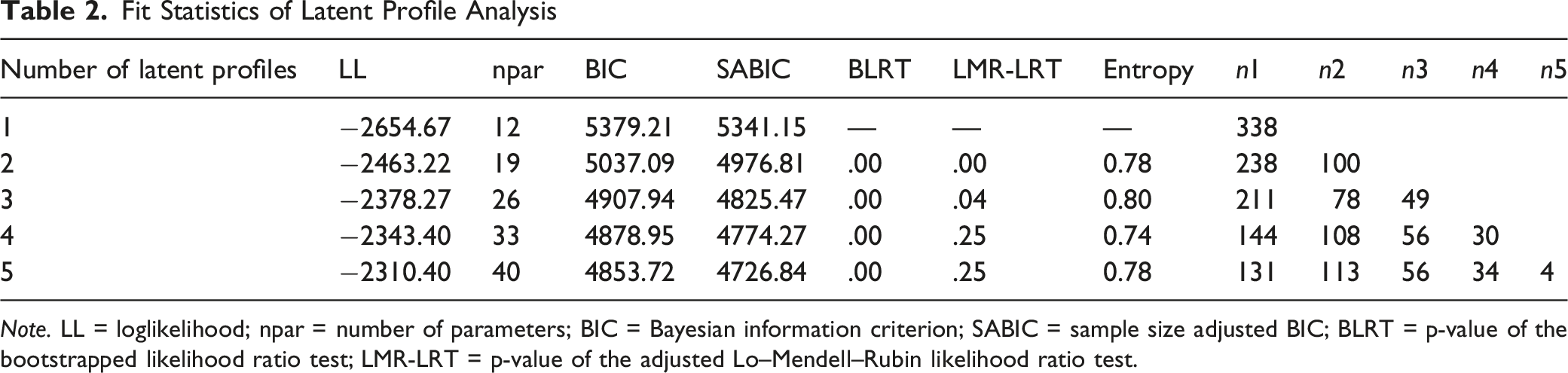
Note. LL = loglikelihood; npar = number of parameters; BIC = Bayesian information criterion; SABIC = sample size adjusted BIC; BLRT = p-value of the bootstrapped likelihood ratio test; LMR-LRT = p-value of the adjusted Lo–Mendell–Rubin likelihood ratio test.
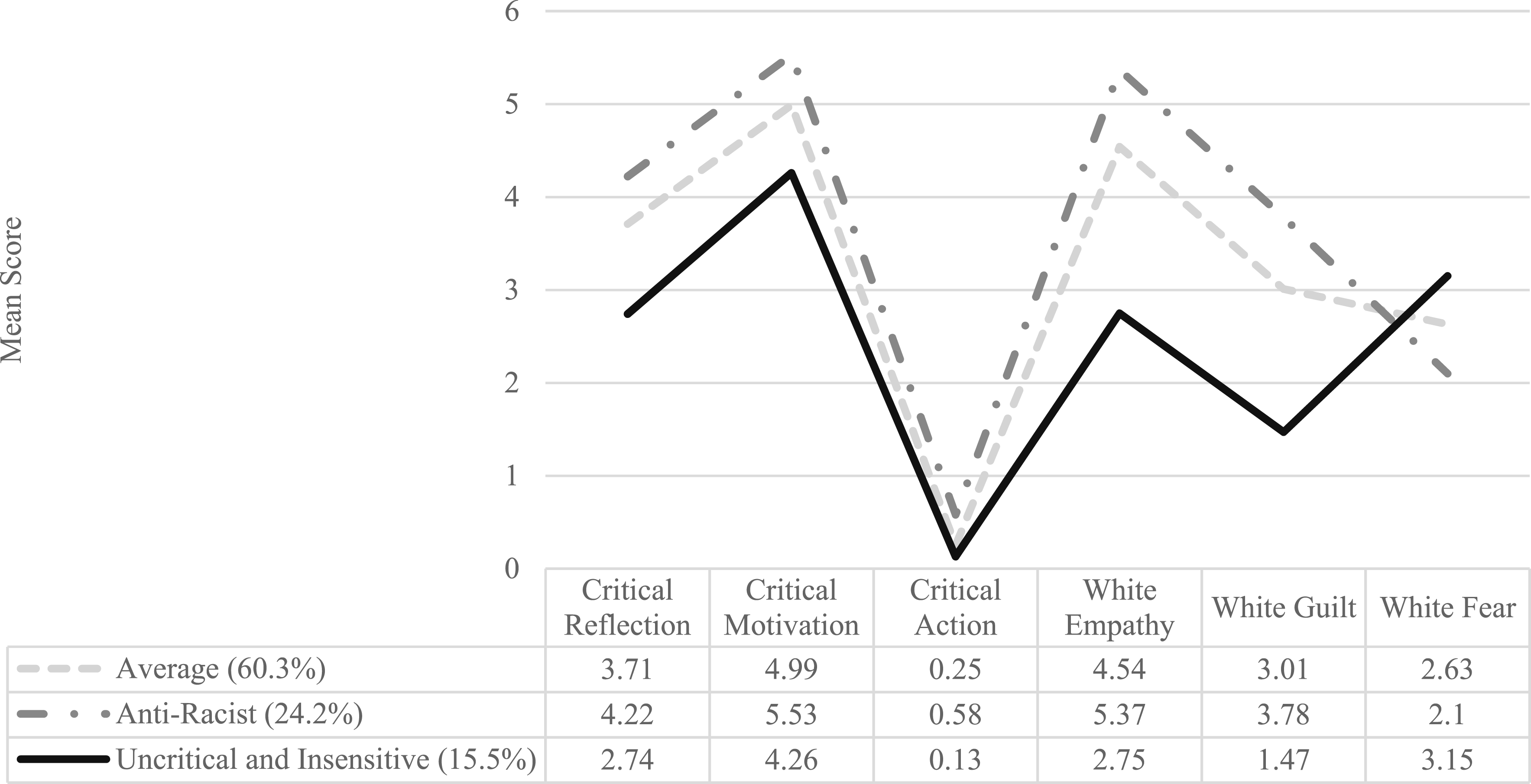
In the first profile (60.3%), termed the “average profile”, the young adults showed relatively average levels on all profile indicators as compared to others in our sample. In absolute terms (i.e., non-standardized means), youth in this profile reported low-medium levels of critical action, medium levels of White guilt and White fear, medium-high levels of critical reflection and White empathy and high levels of critical motivation. In the second profile (24.2%), termed the “anti-racist profile”, the young adults showed the highest levels of the three CC indicators, as well as White empathy and White guilt, but the lowest levels of White fear, out of the three profiles. In absolute terms, youth in this profile reported low-medium levels of White fear, medium levels of critical action, medium-high levels of White guilt, and high levels of critical reflection, critical motivation, and White empathy. In the third profile (15.5%), termed the “uncritical and insensitive profile”, adolescents showed the lowest levels of the three CC indicators, as well as White empathy and White guilt, but the highest levels of White fear, out of the three profiles. In absolute terms, youth in this profile reported low levels of critical action, low-medium levels of White guilt, medium levels of critical reflection, White empathy and White fear, and medium-high levels of critical motivation (see Figure 1 for the standardized estimated means and Figure 2 for unstandardized means in the three latent profiles). Standardized means of final three-profile solution of LPA analysis Non-standardized means of final three-profile solution of LPA analysis
Profile Membership and Subjective Wellbeing (H2)
Path Analysis Results Predicting Life Satisfaction and Future Emotions From Latent Profile Membership

Note. N = 338. The “average profile” (60.3%) was the reference group.
Robustness Checks
As robustness checks, we re-ran all analyses testing Hypothesis 2 including control variables (i.e., age, gender, educational level), and excluding the two multivariate outliers that we had identified. This did not change the pattern of results (see Supplemental Materials 4, Table 4.1–4.3).
Discussion
To further our understanding of White emerging adults’ anti-racism, this study examined patterns of CC about racism and emotional responses to racism among White emerging adults in the Netherlands. Using a person-centered approach, three profiles were identified, highlighting the distinct ways in which CC dimensions co-occur with different emotional responses to racism. Additionally, the present study aimed to shed light on associations between these profiles and youth’s subjective wellbeing. Results suggest that White youth in the “anti-racist” profile tend to feel more negative about the future than youth in other profiles.
Latent Profiles of Critical Consciousness and Emotional Responses to Racism
Supporting Hypothesis 1 based on previous work on profiles of CC (Briggs et al., 2023; Godfrey et al., 2019; Maker Castro et al., 2025; Schwarzenthal et al., 2024) and emotional responses to racism (Mcconnell & Todd, 2015; Spanierman et al., 2006, 2009, 2012), three profiles of CC dimensions and emotional responses to racism were identified in our sample of White emerging adults. As expected, one of these profiles resembled the “anti-racist” profile (24% of the sample), with relatively high scores on all three CC dimensions (i.e., reflection, action, and motivation), high levels of White empathy and guilt, and low levels of White fear, whereas another resembled the most “uncritical and insensitive” profile (16% of the sample), with relatively low scores on all three CC dimensions, low levels of White empathy and guilt, and high levels of White fear. These profile constellations mirror profiles characterized by (relatively) high (‘liberated actors’ or ‘actionist’ profiles) or low (‘acritical bystanders’ or ‘uncritical profiles’) levels across CC dimensions found in earlier studies (Briggs et al., 2023; Godfrey et al., 2019; Maker Castro et al., 2025; Schwarzenthal et al., 2024). Importantly, this finding extends this previous work by showing that these two profiles exist in a sample of White emerging adults only too, and by highlighting how they co-occur with the previously identified ‘anti-racist’ and ‘insensitive and afraid’ profiles of emotional responses to racism, respectively (Mcconnell & Todd, 2015; Spanierman et al., 2006, 2009, 2012). This finding further advances previous efforts to integrate elements of CC and emotional responses to racism, as these previous studies identified profiles characterized by high empathy, guilt, and critical reflection (‘critical racial attitudes’ and ‘emersion’, also characterized by low levels of fear) and by low levels of empathy, guilt, and critical reflection (‘uncritical racial attitudes’ and ‘reintegration’, also characterized by moderate levels of fear) (Parigoris et al., 2024; Parks et al., 2023), by including all three dimensions of CC simultaneously.
Although the labels of these profiles reflect the relative position of youth in comparison to others in our sample, it should be noted that youth scored relatively high on critical reflection and motivation, and relatively low on critical action across profiles in the current study. As such, youth in the “uncritical and insensitive” profile still reported medium levels of critical reflection and medium-high levels of critical motivation, whereas youth in the “anti-racist” profile reported only medium levels of critical action. Similarly, youth in the current sample reported relatively high levels of White empathy and guilt and average levels of White fear. As such, youth in the “uncritical and insensitive” profile did not report very low levels of empathy and guilt (scores were low-medium to medium), and only medium levels of fear.
The third profile, labeled the “average” profile, identified in the present study was characterized by relatively average scores across all profile indicators as compared to the other profiles. These relatively average scores in the present sample in absolute terms reflect medium levels of White guilt and fear, but low-medium levels of critical action, medium-high levels of critical reflection and White empathy, and high levels of critical motivation. In terms of CC dimensions, this profile seems to most closely resemble the ‘precritical bystander’ profile identified in earlier studies among Black adolescents and ethnic-racially diverse college students (Briggs et al., 2023; Maker Castro et al., 2025), although particularly critical motivation levels seem somewhat higher in the current sample in absolute terms (i.e., high vs. medium(-high)). This finding shows how this constellation of CC dimensions is relevant and prevalent among White young adults too. The combination of levels of emotional responses to racism does not resemble any of the earlier identified patterns among White college students in the U.S. (Mcconnell & Todd, 2015; Spanierman et al., 2006, 2009, 2012). The profile constellation does, however, resemble (part of) the ‘ambivalent racial attitudes’ profile found among White adults in the U.S. by Parigoris et al. (2024) using White empathy, White guilt, and critical reflection indicators. This profile additionally reported the second highest levels of racial justice action (Parigoris et al., 2024), similar to the critical action levels in the present study. Interestingly, both in the study by Parigoris et al. (2024) and in the present study, this profile was most prevalent among the sample of White participants (60% of the sample in the present study), suggesting that this particular combination of relatively moderate levels across indicators is frequently observed among White (young) adults. This profile might be interpreted in light of Helm’s conceptualization of pseudo-independence as the first schema of the second phase of White identity development. The second phase is centered around developing an anti-racist identity, and pseudo-independence is conceptualized as a first step in this development, involving some thinking about racism in line with one’s morality but not too much personal consequences in terms of feelings (Helms, 2020). As such, pseudo-independence is seen as a relatively stable and ‘safe’ schema for White people to rely on, potentially explaining why this profile is most prevalent in our current sample.
Associations Between Profiles and Subjective Wellbeing
We hypothesized that subjective wellbeing would be more positive for the “anti-racist” and “uncritical and insensitive” profiles than for ‘in-between’ profiles, in particular those characterized by a combination of high critical reflection with low critical motivation, critical action, or empathy. However, our in-between profile did not resemble any of these combinations, and as such, we could not confirm these hypotheses. The results did show that White youth in the “anti-racist” profile reported less positive future emotions than White youth in the “average” profile, whereas no other significant associations were found between profile membership and indices of subjective wellbeing (i.e., life satisfaction, negative future emotions).
The fact that White youth in the “anti-racist” profile reported relatively less positive future emotions could be interpreted through the lens of system justification theory, which implies that believing that society and its systems are fair has a palliative function, particularly for members from advantaged groups (Jost & Hunyady, 2003). For members of these groups, justifying the system and thereby maintaining the status quo reinforces their relatively privileged position in society. Engaging in CC at relatively high levels may conflict with White youth’s system justification motive, therefore not meeting their social and psychological needs to perceive the status quo as legitimate (Jost et al., 2004). These findings are in line with previous empirical work which suggests that in contrast to effects for youth of color, CC effects may be negative for White youth (Maker Castro et al., 2022; Tyler et al., 2020), and add to the currently mixed literature on how membership in similar CC profiles relates to wellbeing (Desmarais & Christophe, 2024; Maker Castro et al., 2025; Schwarzenthal et al., 2024). Additionally, experiencing relatively high levels of White guilt is generally seen as an unpleasant experience leading to a negative mood (Todd et al., 2010). This finding furthermore aligns with the pattern identified by Parks et al. (2023), whose results showed that White adults in the profile that most closely resembles the “anti-racist” profile based on CC- and emotional responses-related indices reported the lowest levels of wellbeing across a range of indicators (i.e., depressive and anxiety symptoms, general stress, life satisfaction). In agreement with the interpretation by Parks et al. (2023), these results reflect a normative aspect of developing an anti-racist identity as a White person in a colorblind society, which involves learning to become aware of and deal with racial issues and one’s own privilege that is accompanied by discomfort and mild feelings of distress (Helms, 2020). This discomfort is necessary in order to develop anti-racism and thereby contribute to a more just society. Nonetheless, future studies are needed to examine how to support youth in this process and positively adapt these associations, for example by focusing on normalizing these experiences (Parks et al., 2023).
The fact that this pattern was only identified for future positive emotions, and not for negative future emotions and life satisfaction, warrants future research. Possibly, future emotions are less self-focused than life satisfaction, and reflect a more general tendency of worries about society and the world. Given White youth’s dominant position in society, this would explain why in the present study associations were only found between CC and one of the less self-focused outcomes. This is also plausible in light of the current political climate, which is characterized by growing support for radical right-wing parties that openly display Islamophobic and anti-immigrant sentiments (van Holsteyn & Irwin, 2024; Vossen, 2011), which might worry youth in the “anti-racist” profile particularly. Another explanation for not finding any associations for life satisfaction could be that particularly youth in the “anti-racist” profile give more socially desirable answers to this question, reflecting their awareness of their relative privilege. In any case, future longitudinal research is needed to further disentangle (the direction of) associations between White youth’s CC and emotional responses to racism on the one hand and their subjective wellbeing on the other hand. Such a study design would also allow to examine whether the current study design may have inflated the association between being in the “anti-racist” profile and reporting less positive future emotions, as answering questions about critical consciousness and emotional responses to racism prior to reporting one’s outlook on the future may have triggered a negative mood for these youth particularly. Furthermore, results may be different for other conceptualizations of wellbeing. Given its multidimensional nature, future research needs to look into associations between White youth’s CC and other dimensions of wellbeing (e.g., self-esteem, self-efficacy, anxiety).
Limitations and Future Directions
Some limitations to the present study should be taken into account. First of all, the study uses cross-sectional self-report data, which limits our ability to assess temporal associations and increases the risk of social desirability. In particular, future studies are needed to disentangle the directionality of associations between CC, emotional responses to racism, and subjective wellbeing. Secondly, the sample was not nationally representative (i.e., females and higher education students were overrepresented), potentially limiting the generalizability of our findings and highlighting the need for replications in more diverse samples of White youth. The recruitment methods might have impacted representativity of the sample, as it was communicated in the recruitment materials that the study was about youth’s perspectives on racism in the Netherlands. Therefore, these methods potentially recruited youth who were particularly interested in the topic (as evidenced by relatively high levels of CC across profiles). Although the study adds to the literature by focusing on White youth, it did not account for participants’ other, potentially marginalized, identities such as sexual orientation, socioeconomic status, or disability status. These identities may have an important role in shaping processes of critical consciousness across domains, reflecting on one’s intersectional marginalization or privilege. Future research should adopt an intersectional approach and take into account multiple lines of social group membership (Wray-Lake et al., 2023).
Thirdly, the critical motivation measure did not focus on racism specifically, but rather assessed general critical motivation, whereas the measures of critical reflection and critical action were domain specific. Additionally, results from the factor analyses seem to indicate that the critical motivation measure actually consists of two different subcomponents: one tapping into perceived importance of (young) people in general to be critically engaged, and one tapping into one’s personal sense of responsibility. This calls for a clearer conceptualization of critical motivation, as it has been defined and referred to differently throughout the literature (e.g., internal versus external political efficacy, ability versus responsibility to create change) (Diemer & Rapa, 2016; Watts et al., 2011). Furthermore, the critical reflection measure focused on ethnic-racial inequities in education specifically. Although this a salient context for the participants, it raises questions about the extent to which results would be similar if reflection on racism in other sectors or domains would be taken into account. Perhaps reflections on racism in aspects of society that feel ‘further’ from participants daily lives co-occur differently with emotional responses.
Conclusion
The current study provides insights in the interplay between CC and emotional responses to racism among White emerging adults, thereby significantly adding to the currently rather fragmented literature on these related aspects of anti-racism development and extending these predominantly U.S.-based fields to the Netherlands. The findings show that youth display distinct profiles of CC and emotional responses to racism, and highlight the need for more person-centered approaches to understand the full complexity of White people’s anti-racism development. The results furthermore underscore that profile membership relates to some aspects of youth’s subjective wellbeing. Particularly, White emerging adults in the most “anti-racist” profile, characterized by relatively high levels across CC dimensions, high White empathy and guilt and low White fear, report the least positive emotions about the future. Although this can be considered a normative aspect of White youth’s anti-racism development and a necessary development to work towards an anti-racist generation, future research should explore how to support these youth in order for them to use their potential to contribute to a more just society.
Supplemental Material
Supplemental Material - Critical Consciousness and Emotional Responses to Racism: A Latent Profile Analysis and Associations With Socioemotional Wellbeing Among White Dutch Youth
Supplemental Material for Critical Consciousness and Emotional Responses to Racism: A Latent Profile Analysis and Associations With Socioemotional Wellbeing Among White Dutch Youth by Ymke de Bruijn, Miriam Schwarzenthal in Emerging Adulthood
Footnotes
Acknowledgement
We would like to thank Herman Horzelenberg for his contribution as student assistant to this project.

Ethical Considerations
The study procedures were approved by the Ethics Committee of the Faculty of Social and Behavioral Sciences of Utrecht University on April 19th, 2024 (file number 23-0432).
Funding
The authors disclosed receipt of the following financial support for the research, authorship, and/or publication of this article: The work has been funded by the Society for the Psychological Study of Social Issues.
Declaration of Conflicting Interests
The authors declared no potential conflicts of interest with respect to the research, authorship, and/or publication of this article.
Contributions
YB: conceptualization, data curation, funding acquisition, investigation, project administration, writing – original draft preparation, writing – review & editing. MS: conceptualization, data curation, formal analysis, visualization, writing – review & editing.
Transparency and Openness Statement
Supplemental Material
Supplemental material for this article is available online.
Notes
Author Biographies
References
Supplementary Material
Please find the following supplemental material available below.
For Open Access articles published under a Creative Commons License, all supplemental material carries the same license as the article it is associated with.
For non-Open Access articles published, all supplemental material carries a non-exclusive license, and permission requests for re-use of supplemental material or any part of supplemental material shall be sent directly to the copyright owner as specified in the copyright notice associated with the article.
