



Abstract
Personality traits in children predict numerous life outcomes. Although traits are generally stable, if there is personality change in youth, it could affect subsequent behavior in important ways. We found that the trait of urgency, the tendency to act impulsively when highly emotional, increases for some youth in early adolescence. This increase can be predicted from the behavior of young children: alcohol consumption and depressive symptom level in elementary school children (fifth grade) predicted increases in urgency 18 months later. Urgency, in turn, predicted increases in a wide range of maladaptive behaviors another 30 months later, at the end of the first year of high school. The mechanism by which early drinking behavior and depressive symptoms predict personality is not yet clear and merits future research; notably, the findings are consistent with mechanisms proposed by personality change theory and urgency theory.
Introduction
One traditional and highly fruitful line of inquiry for understanding the onset of, and increases in, engagement in impulsive, maladaptive behaviors has been to identify personality traits that increase the risk of engagement in such behaviors (Settles, Cyders, & Smith, 2010; Settles, Zapolski, & Smith, 2014; Sher & Trull, 1994; Smith & Guller, 2014; Tarter, 1988). This paper reports on tests of hypotheses concerning the reverse relationship: We tested whether high-risk behavior by youth predicted subsequent increases in maladaptive personality. Although tests of whether behavior predicts maladaptive personality have rarely been conducted (but see Blonigen et al., 2015; Horvath, Milich, Lynam, Leukefeld, & Clayton, 2004; Littlefield, Vergés, Wood, & Sher, 2012), such tests are important. Because high-risk traits increase risk for harm transdiagnostically—that is, in multiple forms of dysfunction (Smith & Cyders, 2016; Zuckerman, 1994)—behaviors that predict increased levels of high-risk traits may thus have transdiagnostic etiological importance.
The specific model we used to test this possibility was whether engagement in rare and dysfunctional behaviors during elementary school, such as alcohol consumption, smoking, and binge eating, as well as the early presence of depressive symptoms, predicted subsequent increases in the high-risk trait of urgency, which reflects the disposition to act rashly when highly emotional (Cyders & Smith, 2008b). To introduce this test, we briefly review the role of personality in risk models, stability of personality and change within that stability, the role of urgency as a personality predictor of risk, and the problematic nature of very early engagement in drinking, smoking, and binge eating.
The role of personality in risk models
With respect to risk for psychological dysfunction, personality is understood to operate as a distal and transdiagnostic risk factor; multiple studies document that personality predicts life trajectories as reflected in numerous outcomes, both positive and negative, in many domains of functioning (Roberts, Kuncel, Shiner, Caspi, & Goldberg, 2007). Among the many outcomes predicted by personality are physical health, mortality, marital outcomes, interpersonal functioning, educational and occupational attainment, life happiness, engagement in substance abuse, and psychopathology (Costa & McCrae, 1996; Roberts et al., 2007). The importance of personality in youth has become apparent for the prediction of both adult (Caspi et al., 2003; Shiner & Masten, 2002) and adolescent (Smith, Guller, & Zapolski, 2013) adjustment.
Personality stability and change
In addition to being highly heritable (Jang, Livesley, & Vernon, 1996), individual differences in personality are remarkably stable across the lifespan (Costa, Herbst, McCrae, & Siegler, 2000; Costa & McCrae, 1996). Across decades of adult life, stability coefficients (correlations corrected for unreliability) range from .60 to .80 (McCrae & Costa, 1994; Roberts & DelVecchio, 2000), with similar but slightly smaller coefficients representing stability from adolescence to adulthood.
In the context of this stability, there is growing appreciation for personality change, particularly during developmental transitions. A series of studies on the transition into adulthood has shown such change, which can occur in adaptive or maladaptive ways (Bleidorn, 2012; Blonigen et al., 2015; Roberts, Wood, & Caspi, 2008). Those who invest positively in their new adult roles, as reflected in job attainment, work satisfaction, and financial security, tend to experience positive increases in conscientiousness and self-control (Roberts, Caspi, & Moffitt, 2003). Those who respond negatively to the challenges of emerging adulthood, reflected in behaviors such as fighting with coworkers, stealing from the workplace, or using substances at work, tend to experience increases in negative emotionality and decreases in self-control (Roberts, Walton, Bogg, & Caspi, 2006). There is also evidence that those who begin engagement in nonnormative or risky behaviors far earlier than their peers tend to experience personality changes in the negative direction (Blonigen et al., 2015).
Theory holds that the process of personality change is likely to operate in what is sometimes called a bottom-up fashion. During developmental transitions, one takes on new social and achievement roles. Those new roles require engagement in new behaviors. Engagement in new behaviors that are reinforced by the environment leads, over time, to basic personality shifts consistent with investment in the new behaviors (Roberts et al., 2008). For example, engagement in a new behavior such as paying bills on time may be rewarded by the environment (perhaps in the form of a higher credit score, which allows the individual to buy a car). Thus, a new social role (adulthood), and repeated engagement in behaviors that reflect investment in that role, may result in a new environmental reward structure in which, for example, more conscientious behaviors are consistently reinforced, leading to an incremental increase in the personality trait of conscientiousness.
The trait of urgency
Urgency can readily be understood in terms of comprehensive models of personality (Costa & McCrae, 1996): It is characterized by high levels of neuroticism and low levels of agreeableness and conscientiousness (Cyders & Smith, 2008b). The trait of urgency has two facets. Negative and positive urgency refer to the disposition to act rashly when in an unusually negative or positive mood, respectively (Cyders & Smith, 2007, 2008b).
For several reasons, increases in the trait of urgency would be important clinically. First, multiple meta-analyses have identified urgency or its facets as particularly strong predictors of numerous addictive behaviors (Berg, Latzman, Bliwise, & Lilienfeld, 2015; Coskunpinar, Dir, & Cyders, 2013; Fischer, Smith, & Cyders, 2008; Stautz & Cooper, 2013). Second, longitudinal studies have demonstrated that positive and/or negative urgency predict the subsequent onset of, or increases in, drinking frequency and quantity (Cyders, Flory, Rainer, & Smith, 2009; Settles et al., 2010, 2014), tobacco smoking (Doran et al., 2013), drug use (Zapolski, Cyders, & Smith, 2009), risky sex (Zapolski et al., 2009), binge eating (Fischer, Peterson, & McCarthy, 2013; Pearson, Combs, Zapolski, & Smith, 2012), gambling (Cyders & Smith, 2008a), nonsuicidal self-injury (Riley, Combs, Jordan, & Smith, 2015), and depression (Smith et al., 2013). Third, numerous prospective studies have documented this predictive role for urgency in children as young as late elementary school and middle school, thus suggesting that urgency’s predictive role is not a downstream manifestation of scar effects from the consequences of ongoing psychopathology (Widiger & Smith, 2008). Given urgency’s predictive role, increases in this high-risk trait are likely associated with increases in transdiagnostic behavioral risk.
Risky behavior engagement as a predictor of urgency change
The theoretical basis for hypothesizing that early engagement in risky, impulsive acts predicts urgency change is a combination of the bottom-up theory of personality change described above and the theory of urgency (Cyders & Smith, 2008b; Smith & Cyders, 2016). Consistent with personality change theory, early adolescent engagement in new behaviors that provide reinforcement may contribute to gradual changes in personality. More specifically, we felt that increases in urgency might best be predicted by engagement in behaviors that are (a) considered rash or impulsive in youth and (b) often engaged in when experiencing intense emotion.
Early engagement in drinking, smoking, and binge eating behavior all represent plausible candidates to lead to increases in urgency. Engagement in these behaviors during early adolescence is rare (Combs, Pearson, & Smith, 2011; Combs, Spillane, Caudill, Stark, & Smith, 2012; Donovan, 2007) and is associated with both current and future harm (Chassin, Presson, Pitts, & Sherman, 2000; Chung et al., 2012; Guttmannova et al., 2012; Kotler, Cohen, Davies, Pine, & Walsh, 2001; Stice & Martinez, 2005). Nevertheless, each of the behaviors is thought also to provide immediate reinforcement (Doran et al., 2013; Pearson et al., 2012; Smyth et al., 2007; Swendson et al., 2000). Each is often precipitated by intense emotion, whether subjective distress or unusually positive mood states, and functions to provide (a) relief from distress or (b) enhancement of a positive mood state (Baker, Brandon, & Chassin, 2004; Doran et al., 2013; Haedt-Matt & Keel, 2011; Settles et al., 2014; Smyth et al., 2007; Steinberg et al., 2008; Swendson et al., 2000).
Each of the behaviors is described as rash or impulsive, because engagement in them often meets an immediate affective need but also undermines an individual’s health, interests, or long-term goals (Birkley & Smith, 2011; Cyders & Smith, 2008b). Because of the potency of immediate reinforcement, these behaviors are reinforced incrementally over time, as is the disposition to engage in such behaviors. Urgency is one such disposition, and therefore, we hypothesized, it is reinforced and may thus increase over time.
Among these three behaviors, we were particularly interested in whether very early drinking predicts increases in urgency for two reasons. First, drinking may be a better predictor because in children as young as fifth grade (Wave 1 in the current study), more youth have consumed a drink of alcohol than have smoked a cigarette, and the meaning of binge eating in children so young is not yet entirely clear (Combs, Pearson, Zapolski, & Smith, 2012; Tanofsky-Kraff et al., 2011). Second, simple drinker status in youth is highly predictive of alcohol use disorder symptoms (Chung et al., 2012), and the American Academy of Pediatricians (AAP) recommends screening for drinker status in youth (AAP & National Institute on Alcohol Abuse and Alcoholism [NIAAA], 2011). As a result, drinker status in youth is being assessed more frequently. We thus sought to determine whether this assessment also facilitates prediction of personality change.
We also considered the possibility that early depressive symptomatology might predict subsequent increases in urgency. It may be that depressive symptoms, in part, reflect more frequent experiences of both stress and distress. Perhaps experiencing these emotions at a greater frequency increases the probability that, over time, one will be disposed to act in rash, impulsive ways to alleviate distress, resulting in increases in urgency.
The current study
We studied 1,906 youth in the spring of fifth grade (the last year of elementary school), the fall of seventh grade (18 months later, during middle school), and the spring of ninth grade (30 months after the second assessment, the first year of high school). We first tested whether engagement in rash, maladaptive behaviors (drinking, smoking, and binge eating) and depressive symptom level, during elementary school, predicted increases in urgency 18 months later. Second, to evaluate whether middle school urgency does increase risk transdiagnostically, we tested whether middle school urgency predicted increases in drinking, smoking, binge eating, and depression by the end of the first year of high school. Support for these hypotheses would suggest that very early engagement in risky, maladaptive behaviors, as well as the experience of depression at a young age, is a marker of risk for multiple forms of future dysfunction, apparently due to maladaptive personality change.
Our hypotheses were specific to increases in the trait of urgency. To test for this specificity empirically, we conducted the same series of tests using three other personality dispositions thought to be related to impulsive action: sensation seeking, lack of planning (the disposition to act without forethought), and lack of perseverance (difficulty maintaining focus on a task in the face of distractions) (Whiteside & Lynam, 2001).
Method
Sample
Participants were 1,906 youth in fifth grade at the start of the study; they were drawn from urban, rural, and suburban backgrounds and represented 23 public schools in two school systems. The sample was equally divided between girls (49.9%) and boys. At Wave 1, most participants were 11 years old (66.8%), 22.8% were 10 years old, 10% were 12 years old, and 0.2% were either 9 or 13 years old. The ethnic breakdown of the sample was as follows: 60.9% European American, 18.7% African American, 8.2 % Hispanic, 3% Asian American, and 8.8% other racial/ethnic groups.
Measures
Demographic and background questionnaire
Participants were asked to circle their gender, write in their current age (in years), and indicate which label(s) best described their ethnic background.
UPPS-P-Child Version, Urgency (Zapolski, Stairs, Settles, Combs, & Smith, 2010)
UPPS-P refers to the traits of urgency, planning, perseverance, sensation seeking, and positive urgency. Urgency is the label for a trait domain that includes two facets: Positive and negative urgency represent the dispositions to act rashly when experiencing intense positive or negative mood, respectively (Cyders & Smith, 2007, 2008b). The two urgency scales consist of eight items each and responses are on a 4-point Likert-type scale from 1 (not at all like me) to 4 (very much like me). For positive urgency, a sample item is: “When I am very happy, I tend to do things that may cause problems in my life.” For negative urgency, a sample item is: “When I am upset I often act without thinking.” Because positive and negative urgency are facets of a single domain, we investigated (a) the correlation between the two in this sample and (b) whether use of one individual trait produced different results from use of the other individual trait. The two correlated highly: r = .63, p < .001 at Wave 1, with higher correlations in subsequent waves. Each of the predictive models we report was also run with each of the two traits individually. In each case, results were the same across traits. Accordingly, we report all results using the overall trait of urgency. Internal consistency estimates of reliability were high: α = .91 at Wave 1 and higher subsequent waves. Scores were calculated as average item scores, so the range was from 1 to 4.
This measure also provided reliable assessments of sensation seeking (Wave 1 α = .79, with higher estimates subsequent waves), lack of planning (Wave 1 α = .77, with higher estimates subsequent waves), and lack of planning (Wave 1 α = .65, with higher estimates subsequent waves). Concerning validity of the trait assessment, there is good convergent validity in the form of assessment of each trait across methods and good discriminant validity evidence distinguishing each trait from the other traits within method of assessment (Cyders & Smith, 2007).
Drinking Styles Questionnaire (DSQ; Smith, McCarthy, & Goldman, 1995)
The DSQ (Smith et al., 1995) was used to measure self-reported drinker status when the children were in fifth grade and drinking frequency when the children were in seventh and ninth grades. The DSQ measures drinking frequency with a single item asking how often one drinks alcohol. Frequency of drinking was measured at levels ranging from 1 to 4 times in one’s life to almost daily. This assessment method has proven stable over time and there is good evidence for its validity (Settles et al., 2010).
Eating Disorder Examination–Questionnaire (EDE-Q; Fairburn & Beglin, 1994)
We used the EDE-Q, which is a self-report version of the Eating Disorders Examination semistructured interview (Cooper & Fairburn, 1993), to assess binge eating behavior. The EDE-Q has been shown to have good reliability and validity, particularly in clinical samples (Cooper & Fairburn, 1993, Mond, Hay, Rodgers, Owen, & Beumont, 2004). As is typical in studies of youth, we adapted the EDE-Q by using age-appropriate wording, defining concepts that could possibly be difficult to understand and shortening the length of time referred to in the questions to the past 2 weeks, per past recommendations (Carter, Stewart, & Fairburn, 2001).
To measure binge eating, we adopted an approach common in eating disorder research, which is to count a behavior as a binge eating episode when two EDE-Q items are endorsed: one that assesses episodes of eating that most people would regard as an unusually large amount of food and one that assessed loss of control during these episodes. There were seven response options, ranging from 0 days to every day in the past 2 weeks.
Smoking behavior
Smoking behavior was measured using a single item. Frequency of smoking ranged from 1 to 4 times in their lives to almost daily. Numerous single-item measures of self-reported cigarette smoking have been used successfully in studies of adolescents (e.g., Chassin et al., 2000).
Center for Epidemiological Studies-Depression Scale (CES-D; Radloff, 1991)
CES-D (Radloff, 1991) was used to measure individual differences in depressive symptomology, as has previously been used in this age group (Clarke et al., 2005). The scale has proven reliable (internal consistency estimates ranging from .85 to .90) and valid in numerous studies; it is frequently used with children, adolescents, and adults (Clarke et al., 2005). We used CES-D total scores as interval scale indicators of depressive symptomology (α = .85, initial assessment in current sample, with estimates increasing in subsequent waves). Possible scores on the scale range from 20 to 80.
The Pubertal Development Scale (PDS; Petersen, Crockett, Richards, & Boxer, 1988)
This scale consists of five questions for boys (“Do you have facial hair yet?”) and five questions for girls (“Have you begun to have your period?”). Evidence for reliability and validity are strong (Coleman & Coleman, 2002). We used the common dichotomous classification of the PDS (Culbert, Burt, McGue, Iacono, & Klump, 2009) as prepubertal or pubertal, with mean scores above 2.5 indicative of pubertal onset.
Procedure
The current study used data drawn from a larger longitudinal investigation of youth. Data for this study were collected in the spring of fifth grade (elementary school: Wave 1), the fall of seventh grade (middle school: Wave 2), and the spring of ninth grade (high school: Wave 3). As was approved by the university’s IRB, the participating school systems, and the funding agency (NIAAA), a passive-consent procedure was used. Each family was sent a letter, through the U.S. mail, introducing the study. Families were asked to return an enclosed, stamped letter or call a phone number if they did not want their child to participate. Out of 1,988 fifth graders in the participating schools, 1,906 participated in the study (95.9%). Reasons for nonparticipation included declination of consent from parents, declination of assent from children, and language or cognitive difficulties.
The questionnaires were administered in 23 public elementary schools at Wave 1, in 15 middle schools at Wave 2, and in 7 high schools at Wave 3. Questionnaires were administered by study staff in the children’s classrooms or in a central location, such as the school cafeteria, during school hours. The questionnaires took 60 minutes or less to complete. Children who left the school system were asked to continue to participate. Those who consented did so either by completing hard copies of questionnaires delivered through the mail or by completing the measures on a secure web site.
Of the full sample, the percentages of individuals who participated at each wave were as follows: 96.5% at Wave 1, 90.1% at Wave 2 (18 months following Wave 1), and 75% at Wave 3 (48 months following Wave 1). Retained and not retained participants did not vary on any study variables. We have reported on all measures analyzed for this article. The sample size was determined at the start of the 4-year longitudinal study to provide a powerful, representative sample of youth.
Data analysis
Measurement of addictive behaviors
We measured three addictive behaviors: drinking, smoking, and binge eating. For each of the three, individuals endorsed a level of engagement that ranged from 0 = never engaged in the behavior to a maximum level reflecting engagement in the behavior: daily or almost daily. Specifically, for drinking, 0 = “I have never had a drink of alcohol”; 1 = “I have only had 1, 2, 3, or 4 drinks of alcohol in my life”; 2 = “I only drink alcohol 3 or 4 times a year”; 3 = “I drink alcohol about once a month”; 4 = “I drink alcohol once or twice a week”; and 5 = “I drink alcohol almost daily.” For smoking, 0 = “I have never smoked”; 1 = “I have smoked 1, 2, 3, or 4 times in my life”; 2 = “I smoke cigarettes 3 or 4 times a year”; 3 = “I smoke about once a month”; 4 = “I smoke about once or twice a week”; and 5 = “I smoke almost daily or every day.” For binge eating, how many days in the last 14 days an individual engaged in binge eating with loss of control: 0 = “no days”; 1 = “1–2 days”; 2 = “3–4 days”; 3 = “5–7 days”; 4 = “8–10 days”; 5 = “11–13 days”; and 6 = “14 days or every day.”
For Waves 2 and 3 of the current study, there was sufficient engagement in each addictive behavior to support scoring those variables as ordered categorical variables. For Wave 1, when the participants were still in elementary school, the rate and frequency of the behaviors was so low that we modeled drinking, smoking, and binge eating status each as dichotomous variables, reflecting the lifetime presence or absence of alcohol consumption, cigarette smoking, and binge eating. This decision was consistent with the evidence, cited above, indicating the association of simple engagement in these behaviors in children this young with dysfunction.
Model test
Structural equation modeling (SEM) was used to test the predictive model; the software we used was Mplus (Muthén & Muthén, 2004–2010). We used the weighted least squares means and variance adjusted (WSLMV) estimation method, which accommodates ordered categorical variables. Each model allowed for cross-sectional correlations between all variables or disturbance terms.
The model we tested provided for (1) cross-sectional associations between all variables within the wave; (2) autoregressive prediction from each variable to the same variable the following wave; (3) reciprocal prediction between drinking and smoking; (4) prediction from Wave 2 urgency to Wave 3 drinking, smoking, binge eating, and depression; and (5) the key test of the study, which was prediction from Wave 1 drinking, smoking, binge eating, and depression to Wave 2 urgency. In addition, once we identified predictors of Wave 2 urgency, we tested mediation hypotheses of the form that the predictive influence of the Wave 1 predictors on Wave 3 outcomes was mediated by Wave 2 urgency.
To measure model fit, we relied on three fit indices: the Comparative Fix Index (CFI), the Nonnormed Fit Index (NNFI), and the root mean square error of approximation (RMSEA). Guidelines for what constitutes good fit vary. CFI and NNFI values above either .90 or .95 are thought to represent very good fit (Hu & Bentler, 1999; Kline, 2005). RMSEA values of .06 or lower are thought to indicate a close fit, .08 a fair fit, and .10 a marginal fit (Browne & Cudeck, 1993; Hu & Bentler, 1999). Models are judged to fit the data well when good fit is supported by most fit indices. We also report the model chi-square.
Results
Attrition and treatment of missing data
Of the full sample of 1,906 participants, 1,843 participated at Wave 1 (96.7%), 1,721 participated at Wave 2 (90.3%), and 1,434 (75.2%) participated at Wave 3. Those who participated at all waves did not differ from those who participated in fewer waves on any study variables. We therefore assumed data were missing at random and used the expectation maximization (EM) procedure to impute values for the missing data points. This procedure has been shown to produce relatively unbiased population parameter estimates and to be superior to traditional methods (Little & Rubin, 1989). As a result, we were able to make full use of the entire sample of n = 1,906.
Possible effects due to school membership
In order to determine whether there was significant covariance among the study variables due to participants attending the same school, we calculated intraclass coefficients for each variable (using elementary school membership, n = 23, as the nesting variable). Intraclass coefficients ranged from .03 to .00. We therefore concluded that school membership was essentially unrelated to study variables.
Descriptive statistics
Table 1 presents the percentage of youth positive for drinking, smoking, and binge eating at Wave 1 and count frequencies of all three behaviors at Waves 2 and 3. As noted in the table, engagement in drinking and smoking behavior increased steadily across the three waves. The percentage of youth engaging in binge eating changed little from Wave 1 to Wave 2 but increased at Wave 3. Descriptive statistics for urgency scores and depression scores at all three waves remained fairly stable throughout the study timeframe, as expected: Wave 1, urgency mean = 2.17 (standard deviation [SD] = .63), depression mean = 34.70 (SD = 8.43); Wave 2, urgency mean = 2.13 (SD = .66), depression mean = 34.13 (SD = 9.88); Wave 3, urgency mean = 2.18 (SD = .67), depression mean = 36.48 (SD = 9.58). A correlation matrix of all study variables is provided in Table S1 in the Supplemental Material available online.
Count Frequencies of Drinking, Smoking, and Binge Eating Behavior (Waves 2 and 3) for All Participants (n = 1,906)

Note. W1 Drinking, W1 Smoking, and W1 Binge Eating are measures of drinker status, smoker status, and binge eater status and are thus dichotomous 0–1 variables. For drinking, 0 = “I have never had a drink of alcohol”; 1 = “I have only had 1, 2, 3, or 4 drinks of alcohol in my life”; 2 = “I only drink alcohol 3 or 4 times a year”; 3 = “I drink alcohol about once a month”; 4 = “I drink alcohol once or twice a week”; and 5 = “I drink alcohol almost daily.” For smoking, 0 = “I have never smoked”; 1 = “I have smoked 1, 2, 3, or 4 times in my life”; 2 = “I smoke cigarettes 3 or 4 times a year”; 3 = “I smoke about once a month”; 4 = “I smoke about once or twice a week”; and 5 = “I smoke almost daily or every day.” For binge eating, how many days in the last 14 days an individual engaged in binge eating, 0 = “no days”; 1 = “1–2 days”; 2 = “3–4 days”; 3 = “5–7 days”; 4 = “8–10 days”; 5 = “11–13 days”; and 6 = “14 days or every day.”
Model tests
The model fit the data well: χ2(40) = 262.85; p < .001; CFI = .97; NNFI = .91; RMSEA = .05. Because this model included numerous predictive pathways, Figure 1 presents the model with arrows included for all statistically significant time-lagged pathways, and Table 2 presents the path value estimates and confidence intervals for each of those significant predictive pathways. We next summarize the results in accordance with our main hypotheses.
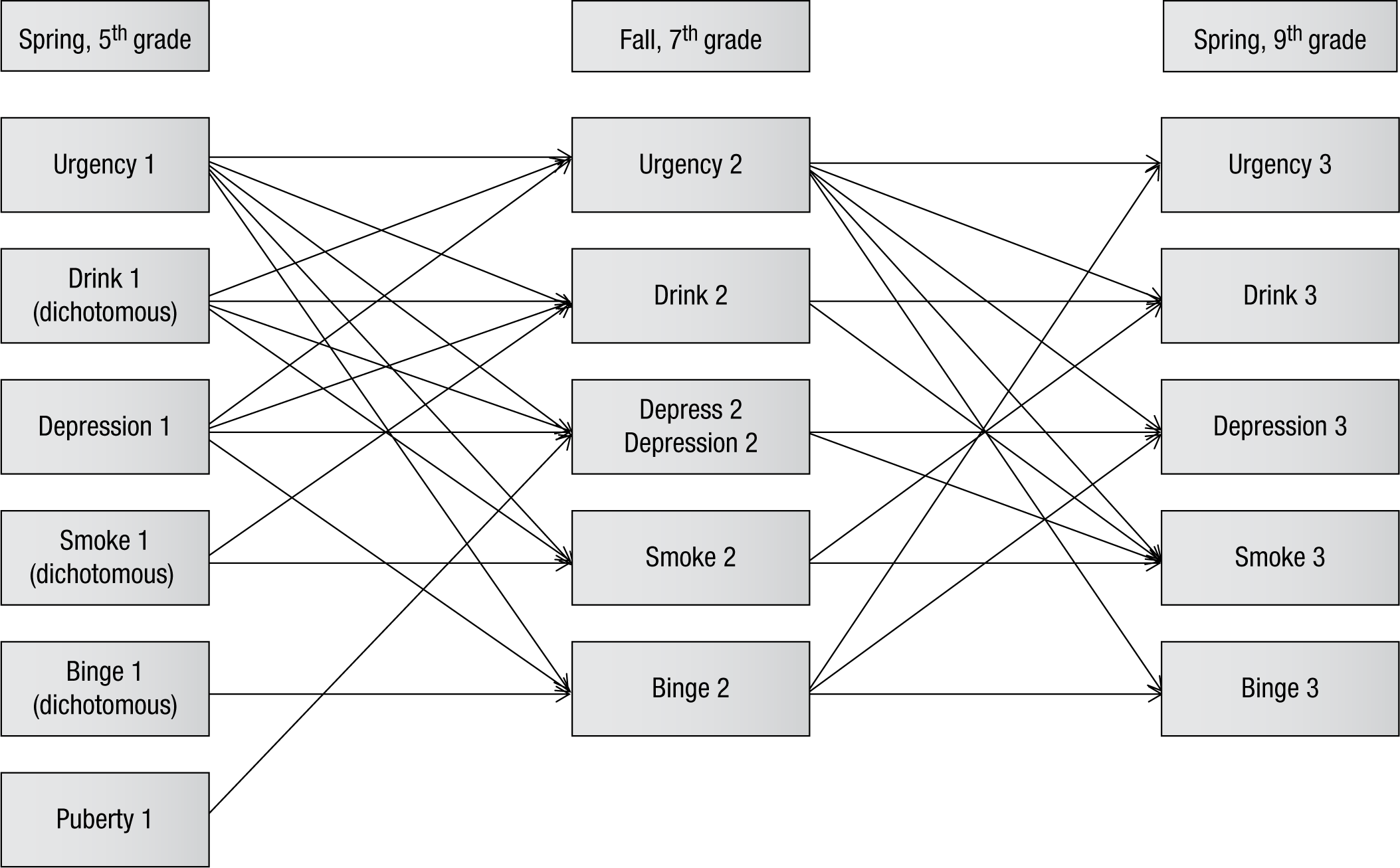
Broad risk implications of early drinker status through urgency change. N = 1,906. Spring, fifth grade: elementary school. Fall, seventh grade: middle school. Spring, ninth grade: high school. All solid line pathways were significantly greater than zero. Drink 1 = drinker status assessed at Time 1. Drink 2 and Drink 3 = drinking behavior at Time 2 and Time 3, measured as an ordinal variable. Smoke 1 = smoker status at Time 1. Smoke 2 and Smoke 3 = smoking behavior at Time 2 and Time 3, ordinal variable. Binge 1 = binge eater status at Time 1. Binge 2 and Binge 3 = binge eating behavior at Time 2 and Time 3, ordinal variable. Path estimates are provided in Table 2.
Path Value Estimates for Figure 1

Note: n = 1,906. Values are unstandardized path coefficients.
p < .05. **p < .001.
Predictors of increases in urgency
Wave 1 drinker status (dichotomous) and Wave 1 depression predicted urgency scores at Wave 2 (18 months later); these variables predicted urgency in the positive direction and beyond the other predictors, including autoregressive prediction. The path coefficients provided in Table 2 are unstandardized weights and thus provide one indication of the magnitude of the predictive effect. Being positive for drinker status at Wave 1 predicted Wave 2 urgency with beta = .28, indicating that being a drinker was associated with a .28 raw units increase in urgency 18 months later above and beyond prediction from the other variables in the model. Because urgency scores were calculated as the mean of the urgency items and scores ranged from 1 to 4, a .28 units increase reflects a .28 increase in the average item score, or an increase of .44 SDs in urgency over 18 months. A 1 unit increase in total depressive symptoms, where the range of scores was 60 units, was associated with a .01 increase in the average urgency item 18 months later (.02 SDs), beyond prediction from other variables.
High school criteria predicted by middle school urgency
Urgency measured at Wave 2 significantly predicted all the Wave 3 variables of interest (high school drinking, smoking, binge eating, and depression); higher levels of urgency in middle school predicted transdiagnostic risk in the form of higher levels of maladaptive behavioral engagement and depression in high school. As noted in Table 2, the magnitude of urgency’s net prediction was moderate for the three addictive behaviors and small for depression.
Mediation tests
The results shown in Table 3 demonstrate that statistical analyses were consistent with the hypothesis that fifth grade (Wave 1) drinking’s prediction of each of the ninth grade (Wave 3) criteria was mediated by seventh grade (Wave 2) urgency levels. The results were also consistent with the hypothesis that fifth grade depressive symptoms’ prediction of each ninth grade criterion was mediated by seventh grade urgency. We only tested mediation from fifth grade drinker status and depression because they were the only variables to predict increases in urgency in seventh grade. As indicated in Table 3, the magnitude of the mediation effects from drinker status through urgency was substantial, whereas those from depression through urgency were quite small.
Test of Mediation From Elementary School Drinking Through Middle School Urgency to High School Maladaptive Behavior

Note. N = 1,906. D1 = drinker status at Wave 1 (dichotomous); U2 = urgency scores measured at Wave 2; D3 = drinking scores measured at Wave 3 (ordinal variable) at Wave 3; Dep1 = depression scores measured at Wave 1; B3 = binge eating scores measured at Wave 3 (ordinal variable); S3 = smoking scores measured at Wave 3 (ordinal variable); Dep3 = depression scores measured at Wave 3. We tested the significance of the mediation using a one-tailed test because the direction of the prediction was hypothesized in advance. Reported here are the unstandardized effects. The standardized indirect effects ranged from a low of b = .08 for the prediction of Wave 3 binge eating to a high of b = .12 for the prediction of Wave 3 drinking and Wave 3 smoking.
The reason .00 is in these confidence intervals but the effects are noted as significantly greater than zero is that these paths were significantly greater than zero using our one-tailed tests but were not so using a two-tailed test.
p < .05. **p < .01.
Specificity of urgency
In order to test whether bottom-up, behavior-based personality change was indeed particular to urgency, and not the other impulsivity-related traits of sensation seeking, lack of planning, and lack of perseverance, we ran the aforementioned model with each of these other traits. Increases in sensation seeking, lack of planning, and lack of perseverance in seventh grade were not predicted from engagement in emotion-driven rash actions, such as drinking, or depressive symptoms in fifth grade. Prediction of personality change was specific to the trait of urgency.
Additional pathways of note
As can be seen in Figure 1, there were several other significant predictions that were not emphasized in our hypothesis tests. First, all of the autoregressive pathways were significant. The autoregressions for urgency were particularly high, which indicates that, overall, there was a large degree of construct stability for urgency. Second, there was a reciprocal predictive relationship between drinking behavior and smoking behavior such that each predicted the other at each wave (Wave 1 drinker status predicted Wave 2 smoking, Wave 1 smoker status predicted Wave 2 drinking, Wave 2 drinking predicted Wave 3 smoking, and Wave 2 smoking predicted Wave 3 drinking) above and beyond their autoregressive predictions. Finally, although Wave 1 binge eating status did not predict urgency change, Wave 1 urgency predicted Wave 2 binge eating above and beyond the binge eating autoregression, and these elevations in binge eating at Wave 2 predicted further elevations in urgency at Wave 3. The same pattern was true for the relationship between binge eating and depression, such that Wave 1 binge eating status did not predict depression at Wave 2, but Wave 1 depression predicted Wave 2 binge eating above and beyond the binge eating autoregression, and these elevations in binge eating at Wave 2 predicted further elevations in depression at Wave 3.
Discussion
The findings of this study are consistent with the possibility that there is adolescent personality change other than the change described by models of normal development (Littlefield, Stevens, Ellingson, King, & Jackson, 2015). Middle school urgency levels can be predicted in advance by the behavior of elementary school children; this prediction is beyond that provided by prior urgency levels. Such change in high-risk personality variables appears to occur in a maladaptive direction, in the form of increases in the trait of urgency that are detectable in middle school. Urgency levels, in turn, predicted several dysfunctional behaviors by high school. Given past findings that urgency elevations also predict nonalcohol drug use, risky sexual behavior, nonsuicidal self-injury, and gambling (Smith & Cyders, 2016), the negative downstream consequences of urgency elevations are probably greater than represented in this study.
The finding that elementary school drinker status and depression symptom level predict increases in urgency, and thus multiple forms of subsequent psychological dysfunction, is important for psychological theory as well as for public health. Concerning theory, it is important to investigate possible mechanisms of personality change. With respect to prediction from drinker status, it is unlikely that substantive changes in personality are caused by the simple act of consuming an alcoholic beverage. It is much more likely that drinking behavior represents an important marker of a network of problem behaviors and emotional distress. This possibility is consistent with the numerous maladaptive behaviors associated with very early drinking (Guttmannova et al., 2012).
With respect to the modest prediction from elementary school depression symptoms, it may be that depressive symptom level is associated with a greater frequency of experiencing stress and distress and that frequent experience of those affective states may increase the likelihood that one will act rashly for immediate emotional modulation. The finding of additive prediction of urgency from early drinking and depressive symptoms supports the conjecture that the experience of multiple problem behaviors and emotional distress may contribute to increases in urgency. Under this hypothesis, the current study measured markers of this broader process by measuring drinker status and depression.
Among adolescents, there appears to be personality change as part of normal development. Areas of the brain often referred to as part of the socioemotional system (the amygdala and ventral striatum, in particular) develop early in adolescence, whereas parts of the prefrontal cortex involved in planning and modulation of affect-driven action propensities are not fully mature until early adulthood (Casey & Caudle, 2013). As a result, early adolescence tends to be characterized by a well-developed responsiveness to emotion and reward but a nascent capacity to modulate that responsiveness (Harden & Tucker-Drob, 2011). Over the course of adolescence, one sees a decline in many impulsivity-related traits as the prefrontal cortex matures (Harden & Tucker-Drob, 2011; Steinberg et al., 2008). In the current study, we demonstrated that, contra this normative change, some youth appear to experience increases in affect-driven impulsive tendencies, which involves nonnormative change that is predictable by very early drinking.
Urgency theory holds that when a youth engages in a rash behavior when emotional, the rash behavior provides either negative reinforcement (distraction from distress if the youth was distressed) or positive reinforcement (enhancement of a positive affective experience), and in that way, both the behavior and the trait are reinforced (Smith & Cyders, 2016). Thus, the present findings could mark a process in which youth experience reinforcement from numerous rash behaviors, thereby leading to personality change. Although the current findings are consistent with this view, this study did not test whether the mechanism indicated by urgency theory is operating. We did not assess affective state in relation to youth drinking. Future research is necessary to test this and other hypotheses concerning possible mechanisms of personality change.
Concerning public health, the negative effects of early drinking appear to extend beyond future drinking behavior itself. Very early drinking is currently assessed by health care practitioners who are following AAP guidelines; this assessment appears to be important in more ways than previously thought. From a practical standpoint, the AAP-recommended assessment of very early drinking is valuable because it is simple, fast (two questions), and well-validated (AAP & NIAAA, 2011; Chung et al., 2012). A positive drinking screen increases the likelihood that the child or adolescent is at risk for increases in a maladaptive personality trait that can lead to far-reaching and long-lasting downstream health and behavior consequences.
As hypothesized, the finding that increases in maladaptive personality could be predicted from very early drinking behavior and depressive symptoms was specific to the trait of urgency. We found no evidence that drinking or depressive symptoms predicted change in sensation seeking, lack of planning, or lack of perseverance, all of which are impulsivity-related traits that do not reflect affect-driven impulsive action. Interestingly, when modeling normative personality change in adolescents, change in urgency and sensation seeking are highly correlated (Littlefield et al., 2015). The current findings suggest that disruptions in that normative developmental process, as reflected by very early engagement in drinking or very early experience of depressive symptoms, may specifically influence the trait of urgency.
There were two other noteworthy findings from this study—namely, the reciprocal prediction between drinking and smoking behavior, and the reciprocal relationship between binge eating and depression. Although these were not the focal analyses of the study, the results demonstrate interesting patterns and would likely be fruitful areas for future research.
As is true in any longitudinal study, there was attrition over the 4-year period. Although retained and nonretained participants did not differ on any study variables, we cannot rule out the possibility that the two groups differed on variables not measured in the current study, such as parental socioeconomic status, and that our results might have differed had there been no attrition. All variables were measured by questionnaire, so we did not have the opportunity to discuss the items with participants and answer their questions. Thus, even though there is good evidence for the validity of each measure used, we cannot know with certainty the impact of our assessment method on the results. Although our model test was driven by a priori theory, it is important to recognize that good fit of an SEM model does not preclude the possibility that alternative models may have fit the data equally well (Tomarken & Waller, 2003), and readers should be aware of recent efforts to improve the ability to control for trait stability over time beyond autoregression controls (Hamaker, Kuiper, & Grasman, 2015). Because our design was not experimental, the finding that drinking predicted personality does not provide confirmation of a causal process. Because 12% of the youth were positive for drinker status at the start of the study, we cannot know whether urgency levels prior to fifth grade predicted fifth grade drinking. It is certainly quite possible that there is a reciprocal influence process between drinking behavior and personality. In fact, the findings presented in Figure 1 are consistent with that possibility, which merits further exploration.
Strikingly, fifth grade drinker status and depressive symptom level predicted increases in a high-risk personality trait that disposes individuals to act impulsively in response to strong emotion, and this trait, in turn, predicted numerous negative outcomes in high school. It thus seems possible that personality can change in a maladaptive direction during adolescence in a way that alters life trajectories in negative ways.
Footnotes
Acknowledgements
The authors gratefully acknowledge research support from the NIAAA as well as the National Institute on Drug Abuse with the National Institutes of Health under Awards R01 AA016166 (to G. T. Smith) and T32DA035200 (Craig Rush). The content is solely the responsibility of the authors and does not necessarily represent the official views of the National Institutes of Health.
Declaration of Conflicting Interests
The authors declared that they had no conflicts of interest with respect to their authorship or the publication of this article.

References
Supplementary Material
Please find the following supplemental material available below.
For Open Access articles published under a Creative Commons License, all supplemental material carries the same license as the article it is associated with.
For non-Open Access articles published, all supplemental material carries a non-exclusive license, and permission requests for re-use of supplemental material or any part of supplemental material shall be sent directly to the copyright owner as specified in the copyright notice associated with the article.
