




Abstract
Following treatment of fear-related disorders, return of fear remains a common occurrence. Currently, the presence of safety signals during treatment procedures is considered harmful, yet recent findings have demonstrated that certain safety signals (social-support figures) lead to enhanced fear extinction and thus might reduce return of fear. Here, we tested the effect of social-support-figure (vs. stranger) images on fear extinction outcomes. We found that, for conditional fear stimuli paired with social-support-figure images during extinction, return of fear was inhibited both immediately after extinction and during a fear reinstatement test 24 hr later; however, return of fear occurred for conditional stimuli paired with images of strangers. These findings suggest that social-support stimuli have unique safety-signaling properties that might enhance fear extinction and improve treatment outcomes for individuals with fear-related disorders.
Although research has made significant advances in identifying treatments for fear-related disorders, these treatments are not entirely effective and relief from symptoms is often short-lived (Craske, 1999; McNally, 2007; Rachman, 1989). The research on which these treatments are based has largely focused on investigating processes by which fears are learned with an eye toward enhancing fear extinction. Less work, however, has examined safety stimuli (which denote the absence of threat) and whether specific types of safety stimuli have beneficial effects on fear extinction. One prevailing view is that safety signals are detrimental to the fear extinction process (Craske et al., 2008; Hermans, Craske, Mineka, & Lovibond, 2006), even though only a handful of studies using simplistic safety signals have tested these effects in humans (Lovibond, Davis, & O’Flaherty, 2000). Although there has been some discussion of the potential benefits of safety behaviors during exposure therapy (Rachman, Radomsky, & Shafran, 2008), protocols for the treatment of fear-related disorders generally warn against the presence of safety signals during therapy, including social-support figures even though their safety role had not been formally tested. However, recent findings suggest that this thinking may be misguided (Hornstein, Fanselow, & Eisenberger, 2016). Here, we examined whether one unique type of safety signal—social-support stimuli—can actually enhance fear extinction and whether these effects remain over time.
The most common and effective method of treatment for maladaptive fears is exposure therapy, a procedure based on fear extinction processes. Yet fear extinction procedures in general, and exposure therapies in particular, are not always successful; fear reduction is often only temporary (Craske, 1999; McNally, 2007; Rachman, 1989) and dropout is not uncommon (Rachman et al., 2008). During fear extinction, a cue associated with an aversive outcome (i.e., shock) is repeatedly presented in the absence of that outcome, leading to new learning that the cue no longer predicts threat and a consequent reduction in the association of fear with that cue (Bouton, 2004; Rescorla & Wagner, 1972). Previous research has demonstrated that the presence of safety signals impedes fear extinction. Specifically, although learned-safety signals reduce the fear response while they are present, once removed they lead to a return of fear for the fearful cue (Lovibond et al., 2000; Rescorla, 2003). During this process, known as “protection from extinction,” the presence of a safety signal is thought to reduce the expectation of an aversive outcome, leading to no difference between what is expected (i.e., safe from shock) and what occurs (i.e., no shock occurs) and no need to update the representation of the relationship between the fearful cue and the outcome (i.e., no extinction: Rescorla, 2003; Rescorla & Wagner, 1972). This understanding of the function of safety signals during fear extinction has led to the widespread conclusion that safety signals are harmful to the exposure therapy process.
However, recent findings contradict this understanding, suggesting that certain safety signals actually have the ability to enhance fear extinction processes. One type of safety signal that may be uniquely positioned to enhance fear extinction is social support. Indeed, previous work has shown that social processes directly impact fear learning processes, for example, allowing for the transmission of learning across individuals via vicarious fear acquisition or extinction (Golkar, Selbing, Flygare, Ohman, & Olsson, 2013; Olsson & Phelps, 2004), suggesting that social-support processes in particular may play an important role in how we learn fear. It has been demonstrated that social-support-figure stimuli act as prepared safety stimuli, such that without requiring specific safety training, social-support-figure stimuli are less readily associated with fear and inhibit fear responding (Hornstein et al., 2016). More specifically with regard to fear extinction, this work has shown that, without any safety training, the presence of social-support-figure images enhanced extinction of learned-fear responses for other cues, leading to continued inhibition of the fear response once the social-support-figure image was removed (Hornstein et al., 2016). These findings contrast sharply with canonical knowledge of learned-safety signals, which require safety training, lead to return of fear once removed, and prevent fear extinction (Lovibond et al., 2000; Rescorla, 1969, 1971, 2003). Hence, counter to what would be expected based on the protection from extinction literature, social-support figures may be a distinct category of safety signals that have the capacity to enhance, rather than protect from, fear extinction, leading to a potentially more lasting reduction of fear.
Building on these novel findings, we must more closely examine the extinction-enhancing effect of social support. Important questions remain regarding the power of this effect and whether it persists beyond the experimental session. Although previous work revealed that the conditional fear response was inhibited both in the presence of the social-support image and after this image was removed (immediately after extinction), these results cannot speak to whether this inhibition continues over time or withstands procedures designed to restore the fear response. To answer these questions, we examined whether the presence of a picture of a social-support figure (defined as the individual from whom the participant received the most social support on a daily basis) inhibited return of fear directly post–fear extinction and whether this inhibition continued during fear reinstatement tests conducted 24 hr and 2 weeks later. More specifically, we compared return of fear for conditional fear stimuli that were paired with either a social-support figure’s image or a friendly (smiling) stranger’s image during fear extinction. Although previous literature would suggest that a fear response would be present for both conditions (Lovibond et al., 2000; Rescorla & Heth, 1975), we hypothesized that there would be return of fear for conditional fear stimuli paired with the control stimulus (stranger image), but not for those paired with social-support-figure images.
Method
Participants
Data were analyzed from a final sample of 30 participants (age M = 20.2; 22 females; 36.7% Latino/a, 33.3% Asian/Asian American, 26.7% White, and 3.3% African American; 29 college undergraduates, 1 college graduate). This sample size was chosen on the basis of a power analysis conducted using previous findings from a similar study (see the Supplemental Material available online). In total, 74 participants were recruited: 2 were excluded on the basis of the telephone screening, 9 on the basis of the SCR prescreening, and 13 on the because of technical and procedural errors; 2 dropped out, 10 were low responders, and 8 did not acquire fear to both CS+s (for further details, see the Supplemental Material). All participants were recruited at the University of California, Los Angeles (UCLA), and all experimental procedures were approved by the UCLA institutional review board.
Procedures
Telephone Screening
Following a telephone screening, participants were excluded from participating if they were pregnant, had a history of mental illness, or were currently taking any mental-health-related medication.
SCR prescreening
Eligible participants came into the lab for a 30-min prescreening session to determine if their skin conductance response (SCR) could be detected by the experiment equipment (see the Supplemental Material). Participants were also asked to identity “the individual who gives you the most support on a daily basis” and to rate how much social support they receive from that individual everyday on a scale of 1 to 10 (M = 8.77). Participants were instructed to send a digital photograph of this individual to the experimenter before returning for the experimental session.
Experimental session
Participants first underwent a shock-calibration procedure to identify the level of shock to be applied during the experiment (see the Supplemental Material). For each participant, shock was calibrated to be extremely uncomfortable, but not painful. Throughout the experiment, SCR, an index of physiological arousal, was collected as a measure of the learned-fear response (see the Supplemental Material).
Participants then underwent a fear conditioning session with four stages: habituation, acquisition, paired-extinction, and test. During the session, three neutral stimuli (stool, cup, clock) were presented, two of which were paired with a secondary image during the paired-extinction stage. There were two secondary-image conditions: (a) social support (social-support-figure image provided by the participant) and (b) stranger (an image of a smiling stranger who was gender, age, and ethnicity matched to the social-support figure). For each stage, presentations were made in a pseudorandom order that was counterbalanced across participants. Each image/combination of images was presented for 6 s, followed by a 10-s interstimulus interval (ISI).
During the habituation stage, participants viewed three nonreinforced presentations of each neutral image. Comparison of the three CSs (two future CS+s, one future CS−) revealed no significant difference in mean SCR across stimulus type, F(2, 58) = 0.589, p = .558, η2 = .02, and follow-up t tests revealed no significant differences between the CS+s later to be paired with strangers or social-support figures and the future CS− (ps > .26), indicating that there were no preexisting characteristics that could account for later differences in SCR.
In the acquisition stage, participants viewed four reinforced presentations of two neutral images that were consistently presented (100% reinforcement schedule) with a coterminating 200 ms electric shock (CS+s), and eight nonreinforced presentations of the third neutral image (CS–; see Fig. 1a). Participants then had a short break, during which they watched a 3-min video clip about airplanes. Following this was the paired-extinction stage, during which participants viewed four nonreinforced presentations of each CS+ consistently paired with one secondary image (social support, stranger) for the entire duration of the CS+ presentation, and four nonreinforced presentations of the CS− presented alone (see Fig. 1b). The CS+/secondary-image pairings were counterbalanced across participants such that each CS+ type was paired equally with each secondary-image type. Participants then watched another 3-min video clip about airplanes.
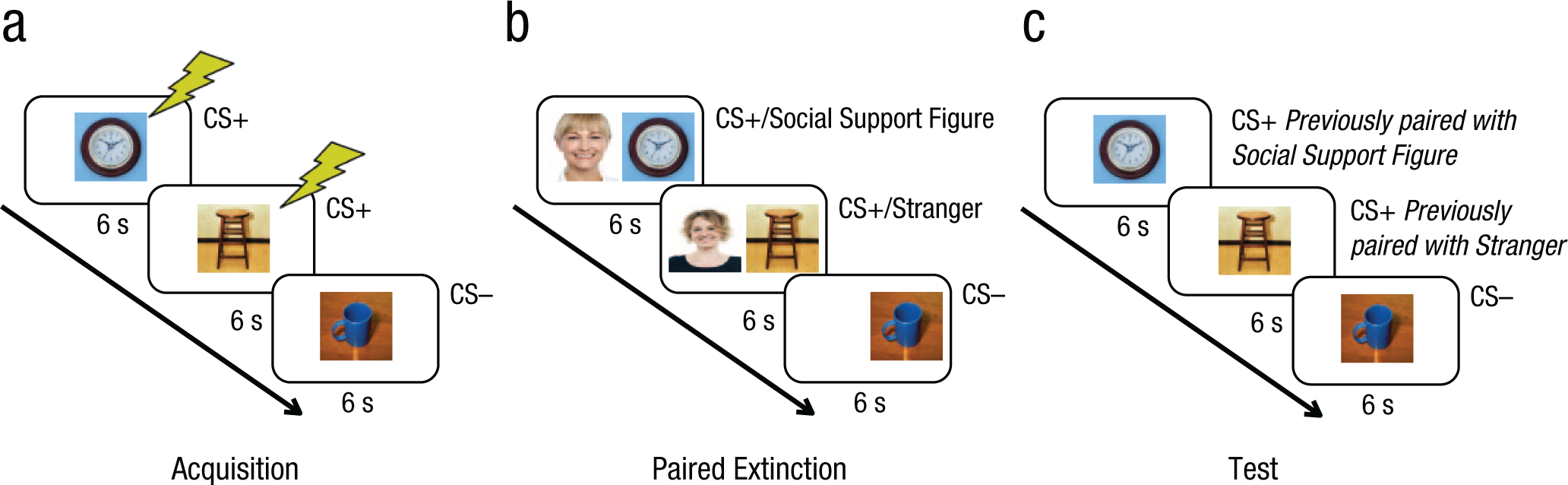
Example of experimental trials. During the acquisition stage (a), two CSs were continuously presented with a coterminating 200 ms electric shock (CS+s) and one was never paired with shock (CS−). During the paired-extinction stage (b), each CS+ was paired with one image type (social-support figure or stranger) and a CS− was presented alone. During the test stage (c), the secondary images were removed and each CS+ and the CS− were presented alone. Images of faces in panel B courtesy of stockimages at FreeDigitalPhotos.net.
Finally, in the test stage, participants viewed four nonreinforced presentations of each original CS+ alone, with the secondary image removed, and of the CS− (see Fig. 1c).
Follow-Ups 1 and 2
Participants returned to the lab 24 hr (Follow-Up 1) and 2 weeks (Follow-Up 2) after the experimental session and underwent a fear reinstatement procedure (Rescorla & Heth, 1975). During this procedure, three unsignaled 200 ms electric shocks were applied, separated by 10-s ISIs, followed by a 30-s break, after which there were three nonreinforced presentations of each CS+ and the CS−.
Data analysis strategy
Before analysis, data were preprocessed and means for each stage calculated (see the Supplemental Material). We then determined whether each participant acquired fear to both CS+s by evaluating whether the acquisition mean for each CS+ was greater than that of the CS− (CS+ − CS− > 0). To ensure that each CS+ elicited a fear response that could be inhibited during the paired-extinction stage and reinstated during the follow-up sessions, if fear was not acquired for both CS+s, a participant’s data were excluded from the experiment.
For each stage, we ran a within-subjects ANOVA to assess differences in fear responding across the three stimulus types. We followed these with paired-samples t tests to assess fear responses. For the acquisition stage, paired-samples t tests were conducted comparing acquisition means to determine if a fear response was acquired for each CS+, indicated by significantly higher SCR elicited for a CS+ compared with the CS−.
For the paired-extinction stage, paired-sample t tests were conducted comparing paired-extinction means to determine if the fear response for each CS+ was inhibited, indicated by no significant difference in SCR elicited by a CS+/secondary-image pairing compared with that of the CS−. A significant difference indicated that a fear response was present and that no inhibition occurred.
For the test stage, paired-samples t tests were conducted comparing test means to determine if a fear response was present for each CS+ when it was once again presented alone (secondary image removed), indicated by significantly higher SCR elicited by a CS+ compared with the CS−. In addition, paired-samples t tests were run comparing unpaired-extinction means (drawn from the final two trials of the test stage) for each CS+ compared with the CS− to ensure that extinction occurred, indicated by no significant differences in mean SCR, allowing us to examine fear reinstatement during each follow-up stage.
Finally, for each follow-up stage, paired-samples t tests were run comparing the follow-up means to determine if fear was reinstated for each CS+, again indicated by significantly higher SCR elicited by a CS+ compared with the CS−.
We also compared mean difference scores (CS+−CS−) for each secondary-image condition (social-support, stranger) to examine the effect of condition on (a) fear inhibition, using means from the paired-extinction stage, (b) return of fear, using means from the test stage, and (c) fear reinstatement, using means from each follow-up stage.
Results
Acquisition stage
We first examined whether fear was acquired to the CS+s (later to be paired with stranger or social-support images) relative to the CS−. An ANOVA revealed a significant difference across the three stimulus types, F(2, 58) = 40.85, p < .001, η2 = .59. Follow-up t tests showed a significant conditional fear response for CS+s that would later be paired with stranger-secondary-images (vs. CS−), t(29) = 6.96, p < .001, 95% CI [0.12, 0.22], and with social-support-secondary-images (vs. CS−), t(29) = 9.71, p < .001, 95% CI [0.16, 0.25], indicating fear was acquired for both CS+s. In addition, there was no significant difference in SCR for the two CS+s (p = .23), indicating fear acquisition was equivalent for both conditions (for plotted means, see the Supplemental Material).
Paired-extinction stage
We then examined whether fear was inhibited during the beginning of the paired-extinction stage by evaluating fear responses for the CS+/secondary-image pairings and the CS−. Comparison of fear responses during the paired-extinction stage revealed differences in fear responding across stimulus types (CS+s/stranger, CS+/social-support figure, CS−), F(2, 58) = 7.07, p = .002, η2 = .20. Replicating our previous findings (Hornstein et al., 2016), follow-up t tests showed that no fear inhibition occurred when a CS+ was paired with a stranger secondary image, indicated by significantly higher SCR to the CS+/stranger image pairing compared with the CS−, t(29) = 3.88, p = .001, 95% CI [0.06, 0.19], but fear inhibition did occur when a CS+ was paired with a social-support secondary-image, indicated by no significant difference in SCR for the CS+/social-support image pairing compared with the CS−, t(29) = −1.62, p = .11, 95% CI [−0.01, 0.12] (see Fig. 2a). Further comparison across these responses showed a significant difference, t(29) = 2.06, p = .048, 95% CI [0.001, 0.13], such that there was a significantly lower fear response elicited by CS+s paired with social-support-figure images compared with those paired with stranger images. This pattern of results shows that, as would be expected of a powerful safety signal (Rescorla, 1969), images of social-support figures inhibit the conditional fear response when present.
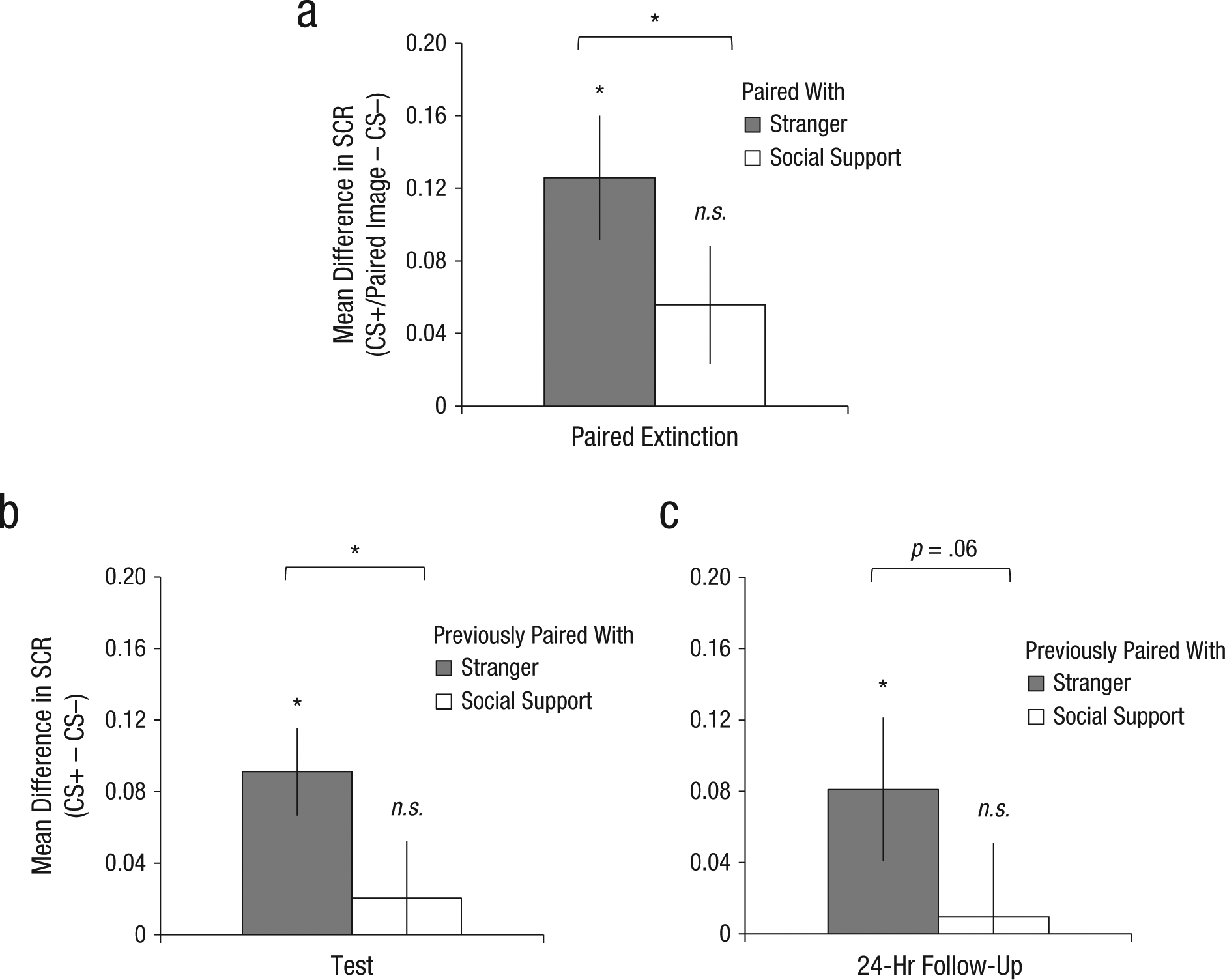
Results from the paired-extinction test, and 24-hr follow-up stages of the experiment. All error bars indicate standard error. Asterisks indicate a significant difference score (p < .05), and ns indicates no significant difference. (a) Paired-extinction stage: results show that fear was inhibited in the social-support condition, but not in the stranger condition. (b) Test stage: results show return of fear for the stranger condition, but not for the social-support condition. (c) 24-hr follow-up: Results show fear reinstatement for the stranger condition, but not for the social-support condition.
Test stage
Next, we examined whether conditional fear responses were present after the secondary images were removed by examining responses to each CS+ compared with the CS− during the test stage. An ANOVA demonstrated a significant difference across stimulus types, F(2, 58) = 5.17, p = .01, η2 = .15. Replicating prior findings (Hornstein et al., 2016), follow-up t tests revealed conditional fear responses for CS+s previously paired with a stranger’s image during the paired-extinction stage (vs. CS−), t(29) = 2.85, p = .01, 95% CI [0.03, 0.16], but still no conditional fear response for the CS+s previously paired with a social-support figure’s image (vs. CS−), t(29) = 0.84, p = .41, 95% CI [−0.03, 0.07] (see Fig.2B). There was also a significant difference in the effect of secondary-image type, t(29) = 2.21, p = .04, 95% CI [0.01, 0.14], such that a significantly lower fear response was elicited by CS+s previously paired with social-support-figure images compared with those previously paired with stranger images. Thus, whereas the presence of typical, learned-safety signals would be expected to prevent fear extinction from occurring (Lovibond et al., 2000; Rescorla, 2003), the presence of social-support-figure stimuli enhanced fear extinction, leading to less return of fear after the fear extinction procedure was complete.
To ensure that all conditional fear responses were extinguished prior to the follow-up stages, allowing us to evaluate fear reinstatement, we evaluated whether CS+s from either condition resisted unpaired extinction. We assessed unpaired extinction by comparing means from the second half of the test stage across the three stimulus types and found no significant differences, F(2, 58) = 0.67, p = .51, η2 = .02. Further comparison of SCR for each CS+ compared with that of the CS− showed that conditional fear responses were extinguished for CS+s paired with stranger images and social-support-figure images (ps > .16) and there was no difference across conditions (p = .48). These results show that there was no fear response present in either condition at the end of the test stage, indicating that fear extinction occurred in both conditions and that fear responding measured in later sessions is due to fear reinstatement.
Fear reinstatement stage: 24-hr follow-up
For each follow-up session, we first compared fear responding across all CSs and then evaluated whether a fear response was reinstated for CS+s in each condition. During Follow-Up Session 1 (24 hr after extinction), we found significant differences in fear responding for the three stimulus types, F(2, 58) = 3.31, p = .04, η2 = .10. Further tests revealed that fear was reinstated for CS+s that had been paired with stranger images, t(29) = 2.40, p = .02, 95% CI [0.01, 0.15], but not for CS+s paired with social-support-figure images, t(29) = 0.30, p = .77, 95% CI [−0.06, 0.08] (see Fig. 2C). However, the amount of fear reinstatement was not significantly different across conditions at this time point (p = .06).
Altogether, these results demonstrate that no return of fear occurred once the social-support-figure image was removed. CS+s previously paired with social-support-figure images did not elicit significant fear responses either in the test stage, directly following the removal of the image, or later in the fear reinstatement stage. These results are counter to current understanding of the effects of learned-safety signals, whose presence would be expected to prevent fear extinction and lead to a return of fear after their removal (Lovibond et al., 2000; Rescorla, 1969, 2003). Indeed, these findings demonstrate that fear extinction not only occurs in the presence of social-support stimuli but also is enhanced such that there is no return of fear following procedures designed to reinstate the fear response 24 hr later.
Fear reinstatement stage: 2-week follow-up
For Follow-Up Session 2, which took place 2 weeks after extinction, we found no difference in fear responding across stimulus types, F(2, 58) = 0.34, p = .71, η2 = .01, and no fear reinstatement in either the stranger or social-support condition (ps > .38). The fact that fear was not reinstated in even the stranger condition suggests that our fear conditioning procedures were not powerful enough to generate conditional fears that could be reinstated 2 weeks later. Further examination of fear reinstatement at this time point is therefore required.
Discussion
Although exposure therapy is the most common form of treatment for fear-related disorders, reduction of fear following this treatment is often only temporary, leaving afflicted individuals with continuing excessive or disruptive fears. Hence, the current research sought to develop understanding of possible methods for decreasing return of fear by exploring the impact of social-support stimuli on the fear extinction process.
Although previous literature would suggest that the presence of a safety signal should lead to return of fear (protection from extinction: Lovibond et al., 2000; Rescorla, 2003), recent research has demonstrated that the presence of certain safety signals, specifically social-support stimuli, during fear extinction inhibits return of fear (Hornstein et al., 2016). Building on these findings, we examined whether the presence of social-support stimuli during a fear extinction procedure not only led to enhanced fear extinction within the experimental session, but also reduced return of fear at later time points. Results showed that pairing a social-support stimulus with a fearful stimulus during fear extinction led to less return of fear both following extinction and following a fear-reinstatement test 24 hr after extinction. Specifically, there was return of fear for fearful cues that had been paired with images of strangers, but there was none for those that had been paired with images of social-support figures.
It is important to note that interpretations of these findings must be made prudently given that our manipulations were limited by ethical considerations regarding strength of fear conditioning procedures and the fact that our sample was drawn from a nonclinical population. Indeed, although there were significant differences in return of fear across conditions directly after extinction, this difference was not significant 24 hr after extinction (p = .06), and no return of fear occurred at all 2 weeks after extinction, suggesting conditional fears may have weakened over time and thus limiting interpretation of these effects. Nevertheless, the repeated pattern of effects demonstrating less return of fear for social-support-paired fearful cues indicates that the presence of social-support reminders may enhance extinction and provides a valuable foundation for exploring an alternative method to improve fear extinction outcomes.
These unexpected findings suggest that social-support stimuli may hold special properties that are distinct from those of typical, learned-safety stimuli and allow social-support-figure reminders to enhance rather than impede fear extinction processes. Although previous research in humans concerning protection from extinction has examined the impact of learned-safety signals on fear extinction (Lovibond et al., 2000), these safety signals are not imbued with the rich history of care, protection, and resources provided by social-support figures. It is thought that protection against extinction occurs because the presence of any safety signal reduces the expectation of an aversive outcome that usually accompanies the presentation of a fearful cue, leading to no violated expectations during fear extinction (when no aversive outcome is experienced) and consequently no change in associative strength for the fearful stimulus (i.e., no extinction: Craske et al., 2008; Hermans et al., 2006; Rescorla & Wagner, 1972). However, the unique ability of social-support stimuli to enhance, as opposed to prevent, fear extinction suggests that social-support stimuli work through a different mechanism than learned-safety signals.
One possible route through which social-support stimuli may confer their unique effects is by disrupting the neurobiological processes that support fear learning. One likely point of overlap for such activity is the opioid system. Opioid activity is thought to play a role in reinforcing and maintaining social-support bonds (Nelson & Panksepp, 1998) and is known to support fear acquisition and extinction (Fanselow, 1998), such that blocking opioids enhances fear acquisition (Fanselow, 1981) and prevents fear extinction (McNally & Westbrook, 2003). Hence, it is possible that social support disrupts fear acquisition and extinction via the opioid system, leading to reduced acquisition (as demonstrated by Hornstein & Eisenberger, 2017) and enhanced extinciton. More specifically, social support may trigger the release of endogenous opioids, providing unsignaled analgesia and buffering against the pain of an aversive event. This would lead to a mismatch in the amount of pain expected compared with what is actually experienced (expectation > experience), ultimately interfering with the negative feedback model that supports fear learning, reducing fear acquisition and enhancing fear extinction. Thus, social-support stimuli, because of their natural activation of opioid processes, may be uniquely positioned to alter the neurobiological processes underlying fear learning.
Another potential explanation for the effects demonstrated here is that the highly positive properties of social-support figures impact fear learning processes by increasing positive valuations of fearful stimuli or by increasing general positive mood, both of which reduce fear reinstatement (Dirikx, Hermans, Vansteenwegen, Baeyens, & Eelen, 2007; Zbozinik, Holmes, & Craske, 2015). Similarly, individuals have frequent contact with social-support figures, and thus their familiarity may account for some of their unique effects. Although prior work has demonstrated that unlike social-support stimuli, both positive and familiar stimuli can become associated with fear and thus do not pass the requirements of prepared safety stimuli (Hornstein et al., 2016), suggesting that these stimuli may not perform the other unique functions of social-support stimuli, no work has directly examined the effect of positive and familiar stimuli on fear extinction. Therefore, future work must directly compare the effects of positive, familiar, and social-support stimuli during extinction specifically to clarify this issue.
Future work must also explore the boundaries of these social-support-safety effects. Examining whether social-support stimuli enhance extinction for stimuli that are fear-relevant, such as snakes and spiders (for which fear associations are more analogous to those held for extreme fears), may more closely match the impact of social-support stimuli on fear extinction for excessive fears or anxiety. Moreover, the use of fear-relevant stimuli may strengthen fear conditioning manipulations and fear associations, thus allowing for examination of the social-support effect at time points beyond 24 hr after extinction. Furthermore, limitations of the current work must be addressed by directly comparing the effects of social-support stimuli and learned-safety signals on fear extinction, testing whether these categories are truly distinct, and the inclusion of a condition in which fear extinction is conducted alone, testing whether social-support stimuli improve extinction outcomes beyond standard procedures. Finally, this work was conducted in a healthy population, but individuals with fear-related disorders may have a more complex safety-learning history with their social-support figures. Thus, extending this work to include clinical populations will reveal a clearer picture of how social-support stimuli might be integrated into research regarding the treatment of maladaptive fears.
Although the procedures involved in exposure therapy are far more complex than fear extinction procedures conducted in the lab, the evidence that social-support stimuli have the ability to enhance fear extinction offers the exciting possibility that therapeutic procedures might similarly be enhanced by the presence of reminders of social-support figures. Currently, fear reduction following exposure therapy is often only temporary (Craske, 1999; McNally, 2007; Rachman, 1989) and dropout of treatment is common (Rachman et al., 2008). Although some have suggested that certain types of safety behaviors do not harm, and may even benefit, treatment outcomes (Rachman et al., 2008), this view is debated and has not been enacted in clinical practice, where it is the norm to prohibit safety behaviors and safety signals. Furthermore, although work has revealed that fear reduction is enhanced after observing strangers undergo extinction procedures (Golkar et al., 2013), the impact of social processes on fear extinction is only starting to be understood, and no prior work has examined the powerful effects that close others might have during the fear extinction process. Thus, although social-support figures are often present during threatening events in daily life, neither they nor reminders of them have been allowed to be present during treatment procedures and therefore their impact on intervention outcomes has been largely unexplored. Therefore the results discussed here suggest that the presence of social-support stimuli might strengthen fear extinction while also signaling safety, improving current treatments and easing the aversiveness that makes fear extinction procedures uncomfortable to complete. Although this idea is still exploratory, the addition of social support to exposure therapies might represent a noninvasive and relatively cheap method for enhancing treatment outcomes.
Overall, the results presented here build on previous research demonstrating the unique safety-signaling properties of social support, showing that social-support stimuli enhance fear extinction and decrease return of fear. Although further research is required, the present findings provide insight into the distinct safety characteristics of social-support figures and reveal potential avenues of research for treatment strategies targeted at reducing excessive fears and anxiety.
Footnotes
Acknowledgements
We thank Michael Fanselow for his advice regarding the use of fear conditioning theory and methods.
Author Contributions
E. A. Hornstein and N. I. Eisenberger developed the study concept and design. E. A. Hornstein, K. E. B. Haltom, and K. Shirole collected the data. E. A. Hornstein analyzed the data. E. A. Hornstein and N. I. Eisenberger wrote the manuscript. All authors approved the final version of the manuscript for submission.
Declaration of Conflicting Interests
The author(s) declared that there were no conflicts of interest with respect to the authorship or the publication of this article.
Funding
This work was supported by the Wendell Jeffrey and Bernice Wenzel Term Chair in Behavioral Neuroscience at UCLA (to N. I. Eisenberger), National Science Foundation (NSF) Graduate Research Fellowship DGE-0707424 (to E. A. Hornstein), and NSF Research Grant 1626477 (to N. I. Eisenberger).

References
Supplementary Material
Please find the following supplemental material available below.
For Open Access articles published under a Creative Commons License, all supplemental material carries the same license as the article it is associated with.
For non-Open Access articles published, all supplemental material carries a non-exclusive license, and permission requests for re-use of supplemental material or any part of supplemental material shall be sent directly to the copyright owner as specified in the copyright notice associated with the article.
