



Abstract
Research suggests that religious practice has a small but consistent inverse relationship with depression, but recent work within the Jewish population has been equivocal. Following the behavioral model of depression, one explanation is that religious activity may provide positive reinforcement. We hypothesized that this would be true only for those who intrinsically value religion, and conversely, religious practice may be depressogenic for individuals lacking intrinsic motivation. We tested this possibility in a longitudinal sample of 160 Jewish individuals meeting DSM–IV criteria for a mood disorder. Multilevel autoregressive growth modeling suggested that controlling for past depressive symptoms, past intrinsic religiosity, and religious practice jointly predicted future depression. Individuals with high religious practice and high intrinsic religiosity reported lower future depressive symptoms, whereas those with high practice and low intrinsic religiosity reported higher depressive symptoms. These findings suggest that religious practice can have both protective and harmful effects, depending on internal values.
Previous research has consistently found that spirituality and religion positively influence mental health in general and depression in particular (Ano & Vasconcelles, 2005; Hackney & Sanders, 2003; Smith, McCullough, & Poll, 2003). Regarding depression, this research includes prospective studies (Miller et al., 2012), longitudinal studies (Fitchett, Rybarczyk, DeMarco, & Nicholas, 1999; Nelson, Rosenfeld, Breitbart, & Galietta, 2002; Wink, Dillon, & Larsen, 2005), neuroimaging studies (Miller et al., 2014), and several clinical investigations demonstrating that spirituality and religion can be helpful in the treatment of depression (see Smith, Bartz, & Scott Richards, 2007, for a review).
These findings are particularly relevant to the Jewish community because research suggests that, unlike trends within the general population, Jewish men are equally likely as Jewish women to develop mood disorders over the life span, putting them at substantially greater risk for developing mood disorders (Levav, Kohn, Golding, & Weissman, 1997). Moreover, in Orthodox Jewish religious culture, religion and spirituality may be particularly important given the profound integration of religion into everyday cognition, emotion, and behavior (Robinson, 2016). Although empirical research within the Jewish community is limited, there is growing evidence of inverse correlations between various aspects of Jewish religiosity and distress, particularly among the Orthodox. For example, Rosmarin, Pirutinsky, Pargament, and Krumrei (2009) reported that religious practices and beliefs in God’s benevolence significantly correlated with lower anxiety and depression among Orthodox Jews (rs ranging from –.27 to –.41), whereas among the non-Orthodox, these correlations were small and nonsignificant (rs ranging from .02 to –.16). Accordingly, a more recent study conducted in Israel suggested that more religious Jews generally report lower levels of distress than less religious Jews, possibly because of the protective effects of religion and spirituality (Feinson & Meir, 2015).
Although the mediating processes explaining the relationship between religion and depression have not yet been fully explored, research and theory have identified a number of possibilities. First, religious practice may reinforce religious coping beliefs such as viewing negative events as part of a greater spiritual plan, which can provide an alternative to depressogenic cognitions (Pargament, 2001). Second, spiritual and religious practices often include a social component that may be a source of support and resources (Pirutinsky, Rosmarin, Holt, et al., 2011). Third, these practices may provide an alternate focus that interrupts negative repetitive thinking patterns such as rumination (Nolen-Hoeksema, 2000), which may alter attentional patterns (Colzato, van den Wildenberg, & Hommel, 2008). Finally, consistent with the behavioral model of depression, religious practices may provide opportunities for value-driven, rewarding activity (Armento, McNulty, & Hopko, 2012).
On the other hand, it is increasingly clear that spirituality and religion can also have negative effects that mirror the positive effects identified above. In line with research on negative religious coping and spiritual struggles, religion can be a source of depressogenic and anxiolytic cognitions such as viewing negative events as punishment from God or the work of uncontrollable evil forces (Pargament, 2001). Religion can also create a context for conflict and even violence between individuals and within families and communities (Pirutinsky, Midlarsky, Kor, & Pelcovitz, 2014). Religious beliefs can become a focus of negative repetitive thinking patterns generating intense spiritual crises and struggles (Exline & Rose, 2005), and finally, consistent with the behavioral model of depression, religious practices can be experienced as unpleasant, stressful, and unrewarding, leading to depressed mood and decreased activation (Agishtein et al., 2013). Indeed, recent research has suggested that religious and spiritual beliefs are associated with higher depression for some individuals (Leurent et al., 2013), and within the Jewish population, previous research found that spiritual struggles predicted future depression in a community sample of Orthodox Jews (Pirutinsky, Rosmarin, Pargament, & Midlarsky, 2011).
What might determine whether religion has positive or negative effects on depression? One possibility is that religion’s effects depend on an individual’s motivation for engagement. Early psychologists Allport and Ross (1967) popularized the dichotomy between intrinsic and extrinsic motivation for religion, and this distinction, although equivocal, continues to be empirically relevant today (e.g., Smith et al., 2003). Intrinsic religiosity refers to engagement in religion that is motivated by internal beliefs, attitudes, and feelings captured by sentiments such as, “I try hard to carry my religion over into all other dealings in life,” and, “In my life, I experience the presence of the Divine (i.e., God)” (Koenig, Meador, & Parkerson, 1997). By contrast, extrinsic religiosity refers to religious involvement that is motivated by factors other than religion itself, such as social approval or pressure and monetary gain or loss. More recent theorists have identified other nonintrinsic motivations for religion, such as introjection, which refers to partial acceptance as a result of self- and other-approval pressures (Ryan, Rigby, & King, 1993). Accordingly, previous correlational research, conducted largely in community samples, suggests that whereas intrinsic religiosity is protective against depression, extrinsic religiosity may in fact be a risk factor (see Smith et al., 2003, for a meta-analysis). Whether religious motivations moderate effects of religious practice on depression, however, remains unclear.
The current research frames these possibilities within the behavioral model of depression, which suggests that depression results from a spiraling process of reduced positive reinforcement and increased punishment, leading to reduced activity, thus leading to further reductions in positive reinforcement and increased punishment (e.g., Lewinsohn, 1974). Accordingly, we proposed that among Jewish individuals with mood disorders, intrinsically motivated religious practice would have positive effects on depressive symptoms because religious practices can provide accessible and regular opportunities for meaningful activities that are highly valued, social, pleasurable, and hence, rewarding. On the other hand, we proposed that frequent engagement in nonintrinsically motivated religion would be depressogenic because such activities involve expending time and energy on behaviors that are experienced as meaningless and unrewarding.
We tested these hypotheses in a six-wave longitudinal study of a sample of 160 Jewish individuals with mood disorders. Consistent with a transdiagnostic approach, we hypothesized that the behavioral contingencies described above would apply across a range of mood disorders and we therefore included individuals with major depressive disorder, dysthymia, and bipolar disorders in our sample (Insel et al., 2010). Specifically, we hypothesized that participants’ levels of intrinsic religiosity would moderate relationships between religious practice and depressive symptoms such that religious practice would predict future reductions in depression among those intrinsically motivated but increases in depression over time among those whose religious motivations are nonintrinsic. Given previous research suggesting that the relevance of religion to mental health may be stronger among Orthodox Jews (Rosmarin et al., 2009), we also explored if these effects are moderate by religious affiliation.
Method
Procedure and participants
Participants meeting Diagnostic and Statistical Manual of Mental Disorders (4th ed., DSM–IV; American Psychiatric Association, 1994) criteria for a mood disorder, such as major depressive disorder (n = 138), bipolar disorder (n = 18), and dysthymic disorder (n = 4), were drawn from a larger longitudinal study. Each participant was followed for 3 years and was assessed at 6-month intervals, for a total of six waves. Demographic information including religious affiliation and diagnostic information was collected at Wave 1. All other measures (i.e., religious practices, intrinsic religiosity, and depression) were assessed at each wave. Data were collected from March 2014 through January 2017. Participants ranged in age from 18 to 75 years (M = 37.91, SD = 15.04), and the majority identified as having Orthodox affiliation (n = 96, 60%) and female gender (n = 122 female, 76%). Recruitment was facilitated through Jewish organizations, community e-mail listservs, social media outlets, advertisements on Jewish websites, and word-of-mouth. Inclusion criteria were (a) 18 years of age or older, (b) self-identification as Jewish (any affiliation), (c) current residency in the United States or Canada, (d) fluency in the English language, and (e) access to a computer (Apple or Windows) with a high-speed Internet connection. Participants were eligible to receive up to a total of $45 in Visa gift cards over the course of the entire study, and all provided informed consent to participate. The study was approved by the McLean Hospital/Harvard Medical School Institutional Review Board.
Measures
Clinical diagnoses
At Wave 1, participants were assessed using the Miniature International Neuropsychiatric Interview (MINI; Sheehan et al., 1997), a widely used and well-validated brief structured diagnostic interview for assessment of DSM–IV and ICD-10 psychiatric disorders. To preserve anonymity and privacy, assessments were completed by telephone by trained graduate and undergraduate students. Training of these students involved reviewing MINI materials, attending a didactic training, conducting several mock assessments, and completing diagnostic interviews with participants concurrently with a licensed psychologist until concordant diagnostic profiles were achieved with at least three participants. The assessment of each subsequent participant was reviewed and discussed in a weekly meeting supervised by a licensed psychologist to establish a consensus diagnosis.
Religious practices
At each wave, religious practices were assessed with a three-item measure created from the following questions: (a) “How often do you speak to God or pray?” (b) “How often do you attend religious services?” (c) “How often do you read religious literature or attend a religious sermon or lecture?” Response anchors ranged from several times a day to never on a 9-point scale. This measure demonstrated a high level of internal reliability in the present sample (α = .76–.82), and an exploratory factor analysis revealed a single factor with an eigenvalue of 2.20 accounting for 73% of the variance.
Depression
Depressive symptoms were measured at each wave using the seven-item depression subscale of the Hospital Anxiety and Depression Scale, a reliable and valid self-report tool for assessing the presence of anxiety and depression within both clinical and community samples (Zigmond & Snaith, 1983). Internal consistency in our sample was high (α = .75–.83).
Intrinsic religiosity
Participants completed the three-item intrinsic religiosity subscale from the Duke Religion Index (Koenig et al., 1997) at each wave. These items were rated on a 5-point Likert-type scale with higher values indicating higher levels of intrinsic religiosity. Internal consistency in the current sample was excellent (α = .83–.89), and this measure has been extensively studied and used (Storch, Strawser, & Storch, 2004), including within the Jewish community (Pirutinsky, Rosmarin, Holt, et al., 2011).
Religious affiliation
At Wave 1, participants self-selected 1 of 16 different Jewish religious identities including “other.” These identifications were then dichotomized into those that are specifically Orthodox (e.g., Chasidic, Yeshiva Orthodox, and Modern Orthodox) and non-Orthodox.
Analytic plan
To test our hypotheses, we used the multilevel autoregressive growth modeling, as described by Rovine and Walls (2006), which accounts for autoregressive state-like aspects of depressive symptoms, trait-like individual mean differences, and any stable long-term patterns of change (Endler, Cox, Parker, & Bagby, 1992). To ensure the most parsimonious representation of our data, these complex models were developed step-by-step from simpler models. Specifically, we first estimated a series of unconditional models of depressive symptoms integrating various components of the autoregressive growth model such as random intercepts, an autoregressive parameter, and fixed and random linear and quadratic slopes. Once the best-fitting model was selected, we then moved on to conditional models that successively integrated lagged predictors such as past intrinsic religiosity, past religious practice, and the interaction between them. This design—modeling short-term, within-subject changes in depressive symptoms over time—allowed us to control for any unmeasured time-invariant, between-subject differences and demonstrate time precedence for any effects, but it could not rule out the presence of unmeasured time-varying within-subject confounding variables (Duckworth, Tsukayama, & May, 2010).
Models were estimated using maximum likelihood-based, multilevel regression (Gelman & Hill, 2006), which provides relatively straightforward estimation and interpretation of interaction terms, is unbiased in the presence of data missing at random, and can incorporate cross-lagged parameters. Models were computed using the LME4 package in R (Bates, Machler, Bolker, & Walker, 2015), inferential tests of model coefficients were computed using lmerTest (Kuznetsova, Brockhoff, & Christensen, 2016), and figures illustrating conditional interaction effects were created with SJPlot (Lüdecke, 2016). Models were compared using variance components, log-likelihood ratio tests, Akaike information criterion (AIC) statistics, and t tests of model coefficients. For all analyses, time was centered at baseline and represented the number of waves in the study lapsed since each assessment. All participants were included in the analysis; however, time points for which data were not available (14%) were excluded. Participants with missing data did not significantly differ in terms of age, religious affiliation, marital status, household size, education, income, ethnicity, religious practice, or intrinsic religiosity (p > .05). As expected, dropouts reported greater depression than individuals who completed the study, but this was specific to individuals who completed only Wave 1 and not any subsequent waves, F(1, 158) = 7.67, p = .006.
Results
As described above, we first calculated a series of unconditional multilevel autoregressive growth models that estimated individual depressive symptoms over time. Each model successively added additional predictors, and overall fit statistics and model comparisons for these models are presented in Table 1. Results indicated that a model adding a random intercept for each participant significantly increased fit, likely reflecting trait-like individual differences on overall mean levels of depression. Similarly, a more complex model that added an autoregressive component (depression at each previous wave) further increased fit, suggesting that depressive symptoms also exhibited state-like episodic characteristics. Finally, other, more complex models including random linear and quadric slopes were not significant, suggesting that within-subject patterns of change could not be characterized by consistent trends over time.
Overall Model Fits for Multilevel Autoregressive Models of Depression

Note: Each model added an additional predictor and was compared with the previous simpler model. df refers to the total number of estimated parameters for each model. AIC = Akaike information criterion.
Accordingly, we included random intercepts and depression at the previous wave as a baseline unconditional model, and we then compared this model to conditional models integrating intrinsic religiosity, religious practice, and their interaction. All of these predictors were lagged and represented measurements at the previous time point. Overall model fit statistics and inferential comparisons for these conditional models are presented in Table 1. Results indicated that the addition of main effects for intrinsic religiosity (IR) and religious practice (RP) did not significantly improve model fit. However, a model including the interaction between them displayed a significant improvement in model fit. Fixed coefficients for this final model are presented in Table 2 (IR × RP), and resulting conditional predictions are graphed in Figure 1. Examination of this plot suggested the presence of a significant moderation effect. Specifically, controlling for individual mean depression and depression at the previous wave, past religious practices predicted greater depression among those low on intrinsic religiosity, whereas for those high on intrinsic religiosity, past practice related to lower depression. The size of this effect at any particular time point appeared moderate, with approximately a 3.59 point difference on the HADS depression scale, which ranges from 0 to 21 with scores greater than 10 indicating clinical depression, between those high on religious practice and intrinsic religiosity versus those high on practice and low on intrinsic religiosity (see Fig. 1).
Fixed Coefficients for the Conditional Intrinsic Religiosity (IR) × Religious Practice (RP) Multilevel Autoregressive Model
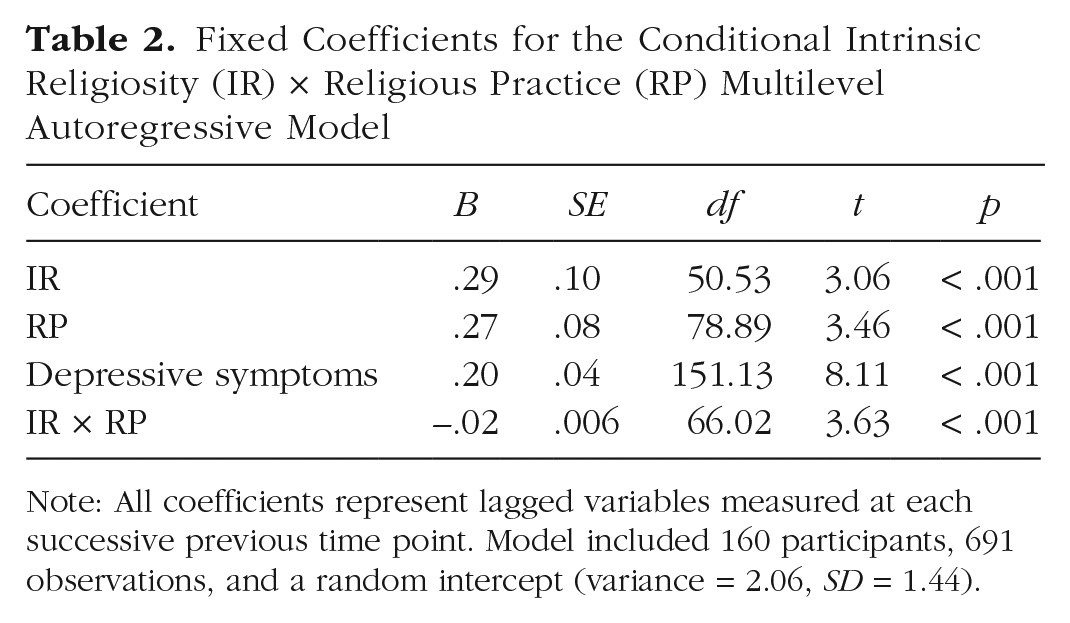
Note: All coefficients represent lagged variables measured at each successive previous time point. Model included 160 participants, 691 observations, and a random intercept (variance = 2.06, SD = 1.44).

Conditional effects of religious practice on depressive symptoms by intrinsic religiosity. Conditional effects were computed by holding all other parameters at zero.
We then conducted a series of secondary exploratory analyses assessing the robustness of these findings within various subgroups of participants. These analyses compared the final conditional model (IR × RP) with more complex models including various demographic characteristics and their interactions with intrinsic religiosity and religious practice. These comparisons indicated that adding main effects and interactions for religious affiliation, ΔAIC = 5, χ2(4) = 2.62, p = .62, and for gender, ΔAIC = 8, χ2(4) = 3.30, p = .51, did not significantly improve model fit, suggesting that these effects were statistically equivalent among men and women and among Orthodox and non-Orthodox Jews.
On the other hand, a model testing if these effects differed between participants diagnosed with a unipolar major depressive disorder and those with a bipolar mood disorder was significant, ΔAIC = −14, χ2 = 23.87, p < .001. Examination of coefficients indicated that participants diagnosed with bipolar differed from those with unipolar depression in two ways. First, depressive symptoms exhibited higher variability between measurements among those with bipolar disorder, and second, the effects of intrinsic religiosity and religious practice were significantly larger for this group. Finally, although these statistical techniques are robust to missing data, we ran an additional sensitivity analysis including a dummy-coded interaction term representing participants with or without missing data at any wave. Results found that the additional coefficients were not significant (p > .11), and the addition of this term to the model did not significantly improve fit, ΔAIC = 4, χ2 = 5.86, p = .32.
Discussion
The majority of research conducted to date has found a protective effect of spirituality/religion and depression (Smith et al., 2003); however, recent work has called into question whether such effects occur for all individuals and further highlighted that religion can sometimes be harmful for depressive symptoms (Leurent et al., 2013). Within the Jewish community, research has similarly been equivocal, demonstrating both positive and negative effects of religious engagement on mood (Feinson & Meir, 2015; Pirutinsky, Rosmarin, Pargament, et al., 2011; Rosmarin et al., 2009). Mediating pathways to these effects likely involves a multiplicity of psychological processes, and the current research is among the first to evaluate how and why religious life can make depression better or worse over time. We suggested, on the basis of the behavioral model of depression, that religious practice can support and increase positive mood by providing consistent opportunities for meaningful rewarding activities. Conversely, engaging in religious practices in the absence of a sense of religious meaning and purpose (i.e., low intrinsic religiosity) not only may undermine positive effects of meaning- and value-based activity but also may create punishment contingencies that exacerbate depression over time. We tested these hypotheses using a multilevel autoregressive statistical model in a large, longitudinal sample of Jewish individuals meeting DSM–IV criteria for a mood disorder.
Results of our study indicated that controlling for individual mean depression and depression at the previous time point, past intrinsic religiosity, and religious practice jointly predicted future depressive symptoms. Specifically, both Orthodox and non-Orthodox Jewish individuals with high intrinsic religiosity and high religious practice at a particular wave reported lower depression at the next time point, whereas those with low intrinsic religiosity and high practice reported higher depression at the subsequent time point. These results suggest that the mood-protective effects of religious practice may be unique to individuals who truly value religion, whereas for those individuals who do not intrinsically value religiosity, religious practice may be harmful and appears related to future depressive symptoms. In this regard, religion’s relationship with depression parallels widely established correlations with frustration in other major life domains such as job dissatisfaction (Faragher, Cass, & Cooper, 2005), marital distress (Proulx, Helms, & Buehler, 2007), and negative life events (Risch et al., 2009).
These findings have clinical relevance to the treatment of religious individuals with mood disorders. First, our results suggest that it is important to carefully assess for not only religious affiliation and practice but also religious motivation and values in the treatment of depression. Consistent with growing empirical literature outlining the negative impact that spiritual struggles can have on mood (e.g., Ellison & Lee, 2010), our findings suggest that nonintrinsically motivated religious practice may precede depressive episodes among individuals with mood disorders. Previous studies suggest that clinicians rarely assess religious and spiritual issues in psychotherapy and that many are uncomfortable integrating spirituality into clinical treatment (Rosmarin, Green, Pirutinsky, & McKay, 2013). Given our findings, however, effective treatment for some individuals may require directly addressing religious beliefs, behaviors, experiences, and motivations.
Second, spiritually sensitive practitioners of behavioral activation often include suggestions for patients to re-engage in religious practices in the course of treatment (e.g., Paukert et al., 2009) because such activities are generally rewarding. There is a growing empirical basis for this clinical practice. Armento et al. (2012) described a randomized clinical trial of a behavioral activation treatment for depression that explicitly integrated religious behaviors. They found that a single session of religious behavioral activation significantly decreased depression and anxiety and that these effects were maintained at 1-month follow-up. Similarly, Rosmarin, Pargament, Pirutinsky, and Mahoney (2010) reported that a spiritually integrated treatment delivered over the Internet significantly lowered participants’ depression, worry, and stress, as compared with a waitlist control group. Our results, however, suggest that although inclusion of religious practices in treatment may be helpful for some, motivations for religion must be carefully assessed prior to implementation because religious practices may be harmful and may lead to an increase in depressive symptoms for those whose motivations are not intrinsic.
Finally, the relationship between religious practice, intrinsic religiosity, and depressive symptoms was stronger among participants with a bipolar mood disorder as compared with those with a unipolar depressive disorder. This suggests that those with bipolar disorder may be more sensitive to behavioral contingencies and, accordingly, their mood is more likely to be influenced by the rewards and punishments experienced through religious practices. This possibility is supported by the growing body of research specifically linking bipolar disorders to dysregulation in the behavioral activation system, leading to increased or decreased reactivity to activating and deactivating events and environments (Alloy & Abramson, 2010).
The current study is limited by several important factors. First, the sample was exclusively Jewish though religiously diverse within this heterogenic identity. The religion-as-culture perspective suggests that religion is not a monolithic construct; rather, like geographic origin or ethnic identity, each religion can be understood as a cultural influence that uniquely alters values, beliefs, emotions, and behavior (Cohen, 2009). In fact, previous research suggests that the mediating links between religiosity and mental health vary between religious cultures (Pirutinsky, Rosmarin, Pargament, et al., 2011). Thus, although the current research supports a longitudinal link between religious practice, motivation, and mood, these effects may be specific to Jewish religious culture and may not generalize to other religious groups. Jewish religious culture has been characterized by Orthopraxy, focused primarily on adherence to religious practice and law rather than beliefs and theology (Robinson, 2016). This distinction is supported by empirical research suggesting that Jewish individuals weigh actions more strongly than beliefs when judging the religiosity of themselves and others (Cohen, Siegel, & Rozin, 2003) and when making interpersonal moral judgments (Cohen & Rozin, 2001). The emphasis on behavior as opposed to beliefs and spiritual experience among Jews may render nonintrinsically motivated religiosity more prevalent and normative among Jewish individuals (Cohen et al., 2005), which may have muted interaction effects in this study. Further research within other religious cultures is warranted to explore this possibility.
Second, from a contextual, social perspective, it is possible that intrinsically motivated religious practice increases the likelihood of engaging in activities with like-minded religious others, providing a strong source of social support and connection, which has been linked to less depression (Cohen & Wills, 1985). Conversely, individuals whose motivations are not intrinsic may feel coerced under false pretenses to interact with others who do not share their values and, as a result, experience a profound sense of alienation that has been linked to increased depression (Exline, Yali, & Sanderson, 2000). Thus, our observed effects may be due to social support and alienation as opposed to internal factors specific to religious practice. Future research incorporating direct measurement of interpersonal mediators is needed to test these various possibilities.
Third, as described above, the sample was recruited through a variety of means and the study was conducted online and by telephone. Accordingly, participants self-selected to join this study, and the resulting sample may not be fully representative of the Jewish population with mood disorders. In addition, because of the strength of social expectations regarding religion, participant responses to religiosity measures may have been influenced by social desirability and demand characteristics, although this concern is somewhat ameliorated by our anonymous method of data collection (Henderson, Evans-Lacko, Flach, & Thornicroft, 2012). On the other hand, given the lack of direct contact with participants, it was particularly difficult to assess if their responses were deceitful. Finally, our results were specific to depressive symptoms and cannot speak to other areas of psychopathology or mental health. Despite these limitations, however, the current study clearly suggests that religion and spirituality have both negative and positive correlations with depressive symptoms, that these effects can be clinically relevant, and that religious and spiritual beliefs, motivations, and behaviors warrant clinical attention and continued research.
Footnotes
Author Contributions
S. Pirutinsky and D. H. Rosmarin designed the study and collected the data. S. Pirutinsky performed statistical analyses and drafted the manuscript. Both authors approved the final version of the manuscript for submission.
Declaration of Conflicting Interests
The author(s) declared that there were no conflicts of interest with respect to the authorship or the publication of this article.