



Abstract
We explore the human capacity for and the function(s) of meta-awareness for biased attentional processing of emotional information (MAB) subserving mental (ill) health. We do so by integrating probe-caught sampling methods, signal detection theory, and multilevel modeling of cognitive-experimental laboratory data among daily smokers (N = 75) known to exhibit biased attentional processing of reward-related (drug) cues in addiction. We found (a) evidence of the capacity for and individual differences in MAB; (b) that momentary MAB was most likely observed in the event of the most extreme micro-expressions of biased attentional processing; and (c) that momentary micro-expressions of biased attention without MAB were more likely followed by attentional dysregulation, whereas momentary micro-expressions of biased attention with MAB were more likely followed by more balanced attentional expression or greater attentional control. We discuss the implications for basic and clinical science of meta-awareness.
By selecting from a sea of potential environmental inputs in a manner that is context sensitive, flexible, and goal relevant, attention enables adaptive pursuit of reward and escape from threat (Vuilleumier, 2005). Accordingly, dysregulation in attentional processing of emotional information, commonly referred to as attentional bias (AB), has been implicated in the etiology and maintenance of prevalent forms of maladaptation, including anxiety, depression, and addiction, and thus is a promising intervention target (Heeren, De Raedt, Koster, & Philippot, 2013; Van Bockstaele et al., 2014). Yet the field has faced growing concerns about the weak psychometric properties of cognitive-experimental measures of AB, mixed evidence of the role of AB in psychopathology, and mixed evidence of efforts to experimentally and clinically modify AB (Bar-Haim, Lamy, Pergamin, Bakermans-Kranenburg, & van IJzendoorn, 2007; Schmukle, 2005; Van Bockstaele et al., 2014).
Accordingly, Zvielli, Bernstein, and Koster (2015) questioned the decades-old paradigm conceptualizing and studying AB as a static trait. They proposed that AB may be better conceptualized, studied, and ultimately modified as a dynamic process that fluctuates toward and away from motivationally relevant stimuli from moment to moment in time (Zvielli, Bernstein, & Koster, 2014; Zvielli et al., 2015; see Fig. 1). To begin to do so, they proposed a novel computational procedures designed to quantify and thereby study dynamic fluctuations of biased attention (e.g., trial-level bias scores; TL-BS) in extant cognitive-experimental tasks of emotional attention (e.g., dot probe, spatial cueing, visual search). They also called for the development of novel measurement methods designed to capture temporal dynamics of emotional attention.
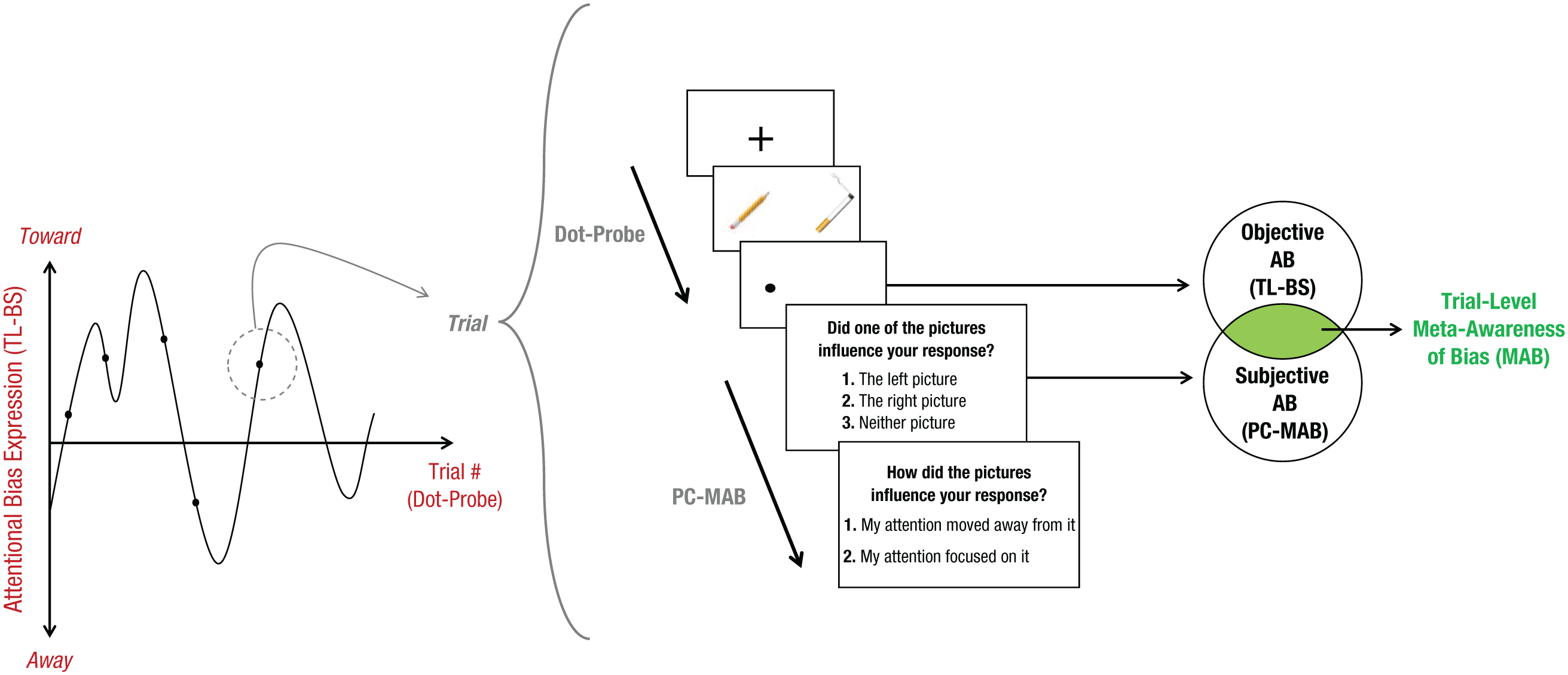
Dynamic process perspective on attentional bias expression (left) and the probe-caught meta-awareness of bias task (right).
Recent studies have demonstrated convergent, incremental, known-group criterion, and predictive validity of the dynamic features of AB. This evidence of validity has been reported in multiple tasks (e.g., dot probe task, spatial cueing task) and with respect to a variety of important outcomes, including spider phobia, addiction behavior (e.g., smoking rate), social anxiety, depression vulnerability (e.g., remitted depression status, depressive episode history), posttraumatic stress disorder (PTSD) risk (prospective-longitudinal prediction of PTSD symptom development), and PTSD symptom severity and trauma-related behavioral avoidance in highly traumatized refugees (Amir, Zvielli, & Bernstein, 2016; Davis et al., 2016; Iacoviello et al., 2014; Yuval, Zvielli, & Bernstein, 2016; Zvielli, Vrijsen, Koster, & Bernstein, 2016). Furthermore, in contrast to poor reliability of traditional aggregated mean bias scores (i.e., Spearman-Brown prophecy corrected r = .11; Schmukle, 2005; Waechter, Nelson, Wright, Hyatt, & Oakman, 2014), key features of the temporal dynamics of AB (TL-BS bias dynamics parameters) have demonstrated acceptable to excellent split-half reliability (Rodebaugh et al., 2016; Schäfer et al., 2016; Zvielli et al., 2015). Furthermore, the dynamic process approach facilitates empirical examination of the phenomenon from moment to moment in time. As a first such step, Amir and colleagues (2016) found that the real-time, dynamic expressions of overt (via eye movement) and covert (via behavioral reaction time) attentional processing of threatening information were significantly associated from trial to trial and dissociated by voluntary inhibition of overt attention in anxious adults. These findings are consistent with long-standing basic cognitive- and neuroscience of attention (de Haan, Morgan, & Rorden, 2008; Posner, Snyder, & Davidson, 1980). Thus, the newfound capacity to model the real-time expression of biased attentional processing of emotional information enables the development of theory and empirical study of processes that subserve the temporal dynamics of AB.
Yet, we know strikingly little about this phenomenon despite its theorized functions for human (mal)adaptation. Specifically, we know little about the mechanisms that may contribute to or transact with moment-to-moment expression and fluctuations of biased attentional processing. These fluctuations may reflect moment-to-moment interactions or conflict between (a) bottom-up processes driving attention toward motivationally relevant information and (b) top-down processes to maintain attention on task-relevant information and down-regulate bottom-up processes (Corbetta & Shulman, 2002). Yet, for such top-down control processes to be functionally deployed, they require moment-to-moment feedback (Mansell & Marken, 2015). This type of feedback mechanisms may monitor real-time allocation of attention, the object of attention, the source of that object of attention, or the relevance or interference of attentional allocation for task performance.
Here we argue that although a number of mechanisms may be important to understanding temporal dynamics of AB, one particularly promising starting point is meta-awareness. Indeed, meta-awareness of bias (MAB) may provide a feedback function facilitating cognitive/top-down control of biased allocation of attention (Bernstein & Zvielli, 2014). Meta-awareness has been conceptualized as awareness of the processes occurring in consciousness (e.g., thinking, feeling, sensing; Bernstein et al., 2015; Dahl, Lutz, & Davidson, 2015). 1 Seminal work on meta-awareness offered a powerful framework for understanding and studying meta-awareness (Schooler, 2002). Likewise, meta-awareness is a core target and mediating process of several psychological interventions (mindfulness-based interventions, cognitive therapy; Bernstein et al., 2015; Teasdale et al., 2002), and its development is thought to contribute to mental health (Bernstein et al., 2015).
Although research to date has yet to focus on AB per se, seminal work on meta-awareness did focus on another important form of attentional dysregulation—mind-wandering. This work has documented individual differences in capacity for meta-awareness of mind-wandering as well as moment-to-moment fluctuations in meta-awareness of mind-wandering (Schooler et al., 2011). Importantly, mind-wandering with and without meta-awareness are differentiated processes with distinct neural (Christoff, Gordon, Smallwood, Smith, & Schooler, 2009; Hasenkamp, Wilson-Mendenhall, Duncan, & Barsalou, 2012; Smith et al., 2006), and cognitive correlates (Smallwood & Schooler, 2015). Notably, meta-awareness of mind-wandering reduces the occurrence of mind-wandering (Smallwood & Schooler, 2015), and meta-awareness during mind-wandering buffers the detrimental effects of mind-wandering on attentional/executive dysregulation (e.g., response inhibition, capacity to construct mental models; Smallwood, McSpadden, & Schooler, 2007). This work is furthermore important in illustrating the utility of real-time experience sampling methods for capturing the moment-to-moment expression and function of meta-awareness of attentional wandering.
Much like meta-awareness of mind-wandering, we posit that MAB may similarly enable self-regulatory control and thereby reduce the occurrence and harmful functional consequences of attentional dysregulation. Indeed, scholars studying meta-awareness foresaw the potential for phenomena such as MAB (Baird, Smallwood, Fishman, Mrazek, & Schooler, 2013; Franklin et al., 2014). Accordingly, we hypothesized (a) that people have a (potential) capacity to monitor and have meta-awareness of their well-rehearsed, and often involuntary dynamic expression of (biased) attentional allocation, although we may expect individual differences in MAB (Farb et al., 2007; Hölzel et al., 2011; Schooler et al., 2011; Shonin, Van Gordon, & Griffiths, 2014; Van Gordon, Shonin, Sumich, Sundin, & Griffiths, 2014) and (b) that MAB will enable self-regulatory attentional control (Ansorge, Fuchs, Khalid, & Kunde, 2011; Koivisto, Kainulainen, & Revonsuo, 2009; Posner & Rothbart, 1998; Ridderinkhof, van den Wildenberg, Segalowitz, & Carter, 2004; Ridderinkhof, Ullsperger, Crone, & Nieuwenhuis, 2004) and thereby remedy AB and its consequences (Bishop, 2008; Derryberry & Reed, 2002; Eysenck, Derakshan, Santos, & Calvo, 2007; Wiers, Gladwin, Hofmann, Salemink, & Ridderinkhof, 2013). Accordingly, findings from a novel intervention methodology provide indirect evidence consistent with the hypothesized capacity for and proposed functions of MAB. Indeed, real-time feedback on the momentary expression of AB—attention feedback awareness and control training designed to train MAB—led to reduced attentional dysregulation and reduced consequent emotional reactivity in response to threatening information (Bernstein & Zvielli, 2014; Sanchez Lopez, Everaert, & Koster, 2016; Zvielli, Amir, Goldstein, & Bernstein, 2016; see also deBettencourt, Norman, & Turk-Browne, 2015, for related work on feedback-based intervention methodologies).
In the present study, we therefore aimed to estimate capacity for and individual differences in MAB and to explore the hypothesized function of real-time MAB on real-time micro-expressions dysregulated attentional processing of emotional information. We did so by means of a novel measurement methodology—the probe-caught meta-awareness of bias task (PC-MAB). First, probe sampling methods, used to study meta-awareness of mind wandering (Smallwood et al., 2007), were applied to estimate real-time “subjective” AB. Then, trial-level bias-scores (Zvielli et al., 2015) were applied to estimate trial-level “objective” AB scores. Finally, signal detection theory (SDT), applied in earlier work on awareness and meta-cognition (Galvin, Podd, Drga, & Whitmore, 2003; Maniscalco & Lau, 2012), was applied to empirically contrast the objective and subjective estimates of AB to quantify MAB as the agreement between these estimates. We focused here on AB to reward stimuli by measuring AB to smoking cues among daily cigarette smokers. This methodology ensures the motivational relevance of emotional information. This is important to maximize the probability of observing biased attentional processing of target stimuli and thereby the ability to study of MAB (Baker, Piper, McCarthy, Majeskie, & Fiore, 2004; Field & Cox, 2008; Pergamin-Hight, Naim, Bakermans-Kranenburg, van IJzendoorn, & Bar-Haim, 2015; Zvielli et al., 2015).
First, we hypothesized that signal detection analysis would reveal evidence of capacity for and individual differences in MAB. Second, we hypothesized that if this potential capacity for MAB is observed and substantive, then real-time or momentary MAB would be most likely observed concurrent with the micro-expressions of attention that are most biased. Indeed, greater momentary levels of AB would be more phenomenologically prominent and thereby detected—for example, by interfering with task performance or by cueing some concurrent epiphenomenon linked to AB (e.g., emotional responding) thereby facilitating MAB. Finally, we hypothesized that momentary MAB would buffer the unfolding of dysregulated emotional attending or attentional reactivity to biased processing of emotional information. Specifically, we hypothesized that the momentary micro-expression of AB in the absence of MAB would more likely immediately precede self/emotion-regulatory attentional reactivity or dyscontrol, whereas momentary micro-expression of AB with MAB would more likely immediately precede cognitive/attentional control.
Method
Participants
A total of 75 adults (62.7% female, M = 26.8, SD = 3.59 years old) were recruited through public advertisements from the University of Haifa. 2 Participants were eligible if they were (a) daily cigarette smokers (~10 cigarettes/day) and (b) 18 years or older. Potential participants were ineligible if they (a) were diagnosed with attention-deficit/hyperactivity disorder or an autism spectrum disorder, (b) had uncorrected vision problems, (c) had self-reported past or current participation in a meditation practice (to rule out past systematic training in meta-awareness), (d) had a current/history of psychotic disorders, (e) had current use of psycho-pharmacology treatment, or (f) were not fluent in Hebrew. Participants were daily, long-term, and nondeprived smokers. Specifically, participants smoked at least 5 cigarettes per day (range 5 to 40 cigarettes/day). Overall, participants reported smoking a mean of 11.51 cigarettes/day (SD = 6.31)—33% of participants smoked 5 to 9 cigarettes/day and 66% smoked 10 or more cigarettes/day. Furthermore, participants initiated smoking regularly at a mean of 18.12 years of age (SD = 2.85), smoked for a mean of 8.20 years (SD = 4.00), made a mean of 1.75 lifetime quit attempts (SD = 1.77), and reported smoking their first cigarette each morning a mean of 76.21 min after waking (SD = 98.2). These smoking characteristics are consistent with a variety of published community samples of regular daily smokers (Goodwin et al., in press). Finally, consistent with the likelihood that participants smoked prior to the lab session, participants reported a relatively low level of craving to smoke at the start of the lab session (M = 2.93, SD = 1.46; 1 = not at all, 7 = very much) and a significantly elevated level of craving to smoke at the end of the lab session (M = 4.73, SD = 1.66), t(54) = 8.1, p < .001.
Procedure
Eligible participants completed a brief self-report battery (not relevant to the present report). Participants then completed the biochemical verification of smoking status, followed by the PC-MAB to measure AB and MAB. 3
Materials and apparatus
Biochemical smoking status assessment
Participants completed a carbon monoxide biochemical verification of smoking status (PPM ≥ 8; CMD/CO Carbon Monoxide Monitor Model 3110, Spirometrics, Inc., Auburn, ME).
Attentional bias measurement
The visual emotional dot probe task (MacLeod, Mathews, & Tata, 1986) was used to measure AB to appetitive cues. Participants were presented with a fixation cross (500 ms), followed by a 100-ms blank screen, followed by two stimuli presented simultaneously for a duration of 500 ms. One stimulus was presented to the left of the fixation cross and the other to the right. One of the stimuli was immediately replaced by a small black probe per trial (50% per side). One of the presented stimuli was always neutral (e.g., pencils), and the other stimuli was either appetitive (e.g., cigarettes; reward trial; 50% of trials) or neutral (neutral trial; 50% of trials). Participants were instructed to first focus their gaze on the fixation cross and then, as quickly and accurately as possible, press one of two (left or right) response box buttons corresponding to the location of the probe. A random interval of 500 to 1,500 ms preceded the next trial. On congruent trials (CT; 25% of trials), the probe appeared in the location of the appetitive stimulus, and on incongruent trials (IT; 25% of trials), the probe appeared in the opposite location of the appetitive stimulus (location of neutral stimulus). Concurrent with the dynamic process perspective on AB (Zvielli et al., 2015), we computed TL-BS by matching and then subtracting temporally contiguous pairs of reward-neutral trial’s response time by subject. Each reward trial (CT or IT) was matched with the first next neutral trial (NT), to reduce any carryover effects of other rewarding stimuli. The TL-BS computation is thereby used to compute objective trial-level bias scores estimations.
Probe-caught meta-awareness of bias task (PC-MAB)
Grounded in probe-caught thought sampling methods (Giambra, 1995; Smallwood & Schooler, 2006), participants were repeatedly probed regarding their attention, concurrent with the repeated trial-level expressions of (biased) attentional expression in the dot-probe task. Awareness probes were delivered randomly over the course of the dot-probe task (25% of trials). Immediately following trial response, participants were asked to report whether one of the pictures in the last trial influenced their response. If their response was affirmative, participants were asked, “How did the picture influence your response” (i.e., “my attention moved away from it” or “my attention focused on it”). By contrasting indices of real-time subjective AB estimates (i.e., via probe-caught awareness samples) with real-time objective AB scores (i.e., via TL-BS), we were able to compute an objective index of MAB in real-time (see Fig. 1).
A signal detection theory computation of MAB
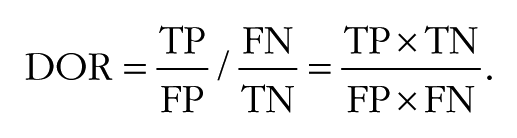
On awareness-probed trials, we matched subjective reporting of attention allocation with trial-level bias scores to compute true- and false-positive/negative rates (TP, FP, TN, FN, correspondingly; see Table 1). This signal detection-based dichotomization enabled us to quantify agreement between subjective AB estimates (i.e., via answers to awareness probes) and objective AB scores (i.e., via TL-BS) in one 2 × 2 contingency table for each participant, as depicted in Table 1 (see Galvin et al., 2003; Maniscalco & Lau, 2012). The trial-level MAB scores (i.e., true and false positives/negatives) were then used in the computation of a single indicator of MAB—the diagnostic odds ratio (DOR; i.e., the ratio of the odds of disease in test positives relative to the odds of disease in test negatives; Glas, Lijmer, Prins, Bonsel, & Bossuyt, 2003), and real-time multilevel analyses (detailed below). DOR provides a valid representation of participant’s discriminatory performance, combines estimates of sensitivity and specificity, and has the unique advantage of a single indicator to estimate MAB. Importantly, DOR is also independent of interindividual differences in the prevalence of AB and in the rate of subjective AB, and thus the most rigorous variable to estimate sample and interindividual differences in MAB. The calculation of the DOR can be derived directly from the 2 × 2 contingency tables (see Table 1) and is calculated as follows:
2 × 2 Objective and Subjective Bias Contingency Table Used to Compute Meta-Awareness of Bias (MAB)
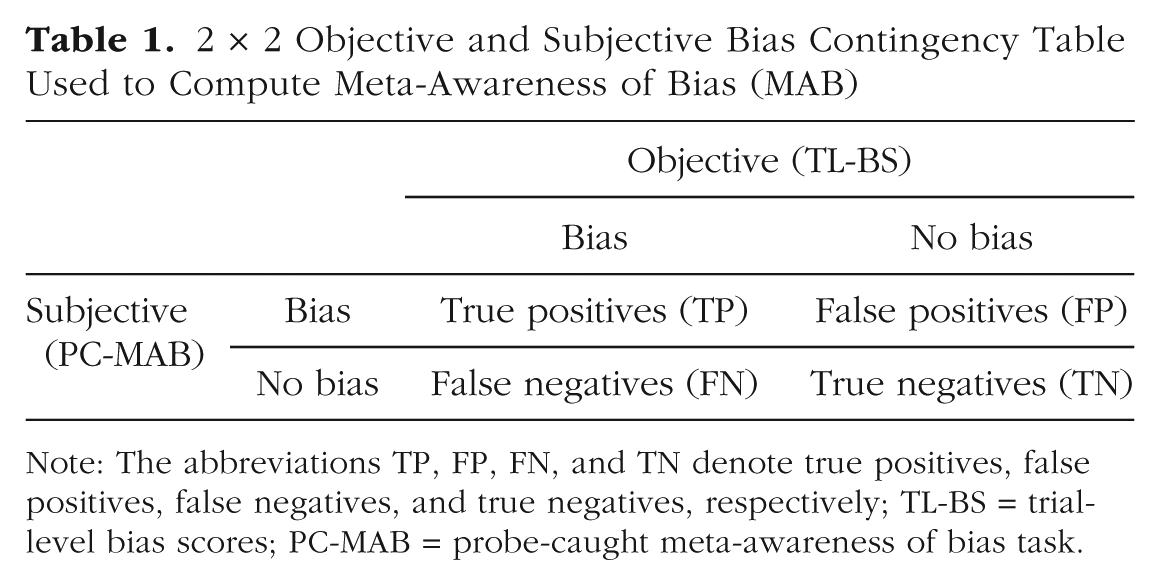
Note: The abbreviations TP, FP, FN, and TN denote true positives, false positives, false negatives, and true negatives, respectively; TL-BS = trial-level bias scores; PC-MAB = probe-caught meta-awareness of bias task.
To compute the DOR for each participant, and because some 2 × 2 tables contained zeroes (in which DOR would be undefined), we added 0.50 to all values in the table (Littenberg & Moses, 1993). DOR values range from 0 to infinity, with higher values indicating better discriminatory test performance (Glas et al., 2003). DOR = 1 indicates that a participant does not discriminate between AB and non-AB trials (i.e., chance performance, or no MAB); similarly, DOR < 1 indicates that a participant does not accurately discriminate between AB and non-AB trials—characterized by higher rates of false negatives and false positive than true positives and true negatives (i.e., no MAB); DOR > 1 indicates that a participant discriminates between AB and non-AB trials at a rate greater than chance (i.e., MAB); for example, DOR = 4 means that for a particular subject, the odds of correctly detecting AB when AB was objectively expressed (TP) was 4 times greater than the odds for inaccurately detecting AB in the absence of AB (FP). DOR = 1 or chance values means that sometimes participants were right/accurate and other times wrong/inaccurate. This pattern of responding is that which you would expect were a person simply guessing (i.e., flipping a coin). In this way, these participants do not demonstrate evidence of MAB. Participants exhibiting DOR < 1 were more consistently wrong or inaccurate. In this way, these participants do not demonstrate evidence of MAB. Finally, because the scale of the DOR is exponential (i.e., highly skewed distribution), calculating a log-transformation DOR for each participant (i.e., logDOR) reduced the skew of the distribution—important to reported data analyses of MAB that assume normality (Tabachnick & Fidell, 2007).
Results
Meta-awareness of bias: capacity and individual differences
First, we tested evidence for, and individual differences in, MAB via SDT analyses. Participants demonstrated some degree of positive objective AB (TL-BS) in a mean of 65.65% of trials (SD = 13.13%) and positive subjective AB (awareness probes) in 27.66% (SD = 23.52%) of trials. For each participant, we calculated the DOR (i.e., the ratio of the odds of positive objective [TL-BS] AB in positive subjective reports [awareness probes] relative to the odds of positive objective [TL-BS] AB in negative subjective reports [awareness probes]—see the method section for details) as a single indicator for MAB. We found that 46.7% of participants demonstrated DOR ≤ 1 (i.e., log transformation of DOR [logDOR] ≤ 0) and 53.3% of participants demonstrated DOR > 1 (i.e., logDOR > 0: DOR = ranges from 0.03 to 17.4; DOR M = 2.29, SD = 3.31, 95% confidence interval, or CI = [1.53, 3.05], Mdn = 1.12; logDOR = ranges from −1.54 to 1.24; logDOR M = 0.04, SD = 0.53, 95% CI = [−0.08, 0.17], Mdn = .04). To more conservatively estimate MAB, so that we do not misclassify values that are negligibly but not meaningfully greater than chance, we computed the 95% CI of the logDORMEAN of 0 (95% CI logDORMEAN = −0.8 to 0.17) and operationalized MAB as logDOR values > 0.17, the upper limit of the 95% CI of the logDORMEAN of 0: that is, logDOR = −0.8 to 0.17 indicates chance performance (i.e., no MAB); logDOR < −0.8 indicates no MAB; and logDOR values > 0.17 reflect levels of MAB greater than chance. We thus found that 64% of participants demonstrated no MAB (i.e., 24% demonstrated chance performance, 40% demonstrated DOR less than chance) and 36% of participants demonstrated some degree of MAB, ranging from low levels just above chance (e.g., DOR = 1.52) to high levels of MAB (e.g., DOR = 17.4).
Second, if this potential capacity for MAB is indeed observed and substantive, then real-time or momentary MAB should be most likely observed concurrent with the micro-expressions of attention that are most biased; moreover, such effects should be uniquely observed among participants for whom SDT-based estimation of MAB via DOR (above) indicates evidence of MAB greater than chance. Accordingly, to examine the real-time trial-to-trial relations between AB and MAB, we carried out a mixed linear model (MLM) analysis via the PROC MIXED procedure in SAS 9.4 (SAS Institute, 2008). For each participant, each time point (trial) included two scores: real-time objective AB score (momentary TL-BS trial estimate) and real-time subjective AB estimate (momentary response to trial-level awareness probe). Because awareness probes always immediately follow AB expression, AB amplitude was the predictor in this model. The trial-level AB amplitude predictor was continuous (i.e., absolute TL-BS amplitude) and the trial-level MAB outcome was dichotomous (true positive/negative vs. false positive/negative). LogDOR was included as a moderator. As predicted, we found a significant interaction between momentary AB amplitude and logDOR level with respect to momentary MAB, F(1, 1343) = 12.74, B = 50.08, SE = 14.03, p = .0004. To unpack this interaction, we used a contrast within the model. As predicted, we found that momentary AB amplitude predicted momentary MAB (B = 48.84, SE = 9.70, t = 4.21, p < .0001), but only for participants who demonstrated evidence of MAB in the SDT analysis (i.e., logDOR > .17). In addition, we found no interaction with the direction of AB direction (i.e., toward or away from reward), F(2, 1341) = 1.27, p = .282, such that the observed association between momentary AB amplitude and momentary MAB did not differ between bias toward and away from reward.
Third, to ensure that our classification of participants with versus without MAB (i.e., above-chance DORs versus chance-level and below-chance DORs) was empirically justified, we conducted the above MLM—testing the real-time trial-to-trial relations between AB and MAB—but this time divided the sample into three subgroups according to their DOR scores: (a) participants expressing DOR levels greater than chance (i.e., logDOR > 0.17); (b) participants expressing DOR = chance (i.e., −0.08 ≤ logDOR ≤ 0.17); and (c) participants expressing DOR less than chance (i.e., logDOR < −0.08). As expected, we found that participants expressing chance and below-chance DOR scores did not perform differently, B = −0.18, SE = 18.85, t(1342) = 0.01, p = .9925, whereas participants demonstrating above-chance DORs (i.e., participants who demonstrated some degree of MAB) performed significantly differently than both subgroups, B = 40.01, SE = 16.37, t(1342) = 2.44, p = .0146. To further examine this effect, we tested these associations with respect to continuous levels of logDOR—to be certain that these findings were not the result of some distributional artifact secondary to the subgroup analysis or limited power within the MLM. Again, we found that momentary AB amplitude predicted momentary MAB (DOR scores) only among participants exhibiting above-chance DOR scores, B = 61.88, SE = 14.39, t(1343) = 4.3, p < .0001, and not among participants who demonstrated chance, B = 11.79, SE = 7.27, t(1343) = 1.62, p = .11, or below-chance performance, B = −13.24, SE = 11.12, t(1343) = −1.19, p = .23.
MAB and attentional (dys)control
We next examined the real-time effect of momentary MAB on attentional reactivity or (dys)control. We did so by testing whether momentary micro-expressions of AB without MAB would immediately precede self/emotion-regulatory attentional reactivity or dyscontrol; whereas, momentary micro-expression of AB with MAB would immediately precede cognitive/attentional control. We ran a MLM analyses via the PROC MIXED procedure in SAS 9.4 (SAS Institute, 2008). For each participant, each time point (trial) included two scores: trial-level true-positive match of MAB (i.e., true positive between subjective and objective bias in the event of bias toward or away from reward) and degree of change in momentary AB micro-expressions from the trial in which MAB was measured to the immediately preceding trial, that is, (TL-BS trial n +1) – (TL-BS trial n ). In this model, momentary MAB (presence or absence of MAB) on trial n was the predictor and consequent change between the micro-expressions of AB from trial n to trialn+1 the outcome. Accordingly, we were able to test the hypothesized functional role(s) of momentary presence versus absence of MAB on the immediately preceding micro-expression of bias—and thereby model the real-time effect of MAB on cognitive/attentional control. We found that in the event of AB (toward or away from reward), the momentary absence of MAB led to a higher degree of attentional reactivity or dyscontrol in which a micro-expression of bias toward reward was immediately preceded by a fluctuation to bias away from reward and vice versa; in contrast, momentary presence of MAB reduced this attentional reactivity/dyscontrol and is more likely followed by a trial characterized by balanced attentional allocation (TL-BS close to zero), F(1, 29) = 4.52, p = .0421; absence of MAB B = −180.89, SE = 17.05, t = −10.61, p < .0001 versus presence of MAB B = −122.45, SE = 23.94, t = −5.11, p < .0001 (see Fig. 2).
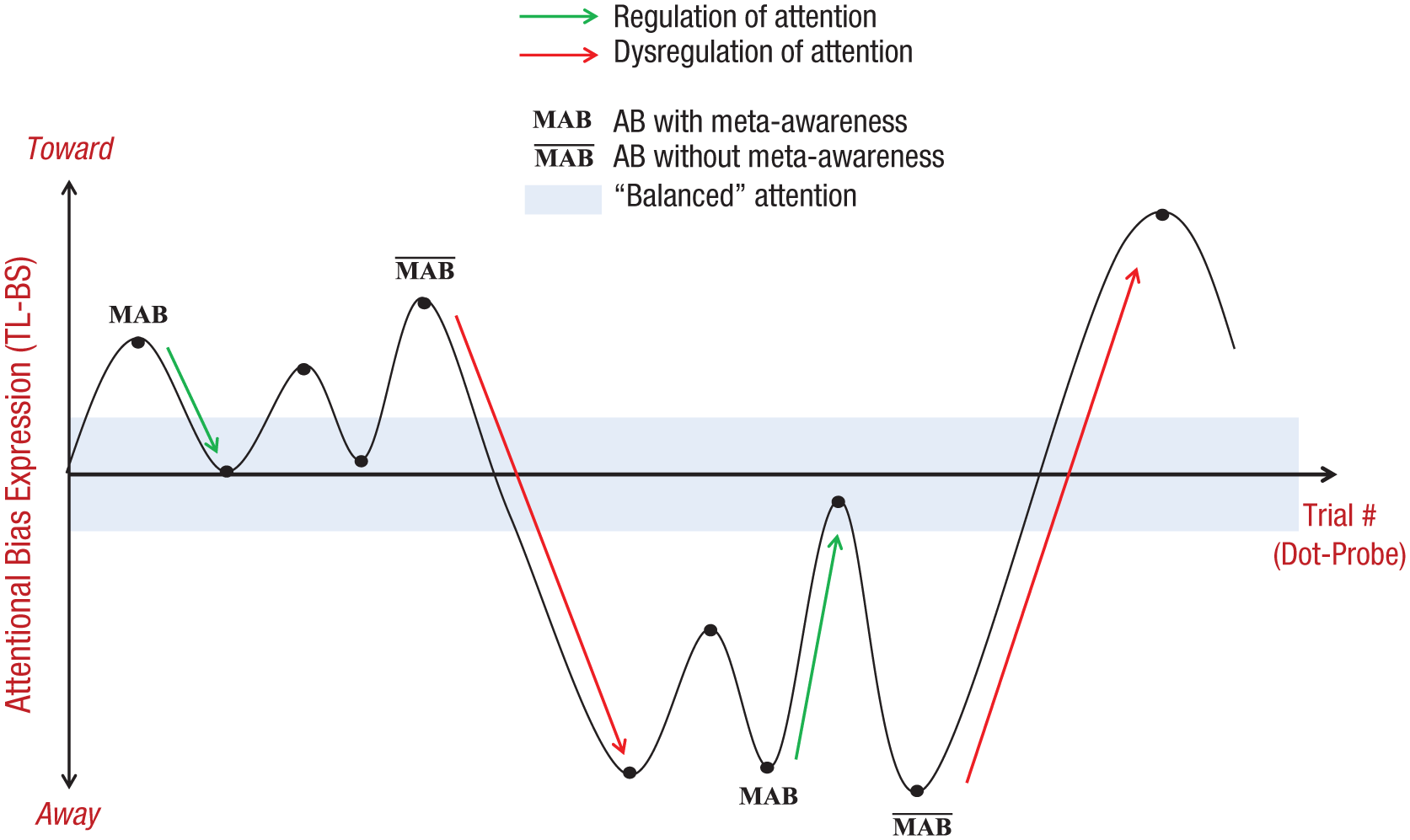
Attentional bias with and without meta-awareness: temporal evidence of a monitoring-for-control function.
Ruling out alternative explanations and artifacts
First, we needed to rule out the possibility that positive endorsement on probes in the first half of the task would predict reduced levels of endorsement in the second half of the task. That is, we wanted to rule out a potentially problematic “learning” effect or learned disincentive of positively endorsing Question 1 of the probes (i.e., because positively endorsing Question 1 of each probe led to additional questions). We thus calculated the ratio of positive versus negative responses to Question 1 of the probes during the first (trials 1–80) versus the second (trials 81–160) half of the PC-MAB task trials. We found a significant, strong, and positive correlation between these two ratios (r = .816, p < .001). Participants showed no evidence of reducing (or changing) their pattern of responding to the probes over the course of repeated trials. Accordingly, we can meaningfully evaluate AB and MAB over the course of the entire block of trials. Second, we wanted to rule out an additional potential carryover artifact of the probe-sampling methodology wherein a probe on trial n would influence the expression of attentional expression on trial n + 1. We thus tested whether n probed trials, relative to n unprobed trials influence levels of AB on trial n + 1. For each participant, we calculated the aggregated mean of TL-BS in n + 1 trials for trials immediately preceded by probed trials versus those immediately preceded by unprobed trials. We found no carryover effect for probes on AB, t(74) = 1.04, p = .30. Accordingly, we conclude the awareness probes did not systematically interfere with task performance or attentional processing of emotional information over the course of the task. Finally, analyses were examined among regular daily smokers. We thus wanted to examine and rule out the possibility that heavier or more dependent smokers may demonstrate different levels of MAB or function(s) of MAB on attentional reactivity or (dys)control reported above. Rate of smoking was not associated with levels of MAB (r = −.10, p = .394), nor did smoking rate moderate the observed effect of MAB on attentional control/reactivity, F(1, 184) < 1, p = .94. Accordingly, we were able to meaningfully evaluate levels of MAB and its function on attentional (dys)regulation among the studied sample of regular daily smokers.
Finally, we tested the potential role(s) of craving (i.e., change in subjective reported craving levels from baseline to posttest) on reported effects of MAB. Craving change scores were selected as they best reflect degree of acute subjective craving over the course of the laboratory session during which MAB was measured. In our first MLM analysis (i.e., real-time trial-to-trial relations between AB and MAB), individual differences in subjective craving levels were not related to amplitude of AB, B = 0.77, SE = 3.68, t(982) = 0.21, p = .8345. Likewise no interaction was observed between craving levels and our main predictor of MAB (i.e., DOR), F(1, 982) = 0.9, B = 4.06, SE = 4.28, p = .3431. Thus, the reported effects were not dependent on craving levels over the course of the experiment nor alternatively explained by craving levels. Finally, when retesting the real-time trial-to-trial relations between AB and MAB, adding change in craving levels to the model did not change the magnitude or significance of the reported effects. Again, we found a significant interaction between momentary AB amplitude and logDOR level with respect to momentary MAB, F(1, 982) = 10.84, B = 66.31, SE = 20.14, p = .001. We then tested the effect of change in craving levels in the second reported MLM model—testing the effect of MAB on cognitive/attentional control. Change in craving was, again, nonsignificant, B = 10.75, SE = 11.74, t(127) = 0.92, p = .3616; craving did not interact with MAB, B = 3.24, SE = 15.09, t(127 = 0.21), p = .8301, and adding craving levels to the model did not change the reported effect of momentary MAB on attentional/cognitive control, B = 73.90, SE = 35.27, t(21) = 2.1, p = .046. These results did not change when we alternatively tested other craving scores (e.g., baseline alone, posttest alone).
Discussion
We aimed to empirically examine meta-awareness of momentary micro-expressions of biased attentional processing of reward cues among nondeprived daily smokers. First, SDT analysis revealed evidence of the capacity for, and individual differences in MAB. This is the first empirical evidence for MAB. This also represents, to the best of our knowledge, the first attempt to apply SDT (Galvin et al., 2003; Maniscalco & Lau, 2012) to probe-sampling data (Smallwood et al., 2007; Teasdale, Segal, & Williams, 1995) to quantify meta-awareness of any process in consciousness more generally. Second, through a novel integration of SDT and multilevel modelling, we found a significant association between the amplitude of momentary (trial-level) AB and momentary (trial-level) MAB. Momentary MAB was most likely observed in the event of the most extreme micro-expressions of AB but only among individuals that our SDT analysis identified as demonstrating some degree of MAB (i.e., DOR greater than chance). These data provide important initial validation of the methodology to quantify MAB. Finally, as predicted, we found that momentary micro-expression of AB without MAB was more likely followed by attentional reactivity/dyscontrol. In contrast, momentary micro-expression of AB with MAB was more likely followed by a more balanced (less biased) attentional expression or greater cognitive/attentional control. These data provide promising evidence that MAB may function to regulate attentional processing of emotion or motivationally relevant information (reward). Finally, we tested and empirically ruled out four potential methodological artifacts that could alternatively account for observed effects. There was no evidence of a learned disincentive of positively endorsing Question 1 of the probes over the course of the task (i.e., because positively endorsing Question 1 of each probe led to additional questions). Awareness probes did not systematically interfere with task performance or attentional processing of emotional information over the course of the task. Rate of smoking was not associated with levels of MAB or its function on attentional control/reactivity. Degree of craving to smoke during the experimental session did not alternatively account for reported findings.
The present findings have a number of implications for basic and clinical psychological science of attentional dysregulation. First, findings indicate that similar to meta-awareness of other mental processes (Lutz, Jha, Dunne, & Saron, 2015; Schooler et al., 2011), MAB may provide a monitoring-for-regulation function. For example, MAB may reduce dysregulated attentional processing directly by means of top-down executive control that actively inhibits exogenous attentional orienting toward or away from reward cues (Bernstein & Zvielli, 2014; Schooler et al., 2011). Specifically, MAB may serve a moment-to-moment internal feedback function regarding the allocation of (dysregulated) attention thereby enabling top-down regulation or control of attentional processing (e.g., Mansell & Marken, 2015). Alternatively or in addition, MAB may enable indirect regulation or control of attention by directly impacting other internal states that influence or subserve attentional processing. For example, MAB may reduce (involuntary) attentional reactivity to internal states elicited by stimulus exposure or it may function to down-regulate the urge or emotional state elicited by stimulus exposure that in turn contributes to attentional orienting (Bernstein et al., 2015; Herwig, Kaffenberger, Jancke, & Bruhl, 2010; Hölzel et al., 2011). Future research designed to test these hypothesized mechanisms may be particularly useful to work on attentional dysregulation as well as the role(s) of meta-awareness for other internal processes more generally.
The present findings may also have interesting translational implications. Indeed, the present findings are broadly in line with the idea that MAB may be a promising intervention target. The findings indicate that people have the (potential) capacity for MAB and that MAB may have a monitoring-for-regulation function on attentional processing of emotion or motivationally relevant information important to mental (ill) health. A growing body of work indicates that meta-awareness broadly, and MAB specifically, is likely malleable and may be targeted via interventions. For example, real-time attentional feedback designed to facilitate MAB may be one such promising approach (Bernstein & Zvielli, 2014; deBettencourt et al., 2015; Sanchez Lopez et al., 2016; Zvielli, Amir, et al., 2016). Similarly, mindfulness-based interventions targeting meta-awareness of multiple internal states and processes may also provide powerful means to target MAB specifically or meta-awareness of other internal states important to mental (ill) health more broadly (Bernstein et al., 2015; Hadash, Plonsker, Vago, & Bernstein, 2016; Lutz et al., 2015). Studies targeting MAB may advance the field’s capacity to therapeutically target attentional dysregulation implicated in prevalent forms of mental (ill) health.
The present study has a number of limitations. First, we tested MAB to reward stimuli only among a clinical population for whom addiction-related processes drive biased attentional processing of reward (Field & Cox, 2008; Zvielli et al., 2015). An important next step is to test the capacity for MAB as well as its functional role(s) with respect to aversive stimuli and respective populations (e.g., patients with anxiety and mood disorders). Second, MAB was not successfully experimentally manipulated in the current study. Our efforts to do so using a brief analogue mindfulness manipulation were unsuccessful. As noted above, future study may test more robust methods to experimentally manipulate MAB so as to evaluate its putative causal function(s) for attentional (dys)regulation. Third, this study examined MAB in the dot-probe task—the most widely used cognitive-experimental task measuring biased attentional processing of emotional information (MacLeod et al., 1986). However, it may also be useful for future study to examine MAB in other experimental tasks measuring covert (e.g., spatial cueing, visual search) and overt (e.g., eye-tracking during free view) attention bias. Fourth, MAB was measured using a probe-caught methodology (Smallwood & Schooler, 2015). Future studies may attempt to measure self-initiated MAB in real-time via a self-caught methodology (Smallwood & Schooler, 2006). Fifth, in the event that our objective index of AB (TL-BS) reflected predominantly noise and not “signal” (of biased momentarily attentional allocation) or our subjective index based on the awareness probes reflected predominantly noise and not “signal” (of MAB), then the observed results would be statistically unlikely. Nevertheless, the greater the signal-to-noise ratio in measurement of meta-awareness on the one hand and momentary bias on the other, the more likely that research on MAB will yield important information and translational implications for intervention. It is important that ongoing work focus on methodological and statistical advances to achieve such aims (Kruijt, Field, & Fox, 2016), such as via application of computational modeling, machine learning or pattern classification to such data as a means of optimizing signal to noise. Finally, we did not test the role of MAB on outcomes related to attentional processing of reward (smoking cues) among the smokers beyond the lab (e.g., cessation attempt outcomes, intervention responding, smoking rate, time since last cigarette) nor the possible therapeutic effects of targeting MAB for such addiction outcomes. Such work may be an exciting translational direction of this initial laboratory investigation.
In summary, we developed a methodology to objectively estimate MAB. We found initial evidence of the capacity for, and individual differences in MAB, as well as evidence that MAB may function to regulate attentional processing of reward cues. The current study may serve as an empirical proof of concept and initial context to develop and test the utility of the proposed methodological and data analytic framework for the study of meta-awareness. We believe this work may be important insofar as we speculate that meta-awareness may have broad and significant implications for clinical psychological science. The reported findings may contribute to an emerging science of the nature and functions of meta-awareness of various internal processes including (biased) attentional processing of emotional or motivationally relevant information.
Footnotes
Acknowledgements
We thank research assistants Noam Asherovich and Elior Carsenti for their help in carrying out the study.
Action Editor
Kenneth J. Sher served as action editor for this article.
Author Contributions
L. Ruimi and A. Bernstein developed the study concept and methodology, created the study design, and contributed to the data collection procedure. L. Ruimi, A. Bernstein, I. Amir, and P. Goldstein performed data analyses and interpretation. All the authors contributed to writing the manuscript and provided critical revisions. All the authors approved the final version of the manuscript for submission.
Declaration of Conflicting Interests
The author(s) declared that there were no conflicts of interest with respect to the authorship or the publication of this article.
Funding
A. Bernstein recognizes funding support from the Israel Science Foundation and the Caesarea-Rothschild Foundation. L. Ruimi recognizes support from the University of Haifa President’s Doctoral Fellowship Program.